
For this issue, visit doi.org/10.1111/mono.12432

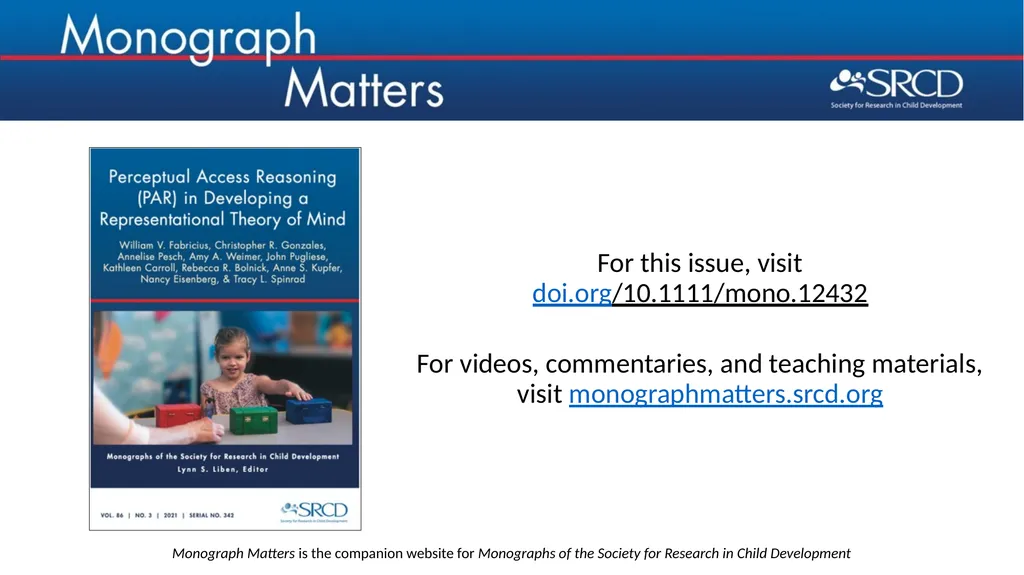

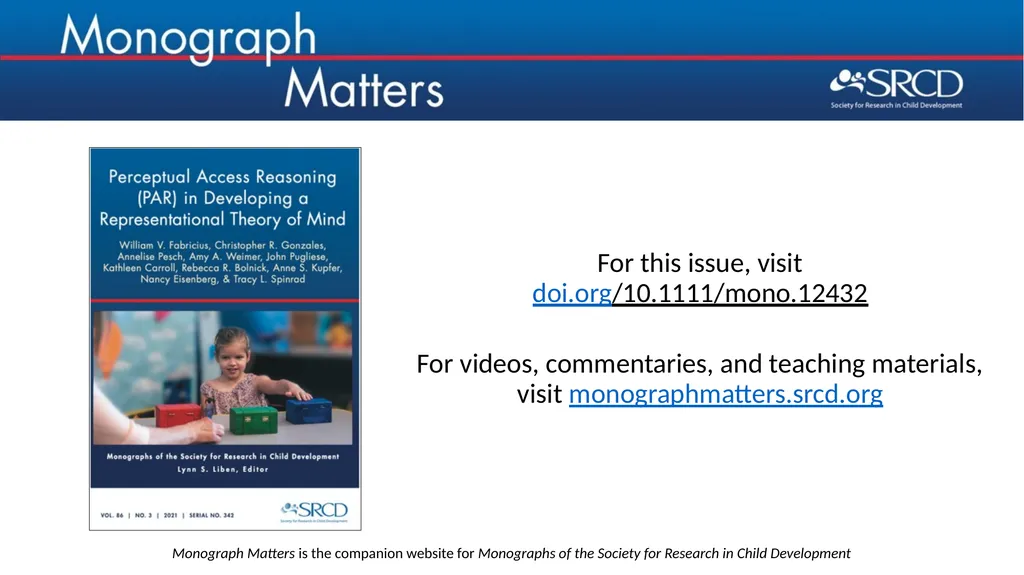
Description: For this issue, visit doi.org10.1111mono.12432 For videos, commentaries, and teaching materials, visit monographmatters.srcd.org Monograph Matters is the companion website for Monographs of the Society for Research in Child Development
Related Topics
Download Presentation
"For this issue, visit doi.org/10.1111/mono.12432" is the property of its rightful owner. Permission is granted to download and print the materials on this website for personal, non-commercial use only, and to display it on your personal computer provided you do not modify the materials and that you retain all copyright notices contained in the materials. By downloading content from our website, you accept the terms of this agreement.
Presentation Transcript
slide1. For this issue, visit
doi.org/10.1111/mono.12432
For videos, commentaries, and teaching materials, visit monographmatters.srcd.org Monograph Matters is the companion website for Monographs of the Society for Research in Child Development<br>
slide2. The Role of Perceptual Access Reasoning (PAR) in the Development of Theory of Mind<br>
slide3. Topics Theory of Mind
Classic False-Belief Tasks
Perceptual Access Reasoning
Methodological Implications
Theoretical Implications Monograph Matters is the companion website for Monographs of the Society for Research in Child Development<br>
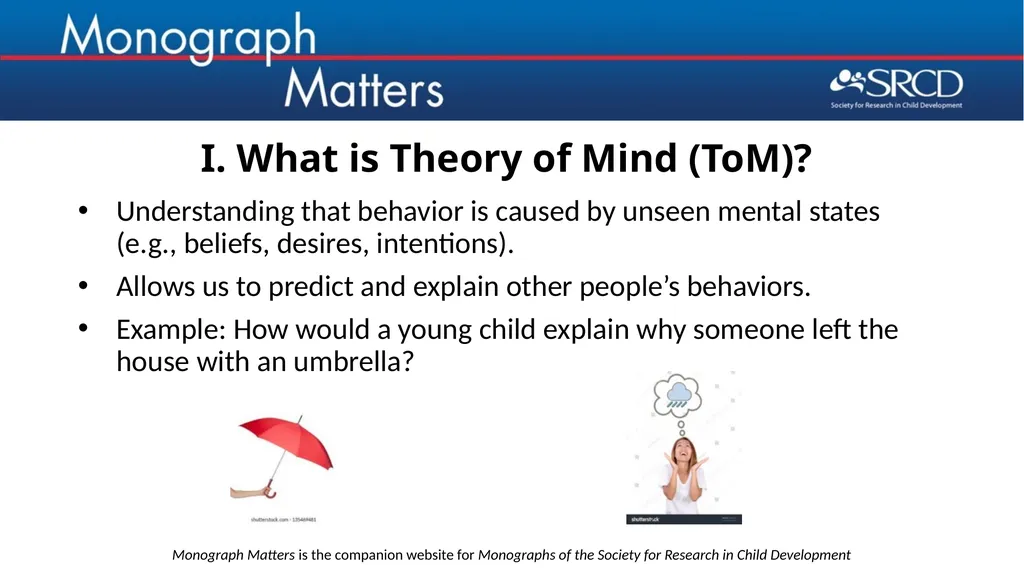
slide4. I. What is Theory of Mind (ToM)? Understanding that behavior is caused by unseen mental states (e.g., beliefs, desires, intentions).
Allows us to predict and explain other people’s behaviors.
Example: How would a young child explain why someone left the house with an umbrella? Monograph Matters is the companion website for Monographs of the Society for Research in Child Development<br>
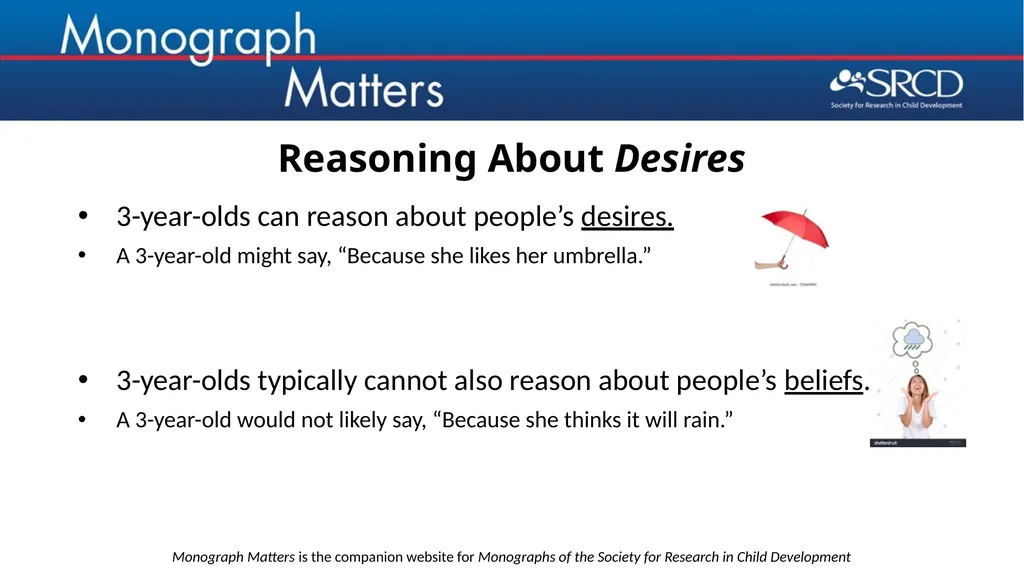
slide5. Reasoning About Desires 3-year-olds can reason about people’s desires.
A 3-year-old might say, “Because she likes her umbrella.”
3-year-olds typically cannot also reason about people’s beliefs.
A 3-year-old would not likely say, “Because she thinks it will rain.” Monograph Matters is the companion website for Monographs of the Society for Research in Child Development<br>
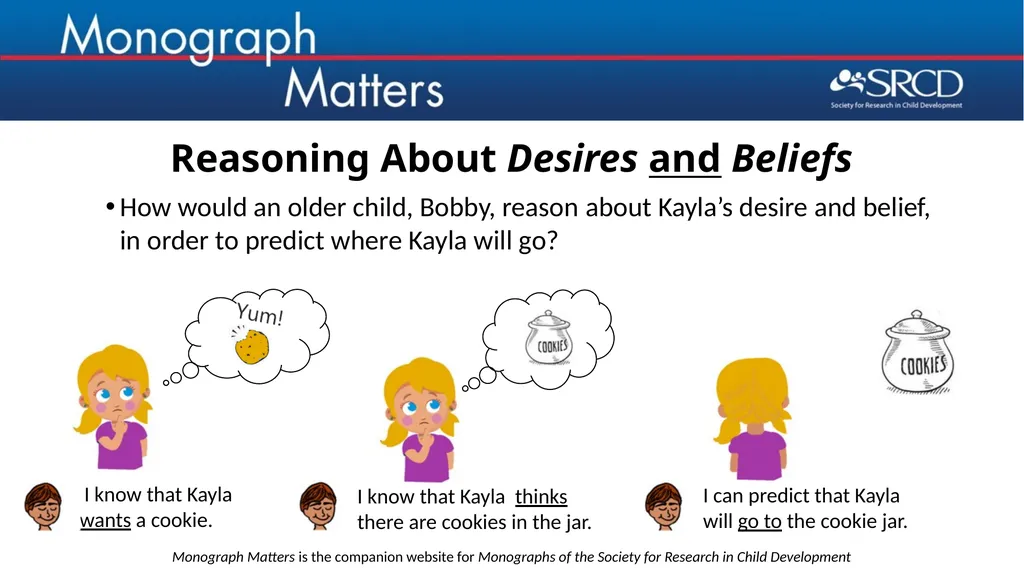
slide6. I know that Kayla
wants a cookie. I know that Kayla thinks
there are cookies in the jar. I can predict that Kayla
will go to the cookie jar. How would an older child, Bobby, reason about Kayla’s desire and belief, in order to predict where Kayla will go? Reasoning About Desires and Beliefs Monograph Matters is the companion website for Monographs of the Society for Research in Child Development<br>
slide7. Reasoning About False Beliefs Young children have difficulty understanding that people can believe something that is not true; i.e., that people can have false beliefs.
Understanding false belief is a big step toward understanding that minds represent the world, sometimes in profoundly different ways. Monograph Matters is the companion website for Monographs of the Society for Research in Child Development<br>
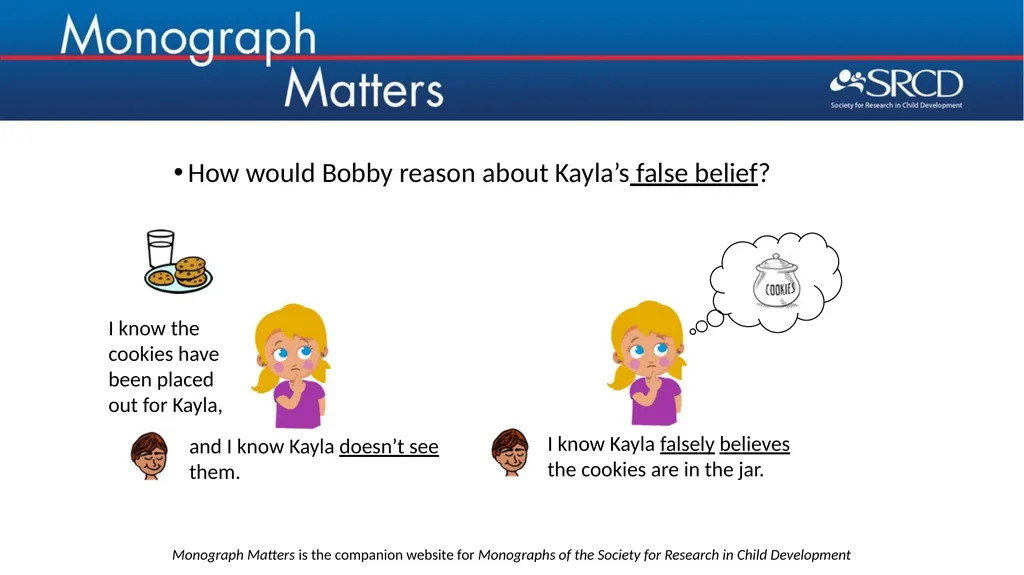
slide8. I know Kayla falsely believes the cookies are in the jar. and I know Kayla doesn’t see them. How would Bobby reason about Kayla’s false belief? I know the cookies have been placed out for Kayla, Monograph Matters is the companion website for Monographs of the Society for Research in Child Development<br>
slide9. II. The Classic False-Belief Tasks In the 1980s, researchers devised False-Belief tasks to investigate when and how children come to understand that a person can hold a false belief. Monograph Matters is the companion website for Monographs of the Society for Research in Child Development<br>
slide10. The Classic False-Belief Tasks are 2-Option Tasks,
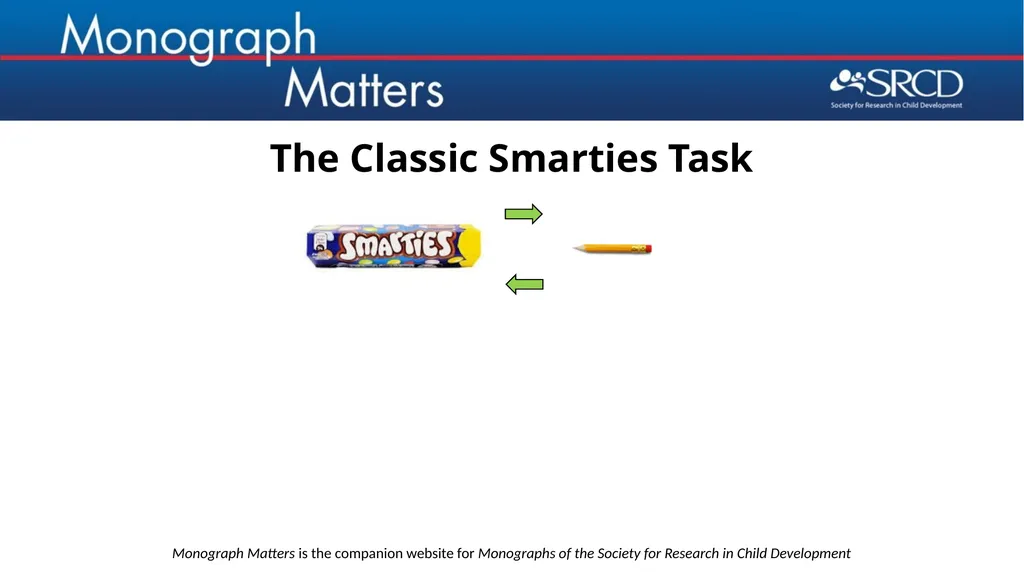
meaning that the test question presents the child with a forced-choice between two possible answers. The “Maxi” False-Belief task (Location task)
The “Smarties” False-Belief task (Contents task) Monograph Matters is the companion website for Monographs of the Society for Research in Child Development<br>
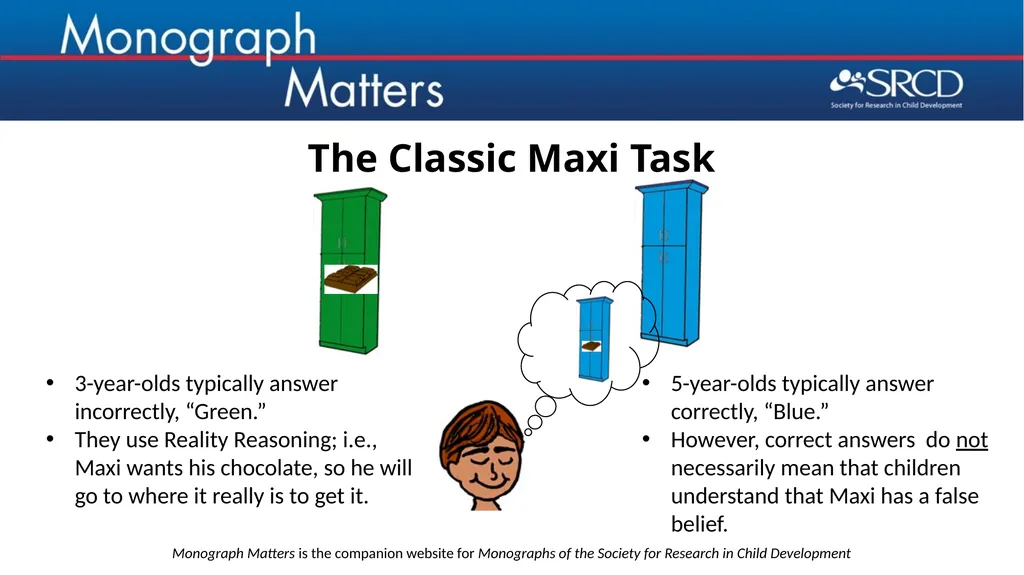
slide11. The Classic Maxi Task Monograph Matters is the companion website for Monographs of the Society for Research in Child Development<br>
slide12. The Classic Maxi Task Monograph Matters is the companion website for Monographs of the Society for Research in Child Development<br>
slide13. The Classic Maxi Task Monograph Matters is the companion website for Monographs of the Society for Research in Child Development 3-year-olds typically answer incorrectly, “Green.”
They use Reality Reasoning; i.e., Maxi wants his chocolate, so he will go to where it really is to get it. 5-year-olds typically answer correctly, “Blue.”
However, correct answers do not necessarily mean that children understand that Maxi has a false belief.<br>
slide14. Monograph Matters is the companion website for Monographs of the Society for Research in Child Development The Classic Smarties Task<br>
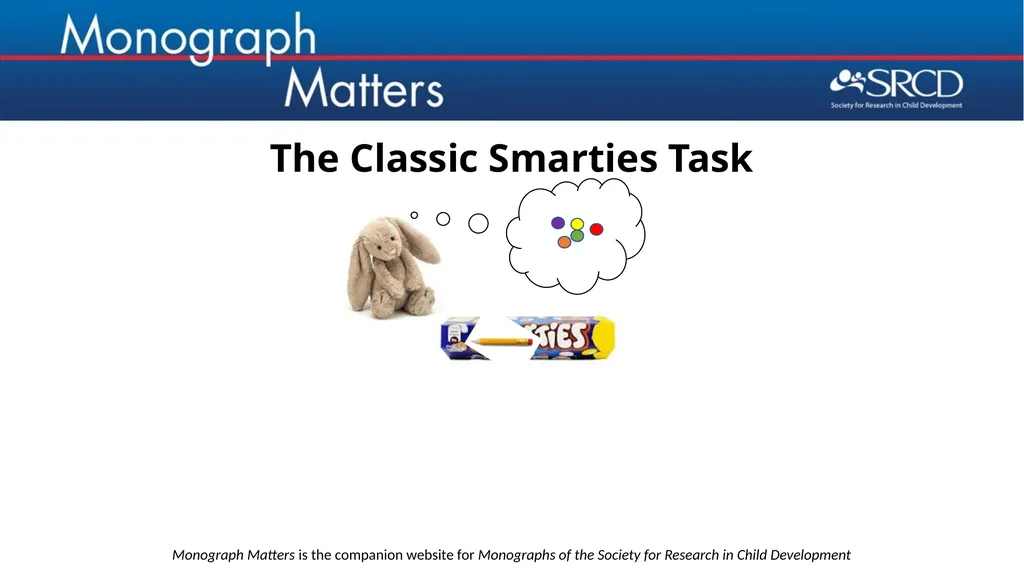
slide15. Monograph Matters is the companion website for Monographs of the Society for Research in Child Development The Classic Smarties Task<br>
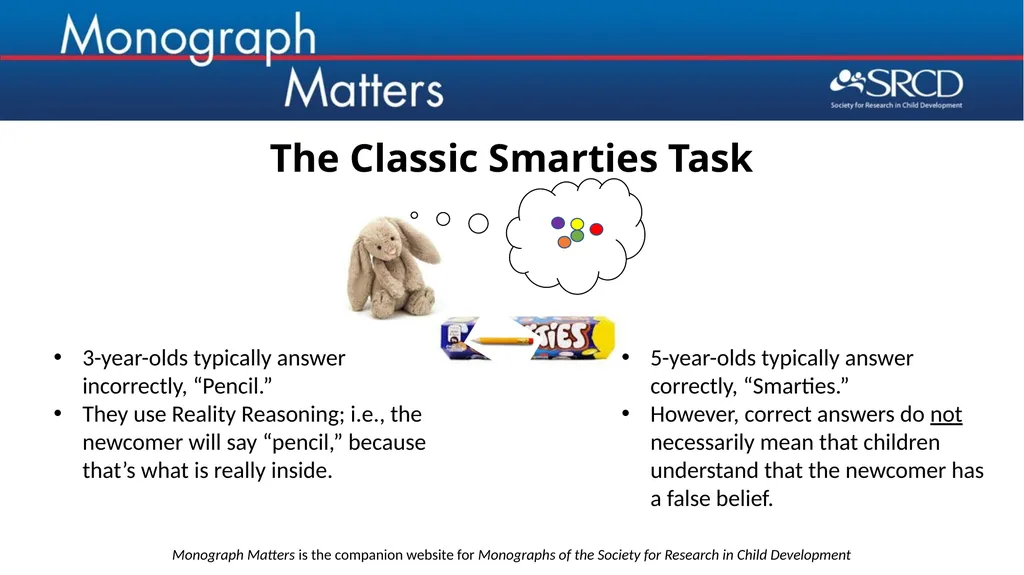
slide16. Monograph Matters is the companion website for Monographs of the Society for Research in Child Development The Classic Smarties Task 3-year-olds typically answer incorrectly, “Pencil.”
They use Reality Reasoning; i.e., the newcomer will say “pencil,” because that’s what is really inside. 5-year-olds typically answer correctly, “Smarties.”
However, correct answers do not necessarily mean that children understand that the newcomer has a false belief.<br>
slide17. Children can pass the Classic, 2-Option False-Belief Tasks without understanding false belief, by using Perceptual Access Reasoning (PAR). III. Perceptual Access Reasoning (PAR) Monograph Matters is the companion website for Monographs of the Society for Research in Child Development<br>
slide18. PAR is Composed of Two Rules: Rule 1: Seeing, or other forms of perceptual access, leads to knowing, and not seeing leads to not knowing.
Rule 2: Knowing leads to “getting it right,” and not knowing leads to “getting it wrong.” Monograph Matters is the companion website for Monographs of the Society for Research in Child Development<br>
slide19. Rule 1: “Bunny can’t see the pencil, so she doesn’t know there’s a pencil inside.” Rule 2: “Bunny doesn’t know there’s a pencil inside, so she’ll get it wrong and she’ll say, Smarties.” With 2 options, there is only 1 way to “get it wrong” (Smarties), so PAR gives the false-belief answer by default. Monograph Matters is the companion website for Monographs of the Society for Research in Child Development How PAR Applies to the Classic, 2-Option Smarties False-Belief Task<br>
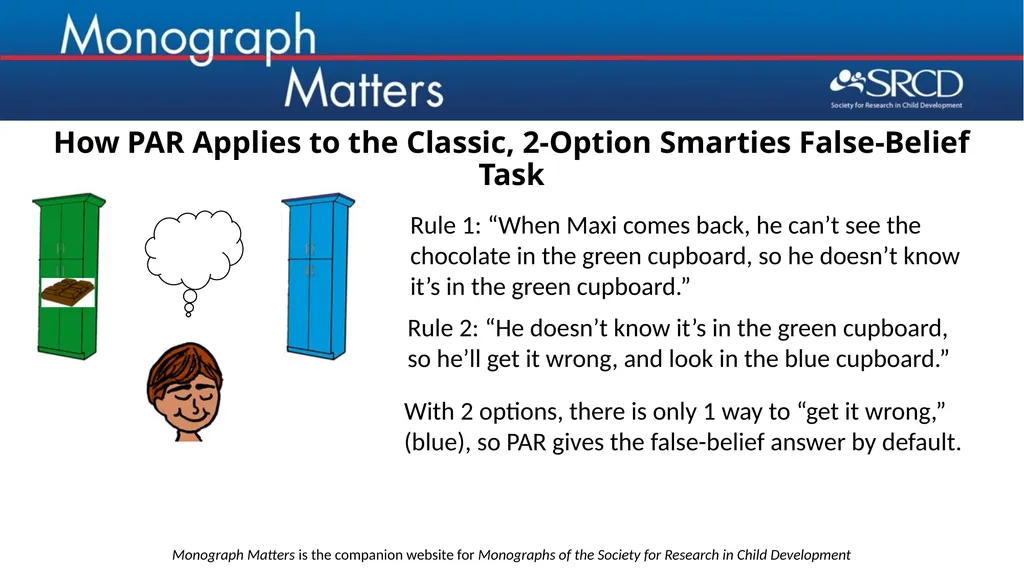
slide20. Monograph Matters is the companion website for Monographs of the Society for Research in Child Development Rule 1: “When Maxi comes back, he can’t see the chocolate in the green cupboard, so he doesn’t know it’s in the green cupboard.” Rule 2: “He doesn’t know it’s in the green cupboard, so he’ll get it wrong, and look in the blue cupboard.” With 2 options, there is only 1 way to “get it wrong,” (blue), so PAR gives the false-belief answer by default. How PAR Applies to the Classic, 2-Option Smarties False-Belief Task<br>
slide21. Monograph Matters is the companion website for Monographs of the Society for Research in Child Development IV. Methodological Implications In all of the 2-Option False-Belief Tasks, reasoning about false beliefs is confounded with PAR.
New methods exist to remove the confound between belief reasoning and PAR.<br>
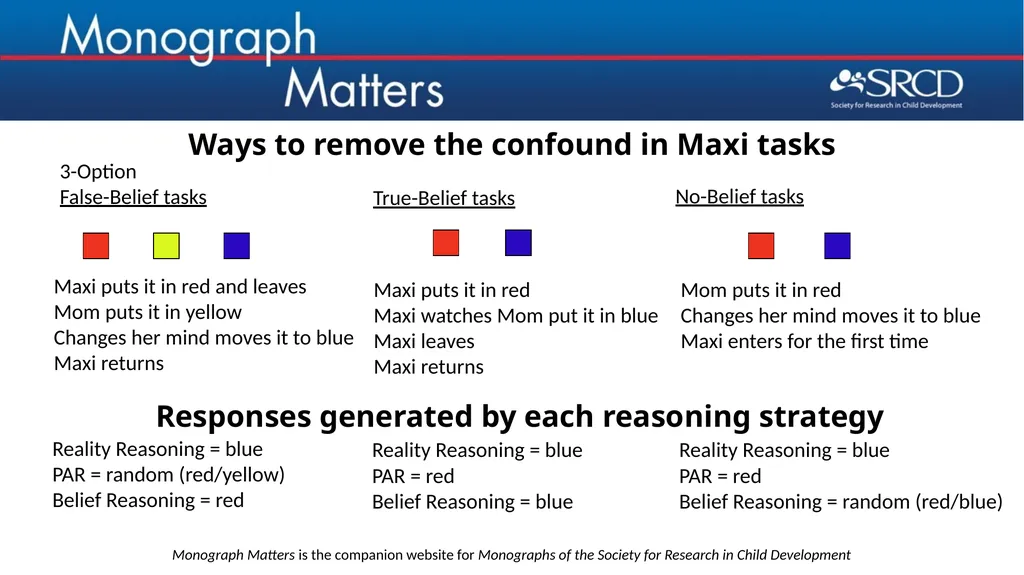
slide22. Ways to remove the confound in Maxi tasks 3-Option
False-Belief tasks True-Belief tasks No-Belief tasks Maxi puts it in red and leaves
Mom puts it in yellow
Changes her mind moves it to blue
Maxi returns Reality Reasoning = blue
PAR = random (red/yellow)
Belief Reasoning = red Maxi puts it in red
Maxi watches Mom put it in blue
Maxi leaves
Maxi returns Mom puts it in red
Changes her mind moves it to blue
Maxi enters for the first time Responses generated by each reasoning strategy Monograph Matters is the companion website for Monographs of the Society for Research in Child Development Reality Reasoning = blue
PAR = red
Belief Reasoning = blue Reality Reasoning = blue
PAR = red
Belief Reasoning = random (red/blue)<br>
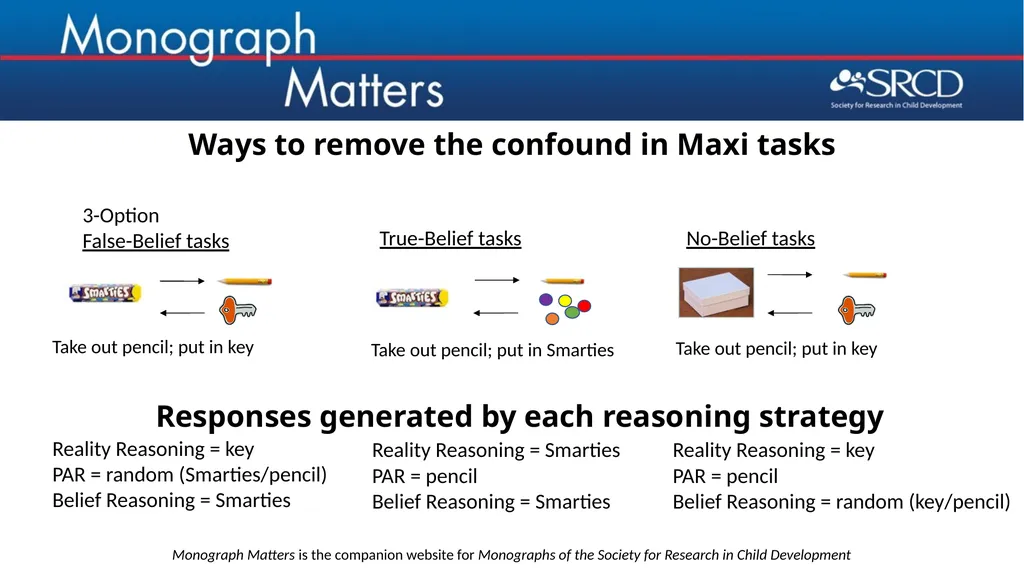
slide23. 3-Option
False-Belief tasks True-Belief tasks No-Belief tasks Monograph Matters is the companion website for Monographs of the Society for Research in Child Development Reality Reasoning = key
PAR = random (Smarties/pencil)
Belief Reasoning = Smarties Reality Reasoning = Smarties
PAR = pencil
Belief Reasoning = Smarties Reality Reasoning = key
PAR = pencil
Belief Reasoning = random (key/pencil) Take out pencil; put in key Take out pencil; put in Smarties Take out pencil; put in key Ways to remove the confound in Maxi tasks Responses generated by each reasoning strategy<br>
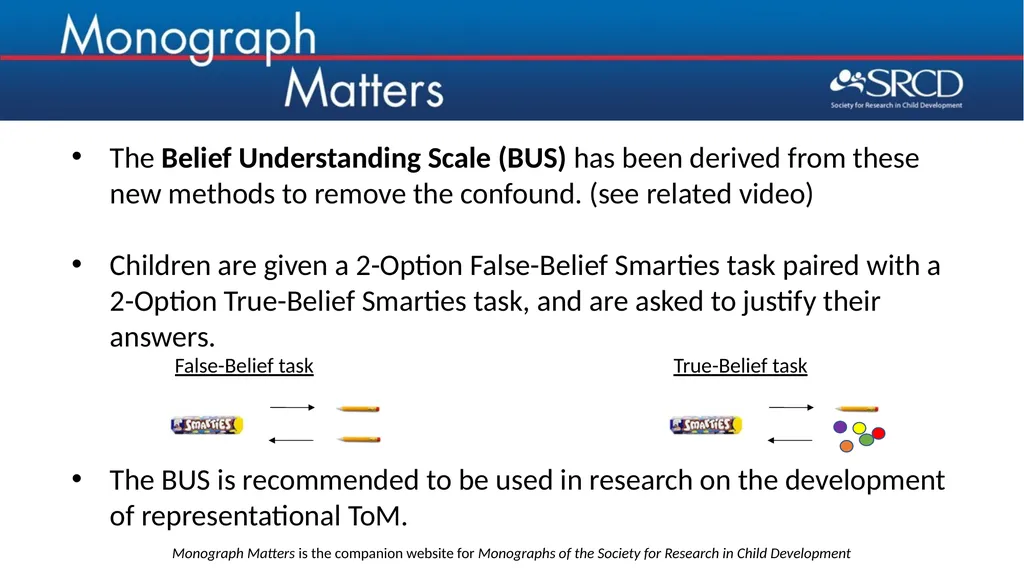
slide24. Monograph Matters is the companion website for Monographs of the Society for Research in Child Development The Belief Understanding Scale (BUS) has been derived from these new methods to remove the confound. (see related video)
Children are given a 2-Option False-Belief Smarties task paired with a 2-Option True-Belief Smarties task, and are asked to justify their answers.
The BUS is recommended to be used in research on the development of representational ToM. True-Belief task False-Belief task<br>
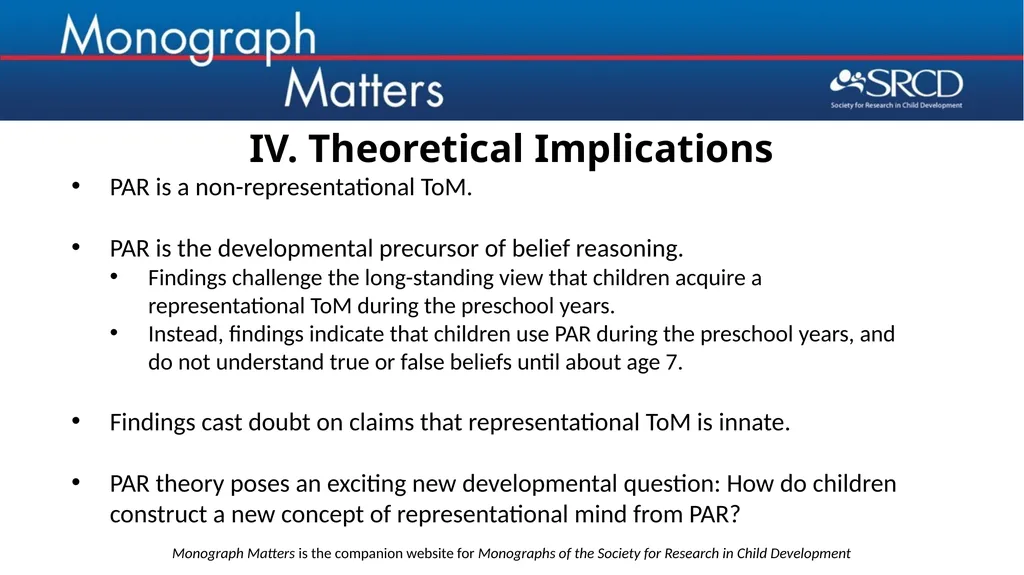
slide25. Monograph Matters is the companion website for Monographs of the Society for Research in Child Development IV. Theoretical Implications PAR is a non-representational ToM.
PAR is the developmental precursor of belief reasoning.
Findings challenge the long-standing view that children acquire a representational ToM during the preschool years.
Instead, findings indicate that children use PAR during the preschool years, and do not understand true or false beliefs until about age 7.
Findings cast doubt on claims that representational ToM is innate.
PAR theory poses an exciting new developmental question: How do children construct a new concept of representational mind from PAR?<br>
slide26. For this issue, visit
doi.org/10.1111/mono.12432
For videos, commentaries, and teaching materials, visit monographmatters.srcd.org Monograph Matters is the companion website for Monographs of the Society for Research in Child Development<br>
slide27. Monograph Matters is the companion website for Monographs of the Society for Research in Child Development Corresponding author
William Fabricius, PhD
William.Fabricius@asu.edu Editorial inquiries
Lynn S. Liben
liben@psu.edu Citation
Fabricius, W. V., Gonzalez, C. R., Pesch, A., Weimer, A. A., Pugliese, J., Carroll, K., Bolnick, R., Kupfer, A. S., Eisenberg, N., & Spinrad, T. (2021). Perceptual access reasoning (PAR) in developing a theory of mind. Monographs of the Society for Research in Child Development, 86(3). https://doi.org/10.1111/mono.12432<br>
doi.org/10.1111/mono.12432
For videos, commentaries, and teaching materials, visit monographmatters.srcd.org Monograph Matters is the companion website for Monographs of the Society for Research in Child Development<br>
slide2. The Role of Perceptual Access Reasoning (PAR) in the Development of Theory of Mind<br>
slide3. Topics Theory of Mind
Classic False-Belief Tasks
Perceptual Access Reasoning
Methodological Implications
Theoretical Implications Monograph Matters is the companion website for Monographs of the Society for Research in Child Development<br>
slide4. I. What is Theory of Mind (ToM)? Understanding that behavior is caused by unseen mental states (e.g., beliefs, desires, intentions).
Allows us to predict and explain other people’s behaviors.
Example: How would a young child explain why someone left the house with an umbrella? Monograph Matters is the companion website for Monographs of the Society for Research in Child Development<br>
slide5. Reasoning About Desires 3-year-olds can reason about people’s desires.
A 3-year-old might say, “Because she likes her umbrella.”
3-year-olds typically cannot also reason about people’s beliefs.
A 3-year-old would not likely say, “Because she thinks it will rain.” Monograph Matters is the companion website for Monographs of the Society for Research in Child Development<br>
slide6. I know that Kayla
wants a cookie. I know that Kayla thinks
there are cookies in the jar. I can predict that Kayla
will go to the cookie jar. How would an older child, Bobby, reason about Kayla’s desire and belief, in order to predict where Kayla will go? Reasoning About Desires and Beliefs Monograph Matters is the companion website for Monographs of the Society for Research in Child Development<br>
slide7. Reasoning About False Beliefs Young children have difficulty understanding that people can believe something that is not true; i.e., that people can have false beliefs.
Understanding false belief is a big step toward understanding that minds represent the world, sometimes in profoundly different ways. Monograph Matters is the companion website for Monographs of the Society for Research in Child Development<br>
slide8. I know Kayla falsely believes the cookies are in the jar. and I know Kayla doesn’t see them. How would Bobby reason about Kayla’s false belief? I know the cookies have been placed out for Kayla, Monograph Matters is the companion website for Monographs of the Society for Research in Child Development<br>
slide9. II. The Classic False-Belief Tasks In the 1980s, researchers devised False-Belief tasks to investigate when and how children come to understand that a person can hold a false belief. Monograph Matters is the companion website for Monographs of the Society for Research in Child Development<br>
slide10. The Classic False-Belief Tasks are 2-Option Tasks,
meaning that the test question presents the child with a forced-choice between two possible answers. The “Maxi” False-Belief task (Location task)
The “Smarties” False-Belief task (Contents task) Monograph Matters is the companion website for Monographs of the Society for Research in Child Development<br>
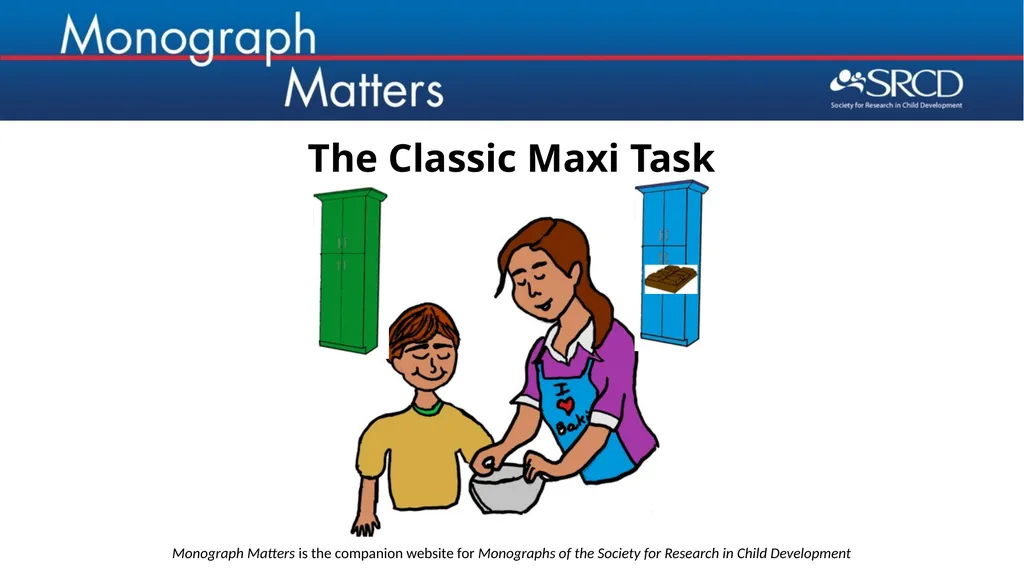
slide11. The Classic Maxi Task Monograph Matters is the companion website for Monographs of the Society for Research in Child Development<br>
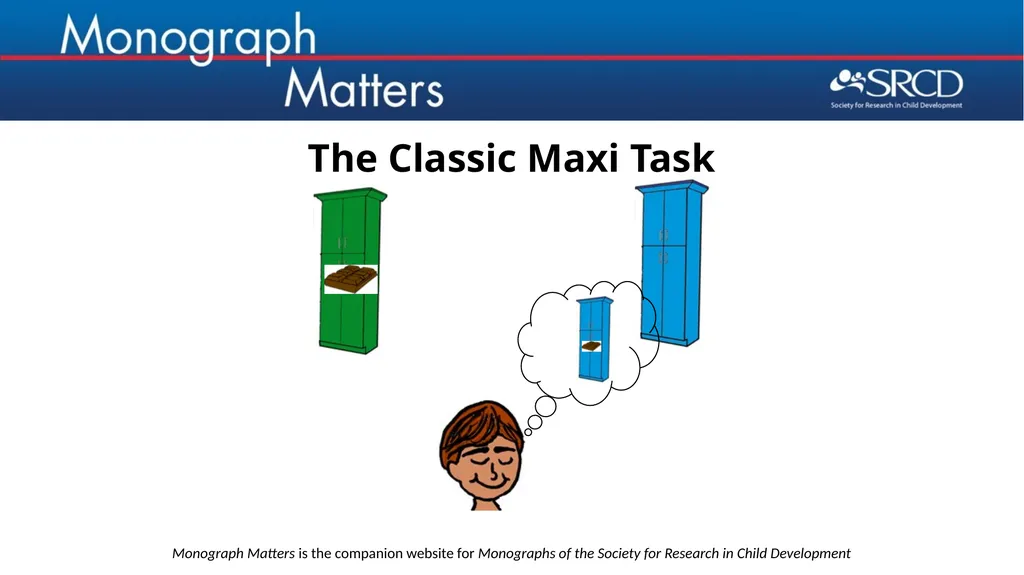
slide12. The Classic Maxi Task Monograph Matters is the companion website for Monographs of the Society for Research in Child Development<br>
slide13. The Classic Maxi Task Monograph Matters is the companion website for Monographs of the Society for Research in Child Development 3-year-olds typically answer incorrectly, “Green.”
They use Reality Reasoning; i.e., Maxi wants his chocolate, so he will go to where it really is to get it. 5-year-olds typically answer correctly, “Blue.”
However, correct answers do not necessarily mean that children understand that Maxi has a false belief.<br>
slide14. Monograph Matters is the companion website for Monographs of the Society for Research in Child Development The Classic Smarties Task<br>
slide15. Monograph Matters is the companion website for Monographs of the Society for Research in Child Development The Classic Smarties Task<br>
slide16. Monograph Matters is the companion website for Monographs of the Society for Research in Child Development The Classic Smarties Task 3-year-olds typically answer incorrectly, “Pencil.”
They use Reality Reasoning; i.e., the newcomer will say “pencil,” because that’s what is really inside. 5-year-olds typically answer correctly, “Smarties.”
However, correct answers do not necessarily mean that children understand that the newcomer has a false belief.<br>
slide17. Children can pass the Classic, 2-Option False-Belief Tasks without understanding false belief, by using Perceptual Access Reasoning (PAR). III. Perceptual Access Reasoning (PAR) Monograph Matters is the companion website for Monographs of the Society for Research in Child Development<br>
slide18. PAR is Composed of Two Rules: Rule 1: Seeing, or other forms of perceptual access, leads to knowing, and not seeing leads to not knowing.
Rule 2: Knowing leads to “getting it right,” and not knowing leads to “getting it wrong.” Monograph Matters is the companion website for Monographs of the Society for Research in Child Development<br>
slide19. Rule 1: “Bunny can’t see the pencil, so she doesn’t know there’s a pencil inside.” Rule 2: “Bunny doesn’t know there’s a pencil inside, so she’ll get it wrong and she’ll say, Smarties.” With 2 options, there is only 1 way to “get it wrong” (Smarties), so PAR gives the false-belief answer by default. Monograph Matters is the companion website for Monographs of the Society for Research in Child Development How PAR Applies to the Classic, 2-Option Smarties False-Belief Task<br>
slide20. Monograph Matters is the companion website for Monographs of the Society for Research in Child Development Rule 1: “When Maxi comes back, he can’t see the chocolate in the green cupboard, so he doesn’t know it’s in the green cupboard.” Rule 2: “He doesn’t know it’s in the green cupboard, so he’ll get it wrong, and look in the blue cupboard.” With 2 options, there is only 1 way to “get it wrong,” (blue), so PAR gives the false-belief answer by default. How PAR Applies to the Classic, 2-Option Smarties False-Belief Task<br>
slide21. Monograph Matters is the companion website for Monographs of the Society for Research in Child Development IV. Methodological Implications In all of the 2-Option False-Belief Tasks, reasoning about false beliefs is confounded with PAR.
New methods exist to remove the confound between belief reasoning and PAR.<br>
slide22. Ways to remove the confound in Maxi tasks 3-Option
False-Belief tasks True-Belief tasks No-Belief tasks Maxi puts it in red and leaves
Mom puts it in yellow
Changes her mind moves it to blue
Maxi returns Reality Reasoning = blue
PAR = random (red/yellow)
Belief Reasoning = red Maxi puts it in red
Maxi watches Mom put it in blue
Maxi leaves
Maxi returns Mom puts it in red
Changes her mind moves it to blue
Maxi enters for the first time Responses generated by each reasoning strategy Monograph Matters is the companion website for Monographs of the Society for Research in Child Development Reality Reasoning = blue
PAR = red
Belief Reasoning = blue Reality Reasoning = blue
PAR = red
Belief Reasoning = random (red/blue)<br>
slide23. 3-Option
False-Belief tasks True-Belief tasks No-Belief tasks Monograph Matters is the companion website for Monographs of the Society for Research in Child Development Reality Reasoning = key
PAR = random (Smarties/pencil)
Belief Reasoning = Smarties Reality Reasoning = Smarties
PAR = pencil
Belief Reasoning = Smarties Reality Reasoning = key
PAR = pencil
Belief Reasoning = random (key/pencil) Take out pencil; put in key Take out pencil; put in Smarties Take out pencil; put in key Ways to remove the confound in Maxi tasks Responses generated by each reasoning strategy<br>
slide24. Monograph Matters is the companion website for Monographs of the Society for Research in Child Development The Belief Understanding Scale (BUS) has been derived from these new methods to remove the confound. (see related video)
Children are given a 2-Option False-Belief Smarties task paired with a 2-Option True-Belief Smarties task, and are asked to justify their answers.
The BUS is recommended to be used in research on the development of representational ToM. True-Belief task False-Belief task<br>
slide25. Monograph Matters is the companion website for Monographs of the Society for Research in Child Development IV. Theoretical Implications PAR is a non-representational ToM.
PAR is the developmental precursor of belief reasoning.
Findings challenge the long-standing view that children acquire a representational ToM during the preschool years.
Instead, findings indicate that children use PAR during the preschool years, and do not understand true or false beliefs until about age 7.
Findings cast doubt on claims that representational ToM is innate.
PAR theory poses an exciting new developmental question: How do children construct a new concept of representational mind from PAR?<br>
slide26. For this issue, visit
doi.org/10.1111/mono.12432
For videos, commentaries, and teaching materials, visit monographmatters.srcd.org Monograph Matters is the companion website for Monographs of the Society for Research in Child Development<br>
slide27. Monograph Matters is the companion website for Monographs of the Society for Research in Child Development Corresponding author
William Fabricius, PhD
William.Fabricius@asu.edu Editorial inquiries
Lynn S. Liben
liben@psu.edu Citation
Fabricius, W. V., Gonzalez, C. R., Pesch, A., Weimer, A. A., Pugliese, J., Carroll, K., Bolnick, R., Kupfer, A. S., Eisenberg, N., & Spinrad, T. (2021). Perceptual access reasoning (PAR) in developing a theory of mind. Monographs of the Society for Research in Child Development, 86(3). https://doi.org/10.1111/mono.12432<br>