
‘Formation’-Beyoncé Kris Boratyn Critics
LV
Published · 14 slides · 0 views
1 / 1

Description
Formation-Beyoncé Kris Boratyn Critics Formation by Beyoncé is a song which is very often regarded as a black power anthem. It contains strong political criticisms in its lyrics. According to Joseph Lamour, formation is a song whose
Related Topics
Share
Embed code
Download this presentation From Below
"‘Formation’-Beyoncé Kris Boratyn Critics" is the property of its rightful owner. Permission is granted to download and print the materials on this website for personal, non-commercial use only, and to display it on your personal computer provided you do not modify the materials and that you retain all copyright notices contained in the materials. By downloading content from our website, you accept the terms of this agreement.
Presentation Transcript
01
‘Formation’-Beyoncé Kris Boratyn<br>
02
Critics ‘Formation’ by Beyoncé is a song which is very often regarded as a black power anthem. It contains strong political criticisms in its lyrics.’
According to Joseph Lamour, formation is “ a song whose lyrics are teeming with notions of empowerment and pride in her heritage as a black American with roots in Alabama and Louisiana”.
According to another critic called Pitchfork “ for Beyoncé the unapologetic embracing of one’s blackness and the power one can harness when making a name, livelihood, and legacy can’t ever be ignored or taken for granted”.
The Daily Beast described the song as ‘a fiery black power anthem and call to arms’.
The video features references to Hurricane Katrina, antebellum and Louisiana creole culture, police brutality, racism, and black pride.<br>
According to Joseph Lamour, formation is “ a song whose lyrics are teeming with notions of empowerment and pride in her heritage as a black American with roots in Alabama and Louisiana”.
According to another critic called Pitchfork “ for Beyoncé the unapologetic embracing of one’s blackness and the power one can harness when making a name, livelihood, and legacy can’t ever be ignored or taken for granted”.
The Daily Beast described the song as ‘a fiery black power anthem and call to arms’.
The video features references to Hurricane Katrina, antebellum and Louisiana creole culture, police brutality, racism, and black pride.<br>
03
Interesting facts The song was released one day after what would have been Trayvon martin’s 21st birthday and one day before what would have been Sandra’s Bland’s 29th birthday. Martin and Bland’s deaths are focal points of Black lives Matter.
The song is a fitting contribution to Black History Month and an important conversation piece in the Black Lives Matter movement.
The song addresses rumours about the singer’s connection to popular conspiracy theories about illuminati
Beyoncé represents her family roots. This has always been a big part of her identity. ‘Unapologetic blackness’.<br>
The song is a fitting contribution to Black History Month and an important conversation piece in the Black Lives Matter movement.
The song addresses rumours about the singer’s connection to popular conspiracy theories about illuminati
Beyoncé represents her family roots. This has always been a big part of her identity. ‘Unapologetic blackness’.<br>
04
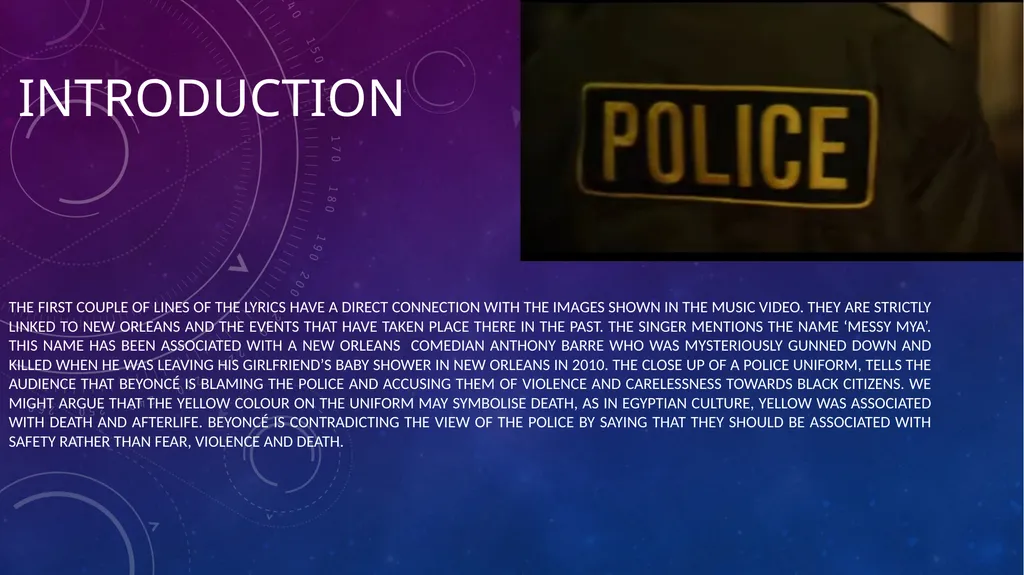
Introduction The first couple of lines of the lyrics have a direct connection with the images shown in the music video. They are strictly linked to New Orleans and the events that have taken place there in the past. the singer mentions the name ‘Messy Mya’. This name has been associated with a New Orleans comedian Anthony barre who was mysteriously gunned down and killed when he was leaving his girlfriend’s baby shower in New Orleans in 2010. The close up of a police uniform, tells the audience that Beyoncé is blaming the police and accusing them of violence and carelessness towards black citizens. We might argue that the yellow colour on the uniform may symbolise death, as in Egyptian culture, yellow was associated with death and afterlife. Beyoncé is contradicting the view of the police by saying that they should be associated with safety rather than fear, violence and death.<br>
05
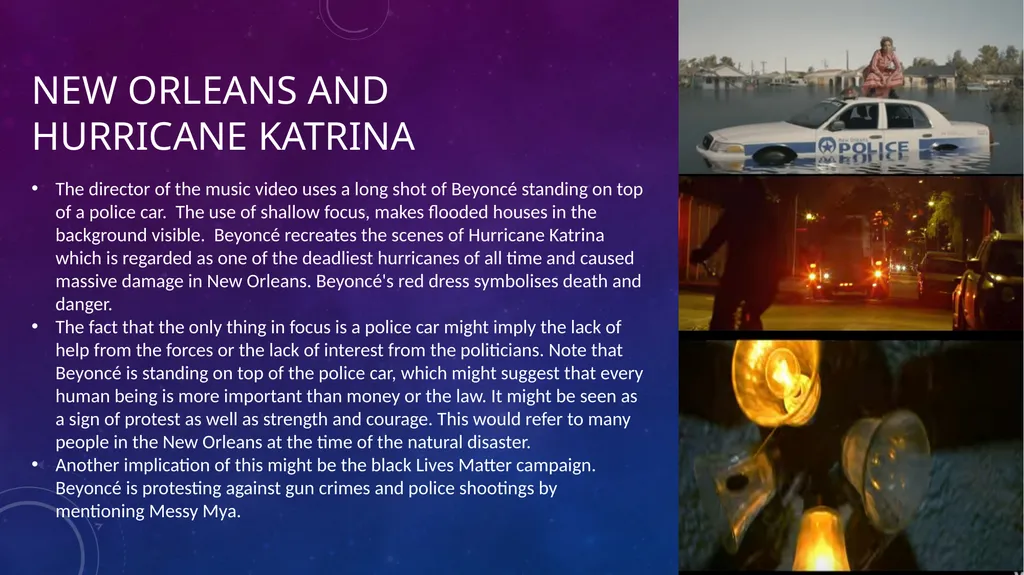
New Orleans and Hurricane Katrina The director of the music video uses a long shot of Beyoncé standing on top of a police car. The use of shallow focus, makes flooded houses in the background visible. Beyoncé recreates the scenes of Hurricane Katrina which is regarded as one of the deadliest hurricanes of all time and caused massive damage in New Orleans. Beyoncé's red dress symbolises death and danger.
The fact that the only thing in focus is a police car might imply the lack of help from the forces or the lack of interest from the politicians. Note that Beyoncé is standing on top of the police car, which might suggest that every human being is more important than money or the law. It might be seen as a sign of protest as well as strength and courage. This would refer to many people in the New Orleans at the time of the natural disaster.
Another implication of this might be the black Lives Matter campaign. Beyoncé is protesting against gun crimes and police shootings by mentioning Messy Mya.<br>
The fact that the only thing in focus is a police car might imply the lack of help from the forces or the lack of interest from the politicians. Note that Beyoncé is standing on top of the police car, which might suggest that every human being is more important than money or the law. It might be seen as a sign of protest as well as strength and courage. This would refer to many people in the New Orleans at the time of the natural disaster.
Another implication of this might be the black Lives Matter campaign. Beyoncé is protesting against gun crimes and police shootings by mentioning Messy Mya.<br>
06
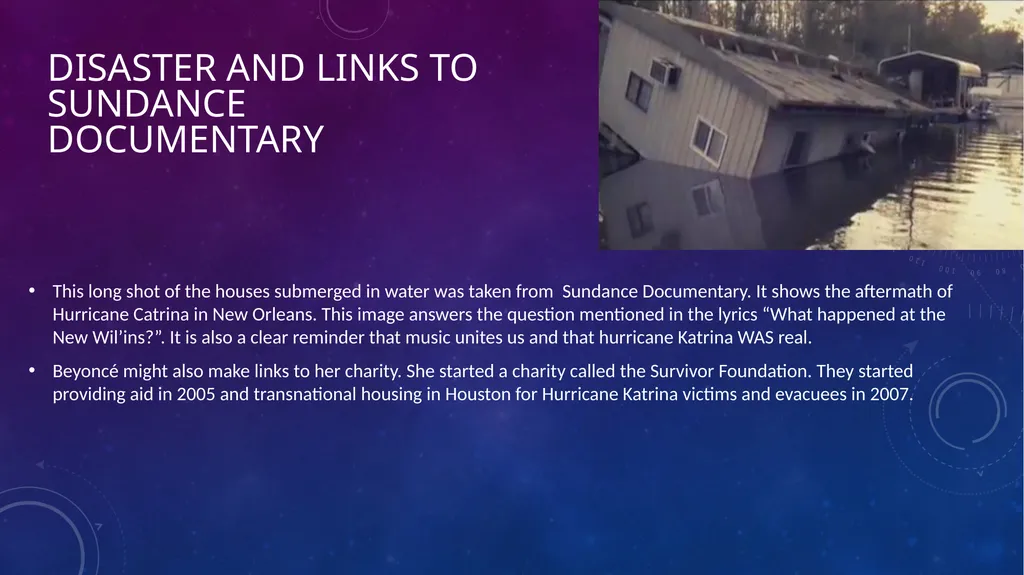
Disaster and links to Sundance documentary This long shot of the houses submerged in water was taken from Sundance Documentary. It shows the aftermath of Hurricane Catrina in New Orleans. This image answers the question mentioned in the lyrics “What happened at the New Wil’ins?”. It is also a clear reminder that music unites us and that hurricane Katrina WAS real.
Beyoncé might also make links to her charity. She started a charity called the Survivor Foundation. They started providing aid in 2005 and transnational housing in Houston for Hurricane Katrina victims and evacuees in 2007.<br>
Beyoncé might also make links to her charity. She started a charity called the Survivor Foundation. They started providing aid in 2005 and transnational housing in Houston for Hurricane Katrina victims and evacuees in 2007.<br>
07
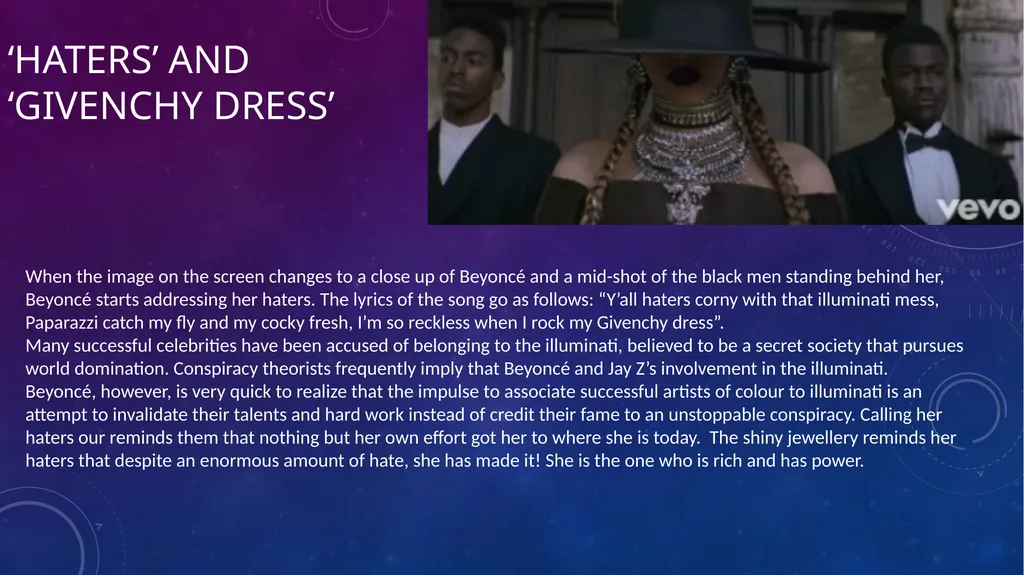
‘Haters’ and ‘Givenchy dress’ When the image on the screen changes to a close up of Beyoncé and a mid-shot of the black men standing behind her, Beyoncé starts addressing her haters. The lyrics of the song go as follows: “Y’all haters corny with that illuminati mess, Paparazzi catch my fly and my cocky fresh, I’m so reckless when I rock my Givenchy dress”.
Many successful celebrities have been accused of belonging to the illuminati, believed to be a secret society that pursues world domination. Conspiracy theorists frequently imply that Beyoncé and Jay Z’s involvement in the illuminati.
Beyoncé, however, is very quick to realize that the impulse to associate successful artists of colour to illuminati is an attempt to invalidate their talents and hard work instead of credit their fame to an unstoppable conspiracy. Calling her haters our reminds them that nothing but her own effort got her to where she is today. The shiny jewellery reminds her haters that despite an enormous amount of hate, she has made it! She is the one who is rich and has power.<br>
Many successful celebrities have been accused of belonging to the illuminati, believed to be a secret society that pursues world domination. Conspiracy theorists frequently imply that Beyoncé and Jay Z’s involvement in the illuminati.
Beyoncé, however, is very quick to realize that the impulse to associate successful artists of colour to illuminati is an attempt to invalidate their talents and hard work instead of credit their fame to an unstoppable conspiracy. Calling her haters our reminds them that nothing but her own effort got her to where she is today. The shiny jewellery reminds her haters that despite an enormous amount of hate, she has made it! She is the one who is rich and has power.<br>
08
Black self-love Beyoncé is clearly proud of her roots and origins. She refers to her ethnicity in the lyrics by saying “ My daddy Alabama, momma Louisiana You mix that negro with that Creole, make a Texas bama”.
‘Bama’ was originally black slang for working class blacks arriving North from South during the Great Migration. The term ‘bama’ was very often used to refer to someone who didn’t know how to behave properly and wasn’t presentable for white sensibilities. Bama is both classed as classist and racist, and Beyoncé uses it in her song to speak about flipping off respectability in politics.
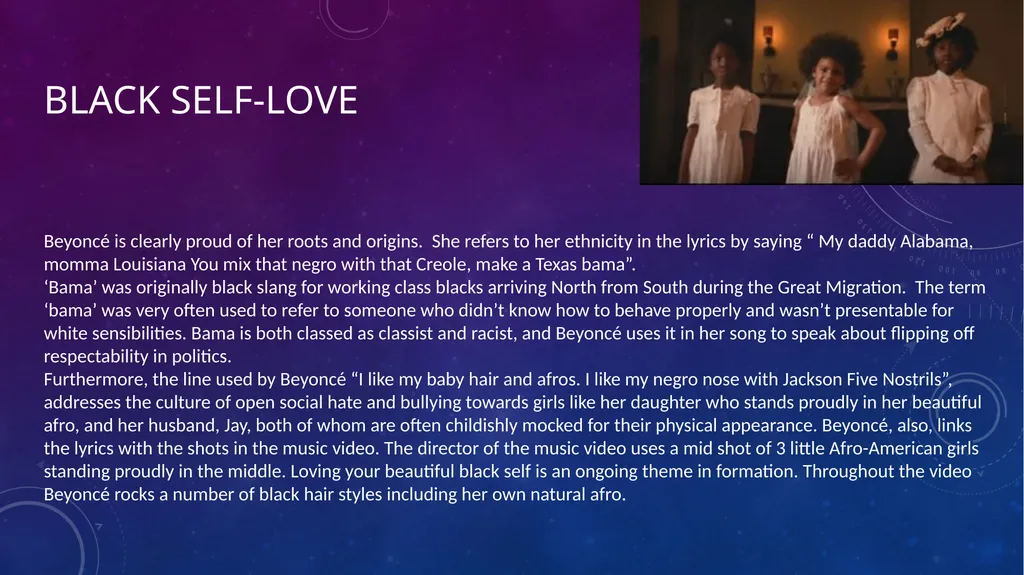
Furthermore, the line used by Beyoncé “I like my baby hair and afros. I like my negro nose with Jackson Five Nostrils”, addresses the culture of open social hate and bullying towards girls like her daughter who stands proudly in her beautiful afro, and her husband, Jay, both of whom are often childishly mocked for their physical appearance. Beyoncé, also, links the lyrics with the shots in the music video. The director of the music video uses a mid shot of 3 little Afro-American girls standing proudly in the middle. Loving your beautiful black self is an ongoing theme in formation. Throughout the video Beyoncé rocks a number of black hair styles including her own natural afro.<br>
‘Bama’ was originally black slang for working class blacks arriving North from South during the Great Migration. The term ‘bama’ was very often used to refer to someone who didn’t know how to behave properly and wasn’t presentable for white sensibilities. Bama is both classed as classist and racist, and Beyoncé uses it in her song to speak about flipping off respectability in politics.
Furthermore, the line used by Beyoncé “I like my baby hair and afros. I like my negro nose with Jackson Five Nostrils”, addresses the culture of open social hate and bullying towards girls like her daughter who stands proudly in her beautiful afro, and her husband, Jay, both of whom are often childishly mocked for their physical appearance. Beyoncé, also, links the lyrics with the shots in the music video. The director of the music video uses a mid shot of 3 little Afro-American girls standing proudly in the middle. Loving your beautiful black self is an ongoing theme in formation. Throughout the video Beyoncé rocks a number of black hair styles including her own natural afro.<br>
09
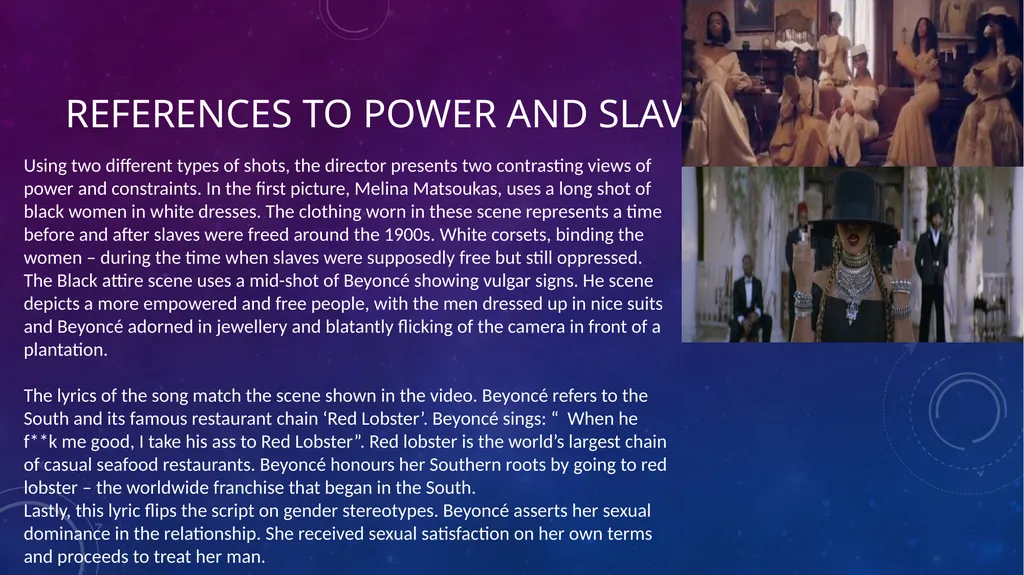
References to power and Slavery Using two different types of shots, the director presents two contrasting views of power and constraints. In the first picture, Melina Matsoukas, uses a long shot of black women in white dresses. The clothing worn in these scene represents a time before and after slaves were freed around the 1900s. White corsets, binding the women – during the time when slaves were supposedly free but still oppressed.
The Black attire scene uses a mid-shot of Beyoncé showing vulgar signs. He scene depicts a more empowered and free people, with the men dressed up in nice suits and Beyoncé adorned in jewellery and blatantly flicking of the camera in front of a plantation.
The lyrics of the song match the scene shown in the video. Beyoncé refers to the South and its famous restaurant chain ‘Red Lobster’. Beyoncé sings: “ When he f**k me good, I take his ass to Red Lobster”. Red lobster is the world’s largest chain of casual seafood restaurants. Beyoncé honours her Southern roots by going to red lobster – the worldwide franchise that began in the South.
Lastly, this lyric flips the script on gender stereotypes. Beyoncé asserts her sexual dominance in the relationship. She received sexual satisfaction on her own terms and proceeds to treat her man.<br>
The Black attire scene uses a mid-shot of Beyoncé showing vulgar signs. He scene depicts a more empowered and free people, with the men dressed up in nice suits and Beyoncé adorned in jewellery and blatantly flicking of the camera in front of a plantation.
The lyrics of the song match the scene shown in the video. Beyoncé refers to the South and its famous restaurant chain ‘Red Lobster’. Beyoncé sings: “ When he f**k me good, I take his ass to Red Lobster”. Red lobster is the world’s largest chain of casual seafood restaurants. Beyoncé honours her Southern roots by going to red lobster – the worldwide franchise that began in the South.
Lastly, this lyric flips the script on gender stereotypes. Beyoncé asserts her sexual dominance in the relationship. She received sexual satisfaction on her own terms and proceeds to treat her man.<br>
10
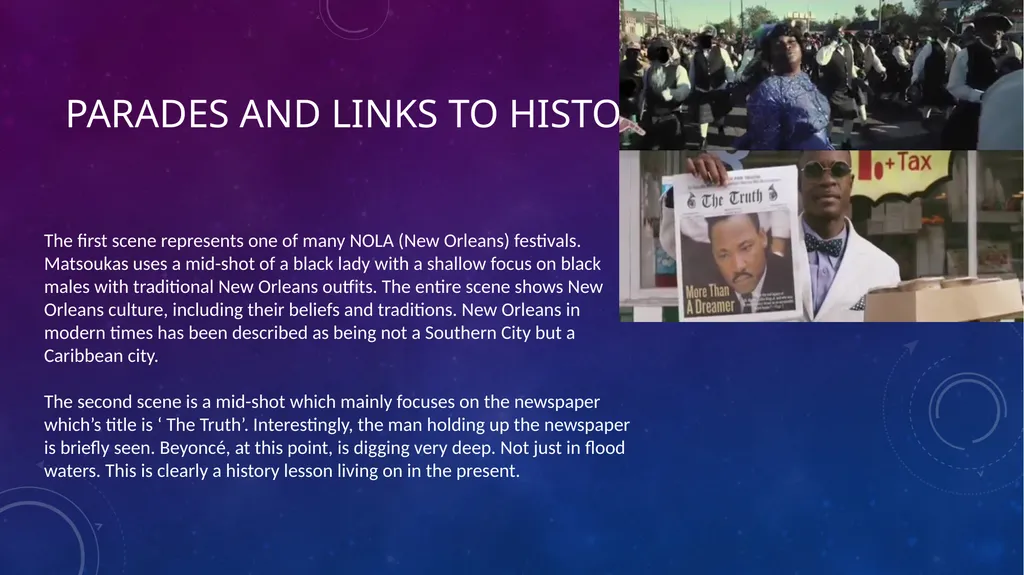
Parades and Links to History The first scene represents one of many NOLA (New Orleans) festivals. Matsoukas uses a mid-shot of a black lady with a shallow focus on black males with traditional New Orleans outfits. The entire scene shows New Orleans culture, including their beliefs and traditions. New Orleans in modern times has been described as being not a Southern City but a Caribbean city.
The second scene is a mid-shot which mainly focuses on the newspaper which’s title is ‘ The Truth’. Interestingly, the man holding up the newspaper is briefly seen. Beyoncé, at this point, is digging very deep. Not just in flood waters. This is clearly a history lesson living on in the present.<br>
The second scene is a mid-shot which mainly focuses on the newspaper which’s title is ‘ The Truth’. Interestingly, the man holding up the newspaper is briefly seen. Beyoncé, at this point, is digging very deep. Not just in flood waters. This is clearly a history lesson living on in the present.<br>
11
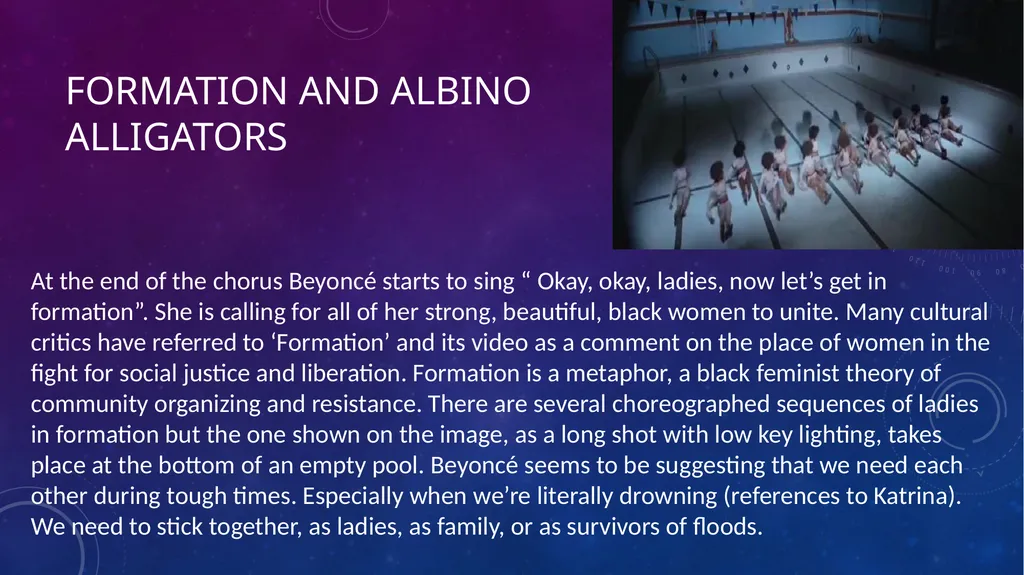
Formation and Albino alligators At the end of the chorus Beyoncé starts to sing “ Okay, okay, ladies, now let’s get in formation”. She is calling for all of her strong, beautiful, black women to unite. Many cultural critics have referred to ‘Formation’ and its video as a comment on the place of women in the fight for social justice and liberation. Formation is a metaphor, a black feminist theory of community organizing and resistance. There are several choreographed sequences of ladies in formation but the one shown on the image, as a long shot with low key lighting, takes place at the bottom of an empty pool. Beyoncé seems to be suggesting that we need each other during tough times. Especially when we’re literally drowning (references to Katrina). We need to stick together, as ladies, as family, or as survivors of floods.<br>
12
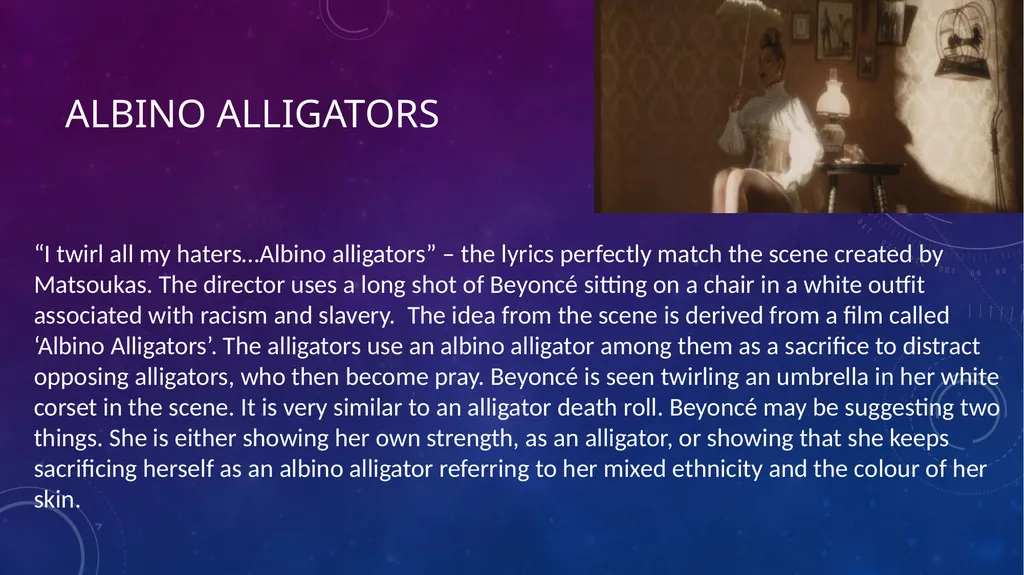
Albino Alligators “I twirl all my haters…Albino alligators” – the lyrics perfectly match the scene created by Matsoukas. The director uses a long shot of Beyoncé sitting on a chair in a white outfit associated with racism and slavery. The idea from the scene is derived from a film called ‘Albino Alligators’. The alligators use an albino alligator among them as a sacrifice to distract opposing alligators, who then become pray. Beyoncé is seen twirling an umbrella in her white corset in the scene. It is very similar to an alligator death roll. Beyoncé may be suggesting two things. She is either showing her own strength, as an alligator, or showing that she keeps sacrificing herself as an albino alligator referring to her mixed ethnicity and the colour of her skin.<br>
13
Black Boy and Black Panthers Links There is a powerful scene of a little boy in a black hoodie break dancing in front of a line of police in riot gear, He stops dancing and puts his hands up in the air. All the police put their arms in the air in response. A clip of graffiti on a wall comes across the screen which says “stop shooting us”. Here, Beyoncé refers to the campaign of Black Lives Matter and the shootings that have taken place in America. The singer seems to be suggesting that the only answer is peace.
The day after Beyoncé released Formation, she performed it at half time of the big game: Broncos vs the Panthers. Her dancers were dressed in Black Panther Party. During the Civil Rights movement in America, Black Panther Party practiced militant self-defence of minority communities against the U.S. Government. They fought to establish revolutionary socialism through mass organizing and community based programs.<br>
The day after Beyoncé released Formation, she performed it at half time of the big game: Broncos vs the Panthers. Her dancers were dressed in Black Panther Party. During the Civil Rights movement in America, Black Panther Party practiced militant self-defence of minority communities against the U.S. Government. They fought to establish revolutionary socialism through mass organizing and community based programs.<br>
14
Theory and formation Paul Gilroy – Colonial discourses continue to inform contemporary attitudes to race and ethnicity in the postcolonial era. Civilisationism constructs racial hierarchies and sets up binary oppositions based om notions of otherness. Beyoncé, in Formation, protests against race inequalities by blaming the police and the government for unequal treating of black citizens.
David Gauntlett – the media provide us with tools or resources that we use to construct our identities. Whilst in the past the media tended to convey singular, straightforward messages about ideal types of male and female identities, the media today offer us a more diverse range of stars, icons and characters from whom we may pick and mix different ideas. Beyoncé is clearly one of the key role models for many young people, especially for black or mixed race youth. Her message in formation is clear: Be Proud Of Who You Are!
Liesbet van Zoonen - men and women are represented differently in the media. Women are objectified as a result of Western culture. There are some clear evidence of notion of looking in the Formation music video. Beyoncé’s body is shown as an object to be looked at, and it is a core element of western patriarchal culture.
Bell Hooks – race and class as well as sex determine the extent to which individuals are exploited, discriminated against or oppressed. Beyoncé seems to be protesting against discrimination, inequality and injustice in the video. She also addresses her haters who suggest that she belongs to illuminati. Even though her qualities and talents are undermined, she stands strong and keeps going. She is proud of who she is and is ready to show off.<br>
David Gauntlett – the media provide us with tools or resources that we use to construct our identities. Whilst in the past the media tended to convey singular, straightforward messages about ideal types of male and female identities, the media today offer us a more diverse range of stars, icons and characters from whom we may pick and mix different ideas. Beyoncé is clearly one of the key role models for many young people, especially for black or mixed race youth. Her message in formation is clear: Be Proud Of Who You Are!
Liesbet van Zoonen - men and women are represented differently in the media. Women are objectified as a result of Western culture. There are some clear evidence of notion of looking in the Formation music video. Beyoncé’s body is shown as an object to be looked at, and it is a core element of western patriarchal culture.
Bell Hooks – race and class as well as sex determine the extent to which individuals are exploited, discriminated against or oppressed. Beyoncé seems to be protesting against discrimination, inequality and injustice in the video. She also addresses her haters who suggest that she belongs to illuminati. Even though her qualities and talents are undermined, she stands strong and keeps going. She is proud of who she is and is ready to show off.<br>