
Foundations and Trusts Block 3 – Part II Spring
JO
Published · 61 slides · 0 views
1 / 1
Description
Foundations and Trusts Block 3 Part II Spring Semester 2022 Dr. Natalie Peter, Attorney-at-Law, LL.M. ,TEP Head Private Clients Tax BlumGrob Attorneys at Law, Zurich 3242022 Foundations and Trusts, Dr. Natalie Peter Page 1 3242022
Related Topics
Share
Embed code
Download this presentation From Below
"Foundations and Trusts Block 3 – Part II Spring" is the property of its rightful owner. Permission is granted to download and print the materials on this website for personal, non-commercial use only, and to display it on your personal computer provided you do not modify the materials and that you retain all copyright notices contained in the materials. By downloading content from our website, you accept the terms of this agreement.
Presentation Transcript
01
Foundations and Trusts Block 3 – Part II
Spring Semester 2022
Dr. Natalie Peter, Attorney-at-Law, LL.M. ,TEP
Head Private Clients / Tax Blum&Grob Attorneys at Law, Zurich 3/24/2022 Foundations and Trusts, Dr. Natalie Peter Page 1<br>
Spring Semester 2022
Dr. Natalie Peter, Attorney-at-Law, LL.M. ,TEP
Head Private Clients / Tax Blum&Grob Attorneys at Law, Zurich 3/24/2022 Foundations and Trusts, Dr. Natalie Peter Page 1<br>
02
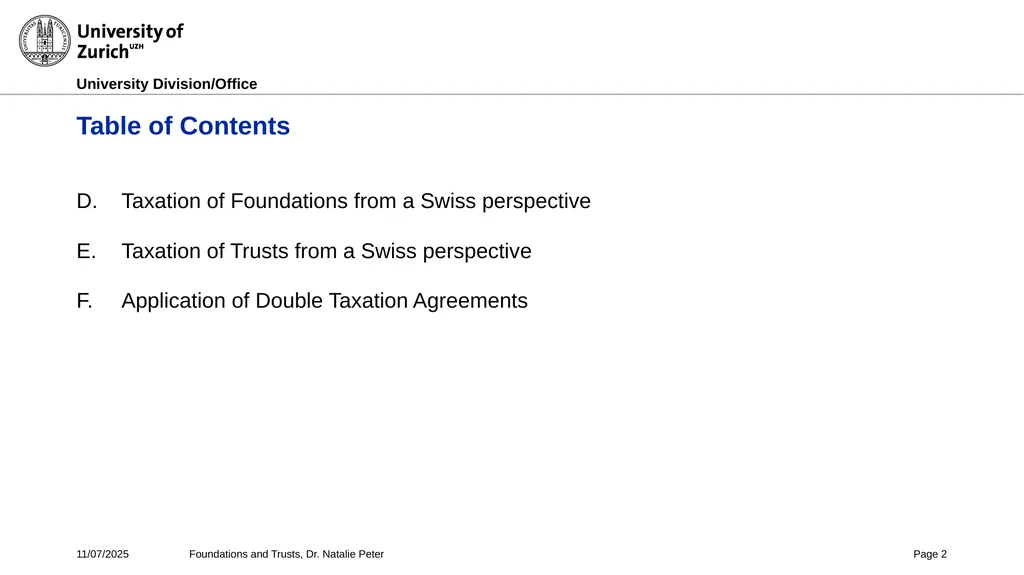
3/24/2022 Foundations and Trusts, Dr. Natalie Peter Table of Contents Taxation of Foundations from a Swiss perspective
Taxation of Trusts from a Swiss perspective
Application of Double Taxation Agreements Page 2<br>
Taxation of Trusts from a Swiss perspective
Application of Double Taxation Agreements Page 2<br>
03
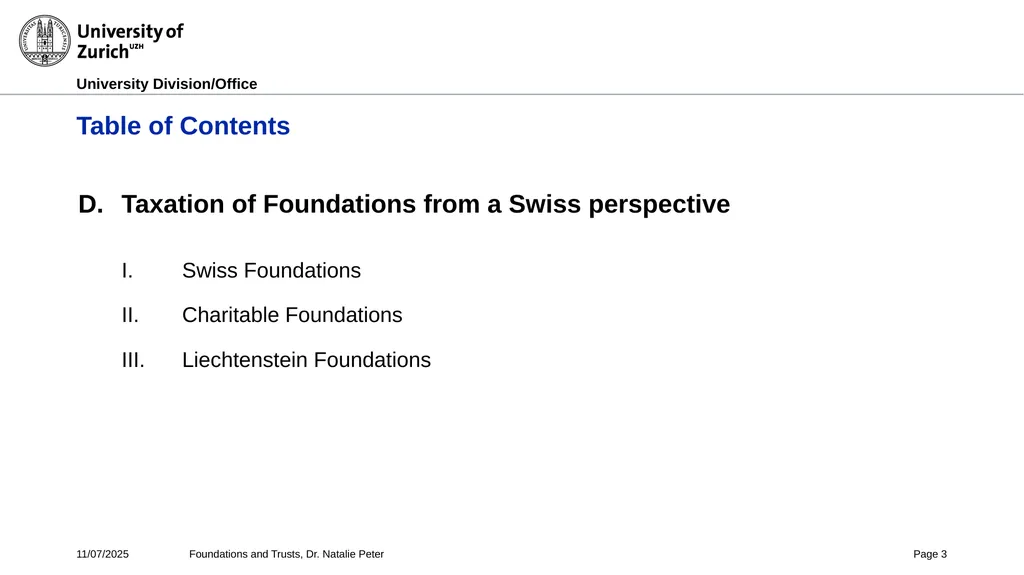
Table of Contents D. Taxation of Foundations from a Swiss perspective
Swiss Foundations
Charitable Foundations
Liechtenstein Foundations 3/24/2022 Foundations and Trusts, Dr. Natalie Peter Page 3<br>
Swiss Foundations
Charitable Foundations
Liechtenstein Foundations 3/24/2022 Foundations and Trusts, Dr. Natalie Peter Page 3<br>
04
3/24/2022 Foundations and Trusts, Dr. Natalie Peter I. Swiss Foundations Separate legal entity
Taxable Profit
According to rules of entities (accounting)
Taxable income: realised income inlcuding capital gains
Exempt income: gifts or bequests
Inheritance and gift tax on transfer of assets to a foundation by as Swiss resident donor or deceased Page 4<br>
Taxable Profit
According to rules of entities (accounting)
Taxable income: realised income inlcuding capital gains
Exempt income: gifts or bequests
Inheritance and gift tax on transfer of assets to a foundation by as Swiss resident donor or deceased Page 4<br>
05
3/24/2022 Foundations and Trusts, Dr. Natalie Peter I. Swiss Foundations In case of family foundations
If distribution is not in line with purpose – distribution is added back to taxable profit
Distribution is taxed as income in the hands of the beneficiary
Distribution is not a gift triggering gift tax. Council has no animus donandi Page 5<br>
If distribution is not in line with purpose – distribution is added back to taxable profit
Distribution is taxed as income in the hands of the beneficiary
Distribution is not a gift triggering gift tax. Council has no animus donandi Page 5<br>
06
3/24/2022 Foundations and Trusts, Dr. Natalie Peter I. Swiss Foundations Taxable Assets
Fair market value of assets not book value
No depreciation taken into account
Liabilities are deductible Page 6<br>
Fair market value of assets not book value
No depreciation taken into account
Liabilities are deductible Page 6<br>
07
3/24/2022 Foundations and Trusts, Dr. Natalie Peter II. Charitable Foundations Foundations with public or charitable purpose are tax-exempt
General requirements
Legal entity – Foundation is a legal entity
Irrevocable Purpose – repayment of funds to the founders in case of a dissolution is prohibited
Carrying out effective Activities
Irrevocable Charitable Purpose – the activity must be exclusively dedicated to a public or charitable purpose. No business interest to be pursued. Page 7<br>
General requirements
Legal entity – Foundation is a legal entity
Irrevocable Purpose – repayment of funds to the founders in case of a dissolution is prohibited
Carrying out effective Activities
Irrevocable Charitable Purpose – the activity must be exclusively dedicated to a public or charitable purpose. No business interest to be pursued. Page 7<br>
08
3/24/2022 Foundations and Trusts, Dr. Natalie Peter II. Charitable Foundations Public Interest
pursued through activities that are in general charitable, humanitarian, constitutional, ecological, educational, scientific or cultural areas
Whether activity qualifies as pursuit of a public interest is decided with reference to the public opinion
activities can be carried out within Switzerland or abroad, as long as they pursue a public interest and are completely altruistic Page 8<br>
pursued through activities that are in general charitable, humanitarian, constitutional, ecological, educational, scientific or cultural areas
Whether activity qualifies as pursuit of a public interest is decided with reference to the public opinion
activities can be carried out within Switzerland or abroad, as long as they pursue a public interest and are completely altruistic Page 8<br>
09
3/24/2022 Foundations and Trusts, Dr. Natalie Peter II. Charitable Foundations Tax Exemption
No profit and asset Tax
In principle, no gift and inheritance tax
No exemption from capital gains tax or VAT
Contributions to tax exempt charitable foundations are deductible up to a certain threshhold
If foundation pursues both charitable and business purposes, it may be able to apply for a partial tax exemption Page 9<br>
No profit and asset Tax
In principle, no gift and inheritance tax
No exemption from capital gains tax or VAT
Contributions to tax exempt charitable foundations are deductible up to a certain threshhold
If foundation pursues both charitable and business purposes, it may be able to apply for a partial tax exemption Page 9<br>
10
3/24/2022 Foundations and Trusts, Dr. Natalie Peter II. Charitable Foundations Altruism
activity is also based on an altruistic spirit
own interests must be sacrificed in order to pursue a public interest
Associations with the purpose of encouraging leisure activities lack such altruistic purpose
board members must carry out their activities on a voluntary basis and, in principle, cannot be remunerated
compensation of the management and other employees in accordance with market conditions is permissible Page 10<br>
activity is also based on an altruistic spirit
own interests must be sacrificed in order to pursue a public interest
Associations with the purpose of encouraging leisure activities lack such altruistic purpose
board members must carry out their activities on a voluntary basis and, in principle, cannot be remunerated
compensation of the management and other employees in accordance with market conditions is permissible Page 10<br>
11
3/24/2022 Foundations and Trusts, Dr. Natalie Peter III. Liechtenstein Foundations “controlled” vs. “uncontrolled” foundation
Supreme Court and most tax authorities ignore a Liechtenstein Foundation for tax purposes in case of avoidance or abuse of rights.
Tax avoidance: the legal arrangement chosen by the taxpayer appears to be
unusual, improper, or abusive, and
it can be assumed that the taxpayer made this choice with the intention of saving taxes that would have been due otherwise, and
the chosen procedure would lead to a significant tax saving if it were accepted by the tax authority Page 11<br>
Supreme Court and most tax authorities ignore a Liechtenstein Foundation for tax purposes in case of avoidance or abuse of rights.
Tax avoidance: the legal arrangement chosen by the taxpayer appears to be
unusual, improper, or abusive, and
it can be assumed that the taxpayer made this choice with the intention of saving taxes that would have been due otherwise, and
the chosen procedure would lead to a significant tax saving if it were accepted by the tax authority Page 11<br>
12
3/24/2022 Foundations and Trusts, Dr. Natalie Peter III. Liechtenstein Foundations “controlled” vs. “uncontrolled” foundation
The qualification is based on a case-by-case analysis of
the foundation deed
the by-laws
a potential letter of wishes
and possibly a mandate agreement between the (economic) founder and the foundation council
as well as on the actual implementation (Substance-over-Form) Page 12<br>
The qualification is based on a case-by-case analysis of
the foundation deed
the by-laws
a potential letter of wishes
and possibly a mandate agreement between the (economic) founder and the foundation council
as well as on the actual implementation (Substance-over-Form) Page 12<br>
13
3/24/2022 Foundations and Trusts, Dr. Natalie Peter III. Liechtenstein Foundations Controlled Foundation
the founder retained a right of revocation
the founder has reserved a right to amend the purpose of the foundation
the founder can continue to regularly appropriate the income from the foundation's assets without violating the foundation deed or the foundation's purpose
the founder acts as if the foundation assets were still his own personal assets, without regard to statutory powers and their limits,
the founder is the first beneficiary with unrestricted entitlement to the capital and income of the foundation,
based on banking powers of attorney, the founder has access to the bank accounts and custody accounts of the foundation and can therefore freely dispose of the assets of the foundation Page 13<br>
the founder retained a right of revocation
the founder has reserved a right to amend the purpose of the foundation
the founder can continue to regularly appropriate the income from the foundation's assets without violating the foundation deed or the foundation's purpose
the founder acts as if the foundation assets were still his own personal assets, without regard to statutory powers and their limits,
the founder is the first beneficiary with unrestricted entitlement to the capital and income of the foundation,
based on banking powers of attorney, the founder has access to the bank accounts and custody accounts of the foundation and can therefore freely dispose of the assets of the foundation Page 13<br>
14
3/24/2022 Foundations and Trusts, Dr. Natalie Peter III. Liechtenstein Foundations Tax consequences in case of a controlled foundation
“pass-through», i.e. it is fictitiously assumed that the foundation does not exist for tax purposes
Transfer of assets it not complete, thus not gift tax on the transfer
Assets and income therefrom still allocated to founder
Distributions to beneficiaries are a deemed gift from the founder to the beneficiary triggering gift tax unless exemption (e.g. spouse or children)
Upon death of the Founder – inheritance tax unless allocation of assets to beneficiaries. Page 14<br>
“pass-through», i.e. it is fictitiously assumed that the foundation does not exist for tax purposes
Transfer of assets it not complete, thus not gift tax on the transfer
Assets and income therefrom still allocated to founder
Distributions to beneficiaries are a deemed gift from the founder to the beneficiary triggering gift tax unless exemption (e.g. spouse or children)
Upon death of the Founder – inheritance tax unless allocation of assets to beneficiaries. Page 14<br>
15
3/24/2022 Foundations and Trusts, Dr. Natalie Peter III. Liechtenstein Foundations Uncontrolled Foundation
the founder has no retained any powers
The founder is not a beneficiary
Transfer to assets trigger gift tax in the canton of the founder’s residence. Typically in the highest tax bracket (exceptions in ZG, NW, GR and others)
Distributions are taxable as income. According to the Supreme Court a distribution cannot be a gift as the Council has no animus donandi Page 15<br>
the founder has no retained any powers
The founder is not a beneficiary
Transfer to assets trigger gift tax in the canton of the founder’s residence. Typically in the highest tax bracket (exceptions in ZG, NW, GR and others)
Distributions are taxable as income. According to the Supreme Court a distribution cannot be a gift as the Council has no animus donandi Page 15<br>
16
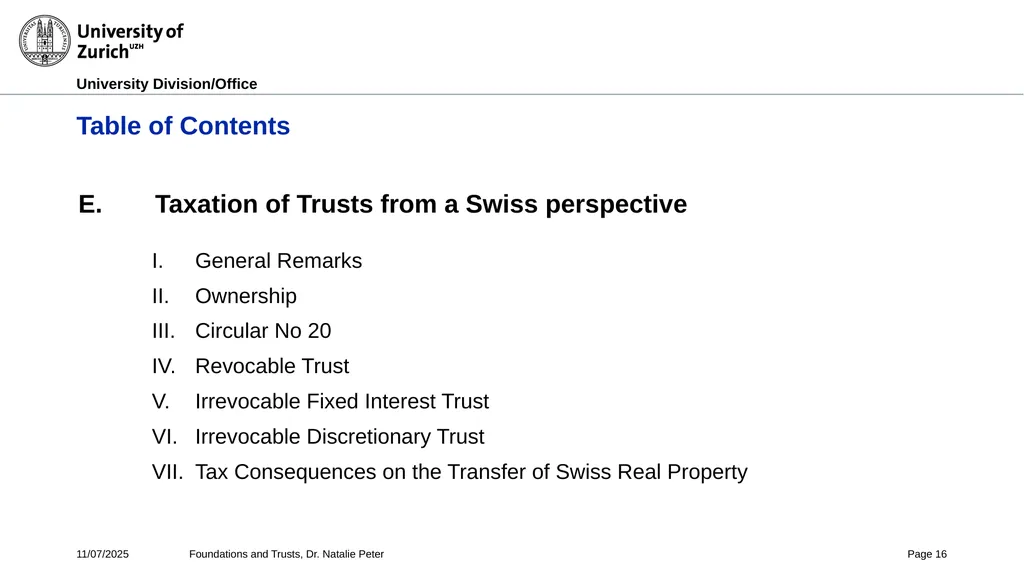
3/24/2022 Foundations and Trusts, Dr. Natalie Peter Table of Contents E. Taxation of Trusts from a Swiss perspective
General Remarks
Ownership
Circular No 20
Revocable Trust
Irrevocable Fixed Interest Trust
Irrevocable Discretionary Trust
Tax Consequences on the Transfer of Swiss Real Property Page 16<br>
General Remarks
Ownership
Circular No 20
Revocable Trust
Irrevocable Fixed Interest Trust
Irrevocable Discretionary Trust
Tax Consequences on the Transfer of Swiss Real Property Page 16<br>
17
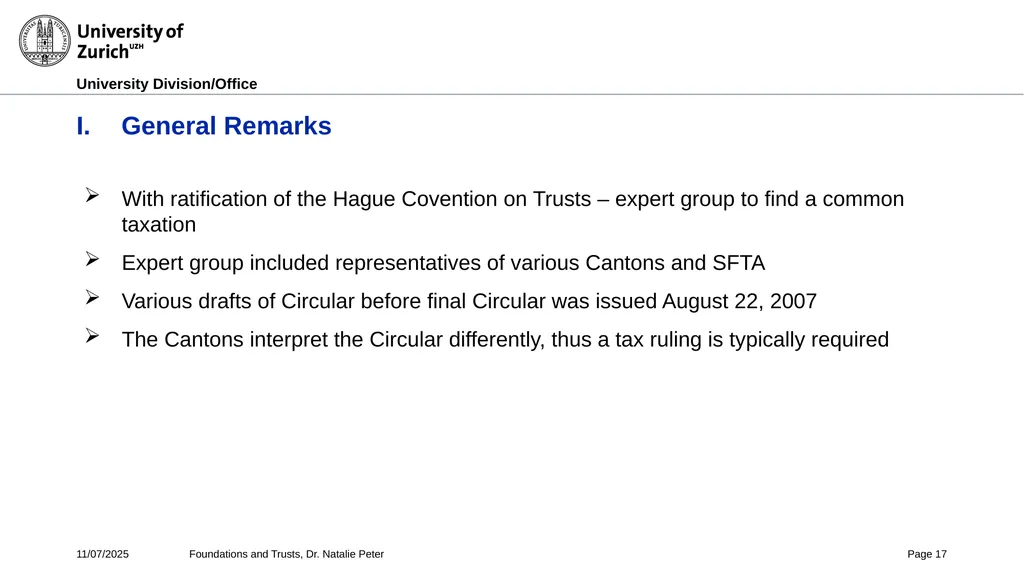
3/24/2022 Foundations and Trusts, Dr. Natalie Peter I. General Remarks With ratification of the Hague Covention on Trusts – expert group to find a common taxation
Expert group included representatives of various Cantons and SFTA
Various drafts of Circular before final Circular was issued August 22, 2007
The Cantons interpret the Circular differently, thus a tax ruling is typically required Page 17<br>
Expert group included representatives of various Cantons and SFTA
Various drafts of Circular before final Circular was issued August 22, 2007
The Cantons interpret the Circular differently, thus a tax ruling is typically required Page 17<br>
18
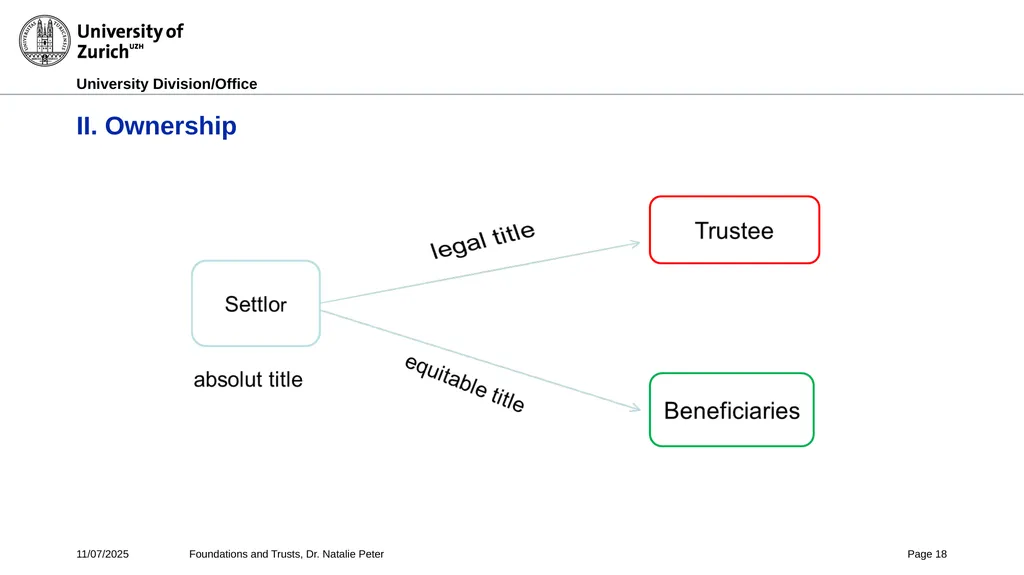
3/24/2022 Foundations and Trusts, Dr. Natalie Peter II. Ownership Page 18<br>
19
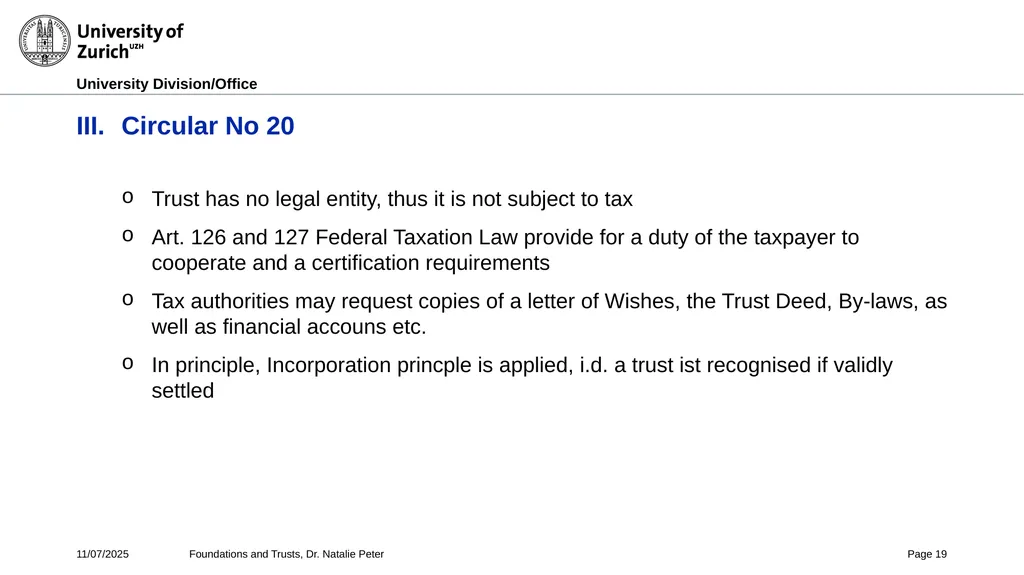
3/24/2022 Foundations and Trusts, Dr. Natalie Peter III. Circular No 20 Trust has no legal entity, thus it is not subject to tax
Art. 126 and 127 Federal Taxation Law provide for a duty of the taxpayer to cooperate and a certification requirements
Tax authorities may request copies of a letter of Wishes, the Trust Deed, By-laws, as well as financial accouns etc.
In principle, Incorporation princple is applied, i.d. a trust ist recognised if validly settled Page 19<br>
Art. 126 and 127 Federal Taxation Law provide for a duty of the taxpayer to cooperate and a certification requirements
Tax authorities may request copies of a letter of Wishes, the Trust Deed, By-laws, as well as financial accouns etc.
In principle, Incorporation princple is applied, i.d. a trust ist recognised if validly settled Page 19<br>
20
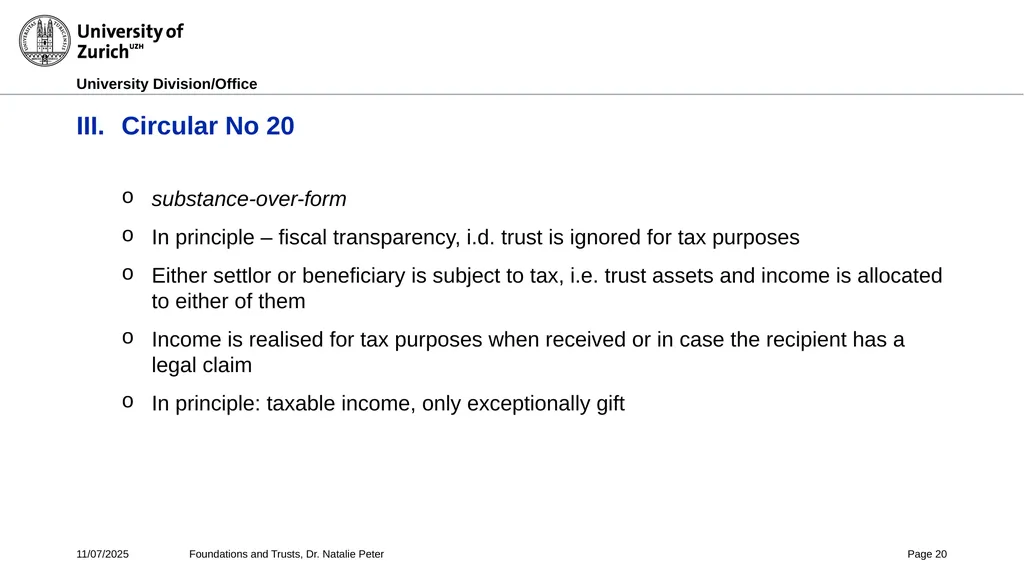
3/24/2022 Foundations and Trusts, Dr. Natalie Peter III. Circular No 20 substance-over-form
In principle – fiscal transparency, i.d. trust is ignored for tax purposes
Either settlor or beneficiary is subject to tax, i.e. trust assets and income is allocated to either of them
Income is realised for tax purposes when received or in case the recipient has a legal claim
In principle: taxable income, only exceptionally gift Page 20<br>
In principle – fiscal transparency, i.d. trust is ignored for tax purposes
Either settlor or beneficiary is subject to tax, i.e. trust assets and income is allocated to either of them
Income is realised for tax purposes when received or in case the recipient has a legal claim
In principle: taxable income, only exceptionally gift Page 20<br>
21
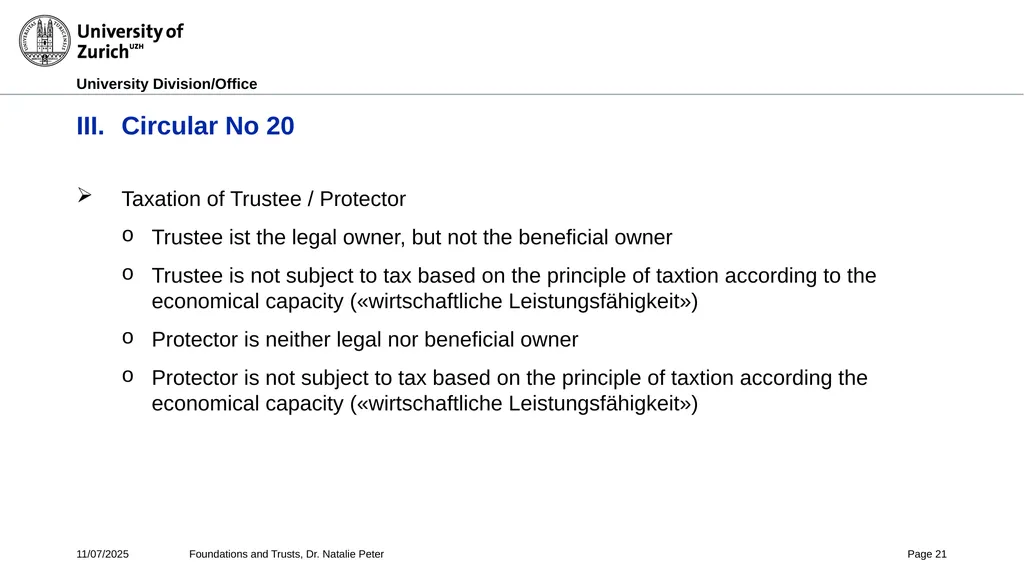
3/24/2022 Foundations and Trusts, Dr. Natalie Peter III. Circular No 20 Taxation of Trustee / Protector
Trustee ist the legal owner, but not the beneficial owner
Trustee is not subject to tax based on the principle of taxtion according to the economical capacity («wirtschaftliche Leistungsfähigkeit»)
Protector is neither legal nor beneficial owner
Protector is not subject to tax based on the principle of taxtion according the economical capacity («wirtschaftliche Leistungsfähigkeit») Page 21<br>
Trustee ist the legal owner, but not the beneficial owner
Trustee is not subject to tax based on the principle of taxtion according to the economical capacity («wirtschaftliche Leistungsfähigkeit»)
Protector is neither legal nor beneficial owner
Protector is not subject to tax based on the principle of taxtion according the economical capacity («wirtschaftliche Leistungsfähigkeit») Page 21<br>
22
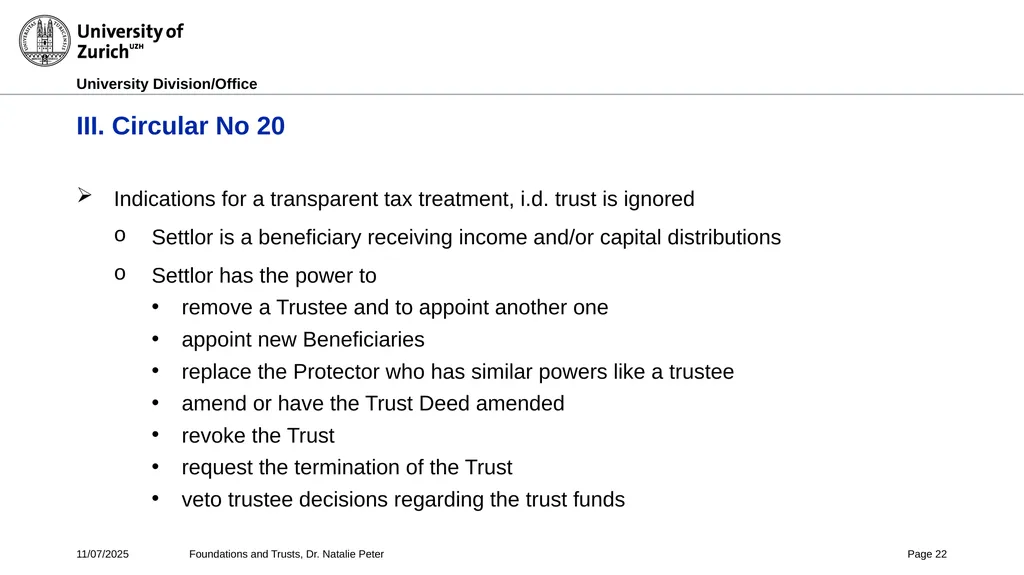
3/24/2022 Foundations and Trusts, Dr. Natalie Peter III. Circular No 20 Indications for a transparent tax treatment, i.d. trust is ignored
Settlor is a beneficiary receiving income and/or capital distributions
Settlor has the power to
remove a Trustee and to appoint another one
appoint new Beneficiaries
replace the Protector who has similar powers like a trustee
amend or have the Trust Deed amended
revoke the Trust
request the termination of the Trust
veto trustee decisions regarding the trust funds Page 22<br>
Settlor is a beneficiary receiving income and/or capital distributions
Settlor has the power to
remove a Trustee and to appoint another one
appoint new Beneficiaries
replace the Protector who has similar powers like a trustee
amend or have the Trust Deed amended
revoke the Trust
request the termination of the Trust
veto trustee decisions regarding the trust funds Page 22<br>
23
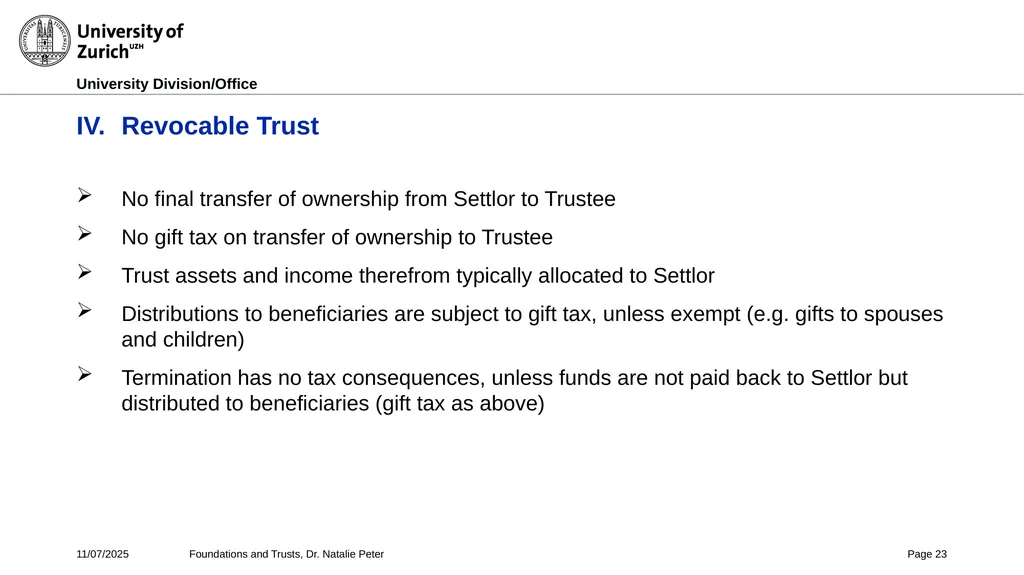
3/24/2022 Foundations and Trusts, Dr. Natalie Peter IV. Revocable Trust No final transfer of ownership from Settlor to Trustee
No gift tax on transfer of ownership to Trustee
Trust assets and income therefrom typically allocated to Settlor
Distributions to beneficiaries are subject to gift tax, unless exempt (e.g. gifts to spouses and children)
Termination has no tax consequences, unless funds are not paid back to Settlor but distributed to beneficiaries (gift tax as above) Page 23<br>
No gift tax on transfer of ownership to Trustee
Trust assets and income therefrom typically allocated to Settlor
Distributions to beneficiaries are subject to gift tax, unless exempt (e.g. gifts to spouses and children)
Termination has no tax consequences, unless funds are not paid back to Settlor but distributed to beneficiaries (gift tax as above) Page 23<br>
24
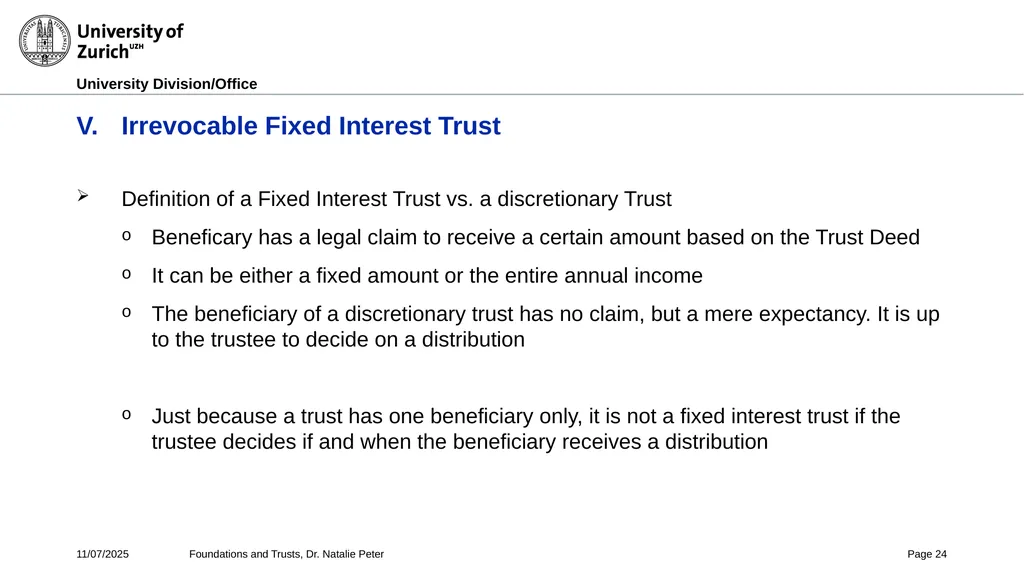
3/24/2022 Foundations and Trusts, Dr. Natalie Peter V. Irrevocable Fixed Interest Trust Definition of a Fixed Interest Trust vs. a discretionary Trust
Beneficary has a legal claim to receive a certain amount based on the Trust Deed
It can be either a fixed amount or the entire annual income
The beneficiary of a discretionary trust has no claim, but a mere expectancy. It is up to the trustee to decide on a distribution
Just because a trust has one beneficiary only, it is not a fixed interest trust if the trustee decides if and when the beneficiary receives a distribution Page 24<br>
Beneficary has a legal claim to receive a certain amount based on the Trust Deed
It can be either a fixed amount or the entire annual income
The beneficiary of a discretionary trust has no claim, but a mere expectancy. It is up to the trustee to decide on a distribution
Just because a trust has one beneficiary only, it is not a fixed interest trust if the trustee decides if and when the beneficiary receives a distribution Page 24<br>
25
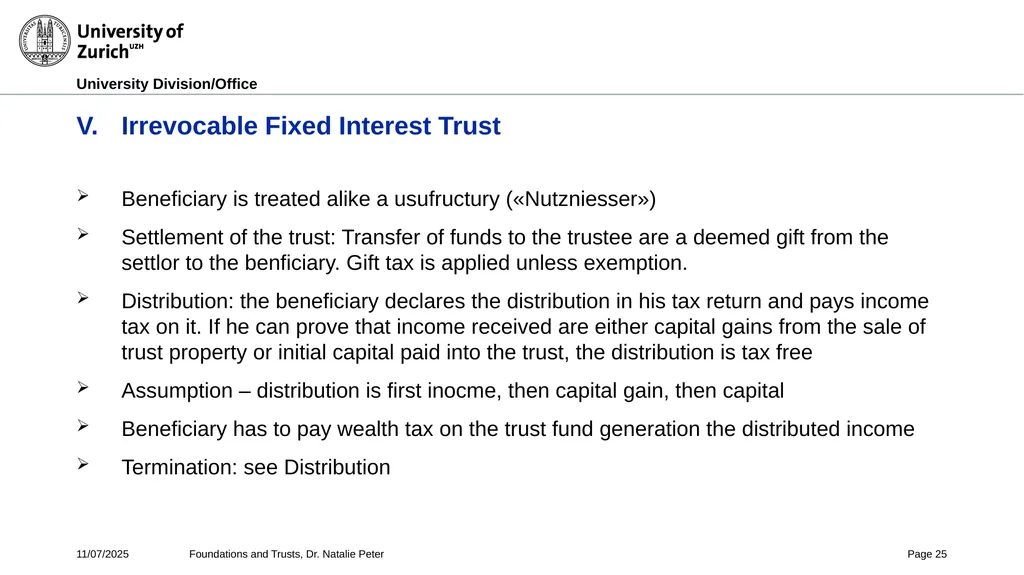
3/24/2022 Foundations and Trusts, Dr. Natalie Peter V. Irrevocable Fixed Interest Trust Beneficiary is treated alike a usufructury («Nutzniesser»)
Settlement of the trust: Transfer of funds to the trustee are a deemed gift from the settlor to the benficiary. Gift tax is applied unless exemption.
Distribution: the beneficiary declares the distribution in his tax return and pays income tax on it. If he can prove that income received are either capital gains from the sale of trust property or initial capital paid into the trust, the distribution is tax free
Assumption – distribution is first inocme, then capital gain, then capital
Beneficiary has to pay wealth tax on the trust fund generation the distributed income
Termination: see Distribution Page 25<br>
Settlement of the trust: Transfer of funds to the trustee are a deemed gift from the settlor to the benficiary. Gift tax is applied unless exemption.
Distribution: the beneficiary declares the distribution in his tax return and pays income tax on it. If he can prove that income received are either capital gains from the sale of trust property or initial capital paid into the trust, the distribution is tax free
Assumption – distribution is first inocme, then capital gain, then capital
Beneficiary has to pay wealth tax on the trust fund generation the distributed income
Termination: see Distribution Page 25<br>
26
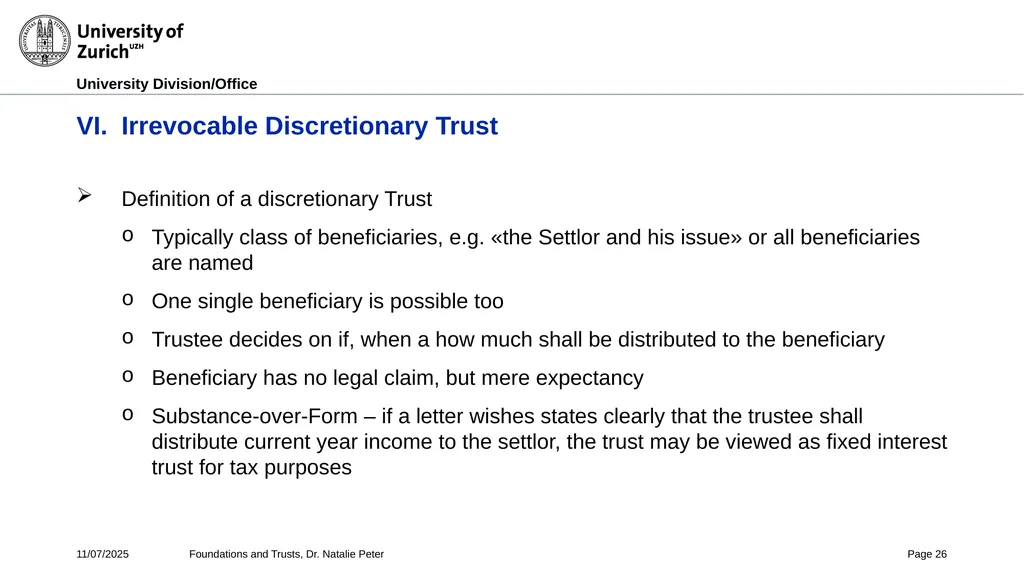
3/24/2022 Foundations and Trusts, Dr. Natalie Peter VI. Irrevocable Discretionary Trust Definition of a discretionary Trust
Typically class of beneficiaries, e.g. «the Settlor and his issue» or all beneficiaries are named
One single beneficiary is possible too
Trustee decides on if, when a how much shall be distributed to the beneficiary
Beneficiary has no legal claim, but mere expectancy
Substance-over-Form – if a letter wishes states clearly that the trustee shall distribute current year income to the settlor, the trust may be viewed as fixed interest trust for tax purposes Page 26<br>
Typically class of beneficiaries, e.g. «the Settlor and his issue» or all beneficiaries are named
One single beneficiary is possible too
Trustee decides on if, when a how much shall be distributed to the beneficiary
Beneficiary has no legal claim, but mere expectancy
Substance-over-Form – if a letter wishes states clearly that the trustee shall distribute current year income to the settlor, the trust may be viewed as fixed interest trust for tax purposes Page 26<br>
27
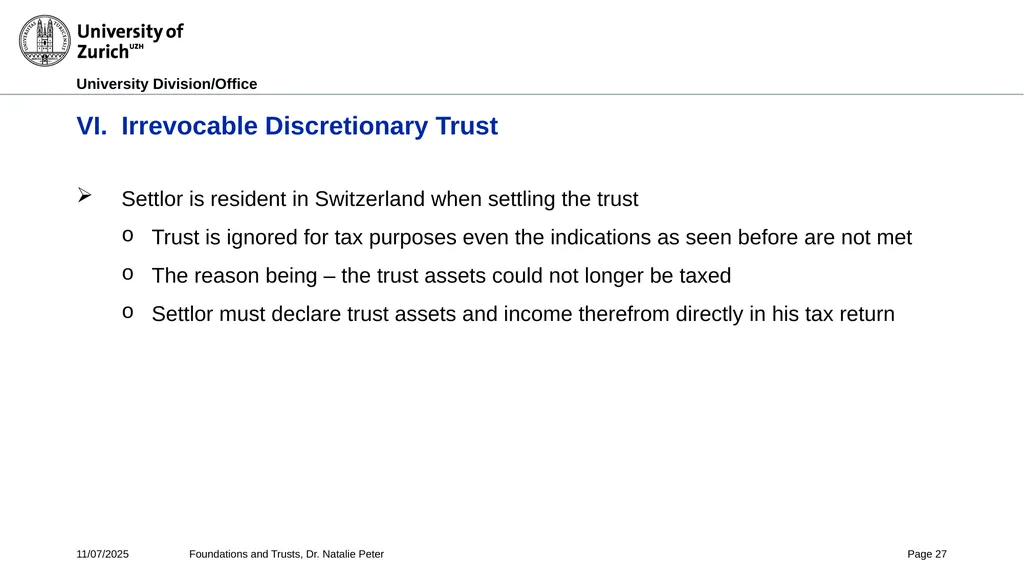
3/24/2022 Foundations and Trusts, Dr. Natalie Peter VI. Irrevocable Discretionary Trust Settlor is resident in Switzerland when settling the trust
Trust is ignored for tax purposes even the indications as seen before are not met
The reason being – the trust assets could not longer be taxed
Settlor must declare trust assets and income therefrom directly in his tax return Page 27<br>
Trust is ignored for tax purposes even the indications as seen before are not met
The reason being – the trust assets could not longer be taxed
Settlor must declare trust assets and income therefrom directly in his tax return Page 27<br>
28
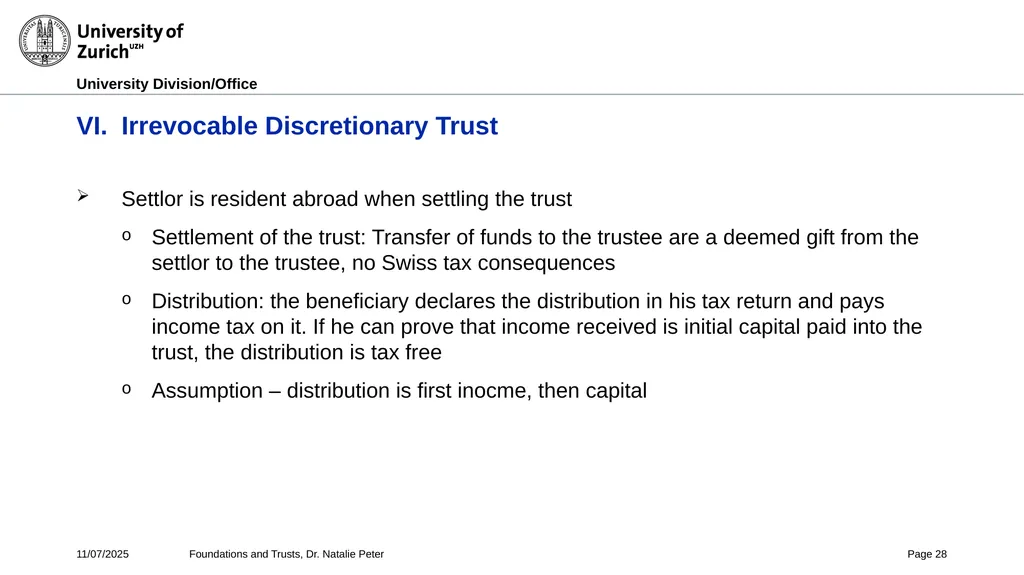
3/24/2022 Foundations and Trusts, Dr. Natalie Peter VI. Irrevocable Discretionary Trust Settlor is resident abroad when settling the trust
Settlement of the trust: Transfer of funds to the trustee are a deemed gift from the settlor to the trustee, no Swiss tax consequences
Distribution: the beneficiary declares the distribution in his tax return and pays income tax on it. If he can prove that income received is initial capital paid into the trust, the distribution is tax free
Assumption – distribution is first inocme, then capital Page 28<br>
Settlement of the trust: Transfer of funds to the trustee are a deemed gift from the settlor to the trustee, no Swiss tax consequences
Distribution: the beneficiary declares the distribution in his tax return and pays income tax on it. If he can prove that income received is initial capital paid into the trust, the distribution is tax free
Assumption – distribution is first inocme, then capital Page 28<br>
29
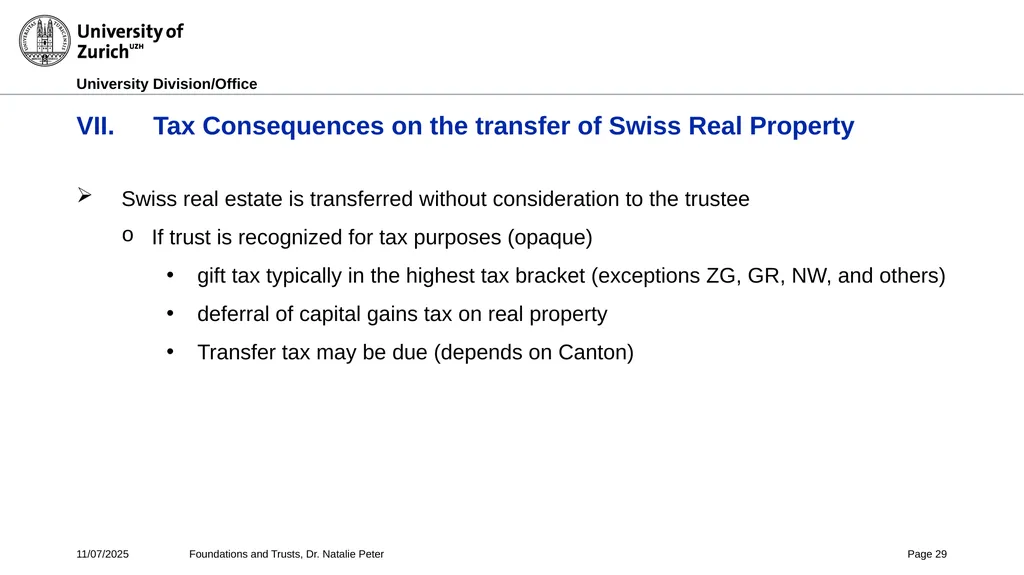
3/24/2022 Foundations and Trusts, Dr. Natalie Peter VII. Tax Consequences on the transfer of Swiss Real Property Swiss real estate is transferred without consideration to the trustee
If trust is recognized for tax purposes (opaque)
gift tax typically in the highest tax bracket (exceptions ZG, GR, NW, and others)
deferral of capital gains tax on real property
Transfer tax may be due (depends on Canton) Page 29<br>
If trust is recognized for tax purposes (opaque)
gift tax typically in the highest tax bracket (exceptions ZG, GR, NW, and others)
deferral of capital gains tax on real property
Transfer tax may be due (depends on Canton) Page 29<br>
30
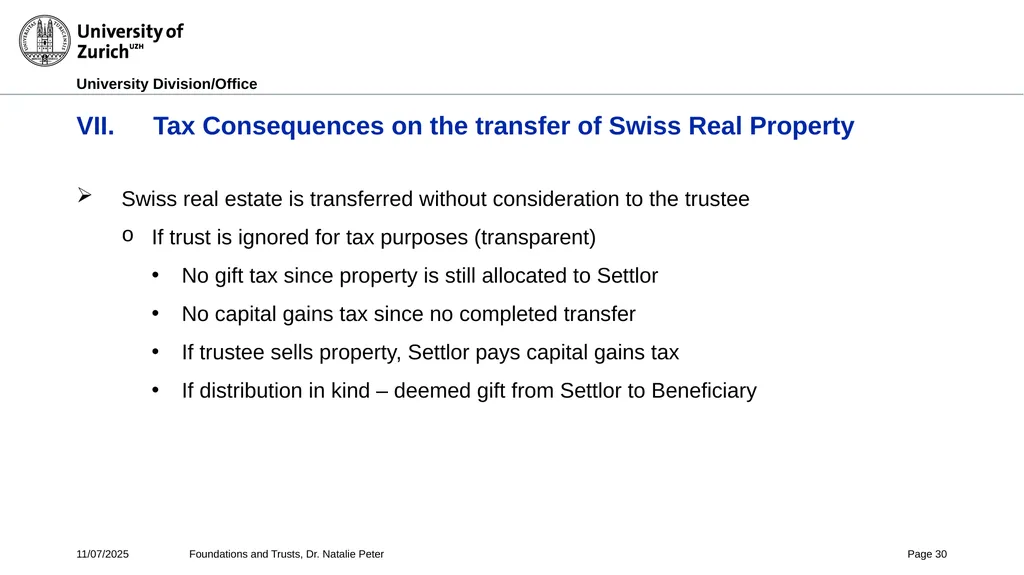
3/24/2022 Foundations and Trusts, Dr. Natalie Peter VII. Tax Consequences on the transfer of Swiss Real Property Swiss real estate is transferred without consideration to the trustee
If trust is ignored for tax purposes (transparent)
No gift tax since property is still allocated to Settlor
No capital gains tax since no completed transfer
If trustee sells property, Settlor pays capital gains tax
If distribution in kind – deemed gift from Settlor to Beneficiary Page 30<br>
If trust is ignored for tax purposes (transparent)
No gift tax since property is still allocated to Settlor
No capital gains tax since no completed transfer
If trustee sells property, Settlor pays capital gains tax
If distribution in kind – deemed gift from Settlor to Beneficiary Page 30<br>
31
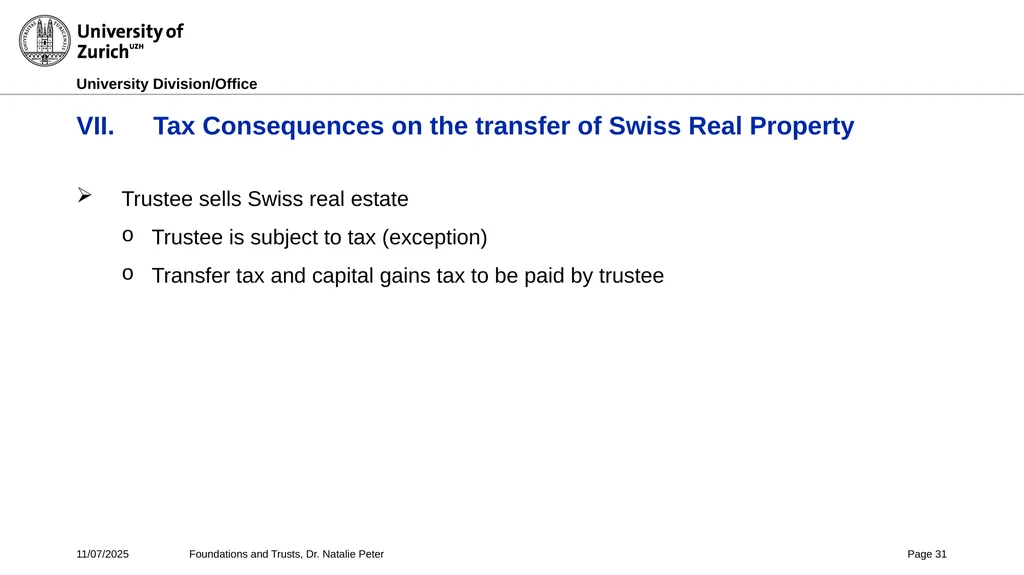
3/24/2022 Foundations and Trusts, Dr. Natalie Peter VII. Tax Consequences on the transfer of Swiss Real Property Trustee sells Swiss real estate
Trustee is subject to tax (exception)
Transfer tax and capital gains tax to be paid by trustee Page 31<br>
Trustee is subject to tax (exception)
Transfer tax and capital gains tax to be paid by trustee Page 31<br>
32
3/24/2022 Foundations and Trusts, Dr. Natalie Peter Table of Contents F. Application of Double Taxation Agreements (DTA)
Purpose of a DTA
Contents of a DTA
Treaty relief and residence according to the DTA
Application on foundations and trusts
Exchange of Information Page 32<br>
Purpose of a DTA
Contents of a DTA
Treaty relief and residence according to the DTA
Application on foundations and trusts
Exchange of Information Page 32<br>
33
3/24/2022 Foundations and Trusts, Dr. Natalie Peter I. Purpose of the DTA Double taxation agreements (DTAs) prevent the double taxation of private individuals and legal entities with an international nexus in the area of taxes on income and capital.
Over 3’000 DTA is place – number is growing
Art 2 of the Vienna Convention on the Law of Treaties
A treaty is an international agreement (in one or more instruments, whatever called) concluded between States and governed by international law.
DTAs confer rights and impose obligations on the two contracting States, but not on third parties such as taxpayers.
Under Article 26 of the Vienna Convention, DTAs are binding on the contracting States and must be performed by them in good faith. Page 33<br>
Over 3’000 DTA is place – number is growing
Art 2 of the Vienna Convention on the Law of Treaties
A treaty is an international agreement (in one or more instruments, whatever called) concluded between States and governed by international law.
DTAs confer rights and impose obligations on the two contracting States, but not on third parties such as taxpayers.
Under Article 26 of the Vienna Convention, DTAs are binding on the contracting States and must be performed by them in good faith. Page 33<br>
34
3/24/2022 Foundations and Trusts, Dr. Natalie Peter I. Purpose of the DTA Prevention of tax evasion and avoidance or double non-taxation
Treaties should apply to ensure that income is taxed once, and only once
Elimination of discrimination against foreign nationals and non-residents, i.e. Any country entering into a treaty wants to ensure that its residents who carry on business in the other contracting State are treated the same as the residents of that other State who carry on similar activities.
Administrative cooperation between the contracting States: exchange of information, assistance in the collection of taxes and dispute resolution
DTAs do not impose tax. Tax is imposed by domestic law, therefore, DTAs limit the taxes otherwise imposed by a State
DTAs are primarily relieving in nature Page 34<br>
Treaties should apply to ensure that income is taxed once, and only once
Elimination of discrimination against foreign nationals and non-residents, i.e. Any country entering into a treaty wants to ensure that its residents who carry on business in the other contracting State are treated the same as the residents of that other State who carry on similar activities.
Administrative cooperation between the contracting States: exchange of information, assistance in the collection of taxes and dispute resolution
DTAs do not impose tax. Tax is imposed by domestic law, therefore, DTAs limit the taxes otherwise imposed by a State
DTAs are primarily relieving in nature Page 34<br>
35
3/24/2022 Foundations and Trusts, Dr. Natalie Peter II. Contents of a typical DTA Based on OECD Model Convention, first published, in draft form, in 1963. Since then, revisions have been made every few years, on nine occasions, most recently in 2014
OECD Commentary, organized on an article-by-article basis, as become increasingly important with respect to the interpretation and the application of tax treaties, including some treaties between countries that are not members of the OECD.
The Commentaries on the OECD Model Convention also contain observations by particular countries on specific aspects of them. Countries register observations to indicate that they disagree with the interpretation of the treaty provided in the Commentary. Page 35<br>
OECD Commentary, organized on an article-by-article basis, as become increasingly important with respect to the interpretation and the application of tax treaties, including some treaties between countries that are not members of the OECD.
The Commentaries on the OECD Model Convention also contain observations by particular countries on specific aspects of them. Countries register observations to indicate that they disagree with the interpretation of the treaty provided in the Commentary. Page 35<br>
36
3/24/2022 Foundations and Trusts, Dr. Natalie Peter II. Contents of a typical DTA Chapter I consists
of Art 1, which identifies the persons whose tax obligations are affected by the treaty, generally residents of the contracting States,
and Art 2, which describes the taxes covered by the treaty, generally income and capital taxes imposed by the contracting States and their political subdivisions Page 36<br>
of Art 1, which identifies the persons whose tax obligations are affected by the treaty, generally residents of the contracting States,
and Art 2, which describes the taxes covered by the treaty, generally income and capital taxes imposed by the contracting States and their political subdivisions Page 36<br>
37
3/24/2022 Foundations and Trusts, Dr. Natalie Peter II. Contents of a typical DTA Chapter II provides
definitions of important terms used in the treaty including general definitions in Art 3
a definition of the term “resident” in Art 4
“permanent establishment” in Art 5 Page 37<br>
definitions of important terms used in the treaty including general definitions in Art 3
a definition of the term “resident” in Art 4
“permanent establishment” in Art 5 Page 37<br>
38
3/24/2022 Foundations and Trusts, Dr. Natalie Peter II. Contents of a typical DTA Chapter III contains the distributive rules of the treaty
Art 6-21 deal with various types of income derived by a resident of one or both of the States.
In general, these provisions determine whether only one or both of the contracting States - the State in which the taxpayer is resident (the residence country) and the State in which the income arises or has its source (the source country) - or whether both of them can tax the income and whether the rate of tax imposed is limited Page 38<br>
Art 6-21 deal with various types of income derived by a resident of one or both of the States.
In general, these provisions determine whether only one or both of the contracting States - the State in which the taxpayer is resident (the residence country) and the State in which the income arises or has its source (the source country) - or whether both of them can tax the income and whether the rate of tax imposed is limited Page 38<br>
39
3/24/2022 Foundations and Trusts, Dr. Natalie Peter II. Contents of a typical DTA Chapter IV deals with the taxation of capital (not income from capital)
Chapter V provides two alternative methods for eliminating double taxation
Art 23A (Exemption method) - the residence country excludes or exempts the income from residence country tax.
Art 23B (Credit method) - the residence country taxes the income but provides a deduction from that tax for the tax paid to the source country on the income Page 39<br>
Chapter V provides two alternative methods for eliminating double taxation
Art 23A (Exemption method) - the residence country excludes or exempts the income from residence country tax.
Art 23B (Credit method) - the residence country taxes the income but provides a deduction from that tax for the tax paid to the source country on the income Page 39<br>
40
3/24/2022 Foundations and Trusts, Dr. Natalie Peter II. Contents of a typical DTA Chapter VI is entitled “Special provisions”.
Art 24 provides protection against various forms of discriminatory taxation by the source and residence countries.
Art 25 provides a mutual agreement procedure (MAP) to resolve disputes concerning the application of the treaty
Art 26 deals with exchanges of information between the States
Art 27 provides rules for the contracting States to assist in collecting one another’s taxes
Art 28 simply provides that nothing in the treaty affects the “fiscal privileges” enjoyed by diplomats and consular officials under international law or other international agreements Page 40<br>
Art 24 provides protection against various forms of discriminatory taxation by the source and residence countries.
Art 25 provides a mutual agreement procedure (MAP) to resolve disputes concerning the application of the treaty
Art 26 deals with exchanges of information between the States
Art 27 provides rules for the contracting States to assist in collecting one another’s taxes
Art 28 simply provides that nothing in the treaty affects the “fiscal privileges” enjoyed by diplomats and consular officials under international law or other international agreements Page 40<br>
41
3/24/2022 Foundations and Trusts, Dr. Natalie Peter II. Contents of a typical DTA Chapter VII provides rules to govern the entry into force and termination of the treaty Page 41<br>
42
3/24/2022 Foundations and Trusts, Dr. Natalie Peter III. Treaty relief and residence according to DTA Art. 3 para.1
a) the term “person” includes an individual, a partnership, a company, an estate, a trust and any other body of person
b) the term "company" means any body corporate or any entity which is treated as a body corporate for tax purposes under the laws of the Contracting State in which it is organized
d) the term "nationals" means
i) all individuals possessing the nationality (i.e., citizenship, in the case of the United States) of a Contracting State; and
ii) all legal persons, partnerships and associations deriving their status as such from the laws in force in a Contracting State Page 42<br>
a) the term “person” includes an individual, a partnership, a company, an estate, a trust and any other body of person
b) the term "company" means any body corporate or any entity which is treated as a body corporate for tax purposes under the laws of the Contracting State in which it is organized
d) the term "nationals" means
i) all individuals possessing the nationality (i.e., citizenship, in the case of the United States) of a Contracting State; and
ii) all legal persons, partnerships and associations deriving their status as such from the laws in force in a Contracting State Page 42<br>
43
3/24/2022 Foundations and Trusts, Dr. Natalie Peter III. Treaty relief and residence according to DTA Art. 4 para.1 a) "resident of a Contracting State" means:
any person who, under the laws of that State, is liable to tax therein by reason of his domicile, residence, nationality, place of management, place of incorporation, or any other criterion of a similar nature,
except that a United States citizen or "green card" holder who is not a resident of Switzerland shall be considered to be a resident of the United States only if such person has a substantial presence, permanent home or habitual abode in the United States;
if, however, such person is also a resident of Switzerland under this paragraph, such person also will be treated as a United States resident under this paragraph and such person's status shall be determined under paragraph 3; Page 43<br>
any person who, under the laws of that State, is liable to tax therein by reason of his domicile, residence, nationality, place of management, place of incorporation, or any other criterion of a similar nature,
except that a United States citizen or "green card" holder who is not a resident of Switzerland shall be considered to be a resident of the United States only if such person has a substantial presence, permanent home or habitual abode in the United States;
if, however, such person is also a resident of Switzerland under this paragraph, such person also will be treated as a United States resident under this paragraph and such person's status shall be determined under paragraph 3; Page 43<br>
44
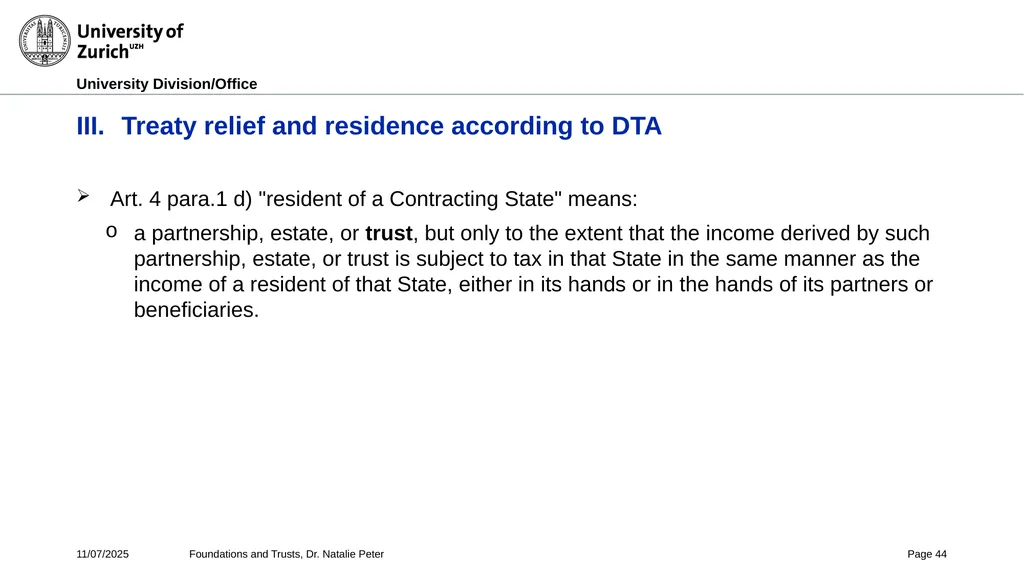
3/24/2022 Foundations and Trusts, Dr. Natalie Peter III. Treaty relief and residence according to DTA Art. 4 para.1 d) "resident of a Contracting State" means:
a partnership, estate, or trust, but only to the extent that the income derived by such partnership, estate, or trust is subject to tax in that State in the same manner as the income of a resident of that State, either in its hands or in the hands of its partners or beneficiaries. Page 44<br>
a partnership, estate, or trust, but only to the extent that the income derived by such partnership, estate, or trust is subject to tax in that State in the same manner as the income of a resident of that State, either in its hands or in the hands of its partners or beneficiaries. Page 44<br>
45
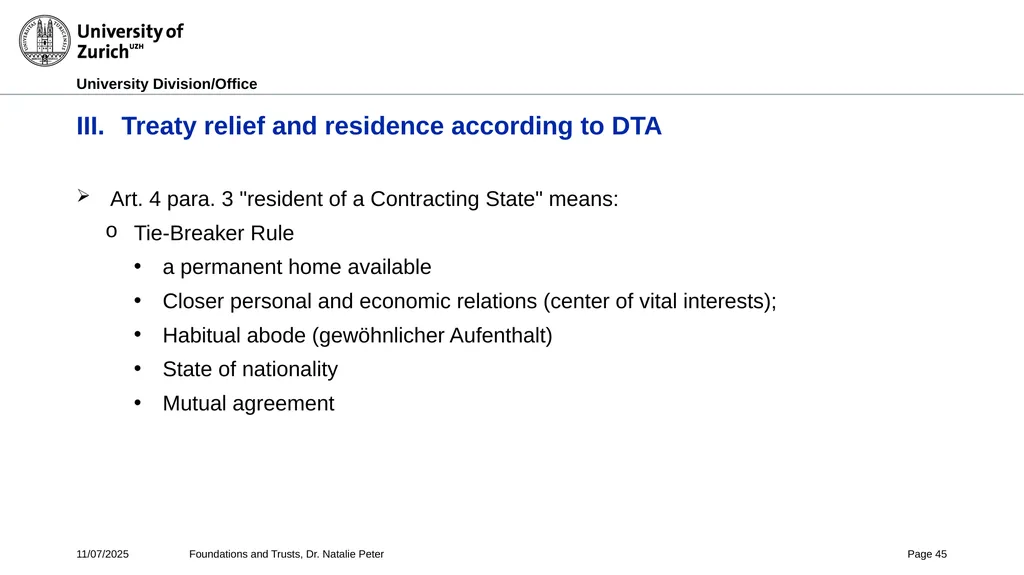
3/24/2022 Foundations and Trusts, Dr. Natalie Peter III. Treaty relief and residence according to DTA Art. 4 para. 3 "resident of a Contracting State" means:
Tie-Breaker Rule
a permanent home available
Closer personal and economic relations (center of vital interests);
Habitual abode (gewöhnlicher Aufenthalt)
State of nationality
Mutual agreement Page 45<br>
Tie-Breaker Rule
a permanent home available
Closer personal and economic relations (center of vital interests);
Habitual abode (gewöhnlicher Aufenthalt)
State of nationality
Mutual agreement Page 45<br>
46
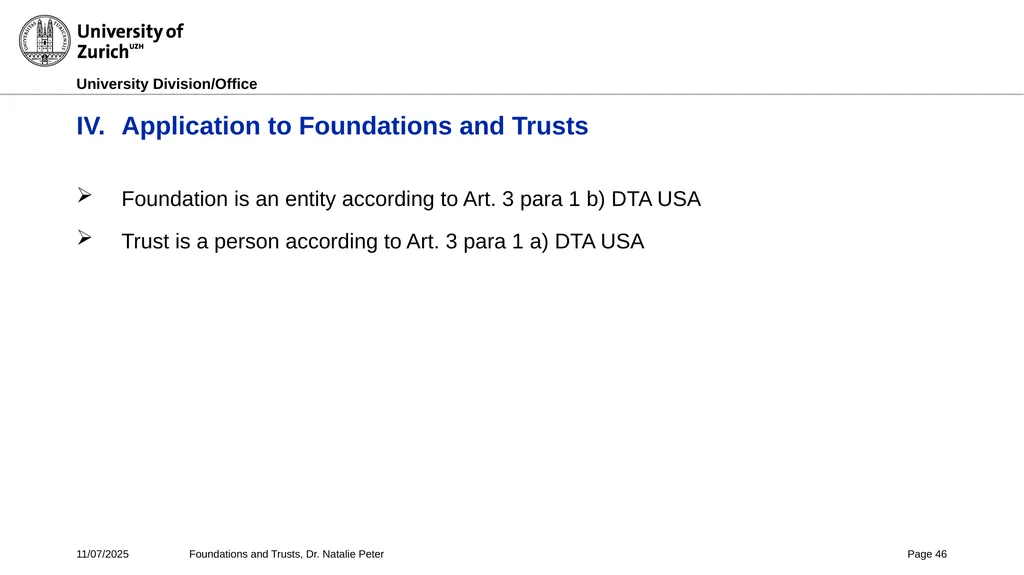
3/24/2022 Foundations and Trusts, Dr. Natalie Peter IV. Application to Foundations and Trusts Foundation is an entity according to Art. 3 para 1 b) DTA USA
Trust is a person according to Art. 3 para 1 a) DTA USA Page 46<br>
Trust is a person according to Art. 3 para 1 a) DTA USA Page 46<br>
47
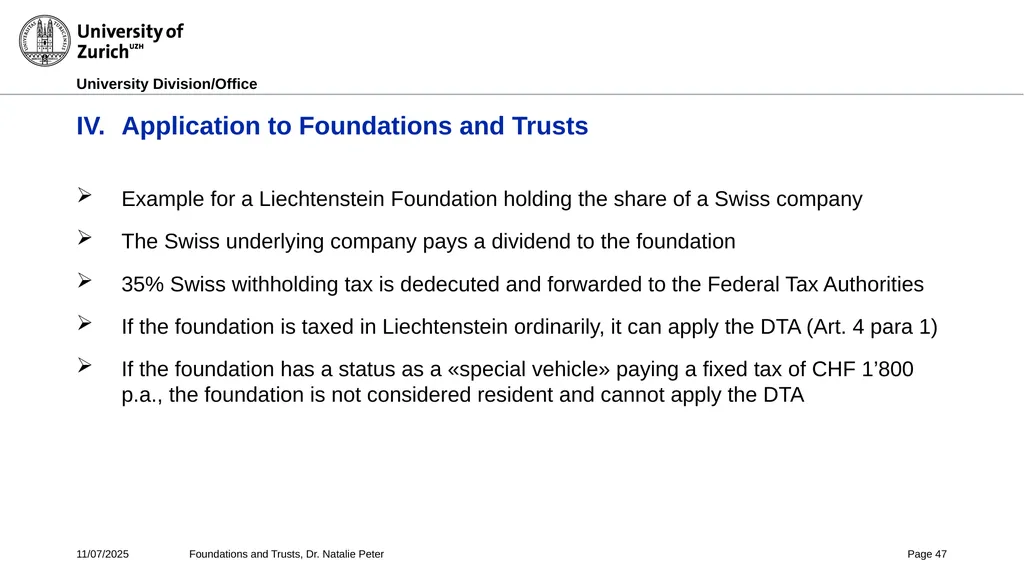
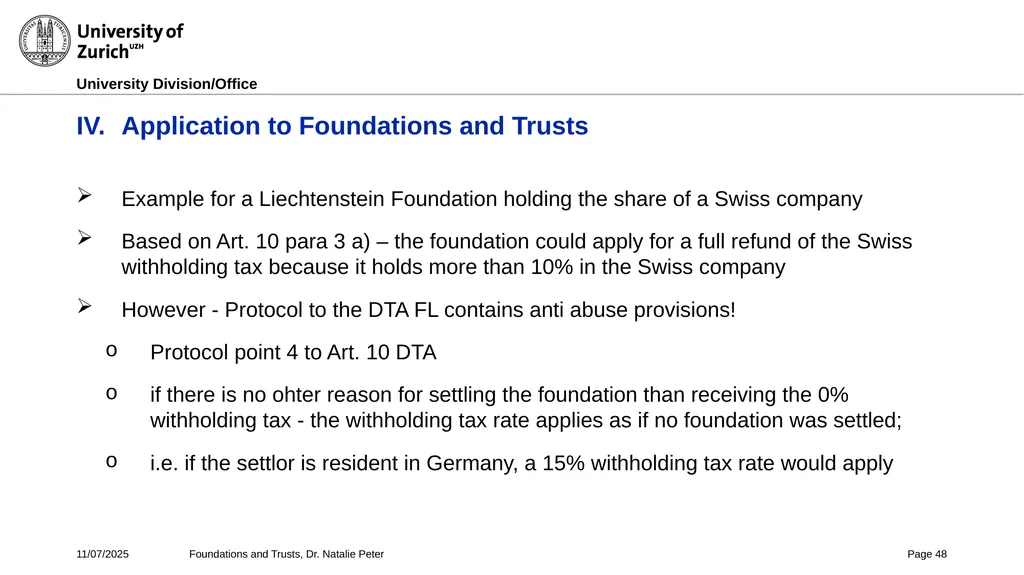
3/24/2022 Foundations and Trusts, Dr. Natalie Peter IV. Application to Foundations and Trusts Example for a Liechtenstein Foundation holding the share of a Swiss company
The Swiss underlying company pays a dividend to the foundation
35% Swiss withholding tax is dedecuted and forwarded to the Federal Tax Authorities
If the foundation is taxed in Liechtenstein ordinarily, it can apply the DTA (Art. 4 para 1)
If the foundation has a status as a «special vehicle» paying a fixed tax of CHF 1’800 p.a., the foundation is not considered resident and cannot apply the DTA Page 47<br>
The Swiss underlying company pays a dividend to the foundation
35% Swiss withholding tax is dedecuted and forwarded to the Federal Tax Authorities
If the foundation is taxed in Liechtenstein ordinarily, it can apply the DTA (Art. 4 para 1)
If the foundation has a status as a «special vehicle» paying a fixed tax of CHF 1’800 p.a., the foundation is not considered resident and cannot apply the DTA Page 47<br>
48
3/24/2022 Foundations and Trusts, Dr. Natalie Peter IV. Application to Foundations and Trusts Example for a Liechtenstein Foundation holding the share of a Swiss company
Based on Art. 10 para 3 a) – the foundation could apply for a full refund of the Swiss withholding tax because it holds more than 10% in the Swiss company
However - Protocol to the DTA FL contains anti abuse provisions!
Protocol point 4 to Art. 10 DTA
if there is no ohter reason for settling the foundation than receiving the 0% withholding tax - the withholding tax rate applies as if no foundation was settled;
i.e. if the settlor is resident in Germany, a 15% withholding tax rate would apply Page 48<br>
Based on Art. 10 para 3 a) – the foundation could apply for a full refund of the Swiss withholding tax because it holds more than 10% in the Swiss company
However - Protocol to the DTA FL contains anti abuse provisions!
Protocol point 4 to Art. 10 DTA
if there is no ohter reason for settling the foundation than receiving the 0% withholding tax - the withholding tax rate applies as if no foundation was settled;
i.e. if the settlor is resident in Germany, a 15% withholding tax rate would apply Page 48<br>
49
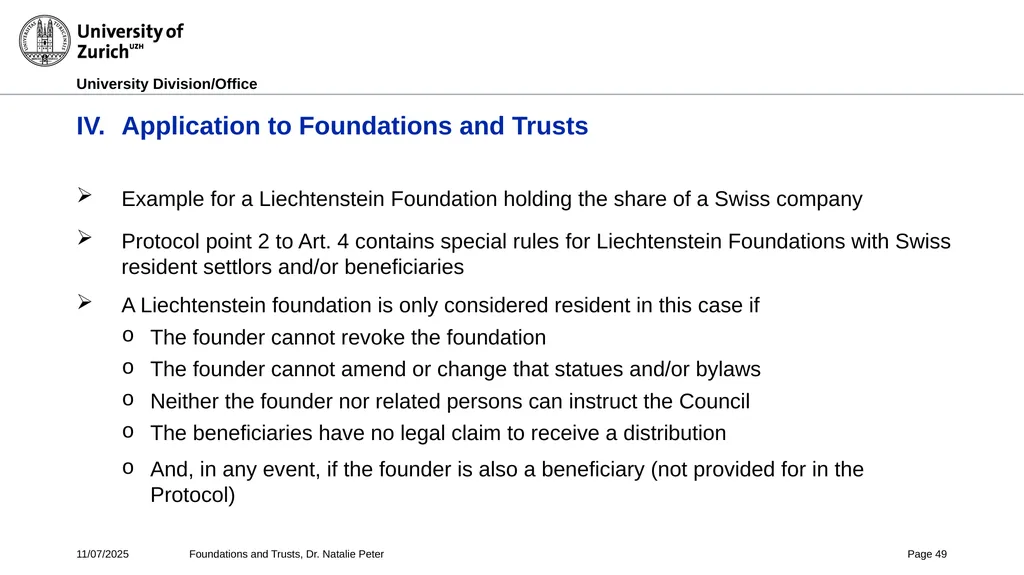
3/24/2022 Foundations and Trusts, Dr. Natalie Peter IV. Application to Foundations and Trusts Example for a Liechtenstein Foundation holding the share of a Swiss company
Protocol point 2 to Art. 4 contains special rules for Liechtenstein Foundations with Swiss resident settlors and/or beneficiaries
A Liechtenstein foundation is only considered resident in this case if
The founder cannot revoke the foundation
The founder cannot amend or change that statues and/or bylaws
Neither the founder nor related persons can instruct the Council
The beneficiaries have no legal claim to receive a distribution
And, in any event, if the founder is also a beneficiary (not provided for in the Protocol) Page 49<br>
Protocol point 2 to Art. 4 contains special rules for Liechtenstein Foundations with Swiss resident settlors and/or beneficiaries
A Liechtenstein foundation is only considered resident in this case if
The founder cannot revoke the foundation
The founder cannot amend or change that statues and/or bylaws
Neither the founder nor related persons can instruct the Council
The beneficiaries have no legal claim to receive a distribution
And, in any event, if the founder is also a beneficiary (not provided for in the Protocol) Page 49<br>
50
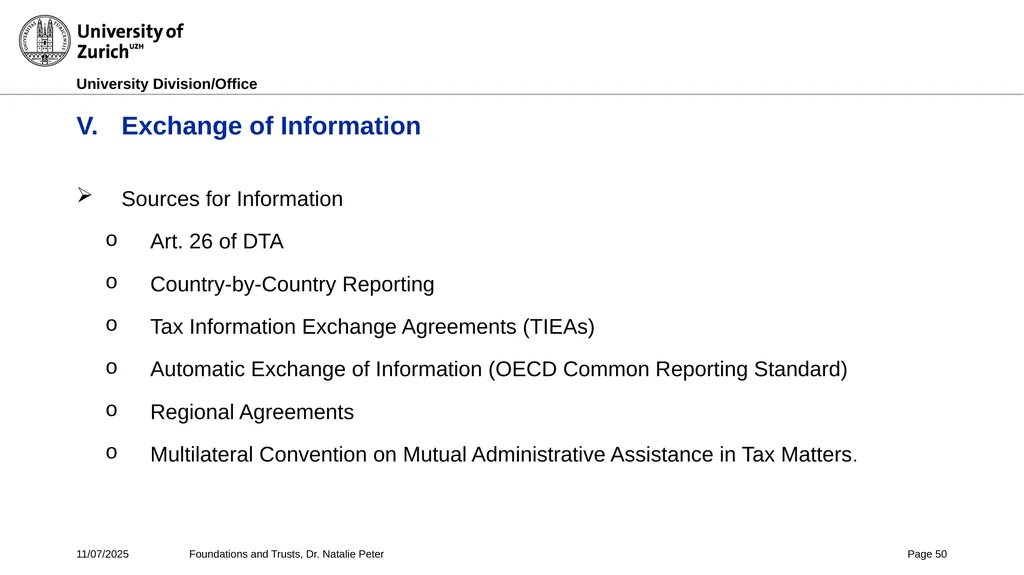
3/24/2022 Foundations and Trusts, Dr. Natalie Peter V. Exchange of Information Sources for Information
Art. 26 of DTA
Country-by-Country Reporting
Tax Information Exchange Agreements (TIEAs)
Automatic Exchange of Information (OECD Common Reporting Standard)
Regional Agreements
Multilateral Convention on Mutual Administrative Assistance in Tax Matters. Page 50<br>
Art. 26 of DTA
Country-by-Country Reporting
Tax Information Exchange Agreements (TIEAs)
Automatic Exchange of Information (OECD Common Reporting Standard)
Regional Agreements
Multilateral Convention on Mutual Administrative Assistance in Tax Matters. Page 50<br>
51
3/24/2022 Foundations and Trusts, Dr. Natalie Peter V. Exchange of Information Federal Act on the Exchange of Information (StAhiG)
Ordinance on the Exchange of Information (StAhiV)
typically Art. 26 DTA Page 51<br>
Ordinance on the Exchange of Information (StAhiV)
typically Art. 26 DTA Page 51<br>
52
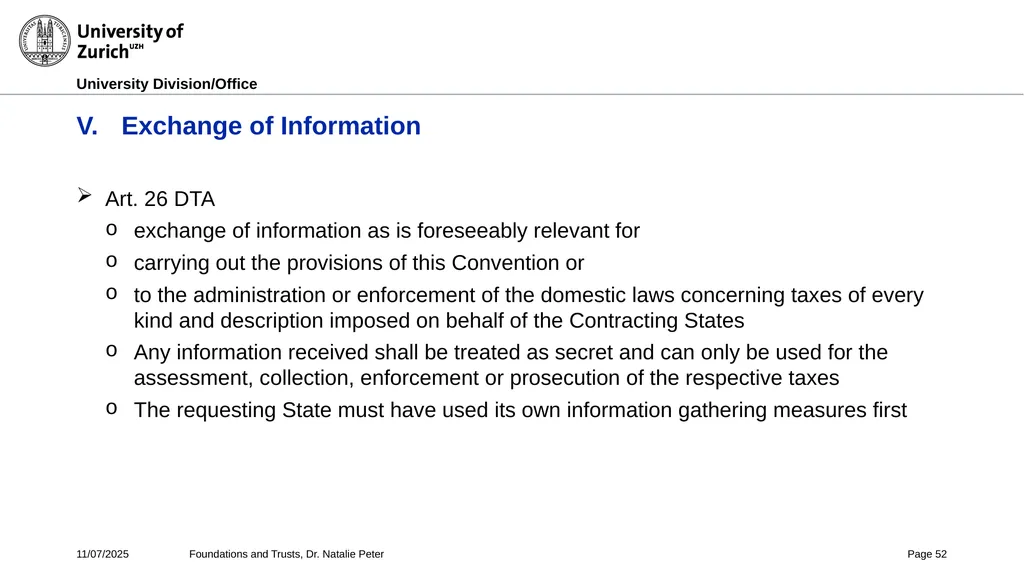
3/24/2022 Foundations and Trusts, Dr. Natalie Peter V. Exchange of Information Art. 26 DTA
exchange of information as is foreseeably relevant for
carrying out the provisions of this Convention or
to the administration or enforcement of the domestic laws concerning taxes of every kind and description imposed on behalf of the Contracting States
Any information received shall be treated as secret and can only be used for the assessment, collection, enforcement or prosecution of the respective taxes
The requesting State must have used its own information gathering measures first Page 52<br>
exchange of information as is foreseeably relevant for
carrying out the provisions of this Convention or
to the administration or enforcement of the domestic laws concerning taxes of every kind and description imposed on behalf of the Contracting States
Any information received shall be treated as secret and can only be used for the assessment, collection, enforcement or prosecution of the respective taxes
The requesting State must have used its own information gathering measures first Page 52<br>
53
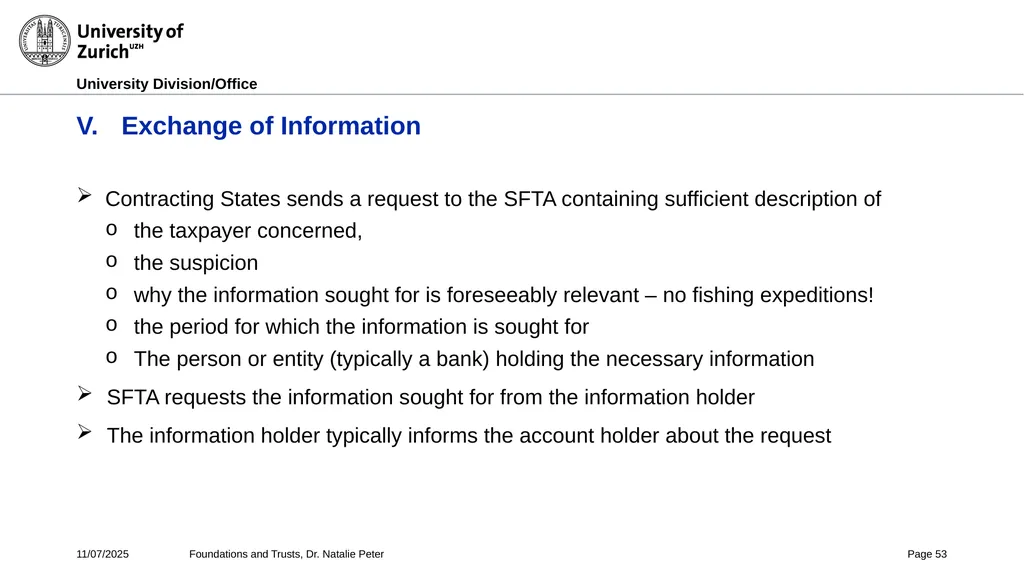
3/24/2022 Foundations and Trusts, Dr. Natalie Peter V. Exchange of Information Contracting States sends a request to the SFTA containing sufficient description of
the taxpayer concerned,
the suspicion
why the information sought for is foreseeably relevant – no fishing expeditions!
the period for which the information is sought for
The person or entity (typically a bank) holding the necessary information
SFTA requests the information sought for from the information holder
The information holder typically informs the account holder about the request Page 53<br>
the taxpayer concerned,
the suspicion
why the information sought for is foreseeably relevant – no fishing expeditions!
the period for which the information is sought for
The person or entity (typically a bank) holding the necessary information
SFTA requests the information sought for from the information holder
The information holder typically informs the account holder about the request Page 53<br>
54
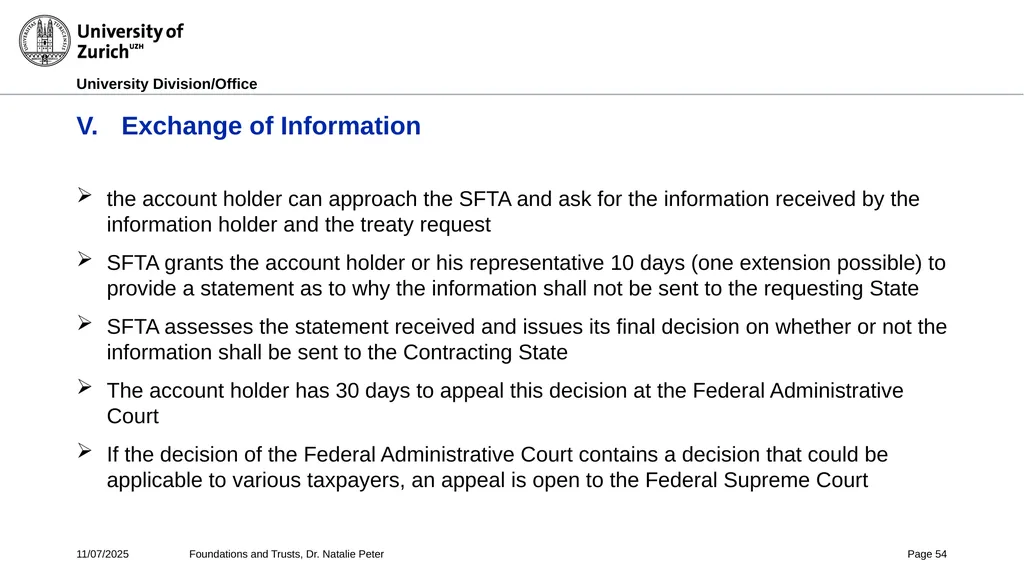
3/24/2022 Foundations and Trusts, Dr. Natalie Peter V. Exchange of Information the account holder can approach the SFTA and ask for the information received by the information holder and the treaty request
SFTA grants the account holder or his representative 10 days (one extension possible) to provide a statement as to why the information shall not be sent to the requesting State
SFTA assesses the statement received and issues its final decision on whether or not the information shall be sent to the Contracting State
The account holder has 30 days to appeal this decision at the Federal Administrative Court
If the decision of the Federal Administrative Court contains a decision that could be applicable to various taxpayers, an appeal is open to the Federal Supreme Court Page 54<br>
SFTA grants the account holder or his representative 10 days (one extension possible) to provide a statement as to why the information shall not be sent to the requesting State
SFTA assesses the statement received and issues its final decision on whether or not the information shall be sent to the Contracting State
The account holder has 30 days to appeal this decision at the Federal Administrative Court
If the decision of the Federal Administrative Court contains a decision that could be applicable to various taxpayers, an appeal is open to the Federal Supreme Court Page 54<br>
55
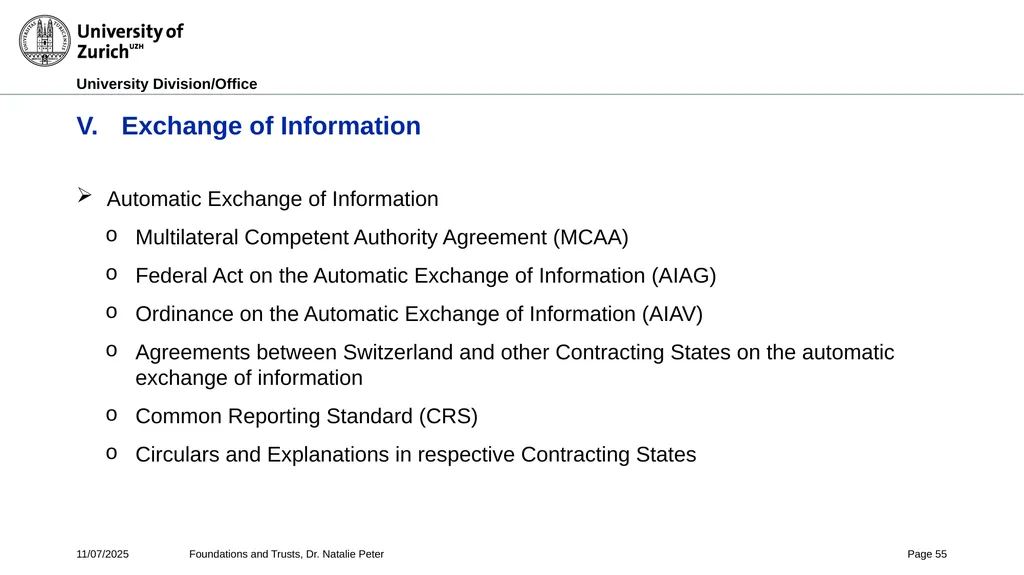
3/24/2022 Foundations and Trusts, Dr. Natalie Peter V. Exchange of Information Automatic Exchange of Information
Multilateral Competent Authority Agreement (MCAA)
Federal Act on the Automatic Exchange of Information (AIAG)
Ordinance on the Automatic Exchange of Information (AIAV)
Agreements between Switzerland and other Contracting States on the automatic exchange of information
Common Reporting Standard (CRS)
Circulars and Explanations in respective Contracting States Page 55<br>
Multilateral Competent Authority Agreement (MCAA)
Federal Act on the Automatic Exchange of Information (AIAG)
Ordinance on the Automatic Exchange of Information (AIAV)
Agreements between Switzerland and other Contracting States on the automatic exchange of information
Common Reporting Standard (CRS)
Circulars and Explanations in respective Contracting States Page 55<br>
56
3/24/2022 Foundations and Trusts, Dr. Natalie Peter V. Exchange of Information Automatic Exchange of Information
Either bank or foundation/trust is the Financial Institution (FI) obliged to do the reporting if necessary
FI is required to identify customers who appear to be tax resident outside of the country/jurisdiction where they hold their accounts
Tax residence means subject to unlimited taxation in a jurisdiction
Information reported: interest, dividends, account balance or value, sales proceeds or income generated from financial assets.
reportable accounts can be held by individuals and entities, which also includes trusts and foundations Page 56<br>
Either bank or foundation/trust is the Financial Institution (FI) obliged to do the reporting if necessary
FI is required to identify customers who appear to be tax resident outside of the country/jurisdiction where they hold their accounts
Tax residence means subject to unlimited taxation in a jurisdiction
Information reported: interest, dividends, account balance or value, sales proceeds or income generated from financial assets.
reportable accounts can be held by individuals and entities, which also includes trusts and foundations Page 56<br>
57
3/24/2022 Foundations and Trusts, Dr. Natalie Peter V. Exchange of Information Automatic Exchange of Information
Controlling person by way of ownership
individuals who directly or indirectly effectively control a legal entity by way of a 25% ownership (voting power or equity participation). For domiciliary companies no such threshold exists, i.e. every beneficial owner, regardless of their participation quota, must be considered to be controlling persons.
Controlling person in another distinguishable manner Page 57<br>
Controlling person by way of ownership
individuals who directly or indirectly effectively control a legal entity by way of a 25% ownership (voting power or equity participation). For domiciliary companies no such threshold exists, i.e. every beneficial owner, regardless of their participation quota, must be considered to be controlling persons.
Controlling person in another distinguishable manner Page 57<br>
58
3/24/2022 Foundations and Trusts, Dr. Natalie Peter V. Exchange of Information Automatic Exchange of Information
Controlling person in another distinguishable manner
Exercise of actual control over a legal entity exercised by
a patron with less than 25% quota or voting power, but nevertheless holds de facto control of over the company,
a shareholder’s agreement if the shareholders can exercise control over the company,
a lender, exercising a dominant influence over the decisions of the management of the company because of a loan. Page 58<br>
Controlling person in another distinguishable manner
Exercise of actual control over a legal entity exercised by
a patron with less than 25% quota or voting power, but nevertheless holds de facto control of over the company,
a shareholder’s agreement if the shareholders can exercise control over the company,
a lender, exercising a dominant influence over the decisions of the management of the company because of a loan. Page 58<br>
59
3/24/2022 Foundations and Trusts, Dr. Natalie Peter V. Exchange of Information Automatic Exchange of Information
In absence of a controlling person in another distinguishable manner
Controlling person as an executive of the legal entity
The managing person, i.e. the individual who effectively manages the legal entity Page 59<br>
In absence of a controlling person in another distinguishable manner
Controlling person as an executive of the legal entity
The managing person, i.e. the individual who effectively manages the legal entity Page 59<br>
60
3/24/2022 Foundations and Trusts, Dr. Natalie Peter V. Exchange of Information Automatic Exchange of Information
In case of trusts and foundations
settlor/founder
trustee, provided it is an individual
protector is the supervisory body of the trust or the foundation, provided it is an individual
beneficiaries, in case they have a legal title to receive a distribution or are named explicitly Page 60<br>
In case of trusts and foundations
settlor/founder
trustee, provided it is an individual
protector is the supervisory body of the trust or the foundation, provided it is an individual
beneficiaries, in case they have a legal title to receive a distribution or are named explicitly Page 60<br>
61
3/24/2022 Foundations and Trusts, Dr. Natalie Peter V. Exchange of Information Automatic Exchange of Information
In case of trusts and foundations
exception: beneficiaries of a discretionary trust/foundation, who have not received any distributions during a calendar year, do not have to be considered as controlling person
trustee confirms to FI in written form, that those beneficiaries have not received any distributions from the trust during the reporting period Page 61<br>
In case of trusts and foundations
exception: beneficiaries of a discretionary trust/foundation, who have not received any distributions during a calendar year, do not have to be considered as controlling person
trustee confirms to FI in written form, that those beneficiaries have not received any distributions from the trust during the reporting period Page 61<br>