FRACTURE CLASSIFICATION Submitted by:- DR.Kumari Prashansa Sinha M.V.Sc. Student (Course VSR-610) Department of veterinary Surgery and Radiology Dr. Ramesh Tiwary Assistant Professor Deptt. of Veterinary Surgery and Radiology FRACTURE A
"FRACTURE CLASSIFICATION Submitted by:- DR.Kumari" is the property of its rightful owner. Permission is granted to
download and print the materials on this website for personal, non-commercial use only, and to display it
on your personal computer provided you do not modify the materials and that you retain all copyright
notices contained in the materials. By downloading content from our website, you accept the terms of this
agreement.
Presentation Transcript
01
FRACTURE CLASSIFICATION Submitted by:-
DR.Kumari Prashansa Sinha
M.V.Sc. Student
(Course VSR-610)
Department of veterinary Surgery and Radiology Dr. Ramesh Tiwary
Assistant Professor
Deptt. of Veterinary Surgery and Radiology<br>
02
FRACTURE A fracture is a break in the continuity of hard tissue like bone , cartilage etc
ETIOLOGY
1) Extrinsic 2) Intrinsic
Extrinsic cause Intrinsic cause
1) Indirect trauma:-Bending force. 1) Muscular Contraction:-
2) Direct trauma. Tensional force. Avulsion fracture.
Shearing force. 2) Pathological fracture:-
Compressive force. -bone tumors & cysts.
-Osteoporosis.
-Localized bone infection
(osteomyelltis).
-Osteoporosis caused by prolonged
fixation .<br>
03
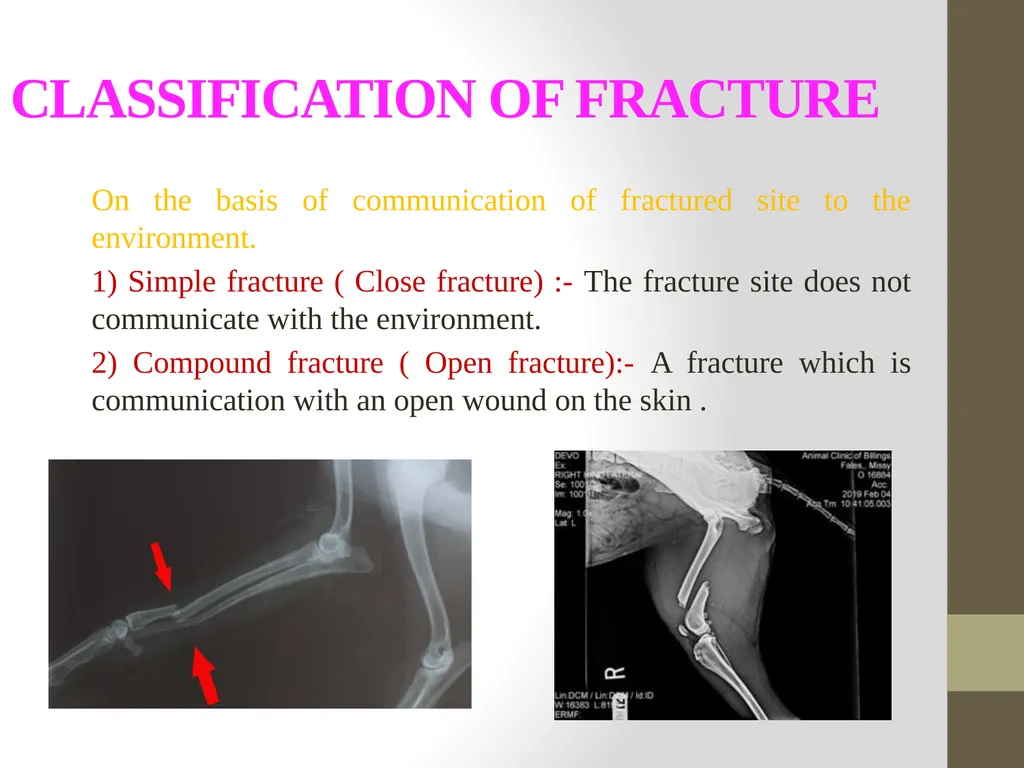
CLASSIFICATION OF FRACTURE On the basis of communication of fractured site to the environment.
1) Simple fracture ( Close fracture) :- The fracture site does not communicate with the environment.
2) Compound fracture ( Open fracture):- A fracture which is communication with an open wound on the skin .<br>
04
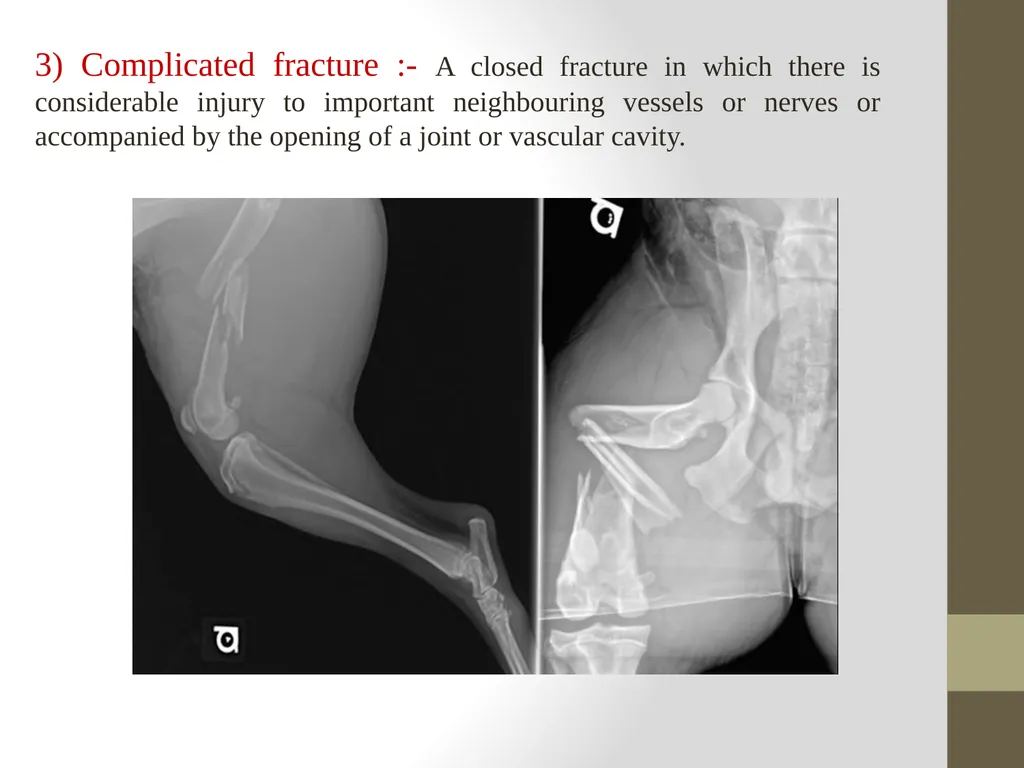
3) Complicated fracture :- A closed fracture in which there is considerable injury to important neighbouring vessels or nerves or accompanied by the opening of a joint or vascular cavity.<br>
05
On the basis of extent of bond damage.
3 types
Incomplete fracture :- Fracture which does not extended through complete thickness of the bone.
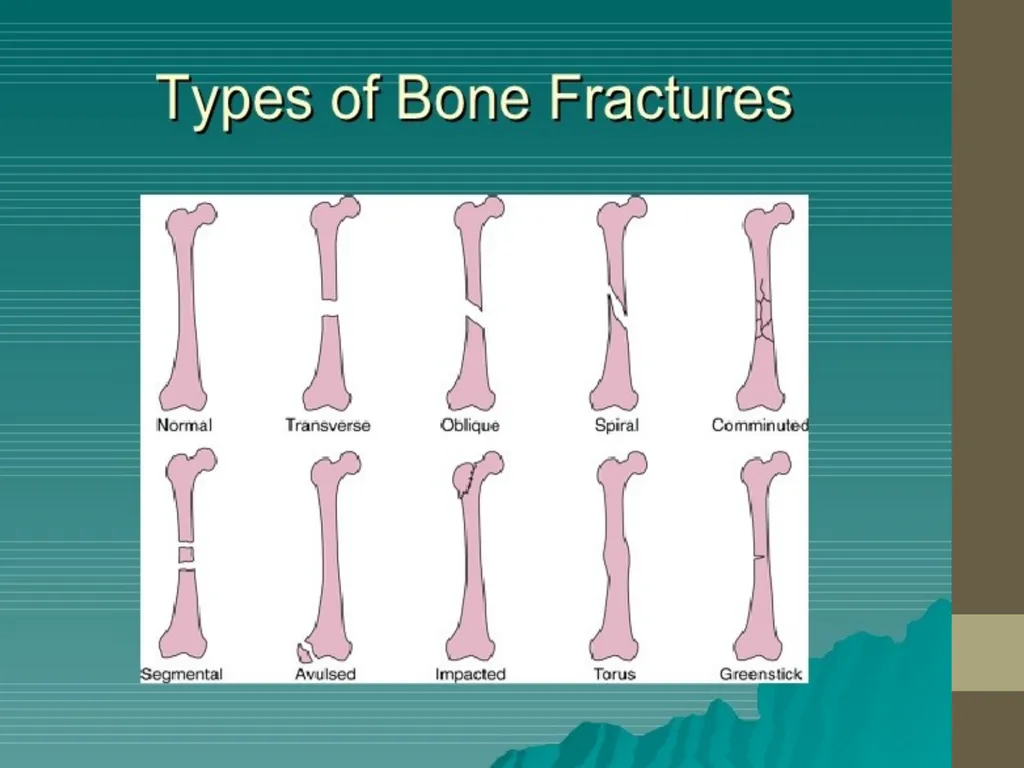
Greenstick fracture:- In such fractures, the cortex opposite to the bending force fractures completely , while the cortex under the force remain intact . Fracture occures in young animal.
Fissured fracture:- fissure (crack)
-In fissured fracture there is a direct trauma applied to a bone is not sufficient to cause a complete fracture , fissure line will occur.
-The fissure formed in one cortex of the bone & generally the periosteum remains intact.
-The fissure line may be longitudinal, transverse or oblique.<br>
06
Splintered or Partial fracture:- When splinters of bone are separated from the main bone .Ex- Fire arms.
Subperiosteal (Intraperiosteal) fracture:- A fracture of the cortical bone without rupture of the periosteum.
Deferred fracture:- In which separation of fragments occurs only after a varying period after incident due to subsequent violence, strain or concussion .Ex- Broken back is horse.
2) A Complete fracture :- It is a fracture in which the bone is broken completely through its thickness.
Single fracture:- When the bone is broken at one place only.
Double fracture:- When there are two fracture in the same bone. Multiple fracture :- when there are two fractures in the same bone.
Comminuted fracture:- At least three fracture lines inter connect each other at one point.<br>
07
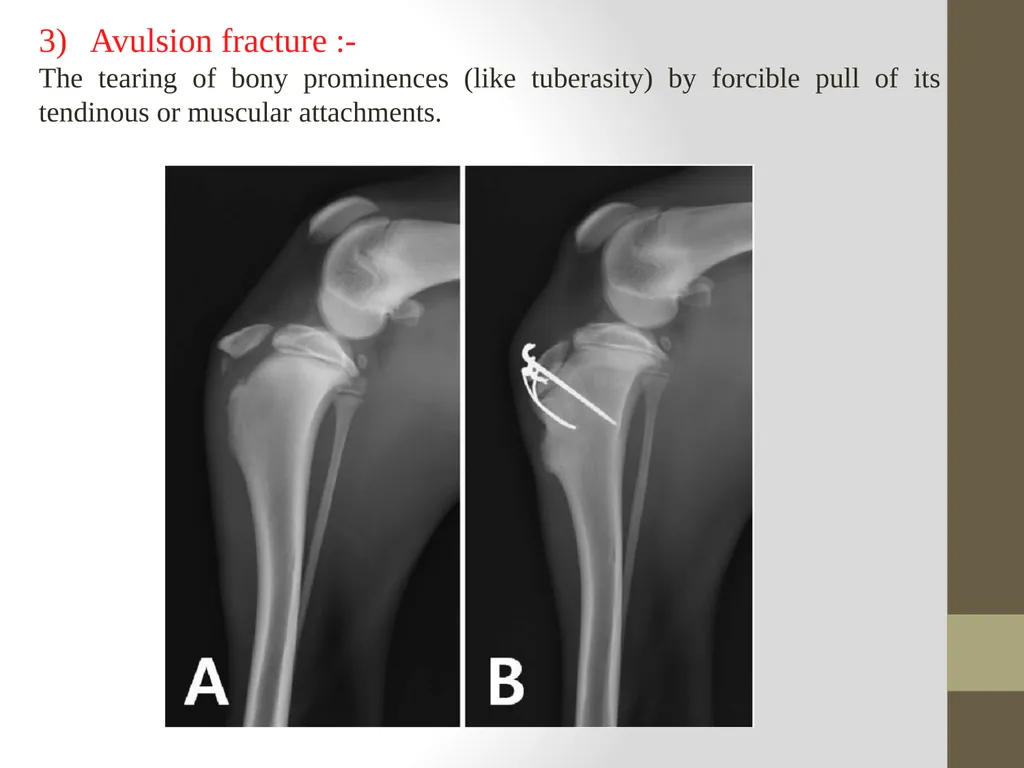
Avulsion fracture :-
The tearing of bony prominences (like tuberasity) by forcible pull of its tendinous or muscular attachments.<br>
08
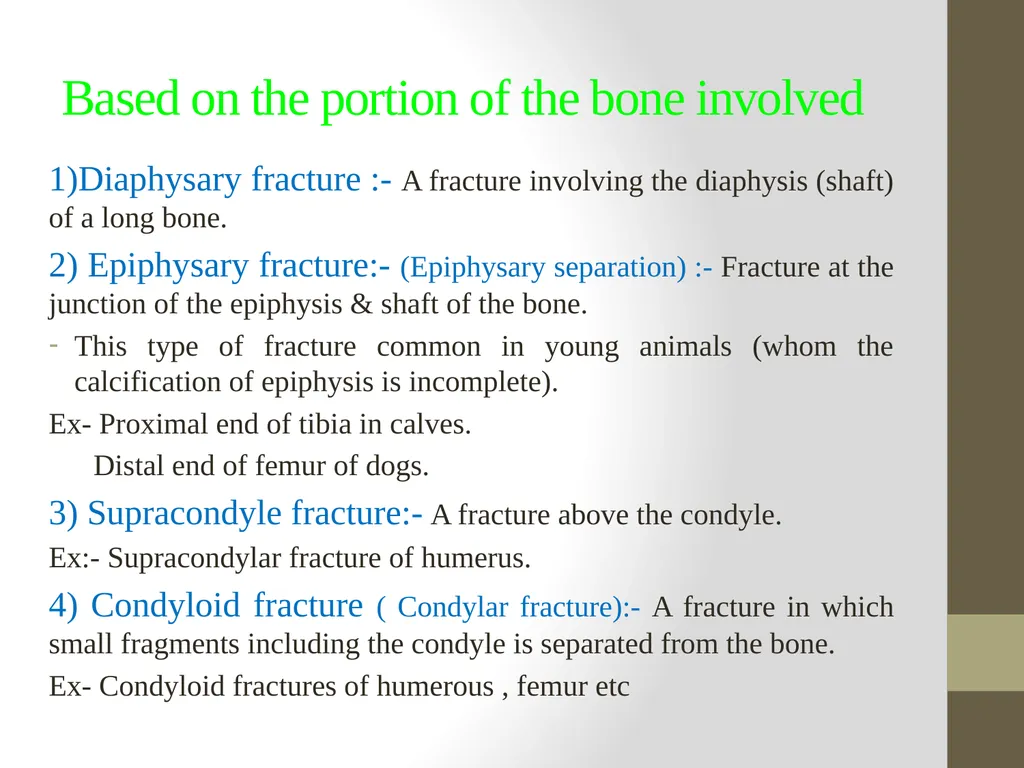
Based on the portion of the bone involved 1)Diaphysary fracture :- A fracture involving the diaphysis (shaft) of a long bone.
2) Epiphysary fracture:- (Epiphysary separation) :- Fracture at the junction of the epiphysis & shaft of the bone.
This type of fracture common in young animals (whom the calcification of epiphysis is incomplete).
Ex- Proximal end of tibia in calves.
Distal end of femur of dogs.
3) Supracondyle fracture:- A fracture above the condyle.
Ex:- Supracondylar fracture of humerus.
4) Condyloid fracture ( Condylar fracture):- A fracture in which small fragments including the condyle is separated from the bone.
Ex- Condyloid fractures of humerous , femur etc<br>
09
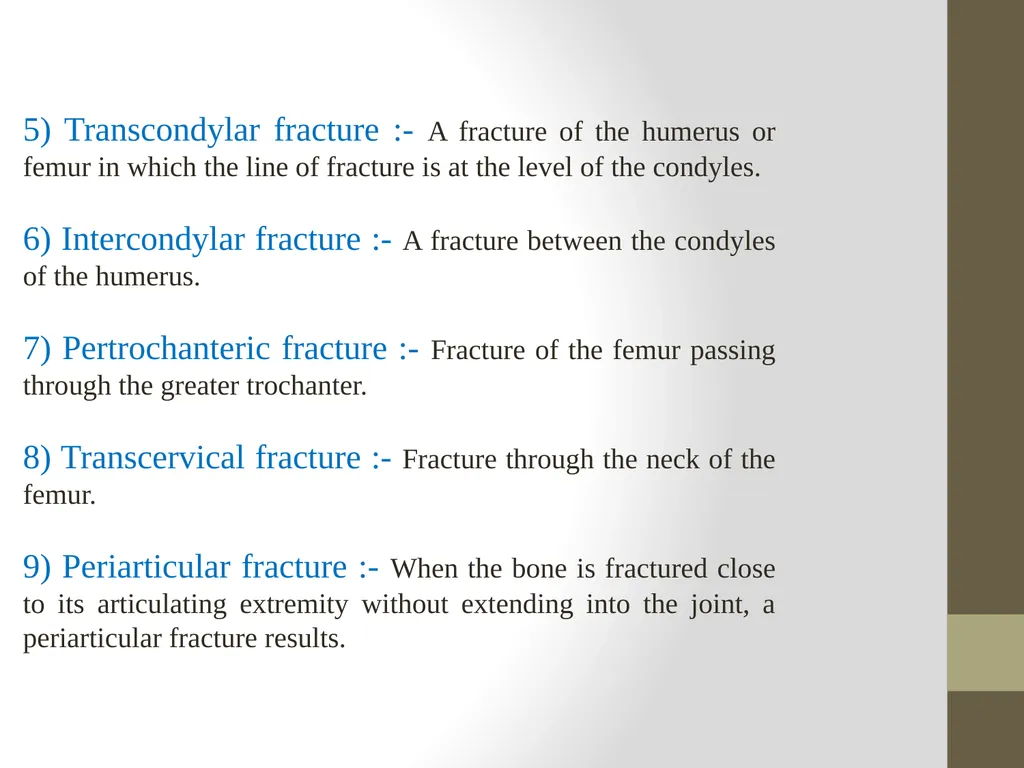
5) Transcondylar fracture :- A fracture of the humerus or femur in which the line of fracture is at the level of the condyles.
6) Intercondylar fracture :- A fracture between the condyles of the humerus.
7) Pertrochanteric fracture :- Fracture of the femur passing through the greater trochanter.
8) Transcervical fracture :- Fracture through the neck of the femur.
9) Periarticular fracture :- When the bone is fractured close to its articulating extremity without extending into the joint, a periarticular fracture results.<br>
10
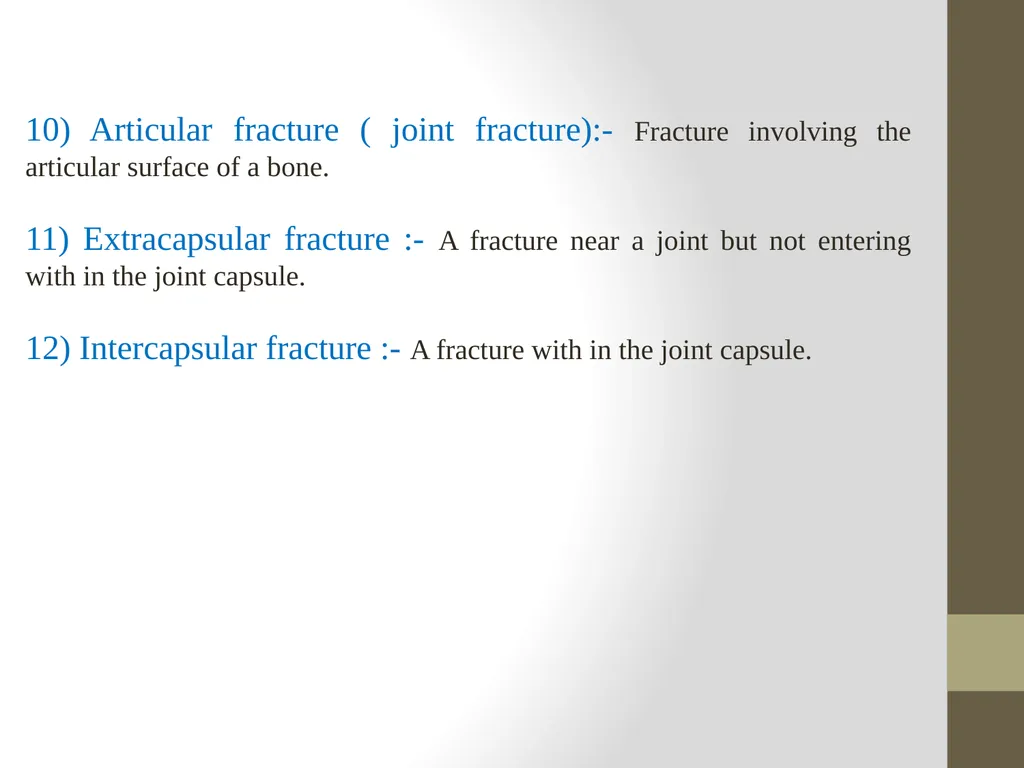
10) Articular fracture ( joint fracture):- Fracture involving the articular surface of a bone.
11) Extracapsular fracture :- A fracture near a joint but not entering with in the joint capsule.
12) Intercapsular fracture :- A fracture with in the joint capsule.<br>
11
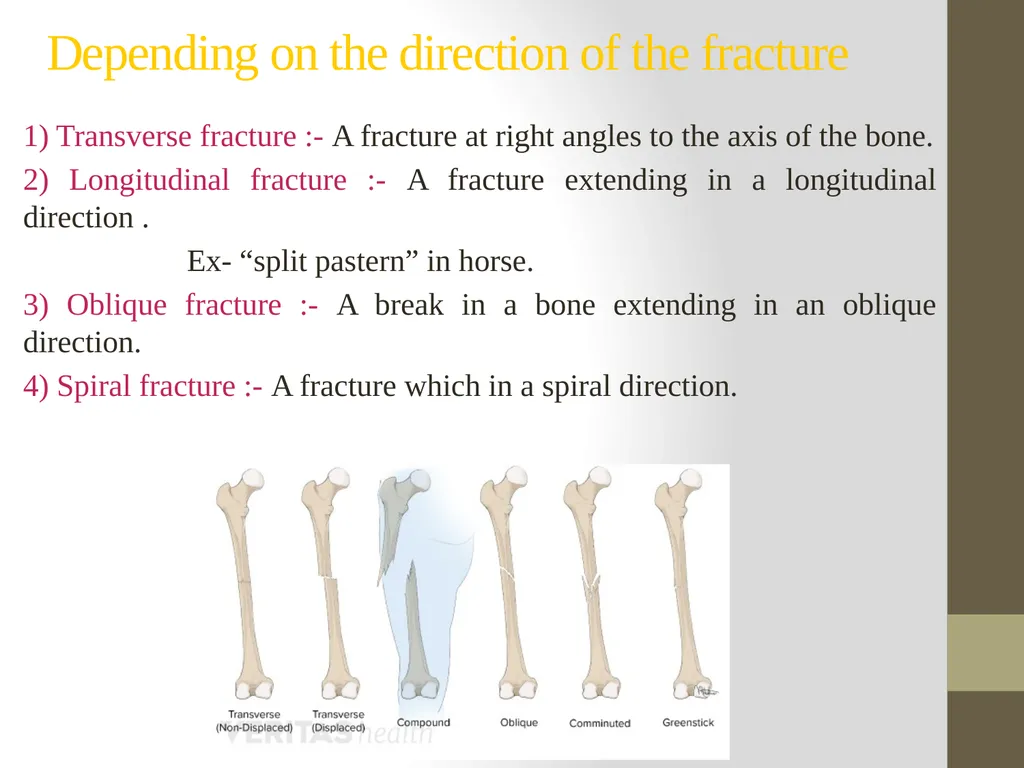
Depending on the direction of the fracture 1) Transverse fracture :- A fracture at right angles to the axis of the bone.
2) Longitudinal fracture :- A fracture extending in a longitudinal direction .
Ex- “split pastern” in horse.
3) Oblique fracture :- A break in a bone extending in an oblique direction.
4) Spiral fracture :- A fracture which in a spiral direction.<br>
12
Depending on relation between the fragments in the fracture. 1) Torsion fracture :- A fracture in which one of the fragments has been twisted & separated.
2) Impacted fracture :- Fracture in which one fragment is firmly driven into another or one bone is driven into the fracture site of another. Ex:- Head of femur being driven into a fractured acetabulum.
3) Dentate fracture :- A fracture in which the ends of the fragments are toothed & interlocked.
4) Riding fracture ( Over- riding fracture) :- A fracture in which fragments lie side by side , causing shortening of the limb.
5) Distracted fracture :- A fracture in which the fragments are separated by muscular pull. Ex- Fracture of olecranon.<br>
13
A FRACTURE COULD BE 1) Compression fracture :- A fracture produced by compression , causing apparent reduction in the size of the bone due to pressure . Ex:- Some fracture occurring in cancellous bones like vertebrae.
2) Depressed fracture :- A fracture of the skull in which a fragment is depressed below the surface .
3) Colle’s fracture :- Fracture of the distal end of radius. Abduction a paw is noticed in colle’s fracture.
4) Pathological fracture (Spontaneous fracture, secondary fracture):- A fracture occurring due to a weakening of bone by disease & not due to trauma.
5) Congenital ( Intrauterine) fracture:- Fracture of the bone of a foetus in the uterus.<br>