Framework for Community Clinic Collaboration March
Description: Framework for Community Clinic Collaboration March 6, 2018 Prepared for: CCALAC Homeless Housing Committee 1 Agenda WPC-LA Overview Community Health Worker (CHW) Care Management Model Framework for Collaboration Next Steps Questions and
Related Topics
Download Presentation
"Framework for Community Clinic Collaboration March" is the property of its rightful owner. Permission is granted to download and print the materials on this website for personal, non-commercial use only, and to display it on your personal computer provided you do not modify the materials and that you retain all copyright notices contained in the materials. By downloading content from our website, you accept the terms of this agreement.
Presentation Transcript
slide1. Framework for Community Clinic Collaboration March 6, 2018
Prepared for: CCALAC Homeless Housing Committee 1<br>
slide2. Agenda WPC-LA Overview
Community Health Worker (CHW) – Care Management Model
Framework for Collaboration
Next Steps
Questions and Feedback 2<br>
slide3. Meeting Objectives Review WPC-LA’s fundamental understandings relevant to the primary care setting
Increase understanding of WPC-LA’s CHW based care management model
Discuss the framework for clinic engagement
Review next steps for collaboration
Discuss questions and feedback 3<br>
slide4. WPC-LA Overview 4<br>
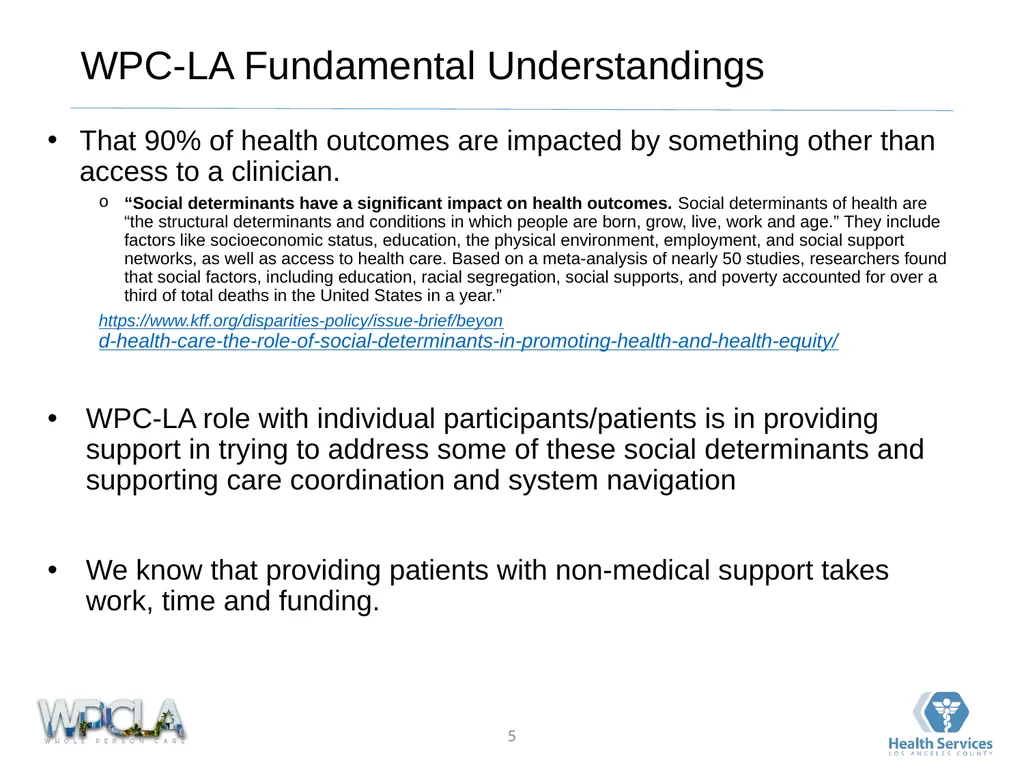
slide5. WPC-LA Fundamental Understandings That 90% of health outcomes are impacted by something other than access to a clinician.
“Social determinants have a significant impact on health outcomes. Social determinants of health are “the structural determinants and conditions in which people are born, grow, live, work and age.” They include factors like socioeconomic status, education, the physical environment, employment, and social support networks, as well as access to health care. Based on a meta-analysis of nearly 50 studies, researchers found that social factors, including education, racial segregation, social supports, and poverty accounted for over a third of total deaths in the United States in a year.”
https://www.kff.org/disparities-policy/issue-brief/beyond-health-care-the-role-of-social-determinants-in-promoting-health-and-health-equity/
WPC-LA role with individual participants/patients is in providing support in trying to address some of these social determinants and supporting care coordination and system navigation
We know that providing patients with non-medical support takes work, time and funding. 5<br>
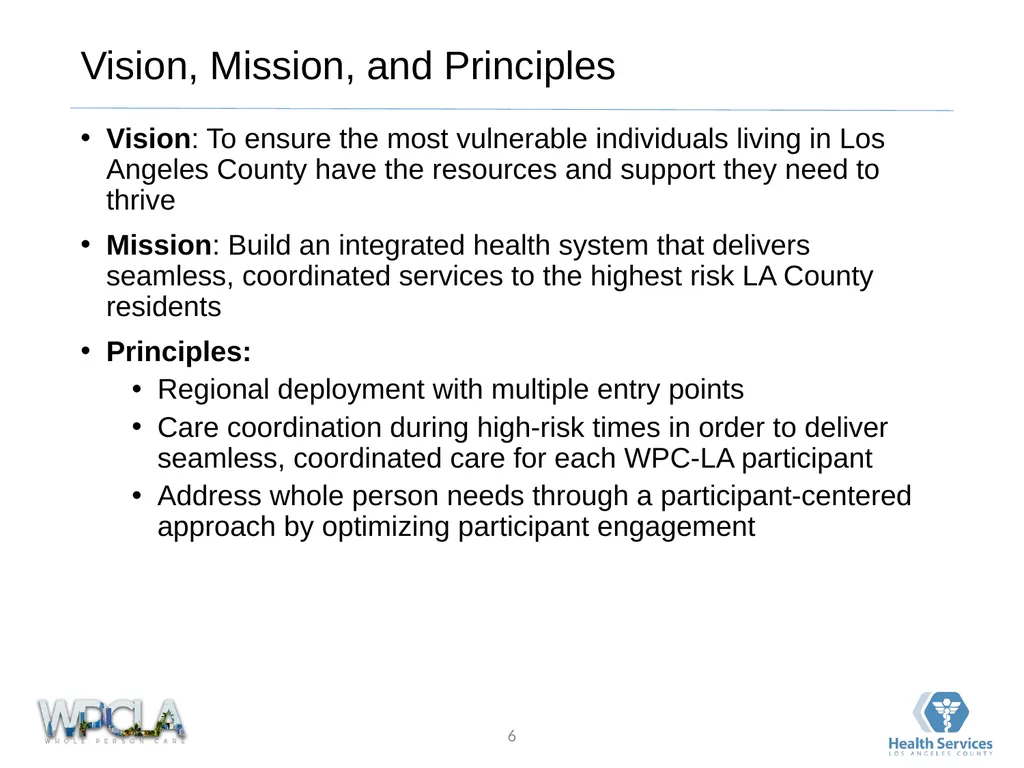
slide6. Vision, Mission, and Principles Vision: To ensure the most vulnerable individuals living in Los Angeles County have the resources and support they need to thrive
Mission: Build an integrated health system that delivers seamless, coordinated services to the highest risk LA County residents
Principles:
Regional deployment with multiple entry points
Care coordination during high-risk times in order to deliver seamless, coordinated care for each WPC-LA participant
Address whole person needs through a participant-centered approach by optimizing participant engagement 6<br>
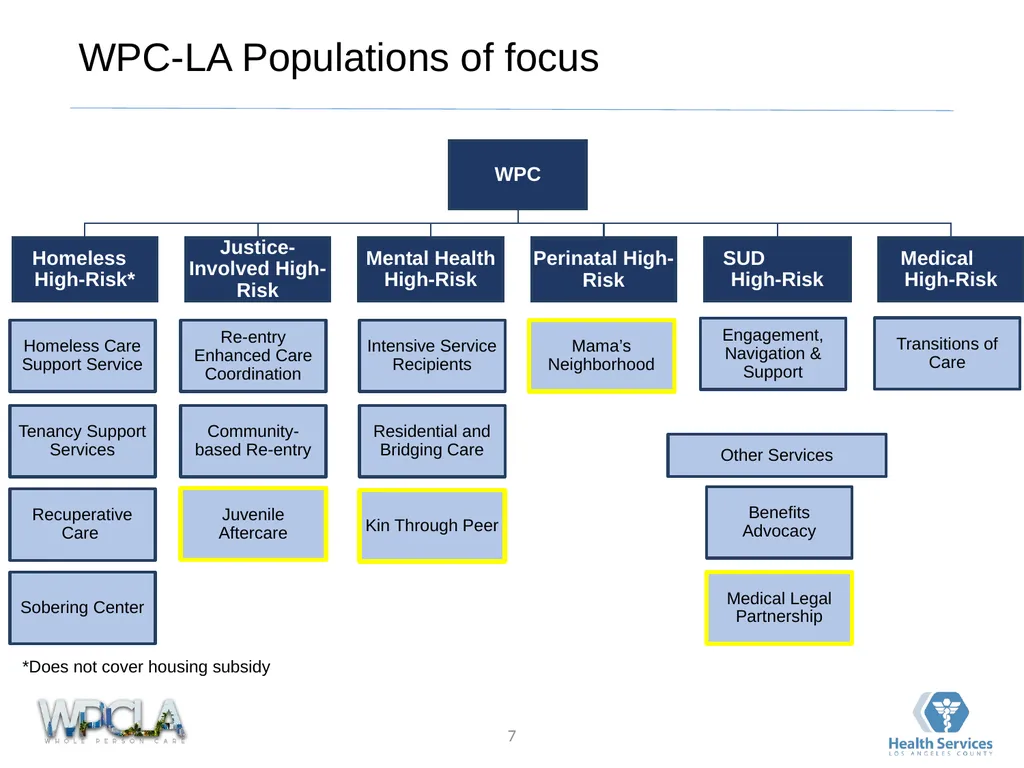
slide7. WPC-LA Populations of focus Homeless Care Support Service Benefits Advocacy Recuperative Care Sobering Center Tenancy Support Services Re-entry Enhanced Care Coordination Community-based Re-entry Intensive Service Recipients Residential and Bridging Care Engagement, Navigation & Support Transitions of Care *Does not cover housing subsidy Kin Through Peer Juvenile Aftercare Mama’s Neighborhood Medical Legal Partnership Other Services 7<br>
slide8. Community Health Worker (CHW) – Care Management Model 8<br>
slide9. CHW’s are the primary change agents for WPC-LA What WPC-LA Community Health Workers bring to this work:
Expertise from life experience
Skills in variety of areas: health education, care planning, motivational interviewing, chronic disease self-management, and community organizing
Trusting relationship to help participants efficiently navigate health and social services 9<br>
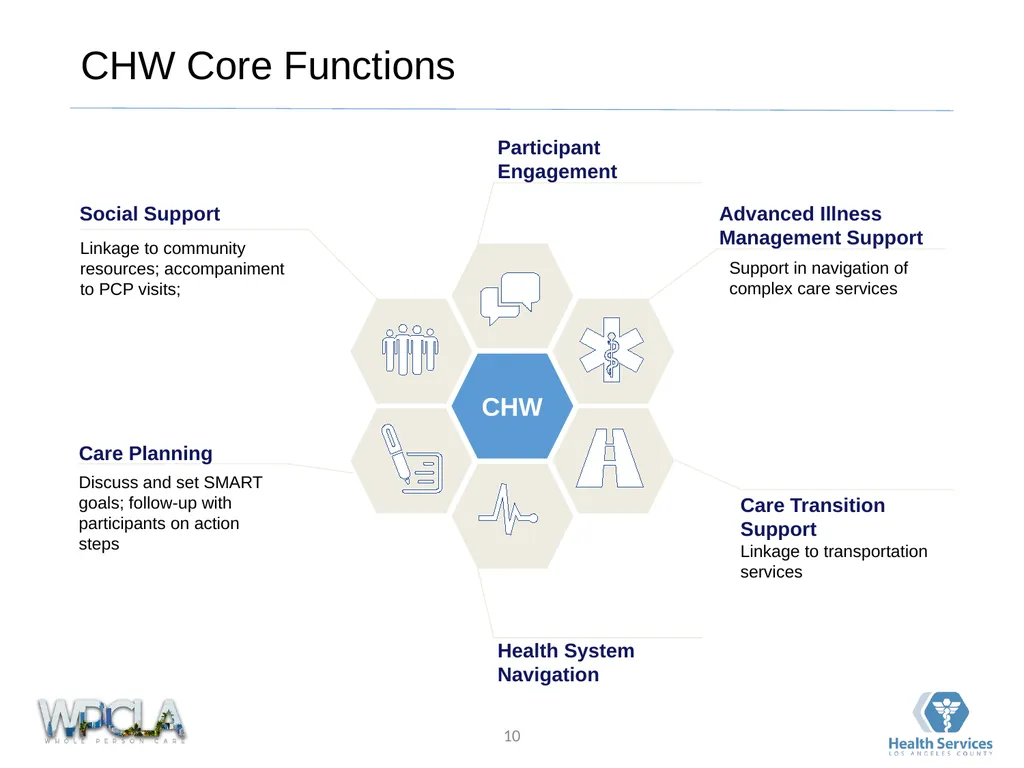
slide10. CHW Core Functions CHW Care Transition Support
Linkage to transportation services Care Planning Health System Navigation Social Support Advanced Illness Management Support Participant Engagement Linkage to community resources; accompaniment to PCP visits; Discuss and set SMART goals; follow-up with participants on action steps Support in navigation of complex care services 10<br>
slide11. CHWs benefit both the patient and the clinic They act as a cultural liaison between the client and provider
Enhance the capacity of primary care teams to work beyond the walls of the clinic
Support patient engagement and connections to community-based services to address social need
Support care coordination activities, particularly during high-risk care transitions (e.g. hospital-to-home or jail-to-home) 11<br>
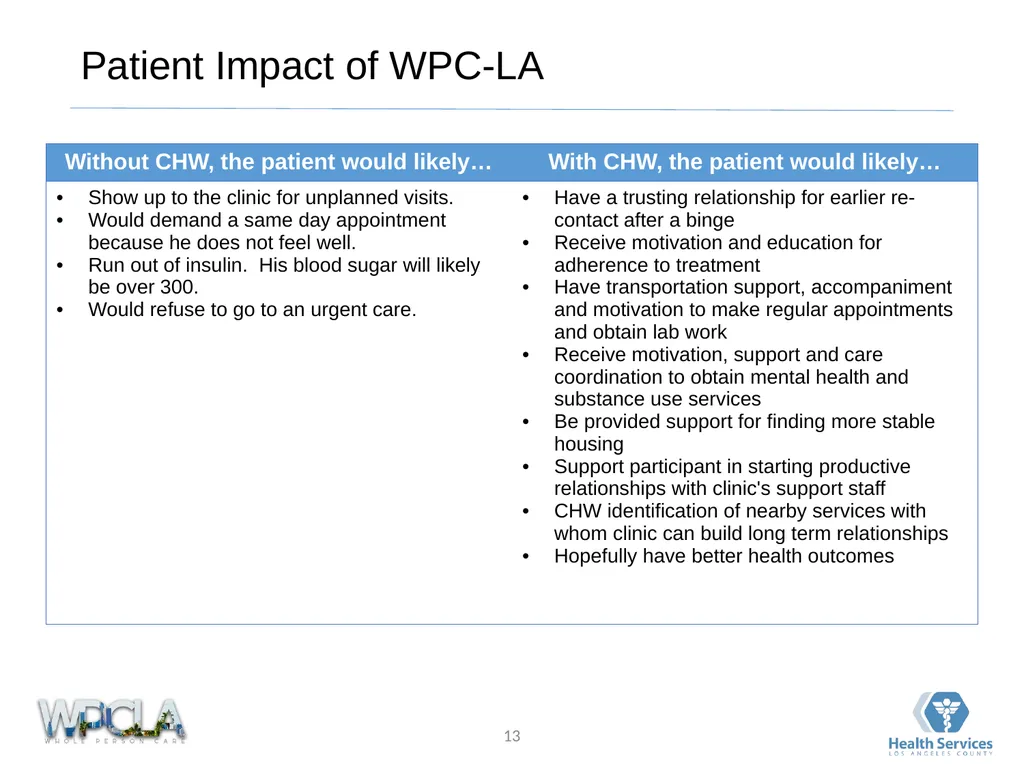
slide12. WPC-LA Participant Case Study Walt is a Re-Entry CHW supporting a WPC-LA participant named Jeff.
Jeff was recently released from Twin Towers after a 2 month incarceration.
Jeff is 23 y.o. has Type 1 Diabetes
He uses methamphetamines for weeks at a time, when he gets stressed out by his Mom and her boyfriend
His mother lets him live with her when she is on the outs with her boyfriend
They have moved through different neighborhoods since he was 10 y.o. after he was placed for about a year in the foster care system 12<br>
slide13. Patient Impact of WPC-LA 13<br>
slide14. Framework for Collaboration 14<br>
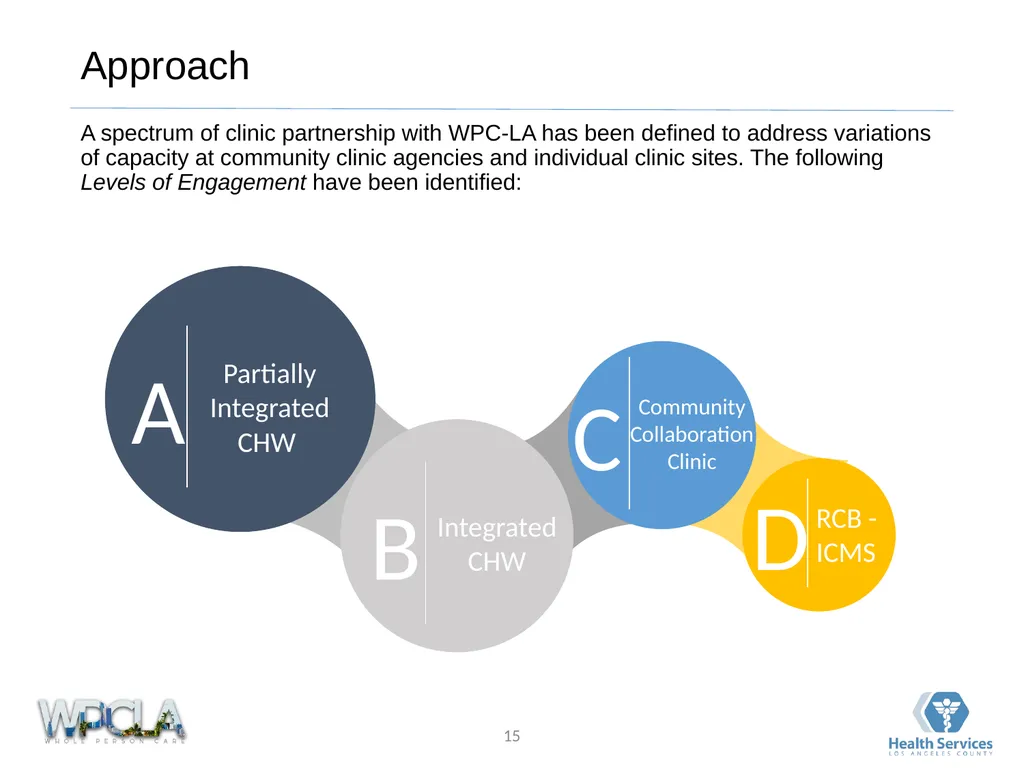
slide15. Approach A spectrum of clinic partnership with WPC-LA has been defined to address variations of capacity at community clinic agencies and individual clinic sites. The following Levels of Engagement have been identified: Partially Integrated CHW A Integrated CHW B Community Collaboration Clinic C RCB - ICMS D 15<br>
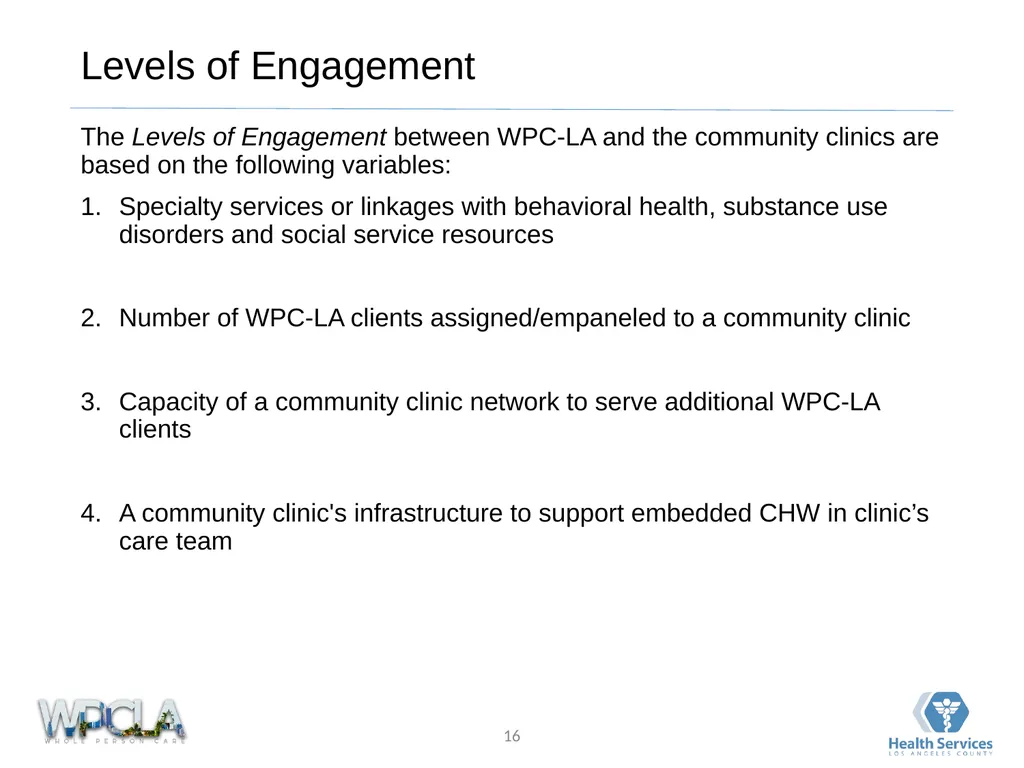
slide16. Levels of Engagement The Levels of Engagement between WPC-LA and the community clinics are based on the following variables:
Specialty services or linkages with behavioral health, substance use disorders and social service resources
Number of WPC-LA clients assigned/empaneled to a community clinic
Capacity of a community clinic network to serve additional WPC-LA clients
A community clinic's infrastructure to support embedded CHW in clinic’s care team 16<br>
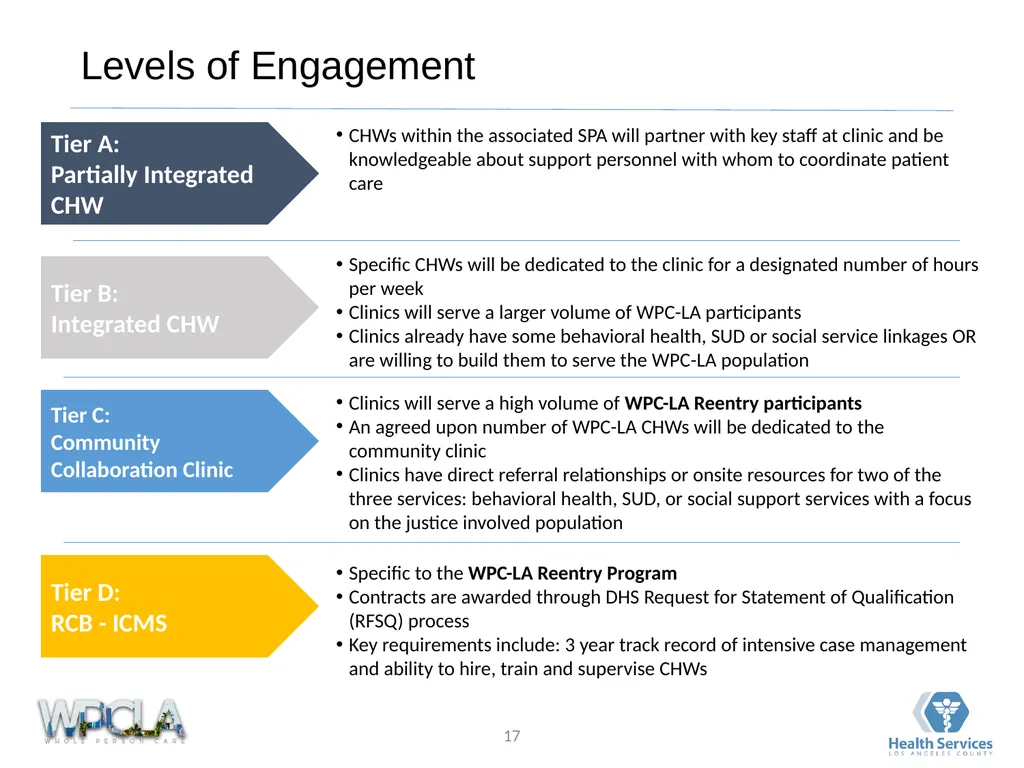
slide17. Levels of Engagement Tier A:
Partially Integrated CHW Clinics will serve a high volume of WPC-LA Reentry participants
An agreed upon number of WPC-LA CHWs will be dedicated to the community clinic
Clinics have direct referral relationships or onsite resources for two of the three services: behavioral health, SUD, or social support services with a focus on the justice involved population Tier C:
Community Collaboration Clinic Specific to the WPC-LA Reentry Program
Contracts are awarded through DHS Request for Statement of Qualification (RFSQ) process
Key requirements include: 3 year track record of intensive case management and ability to hire, train and supervise CHWs Tier D:
RCB - ICMS CHWs within the associated SPA will partner with key staff at clinic and be knowledgeable about support personnel with whom to coordinate patient care Tier B:
Integrated CHW Specific CHWs will be dedicated to the clinic for a designated number of hours per week
Clinics will serve a larger volume of WPC-LA participants
Clinics already have some behavioral health, SUD or social service linkages OR are willing to build them to serve the WPC-LA population 17<br>
slide18. Key Operational Domains for Collaboration 18<br>
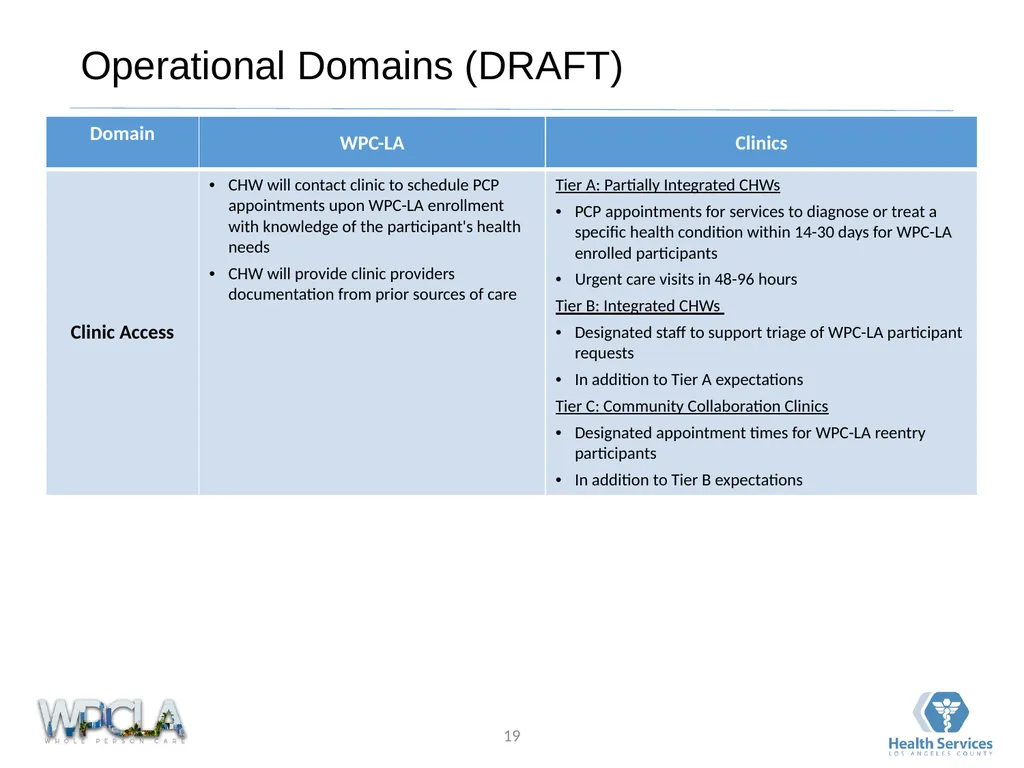
slide19. Operational Domains (DRAFT) 19<br>
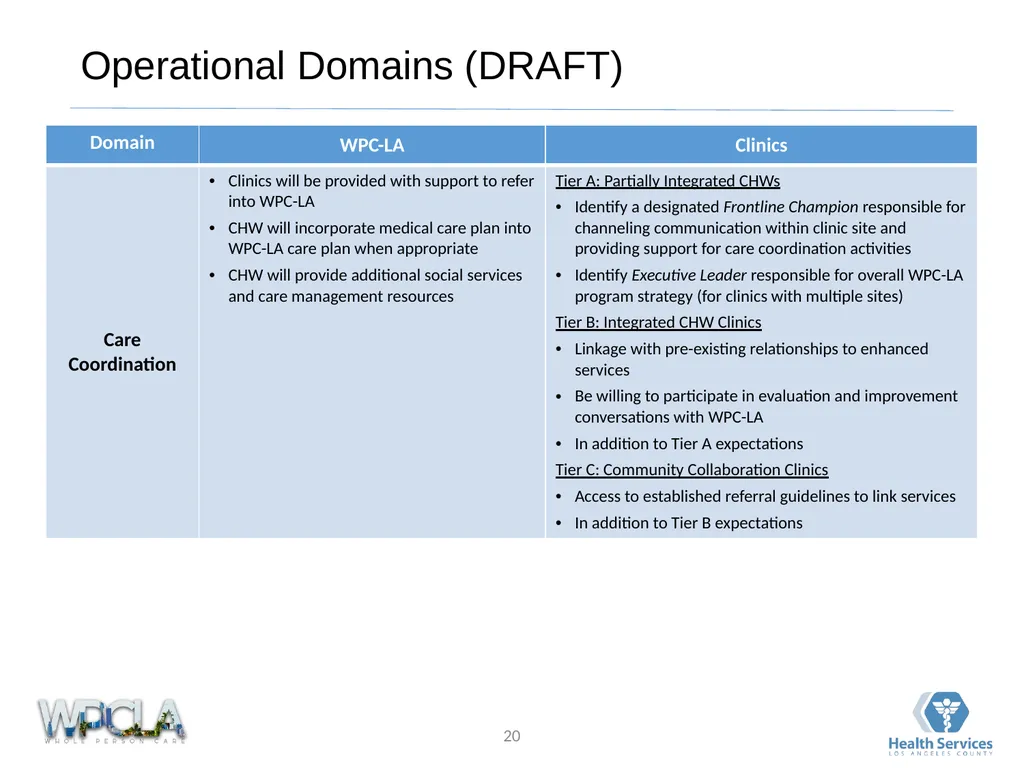
slide20. Operational Domains (DRAFT) 20<br>
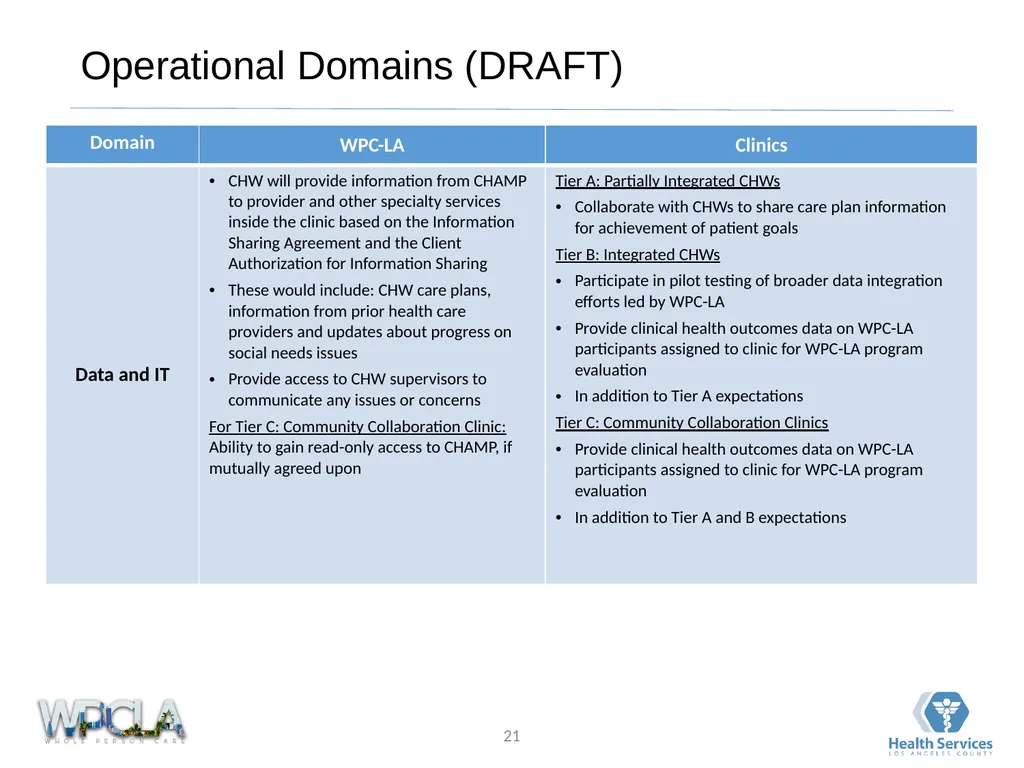
slide21. Operational Domains (DRAFT) 21<br>
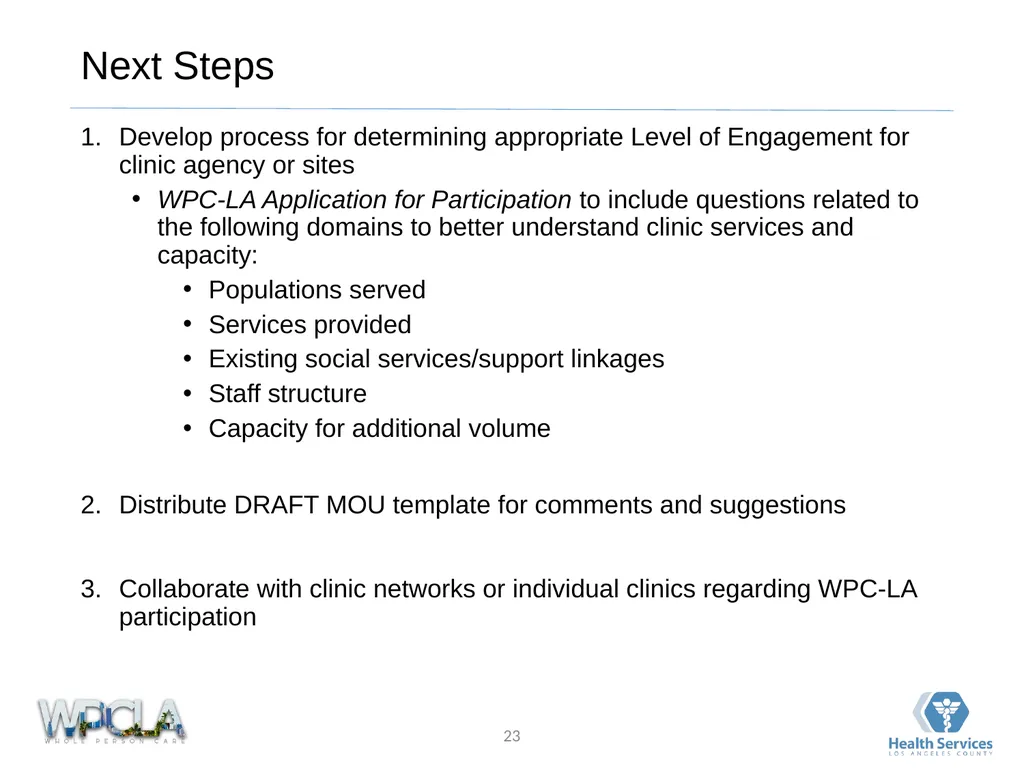
slide22. Next Steps 22<br>
slide23. Next Steps Develop process for determining appropriate Level of Engagement for clinic agency or sites
WPC-LA Application for Participation to include questions related to the following domains to better understand clinic services and capacity:
Populations served
Services provided
Existing social services/support linkages
Staff structure
Capacity for additional volume
Distribute DRAFT MOU template for comments and suggestions
Collaborate with clinic networks or individual clinics regarding WPC-LA participation 23<br>
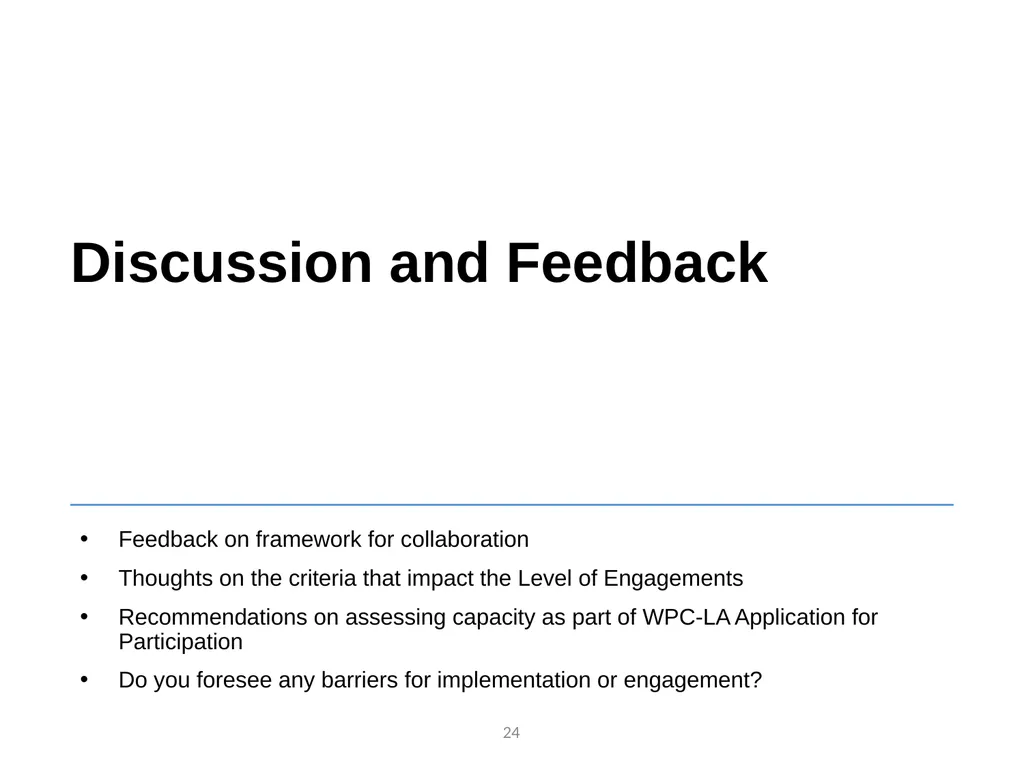
slide24. Discussion and Feedback Feedback on framework for collaboration
Thoughts on the criteria that impact the Level of Engagements
Recommendations on assessing capacity as part of WPC-LA Application for Participation
Do you foresee any barriers for implementation or engagement? 24<br>
slide25. Contact Information For follow-up questions or comments please contact:
Henna Zaidi (hzaidi@dhs.lacounty.gov), Director of Delivery System Integration
Simmi Gandhi (SGandhi@dhs.lacounty.gov), Associate Clinical and Capacity Building Director, for any questions. 25<br>

Prepared for: CCALAC Homeless Housing Committee 1<br>
slide2. Agenda WPC-LA Overview
Community Health Worker (CHW) – Care Management Model
Framework for Collaboration
Next Steps
Questions and Feedback 2<br>
slide3. Meeting Objectives Review WPC-LA’s fundamental understandings relevant to the primary care setting
Increase understanding of WPC-LA’s CHW based care management model
Discuss the framework for clinic engagement
Review next steps for collaboration
Discuss questions and feedback 3<br>
slide4. WPC-LA Overview 4<br>
slide5. WPC-LA Fundamental Understandings That 90% of health outcomes are impacted by something other than access to a clinician.
“Social determinants have a significant impact on health outcomes. Social determinants of health are “the structural determinants and conditions in which people are born, grow, live, work and age.” They include factors like socioeconomic status, education, the physical environment, employment, and social support networks, as well as access to health care. Based on a meta-analysis of nearly 50 studies, researchers found that social factors, including education, racial segregation, social supports, and poverty accounted for over a third of total deaths in the United States in a year.”
https://www.kff.org/disparities-policy/issue-brief/beyond-health-care-the-role-of-social-determinants-in-promoting-health-and-health-equity/
WPC-LA role with individual participants/patients is in providing support in trying to address some of these social determinants and supporting care coordination and system navigation
We know that providing patients with non-medical support takes work, time and funding. 5<br>
slide6. Vision, Mission, and Principles Vision: To ensure the most vulnerable individuals living in Los Angeles County have the resources and support they need to thrive
Mission: Build an integrated health system that delivers seamless, coordinated services to the highest risk LA County residents
Principles:
Regional deployment with multiple entry points
Care coordination during high-risk times in order to deliver seamless, coordinated care for each WPC-LA participant
Address whole person needs through a participant-centered approach by optimizing participant engagement 6<br>
slide7. WPC-LA Populations of focus Homeless Care Support Service Benefits Advocacy Recuperative Care Sobering Center Tenancy Support Services Re-entry Enhanced Care Coordination Community-based Re-entry Intensive Service Recipients Residential and Bridging Care Engagement, Navigation & Support Transitions of Care *Does not cover housing subsidy Kin Through Peer Juvenile Aftercare Mama’s Neighborhood Medical Legal Partnership Other Services 7<br>
slide8. Community Health Worker (CHW) – Care Management Model 8<br>
slide9. CHW’s are the primary change agents for WPC-LA What WPC-LA Community Health Workers bring to this work:
Expertise from life experience
Skills in variety of areas: health education, care planning, motivational interviewing, chronic disease self-management, and community organizing
Trusting relationship to help participants efficiently navigate health and social services 9<br>
slide10. CHW Core Functions CHW Care Transition Support
Linkage to transportation services Care Planning Health System Navigation Social Support Advanced Illness Management Support Participant Engagement Linkage to community resources; accompaniment to PCP visits; Discuss and set SMART goals; follow-up with participants on action steps Support in navigation of complex care services 10<br>
slide11. CHWs benefit both the patient and the clinic They act as a cultural liaison between the client and provider
Enhance the capacity of primary care teams to work beyond the walls of the clinic
Support patient engagement and connections to community-based services to address social need
Support care coordination activities, particularly during high-risk care transitions (e.g. hospital-to-home or jail-to-home) 11<br>
slide12. WPC-LA Participant Case Study Walt is a Re-Entry CHW supporting a WPC-LA participant named Jeff.
Jeff was recently released from Twin Towers after a 2 month incarceration.
Jeff is 23 y.o. has Type 1 Diabetes
He uses methamphetamines for weeks at a time, when he gets stressed out by his Mom and her boyfriend
His mother lets him live with her when she is on the outs with her boyfriend
They have moved through different neighborhoods since he was 10 y.o. after he was placed for about a year in the foster care system 12<br>
slide13. Patient Impact of WPC-LA 13<br>
slide14. Framework for Collaboration 14<br>
slide15. Approach A spectrum of clinic partnership with WPC-LA has been defined to address variations of capacity at community clinic agencies and individual clinic sites. The following Levels of Engagement have been identified: Partially Integrated CHW A Integrated CHW B Community Collaboration Clinic C RCB - ICMS D 15<br>
slide16. Levels of Engagement The Levels of Engagement between WPC-LA and the community clinics are based on the following variables:
Specialty services or linkages with behavioral health, substance use disorders and social service resources
Number of WPC-LA clients assigned/empaneled to a community clinic
Capacity of a community clinic network to serve additional WPC-LA clients
A community clinic's infrastructure to support embedded CHW in clinic’s care team 16<br>
slide17. Levels of Engagement Tier A:
Partially Integrated CHW Clinics will serve a high volume of WPC-LA Reentry participants
An agreed upon number of WPC-LA CHWs will be dedicated to the community clinic
Clinics have direct referral relationships or onsite resources for two of the three services: behavioral health, SUD, or social support services with a focus on the justice involved population Tier C:
Community Collaboration Clinic Specific to the WPC-LA Reentry Program
Contracts are awarded through DHS Request for Statement of Qualification (RFSQ) process
Key requirements include: 3 year track record of intensive case management and ability to hire, train and supervise CHWs Tier D:
RCB - ICMS CHWs within the associated SPA will partner with key staff at clinic and be knowledgeable about support personnel with whom to coordinate patient care Tier B:
Integrated CHW Specific CHWs will be dedicated to the clinic for a designated number of hours per week
Clinics will serve a larger volume of WPC-LA participants
Clinics already have some behavioral health, SUD or social service linkages OR are willing to build them to serve the WPC-LA population 17<br>
slide18. Key Operational Domains for Collaboration 18<br>
slide19. Operational Domains (DRAFT) 19<br>
slide20. Operational Domains (DRAFT) 20<br>
slide21. Operational Domains (DRAFT) 21<br>
slide22. Next Steps 22<br>
slide23. Next Steps Develop process for determining appropriate Level of Engagement for clinic agency or sites
WPC-LA Application for Participation to include questions related to the following domains to better understand clinic services and capacity:
Populations served
Services provided
Existing social services/support linkages
Staff structure
Capacity for additional volume
Distribute DRAFT MOU template for comments and suggestions
Collaborate with clinic networks or individual clinics regarding WPC-LA participation 23<br>
slide24. Discussion and Feedback Feedback on framework for collaboration
Thoughts on the criteria that impact the Level of Engagements
Recommendations on assessing capacity as part of WPC-LA Application for Participation
Do you foresee any barriers for implementation or engagement? 24<br>
slide25. Contact Information For follow-up questions or comments please contact:
Henna Zaidi (hzaidi@dhs.lacounty.gov), Director of Delivery System Integration
Simmi Gandhi (SGandhi@dhs.lacounty.gov), Associate Clinical and Capacity Building Director, for any questions. 25<br>