
From Data Warehouse to Business Intelligence –
Description: From Data Warehouse to Business Intelligence Paradigm shift or simply new set of tools? Kamalika Sandell, Associate CIO Joyce Deroy, Director, Information Services Matteo Becchi, BI Program Manager American University American University,
Related Topics
Download Presentation
"From Data Warehouse to Business Intelligence –" is the property of its rightful owner. Permission is granted to download and print the materials on this website for personal, non-commercial use only, and to display it on your personal computer provided you do not modify the materials and that you retain all copyright notices contained in the materials. By downloading content from our website, you accept the terms of this agreement.
Presentation Transcript
slide1. From Data Warehouse to Business Intelligence – Paradigm shift or simply new set of tools? Kamalika Sandell, Associate CIO
Joyce Deroy, Director, Information Services
Matteo Becchi, BI Program Manager
American University<br>
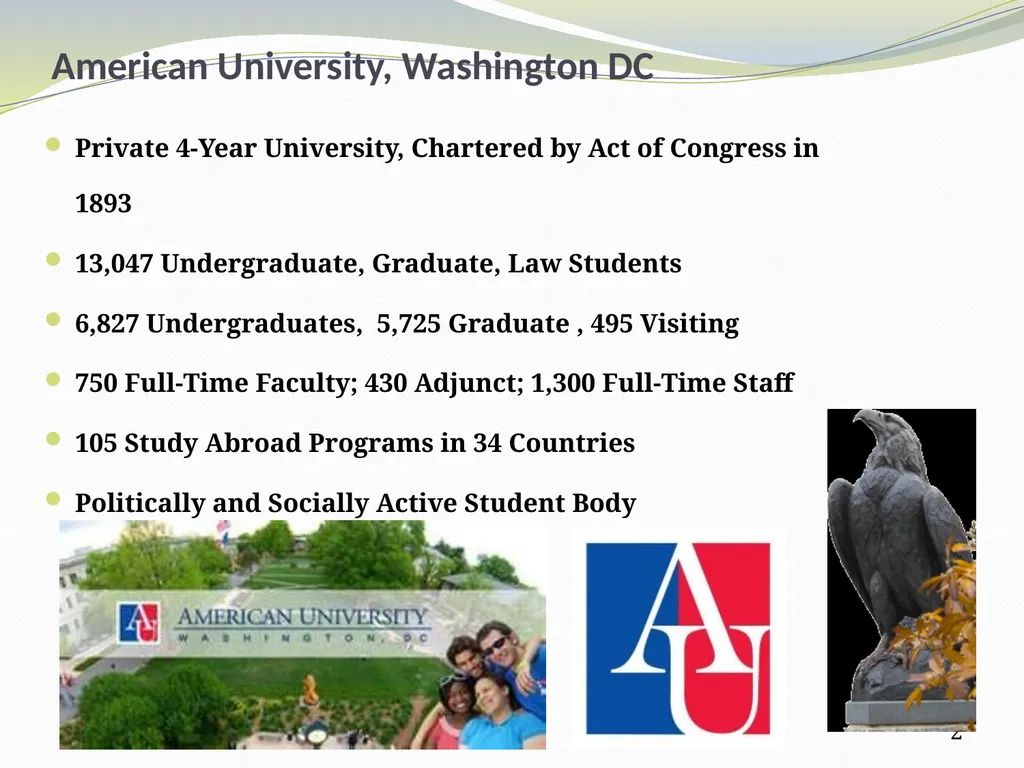
slide2. American University, Washington DC Private 4-Year University, Chartered by Act of Congress in 1893
13,047 Undergraduate, Graduate, Law Students
6,827 Undergraduates, 5,725 Graduate , 495 Visiting
750 Full-Time Faculty; 430 Adjunct; 1,300 Full-Time Staff
105 Study Abroad Programs in 34 Countries
Politically and Socially Active Student Body 2<br>
slide3. Objective of this presentation Share our experiences and approach to BI
Explore what makes BI implementations different
Share lessons learned
Hoping to stimulate conversations, learn from you! 3<br>
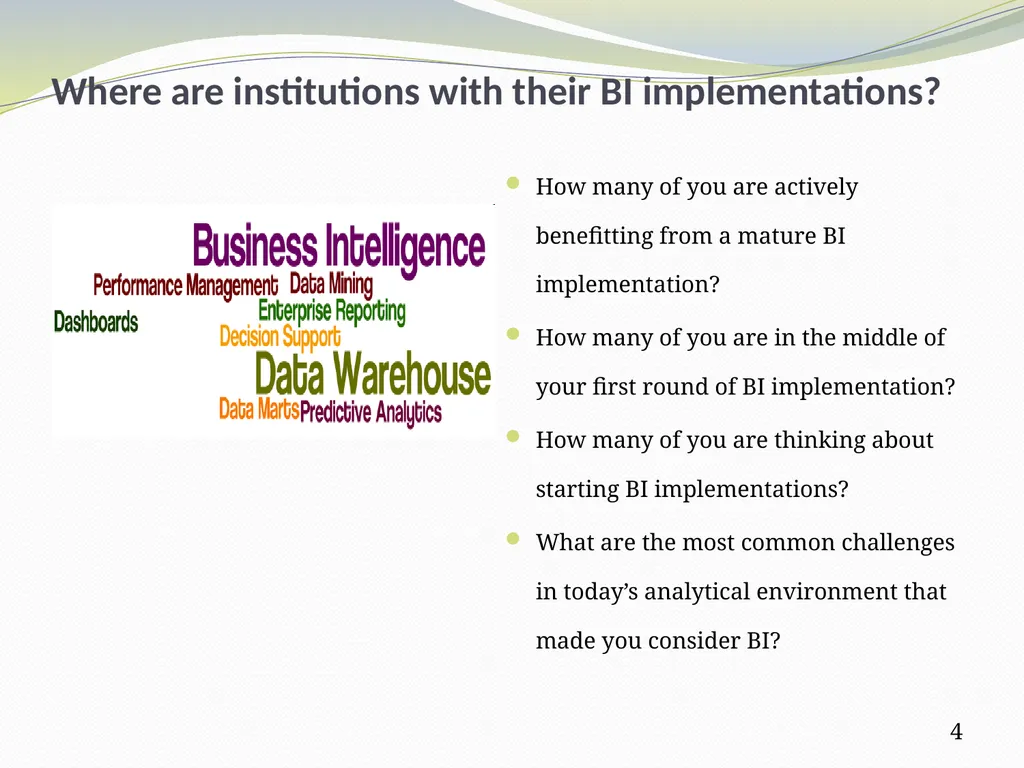
slide4. Where are institutions with their BI implementations? How many of you are actively benefitting from a mature BI implementation?
How many of you are in the middle of your first round of BI implementation?
How many of you are thinking about starting BI implementations?
What are the most common challenges in today’s analytical environment that made you consider BI? 4<br>
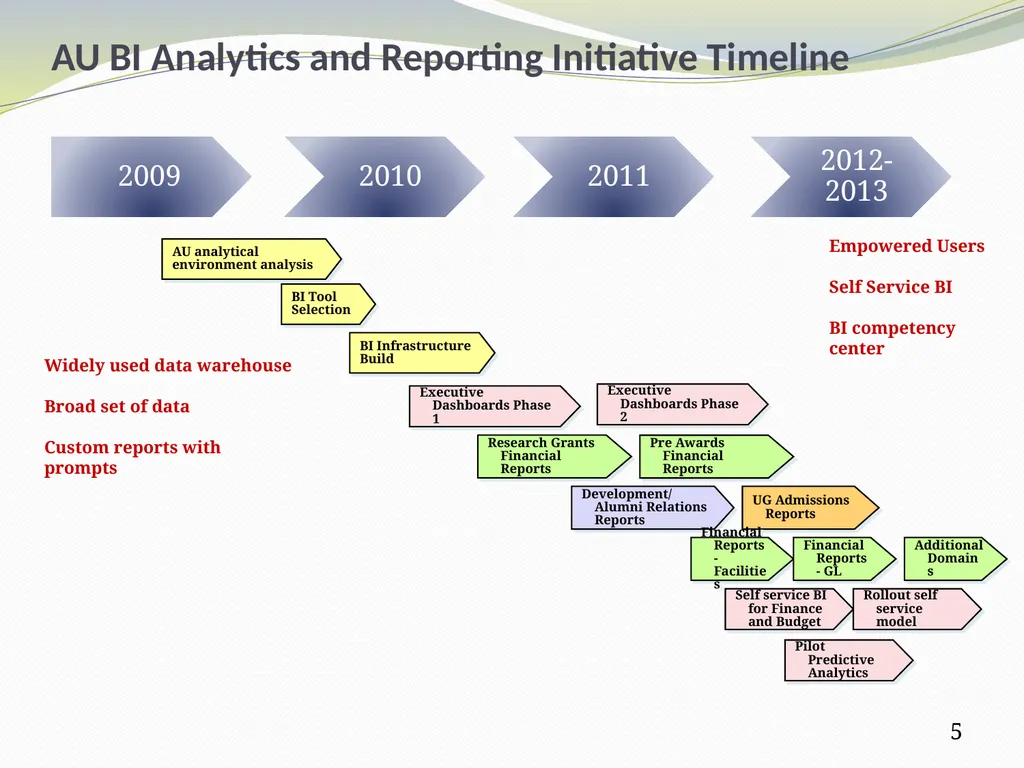
slide5. AU BI Analytics and Reporting Initiative Timeline AU analytical environment analysis Executive Dashboards Phase 1 Research Grants Financial Reports UG Admissions Reports Pre Awards Financial Reports BI Tool Selection BI Infrastructure Build Development/ Alumni Relations Reports Executive Dashboards Phase 2 Financial Reports - Facilities Financial Reports - GL Pilot Predictive Analytics Self service BI for Finance and Budget Widely used data warehouse
Broad set of data
Custom reports with prompts Empowered Users
Self Service BI
BI competency center Additional Domains Rollout self service model 5<br>
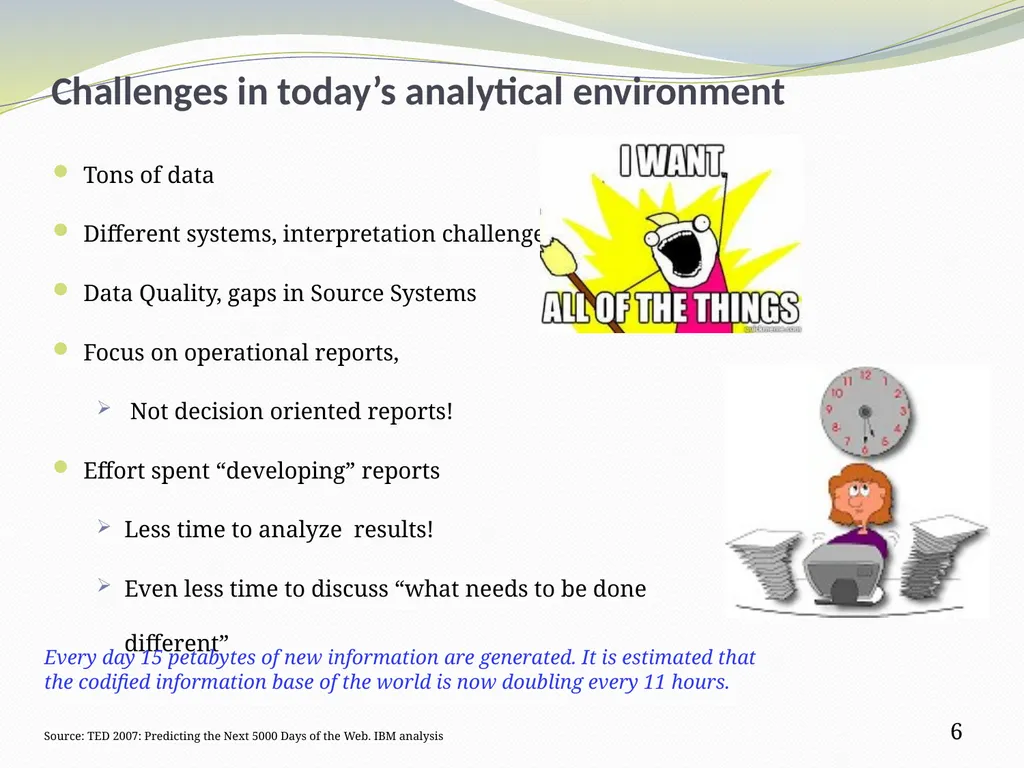
slide6. Challenges in today’s analytical environment Tons of data
Different systems, interpretation challenges
Data Quality, gaps in Source Systems
Focus on operational reports,
Not decision oriented reports!
Effort spent “developing” reports
Less time to analyze results!
Even less time to discuss “what needs to be done different” Every day 15 petabytes of new information are generated. It is estimated that the codified information base of the world is now doubling every 11 hours. Source: TED 2007: Predicting the Next 5000 Days of the Web. IBM analysis 6<br>
slide7. The promise of BI Right data
Right correlation
Right interpretation
Right access
Right people
Right set of analytics Intelligently harnessing data to make better decisions: 7<br>
slide8. AU BI Success Stories SIGUCCS Award:
Best of Category for Printed Instructional Classroom Materials for "Research Grants Financial Reporting“
User Success Stories: “I use it on a daily basis. Now that I'm familiar with it and the reports I like, it's really amazing. I can track a single expense in less than half the time it took before BI. I can provide PI's a snapshot of their budget in no time at all. In sum, it's substantially improved our ability to provide the faculty with information to make decisions on how best to utilize funding to accomplish the goals of their sponsored research projects.”
Bill Brown
Financial Operations Manager
School of Public Affairs “A payment didn't make it to a vendor. In a few seconds I was able to see that the funds had not yet been encumbered, meaning the purchase order had not yet been processed. That information allowed me to quickly identify exactly whom I needed to contact. Problem solved. “ Mary Eschelbach Hansen Associate Professor Director of Undergraduate Studies Department of Economics 8<br>
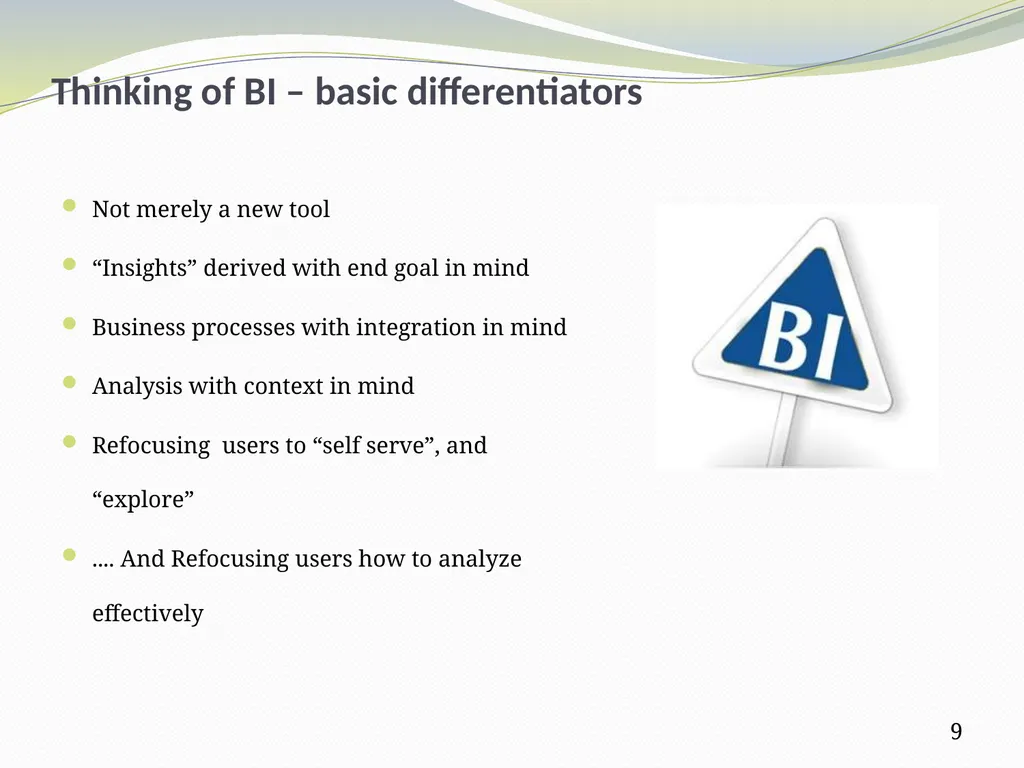
slide9. Thinking of BI – basic differentiators Not merely a new tool
“Insights” derived with end goal in mind
Business processes with integration in mind
Analysis with context in mind
Refocusing users to “self serve”, and “explore”
.... And Refocusing users how to analyze effectively 9<br>
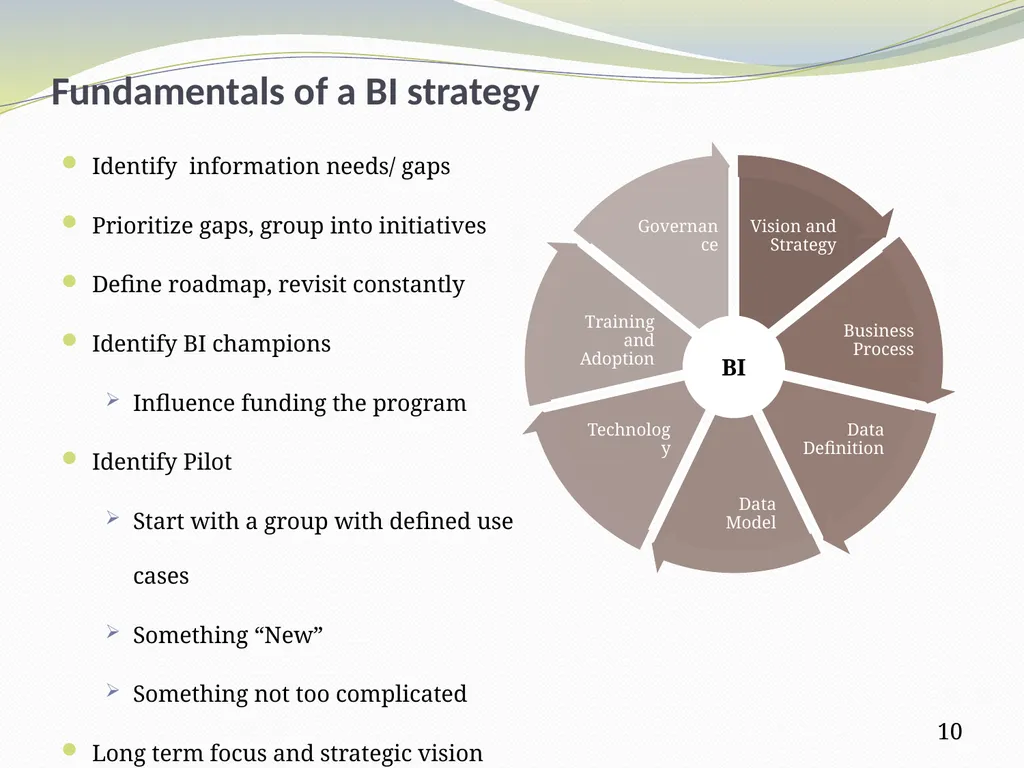
slide10. Fundamentals of a BI strategy Identify information needs/ gaps
Prioritize gaps, group into initiatives
Define roadmap, revisit constantly
Identify BI champions
Influence funding the program
Identify Pilot
Start with a group with defined use cases
Something “New”
Something not too complicated
Long term focus and strategic vision BI 10<br>
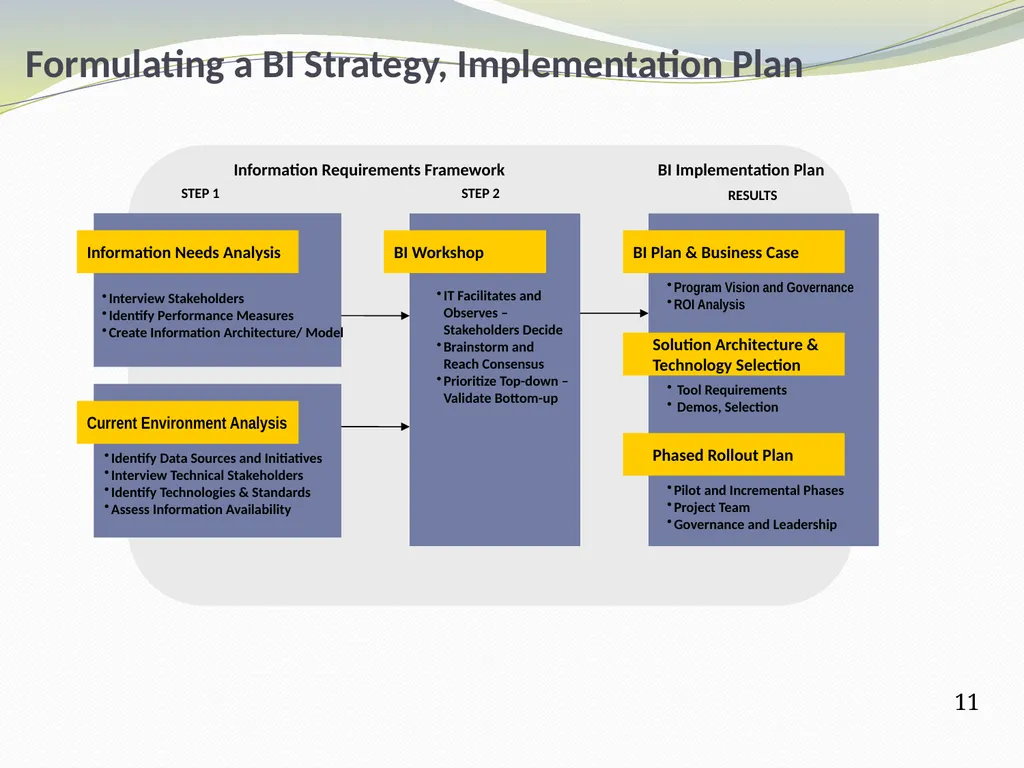
slide11. Formulating a BI Strategy, Implementation Plan Information Needs Analysis Current Environment Analysis BI Plan & Business Case Solution Architecture &
Technology Selection BI Workshop Interview Stakeholders
Identify Performance Measures
Create Information Architecture/ Model Identify Data Sources and Initiatives
Interview Technical Stakeholders
Identify Technologies & Standards
Assess Information Availability IT Facilitates and Observes – Stakeholders Decide
Brainstorm and Reach Consensus
Prioritize Top-down – Validate Bottom-up Program Vision and Governance
ROI Analysis RESULTS STEP 2 STEP 1 Tool Requirements
Demos, Selection Information Requirements Framework Phased Rollout Plan Pilot and Incremental Phases
Project Team
Governance and Leadership BI Implementation Plan 11<br>
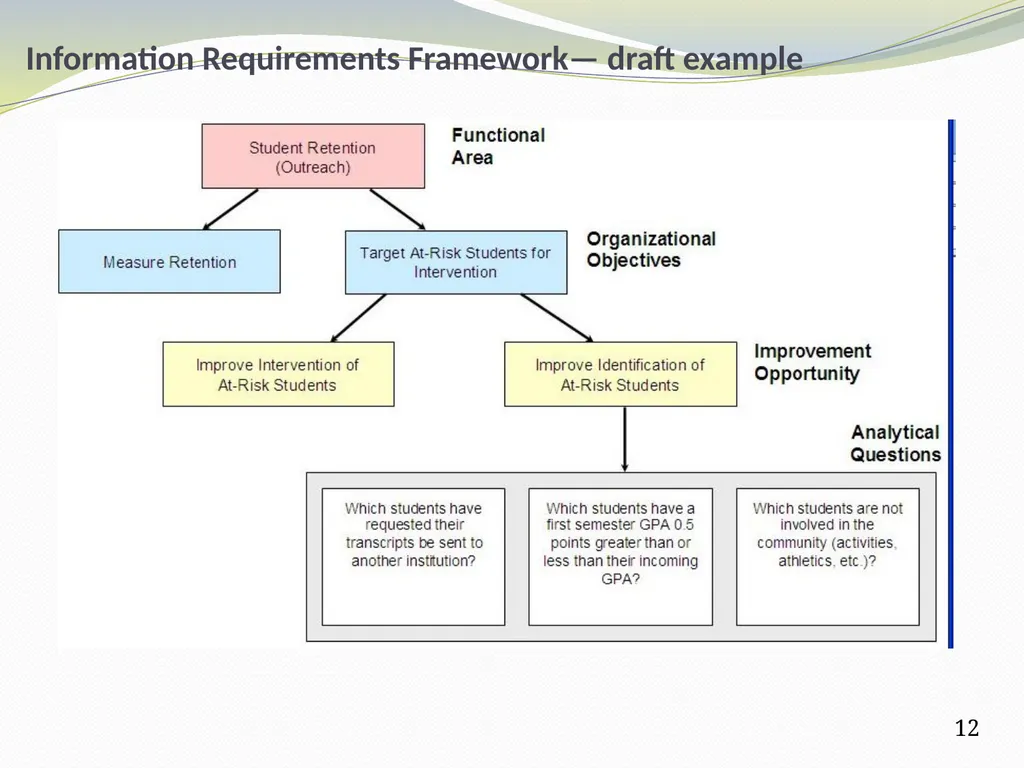
slide12. Information Requirements Framework— draft example 12<br>
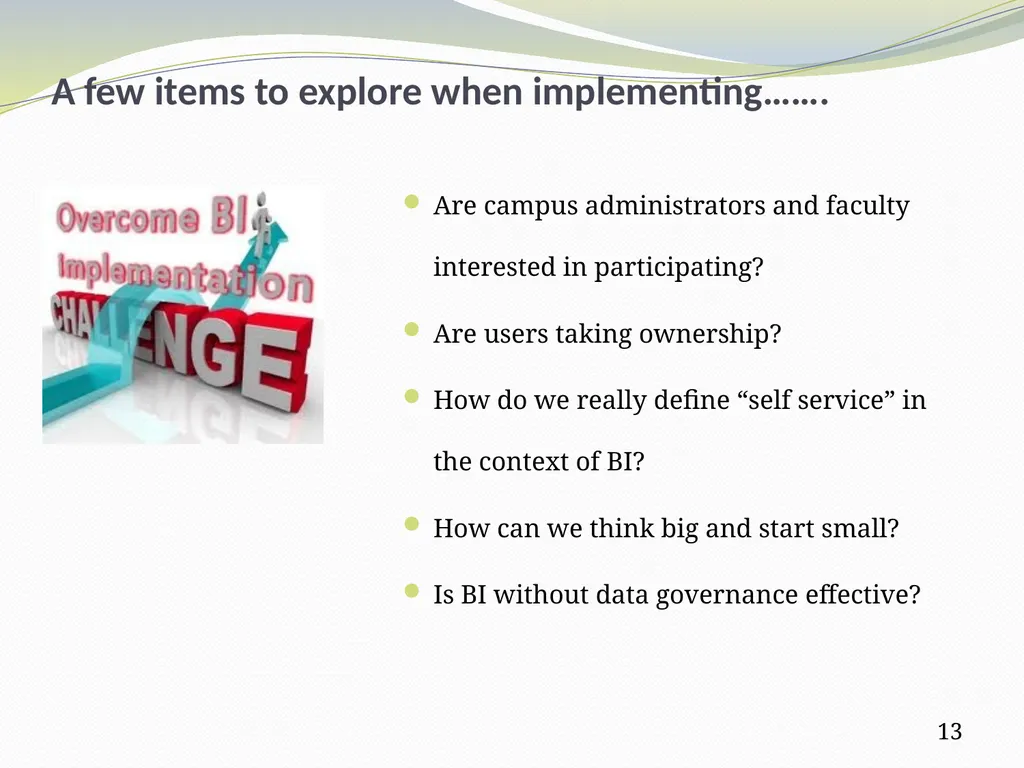
slide13. A few items to explore when implementing……. Are campus administrators and faculty interested in participating?
Are users taking ownership?
How do we really define “self service” in the context of BI?
How can we think big and start small?
Is BI without data governance effective? 13<br>
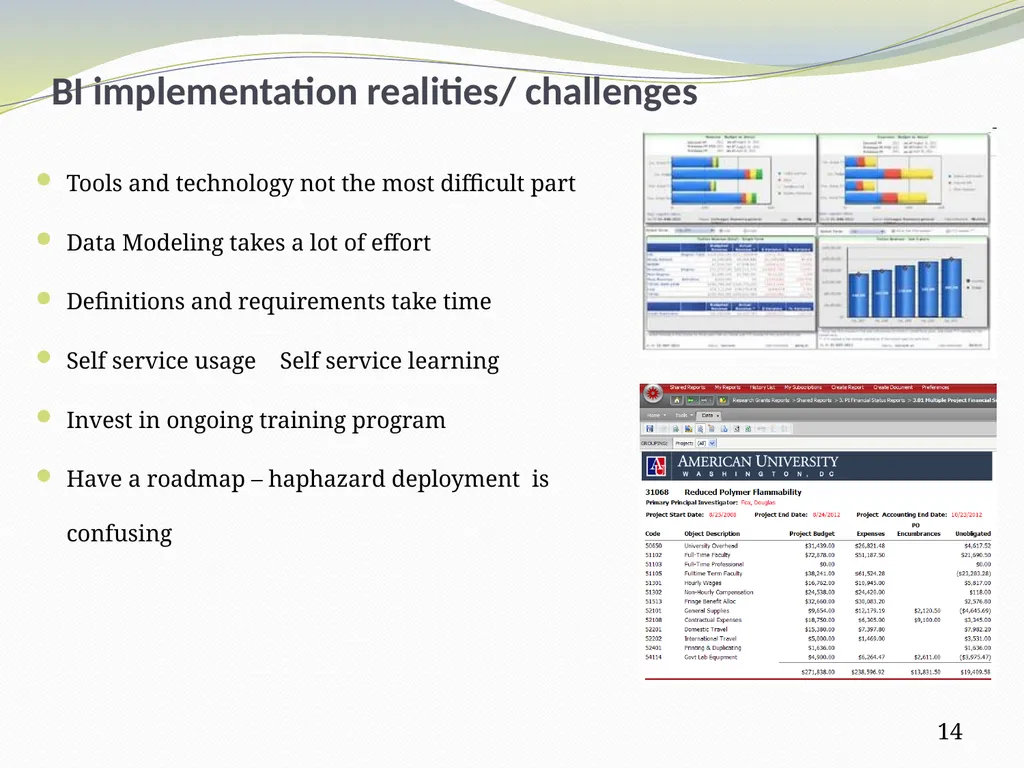
slide14. BI implementation realities/ challenges Tools and technology not the most difficult part
Data Modeling takes a lot of effort
Definitions and requirements take time
Self service usage Self service learning
Invest in ongoing training program
Have a roadmap – haphazard deployment is confusing 14<br>
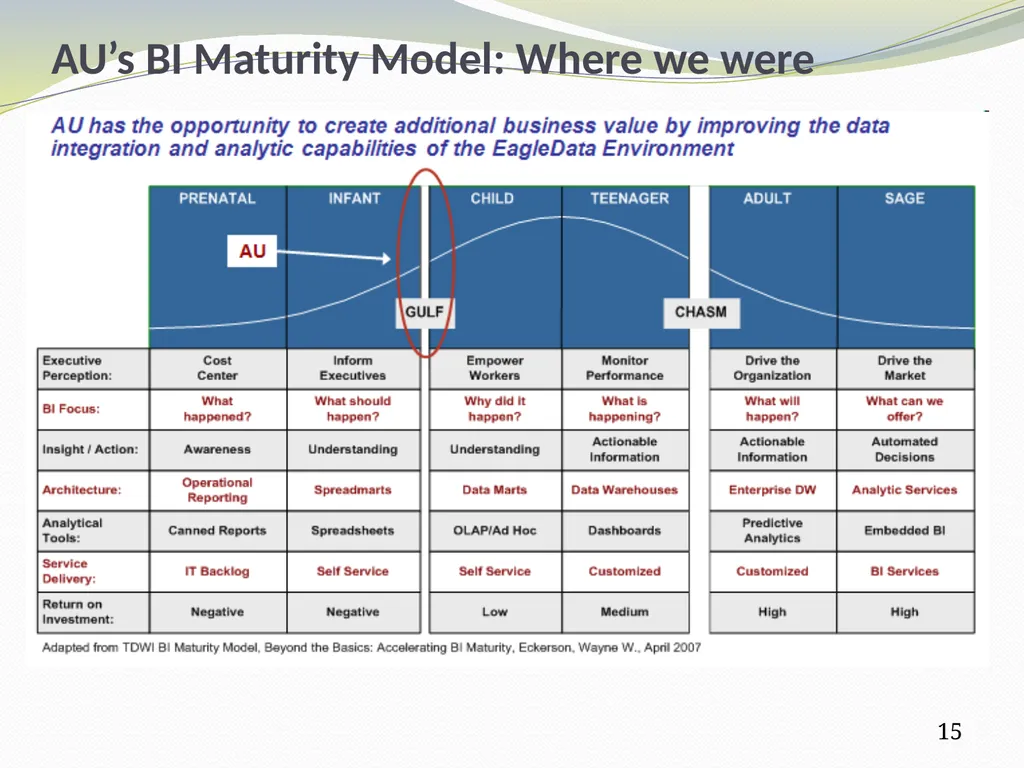
slide15. AU’s BI Maturity Model: Where we were 15<br>
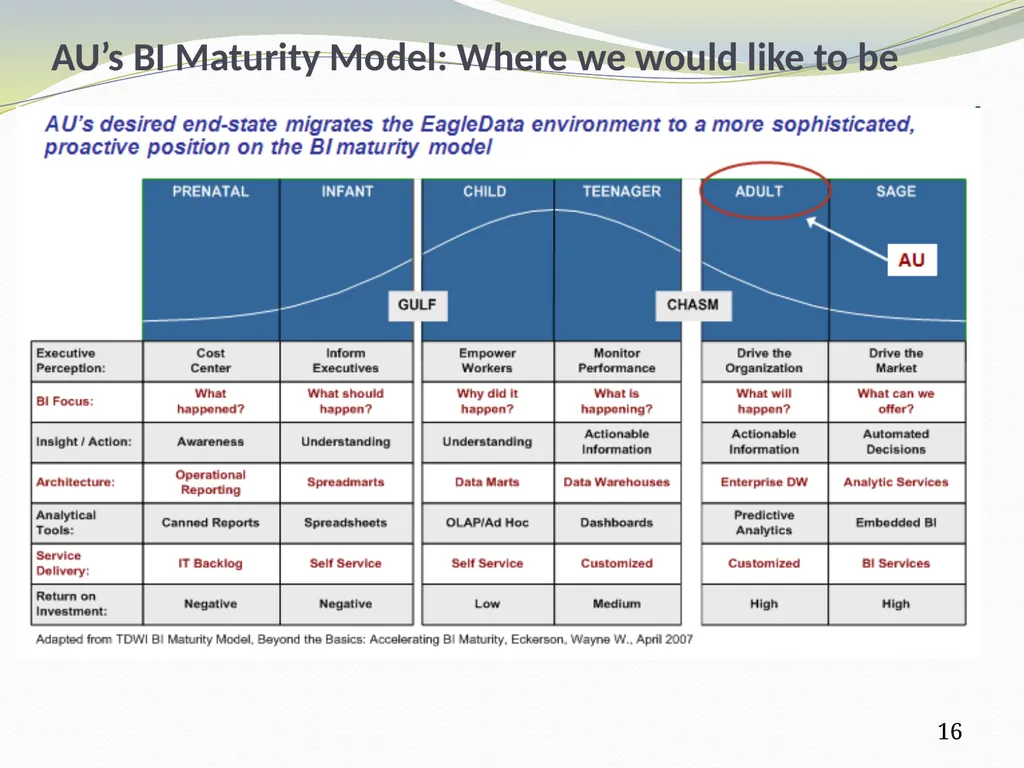
slide16. AU’s BI Maturity Model: Where we would like to be 16<br>
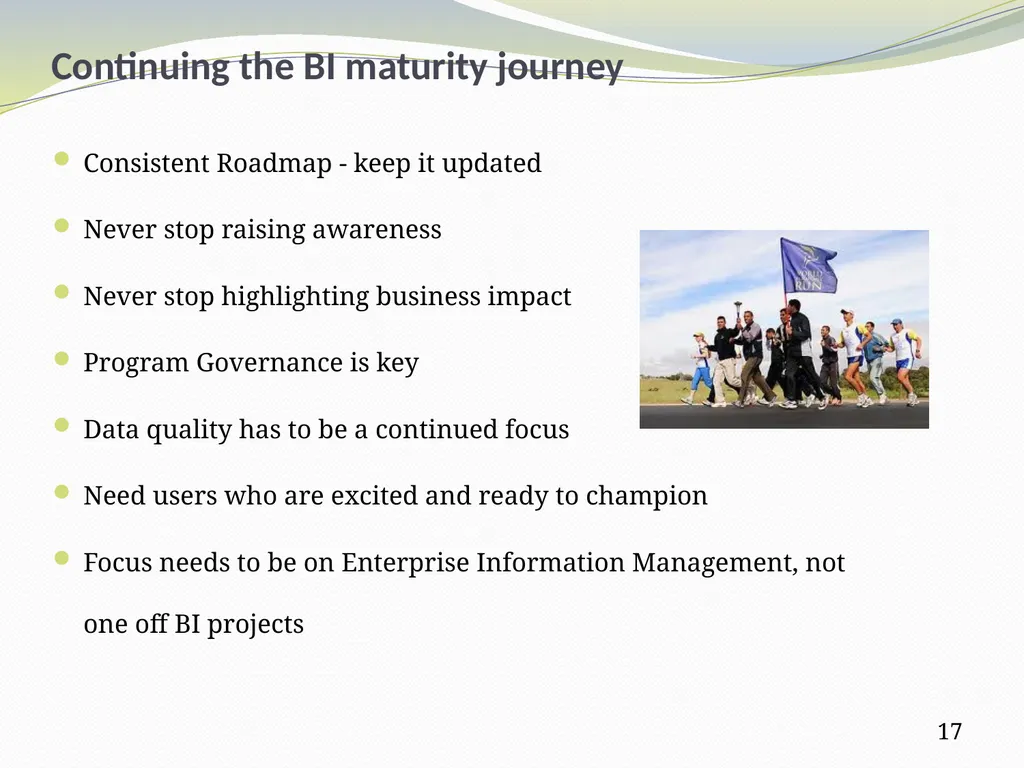
slide17. Continuing the BI maturity journey Consistent Roadmap - keep it updated
Never stop raising awareness
Never stop highlighting business impact
Program Governance is key
Data quality has to be a continued focus
Need users who are excited and ready to champion
Focus needs to be on Enterprise Information Management, not one off BI projects 17<br>
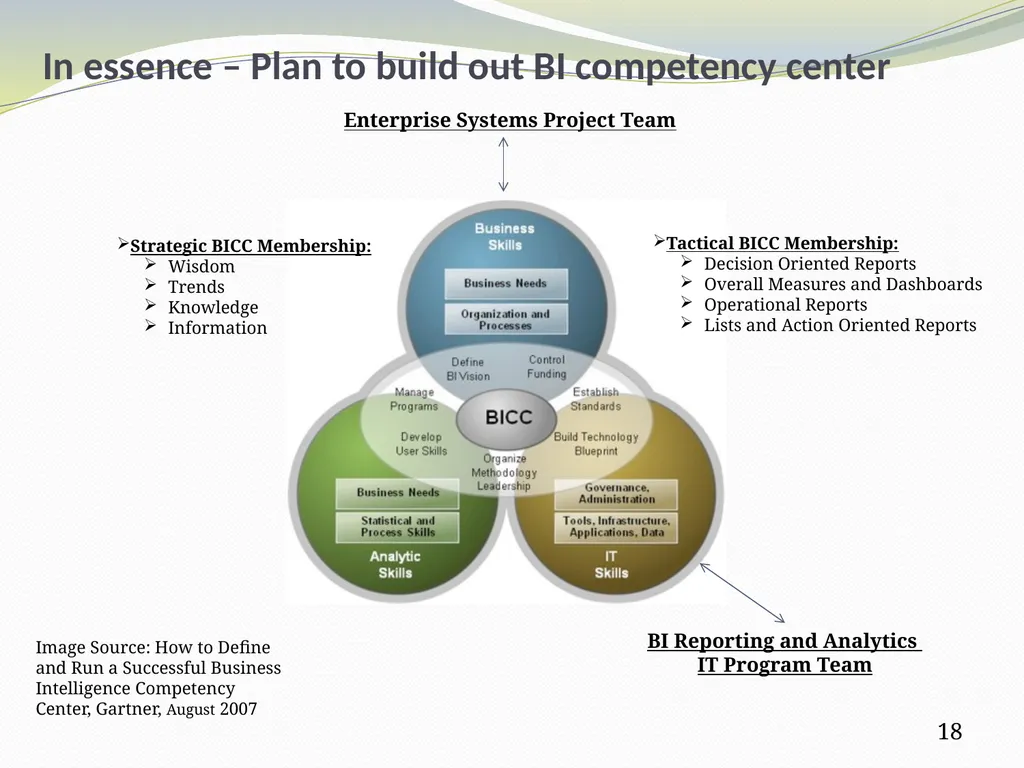
slide18. In essence – Plan to build out BI competency center Image Source: How to Define and Run a Successful Business Intelligence Competency Center, Gartner, August 2007 Strategic BICC Membership:
Wisdom
Trends
Knowledge
Information Tactical BICC Membership:
Decision Oriented Reports
Overall Measures and Dashboards
Operational Reports
Lists and Action Oriented Reports Enterprise Systems Project Team BI Reporting and Analytics
IT Program Team 18<br>
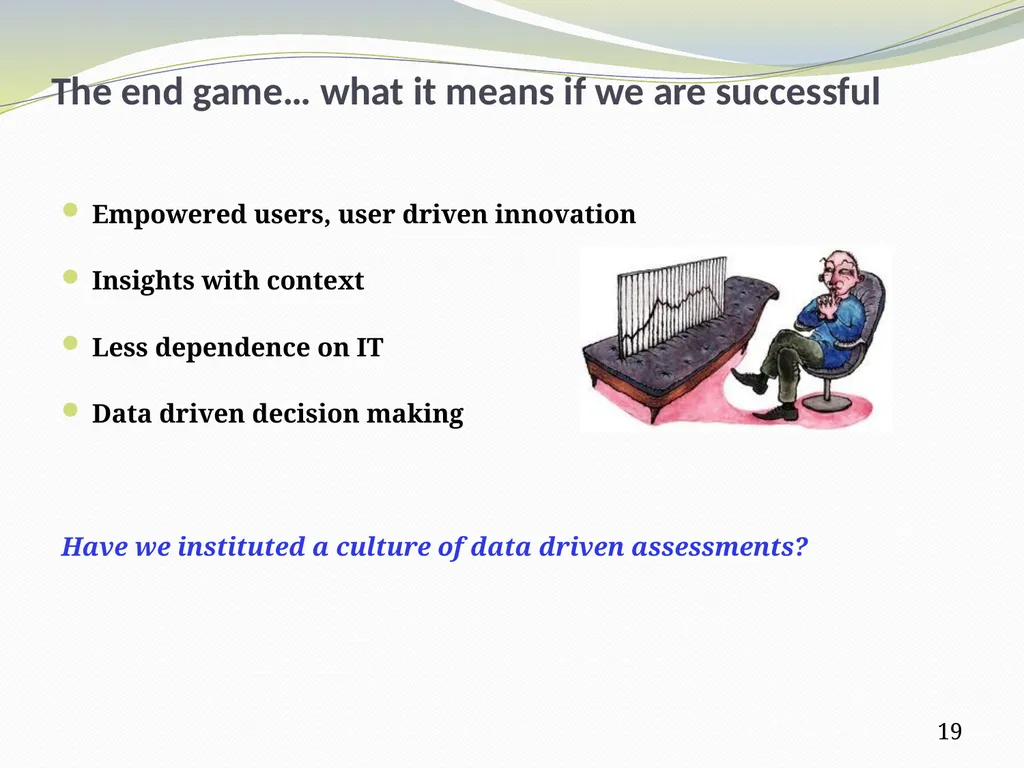
slide19. The end game… what it means if we are successful Empowered users, user driven innovation
Insights with context
Less dependence on IT
Data driven decision making
Have we instituted a culture of data driven assessments? 19<br>
slide20. Questions or Comments? 20 THANK YOU!!!<br>
Joyce Deroy, Director, Information Services
Matteo Becchi, BI Program Manager
American University<br>
slide2. American University, Washington DC Private 4-Year University, Chartered by Act of Congress in 1893
13,047 Undergraduate, Graduate, Law Students
6,827 Undergraduates, 5,725 Graduate , 495 Visiting
750 Full-Time Faculty; 430 Adjunct; 1,300 Full-Time Staff
105 Study Abroad Programs in 34 Countries
Politically and Socially Active Student Body 2<br>
slide3. Objective of this presentation Share our experiences and approach to BI
Explore what makes BI implementations different
Share lessons learned
Hoping to stimulate conversations, learn from you! 3<br>
slide4. Where are institutions with their BI implementations? How many of you are actively benefitting from a mature BI implementation?
How many of you are in the middle of your first round of BI implementation?
How many of you are thinking about starting BI implementations?
What are the most common challenges in today’s analytical environment that made you consider BI? 4<br>
slide5. AU BI Analytics and Reporting Initiative Timeline AU analytical environment analysis Executive Dashboards Phase 1 Research Grants Financial Reports UG Admissions Reports Pre Awards Financial Reports BI Tool Selection BI Infrastructure Build Development/ Alumni Relations Reports Executive Dashboards Phase 2 Financial Reports - Facilities Financial Reports - GL Pilot Predictive Analytics Self service BI for Finance and Budget Widely used data warehouse
Broad set of data
Custom reports with prompts Empowered Users
Self Service BI
BI competency center Additional Domains Rollout self service model 5<br>
slide6. Challenges in today’s analytical environment Tons of data
Different systems, interpretation challenges
Data Quality, gaps in Source Systems
Focus on operational reports,
Not decision oriented reports!
Effort spent “developing” reports
Less time to analyze results!
Even less time to discuss “what needs to be done different” Every day 15 petabytes of new information are generated. It is estimated that the codified information base of the world is now doubling every 11 hours. Source: TED 2007: Predicting the Next 5000 Days of the Web. IBM analysis 6<br>
slide7. The promise of BI Right data
Right correlation
Right interpretation
Right access
Right people
Right set of analytics Intelligently harnessing data to make better decisions: 7<br>
slide8. AU BI Success Stories SIGUCCS Award:
Best of Category for Printed Instructional Classroom Materials for "Research Grants Financial Reporting“
User Success Stories: “I use it on a daily basis. Now that I'm familiar with it and the reports I like, it's really amazing. I can track a single expense in less than half the time it took before BI. I can provide PI's a snapshot of their budget in no time at all. In sum, it's substantially improved our ability to provide the faculty with information to make decisions on how best to utilize funding to accomplish the goals of their sponsored research projects.”
Bill Brown
Financial Operations Manager
School of Public Affairs “A payment didn't make it to a vendor. In a few seconds I was able to see that the funds had not yet been encumbered, meaning the purchase order had not yet been processed. That information allowed me to quickly identify exactly whom I needed to contact. Problem solved. “ Mary Eschelbach Hansen Associate Professor Director of Undergraduate Studies Department of Economics 8<br>
slide9. Thinking of BI – basic differentiators Not merely a new tool
“Insights” derived with end goal in mind
Business processes with integration in mind
Analysis with context in mind
Refocusing users to “self serve”, and “explore”
.... And Refocusing users how to analyze effectively 9<br>
slide10. Fundamentals of a BI strategy Identify information needs/ gaps
Prioritize gaps, group into initiatives
Define roadmap, revisit constantly
Identify BI champions
Influence funding the program
Identify Pilot
Start with a group with defined use cases
Something “New”
Something not too complicated
Long term focus and strategic vision BI 10<br>
slide11. Formulating a BI Strategy, Implementation Plan Information Needs Analysis Current Environment Analysis BI Plan & Business Case Solution Architecture &
Technology Selection BI Workshop Interview Stakeholders
Identify Performance Measures
Create Information Architecture/ Model Identify Data Sources and Initiatives
Interview Technical Stakeholders
Identify Technologies & Standards
Assess Information Availability IT Facilitates and Observes – Stakeholders Decide
Brainstorm and Reach Consensus
Prioritize Top-down – Validate Bottom-up Program Vision and Governance
ROI Analysis RESULTS STEP 2 STEP 1 Tool Requirements
Demos, Selection Information Requirements Framework Phased Rollout Plan Pilot and Incremental Phases
Project Team
Governance and Leadership BI Implementation Plan 11<br>
slide12. Information Requirements Framework— draft example 12<br>
slide13. A few items to explore when implementing……. Are campus administrators and faculty interested in participating?
Are users taking ownership?
How do we really define “self service” in the context of BI?
How can we think big and start small?
Is BI without data governance effective? 13<br>
slide14. BI implementation realities/ challenges Tools and technology not the most difficult part
Data Modeling takes a lot of effort
Definitions and requirements take time
Self service usage Self service learning
Invest in ongoing training program
Have a roadmap – haphazard deployment is confusing 14<br>
slide15. AU’s BI Maturity Model: Where we were 15<br>
slide16. AU’s BI Maturity Model: Where we would like to be 16<br>
slide17. Continuing the BI maturity journey Consistent Roadmap - keep it updated
Never stop raising awareness
Never stop highlighting business impact
Program Governance is key
Data quality has to be a continued focus
Need users who are excited and ready to champion
Focus needs to be on Enterprise Information Management, not one off BI projects 17<br>
slide18. In essence – Plan to build out BI competency center Image Source: How to Define and Run a Successful Business Intelligence Competency Center, Gartner, August 2007 Strategic BICC Membership:
Wisdom
Trends
Knowledge
Information Tactical BICC Membership:
Decision Oriented Reports
Overall Measures and Dashboards
Operational Reports
Lists and Action Oriented Reports Enterprise Systems Project Team BI Reporting and Analytics
IT Program Team 18<br>
slide19. The end game… what it means if we are successful Empowered users, user driven innovation
Insights with context
Less dependence on IT
Data driven decision making
Have we instituted a culture of data driven assessments? 19<br>
slide20. Questions or Comments? 20 THANK YOU!!!<br>