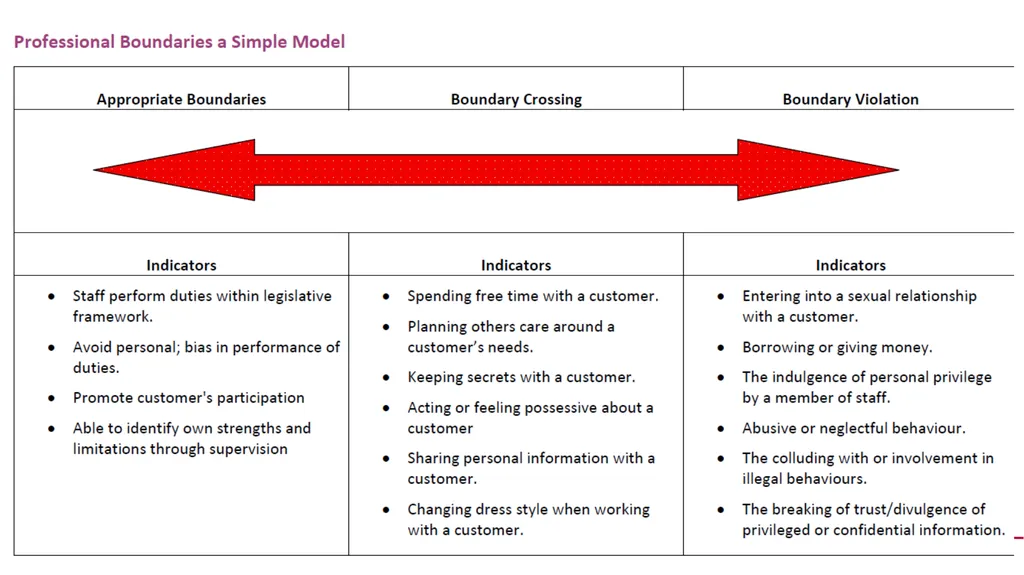
Frontline Network Boundaries Webinar Delivered by: Dr Natalie Isaia, BGPS Why are boundaries important? Boundaries are essential to keep us and our clients safe. Boundaries help others to know what to expect. We often feel guilty when we
"Frontline Network Boundaries Webinar Delivered by:" is the property of its rightful owner. Permission is granted to
download and print the materials on this website for personal, non-commercial use only, and to display it
on your personal computer provided you do not modify the materials and that you retain all copyright
notices contained in the materials. By downloading content from our website, you accept the terms of this
agreement.
Presentation Transcript
01
Frontline Network Boundaries Webinar
Delivered by: Dr Natalie Isaia, BGPS<br>
02
Why are boundaries important? Boundaries are essential to keep us and our clients safe.
Boundaries help others to know what to expect.
We often feel guilty when we hold our boundaries. We are often not thanked for holding boundaries. But in the long run everyone feels happier.
Emotional contagion and working with traumatic material puts us at risk of burnout and vicarious trauma and moral injury.
Boundaries help you to be effective in your job over the long term
It is your professional responsibility to understand your boundaries and hold them. www.frontlinenetwork.org.uk/funding<br>
03
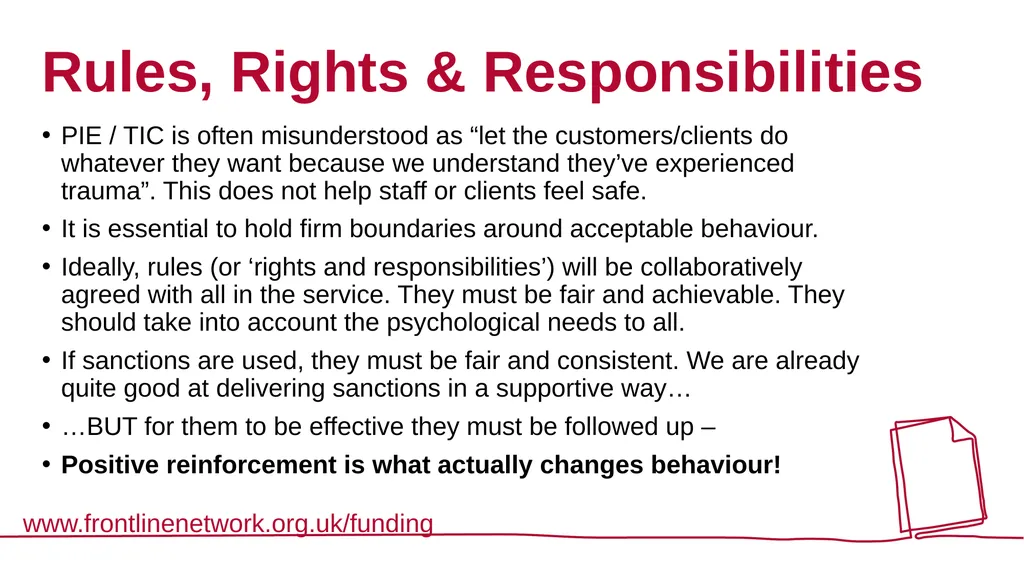
Rules, Rights & Responsibilities PIE / TIC is often misunderstood as “let the customers/clients do whatever they want because we understand they’ve experienced trauma”. This does not help staff or clients feel safe.
It is essential to hold firm boundaries around acceptable behaviour.
Ideally, rules (or ‘rights and responsibilities’) will be collaboratively agreed with all in the service. They must be fair and achievable. They should take into account the psychological needs to all.
If sanctions are used, they must be fair and consistent. We are already quite good at delivering sanctions in a supportive way…
…BUT for them to be effective they must be followed up –
Positive reinforcement is what actually changes behaviour!<br>
04
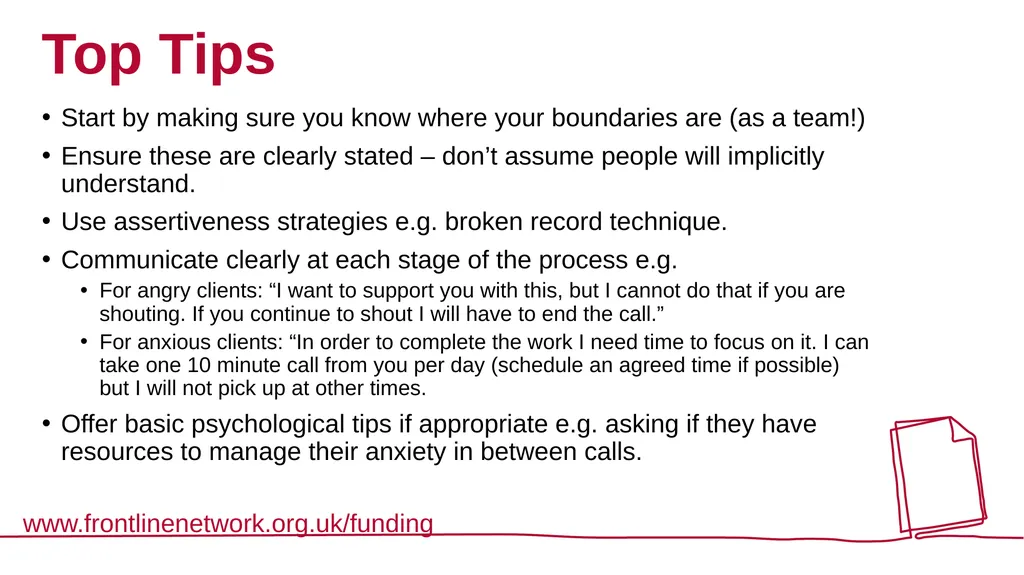
Top Tips Start by making sure you know where your boundaries are (as a team!)
Ensure these are clearly stated – don’t assume people will implicitly understand.
Use assertiveness strategies e.g. broken record technique.
Communicate clearly at each stage of the process e.g.
For angry clients: “I want to support you with this, but I cannot do that if you are shouting. If you continue to shout I will have to end the call.”
For anxious clients: “In order to complete the work I need time to focus on it. I can take one 10 minute call from you per day (schedule an agreed time if possible) but I will not pick up at other times.
Offer basic psychological tips if appropriate e.g. asking if they have resources to manage their anxiety in between calls.<br>
05
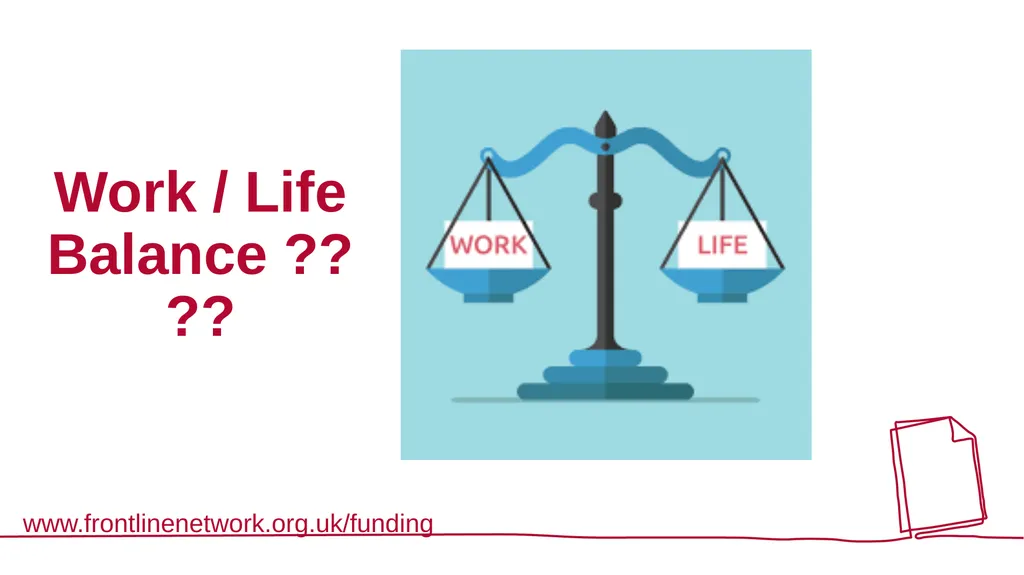
Work / Life Balance ????<br>
06
Time boundaries Sometimes you HAVE to stay late or skip a lunchtime. Often it’s just habit.
Checking emails out of hours is an anxiety-driven checking behaviour – you can retrain your brain to learn that the service is OK when you’re not!
Ideally the team culture should shift away from everyone feeling guilty if they take a lunchbreak or leave on time.
Managers must model good time boundaries!!<br>
07
Basic Assertiveness Sometimes we have to manage up…
Your manager is also getting a lot of pressure put onto them.
Assertiveness is the art of holding your boundaries while taking into account the other person’s needs and feelings.
Example:
“I understand we’re under pressure as a service to meet these targets and of course I want our service to perform well. Here is my calendar and current to do list… as you can see, it won’t be possible for me to get this done on top as everything in the time that I have. Please let me know what you’d like me to prioritise.<br>
08
Self-compassion When we are in ‘threat mode’ our brains tell us “YOU DON’T HAVE TIME TO STOP! KEEP GOING! KEEP GOING!”.
Our brains are well meaning but wrong!
For many people, if you worked 24/7, you still won’t complete your ‘to do’ list.
You don’t have time NOT to stop – without boundaries you cannot work effectively. If you’re burned out, you can’t help anyone.
We have to use a self-compassionate inner voice (like a coach) to be able to gently counter the threat-based voice.
Quick self-compassion hack – “What would I say to a friend or a colleague if they were in this situation?”<br>
09
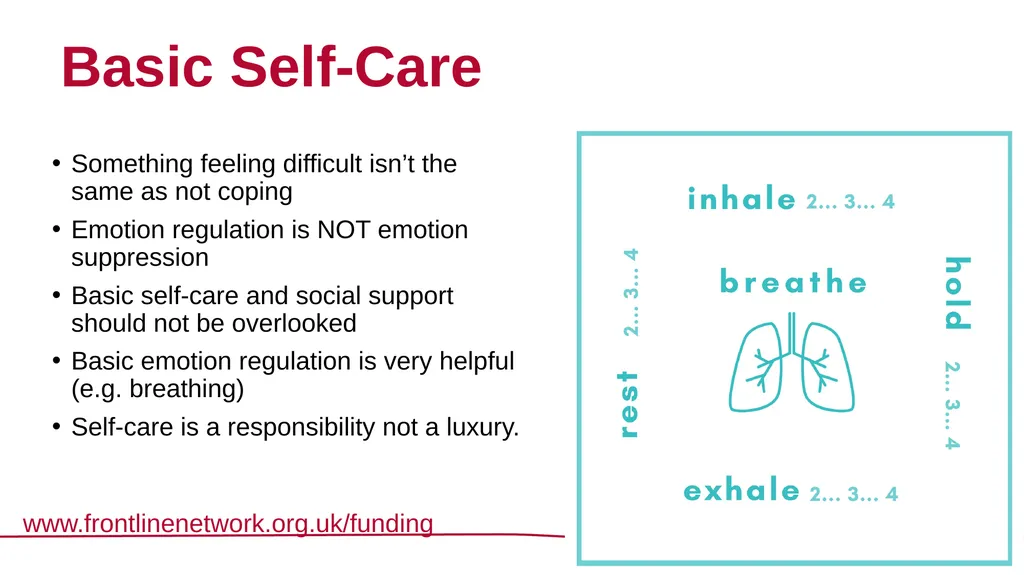
Something feeling difficult isn’t the same as not coping
Emotion regulation is NOT emotion suppression
Basic self-care and social support should not be overlooked
Basic emotion regulation is very helpful (e.g. breathing)
Self-care is a responsibility not a luxury. Basic Self-Care<br>
10
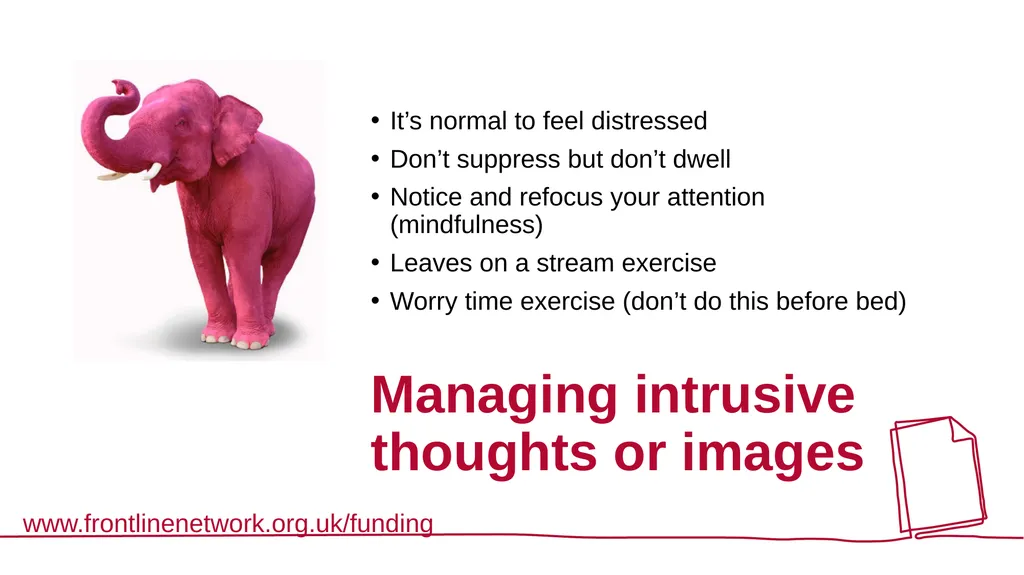
Managing intrusive thoughts or images It’s normal to feel distressed
Don’t suppress but don’t dwell
Notice and refocus your attention (mindfulness)
Leaves on a stream exercise
Worry time exercise (don’t do this before bed)<br>
11
Common barriers “But I don’t have time…”
You don’t have time NOT to!
You’ll be more efficient and effective when you have good boundaries.
Once you train your threat system into good habits, it’ll stop feeling so scary to balance everyone’s needs, including your own. “But I feel guilty…”
People don’t usually thank you for holding boundaries.
The compassionate action is NOT always the nice/easy action.
If you’ve thought through your boundaries, and you believe it is in everyone’s best interest, then it’s fine to feel guilty – you can learn to sit with that feeling.<br>
12
Summary Tools to strengthen boundaries:
Supervision
Team discussion
Policy & Procedure
Everyone should be clear on:
Negotiable boundaries
Vs.
Non-negotiable boundaries Boundaries must be:
Held consistently by each staff member
Held consistently across the team
Held consistently for all residents
Psychologically informed<br>
13
Resources BGPS Training Including…
Personalised Boundaries Workshop
Emotional Intelligence & Resilience
Moral Injury and Compassion
Compassion Focused Assertiveness Skills
Self-compassion online resource - https://www.cci.health.wa.gov.au/Resources/Looking-After-Yourself/Self-Compassion
Leaves on a stream - https://www.mindfulnessmuse.com/acceptance-and-commitment-therapy/leaves-on-a-stream-cognitive-defusion-exercise
Breathing – https://mi-psych.com.au/soothing-rhythm-breathing/<br>
14
Thank you for your attention! My email – Natalie@bgpsych.com / Training@bgpsych.com<br>