
Functions and Loops in R (Example on evaluation of

Description: Functions and Loops in R (Example on evaluation of clusters) Arko Barman COSC 6335 Data Mining University of Houston Commonly used loop structures in R - for while apply repeat Other important keywords break next (similar to continue in
Related Topics
Download Presentation
"Functions and Loops in R (Example on evaluation of" is the property of its rightful owner. Permission is granted to download and print the materials on this website for personal, non-commercial use only, and to display it on your personal computer provided you do not modify the materials and that you retain all copyright notices contained in the materials. By downloading content from our website, you accept the terms of this agreement.
Presentation Transcript
slide1. Functions and Loops in R
(Example on evaluation of clusters) Arko Barman
COSC 6335 Data Mining
University of Houston<br>
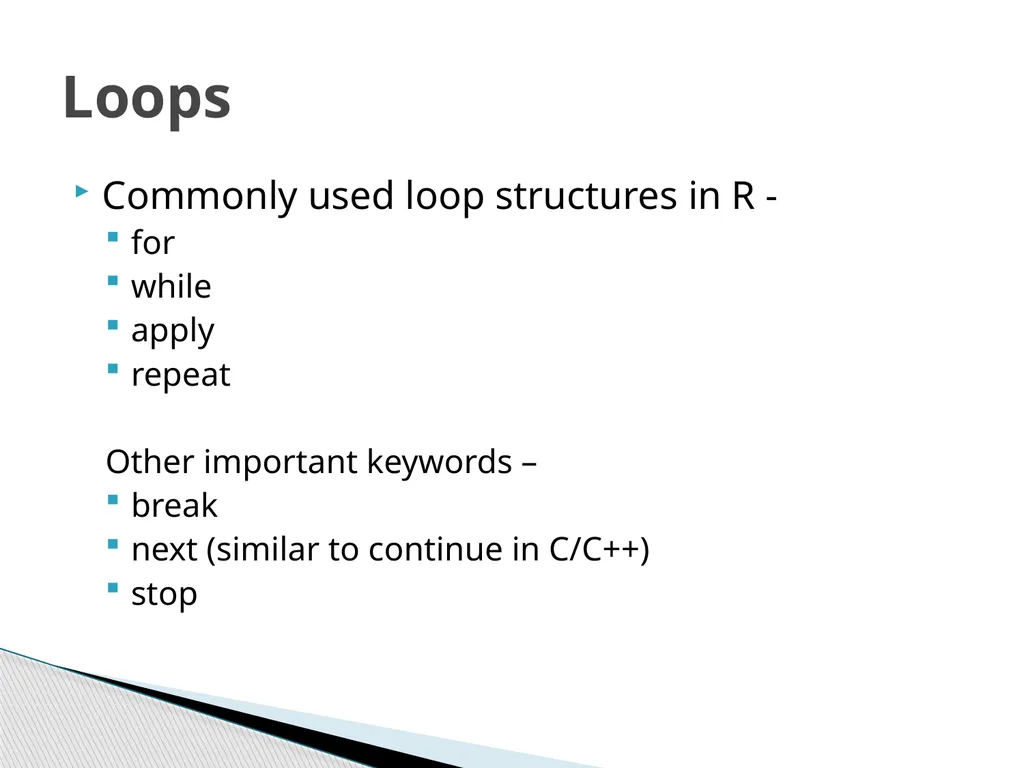
slide2. Commonly used loop structures in R -
for
while
apply
repeat
Other important keywords –
break
next (similar to continue in C/C++)
stop Loops<br>
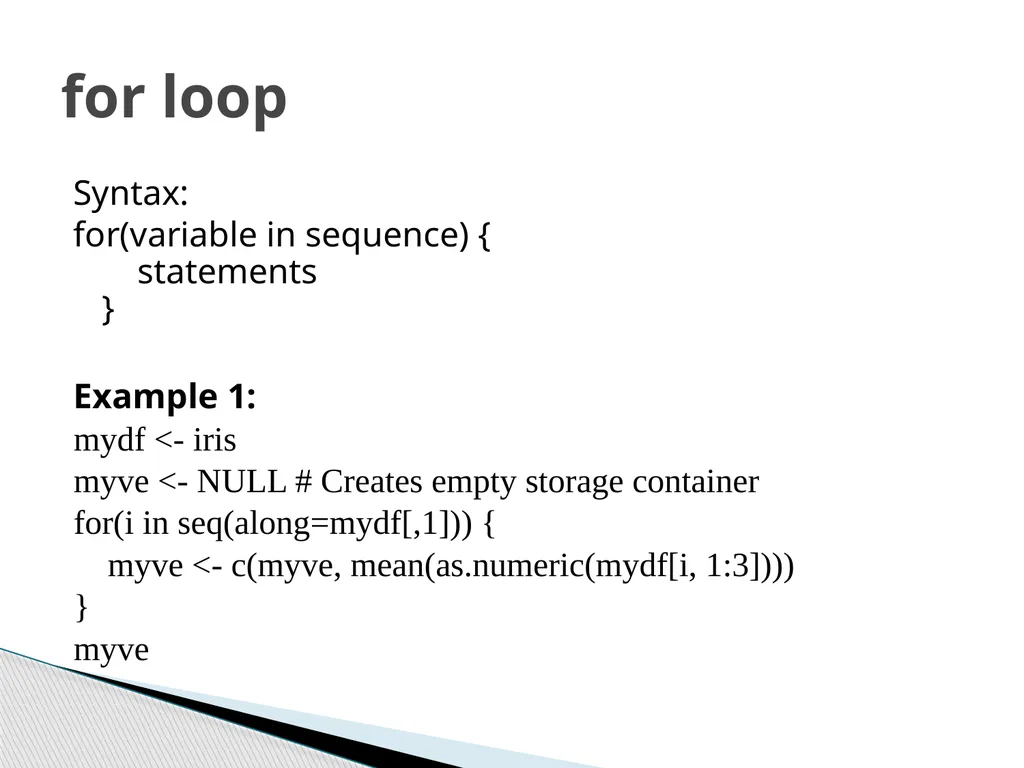
slide3. Syntax:
for(variable in sequence) { statements }
Example 1:
mydf <- iris
myve <- NULL # Creates empty storage container
for(i in seq(along=mydf[,1])) {
myve <- c(myve, mean(as.numeric(mydf[i, 1:3])))
}
myve for loop<br>
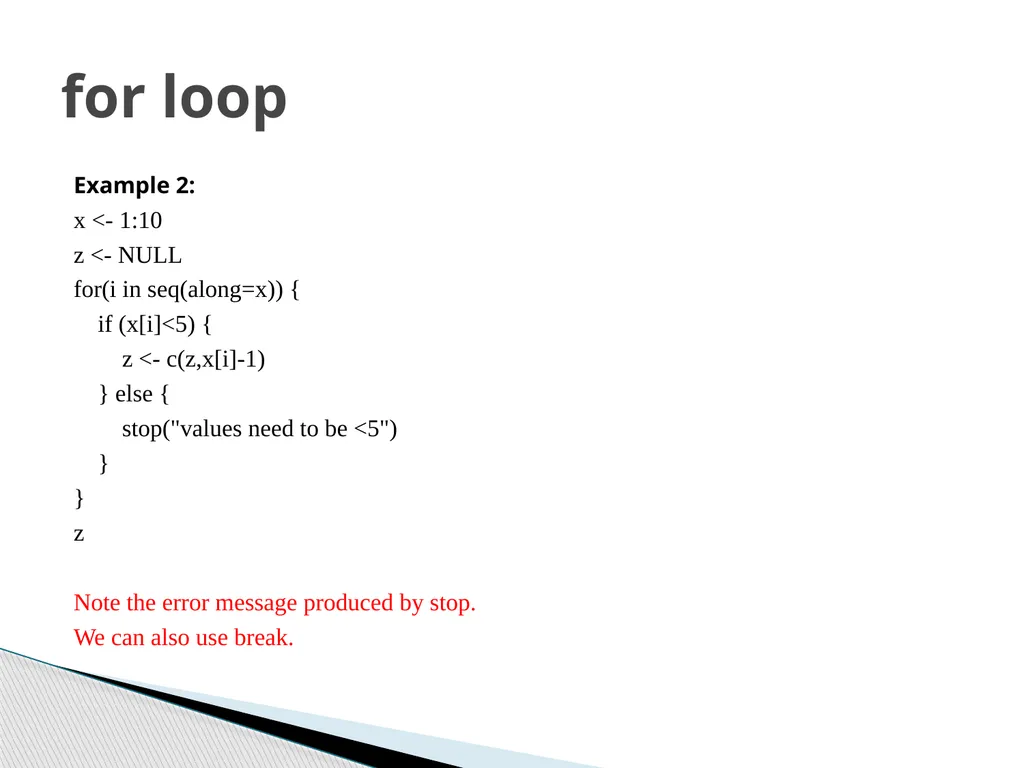
slide4. Example 2:
x <- 1:10
z <- NULL
for(i in seq(along=x)) {
if (x[i]<5) {
z <- c(z,x[i]-1)
} else {
stop("values need to be <5")
}
}
z
Note the error message produced by stop.
We can also use break. for loop<br>
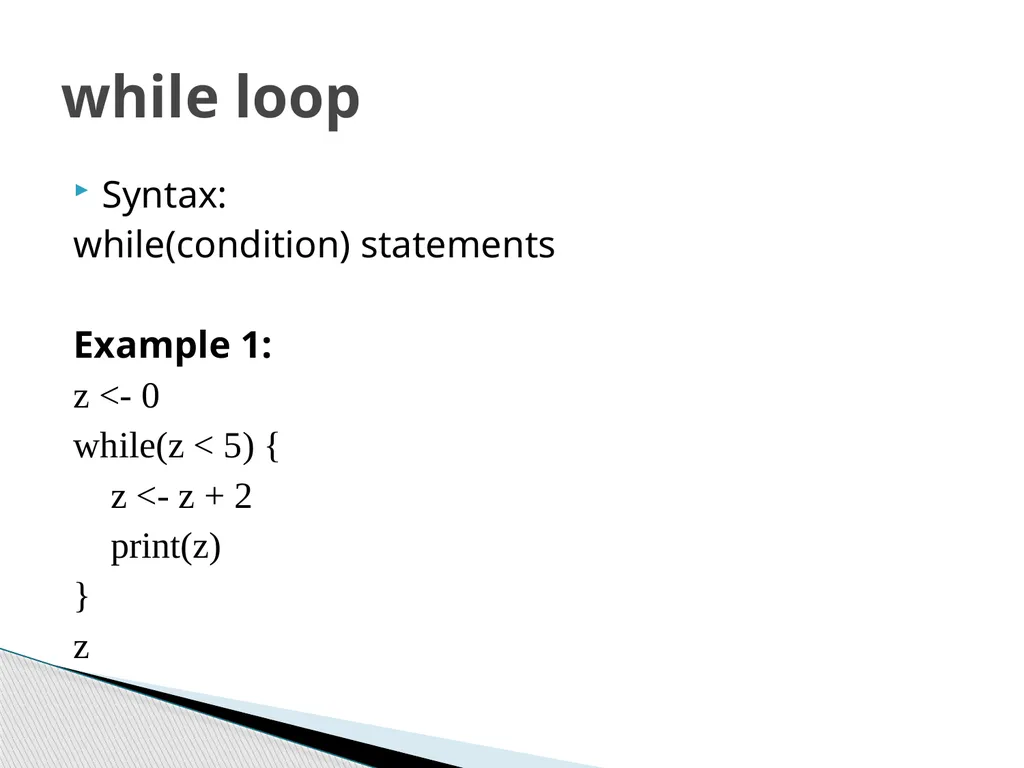
slide5. Syntax:
while(condition) statements
Example 1:
z <- 0
while(z < 5) {
z <- z + 2
print(z)
}
z while loop<br>
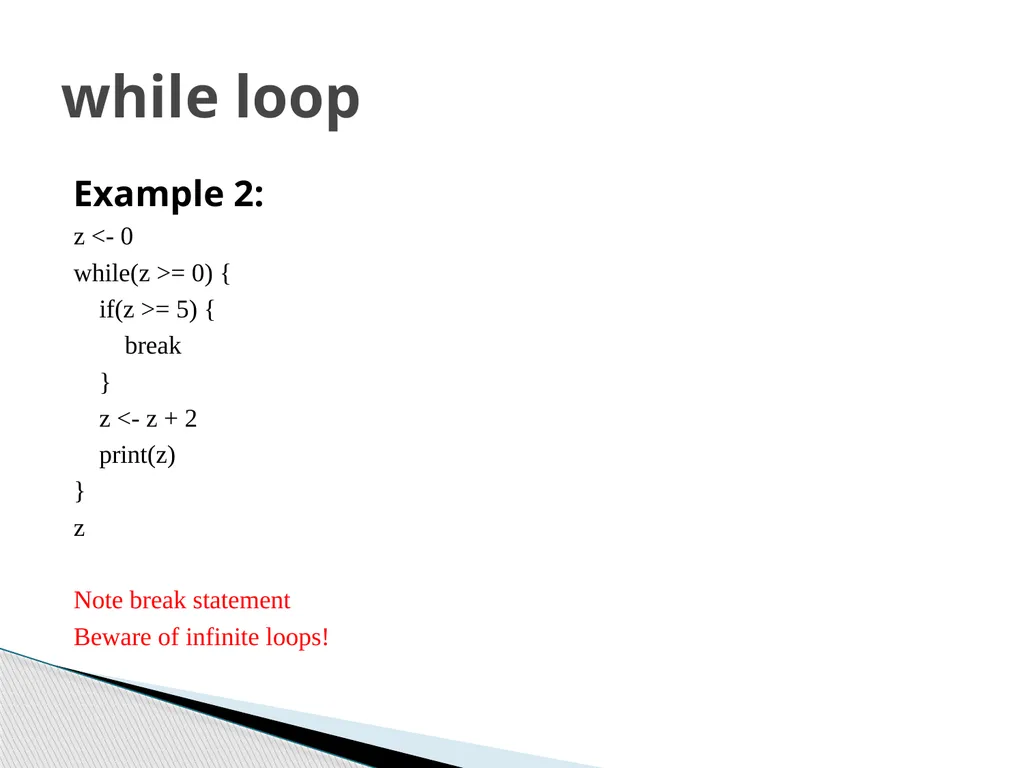
slide6. Example 2:
z <- 0
while(z >= 0) {
if(z >= 5) {
break
}
z <- z + 2
print(z)
}
z
Note break statement
Beware of infinite loops! while loop<br>
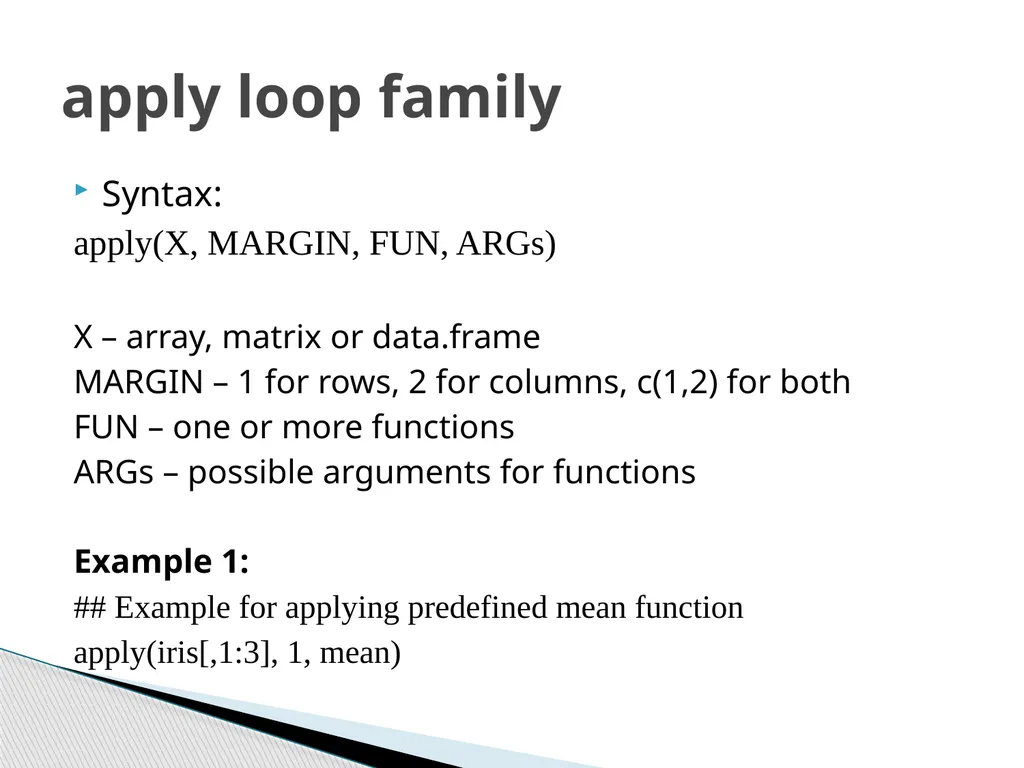
slide7. Syntax:
apply(X, MARGIN, FUN, ARGs)
X – array, matrix or data.frame
MARGIN – 1 for rows, 2 for columns, c(1,2) for both
FUN – one or more functions
ARGs – possible arguments for functions
Example 1:
## Example for applying predefined mean function
apply(iris[,1:3], 1, mean) apply loop family<br>
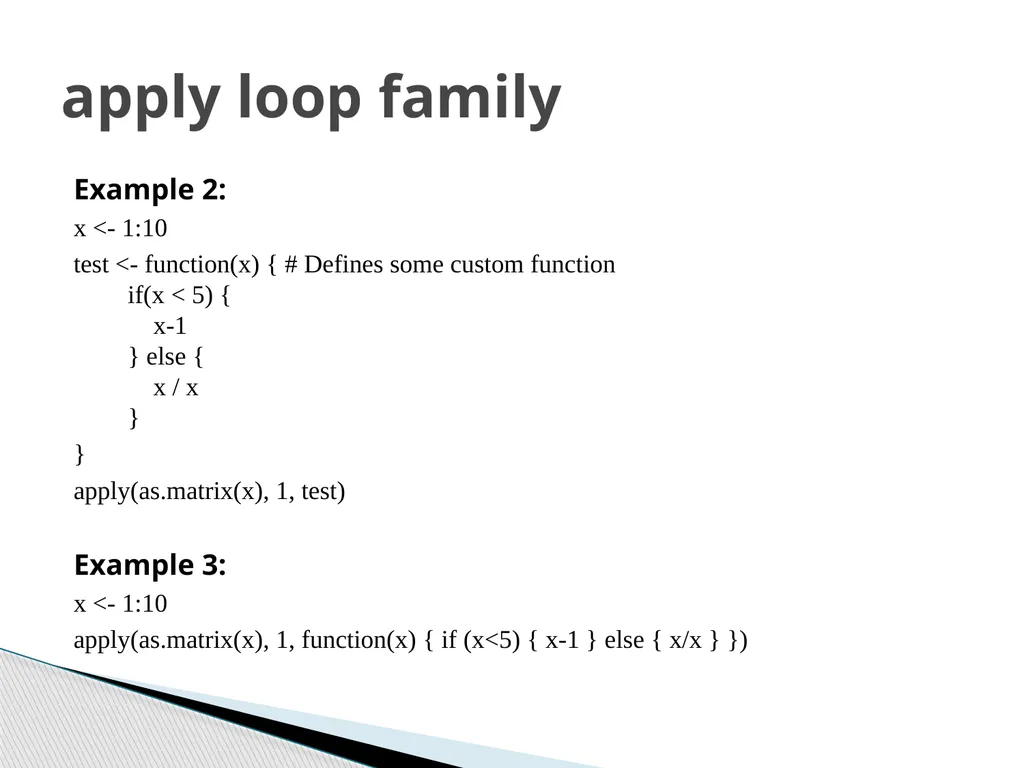
slide8. Example 2:
x <- 1:10
test <- function(x) { # Defines some custom function if(x < 5) { x-1 } else { x / x }
}
apply(as.matrix(x), 1, test)
Example 3:
x <- 1:10
apply(as.matrix(x), 1, function(x) { if (x<5) { x-1 } else { x/x } }) apply loop family<br>
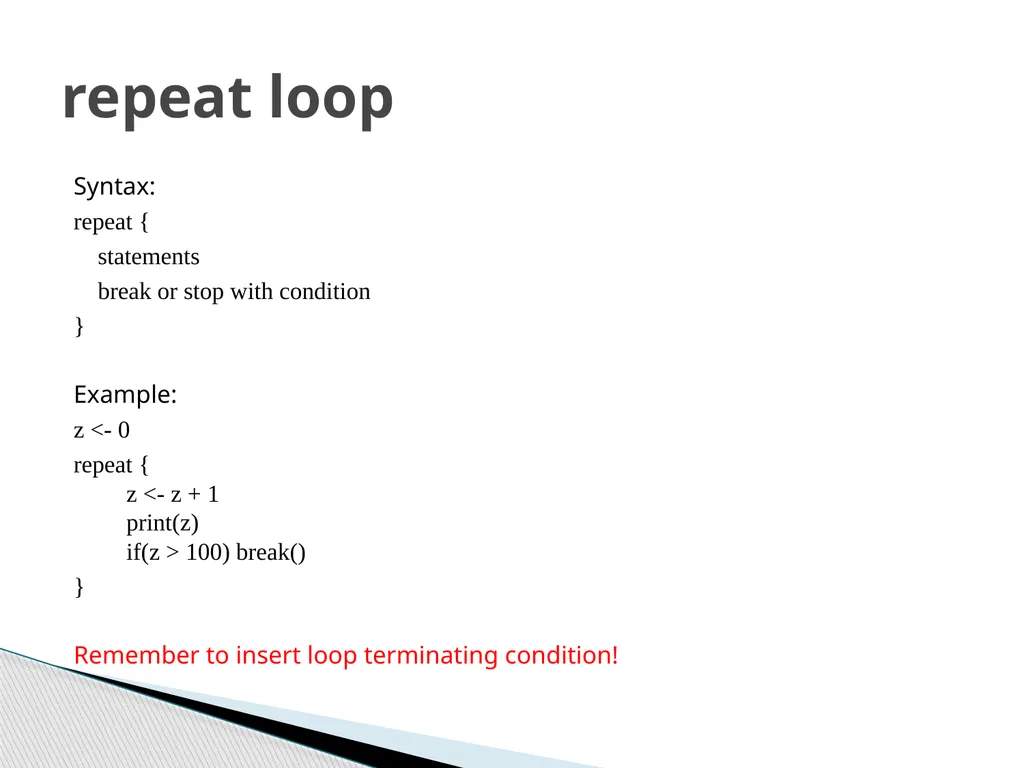
slide9. Syntax:
repeat {
statements
break or stop with condition
}
Example:
z <- 0
repeat { z <- z + 1 print(z) if(z > 100) break()
}
Remember to insert loop terminating condition! repeat loop<br>
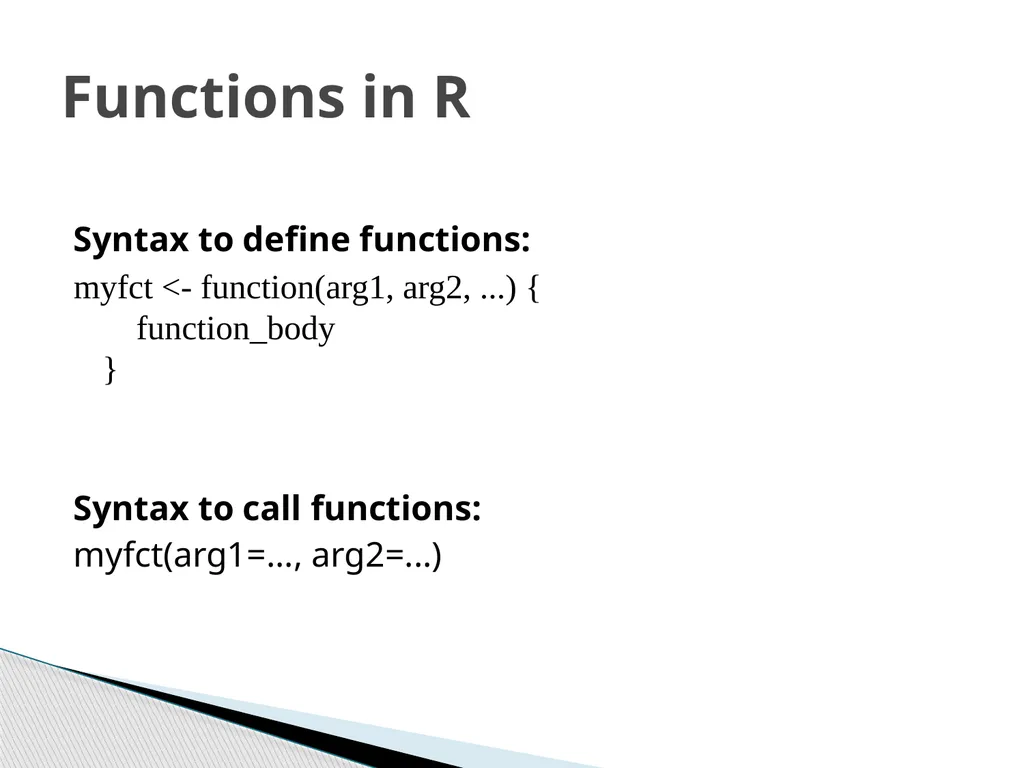
slide10. Syntax to define functions:
myfct <- function(arg1, arg2, ...) { function_body }
Syntax to call functions:
myfct(arg1=..., arg2=...) Functions in R<br>
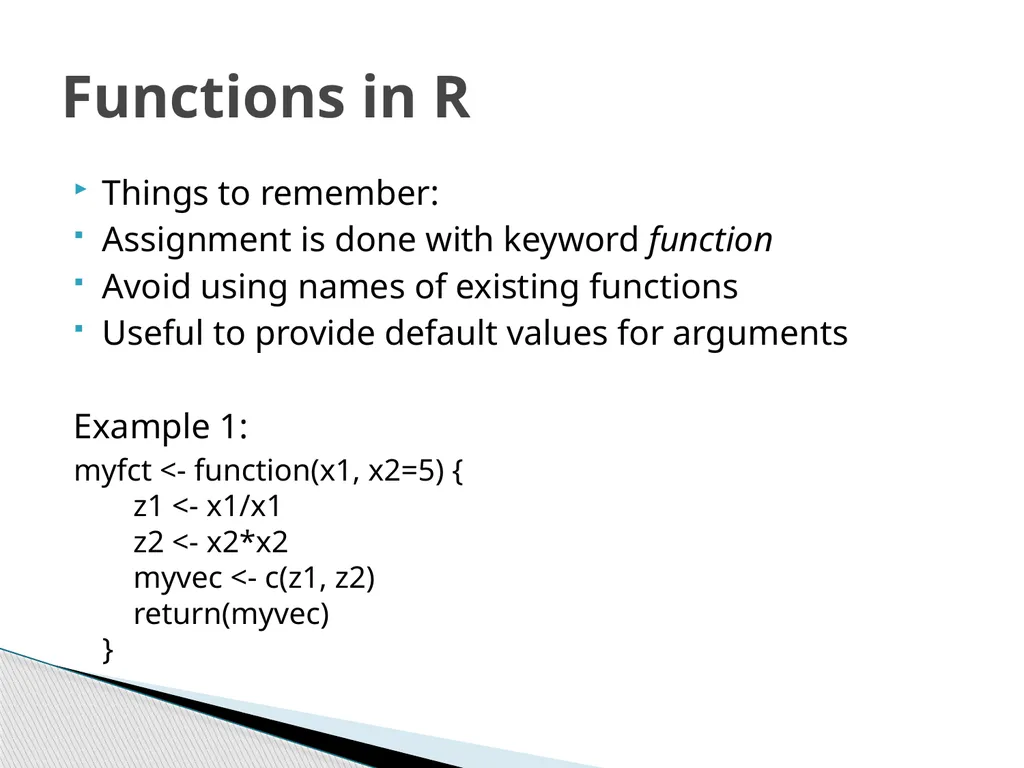
slide11. Things to remember:
Assignment is done with keyword function
Avoid using names of existing functions
Useful to provide default values for arguments
Example 1:
myfct <- function(x1, x2=5) { z1 <- x1/x1 z2 <- x2*x2 myvec <- c(z1, z2) return(myvec) } Functions in R<br>
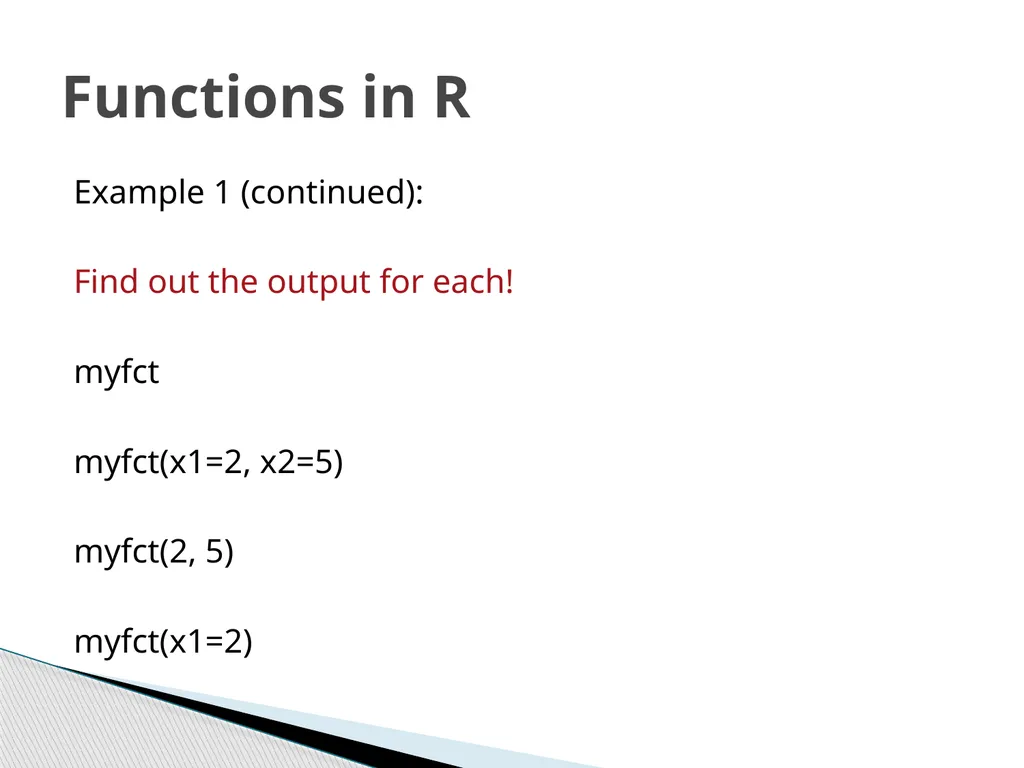
slide12. Example 1 (continued):
Find out the output for each!
myfct
myfct(x1=2, x2=5)
myfct(2, 5)
myfct(x1=2) Functions in R<br>
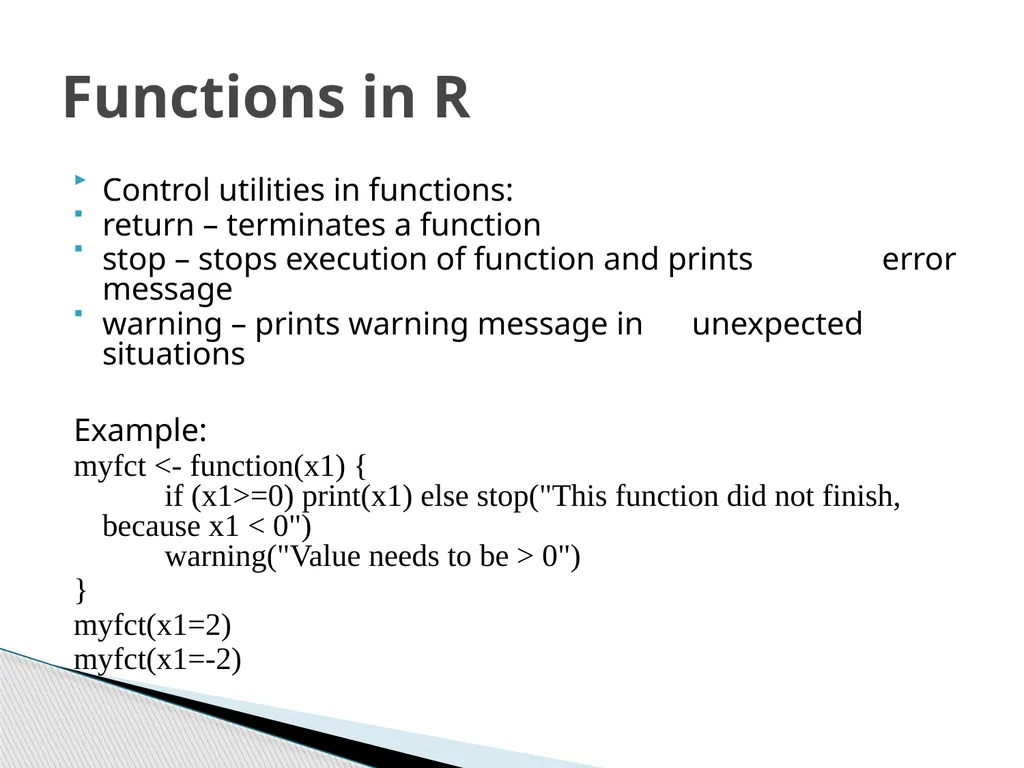
slide13. Control utilities in functions:
return – terminates a function
stop – stops execution of function and prints error message
warning – prints warning message in unexpected situations
Example:
myfct <- function(x1) { if (x1>=0) print(x1) else stop("This function did not finish, because x1 < 0") warning("Value needs to be > 0")
}
myfct(x1=2)
myfct(x1=-2) Functions in R<br>
slide14. Questions?<br>
COSC 6335 Data Mining
University of Houston<br>
slide2. Commonly used loop structures in R -
for
while
apply
repeat
Other important keywords –
break
next (similar to continue in C/C++)
stop Loops<br>
slide3. Syntax:
for(variable in sequence) { statements }
Example 1:
mydf <- iris
myve <- NULL # Creates empty storage container
for(i in seq(along=mydf[,1])) {
myve <- c(myve, mean(as.numeric(mydf[i, 1:3])))
}
myve for loop<br>
slide4. Example 2:
x <- 1:10
z <- NULL
for(i in seq(along=x)) {
if (x[i]<5) {
z <- c(z,x[i]-1)
} else {
stop("values need to be <5")
}
}
z
Note the error message produced by stop.
We can also use break. for loop<br>
slide5. Syntax:
while(condition) statements
Example 1:
z <- 0
while(z < 5) {
z <- z + 2
print(z)
}
z while loop<br>
slide6. Example 2:
z <- 0
while(z >= 0) {
if(z >= 5) {
break
}
z <- z + 2
print(z)
}
z
Note break statement
Beware of infinite loops! while loop<br>
slide7. Syntax:
apply(X, MARGIN, FUN, ARGs)
X – array, matrix or data.frame
MARGIN – 1 for rows, 2 for columns, c(1,2) for both
FUN – one or more functions
ARGs – possible arguments for functions
Example 1:
## Example for applying predefined mean function
apply(iris[,1:3], 1, mean) apply loop family<br>
slide8. Example 2:
x <- 1:10
test <- function(x) { # Defines some custom function if(x < 5) { x-1 } else { x / x }
}
apply(as.matrix(x), 1, test)
Example 3:
x <- 1:10
apply(as.matrix(x), 1, function(x) { if (x<5) { x-1 } else { x/x } }) apply loop family<br>
slide9. Syntax:
repeat {
statements
break or stop with condition
}
Example:
z <- 0
repeat { z <- z + 1 print(z) if(z > 100) break()
}
Remember to insert loop terminating condition! repeat loop<br>
slide10. Syntax to define functions:
myfct <- function(arg1, arg2, ...) { function_body }
Syntax to call functions:
myfct(arg1=..., arg2=...) Functions in R<br>
slide11. Things to remember:
Assignment is done with keyword function
Avoid using names of existing functions
Useful to provide default values for arguments
Example 1:
myfct <- function(x1, x2=5) { z1 <- x1/x1 z2 <- x2*x2 myvec <- c(z1, z2) return(myvec) } Functions in R<br>
slide12. Example 1 (continued):
Find out the output for each!
myfct
myfct(x1=2, x2=5)
myfct(2, 5)
myfct(x1=2) Functions in R<br>
slide13. Control utilities in functions:
return – terminates a function
stop – stops execution of function and prints error message
warning – prints warning message in unexpected situations
Example:
myfct <- function(x1) { if (x1>=0) print(x1) else stop("This function did not finish, because x1 < 0") warning("Value needs to be > 0")
}
myfct(x1=2)
myfct(x1=-2) Functions in R<br>
slide14. Questions?<br>