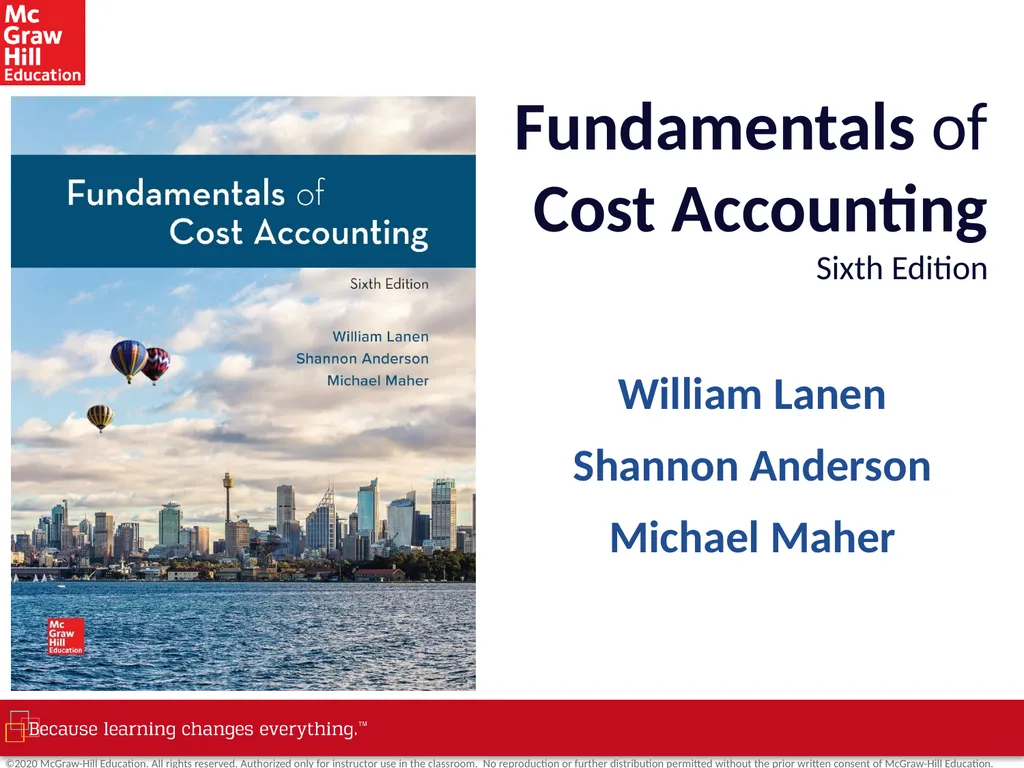
Fundamentals of Cost Accounting Sixth Edition

Published  . 0 views
↓ Download
Fundamentals of Cost Accounting Sixth Edition
1 / 1
Fundamentals of Cost Accounting Sixth Edition - slide 1 of 33 Fundamentals of Cost Accounting Sixth Edition - slide 2 of 33 Fundamentals of Cost Accounting Sixth Edition - slide 3 of 33 Fundamentals of Cost Accounting Sixth Edition - slide 4 of 33 Fundamentals of Cost Accounting Sixth Edition - slide 5 of 33 Fundamentals of Cost Accounting Sixth Edition - slide 6 of 33 Fundamentals of Cost Accounting Sixth Edition - slide 7 of 33 Fundamentals of Cost Accounting Sixth Edition - slide 8 of 33 Fundamentals of Cost Accounting Sixth Edition - slide 9 of 33 Fundamentals of Cost Accounting Sixth Edition - slide 10 of 33 Fundamentals of Cost Accounting Sixth Edition - slide 11 of 33 Fundamentals of Cost Accounting Sixth Edition - slide 12 of 33 Fundamentals of Cost Accounting Sixth Edition - slide 13 of 33 Fundamentals of Cost Accounting Sixth Edition - slide 14 of 33 Fundamentals of Cost Accounting Sixth Edition - slide 15 of 33 Fundamentals of Cost Accounting Sixth Edition - slide 16 of 33 Fundamentals of Cost Accounting Sixth Edition - slide 17 of 33 Fundamentals of Cost Accounting Sixth Edition - slide 18 of 33 Fundamentals of Cost Accounting Sixth Edition - slide 19 of 33 Fundamentals of Cost Accounting Sixth Edition - slide 20 of 33 Fundamentals of Cost Accounting Sixth Edition - slide 21 of 33 Fundamentals of Cost Accounting Sixth Edition - slide 22 of 33 Fundamentals of Cost Accounting Sixth Edition - slide 23 of 33 Fundamentals of Cost Accounting Sixth Edition - slide 24 of 33 Fundamentals of Cost Accounting Sixth Edition - slide 25 of 33 Fundamentals of Cost Accounting Sixth Edition - slide 26 of 33 Fundamentals of Cost Accounting Sixth Edition - slide 27 of 33 Fundamentals of Cost Accounting Sixth Edition - slide 28 of 33 Fundamentals of Cost Accounting Sixth Edition - slide 29 of 33 Fundamentals of Cost Accounting Sixth Edition - slide 30 of 33 Fundamentals of Cost Accounting Sixth Edition - slide 31 of 33 Fundamentals of Cost Accounting Sixth Edition - slide 32 of 33 Fundamentals of Cost Accounting Sixth Edition - slide 33 of 33
Description: Fundamentals of Cost Accounting Sixth Edition William Lanen Shannon Anderson Michael Maher 2020 McGraw-Hill Education. All rights reserved. Authorized only for instructor use in the classroom. No reproduction or further distribution

Related Topics

Download Presentation

"Fundamentals of Cost Accounting Sixth Edition" is the property of its rightful owner. Permission is granted to download and print the materials on this website for personal, non-commercial use only, and to display it on your personal computer provided you do not modify the materials and that you retain all copyright notices contained in the materials. By downloading content from our website, you accept the terms of this agreement.

Presentation Transcript

slide1. Fundamentals of Cost Accounting Sixth Edition William Lanen
Shannon Anderson
Michael Maher ©2020 McGraw-Hill Education. All rights reserved. Authorized only for instructor use in the classroom.  No reproduction or further distribution permitted without the prior written consent of McGraw-Hill Education.<br>
slide2. Chapter 4 Fundamentals of Cost Analysis for Decision Making<br>
slide3. Learning Objectives LO 4-1 Use differential analysis to analyze decisions.
LO 4-2 Understand how to apply differential analysis to pricing decisions.
LO 4-3 Understand several approaches for establishing prices based on costs for long-run pricing decisions.
LO 4-4 Understand how to apply differential analysis to production decisions.
LO 4-5 Understand the theory of constraints.<br>
slide4. Differential Analysis LO 4-1 Use differential analysis to analyze decisions. Differential Analysis
The process of estimating revenues and costs of alternative actions available to decision makers and of comparing these estimates to the status quo. Short Run
The period of time over which capacity will be unchanged, usually one year. LO 4-1<br>
slide5. Differential Costs With two or more alternatives, costs that differ among or between alternatives Costs that change in response to an alternative course of action LO 4-1<br>
slide6. Sunk Costs Costs incurred in the past that cannot be changed by present or future decisions A sunk cost is NOT relevant for making decisions. LO 4-1<br>
slide7. Differential Costs versus Total Costs Information presented to management can show the detailed costs that are included for making a decision, or it can show just the differences between alternatives, as follows. LO 4-1<br>
slide8. Differential Analysis and Pricing Decisions LO 4-2 Understand how to apply differential analysis to pricing decisions. Variable costs must always be covered. Fixed costs must be covered in the long run. LO 4-2<br>
slide9. Short-Run versus Long-Run Pricing Decisions LO 4-2 Access the text alternative for these images<br>
slide10. Short-Run Pricing Decisions: Special Orders 1 An order that will not affect other sales and is usually a short-run occurrence LO 4-2 Access the text alternative for these images<br>
slide11. Short-Run Pricing Decisions: Special Orders 2 Desert Adventures has received a one-time offer for 5 additional tours at a discounted price of $700 per tour.
The regular price is $900 per tour and they have enough idle capacity in the month to take the offer. LO 4-2<br>
slide12. Short-Run Pricing Decisions: Special Orders 3 Analysis of Special Order: U-Develop LO 4-2 Access the text alternative for these images<br>
slide13. Long-Run Pricing Decisions LO 4-3 Understand several approaches for establishing prices based on costs for long-run pricing decisions. Full cost is the sum of all fixed and variable costs of manufacturing and selling a unit. Full costs are relevant for the long-term pricing decisions. LO 4-3<br>
slide14. Long-Run versus Short-Run Pricing In the short run, differential costs may be very low. In the long run, differential costs are higher than in the short run. LO 4-3<br>
slide15. Cost Analysis for Pricing In the long run, an organization must cover all variable and fixed costs—both manufacturing and selling. LO 4-3<br>
slide16. Life-Cycle Product Costing and Pricing Product life-cycle is concerned with covering costs in all categories of the life cycle. R & D Design Manufacturing Marketing and distribution Customer service Take back (disposal) LO 4-3<br>
slide17. Target Costing from Target Pricing Target Price
The price based on customers’ perceived value for the product and the price that competitors charge. What would a customer pay?
How much profit do I need?
Can I make it at this cost? Target price − Desired profit = Target cost LO 4-3<br>
slide18. Legal Issues Relating to Costs and Sales Price 1 Predatory Pricing
Practice of setting price below cost with the intent to drive competitors out of business Dumping
Exporting a product to another country at a price below domestic price Price Discrimination
Practice of selling identical goods to different customers at different prices LO 4-3<br>
slide19. Legal Issues Relating to Costs and Sales Price 2 Peak-load Pricing
Practice of setting prices highest when the quantity demanded for the product approaches capacity. Price Fixing
Agreement among businesses to set prices at a particular level. LO 4-3<br>
slide20. Use of Differential Analysis for Production Decision LO 4-4 Understand how to apply differential analysis to production decisions. LO 4-4 Access the text alternative for these images<br>
slide21. Make-or-Buy Decisions 1 Desert Adventure’s current costs of developing prints: This year’s expected volume is 150 tours, so the full cost of operating one of these tours is:
$222,000 ÷ 150 tours = $1,480 LO 4-4<br>
slide22. Make-or-Buy Decisions 2 Desert Adventures has received an offer from a local tour operator to organize and lead these tours for a cost (to Desert Adventures) of $1,400. Does Desert Adventures accept the offer? The accounting department prepared cost analyses at volume levels of 150 and 100 tours per year. LO 4-4<br>
slide23. Make-or-Buy Decisions 3 Differential costs increase by $12,000, so reject alternative to outsource. Differential costs decrease by $8,000, so accept alternative to outsource. a If tours are outsourced, no Desert Adventures labor is required for leading the tours.
b Pay outside supplier $210,000 (= 150 tours × $1,400) to operate tours.
c These common costs remain unchanged for these volumes. Because they do not change, they could be omitted from the analysis.
d Total variable costs reduced by 1/3 because volume was reduced by 1/3 (= [150 tours − 100 tours]/150 tours).
e If tours are outsourced, no Desert Adventures labor is required for leading the tours.
f Pay outside supplier $140,000 (= 100 tours × $1,400) to operate tours. LO 4-4<br>
slide24. Opportunity Costs of Making 1 Desert Adventures expected volume is 150 trips. Assume that the building used to store and maintain equipment could be used for aerial excursions of the local canyons. This new service would provide a $40,000 differential contribution. Should Desert Adventures accept or reject the alternative? LO 4-4<br>
slide25. Opportunity Costs of Making 2 Differential costs decrease by $28,000, so accept the alternative. “Higher” or “lower” indicates whether the alternative is higher or lower than the status quo. Differential costs decrease by $28,000, so accept the alternative. LO 4-4<br>
slide26. Add or Drop Decisions 1 Desert Adventures Fourth Quarter Product Line Income Statement LO 4-4<br>
slide27. Add or Drop Decisions 2 Desert Adventures
Differential Analysis Profits decrease $25,000. Therefore, keep desert trips. LO 4-4<br>
slide28. Product Choice Decisions 1 Constraints
Activities, resources, or policies that limit or bound the attainment of an objective Contribution Margin per Unit of Scarce Resource
Contribution margin per unit of a particular input with limited availability LO 4-4<br>
slide29. Product Choice Decisions 2 Southwestern Frames Revenue and Cost Information LO 4-4 Access the text alternative for these images<br>
slide30. Product Choice Decisions 3 Southwestern Frames Revenue and Cost Information Metal Frames have a higher contribution margin per machine hour. LO 4-4<br>
slide31. Product Choice Decisions 4 Suppose Southwestern Frames has 20,000 machine hours per month available. Selling metal frames will result in higher profits than selling wooden frames. LO 4-4<br>
slide32. The Theory of Constraints LO 4-5 Understand the theory of constraints. Theory of Constraints
Focuses on revenue and cost management when faced with bottlenecks Bottleneck
Operation where the work required limits production; a bottleneck is the constraining resource Throughput Contribution
Sales dollars minus direct materials costs and variables such as energy and piecework labor LO 4-5<br>
slide33. End of Chapter 4<br>
slide34. Accessibility Content: Text Alternatives for Images<br>
slide35. Short-Run versus Long-Run Pricing Decisions Text Alternative Short-run pricing decisions look less than one year forward, for example pricing a one-time special order.
Long-run pricing decisions look more than one year into the future, such as pricing a new product. Return to slide containing original image<br>
slide36. Short-Run Pricing Decisions: Special Orders 1 Text Alternative Decision to be made: Accept special order? Option 1: Status quo: Reject special order. Option 2: Alternative: Accept special order. Is the value of Option 1 greater than the value of Option 2? Return to slide containing original image<br>
slide37. Short-Run Pricing Decisions: Special Orders 3 Text Alternative Return to slide containing original image<br>
slide38. Use of Differential Analysis for Production Decision Text Alternative Return to slide containing original image First is Make or buy. This points right to Decision to make goods or services internally or purchase them externally. Next row shows at the left: Add or drop a segment. This points to: Decision to add or drop a product line or close a business unit. Last row has Product choice at the left. At the right is: Decision on what products or services to offer (product mix).<br>
slide39. Product Choice Decisions 2 Text Alternative Return to slide containing original image<br>