
Fundamentals of Negotiating Environmental Issues
MJ
Published · 35 slides · 0 views

1 / 1

Description
Fundamentals of Negotiating Environmental Issues in the Commercial Context Webinar Presentation to Environmental Bankers Association Barry J. Trilling The Trilling Environmental Law Firm LLC www.trill-envirolaw.com
Related Topics
Share
Embed code
Download this presentation From Below
"Fundamentals of Negotiating Environmental Issues" is the property of its rightful owner. Permission is granted to download and print the materials on this website for personal, non-commercial use only, and to display it on your personal computer provided you do not modify the materials and that you retain all copyright notices contained in the materials. By downloading content from our website, you accept the terms of this agreement.
Presentation Transcript
01
Fundamentals of Negotiating Environmental Issues in the Commercial Context Webinar Presentation to Environmental Bankers Association
Barry J. Trilling
The Trilling Environmental Law Firm LLC
www.trill-envirolaw.com
btrilling@trill-envirolaw.com
(203) 450-7100<br>
Barry J. Trilling
The Trilling Environmental Law Firm LLC
www.trill-envirolaw.com
btrilling@trill-envirolaw.com
(203) 450-7100<br>
02
This session will provide fundamental principles and guidance for the lender to know and act upon in decision making when negotiating a matter that raises environmental issues.
As with the negotiation of any commercial subject, parties who negotiate agreements that involve environmental issues have bottom line financial goals that usually leave room for the parties to establish their respective 'walk away' positions.
When those environmental negotiations also involve difficult to quantify or non-quantifiable issues, however, that monetary room for accommodation may not exist. In these circumstances the negotiator may need to find the 'optimum' rather than 'maximum' result.<br>
As with the negotiation of any commercial subject, parties who negotiate agreements that involve environmental issues have bottom line financial goals that usually leave room for the parties to establish their respective 'walk away' positions.
When those environmental negotiations also involve difficult to quantify or non-quantifiable issues, however, that monetary room for accommodation may not exist. In these circumstances the negotiator may need to find the 'optimum' rather than 'maximum' result.<br>
03
Objectives – Help Negotiators to: Understand the intricacies of the environmental issues they will confront;
Make decisions confidently in the face of complexity;
Become able to justify their decisions convincingly to themselves and to their constituents; and
Conduct negotiations so that they will be satisfied with the consequences of their actions.
This NOT a program on any specific environmental law, regulation, or issue, but about how to conduct negotiations of commercial transactions or agreements that involve environmental issues.<br>
Make decisions confidently in the face of complexity;
Become able to justify their decisions convincingly to themselves and to their constituents; and
Conduct negotiations so that they will be satisfied with the consequences of their actions.
This NOT a program on any specific environmental law, regulation, or issue, but about how to conduct negotiations of commercial transactions or agreements that involve environmental issues.<br>
04
Lender’s Interest Beyond Price: Risk Tolerance v. Liability Avoidance Risk and Liability are two different, but related concepts:
Risk: possibility of loss or injury that has not yet happened (a “peril”); something that creates or suggests a hazard.
Liability: the state of being legally responsible for a risk that has materialized, especially a pecuniary obligation.
Risk is something unknown or suspected that needs to be discovered and assessed. Once discovered and assessed one can apply a level of tolerance.
Liability is something known or reasonably ascertainable and, in negotiations, needs to be allocated. Identify the liabilities and divide up the responsibility.
Concerns about both risk and liability may be overcome by other business concerns that may be more important, e.g., other contractual or regulatory obligations, ancillary transactions, politics, public relations.<br>
Risk: possibility of loss or injury that has not yet happened (a “peril”); something that creates or suggests a hazard.
Liability: the state of being legally responsible for a risk that has materialized, especially a pecuniary obligation.
Risk is something unknown or suspected that needs to be discovered and assessed. Once discovered and assessed one can apply a level of tolerance.
Liability is something known or reasonably ascertainable and, in negotiations, needs to be allocated. Identify the liabilities and divide up the responsibility.
Concerns about both risk and liability may be overcome by other business concerns that may be more important, e.g., other contractual or regulatory obligations, ancillary transactions, politics, public relations.<br>
05
The Lender’s Interest Lender liability
Value of the collateral
Ability of the borrower to repay the loan in full and on time
Must reconcile the risk tolerance of the lender with that of the borrower (and the lender usually wins)<br>
Value of the collateral
Ability of the borrower to repay the loan in full and on time
Must reconcile the risk tolerance of the lender with that of the borrower (and the lender usually wins)<br>
06
The Essential Road Map What are the borrower’s and the lender’s business and/or tax objectives?
What are borrower’s and lender’s risk tolerances?
What is the anticipated deal structure (asset or stock purchase)?
What is the borrower’s knowledge base?
What law applies to the environmental issues of the business or property and what are the potential consequences and liabilities?
What is the most advantageous, realistic, and practical allocation of potential liabilities that may arise from the transaction?<br>
What are borrower’s and lender’s risk tolerances?
What is the anticipated deal structure (asset or stock purchase)?
What is the borrower’s knowledge base?
What law applies to the environmental issues of the business or property and what are the potential consequences and liabilities?
What is the most advantageous, realistic, and practical allocation of potential liabilities that may arise from the transaction?<br>
07
Define the Terms of the Agreement with Care Be clear from the outset all the parties should clearly understand that they are speaking the same language and using the same definitions of terms.
For example
Environmental Condition
Environmental Law
Hazardous Substances/Materials of Environmental Concern
Loss or Claim<br>
For example
Environmental Condition
Environmental Law
Hazardous Substances/Materials of Environmental Concern
Loss or Claim<br>
08
Knowledge as the initial limiting factor The object of any negotiation is to solve the problems of which the parties are aware or that they have a reasonable basis to anticipate.
The parties’ knowledge of the environmental issues should necessarily limit the scope of any agreement between them.
Knowledge necessary to establish eligibility for liability protection under state “innocent purchaser” and voluntary compliance programs.
It is thus essential that factual disclosures and due diligence be thorough. A knowledge inquiry should aim both to uncover and to resolve uncertainties.
Having a thorough knowledge base should help the parties to avoid the mistake of trying to solve the “wrong” problem.<br>
The parties’ knowledge of the environmental issues should necessarily limit the scope of any agreement between them.
Knowledge necessary to establish eligibility for liability protection under state “innocent purchaser” and voluntary compliance programs.
It is thus essential that factual disclosures and due diligence be thorough. A knowledge inquiry should aim both to uncover and to resolve uncertainties.
Having a thorough knowledge base should help the parties to avoid the mistake of trying to solve the “wrong” problem.<br>
09
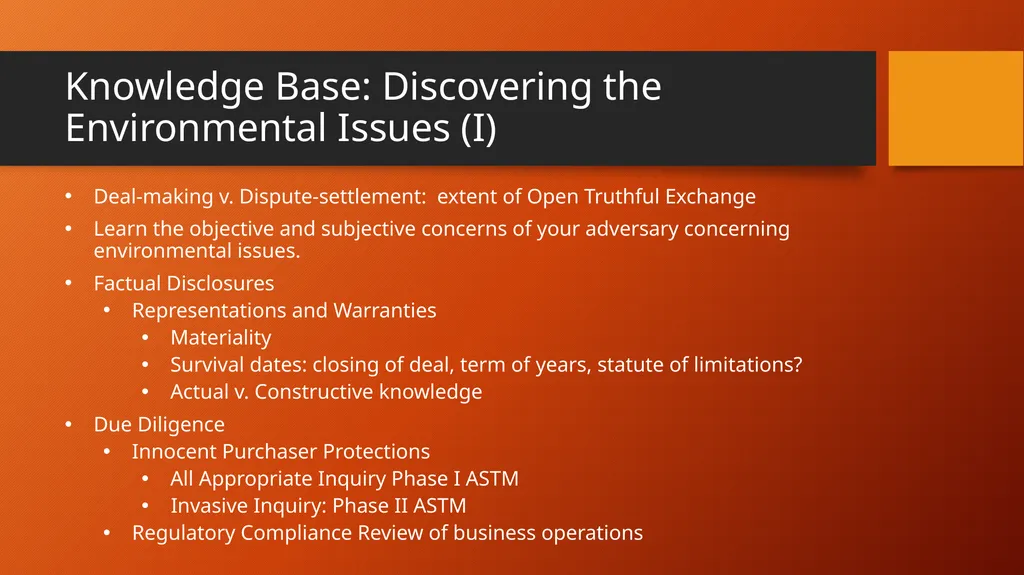
Knowledge Base: Discovering the Environmental Issues (I) Deal-making v. Dispute-settlement: extent of Open Truthful Exchange
Learn the objective and subjective concerns of your adversary concerning environmental issues.
Factual Disclosures
Representations and Warranties
Materiality
Survival dates: closing of deal, term of years, statute of limitations?
Actual v. Constructive knowledge
Due Diligence
Innocent Purchaser Protections
All Appropriate Inquiry Phase I ASTM
Invasive Inquiry: Phase II ASTM
Regulatory Compliance Review of business operations<br>
Learn the objective and subjective concerns of your adversary concerning environmental issues.
Factual Disclosures
Representations and Warranties
Materiality
Survival dates: closing of deal, term of years, statute of limitations?
Actual v. Constructive knowledge
Due Diligence
Innocent Purchaser Protections
All Appropriate Inquiry Phase I ASTM
Invasive Inquiry: Phase II ASTM
Regulatory Compliance Review of business operations<br>
10
Knowledge Base: Discovering the Environmental Issues (II) Expertise
In-House
Environmental Consultant
Environmental Lawyer
Insurer
Confidentiality and Non-Disclosure<br>
In-House
Environmental Consultant
Environmental Lawyer
Insurer
Confidentiality and Non-Disclosure<br>
11
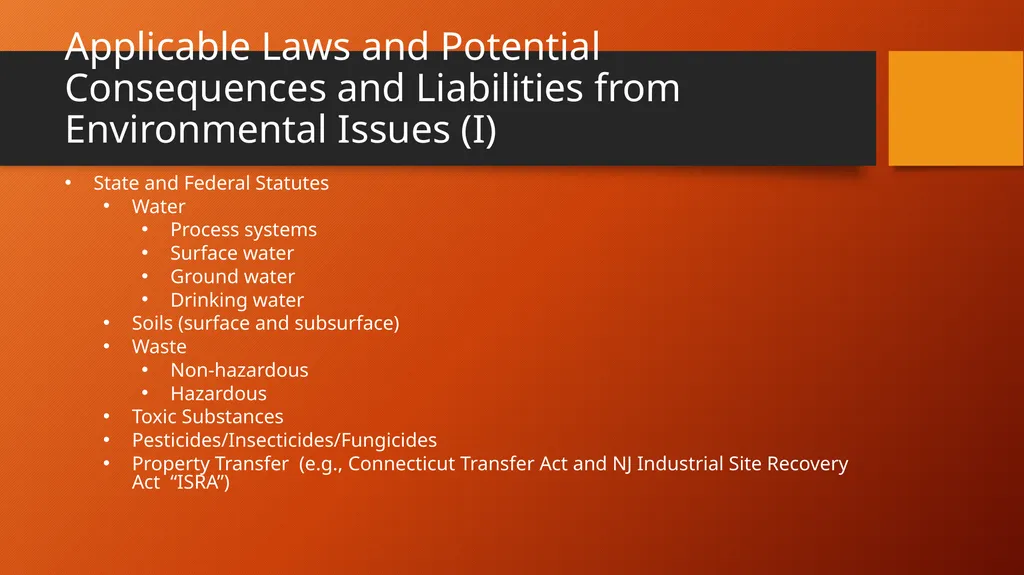
Applicable Laws and Potential Consequences and Liabilities from Environmental Issues (I) State and Federal Statutes
Water
Process systems
Surface water
Ground water
Drinking water
Soils (surface and subsurface)
Waste
Non-hazardous
Hazardous
Toxic Substances
Pesticides/Insecticides/Fungicides
Property Transfer (e.g., Connecticut Transfer Act and NJ Industrial Site Recovery Act “ISRA”)<br>
Water
Process systems
Surface water
Ground water
Drinking water
Soils (surface and subsurface)
Waste
Non-hazardous
Hazardous
Toxic Substances
Pesticides/Insecticides/Fungicides
Property Transfer (e.g., Connecticut Transfer Act and NJ Industrial Site Recovery Act “ISRA”)<br>
12
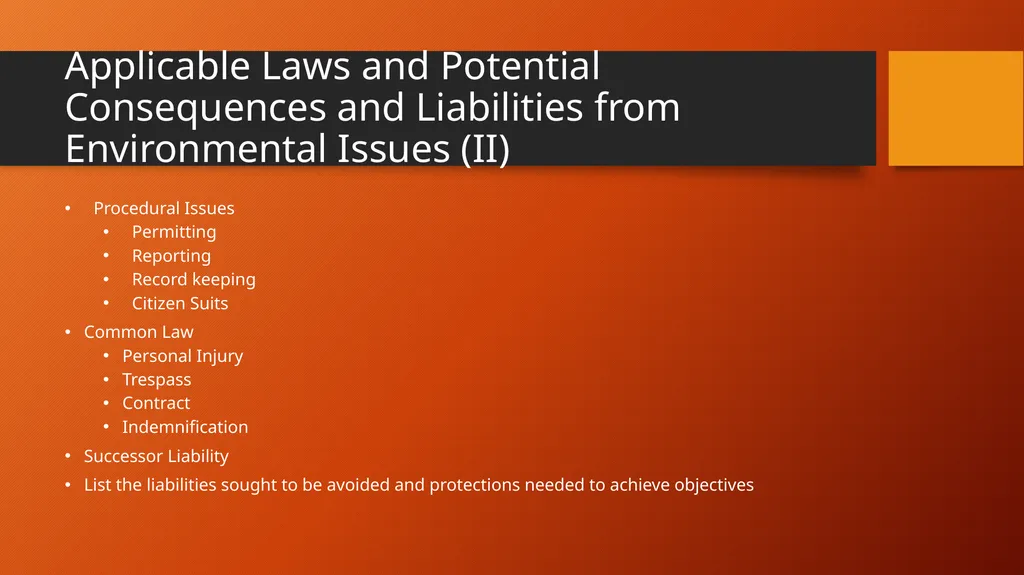
Applicable Laws and Potential Consequences and Liabilities from Environmental Issues (II) Procedural Issues
Permitting
Reporting
Record keeping
Citizen Suits
Common Law
Personal Injury
Trespass
Contract
Indemnification
Successor Liability
List the liabilities sought to be avoided and protections needed to achieve objectives<br>
Permitting
Reporting
Record keeping
Citizen Suits
Common Law
Personal Injury
Trespass
Contract
Indemnification
Successor Liability
List the liabilities sought to be avoided and protections needed to achieve objectives<br>
13
Liability Allocation: The Continuing Relationship of the Parties After Reaching “YES” Insurance
Indemnification, Hold Harmless, Release and Waiver
Cascading liabilities
Escrows and holdbacks
Triggers and ceilings
Earn outs
Limitations on use
Consider who will be the successor to the party that will sign the Agreement, e.g., will there continue to be a viable entity from whom you may be able to obtain relief?<br>
Indemnification, Hold Harmless, Release and Waiver
Cascading liabilities
Escrows and holdbacks
Triggers and ceilings
Earn outs
Limitations on use
Consider who will be the successor to the party that will sign the Agreement, e.g., will there continue to be a viable entity from whom you may be able to obtain relief?<br>
14
Guiding Principles– DO NOT DEVIATE FROM THESE! “Meat feeds the family. Gravy only makes it taste better.”
The negotiator’s objective is to win, not for the other side to lose.
Know when you have won and accept that you have done so.<br>
The negotiator’s objective is to win, not for the other side to lose.
Know when you have won and accept that you have done so.<br>
15
Establish “Walk Away” Bottom Line Position: Sometimes called “Reservation Point” Is there a “Surplus”
Identify an “Optimum” (The best likely outcome)
Propose an “Anchor” (Starting point for the negotiation)
Environmental concerns may be practically unquantifiable<br>
Identify an “Optimum” (The best likely outcome)
Propose an “Anchor” (Starting point for the negotiation)
Environmental concerns may be practically unquantifiable<br>
16
“Surplus” as Negotiation Reference Point In every negotiation, whether or not involving environmental issues, each party ordinarily sets a walk-away bottom line (sometimes called a “reserve” point), which it will not cross. That is, the party will risk the consequences of walking away from a deal rather than cross that line.
That bottom line may be directly monetary -- as when Party A decides it will never accept any amount less than $100,000 for the contaminated property it wishes to sell, and when Party B decides it will never pay an amount exceeding $500,000 for the property. The $400,000 range between the parties’ respective bottom lines comprises the “Surplus.”
Where is no objective Surplus, quantify the non-objective benefits and costs and do a cost benefit decision tree analysis.<br>
That bottom line may be directly monetary -- as when Party A decides it will never accept any amount less than $100,000 for the contaminated property it wishes to sell, and when Party B decides it will never pay an amount exceeding $500,000 for the property. The $400,000 range between the parties’ respective bottom lines comprises the “Surplus.”
Where is no objective Surplus, quantify the non-objective benefits and costs and do a cost benefit decision tree analysis.<br>
17
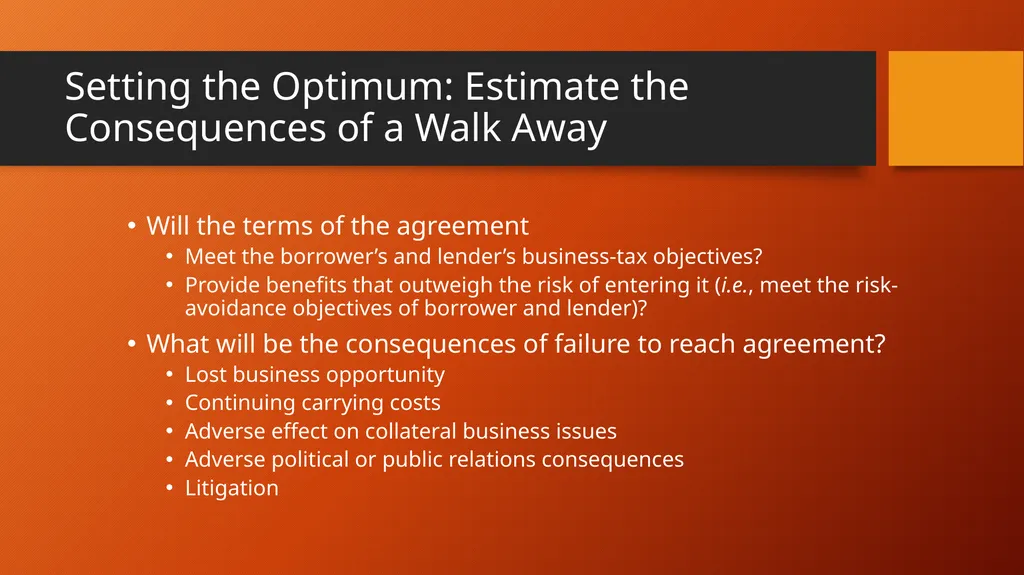
Setting the Optimum: Estimate the Consequences of a Walk Away Will the terms of the agreement
Meet the borrower’s and lender’s business-tax objectives?
Provide benefits that outweigh the risk of entering it (i.e., meet the risk-avoidance objectives of borrower and lender)?
What will be the consequences of failure to reach agreement?
Lost business opportunity
Continuing carrying costs
Adverse effect on collateral business issues
Adverse political or public relations consequences
Litigation<br>
Meet the borrower’s and lender’s business-tax objectives?
Provide benefits that outweigh the risk of entering it (i.e., meet the risk-avoidance objectives of borrower and lender)?
What will be the consequences of failure to reach agreement?
Lost business opportunity
Continuing carrying costs
Adverse effect on collateral business issues
Adverse political or public relations consequences
Litigation<br>
18
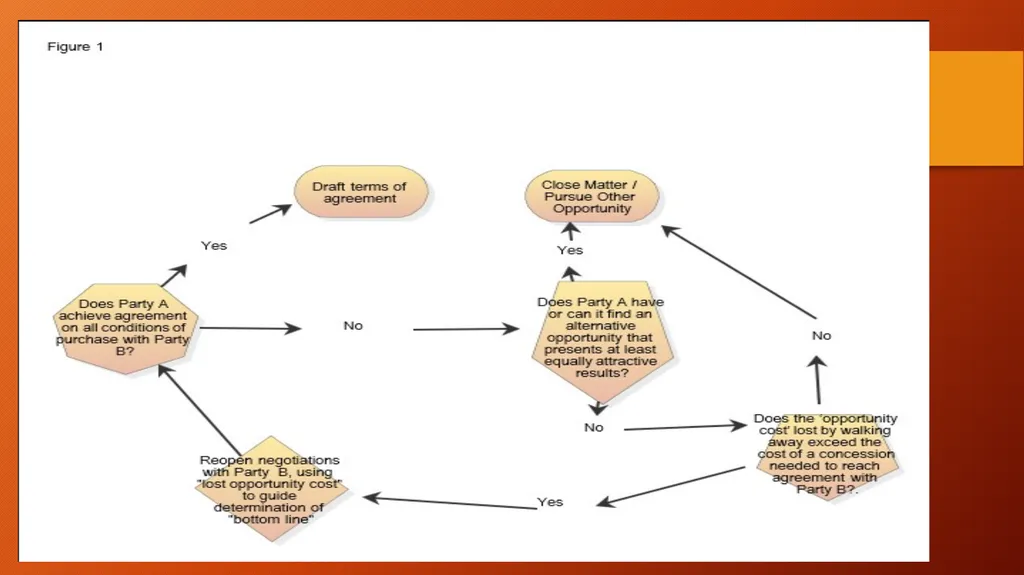
Always Try To Quantify What a Walk Away Will Cost You! The cost of the walk away may serve as the standard you will use to determine your optimum value.
For instance, if you calculate that it will cost you $100,000 to walk away from the deal, then you should arguably be willing to make concessions to the other side up to that $100,000.<br>
For instance, if you calculate that it will cost you $100,000 to walk away from the deal, then you should arguably be willing to make concessions to the other side up to that $100,000.<br>
19
Don’t let infatuation with the deal prevent you from walking away The party that more convincingly demonstrates that it is willing to walk away from the deal is more often than not the one that gets the better deal.
Fortunately we’re not dealing here with affairs of the heart– the parties should endeavor to quantify their alternatives so that they can make rational decisions.<br>
Fortunately we’re not dealing here with affairs of the heart– the parties should endeavor to quantify their alternatives so that they can make rational decisions.<br>
20
Consider creative alternatives to walking away If the parties appear to have reached impasse on a particular condition or demand, instead of a walk-away consider an option or alternative that is not mutually exclusive to either party’s bottom line.
For example,<br>
For example,<br>
21
Alternatives to walking away (1) Create a mechanisms to avoid or lay off the perceived risk:
If Buyer requires remediation of a particular condition, but seller refuses, consider alternatives such as escrow or hold-back for a negotiated period to account for remediation required by law or because of Buyer’s needs or contracting with third party remediation buyout entity to take over the problem and indemnify the parties.<br>
If Buyer requires remediation of a particular condition, but seller refuses, consider alternatives such as escrow or hold-back for a negotiated period to account for remediation required by law or because of Buyer’s needs or contracting with third party remediation buyout entity to take over the problem and indemnify the parties.<br>
22
Alternatives to walking away (2) Create a larger pie to slice up:
If buyer requires seller’s method of remediation to accommodate buyer’s contemplated future use of the property or operation of its business and such method either exceeds statutory requirements or would be more expensive than required by law, then enter sharing agreement to off-set the increased costs.
If this is possible, however, one must be careful while increasing the overall size of the pie to divide not to decrease the size of the slice so that the result amounts to an unacceptable loss, e.g., seller agreeing to enter a remediation that creates new liabilities or regulatory obligations.<br>
If buyer requires seller’s method of remediation to accommodate buyer’s contemplated future use of the property or operation of its business and such method either exceeds statutory requirements or would be more expensive than required by law, then enter sharing agreement to off-set the increased costs.
If this is possible, however, one must be careful while increasing the overall size of the pie to divide not to decrease the size of the slice so that the result amounts to an unacceptable loss, e.g., seller agreeing to enter a remediation that creates new liabilities or regulatory obligations.<br>
23
Leverage Identify your leverage points
Your strengths
Your adversary’s weaknesses
Use your leverage points in
Expressing your Anchor
Suggesting alternative solutions
Moving on to the Rational Optimum Outcome<br>
Your strengths
Your adversary’s weaknesses
Use your leverage points in
Expressing your Anchor
Suggesting alternative solutions
Moving on to the Rational Optimum Outcome<br>
24
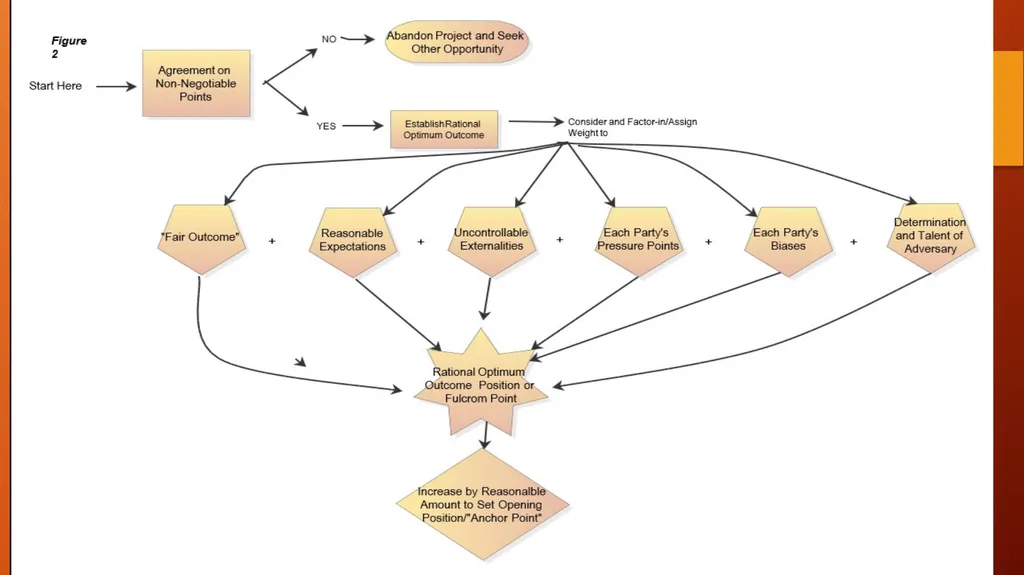
Aim for the “Rational Optimum Outcome” What would an uninterested third party consider to be a “fair” outcome?
What is each party’s reasonable expectation, including its non-monetary goals and costs of not reaching settlement?
What weight should be given to uncontrollable externalities such as potential litigation, fluctuations in the economy, and changes in laws and regulations, public relations, and politics?
What are each party’s pressure points, such as timing, budget, and concurrent or contemplated transactions that may be dependent on the outcome of the negotiation?
How to react/respond to each party’s biases, both rational and irrational, reasonable and unreasonable?
How powerful is the relative determination of the other party and what is the strength of personality and talent of its bargaining representative?<br>
What is each party’s reasonable expectation, including its non-monetary goals and costs of not reaching settlement?
What weight should be given to uncontrollable externalities such as potential litigation, fluctuations in the economy, and changes in laws and regulations, public relations, and politics?
What are each party’s pressure points, such as timing, budget, and concurrent or contemplated transactions that may be dependent on the outcome of the negotiation?
How to react/respond to each party’s biases, both rational and irrational, reasonable and unreasonable?
How powerful is the relative determination of the other party and what is the strength of personality and talent of its bargaining representative?<br>
25
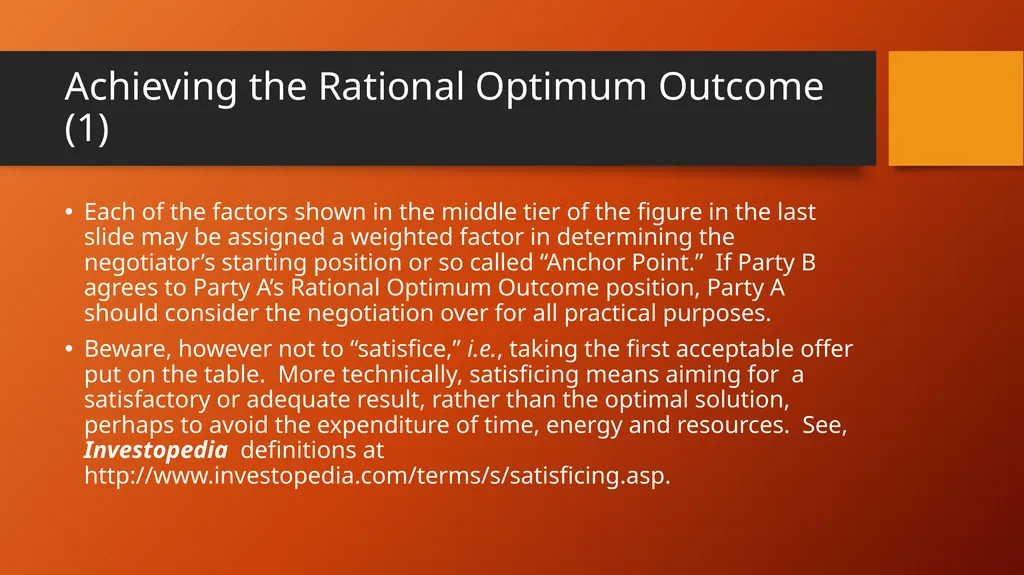
Achieving the Rational Optimum Outcome (1) Each of the factors shown in the middle tier of the figure in the last slide may be assigned a weighted factor in determining the negotiator’s starting position or so called “Anchor Point.” If Party B agrees to Party A’s Rational Optimum Outcome position, Party A should consider the negotiation over for all practical purposes.
Beware, however not to “satisfice,” i.e., taking the first acceptable offer put on the table. More technically, satisficing means aiming for a satisfactory or adequate result, rather than the optimal solution, perhaps to avoid the expenditure of time, energy and resources. See, Investopedia definitions at http://www.investopedia.com/terms/s/satisficing.asp.<br>
Beware, however not to “satisfice,” i.e., taking the first acceptable offer put on the table. More technically, satisficing means aiming for a satisfactory or adequate result, rather than the optimal solution, perhaps to avoid the expenditure of time, energy and resources. See, Investopedia definitions at http://www.investopedia.com/terms/s/satisficing.asp.<br>
26
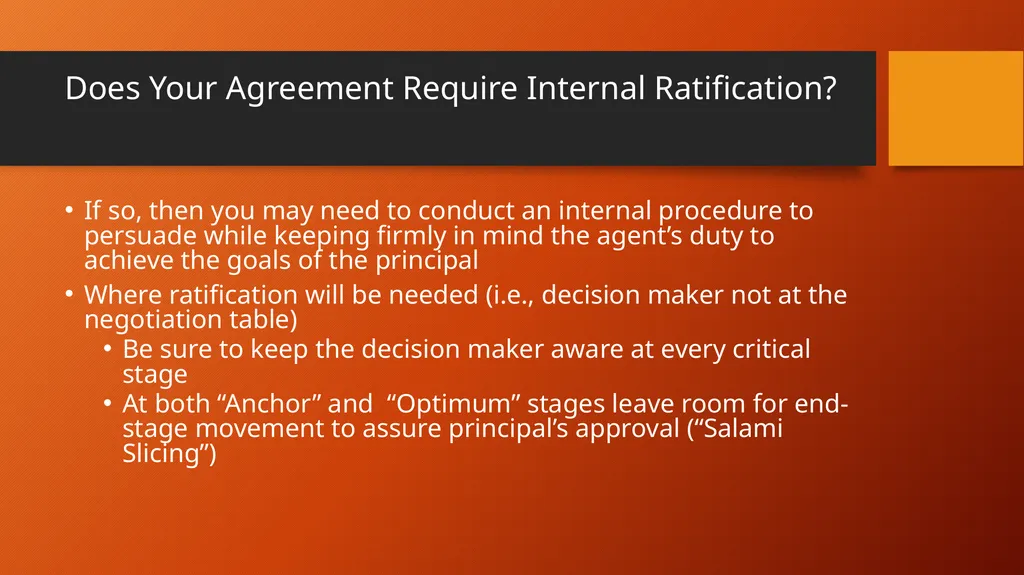
Does Your Agreement Require Internal Ratification? If so, then you may need to conduct an internal procedure to persuade while keeping firmly in mind the agent’s duty to achieve the goals of the principal
Where ratification will be needed (i.e., decision maker not at the negotiation table)
Be sure to keep the decision maker aware at every critical stage
At both “Anchor” and “Optimum” stages leave room for end-stage movement to assure principal’s approval (“Salami Slicing”)<br>
Where ratification will be needed (i.e., decision maker not at the negotiation table)
Be sure to keep the decision maker aware at every critical stage
At both “Anchor” and “Optimum” stages leave room for end-stage movement to assure principal’s approval (“Salami Slicing”)<br>
27
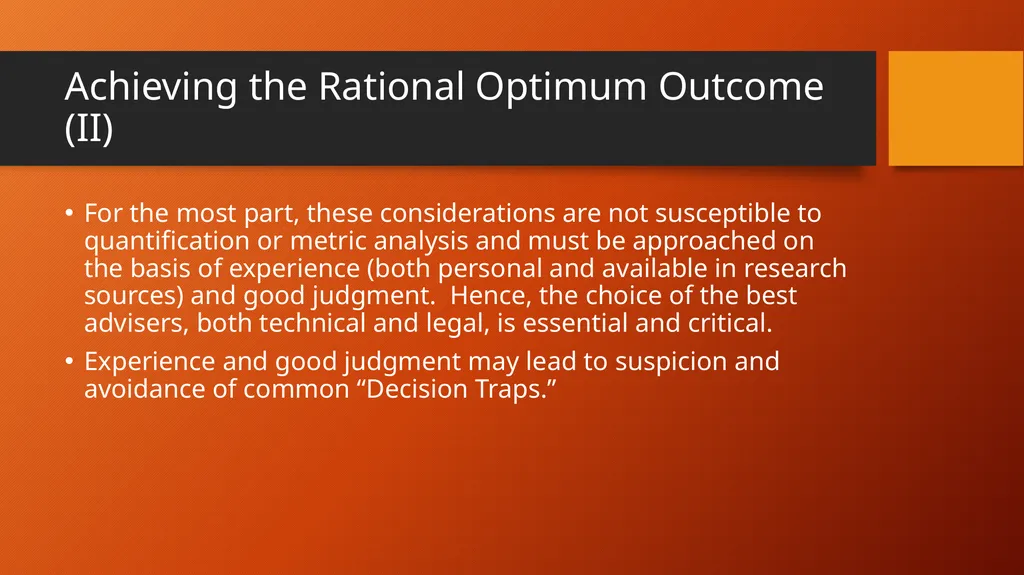
Achieving the Rational Optimum Outcome (II) For the most part, these considerations are not susceptible to quantification or metric analysis and must be approached on the basis of experience (both personal and available in research sources) and good judgment. Hence, the choice of the best advisers, both technical and legal, is essential and critical.
Experience and good judgment may lead to suspicion and avoidance of common “Decision Traps.”<br>
Experience and good judgment may lead to suspicion and avoidance of common “Decision Traps.”<br>
28
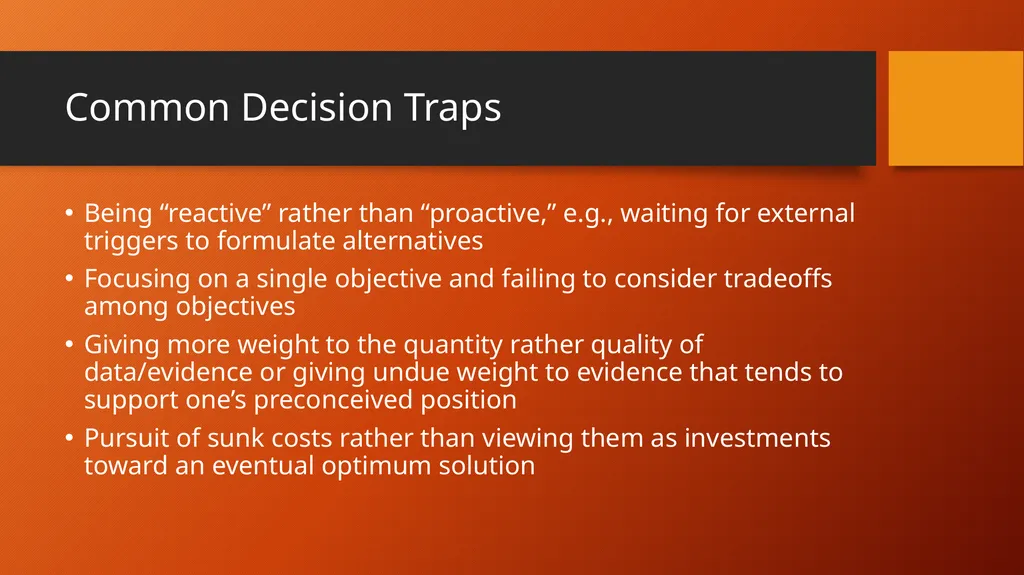
Common Decision Traps Being “reactive” rather than “proactive,” e.g., waiting for external triggers to formulate alternatives
Focusing on a single objective and failing to consider tradeoffs among objectives
Giving more weight to the quantity rather quality of data/evidence or giving undue weight to evidence that tends to support one’s preconceived position
Pursuit of sunk costs rather than viewing them as investments toward an eventual optimum solution<br>
Focusing on a single objective and failing to consider tradeoffs among objectives
Giving more weight to the quantity rather quality of data/evidence or giving undue weight to evidence that tends to support one’s preconceived position
Pursuit of sunk costs rather than viewing them as investments toward an eventual optimum solution<br>
29
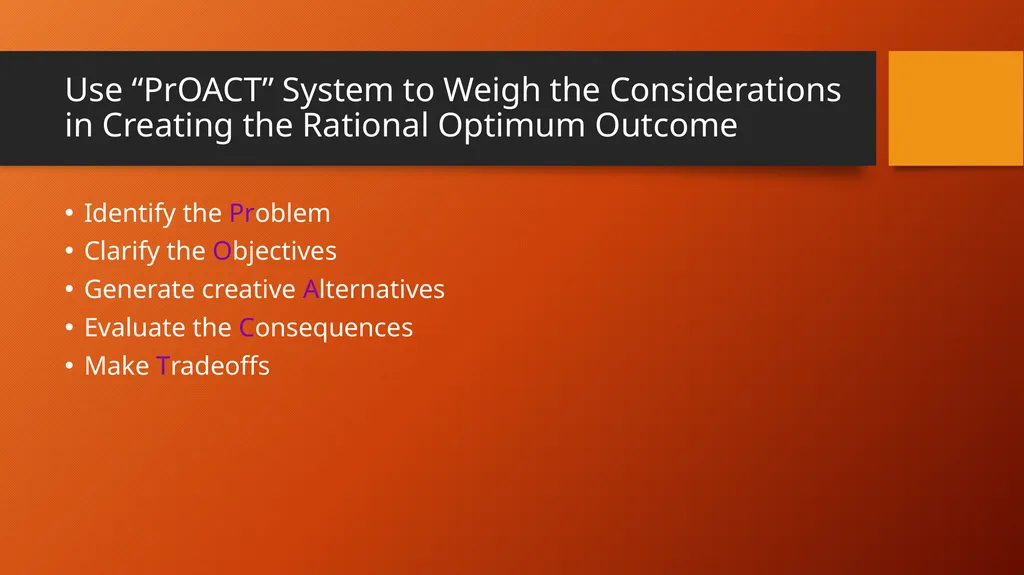
Use “PrOACT” System to Weigh the Considerations in Creating the Rational Optimum Outcome Identify the Problem
Clarify the Objectives
Generate creative Alternatives
Evaluate the Consequences
Make Tradeoffs<br>
Clarify the Objectives
Generate creative Alternatives
Evaluate the Consequences
Make Tradeoffs<br>
30
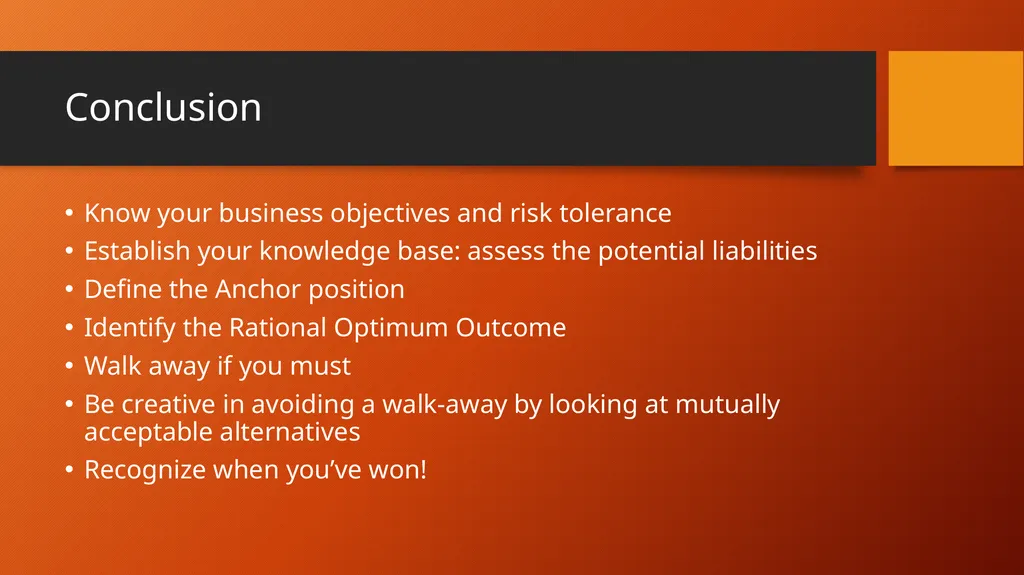
Conclusion Know your business objectives and risk tolerance
Establish your knowledge base: assess the potential liabilities
Define the Anchor position
Identify the Rational Optimum Outcome
Walk away if you must
Be creative in avoiding a walk-away by looking at mutually acceptable alternatives
Recognize when you’ve won!<br>
Establish your knowledge base: assess the potential liabilities
Define the Anchor position
Identify the Rational Optimum Outcome
Walk away if you must
Be creative in avoiding a walk-away by looking at mutually acceptable alternatives
Recognize when you’ve won!<br>
31
Bibliography (1) Abbi Cohen, Lydia B. Duff, Jeffrey B. Gracer, Betty Moy Huber, and Larry Nettles, “Current Environmental Considerations in Business Transactions With Sample Contract Language,” American Bar Association Section of Environment, Energy, and Resources, 23rd Fall Conference Chicago, Illinois October 28 - 30, 2015, BNA http://src.bna.com/SN
(2)James A. Vroman, “Structuring the Deal and Environmental Issues in the Real Estate Contract,” Chapter 3 in Environmental Law in Illinois Corporate and Real Estate Transactions, IICLE 2007, https://jenner.com/system/assets/publications/2014/original/Ch3_forfinal.pdf?1319642205<br>
(2)James A. Vroman, “Structuring the Deal and Environmental Issues in the Real Estate Contract,” Chapter 3 in Environmental Law in Illinois Corporate and Real Estate Transactions, IICLE 2007, https://jenner.com/system/assets/publications/2014/original/Ch3_forfinal.pdf?1319642205<br>
32
Bibliography (2) (3) Gail V. Karlsson, The Impact of Environmental Liabilities on Real Estate Contract Negotiations, 8 Pace Envtl. L. Rev. 37 (1990), http://digitalcommons.pace.edu/pelr/vol8/iss1/3
(4) Howard Raiffa,John Richardson, and David Metcalfe, Negotiation Analysis: The Science and Art of Collaborative Decision Making (2002)
(5) Donald Trump, Trump: The Art of the Deal (1987)
(6) Barry J. Trilling, “A Thumbnail Guide to Negotiating Agreements and Settlement of Disputes Involving Environmental Issues,” American Bar Association, Section on Environment, Energy, and Resources, Environmental Transactions and Brownfields Committee Newsletter, August 2015<br>
(4) Howard Raiffa,John Richardson, and David Metcalfe, Negotiation Analysis: The Science and Art of Collaborative Decision Making (2002)
(5) Donald Trump, Trump: The Art of the Deal (1987)
(6) Barry J. Trilling, “A Thumbnail Guide to Negotiating Agreements and Settlement of Disputes Involving Environmental Issues,” American Bar Association, Section on Environment, Energy, and Resources, Environmental Transactions and Brownfields Committee Newsletter, August 2015<br>
33
Appendix A: Federal Environmental Laws<br>