
FY20 SHERM Metrics-Based Performance Summary Key
BR
Published · 46 slides · 0 views
1 / 1



Description
FY20 SHERM Metrics-Based Performance Summary Key Performance Indicators for Safety, Health, Environment Risk Management (SHERM): Losses, Compliance, Finances, and Client Satisfaction UTHealth Institutional Missions and SHERMs Role,
Related Topics
Share
Embed code
Download this presentation From Below
"FY20 SHERM Metrics-Based Performance Summary Key" is the property of its rightful owner. Permission is granted to download and print the materials on this website for personal, non-commercial use only, and to display it on your personal computer provided you do not modify the materials and that you retain all copyright notices contained in the materials. By downloading content from our website, you accept the terms of this agreement.
Presentation Transcript
01
FY20 SHERM Metrics-Based
Performance Summary Key Performance Indicators for Safety, Health, Environment & Risk Management (SHERM):
Losses, Compliance, Finances, and Client Satisfaction<br>
Losses, Compliance, Finances, and Client Satisfaction<br>
02
UTHealth Institutional Missions and
SHERM’s Role, Contributions UTHealth institutional missions:
Teaching
Research
Service
Service to the Institution (SHERM’s primary role)
4 Key Performance Indicators (KPI) of safety services provided
Service to the Community
SHERM also contributes to the other key institutional missions as well<br>
Teaching
Research
Service
Service to the Institution (SHERM’s primary role)
4 Key Performance Indicators (KPI) of safety services provided
Service to the Community
SHERM also contributes to the other key institutional missions as well<br>
03
COVID-19 Pandemic Impacts Throughout this year’s annual report, impacts to our departmental operations and services due to COVID-19 are specifically highlighted and addressed
Many services dramatically increased
Normal operations and services were maintained
Some services reduced or were deferred until a later time period
As essential personnel, SHERM staff remained on campus during the entirety of the pandemic to serve the institution
Despite the incredibly high work load, all SHERM staff participated in the mandatory “one day per week” vacation / furlough program for the full sixteen week period<br>
Many services dramatically increased
Normal operations and services were maintained
Some services reduced or were deferred until a later time period
As essential personnel, SHERM staff remained on campus during the entirety of the pandemic to serve the institution
Despite the incredibly high work load, all SHERM staff participated in the mandatory “one day per week” vacation / furlough program for the full sixteen week period<br>
04
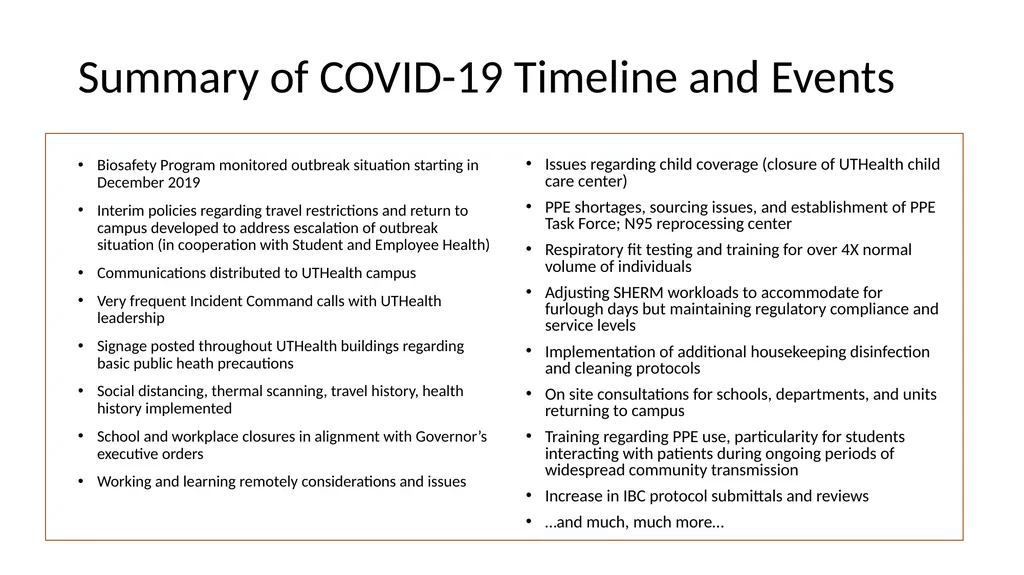
Summary of COVID-19 Timeline and Events Biosafety Program monitored outbreak situation starting in December 2019
Interim policies regarding travel restrictions and return to campus developed to address escalation of outbreak situation (in cooperation with Student and Employee Health)
Communications distributed to UTHealth campus
Very frequent Incident Command calls with UTHealth leadership
Signage posted throughout UTHealth buildings regarding basic public heath precautions
Social distancing, thermal scanning, travel history, health history implemented
School and workplace closures in alignment with Governor’s executive orders
Working and learning remotely considerations and issues Issues regarding child coverage (closure of UTHealth child care center)
PPE shortages, sourcing issues, and establishment of PPE Task Force; N95 reprocessing center
Respiratory fit testing and training for over 4X normal volume of individuals
Adjusting SHERM workloads to accommodate for furlough days but maintaining regulatory compliance and service levels
Implementation of additional housekeeping disinfection and cleaning protocols
On site consultations for schools, departments, and units returning to campus
Training regarding PPE use, particularity for students interacting with patients during ongoing periods of widespread community transmission
Increase in IBC protocol submittals and reviews
…and much, much more…<br>
Interim policies regarding travel restrictions and return to campus developed to address escalation of outbreak situation (in cooperation with Student and Employee Health)
Communications distributed to UTHealth campus
Very frequent Incident Command calls with UTHealth leadership
Signage posted throughout UTHealth buildings regarding basic public heath precautions
Social distancing, thermal scanning, travel history, health history implemented
School and workplace closures in alignment with Governor’s executive orders
Working and learning remotely considerations and issues Issues regarding child coverage (closure of UTHealth child care center)
PPE shortages, sourcing issues, and establishment of PPE Task Force; N95 reprocessing center
Respiratory fit testing and training for over 4X normal volume of individuals
Adjusting SHERM workloads to accommodate for furlough days but maintaining regulatory compliance and service levels
Implementation of additional housekeeping disinfection and cleaning protocols
On site consultations for schools, departments, and units returning to campus
Training regarding PPE use, particularity for students interacting with patients during ongoing periods of widespread community transmission
Increase in IBC protocol submittals and reviews
…and much, much more…<br>
05
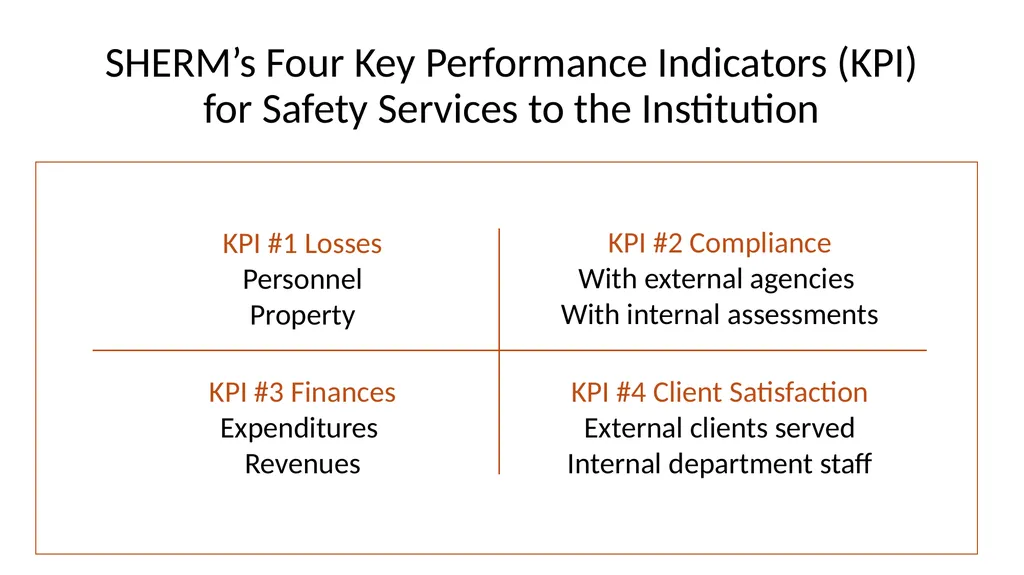
SHERM’s Four Key Performance Indicators (KPI) for Safety Services to the Institution KPI #1 Losses
Personnel
Property KPI #3 Finances
Expenditures
Revenues KPI #2 Compliance
With external agencies
With internal assessments KPI #4 Client Satisfaction
External clients served
Internal department staff<br>
Personnel
Property KPI #3 Finances
Expenditures
Revenues KPI #2 Compliance
With external agencies
With internal assessments KPI #4 Client Satisfaction
External clients served
Internal department staff<br>
06
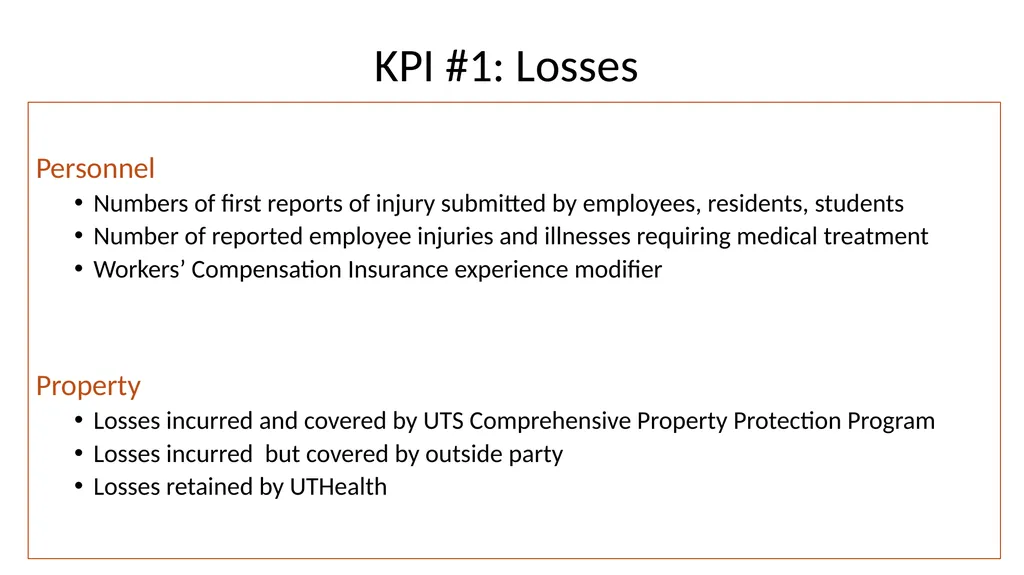
KPI #1: Losses Personnel
Numbers of first reports of injury submitted by employees, residents, students
Number of reported employee injuries and illnesses requiring medical treatment
Workers’ Compensation Insurance experience modifier
Property
Losses incurred and covered by UTS Comprehensive Property Protection Program
Losses incurred but covered by outside party
Losses retained by UTHealth<br>
Numbers of first reports of injury submitted by employees, residents, students
Number of reported employee injuries and illnesses requiring medical treatment
Workers’ Compensation Insurance experience modifier
Property
Losses incurred and covered by UTS Comprehensive Property Protection Program
Losses incurred but covered by outside party
Losses retained by UTHealth<br>
07
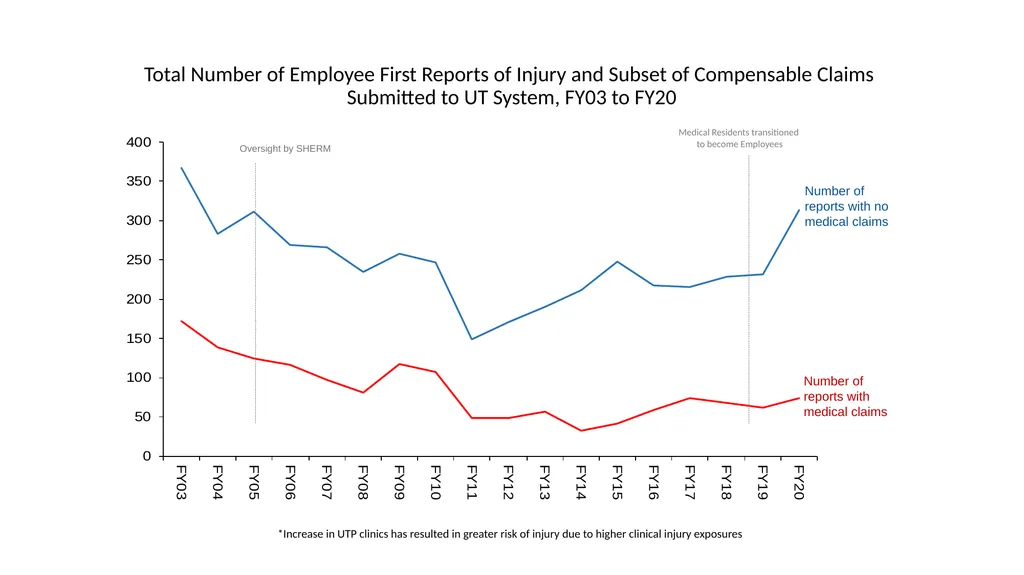
Total Number of Employee First Reports of Injury and Subset of Compensable Claims
Submitted to UT System, FY03 to FY20 Number of reports with no medical claims Number of reports with medical claims Oversight by SHERM *Increase in UTP clinics has resulted in greater risk of injury due to higher clinical injury exposures Medical Residents transitioned
to become Employees<br>
to become Employees<br>
08
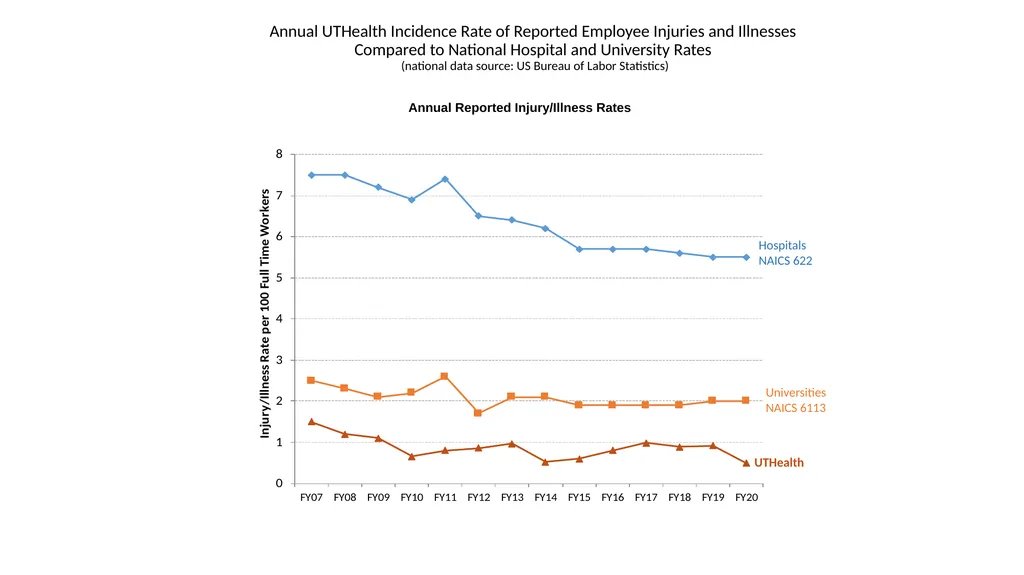
Annual UTHealth Incidence Rate of Reported Employee Injuries and Illnesses
Compared to National Hospital and University Rates
(national data source: US Bureau of Labor Statistics) Annual Reported Injury/Illness Rates Hospitals
NAICS 622 Universities
NAICS 6113 UTHealth<br>
NAICS 622 Universities
NAICS 6113 UTHealth<br>
09
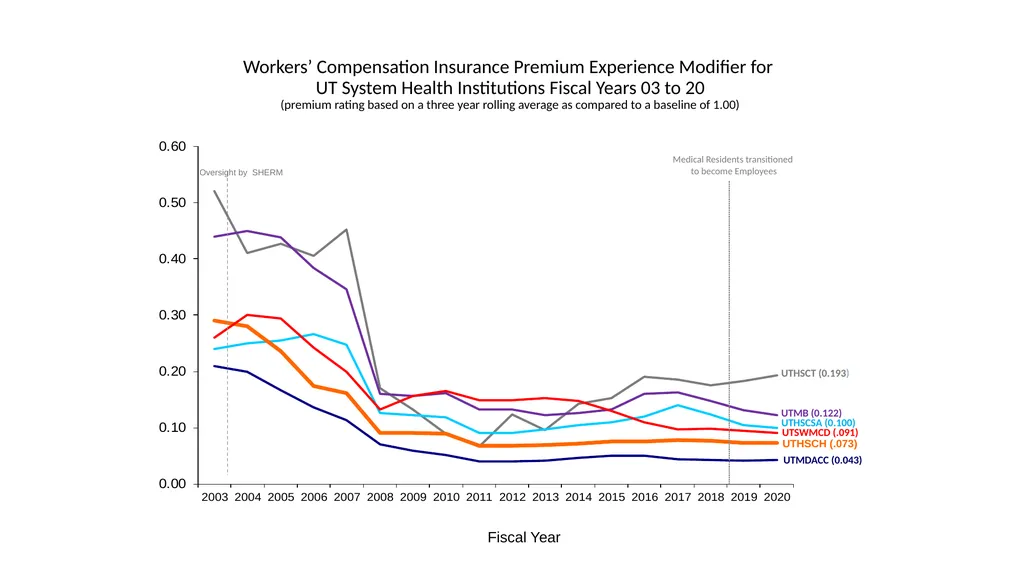
Workers’ Compensation Insurance Premium Experience Modifier for
UT System Health Institutions Fiscal Years 03 to 20
(premium rating based on a three year rolling average as compared to a baseline of 1.00) UTHSCT (0.193) UTMB (0.122) UTHSCSA (0.100) UTSWMCD (.091) UTMDACC (0.043) Oversight by SHERM Fiscal Year UTHSCH (.073) Medical Residents transitioned
to become Employees<br>
to become Employees<br>
10
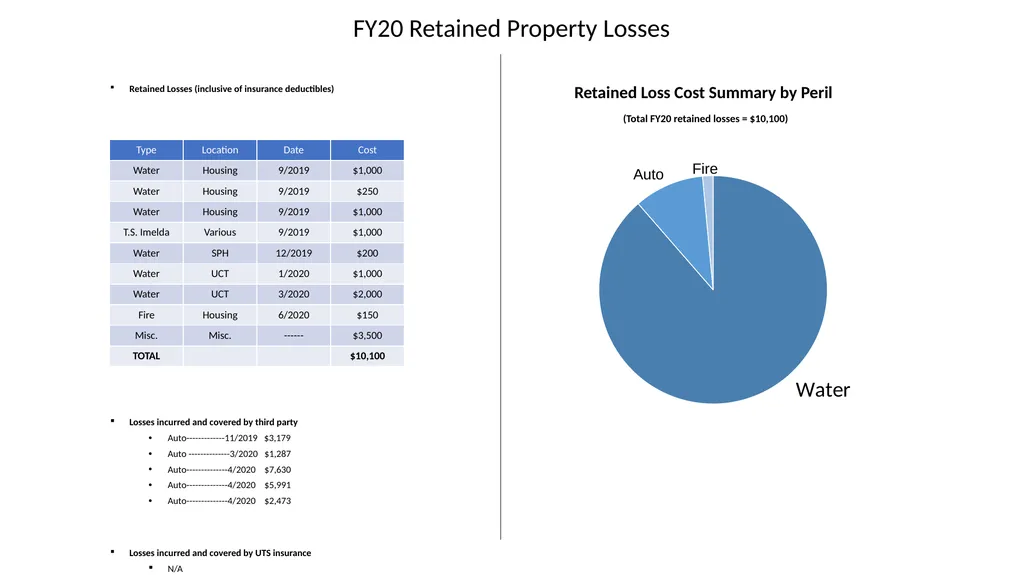
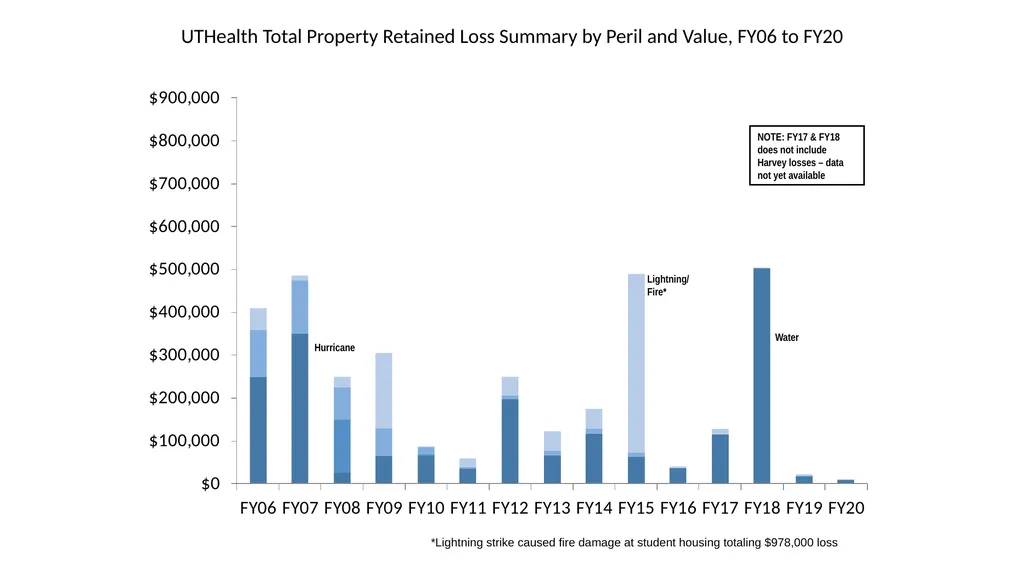
FY20 Retained Property Losses Retained Losses (inclusive of insurance deductibles)
Losses incurred and covered by third party
Auto-------------11/2019 $3,179
Auto --------------3/2020 $1,287
Auto--------------4/2020 $7,630
Auto--------------4/2020 $5,991
Auto--------------4/2020 $2,473
Losses incurred and covered by UTS insurance
N/A Fire Auto Retained Loss Cost Summary by Peril
(Total FY20 retained losses = $10,100)<br>
Losses incurred and covered by third party
Auto-------------11/2019 $3,179
Auto --------------3/2020 $1,287
Auto--------------4/2020 $7,630
Auto--------------4/2020 $5,991
Auto--------------4/2020 $2,473
Losses incurred and covered by UTS insurance
N/A Fire Auto Retained Loss Cost Summary by Peril
(Total FY20 retained losses = $10,100)<br>
11
UTHealth Total Property Retained Loss Summary by Peril and Value, FY06 to FY20 Hurricane Lightning/Fire* Water *Lightning strike caused fire damage at student housing totaling $978,000 loss NOTE: FY17 & FY18 does not include Harvey losses – data not yet available<br>
12
COVID-19 Impacts on Losses Employees, residents, and students testing positive during COVID-19 pandemic impacting their ability to work or learn
Each case resulted in needs for contact investigations, disinfection/decontamination of work spaces, and lost work time during quarantine period
34 individuals providing clinical care submitted First Reports of Injuries indicating they sustained a workplace COVID-19 exposure
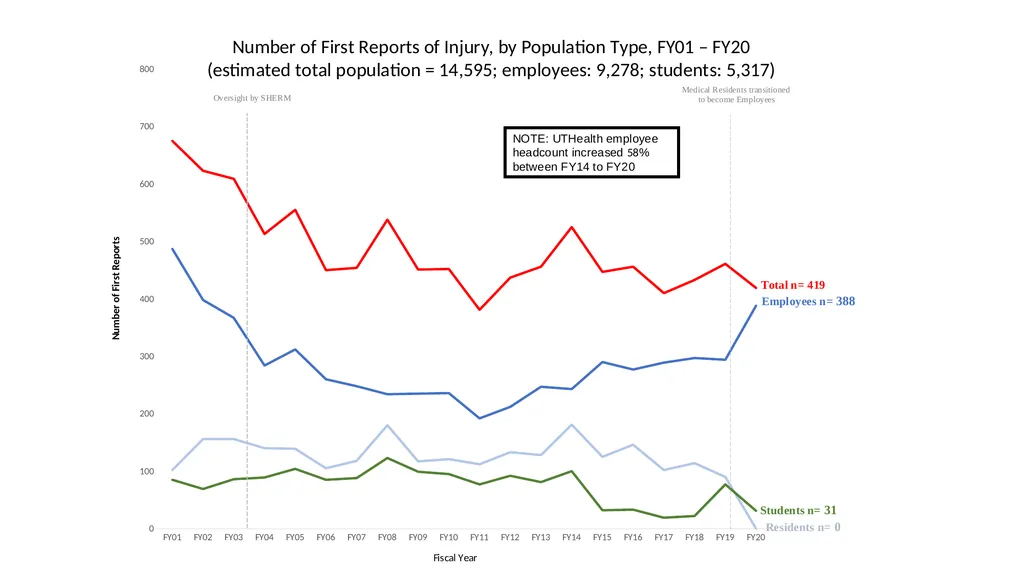
Total number of First Reports of Injury plummeted overall during fiscal year due to significant number of individuals working or learning remotely
Anticipating possible increase in First Reports of Injury for issues sustained off campus while working/learning remotely (e.g. ergonomics, etc.), but this has not occurred yet<br>
Each case resulted in needs for contact investigations, disinfection/decontamination of work spaces, and lost work time during quarantine period
34 individuals providing clinical care submitted First Reports of Injuries indicating they sustained a workplace COVID-19 exposure
Total number of First Reports of Injury plummeted overall during fiscal year due to significant number of individuals working or learning remotely
Anticipating possible increase in First Reports of Injury for issues sustained off campus while working/learning remotely (e.g. ergonomics, etc.), but this has not occurred yet<br>
13
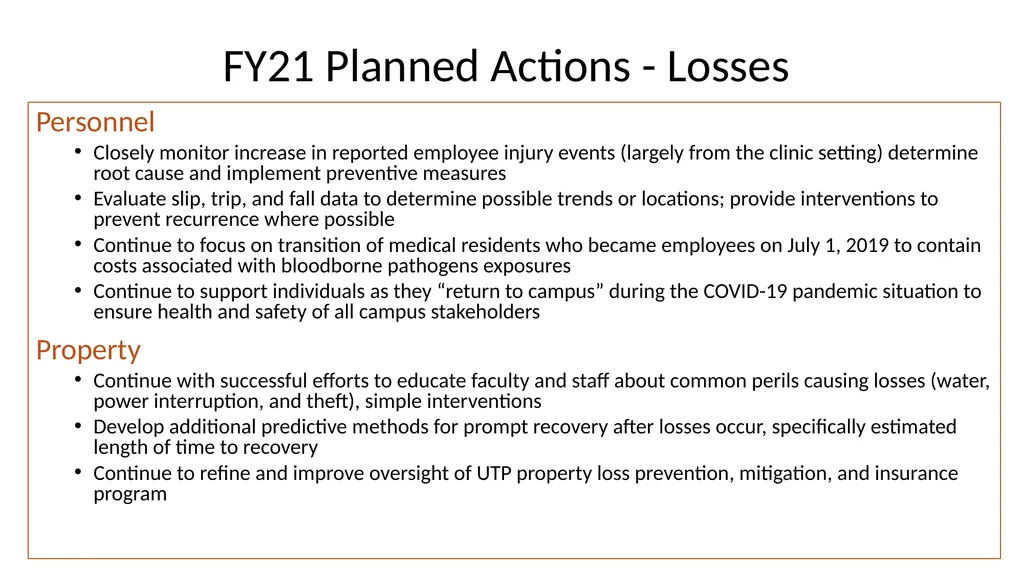
FY21 Planned Actions - Losses Personnel
Closely monitor increase in reported employee injury events (largely from the clinic setting) determine root cause and implement preventive measures
Evaluate slip, trip, and fall data to determine possible trends or locations; provide interventions to prevent recurrence where possible
Continue to focus on transition of medical residents who became employees on July 1, 2019 to contain costs associated with bloodborne pathogens exposures
Continue to support individuals as they “return to campus” during the COVID-19 pandemic situation to ensure health and safety of all campus stakeholders
Property
Continue with successful efforts to educate faculty and staff about common perils causing losses (water, power interruption, and theft), simple interventions
Develop additional predictive methods for prompt recovery after losses occur, specifically estimated length of time to recovery
Continue to refine and improve oversight of UTP property loss prevention, mitigation, and insurance program<br>
Closely monitor increase in reported employee injury events (largely from the clinic setting) determine root cause and implement preventive measures
Evaluate slip, trip, and fall data to determine possible trends or locations; provide interventions to prevent recurrence where possible
Continue to focus on transition of medical residents who became employees on July 1, 2019 to contain costs associated with bloodborne pathogens exposures
Continue to support individuals as they “return to campus” during the COVID-19 pandemic situation to ensure health and safety of all campus stakeholders
Property
Continue with successful efforts to educate faculty and staff about common perils causing losses (water, power interruption, and theft), simple interventions
Develop additional predictive methods for prompt recovery after losses occur, specifically estimated length of time to recovery
Continue to refine and improve oversight of UTP property loss prevention, mitigation, and insurance program<br>
14
KPI #2: Compliance With external agencies
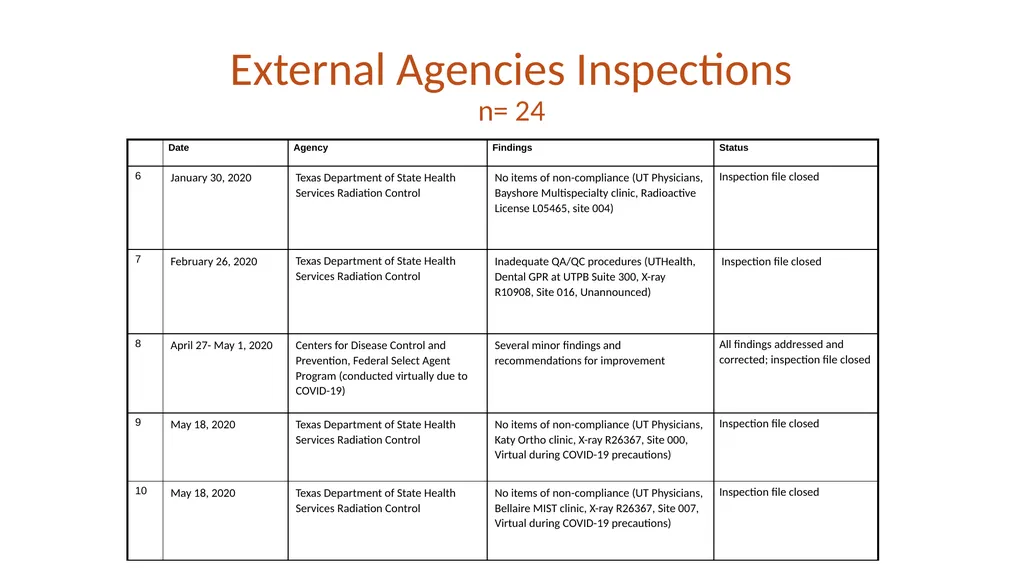
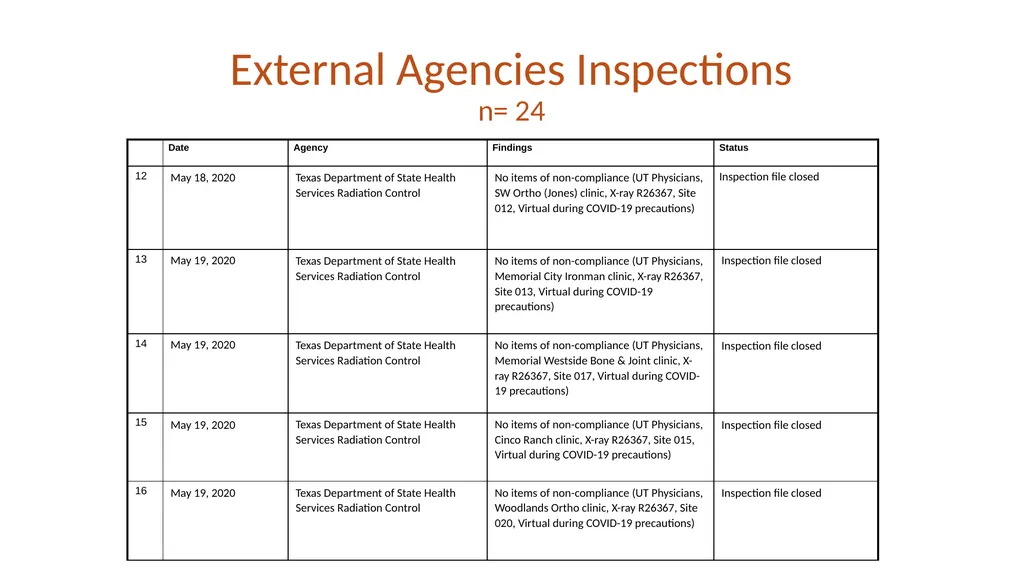
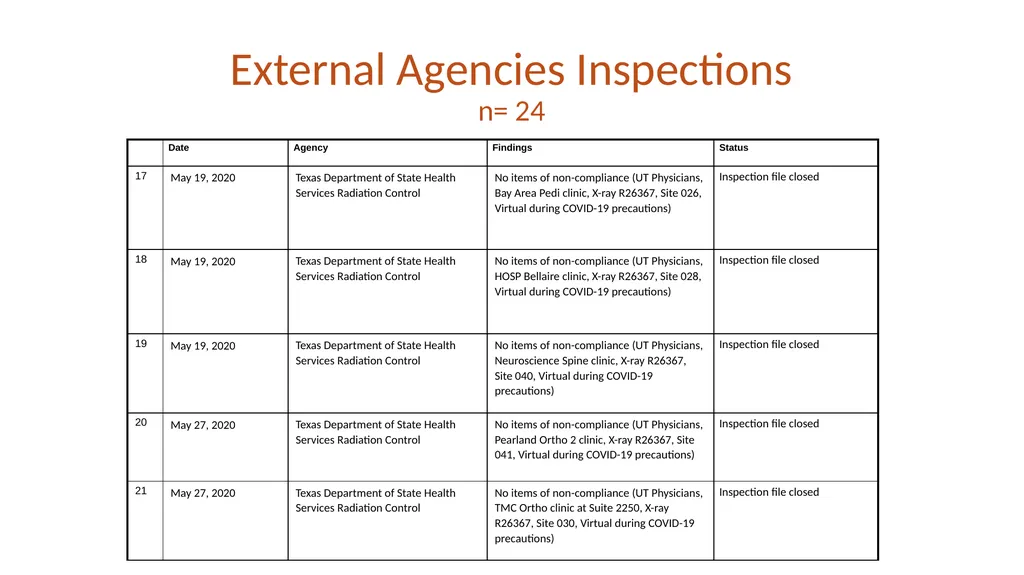
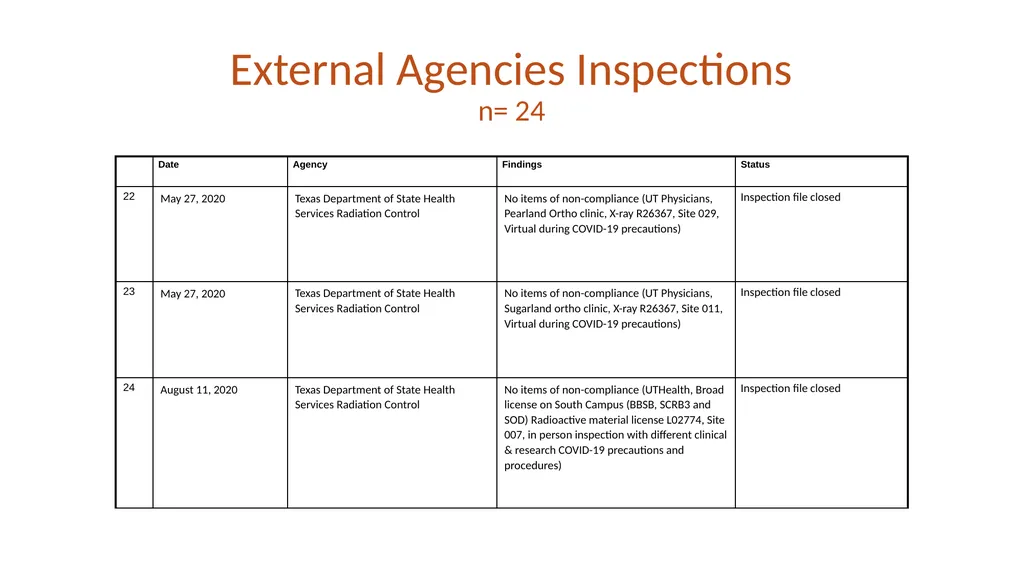
Regulatory inspections; other compliance related inspections by outside entities
With internal assessments
Results of EH&S routine safety surveillance activities<br>
Regulatory inspections; other compliance related inspections by outside entities
With internal assessments
Results of EH&S routine safety surveillance activities<br>
15
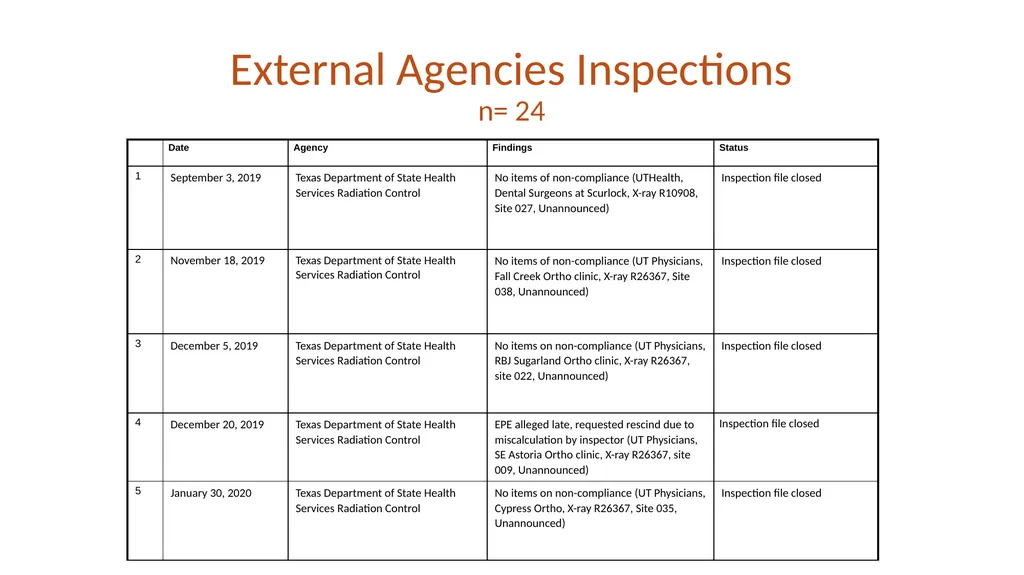
External Agencies Inspections
n= 24<br>
16
External Agencies Inspections
n= 24<br>
17
External Agencies Inspections
n= 24<br>
18
External Agencies Inspections
n= 24<br>
19
External Agencies Inspections
n= 24<br>
20
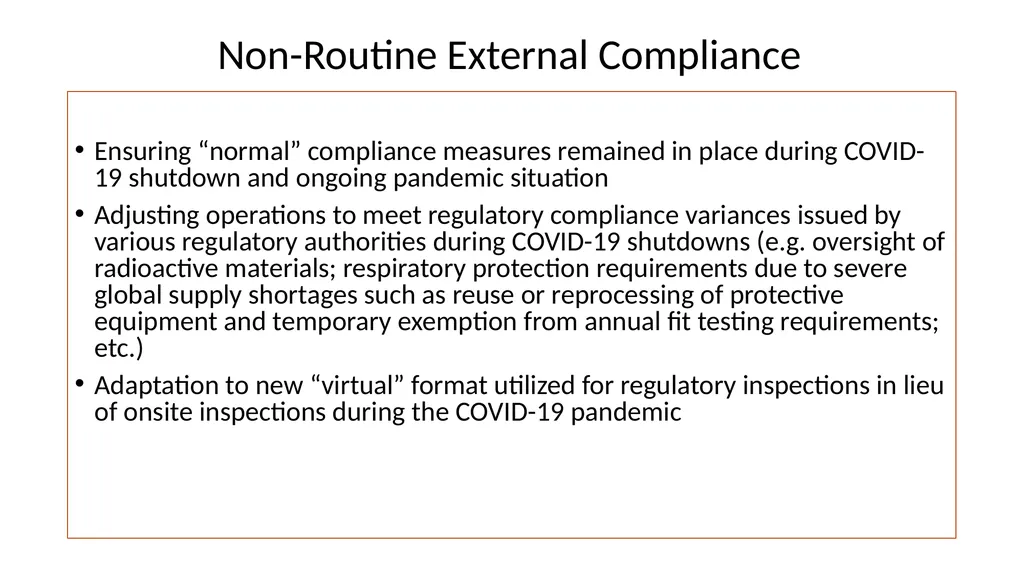
Non-Routine External Compliance Ensuring “normal” compliance measures remained in place during COVID-19 shutdown and ongoing pandemic situation
Adjusting operations to meet regulatory compliance variances issued by various regulatory authorities during COVID-19 shutdowns (e.g. oversight of radioactive materials; respiratory protection requirements due to severe global supply shortages such as reuse or reprocessing of protective equipment and temporary exemption from annual fit testing requirements; etc.)
Adaptation to new “virtual” format utilized for regulatory inspections in lieu of onsite inspections during the COVID-19 pandemic<br>
Adjusting operations to meet regulatory compliance variances issued by various regulatory authorities during COVID-19 shutdowns (e.g. oversight of radioactive materials; respiratory protection requirements due to severe global supply shortages such as reuse or reprocessing of protective equipment and temporary exemption from annual fit testing requirements; etc.)
Adaptation to new “virtual” format utilized for regulatory inspections in lieu of onsite inspections during the COVID-19 pandemic<br>
21
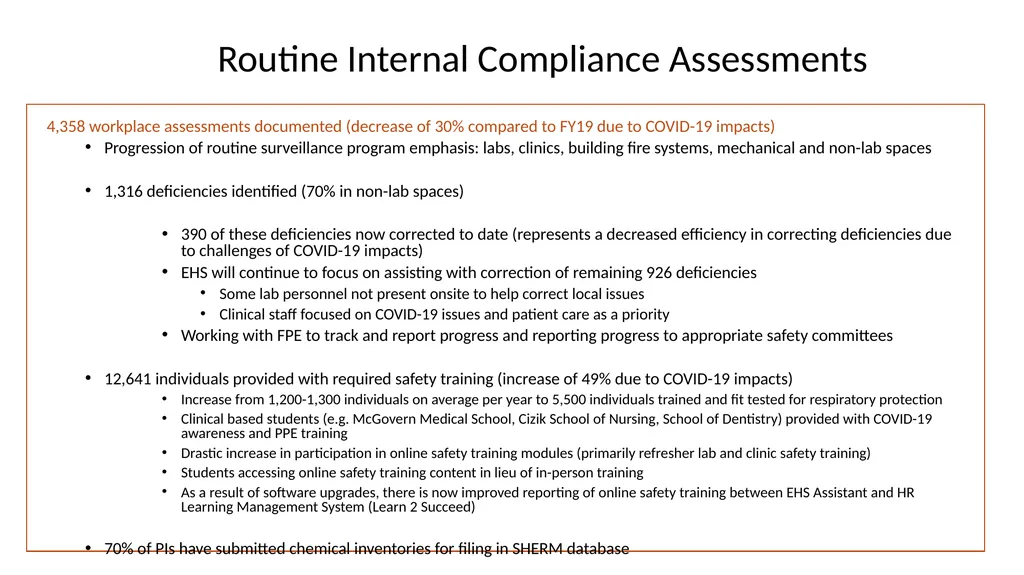
Routine Internal Compliance Assessments 4,358 workplace assessments documented (decrease of 30% compared to FY19 due to COVID-19 impacts)
Progression of routine surveillance program emphasis: labs, clinics, building fire systems, mechanical and non-lab spaces
1,316 deficiencies identified (70% in non-lab spaces)
390 of these deficiencies now corrected to date (represents a decreased efficiency in correcting deficiencies due to challenges of COVID-19 impacts)
EHS will continue to focus on assisting with correction of remaining 926 deficiencies
Some lab personnel not present onsite to help correct local issues
Clinical staff focused on COVID-19 issues and patient care as a priority
Working with FPE to track and report progress and reporting progress to appropriate safety committees
12,641 individuals provided with required safety training (increase of 49% due to COVID-19 impacts)
Increase from 1,200-1,300 individuals on average per year to 5,500 individuals trained and fit tested for respiratory protection
Clinical based students (e.g. McGovern Medical School, Cizik School of Nursing, School of Dentistry) provided with COVID-19 awareness and PPE training
Drastic increase in participation in online safety training modules (primarily refresher lab and clinic safety training)
Students accessing online safety training content in lieu of in-person training
As a result of software upgrades, there is now improved reporting of online safety training between EHS Assistant and HR Learning Management System (Learn 2 Succeed)
70% of PIs have submitted chemical inventories for filing in SHERM database<br>
Progression of routine surveillance program emphasis: labs, clinics, building fire systems, mechanical and non-lab spaces
1,316 deficiencies identified (70% in non-lab spaces)
390 of these deficiencies now corrected to date (represents a decreased efficiency in correcting deficiencies due to challenges of COVID-19 impacts)
EHS will continue to focus on assisting with correction of remaining 926 deficiencies
Some lab personnel not present onsite to help correct local issues
Clinical staff focused on COVID-19 issues and patient care as a priority
Working with FPE to track and report progress and reporting progress to appropriate safety committees
12,641 individuals provided with required safety training (increase of 49% due to COVID-19 impacts)
Increase from 1,200-1,300 individuals on average per year to 5,500 individuals trained and fit tested for respiratory protection
Clinical based students (e.g. McGovern Medical School, Cizik School of Nursing, School of Dentistry) provided with COVID-19 awareness and PPE training
Drastic increase in participation in online safety training modules (primarily refresher lab and clinic safety training)
Students accessing online safety training content in lieu of in-person training
As a result of software upgrades, there is now improved reporting of online safety training between EHS Assistant and HR Learning Management System (Learn 2 Succeed)
70% of PIs have submitted chemical inventories for filing in SHERM database<br>
22
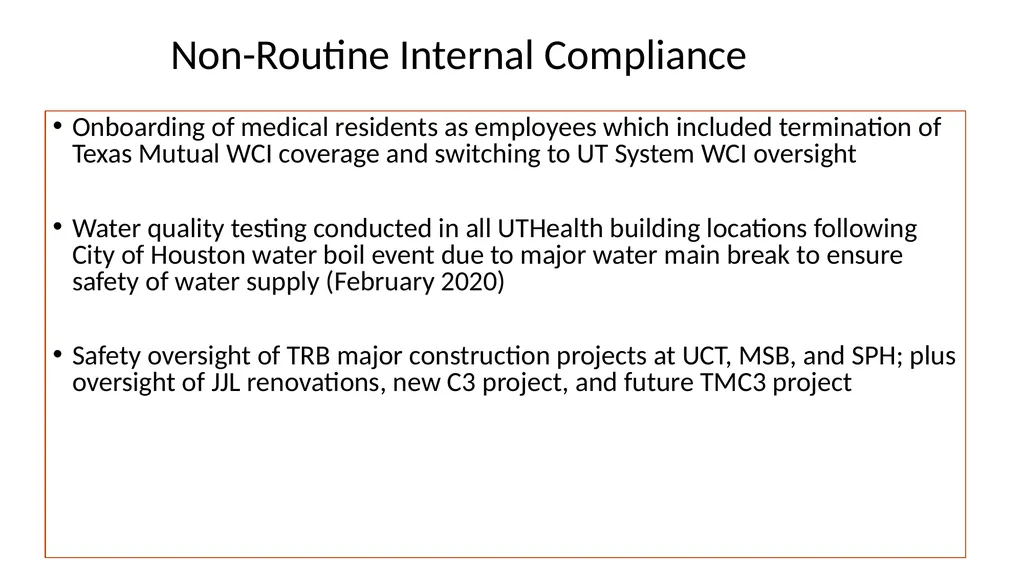
Non-Routine Internal Compliance Onboarding of medical residents as employees which included termination of Texas Mutual WCI coverage and switching to UT System WCI oversight
Water quality testing conducted in all UTHealth building locations following City of Houston water boil event due to major water main break to ensure safety of water supply (February 2020)
Safety oversight of TRB major construction projects at UCT, MSB, and SPH; plus oversight of JJL renovations, new C3 project, and future TMC3 project<br>
Water quality testing conducted in all UTHealth building locations following City of Houston water boil event due to major water main break to ensure safety of water supply (February 2020)
Safety oversight of TRB major construction projects at UCT, MSB, and SPH; plus oversight of JJL renovations, new C3 project, and future TMC3 project<br>
23
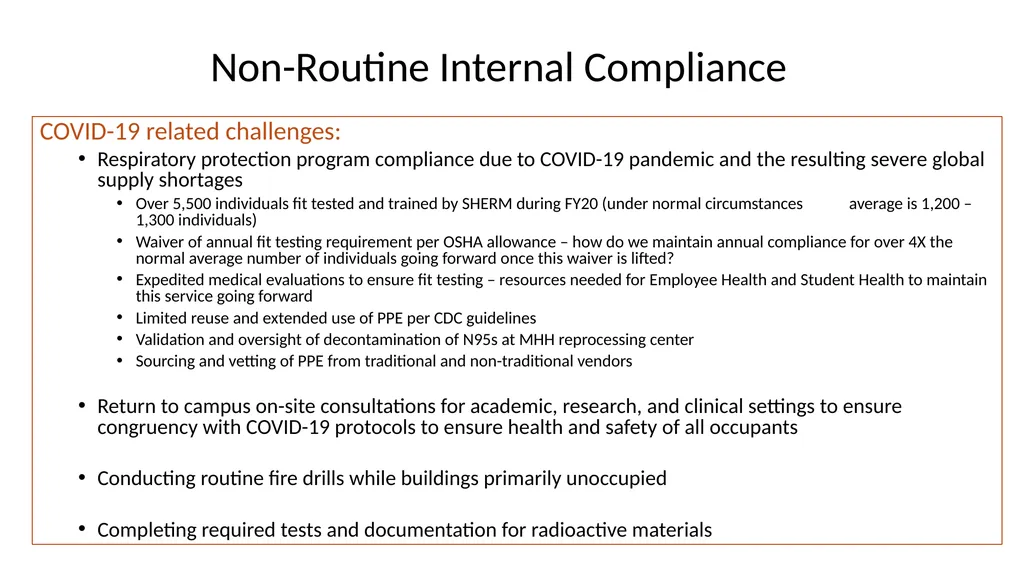
Non-Routine Internal Compliance COVID-19 related challenges:
Respiratory protection program compliance due to COVID-19 pandemic and the resulting severe global supply shortages
Over 5,500 individuals fit tested and trained by SHERM during FY20 (under normal circumstances average is 1,200 – 1,300 individuals)
Waiver of annual fit testing requirement per OSHA allowance – how do we maintain annual compliance for over 4X the normal average number of individuals going forward once this waiver is lifted?
Expedited medical evaluations to ensure fit testing – resources needed for Employee Health and Student Health to maintain this service going forward
Limited reuse and extended use of PPE per CDC guidelines
Validation and oversight of decontamination of N95s at MHH reprocessing center
Sourcing and vetting of PPE from traditional and non-traditional vendors
Return to campus on-site consultations for academic, research, and clinical settings to ensure congruency with COVID-19 protocols to ensure health and safety of all occupants
Conducting routine fire drills while buildings primarily unoccupied
Completing required tests and documentation for radioactive materials<br>
Respiratory protection program compliance due to COVID-19 pandemic and the resulting severe global supply shortages
Over 5,500 individuals fit tested and trained by SHERM during FY20 (under normal circumstances average is 1,200 – 1,300 individuals)
Waiver of annual fit testing requirement per OSHA allowance – how do we maintain annual compliance for over 4X the normal average number of individuals going forward once this waiver is lifted?
Expedited medical evaluations to ensure fit testing – resources needed for Employee Health and Student Health to maintain this service going forward
Limited reuse and extended use of PPE per CDC guidelines
Validation and oversight of decontamination of N95s at MHH reprocessing center
Sourcing and vetting of PPE from traditional and non-traditional vendors
Return to campus on-site consultations for academic, research, and clinical settings to ensure congruency with COVID-19 protocols to ensure health and safety of all occupants
Conducting routine fire drills while buildings primarily unoccupied
Completing required tests and documentation for radioactive materials<br>
24
FY21 Planned Actions - Compliance External compliance
Continue to educate and prepare UTHealth & UTPhysicians clinics about State of Texas Radiation Control program who continue to conduct frequent unannounced x-ray inspections
Consider participation in NNSA program to support decommissioning of Cesium irradiators and replacement with suitable X-ray irradiator alternatives
Provide support for the forthcoming AAALAC accreditation site visit regarding occupational health and safety programs
Providing necessary information and consultation for forthcoming SACSCOC site visit
Internal compliance
Develop efficiencies and strategy for long term management of respiratory protection program now that the demand has increased over four fold due to COVID-19
Continue aggressive routine surveillance program. Incorporate lessons learned from deficiency data into safety training to prevent recurrence.
Focus on education of research and clinic personnel regarding controlled substances used and stored at UTHealth and UTP
Continue to work with FPE to systematically address identified deficiencies and support current projects to address fire safety considerations
Provide regular updates to appropriate safety committees
Continue emphasis on lab inventories of hazardous materials
Chemical inventories already a requirement
Support biosafety awareness and inventory of biological agents and toxins within UTHealth laboratories<br>
Continue to educate and prepare UTHealth & UTPhysicians clinics about State of Texas Radiation Control program who continue to conduct frequent unannounced x-ray inspections
Consider participation in NNSA program to support decommissioning of Cesium irradiators and replacement with suitable X-ray irradiator alternatives
Provide support for the forthcoming AAALAC accreditation site visit regarding occupational health and safety programs
Providing necessary information and consultation for forthcoming SACSCOC site visit
Internal compliance
Develop efficiencies and strategy for long term management of respiratory protection program now that the demand has increased over four fold due to COVID-19
Continue aggressive routine surveillance program. Incorporate lessons learned from deficiency data into safety training to prevent recurrence.
Focus on education of research and clinic personnel regarding controlled substances used and stored at UTHealth and UTP
Continue to work with FPE to systematically address identified deficiencies and support current projects to address fire safety considerations
Provide regular updates to appropriate safety committees
Continue emphasis on lab inventories of hazardous materials
Chemical inventories already a requirement
Support biosafety awareness and inventory of biological agents and toxins within UTHealth laboratories<br>
25
KPI #3: Finances Expenditures
Program cost, cost drivers
Revenues
Sources of revenue, amounts<br>
Program cost, cost drivers
Revenues
Sources of revenue, amounts<br>
26
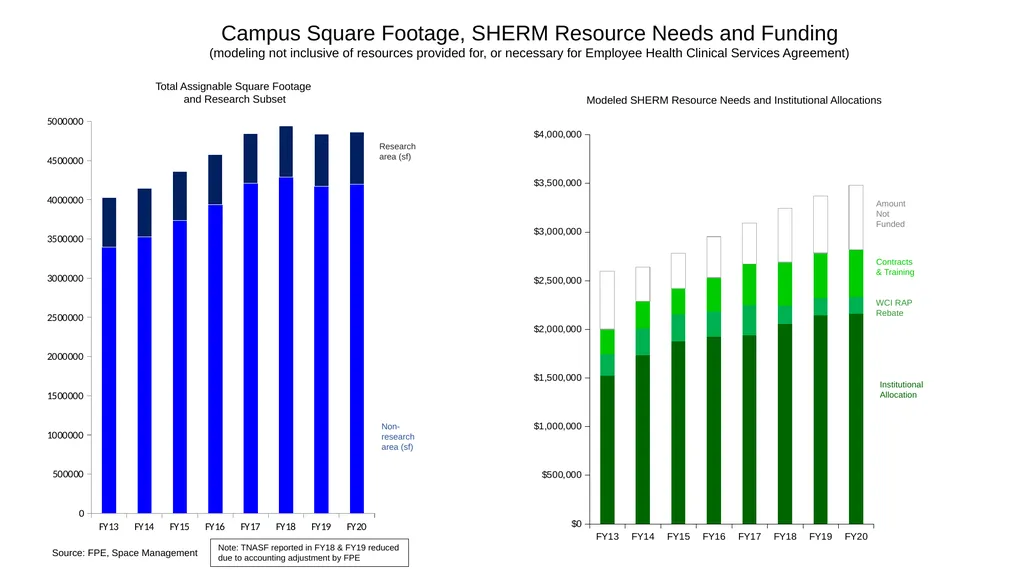
Campus Square Footage, SHERM Resource Needs and Funding
(modeling not inclusive of resources provided for, or necessary for Employee Health Clinical Services Agreement) Modeled SHERM Resource Needs and Institutional Allocations Institutional Allocation Amount Not Funded Contracts & Training WCI RAP Rebate Source: FPE, Space Management Research area (sf) Non-research area (sf) Note: TNASF reported in FY18 & FY19 reduced due to accounting adjustment by FPE Total Assignable Square Footage
and Research Subset<br>
(modeling not inclusive of resources provided for, or necessary for Employee Health Clinical Services Agreement) Modeled SHERM Resource Needs and Institutional Allocations Institutional Allocation Amount Not Funded Contracts & Training WCI RAP Rebate Source: FPE, Space Management Research area (sf) Non-research area (sf) Note: TNASF reported in FY18 & FY19 reduced due to accounting adjustment by FPE Total Assignable Square Footage
and Research Subset<br>
27
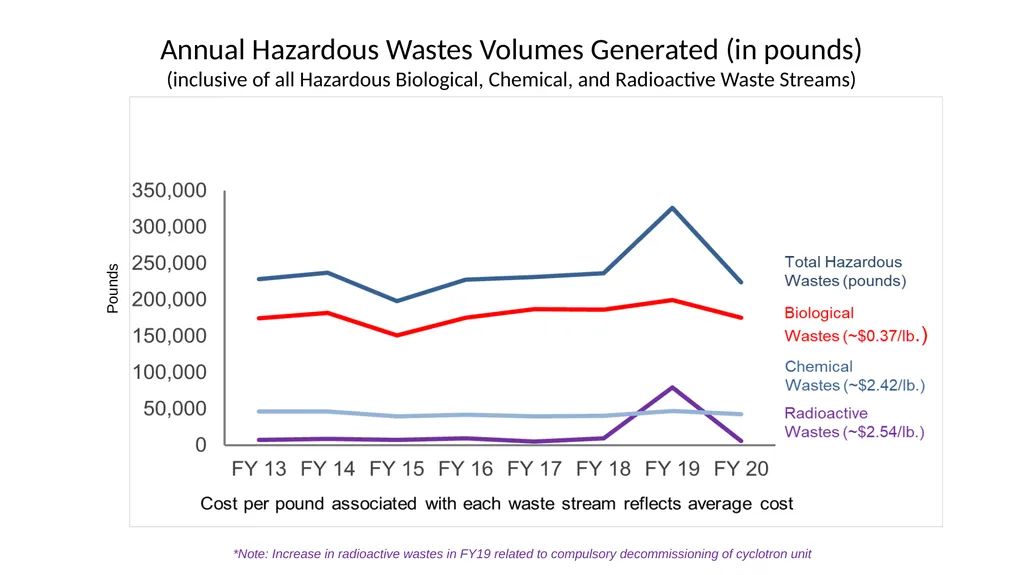
Annual Hazardous Wastes Volumes Generated (in pounds)
(inclusive of all Hazardous Biological, Chemical, and Radioactive Waste Streams) *Note: Increase in radioactive wastes in FY19 related to compulsory decommissioning of cyclotron unit Pounds<br>
(inclusive of all Hazardous Biological, Chemical, and Radioactive Waste Streams) *Note: Increase in radioactive wastes in FY19 related to compulsory decommissioning of cyclotron unit Pounds<br>
28
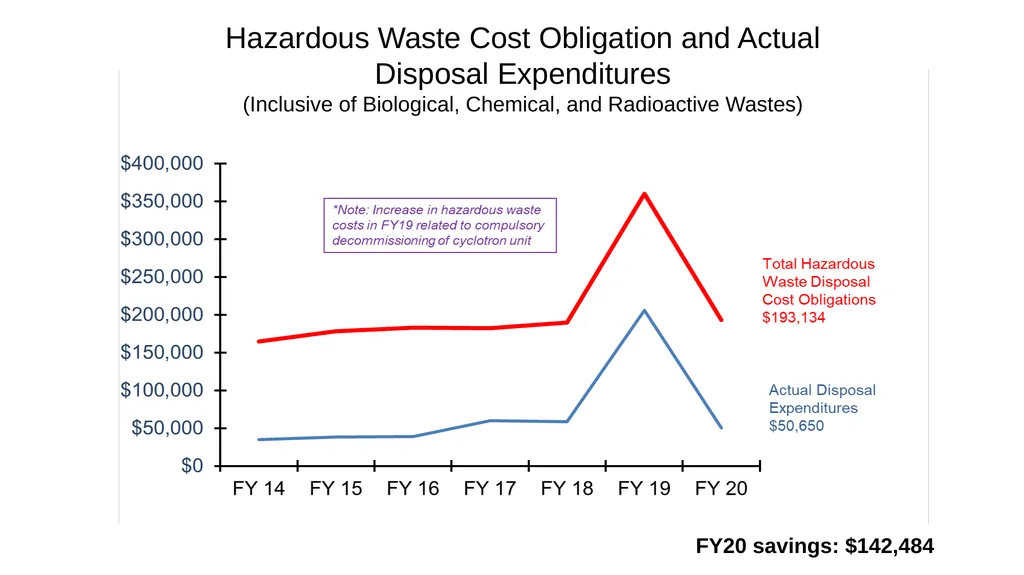
Hazardous Waste Cost Obligation and Actual Disposal Expenditures
(Inclusive of Biological, Chemical, and Radioactive Wastes) FY20 savings: $142,484<br>
29
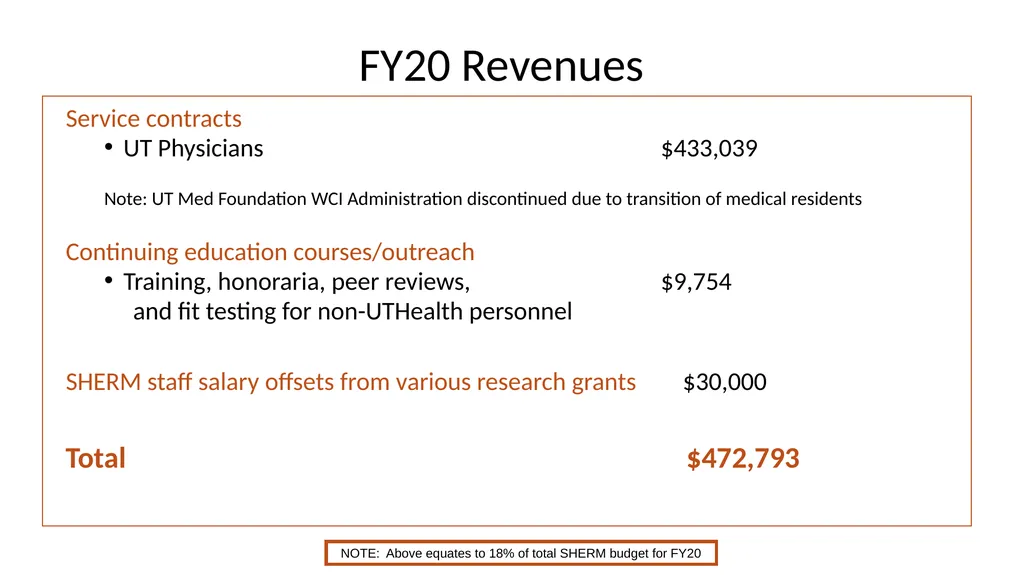
FY20 Revenues Service contracts
UT Physicians $433,039
Note: UT Med Foundation WCI Administration discontinued due to transition of medical residents
Continuing education courses/outreach
Training, honoraria, peer reviews, $9,754
and fit testing for non-UTHealth personnel
SHERM staff salary offsets from various research grants $30,000
Total $472,793 NOTE: Above equates to 18% of total SHERM budget for FY20<br>
UT Physicians $433,039
Note: UT Med Foundation WCI Administration discontinued due to transition of medical residents
Continuing education courses/outreach
Training, honoraria, peer reviews, $9,754
and fit testing for non-UTHealth personnel
SHERM staff salary offsets from various research grants $30,000
Total $472,793 NOTE: Above equates to 18% of total SHERM budget for FY20<br>
30
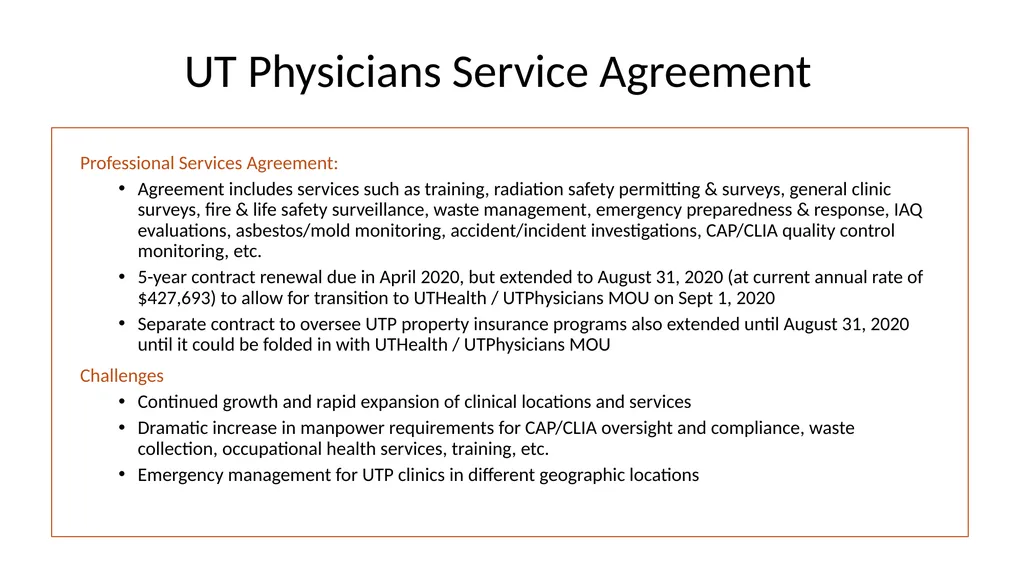
UT Physicians Service Agreement Professional Services Agreement:
Agreement includes services such as training, radiation safety permitting & surveys, general clinic surveys, fire & life safety surveillance, waste management, emergency preparedness & response, IAQ evaluations, asbestos/mold monitoring, accident/incident investigations, CAP/CLIA quality control monitoring, etc.
5-year contract renewal due in April 2020, but extended to August 31, 2020 (at current annual rate of $427,693) to allow for transition to UTHealth / UTPhysicians MOU on Sept 1, 2020
Separate contract to oversee UTP property insurance programs also extended until August 31, 2020 until it could be folded in with UTHealth / UTPhysicians MOU
Challenges
Continued growth and rapid expansion of clinical locations and services
Dramatic increase in manpower requirements for CAP/CLIA oversight and compliance, waste collection, occupational health services, training, etc.
Emergency management for UTP clinics in different geographic locations<br>
Agreement includes services such as training, radiation safety permitting & surveys, general clinic surveys, fire & life safety surveillance, waste management, emergency preparedness & response, IAQ evaluations, asbestos/mold monitoring, accident/incident investigations, CAP/CLIA quality control monitoring, etc.
5-year contract renewal due in April 2020, but extended to August 31, 2020 (at current annual rate of $427,693) to allow for transition to UTHealth / UTPhysicians MOU on Sept 1, 2020
Separate contract to oversee UTP property insurance programs also extended until August 31, 2020 until it could be folded in with UTHealth / UTPhysicians MOU
Challenges
Continued growth and rapid expansion of clinical locations and services
Dramatic increase in manpower requirements for CAP/CLIA oversight and compliance, waste collection, occupational health services, training, etc.
Emergency management for UTP clinics in different geographic locations<br>
31
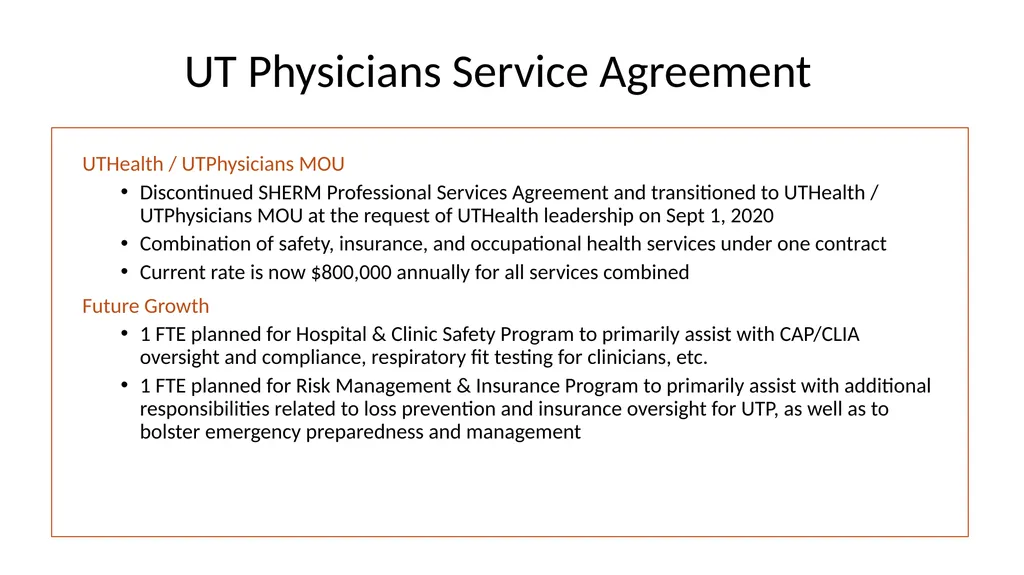
UT Physicians Service Agreement UTHealth / UTPhysicians MOU
Discontinued SHERM Professional Services Agreement and transitioned to UTHealth / UTPhysicians MOU at the request of UTHealth leadership on Sept 1, 2020
Combination of safety, insurance, and occupational health services under one contract
Current rate is now $800,000 annually for all services combined
Future Growth
1 FTE planned for Hospital & Clinic Safety Program to primarily assist with CAP/CLIA oversight and compliance, respiratory fit testing for clinicians, etc.
1 FTE planned for Risk Management & Insurance Program to primarily assist with additional responsibilities related to loss prevention and insurance oversight for UTP, as well as to bolster emergency preparedness and management<br>
Discontinued SHERM Professional Services Agreement and transitioned to UTHealth / UTPhysicians MOU at the request of UTHealth leadership on Sept 1, 2020
Combination of safety, insurance, and occupational health services under one contract
Current rate is now $800,000 annually for all services combined
Future Growth
1 FTE planned for Hospital & Clinic Safety Program to primarily assist with CAP/CLIA oversight and compliance, respiratory fit testing for clinicians, etc.
1 FTE planned for Risk Management & Insurance Program to primarily assist with additional responsibilities related to loss prevention and insurance oversight for UTP, as well as to bolster emergency preparedness and management<br>
32
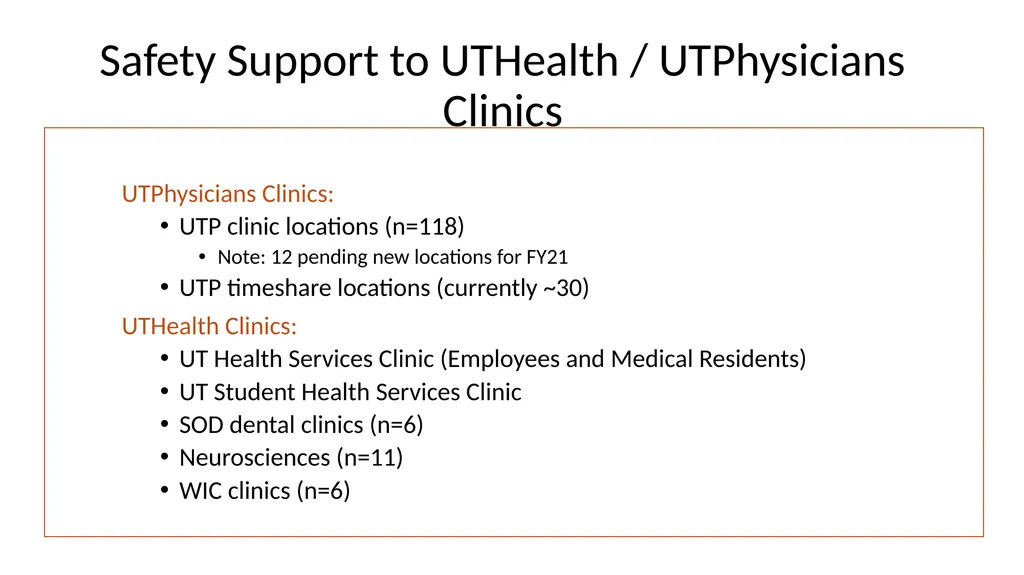
Safety Support to UTHealth / UTPhysicians Clinics UTPhysicians Clinics:
UTP clinic locations (n=118)
Note: 12 pending new locations for FY21
UTP timeshare locations (currently ~30)
UTHealth Clinics:
UT Health Services Clinic (Employees and Medical Residents)
UT Student Health Services Clinic
SOD dental clinics (n=6)
Neurosciences (n=11)
WIC clinics (n=6)<br>
UTP clinic locations (n=118)
Note: 12 pending new locations for FY21
UTP timeshare locations (currently ~30)
UTHealth Clinics:
UT Health Services Clinic (Employees and Medical Residents)
UT Student Health Services Clinic
SOD dental clinics (n=6)
Neurosciences (n=11)
WIC clinics (n=6)<br>
33
FY21 Planned Actions - Financial Expenditures
Continue aggressive hazardous waste minimization program to contain hazardous waste disposal costs
Focus on regulated medical waste generation reduction in labs and clinics due to 30% increase experienced during recent (Sept 1, 2019) renewal of UT System-wide contract
Fees increase significantly each fiscal year for each point of collection, so primary focus is on minimizing volumes and maximizing efficiency to reduce stop frequencies
Continue to lobby for dedicated funding for Occupational Health Clinical Services Agreement because of impending discontinuance of UTS WCI RAP
Revenues
UTHealth / UTPhysicians MOU now includes occupational health allocation of $138,700
Continue with service contracts and community outreach activities that provide financial support to supplement institutional funding, including enhancing virtual training capabilities
Continue to participate in various research grant projects which allow for staff salary offsets
Continued receipt of WCI RAP fund allocations in FY21 ($160,721), but program may terminate at any point<br>
Continue aggressive hazardous waste minimization program to contain hazardous waste disposal costs
Focus on regulated medical waste generation reduction in labs and clinics due to 30% increase experienced during recent (Sept 1, 2019) renewal of UT System-wide contract
Fees increase significantly each fiscal year for each point of collection, so primary focus is on minimizing volumes and maximizing efficiency to reduce stop frequencies
Continue to lobby for dedicated funding for Occupational Health Clinical Services Agreement because of impending discontinuance of UTS WCI RAP
Revenues
UTHealth / UTPhysicians MOU now includes occupational health allocation of $138,700
Continue with service contracts and community outreach activities that provide financial support to supplement institutional funding, including enhancing virtual training capabilities
Continue to participate in various research grant projects which allow for staff salary offsets
Continued receipt of WCI RAP fund allocations in FY21 ($160,721), but program may terminate at any point<br>
34
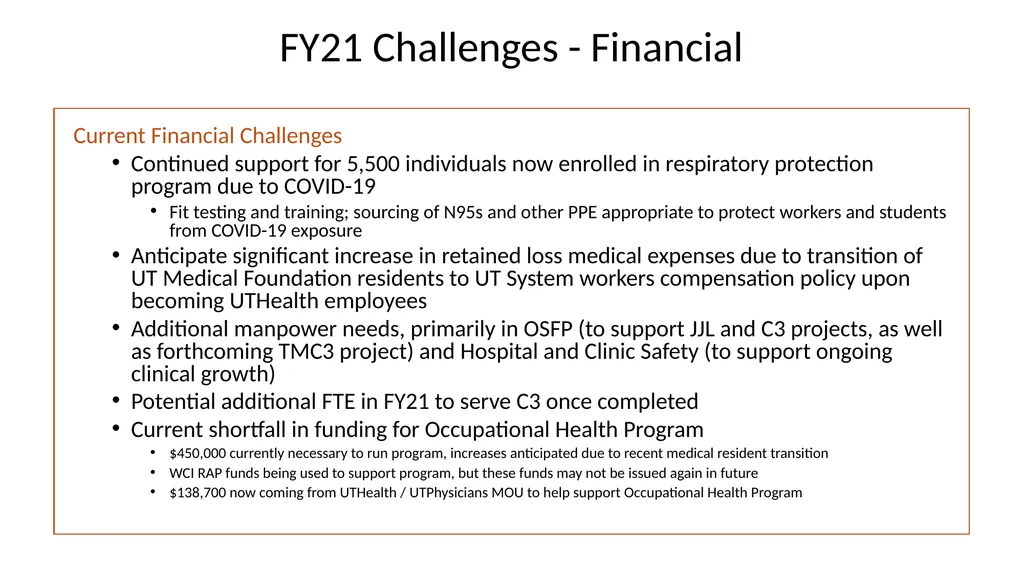
FY21 Challenges - Financial Current Financial Challenges
Continued support for 5,500 individuals now enrolled in respiratory protection program due to COVID-19
Fit testing and training; sourcing of N95s and other PPE appropriate to protect workers and students from COVID-19 exposure
Anticipate significant increase in retained loss medical expenses due to transition of UT Medical Foundation residents to UT System workers compensation policy upon becoming UTHealth employees
Additional manpower needs, primarily in OSFP (to support JJL and C3 projects, as well as forthcoming TMC3 project) and Hospital and Clinic Safety (to support ongoing clinical growth)
Potential additional FTE in FY21 to serve C3 once completed
Current shortfall in funding for Occupational Health Program
$450,000 currently necessary to run program, increases anticipated due to recent medical resident transition
WCI RAP funds being used to support program, but these funds may not be issued again in future
$138,700 now coming from UTHealth / UTPhysicians MOU to help support Occupational Health Program<br>
Continued support for 5,500 individuals now enrolled in respiratory protection program due to COVID-19
Fit testing and training; sourcing of N95s and other PPE appropriate to protect workers and students from COVID-19 exposure
Anticipate significant increase in retained loss medical expenses due to transition of UT Medical Foundation residents to UT System workers compensation policy upon becoming UTHealth employees
Additional manpower needs, primarily in OSFP (to support JJL and C3 projects, as well as forthcoming TMC3 project) and Hospital and Clinic Safety (to support ongoing clinical growth)
Potential additional FTE in FY21 to serve C3 once completed
Current shortfall in funding for Occupational Health Program
$450,000 currently necessary to run program, increases anticipated due to recent medical resident transition
WCI RAP funds being used to support program, but these funds may not be issued again in future
$138,700 now coming from UTHealth / UTPhysicians MOU to help support Occupational Health Program<br>
35
KPI #4: Client Satisfaction External clients served
Results of Client Satisfaction Survey for UT Police department
Internal department staff
Summary of ongoing staff professional development activities<br>
Results of Client Satisfaction Survey for UT Police department
Internal department staff
Summary of ongoing staff professional development activities<br>
36
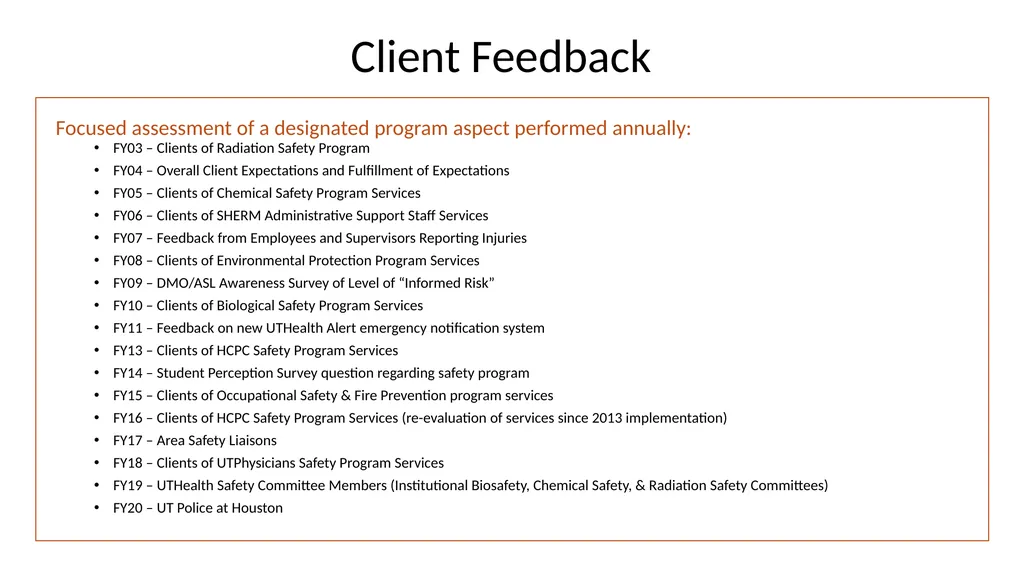
Client Feedback Focused assessment of a designated program aspect performed annually:
FY03 – Clients of Radiation Safety Program
FY04 – Overall Client Expectations and Fulfillment of Expectations
FY05 – Clients of Chemical Safety Program Services
FY06 – Clients of SHERM Administrative Support Staff Services
FY07 – Feedback from Employees and Supervisors Reporting Injuries
FY08 – Clients of Environmental Protection Program Services
FY09 – DMO/ASL Awareness Survey of Level of “Informed Risk”
FY10 – Clients of Biological Safety Program Services
FY11 – Feedback on new UTHealth Alert emergency notification system
FY13 – Clients of HCPC Safety Program Services
FY14 – Student Perception Survey question regarding safety program
FY15 – Clients of Occupational Safety & Fire Prevention program services
FY16 – Clients of HCPC Safety Program Services (re-evaluation of services since 2013 implementation)
FY17 – Area Safety Liaisons
FY18 – Clients of UTPhysicians Safety Program Services
FY19 – UTHealth Safety Committee Members (Institutional Biosafety, Chemical Safety, & Radiation Safety Committees)
FY20 – UT Police at Houston<br>
FY03 – Clients of Radiation Safety Program
FY04 – Overall Client Expectations and Fulfillment of Expectations
FY05 – Clients of Chemical Safety Program Services
FY06 – Clients of SHERM Administrative Support Staff Services
FY07 – Feedback from Employees and Supervisors Reporting Injuries
FY08 – Clients of Environmental Protection Program Services
FY09 – DMO/ASL Awareness Survey of Level of “Informed Risk”
FY10 – Clients of Biological Safety Program Services
FY11 – Feedback on new UTHealth Alert emergency notification system
FY13 – Clients of HCPC Safety Program Services
FY14 – Student Perception Survey question regarding safety program
FY15 – Clients of Occupational Safety & Fire Prevention program services
FY16 – Clients of HCPC Safety Program Services (re-evaluation of services since 2013 implementation)
FY17 – Area Safety Liaisons
FY18 – Clients of UTPhysicians Safety Program Services
FY19 – UTHealth Safety Committee Members (Institutional Biosafety, Chemical Safety, & Radiation Safety Committees)
FY20 – UT Police at Houston<br>
37
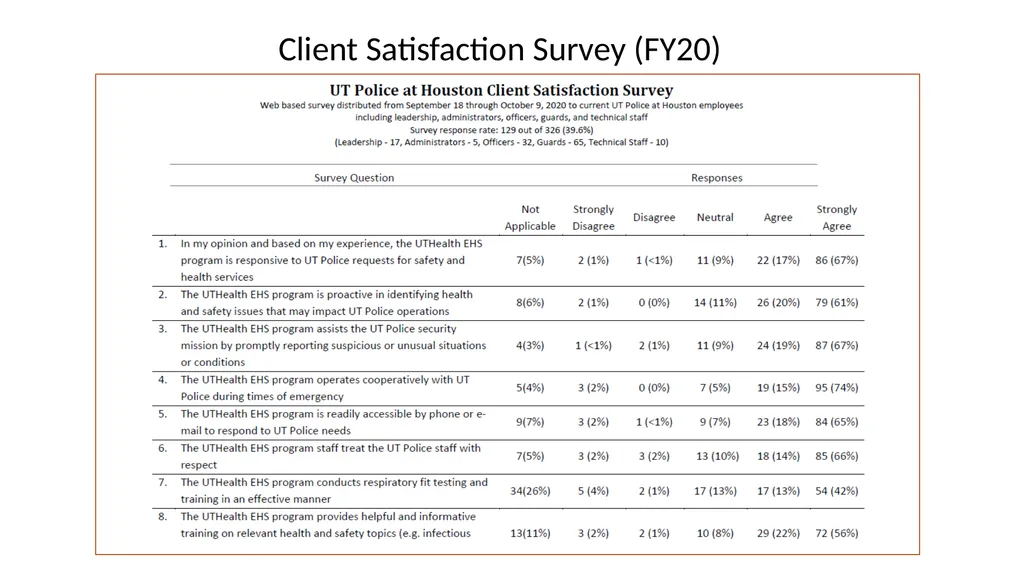
Client Satisfaction Survey (FY20)<br>
38
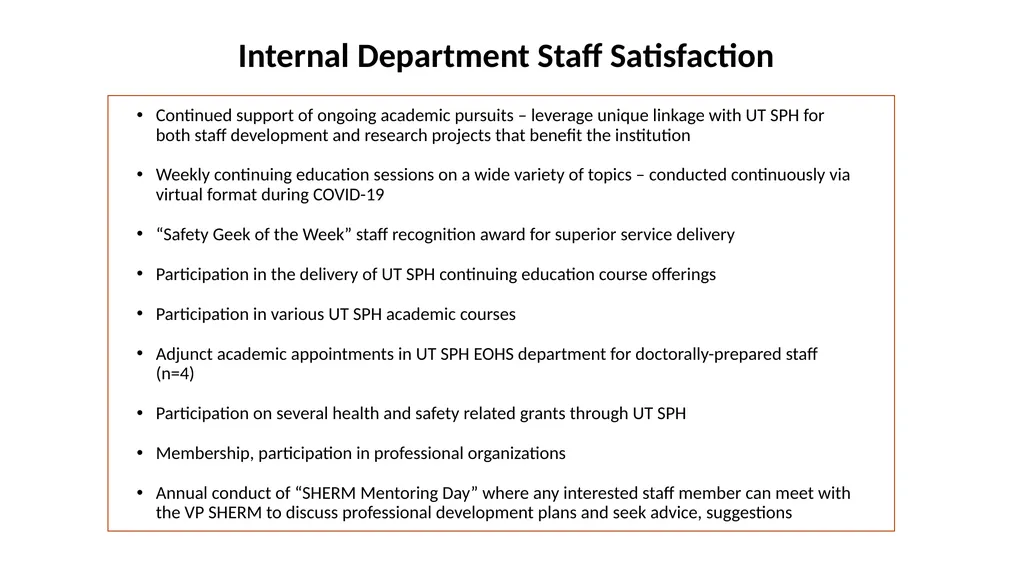
Internal Department Staff Satisfaction Continued support of ongoing academic pursuits – leverage unique linkage with UT SPH for both staff development and research projects that benefit the institution
Weekly continuing education sessions on a wide variety of topics – conducted continuously via virtual format during COVID-19
“Safety Geek of the Week” staff recognition award for superior service delivery
Participation in the delivery of UT SPH continuing education course offerings
Participation in various UT SPH academic courses
Adjunct academic appointments in UT SPH EOHS department for doctorally-prepared staff (n=4)
Participation on several health and safety related grants through UT SPH
Membership, participation in professional organizations
Annual conduct of “SHERM Mentoring Day” where any interested staff member can meet with the VP SHERM to discuss professional development plans and seek advice, suggestions<br>
Weekly continuing education sessions on a wide variety of topics – conducted continuously via virtual format during COVID-19
“Safety Geek of the Week” staff recognition award for superior service delivery
Participation in the delivery of UT SPH continuing education course offerings
Participation in various UT SPH academic courses
Adjunct academic appointments in UT SPH EOHS department for doctorally-prepared staff (n=4)
Participation on several health and safety related grants through UT SPH
Membership, participation in professional organizations
Annual conduct of “SHERM Mentoring Day” where any interested staff member can meet with the VP SHERM to discuss professional development plans and seek advice, suggestions<br>
39
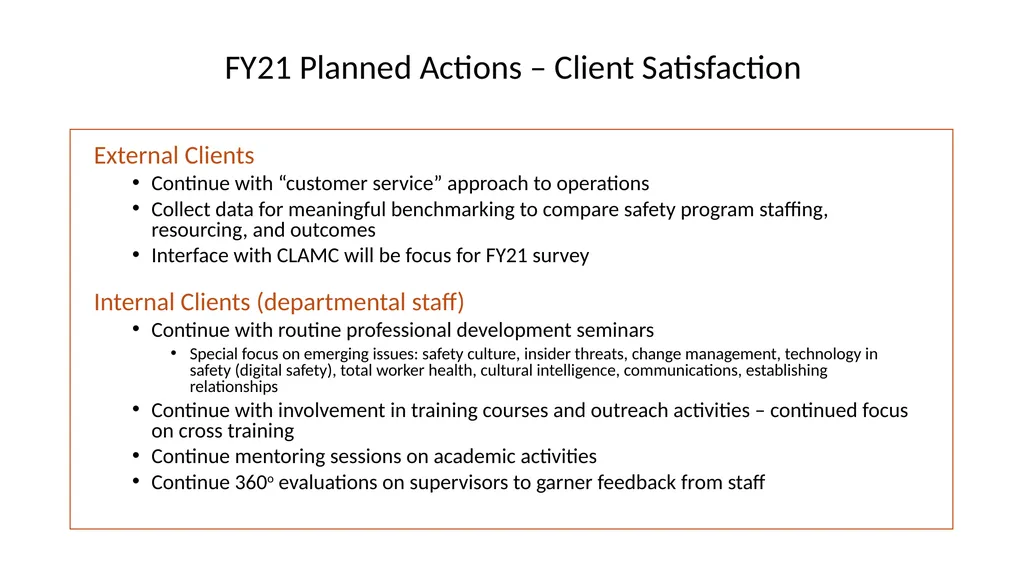
FY21 Planned Actions – Client Satisfaction External Clients
Continue with “customer service” approach to operations
Collect data for meaningful benchmarking to compare safety program staffing, resourcing, and outcomes
Interface with CLAMC will be focus for FY21 survey
Internal Clients (departmental staff)
Continue with routine professional development seminars
Special focus on emerging issues: safety culture, insider threats, change management, technology in safety (digital safety), total worker health, cultural intelligence, communications, establishing relationships
Continue with involvement in training courses and outreach activities – continued focus on cross training
Continue mentoring sessions on academic activities
Continue 360o evaluations on supervisors to garner feedback from staff<br>
Continue with “customer service” approach to operations
Collect data for meaningful benchmarking to compare safety program staffing, resourcing, and outcomes
Interface with CLAMC will be focus for FY21 survey
Internal Clients (departmental staff)
Continue with routine professional development seminars
Special focus on emerging issues: safety culture, insider threats, change management, technology in safety (digital safety), total worker health, cultural intelligence, communications, establishing relationships
Continue with involvement in training courses and outreach activities – continued focus on cross training
Continue mentoring sessions on academic activities
Continue 360o evaluations on supervisors to garner feedback from staff<br>
40
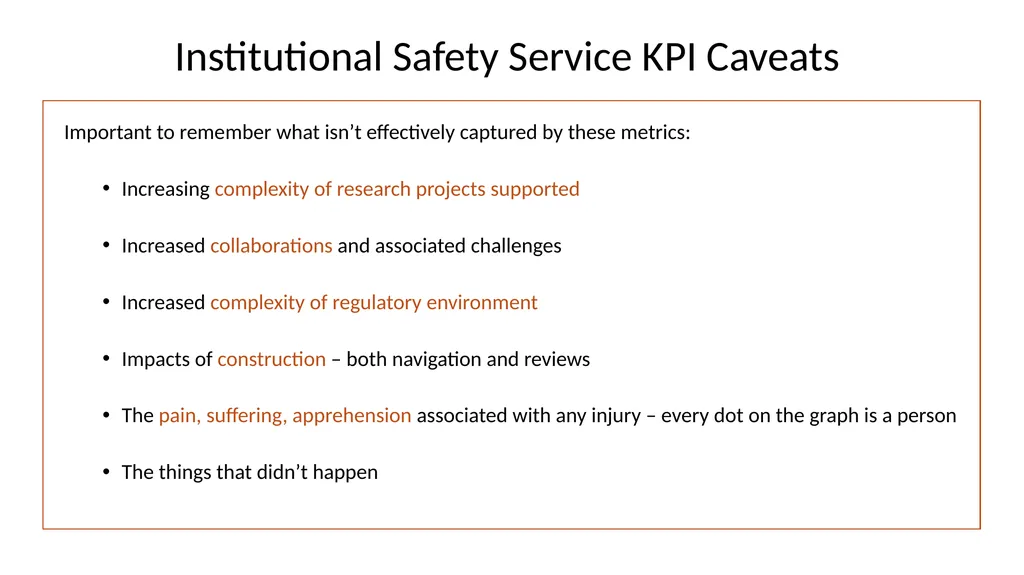
Institutional Safety Service KPI Caveats Important to remember what isn’t effectively captured by these metrics:
Increasing complexity of research projects supported
Increased collaborations and associated challenges
Increased complexity of regulatory environment
Impacts of construction – both navigation and reviews
The pain, suffering, apprehension associated with any injury – every dot on the graph is a person
The things that didn’t happen<br>
Increasing complexity of research projects supported
Increased collaborations and associated challenges
Increased complexity of regulatory environment
Impacts of construction – both navigation and reviews
The pain, suffering, apprehension associated with any injury – every dot on the graph is a person
The things that didn’t happen<br>
41
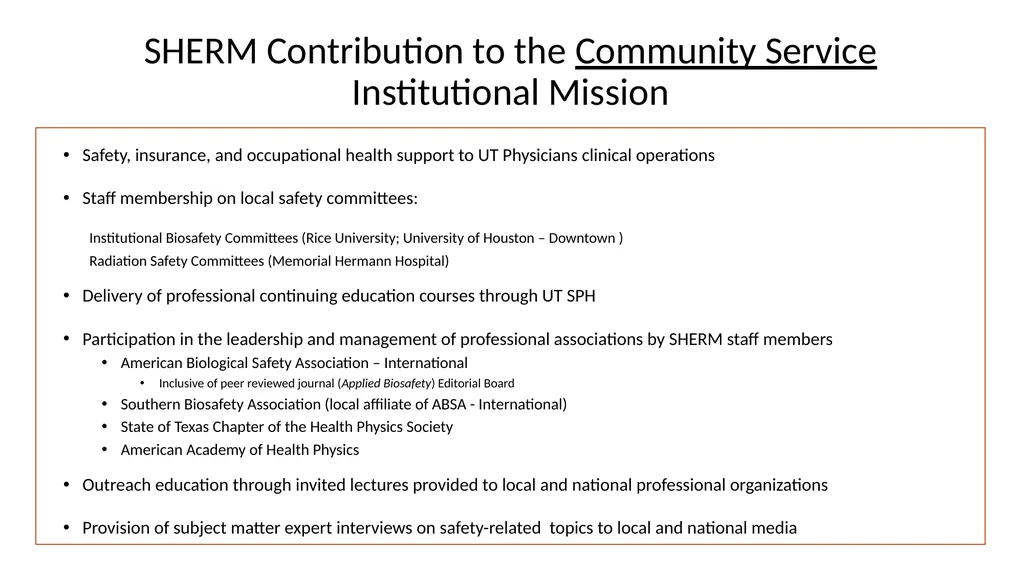
SHERM Contribution to the Community Service Institutional Mission Safety, insurance, and occupational health support to UT Physicians clinical operations
Staff membership on local safety committees:
Institutional Biosafety Committees (Rice University; University of Houston – Downtown )
Radiation Safety Committees (Memorial Hermann Hospital)
Delivery of professional continuing education courses through UT SPH
Participation in the leadership and management of professional associations by SHERM staff members
American Biological Safety Association – International
Inclusive of peer reviewed journal (Applied Biosafety) Editorial Board
Southern Biosafety Association (local affiliate of ABSA - International)
State of Texas Chapter of the Health Physics Society
American Academy of Health Physics
Outreach education through invited lectures provided to local and national professional organizations
Provision of subject matter expert interviews on safety-related topics to local and national media<br>
Staff membership on local safety committees:
Institutional Biosafety Committees (Rice University; University of Houston – Downtown )
Radiation Safety Committees (Memorial Hermann Hospital)
Delivery of professional continuing education courses through UT SPH
Participation in the leadership and management of professional associations by SHERM staff members
American Biological Safety Association – International
Inclusive of peer reviewed journal (Applied Biosafety) Editorial Board
Southern Biosafety Association (local affiliate of ABSA - International)
State of Texas Chapter of the Health Physics Society
American Academy of Health Physics
Outreach education through invited lectures provided to local and national professional organizations
Provision of subject matter expert interviews on safety-related topics to local and national media<br>
42
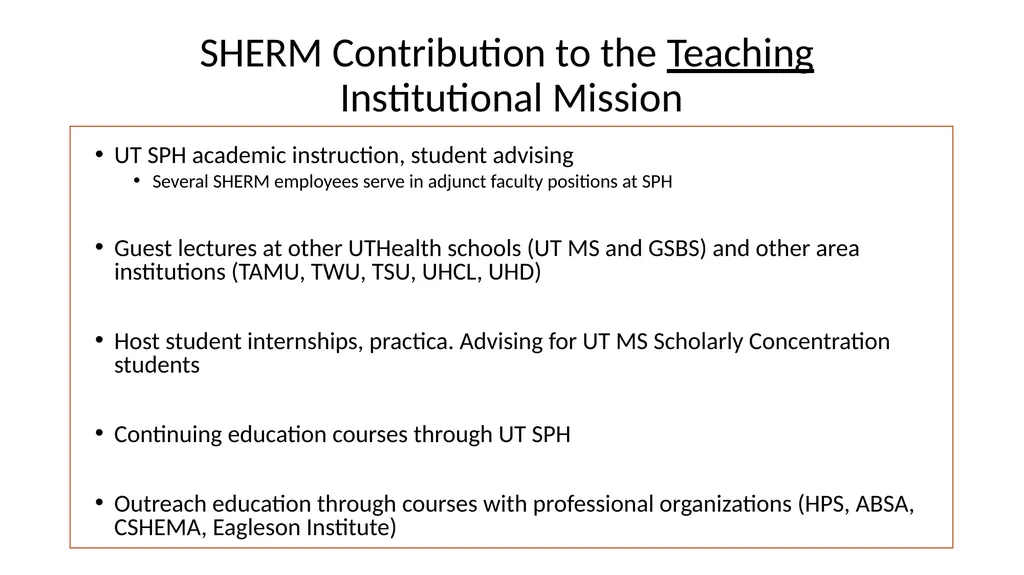
SHERM Contribution to the Teaching
Institutional Mission UT SPH academic instruction, student advising
Several SHERM employees serve in adjunct faculty positions at SPH
Guest lectures at other UTHealth schools (UT MS and GSBS) and other area institutions (TAMU, TWU, TSU, UHCL, UHD)
Host student internships, practica. Advising for UT MS Scholarly Concentration students
Continuing education courses through UT SPH
Outreach education through courses with professional organizations (HPS, ABSA, CSHEMA, Eagleson Institute)<br>
Several SHERM employees serve in adjunct faculty positions at SPH
Guest lectures at other UTHealth schools (UT MS and GSBS) and other area institutions (TAMU, TWU, TSU, UHCL, UHD)
Host student internships, practica. Advising for UT MS Scholarly Concentration students
Continuing education courses through UT SPH
Outreach education through courses with professional organizations (HPS, ABSA, CSHEMA, Eagleson Institute)<br>
43
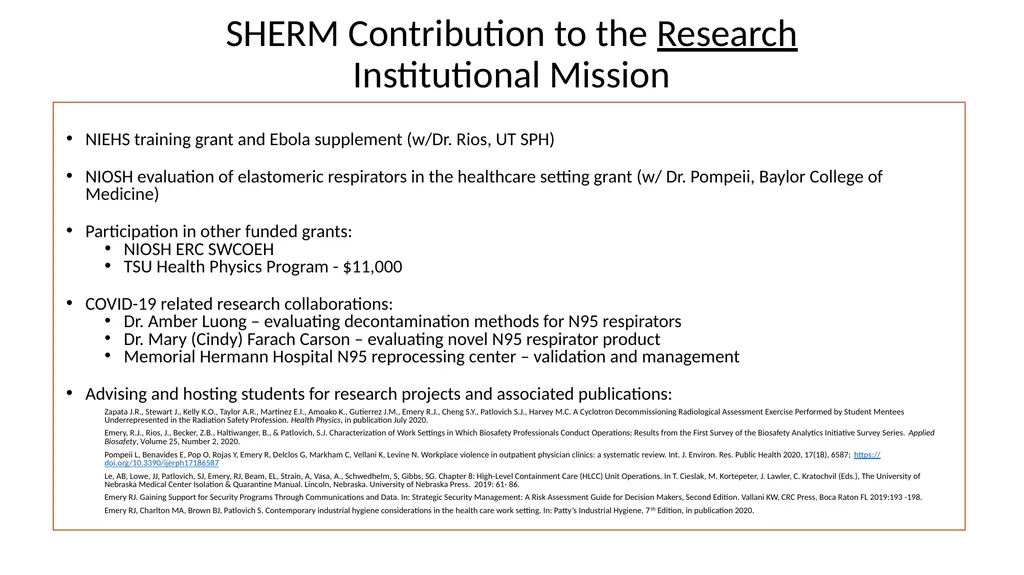
SHERM Contribution to the Research Institutional Mission NIEHS training grant and Ebola supplement (w/Dr. Rios, UT SPH)
NIOSH evaluation of elastomeric respirators in the healthcare setting grant (w/ Dr. Pompeii, Baylor College of Medicine)
Participation in other funded grants:
NIOSH ERC SWCOEH
TSU Health Physics Program - $11,000
COVID-19 related research collaborations:
Dr. Amber Luong – evaluating decontamination methods for N95 respirators
Dr. Mary (Cindy) Farach Carson – evaluating novel N95 respirator product
Memorial Hermann Hospital N95 reprocessing center – validation and management
Advising and hosting students for research projects and associated publications:
Zapata J.R., Stewart J., Kelly K.O., Taylor A.R., Martinez E.I., Amoako K., Gutierrez J.M., Emery R.J., Cheng S.Y., Patlovich S.J., Harvey M.C. A Cyclotron Decommissioning Radiological Assessment Exercise Performed by Student Mentees Underrepresented in the Radiation Safety Profession. Health Physics, in publication July 2020.
Emery, R.J., Rios, J., Becker, Z.B., Haltiwanger, B., & Patlovich, S.J. Characterization of Work Settings in Which Biosafety Professionals Conduct Operations: Results from the First Survey of the Biosafety Analytics Initiative Survey Series. Applied Biosafety, Volume 25, Number 2, 2020.
Pompeii L, Benavides E, Pop O, Rojas Y, Emery R, Delclos G, Markham C, Vellani K, Levine N. Workplace violence in outpatient physician clinics: a systematic review. Int. J. Environ. Res. Public Health 2020, 17(18), 6587; https://doi.org/10.3390/ijerph17186587
Le, AB, Lowe, JJ, Patlovich, SJ, Emery, RJ, Beam, EL, Strain, A, Vasa, A., Schwedhelm, S, Gibbs, SG. Chapter 8: High-Level Containment Care (HLCC) Unit Operations. In T. Cieslak, M. Kortepeter, J. Lawler, C. Kratochvil (Eds.), The University of Nebraska Medical Center Isolation & Quarantine Manual. Lincoln, Nebraska. University of Nebraska Press. 2019: 61- 86.
Emery RJ. Gaining Support for Security Programs Through Communications and Data. In: Strategic Security Management: A Risk Assessment Guide for Decision Makers, Second Edition. Vallani KW, CRC Press, Boca Raton FL 2019:193 -198.
Emery RJ, Charlton MA, Brown BJ, Patlovich S. Contemporary industrial hygiene considerations in the health care work setting. In: Patty’s Industrial Hygiene, 7th Edition, in publication 2020.<br>
NIOSH evaluation of elastomeric respirators in the healthcare setting grant (w/ Dr. Pompeii, Baylor College of Medicine)
Participation in other funded grants:
NIOSH ERC SWCOEH
TSU Health Physics Program - $11,000
COVID-19 related research collaborations:
Dr. Amber Luong – evaluating decontamination methods for N95 respirators
Dr. Mary (Cindy) Farach Carson – evaluating novel N95 respirator product
Memorial Hermann Hospital N95 reprocessing center – validation and management
Advising and hosting students for research projects and associated publications:
Zapata J.R., Stewart J., Kelly K.O., Taylor A.R., Martinez E.I., Amoako K., Gutierrez J.M., Emery R.J., Cheng S.Y., Patlovich S.J., Harvey M.C. A Cyclotron Decommissioning Radiological Assessment Exercise Performed by Student Mentees Underrepresented in the Radiation Safety Profession. Health Physics, in publication July 2020.
Emery, R.J., Rios, J., Becker, Z.B., Haltiwanger, B., & Patlovich, S.J. Characterization of Work Settings in Which Biosafety Professionals Conduct Operations: Results from the First Survey of the Biosafety Analytics Initiative Survey Series. Applied Biosafety, Volume 25, Number 2, 2020.
Pompeii L, Benavides E, Pop O, Rojas Y, Emery R, Delclos G, Markham C, Vellani K, Levine N. Workplace violence in outpatient physician clinics: a systematic review. Int. J. Environ. Res. Public Health 2020, 17(18), 6587; https://doi.org/10.3390/ijerph17186587
Le, AB, Lowe, JJ, Patlovich, SJ, Emery, RJ, Beam, EL, Strain, A, Vasa, A., Schwedhelm, S, Gibbs, SG. Chapter 8: High-Level Containment Care (HLCC) Unit Operations. In T. Cieslak, M. Kortepeter, J. Lawler, C. Kratochvil (Eds.), The University of Nebraska Medical Center Isolation & Quarantine Manual. Lincoln, Nebraska. University of Nebraska Press. 2019: 61- 86.
Emery RJ. Gaining Support for Security Programs Through Communications and Data. In: Strategic Security Management: A Risk Assessment Guide for Decision Makers, Second Edition. Vallani KW, CRC Press, Boca Raton FL 2019:193 -198.
Emery RJ, Charlton MA, Brown BJ, Patlovich S. Contemporary industrial hygiene considerations in the health care work setting. In: Patty’s Industrial Hygiene, 7th Edition, in publication 2020.<br>
44
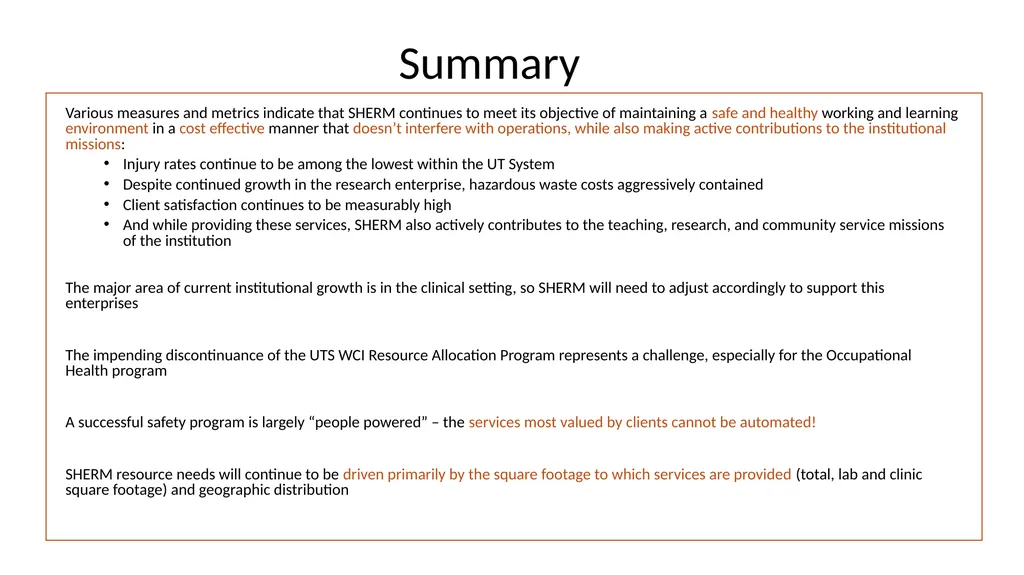
Summary Various measures and metrics indicate that SHERM continues to meet its objective of maintaining a safe and healthy working and learning environment in a cost effective manner that doesn’t interfere with operations, while also making active contributions to the institutional missions:
Injury rates continue to be among the lowest within the UT System
Despite continued growth in the research enterprise, hazardous waste costs aggressively contained
Client satisfaction continues to be measurably high
And while providing these services, SHERM also actively contributes to the teaching, research, and community service missions of the institution
The major area of current institutional growth is in the clinical setting, so SHERM will need to adjust accordingly to support this enterprises
The impending discontinuance of the UTS WCI Resource Allocation Program represents a challenge, especially for the Occupational Health program
A successful safety program is largely “people powered” – the services most valued by clients cannot be automated!
SHERM resource needs will continue to be driven primarily by the square footage to which services are provided (total, lab and clinic square footage) and geographic distribution<br>
Injury rates continue to be among the lowest within the UT System
Despite continued growth in the research enterprise, hazardous waste costs aggressively contained
Client satisfaction continues to be measurably high
And while providing these services, SHERM also actively contributes to the teaching, research, and community service missions of the institution
The major area of current institutional growth is in the clinical setting, so SHERM will need to adjust accordingly to support this enterprises
The impending discontinuance of the UTS WCI Resource Allocation Program represents a challenge, especially for the Occupational Health program
A successful safety program is largely “people powered” – the services most valued by clients cannot be automated!
SHERM resource needs will continue to be driven primarily by the square footage to which services are provided (total, lab and clinic square footage) and geographic distribution<br>