Gabbions Harshit Gabions - Introduction The word is derived from Latin word gabbione meaning big cage and from Italian gabbia The early gabion-type structures were seen 7,000 years ago to protect the banks of Nile River. In the medieval
"Gabbions Harshit Gabions - Introduction The word" is the property of its rightful owner. Permission is granted to
download and print the materials on this website for personal, non-commercial use only, and to display it
on your personal computer provided you do not modify the materials and that you retain all copyright
notices contained in the materials. By downloading content from our website, you accept the terms of this
agreement.
Presentation Transcript
01
Gabbions Harshit<br>
02
Gabions - Introduction The word is derived from Latin word gabbione meaning "big cage" and from Italian gabbia
The early gabion-type structures were seen 7,000 years ago to protect the banks of Nile River.
In the medieval era, gabions were employed as military fortifications. Later they were used for structural purposes in architecture.
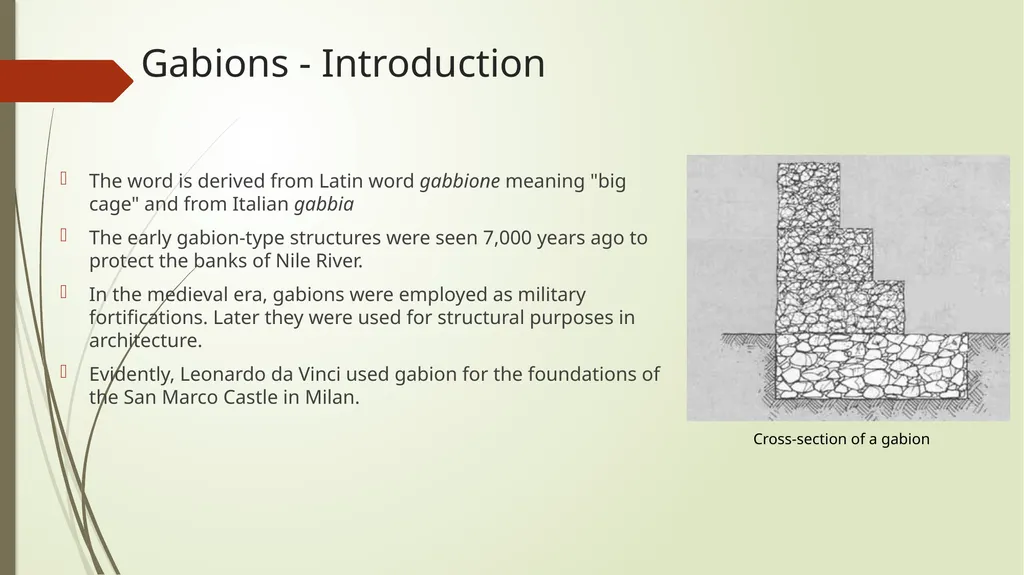
Evidently, Leonardo da Vinci used gabion for the foundations of the San Marco Castle in Milan. Cross-section of a gabion<br>
03
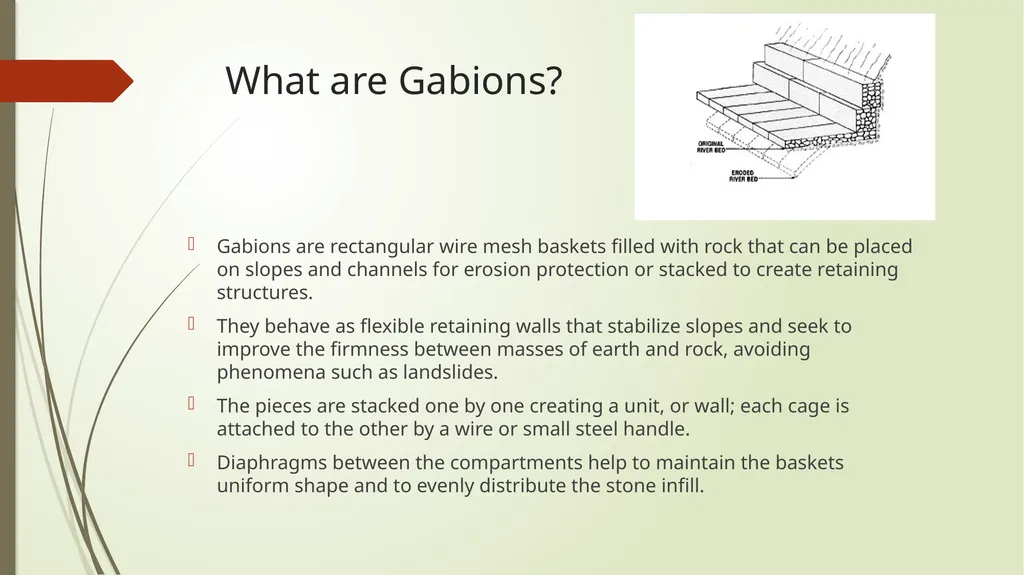
What are Gabions? Gabions are rectangular wire mesh baskets filled with rock that can be placed on slopes and channels for erosion protection or stacked to create retaining structures.
They behave as flexible retaining walls that stabilize slopes and seek to improve the firmness between masses of earth and rock, avoiding phenomena such as landslides.
The pieces are stacked one by one creating a unit, or wall; each cage is attached to the other by a wire or small steel handle.
Diaphragms between the compartments help to maintain the baskets uniform shape and to evenly distribute the stone infill.<br>
04
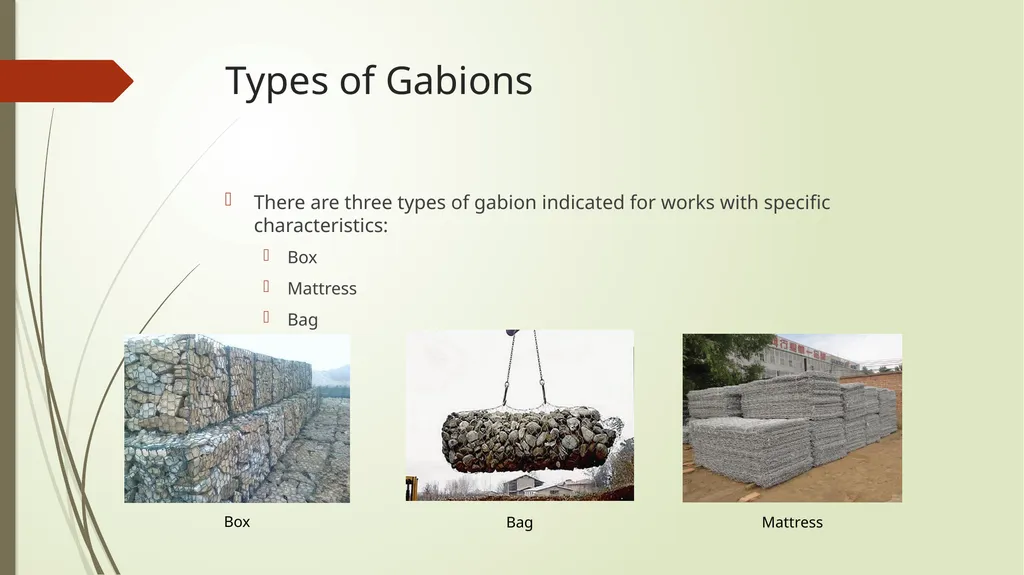
Types of Gabions There are three types of gabion indicated for works with specific characteristics:
Box
Mattress
Bag Mattress Bag Box<br>
05
Applications Flow Diversion and prevention of bank erosion
Bridge Abutments and Wing Walls
Drop Structures and Weirs
Channel Linings and Retaining Walls
Used as temporary flood walls.
To dissipate energy in the channels
As a noise barrier.
Improving Aesthetics<br>
06
Advantages of Gabions Gabions remain flexible and are well suited to projects over unstable foundations.
Gabions work well in unimproved channels because they provide surface roughness more in harmony with natural channels.
Gabion has a very high resistance to atmospheric corrosion because of the well bonded zinc coating on the wire and their ability to support vegetation growth.
They possess tremendous strength
Require little maintenance.
Gabions are permeable, limiting the need for costly drainage provisions and promote growth of vegetation.
Can be installed in dry or wet conditions.<br>
07
Disadvantages and Limitations If the gabions fail, they need high cost demanding repackaging of constituent material
Regular inspections are required for the integrity
Requires heavy machinery for erection and setup
Heavy vegetation growth provides habitat for reptiles which could be dangerous
Cannot be easily shifted or relocated<br>
08
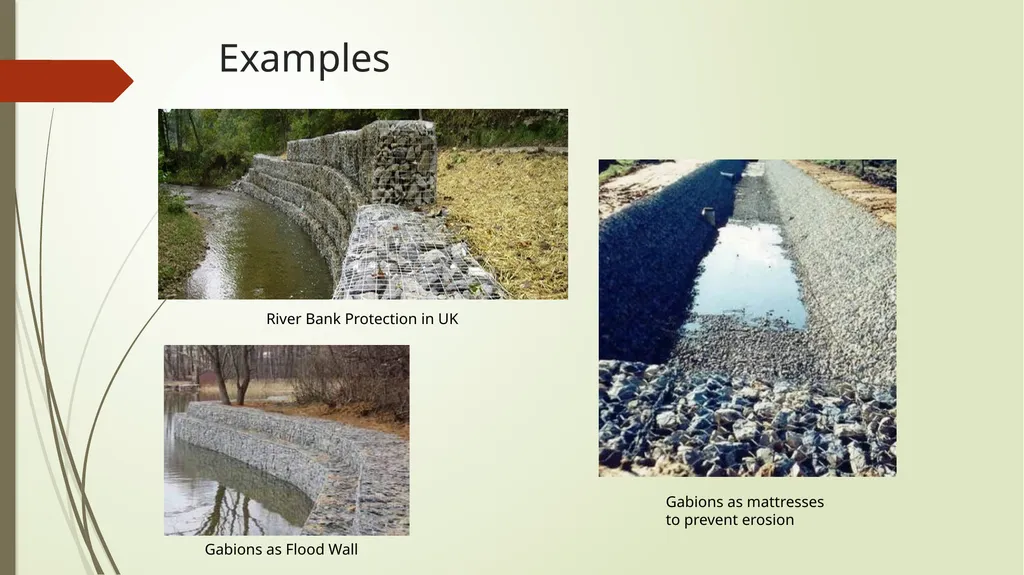
Examples River Bank Protection in UK Gabions as Flood Wall Gabions as mattresses to prevent erosion<br>
09
Reference Julien, Pierre Y. River mechanics. Cambridge University Press, 2018.
“Gabion and Mattresses - Geo-Synthetics, LLC.” Geo, www.geo-synthetics.com/construction-products/erosion-control/gabion-and-mattresses/.
“What Is Gabion? Its Types, Applications, and Advantages.” The Constructor, 10 Sept. 2018, theconstructor.org/geotechnical/gabion-types-uses/24459/.<br>