
Gaia impact on asteroidal occultations © Dave


Description: Gaia impact on asteroidal occultations Dave Herald Murrumbateman Mar 2016 126 25 July 2016 Current situation A number to remember. For Main Belt asteroids, 1mas equates to about 2km on the Earth Typical uncertainty in star position 50mas
Related Topics
Download Presentation
"Gaia impact on asteroidal occultations © Dave" is the property of its rightful owner. Permission is granted to download and print the materials on this website for personal, non-commercial use only, and to display it on your personal computer provided you do not modify the materials and that you retain all copyright notices contained in the materials. By downloading content from our website, you accept the terms of this agreement.
Presentation Transcript
slide1. Gaia
impact on asteroidal occultations © Dave Herald
Murrumbateman
Mar 2016 1/26 25 July 2016<br>
slide2. Current situation A number to remember. For Main Belt asteroids, 1mas equates to about 2km on the Earth
Typical uncertainty in star position 50mas
Typical uncertainty in asteroid position 150mas
For any one event, there is little basis to attribute the path shift between the star or the asteroid. That is, with the current accuracy of star catalogues and asteroid ephemerides, we cannot improve predictions based on recent observations 2 25 July 2016<br>
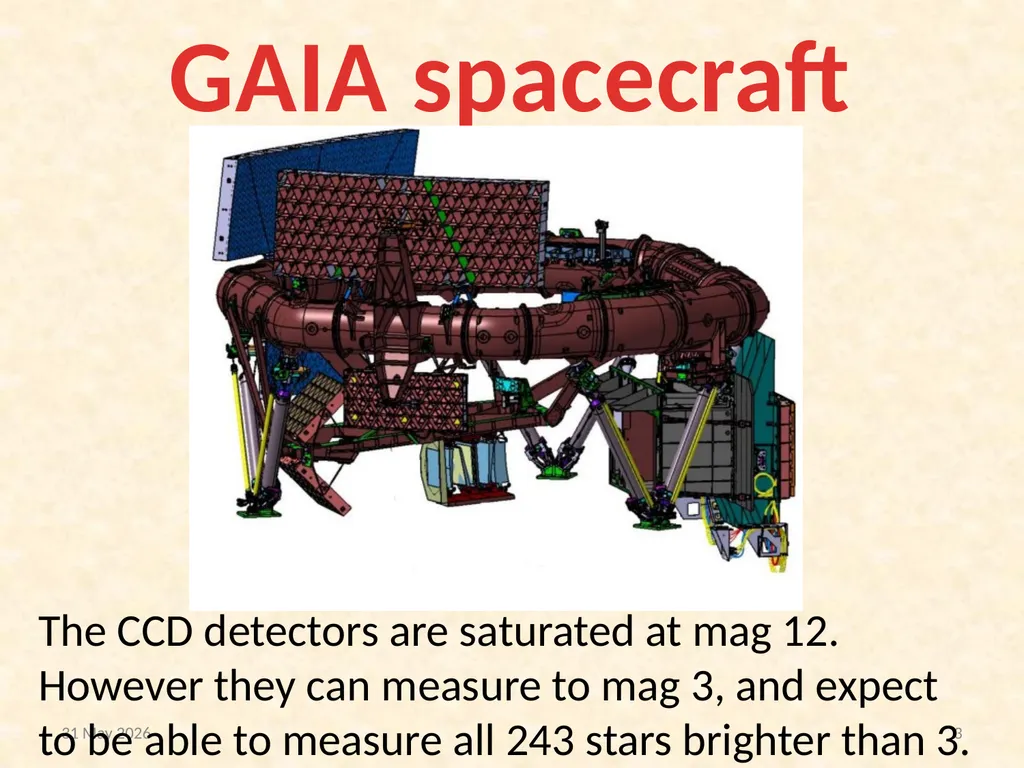
slide3. GAIA spacecraft The CCD detectors are saturated at mag 12. However they can measure to mag 3, and expect to be able to measure all 243 stars brighter than 3. 3 25 July 2016<br>
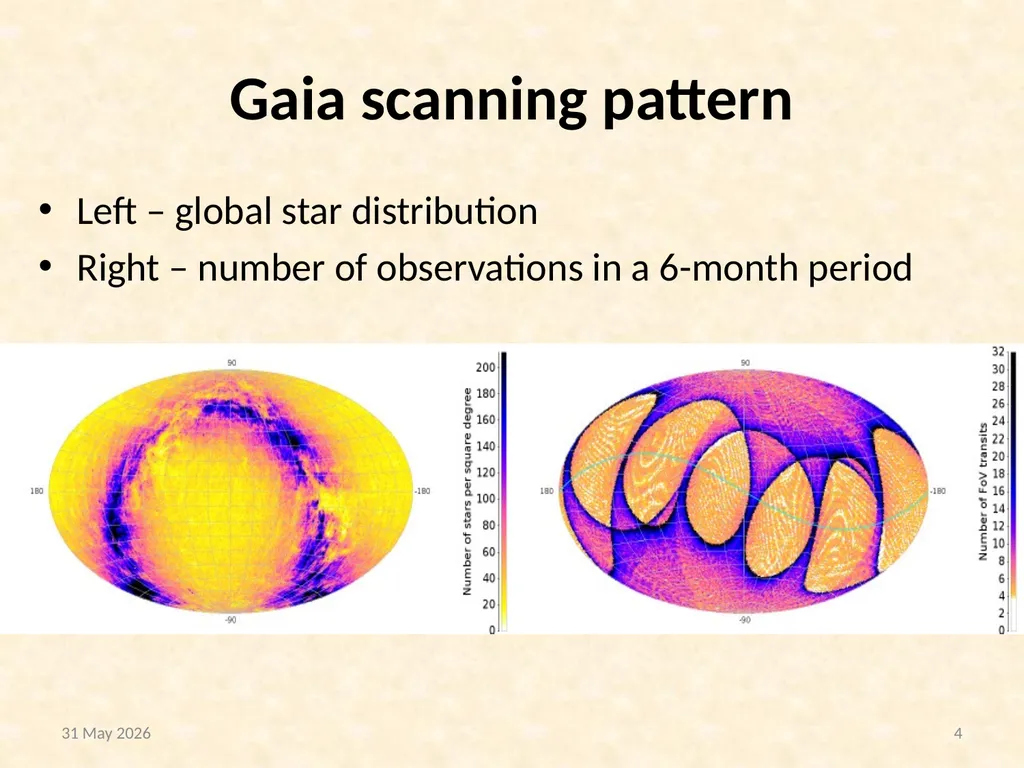
slide4. Gaia scanning pattern Left – global star distribution
Right – number of observations in a 6-month period 4 25 July 2016<br>
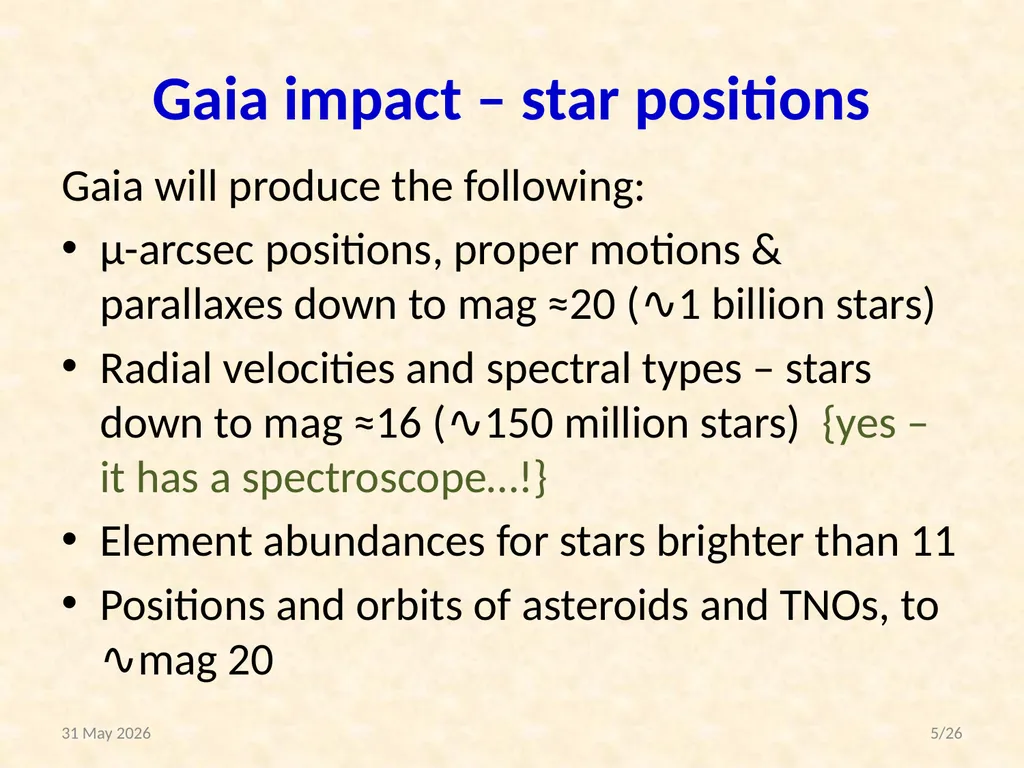
slide5. Gaia impact – star positions Gaia will produce the following:
μ-arcsec positions, proper motions & parallaxes down to mag ≈20 (∿1 billion stars)
Radial velocities and spectral types – stars down to mag ≈16 (∿150 million stars) {yes – it has a spectroscope…!}
Element abundances for stars brighter than 11
Positions and orbits of asteroids and TNOs, to ∿mag 20 5/26 25 July 2016<br>
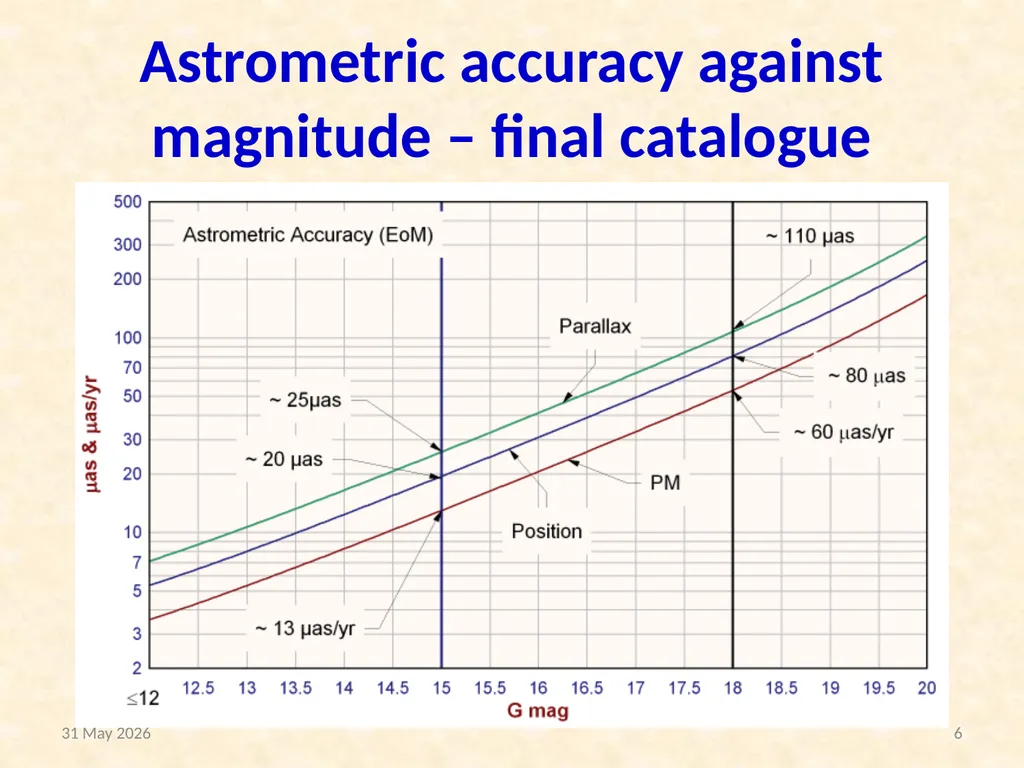
slide6. Astrometric accuracy against magnitude – final catalogue 6 25 July 2016<br>
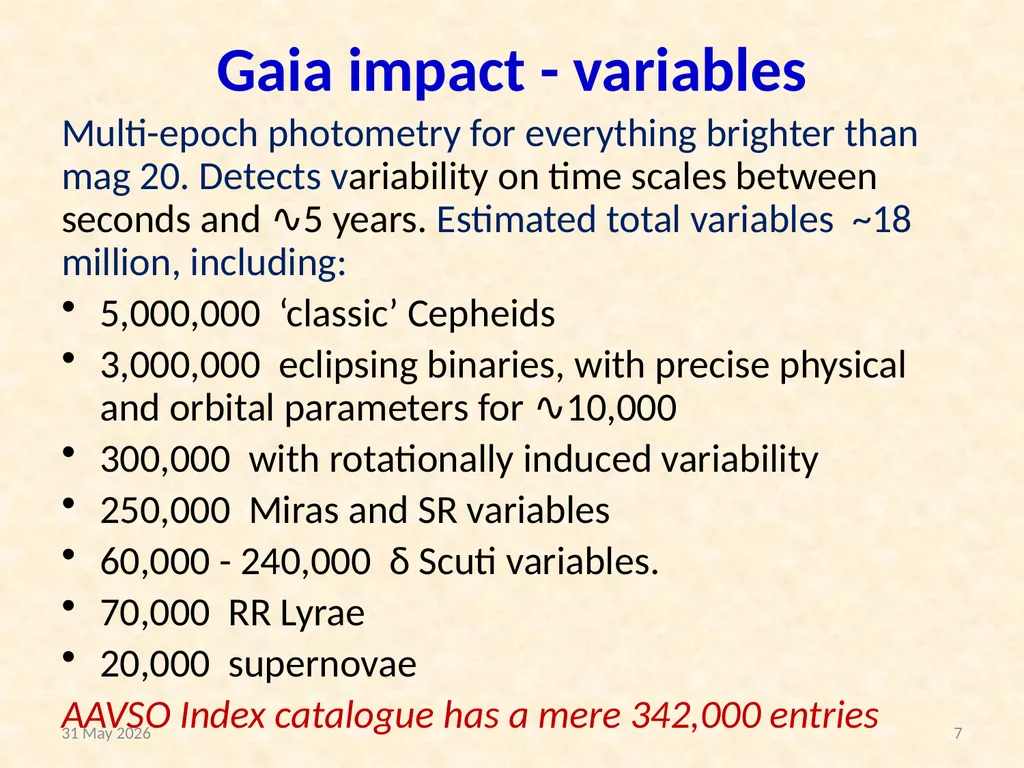
slide7. Gaia impact - variables Multi-epoch photometry for everything brighter than mag 20. Detects variability on time scales between seconds and ∿5 years. Estimated total variables ~18 million, including:
5,000,000 ‘classic’ Cepheids
3,000,000 eclipsing binaries, with precise physical and orbital parameters for ∿10,000
300,000 with rotationally induced variability
250,000 Miras and SR variables
60,000 - 240,000 δ Scuti variables.
70,000 RR Lyrae
20,000 supernovae
AAVSO Index catalogue has a mere 342,000 entries 7 25 July 2016<br>
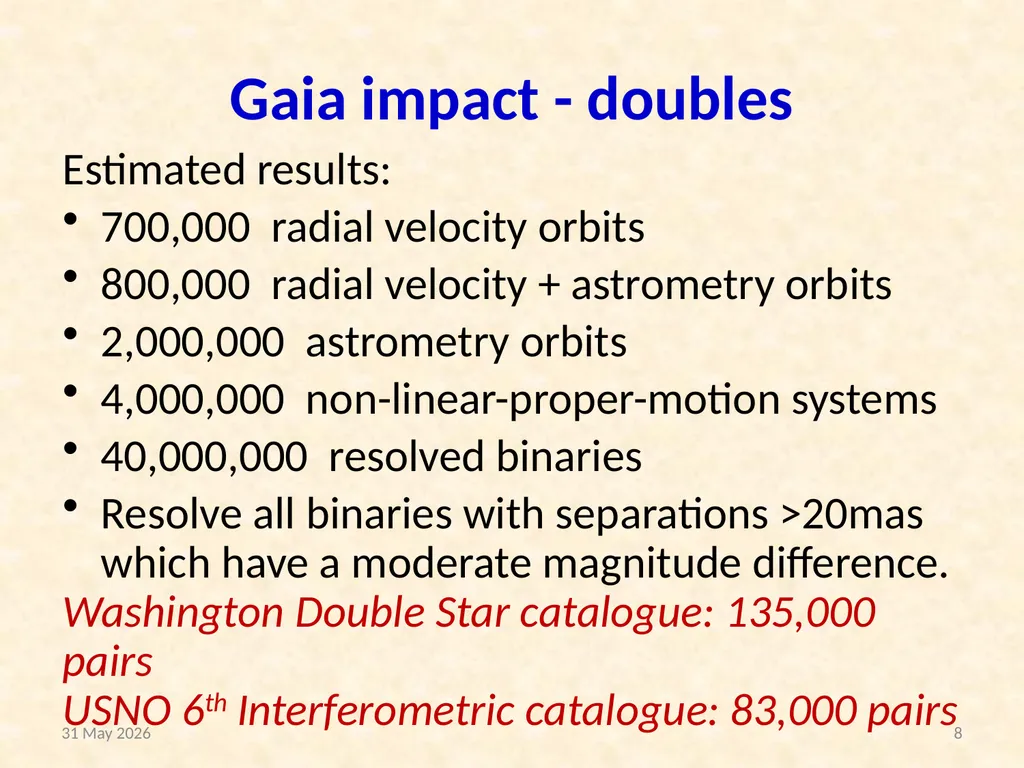
slide8. Gaia impact - doubles Estimated results:
700,000 radial velocity orbits
800,000 radial velocity + astrometry orbits
2,000,000 astrometry orbits
4,000,000 non-linear-proper-motion systems
40,000,000 resolved binaries
Resolve all binaries with separations >20mas which have a moderate magnitude difference.
Washington Double Star catalogue: 135,000 pairs
USNO 6th Interferometric catalogue: 83,000 pairs 8 25 July 2016<br>
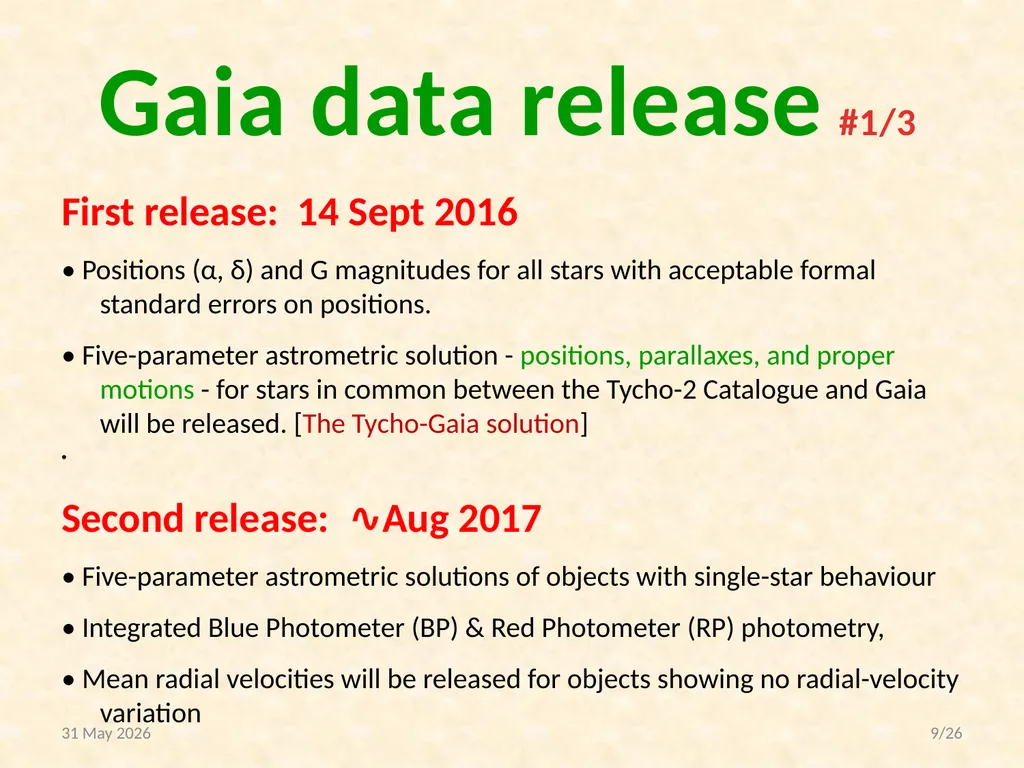
slide9. Gaia data release #1/3 First release: 14 Sept 2016
• Positions (α, δ) and G magnitudes for all stars with acceptable formal standard errors on positions.
• Five-parameter astrometric solution - positions, parallaxes, and proper motions - for stars in common between the Tycho-2 Catalogue and Gaia will be released. [The Tycho-Gaia solution]
Second release: ∿Aug 2017
• Five-parameter astrometric solutions of objects with single-star behaviour
• Integrated Blue Photometer (BP) & Red Photometer (RP) photometry,
• Mean radial velocities will be released for objects showing no radial-velocity variation 9/26 25 July 2016<br>
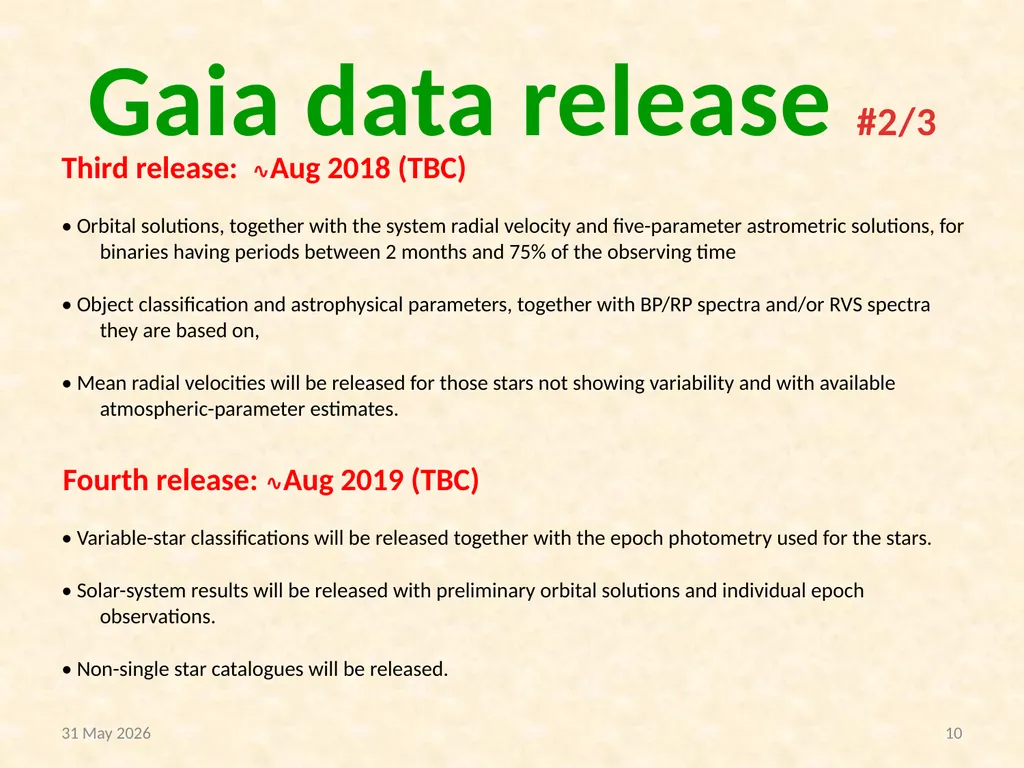
slide10. Gaia data release #2/3 Third release: ∿Aug 2018 (TBC)
• Orbital solutions, together with the system radial velocity and five-parameter astrometric solutions, for binaries having periods between 2 months and 75% of the observing time
• Object classification and astrophysical parameters, together with BP/RP spectra and/or RVS spectra they are based on,
• Mean radial velocities will be released for those stars not showing variability and with available atmospheric-parameter estimates.
Fourth release: ∿Aug 2019 (TBC)
• Variable-star classifications will be released together with the epoch photometry used for the stars.
• Solar-system results will be released with preliminary orbital solutions and individual epoch observations.
• Non-single star catalogues will be released. 10 25 July 2016<br>
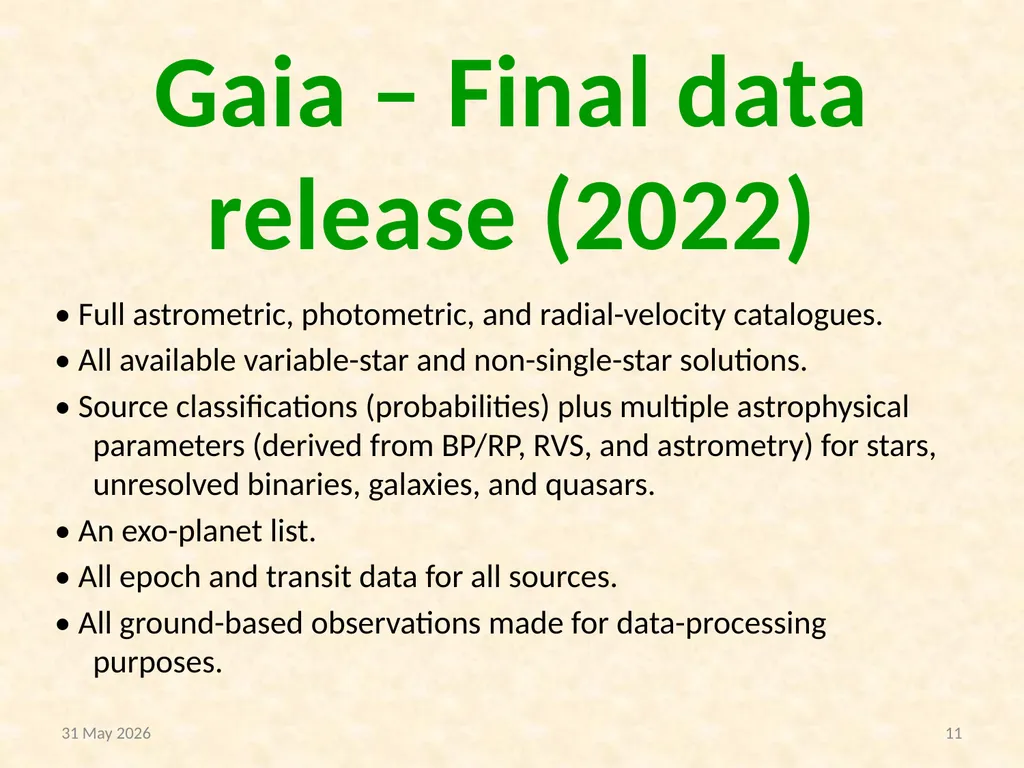
slide11. Gaia – Final data release (2022) • Full astrometric, photometric, and radial-velocity catalogues.
• All available variable-star and non-single-star solutions.
• Source classifications (probabilities) plus multiple astrophysical parameters (derived from BP/RP, RVS, and astrometry) for stars, unresolved binaries, galaxies, and quasars.
• An exo-planet list.
• All epoch and transit data for all sources.
• All ground-based observations made for data-processing purposes. 11 25 July 2016<br>
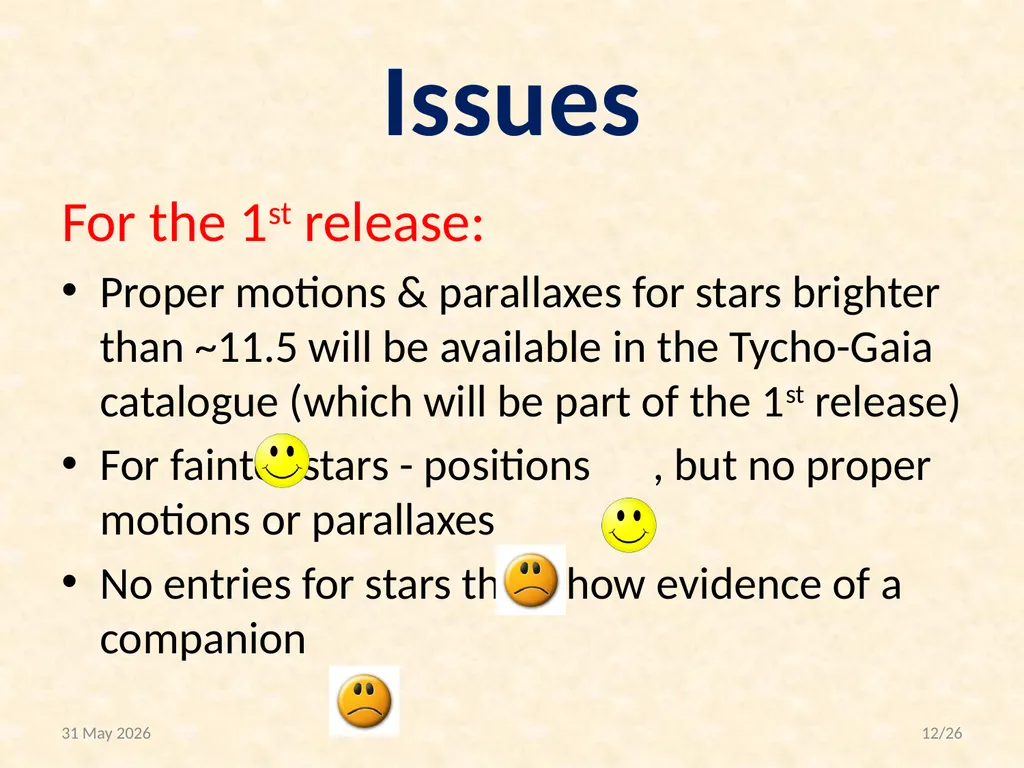
slide12. Issues For the 1st release:
Proper motions & parallaxes for stars brighter than ~11.5 will be available in the Tycho-Gaia catalogue (which will be part of the 1st release)
For fainter stars - positions , but no proper motions or parallaxes
No entries for stars that show evidence of a companion 12/26 25 July 2016<br>
slide13. For stars in Tycho-Gaia solution Astrometric standard errors
for events within 2 years of Gaia epoch
positional uncertainty at mag 6 ∿0.5mas;
at mag 9 ∿1.1mas; at mag 12 ∿3.5mas Remember: for a main belt asteroid, 1mas ≈ 2km 13 25 July 2016<br>
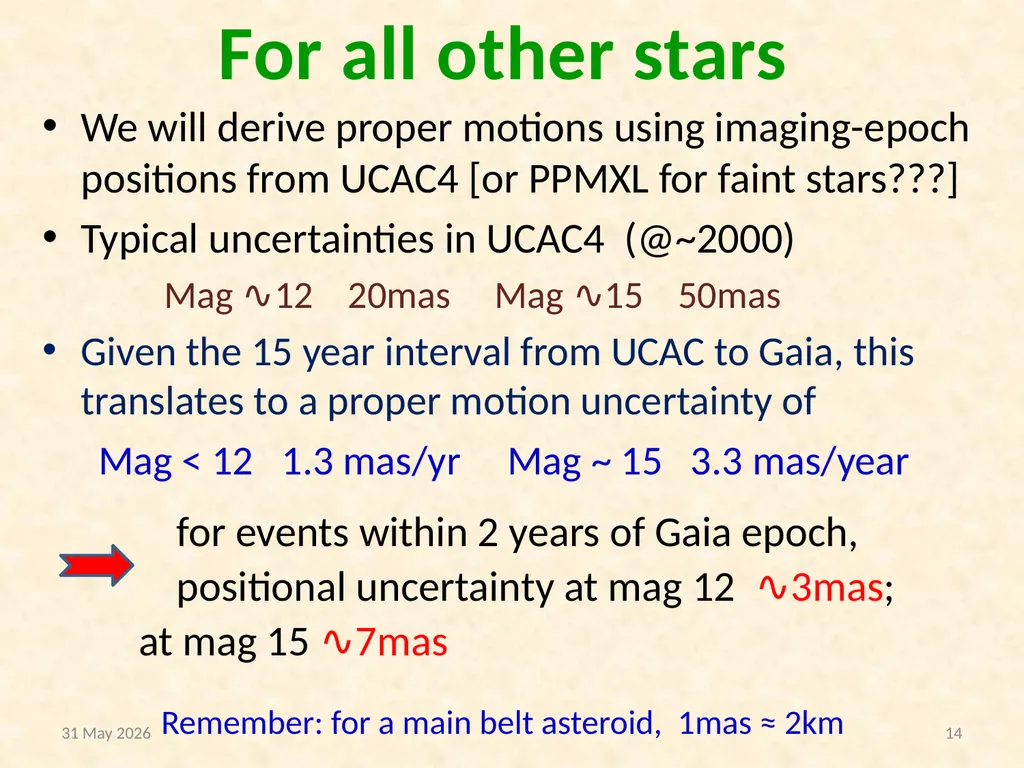
slide14. For all other stars We will derive proper motions using imaging-epoch positions from UCAC4 [or PPMXL for faint stars???]
Typical uncertainties in UCAC4 (@~2000)
Mag ∿12 20mas Mag ∿15 50mas
Given the 15 year interval from UCAC to Gaia, this translates to a proper motion uncertainty of
Mag < 12 1.3 mas/yr Mag ~ 15 3.3 mas/year
for events within 2 years of Gaia epoch,
positional uncertainty at mag 12 ∿3mas;
at mag 15 ∿7mas Remember: for a main belt asteroid, 1mas ≈ 2km 14 25 July 2016<br>
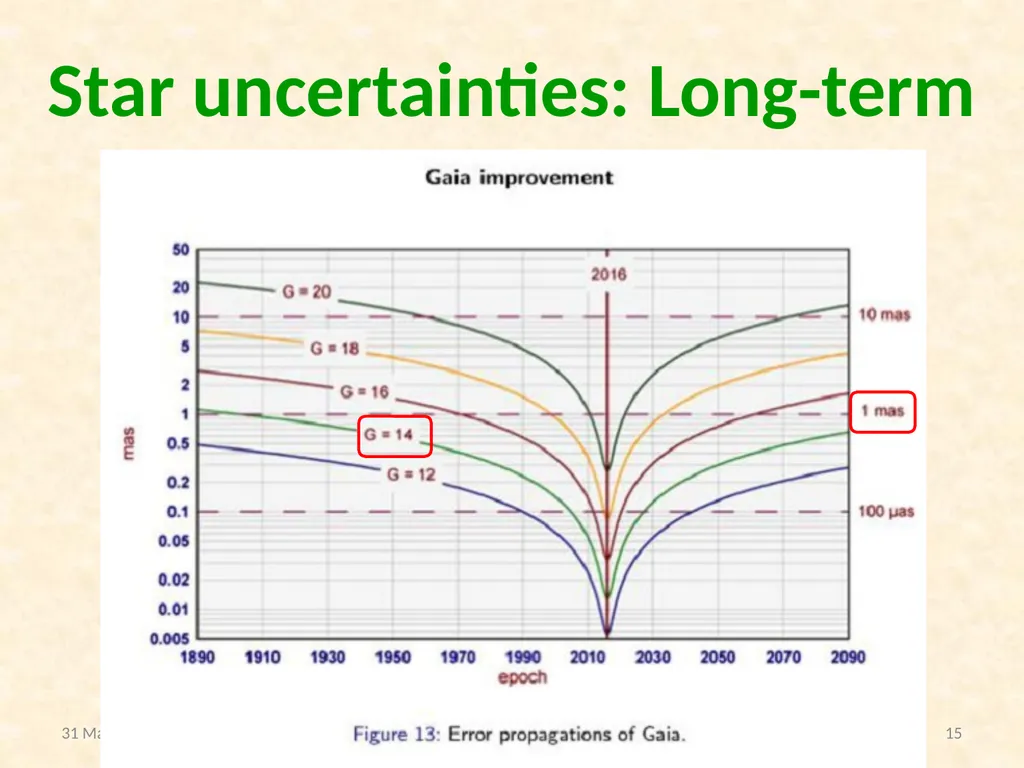
slide15. Star uncertainties: Long-term 25 July 2016 15<br>
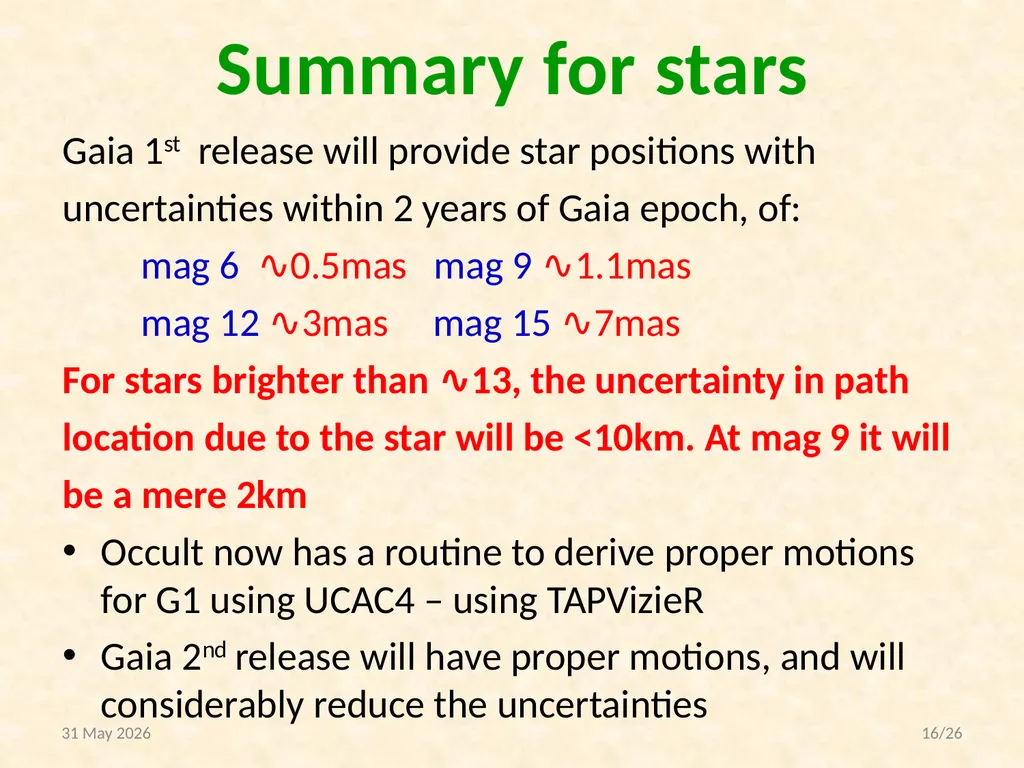
slide16. Summary for stars Gaia 1st release will provide star positions with uncertainties within 2 years of Gaia epoch, of:
mag 6 ∿0.5mas mag 9 ∿1.1mas
mag 12 ∿3mas mag 15 ∿7mas
For stars brighter than ∿13, the uncertainty in path location due to the star will be <10km. At mag 9 it will be a mere 2km
Occult now has a routine to derive proper motions for G1 using UCAC4 – using TAPVizieR
Gaia 2nd release will have proper motions, and will considerably reduce the uncertainties 16/26 25 July 2016<br>
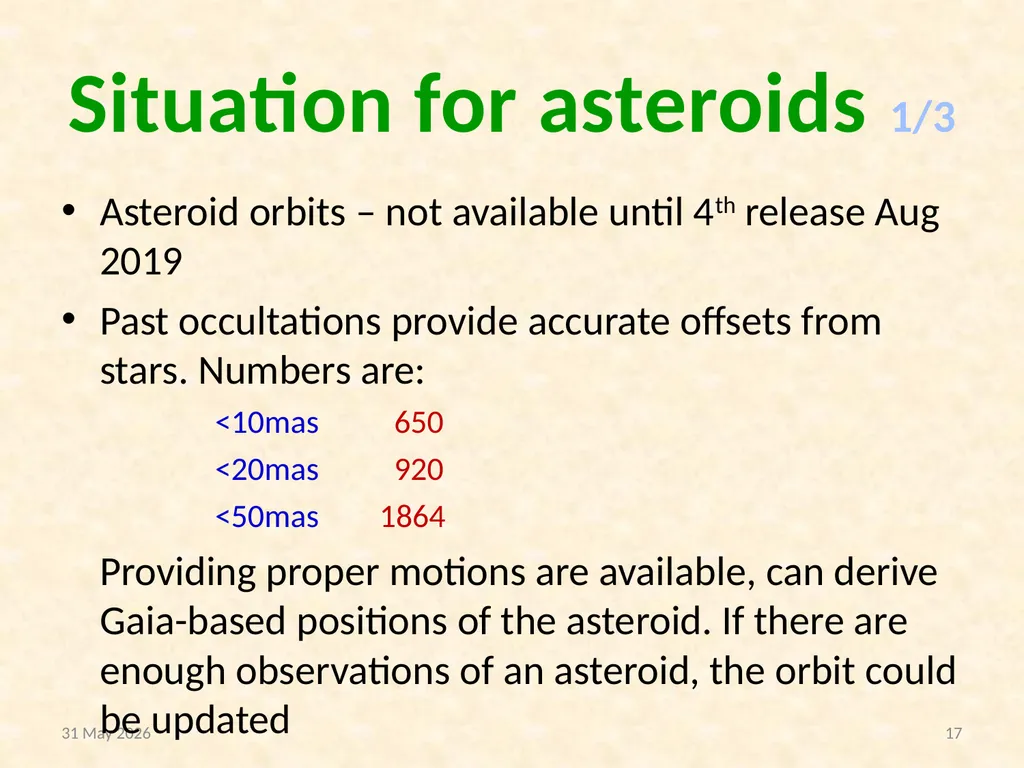
slide17. Situation for asteroids 1/3 Asteroid orbits – not available until 4th release Aug 2019
Past occultations provide accurate offsets from stars. Numbers are:
<10mas 650
<20mas 920
<50mas 1864
Providing proper motions are available, can derive Gaia-based positions of the asteroid. If there are enough observations of an asteroid, the orbit could be updated 17 25 July 2016<br>
slide18. The remainder of this discussion excludes TNO asteroids
Data release #1 – no GAIA proper motions
∴ ‘old’ positions remain limited by the accuracy of the old catalogue
However observations made within last few years will be less affected by proper motion issues
∴ opportunity to improve current predictions by using astrometry from asteroidals made in last 1 to 3 years... Situation for asteroids 2/3 18 25 July 2016<br>
slide19. Data release #2 – has GAIA proper motions
∴ ‘old’ positions limited only by the accuracy of the relative astrometry derived from an occultation. Can use our backfile of astrometry from occultations to improve the orbits
Full improvement for asteroids will not come until data release #4 (2019) Situation for asteroids 3/3 19 25 July 2016<br>
slide20. For main-belt asteroids: positional O-C’s likely to change slowly over a period of months
→an observed offset from a recent occultation will provide a reliable indicator of the offset for the next event
→observations from several previous events will provide a trend that can be extrapolated Immediate situation for asteroids 1/2 20/26 25 July 2016<br>
slide21. Need to encourage observations of as many events as possible – even if probability of an occultation is small – to establish the recent offsets of asteroid ephemerides
For stars brighter than mag 12, should be able to have combined uncertainty of star and asteroid <10mas
that is, a path uncertainty <20km Immediate situation for asteroids 2/2 21 25 July 2016<br>
slide22. Asteroids – USNO FASTT USNO FASTT telescope may be able to provide astrometry of selected asteroids using the Gaia reference frame
This might provide the most reliable source of asteroid positions before the release of the Gaia asteroid orbits
Will need to establish arrangements to obtain astrometry of ‘desired’ asteroids The US Naval Observatory Flagstaff Astrometric Scanning Transit Telescope (FASTT) is a completely automated 20-cm transit telescope utilizing scan-mode CCD cameras 22 25 July 2016<br>
slide23. Path predictions will be accurate to about 1km
Will be able to plan an event with certainty (apart from the weather)
Focus will move from observing anything that happens nearby, to efforts to study particular asteroids
Will need to develop capability to incorporate shape model predictions to predict path edge locations Long-term situation for asteroids 23/26 25 July 2016<br>
slide24. Other issues for asteroids (1) Will need to identify asteroids that we should focus our attention. Issues such as:
Binary asteroids
Asteroids with shape models
Asteroids having some other characteristic of importance. (Eg a member of certain classes of asteroids – whether that be based on composition, orbit type, or some other consideration) 24 25 July 2016<br>
slide25. Other issues for asteroids (2) Also need to think about the frequency of events involving a selected asteroid.
For example, do we focus on asteroids when they move through star-rich regions of the sky – such that we get numerous events over a few months at different rotational orientations, which we can then match to shape models. 25 25 July 2016<br>
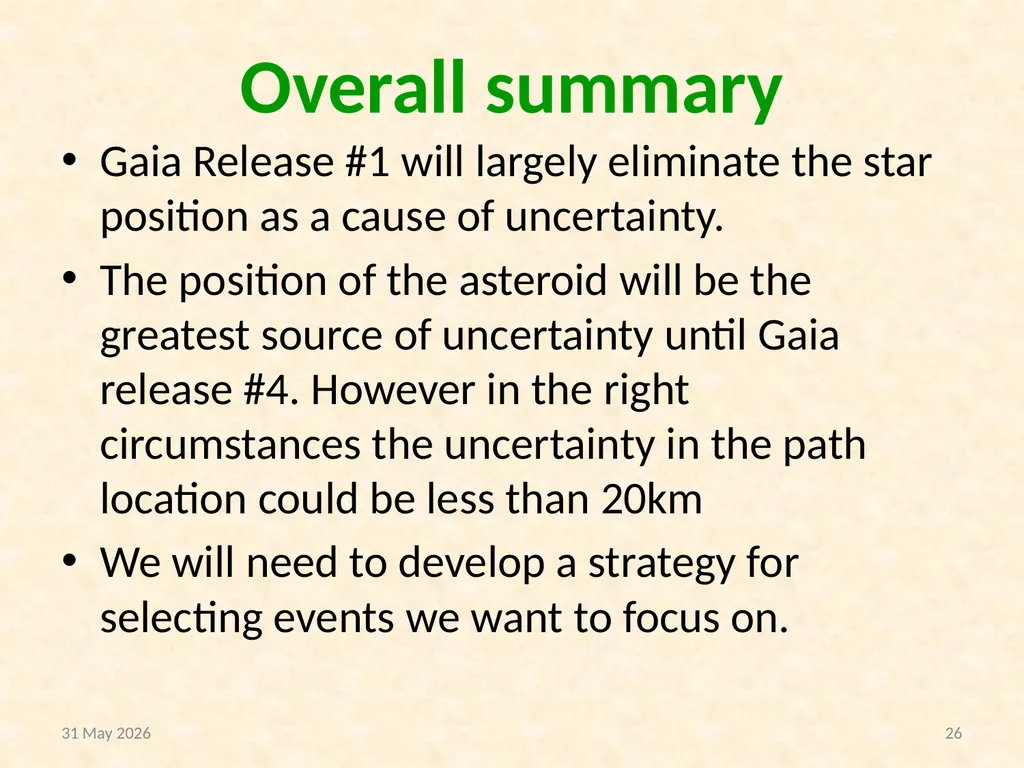
slide26. Overall summary Gaia Release #1 will largely eliminate the star position as a cause of uncertainty.
The position of the asteroid will be the greatest source of uncertainty until Gaia release #4. However in the right circumstances the uncertainty in the path location could be less than 20km
We will need to develop a strategy for selecting events we want to focus on. 26 25 July 2016<br>
slide27. The future for asteroidal occultations is exciting….
Any questions?! 27 25 July 2016<br>
Murrumbateman
Mar 2016 1/26 25 July 2016<br>
slide2. Current situation A number to remember. For Main Belt asteroids, 1mas equates to about 2km on the Earth
Typical uncertainty in star position 50mas
Typical uncertainty in asteroid position 150mas
For any one event, there is little basis to attribute the path shift between the star or the asteroid. That is, with the current accuracy of star catalogues and asteroid ephemerides, we cannot improve predictions based on recent observations 2 25 July 2016<br>
slide3. GAIA spacecraft The CCD detectors are saturated at mag 12. However they can measure to mag 3, and expect to be able to measure all 243 stars brighter than 3. 3 25 July 2016<br>
slide4. Gaia scanning pattern Left – global star distribution
Right – number of observations in a 6-month period 4 25 July 2016<br>
slide5. Gaia impact – star positions Gaia will produce the following:
μ-arcsec positions, proper motions & parallaxes down to mag ≈20 (∿1 billion stars)
Radial velocities and spectral types – stars down to mag ≈16 (∿150 million stars) {yes – it has a spectroscope…!}
Element abundances for stars brighter than 11
Positions and orbits of asteroids and TNOs, to ∿mag 20 5/26 25 July 2016<br>
slide6. Astrometric accuracy against magnitude – final catalogue 6 25 July 2016<br>
slide7. Gaia impact - variables Multi-epoch photometry for everything brighter than mag 20. Detects variability on time scales between seconds and ∿5 years. Estimated total variables ~18 million, including:
5,000,000 ‘classic’ Cepheids
3,000,000 eclipsing binaries, with precise physical and orbital parameters for ∿10,000
300,000 with rotationally induced variability
250,000 Miras and SR variables
60,000 - 240,000 δ Scuti variables.
70,000 RR Lyrae
20,000 supernovae
AAVSO Index catalogue has a mere 342,000 entries 7 25 July 2016<br>
slide8. Gaia impact - doubles Estimated results:
700,000 radial velocity orbits
800,000 radial velocity + astrometry orbits
2,000,000 astrometry orbits
4,000,000 non-linear-proper-motion systems
40,000,000 resolved binaries
Resolve all binaries with separations >20mas which have a moderate magnitude difference.
Washington Double Star catalogue: 135,000 pairs
USNO 6th Interferometric catalogue: 83,000 pairs 8 25 July 2016<br>
slide9. Gaia data release #1/3 First release: 14 Sept 2016
• Positions (α, δ) and G magnitudes for all stars with acceptable formal standard errors on positions.
• Five-parameter astrometric solution - positions, parallaxes, and proper motions - for stars in common between the Tycho-2 Catalogue and Gaia will be released. [The Tycho-Gaia solution]
Second release: ∿Aug 2017
• Five-parameter astrometric solutions of objects with single-star behaviour
• Integrated Blue Photometer (BP) & Red Photometer (RP) photometry,
• Mean radial velocities will be released for objects showing no radial-velocity variation 9/26 25 July 2016<br>
slide10. Gaia data release #2/3 Third release: ∿Aug 2018 (TBC)
• Orbital solutions, together with the system radial velocity and five-parameter astrometric solutions, for binaries having periods between 2 months and 75% of the observing time
• Object classification and astrophysical parameters, together with BP/RP spectra and/or RVS spectra they are based on,
• Mean radial velocities will be released for those stars not showing variability and with available atmospheric-parameter estimates.
Fourth release: ∿Aug 2019 (TBC)
• Variable-star classifications will be released together with the epoch photometry used for the stars.
• Solar-system results will be released with preliminary orbital solutions and individual epoch observations.
• Non-single star catalogues will be released. 10 25 July 2016<br>
slide11. Gaia – Final data release (2022) • Full astrometric, photometric, and radial-velocity catalogues.
• All available variable-star and non-single-star solutions.
• Source classifications (probabilities) plus multiple astrophysical parameters (derived from BP/RP, RVS, and astrometry) for stars, unresolved binaries, galaxies, and quasars.
• An exo-planet list.
• All epoch and transit data for all sources.
• All ground-based observations made for data-processing purposes. 11 25 July 2016<br>
slide12. Issues For the 1st release:
Proper motions & parallaxes for stars brighter than ~11.5 will be available in the Tycho-Gaia catalogue (which will be part of the 1st release)
For fainter stars - positions , but no proper motions or parallaxes
No entries for stars that show evidence of a companion 12/26 25 July 2016<br>
slide13. For stars in Tycho-Gaia solution Astrometric standard errors
for events within 2 years of Gaia epoch
positional uncertainty at mag 6 ∿0.5mas;
at mag 9 ∿1.1mas; at mag 12 ∿3.5mas Remember: for a main belt asteroid, 1mas ≈ 2km 13 25 July 2016<br>
slide14. For all other stars We will derive proper motions using imaging-epoch positions from UCAC4 [or PPMXL for faint stars???]
Typical uncertainties in UCAC4 (@~2000)
Mag ∿12 20mas Mag ∿15 50mas
Given the 15 year interval from UCAC to Gaia, this translates to a proper motion uncertainty of
Mag < 12 1.3 mas/yr Mag ~ 15 3.3 mas/year
for events within 2 years of Gaia epoch,
positional uncertainty at mag 12 ∿3mas;
at mag 15 ∿7mas Remember: for a main belt asteroid, 1mas ≈ 2km 14 25 July 2016<br>
slide15. Star uncertainties: Long-term 25 July 2016 15<br>
slide16. Summary for stars Gaia 1st release will provide star positions with uncertainties within 2 years of Gaia epoch, of:
mag 6 ∿0.5mas mag 9 ∿1.1mas
mag 12 ∿3mas mag 15 ∿7mas
For stars brighter than ∿13, the uncertainty in path location due to the star will be <10km. At mag 9 it will be a mere 2km
Occult now has a routine to derive proper motions for G1 using UCAC4 – using TAPVizieR
Gaia 2nd release will have proper motions, and will considerably reduce the uncertainties 16/26 25 July 2016<br>
slide17. Situation for asteroids 1/3 Asteroid orbits – not available until 4th release Aug 2019
Past occultations provide accurate offsets from stars. Numbers are:
<10mas 650
<20mas 920
<50mas 1864
Providing proper motions are available, can derive Gaia-based positions of the asteroid. If there are enough observations of an asteroid, the orbit could be updated 17 25 July 2016<br>
slide18. The remainder of this discussion excludes TNO asteroids
Data release #1 – no GAIA proper motions
∴ ‘old’ positions remain limited by the accuracy of the old catalogue
However observations made within last few years will be less affected by proper motion issues
∴ opportunity to improve current predictions by using astrometry from asteroidals made in last 1 to 3 years... Situation for asteroids 2/3 18 25 July 2016<br>
slide19. Data release #2 – has GAIA proper motions
∴ ‘old’ positions limited only by the accuracy of the relative astrometry derived from an occultation. Can use our backfile of astrometry from occultations to improve the orbits
Full improvement for asteroids will not come until data release #4 (2019) Situation for asteroids 3/3 19 25 July 2016<br>
slide20. For main-belt asteroids: positional O-C’s likely to change slowly over a period of months
→an observed offset from a recent occultation will provide a reliable indicator of the offset for the next event
→observations from several previous events will provide a trend that can be extrapolated Immediate situation for asteroids 1/2 20/26 25 July 2016<br>
slide21. Need to encourage observations of as many events as possible – even if probability of an occultation is small – to establish the recent offsets of asteroid ephemerides
For stars brighter than mag 12, should be able to have combined uncertainty of star and asteroid <10mas
that is, a path uncertainty <20km Immediate situation for asteroids 2/2 21 25 July 2016<br>
slide22. Asteroids – USNO FASTT USNO FASTT telescope may be able to provide astrometry of selected asteroids using the Gaia reference frame
This might provide the most reliable source of asteroid positions before the release of the Gaia asteroid orbits
Will need to establish arrangements to obtain astrometry of ‘desired’ asteroids The US Naval Observatory Flagstaff Astrometric Scanning Transit Telescope (FASTT) is a completely automated 20-cm transit telescope utilizing scan-mode CCD cameras 22 25 July 2016<br>
slide23. Path predictions will be accurate to about 1km
Will be able to plan an event with certainty (apart from the weather)
Focus will move from observing anything that happens nearby, to efforts to study particular asteroids
Will need to develop capability to incorporate shape model predictions to predict path edge locations Long-term situation for asteroids 23/26 25 July 2016<br>
slide24. Other issues for asteroids (1) Will need to identify asteroids that we should focus our attention. Issues such as:
Binary asteroids
Asteroids with shape models
Asteroids having some other characteristic of importance. (Eg a member of certain classes of asteroids – whether that be based on composition, orbit type, or some other consideration) 24 25 July 2016<br>
slide25. Other issues for asteroids (2) Also need to think about the frequency of events involving a selected asteroid.
For example, do we focus on asteroids when they move through star-rich regions of the sky – such that we get numerous events over a few months at different rotational orientations, which we can then match to shape models. 25 25 July 2016<br>
slide26. Overall summary Gaia Release #1 will largely eliminate the star position as a cause of uncertainty.
The position of the asteroid will be the greatest source of uncertainty until Gaia release #4. However in the right circumstances the uncertainty in the path location could be less than 20km
We will need to develop a strategy for selecting events we want to focus on. 26 25 July 2016<br>
slide27. The future for asteroidal occultations is exciting….
Any questions?! 27 25 July 2016<br>