
Galileo’s New World Post-visit In-depth materials

Description: Galileos New World Post-visit In-depth materials (Primary and middle schools, age 9-13) Measuring Time by Night: Astrolabes and Nocturnals Highly versatile instruments, astrolabes could also be used to tell the time by day or by night,
Related Topics
Download Presentation
"Galileo’s New World Post-visit In-depth materials" is the property of its rightful owner. Permission is granted to download and print the materials on this website for personal, non-commercial use only, and to display it on your personal computer provided you do not modify the materials and that you retain all copyright notices contained in the materials. By downloading content from our website, you accept the terms of this agreement.
Presentation Transcript
slide1. Galileo’s New World Post-visit
In-depth materials
(Primary and middle schools, age 9-13)<br>
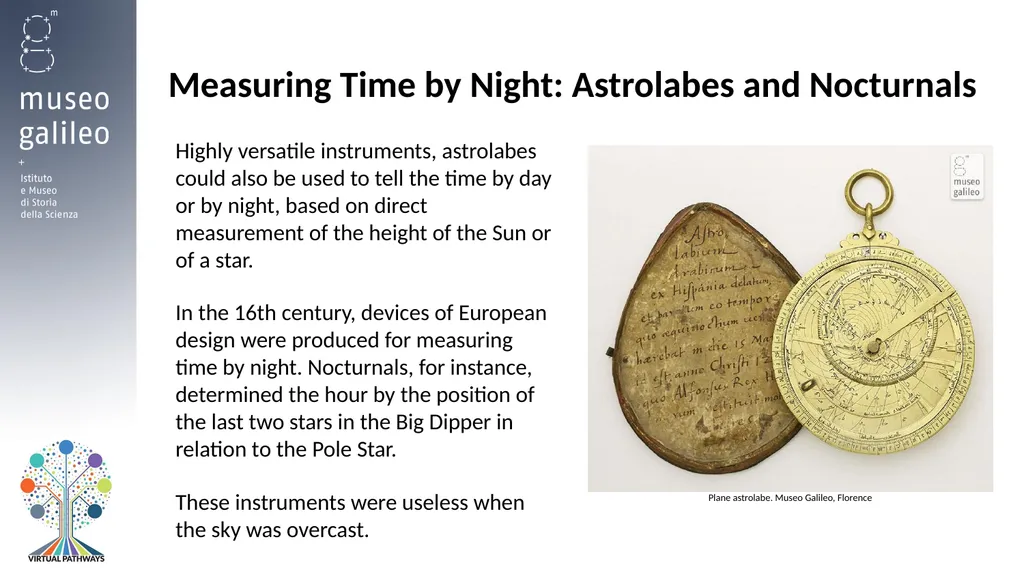
slide2. Measuring Time by Night: Astrolabes and Nocturnals Highly versatile instruments, astrolabes could also be used to tell the time by day or by night, based on direct measurement of the height of the Sun or of a star.
In the 16th century, devices of European design were produced for measuring time by night. Nocturnals, for instance, determined the hour by the position of the last two stars in the Big Dipper in relation to the Pole Star.
These instruments were useless when the sky was overcast. Plane astrolabe. Museo Galileo, Florence<br>
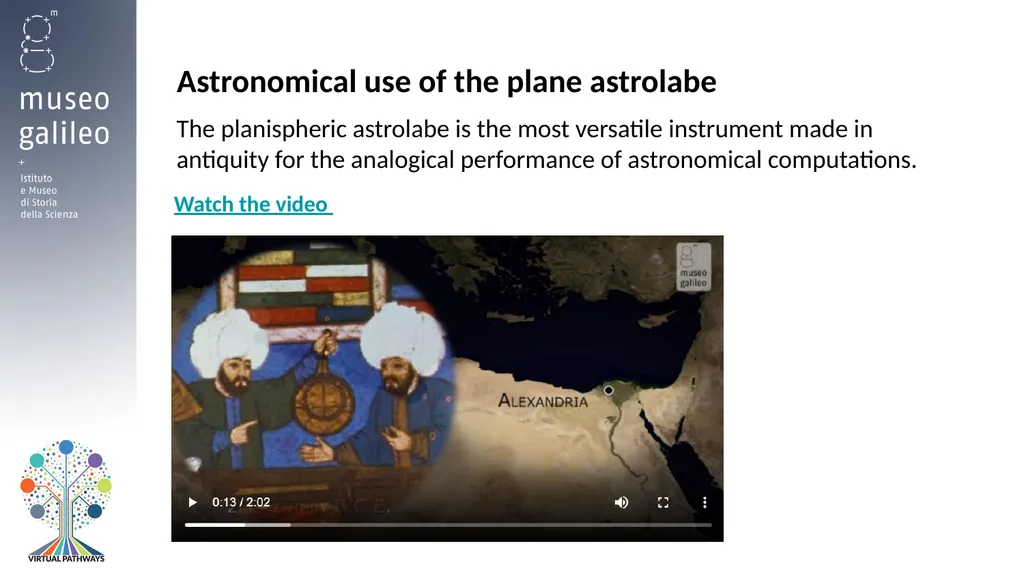
slide3. Astronomical use of the plane astrolabe Watch the video The planispheric astrolabe is the most versatile instrument made in antiquity for the analogical performance of astronomical computations.<br>
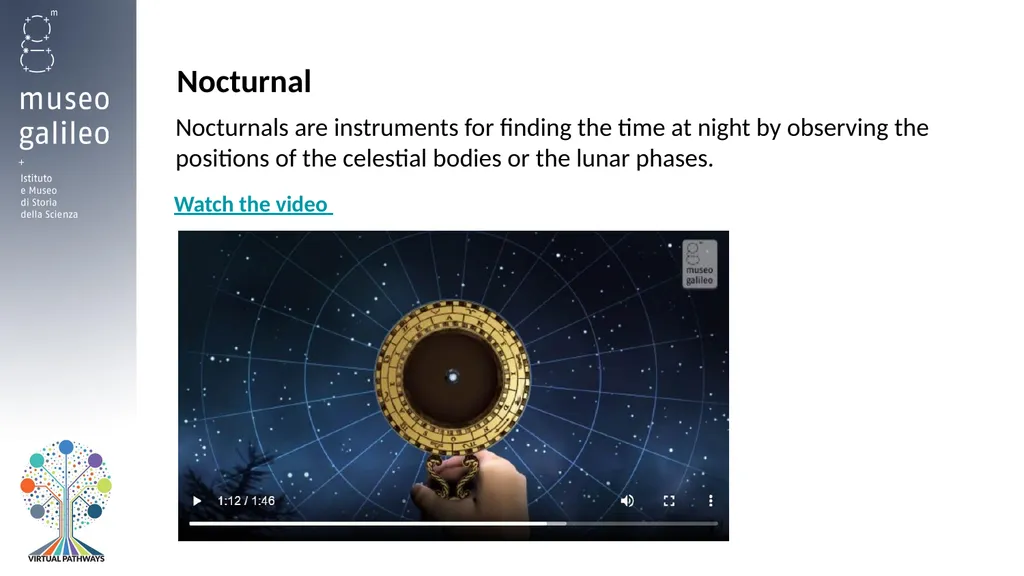
slide4. Nocturnal Watch the video Nocturnals are instruments for finding the time at night by observing the positions of the celestial bodies or the lunar phases.<br>
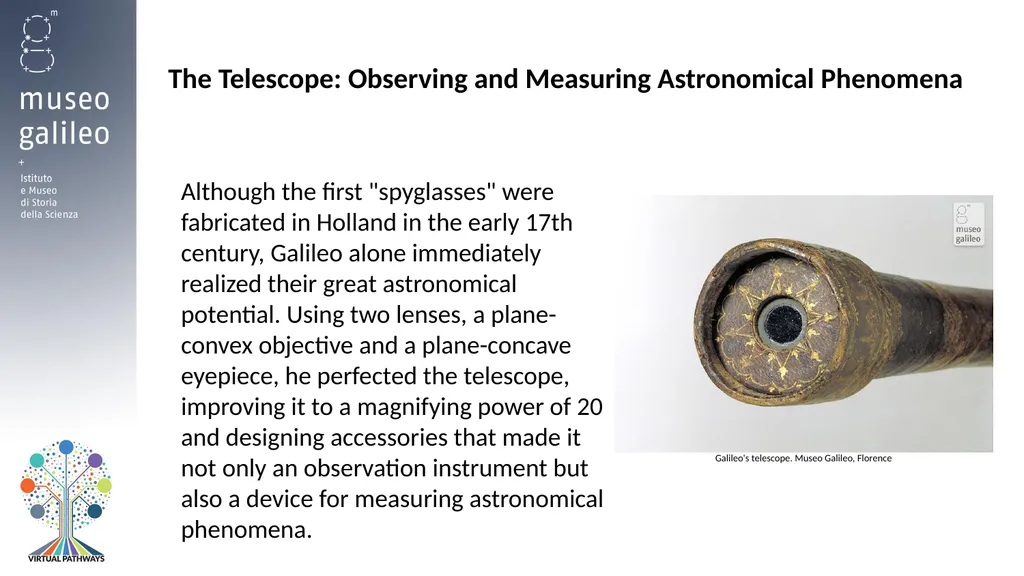
slide5. The Telescope: Observing and Measuring Astronomical Phenomena Although the first "spyglasses" were fabricated in Holland in the early 17th century, Galileo alone immediately realized their great astronomical potential. Using two lenses, a plane-convex objective and a plane-concave eyepiece, he perfected the telescope, improving it to a magnifying power of 20 and designing accessories that made it not only an observation instrument but also a device for measuring astronomical phenomena. Galileo's telescope. Museo Galileo, Florence<br>
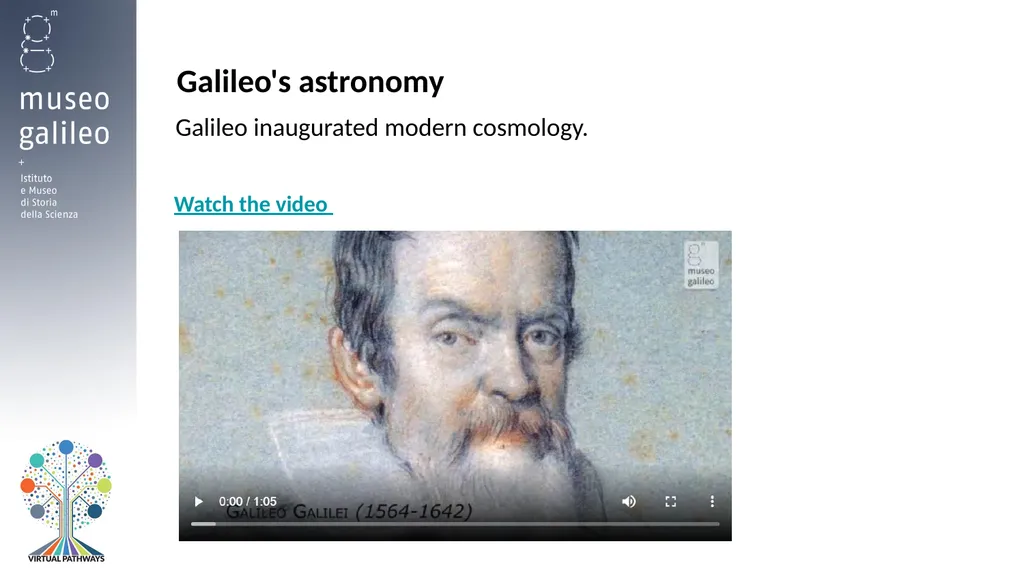
slide6. Galileo's astronomy Watch the video Galileo inaugurated modern cosmology.<br>
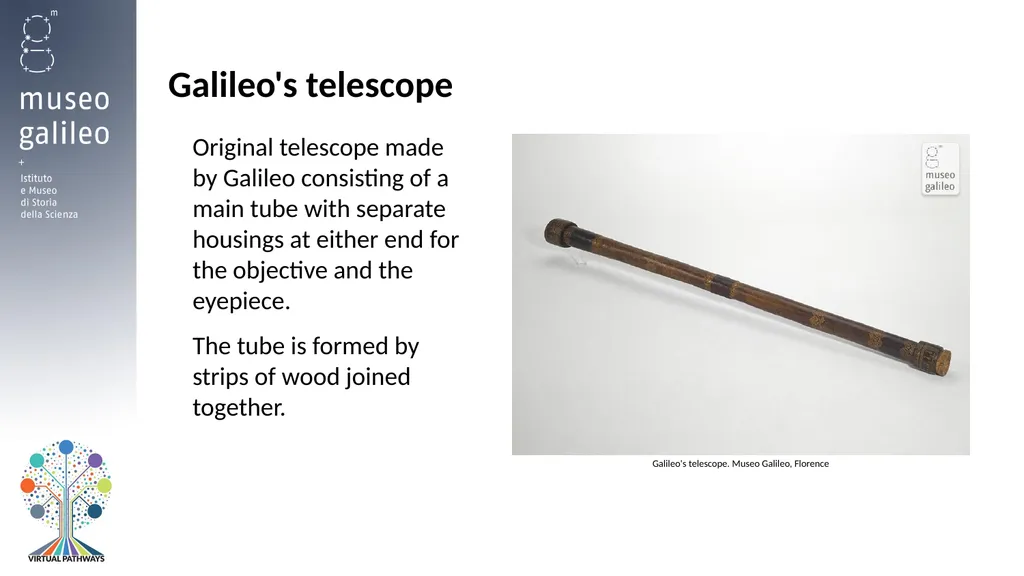
slide7. Galileo's telescope Original telescope made by Galileo consisting of a main tube with separate housings at either end for the objective and the eyepiece.
The tube is formed by strips of wood joined together. Galileo's telescope. Museo Galileo, Florence<br>
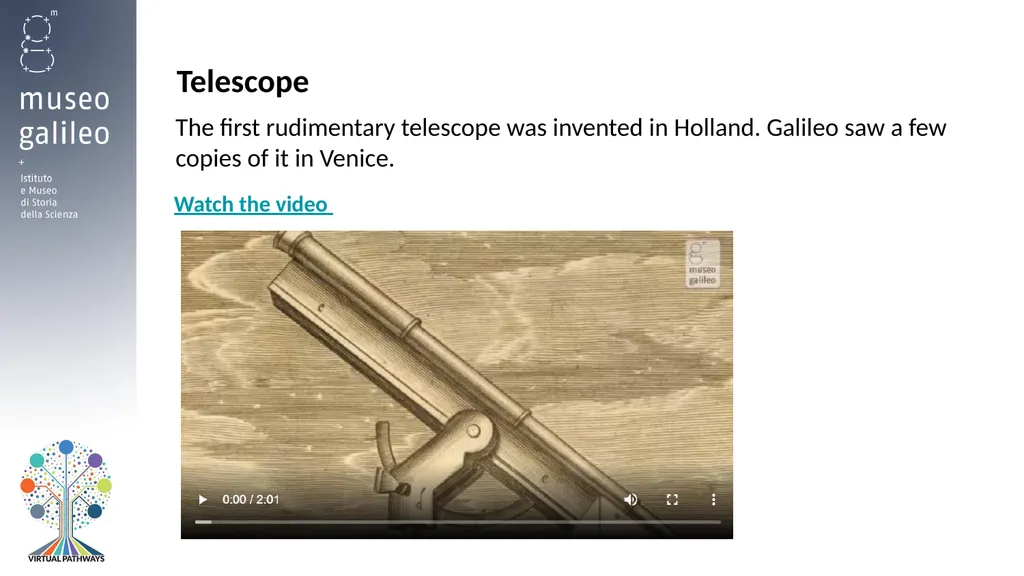
slide8. Telescope Watch the video The first rudimentary telescope was invented in Holland. Galileo saw a few copies of it in Venice.<br>
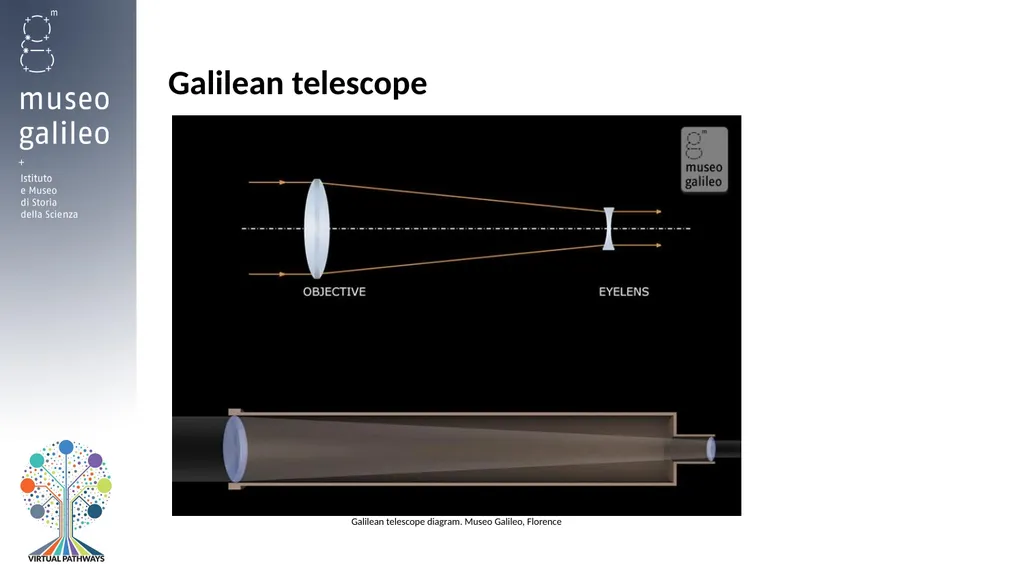
slide9. Galilean telescope Galilean telescope diagram. Museo Galileo, Florence<br>
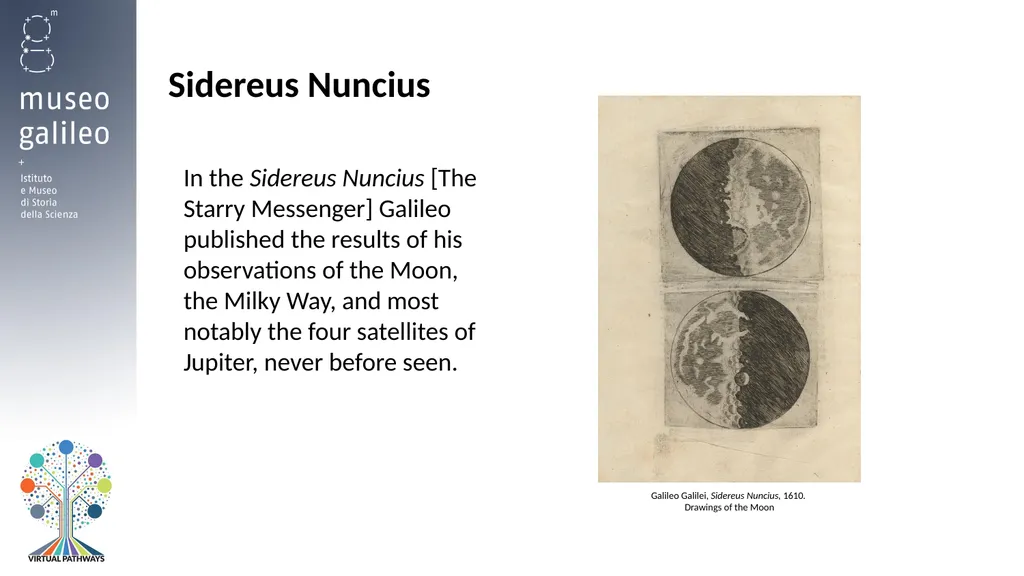
slide10. Sidereus Nuncius In the Sidereus Nuncius [The Starry Messenger] Galileo published the results of his observations of the Moon, the Milky Way, and most notably the four satellites of Jupiter, never before seen. Galileo Galilei, Sidereus Nuncius, 1610.
Drawings of the Moon<br>
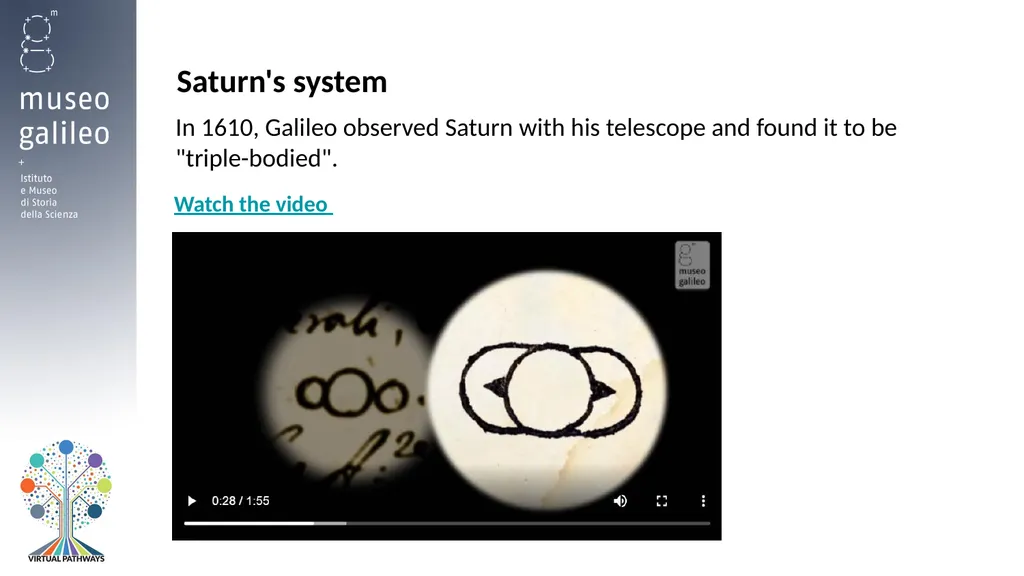
slide11. Saturn's system Watch the video In 1610, Galileo observed Saturn with his telescope and found it to be "triple-bodied".<br>
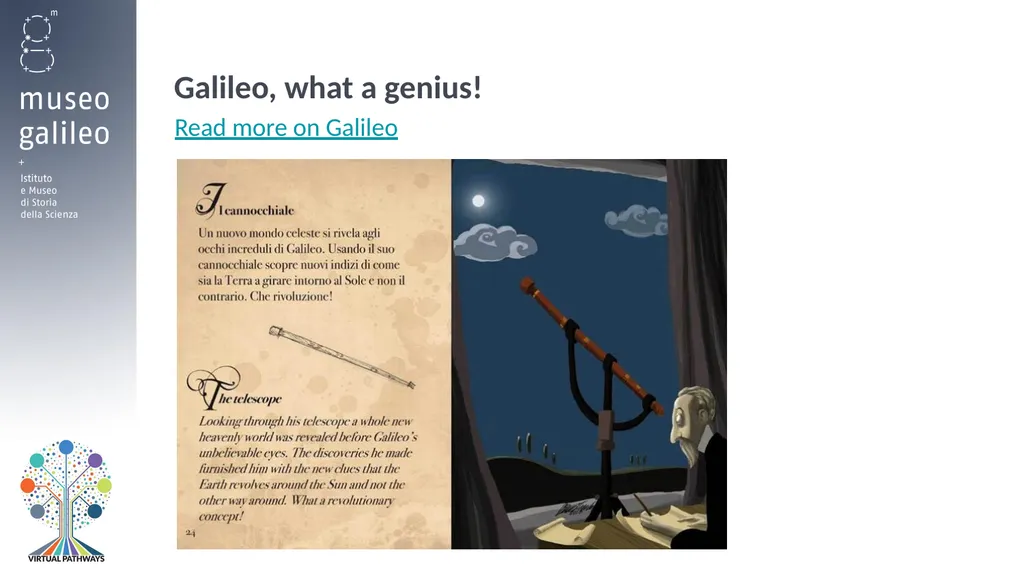
slide12. Galileo, what a genius! Read more on Galileo<br>
In-depth materials
(Primary and middle schools, age 9-13)<br>
slide2. Measuring Time by Night: Astrolabes and Nocturnals Highly versatile instruments, astrolabes could also be used to tell the time by day or by night, based on direct measurement of the height of the Sun or of a star.
In the 16th century, devices of European design were produced for measuring time by night. Nocturnals, for instance, determined the hour by the position of the last two stars in the Big Dipper in relation to the Pole Star.
These instruments were useless when the sky was overcast. Plane astrolabe. Museo Galileo, Florence<br>
slide3. Astronomical use of the plane astrolabe Watch the video The planispheric astrolabe is the most versatile instrument made in antiquity for the analogical performance of astronomical computations.<br>
slide4. Nocturnal Watch the video Nocturnals are instruments for finding the time at night by observing the positions of the celestial bodies or the lunar phases.<br>
slide5. The Telescope: Observing and Measuring Astronomical Phenomena Although the first "spyglasses" were fabricated in Holland in the early 17th century, Galileo alone immediately realized their great astronomical potential. Using two lenses, a plane-convex objective and a plane-concave eyepiece, he perfected the telescope, improving it to a magnifying power of 20 and designing accessories that made it not only an observation instrument but also a device for measuring astronomical phenomena. Galileo's telescope. Museo Galileo, Florence<br>
slide6. Galileo's astronomy Watch the video Galileo inaugurated modern cosmology.<br>
slide7. Galileo's telescope Original telescope made by Galileo consisting of a main tube with separate housings at either end for the objective and the eyepiece.
The tube is formed by strips of wood joined together. Galileo's telescope. Museo Galileo, Florence<br>
slide8. Telescope Watch the video The first rudimentary telescope was invented in Holland. Galileo saw a few copies of it in Venice.<br>
slide9. Galilean telescope Galilean telescope diagram. Museo Galileo, Florence<br>
slide10. Sidereus Nuncius In the Sidereus Nuncius [The Starry Messenger] Galileo published the results of his observations of the Moon, the Milky Way, and most notably the four satellites of Jupiter, never before seen. Galileo Galilei, Sidereus Nuncius, 1610.
Drawings of the Moon<br>
slide11. Saturn's system Watch the video In 1610, Galileo observed Saturn with his telescope and found it to be "triple-bodied".<br>
slide12. Galileo, what a genius! Read more on Galileo<br>