
Gambling Disorders Among Veterans Maureen Corbett,
GB
Published · 47 slides · 0 views

1 / 1

Description
Gambling Disorders Among Veterans Maureen Corbett, MS,CPGC Stratton VA Medical Center DSM-5 Moved from Impulse Control Disorder to Substance Related and Addictive Disorders. Changed from Pathological Gambling to Gambling Disorder.
Related Topics
Share
Embed code
Download this presentation From Below
"Gambling Disorders Among Veterans Maureen Corbett," is the property of its rightful owner. Permission is granted to download and print the materials on this website for personal, non-commercial use only, and to display it on your personal computer provided you do not modify the materials and that you retain all copyright notices contained in the materials. By downloading content from our website, you accept the terms of this agreement.
Presentation Transcript
01
Gambling Disorders Among Veterans Maureen Corbett, MS,CPGC
Stratton VA Medical Center<br>
Stratton VA Medical Center<br>
02
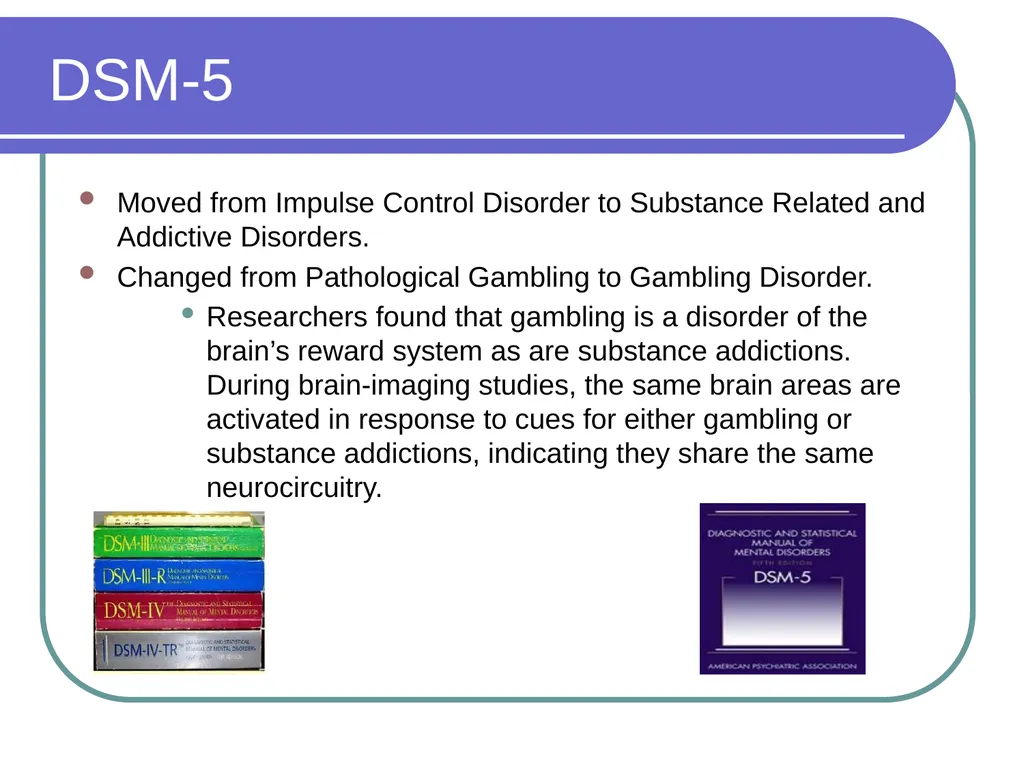
DSM-5 Moved from Impulse Control Disorder to Substance Related and Addictive Disorders.
Changed from Pathological Gambling to Gambling Disorder.
Researchers found that gambling is a disorder of the brain’s reward system as are substance addictions. During brain-imaging studies, the same brain areas are activated in response to cues for either gambling or substance addictions, indicating they share the same neurocircuitry.<br>
Changed from Pathological Gambling to Gambling Disorder.
Researchers found that gambling is a disorder of the brain’s reward system as are substance addictions. During brain-imaging studies, the same brain areas are activated in response to cues for either gambling or substance addictions, indicating they share the same neurocircuitry.<br>
03
Gambling Disorder Defined First recognized as diagnosable disorder in the DSM in 1980
Is progressive
Is characterized by psychologically uncontrollable urges
Can damage family, social and vocational interests<br>
Is progressive
Is characterized by psychologically uncontrollable urges
Can damage family, social and vocational interests<br>
04
Characteristics of a Gambling Disorder Preoccupied with gambling
Needing to gamble with increasing amounts of money to achieve the same excitement
Repeated unsuccessful efforts to control, cut back or stop gambling
Is restless or irritable when attempting to cut down or stop
Gambles as a way of escaping problems
After losing money gambling often returns another day to get even (chasing losses) (DSM-5, American Psychiatric Association)<br>
Needing to gamble with increasing amounts of money to achieve the same excitement
Repeated unsuccessful efforts to control, cut back or stop gambling
Is restless or irritable when attempting to cut down or stop
Gambles as a way of escaping problems
After losing money gambling often returns another day to get even (chasing losses) (DSM-5, American Psychiatric Association)<br>
05
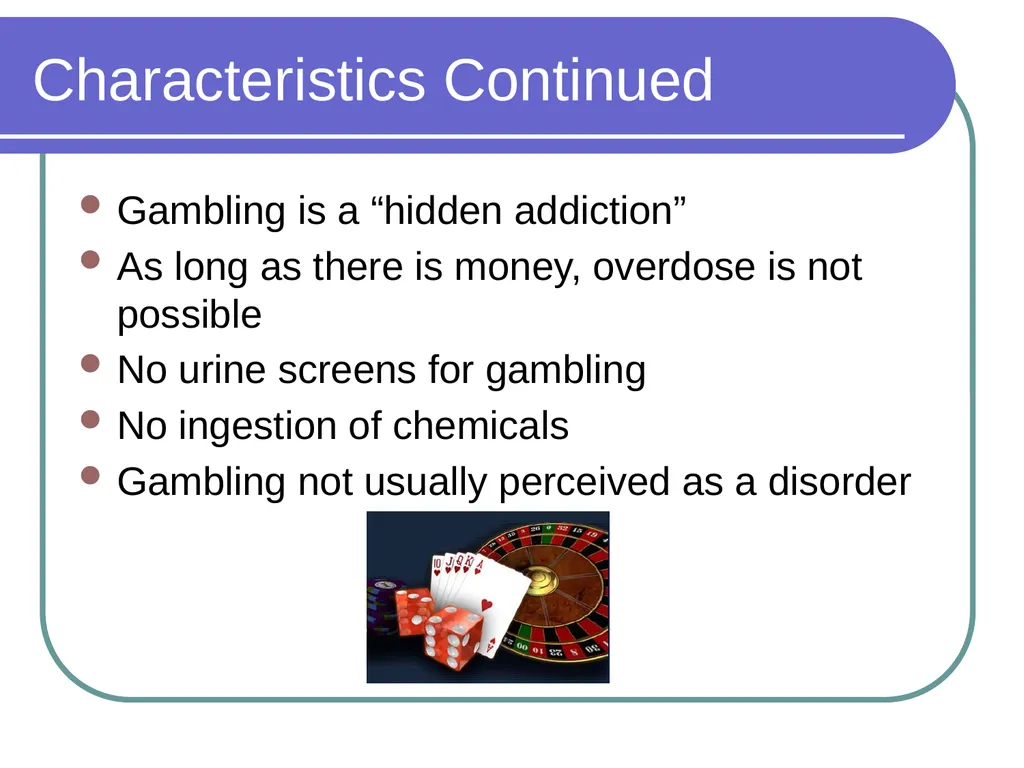
Characteristics Continued Gambling is a “hidden addiction”
As long as there is money, overdose is not possible
No urine screens for gambling
No ingestion of chemicals
Gambling not usually perceived as a disorder<br>
As long as there is money, overdose is not possible
No urine screens for gambling
No ingestion of chemicals
Gambling not usually perceived as a disorder<br>
06
Characteristics Continued Fewer resources available for those negatively affected by Gambling
Gambling can cause tremendous financial problems
Problem gamblers are usually functioning at work
Gambling prevention message not as easily accepted as drug prevention message<br>
Gambling can cause tremendous financial problems
Problem gamblers are usually functioning at work
Gambling prevention message not as easily accepted as drug prevention message<br>
07
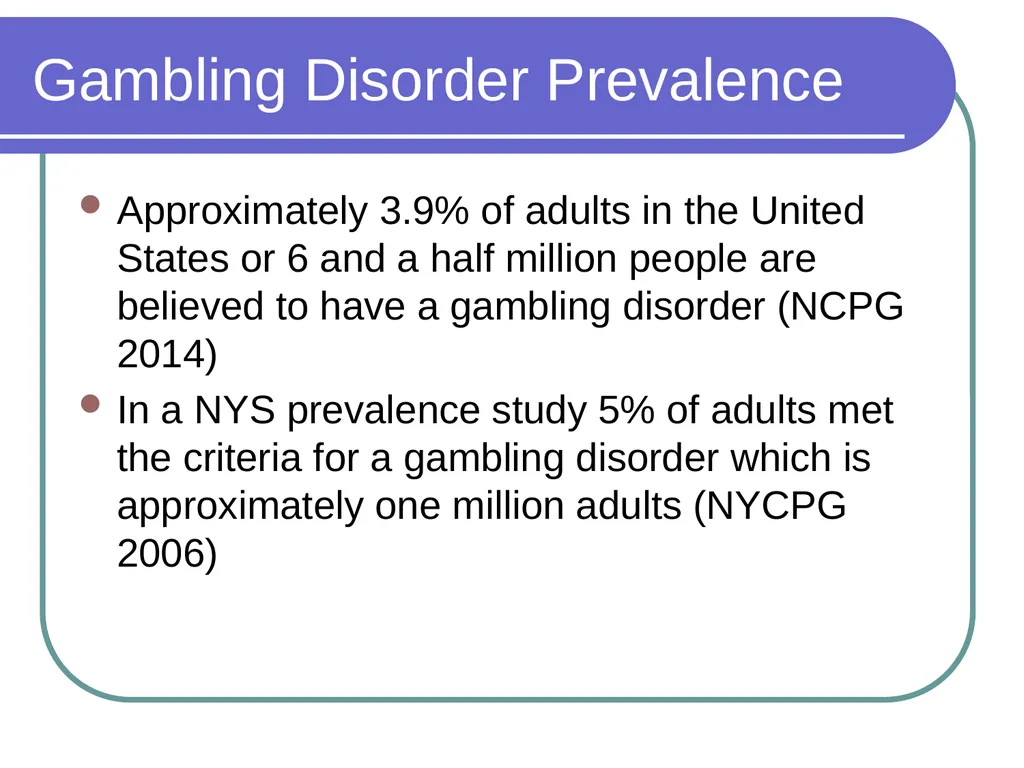
Gambling Disorder Prevalence Approximately 3.9% of adults in the United States or 6 and a half million people are believed to have a gambling disorder (NCPG 2014)
In a NYS prevalence study 5% of adults met the criteria for a gambling disorder which is approximately one million adults (NYCPG 2006)<br>
In a NYS prevalence study 5% of adults met the criteria for a gambling disorder which is approximately one million adults (NYCPG 2006)<br>
08
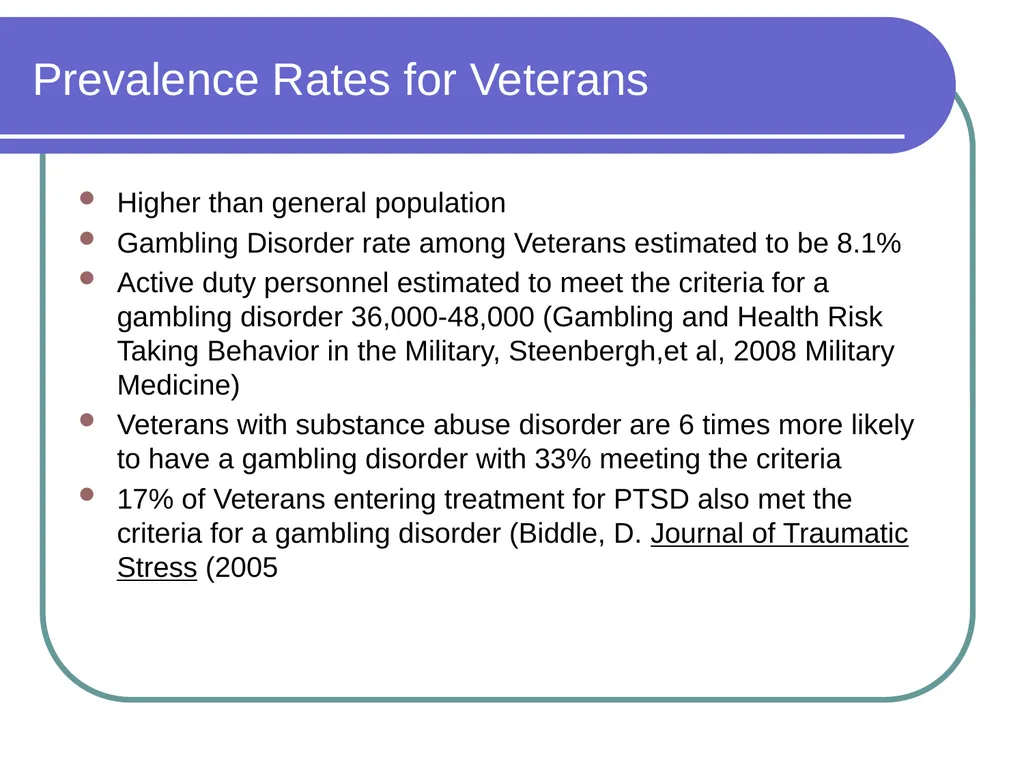
Prevalence Rates for Veterans Higher than general population
Gambling Disorder rate among Veterans estimated to be 8.1%
Active duty personnel estimated to meet the criteria for a gambling disorder 36,000-48,000 (Gambling and Health Risk Taking Behavior in the Military, Steenbergh,et al, 2008 Military Medicine)
Veterans with substance abuse disorder are 6 times more likely to have a gambling disorder with 33% meeting the criteria
17% of Veterans entering treatment for PTSD also met the criteria for a gambling disorder (Biddle, D. Journal of Traumatic Stress (2005<br>
Gambling Disorder rate among Veterans estimated to be 8.1%
Active duty personnel estimated to meet the criteria for a gambling disorder 36,000-48,000 (Gambling and Health Risk Taking Behavior in the Military, Steenbergh,et al, 2008 Military Medicine)
Veterans with substance abuse disorder are 6 times more likely to have a gambling disorder with 33% meeting the criteria
17% of Veterans entering treatment for PTSD also met the criteria for a gambling disorder (Biddle, D. Journal of Traumatic Stress (2005<br>
09
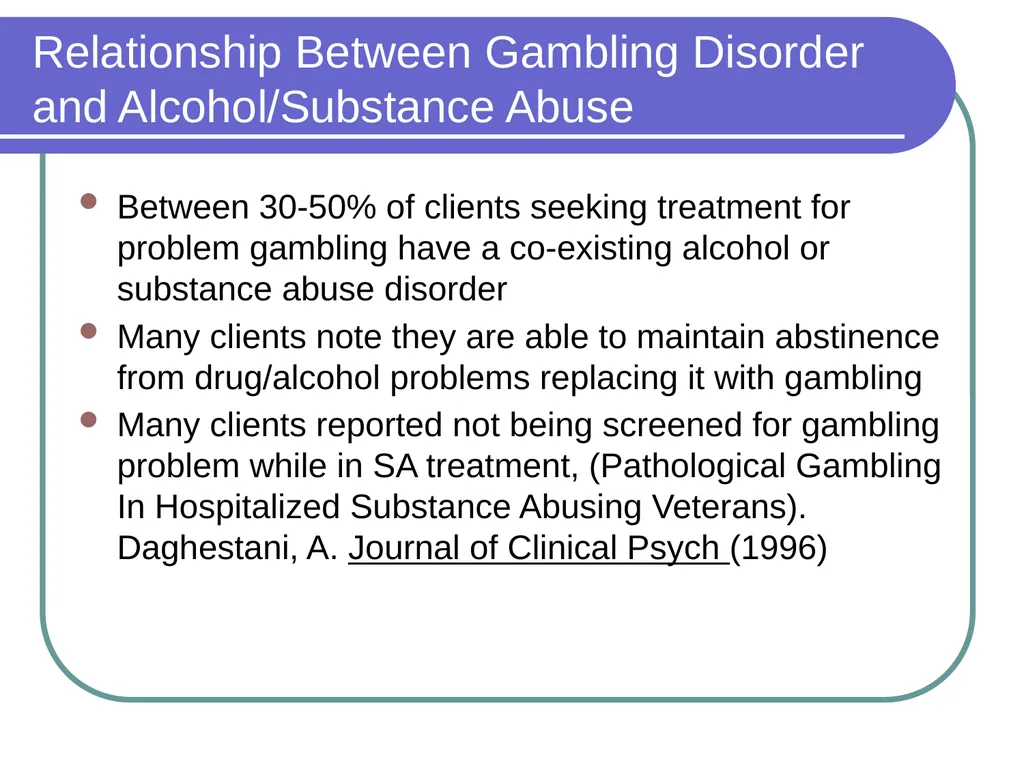
Relationship Between Gambling Disorder and Alcohol/Substance Abuse Between 30-50% of clients seeking treatment for problem gambling have a co-existing alcohol or substance abuse disorder
Many clients note they are able to maintain abstinence from drug/alcohol problems replacing it with gambling
Many clients reported not being screened for gambling problem while in SA treatment, (Pathological Gambling In Hospitalized Substance Abusing Veterans). Daghestani, A. Journal of Clinical Psych (1996)<br>
Many clients note they are able to maintain abstinence from drug/alcohol problems replacing it with gambling
Many clients reported not being screened for gambling problem while in SA treatment, (Pathological Gambling In Hospitalized Substance Abusing Veterans). Daghestani, A. Journal of Clinical Psych (1996)<br>
10
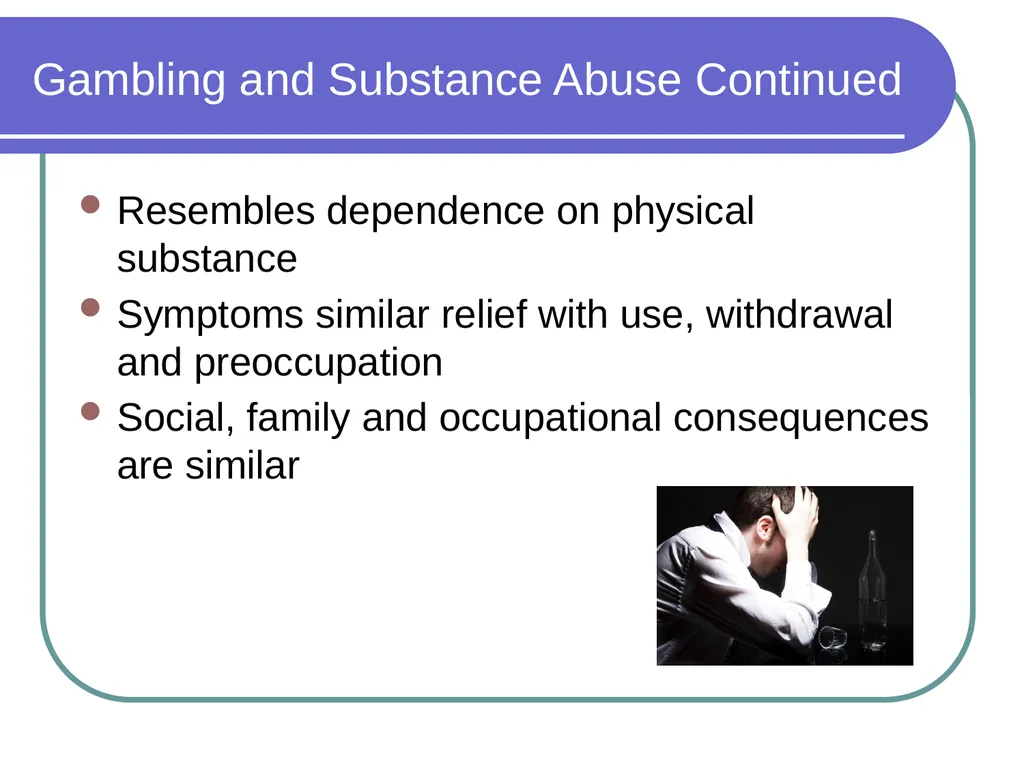
Gambling and Substance Abuse Continued Resembles dependence on physical substance
Symptoms similar relief with use, withdrawal and preoccupation
Social, family and occupational consequences are similar<br>
Symptoms similar relief with use, withdrawal and preoccupation
Social, family and occupational consequences are similar<br>
11
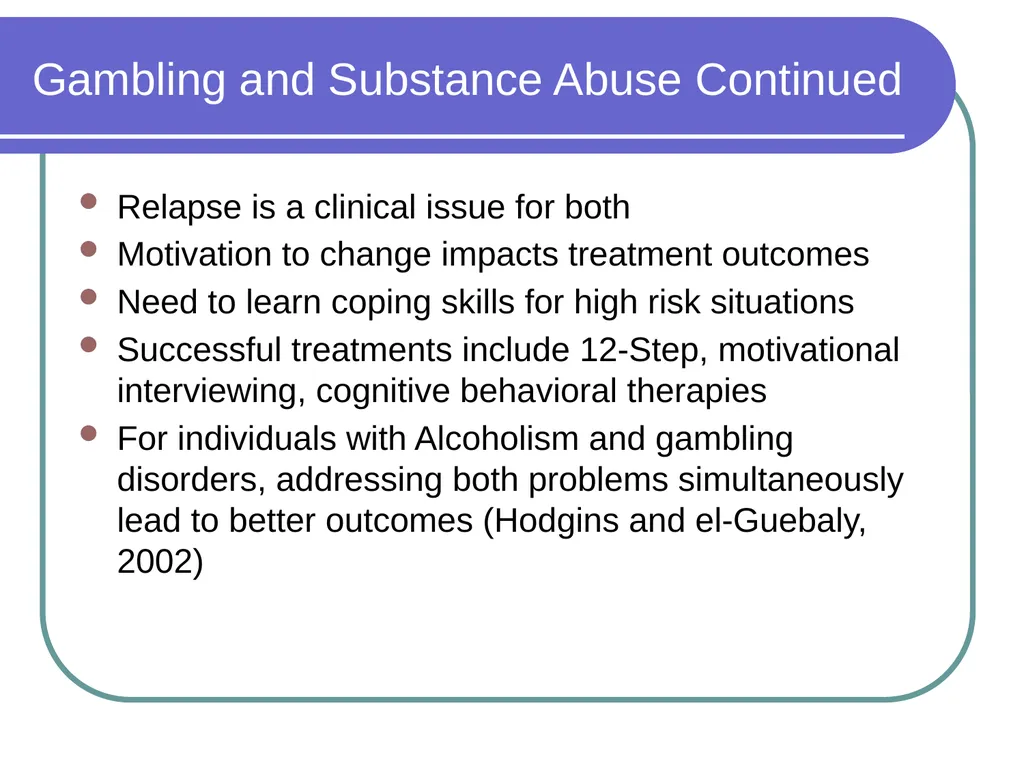
Gambling and Substance Abuse Continued Relapse is a clinical issue for both
Motivation to change impacts treatment outcomes
Need to learn coping skills for high risk situations
Successful treatments include 12-Step, motivational interviewing, cognitive behavioral therapies
For individuals with Alcoholism and gambling disorders, addressing both problems simultaneously lead to better outcomes (Hodgins and el-Guebaly, 2002)<br>
Motivation to change impacts treatment outcomes
Need to learn coping skills for high risk situations
Successful treatments include 12-Step, motivational interviewing, cognitive behavioral therapies
For individuals with Alcoholism and gambling disorders, addressing both problems simultaneously lead to better outcomes (Hodgins and el-Guebaly, 2002)<br>
12
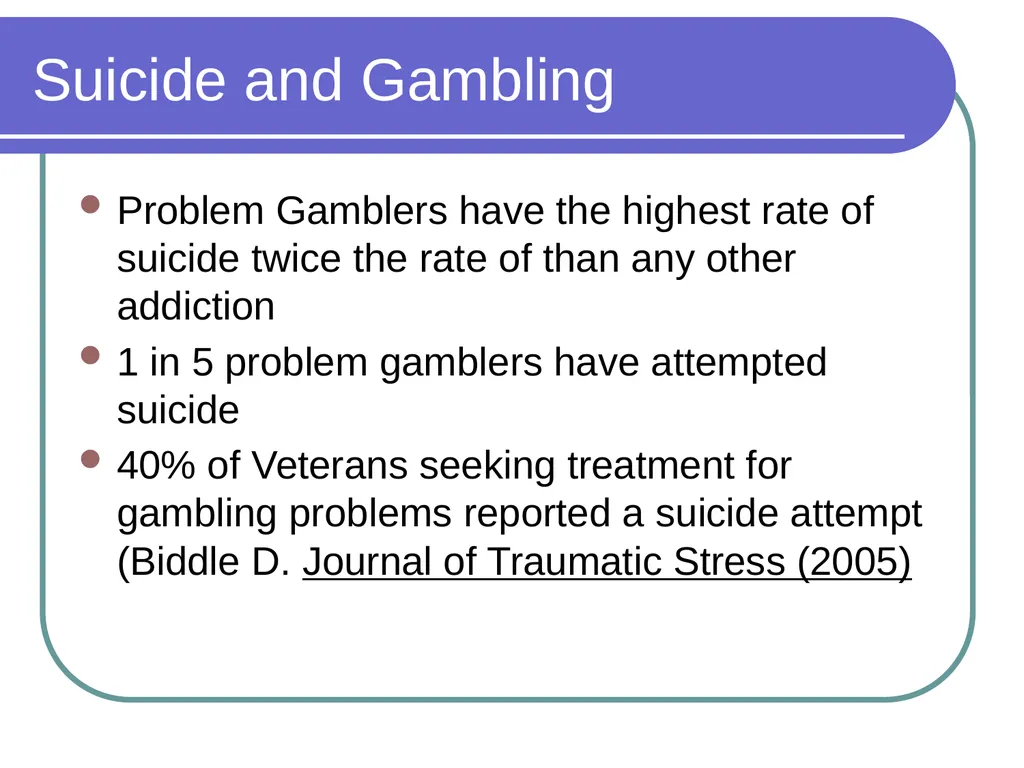
Suicide and Gambling Problem Gamblers have the highest rate of suicide twice the rate of than any other addiction
1 in 5 problem gamblers have attempted suicide
40% of Veterans seeking treatment for gambling problems reported a suicide attempt (Biddle D. Journal of Traumatic Stress (2005)<br>
1 in 5 problem gamblers have attempted suicide
40% of Veterans seeking treatment for gambling problems reported a suicide attempt (Biddle D. Journal of Traumatic Stress (2005)<br>
13
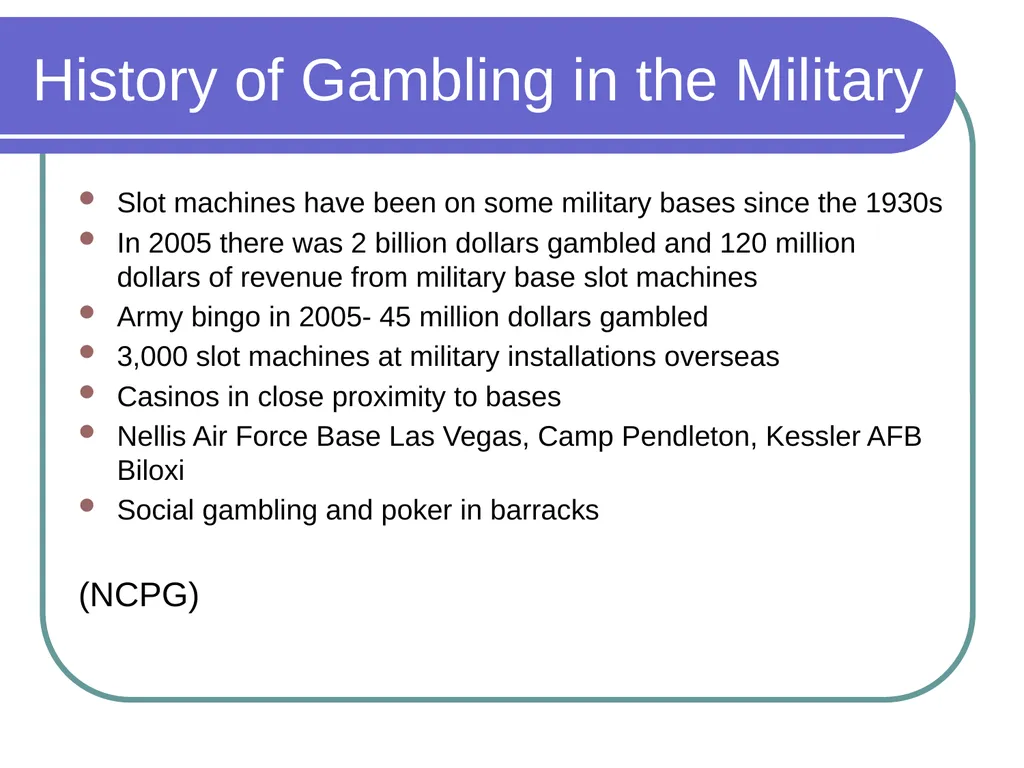
History of Gambling in the Military Slot machines have been on some military bases since the 1930s
In 2005 there was 2 billion dollars gambled and 120 million dollars of revenue from military base slot machines
Army bingo in 2005- 45 million dollars gambled
3,000 slot machines at military installations overseas
Casinos in close proximity to bases
Nellis Air Force Base Las Vegas, Camp Pendleton, Kessler AFB Biloxi
Social gambling and poker in barracks
(NCPG)<br>
In 2005 there was 2 billion dollars gambled and 120 million dollars of revenue from military base slot machines
Army bingo in 2005- 45 million dollars gambled
3,000 slot machines at military installations overseas
Casinos in close proximity to bases
Nellis Air Force Base Las Vegas, Camp Pendleton, Kessler AFB Biloxi
Social gambling and poker in barracks
(NCPG)<br>
14
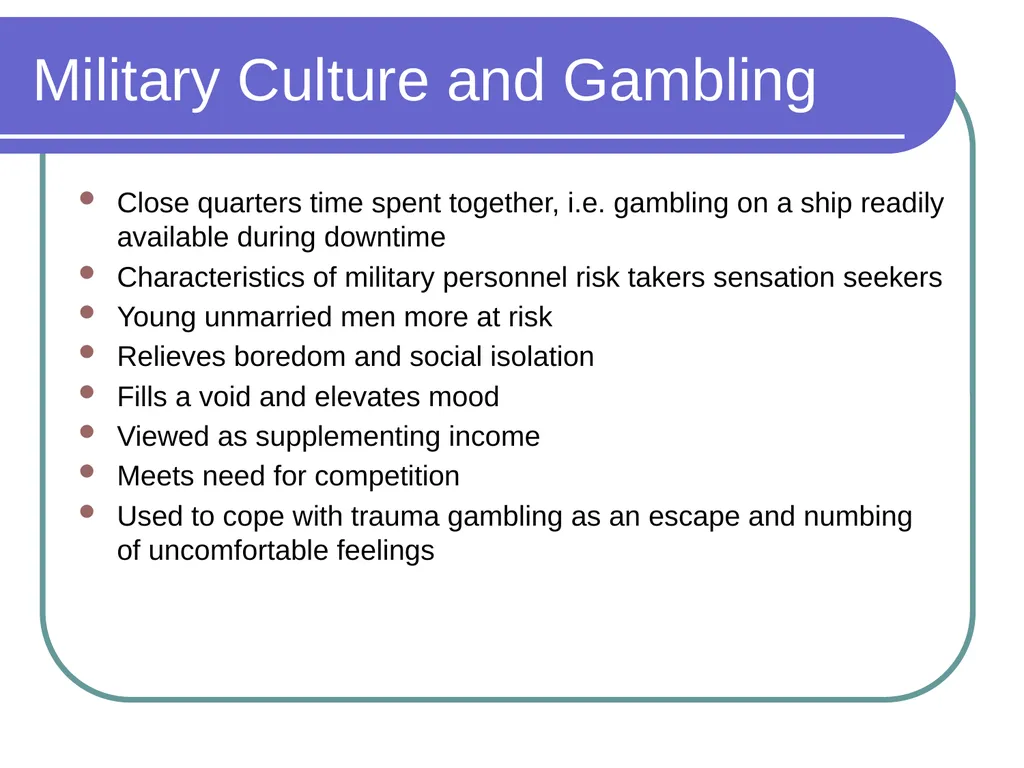
Military Culture and Gambling Close quarters time spent together, i.e. gambling on a ship readily available during downtime
Characteristics of military personnel risk takers sensation seekers
Young unmarried men more at risk
Relieves boredom and social isolation
Fills a void and elevates mood
Viewed as supplementing income
Meets need for competition
Used to cope with trauma gambling as an escape and numbing of uncomfortable feelings<br>
Characteristics of military personnel risk takers sensation seekers
Young unmarried men more at risk
Relieves boredom and social isolation
Fills a void and elevates mood
Viewed as supplementing income
Meets need for competition
Used to cope with trauma gambling as an escape and numbing of uncomfortable feelings<br>
15
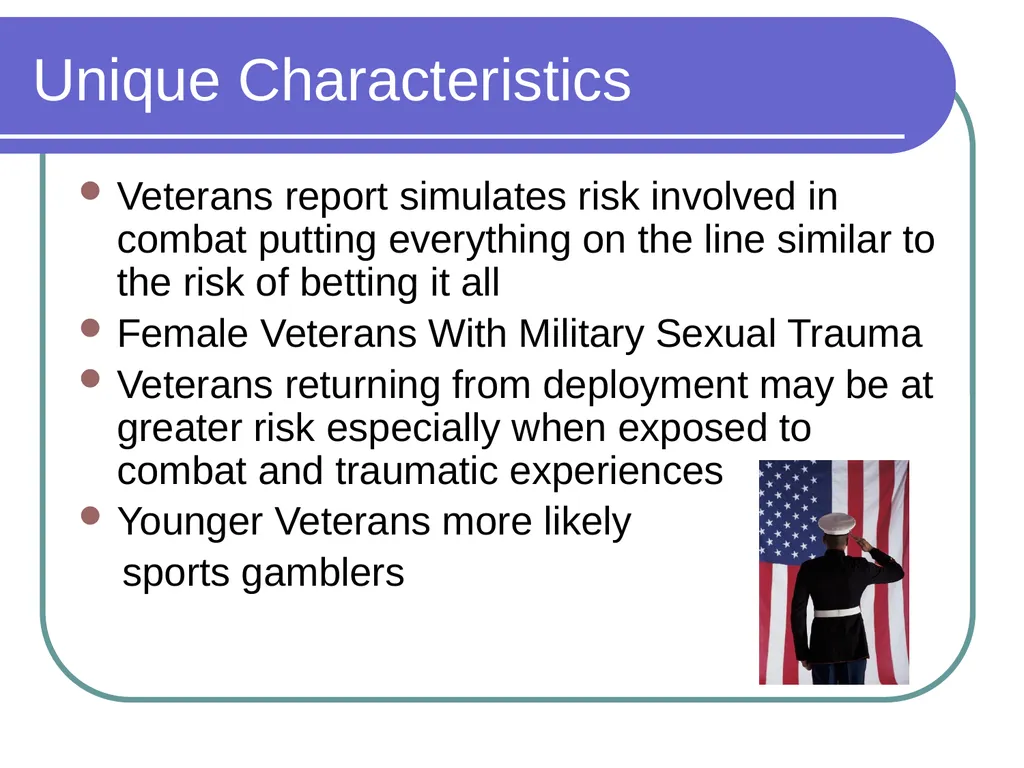
Unique Characteristics Veterans report simulates risk involved in combat putting everything on the line similar to the risk of betting it all
Female Veterans With Military Sexual Trauma
Veterans returning from deployment may be at greater risk especially when exposed to combat and traumatic experiences
Younger Veterans more likely
sports gamblers<br>
Female Veterans With Military Sexual Trauma
Veterans returning from deployment may be at greater risk especially when exposed to combat and traumatic experiences
Younger Veterans more likely
sports gamblers<br>
16
Similarities with General Population More similarities than differences
Problem Gambling under reported
Correlation between trauma and addiction
Usually seek help when crisis has occurred
Same treatment modalities used MI, CBT, Self Help<br>
Problem Gambling under reported
Correlation between trauma and addiction
Usually seek help when crisis has occurred
Same treatment modalities used MI, CBT, Self Help<br>
17
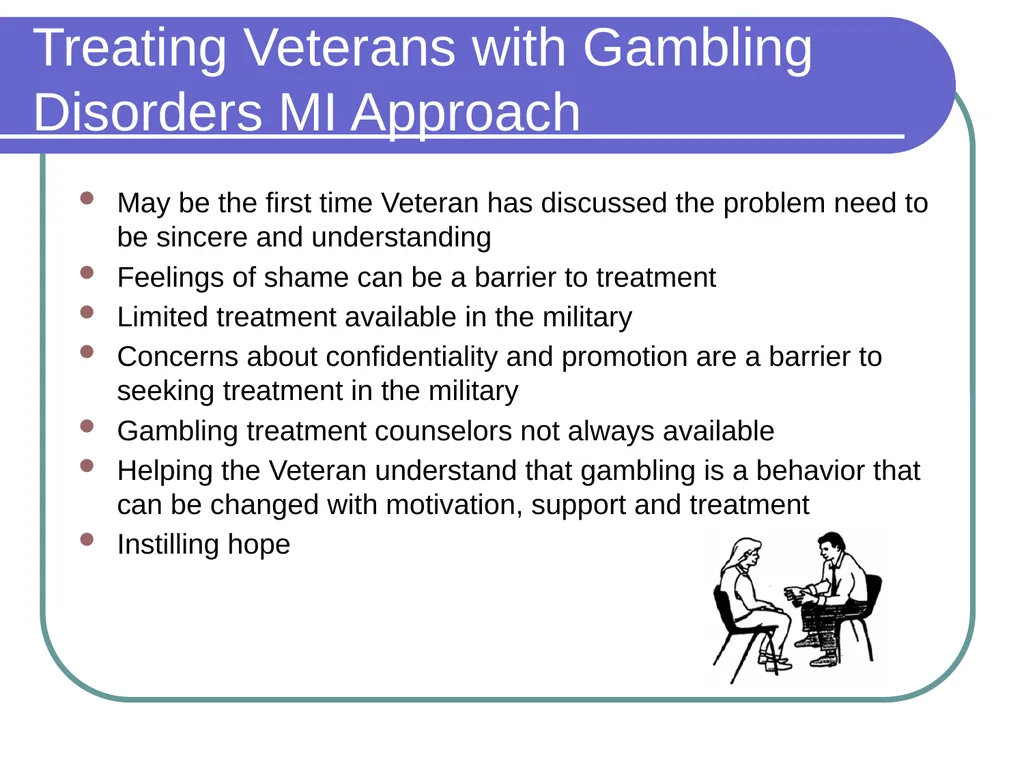
Treating Veterans with Gambling Disorders MI Approach May be the first time Veteran has discussed the problem need to be sincere and understanding
Feelings of shame can be a barrier to treatment
Limited treatment available in the military
Concerns about confidentiality and promotion are a barrier to seeking treatment in the military
Gambling treatment counselors not always available
Helping the Veteran understand that gambling is a behavior that can be changed with motivation, support and treatment
Instilling hope<br>
Feelings of shame can be a barrier to treatment
Limited treatment available in the military
Concerns about confidentiality and promotion are a barrier to seeking treatment in the military
Gambling treatment counselors not always available
Helping the Veteran understand that gambling is a behavior that can be changed with motivation, support and treatment
Instilling hope<br>
18
Treatment Continued Cognitive Behavioral Therapy
Gambling is a “heady” addiction
Helping the Veteran to identify thoughts that lead to gambling often they are thinking only about the possibility of winning
Discussing the odds of winning helping them to focus on the reality of gambling<br>
Gambling is a “heady” addiction
Helping the Veteran to identify thoughts that lead to gambling often they are thinking only about the possibility of winning
Discussing the odds of winning helping them to focus on the reality of gambling<br>
19
Treatment Continued Identifying high risk situations and the thoughts that lead to gambling
Helping the Veteran to identify new thoughts and behaviors to better cope with urges to gamble
Slowing down thinking and raising awareness of the impact of gambling in their lives<br>
Helping the Veteran to identify new thoughts and behaviors to better cope with urges to gamble
Slowing down thinking and raising awareness of the impact of gambling in their lives<br>
20
Group support very helpful
Many Veterans have reported that being in a group with other Veterans has been very therapeutic for them
GA self-help groups Treatment Continued<br>
Many Veterans have reported that being in a group with other Veterans has been very therapeutic for them
GA self-help groups Treatment Continued<br>
21
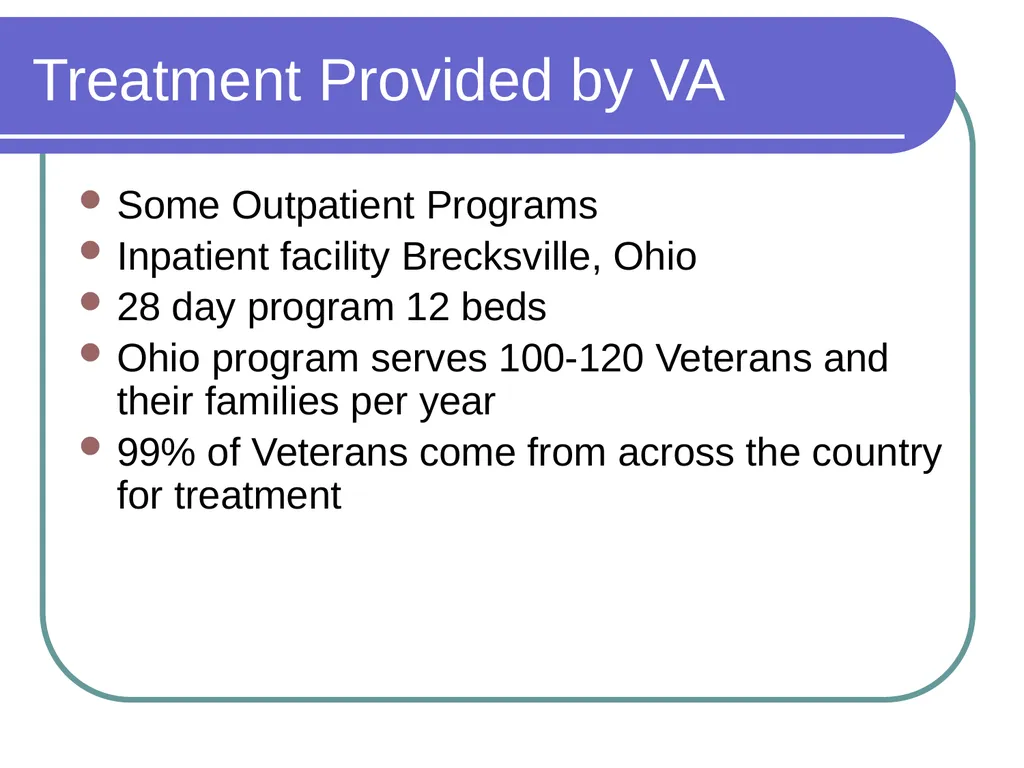
Treatment Provided by VA Some Outpatient Programs
Inpatient facility Brecksville, Ohio
28 day program 12 beds
Ohio program serves 100-120 Veterans and their families per year
99% of Veterans come from across the country for treatment<br>
Inpatient facility Brecksville, Ohio
28 day program 12 beds
Ohio program serves 100-120 Veterans and their families per year
99% of Veterans come from across the country for treatment<br>
22
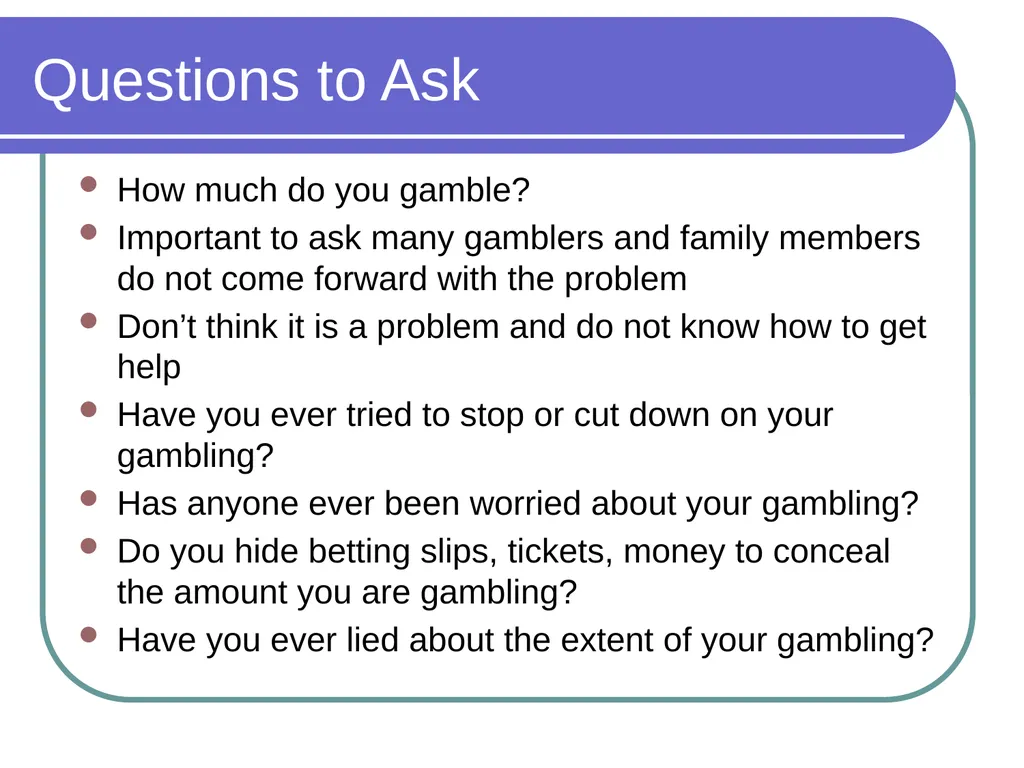
Questions to Ask How much do you gamble?
Important to ask many gamblers and family members do not come forward with the problem
Don’t think it is a problem and do not know how to get help
Have you ever tried to stop or cut down on your gambling?
Has anyone ever been worried about your gambling?
Do you hide betting slips, tickets, money to conceal the amount you are gambling?
Have you ever lied about the extent of your gambling?<br>
Important to ask many gamblers and family members do not come forward with the problem
Don’t think it is a problem and do not know how to get help
Have you ever tried to stop or cut down on your gambling?
Has anyone ever been worried about your gambling?
Do you hide betting slips, tickets, money to conceal the amount you are gambling?
Have you ever lied about the extent of your gambling?<br>
23
References Bray, R. M. Sanchez R.P. Ornstein, M.L. Lentine, D. Vincus, A. A. Baird T. V. Lannacchione, V. G. (1998). Department of Defense Behaviors Among Military Personnel
(Biddle, D. Journal of Traumatic Stress (2005)
DSM-V, American Psychiatric Association 2015
Gambling and Health Risk Taking Behavior in the Military, Steenbergh,et al, 2008 Military Medicine
Minnesota Department of Human Services, Problem Gambling the Hidden Addiction
Najavits, L.M. (2011). Treatment for PTSD and Pathological Gambling: What do Patients Want? Journal of Gambling Studies
National Council on Problem Gambling
New York Council on Problem Gambling
Pathological Gambling In Hospitalized Substance Abusing Veterans). Daghestani, A. Journal of Clinical Psych (1996)
Tucker, J.H., (2012) Military Has a Gambling Problem. Seattle News.<br>
(Biddle, D. Journal of Traumatic Stress (2005)
DSM-V, American Psychiatric Association 2015
Gambling and Health Risk Taking Behavior in the Military, Steenbergh,et al, 2008 Military Medicine
Minnesota Department of Human Services, Problem Gambling the Hidden Addiction
Najavits, L.M. (2011). Treatment for PTSD and Pathological Gambling: What do Patients Want? Journal of Gambling Studies
National Council on Problem Gambling
New York Council on Problem Gambling
Pathological Gambling In Hospitalized Substance Abusing Veterans). Daghestani, A. Journal of Clinical Psych (1996)
Tucker, J.H., (2012) Military Has a Gambling Problem. Seattle News.<br>
24
Substance Use Disorders and PTSD among Veterans Devon Cummings, Ph.D.
Stratton VA Medical Center<br>
Stratton VA Medical Center<br>
25
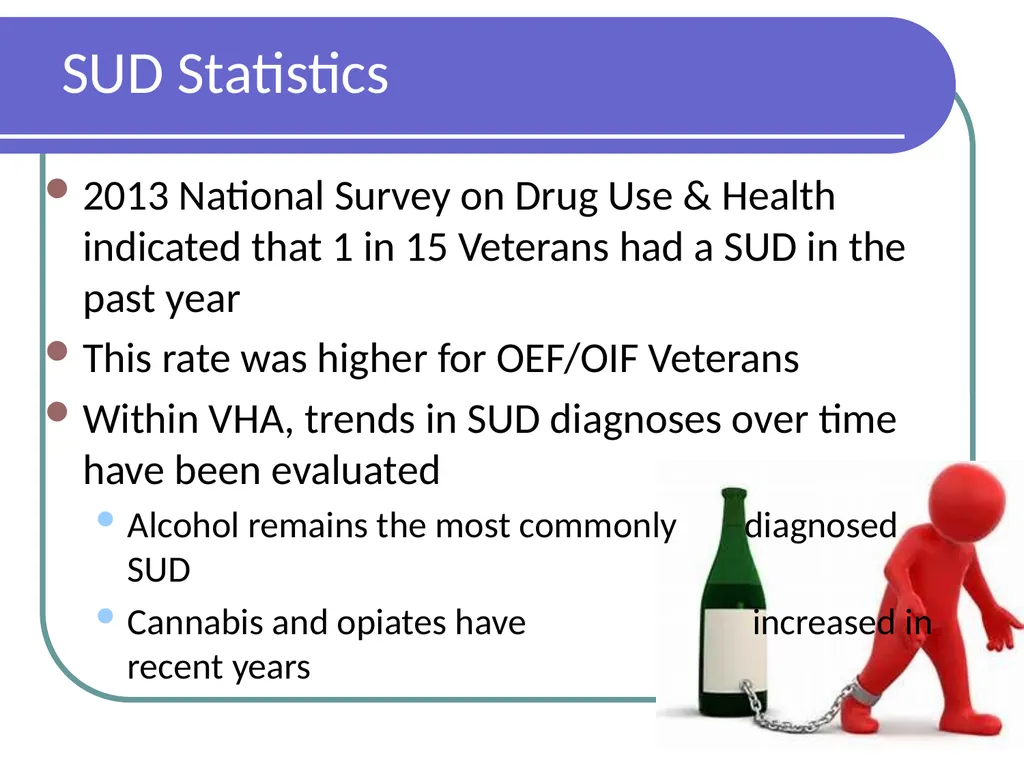
SUD Statistics 2013 National Survey on Drug Use & Health indicated that 1 in 15 Veterans had a SUD in the past year
This rate was higher for OEF/OIF Veterans
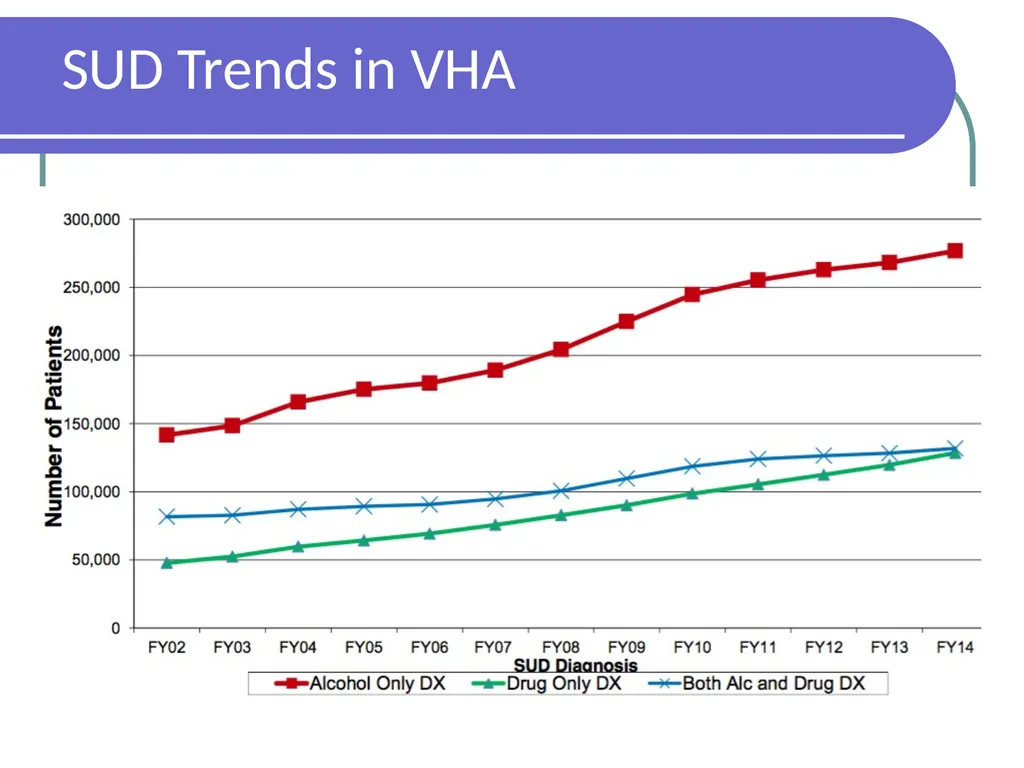
Within VHA, trends in SUD diagnoses over time have been evaluated
Alcohol remains the most commonly diagnosed SUD
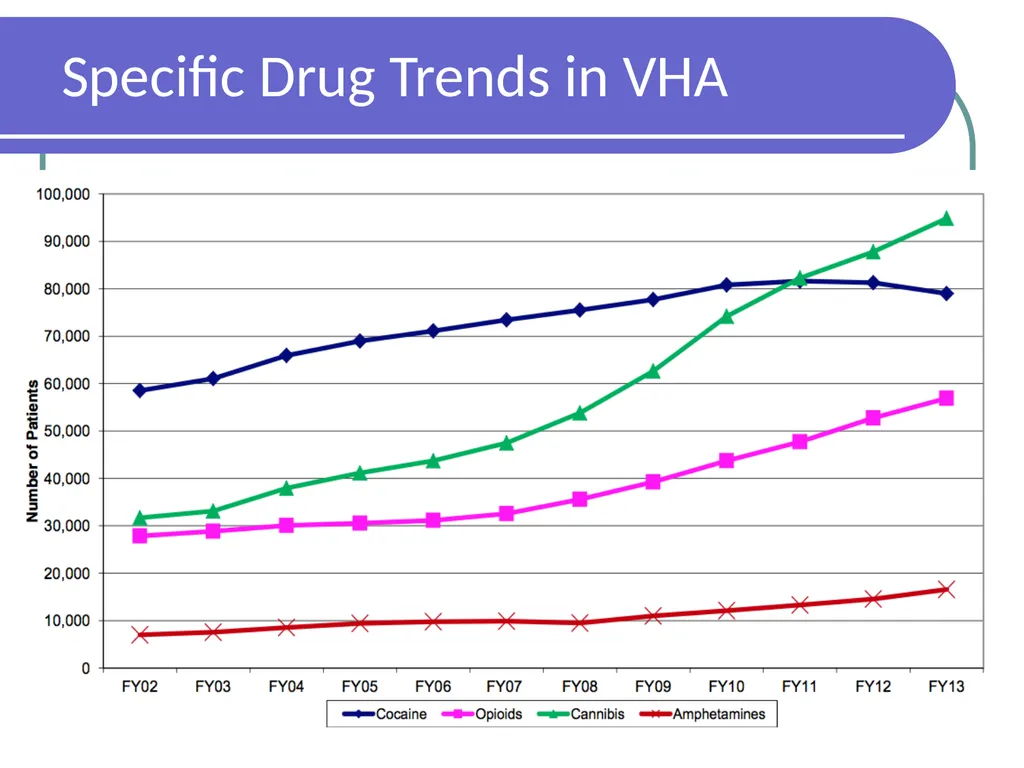
Cannabis and opiates have increased in recent years<br>
This rate was higher for OEF/OIF Veterans
Within VHA, trends in SUD diagnoses over time have been evaluated
Alcohol remains the most commonly diagnosed SUD
Cannabis and opiates have increased in recent years<br>
26
SUD Trends in VHA<br>
27
Specific Drug Trends in VHA<br>
28
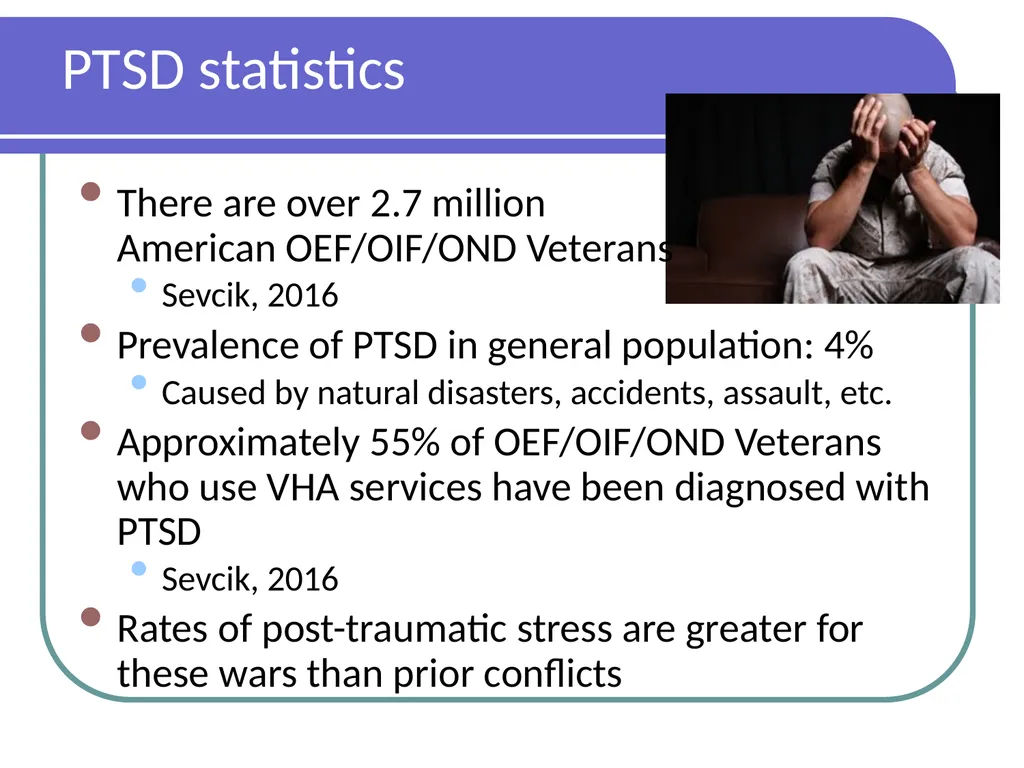
PTSD statistics There are over 2.7 million American OEF/OIF/OND Veterans
Sevcik, 2016
Prevalence of PTSD in general population: 4%
Caused by natural disasters, accidents, assault, etc.
Approximately 55% of OEF/OIF/OND Veterans who use VHA services have been diagnosed with PTSD
Sevcik, 2016
Rates of post-traumatic stress are greater for these wars than prior conflicts<br>
Sevcik, 2016
Prevalence of PTSD in general population: 4%
Caused by natural disasters, accidents, assault, etc.
Approximately 55% of OEF/OIF/OND Veterans who use VHA services have been diagnosed with PTSD
Sevcik, 2016
Rates of post-traumatic stress are greater for these wars than prior conflicts<br>
29
SUD & PTSD Statistics Patients seeking treatment for PTSD are up to 14 times more likely than those without PTSD to have a SUD
McCauley et al., 2012<br>
McCauley et al., 2012<br>
30
VHA SUD & PTSD Statistics The prevalence of co-occurring PTSD/SUD in Veterans seeking treatment in VHA increased 76% between FY08 and FY13
Drexler, 2016
Of OEF/OIF Veterans who enrolled in VA care between 2001 and 2009 and were diagnosed with a SUD, 55%-75% were also diagnosed with PTSD or depression
VA/DoD SUD Practice Guidelines, 2015
Increased mortality rate for Veterans who have co-occurring PTSD and SUD
VA/DoD SUD Practice Guidelines, 2015<br>
Drexler, 2016
Of OEF/OIF Veterans who enrolled in VA care between 2001 and 2009 and were diagnosed with a SUD, 55%-75% were also diagnosed with PTSD or depression
VA/DoD SUD Practice Guidelines, 2015
Increased mortality rate for Veterans who have co-occurring PTSD and SUD
VA/DoD SUD Practice Guidelines, 2015<br>
31
SUD & PTSD Co-occurring PTSD and SUD is more difficult and costly than either diagnosis alone (McCauley et al., 2012; Browne et al., 2016; Coker, Stefanovics, & Rosenheck, 2016; Haller et al., 2016)
Increased chronic physical health problems
Poorer social functioning
Higher rates of suicide attempts
More legal problems
Increased risk of violence
Worse treatment adherence
Less improvement during treatment<br>
Increased chronic physical health problems
Poorer social functioning
Higher rates of suicide attempts
More legal problems
Increased risk of violence
Worse treatment adherence
Less improvement during treatment<br>
32
OEF/OIF Veterans with SUD/PTSD OEF/OIF Veterans diagnosed with PTSD are significantly more likely to receive opiates for pain, higher doses of opiates, two or more opiates, sedative hypnotics concurrent with opiates, and to obtain early refills
Seal et al., 2012<br>
Seal et al., 2012<br>
33
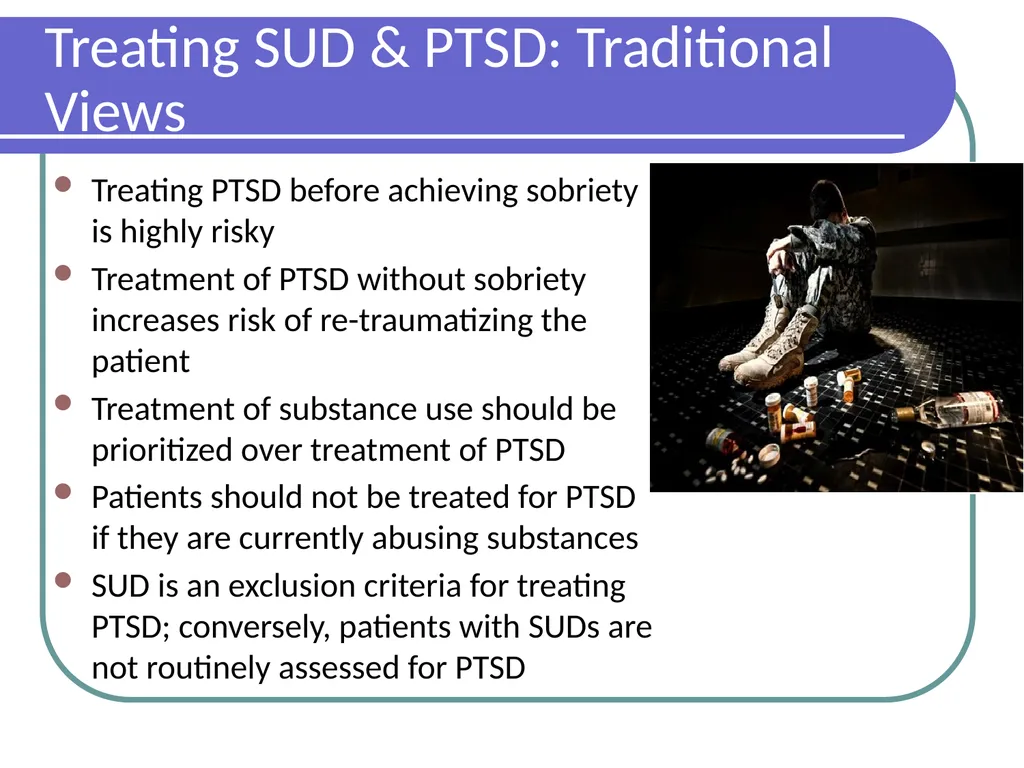
Treating SUD & PTSD: Traditional Views Treating PTSD before achieving sobriety is highly risky
Treatment of PTSD without sobriety increases risk of re-traumatizing the patient
Treatment of substance use should be prioritized over treatment of PTSD
Patients should not be treated for PTSD if they are currently abusing substances
SUD is an exclusion criteria for treating PTSD; conversely, patients with SUDs are not routinely assessed for PTSD<br>
Treatment of PTSD without sobriety increases risk of re-traumatizing the patient
Treatment of substance use should be prioritized over treatment of PTSD
Patients should not be treated for PTSD if they are currently abusing substances
SUD is an exclusion criteria for treating PTSD; conversely, patients with SUDs are not routinely assessed for PTSD<br>
34
Treating SUD & PTSD: Emerging View Previous assumptions more anecdotal, not actually that well-investigated
Treating co-occurring PTSD & SUD can happen in either order or concurrently
Evidence-based protocols can be used with persons who have active SUDs
Cognitive Processing Therapy well-tolerated with Alcohol Use Disorders (Kaysen et al., 2014)
Treating SUD without treating PTSD increases the risk of relapse and fails to address underlying problem
SUD patients should routinely be screened for PTSD<br>
Treating co-occurring PTSD & SUD can happen in either order or concurrently
Evidence-based protocols can be used with persons who have active SUDs
Cognitive Processing Therapy well-tolerated with Alcohol Use Disorders (Kaysen et al., 2014)
Treating SUD without treating PTSD increases the risk of relapse and fails to address underlying problem
SUD patients should routinely be screened for PTSD<br>
35
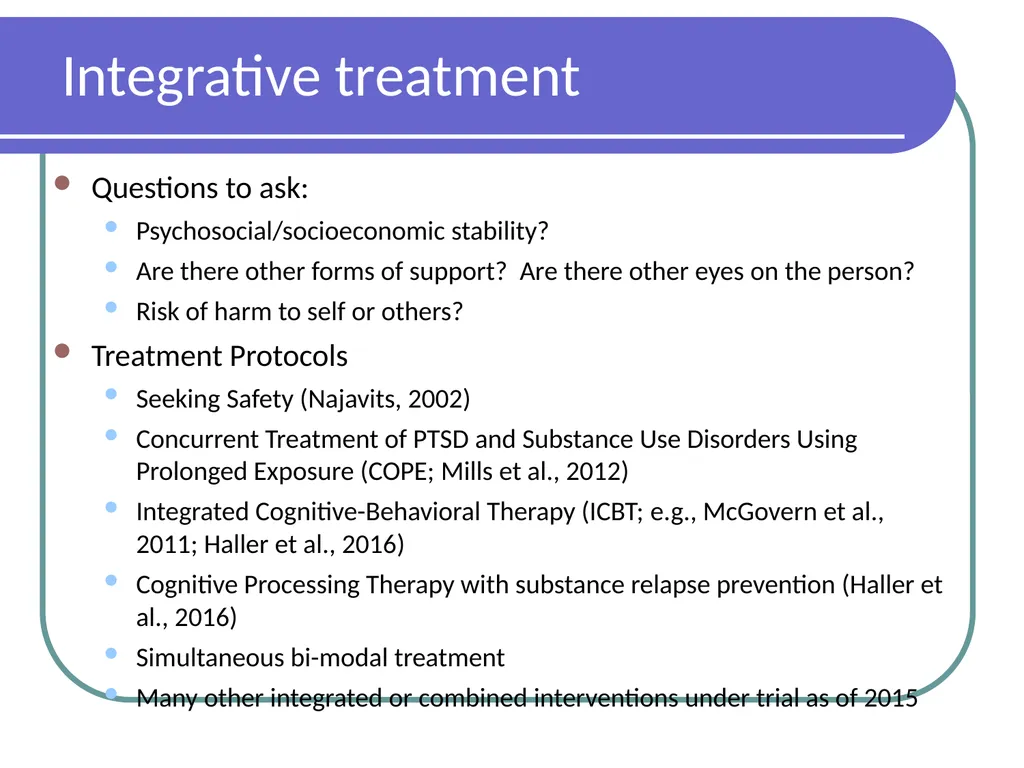
Integrative treatment Questions to ask:
Psychosocial/socioeconomic stability?
Are there other forms of support? Are there other eyes on the person?
Risk of harm to self or others?
Treatment Protocols
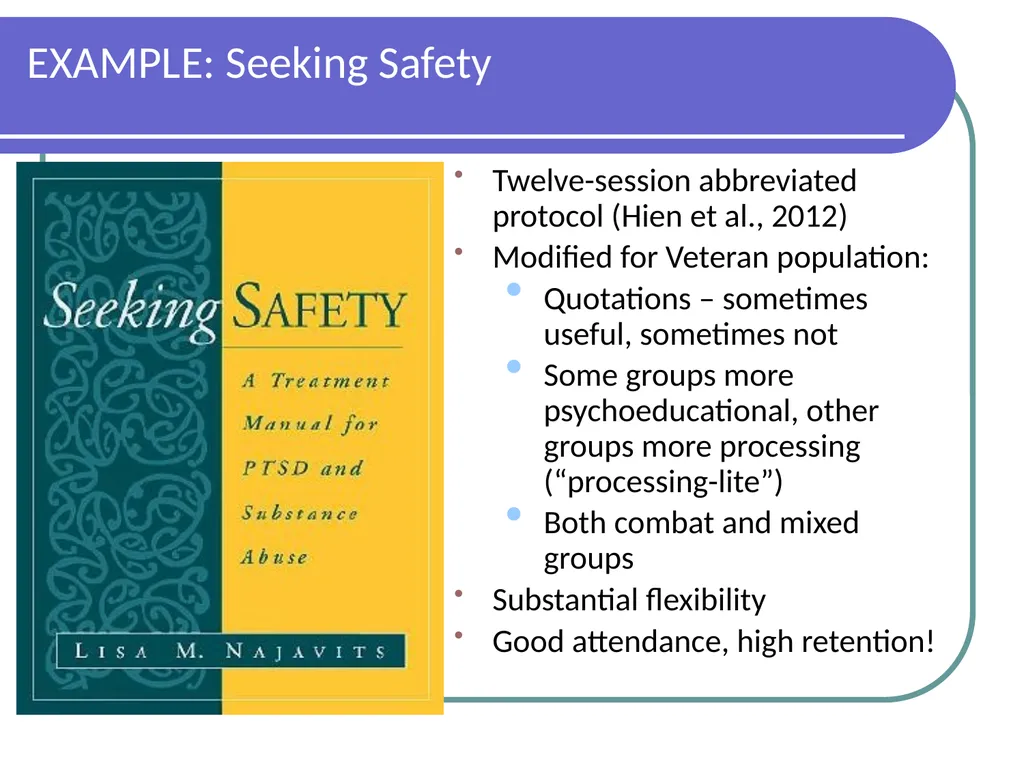
Seeking Safety (Najavits, 2002)
Concurrent Treatment of PTSD and Substance Use Disorders Using Prolonged Exposure (COPE; Mills et al., 2012)
Integrated Cognitive-Behavioral Therapy (ICBT; e.g., McGovern et al., 2011; Haller et al., 2016)
Cognitive Processing Therapy with substance relapse prevention (Haller et al., 2016)
Simultaneous bi-modal treatment
Many other integrated or combined interventions under trial as of 2015<br>
Psychosocial/socioeconomic stability?
Are there other forms of support? Are there other eyes on the person?
Risk of harm to self or others?
Treatment Protocols
Seeking Safety (Najavits, 2002)
Concurrent Treatment of PTSD and Substance Use Disorders Using Prolonged Exposure (COPE; Mills et al., 2012)
Integrated Cognitive-Behavioral Therapy (ICBT; e.g., McGovern et al., 2011; Haller et al., 2016)
Cognitive Processing Therapy with substance relapse prevention (Haller et al., 2016)
Simultaneous bi-modal treatment
Many other integrated or combined interventions under trial as of 2015<br>
36
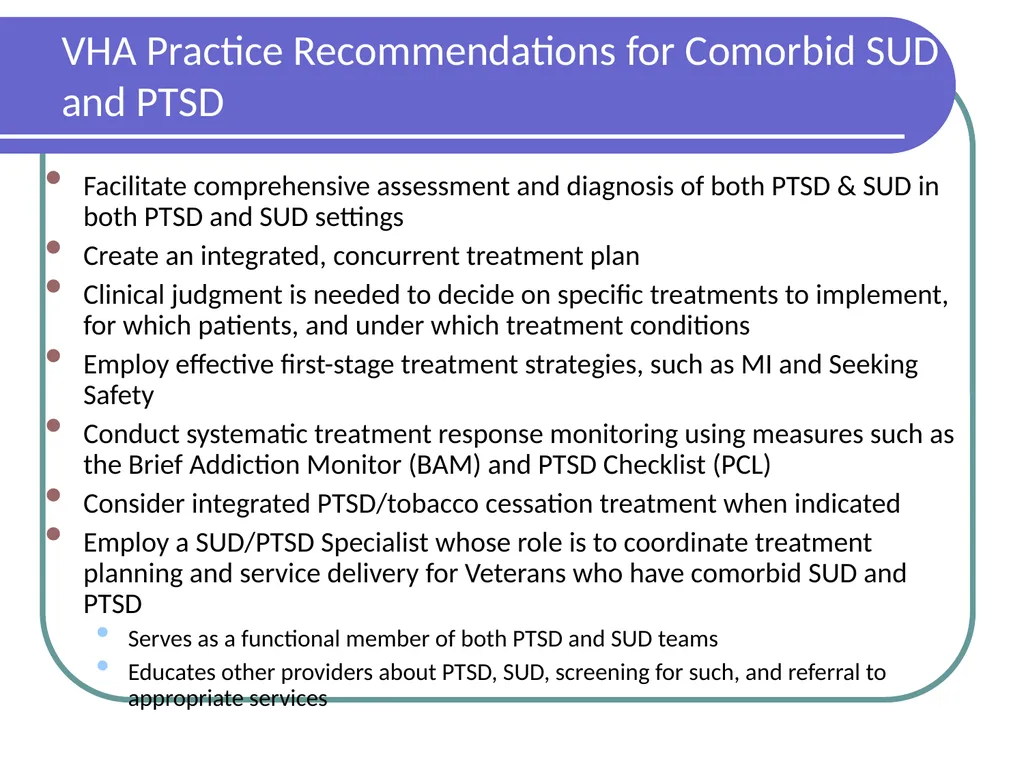
VHA Practice Recommendations for Comorbid SUD and PTSD Facilitate comprehensive assessment and diagnosis of both PTSD & SUD in both PTSD and SUD settings
Create an integrated, concurrent treatment plan
Clinical judgment is needed to decide on specific treatments to implement, for which patients, and under which treatment conditions
Employ effective first-stage treatment strategies, such as MI and Seeking Safety
Conduct systematic treatment response monitoring using measures such as the Brief Addiction Monitor (BAM) and PTSD Checklist (PCL)
Consider integrated PTSD/tobacco cessation treatment when indicated
Employ a SUD/PTSD Specialist whose role is to coordinate treatment planning and service delivery for Veterans who have comorbid SUD and PTSD
Serves as a functional member of both PTSD and SUD teams
Educates other providers about PTSD, SUD, screening for such, and referral to appropriate services<br>
Create an integrated, concurrent treatment plan
Clinical judgment is needed to decide on specific treatments to implement, for which patients, and under which treatment conditions
Employ effective first-stage treatment strategies, such as MI and Seeking Safety
Conduct systematic treatment response monitoring using measures such as the Brief Addiction Monitor (BAM) and PTSD Checklist (PCL)
Consider integrated PTSD/tobacco cessation treatment when indicated
Employ a SUD/PTSD Specialist whose role is to coordinate treatment planning and service delivery for Veterans who have comorbid SUD and PTSD
Serves as a functional member of both PTSD and SUD teams
Educates other providers about PTSD, SUD, screening for such, and referral to appropriate services<br>
37
EXAMPLE: Seeking Safety Twelve-session abbreviated protocol (Hien et al., 2012)
Modified for Veteran population:
Quotations – sometimes useful, sometimes not
Some groups more psychoeducational, other groups more processing (“processing-lite”)
Both combat and mixed groups
Substantial flexibility
Good attendance, high retention!<br>
Modified for Veteran population:
Quotations – sometimes useful, sometimes not
Some groups more psychoeducational, other groups more processing (“processing-lite”)
Both combat and mixed groups
Substantial flexibility
Good attendance, high retention!<br>
38
Teaming Up: PTSD & SUD Programs Working Together Coordinated approach between both programs
Highly individualized for Veterans who have unique or significant needs
Regular communication and collaboration
Closes gaps in service
Avoids duplication of services and “back-and-forth” between programs
Improves access and quality of care<br>
Highly individualized for Veterans who have unique or significant needs
Regular communication and collaboration
Closes gaps in service
Avoids duplication of services and “back-and-forth” between programs
Improves access and quality of care<br>
39
References Browne, K. C., Wray, T. B., Stappenbeck, C. A., Krenek, M., & Simpson, T. L. (2016). Alcohol consumption, craving, and craving control efforts assessed daily in the context of readiness to change among individuals with alcohol dependence and PTSD. Journal of Substance Abuse Treatment, 61, 34-41. http://dx.doi.org/10.1016/j.jsat.2015.09.005
Coker, K. L., Stefanovics, E., & Rosenheck, R. (2016). Correlates of improvement in substance abuse among dually diagnosed veterans with post-traumatic stress disorder in specialized intensive VA treatment. Psychological Trauma: Theory, Research, Practice and Policy, 8, 41-48. http://dx.doi.org/10.1037/tra0000061
Drexler, K. (2016). How are we doing? Evidence-based practices in substance use disorder treatment [PowerPoint Slides]. Retrieved from the Department of Veterans Affairs: www.va.gov
Haller, M., Norman, S. B., Cummins, K., Trim, R. S., Xu, X., Ruifeng, C., et al. (2016). Integrative cognitive behavioral therapy for adults with depression, substance use disorder, and trauma. Journal of Substance Abuse Treatment, 62, 38-48. http://dx.doi.org/10.1016/j.jsat.2015.11.005
Hien, D. A., Morgan-Lopez, A. A., Campbell A. N. C., Saavedra, L. M., Wu, E., Cohen, L. R., et al. (2012). Attendance and substance use outcomes for the seeking safety program: Sometimes less is more. Journal of Consulting and Clinical Psychology, 80, 29-42. http://psycnet.apa.org/doi/10.1037/a0026361<br>
Coker, K. L., Stefanovics, E., & Rosenheck, R. (2016). Correlates of improvement in substance abuse among dually diagnosed veterans with post-traumatic stress disorder in specialized intensive VA treatment. Psychological Trauma: Theory, Research, Practice and Policy, 8, 41-48. http://dx.doi.org/10.1037/tra0000061
Drexler, K. (2016). How are we doing? Evidence-based practices in substance use disorder treatment [PowerPoint Slides]. Retrieved from the Department of Veterans Affairs: www.va.gov
Haller, M., Norman, S. B., Cummins, K., Trim, R. S., Xu, X., Ruifeng, C., et al. (2016). Integrative cognitive behavioral therapy for adults with depression, substance use disorder, and trauma. Journal of Substance Abuse Treatment, 62, 38-48. http://dx.doi.org/10.1016/j.jsat.2015.11.005
Hien, D. A., Morgan-Lopez, A. A., Campbell A. N. C., Saavedra, L. M., Wu, E., Cohen, L. R., et al. (2012). Attendance and substance use outcomes for the seeking safety program: Sometimes less is more. Journal of Consulting and Clinical Psychology, 80, 29-42. http://psycnet.apa.org/doi/10.1037/a0026361<br>
40
References Kaysen, D., Schumm, J., Pedersen, E. R., Seim, R. W. Bedard-Gilligan, M., & Chard, K. (2014). Cognitive processing therapy for veterans with comorbid PTSD and alcohol use disorders. Addictive Behaviors, 39, 420-427. doi: 10.1016/j.addbeh.2013.08.016
McCauley, J. L., Killeen, T., Gros, D. F., Brady, K. T., & Back, S. E. (2012). Posttraumatic stress disorder and co-occurring substance use disorders: Advances in assessment and treatment. Clinical Psychology, 19, 283-304. doi: 10.1111/cpsp.12006
McGovern, M. P., Lambert-Harris, C., Alterman, A., Xie, H., & Meier, A. (2011). A randomized controlled trial comparing integrated cognitive behavioral therapy versus individual addiction counseling for co-occurring substance use and posttraumatic stress disorders. Journal of Dual Diagnosis, 7, 207–227. doi: 10.1080/15504263.2011.620425
Mills, K. L., Teesson, M., Back, S. E., Brady, K. T., Baker, A. L., Hopwood, S., et al. (2012). Integrated exposure-based therapy for co-occurring posttraumatic stress disorder and substance dependence: A randomized controlled trial. JAMA, 308, 690-699. doi: 10.1001/jama.2012.9071
Najavits, L. M. (2001). Seeking safety: A treatment manual for PTSD and substance abuse. New York, NY: Guilford Press.
National Center for PTSD. (2010, March). Report of (VA) consensus conference: Practice recommendations for treatment of veterans with comorbid substance abuse and PTSD. Retrieved February 25, 2016, from http://www.ptsd.va.gov/professional/pages/handouts-pdf/SUD_PTSD_Practice_Recommend.pdf<br>
McCauley, J. L., Killeen, T., Gros, D. F., Brady, K. T., & Back, S. E. (2012). Posttraumatic stress disorder and co-occurring substance use disorders: Advances in assessment and treatment. Clinical Psychology, 19, 283-304. doi: 10.1111/cpsp.12006
McGovern, M. P., Lambert-Harris, C., Alterman, A., Xie, H., & Meier, A. (2011). A randomized controlled trial comparing integrated cognitive behavioral therapy versus individual addiction counseling for co-occurring substance use and posttraumatic stress disorders. Journal of Dual Diagnosis, 7, 207–227. doi: 10.1080/15504263.2011.620425
Mills, K. L., Teesson, M., Back, S. E., Brady, K. T., Baker, A. L., Hopwood, S., et al. (2012). Integrated exposure-based therapy for co-occurring posttraumatic stress disorder and substance dependence: A randomized controlled trial. JAMA, 308, 690-699. doi: 10.1001/jama.2012.9071
Najavits, L. M. (2001). Seeking safety: A treatment manual for PTSD and substance abuse. New York, NY: Guilford Press.
National Center for PTSD. (2010, March). Report of (VA) consensus conference: Practice recommendations for treatment of veterans with comorbid substance abuse and PTSD. Retrieved February 25, 2016, from http://www.ptsd.va.gov/professional/pages/handouts-pdf/SUD_PTSD_Practice_Recommend.pdf<br>
41
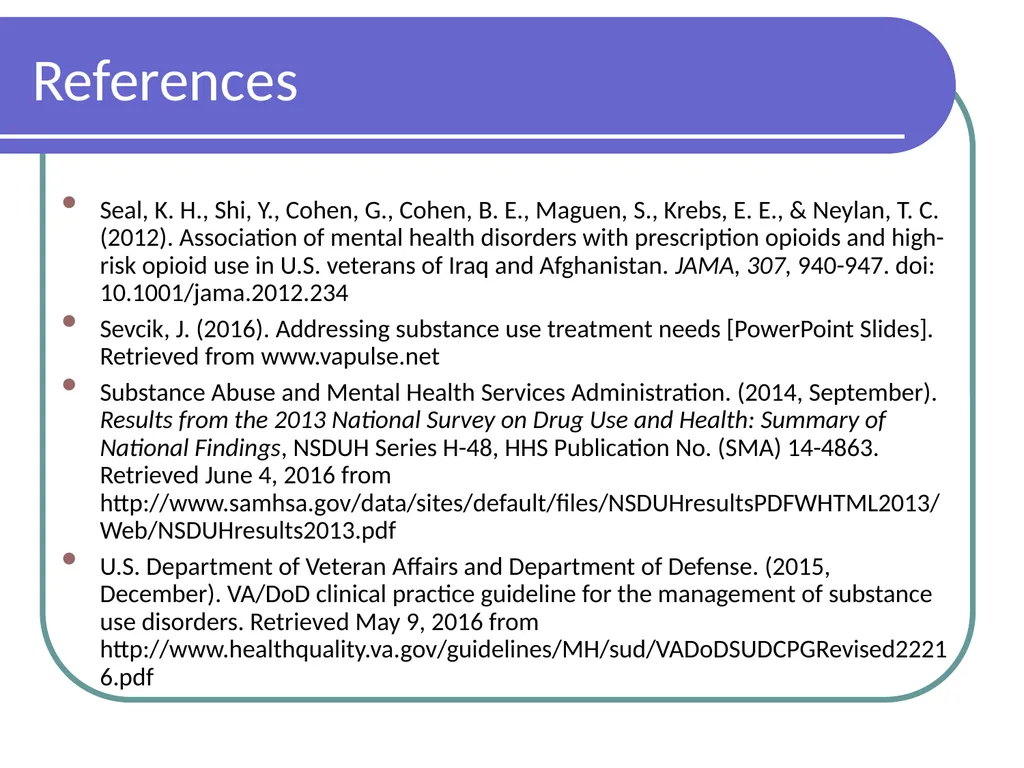
References Seal, K. H., Shi, Y., Cohen, G., Cohen, B. E., Maguen, S., Krebs, E. E., & Neylan, T. C. (2012). Association of mental health disorders with prescription opioids and high-risk opioid use in U.S. veterans of Iraq and Afghanistan. JAMA, 307, 940-947. doi: 10.1001/jama.2012.234
Sevcik, J. (2016). Addressing substance use treatment needs [PowerPoint Slides]. Retrieved from www.vapulse.net
Substance Abuse and Mental Health Services Administration. (2014, September). Results from the 2013 National Survey on Drug Use and Health: Summary of National Findings, NSDUH Series H-48, HHS Publication No. (SMA) 14-4863. Retrieved June 4, 2016 from http://www.samhsa.gov/data/sites/default/files/NSDUHresultsPDFWHTML2013/Web/NSDUHresults2013.pdf
U.S. Department of Veteran Affairs and Department of Defense. (2015, December). VA/DoD clinical practice guideline for the management of substance use disorders. Retrieved May 9, 2016 from http://www.healthquality.va.gov/guidelines/MH/sud/VADoDSUDCPGRevised22216.pdf<br>
Sevcik, J. (2016). Addressing substance use treatment needs [PowerPoint Slides]. Retrieved from www.vapulse.net
Substance Abuse and Mental Health Services Administration. (2014, September). Results from the 2013 National Survey on Drug Use and Health: Summary of National Findings, NSDUH Series H-48, HHS Publication No. (SMA) 14-4863. Retrieved June 4, 2016 from http://www.samhsa.gov/data/sites/default/files/NSDUHresultsPDFWHTML2013/Web/NSDUHresults2013.pdf
U.S. Department of Veteran Affairs and Department of Defense. (2015, December). VA/DoD clinical practice guideline for the management of substance use disorders. Retrieved May 9, 2016 from http://www.healthquality.va.gov/guidelines/MH/sud/VADoDSUDCPGRevised22216.pdf<br>
42
Chemical Dependency Rehabilitation Program (CDRP) at Stratton VAMC Outpatient Programming
SAMHSA’s Matrix Model: Early Recovery Skills & Relapse Prevention
Veterans participate in outpatient programming for approximately 6 months to one year, depending on their needs
Process groups, psychoeducation, & family programming are offered
ACT group for those who have participated in multiple levels of care, multiple times, without a significant change in symptoms
Veterans have enjoyed this group and report that it is more helpful because it is different from other groups they have previously attended multiple times
Intensive Outpatient Programming (IOP)
4 hours per day, 5 days per week, for approximately 5 weeks
Attends four hours of morning programming with SARRTP Veterans
Residential Programming (SARRTP)
12 beds (men & women)
Approximately 35 days, depending on the Veteran’s needs
8+ hours of treatment per day, Monday through Friday
4 hours of treatment on Saturdays & Sundays<br>
SAMHSA’s Matrix Model: Early Recovery Skills & Relapse Prevention
Veterans participate in outpatient programming for approximately 6 months to one year, depending on their needs
Process groups, psychoeducation, & family programming are offered
ACT group for those who have participated in multiple levels of care, multiple times, without a significant change in symptoms
Veterans have enjoyed this group and report that it is more helpful because it is different from other groups they have previously attended multiple times
Intensive Outpatient Programming (IOP)
4 hours per day, 5 days per week, for approximately 5 weeks
Attends four hours of morning programming with SARRTP Veterans
Residential Programming (SARRTP)
12 beds (men & women)
Approximately 35 days, depending on the Veteran’s needs
8+ hours of treatment per day, Monday through Friday
4 hours of treatment on Saturdays & Sundays<br>
43
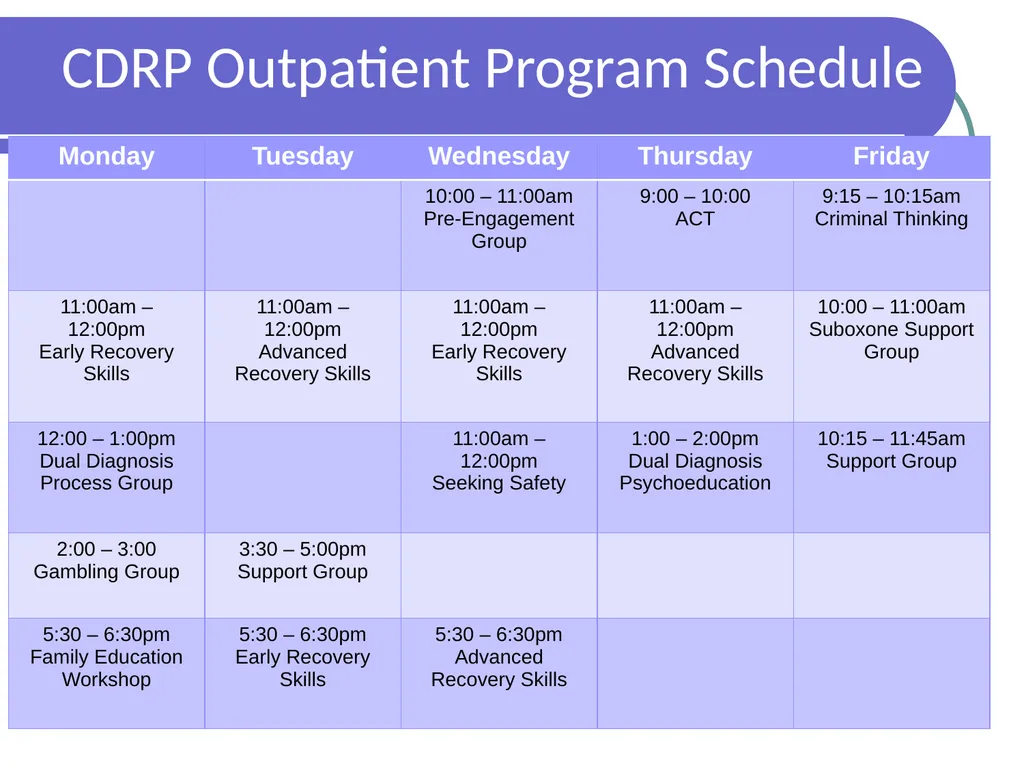
CDRP Outpatient Program Schedule<br>
44
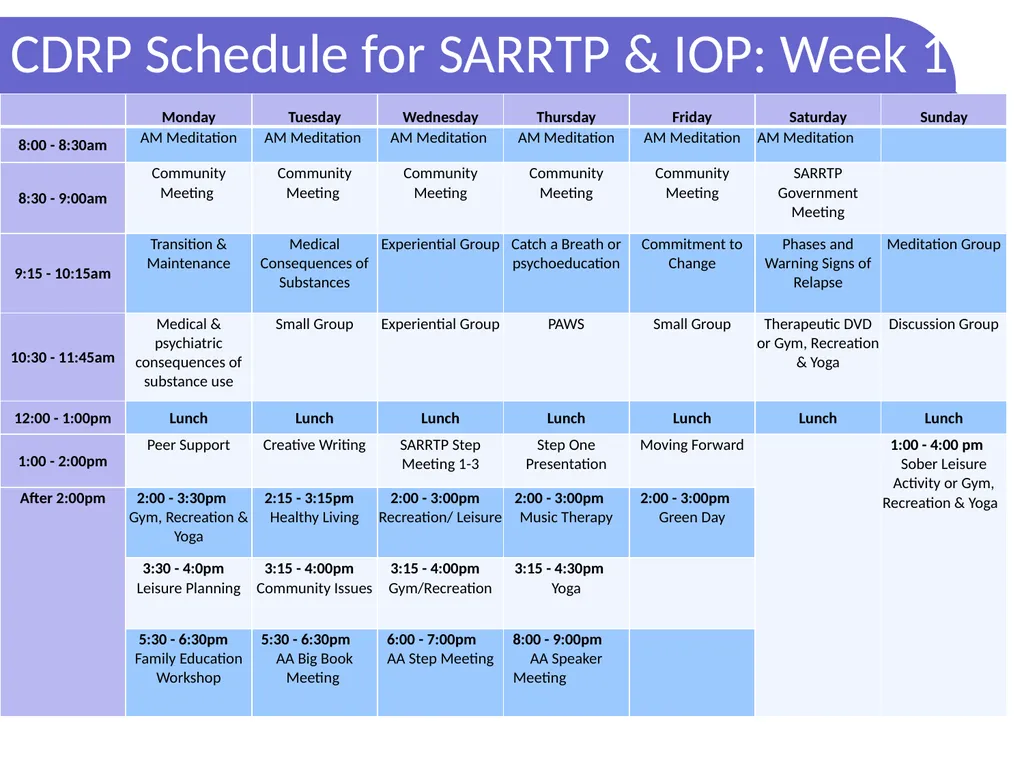
CDRP Schedule for SARRTP & IOP: Week 1<br>
45
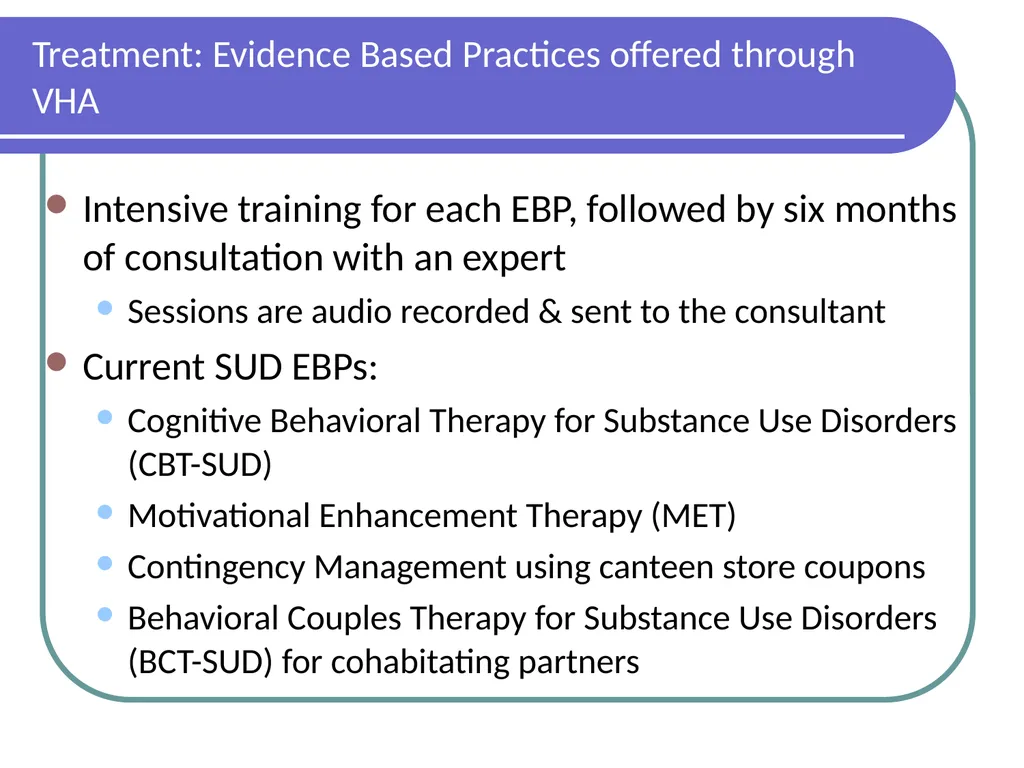
Treatment: Evidence Based Practices offered through VHA Intensive training for each EBP, followed by six months of consultation with an expert
Sessions are audio recorded & sent to the consultant
Current SUD EBPs:
Cognitive Behavioral Therapy for Substance Use Disorders (CBT-SUD)
Motivational Enhancement Therapy (MET)
Contingency Management using canteen store coupons
Behavioral Couples Therapy for Substance Use Disorders (BCT-SUD) for cohabitating partners<br>
Sessions are audio recorded & sent to the consultant
Current SUD EBPs:
Cognitive Behavioral Therapy for Substance Use Disorders (CBT-SUD)
Motivational Enhancement Therapy (MET)
Contingency Management using canteen store coupons
Behavioral Couples Therapy for Substance Use Disorders (BCT-SUD) for cohabitating partners<br>
46
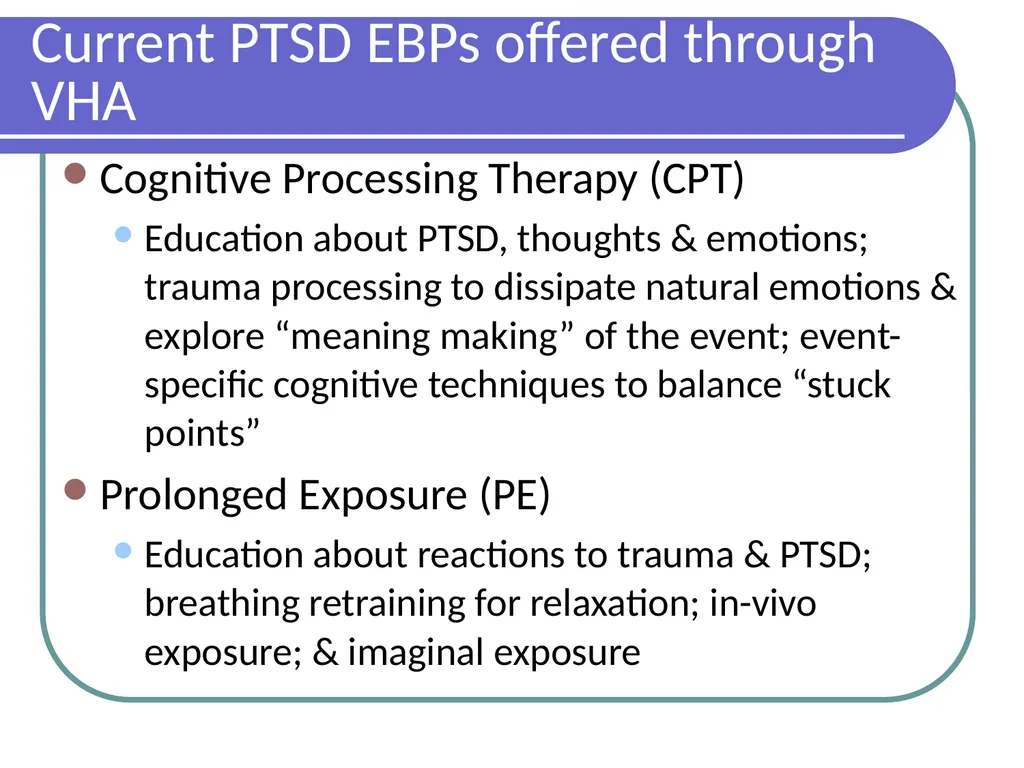
Current PTSD EBPs offered through VHA Cognitive Processing Therapy (CPT)
Education about PTSD, thoughts & emotions; trauma processing to dissipate natural emotions & explore “meaning making” of the event; event-specific cognitive techniques to balance “stuck points”
Prolonged Exposure (PE)
Education about reactions to trauma & PTSD; breathing retraining for relaxation; in-vivo exposure; & imaginal exposure<br>
Education about PTSD, thoughts & emotions; trauma processing to dissipate natural emotions & explore “meaning making” of the event; event-specific cognitive techniques to balance “stuck points”
Prolonged Exposure (PE)
Education about reactions to trauma & PTSD; breathing retraining for relaxation; in-vivo exposure; & imaginal exposure<br>
47
Contact Information Devon Cummings, Ph.D.
Chemical Dependency Rehabilitation Program Manager
Stratton VA Medical Center
113 Holland Ave.
Albany, NY 12047
Phone: 518-626-5394
Email: Devon.Cummings@va.gov<br>
Chemical Dependency Rehabilitation Program Manager
Stratton VA Medical Center
113 Holland Ave.
Albany, NY 12047
Phone: 518-626-5394
Email: Devon.Cummings@va.gov<br>