
Gastrointestinal agents Define and classify
DP
Published · 45 slides · 0 views
1 / 1







Description
Gastrointestinal agents Define and classify gastrointestinal agents with examples. GIT agents- These agents are used in the treatment of GIT disorders such as achlorhydria, hyperacidity, diarrhoea constipation. or The agents which are
Related Topics
Share
Embed code
Download this presentation From Below
"Gastrointestinal agents Define and classify" is the property of its rightful owner. Permission is granted to download and print the materials on this website for personal, non-commercial use only, and to display it on your personal computer provided you do not modify the materials and that you retain all copyright notices contained in the materials. By downloading content from our website, you accept the terms of this agreement.
Presentation Transcript
01
Gastrointestinal agents<br>
02
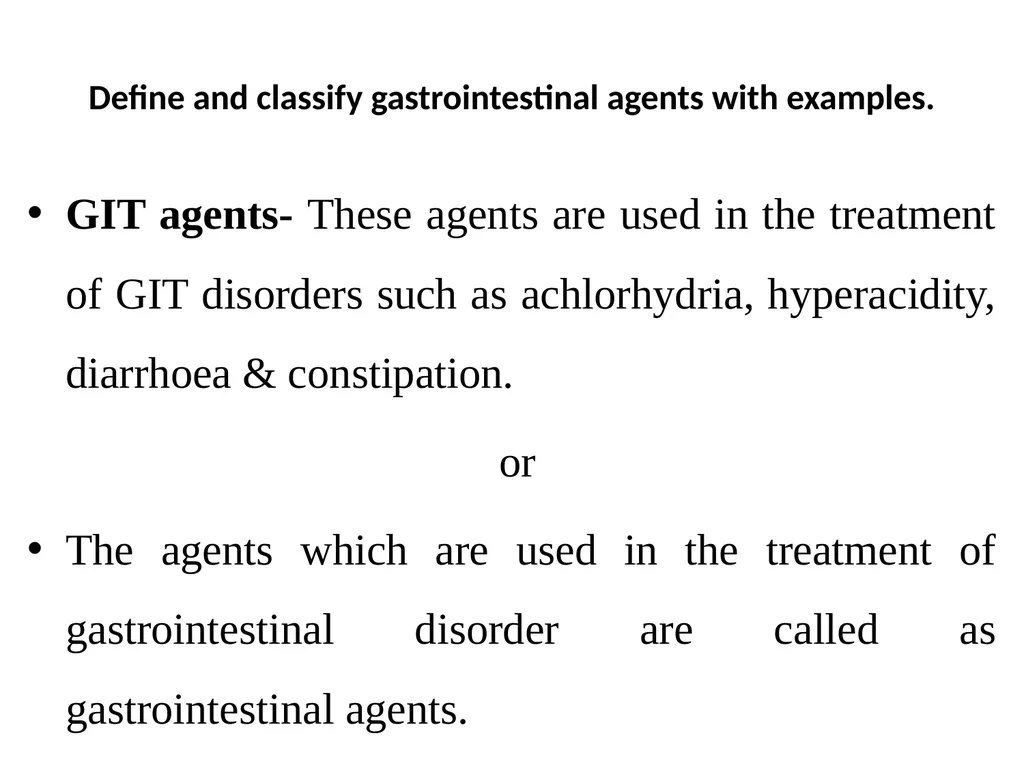
Define and classify gastrointestinal agents with examples. GIT agents- These agents are used in the treatment of GIT disorders such as achlorhydria, hyperacidity, diarrhoea & constipation.
or
The agents which are used in the treatment of gastrointestinal disorder are called as gastrointestinal agents.<br>
or
The agents which are used in the treatment of gastrointestinal disorder are called as gastrointestinal agents.<br>
03
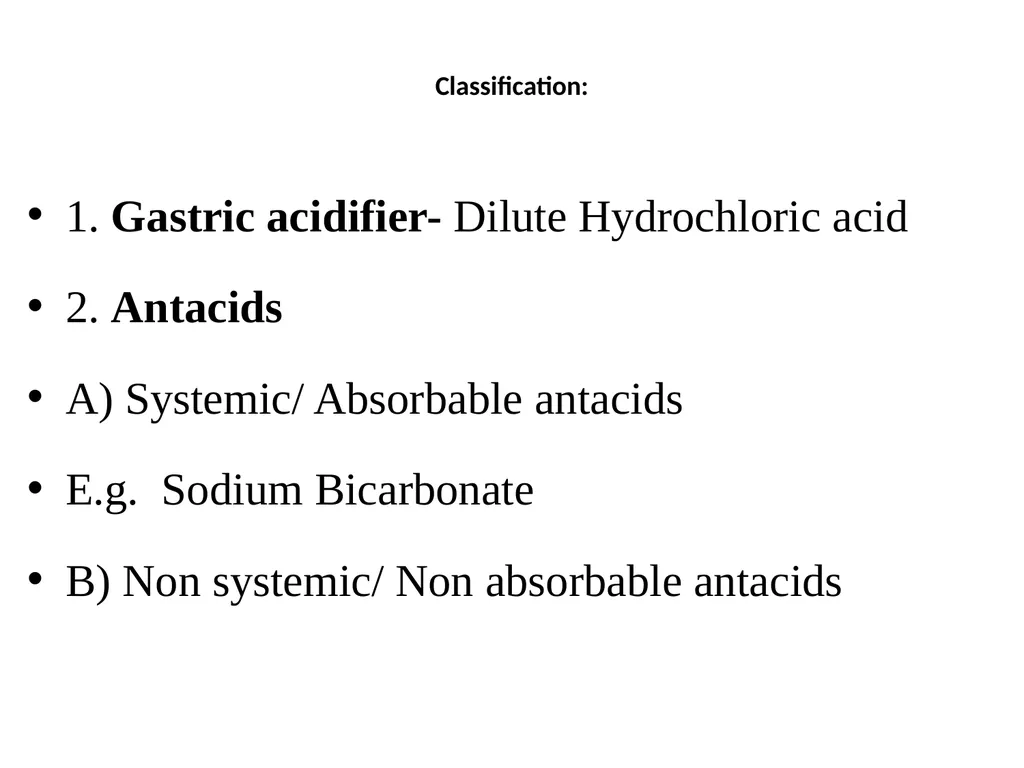
Classification: 1. Gastric acidifier- Dilute Hydrochloric acid
2. Antacids
A) Systemic/ Absorbable antacids
E.g. Sodium Bicarbonate
B) Non systemic/ Non absorbable antacids<br>
2. Antacids
A) Systemic/ Absorbable antacids
E.g. Sodium Bicarbonate
B) Non systemic/ Non absorbable antacids<br>
04
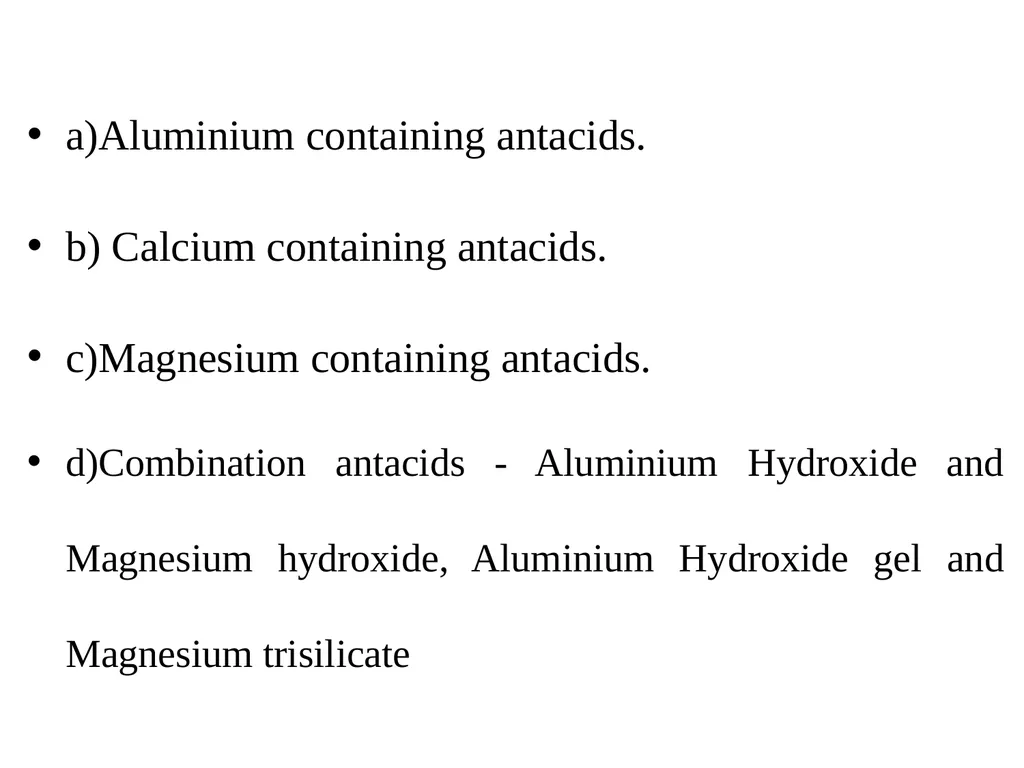
a)Aluminium containing antacids.
b) Calcium containing antacids.
c)Magnesium containing antacids.
d)Combination antacids - Aluminium Hydroxide and Magnesium hydroxide, Aluminium Hydroxide gel and Magnesium trisilicate<br>
b) Calcium containing antacids.
c)Magnesium containing antacids.
d)Combination antacids - Aluminium Hydroxide and Magnesium hydroxide, Aluminium Hydroxide gel and Magnesium trisilicate<br>
05
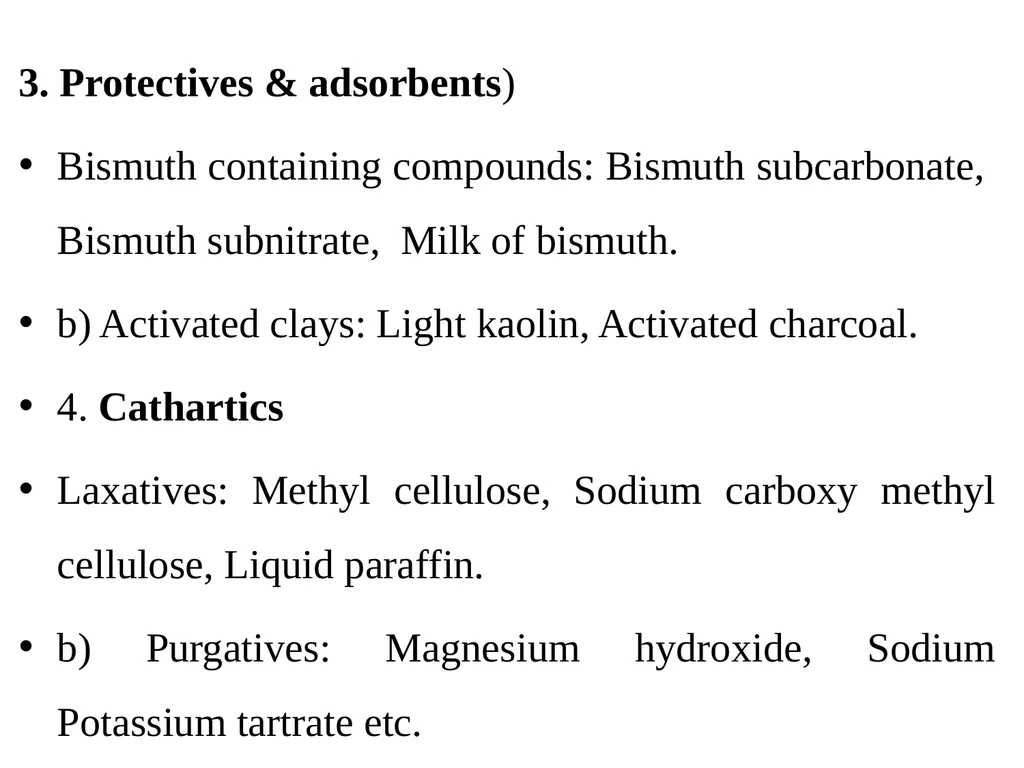
3. Protectives & adsorbents)
Bismuth containing compounds: Bismuth subcarbonate, Bismuth subnitrate, Milk of bismuth.
b) Activated clays: Light kaolin, Activated charcoal.
4. Cathartics
Laxatives: Methyl cellulose, Sodium carboxy methyl cellulose, Liquid paraffin.
b) Purgatives: Magnesium hydroxide, Sodium Potassium tartrate etc.<br>
Bismuth containing compounds: Bismuth subcarbonate, Bismuth subnitrate, Milk of bismuth.
b) Activated clays: Light kaolin, Activated charcoal.
4. Cathartics
Laxatives: Methyl cellulose, Sodium carboxy methyl cellulose, Liquid paraffin.
b) Purgatives: Magnesium hydroxide, Sodium Potassium tartrate etc.<br>
06
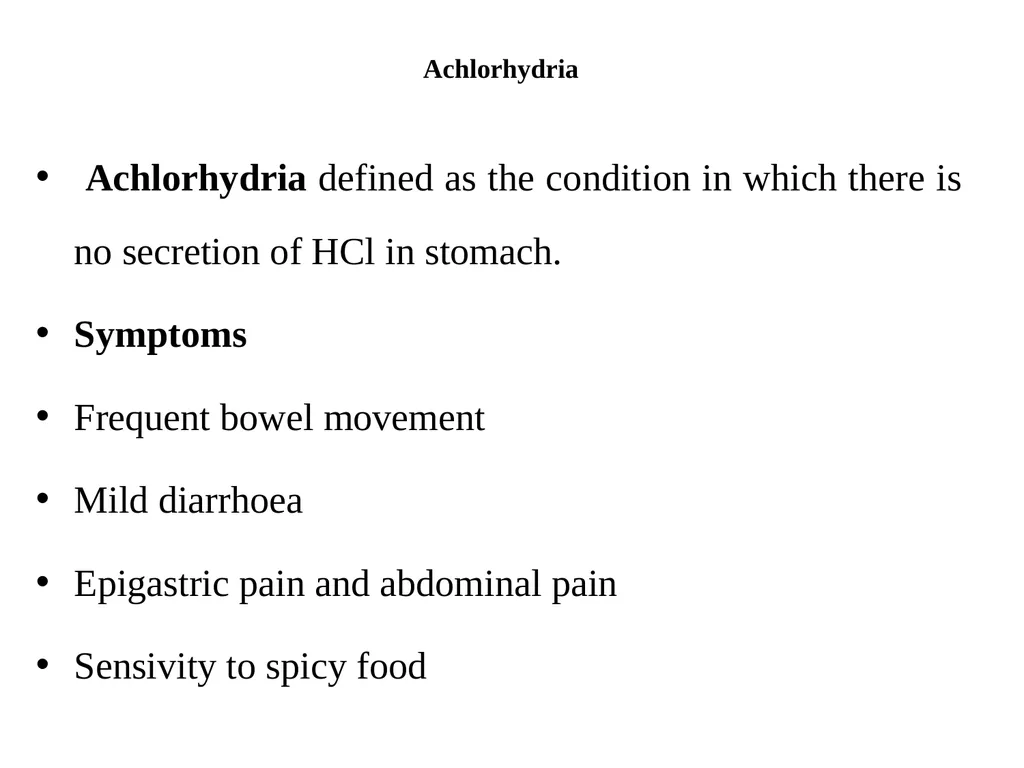
Achlorhydria Achlorhydria defined as the condition in which there is no secretion of HCl in stomach.
Symptoms
Frequent bowel movement
Mild diarrhoea
Epigastric pain and abdominal pain
Sensivity to spicy food<br>
Symptoms
Frequent bowel movement
Mild diarrhoea
Epigastric pain and abdominal pain
Sensivity to spicy food<br>
07
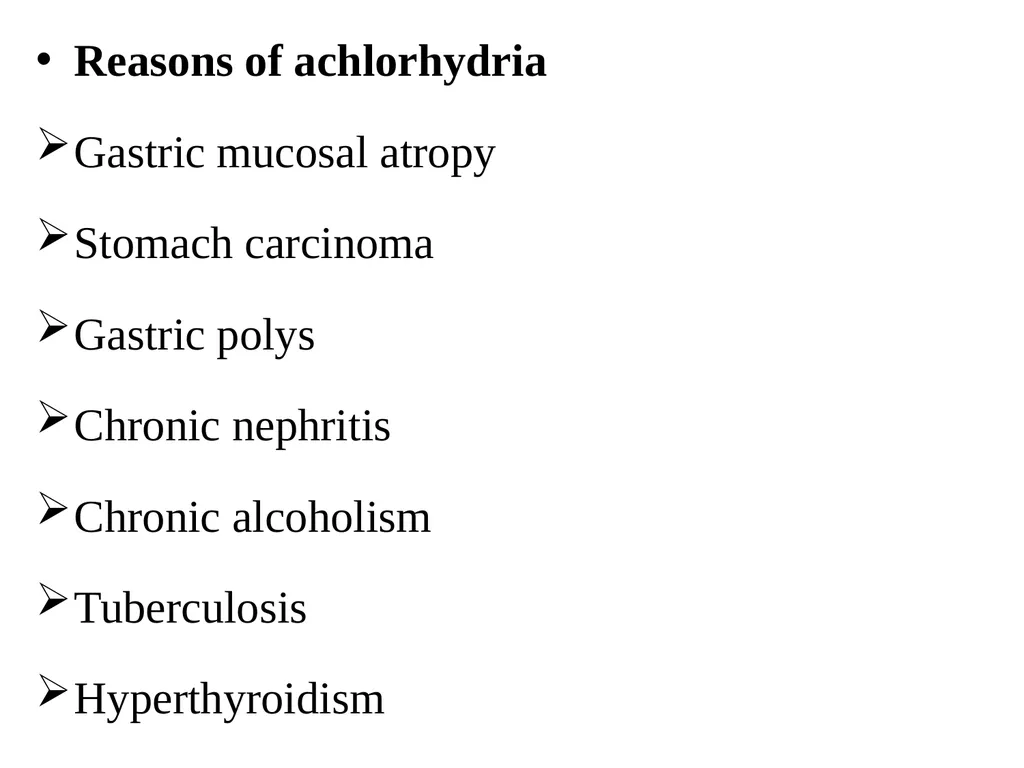
Reasons of achlorhydria
Gastric mucosal atropy
Stomach carcinoma
Gastric polys
Chronic nephritis
Chronic alcoholism
Tuberculosis
Hyperthyroidism<br>
Gastric mucosal atropy
Stomach carcinoma
Gastric polys
Chronic nephritis
Chronic alcoholism
Tuberculosis
Hyperthyroidism<br>
08
Drug used in treatment of achlorhydria?
Dilute hydrochloric acid is used for treatment of achlorhydria.
It increase gastric HCl level.<br>
Dilute hydrochloric acid is used for treatment of achlorhydria.
It increase gastric HCl level.<br>
09
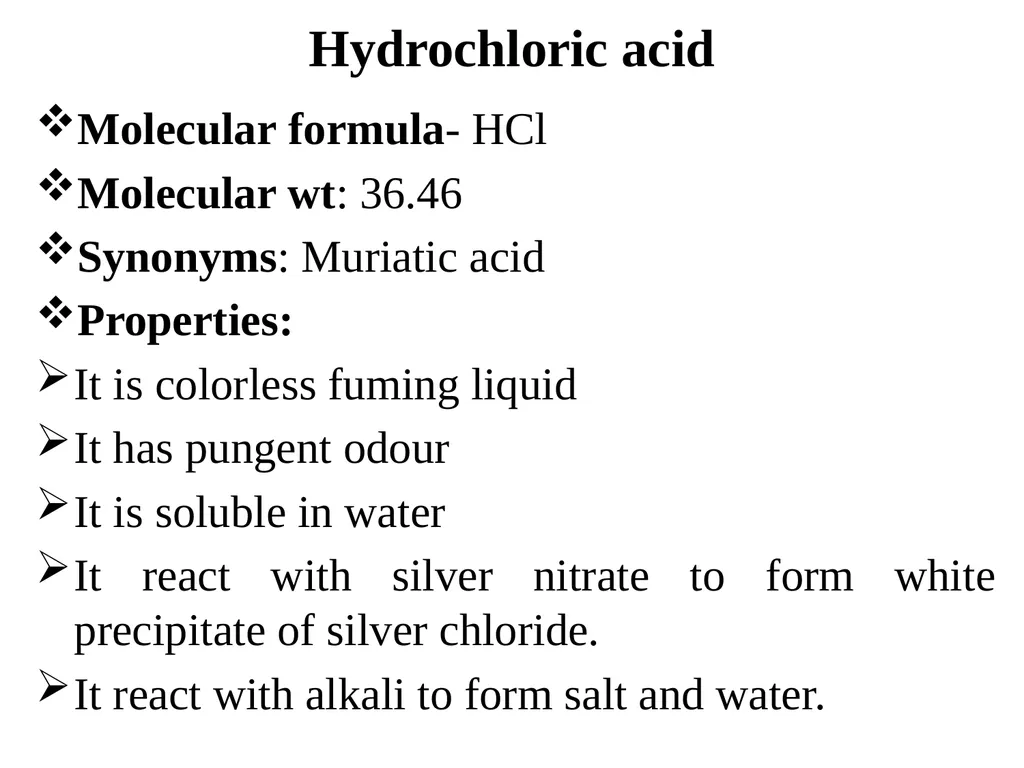
Hydrochloric acid Molecular formula- HCl
Molecular wt: 36.46
Synonyms: Muriatic acid
Properties:
It is colorless fuming liquid
It has pungent odour
It is soluble in water
It react with silver nitrate to form white precipitate of silver chloride.
It react with alkali to form salt and water.<br>
Molecular wt: 36.46
Synonyms: Muriatic acid
Properties:
It is colorless fuming liquid
It has pungent odour
It is soluble in water
It react with silver nitrate to form white precipitate of silver chloride.
It react with alkali to form salt and water.<br>
10
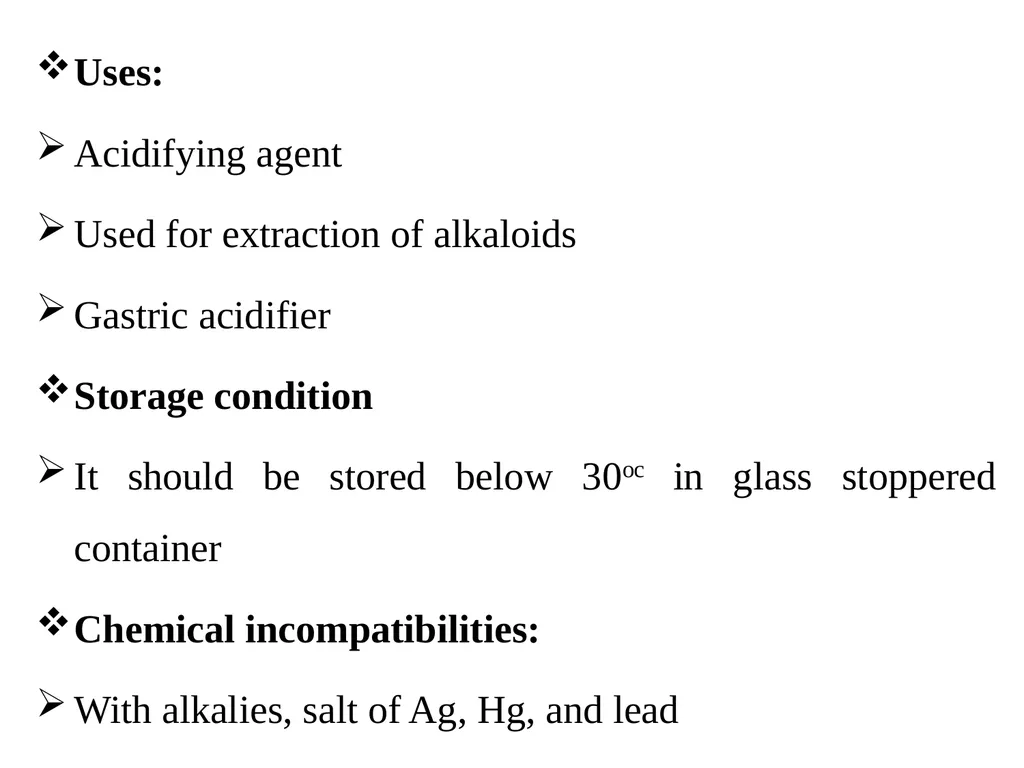
Uses:
Acidifying agent
Used for extraction of alkaloids
Gastric acidifier
Storage condition
It should be stored below 30oc in glass stoppered container
Chemical incompatibilities:
With alkalies, salt of Ag, Hg, and lead<br>
Acidifying agent
Used for extraction of alkaloids
Gastric acidifier
Storage condition
It should be stored below 30oc in glass stoppered container
Chemical incompatibilities:
With alkalies, salt of Ag, Hg, and lead<br>
11
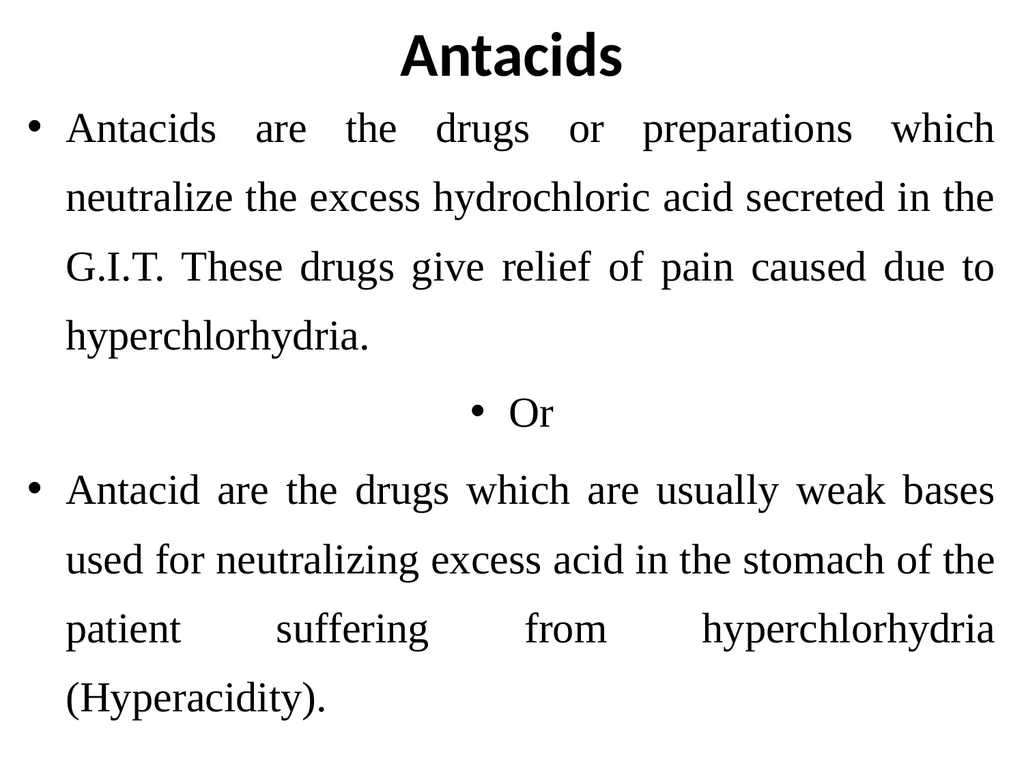
Antacids Antacids are the drugs or preparations which neutralize the excess hydrochloric acid secreted in the G.I.T. These drugs give relief of pain caused due to hyperchlorhydria.
Or
Antacid are the drugs which are usually weak bases used for neutralizing excess acid in the stomach of the patient suffering from hyperchlorhydria (Hyperacidity).<br>
Or
Antacid are the drugs which are usually weak bases used for neutralizing excess acid in the stomach of the patient suffering from hyperchlorhydria (Hyperacidity).<br>
12
Ideal characteristics of an antacid- It should not be absorbable and cause systemic alkalosis.
It should not be laxative or cause constipation.
It should exert effect rapidly & over a long period of time.
It should buffer in pH 4-6.
It should not produce large volume of gas.
It should be palatable & inexpensive.
It should probably inhibit pepsin.<br>
It should not be laxative or cause constipation.
It should exert effect rapidly & over a long period of time.
It should buffer in pH 4-6.
It should not produce large volume of gas.
It should be palatable & inexpensive.
It should probably inhibit pepsin.<br>
13
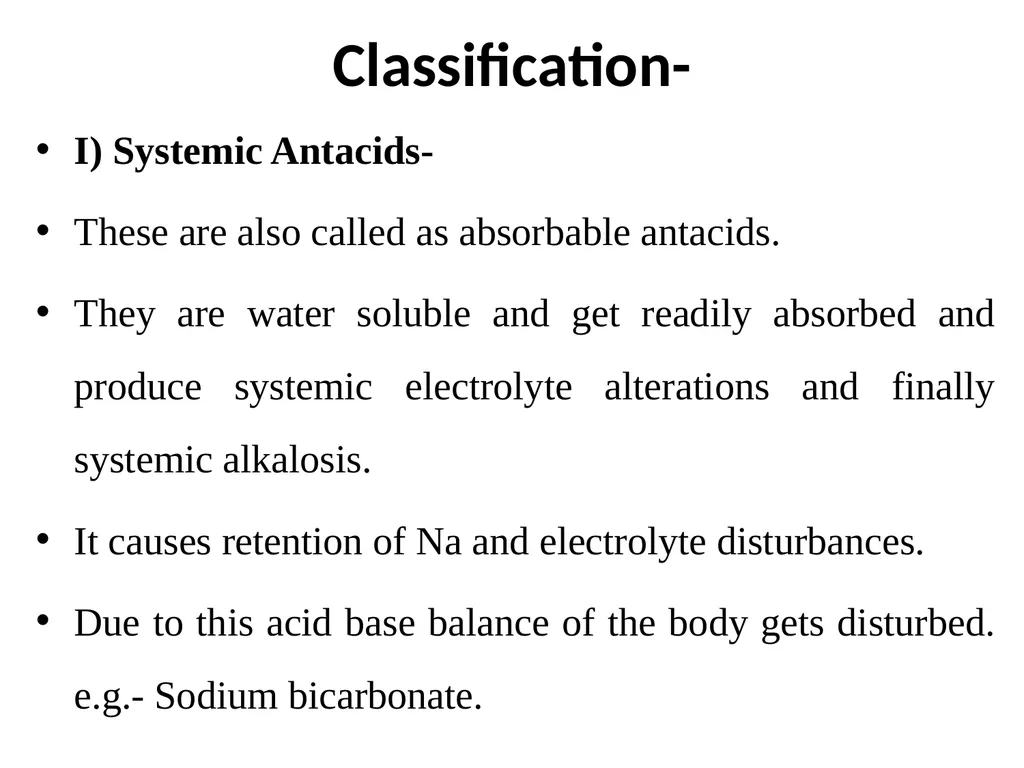
Classification- I) Systemic Antacids-
These are also called as absorbable antacids.
They are water soluble and get readily absorbed and produce systemic electrolyte alterations and finally systemic alkalosis.
It causes retention of Na and electrolyte disturbances.
Due to this acid base balance of the body gets disturbed. e.g.- Sodium bicarbonate.<br>
These are also called as absorbable antacids.
They are water soluble and get readily absorbed and produce systemic electrolyte alterations and finally systemic alkalosis.
It causes retention of Na and electrolyte disturbances.
Due to this acid base balance of the body gets disturbed. e.g.- Sodium bicarbonate.<br>
14
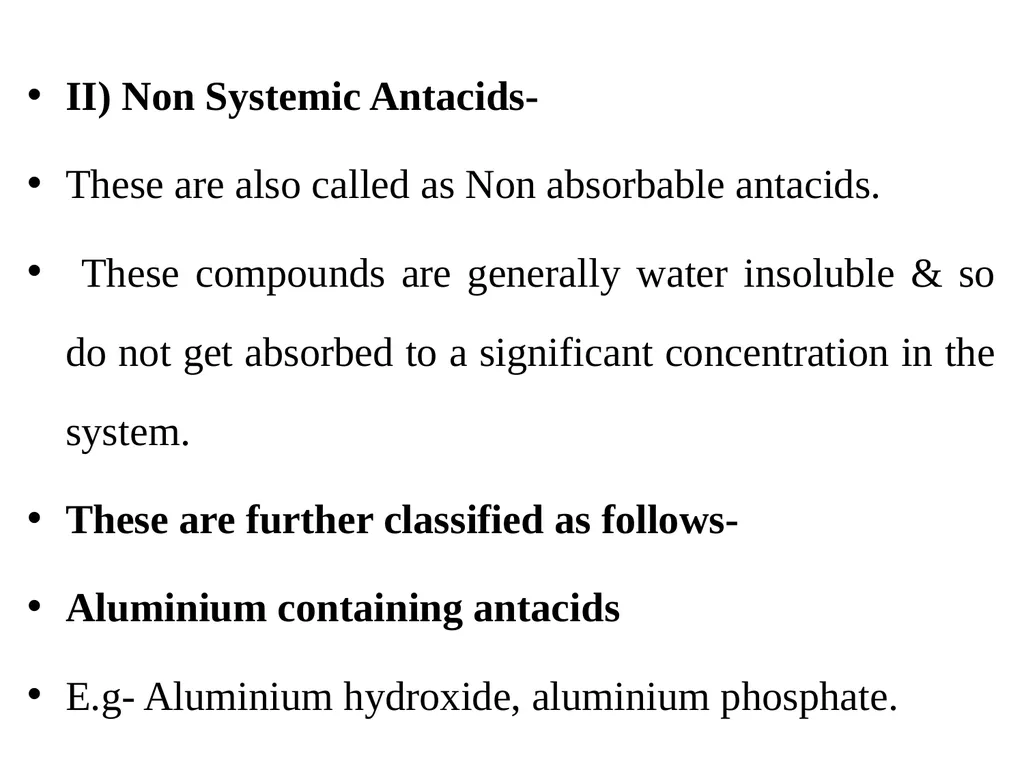
II) Non Systemic Antacids-
These are also called as Non absorbable antacids.
These compounds are generally water insoluble & so do not get absorbed to a significant concentration in the system.
These are further classified as follows-
Aluminium containing antacids
E.g- Aluminium hydroxide, aluminium phosphate.<br>
These are also called as Non absorbable antacids.
These compounds are generally water insoluble & so do not get absorbed to a significant concentration in the system.
These are further classified as follows-
Aluminium containing antacids
E.g- Aluminium hydroxide, aluminium phosphate.<br>
15
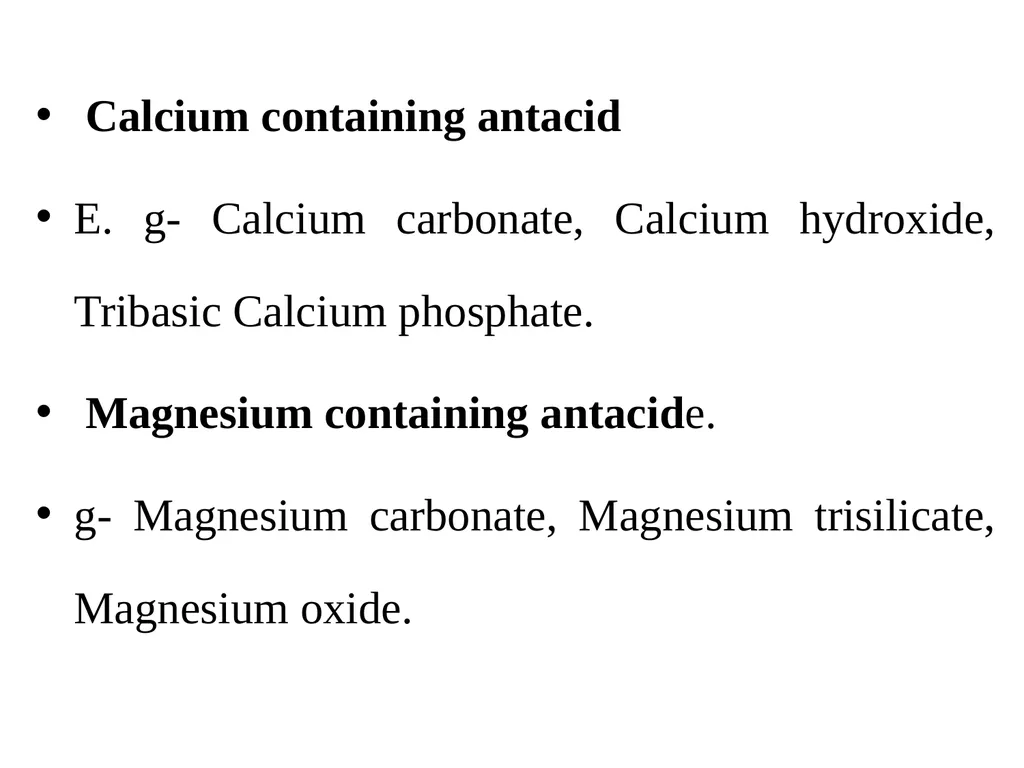
Calcium containing antacid
E. g- Calcium carbonate, Calcium hydroxide, Tribasic Calcium phosphate.
Magnesium containing antacide.
g- Magnesium carbonate, Magnesium trisilicate, Magnesium oxide.<br>
E. g- Calcium carbonate, Calcium hydroxide, Tribasic Calcium phosphate.
Magnesium containing antacide.
g- Magnesium carbonate, Magnesium trisilicate, Magnesium oxide.<br>
16
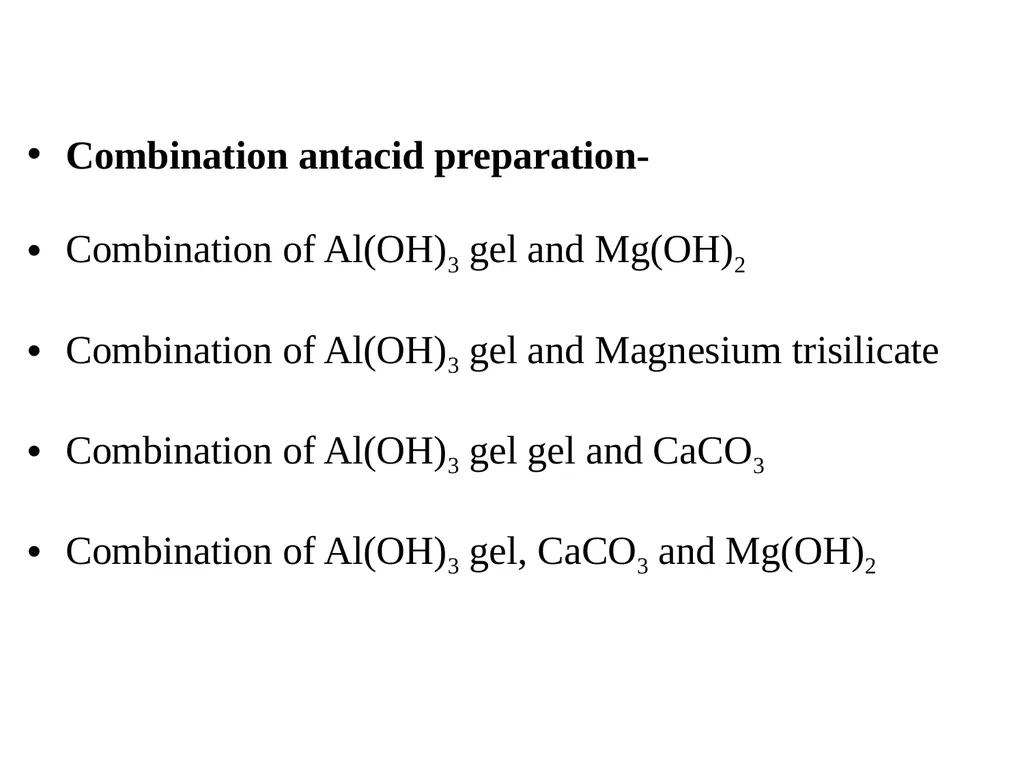
Combination antacid preparation-
Combination of Al(OH)3 gel and Mg(OH)2
Combination of Al(OH)3 gel and Magnesium trisilicate
Combination of Al(OH)3 gel gel and CaCO3
Combination of Al(OH)3 gel, CaCO3 and Mg(OH)2<br>
Combination of Al(OH)3 gel and Mg(OH)2
Combination of Al(OH)3 gel and Magnesium trisilicate
Combination of Al(OH)3 gel gel and CaCO3
Combination of Al(OH)3 gel, CaCO3 and Mg(OH)2<br>
17
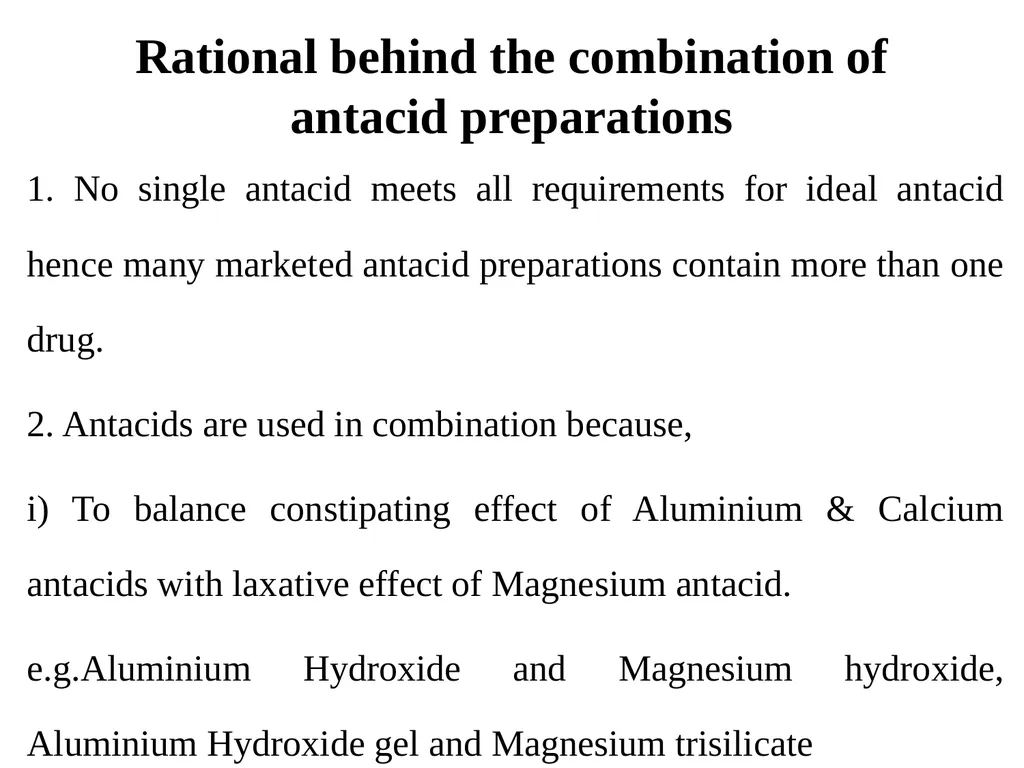
Rational behind the combination of antacid preparations 1. No single antacid meets all requirements for ideal antacid hence many marketed antacid preparations contain more than one drug.
2. Antacids are used in combination because,
i) To balance constipating effect of Aluminium & Calcium antacids with laxative effect of Magnesium antacid.
e.g.Aluminium Hydroxide and Magnesium hydroxide, Aluminium Hydroxide gel and Magnesium trisilicate<br>
2. Antacids are used in combination because,
i) To balance constipating effect of Aluminium & Calcium antacids with laxative effect of Magnesium antacid.
e.g.Aluminium Hydroxide and Magnesium hydroxide, Aluminium Hydroxide gel and Magnesium trisilicate<br>
18
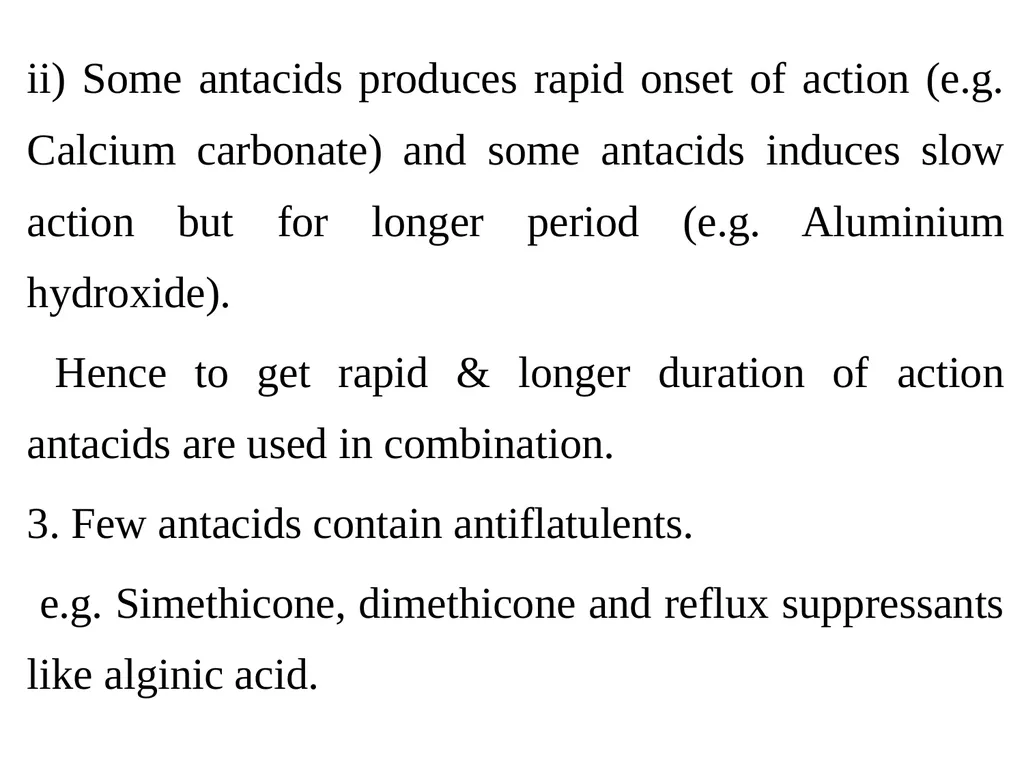
ii) Some antacids produces rapid onset of action (e.g. Calcium carbonate) and some antacids induces slow action but for longer period (e.g. Aluminium hydroxide).
Hence to get rapid & longer duration of action antacids are used in combination.
3. Few antacids contain antiflatulents.
e.g. Simethicone, dimethicone and reflux suppressants like alginic acid.<br>
Hence to get rapid & longer duration of action antacids are used in combination.
3. Few antacids contain antiflatulents.
e.g. Simethicone, dimethicone and reflux suppressants like alginic acid.<br>
19
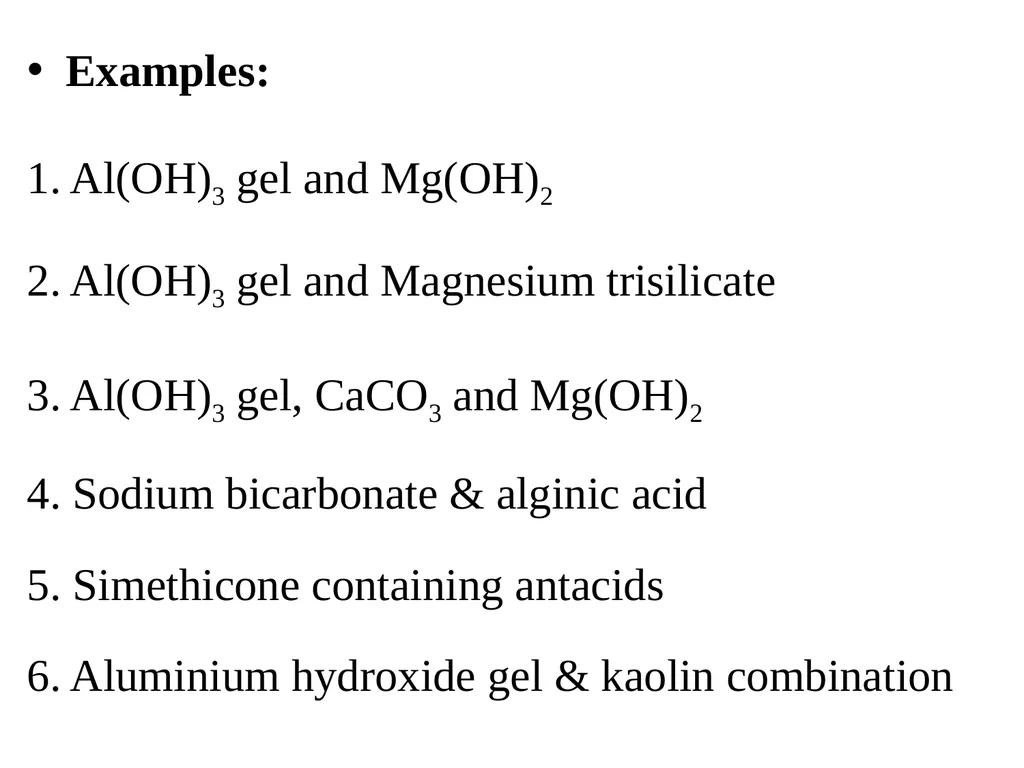
Examples:
1. Al(OH)3 gel and Mg(OH)2
2. Al(OH)3 gel and Magnesium trisilicate
3. Al(OH)3 gel, CaCO3 and Mg(OH)2
4. Sodium bicarbonate & alginic acid
5. Simethicone containing antacids
6. Aluminium hydroxide gel & kaolin combination<br>
1. Al(OH)3 gel and Mg(OH)2
2. Al(OH)3 gel and Magnesium trisilicate
3. Al(OH)3 gel, CaCO3 and Mg(OH)2
4. Sodium bicarbonate & alginic acid
5. Simethicone containing antacids
6. Aluminium hydroxide gel & kaolin combination<br>
20
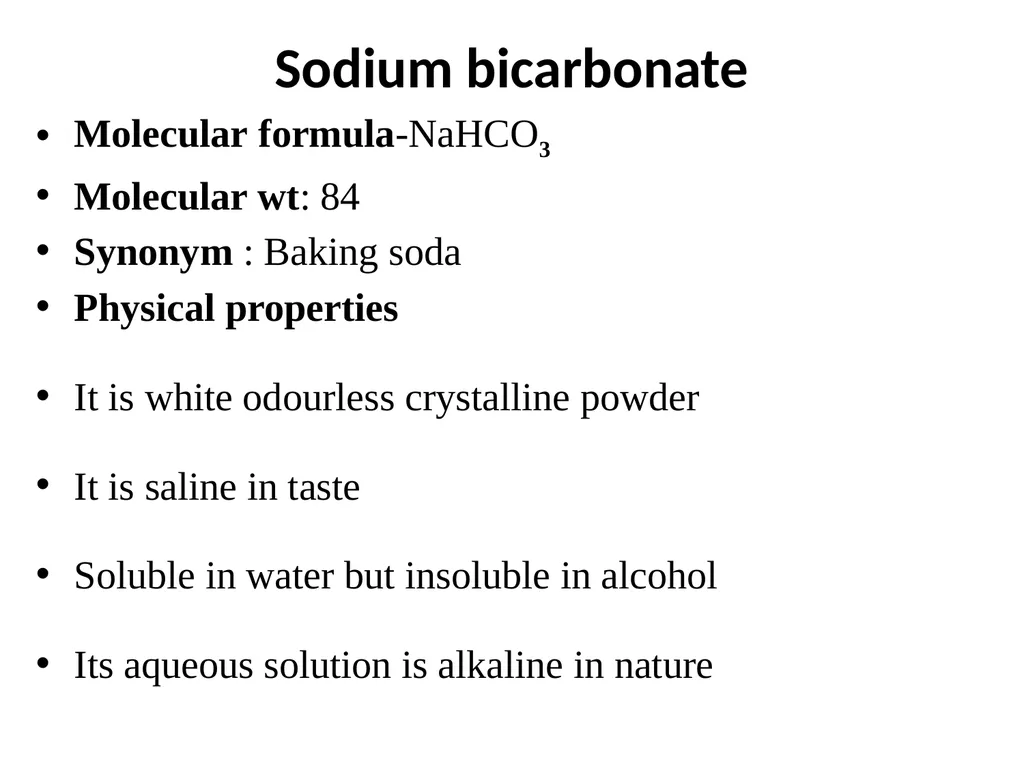
Sodium bicarbonate Molecular formula-NaHCO3
Molecular wt: 84
Synonym : Baking soda
Physical properties
It is white odourless crystalline powder
It is saline in taste
Soluble in water but insoluble in alcohol
Its aqueous solution is alkaline in nature<br>
Molecular wt: 84
Synonym : Baking soda
Physical properties
It is white odourless crystalline powder
It is saline in taste
Soluble in water but insoluble in alcohol
Its aqueous solution is alkaline in nature<br>
21
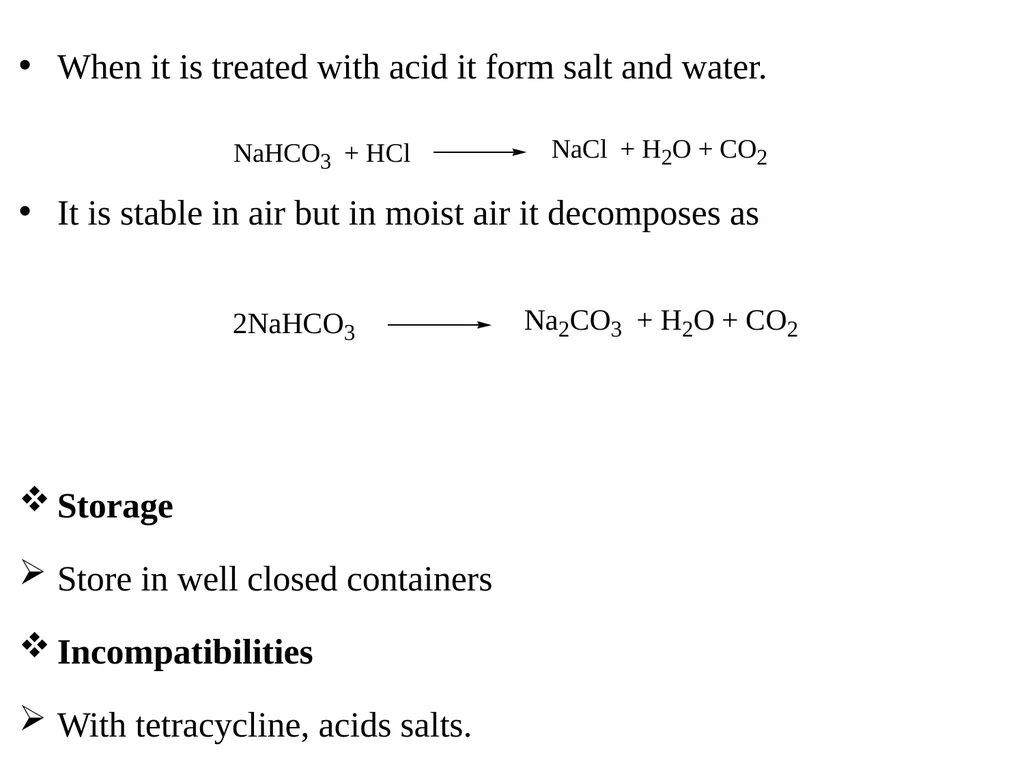
When it is treated with acid it form salt and water.
It is stable in air but in moist air it decomposes as
Storage
Store in well closed containers
Incompatibilities
With tetracycline, acids salts.<br>
It is stable in air but in moist air it decomposes as
Storage
Store in well closed containers
Incompatibilities
With tetracycline, acids salts.<br>
22
Preparation
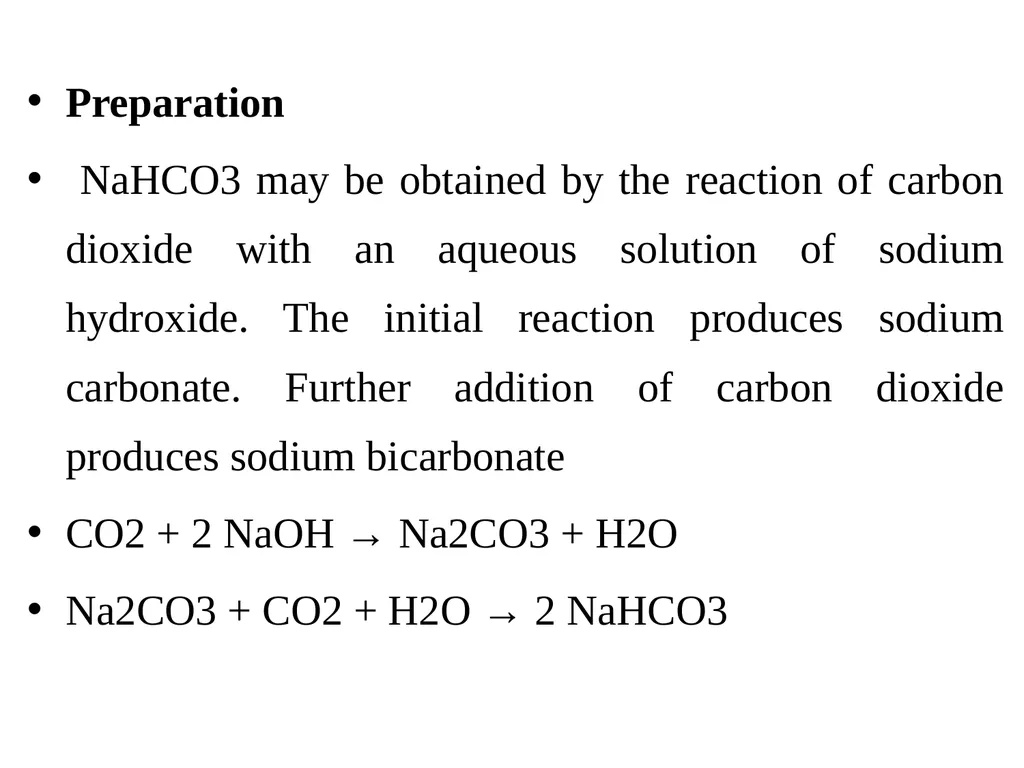
NaHCO3 may be obtained by the reaction of carbon dioxide with an aqueous solution of sodium hydroxide. The initial reaction produces sodium carbonate. Further addition of carbon dioxide produces sodium bicarbonate
CO2 + 2 NaOH → Na2CO3 + H2O
Na2CO3 + CO2 + H2O → 2 NaHCO3<br>
NaHCO3 may be obtained by the reaction of carbon dioxide with an aqueous solution of sodium hydroxide. The initial reaction produces sodium carbonate. Further addition of carbon dioxide produces sodium bicarbonate
CO2 + 2 NaOH → Na2CO3 + H2O
Na2CO3 + CO2 + H2O → 2 NaHCO3<br>
23
Uses of sodium bicarbonate
It is used as Antacid.
It is used as systemic antacid in treatment of systemic acidosis.
It is used as electrolyte replenisher.
3 to 5% solution in warm water is used as eye lotion.
It is used as an ingredient of compound NaHCO3 tablets.
It is also used in effervescent antacid.<br>
It is used as Antacid.
It is used as systemic antacid in treatment of systemic acidosis.
It is used as electrolyte replenisher.
3 to 5% solution in warm water is used as eye lotion.
It is used as an ingredient of compound NaHCO3 tablets.
It is also used in effervescent antacid.<br>
24
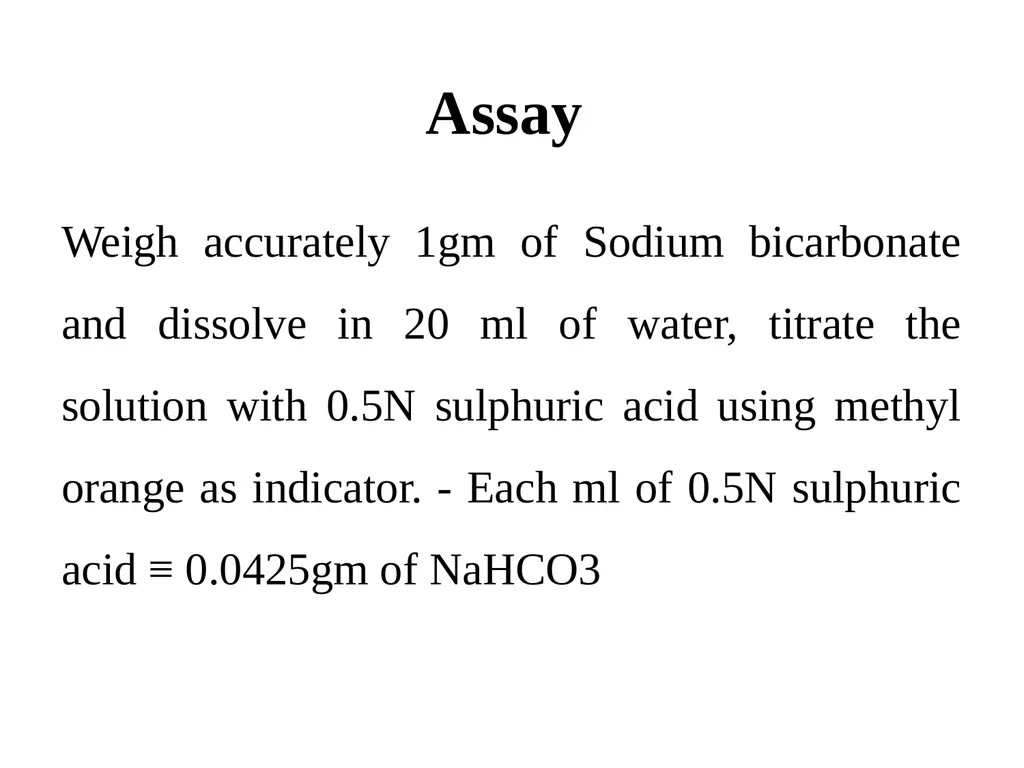
Assay Weigh accurately 1gm of Sodium bicarbonate and dissolve in 20 ml of water, titrate the solution with 0.5N sulphuric acid using methyl orange as indicator. - Each ml of 0.5N sulphuric acid ≡ 0.0425gm of NaHCO3<br>
25
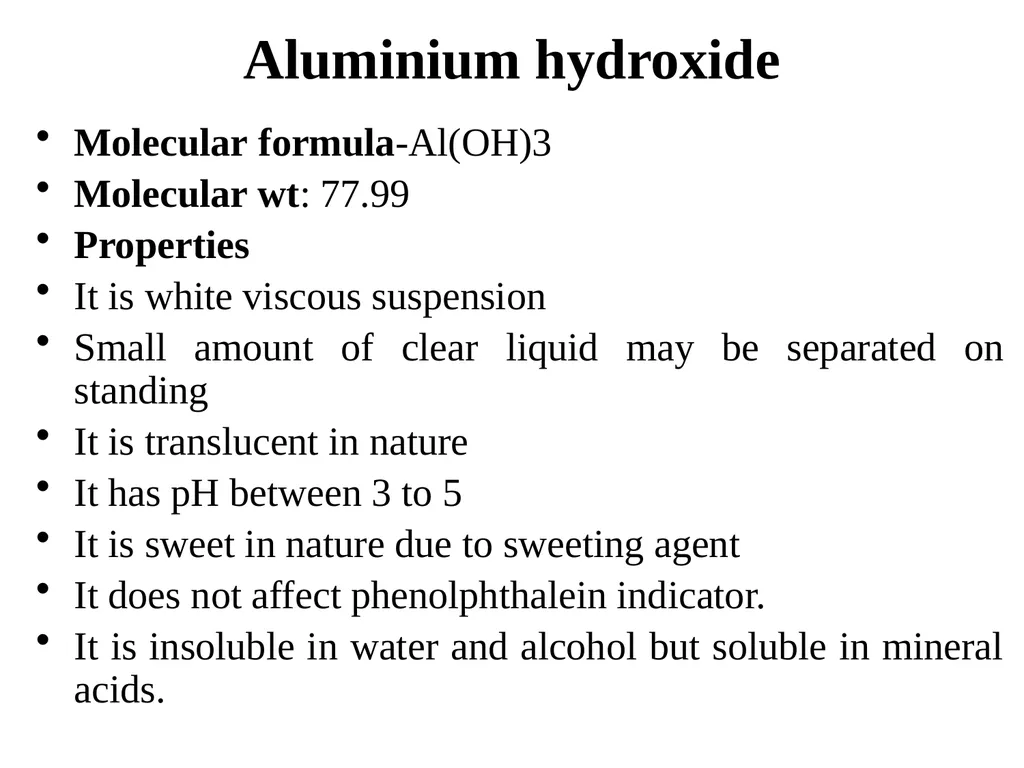
Aluminium hydroxide Molecular formula-Al(OH)3
Molecular wt: 77.99
Properties
It is white viscous suspension
Small amount of clear liquid may be separated on standing
It is translucent in nature
It has pH between 3 to 5
It is sweet in nature due to sweeting agent
It does not affect phenolphthalein indicator.
It is insoluble in water and alcohol but soluble in mineral acids.<br>
Molecular wt: 77.99
Properties
It is white viscous suspension
Small amount of clear liquid may be separated on standing
It is translucent in nature
It has pH between 3 to 5
It is sweet in nature due to sweeting agent
It does not affect phenolphthalein indicator.
It is insoluble in water and alcohol but soluble in mineral acids.<br>
26
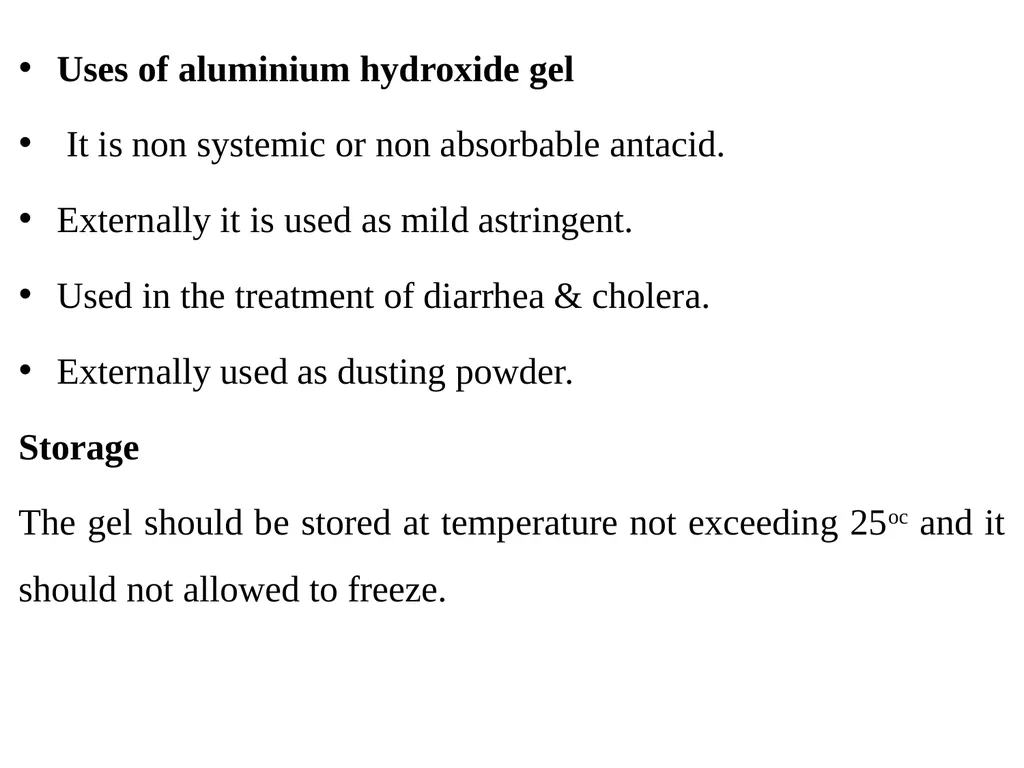
Uses of aluminium hydroxide gel
It is non systemic or non absorbable antacid.
Externally it is used as mild astringent.
Used in the treatment of diarrhea & cholera.
Externally used as dusting powder.
Storage
The gel should be stored at temperature not exceeding 25oc and it should not allowed to freeze.<br>
It is non systemic or non absorbable antacid.
Externally it is used as mild astringent.
Used in the treatment of diarrhea & cholera.
Externally used as dusting powder.
Storage
The gel should be stored at temperature not exceeding 25oc and it should not allowed to freeze.<br>
27
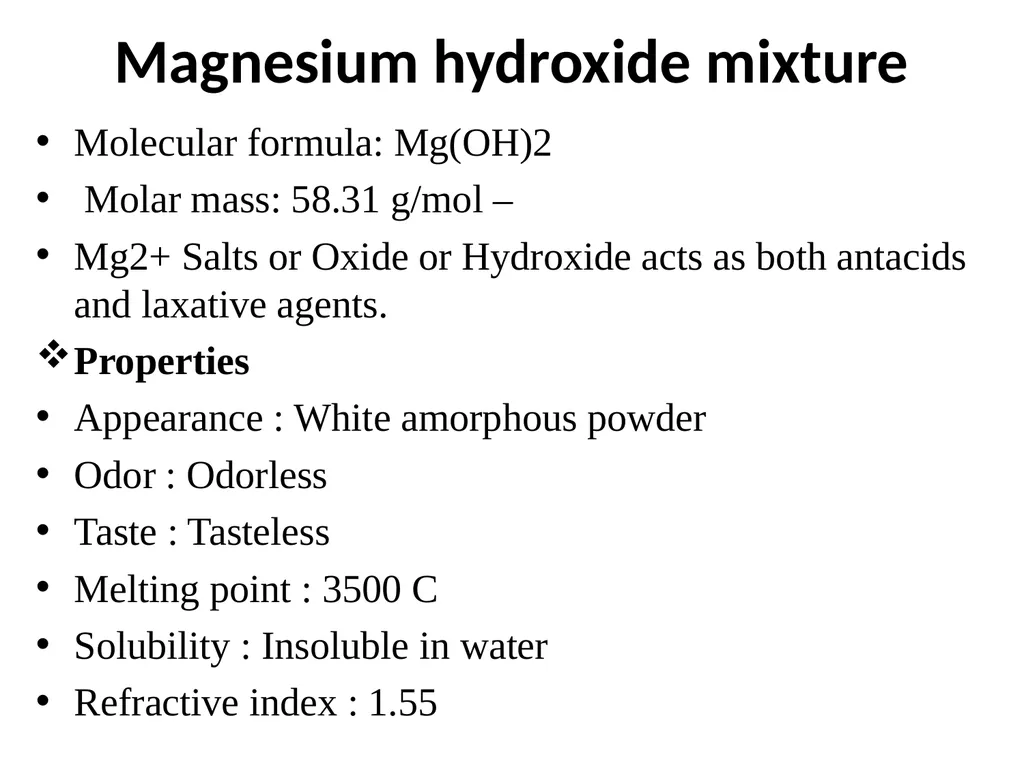
Magnesium hydroxide mixture Molecular formula: Mg(OH)2
Molar mass: 58.31 g/mol –
Mg2+ Salts or Oxide or Hydroxide acts as both antacids and laxative agents.
Properties
Appearance : White amorphous powder
Odor : Odorless
Taste : Tasteless
Melting point : 3500 C
Solubility : Insoluble in water
Refractive index : 1.55<br>
Molar mass: 58.31 g/mol –
Mg2+ Salts or Oxide or Hydroxide acts as both antacids and laxative agents.
Properties
Appearance : White amorphous powder
Odor : Odorless
Taste : Tasteless
Melting point : 3500 C
Solubility : Insoluble in water
Refractive index : 1.55<br>
28
Preparation:
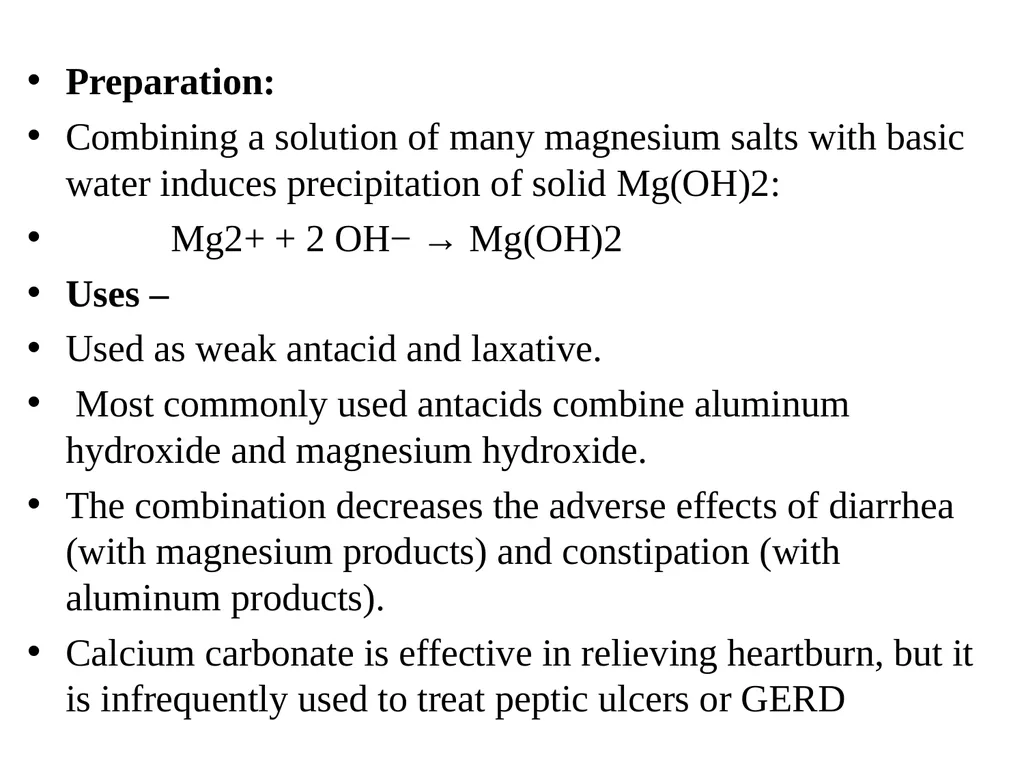
Combining a solution of many magnesium salts with basic water induces precipitation of solid Mg(OH)2:
Mg2+ + 2 OH− → Mg(OH)2
Uses –
Used as weak antacid and laxative.
Most commonly used antacids combine aluminum hydroxide and magnesium hydroxide.
The combination decreases the adverse effects of diarrhea (with magnesium products) and constipation (with aluminum products).
Calcium carbonate is effective in relieving heartburn, but it is infrequently used to treat peptic ulcers or GERD<br>
Combining a solution of many magnesium salts with basic water induces precipitation of solid Mg(OH)2:
Mg2+ + 2 OH− → Mg(OH)2
Uses –
Used as weak antacid and laxative.
Most commonly used antacids combine aluminum hydroxide and magnesium hydroxide.
The combination decreases the adverse effects of diarrhea (with magnesium products) and constipation (with aluminum products).
Calcium carbonate is effective in relieving heartburn, but it is infrequently used to treat peptic ulcers or GERD<br>
29
Cathartics These are the drugs which gives relief from constipation. Or these are the drugs which brings defecation.<br>
30
Mechanism action of cathartics 1.Bulk producing drugs: These drugs promote evacuation by increasing the stool bulk volume and water content.
e.g. Isapgol, agar-agar, methylcellulose
2. Stool softners/ Emollient: It penetrates, lubricates and softens the stools.
e.g. Liquid paraffin, mineral oils etc.<br>
e.g. Isapgol, agar-agar, methylcellulose
2. Stool softners/ Emollient: It penetrates, lubricates and softens the stools.
e.g. Liquid paraffin, mineral oils etc.<br>
31
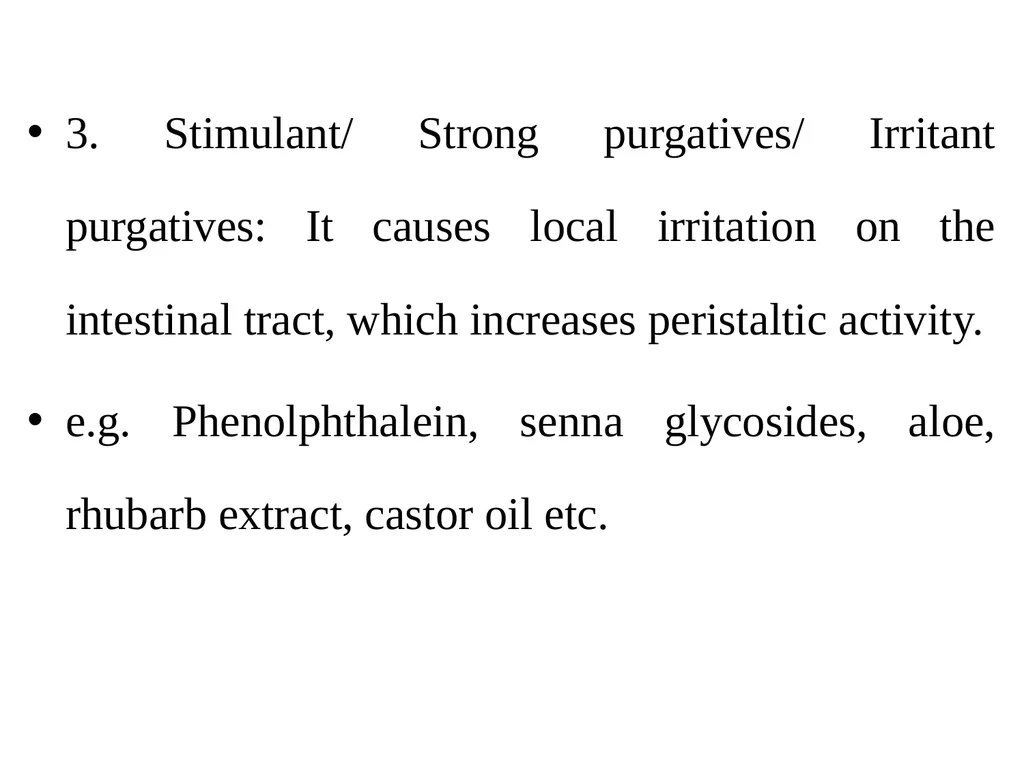
3. Stimulant/ Strong purgatives/ Irritant purgatives: It causes local irritation on the intestinal tract, which increases peristaltic activity.
e.g. Phenolphthalein, senna glycosides, aloe, rhubarb extract, castor oil etc.<br>
e.g. Phenolphthalein, senna glycosides, aloe, rhubarb extract, castor oil etc.<br>
32
4. Osmotic laxatives/ Saline cathartics: These are salts of poorly absorbable ions which increases osmotic load on intestinal tract which is relieved by secretion of addition fluids in the intestinal tract. Hence these agents increase fluidity of intestinal tract by retention of water by osmotic forces.
e.g. Antimony potassium tartrate, sodium phosphate, magnesium sulphate, sodium sulphate, potassium phosphate etc.<br>
e.g. Antimony potassium tartrate, sodium phosphate, magnesium sulphate, sodium sulphate, potassium phosphate etc.<br>
33
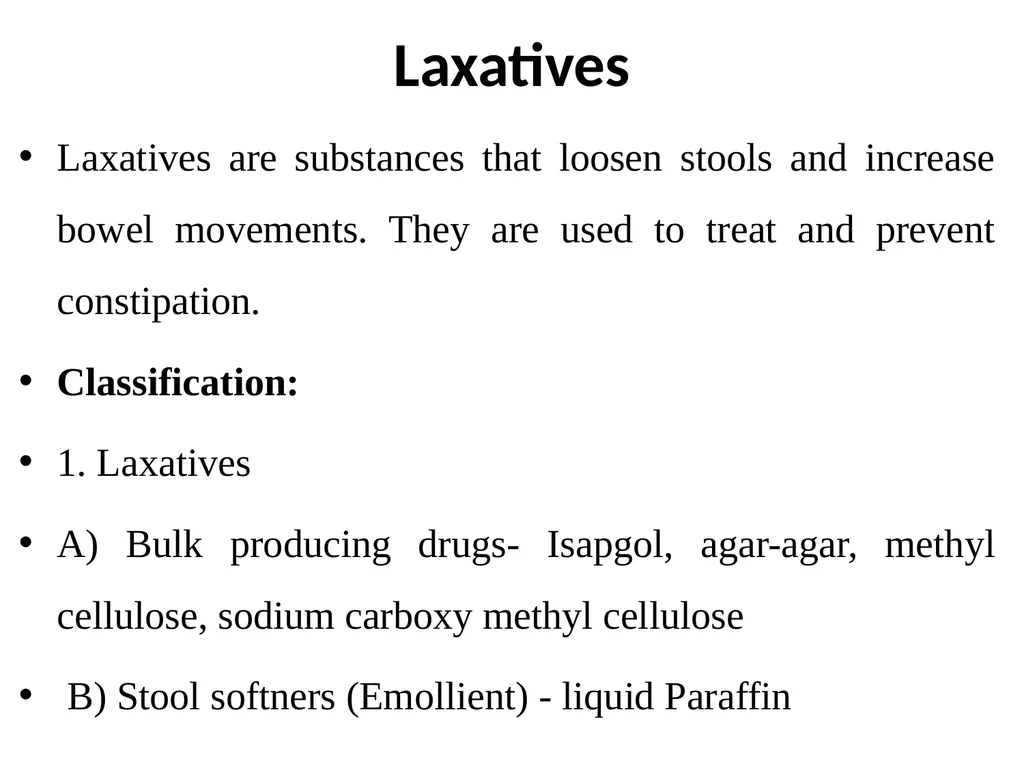
Laxatives Laxatives are substances that loosen stools and increase bowel movements. They are used to treat and prevent constipation.
Classification:
1. Laxatives
A) Bulk producing drugs- Isapgol, agar-agar, methyl cellulose, sodium carboxy methyl cellulose
B) Stool softners (Emollient) - liquid Paraffin<br>
Classification:
1. Laxatives
A) Bulk producing drugs- Isapgol, agar-agar, methyl cellulose, sodium carboxy methyl cellulose
B) Stool softners (Emollient) - liquid Paraffin<br>
34
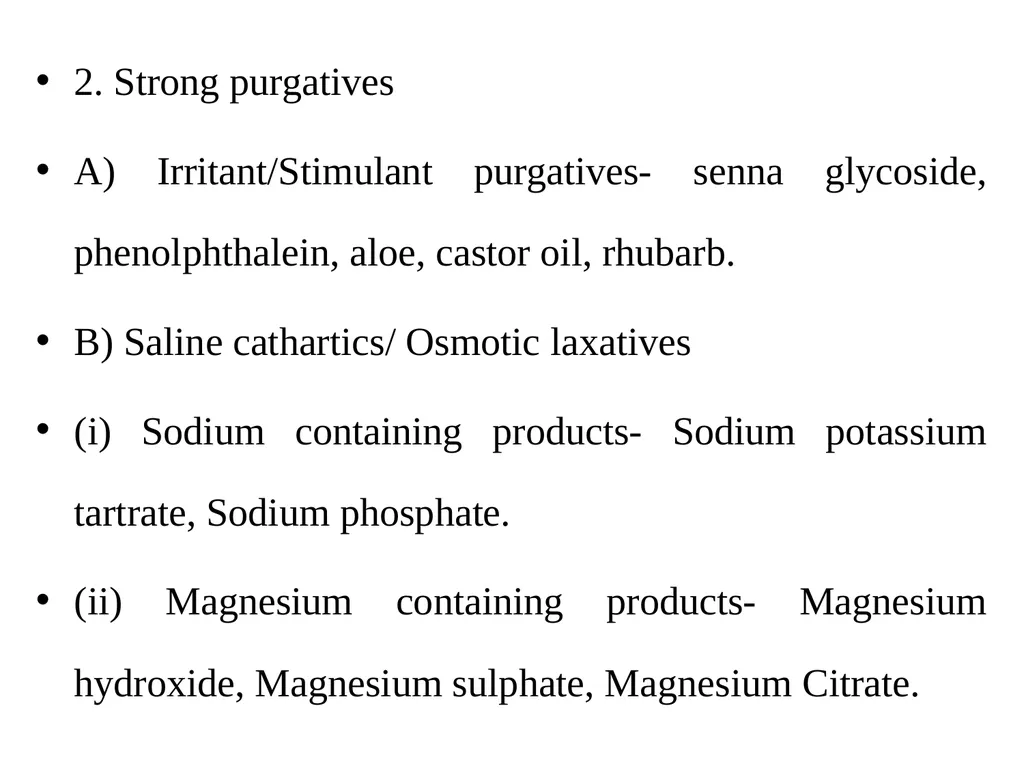
2. Strong purgatives
A) Irritant/Stimulant purgatives- senna glycoside, phenolphthalein, aloe, castor oil, rhubarb.
B) Saline cathartics/ Osmotic laxatives
(i) Sodium containing products- Sodium potassium tartrate, Sodium phosphate.
(ii) Magnesium containing products- Magnesium hydroxide, Magnesium sulphate, Magnesium Citrate.<br>
A) Irritant/Stimulant purgatives- senna glycoside, phenolphthalein, aloe, castor oil, rhubarb.
B) Saline cathartics/ Osmotic laxatives
(i) Sodium containing products- Sodium potassium tartrate, Sodium phosphate.
(ii) Magnesium containing products- Magnesium hydroxide, Magnesium sulphate, Magnesium Citrate.<br>
35
(iii) Sulfur as cathartic
(iv) Non official Cathartics- Sodium sulphate, Potassium phosphate.<br>
(iv) Non official Cathartics- Sodium sulphate, Potassium phosphate.<br>
36
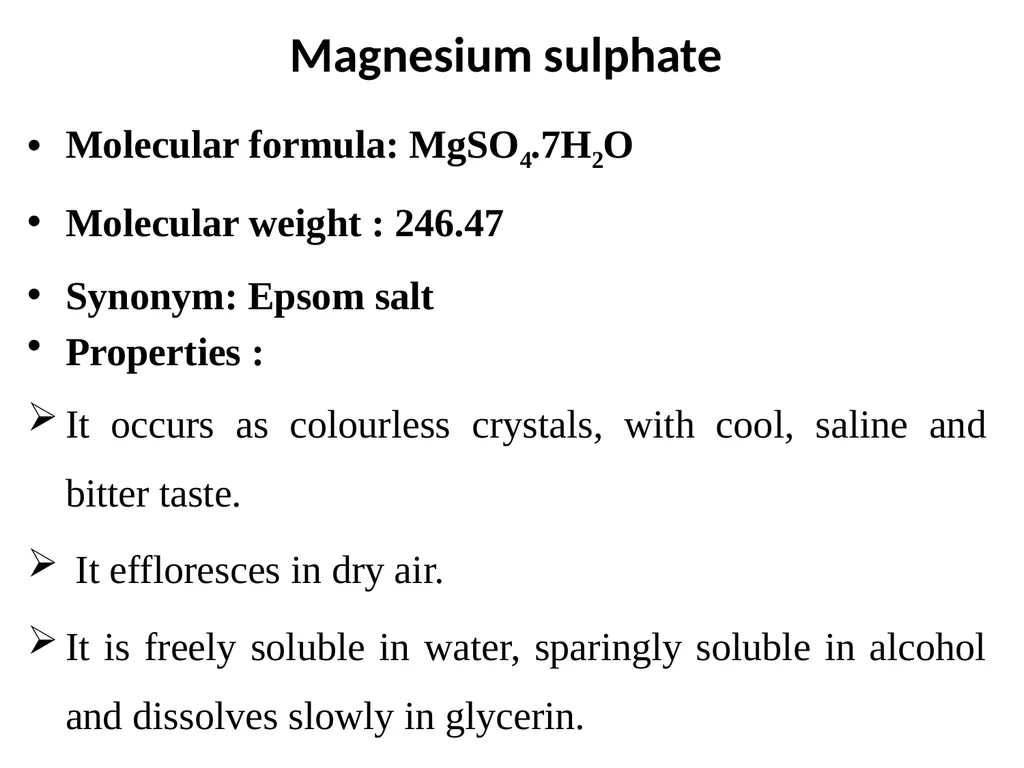
Magnesium sulphate Molecular formula: MgSO4.7H2O
Molecular weight : 246.47
Synonym: Epsom salt
Properties :
It occurs as colourless crystals, with cool, saline and bitter taste.
It effloresces in dry air.
It is freely soluble in water, sparingly soluble in alcohol and dissolves slowly in glycerin.<br>
Molecular weight : 246.47
Synonym: Epsom salt
Properties :
It occurs as colourless crystals, with cool, saline and bitter taste.
It effloresces in dry air.
It is freely soluble in water, sparingly soluble in alcohol and dissolves slowly in glycerin.<br>
37
Uses
Magnesium sulphate is used as a saline cathartic.
It is not absorbed in intestinal tract, so it increases the hydrostatic pressure on intestine and increases the peristaltic activity.
It is also used as an antidote in Heavy metal poisoning.<br>
Magnesium sulphate is used as a saline cathartic.
It is not absorbed in intestinal tract, so it increases the hydrostatic pressure on intestine and increases the peristaltic activity.
It is also used as an antidote in Heavy metal poisoning.<br>
38
Wet dressings of a 25% solution of magnesium sulphate are sometimes used in the treatment of carbuncles & boils.
It should be used with care as a laxative in patients with impaired renal functions
Storage
Store in air tight container in cool place.<br>
It should be used with care as a laxative in patients with impaired renal functions
Storage
Store in air tight container in cool place.<br>
39
Kaolin Molecular formula Al2O3. 2SiO2. 2H2O
Molecular weight : 258.
Synonym: China clay
Properties:
It occurs as a soft white or yellowish white powder.
odourless and has clay like taste.<br>
Molecular weight : 258.
Synonym: China clay
Properties:
It occurs as a soft white or yellowish white powder.
odourless and has clay like taste.<br>
40
When moistened with water, assumes a darker color & develops a marked clay-like odor.
It is insoluble in water, in mineral acids and in solution of alkali hydroxides.
Chemically, it is practically inert, since it is insoluble in all the common solvents.<br>
It is insoluble in water, in mineral acids and in solution of alkali hydroxides.
Chemically, it is practically inert, since it is insoluble in all the common solvents.<br>
41
Uses:-
It is used in mixtures intended for treatment in dysentery, diarrhoea and for symptomatic treatment of colitis, cholera etc.
It is employed in the treatment of food and alkaloidal poisoning as it adsorbs toxins.
It also finds use in dusting powder, cosmetic preparations and is an ingredient of Kaolin poultice.<br>
It is used in mixtures intended for treatment in dysentery, diarrhoea and for symptomatic treatment of colitis, cholera etc.
It is employed in the treatment of food and alkaloidal poisoning as it adsorbs toxins.
It also finds use in dusting powder, cosmetic preparations and is an ingredient of Kaolin poultice.<br>
42
References Pharmaceutical inorganic chemistry volume – I, by G. R. Chatwal published by himalaya page no. 152.
https://www.google.co.in/image<br>
https://www.google.co.in/image<br>