
GCPH Contact Information PRESENTERS: Kelly Ray,
TG
Published · 51 slides · 0 views

1 / 1





Description
GCPH Contact Information PRESENTERS: Kelly Ray, REHS Public Health Sanitarian (937) 374-5610; kraygcph.info Melanie Straight, EHSIT Public Health Sanitarian (937) 374-5618; mstraightgcph.info Introduction to Pools and Spas Presented by:
Related Topics
Share
Embed code
Download this presentation From Below
"GCPH Contact Information PRESENTERS: Kelly Ray," is the property of its rightful owner. Permission is granted to download and print the materials on this website for personal, non-commercial use only, and to display it on your personal computer provided you do not modify the materials and that you retain all copyright notices contained in the materials. By downloading content from our website, you accept the terms of this agreement.
Presentation Transcript
01
GCPH Contact Information PRESENTERS:
Kelly Ray, REHS
Public Health Sanitarian
(937) 374-5610; kray@gcph.info
Melanie Straight, EHSIT Public Health Sanitarian
(937) 374-5618; mstraight@gcph.info<br>
Kelly Ray, REHS
Public Health Sanitarian
(937) 374-5610; kray@gcph.info
Melanie Straight, EHSIT Public Health Sanitarian
(937) 374-5618; mstraight@gcph.info<br>
02
Introduction to Pools and Spas Presented by:<br>
03
Purpose of Pool & Spa Safety Protect the public from possible safety and health hazards
Provide a basic knowledge of regulations from the health code
Build a good relationship between pool operators and the health department<br>
Provide a basic knowledge of regulations from the health code
Build a good relationship between pool operators and the health department<br>
04
Rules and Regulations Pool operators must be aware of many requirements to safely operate their pools. These requirements are important to the health and safety of the patrons, and all people who are in charge at the pool should be aware of the regulations.
Greene County Public Health (GCPH) – a local public health agency that regulates pools/spas
Ohio Department of Health (ODH) – a state public health agency that creates regulations
and sets minimum standards within the state of Ohio.
The Occupational Safety and Health Administration (OSHA) – Protects the safety of workers
The Center for Disease Control and Prevention (CDC) – Does not regulate, but advises and investigates outbreaks of communicable disease
Consumer Product Safety Commission (CPSC) – protects the public from
unsafe products. Example: VGB.<br>
Greene County Public Health (GCPH) – a local public health agency that regulates pools/spas
Ohio Department of Health (ODH) – a state public health agency that creates regulations
and sets minimum standards within the state of Ohio.
The Occupational Safety and Health Administration (OSHA) – Protects the safety of workers
The Center for Disease Control and Prevention (CDC) – Does not regulate, but advises and investigates outbreaks of communicable disease
Consumer Product Safety Commission (CPSC) – protects the public from
unsafe products. Example: VGB.<br>
05
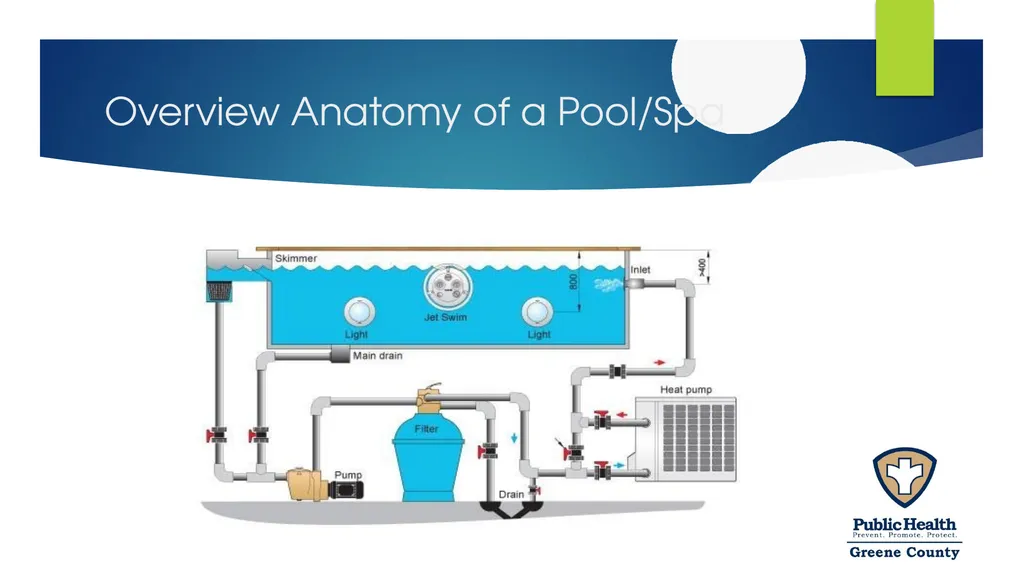
Overview Anatomy of a Pool/Spa<br>
06
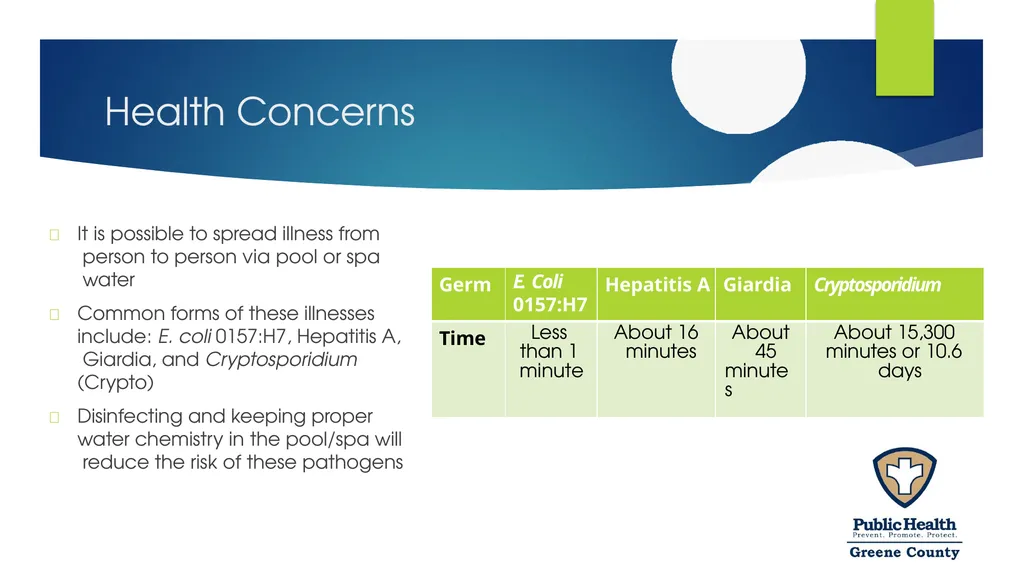
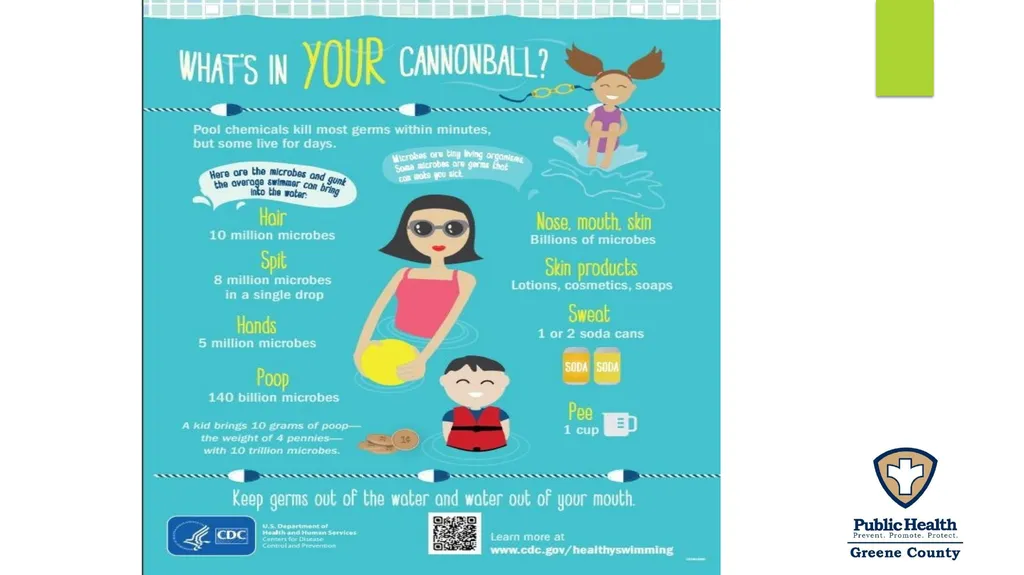
Health Concerns It is possible to spread illness from person to person via pool or spa water
Common forms of these illnesses include: E. coli 0157:H7, Hepatitis A, Giardia, and Cryptosporidium (Crypto)
Disinfecting and keeping proper water chemistry in the pool/spa will reduce the risk of these pathogens<br>
Common forms of these illnesses include: E. coli 0157:H7, Hepatitis A, Giardia, and Cryptosporidium (Crypto)
Disinfecting and keeping proper water chemistry in the pool/spa will reduce the risk of these pathogens<br>
07
How Are Illnesses Spread at Aquatic Facilities? These illnesses are not only spread by blood - most can be spread:
By swallowing contaminated water
By accidentally swallowing something that has come in contact with the stool
of a person or animal infected with the germ
By swallowing the germ picked up from surfaces (such as lounge chairs, picnic tables, bathroom fixtures, changing tables) contaminated with the stool from an infected person<br>
By swallowing contaminated water
By accidentally swallowing something that has come in contact with the stool
of a person or animal infected with the germ
By swallowing the germ picked up from surfaces (such as lounge chairs, picnic tables, bathroom fixtures, changing tables) contaminated with the stool from an infected person<br>
08
How do I promote healthy swimming? Encourage swimmers TO:
Practice good hygiene such as:
taking a shower before swimming
washing their hands after using the toilet
changing diapers
Take children to the bathroom on breaks and change swim diapers often
Only change diapers in the bathroom
Wash children thoroughly (especially the rear end) with soap and water before swimming<br>
Practice good hygiene such as:
taking a shower before swimming
washing their hands after using the toilet
changing diapers
Take children to the bathroom on breaks and change swim diapers often
Only change diapers in the bathroom
Wash children thoroughly (especially the rear end) with soap and water before swimming<br>
09
How do I promote health swimming? Encourage swimmers NOT TO:
Swim when they have diarrhea
Swallow the pool water
Change diapers poolside<br>
Swim when they have diarrhea
Swallow the pool water
Change diapers poolside<br>
10
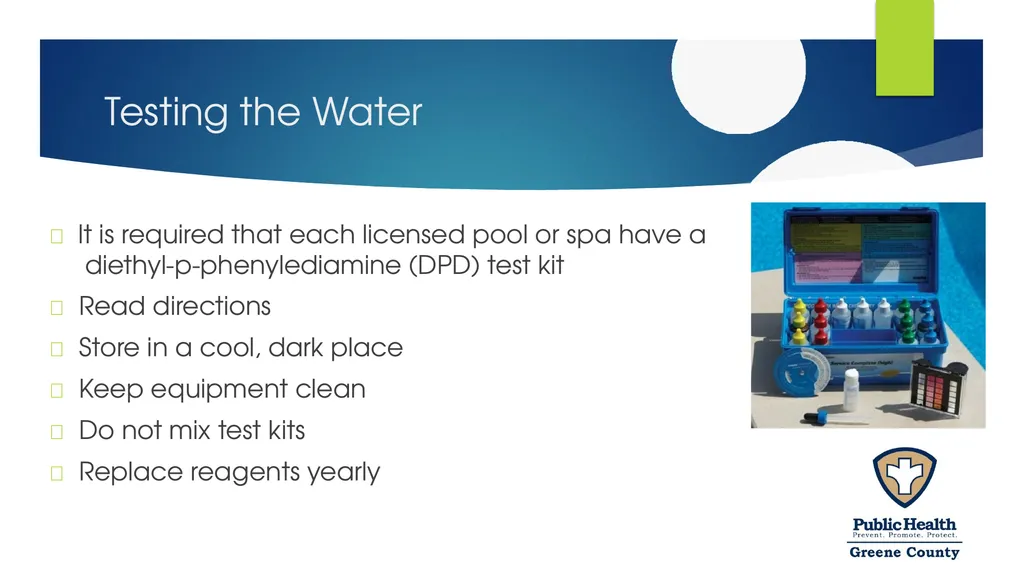
Testing the Water It is required that each licensed pool or spa have a diethyl-p-phenylediamine (DPD) test kit
Read directions
Store in a cool, dark place
Keep equipment clean
Do not mix test kits
Replace reagents yearly<br>
Read directions
Store in a cool, dark place
Keep equipment clean
Do not mix test kits
Replace reagents yearly<br>
11
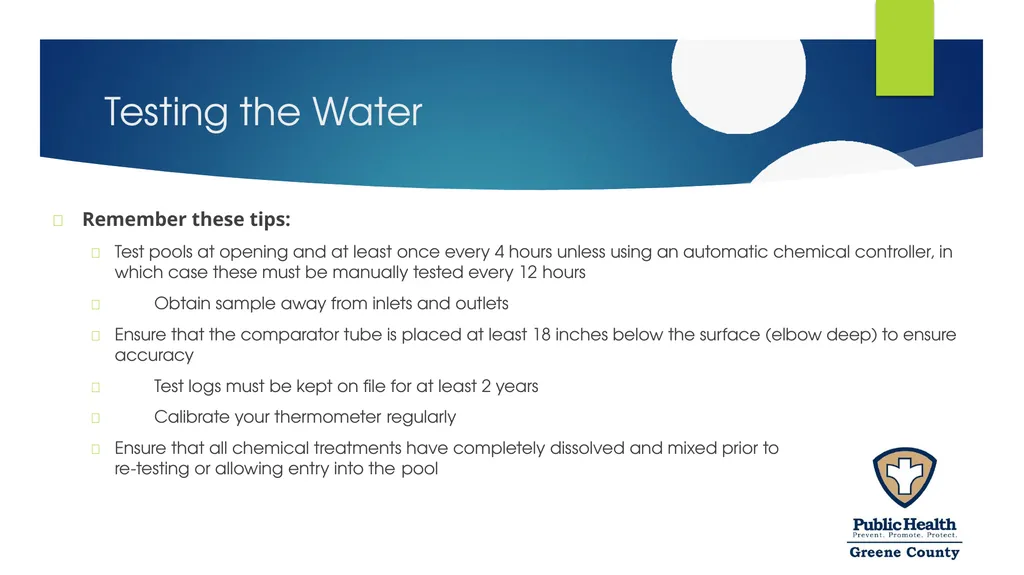
Testing the Water Remember these tips:
Test pools at opening and at least once every 4 hours unless using an automatic chemical controller, in which case these must be manually tested every 12 hours
Obtain sample away from inlets and outlets
Ensure that the comparator tube is placed at least 18 inches below the surface (elbow deep) to ensure accuracy
Test logs must be kept on file for at least 2 years
Calibrate your thermometer regularly
Ensure that all chemical treatments have completely dissolved and mixed prior to re-testing or allowing entry into the pool<br>
Test pools at opening and at least once every 4 hours unless using an automatic chemical controller, in which case these must be manually tested every 12 hours
Obtain sample away from inlets and outlets
Ensure that the comparator tube is placed at least 18 inches below the surface (elbow deep) to ensure accuracy
Test logs must be kept on file for at least 2 years
Calibrate your thermometer regularly
Ensure that all chemical treatments have completely dissolved and mixed prior to re-testing or allowing entry into the pool<br>
12
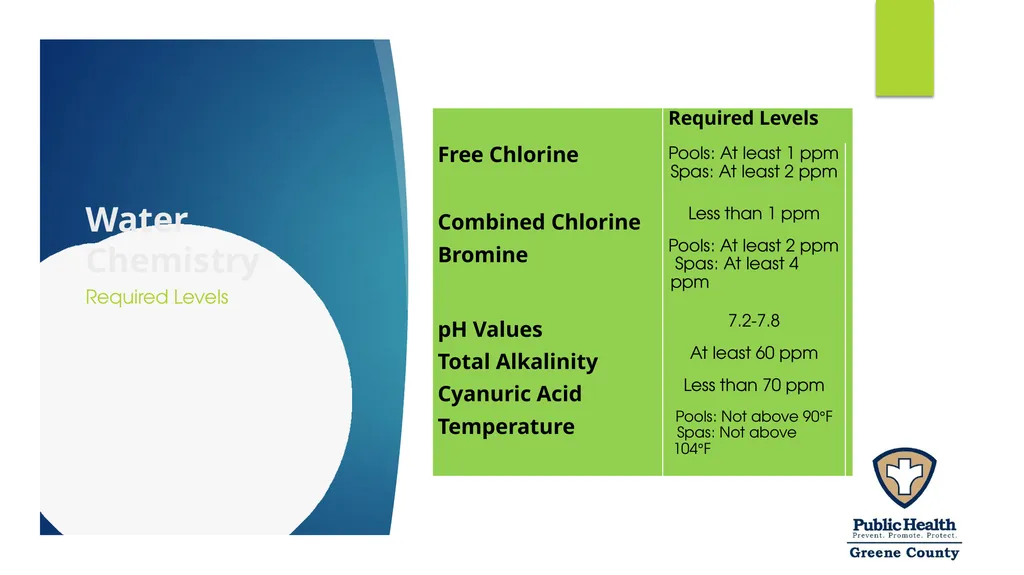
Water Chemistry
Required Levels<br>
Required Levels<br>
13
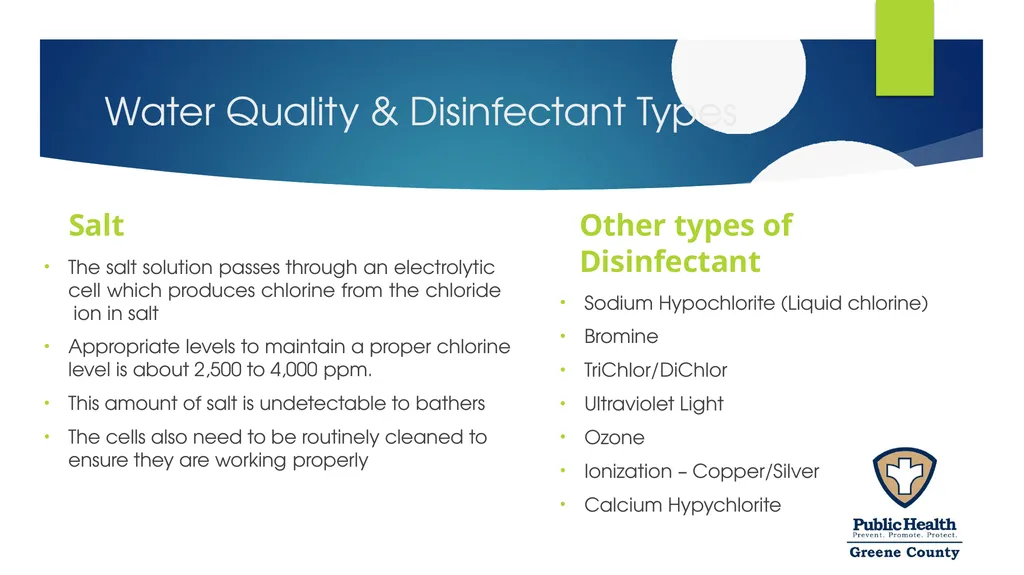
Water Quality & Disinfectant Types Salt
The salt solution passes through an electrolytic cell which produces chlorine from the chloride ion in salt
Appropriate levels to maintain a proper chlorine level is about 2,500 to 4,000 ppm.
This amount of salt is undetectable to bathers
The cells also need to be routinely cleaned to ensure they are working properly Other types of Disinfectant
Sodium Hypochlorite (Liquid chlorine)
Bromine
TriChlor/DiChlor
Ultraviolet Light
Ozone
Ionization – Copper/Silver
Calcium Hypychlorite<br>
The salt solution passes through an electrolytic cell which produces chlorine from the chloride ion in salt
Appropriate levels to maintain a proper chlorine level is about 2,500 to 4,000 ppm.
This amount of salt is undetectable to bathers
The cells also need to be routinely cleaned to ensure they are working properly Other types of Disinfectant
Sodium Hypochlorite (Liquid chlorine)
Bromine
TriChlor/DiChlor
Ultraviolet Light
Ozone
Ionization – Copper/Silver
Calcium Hypychlorite<br>
14
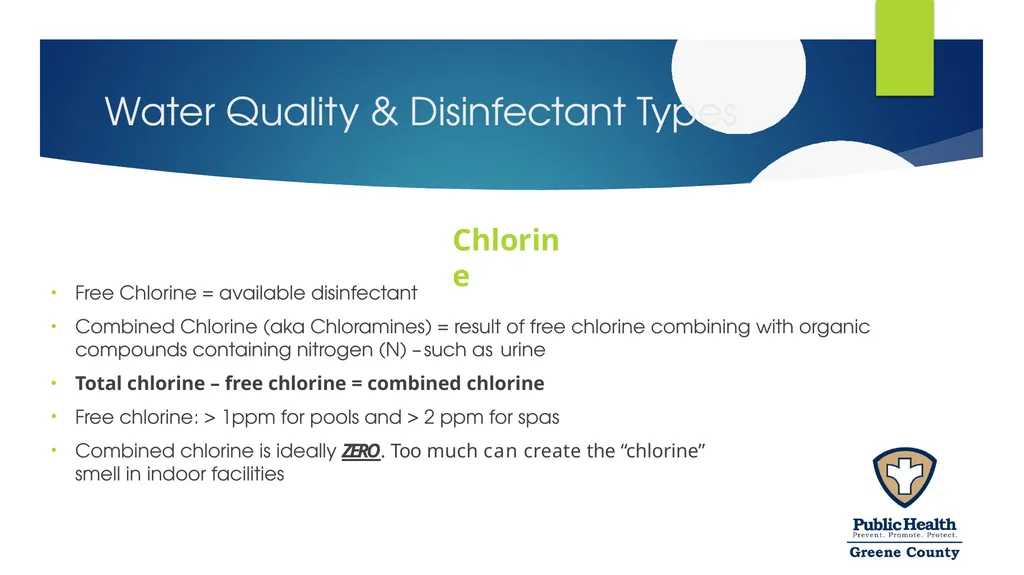
Water Quality & Disinfectant Types Chlorine Free Chlorine = available disinfectant
Combined Chlorine (aka Chloramines) = result of free chlorine combining with organic compounds containing nitrogen (N) – such as urine
Total chlorine – free chlorine = combined chlorine
Free chlorine: > 1ppm for pools and > 2 ppm for spas
Combined chlorine is ideally ZERO. Too much can create the “chlorine”
smell in indoor facilities<br>
Combined Chlorine (aka Chloramines) = result of free chlorine combining with organic compounds containing nitrogen (N) – such as urine
Total chlorine – free chlorine = combined chlorine
Free chlorine: > 1ppm for pools and > 2 ppm for spas
Combined chlorine is ideally ZERO. Too much can create the “chlorine”
smell in indoor facilities<br>
15
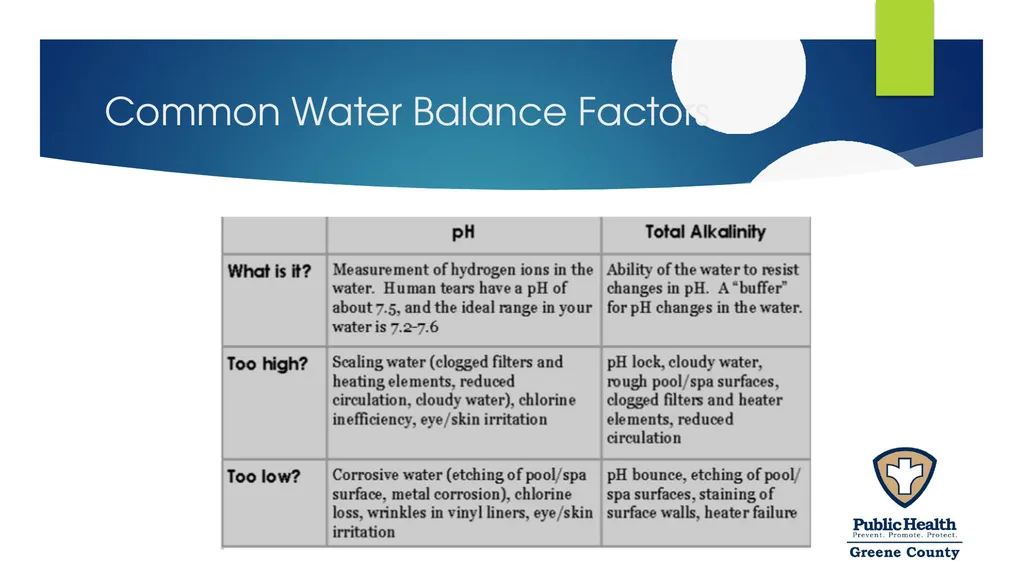
Common Water Balance Factors<br>
16
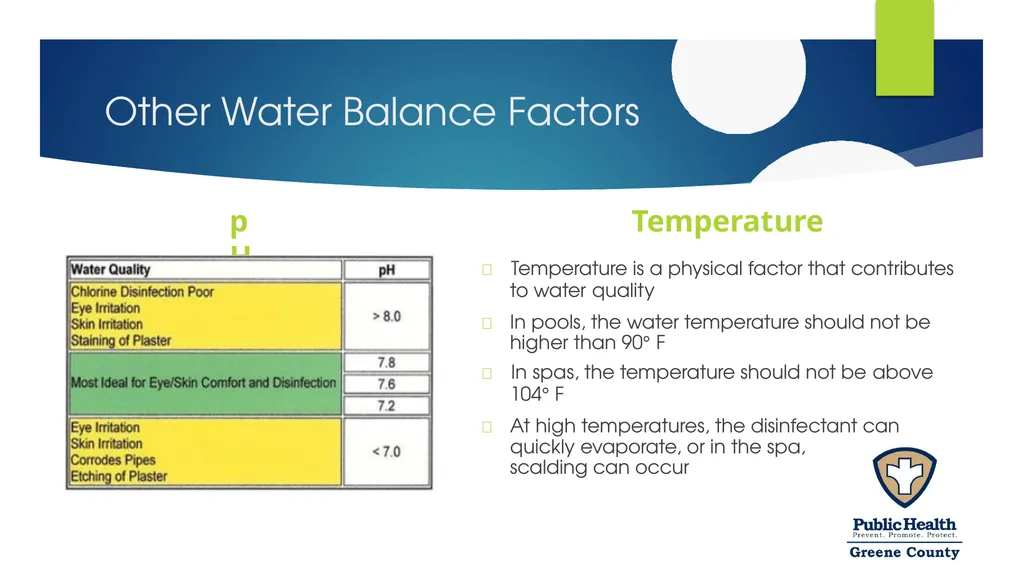
Other Water Balance Factors pH Temperature
Temperature is a physical factor that contributes
to water quality
In pools, the water temperature should not be higher than 90° F
In spas, the temperature should not be above
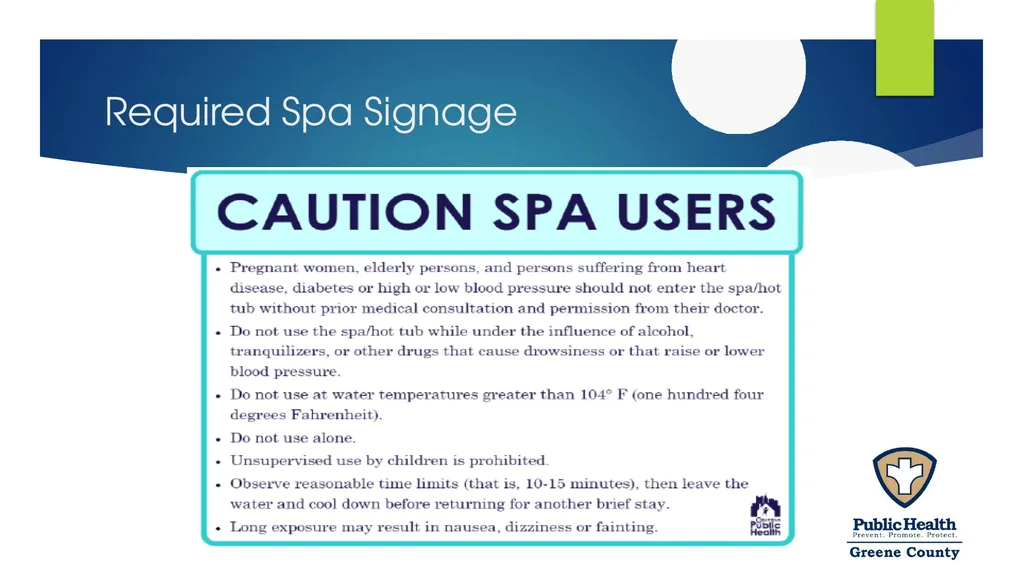
104° F
At high temperatures, the disinfectant can quickly evaporate, or in the spa,
scalding can occur<br>
Temperature is a physical factor that contributes
to water quality
In pools, the water temperature should not be higher than 90° F
In spas, the temperature should not be above
104° F
At high temperatures, the disinfectant can quickly evaporate, or in the spa,
scalding can occur<br>
17
Operational Requirements Draining Requirements
Spas must be completely drained at least once every 30 days
Draining is also necessary when water chemistry concentrations are off and no other chemical treatments are successful
Cyanuric acid levels can only be reduced by draining Flow requirements
The flow rate is the rate of water flow through the circulation system
Flow rate is measured in gallons per minute (GPM)
Must have a working flow meter at all times to ensure proper circulation of disinfectants/turn-over rates
If the float is stuck, try cleaning
the flow meter
If minimum flow rate is not being achieved, clean filters Mixing/Holding Tank
These are often found at spray grounds
They must be cleaned and drained at least once every 120 days<br>
Spas must be completely drained at least once every 30 days
Draining is also necessary when water chemistry concentrations are off and no other chemical treatments are successful
Cyanuric acid levels can only be reduced by draining Flow requirements
The flow rate is the rate of water flow through the circulation system
Flow rate is measured in gallons per minute (GPM)
Must have a working flow meter at all times to ensure proper circulation of disinfectants/turn-over rates
If the float is stuck, try cleaning
the flow meter
If minimum flow rate is not being achieved, clean filters Mixing/Holding Tank
These are often found at spray grounds
They must be cleaned and drained at least once every 120 days<br>
18
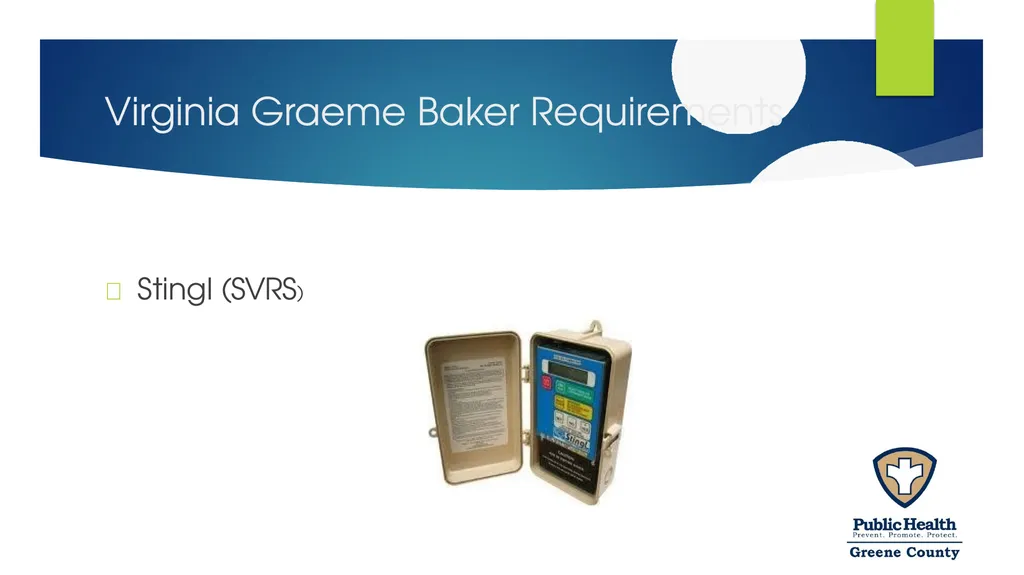
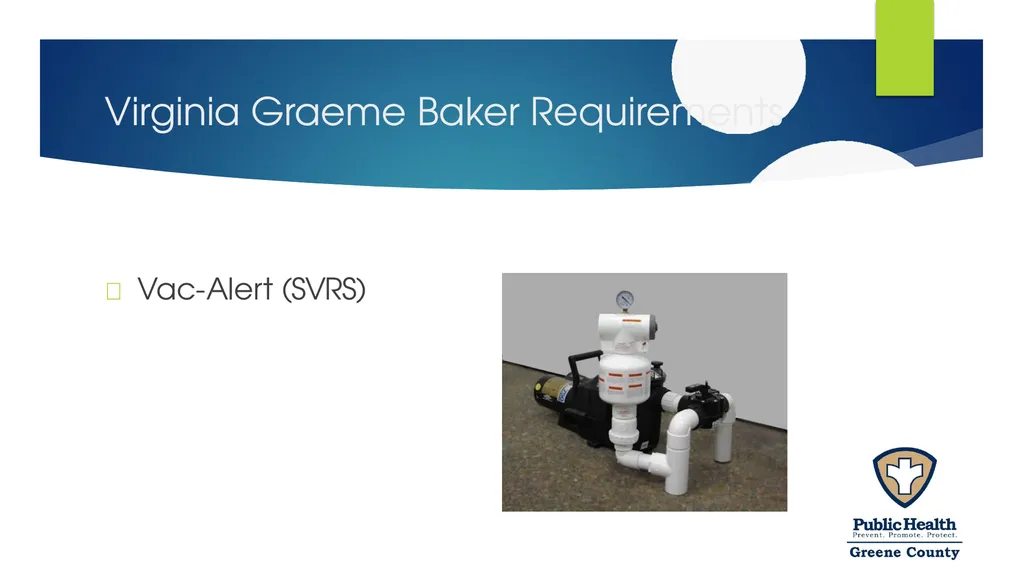
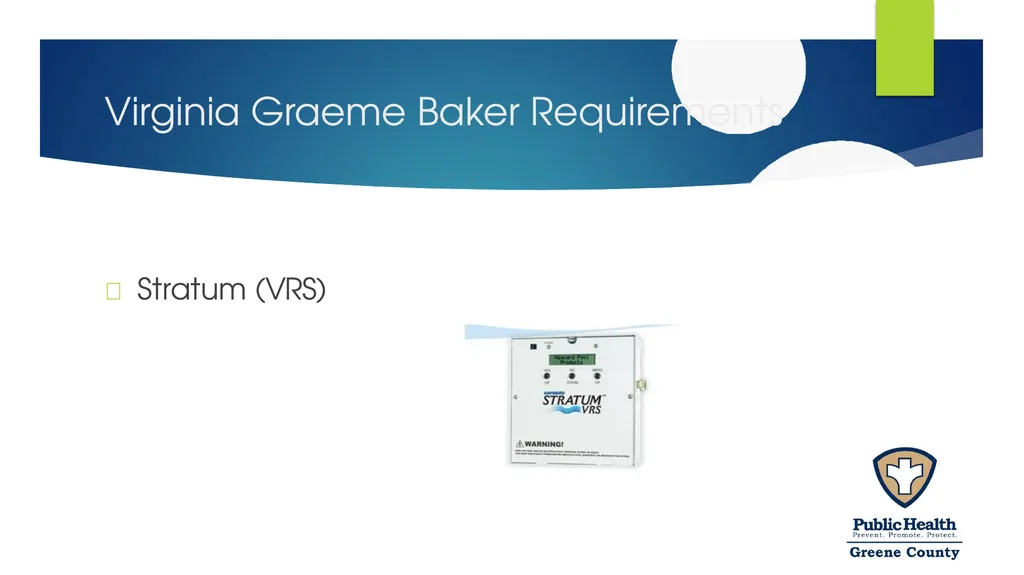
SVRS Systems Safety Vacuum Release System (SVRS)
Safety Vacuum Release Systems are required on pools or spas with one main drain on direct
suction
This device senses a blockage on the drain and reduces or eliminates suction at the drain
Should be mounted ahead of the hair and lint strainer in the equipment room or integrated with
the pump<br>
Safety Vacuum Release Systems are required on pools or spas with one main drain on direct
suction
This device senses a blockage on the drain and reduces or eliminates suction at the drain
Should be mounted ahead of the hair and lint strainer in the equipment room or integrated with
the pump<br>
19
VGB VGB Main Drain
Main drains are important to your pool’s operation
Main drains must be in the deepest area of the pool or spa
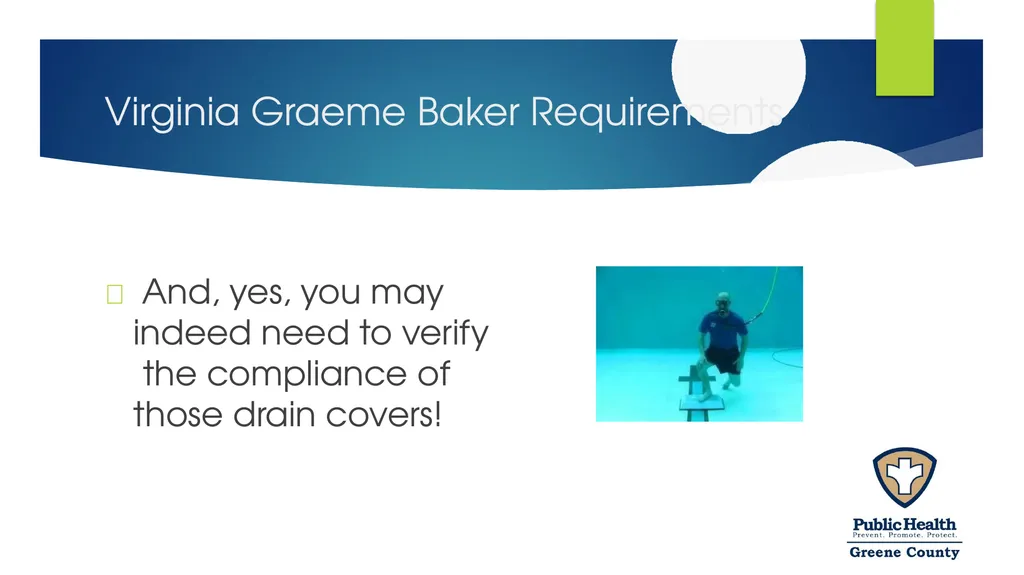
Drains must be covered with VGB-compliant grates that require the use of tools for removal (be certain to verify manufacturer’s expiration dates/check for recalls)
Pools or spas on direct suction and no SVRS must have 2 drains a minimum of 3 feet apart unless
the drain is considered un-blockable (greater than or equal to 18 inches x 23 inches)
Main drains must be visible<br>
Main drains are important to your pool’s operation
Main drains must be in the deepest area of the pool or spa
Drains must be covered with VGB-compliant grates that require the use of tools for removal (be certain to verify manufacturer’s expiration dates/check for recalls)
Pools or spas on direct suction and no SVRS must have 2 drains a minimum of 3 feet apart unless
the drain is considered un-blockable (greater than or equal to 18 inches x 23 inches)
Main drains must be visible<br>
20
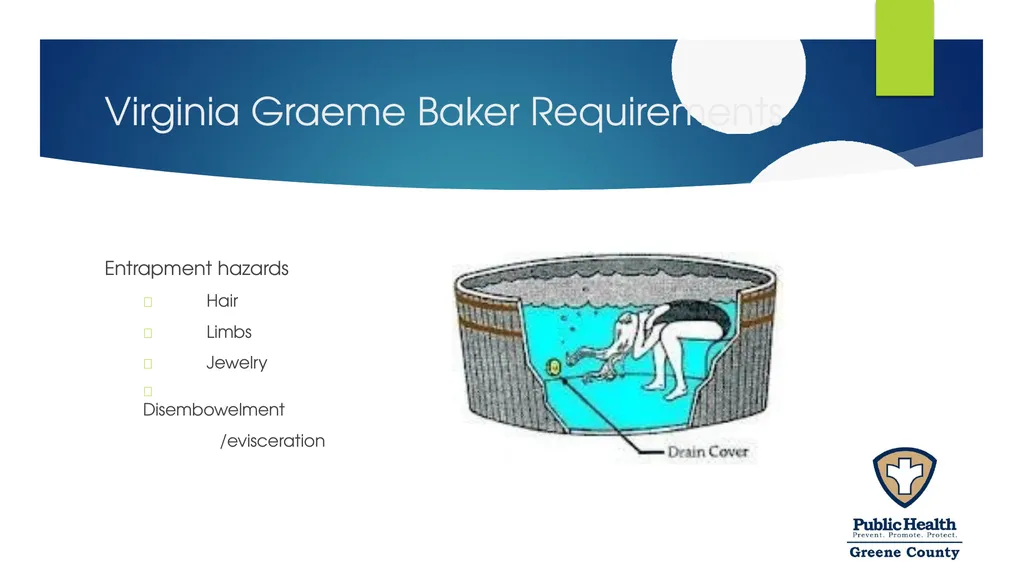
Virginia Graeme Baker Requirements Entrapment hazards
Hair
Limbs
Jewelry
Disembowelment
/evisceration<br>
Hair
Limbs
Jewelry
Disembowelment
/evisceration<br>
21
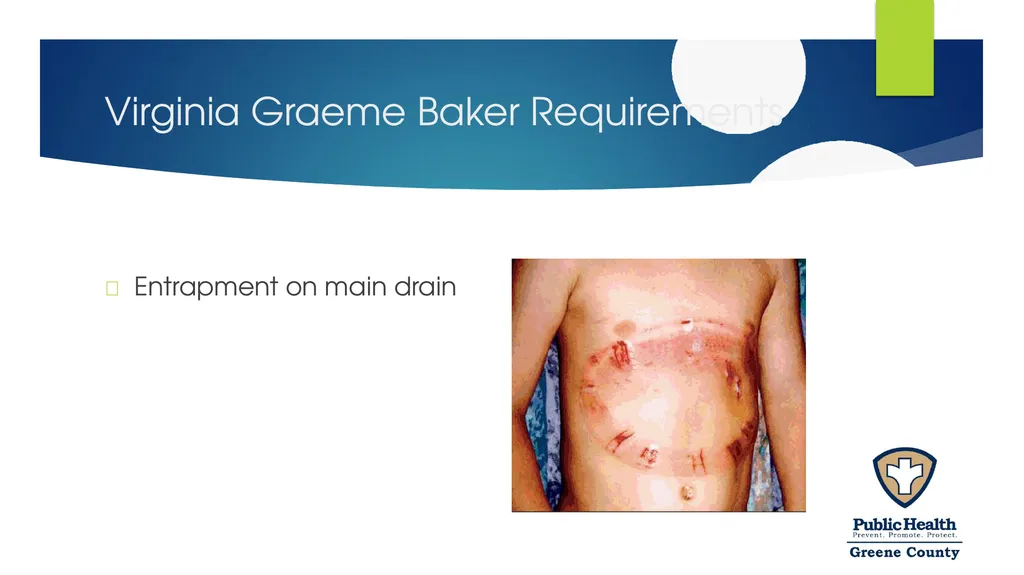
Virginia Graeme Baker Requirements Entrapment on main drain<br>
22
Virginia Graeme Baker Requirements Unblockable drain covers Main drains
:Single drain: 18”x23”
:Two drains: minimum 3’ between
drains
Equalizer lines
Covers?
Plugs?
Other submerged outlets<br>
:Single drain: 18”x23”
:Two drains: minimum 3’ between
drains
Equalizer lines
Covers?
Plugs?
Other submerged outlets<br>
23
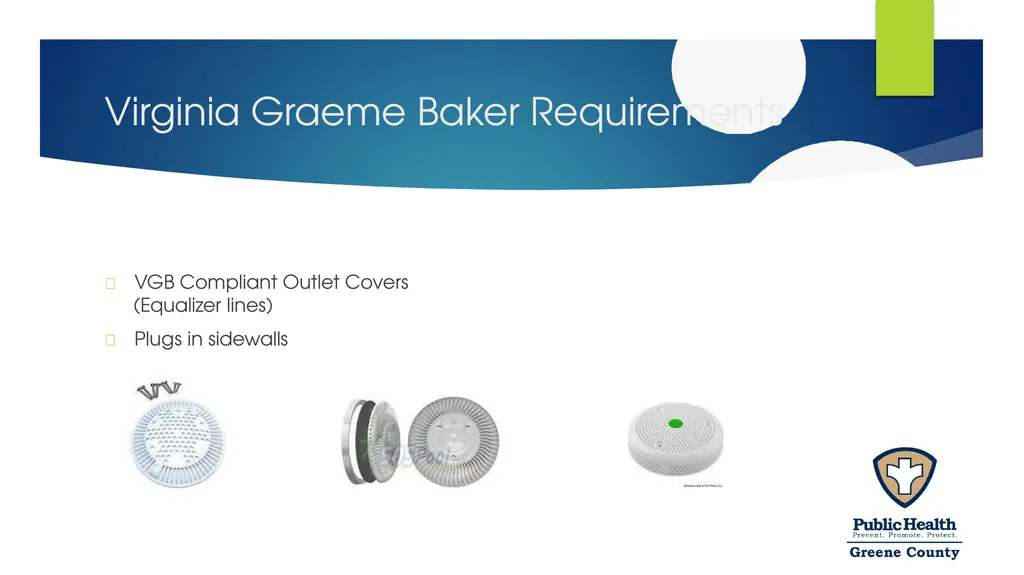
Virginia Graeme Baker Requirements VGB Compliant Outlet Covers
(Equalizer lines)
Plugs in sidewalls<br>
(Equalizer lines)
Plugs in sidewalls<br>
24
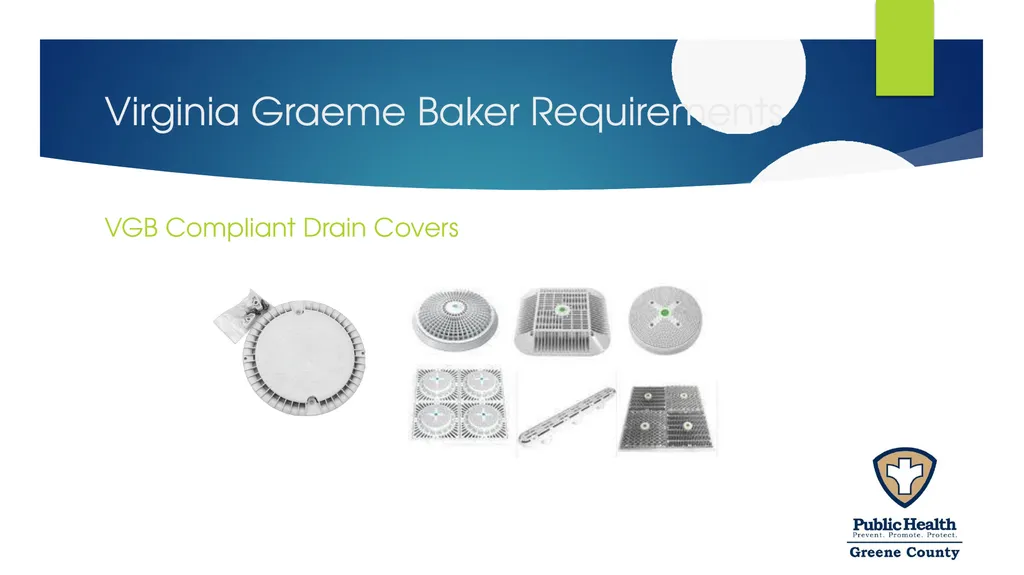
Virginia Graeme Baker Requirements VGB Compliant Drain Covers<br>
25
Virginia Graeme Baker Requirements Look for the ASME symbol
embossed on cover<br>
embossed on cover<br>
26
Virginia Graeme Baker Requirements Single Main Drains Single Main Drains
Compliant covers :Licensee must
keep written documentation on file Secondary means of entrapment prevention: Monthly tests results taken and recorded on Weekly report forms by licensee<br>
Compliant covers :Licensee must
keep written documentation on file Secondary means of entrapment prevention: Monthly tests results taken and recorded on Weekly report forms by licensee<br>
27
Virginia Graeme Baker Requirements Multiple Drains
Multiple Drain Covers VGB Compliant covers Minimum Distance Between Drains<br>
Multiple Drain Covers VGB Compliant covers Minimum Distance Between Drains<br>
28
Virginia Graeme Baker Requirements And, yes, you may indeed need to verify the compliance of those drain covers!<br>
29
Virginia Graeme Baker Requirements Stingl (SVRS)<br>
30
Virginia Graeme Baker Requirements Vac-Alert (SVRS)<br>
31
Virginia Graeme Baker Requirements Stratum (VRS)<br>
32
Equipment Maintenance It can be easy to neglect the equipment room, because it is hidden from the view of the public.
However, it is important to ensure that this room is:
Clean and well-drained
Damaged walls, etc. are repaired
Adequately lit and ventilated, and
Not accessible to bathers and patrons
Ensure that skimmers are cleaned regularly
The disinfection system must be maintained
The automatic chemical controller probes must be calibrated and maintained
Hand dosing to continuously disinfect the pool is unacceptable!<br>
However, it is important to ensure that this room is:
Clean and well-drained
Damaged walls, etc. are repaired
Adequately lit and ventilated, and
Not accessible to bathers and patrons
Ensure that skimmers are cleaned regularly
The disinfection system must be maintained
The automatic chemical controller probes must be calibrated and maintained
Hand dosing to continuously disinfect the pool is unacceptable!<br>
33
Facility Safety Mandatory Fencing Guidelines
All fences must be at least 48 inches high measured from the ground (wading pools must have a
fence at least 36 inches high)
All perimeter fences or barriers must not have any opening that will allow a sphere with a diameter of 4 inches to pass through
All doors or gates must be self-closing, self-latching, lockable (require a key for entry) and the
latch must be at least 38 inches from the ground
All barriers must be locked whenever the pool is closed<br>
All fences must be at least 48 inches high measured from the ground (wading pools must have a
fence at least 36 inches high)
All perimeter fences or barriers must not have any opening that will allow a sphere with a diameter of 4 inches to pass through
All doors or gates must be self-closing, self-latching, lockable (require a key for entry) and the
latch must be at least 38 inches from the ground
All barriers must be locked whenever the pool is closed<br>
34
Facility Safety Safety Checklist
Spineboard (headgear on guarded pools)
Working emergency telephone w/instructions (example: dial 9) and emergency numbers
First Aid supplies (bandages, gauze, disposable gloves, etc.) – cannot be in a locked room!
Self-closing gates
Ring Buoy and rope, non-telescoping reach pole
Shepherds crook if no lifeguard
Ladders and diving boards are secure
Verify that underwater lights work
Starting blocks inaccessible<br>
Spineboard (headgear on guarded pools)
Working emergency telephone w/instructions (example: dial 9) and emergency numbers
First Aid supplies (bandages, gauze, disposable gloves, etc.) – cannot be in a locked room!
Self-closing gates
Ring Buoy and rope, non-telescoping reach pole
Shepherds crook if no lifeguard
Ladders and diving boards are secure
Verify that underwater lights work
Starting blocks inaccessible<br>
35
Required Signage “No Diving” for depths < 5 feet
Depth Markers (at least 4 inches high)
If no lifeguard:
“Warning, No Lifeguard”
“Swimming alone is not recommended”
“Children must be supervised”
Anytime the pool or spa is closed, you must post at least one sign stating
“Danger – Pool (or Spa) Closed” or “Warning – Pool (or Spa) Closed”<br>
Depth Markers (at least 4 inches high)
If no lifeguard:
“Warning, No Lifeguard”
“Swimming alone is not recommended”
“Children must be supervised”
Anytime the pool or spa is closed, you must post at least one sign stating
“Danger – Pool (or Spa) Closed” or “Warning – Pool (or Spa) Closed”<br>
36
Required Spa Signage<br>
37
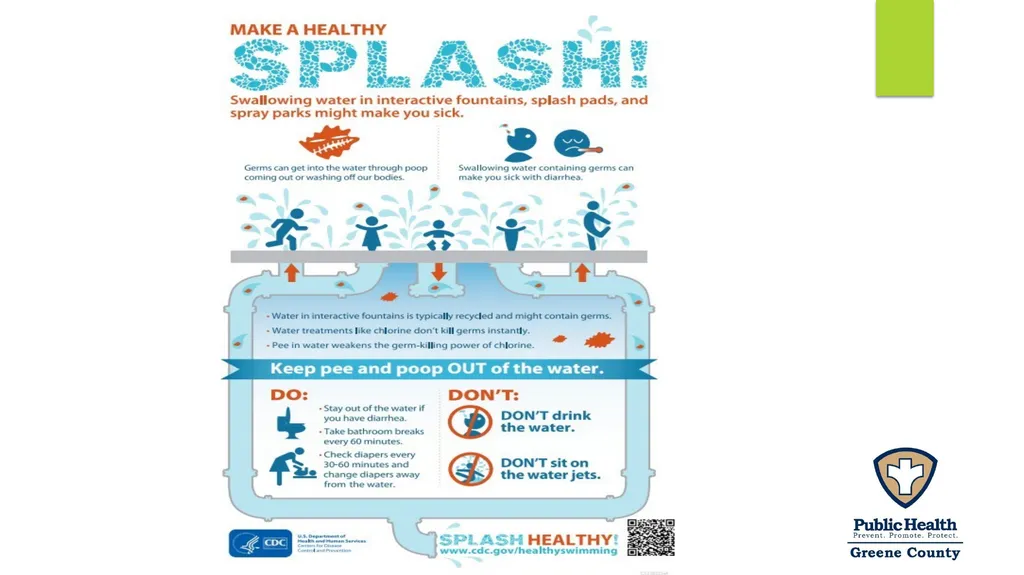
Signage for Spray Grounds Using same or similar language as listed below:
Do not use pool while having diarrhea
Water is not to be swallowed
Wash hands after using the restroom or changing diapers
Take regular restroom breaks or change diapers only in a restroom
Manufacturer’s safety recommendations must be posted conspicuously<br>
Do not use pool while having diarrhea
Water is not to be swallowed
Wash hands after using the restroom or changing diapers
Take regular restroom breaks or change diapers only in a restroom
Manufacturer’s safety recommendations must be posted conspicuously<br>
38
Signage for Slides Safety recommendations must be posted conspicuously at the slide
Only one user at a time, no chains
Check to see that landing areas are clear before entering the slide
Users must exit the landing area immediately
Feet first
Minimum user height must be posted
Life jackets or other flotation devices are prohibited other than those
designed for the slide and used as directed by the manufacturer<br>
Only one user at a time, no chains
Check to see that landing areas are clear before entering the slide
Users must exit the landing area immediately
Feet first
Minimum user height must be posted
Life jackets or other flotation devices are prohibited other than those
designed for the slide and used as directed by the manufacturer<br>
39
Lifeguards When are lifeguards required?
All pools with diving boards
All pools with recreational slides
All pools with surface areas of 2,000 square feet or greater
All pools with a surface area of less than 2,000 square feet and more than 50 people occupying the pool
All pools with zero depth entry with depths more than 18 inches
Public swimming pools that are 6,000 square feet or larger must have a written plan that shows adequate lifeguard coverage.<br>
All pools with diving boards
All pools with recreational slides
All pools with surface areas of 2,000 square feet or greater
All pools with a surface area of less than 2,000 square feet and more than 50 people occupying the pool
All pools with zero depth entry with depths more than 18 inches
Public swimming pools that are 6,000 square feet or larger must have a written plan that shows adequate lifeguard coverage.<br>
40
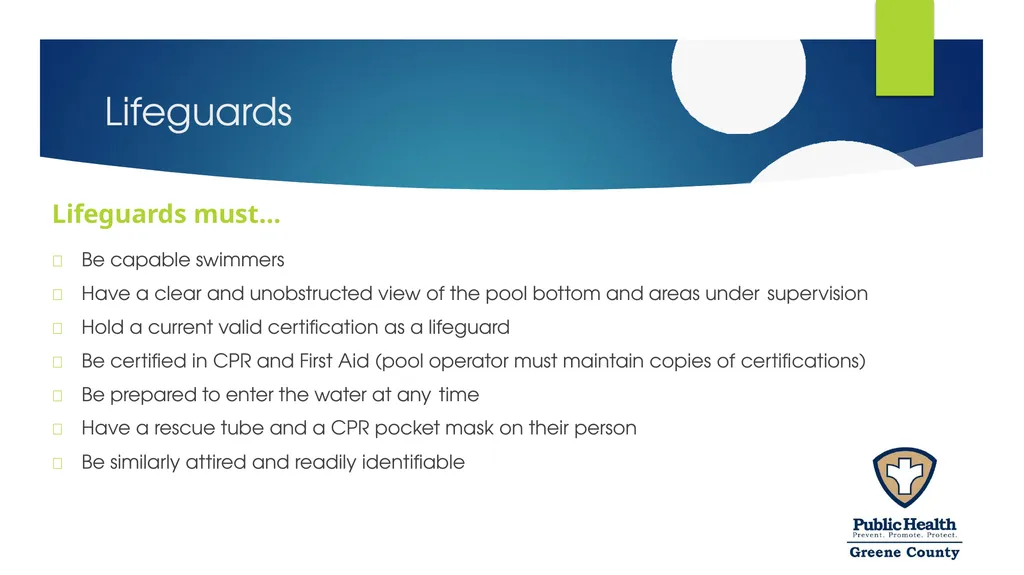
Lifeguards Lifeguards must…
Be capable swimmers
Have a clear and unobstructed view of the pool bottom and areas under supervision
Hold a current valid certification as a lifeguard
Be certified in CPR and First Aid (pool operator must maintain copies of certifications)
Be prepared to enter the water at any time
Have a rescue tube and a CPR pocket mask on their person
Be similarly attired and readily identifiable<br>
Be capable swimmers
Have a clear and unobstructed view of the pool bottom and areas under supervision
Hold a current valid certification as a lifeguard
Be certified in CPR and First Aid (pool operator must maintain copies of certifications)
Be prepared to enter the water at any time
Have a rescue tube and a CPR pocket mask on their person
Be similarly attired and readily identifiable<br>
41
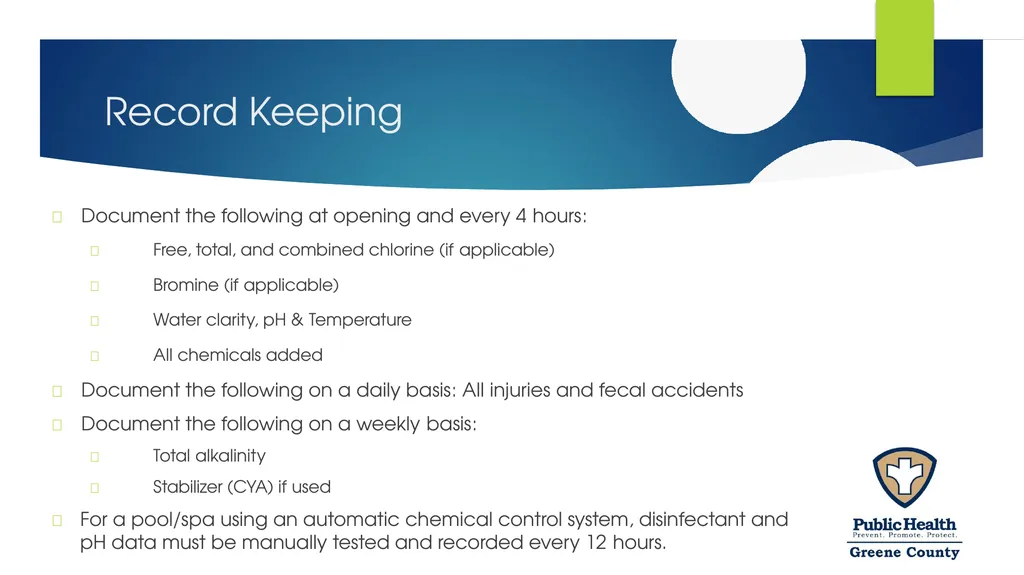
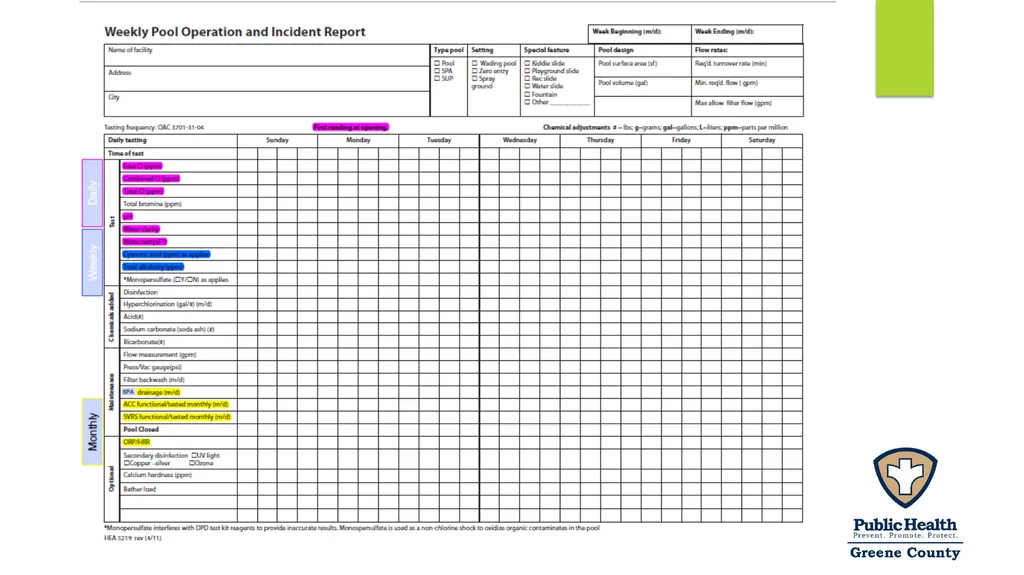
Record Keeping Document the following at opening and every 4 hours:
Free, total, and combined chlorine (if applicable)
Bromine (if applicable)
Water clarity, pH & Temperature
All chemicals added
Document the following on a daily basis: All injuries and fecal accidents
Document the following on a weekly basis:
Total alkalinity
Stabilizer (CYA) if used
For a pool/spa using an automatic chemical control system, disinfectant and pH data must be manually tested and recorded every 12 hours.<br>
Free, total, and combined chlorine (if applicable)
Bromine (if applicable)
Water clarity, pH & Temperature
All chemicals added
Document the following on a daily basis: All injuries and fecal accidents
Document the following on a weekly basis:
Total alkalinity
Stabilizer (CYA) if used
For a pool/spa using an automatic chemical control system, disinfectant and pH data must be manually tested and recorded every 12 hours.<br>
42
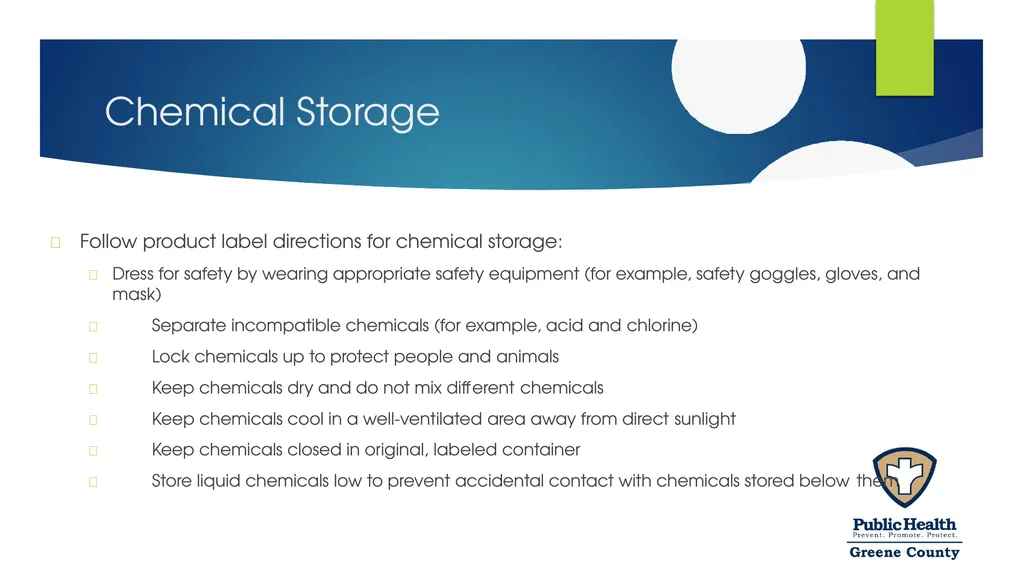
Chemical Storage Follow product label directions for chemical storage:
Dress for safety by wearing appropriate safety equipment (for example, safety goggles, gloves, and mask)
Separate incompatible chemicals (for example, acid and chlorine)
Lock chemicals up to protect people and animals
Keep chemicals dry and do not mix different chemicals
Keep chemicals cool in a well-ventilated area away from direct sunlight
Keep chemicals closed in original, labeled container
Store liquid chemicals low to prevent accidental contact with chemicals stored below them<br>
Dress for safety by wearing appropriate safety equipment (for example, safety goggles, gloves, and mask)
Separate incompatible chemicals (for example, acid and chlorine)
Lock chemicals up to protect people and animals
Keep chemicals dry and do not mix different chemicals
Keep chemicals cool in a well-ventilated area away from direct sunlight
Keep chemicals closed in original, labeled container
Store liquid chemicals low to prevent accidental contact with chemicals stored below them<br>
43
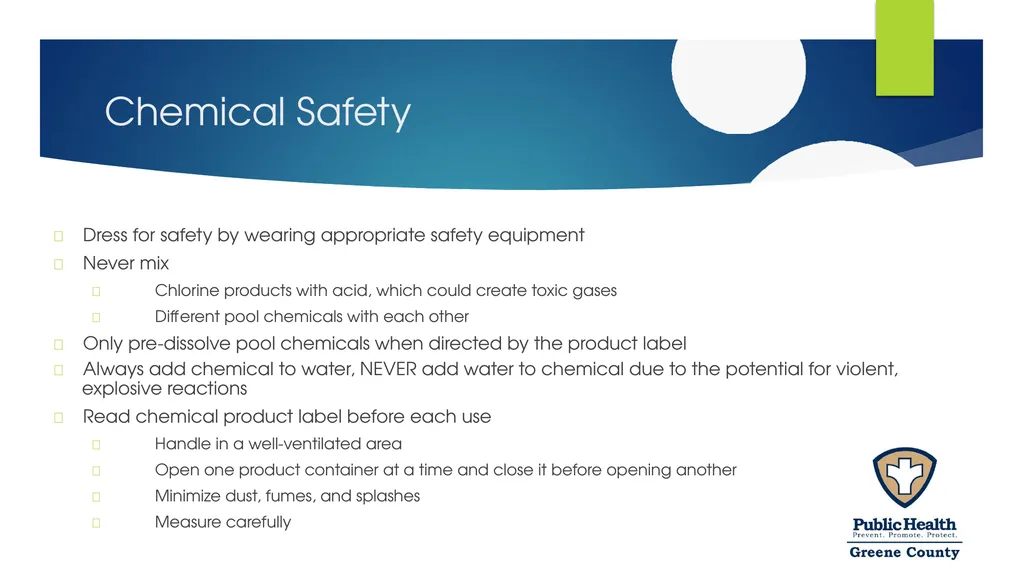
Chemical Safety Dress for safety by wearing appropriate safety equipment
Never mix
Chlorine products with acid, which could create toxic gases
Different pool chemicals with each other
Only pre-dissolve pool chemicals when directed by the product label
Always add chemical to water, NEVER add water to chemical due to the potential for violent,
explosive reactions
Read chemical product label before each use
Handle in a well-ventilated area
Open one product container at a time and close it before opening another
Minimize dust, fumes, and splashes
Measure carefully<br>
Never mix
Chlorine products with acid, which could create toxic gases
Different pool chemicals with each other
Only pre-dissolve pool chemicals when directed by the product label
Always add chemical to water, NEVER add water to chemical due to the potential for violent,
explosive reactions
Read chemical product label before each use
Handle in a well-ventilated area
Open one product container at a time and close it before opening another
Minimize dust, fumes, and splashes
Measure carefully<br>
44
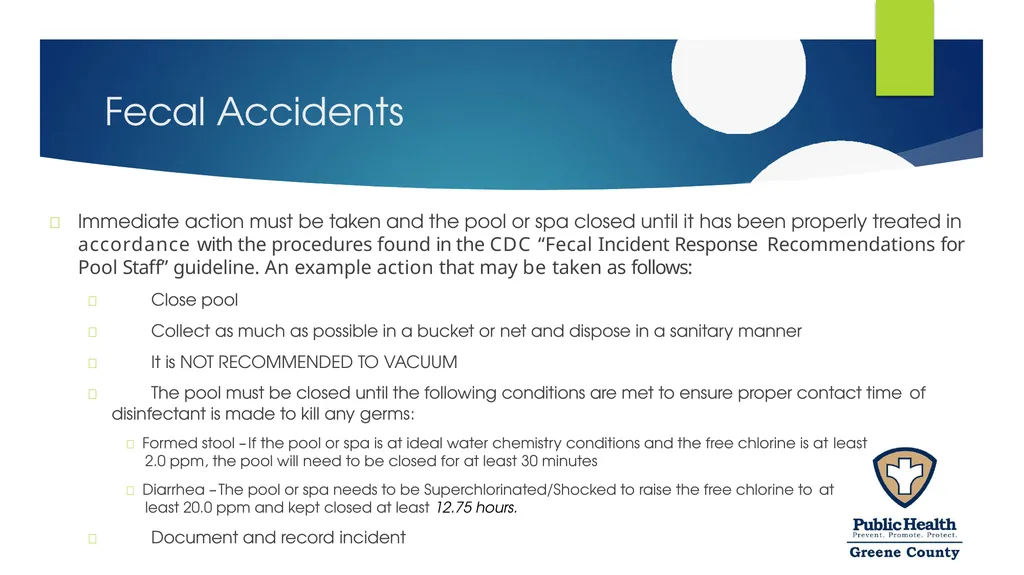
Fecal Accidents Immediate action must be taken and the pool or spa closed until it has been properly treated in accordance with the procedures found in the CDC “Fecal Incident Response Recommendations for Pool Staff” guideline. An example action that may be taken as follows:
Close pool
Collect as much as possible in a bucket or net and dispose in a sanitary manner
It is NOT RECOMMENDED TO VACUUM
The pool must be closed until the following conditions are met to ensure proper contact time of
disinfectant is made to kill any germs:
Formed stool – If the pool or spa is at ideal water chemistry conditions and the free chlorine is at least
2.0 ppm, the pool will need to be closed for at least 30 minutes
Diarrhea – The pool or spa needs to be Superchlorinated/Shocked to raise the free chlorine to at
least 20.0 ppm and kept closed at least 12.75 hours.
Document and record incident<br>
Close pool
Collect as much as possible in a bucket or net and dispose in a sanitary manner
It is NOT RECOMMENDED TO VACUUM
The pool must be closed until the following conditions are met to ensure proper contact time of
disinfectant is made to kill any germs:
Formed stool – If the pool or spa is at ideal water chemistry conditions and the free chlorine is at least
2.0 ppm, the pool will need to be closed for at least 30 minutes
Diarrhea – The pool or spa needs to be Superchlorinated/Shocked to raise the free chlorine to at
least 20.0 ppm and kept closed at least 12.75 hours.
Document and record incident<br>
45
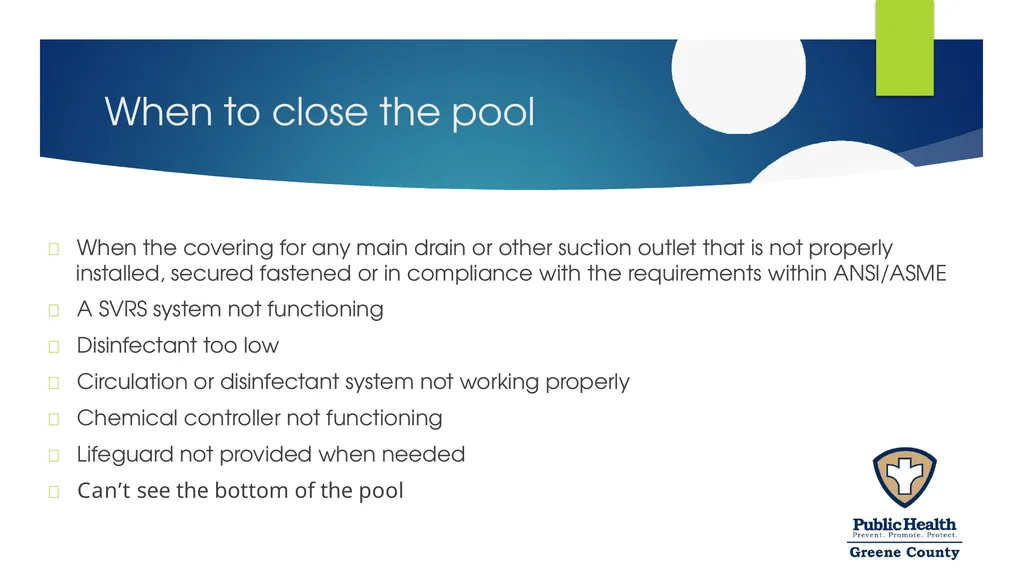
When to close the pool When the covering for any main drain or other suction outlet that is not properly
installed, secured fastened or in compliance with the requirements within ANSI/ASME
A SVRS system not functioning
Disinfectant too low
Circulation or disinfectant system not working properly
Chemical controller not functioning
Lifeguard not provided when needed
Can’t see the bottom of the pool<br>
installed, secured fastened or in compliance with the requirements within ANSI/ASME
A SVRS system not functioning
Disinfectant too low
Circulation or disinfectant system not working properly
Chemical controller not functioning
Lifeguard not provided when needed
Can’t see the bottom of the pool<br>
46
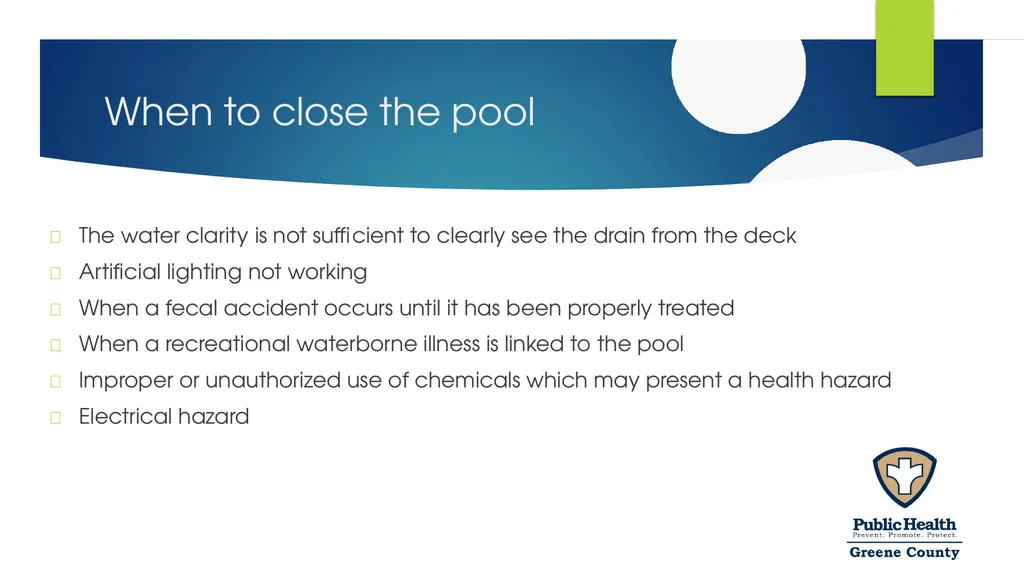
When to close the pool The water clarity is not sufficient to clearly see the drain from the deck
Artificial lighting not working
When a fecal accident occurs until it has been properly treated
When a recreational waterborne illness is linked to the pool
Improper or unauthorized use of chemicals which may present a health hazard
Electrical hazard<br>
Artificial lighting not working
When a fecal accident occurs until it has been properly treated
When a recreational waterborne illness is linked to the pool
Improper or unauthorized use of chemicals which may present a health hazard
Electrical hazard<br>
47
Questions? Comments?<br>