GCSE BrightSparks Resources BrightSparks is generously funded by the Rothschild Foundation with additional support from the Candide Trust, Dunard Fund, Rivers Foundation, Mrs Philip Kan, Gill and Julian Simmonds and Garfield Weston
"GCSE BrightSparks Resources BrightSparks is" is the property of its rightful owner. Permission is granted to
download and print the materials on this website for personal, non-commercial use only, and to display it
on your personal computer provided you do not modify the materials and that you retain all copyright
notices contained in the materials. By downloading content from our website, you accept the terms of this
agreement.
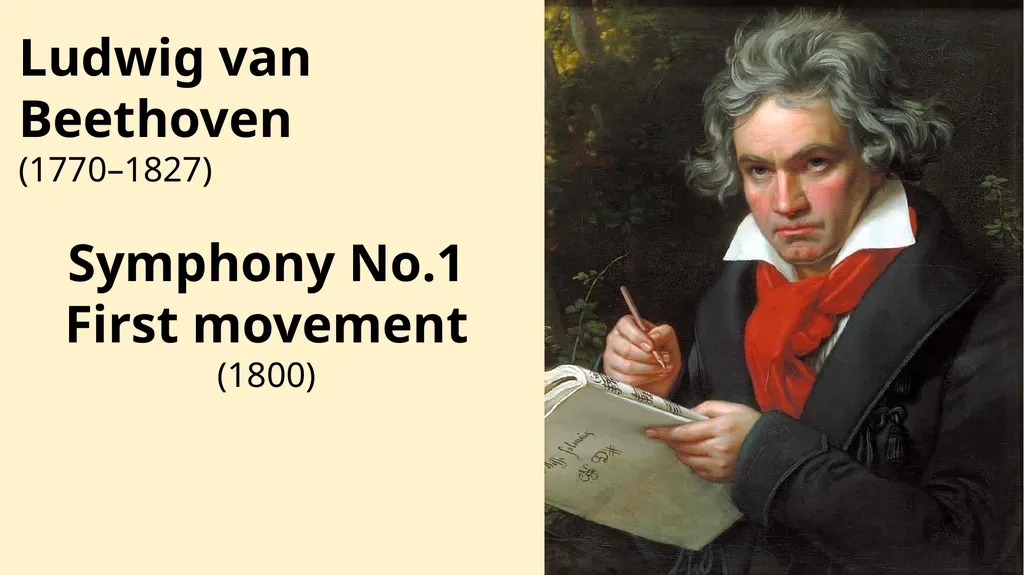
Ludwig van Beethoven
(1770–1827) Symphony No.1
First movement
(1800)<br>
03
Features of the Classical Period (c. 1730–1830) Perfect musical structures
Balanced, regular phrasing
System of harmonic rules
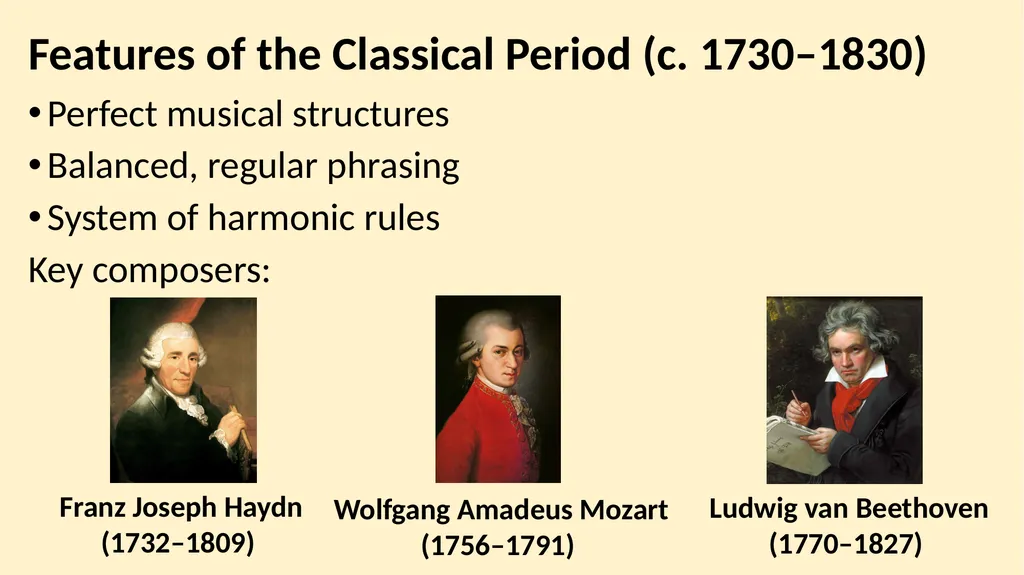
Key composers: Franz Joseph Haydn
(1732–1809) Wolfgang Amadeus Mozart (1756–1791) Ludwig van Beethoven
(1770–1827)<br>
04
Ludwig van Beethoven (1770–1827) Beethoven is considered to be one of the most important figures in the history of Western classical music
He was born in Bonn, Germany, in 1770, and displayed his musical talent from a young age
Aged 21 he moved to Vienna, Austria, and studied composition with the famous classical composer Joseph Haydn
Symphony No.1 was his first major orchestral work, but throughout his career he wrote more symphonies, string quartets, concertos, chamber music and piano sonatas
He began to lose his hearing early in his career, and was almost completely deaf by 1815
He died after several moths of illness in 1827<br>
05
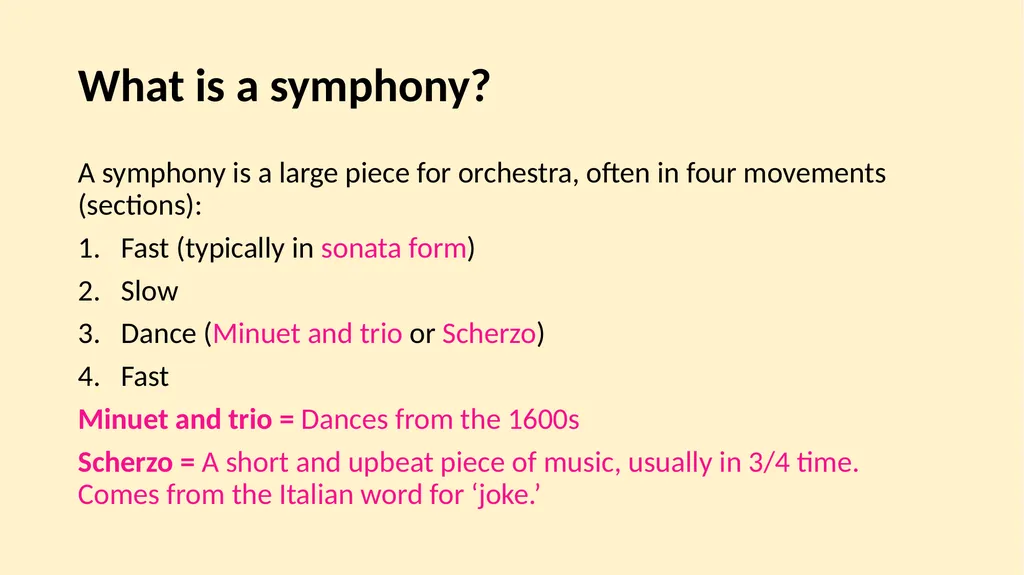
What is a symphony? A symphony is a large piece for orchestra, often in four movements (sections):
Fast (typically in sonata form)
Slow
Dance (Minuet and trio or Scherzo)
Fast
Minuet and trio = Dances from the 1600s
Scherzo = A short and upbeat piece of music, usually in 3/4 time. Comes from the Italian word for ‘joke.’<br>
06
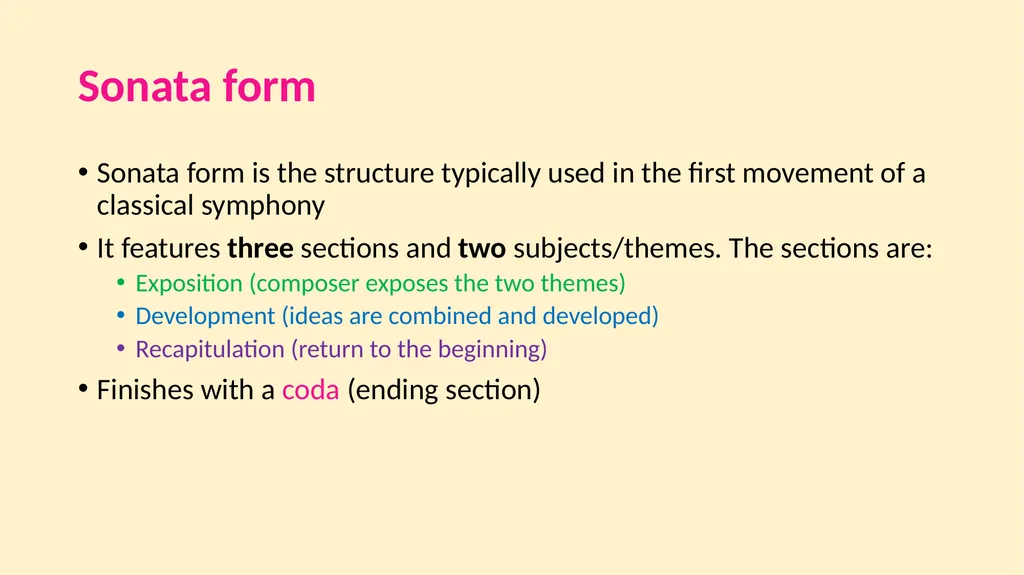
Sonata form Sonata form is the structure typically used in the first movement of a classical symphony
It features three sections and two subjects/themes. The sections are:
Exposition (composer exposes the two themes)
Development (ideas are combined and developed)
Recapitulation (return to the beginning)
Finishes with a coda (ending section)<br>
07
Beethoven
Symphony No.1 – first movement
Analysis<br>
08
https://youtu.be/VwMqvKTpXEs Scrolling score and analysis…<br>
09
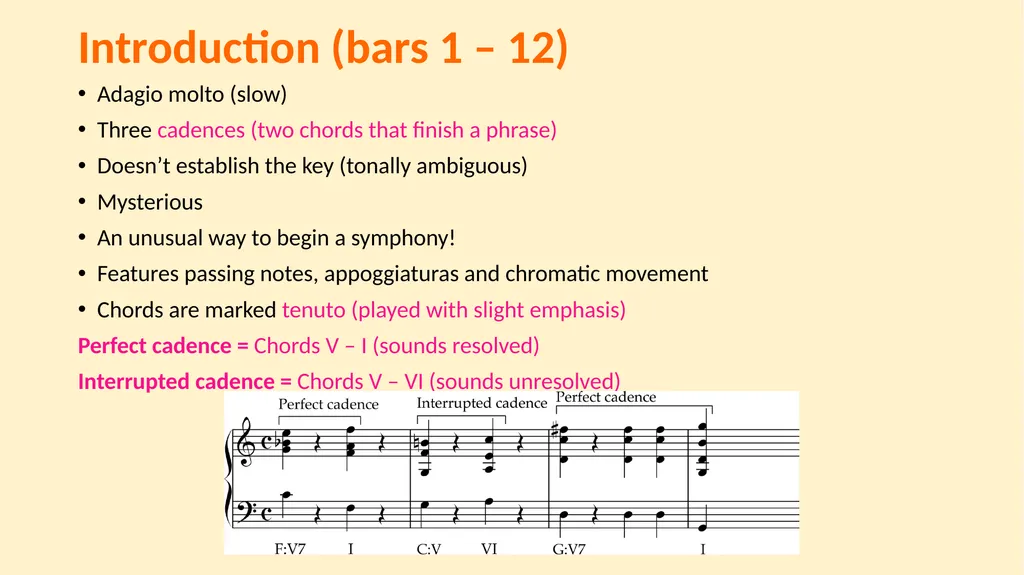
Introduction (bars 1 – 12) Adagio molto (slow)
Three cadences (two chords that finish a phrase)
Doesn’t establish the key (tonally ambiguous)
Mysterious
An unusual way to begin a symphony!
Features passing notes, appoggiaturas and chromatic movement
Chords are marked tenuto (played with slight emphasis)
Perfect cadence = Chords V – I (sounds resolved)
Interrupted cadence = Chords V – VI (sounds unresolved)<br>
10
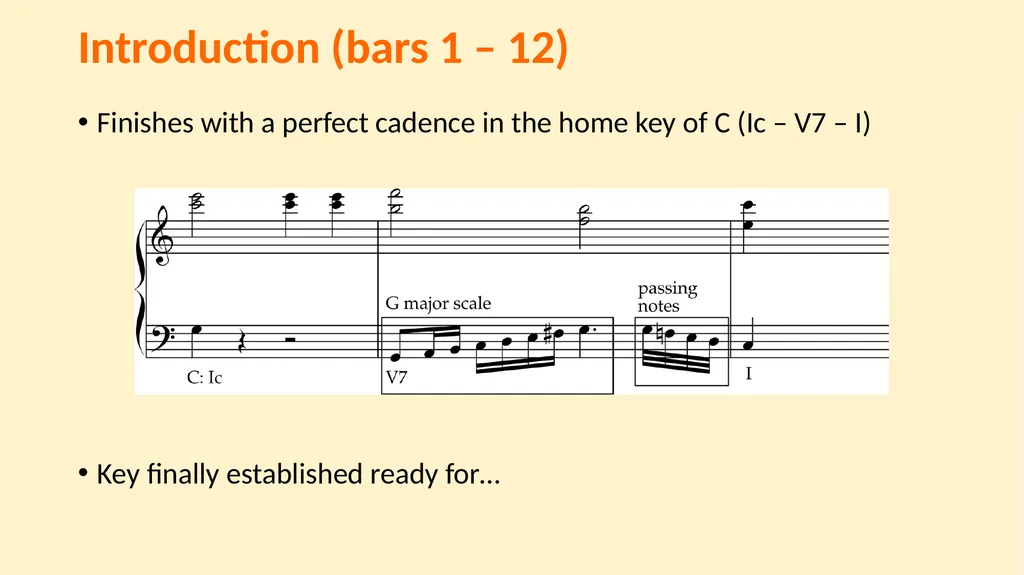
Introduction (bars 1 – 12) Finishes with a perfect cadence in the home key of C (Ic – V7 – I) Key finally established ready for…<br>
11
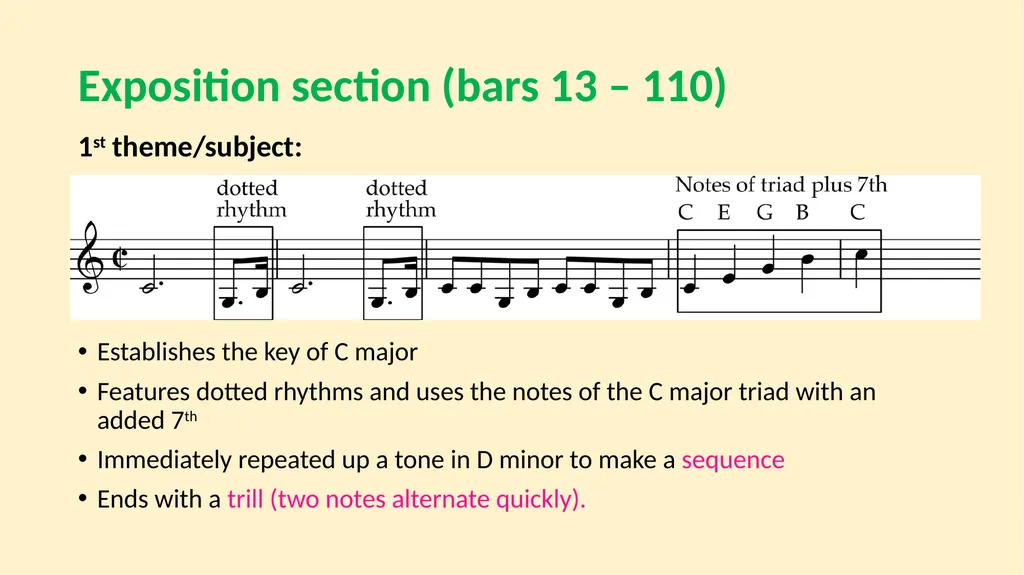
Exposition section (bars 13 – 110) 1st theme/subject: Establishes the key of C major
Features dotted rhythms and uses the notes of the C major triad with an added 7th
Immediately repeated up a tone in D minor to make a sequence
Ends with a trill (two notes alternate quickly).<br>
12
Regular phrasing Regular phrasing = phrases last the same length (in the Classical period, usually 4 or 8 bars). Also called ‘balanced phrasing’
Beethoven’s first subject is unusual because it lasts for 5 bars and is placed within a 6 bar phrase<br>
13
Exposition section (bars 13 – 110) Bar 30 – descending G7 arpeggio and perfect cadence lead to…
Transition theme (bar 32) – 8 bar tonic pedal and…
Antiphony = orchestra is split into two ‘teams’ playing the same material back and forth (woodwind vs strings)
Bar 53 – Imperfect cadence (I – V) leads to…<br>
14
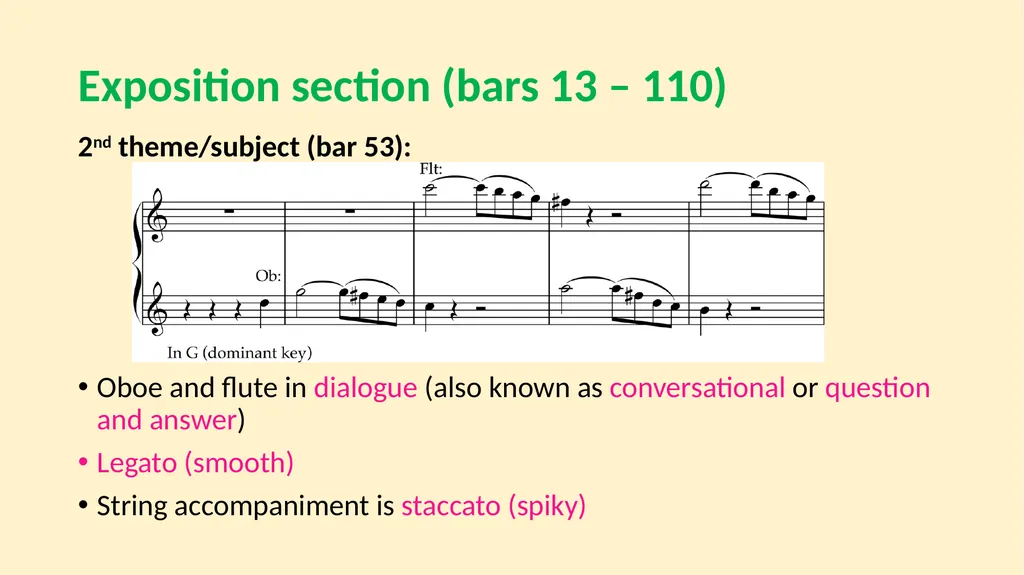
Exposition section (bars 13 – 110) 2nd theme/subject (bar 53): Oboe and flute in dialogue (also known as conversational or question and answer)
Legato (smooth)
String accompaniment is staccato (spiky)<br>
15
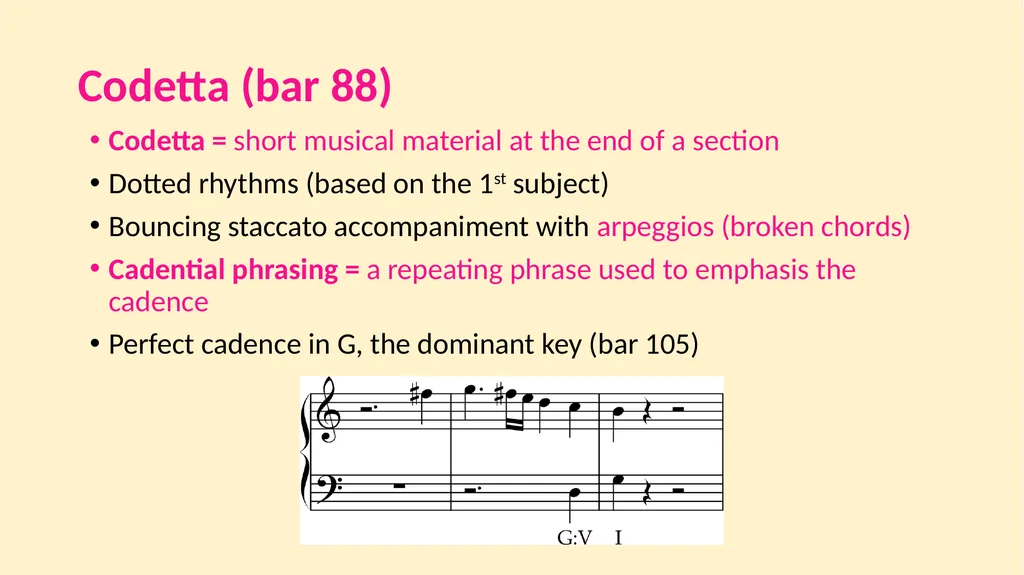
Codetta (bar 88) Codetta = short musical material at the end of a section
Dotted rhythms (based on the 1st subject)
Bouncing staccato accompaniment with arpeggios (broken chords)
Cadential phrasing = a repeating phrase used to emphasis the cadence
Perfect cadence in G, the dominant key (bar 105)<br>
16
Development section (bars 110 – 177) All ideas so far combine, interact and develop
Beethoven mainly uses 1st subject theme (with dotted rhythm)
Begins in G minor and moves through some unusual keys using a sequence
Uses a cycle of fifths (keys are a 5th apart)<br>
17
Development section (bars 110 – 177) Bar 136: canon = an idea is imitated by different instruments with staggered entries (also known as a round)
Bar 139: contrary motion = parts move up and down at the same time
Bar 144: imitation = one idea (the dotted rhythm!) is copied and moved across the orchestra
Bar 171: dramatic dynamics and falling G triad lead to…<br>
18
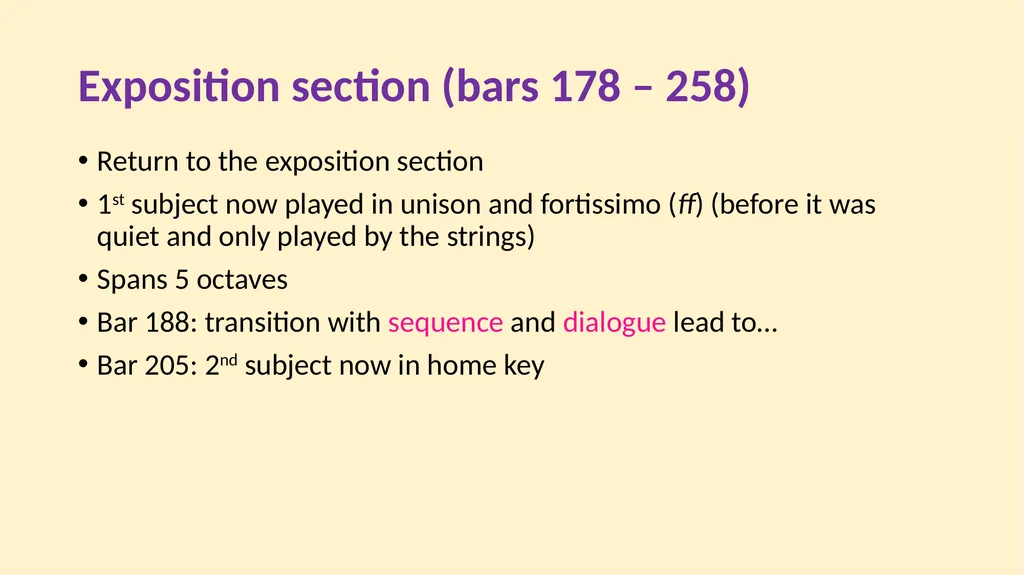
Exposition section (bars 178 – 258) Return to the exposition section
1st subject now played in unison and fortissimo (ff) (before it was quiet and only played by the strings)
Spans 5 octaves
Bar 188: transition with sequence and dialogue lead to…
Bar 205: 2nd subject now in home key<br>
19
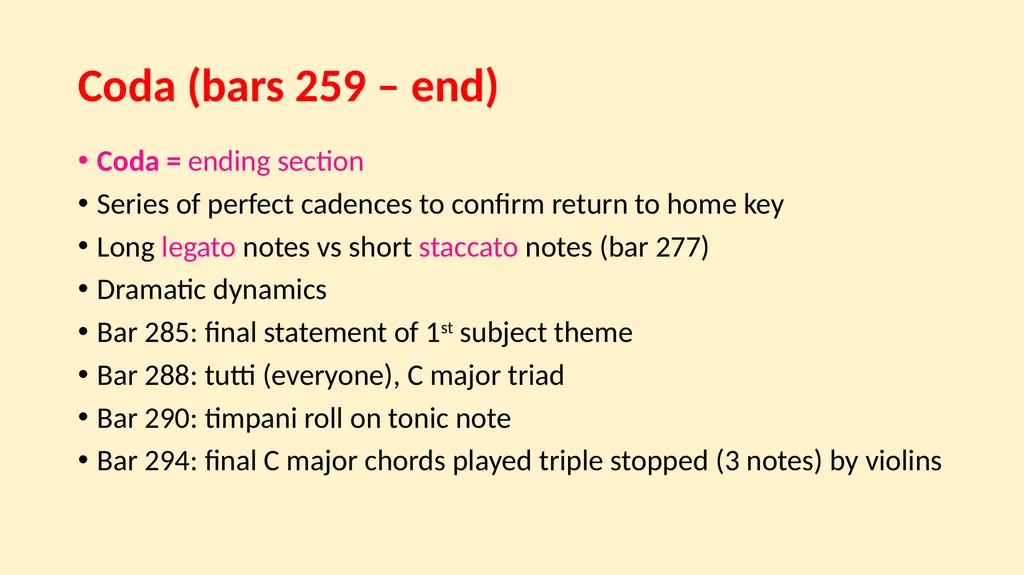
Coda (bars 259 – end) Coda = ending section
Series of perfect cadences to confirm return to home key
Long legato notes vs short staccato notes (bar 277)
Dramatic dynamics
Bar 285: final statement of 1st subject theme
Bar 288: tutti (everyone), C major triad
Bar 290: timpani roll on tonic note
Bar 294: final C major chords played triple stopped (3 notes) by violins<br>
20
Explore more… Revise the Symphony form further with our Guide to the Classical Symphony
Test your knowledge of musical terminology with our bumper terminology quiz
Support your knowledge of classical music with our resources exploring Mozart’s Horn Concerto No. 4, Clarinet Concerto and Eine Kleine Nachtmusik<br>