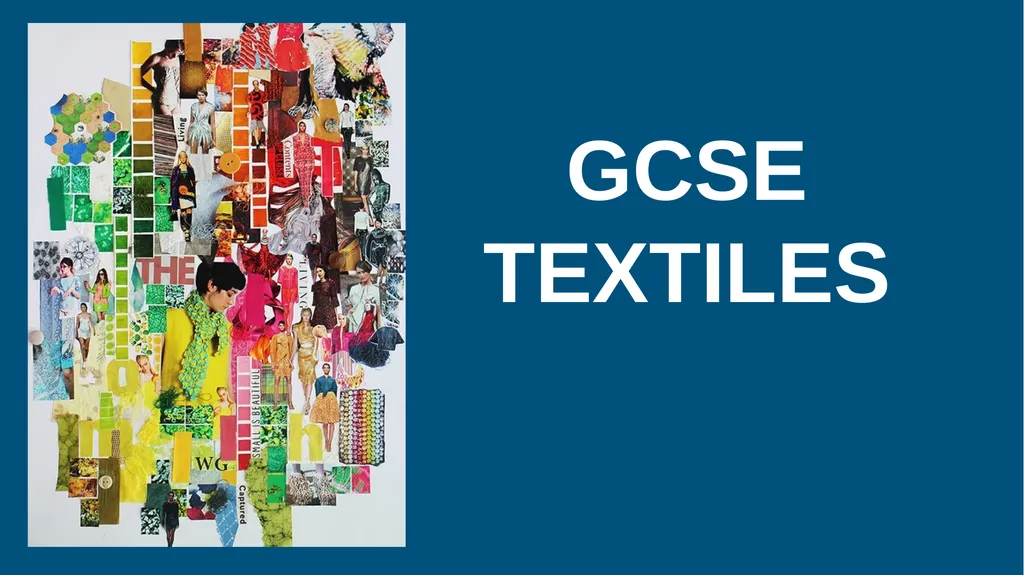
GCSE TEXTILES Content Exam Staff Pupil view Careers Video GCSE Art Textiles is a vibrant and dynamic course which teaches skills such as weaving, felting, stitching, appliqué, construction methods, and printing. It give students the freedom
Related Topics
Share
Embed code
Download this presentation From Below
"GCSE TEXTILES Content Exam Staff Pupil view" is the property of its rightful owner. Permission is granted to
download and print the materials on this website for personal, non-commercial use only, and to display it
on your personal computer provided you do not modify the materials and that you retain all copyright
notices contained in the materials. By downloading content from our website, you accept the terms of this
agreement.
Presentation Transcript
01
GCSE TEXTILES<br>
02
Content Exam Staff Pupil view Careers Video GCSE Art Textiles is a vibrant and dynamic course which teaches skills such as weaving, felting, stitching, appliqué, construction methods, and printing. It give students the freedom to express themselves using techniques and materials they enjoy using. It is not only inspiring and enjoyable but equips them with the skills to continue the subject with confidence at AS, A-level and beyond.
Textiles gives you skills you need for employment in key growth sectors like advanced manufacturing, design, engineering and creative industries. It is the subject where you have to make decisions, plan and predict, design creative and innovative solutions to problems, evaluate and assess the consequences of your decisions. Textiles stretches and challenges you and makes you think creatively. It will hopefully inspire you to follow a career in areas which are vital for the future of our country and perhaps to be an entrepreneur who designs and makes products that people want.<br>
03
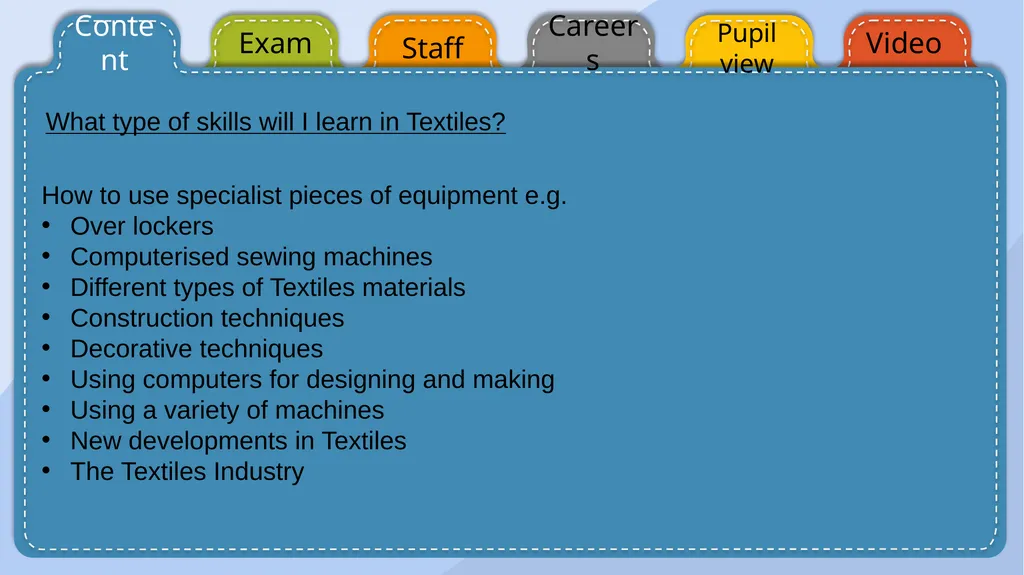
Content Exam Staff Pupil view Careers Video How to use specialist pieces of equipment e.g.
Over lockers
Computerised sewing machines
Different types of Textiles materials
Construction techniques
Decorative techniques
Using computers for designing and making
Using a variety of machines
New developments in Textiles
The Textiles Industry What type of skills will I learn in Textiles?<br>
04
Content Exam Staff Pupil view Careers Video About the course
A high percentage of the work is taught through practical experiences and small projects, which develop your level of technical skills. You will find a great deal of independent choice as well as more structured learning situations in preparation for the assessments. Pupils also be expected to enter local and nationally based competitions in order for them to gain experience and drive within the subject area. Trips to local Textile and Fashion industries is also expected.<br>
05
Exam This subject comes under the Art and Design specification with the WJEC
Unit 1 (60%): Portfolio (120 marks).
Based on a major theme and implementing the design process, through the medium of textiles. A portfolio of evidence is required to be submitted to the very best of the pupils ability.
Unit 2 (40%): Externally set assignment (80 marks).
Externally set by the exam board and pupils are expected to produce a personal response to a given theme, again through the medium of textiles. Throughout the two year course, pupils will have plenty of opportunity to explore the world of textiles. They will be encouraged to experiment and construct different materials, surface design and fabrics. Pupils will be expected to be innovative and creative in their approach to the subject and challenge their way of thinking. The course also provides pupils to engage in the following topics: Constructed Textiles Digital Textiles Dyed Fabrics Printed Fabrics Fashion Design Installed Textiles Soft Furnishings Stitched Textiles, Embellished Textiles and many more…<br>
06
Staff Miss Owen and Mrs Forshaw are the subject specialist for Textiles.
All classes will be taught by either Miss Owen or Mrs Forshaw.<br>
07
Careers Future Careers
There are many careers that you can go into with Textiles:
Illustrator
Interior and spatial designer
Fashion designer
Textile designer
Community arts worker
Conservator
Further education teacher
Graphic designer
Higher education lecturer
Printmaker
Product designer
Retail buyer
Secondary school teacher
Stylist
Visual merchandiser
Tailoring & bespoke textiles How Textiles will help you in the future
As well as technical skills Textiles’ qualifications develop student’s self confidence. In addition it also develops skills in ICT, decision making, team work, independence, planning and organisation. These are all important skills for entering any work place or area of further study. Besides developing a broad base of skills concerning the designing and making of products, this course is an excellent preparation for further education in Textiles. The modern Textiles’ industry uses some of the newest and most exciting technology and it offers students an interesting and dynamic career, with many Higher Education courses at degree and vocational level.<br>
08
Pupil views “You can design & make things that are unique to you and it feels really good when you finish a product you have designed and made.” “We do a lot of practical work and it is fun designing your own product.” “The room is modern and you can use up to date machinery including computerised machines.” “You can be independent and make your own choices.” “Textiles is good because sometimes we work on our own and sometimes in groups. This work is interesting to learn and it is fun. It also widens your prospects and makes you think harder about everyday life.” “Textiles is challenging and you get lots of freedom to make what you want. You can use your imagination to design & make things.”<br>