
Gender and migration discourse in British
LS
Published · 21 slides · 0 views
1 / 1


Description
Gender and migration discourse in British newspapers Alexandra Polyzou alexandra.polyzoucanterbury.ac.uk Amina Kebabi a.kebabi417canterbury.ac.uk Outline Background and details of the study Literature and findings Discussion and
Related Topics
Share
Embed code
Download this presentation From Below
"Gender and migration discourse in British" is the property of its rightful owner. Permission is granted to download and print the materials on this website for personal, non-commercial use only, and to display it on your personal computer provided you do not modify the materials and that you retain all copyright notices contained in the materials. By downloading content from our website, you accept the terms of this agreement.
Presentation Transcript
01
Gender and migration discourse in British newspapers Alexandra Polyzou
alexandra.polyzou@canterbury.ac.uk
&
Amina Kebabi
a.kebabi417@canterbury.ac.uk<br>
alexandra.polyzou@canterbury.ac.uk
&
Amina Kebabi
a.kebabi417@canterbury.ac.uk<br>
02
Outline Background and details of the study
Literature and findings
Discussion and concluding remarks 2<br>
Literature and findings
Discussion and concluding remarks 2<br>
03
CDS, migration discourse and Othering Discourse(s) on migration well studied in CDS (e.g. Wodak, 2011; KhosraviNik, 2014, Charteris-Black, 2016; Demetriou, 2018; Drywood & Gray, 2019)
Key socio-cognitive Us/Them distinction, construction and legitimation of exclusionary identities and practices (van Dijk, 1993)
Cognitive framing in discourse triggering and further reinforcing defensiveness and fear (Hart, 2010; 2011; Musolff, 2015)
Range of fields (e.g. mass or social media, politics) and contexts (historical, national, institutional) 3<br>
Key socio-cognitive Us/Them distinction, construction and legitimation of exclusionary identities and practices (van Dijk, 1993)
Cognitive framing in discourse triggering and further reinforcing defensiveness and fear (Hart, 2010; 2011; Musolff, 2015)
Range of fields (e.g. mass or social media, politics) and contexts (historical, national, institutional) 3<br>
04
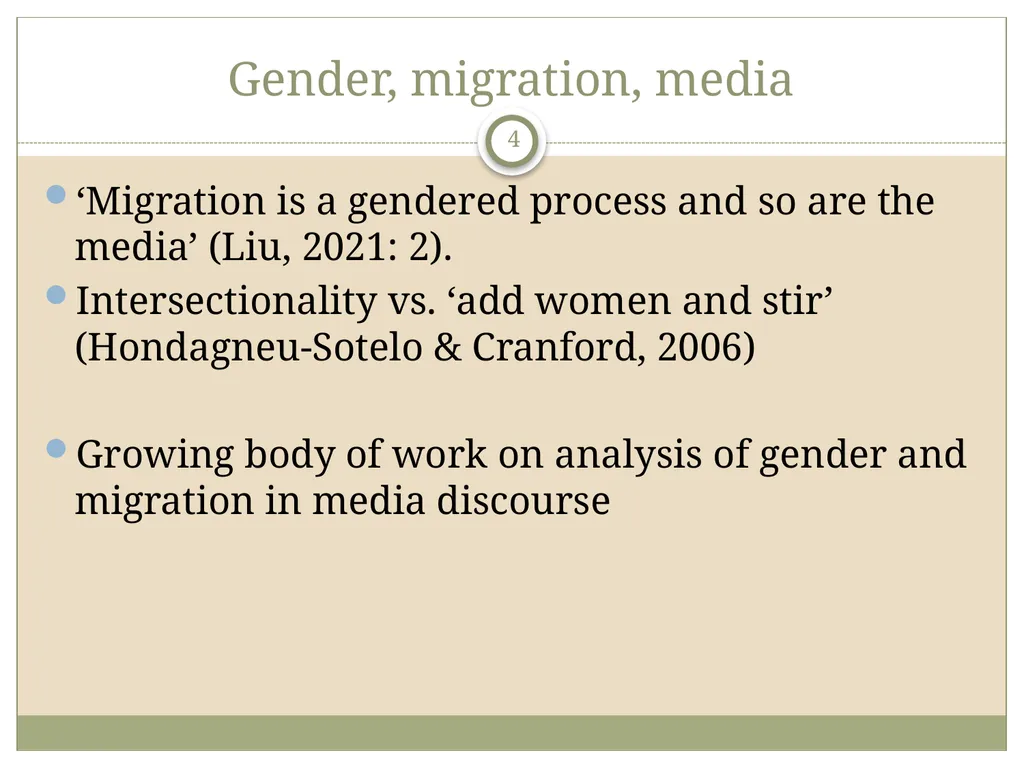
Gender, migration, media ‘Migration is a gendered process and so are the media’ (Liu, 2021: 2).
Intersectionality vs. ‘add women and stir’ (Hondagneu-Sotelo & Cranford, 2006)
Growing body of work on analysis of gender and migration in media discourse 4<br>
Intersectionality vs. ‘add women and stir’ (Hondagneu-Sotelo & Cranford, 2006)
Growing body of work on analysis of gender and migration in media discourse 4<br>
05
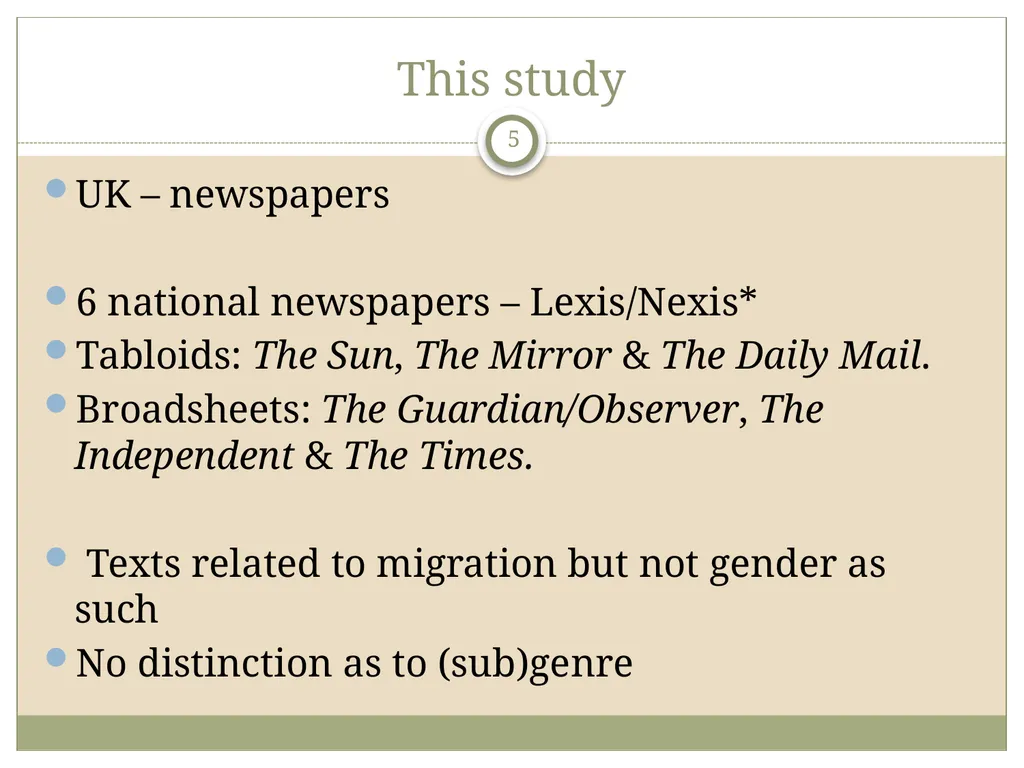
This study UK – newspapers
6 national newspapers – Lexis/Nexis*
Tabloids: The Sun, The Mirror & The Daily Mail.
Broadsheets: The Guardian/Observer, The Independent & The Times.
Texts related to migration but not gender as such
No distinction as to (sub)genre 5<br>
6 national newspapers – Lexis/Nexis*
Tabloids: The Sun, The Mirror & The Daily Mail.
Broadsheets: The Guardian/Observer, The Independent & The Times.
Texts related to migration but not gender as such
No distinction as to (sub)genre 5<br>
06
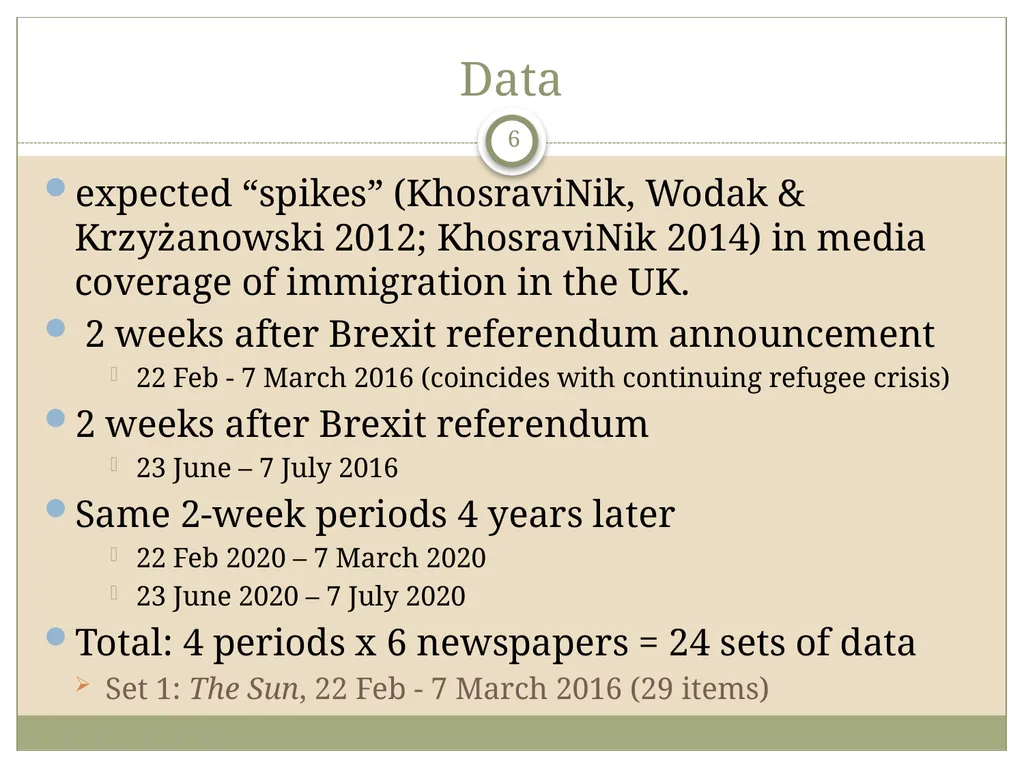
Data expected “spikes” (KhosraviNik, Wodak & Krzyżanowski 2012; KhosraviNik 2014) in media coverage of immigration in the UK.
2 weeks after Brexit referendum announcement
22 Feb - 7 March 2016 (coincides with continuing refugee crisis)
2 weeks after Brexit referendum
23 June – 7 July 2016
Same 2-week periods 4 years later
22 Feb 2020 – 7 March 2020
23 June 2020 – 7 July 2020
Total: 4 periods x 6 newspapers = 24 sets of data
Set 1: The Sun, 22 Feb - 7 March 2016 (29 items) 6<br>
2 weeks after Brexit referendum announcement
22 Feb - 7 March 2016 (coincides with continuing refugee crisis)
2 weeks after Brexit referendum
23 June – 7 July 2016
Same 2-week periods 4 years later
22 Feb 2020 – 7 March 2020
23 June 2020 – 7 July 2020
Total: 4 periods x 6 newspapers = 24 sets of data
Set 1: The Sun, 22 Feb - 7 March 2016 (29 items) 6<br>
07
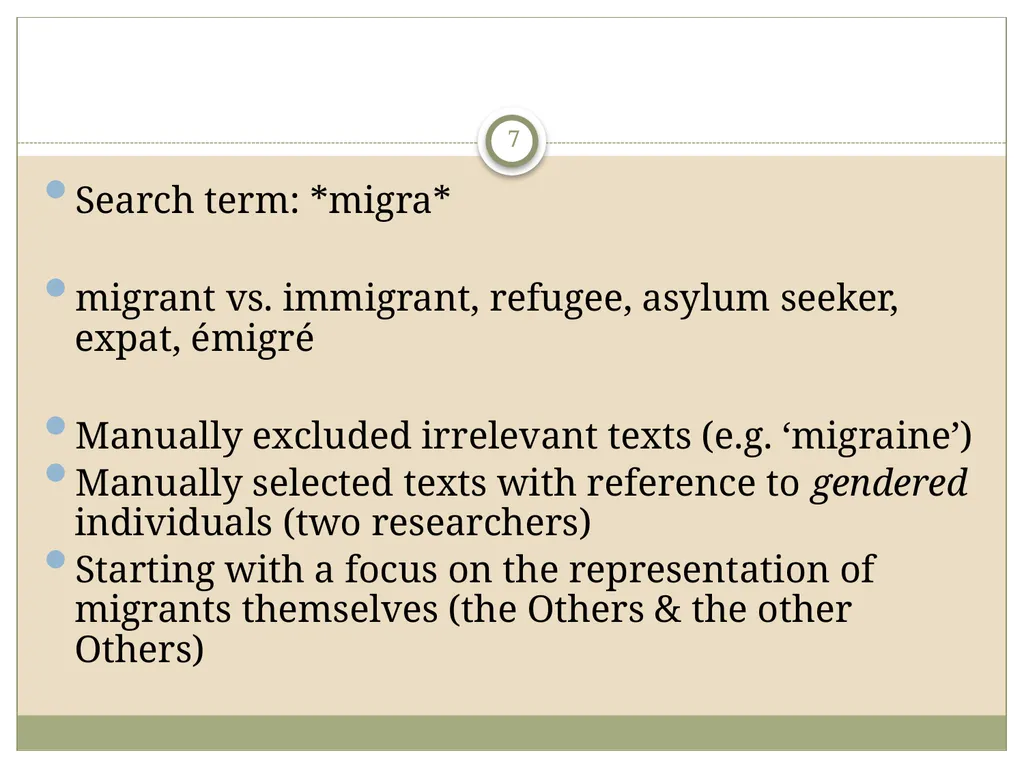
Search term: *migra*
migrant vs. immigrant, refugee, asylum seeker, expat, émigré
Manually excluded irrelevant texts (e.g. ‘migraine’)
Manually selected texts with reference to gendered individuals (two researchers)
Starting with a focus on the representation of migrants themselves (the Others & the other Others) 7<br>
migrant vs. immigrant, refugee, asylum seeker, expat, émigré
Manually excluded irrelevant texts (e.g. ‘migraine’)
Manually selected texts with reference to gendered individuals (two researchers)
Starting with a focus on the representation of migrants themselves (the Others & the other Others) 7<br>
08
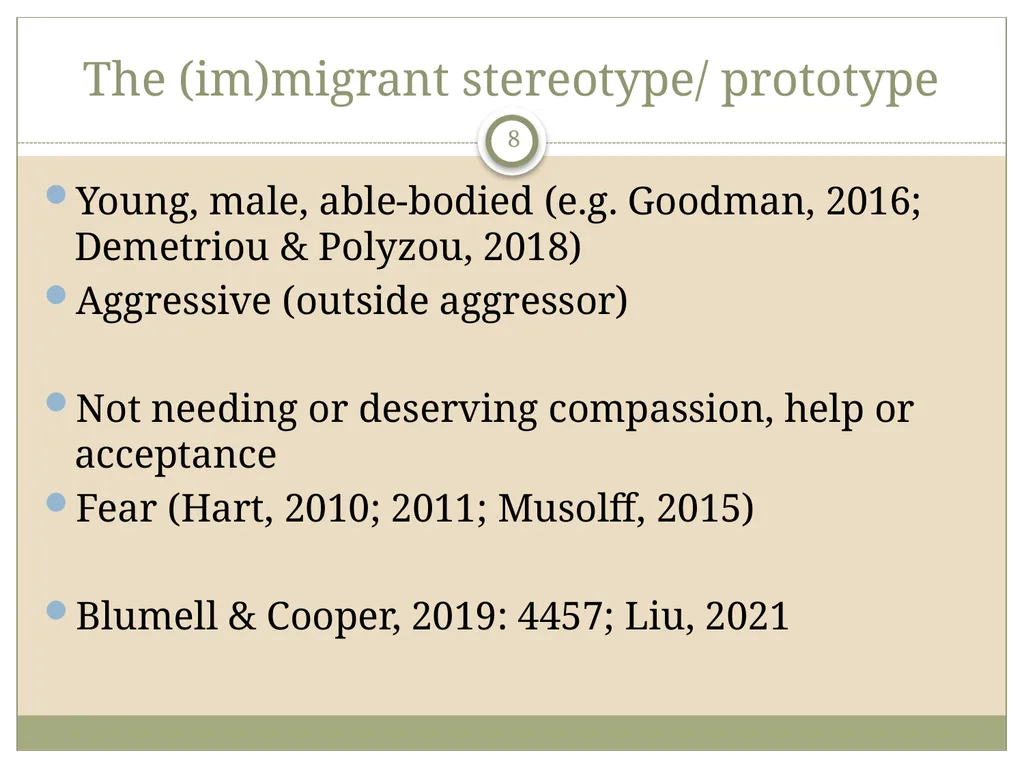
The (im)migrant stereotype/ prototype Young, male, able-bodied (e.g. Goodman, 2016; Demetriou & Polyzou, 2018)
Aggressive (outside aggressor)
Not needing or deserving compassion, help or acceptance
Fear (Hart, 2010; 2011; Musolff, 2015)
Blumell & Cooper, 2019: 4457; Liu, 2021 8<br>
Aggressive (outside aggressor)
Not needing or deserving compassion, help or acceptance
Fear (Hart, 2010; 2011; Musolff, 2015)
Blumell & Cooper, 2019: 4457; Liu, 2021 8<br>
09
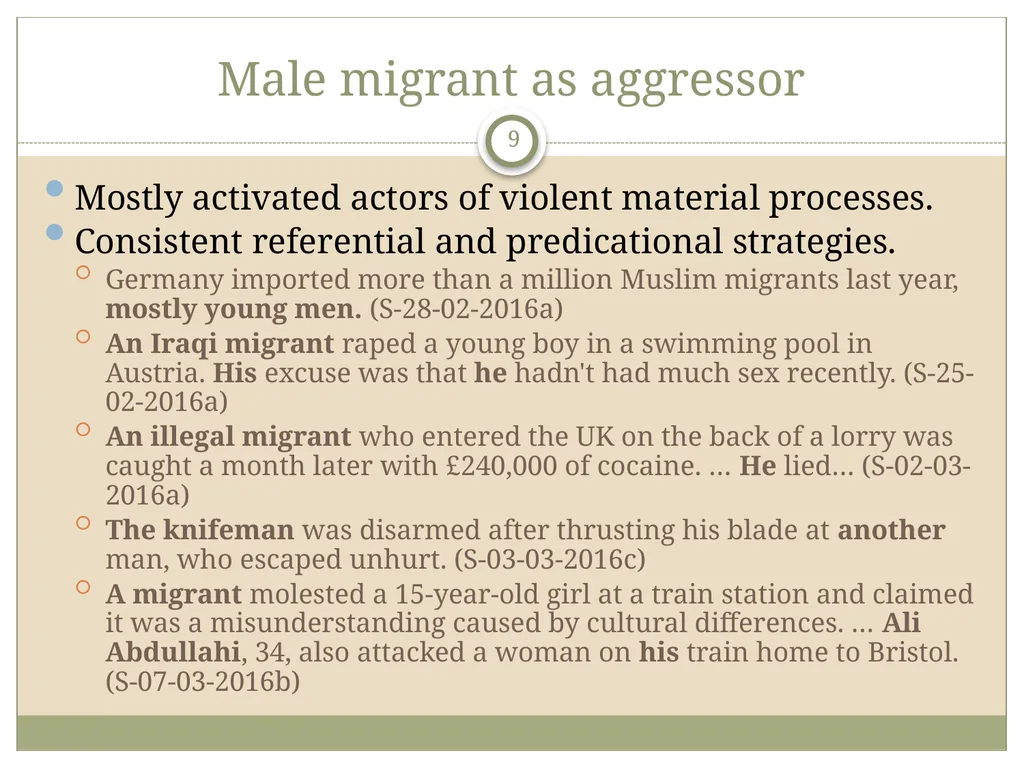
Male migrant as aggressor Mostly activated actors of violent material processes.
Consistent referential and predicational strategies.
Germany imported more than a million Muslim migrants last year, mostly young men. (S-28-02-2016a)
An Iraqi migrant raped a young boy in a swimming pool in Austria. His excuse was that he hadn't had much sex recently. (S-25-02-2016a)
An illegal migrant who entered the UK on the back of a lorry was caught a month later with £240,000 of cocaine. … He lied… (S-02-03-2016a)
The knifeman was disarmed after thrusting his blade at another man, who escaped unhurt. (S-03-03-2016c)
A migrant molested a 15-year-old girl at a train station and claimed it was a misunderstanding caused by cultural differences. … Ali Abdullahi, 34, also attacked a woman on his train home to Bristol. (S-07-03-2016b) 9<br>
Consistent referential and predicational strategies.
Germany imported more than a million Muslim migrants last year, mostly young men. (S-28-02-2016a)
An Iraqi migrant raped a young boy in a swimming pool in Austria. His excuse was that he hadn't had much sex recently. (S-25-02-2016a)
An illegal migrant who entered the UK on the back of a lorry was caught a month later with £240,000 of cocaine. … He lied… (S-02-03-2016a)
The knifeman was disarmed after thrusting his blade at another man, who escaped unhurt. (S-03-03-2016c)
A migrant molested a 15-year-old girl at a train station and claimed it was a misunderstanding caused by cultural differences. … Ali Abdullahi, 34, also attacked a woman on his train home to Bristol. (S-07-03-2016b) 9<br>
10
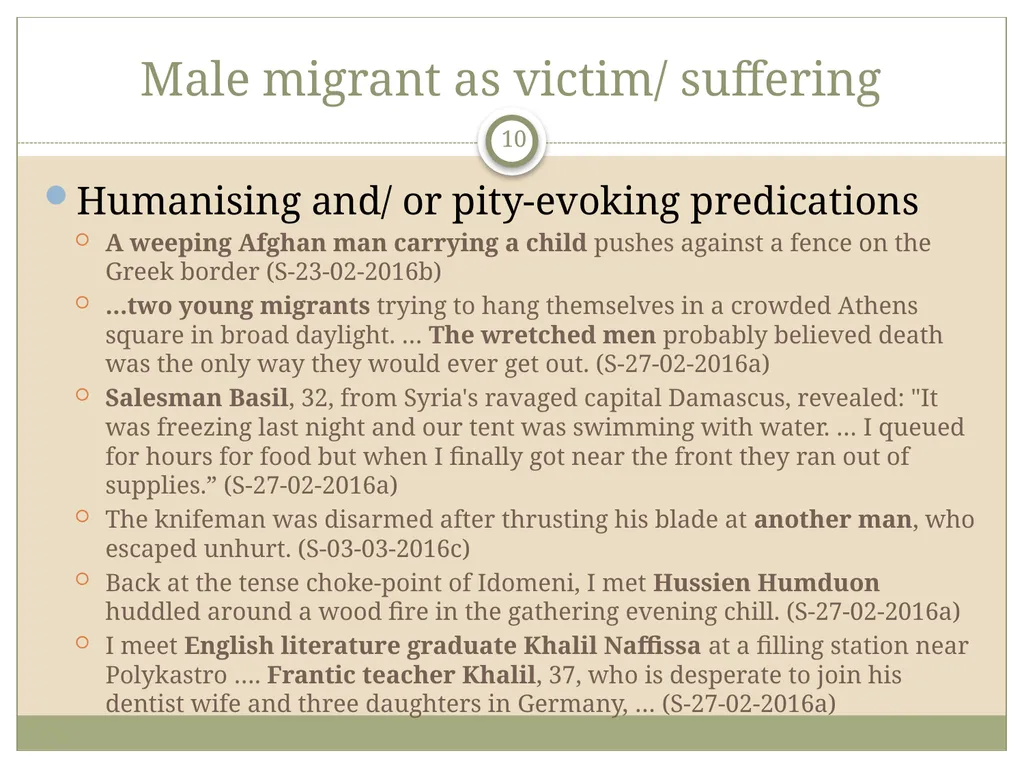
Male migrant as victim/ suffering Humanising and/ or pity-evoking predications
A weeping Afghan man carrying a child pushes against a fence on the Greek border (S-23-02-2016b)
…two young migrants trying to hang themselves in a crowded Athens square in broad daylight. … The wretched men probably believed death was the only way they would ever get out. (S-27-02-2016a)
Salesman Basil, 32, from Syria's ravaged capital Damascus, revealed: "It was freezing last night and our tent was swimming with water. … I queued for hours for food but when I finally got near the front they ran out of supplies.” (S-27-02-2016a)
The knifeman was disarmed after thrusting his blade at another man, who escaped unhurt. (S-03-03-2016c)
Back at the tense choke-point of Idomeni, I met Hussien Humduon huddled around a wood fire in the gathering evening chill. (S-27-02-2016a)
I meet English literature graduate Khalil Naffissa at a filling station near Polykastro …. Frantic teacher Khalil, 37, who is desperate to join his dentist wife and three daughters in Germany, … (S-27-02-2016a) 10<br>
A weeping Afghan man carrying a child pushes against a fence on the Greek border (S-23-02-2016b)
…two young migrants trying to hang themselves in a crowded Athens square in broad daylight. … The wretched men probably believed death was the only way they would ever get out. (S-27-02-2016a)
Salesman Basil, 32, from Syria's ravaged capital Damascus, revealed: "It was freezing last night and our tent was swimming with water. … I queued for hours for food but when I finally got near the front they ran out of supplies.” (S-27-02-2016a)
The knifeman was disarmed after thrusting his blade at another man, who escaped unhurt. (S-03-03-2016c)
Back at the tense choke-point of Idomeni, I met Hussien Humduon huddled around a wood fire in the gathering evening chill. (S-27-02-2016a)
I meet English literature graduate Khalil Naffissa at a filling station near Polykastro …. Frantic teacher Khalil, 37, who is desperate to join his dentist wife and three daughters in Germany, … (S-27-02-2016a) 10<br>
11
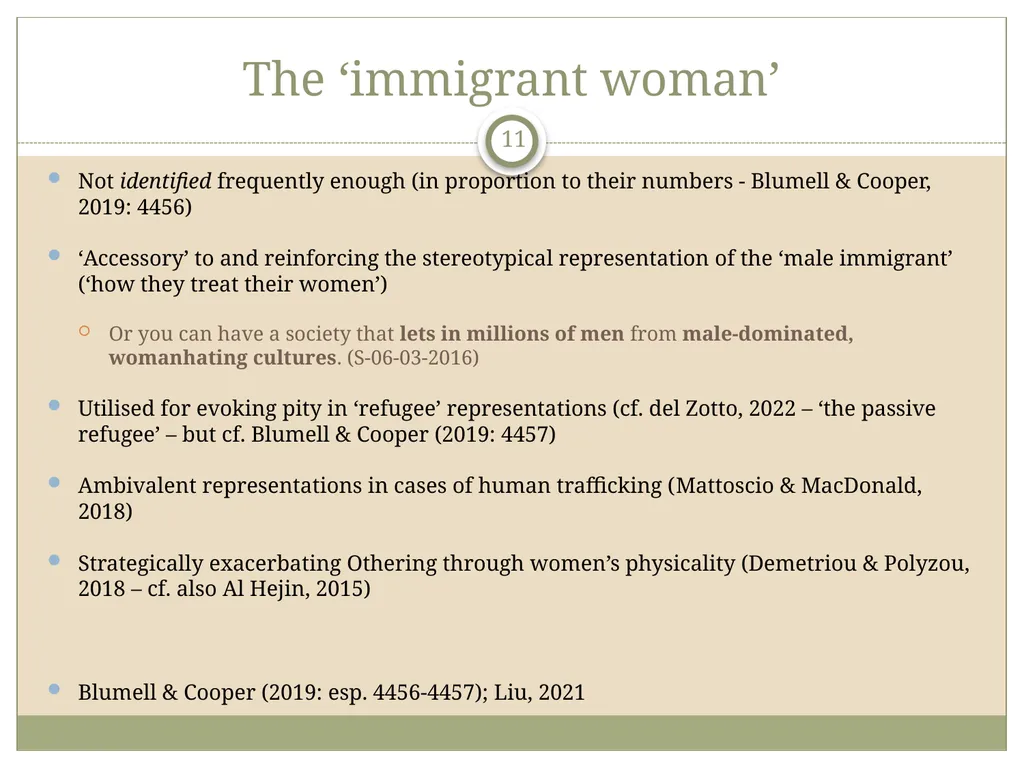
The ‘immigrant woman’ Not identified frequently enough (in proportion to their numbers - Blumell & Cooper, 2019: 4456)
‘Accessory’ to and reinforcing the stereotypical representation of the ‘male immigrant’ (‘how they treat their women’)
Or you can have a society that lets in millions of men from male-dominated, womanhating cultures. (S-06-03-2016)
Utilised for evoking pity in ‘refugee’ representations (cf. del Zotto, 2022 – ‘the passive refugee’ – but cf. Blumell & Cooper (2019: 4457)
Ambivalent representations in cases of human trafficking (Mattoscio & MacDonald, 2018)
Strategically exacerbating Othering through women’s physicality (Demetriou & Polyzou, 2018 – cf. also Al Hejin, 2015)
Blumell & Cooper (2019: esp. 4456-4457); Liu, 2021 11<br>
‘Accessory’ to and reinforcing the stereotypical representation of the ‘male immigrant’ (‘how they treat their women’)
Or you can have a society that lets in millions of men from male-dominated, womanhating cultures. (S-06-03-2016)
Utilised for evoking pity in ‘refugee’ representations (cf. del Zotto, 2022 – ‘the passive refugee’ – but cf. Blumell & Cooper (2019: 4457)
Ambivalent representations in cases of human trafficking (Mattoscio & MacDonald, 2018)
Strategically exacerbating Othering through women’s physicality (Demetriou & Polyzou, 2018 – cf. also Al Hejin, 2015)
Blumell & Cooper (2019: esp. 4456-4457); Liu, 2021 11<br>
12
Female migrant as mother and wife 12 Relational identification and association
War-haunted Basil and Abir Trabulsi gaze forlornly at the razor-wire gateway that leads to prosperous northern Europe. … Cradling eight-month-old son Fahed, Basil's Lebanese wife Abir… (S-27-02-2016a)
Census statistics show foreignborn mothers have more children than Brits. The Government insisted it had created 3,000 extra school places a month since September. (S-29-02-2016a and b)
Aylan, brother Galip, five, and mum Rehan were among those killed when their boat capsized near Bodrum as they fled from Kobani in Syria. (S-05-03-2016c)
Local dad-of-two Apostole Giapoutzis, 51, told me: "Many the migrants I've seen are peaceful women and children (S-27-02-2016a)<br>
War-haunted Basil and Abir Trabulsi gaze forlornly at the razor-wire gateway that leads to prosperous northern Europe. … Cradling eight-month-old son Fahed, Basil's Lebanese wife Abir… (S-27-02-2016a)
Census statistics show foreignborn mothers have more children than Brits. The Government insisted it had created 3,000 extra school places a month since September. (S-29-02-2016a and b)
Aylan, brother Galip, five, and mum Rehan were among those killed when their boat capsized near Bodrum as they fled from Kobani in Syria. (S-05-03-2016c)
Local dad-of-two Apostole Giapoutzis, 51, told me: "Many the migrants I've seen are peaceful women and children (S-27-02-2016a)<br>
13
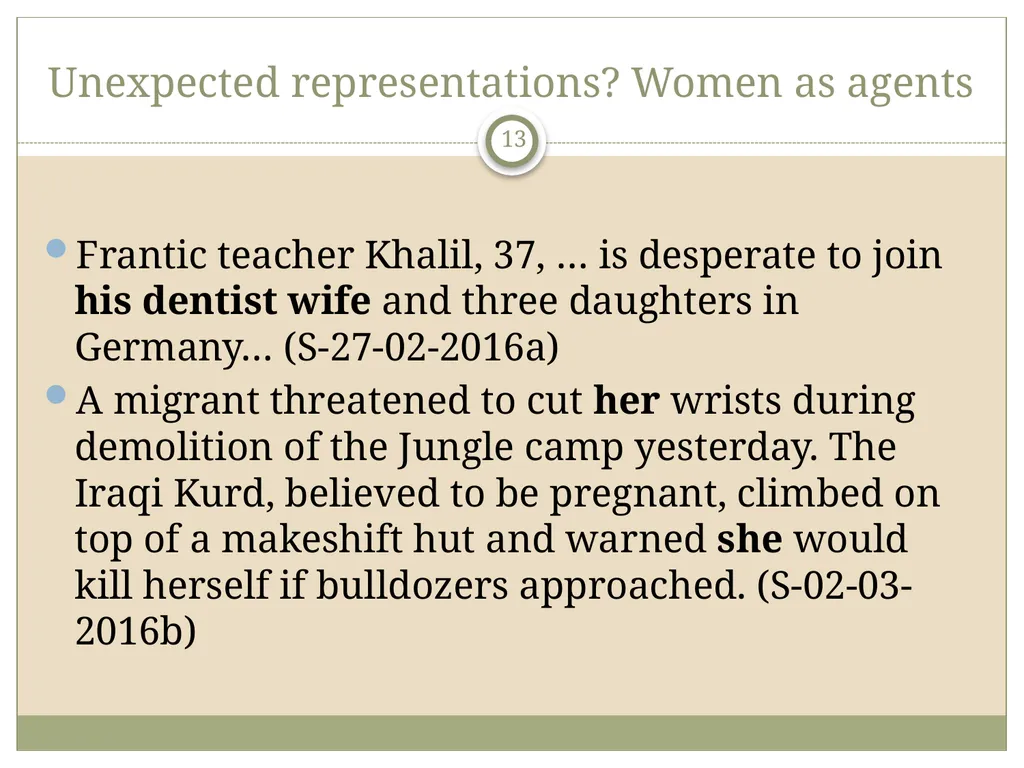
Unexpected representations? Women as agents 13 Frantic teacher Khalil, 37, … is desperate to join his dentist wife and three daughters in Germany… (S-27-02-2016a)
A migrant threatened to cut her wrists during demolition of the Jungle camp yesterday. The Iraqi Kurd, believed to be pregnant, climbed on top of a makeshift hut and warned she would kill herself if bulldozers approached. (S-02-03-2016b)<br>
A migrant threatened to cut her wrists during demolition of the Jungle camp yesterday. The Iraqi Kurd, believed to be pregnant, climbed on top of a makeshift hut and warned she would kill herself if bulldozers approached. (S-02-03-2016b)<br>
14
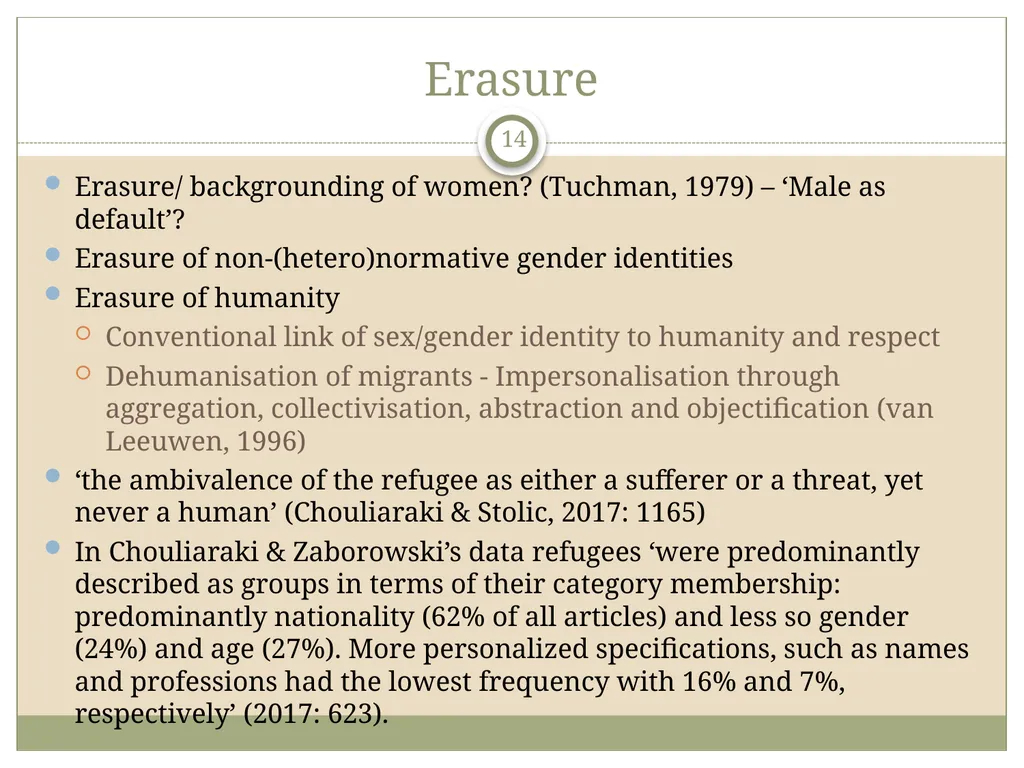
Erasure Erasure/ backgrounding of women? (Tuchman, 1979) – ‘Male as default’?
Erasure of non-(hetero)normative gender identities
Erasure of humanity
Conventional link of sex/gender identity to humanity and respect
Dehumanisation of migrants - Impersonalisation through aggregation, collectivisation, abstraction and objectification (van Leeuwen, 1996)
‘the ambivalence of the refugee as either a sufferer or a threat, yet never a human’ (Chouliaraki & Stolic, 2017: 1165)
In Chouliaraki & Zaborowski’s data refugees ‘were predominantly described as groups in terms of their category membership: predominantly nationality (62% of all articles) and less so gender (24%) and age (27%). More personalized specifications, such as names and professions had the lowest frequency with 16% and 7%, respectively’ (2017: 623). 14<br>
Erasure of non-(hetero)normative gender identities
Erasure of humanity
Conventional link of sex/gender identity to humanity and respect
Dehumanisation of migrants - Impersonalisation through aggregation, collectivisation, abstraction and objectification (van Leeuwen, 1996)
‘the ambivalence of the refugee as either a sufferer or a threat, yet never a human’ (Chouliaraki & Stolic, 2017: 1165)
In Chouliaraki & Zaborowski’s data refugees ‘were predominantly described as groups in terms of their category membership: predominantly nationality (62% of all articles) and less so gender (24%) and age (27%). More personalized specifications, such as names and professions had the lowest frequency with 16% and 7%, respectively’ (2017: 623). 14<br>
15
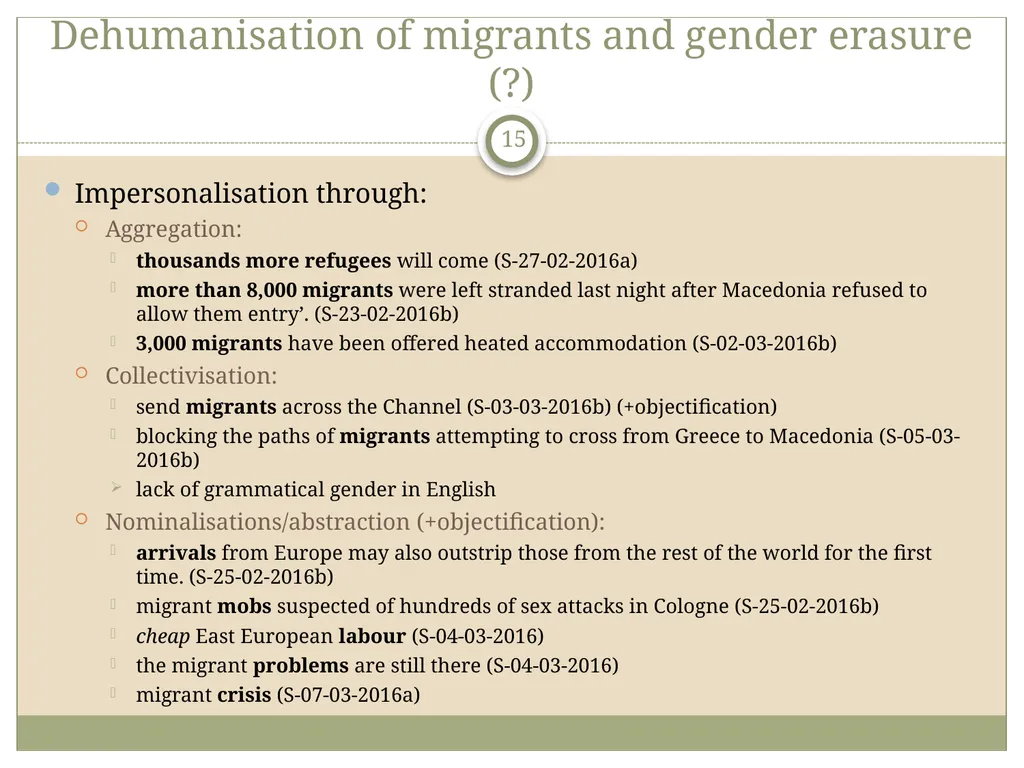
Dehumanisation of migrants and gender erasure (?) Impersonalisation through:
Aggregation:
thousands more refugees will come (S-27-02-2016a)
more than 8,000 migrants were left stranded last night after Macedonia refused to allow them entry’. (S-23-02-2016b)
3,000 migrants have been offered heated accommodation (S-02-03-2016b)
Collectivisation:
send migrants across the Channel (S-03-03-2016b) (+objectification)
blocking the paths of migrants attempting to cross from Greece to Macedonia (S-05-03-2016b)
lack of grammatical gender in English
Nominalisations/abstraction (+objectification):
arrivals from Europe may also outstrip those from the rest of the world for the first time. (S-25-02-2016b)
migrant mobs suspected of hundreds of sex attacks in Cologne (S-25-02-2016b)
cheap East European labour (S-04-03-2016)
the migrant problems are still there (S-04-03-2016)
migrant crisis (S-07-03-2016a) 15<br>
Aggregation:
thousands more refugees will come (S-27-02-2016a)
more than 8,000 migrants were left stranded last night after Macedonia refused to allow them entry’. (S-23-02-2016b)
3,000 migrants have been offered heated accommodation (S-02-03-2016b)
Collectivisation:
send migrants across the Channel (S-03-03-2016b) (+objectification)
blocking the paths of migrants attempting to cross from Greece to Macedonia (S-05-03-2016b)
lack of grammatical gender in English
Nominalisations/abstraction (+objectification):
arrivals from Europe may also outstrip those from the rest of the world for the first time. (S-25-02-2016b)
migrant mobs suspected of hundreds of sex attacks in Cologne (S-25-02-2016b)
cheap East European labour (S-04-03-2016)
the migrant problems are still there (S-04-03-2016)
migrant crisis (S-07-03-2016a) 15<br>
16
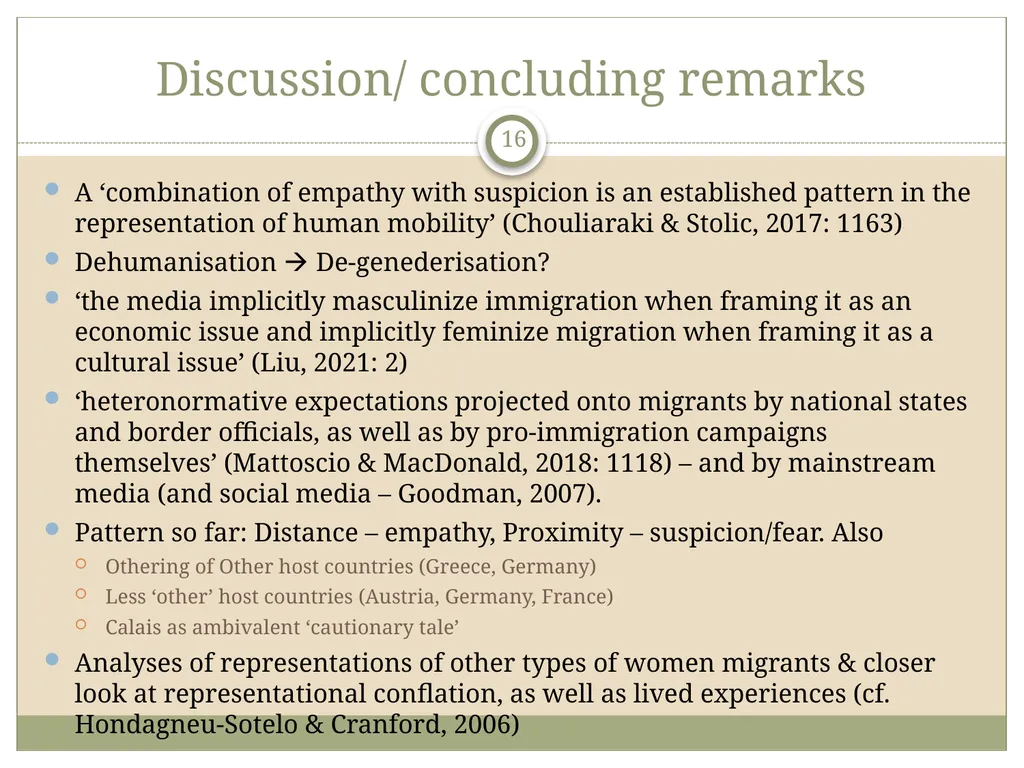
Discussion/ concluding remarks A ‘combination of empathy with suspicion is an established pattern in the representation of human mobility’ (Chouliaraki & Stolic, 2017: 1163)
Dehumanisation De-genederisation?
‘the media implicitly masculinize immigration when framing it as an economic issue and implicitly feminize migration when framing it as a cultural issue’ (Liu, 2021: 2)
‘heteronormative expectations projected onto migrants by national states and border officials, as well as by pro-immigration campaigns themselves’ (Mattoscio & MacDonald, 2018: 1118) – and by mainstream media (and social media – Goodman, 2007).
Pattern so far: Distance – empathy, Proximity – suspicion/fear. Also
Othering of Other host countries (Greece, Germany)
Less ‘other’ host countries (Austria, Germany, France)
Calais as ambivalent ‘cautionary tale’
Analyses of representations of other types of women migrants & closer look at representational conflation, as well as lived experiences (cf. Hondagneu-Sotelo & Cranford, 2006) 16<br>
Dehumanisation De-genederisation?
‘the media implicitly masculinize immigration when framing it as an economic issue and implicitly feminize migration when framing it as a cultural issue’ (Liu, 2021: 2)
‘heteronormative expectations projected onto migrants by national states and border officials, as well as by pro-immigration campaigns themselves’ (Mattoscio & MacDonald, 2018: 1118) – and by mainstream media (and social media – Goodman, 2007).
Pattern so far: Distance – empathy, Proximity – suspicion/fear. Also
Othering of Other host countries (Greece, Germany)
Less ‘other’ host countries (Austria, Germany, France)
Calais as ambivalent ‘cautionary tale’
Analyses of representations of other types of women migrants & closer look at representational conflation, as well as lived experiences (cf. Hondagneu-Sotelo & Cranford, 2006) 16<br>
17
17 Questions? Comments? Feedback? Suggestions? Alexandra Polyzou
alexandra.polyzou@canterbury.ac.uk
&
Amina Kebabi
a.kebabi417@canterbury.ac.uk<br>
alexandra.polyzou@canterbury.ac.uk
&
Amina Kebabi
a.kebabi417@canterbury.ac.uk<br>
18
References Al-Hejin, B. 2015. Covering Muslim women: Semantic macrostructures in BBC News. Discourse & Communication, 9(1): 19–46
Blumell, L. & Cooper, G. 2019. Measuring gender in news representations of refugees and asylum seekers. International Journal of Communication, 13: 4444-4464.
Charteris-Black, J. 2006. Britain as a container: Immigration metaphors in the 2005 election campaign. Discourse & Society, 17(5): 563–581.
Chouliaraki, L. & Stolic, T. 2017. Rethinking humanity and responsibility in the refugee ‘crisis’: A visual typology of news media. Media, Culture & Society, 39(8): 1162-1177.
Chouliaraki, L. & Zaborowski, R. 2017. Voice and community in the 2015 refugee crisis: A content analysis of news coverage in eight European countries. The International Communication Gazette, 79(6–7): 613–635. 18<br>
Blumell, L. & Cooper, G. 2019. Measuring gender in news representations of refugees and asylum seekers. International Journal of Communication, 13: 4444-4464.
Charteris-Black, J. 2006. Britain as a container: Immigration metaphors in the 2005 election campaign. Discourse & Society, 17(5): 563–581.
Chouliaraki, L. & Stolic, T. 2017. Rethinking humanity and responsibility in the refugee ‘crisis’: A visual typology of news media. Media, Culture & Society, 39(8): 1162-1177.
Chouliaraki, L. & Zaborowski, R. 2017. Voice and community in the 2015 refugee crisis: A content analysis of news coverage in eight European countries. The International Communication Gazette, 79(6–7): 613–635. 18<br>
19
del Zotto, A. 2002. Weeping Women, Wringing Hands: How the Mainstream Media Stereotyped Women's Experiences in Kosovo, Journal of Gender Studies, 11(2): 141-150.
Demetriou, D. 2018. Discourse on immigration in the UK: representations and evaluations of Romanians and Bulgarians as ‘benefit tourists’. PhD. thesis, Canterbury Christ Church University.
Demetriou, D. & Polyzou, A. 2018. Representations of Gender and Ethnicity in the EU migration debate: An examination of UK (online) right-wing press. Critical Approaches to Discourse Analysis across Disciplines (CADAAD). 4-6 July 2018. Aalborg University, Aalborg, Denmark.
Drywood, E. & Gray, H. 2019. Demonising immigrants: How a human rights narrative has contributed to negative portrayals of immigrants in the UK media, in Farrell, M., Drywood, E., and Hughes, E. (eds) Human Rights in the Media: Fear and Fetish. London: Routledge, 777-808. 19<br>
Demetriou, D. 2018. Discourse on immigration in the UK: representations and evaluations of Romanians and Bulgarians as ‘benefit tourists’. PhD. thesis, Canterbury Christ Church University.
Demetriou, D. & Polyzou, A. 2018. Representations of Gender and Ethnicity in the EU migration debate: An examination of UK (online) right-wing press. Critical Approaches to Discourse Analysis across Disciplines (CADAAD). 4-6 July 2018. Aalborg University, Aalborg, Denmark.
Drywood, E. & Gray, H. 2019. Demonising immigrants: How a human rights narrative has contributed to negative portrayals of immigrants in the UK media, in Farrell, M., Drywood, E., and Hughes, E. (eds) Human Rights in the Media: Fear and Fetish. London: Routledge, 777-808. 19<br>
20
Goodman, S. 2007. Constructing Asylum Seeking Families. Critical Approaches to Discourse Analysis Across Disciplines, 1 (1): 36-50.
Goodman, S. 2016. The representation of refugees and the refugee crisis. Presentation, 16/11/2016, Canterbury Christ Church University.
Hart, C. 2010. Critical Discourse Analysis and Cognitive Science: New Perspectives on Immigration Discourse. Basingstoke: Palgrave Macmillan.
Hart, C. 2011. Force-interactive patterns in immigration discourse: A Cognitive Linguistic approach to CDA. Discourse & Society, 22 (3): 269-286.
Hondagneu-Sotelo, P. & Cranford, C., 2006. Gender and migration. In Saltzman Chafetz, J. (ed.) Handbook of the Sociology of Gender. Boston, MA: Springer, 105-126.
KhosraviNik, M. 2014. Immigration discourses and critical discourse analysis: dynamics of world events and immigration representations in the British press, in Hart, C. and Cap, P. (eds) Contemporary Critical Discourse Studies. London: Bloomsbury, 503–522. 20<br>
Goodman, S. 2016. The representation of refugees and the refugee crisis. Presentation, 16/11/2016, Canterbury Christ Church University.
Hart, C. 2010. Critical Discourse Analysis and Cognitive Science: New Perspectives on Immigration Discourse. Basingstoke: Palgrave Macmillan.
Hart, C. 2011. Force-interactive patterns in immigration discourse: A Cognitive Linguistic approach to CDA. Discourse & Society, 22 (3): 269-286.
Hondagneu-Sotelo, P. & Cranford, C., 2006. Gender and migration. In Saltzman Chafetz, J. (ed.) Handbook of the Sociology of Gender. Boston, MA: Springer, 105-126.
KhosraviNik, M. 2014. Immigration discourses and critical discourse analysis: dynamics of world events and immigration representations in the British press, in Hart, C. and Cap, P. (eds) Contemporary Critical Discourse Studies. London: Bloomsbury, 503–522. 20<br>
21
KhosraviNik M., Krzyżanowski, M. & Wodak, R. 2012. Dynamics of representation in discourse: Immigrants in the British press, in Messer M., Schroeder, R. & Wodak, R. (eds) Migrations: Interdisciplinary Perspectives. New York: Springer, 283–296.
Liu, S. 2021. Gendering immigration: media framings of the economic and cultural consequences of immigration, Feminist Media Studies, 1-18.
Mattoscio, M. & MacDonald, M. 2018. Introduction: Gender, Migration, and the Media. Feminist Media Studies. 18(6): 1117–1132.
Musolff, A. 2015. Dehumanizing metaphors in UK immigrant debates in press and online media. Journal of Language Aggression and Conflict, 3(1): 41–56.
Tuchman, G. 1979. Women's Depiction by the Mass Media. Signs, 4(3): 528-542.
van Dijk, T. 1993. Principles of Critical Discourse Analysis. Discourse & Society, 4(2): 249-283.
Wodak, R. 2011. ‘Us’ and ‘them’: inclusion and exclusion – discrimination via discourse. in G. Delanty, R. Wodak & P. Jones (eds), Identity, Belonging and Migration. Liverpool: University of Liverpool Press, pp. 54-77. 21<br>
Liu, S. 2021. Gendering immigration: media framings of the economic and cultural consequences of immigration, Feminist Media Studies, 1-18.
Mattoscio, M. & MacDonald, M. 2018. Introduction: Gender, Migration, and the Media. Feminist Media Studies. 18(6): 1117–1132.
Musolff, A. 2015. Dehumanizing metaphors in UK immigrant debates in press and online media. Journal of Language Aggression and Conflict, 3(1): 41–56.
Tuchman, G. 1979. Women's Depiction by the Mass Media. Signs, 4(3): 528-542.
van Dijk, T. 1993. Principles of Critical Discourse Analysis. Discourse & Society, 4(2): 249-283.
Wodak, R. 2011. ‘Us’ and ‘them’: inclusion and exclusion – discrimination via discourse. in G. Delanty, R. Wodak & P. Jones (eds), Identity, Belonging and Migration. Liverpool: University of Liverpool Press, pp. 54-77. 21<br>