Gender auditing: creating a gender-sensitive workplace Session 6: Analysis and validation of data Reconciling sources of evidence 2 Iterative Process - Feedback Loops Identifying root causes In the analysis, it is important to distinguish
"Gender auditing: creating a gender-sensitive" is the property of its rightful owner. Permission is granted to
download and print the materials on this website for personal, non-commercial use only, and to display it
on your personal computer provided you do not modify the materials and that you retain all copyright
notices contained in the materials. By downloading content from our website, you accept the terms of this
agreement.
Presentation Transcript
01
Gender auditing: creating a gender-sensitive workplace Session 6: Analysis and validation of data<br>
02
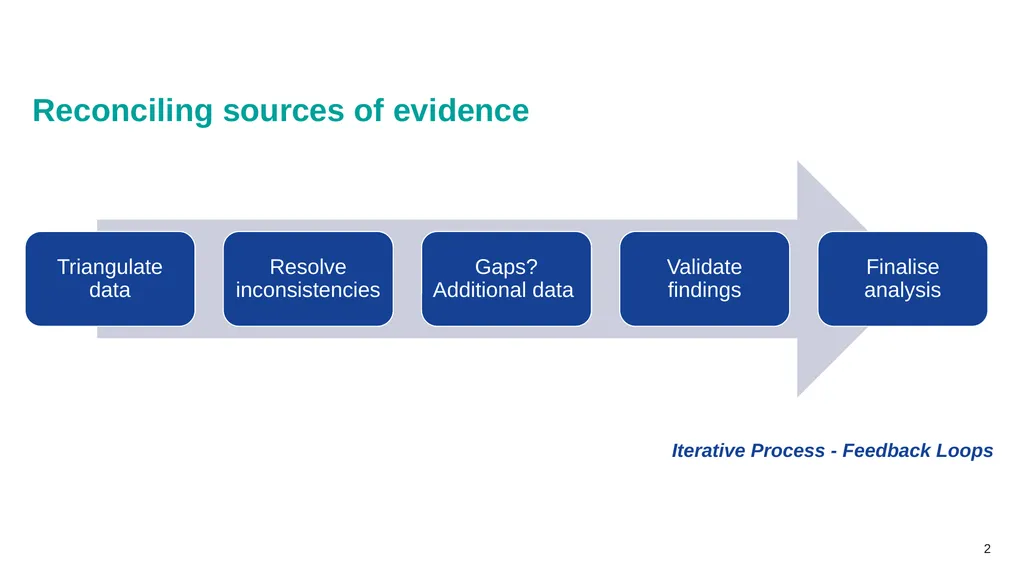
Reconciling sources of evidence 2 Iterative Process - Feedback Loops<br>
03
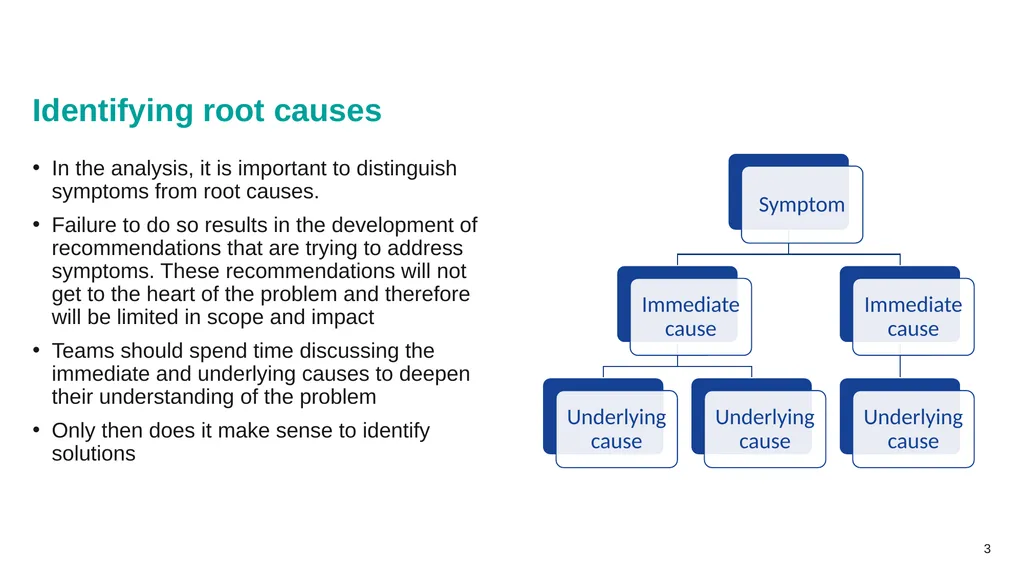
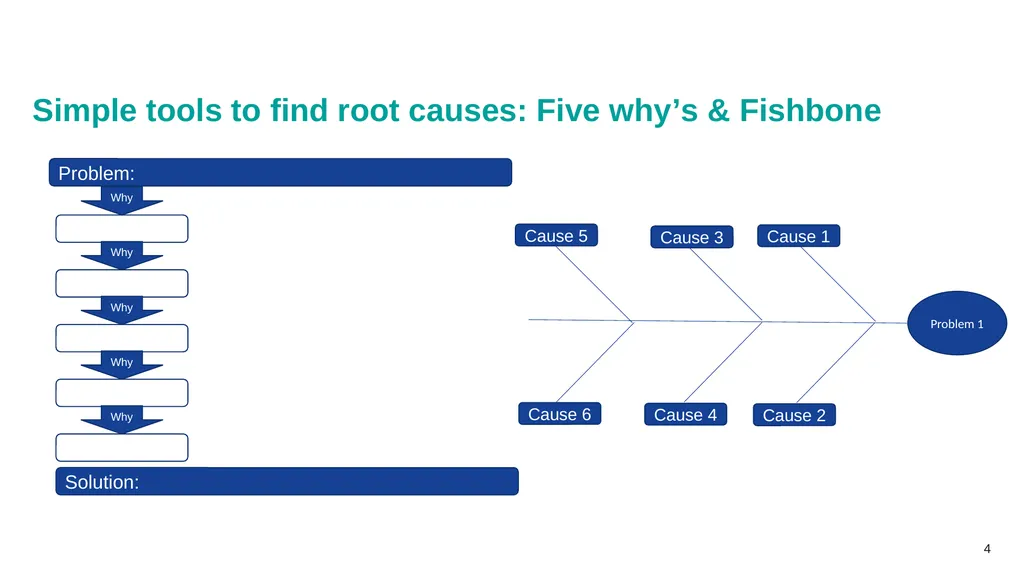
Identifying root causes In the analysis, it is important to distinguish symptoms from root causes.
Failure to do so results in the development of recommendations that are trying to address symptoms. These recommendations will not get to the heart of the problem and therefore will be limited in scope and impact
Teams should spend time discussing the immediate and underlying causes to deepen their understanding of the problem
Only then does it make sense to identify solutions 3<br>
04
Simple tools to find root causes: Five why’s & Fishbone 4 Problem: Solution: Why Why Why Why Why<br>
05
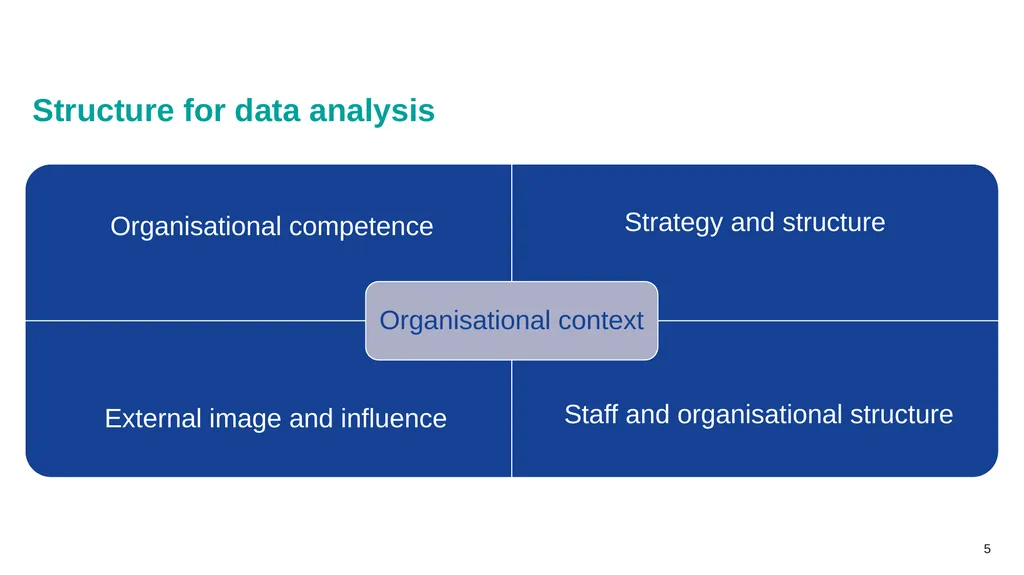
Structure for data analysis 5<br>
06
Audit-simulation exercise (1/12) 6 Imagine that you are an audit team in the early stages of data gathering.
The group member(s) from the workplace you are focusing on represent(s) the internal company team.
Use the gender audit framework introduced in Session 4 to think through the questions.
You have about 25 minutes.<br>
07
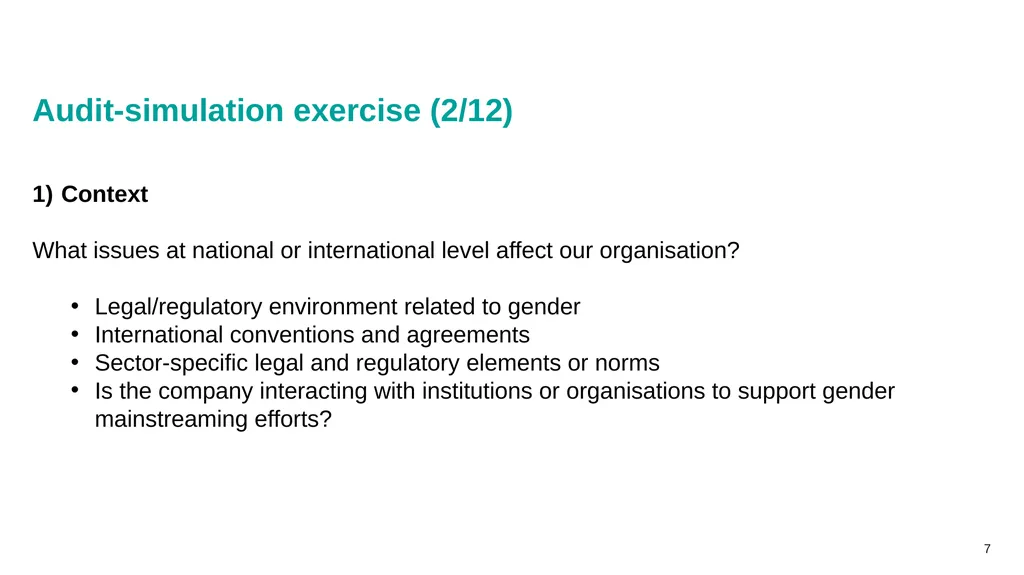
Audit-simulation exercise (2/12) 7 Context
What issues at national or international level affect our organisation?
Legal/regulatory environment related to gender
International conventions and agreements
Sector-specific legal and regulatory elements or norms
Is the company interacting with institutions or organisations to support gender mainstreaming efforts?<br>
08
Audit-simulation exercise (3/12) 8 2) Company competence
Clear and common understanding of gender issues?
Vision for how to implement gender mainstreaming?
How does it conceptualise gender?
What is internal level of gender expertise?
Are there gender-focused posts, committees or task forces?
Efforts and training to build awareness?
How is gender knowledge shared internally?
How are resources allocated to gender issues (staff time, funds, external specialists)?
Are resources sufficient?<br>
09
Audit-simulation exercise (4/12) 9 3) Strategy and structure
a) Strategy
How is gender equality incorporated into strategy and plans? Separate strategy, mainstreamed or mix of both?
Were strategy and plans developed through consultation? Based on analysis of evidence? What/who influenced them?
Are there targets for achieving progress?
b) Monitoring and evaluation
Is there a baseline and monitoring plan to track progress? How is it integrated into reporting?
Is sex-disaggregated data collected and used? Does it include the allocation of resources, activities and results? What gaps? What can be improved?<br>
10
Audit-simulation exercise (5/12) 10 3) Strategy and structure
b) Monitoring and evaluation (cont.)
How is accountability maintained? Are staff aware of responsibilities? Do they know who is accountable for what?
c) Operations
How does gender strategy filter into products and services, marketing, sales and customer relations?
How is it reflected in HR and other areas of work?
Budgets/resources to implement action plan? Are they adequate?<br>
11
Audit-simulation exercise (6/12) 11 3) Strategy and structure
d) Knowledge management
How is information and knowledge related to gender equality collected and stored?
How is it generated (eg research, training, experience exchange)?
How is it shared (eg via workshops, events, newsletters)?
Is it easy to access?
How is it used?
How is it disseminated internally (eg training, capacity building) and externally (eg via networks, website, social media)?<br>
12
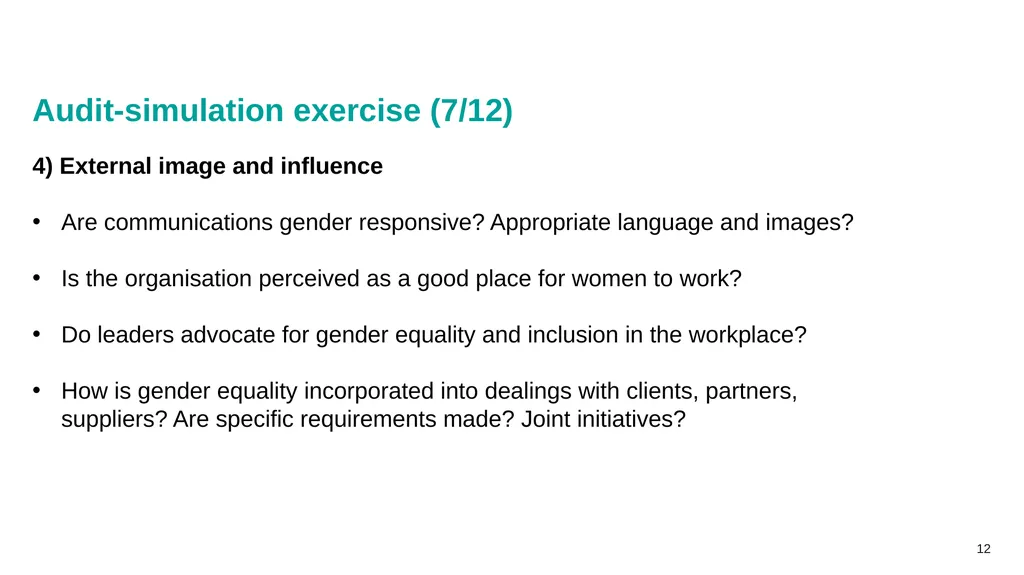
Audit-simulation exercise (7/12) 12 4) External image and influence
Are communications gender responsive? Appropriate language and images?
Is the organisation perceived as a good place for women to work?
Do leaders advocate for gender equality and inclusion in the workplace?
How is gender equality incorporated into dealings with clients, partners, suppliers? Are specific requirements made? Joint initiatives?<br>
13
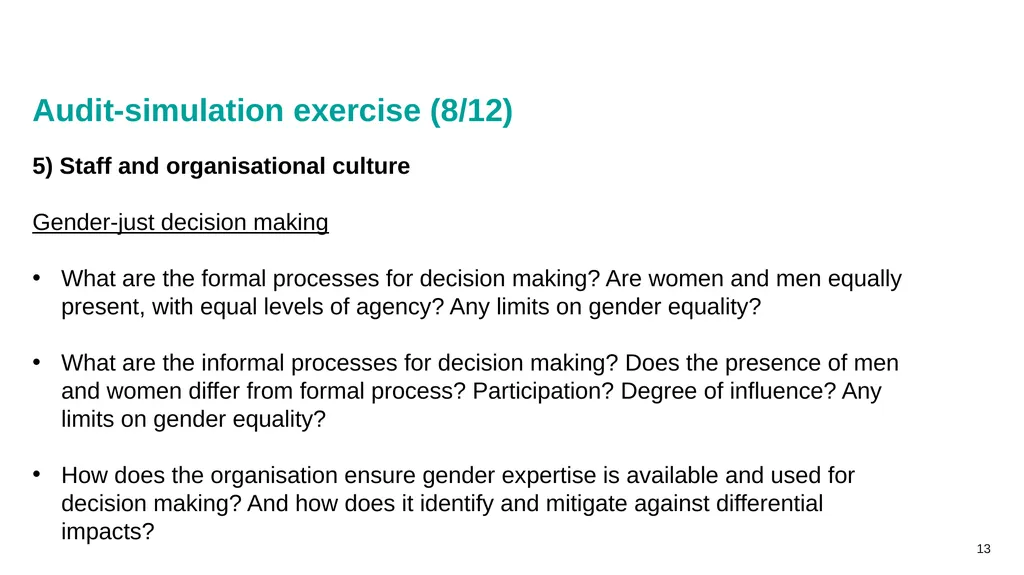
Audit-simulation exercise (8/12) 13 5) Staff and organisational culture
Gender-just decision making
What are the formal processes for decision making? Are women and men equally present, with equal levels of agency? Any limits on gender equality?
What are the informal processes for decision making? Does the presence of men and women differ from formal process? Participation? Degree of influence? Any limits on gender equality?
How does the organisation ensure gender expertise is available and used for decision making? And how does it identify and mitigate against differential impacts?<br>
14
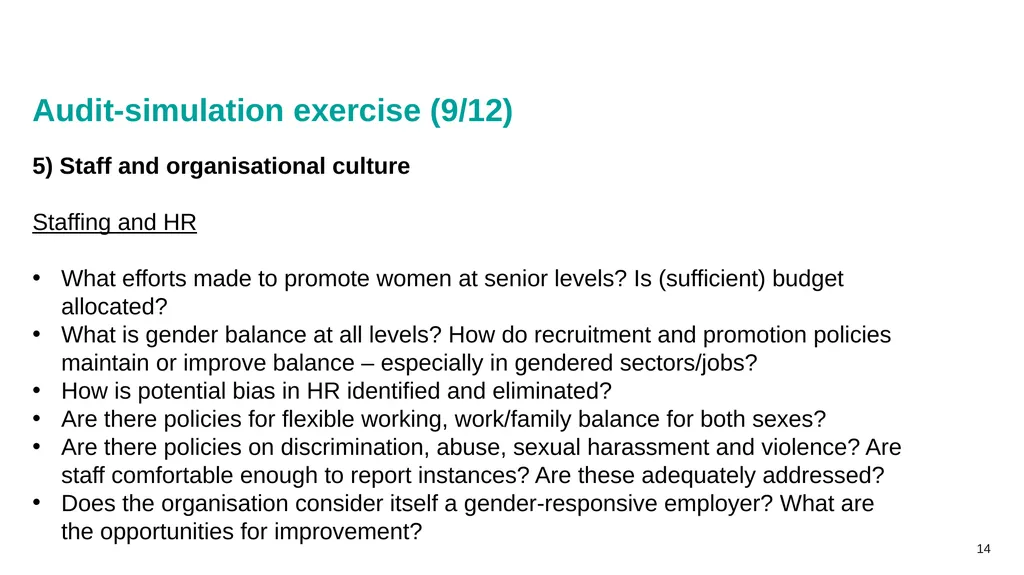
Audit-simulation exercise (9/12) 14 5) Staff and organisational culture
Staffing and HR
What efforts made to promote women at senior levels? Is (sufficient) budget allocated?
What is gender balance at all levels? How do recruitment and promotion policies maintain or improve balance – especially in gendered sectors/jobs?
How is potential bias in HR identified and eliminated?
Are there policies for flexible working, work/family balance for both sexes?
Are there policies on discrimination, abuse, sexual harassment and violence? Are staff comfortable enough to report instances? Are these adequately addressed?
Does the organisation consider itself a gender-responsive employer? What are the opportunities for improvement?<br>
15
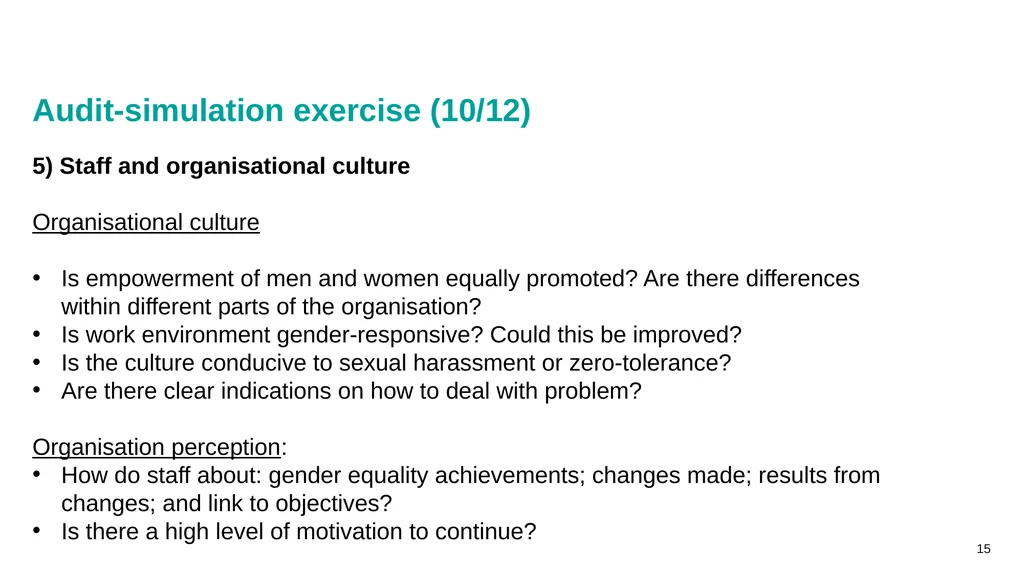
Audit-simulation exercise (10/12) 15 5) Staff and organisational culture
Organisational culture
Is empowerment of men and women equally promoted? Are there differences within different parts of the organisation?
Is work environment gender-responsive? Could this be improved?
Is the culture conducive to sexual harassment or zero-tolerance?
Are there clear indications on how to deal with problem?
Organisation perception:
How do staff about: gender equality achievements; changes made; results from changes; and link to objectives?
Is there a high level of motivation to continue?<br>
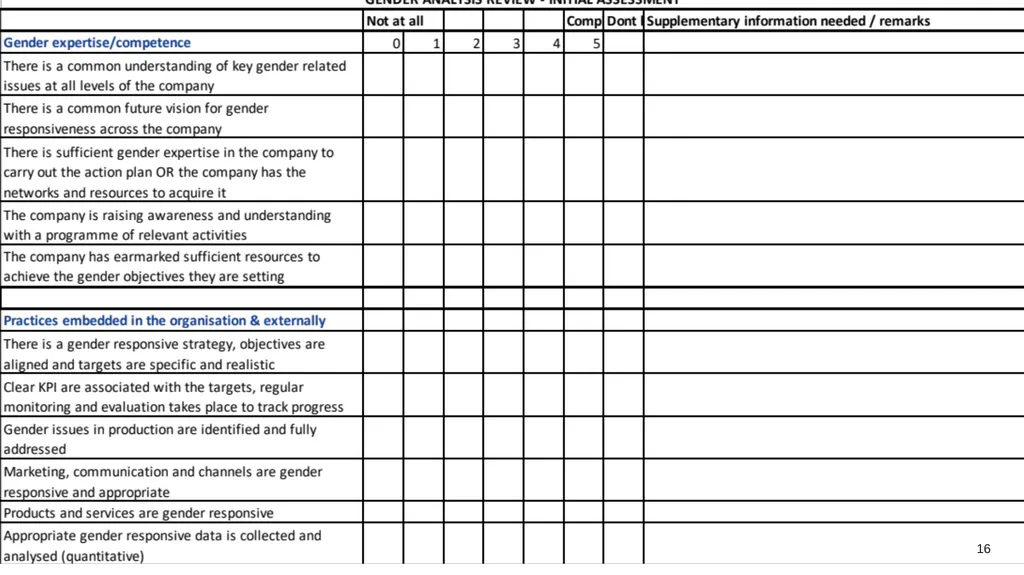
16
16<br>
17
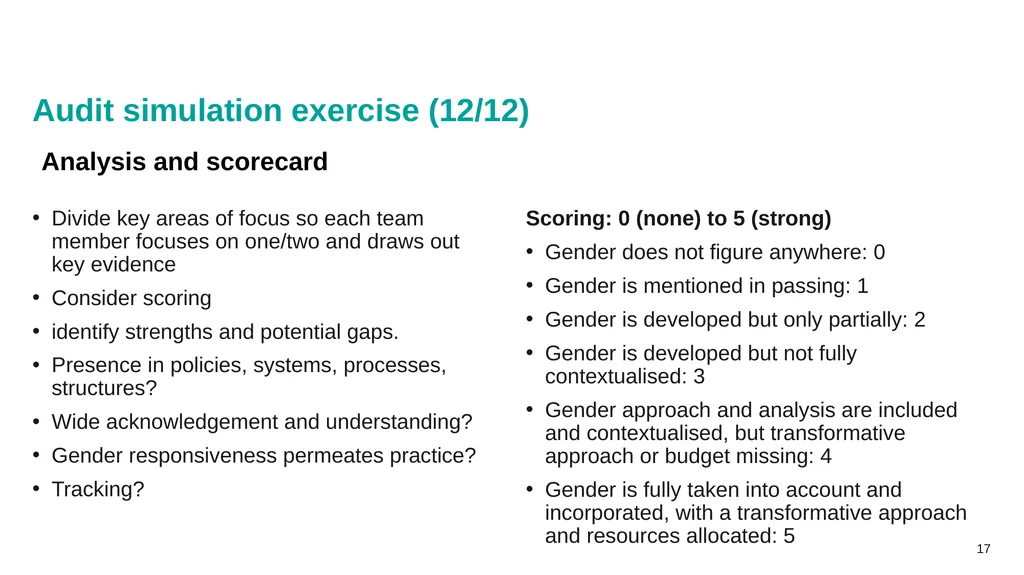
Audit simulation exercise (12/12) Divide key areas of focus so each team member focuses on one/two and draws out key evidence
Consider scoring
identify strengths and potential gaps.
Presence in policies, systems, processes, structures?
Wide acknowledgement and understanding?
Gender responsiveness permeates practice?
Tracking? Scoring: 0 (none) to 5 (strong)
Gender does not figure anywhere: 0
Gender is mentioned in passing: 1
Gender is developed but only partially: 2
Gender is developed but not fully contextualised: 3
Gender approach and analysis are included and contextualised, but transformative approach or budget missing: 4
Gender is fully taken into account and incorporated, with a transformative approach and resources allocated: 5 17 Analysis and scorecard<br>
18
Audit simulation exercise (12/12) 18 Group presentations
A spokesperson for each group will pull together the key points on a flipchart and then deliver a presentation, as though you were presenting the initial results to the management team.
Think about the order of presentation, language, etc.<br>