
General Criminal Law slides Power Point
SN
Published · 230 slides · 0 views

1 / 1







Description
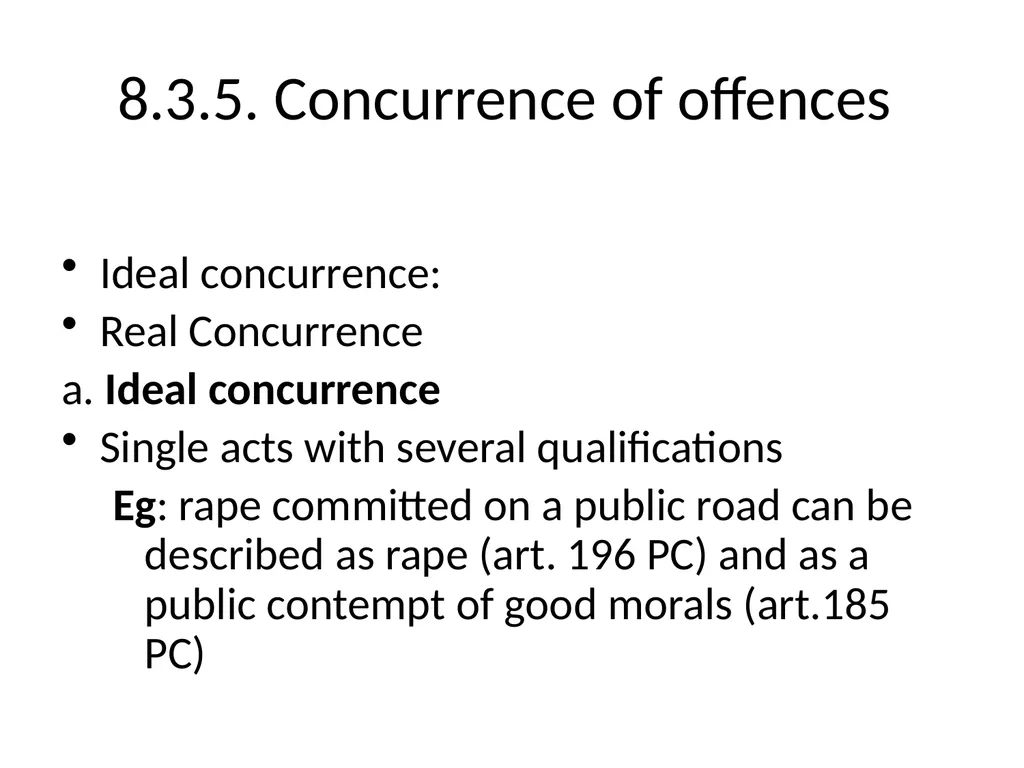
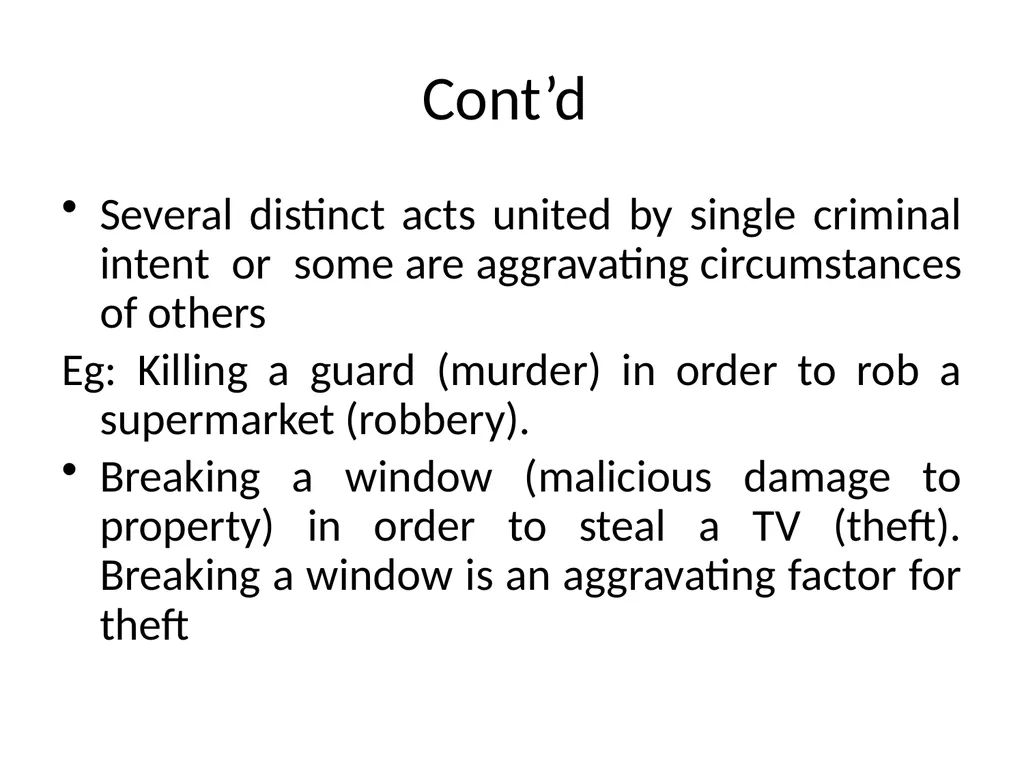
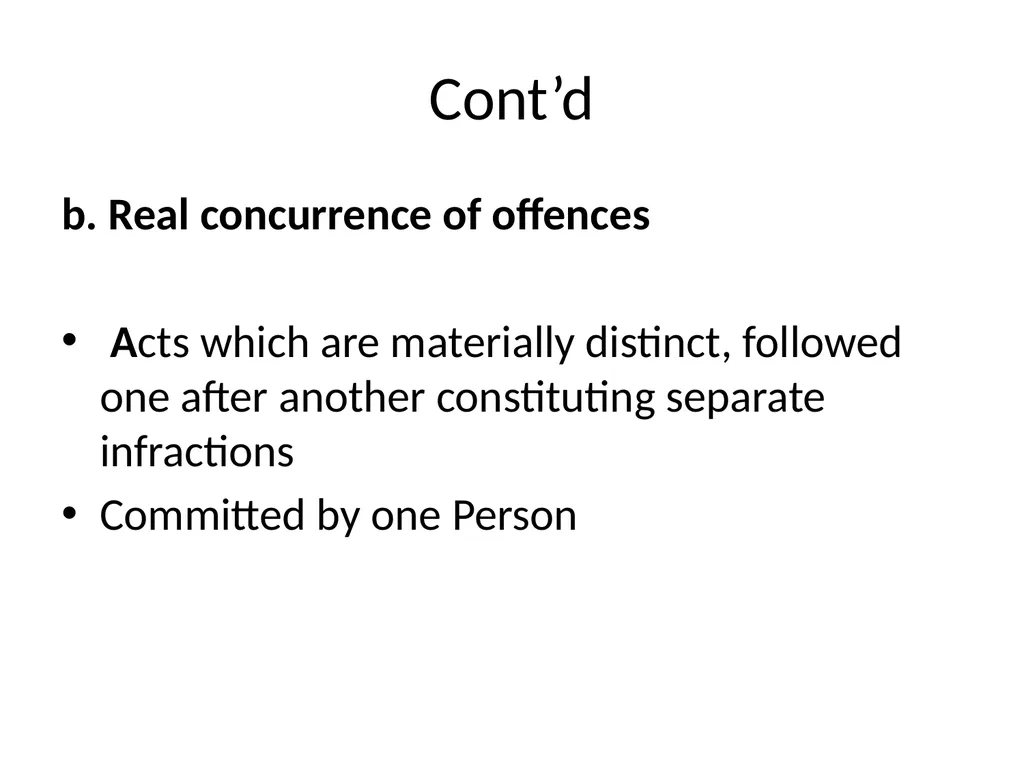
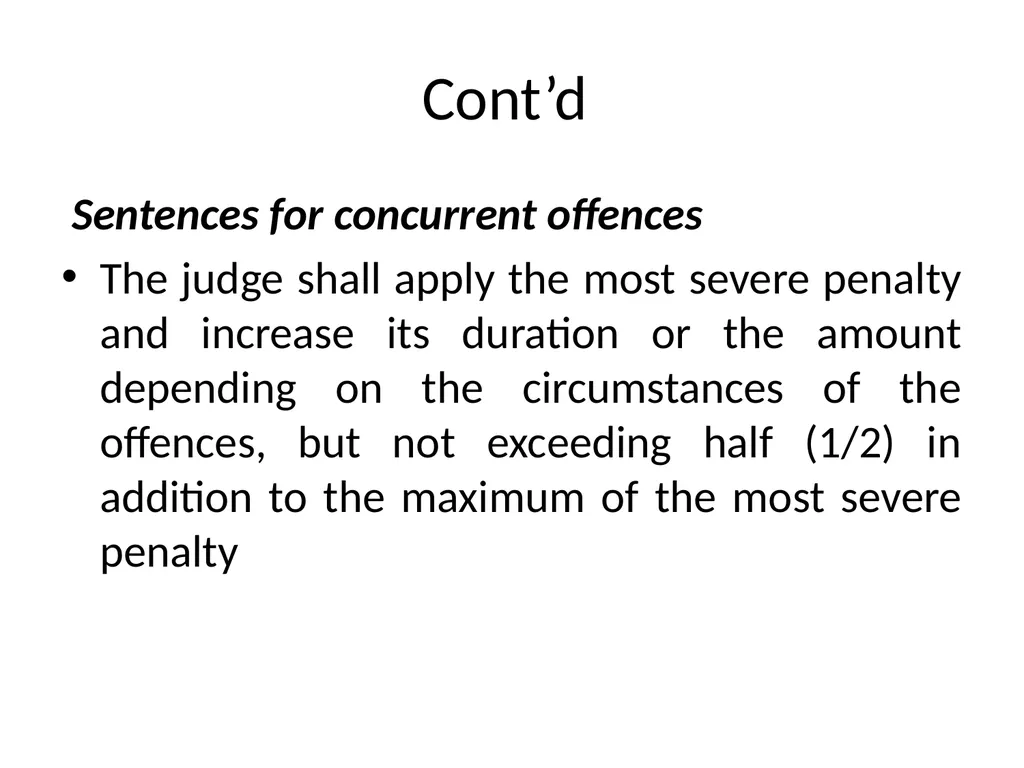
General Criminal Law slides Power Point Presentations Introduction 1. Importance of criminal law General criminal law deals with rules governing offences and their penalties in general Definition of an offence An offence is an act
Related Topics
Share
Embed code
Download this presentation From Below
"General Criminal Law slides Power Point" is the property of its rightful owner. Permission is granted to download and print the materials on this website for personal, non-commercial use only, and to display it on your personal computer provided you do not modify the materials and that you retain all copyright notices contained in the materials. By downloading content from our website, you accept the terms of this agreement.
Presentation Transcript
01
General Criminal Law slides Power Point Presentations<br>
02
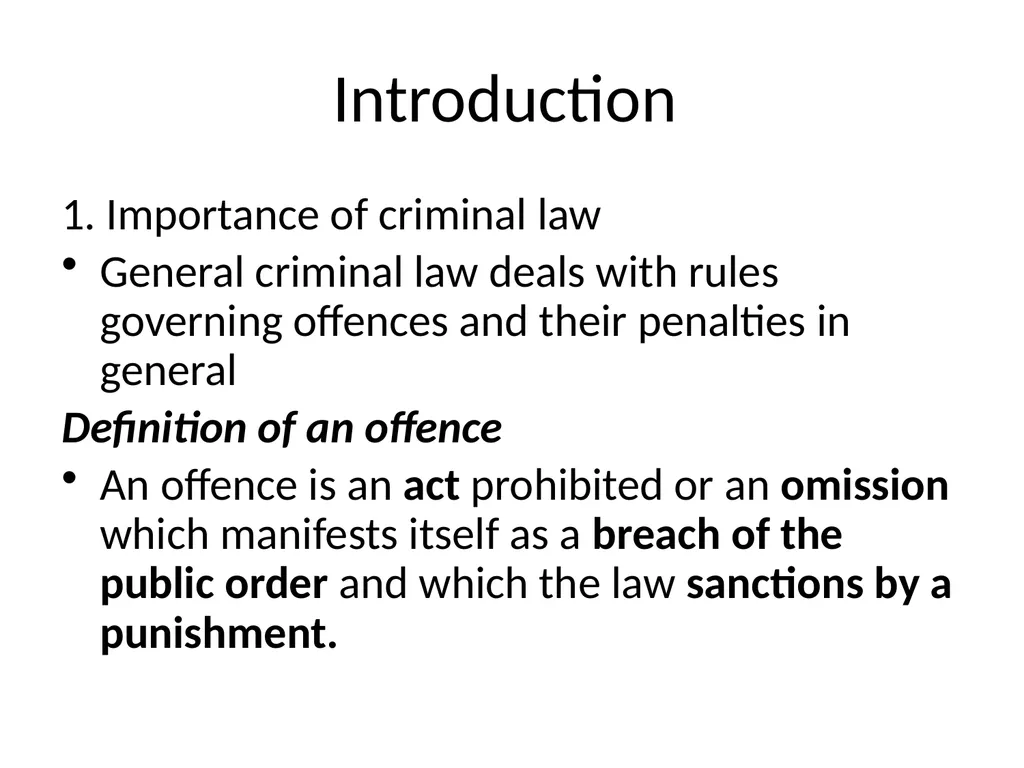
Introduction 1. Importance of criminal law
General criminal law deals with rules governing offences and their penalties in general
Definition of an offence
An offence is an act prohibited or an omission which manifests itself as a breach of the public order and which the law sanctions by a punishment.<br>
General criminal law deals with rules governing offences and their penalties in general
Definition of an offence
An offence is an act prohibited or an omission which manifests itself as a breach of the public order and which the law sanctions by a punishment.<br>
03
2. Relationship between criminal law and social sciences Criminal law and morality
Criminal Law and psychology<br>
Criminal Law and psychology<br>
04
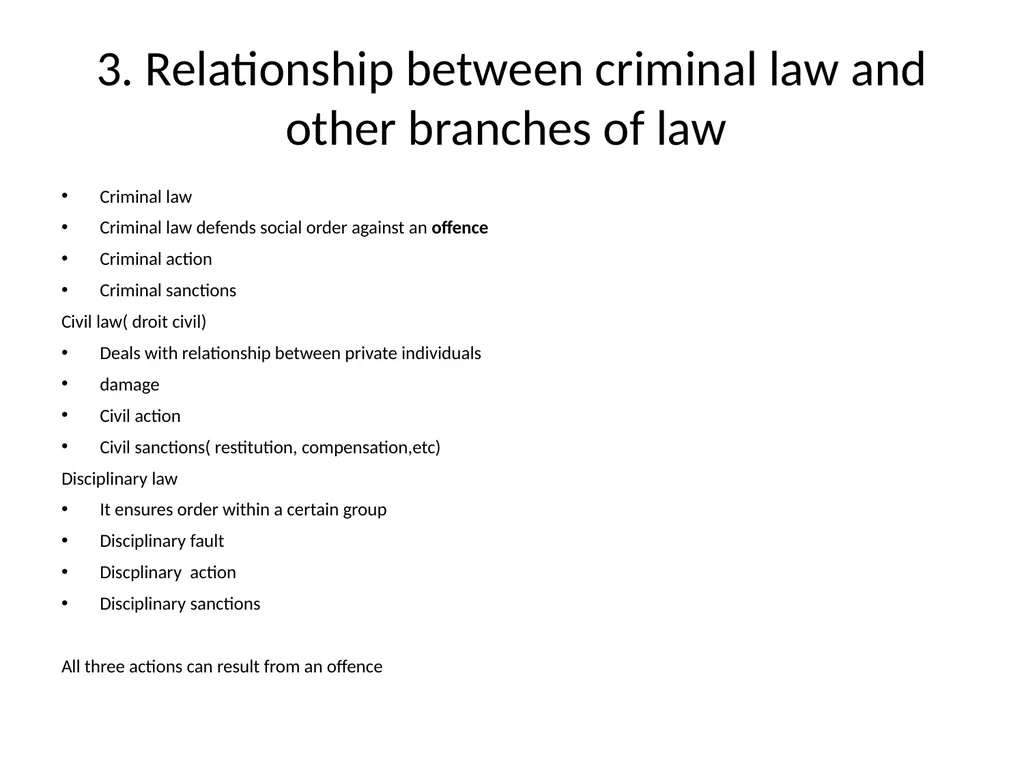
3. Relationship between criminal law and other branches of law Criminal law
Criminal law defends social order against an offence
Criminal action
Criminal sanctions
Civil law( droit civil)
Deals with relationship between private individuals
damage
Civil action
Civil sanctions( restitution, compensation,etc)
Disciplinary law
It ensures order within a certain group
Disciplinary fault
Discplinary action
Disciplinary sanctions
All three actions can result from an offence<br>
Criminal law defends social order against an offence
Criminal action
Criminal sanctions
Civil law( droit civil)
Deals with relationship between private individuals
damage
Civil action
Civil sanctions( restitution, compensation,etc)
Disciplinary law
It ensures order within a certain group
Disciplinary fault
Discplinary action
Disciplinary sanctions
All three actions can result from an offence<br>
05
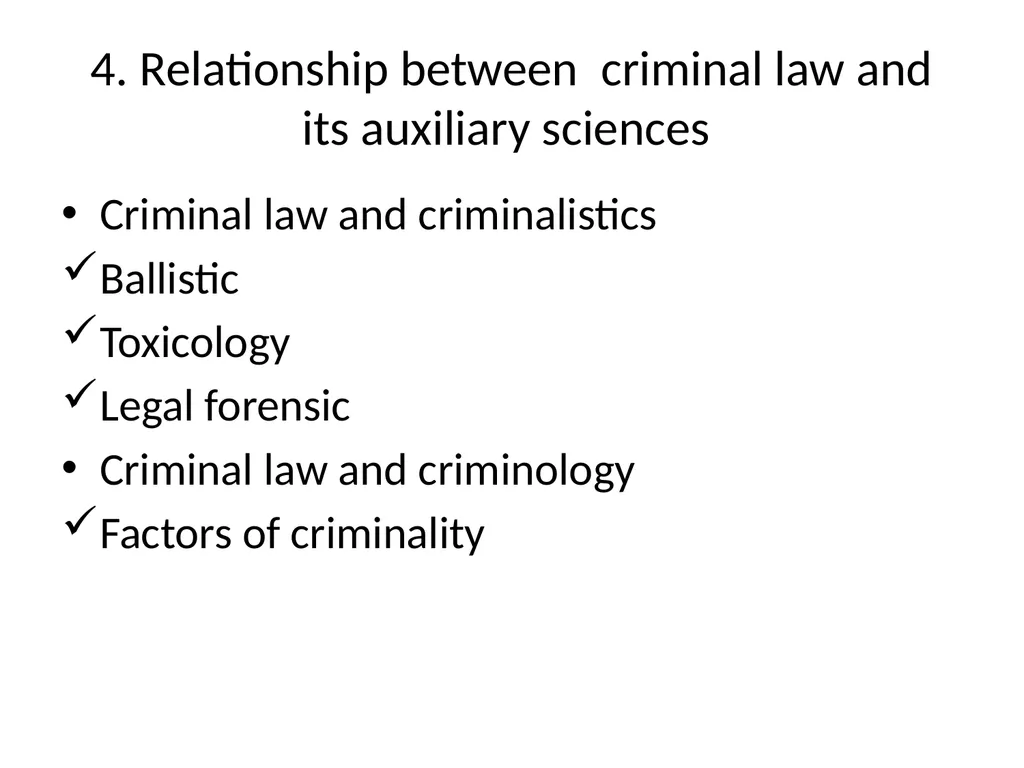
4. Relationship between criminal law and its auxiliary sciences Criminal law and criminalistics
Ballistic
Toxicology
Legal forensic
Criminal law and criminology
Factors of criminality<br>
Ballistic
Toxicology
Legal forensic
Criminal law and criminology
Factors of criminality<br>
06
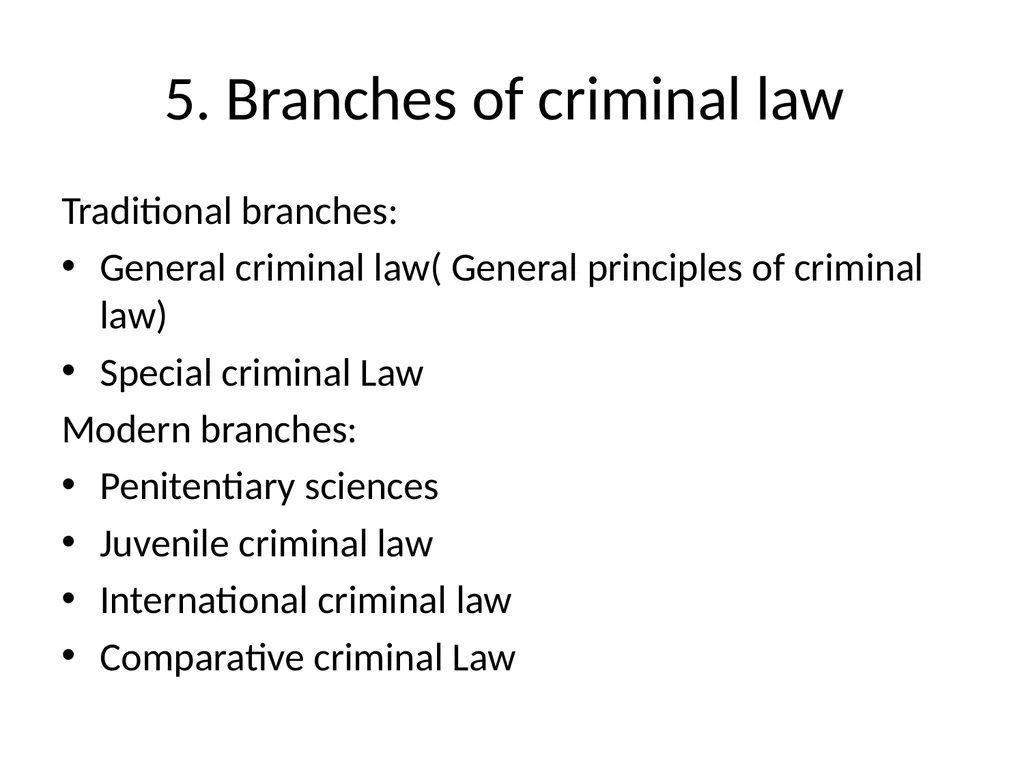
5. Branches of criminal law Traditional branches:
General criminal law( General principles of criminal law)
Special criminal Law
Modern branches:
Penitentiary sciences
Juvenile criminal law
International criminal law
Comparative criminal Law<br>
General criminal law( General principles of criminal law)
Special criminal Law
Modern branches:
Penitentiary sciences
Juvenile criminal law
International criminal law
Comparative criminal Law<br>
07
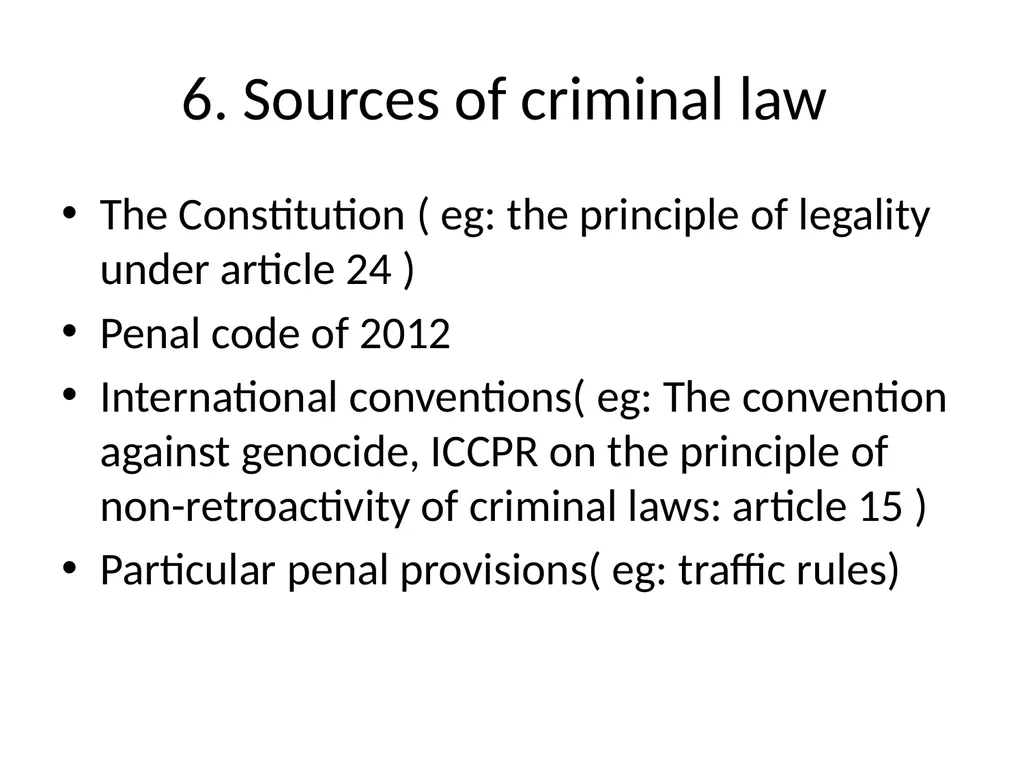
6. Sources of criminal law The Constitution ( eg: the principle of legality under article 24 )
Penal code of 2012
International conventions( eg: The convention against genocide, ICCPR on the principle of non-retroactivity of criminal laws: article 15 )
Particular penal provisions( eg: traffic rules)<br>
Penal code of 2012
International conventions( eg: The convention against genocide, ICCPR on the principle of non-retroactivity of criminal laws: article 15 )
Particular penal provisions( eg: traffic rules)<br>
08
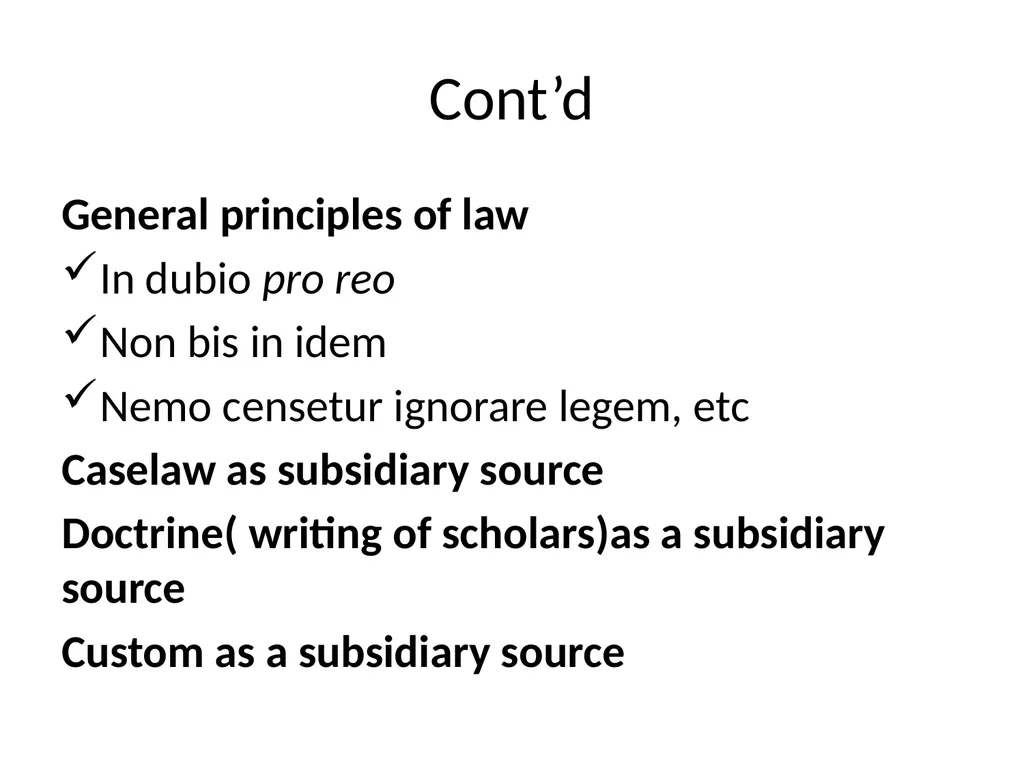
Cont’d General principles of law
In dubio pro reo
Non bis in idem
Nemo censetur ignorare legem, etc
Caselaw as subsidiary source
Doctrine( writing of scholars)as a subsidiary source
Custom as a subsidiary source<br>
In dubio pro reo
Non bis in idem
Nemo censetur ignorare legem, etc
Caselaw as subsidiary source
Doctrine( writing of scholars)as a subsidiary source
Custom as a subsidiary source<br>
09
Chapter 1. General principles of criminal law 1.1. THE PRINCIPLE OF LEGALITY
It is important that mechanisms exist to protect the rights of individuals against abuse by State organs and agents.
The principle of legality plays an important role in this regard.
Broadly stated, the principle of legality means that there is “no crime without law” and there is “no punishment without law”<br>
It is important that mechanisms exist to protect the rights of individuals against abuse by State organs and agents.
The principle of legality plays an important role in this regard.
Broadly stated, the principle of legality means that there is “no crime without law” and there is “no punishment without law”<br>
10
Cont’d Legal basis for the principle of legality
Article 24 of the Constitution, which reads as follows:
No one shall be subjected to prosecution, arrest, detention or punishment unless provided for by laws in force at the time the offence was committed.<br>
Article 24 of the Constitution, which reads as follows:
No one shall be subjected to prosecution, arrest, detention or punishment unless provided for by laws in force at the time the offence was committed.<br>
11
Cont’d The principle of legality is also enshrined in the Penal Code which provides that:
A person shall not be punished on account of an act or omission that did not constitute an offence at the time of commission under national or international law.
A person shall not be penalized for a heavier penalty than that which was provided for by law at the time the offence was committed.
An offence shall not be punishable by penalties which were not provided for by the law published before its commission
ICCPR, art. 15
UDHR, art. 11
This principle is broader and implies the next rules:<br>
A person shall not be punished on account of an act or omission that did not constitute an offence at the time of commission under national or international law.
A person shall not be penalized for a heavier penalty than that which was provided for by law at the time the offence was committed.
An offence shall not be punishable by penalties which were not provided for by the law published before its commission
ICCPR, art. 15
UDHR, art. 11
This principle is broader and implies the next rules:<br>
12
Rules embodied in the principle of legality A. The principle of legality in relation to criminal offences (nullum crimen sine lege)
It embodies five distinct rules:
Ius acceptum: act committed is recognised by the law as a crime. No crime without law<br>
It embodies five distinct rules:
Ius acceptum: act committed is recognised by the law as a crime. No crime without law<br>
13
Cont’d 2.Ius praevium
act committed was recognised as a crime at the time of its commission. Penal provisions do not have retroactive effect except:
Retroactivity in mitius
The legislator stated it
Interpretative laws<br>
act committed was recognised as a crime at the time of its commission. Penal provisions do not have retroactive effect except:
Retroactivity in mitius
The legislator stated it
Interpretative laws<br>
14
Cont’ 3. Ius certum
if ius acceptum and ius praevium rules are complied with, the principle of legality can still be undermined by the creation of criminal norms which are formulated vaguely or unclearly because, in this case, it would be difficult for individuals to understand exactly what is expected of them. Thus, crimes must be formulated clearly; they ought not to be formulated vaguely.<br>
if ius acceptum and ius praevium rules are complied with, the principle of legality can still be undermined by the creation of criminal norms which are formulated vaguely or unclearly because, in this case, it would be difficult for individuals to understand exactly what is expected of them. Thus, crimes must be formulated clearly; they ought not to be formulated vaguely.<br>
15
Cont’d An example of a criminal prohibition couched in unacceptably vague language (and hailing from Nazi Germany in 1953) is the following:
“ Any person who commits an act which, according to the fundamental idea behind the penal law, and according to the good sense of the nation, deserves to be punished, shall be punished”<br>
“ Any person who commits an act which, according to the fundamental idea behind the penal law, and according to the good sense of the nation, deserves to be punished, shall be punished”<br>
16
Cont’d 4. Ius strictum
Even if all the above-mentioned three aspects of the requirement of legality are complied with, the general principle can nevertheless be undermined if a court is free to interpret widely the words or concepts contained in the definition of the crime or to extend their application by analogous interpretation. Thus, provisions creating crimes must be interpreted strictly; not by analogy. This rule is enshrined in art 4 PC, which provides that:
[C]riminal laws shall not be interpreted too extensively, they must be construed strictly.<br>
Even if all the above-mentioned three aspects of the requirement of legality are complied with, the general principle can nevertheless be undermined if a court is free to interpret widely the words or concepts contained in the definition of the crime or to extend their application by analogous interpretation. Thus, provisions creating crimes must be interpreted strictly; not by analogy. This rule is enshrined in art 4 PC, which provides that:
[C]riminal laws shall not be interpreted too extensively, they must be construed strictly.<br>
17
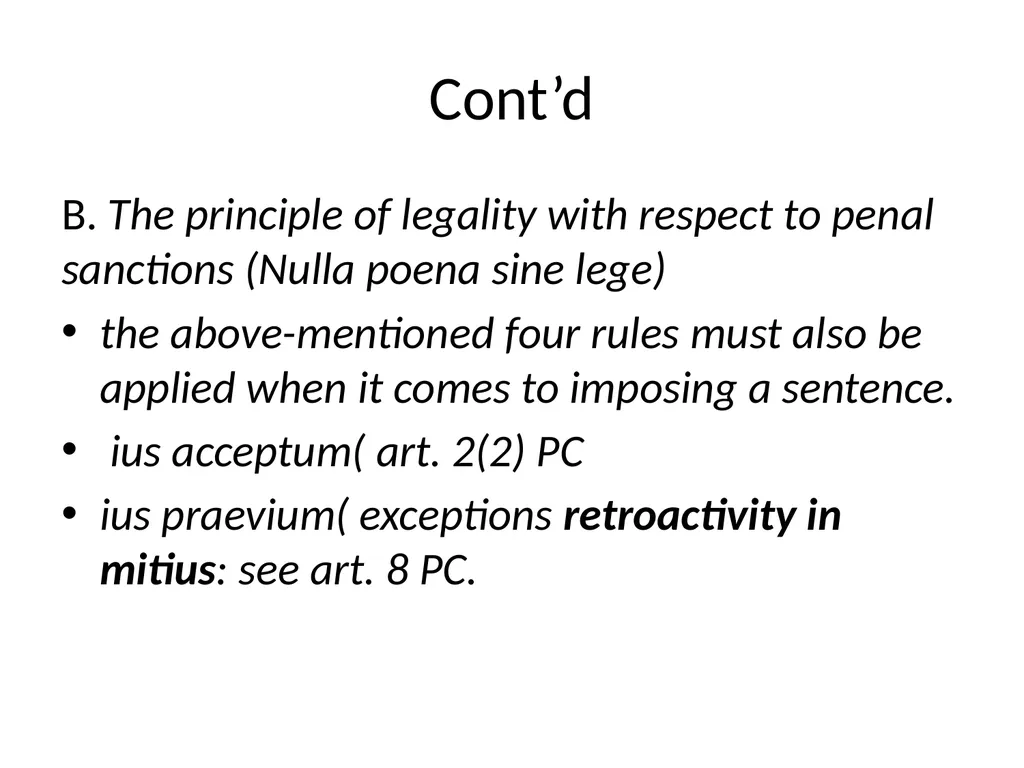
Cont’d B. The principle of legality with respect to penal sanctions (Nulla poena sine lege)
the above-mentioned four rules must also be applied when it comes to imposing a sentence.
ius acceptum( art. 2(2) PC
ius praevium( exceptions retroactivity in mitius: see art. 8 PC.<br>
the above-mentioned four rules must also be applied when it comes to imposing a sentence.
ius acceptum( art. 2(2) PC
ius praevium( exceptions retroactivity in mitius: see art. 8 PC.<br>
18
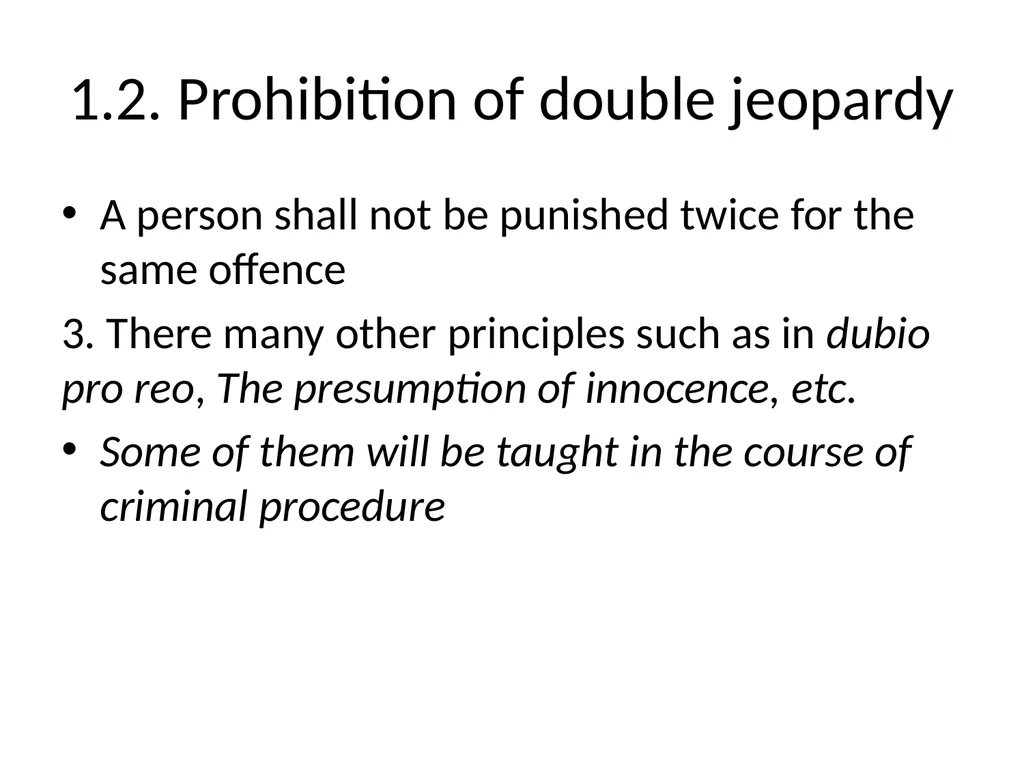
1.2. Prohibition of double jeopardy A person shall not be punished twice for the same offence
3. There many other principles such as in dubio pro reo, The presumption of innocence, etc.
Some of them will be taught in the course of criminal procedure<br>
3. There many other principles such as in dubio pro reo, The presumption of innocence, etc.
Some of them will be taught in the course of criminal procedure<br>
19
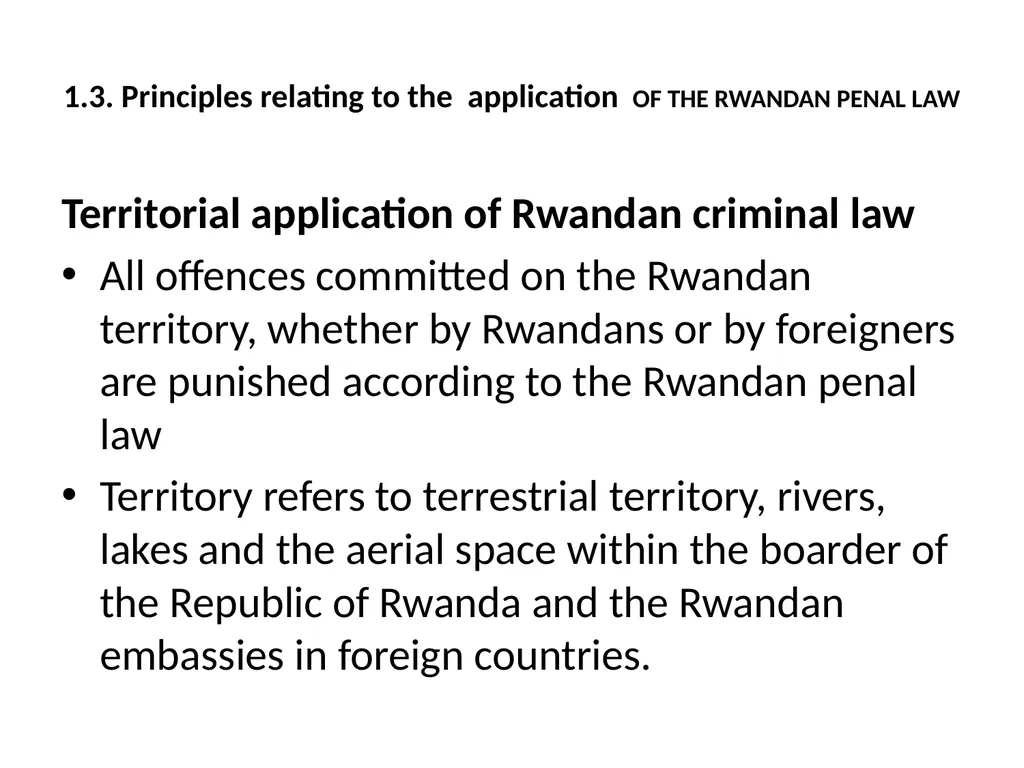
1.3. Principles relating to the application OF THE RWANDAN PENAL LAW Territorial application of Rwandan criminal law
All offences committed on the Rwandan territory, whether by Rwandans or by foreigners are punished according to the Rwandan penal law
Territory refers to terrestrial territory, rivers, lakes and the aerial space within the boarder of the Republic of Rwanda and the Rwandan embassies in foreign countries.<br>
All offences committed on the Rwandan territory, whether by Rwandans or by foreigners are punished according to the Rwandan penal law
Territory refers to terrestrial territory, rivers, lakes and the aerial space within the boarder of the Republic of Rwanda and the Rwandan embassies in foreign countries.<br>
20
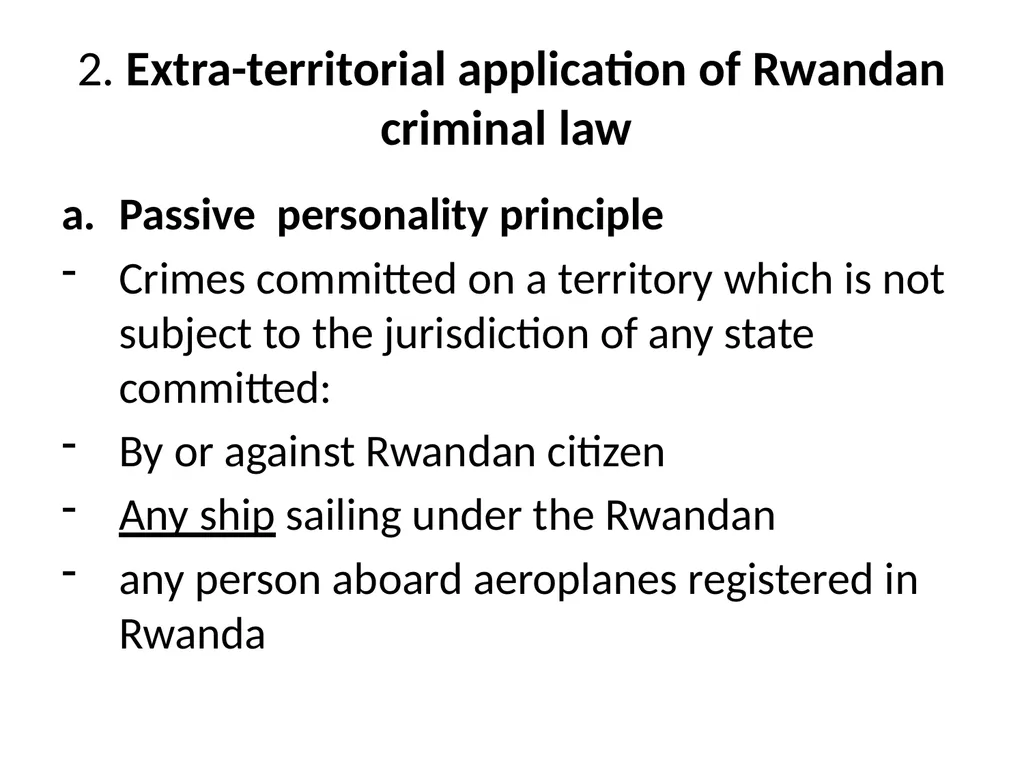
2. Extra-territorial application of Rwandan criminal law Passive personality principle
Crimes committed on a territory which is not subject to the jurisdiction of any state committed:
By or against Rwandan citizen
Any ship sailing under the Rwandan
any person aboard aeroplanes registered in Rwanda<br>
Crimes committed on a territory which is not subject to the jurisdiction of any state committed:
By or against Rwandan citizen
Any ship sailing under the Rwandan
any person aboard aeroplanes registered in Rwanda<br>
21
Cont’d b. Nationality Principle
A Rwandan who commits a felony or a misdemeanour, outside Rwandan territory, may be prosecuted and tried by Rwandan courts in accordance with the Rwandan Law as if the offence had been committed on the Rwandan territory if such an offence is punishable by Rwandan Law
Ne bis in idem applicable if any<br>
A Rwandan who commits a felony or a misdemeanour, outside Rwandan territory, may be prosecuted and tried by Rwandan courts in accordance with the Rwandan Law as if the offence had been committed on the Rwandan territory if such an offence is punishable by Rwandan Law
Ne bis in idem applicable if any<br>
22
Cont’d c. Universal jurisdiction
Any person, including a foreigner, found within the territory of the Republic of Rwanda after having, while abroad, committed International crimes or transnational crimes
This is based on the nature of the crimes. International crimes are particularly considered as committed against the international community as a whole.
Article 16 of the penal code<br>
Any person, including a foreigner, found within the territory of the Republic of Rwanda after having, while abroad, committed International crimes or transnational crimes
This is based on the nature of the crimes. International crimes are particularly considered as committed against the international community as a whole.
Article 16 of the penal code<br>
23
Cont’d Mr Mambo and Matatizo (both men are 30 years old) committed forced homosexual acts against a young man of 22 years old. The victim submitted the case to the Prosecutor and the case was later submitted to Court. The lawyer of the accused contends that this is not rape as defined under article 196 of the penal code which states: “Rape means causing another person to engage in a non-consensual sexual intercourse by using force, threat or trickery”. Assume you are an charge of this case, how would you interpret and apply this article to this case?
Ms MAYERI of Rwandan Nationality knowing that, according to Rwandan Penal code, “A woman who commits voluntary abortion is sentenced to a term of imprisonment of 3 to 5 years”, decided to go to USA, Arizona State where abortion is allowed since 2009 and abort. A week after, she came back in Rwanda and on her arrival to Kanombe International Airport, the Rwandan Police arrested her and after 2 days of investigations, the police transferred the accusation file to the National Public Prosecution Authority (NPPA) which submitted the case before the court. Will Rwandan criminal law be applicable in this case, i.e do Rwandan courts have jurisdiction to hear this case and apply Rwandan criminal law?<br>
Ms MAYERI of Rwandan Nationality knowing that, according to Rwandan Penal code, “A woman who commits voluntary abortion is sentenced to a term of imprisonment of 3 to 5 years”, decided to go to USA, Arizona State where abortion is allowed since 2009 and abort. A week after, she came back in Rwanda and on her arrival to Kanombe International Airport, the Rwandan Police arrested her and after 2 days of investigations, the police transferred the accusation file to the National Public Prosecution Authority (NPPA) which submitted the case before the court. Will Rwandan criminal law be applicable in this case, i.e do Rwandan courts have jurisdiction to hear this case and apply Rwandan criminal law?<br>
24
Chapter 2: Criminal liability Before a person can be convicted of any crime, the following requirements must be satisfied.
These are:
An act (or omission)
Compliance with the definitional elements of the crime
Lack of justification (Unlawfulness)
Blameworthiness (Culpability):Lack of excuse<br>
These are:
An act (or omission)
Compliance with the definitional elements of the crime
Lack of justification (Unlawfulness)
Blameworthiness (Culpability):Lack of excuse<br>
25
2.1. The requirement of an act (or omission) Act or ommission
Thoughts are not punishable
Act must human
Act must voluntary<br>
Thoughts are not punishable
Act must human
Act must voluntary<br>
26
Cont’d Omissions: special considerations
Legal duty to act positively
The defence of impossibility: a lame to come to the aid of a sinking person<br>
Legal duty to act positively
The defence of impossibility: a lame to come to the aid of a sinking person<br>
27
2.2. Constitutive elements of an offence Once it is established that there was an act or omission, the next step in the determination of criminal liability is to investigate whether the conduct in question complied with (or corresponds to) the “definitional elements” of the crime<br>
28
Cont’d Two elements of each crime:
the material element (actus reus)
the mental element (mens rea).<br>
the material element (actus reus)
the mental element (mens rea).<br>
29
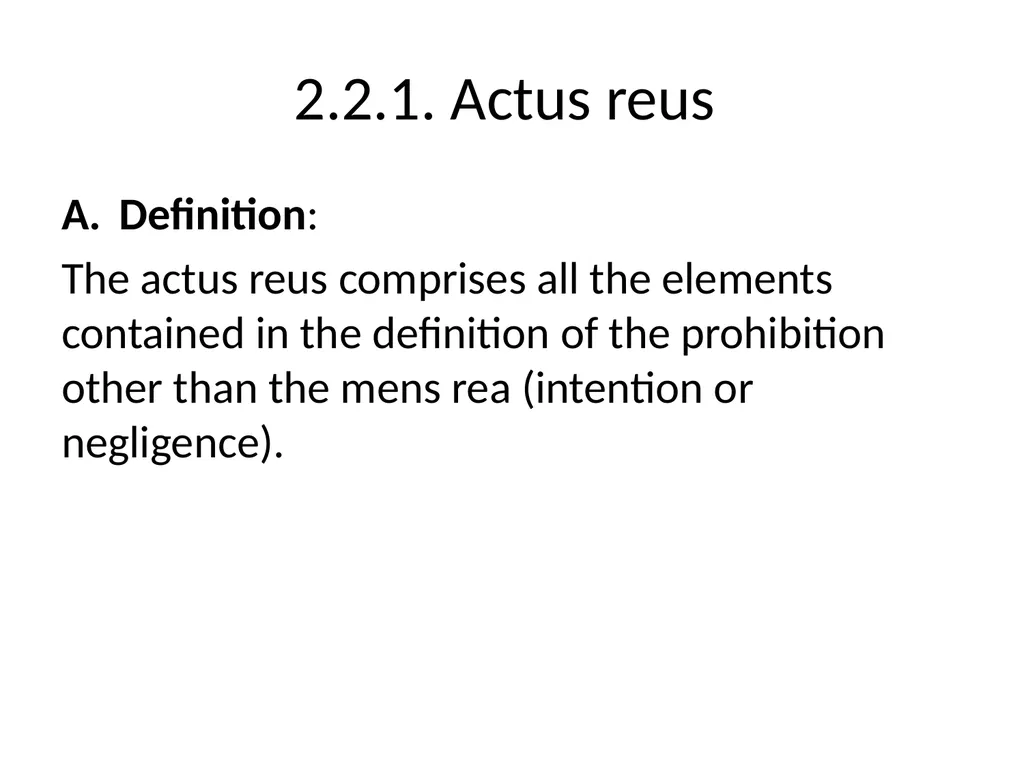
2.2.1. Actus reus Definition:
The actus reus comprises all the elements contained in the definition of the prohibition other than the mens rea (intention or negligence).<br>
The actus reus comprises all the elements contained in the definition of the prohibition other than the mens rea (intention or negligence).<br>
30
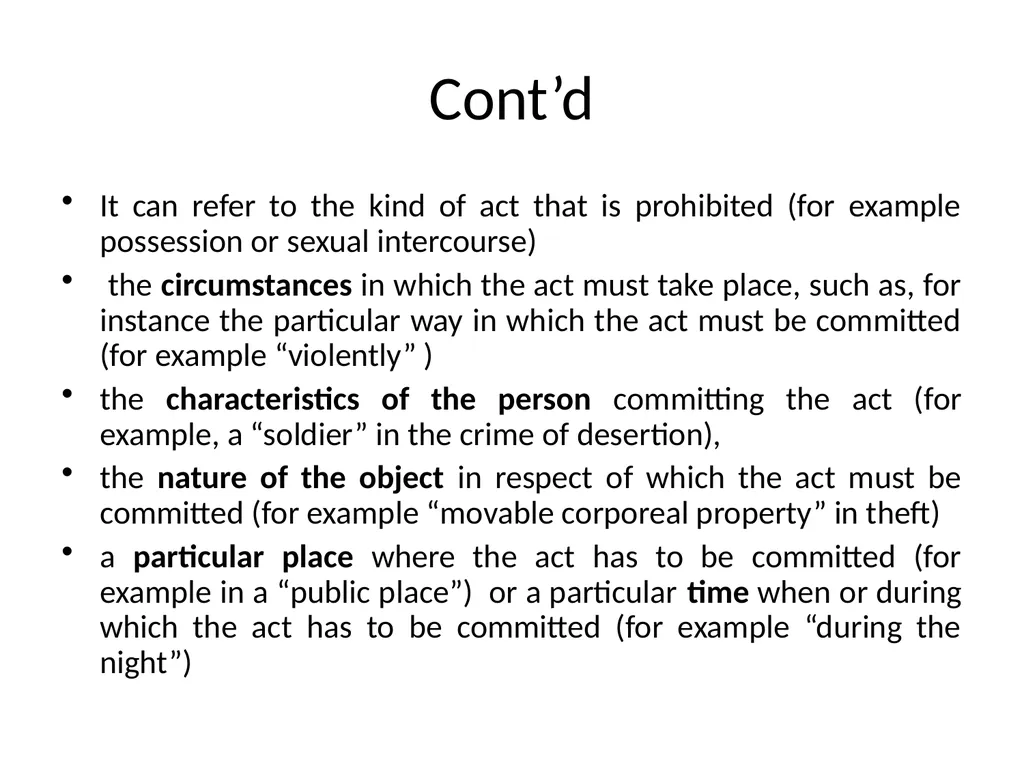
Cont’d It can refer to the kind of act that is prohibited (for example possession or sexual intercourse)
the circumstances in which the act must take place, such as, for instance the particular way in which the act must be committed (for example “violently” )
the characteristics of the person committing the act (for example, a “soldier” in the crime of desertion),
the nature of the object in respect of which the act must be committed (for example “movable corporeal property” in theft)
a particular place where the act has to be committed (for example in a “public place”) or a particular time when or during which the act has to be committed (for example “during the night”)<br>
the circumstances in which the act must take place, such as, for instance the particular way in which the act must be committed (for example “violently” )
the characteristics of the person committing the act (for example, a “soldier” in the crime of desertion),
the nature of the object in respect of which the act must be committed (for example “movable corporeal property” in theft)
a particular place where the act has to be committed (for example in a “public place”) or a particular time when or during which the act has to be committed (for example “during the night”)<br>
31
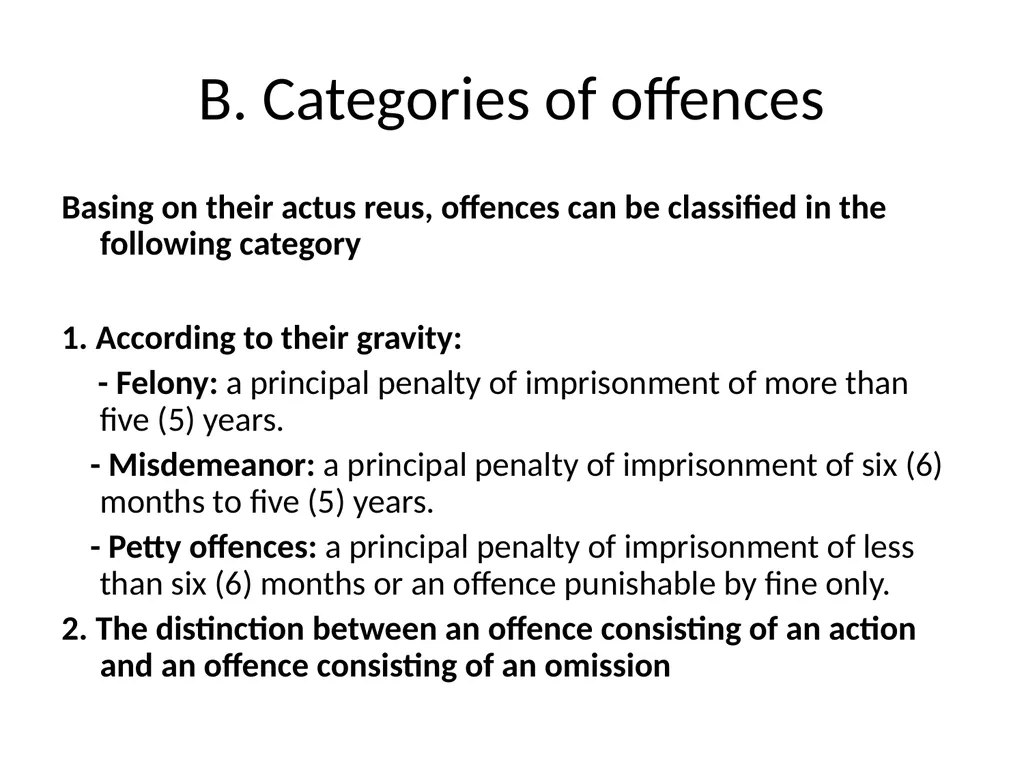
B. Categories of offences Basing on their actus reus, offences can be classified in the following category
1. According to their gravity:
- Felony: a principal penalty of imprisonment of more than five (5) years.
- Misdemeanor: a principal penalty of imprisonment of six (6) months to five (5) years.
- Petty offences: a principal penalty of imprisonment of less than six (6) months or an offence punishable by fine only.
2. The distinction between an offence consisting of an action and an offence consisting of an omission<br>
1. According to their gravity:
- Felony: a principal penalty of imprisonment of more than five (5) years.
- Misdemeanor: a principal penalty of imprisonment of six (6) months to five (5) years.
- Petty offences: a principal penalty of imprisonment of less than six (6) months or an offence punishable by fine only.
2. The distinction between an offence consisting of an action and an offence consisting of an omission<br>
32
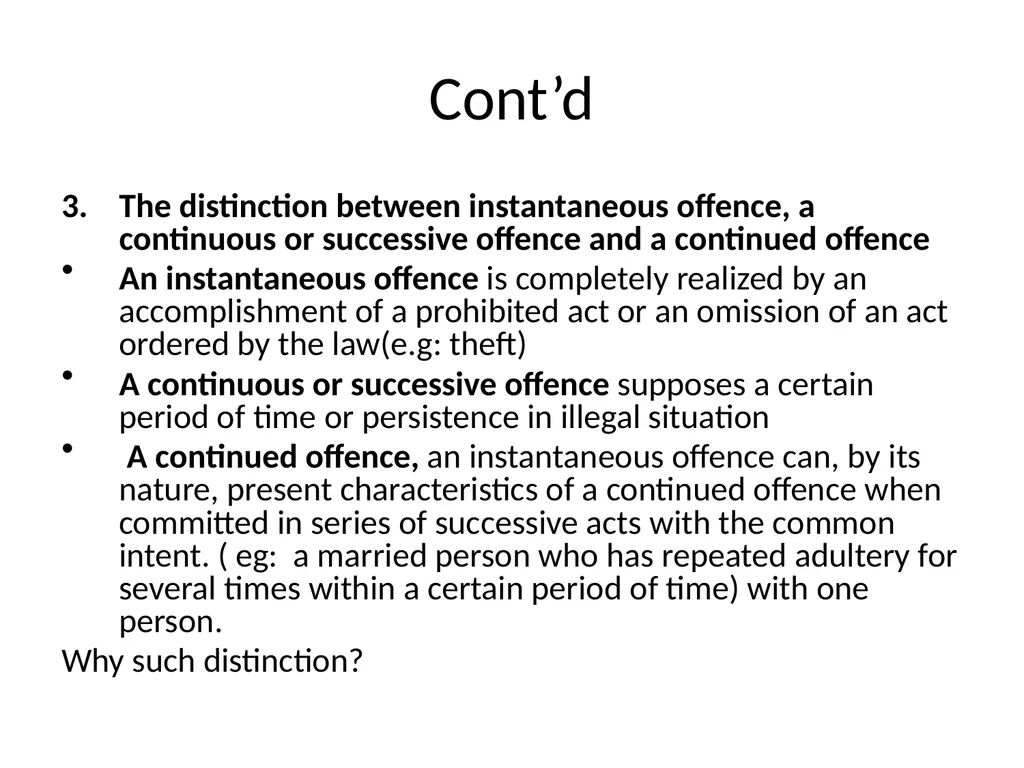
Cont’d The distinction between instantaneous offence, a continuous or successive offence and a continued offence
An instantaneous offence is completely realized by an accomplishment of a prohibited act or an omission of an act ordered by the law(e.g: theft)
A continuous or successive offence supposes a certain period of time or persistence in illegal situation
A continued offence, an instantaneous offence can, by its nature, present characteristics of a continued offence when committed in series of successive acts with the common intent. ( eg: a married person who has repeated adultery for several times within a certain period of time) with one person.
Why such distinction?<br>
An instantaneous offence is completely realized by an accomplishment of a prohibited act or an omission of an act ordered by the law(e.g: theft)
A continuous or successive offence supposes a certain period of time or persistence in illegal situation
A continued offence, an instantaneous offence can, by its nature, present characteristics of a continued offence when committed in series of successive acts with the common intent. ( eg: a married person who has repeated adultery for several times within a certain period of time) with one person.
Why such distinction?<br>
33
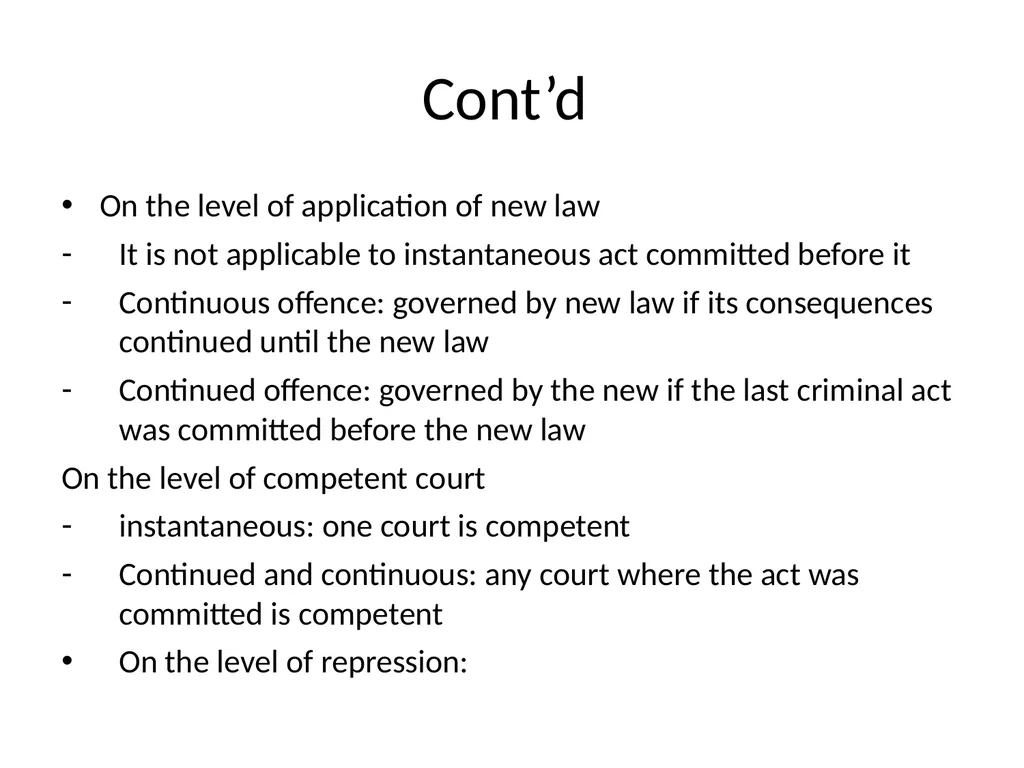
Cont’d On the level of application of new law
It is not applicable to instantaneous act committed before it
Continuous offence: governed by new law if its consequences continued until the new law
Continued offence: governed by the new if the last criminal act was committed before the new law
On the level of competent court
instantaneous: one court is competent
Continued and continuous: any court where the act was committed is competent
On the level of repression:<br>
It is not applicable to instantaneous act committed before it
Continuous offence: governed by new law if its consequences continued until the new law
Continued offence: governed by the new if the last criminal act was committed before the new law
On the level of competent court
instantaneous: one court is competent
Continued and continuous: any court where the act was committed is competent
On the level of repression:<br>
34
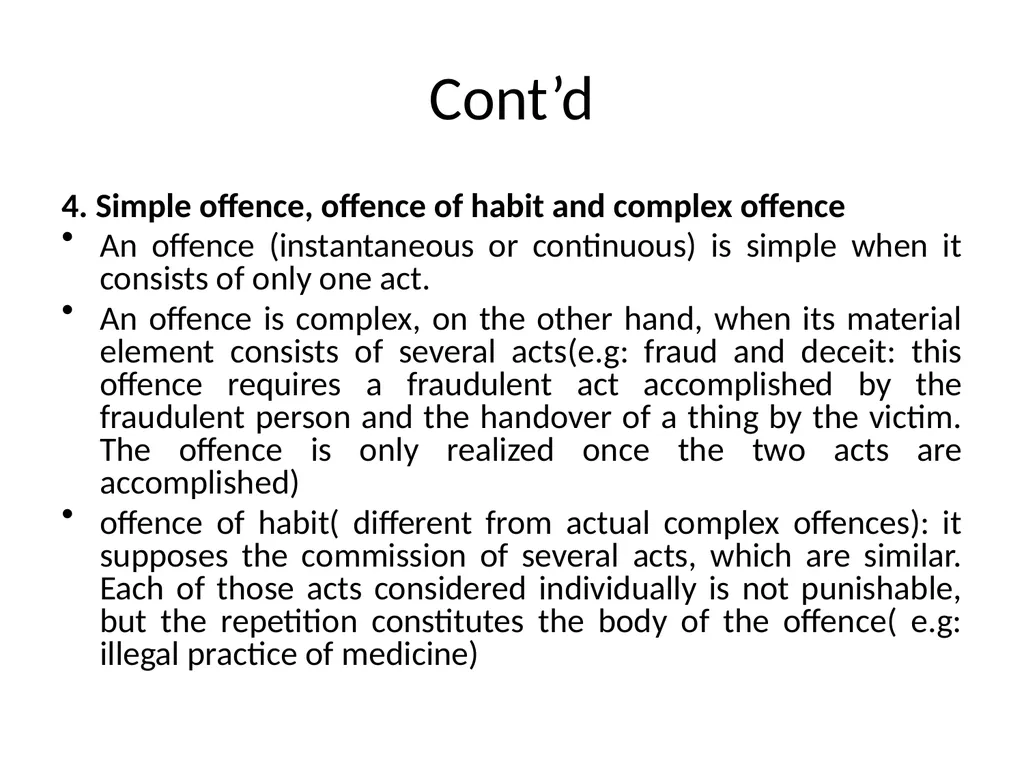
Cont’d 4. Simple offence, offence of habit and complex offence
An offence (instantaneous or continuous) is simple when it consists of only one act.
An offence is complex, on the other hand, when its material element consists of several acts(e.g: fraud and deceit: this offence requires a fraudulent act accomplished by the fraudulent person and the handover of a thing by the victim. The offence is only realized once the two acts are accomplished)
offence of habit( different from actual complex offences): it supposes the commission of several acts, which are similar. Each of those acts considered individually is not punishable, but the repetition constitutes the body of the offence( e.g: illegal practice of medicine)<br>
An offence (instantaneous or continuous) is simple when it consists of only one act.
An offence is complex, on the other hand, when its material element consists of several acts(e.g: fraud and deceit: this offence requires a fraudulent act accomplished by the fraudulent person and the handover of a thing by the victim. The offence is only realized once the two acts are accomplished)
offence of habit( different from actual complex offences): it supposes the commission of several acts, which are similar. Each of those acts considered individually is not punishable, but the repetition constitutes the body of the offence( e.g: illegal practice of medicine)<br>
35
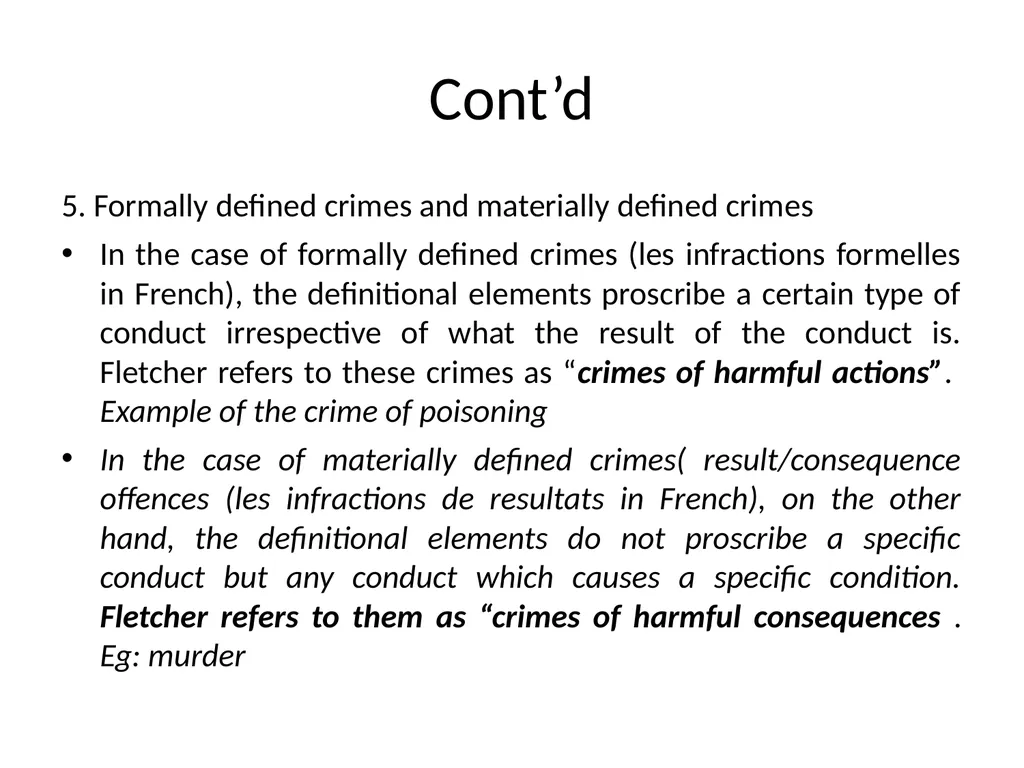
Cont’d 5. Formally defined crimes and materially defined crimes
In the case of formally defined crimes (les infractions formelles in French), the definitional elements proscribe a certain type of conduct irrespective of what the result of the conduct is. Fletcher refers to these crimes as “crimes of harmful actions”. Example of the crime of poisoning
In the case of materially defined crimes( result/consequence offences (les infractions de resultats in French), on the other hand, the definitional elements do not proscribe a specific conduct but any conduct which causes a specific condition. Fletcher refers to them as “crimes of harmful consequences . Eg: murder<br>
In the case of formally defined crimes (les infractions formelles in French), the definitional elements proscribe a certain type of conduct irrespective of what the result of the conduct is. Fletcher refers to these crimes as “crimes of harmful actions”. Example of the crime of poisoning
In the case of materially defined crimes( result/consequence offences (les infractions de resultats in French), on the other hand, the definitional elements do not proscribe a specific conduct but any conduct which causes a specific condition. Fletcher refers to them as “crimes of harmful consequences . Eg: murder<br>
36
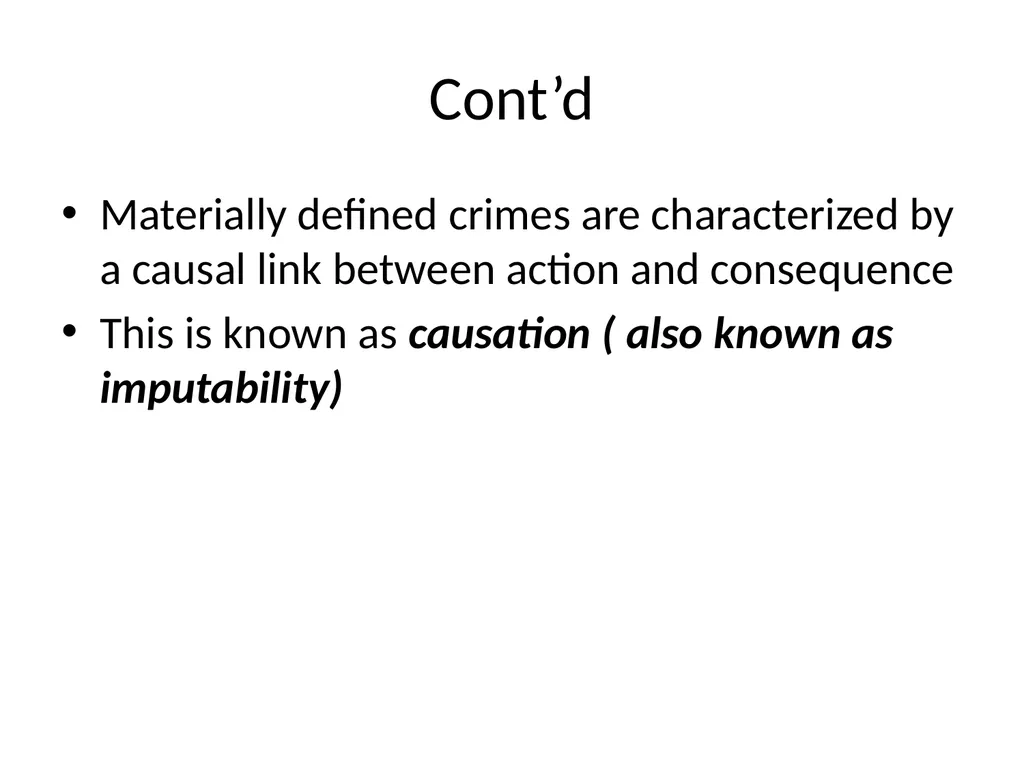
Cont’d Materially defined crimes are characterized by a causal link between action and consequence
This is known as causation ( also known as imputability)<br>
This is known as causation ( also known as imputability)<br>
37
C. The Concept of causation (1)Definition
Causation is the name given to the complexities that can break the link between action and consequence; when causation is absent, the harmful consequence is no longer attributable to the suspect.
For example, in case of murder, the question which always arises is whether or not there is a “causal link”(or nexus) between X’s conduct and the prohibited result (for example Y’s death)<br>
Causation is the name given to the complexities that can break the link between action and consequence; when causation is absent, the harmful consequence is no longer attributable to the suspect.
For example, in case of murder, the question which always arises is whether or not there is a “causal link”(or nexus) between X’s conduct and the prohibited result (for example Y’s death)<br>
38
(2)The principles to be applied in determining causation (a)Factual causation
In order to determine whether an act is a factual cause of the prohibited situation courts use the conditio sine qua non formula. This is equivalent to the “but for-causation” test in english law.
According to this formula (or theory) one must ask oneself what would have happened if X’s conduct had not taken place: would the result nevertheless have ensued?
In order to limit the wide ambit of the factual causation and the operation of the conditio sine qua non formula, the second leg of causation intervenes. This is the investigation into legal causation.<br>
In order to determine whether an act is a factual cause of the prohibited situation courts use the conditio sine qua non formula. This is equivalent to the “but for-causation” test in english law.
According to this formula (or theory) one must ask oneself what would have happened if X’s conduct had not taken place: would the result nevertheless have ensued?
In order to limit the wide ambit of the factual causation and the operation of the conditio sine qua non formula, the second leg of causation intervenes. This is the investigation into legal causation.<br>
39
Cont’d (b) Legal causation
The theory of adequate causation: According to this theory, an act is a legal cause of a situation if, according to human experience, in the normal course of events, the act has the tendency to bring about that type of that situation
In the Anglo-American law this corresponds to the “natural and probable consequences” or the “reasonable consequences” of the act.<br>
The theory of adequate causation: According to this theory, an act is a legal cause of a situation if, according to human experience, in the normal course of events, the act has the tendency to bring about that type of that situation
In the Anglo-American law this corresponds to the “natural and probable consequences” or the “reasonable consequences” of the act.<br>
40
Cont’d Eg: To strike a match is to perform an act which tends to cause a fire, or which in normal circumstances has that potential. If, therefore, X strikes a match and uses the burning match to set a wooden cabin alight, one can aver without difficult that her act was the cause of the burning down of the cabin.<br>
41
(3) The novus actus interveniens The expression novus actus interveniens means “new intervening event”, and is used to describe a situation where between X’s initial act and the ultimate death of Y, another event which has broken the chain of causation has taken place, preventing us from regarding X’s act as the cause of Y’s death.<br>
42
Cont’d an act is a novus actus if it constitutes an unexpected, abnormal or unusual occurrence
For example, X administers a poison to Y which will slowly kill her. Shortly afterwards Z, who also bears a grudge against Y, and who acts completely independently of X, shoots Y, killing her. It is then Z’s act, and not that of X, which is the cause of Y’s death. The death of Y cannot be attributed to X’s act because the chain of causation was broken by a novus actus interveniens, an unexpected, abnormal or unusual event.<br>
For example, X administers a poison to Y which will slowly kill her. Shortly afterwards Z, who also bears a grudge against Y, and who acts completely independently of X, shoots Y, killing her. It is then Z’s act, and not that of X, which is the cause of Y’s death. The death of Y cannot be attributed to X’s act because the chain of causation was broken by a novus actus interveniens, an unexpected, abnormal or unusual event.<br>
43
2.2.2. Mens rea all crimes require a mental element (mens rea) in the form of either intention (dolus) or negligence (culpa).
Unless otherwise provided by the law, only a person who intentionally commits an offence shall be liable to a penalty. [...]
However, where provided by the law, an offence occurs in case of recklessness, negligence or carelessness. The words “recklessness”, “negligence” and “carelessness” refer to the same concept which is generally simply referred to as negligence<br>
Unless otherwise provided by the law, only a person who intentionally commits an offence shall be liable to a penalty. [...]
However, where provided by the law, an offence occurs in case of recklessness, negligence or carelessness. The words “recklessness”, “negligence” and “carelessness” refer to the same concept which is generally simply referred to as negligence<br>
44
A.Intention (dolus) (1) Definition
Defined concisely, one can say that intention is to know (connaître) and to will (vouloir) an act or result.
This definition corresponds to the one contained in article 96(3) PC which reads as follows:
A person who commits an offence intentionally is one who commits it consciously and willingly.<br>
Defined concisely, one can say that intention is to know (connaître) and to will (vouloir) an act or result.
This definition corresponds to the one contained in article 96(3) PC which reads as follows:
A person who commits an offence intentionally is one who commits it consciously and willingly.<br>
45
Cont’d (2) The two elements of intention: knowledge and will
The cognitive element( knowledge) consists in X’s knowledge or awareness of all the elements and circumstances contained in the material elements of the crime.
The conative element(will) consists in X’s directing his will towards a certain act or result.<br>
The cognitive element( knowledge) consists in X’s knowledge or awareness of all the elements and circumstances contained in the material elements of the crime.
The conative element(will) consists in X’s directing his will towards a certain act or result.<br>
46
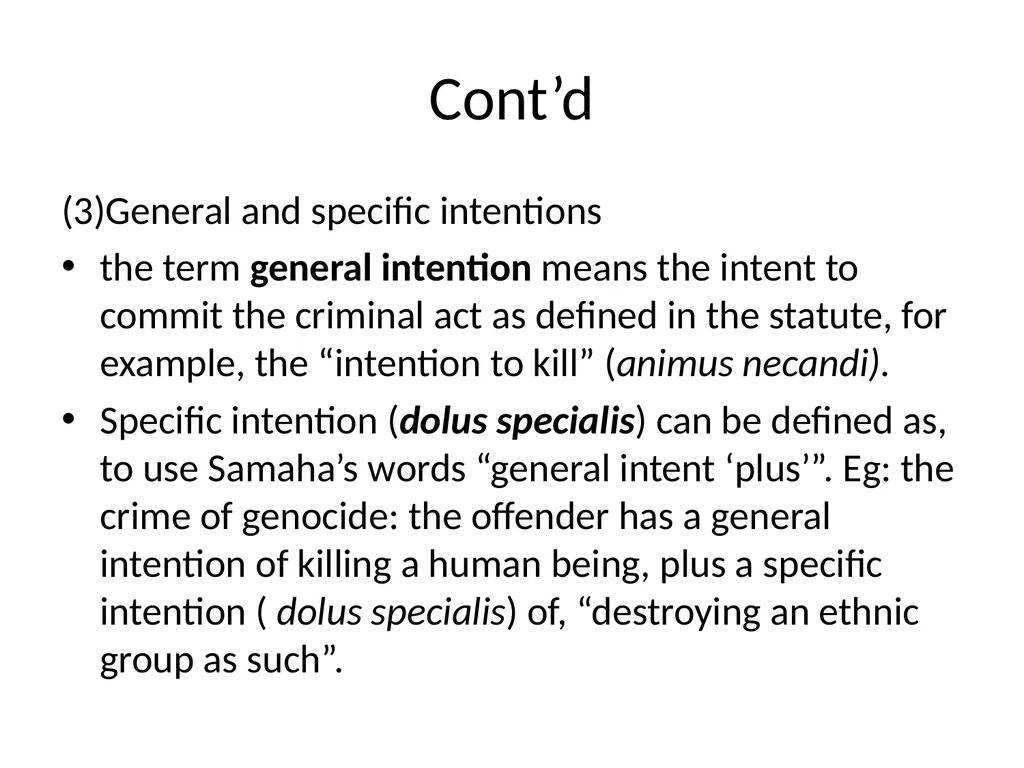
Cont’d (3)General and specific intentions
the term general intention means the intent to commit the criminal act as defined in the statute, for example, the “intention to kill” (animus necandi).
Specific intention (dolus specialis) can be defined as, to use Samaha’s words “general intent ‘plus’”. Eg: the crime of genocide: the offender has a general intention of killing a human being, plus a specific intention ( dolus specialis) of, “destroying an ethnic group as such”.<br>
the term general intention means the intent to commit the criminal act as defined in the statute, for example, the “intention to kill” (animus necandi).
Specific intention (dolus specialis) can be defined as, to use Samaha’s words “general intent ‘plus’”. Eg: the crime of genocide: the offender has a general intention of killing a human being, plus a specific intention ( dolus specialis) of, “destroying an ethnic group as such”.<br>
47
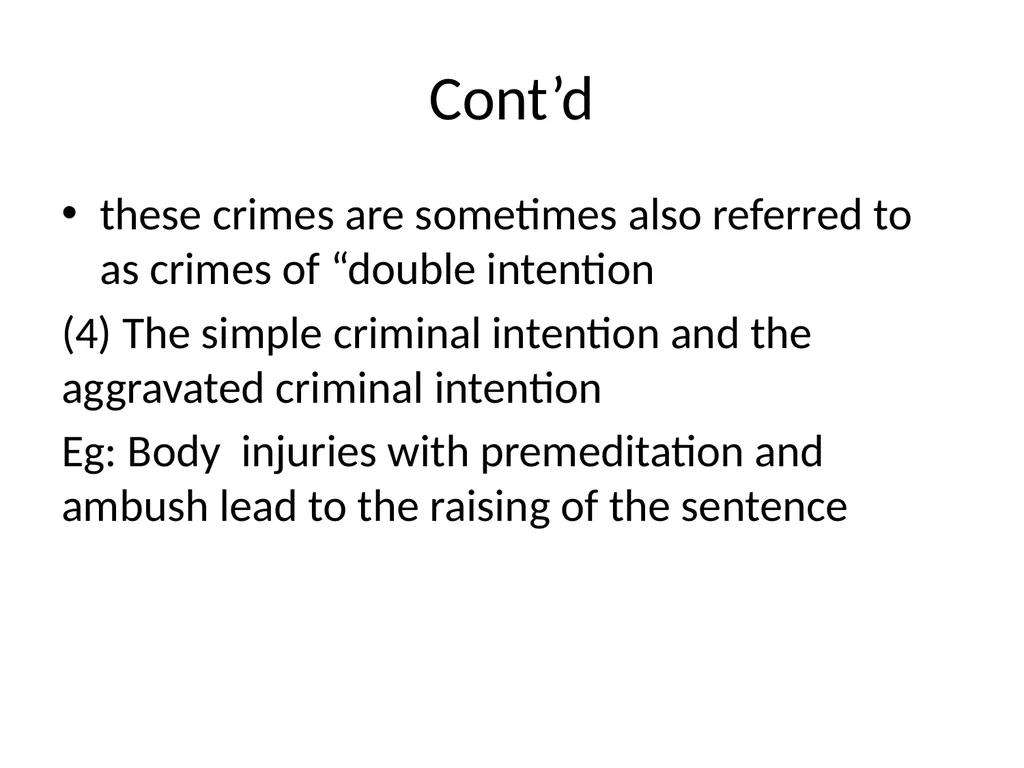
Cont’d these crimes are sometimes also referred to as crimes of “double intention
(4) The simple criminal intention and the aggravated criminal intention
Eg: Body injuries with premeditation and ambush lead to the raising of the sentence<br>
(4) The simple criminal intention and the aggravated criminal intention
Eg: Body injuries with premeditation and ambush lead to the raising of the sentence<br>
48
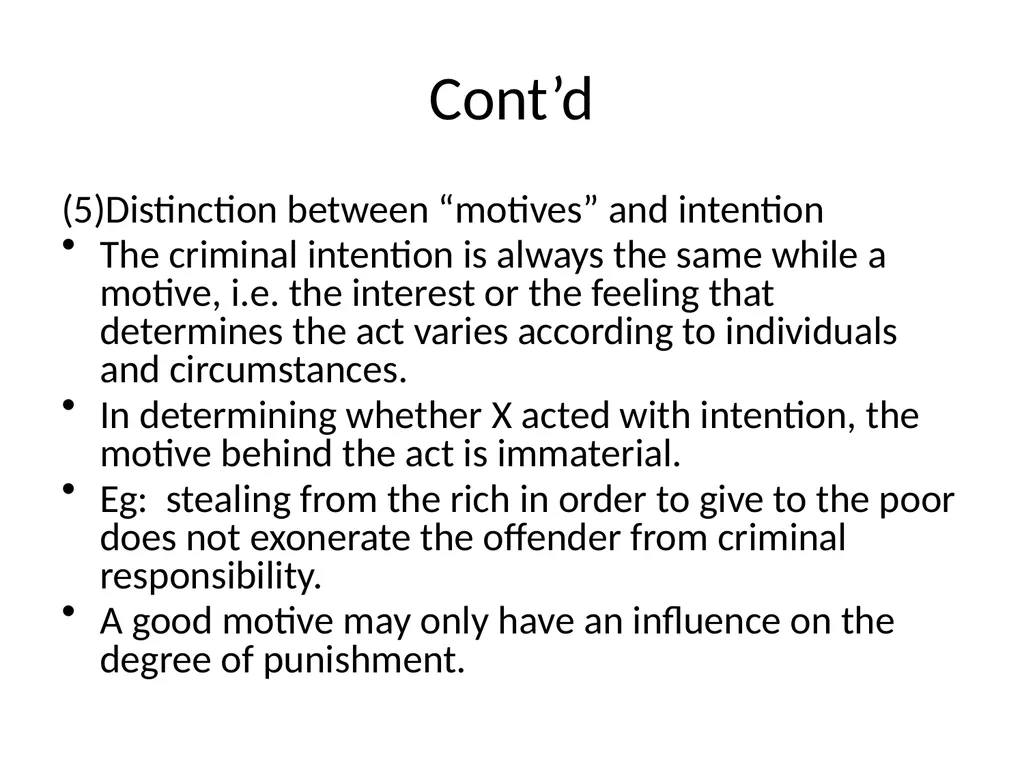
Cont’d (5)Distinction between “motives” and intention
The criminal intention is always the same while a motive, i.e. the interest or the feeling that determines the act varies according to individuals and circumstances.
In determining whether X acted with intention, the motive behind the act is immaterial.
Eg: stealing from the rich in order to give to the poor does not exonerate the offender from criminal responsibility.
A good motive may only have an influence on the degree of punishment.<br>
The criminal intention is always the same while a motive, i.e. the interest or the feeling that determines the act varies according to individuals and circumstances.
In determining whether X acted with intention, the motive behind the act is immaterial.
Eg: stealing from the rich in order to give to the poor does not exonerate the offender from criminal responsibility.
A good motive may only have an influence on the degree of punishment.<br>
49
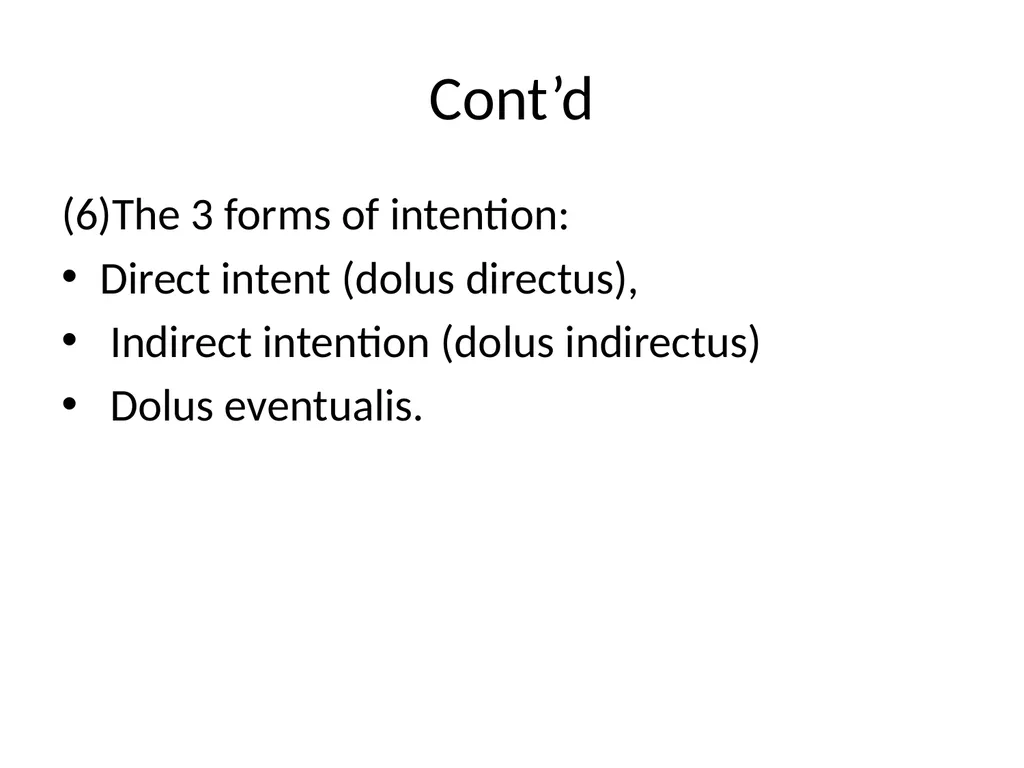
Cont’d (6)The 3 forms of intention:
Direct intent (dolus directus),
Indirect intention (dolus indirectus)
Dolus eventualis.<br>
Direct intent (dolus directus),
Indirect intention (dolus indirectus)
Dolus eventualis.<br>
50
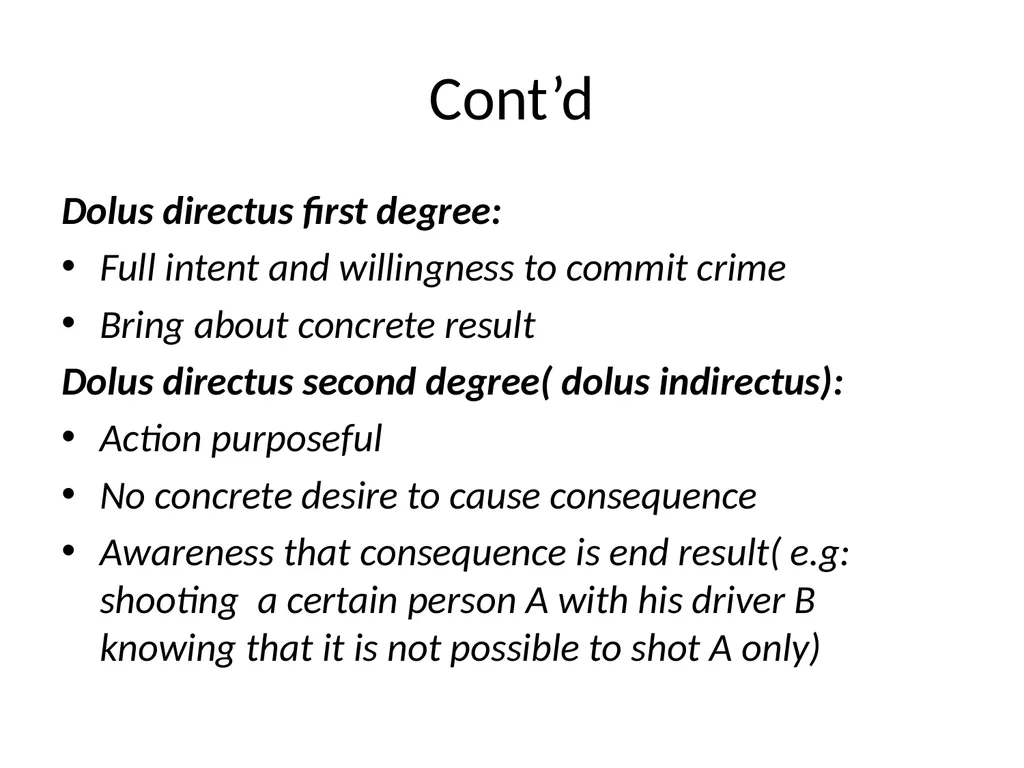
Cont’d Dolus directus first degree:
Full intent and willingness to commit crime
Bring about concrete result
Dolus directus second degree( dolus indirectus):
Action purposeful
No concrete desire to cause consequence
Awareness that consequence is end result( e.g: shooting a certain person A with his driver B knowing that it is not possible to shot A only)<br>
Full intent and willingness to commit crime
Bring about concrete result
Dolus directus second degree( dolus indirectus):
Action purposeful
No concrete desire to cause consequence
Awareness that consequence is end result( e.g: shooting a certain person A with his driver B knowing that it is not possible to shot A only)<br>
51
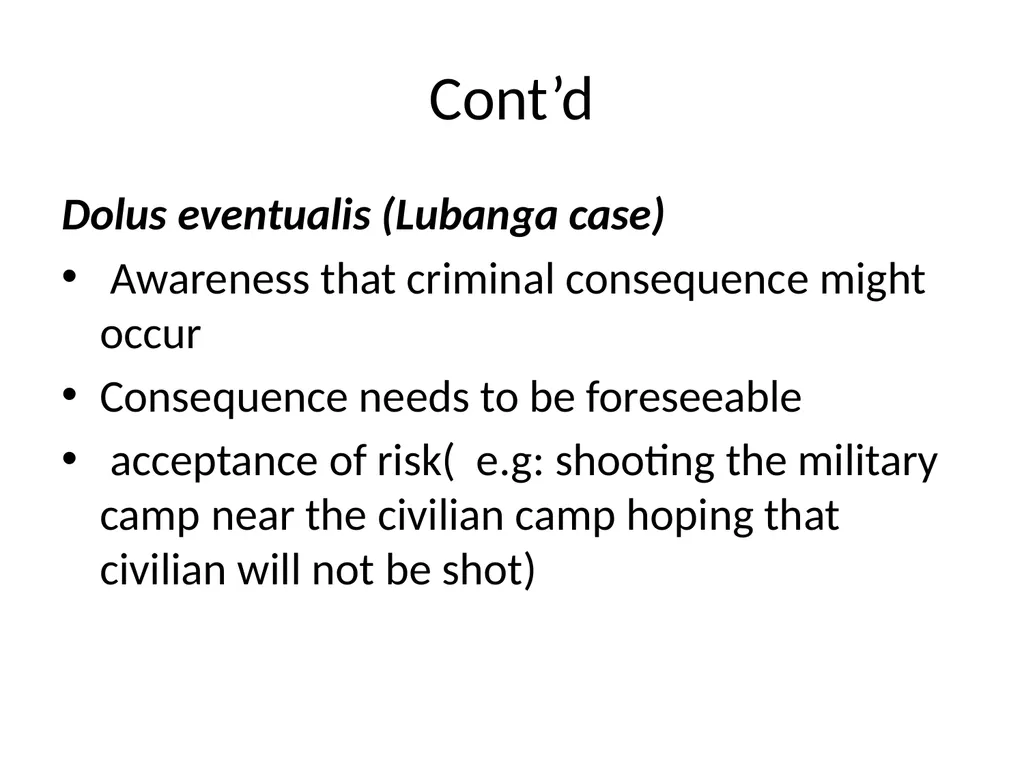
Cont’d Dolus eventualis (Lubanga case)
Awareness that criminal consequence might occur
Consequence needs to be foreseeable
acceptance of risk( e.g: shooting the military camp near the civilian camp hoping that civilian will not be shot)<br>
Awareness that criminal consequence might occur
Consequence needs to be foreseeable
acceptance of risk( e.g: shooting the military camp near the civilian camp hoping that civilian will not be shot)<br>
52
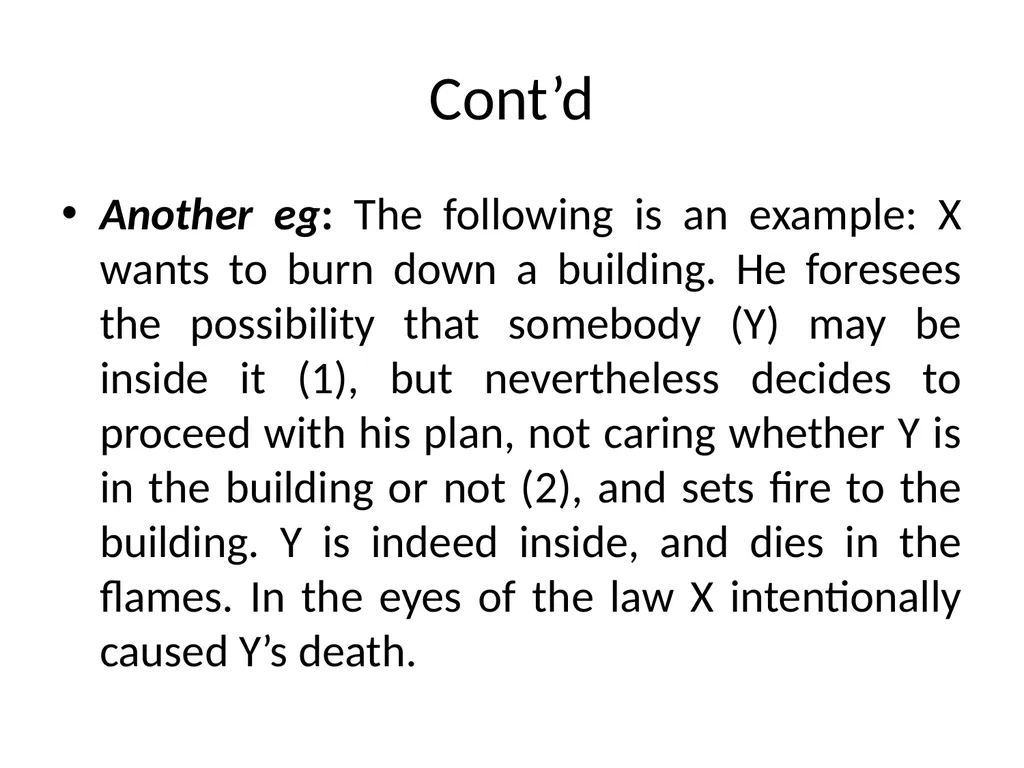
Cont’d Another eg: The following is an example: X wants to burn down a building. He foresees the possibility that somebody (Y) may be inside it (1), but nevertheless decides to proceed with his plan, not caring whether Y is in the building or not (2), and sets fire to the building. Y is indeed inside, and dies in the flames. In the eyes of the law X intentionally caused Y’s death.<br>
53
Cont’d (7)Proof of intention
Direct evidence( eg: confession and guilty plea)
Circumstantial evidence<br>
Direct evidence( eg: confession and guilty plea)
Circumstantial evidence<br>
54
B. Negligence (Culpa) (1)definition:
A person’s act is negligent if:
A reasonable person in the same circumstances would have foreseen the possibility that: the particular circumstance might exist, or his conduct might bring about the particular result;
A reasonable person would have taken steps to guard against such a possibility; and
The conduct of the person whose negligence is being determined differed from the conduct expected of the reasonable person.<br>
A person’s act is negligent if:
A reasonable person in the same circumstances would have foreseen the possibility that: the particular circumstance might exist, or his conduct might bring about the particular result;
A reasonable person would have taken steps to guard against such a possibility; and
The conduct of the person whose negligence is being determined differed from the conduct expected of the reasonable person.<br>
55
Cont’d (2)The concept of a “reasonable person”
An ordinary, normal, average person. He is the man of ordinary knowledge or intelligence.
He is neither an exceptionally cautious or talented person nor an underdeveloped person, or somebody who recklessly takes chances.<br>
An ordinary, normal, average person. He is the man of ordinary knowledge or intelligence.
He is neither an exceptionally cautious or talented person nor an underdeveloped person, or somebody who recklessly takes chances.<br>
56
Cont’d (3)The test of negligence is both objective and subjective
Objective test: foreseeability of the result or circumstance by a reasonable person.
Subjective test( exception):
The negligence of children who, despite their youth, have criminal capacity (i.e. aged between 14 and 18), out to be determined by inquiring what a reasonable child would have done or foreseen in the circumstances;<br>
Objective test: foreseeability of the result or circumstance by a reasonable person.
Subjective test( exception):
The negligence of children who, despite their youth, have criminal capacity (i.e. aged between 14 and 18), out to be determined by inquiring what a reasonable child would have done or foreseen in the circumstances;<br>
57
Cont’d In the case of experts, it must be asked whether a reasonable expert who embarks upon a similar activity would have foreseen the possibility of the particular result ensuing or the particular circumstance existing;
If X happens to have knowledge of a certain matter which is superior to the knowledge which a reasonable person would have had on the matter, he cannot expect a court to determine his negligence by referring to the inferior knowledge of the reasonable person. His superior subjective knowledge of a fact of which the reasonable person would have had no knowledge must indeed be taken into account.<br>
If X happens to have knowledge of a certain matter which is superior to the knowledge which a reasonable person would have had on the matter, he cannot expect a court to determine his negligence by referring to the inferior knowledge of the reasonable person. His superior subjective knowledge of a fact of which the reasonable person would have had no knowledge must indeed be taken into account.<br>
58
Cont’d (4)Two forms of negligence: conscious and unconscious negligence
a. Conscious negligence exists where (1) the accused foresees a possibility of a consequence resulting from his conduct and (2) fails to take the steps that a reasonable man would have taken to guard against this possibility
the concept of conscious negligence is hybrid of subjective foresight and the failure to take objectively reasonable steps to guard against a foreseen consequence<br>
a. Conscious negligence exists where (1) the accused foresees a possibility of a consequence resulting from his conduct and (2) fails to take the steps that a reasonable man would have taken to guard against this possibility
the concept of conscious negligence is hybrid of subjective foresight and the failure to take objectively reasonable steps to guard against a foreseen consequence<br>
59
Cont’d unconscious negligence: the actor, because of lack of care, does not think of the possibility that he may bring about the constitutive facts of the offence.
He does not foresee the prohibited result, but as a reasonable person, he should have foreseen that the result may ensue<br>
He does not foresee the prohibited result, but as a reasonable person, he should have foreseen that the result may ensue<br>
60
Cont’d (5)The difference between dolus eventualis and conscious negligence
Both dolus eventualis and conscious negligence involve foresight
Dolus evantualis amounts to intentional conduct (towards the result) while the conscious negligence amounts to unintentional (negligent) conduct.
Secondly, whereas the test for dolus eventualis is purely subjective, for conscious negligence the test is hybrid.
To determine dolus eventualis the question is whether in “actual fact”, X foresaw and accepted the possibility into the bargain.
For conscious negligence, the question becomes whether “in actual fact” X foresaw the result ensuing (subjective test) and if a reasonable man could have prevented that possibility (objective test).<br>
Both dolus eventualis and conscious negligence involve foresight
Dolus evantualis amounts to intentional conduct (towards the result) while the conscious negligence amounts to unintentional (negligent) conduct.
Secondly, whereas the test for dolus eventualis is purely subjective, for conscious negligence the test is hybrid.
To determine dolus eventualis the question is whether in “actual fact”, X foresaw and accepted the possibility into the bargain.
For conscious negligence, the question becomes whether “in actual fact” X foresaw the result ensuing (subjective test) and if a reasonable man could have prevented that possibility (objective test).<br>
61
C. STRICT LIABILITY: DISREGARD OF THE REQUIREMENT OF MENS REA In principle, intention or negligence is required for criminal liability.
However there are cases of strict liability: there is no requirement to prove mens rea (intention or negligence) in relation to one or more aspects of the actus reus
Once the prohibited act (actus reus) is committed, the crime is committed. Eg: road-traffic offences such as speeding, driving without insurance, etc.
In most cases, regulatory offences aimed at businesses in relation to health and safety also lead to strict liability such as pollution, manufacturing harmful products, etc.<br>
However there are cases of strict liability: there is no requirement to prove mens rea (intention or negligence) in relation to one or more aspects of the actus reus
Once the prohibited act (actus reus) is committed, the crime is committed. Eg: road-traffic offences such as speeding, driving without insurance, etc.
In most cases, regulatory offences aimed at businesses in relation to health and safety also lead to strict liability such as pollution, manufacturing harmful products, etc.<br>
62
Cont’d Also many driving offences are crimes of strict liability eg. speeding, driving without insurance. The use of strict liability in criminal law is controversial as it means a person may be liable where they are not at fault or have taken all reasonable care to ensure compliance of the law<br>
63
Cases Mr Danger has given acidic substance to the child of the neighbor. Though the experts found that the substances were deadly, fortunately the child was not dead. Did he commit an offence? Explain your answer.
On 22nd February 2013, Mr Kaga used the fake keys and entered the house of Mr Mateso where he stole the dining table. On the 23 February 2013, he used the same fake keys in order to steal all the remaining furniture in the sitting room. On this very date, he was caught red- handed by the Police. Assume you are a judge in charge of this case; (i) is there concurrence of offenses in this case? How can you determine the sentence in this case?
Shane had been in a relationship with Nicola for two years. In early June 2016, Nicola ended the relationship and began a new relationship with Gareth, who owned a shop in the neighbourhood. Shane was greatly distressed and angered by Nicola’s decision. One day, in early July 2016,Shane went to Gareth’s shop. Shane was carrying a pistol which he legally held. He entered the shop and shot Gareth twice in the stomach. The ambulance arrived at the scene of the shooting after two hours. Gareth died immediately after the ambulance reached the hospital. Medical specialists who carried out the post-mortem are of the view that he could have been saved if the ambulance had arrived immediately at the scene of the shooting. You are asked to advise the Prosecution as to the charge(s) that may appropriately be brought against Shane in these circumstances. Give reasons for your advice.<br>
On 22nd February 2013, Mr Kaga used the fake keys and entered the house of Mr Mateso where he stole the dining table. On the 23 February 2013, he used the same fake keys in order to steal all the remaining furniture in the sitting room. On this very date, he was caught red- handed by the Police. Assume you are a judge in charge of this case; (i) is there concurrence of offenses in this case? How can you determine the sentence in this case?
Shane had been in a relationship with Nicola for two years. In early June 2016, Nicola ended the relationship and began a new relationship with Gareth, who owned a shop in the neighbourhood. Shane was greatly distressed and angered by Nicola’s decision. One day, in early July 2016,Shane went to Gareth’s shop. Shane was carrying a pistol which he legally held. He entered the shop and shot Gareth twice in the stomach. The ambulance arrived at the scene of the shooting after two hours. Gareth died immediately after the ambulance reached the hospital. Medical specialists who carried out the post-mortem are of the view that he could have been saved if the ambulance had arrived immediately at the scene of the shooting. You are asked to advise the Prosecution as to the charge(s) that may appropriately be brought against Shane in these circumstances. Give reasons for your advice.<br>
64
2.3. Defences Even when the actus reus is committed with the required mens rea, circumstances may exist which make the act justified or excusable
For a person to be liable, there must be
lack of justification (unlawfulness)
and lack of excuse (blameworthiness or culpability)
Thus, a person will not be liable if there
Justificatory defences : defenses in which the defendant claims that his actions were right or justified based on the circumstances
excusatory defences : the defendant admits what he did was wrong but claims he should be excused from criminal liability based on the circumstances<br>
For a person to be liable, there must be
lack of justification (unlawfulness)
and lack of excuse (blameworthiness or culpability)
Thus, a person will not be liable if there
Justificatory defences : defenses in which the defendant claims that his actions were right or justified based on the circumstances
excusatory defences : the defendant admits what he did was wrong but claims he should be excused from criminal liability based on the circumstances<br>
65
2.3.1. Defences excluding unlawfulness (Justificatory defences) The mere fact that there is an act which corresponds to the definitional elements does not mean that the person who performs the act is liable for the particular crime.
The next step in the determination of liability is to enquire whether the act which complies with the definitional elements is also unlawful
Below are the defenses that exclude the unlawfulness<br>
The next step in the determination of liability is to enquire whether the act which complies with the definitional elements is also unlawful
Below are the defenses that exclude the unlawfulness<br>
66
A. Self-defence: art 105, 106 and 107 PC (i)Requirements of self defence
Requirements of the attack
be illegal;
be directed at an interest which legally deserves to be protected ( person or property )
have commenced or be imminent, but not yet completed( see Mbanzamihigo case)<br>
Requirements of the attack
be illegal;
be directed at an interest which legally deserves to be protected ( person or property )
have commenced or be imminent, but not yet completed( see Mbanzamihigo case)<br>
67
Cont’d Requirements of the defensive act
be directed against the attacker;
be necessary( necessity)
stand in a reasonable relationship to the attack (proportionality). e.g: it is not self defense to respond to a slap with a gunshot
be taken while the defender is aware that he is acting in private defence. There is no such thing as unconscious or accidental private defence.<br>
be directed against the attacker;
be necessary( necessity)
stand in a reasonable relationship to the attack (proportionality). e.g: it is not self defense to respond to a slap with a gunshot
be taken while the defender is aware that he is acting in private defence. There is no such thing as unconscious or accidental private defence.<br>
68
Cont’d The assessment of proportionality can take into account different factors such as:
The relative strength of the parties;
The sex of the parties;
The ages of the parties;
The means they have at their disposal;
The value of the interest threatened, etc
It is import to note that the test for private defence is objective: Putative private defence is not self- defence. It can be an excuse as it will be discussed later.<br>
The relative strength of the parties;
The sex of the parties;
The ages of the parties;
The means they have at their disposal;
The value of the interest threatened, etc
It is import to note that the test for private defence is objective: Putative private defence is not self- defence. It can be an excuse as it will be discussed later.<br>
69
B. Necessity: article 108 PC It is a justification defense in which the defendant commits a crime out of necessity or to avoid a greater evil.
(i) Requirements of necessity defence
the presence of an actual or imminent danger against one self or another person
The interest to protect must be of a higher value than the sacrificed one, or at least, the two interests must be of the same value
Proportionality between the means of defense and the gravity of the danger<br>
(i) Requirements of necessity defence
the presence of an actual or imminent danger against one self or another person
The interest to protect must be of a higher value than the sacrificed one, or at least, the two interests must be of the same value
Proportionality between the means of defense and the gravity of the danger<br>
70
C. Consent and presumed consent (1)The different effects that consent
Consent can only operate as ground of justification in respect of certain crimes, and only under certain circumstances.
There are crimes in respect of which consent does operate as defence, but forms part of the definitional elements of the crime. Eg: rape. Rape is only possible if the non-consexual sexual takes place without the person’s consent.<br>
Consent can only operate as ground of justification in respect of certain crimes, and only under certain circumstances.
There are crimes in respect of which consent does operate as defence, but forms part of the definitional elements of the crime. Eg: rape. Rape is only possible if the non-consexual sexual takes place without the person’s consent.<br>
71
Cont’d There are crimes in respect of which consent by the injured party is not recognized as a defence. Eg: murder. Euthanasia is unlawful( see article 179 PC)
There is a group of crimes in respect of which consent is sometimes regarded as a ground of justification and sometimes not. Eg: sporting events (such in Karate) , and where a person’s bodily integrity is impaired in the course of medical treatment(such as an operation (such as performing caesarean). The test is the bonos mores. If the act was contra bonos mores (against the good morals), it leads to liability.<br>
There is a group of crimes in respect of which consent is sometimes regarded as a ground of justification and sometimes not. Eg: sporting events (such in Karate) , and where a person’s bodily integrity is impaired in the course of medical treatment(such as an operation (such as performing caesarean). The test is the bonos mores. If the act was contra bonos mores (against the good morals), it leads to liability.<br>
72
Cont’d (2)Requirements for a valid plea of consent
The consent must be given voluntarily, without any coercion
The person giving consent must be endowed with certain minimum mental abilities ( eg: no consent in case of intoxication
The consent must be given before the otherwise unlawful act is committed
consent must be given by the “victim” herself. Exception: Example of informed consent in medical treatment<br>
The consent must be given voluntarily, without any coercion
The person giving consent must be endowed with certain minimum mental abilities ( eg: no consent in case of intoxication
The consent must be given before the otherwise unlawful act is committed
consent must be given by the “victim” herself. Exception: Example of informed consent in medical treatment<br>
73
Cont’d (3) Presumed consent
Known as spontaneous agency
Example: X is in a critical health condition and is operated by a doctor while she is unconscious. The doctor can rely on the defence of presumed consent if, after recovering, X claims that her body was violated without her consent and institutes a criminal action against the doctor<br>
Known as spontaneous agency
Example: X is in a critical health condition and is operated by a doctor while she is unconscious. The doctor can rely on the defence of presumed consent if, after recovering, X claims that her body was violated without her consent and institutes a criminal action against the doctor<br>
74
D. Act ordered by law( art.104) Eg: the policeman who searches an occupied house does not commit “violation of domicile” if he does so with a search warrant.
This is a law enforcement defence<br>
This is a law enforcement defence<br>
75
E. Parents’ right of chastisement Parents have the right to punish their children with moderate and reasonable corporal punishment
This can be a defence in Rwanda<br>
This can be a defence in Rwanda<br>
76
2.3.2. Defences that negate blameworthiness (excuses) The mere fact that a person has committed an act which complies with the definitional elements and which is unlawful (not justified) is not yet sufficient to render him criminally liable
There must be blameworthiness (also called culpability)
Test: “Could one in all fairness have expected X to avoid the wrongdoing?”<br>
There must be blameworthiness (also called culpability)
Test: “Could one in all fairness have expected X to avoid the wrongdoing?”<br>
77
A. Defences excluding criminal capacity People who lack “criminal capacity” are not punishable
The term “criminal capacity” refers to the mental abilities or capacities to appreciate the wrongfulness of his act and to act in accordance with such an appreciation
It is different from intent<br>
The term “criminal capacity” refers to the mental abilities or capacities to appreciate the wrongfulness of his act and to act in accordance with such an appreciation
It is different from intent<br>
78
Cont’d Minority : article 100 PC
less than 14 years.
14 to less than 18 years: mitigating excuse
(2) Insanity: article 101 PC
It means all forms of mental illness that deprives the individual from the control or supervision of his/her acts at the time of their commission
“Mental illness” is an illness of the mind. It includes common conditions like depression and less common conditions like schizophrenia, bipolar disorder, anorexia nervosa and dementia, etc.
The defendant bears the burden of proving on the balance of probabilities that he or she is insane<br>
less than 14 years.
14 to less than 18 years: mitigating excuse
(2) Insanity: article 101 PC
It means all forms of mental illness that deprives the individual from the control or supervision of his/her acts at the time of their commission
“Mental illness” is an illness of the mind. It includes common conditions like depression and less common conditions like schizophrenia, bipolar disorder, anorexia nervosa and dementia, etc.
The defendant bears the burden of proving on the balance of probabilities that he or she is insane<br>
79
Cont’d There are cases of Diminished responsibility:
It is a legal doctrine that absolves an accused person of part of the liability for his criminal act if he suffers from such abnormality of mind as to substantially impair his responsibility in committing or being a party to an alleged violation.
The doctrine of diminished responsibility provides a mitigating defense in cases in which the mental disease or defect is not of such magnitude as to exclude criminal responsibility altogether.<br>
It is a legal doctrine that absolves an accused person of part of the liability for his criminal act if he suffers from such abnormality of mind as to substantially impair his responsibility in committing or being a party to an alleged violation.
The doctrine of diminished responsibility provides a mitigating defense in cases in which the mental disease or defect is not of such magnitude as to exclude criminal responsibility altogether.<br>
80
Cont’d (3) Non-pathological criminal incapacity
criminal incapacity as a defence outside the situations in which he relies on mental illness and youthful age, fall under the heading “non-pathological criminal incapacity( eg: extreme “intoxication, “provocation” and “emotional stress)
This is different from sane automatism which is the defence which is raised when it is alleged that an accused’s behaviour was not voluntary:
Reflex movements such as heart palpitations or a sneezing fit;
Somnambulism;
(iii) Muscular movements such as an arm movement of a person who is asleep, unconscious or hypnotised, or having a nightmare, an epileptic fit, or the so-called “black-out”<br>
criminal incapacity as a defence outside the situations in which he relies on mental illness and youthful age, fall under the heading “non-pathological criminal incapacity( eg: extreme “intoxication, “provocation” and “emotional stress)
This is different from sane automatism which is the defence which is raised when it is alleged that an accused’s behaviour was not voluntary:
Reflex movements such as heart palpitations or a sneezing fit;
Somnambulism;
(iii) Muscular movements such as an arm movement of a person who is asleep, unconscious or hypnotised, or having a nightmare, an epileptic fit, or the so-called “black-out”<br>
81
B. Obedience to superior orders (art 104 PC) obedience to orders is a defence provided that the order was not manifestly illegal.
The Criminal Law thus provides the subordinate with a defence if he executes an unlawful order in a “reasonable” belief that the order is lawful
No liability for order issue by legitimate authority( in pple)<br>
The Criminal Law thus provides the subordinate with a defence if he executes an unlawful order in a “reasonable” belief that the order is lawful
No liability for order issue by legitimate authority( in pple)<br>
82
Cont’d What if the order is illegal but is issued by a legitimate authority?
For some authors, an illegal command should erase criminal responsibility for the subordinated agents who must always and in whatever circumstances obey orders from his superior without discusssing or challenging them. Obedience prevails over legality. This system is known as “passive obedience”
Some other authors, considering serious consequences that can be caused by passive obedience, recognize a right of challenging superior’s orders and refuse to execute when they are illegal. The theory is known as “claver bayonet”.
Others cut out the responsibility only in case when illegal character of the command is manifest and crass.
Rwanda has adopted this last approach. There is no criminal liability unless the ordered act is manifestly unlawful( article 104 of the Penal code)<br>
For some authors, an illegal command should erase criminal responsibility for the subordinated agents who must always and in whatever circumstances obey orders from his superior without discusssing or challenging them. Obedience prevails over legality. This system is known as “passive obedience”
Some other authors, considering serious consequences that can be caused by passive obedience, recognize a right of challenging superior’s orders and refuse to execute when they are illegal. The theory is known as “claver bayonet”.
Others cut out the responsibility only in case when illegal character of the command is manifest and crass.
Rwanda has adopted this last approach. There is no criminal liability unless the ordered act is manifestly unlawful( article 104 of the Penal code)<br>
83
C. Duress: Article 103 Notion
Duress can be physical or moral
It affects the will of the offender
Duress is different from necessity. For the latter, the threat to the defendant comes from natural or circumstantial rather than human sources
Conditions
Irresistible( appreciation by the judge)
Unpredictable
NB: The legislator does not clearly indicate whether duress can be accepted for all offenses. Some legislations like the UK exclude such defence for some felonies such as murder.<br>
Duress can be physical or moral
It affects the will of the offender
Duress is different from necessity. For the latter, the threat to the defendant comes from natural or circumstantial rather than human sources
Conditions
Irresistible( appreciation by the judge)
Unpredictable
NB: The legislator does not clearly indicate whether duress can be accepted for all offenses. Some legislations like the UK exclude such defence for some felonies such as murder.<br>
84
D. Mistake of facts This defence applies in case the defendant misunderstood some facts that negate an element of the crime.
Eg: X thinks that he finds herself in a situation of private defence because Y is threatening him with a revolver, whereas Y is merely joking and the “revolver” is in fact a toy. If X “defends” himself and kills Y, he cannot rely on private defence, but can raise the defence of “mistake” in relation to unlawfulness. “putative private defence” situation.
This defence is provided by art. 32 of the Rome Statute : “A mistake of fact shall be a ground for excluding criminal responsibility only if it negates the mental element required by the crime.
This defence is not provided under rwandan law but can be invoked before courts.<br>
Eg: X thinks that he finds herself in a situation of private defence because Y is threatening him with a revolver, whereas Y is merely joking and the “revolver” is in fact a toy. If X “defends” himself and kills Y, he cannot rely on private defence, but can raise the defence of “mistake” in relation to unlawfulness. “putative private defence” situation.
This defence is provided by art. 32 of the Rome Statute : “A mistake of fact shall be a ground for excluding criminal responsibility only if it negates the mental element required by the crime.
This defence is not provided under rwandan law but can be invoked before courts.<br>
85
E. Mistake( or ignorance) of the law Mistake of law is a defense that the criminal defendant misunderstood or was ignorant of the law as it existed at the time.
Under Rwandan law, article 176(2) of the Constitution provides that ‘‘ignorance of the law which has been duly published is not a defence
Codification of the principle “ignorance of the law is no excuse” (Ignorantia juris neminem excusat)
This defence is admitted in some countries such as South Africa and France
To be accepted, the ignorance must be invincible: An invincible mistake or ignorance that any reasonable and cautious individual can commit.<br>
Under Rwandan law, article 176(2) of the Constitution provides that ‘‘ignorance of the law which has been duly published is not a defence
Codification of the principle “ignorance of the law is no excuse” (Ignorantia juris neminem excusat)
This defence is admitted in some countries such as South Africa and France
To be accepted, the ignorance must be invincible: An invincible mistake or ignorance that any reasonable and cautious individual can commit.<br>
86
Cont’d Mistake of law can generally be used as a defense in limited circumstances such as:
When the law has not been published;
When the defendant relied upon a law that was later abrogated or declared unconstitutional;
When the defendant relied upon a judicial decision that was later overruled; or
When the defendant relied upon an interpretation by an applicable official.
NB:
The Rwandan penal code does not provide expressly for the mistake (ignorance) of law as an excuse.
It would be up to the jugde to appreciate if the ignorance negate the mental element of the crime.
This approach was also adopted by the Rome statute establishing the International Criminal Court( but Rwanda is not party to the Rome Statute).<br>
When the law has not been published;
When the defendant relied upon a law that was later abrogated or declared unconstitutional;
When the defendant relied upon a judicial decision that was later overruled; or
When the defendant relied upon an interpretation by an applicable official.
NB:
The Rwandan penal code does not provide expressly for the mistake (ignorance) of law as an excuse.
It would be up to the jugde to appreciate if the ignorance negate the mental element of the crime.
This approach was also adopted by the Rome statute establishing the International Criminal Court( but Rwanda is not party to the Rome Statute).<br>
87
Chap. 3: Intoxication Involuntary intoxication
Voluntary intoxication<br>
Voluntary intoxication<br>
88
A. Involuntary intoxication Complete involuntary intoxication
Complete intoxication occurs when one of the following requirements of criminal liability is impaired:
A voluntary act;
Criminal capacity;
Intention and negligence (mens rea)
It leads to acquittal of the accused<br>
Complete intoxication occurs when one of the following requirements of criminal liability is impaired:
A voluntary act;
Criminal capacity;
Intention and negligence (mens rea)
It leads to acquittal of the accused<br>
89
Cont’d (2) Partial involuntary intoxication
This intoxication is not a defence to a crime; but there is a way of considering a mitigating circumstance<br>
This intoxication is not a defence to a crime; but there is a way of considering a mitigating circumstance<br>
90
B. Voluntary intoxication Three different situations of intoxication have to be clearly distinguished:
The actio libera in causa
Intoxication resulting in mental illness;
Ordinary voluntary intoxication.<br>
The actio libera in causa
Intoxication resulting in mental illness;
Ordinary voluntary intoxication.<br>
91
Cont’d (1)The actio libera in causa
voluntary act of intoxication with the purpose of committing the crime
This is not a defence and can be an aggravating circumstance<br>
voluntary act of intoxication with the purpose of committing the crime
This is not a defence and can be an aggravating circumstance<br>
92
Cont’d (2)Voluntary intoxication resulting in mental illness
If a mental illness( insanity) results from a chronic abuse of alcohol, it constitute a defence like insanity<br>
If a mental illness( insanity) results from a chronic abuse of alcohol, it constitute a defence like insanity<br>
93
Cont’d (3)Ordinary voluntary intoxication
The ‘‘unyielding’’ approach: no defence
The Rwandan law follows this approach. Article 101(2) provides that:
“ a person who has voluntarily deprived him/herself of the use of his/her mind during the commission of the offence shall remain criminally liable, even if such deprivation would have not been caused for the purposes of committing an offence”.
The ‘‘lenient’’ approach<br>
The ‘‘unyielding’’ approach: no defence
The Rwandan law follows this approach. Article 101(2) provides that:
“ a person who has voluntarily deprived him/herself of the use of his/her mind during the commission of the offence shall remain criminally liable, even if such deprivation would have not been caused for the purposes of committing an offence”.
The ‘‘lenient’’ approach<br>
94
Cont’d Lenient approach
There may be situations in which such a person should escape criminal liability, the basis of this being that because of her intoxication he either did not perform a voluntary act, or lacked either the intention required in the definition of the crime or the minimum criminal capacity required for a conviction.
This situation is especially true in case of “complete voluntary intoxication”. It should be a defence<br>
There may be situations in which such a person should escape criminal liability, the basis of this being that because of her intoxication he either did not perform a voluntary act, or lacked either the intention required in the definition of the crime or the minimum criminal capacity required for a conviction.
This situation is especially true in case of “complete voluntary intoxication”. It should be a defence<br>
95
Cont’d Partial Voluntary intoxication: Not a defence. It can be a mitigating circumstance.<br>
96
Chap. 4: PROVOCATION AND EMOTIONAL STRESS Provocation as a complete defence
Provocation as mitigating excuse
Emotional stress<br>
Provocation as mitigating excuse
Emotional stress<br>
97
A. Provocation as a complete defence In some countries( eg:South Africa) provocation is accepted as a ground for negating culpability (non-pathological criminal incapacity).
Even in the legal systems where this defence is available, such a judgment of acquittal will be reached only in exceptional cases( eg: extreme anger)<br>
Even in the legal systems where this defence is available, such a judgment of acquittal will be reached only in exceptional cases( eg: extreme anger)<br>
98
B. Provocation as mitigating excuse Rwandan law follows this approach
Under art 73 PC, provocation may operate only as a ground for mitigation of punishment.
Determination of sentence in case of provocation will be discussed on the section on sentencing<br>
Under art 73 PC, provocation may operate only as a ground for mitigation of punishment.
Determination of sentence in case of provocation will be discussed on the section on sentencing<br>
99
C. Emotional stress Emotional stress includes cases such as anger (not immediately caused by provocation) or stress caused by social, health or financial problems.
examples:
X finds Y sleeping with X’s wife. X grabs an axe and strikes Y’s head killing him instantly.
X has sexual intercourse with a woman (Y). After the intercourse Y apologises to X that she is infected with a deadly sexually transmissible disease. X rushes to a nearby hospital to check if he is infected or not. The test is positive, he is infected. He is also informed that no cure is available and that he will die within 6 months!! X is infuriated, returns to Y’s apartment and shoots her in the head with a pistol.<br>
examples:
X finds Y sleeping with X’s wife. X grabs an axe and strikes Y’s head killing him instantly.
X has sexual intercourse with a woman (Y). After the intercourse Y apologises to X that she is infected with a deadly sexually transmissible disease. X rushes to a nearby hospital to check if he is infected or not. The test is positive, he is infected. He is also informed that no cure is available and that he will die within 6 months!! X is infuriated, returns to Y’s apartment and shoots her in the head with a pistol.<br>
100
Cont’d X has lost his girlfriend. He passes by the bank and withdraws all his money (say 25 million Rwandan franc) in order to leave the country and go to live abroad. On his way to buy the air ticket, his bag is stolen and all the money is gone. On his way back home, he receives a telephone call informing him that his beloved mother has been killed in a road accident. As he is still under the shock of that terrible news and under anger because of losing his girlfriend and his money, a beggar approaches him begging for money. X loses temper and punches him on the mouth. The beggar is seriously injured and loses one tooth.<br>
101
Cont’d In a criminal trial, Y confesses to have killed Z. He describes the manner in which he killed Z, including raping her before and after her death. He also describes how he chopped off her eyes before killing her. X, Z’s son, loses tempter and throws a stone to Y killing him on the spot.<br>
102
Cont’d The Rwandan Penal Code is silent on the issue of emotional stress.
It is left to the discretion of the judge.
The judges may consider such emotional stress as a mitigating circumstance
There is no exhaustive list of mitigating circumstances. They shall be discussed on the chapter relating to sentencing.<br>
It is left to the discretion of the judge.
The judges may consider such emotional stress as a mitigating circumstance
There is no exhaustive list of mitigating circumstances. They shall be discussed on the chapter relating to sentencing.<br>
103
Chapter 5 : Corporate Criminal Liability General
Liability of corporate representatives<br>
Liability of corporate representatives<br>
104
1. General Natural person
Juristic person: entity with legal personality
Corporate Criminal liability is different from vicarious liability
Vicarious liability: liability imputed to one person for the actions of another. A person is held liable for a wrong in fact committed by someone else.<br>
Juristic person: entity with legal personality
Corporate Criminal liability is different from vicarious liability
Vicarious liability: liability imputed to one person for the actions of another. A person is held liable for a wrong in fact committed by someone else.<br>
105
Cont’d vicarious liability is expressly excluded by article 29( 5)of the Constitution which provides that “criminal liability is personal
Corporate criminal liability is not vicarious liability since the corporation has separate legal personality distinct from its members and is bearer of rights and obligations.
The corporation is held liable as juristic persons<br>
Corporate criminal liability is not vicarious liability since the corporation has separate legal personality distinct from its members and is bearer of rights and obligations.
The corporation is held liable as juristic persons<br>
106
The issue of mens rea Mens Rea: Tesco Supermarkets Ltd. v. Natrass
Corporation compared to human body
Representatives represented the brain, intelligence and will of the corporation
willpower of the corporations’ managers represented the willpower of the corporations<br>
Corporation compared to human body
Representatives represented the brain, intelligence and will of the corporation
willpower of the corporations’ managers represented the willpower of the corporations<br>
107
Conditions for corporate liability In Rwanda: Corporations are punished under these conditions :
committed by their representatives or by those who hold leadership positions
acting for the benefit of these legal persons
on the basis of:
1° power of representation;
2° power to take decisions;
3° power of supervision.’<br>
committed by their representatives or by those who hold leadership positions
acting for the benefit of these legal persons
on the basis of:
1° power of representation;
2° power to take decisions;
3° power of supervision.’<br>
108
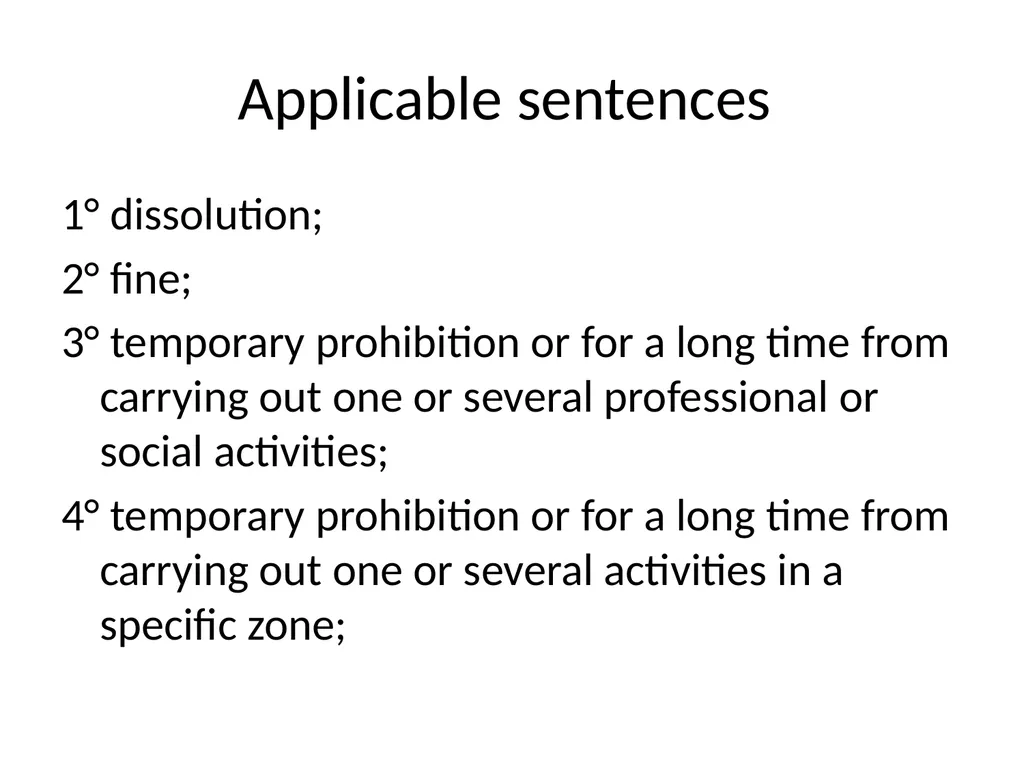
Applicable sentences 1° dissolution;
2° fine;
3° temporary prohibition or for a long time from carrying out one or several professional or social activities;
4° temporary prohibition or for a long time from carrying out one or several activities in a specific zone;<br>
2° fine;
3° temporary prohibition or for a long time from carrying out one or several professional or social activities;
4° temporary prohibition or for a long time from carrying out one or several activities in a specific zone;<br>
109
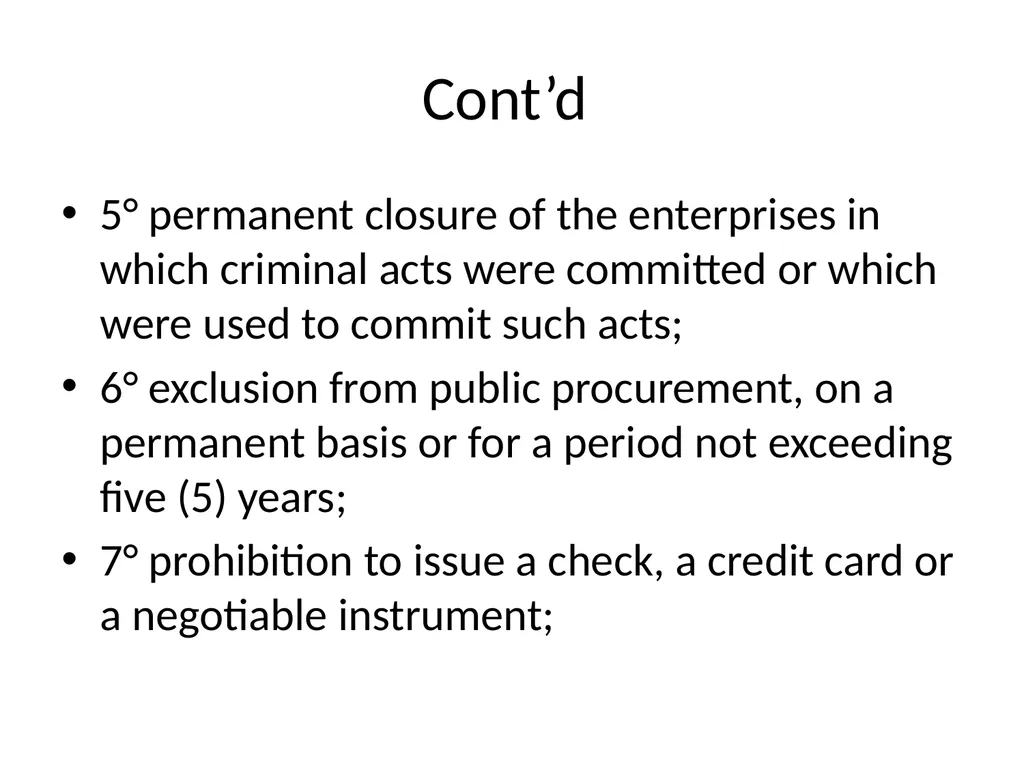
Cont’d 5° permanent closure of the enterprises in which criminal acts were committed or which were used to commit such acts;
6° exclusion from public procurement, on a permanent basis or for a period not exceeding five (5) years;
7° prohibition to issue a check, a credit card or a negotiable instrument;<br>
6° exclusion from public procurement, on a permanent basis or for a period not exceeding five (5) years;
7° prohibition to issue a check, a credit card or a negotiable instrument;<br>
110
Cont’d 8° confiscation of the object which was used in or intended for use in committing the offence or was the product of the offence;
9° placement under judicial supervision;
10° Publication of the decision by any media.<br>
9° placement under judicial supervision;
10° Publication of the decision by any media.<br>
111
2. Criminal liability of representatives or their accomplices Criminal liability of corporate bodies does not exclude criminal proceedings against their representatives or their accomplices
Both the corporate entity and representative can be held responsible.<br>
Both the corporate entity and representative can be held responsible.<br>
112
Chap 6: CRIMINAL PARTICIPATION Categories of persons involved in the commission of an offence
Sentences of involved persons<br>
Sentences of involved persons<br>
113
I. Categories of persons involved in the commission of an offence Offender
Definition: Under art. 98 (1) an offender is a person who commits an offence
This definition should be expanded to include cases where a person commits an offence through another person.
This the case of article 25(1) of German criminal code<br>
Definition: Under art. 98 (1) an offender is a person who commits an offence
This definition should be expanded to include cases where a person commits an offence through another person.
This the case of article 25(1) of German criminal code<br>
114
2. Co-offenders (or Co-perpetrators) a. Definition: a person who directly cooperates in the commission of an offence
This term is normally used to refer to joint commission of the offence
Plurality of offenders
Also known as co-perpetration<br>
This term is normally used to refer to joint commission of the offence
Plurality of offenders
Also known as co-perpetration<br>
115
Cont’d (b). The problem of causation and the doctrine of common purpose
Difficult to find whether that the individual conduct of each member satisfied the requirement of causation.
Ex: murder committed by many offenders
the courts apply the doctrine of common purpose to facilitate the conviction of murder of each separate member of the group<br>
Difficult to find whether that the individual conduct of each member satisfied the requirement of causation.
Ex: murder committed by many offenders
the courts apply the doctrine of common purpose to facilitate the conviction of murder of each separate member of the group<br>
116
3. Accomplices A. Definition
The accomplice is a person whose conduct does not conform to all the requirements in the definition of the crime, but which is nonetheless punishable because she has intentionally furthered the commission of the crime by another<br>
The accomplice is a person whose conduct does not conform to all the requirements in the definition of the crime, but which is nonetheless punishable because she has intentionally furthered the commission of the crime by another<br>
117
B. Forms of complicity 1. Complicity by aiding and abetting
Art 98(1) (3o) defines an accomplice as:
“a person knowingly aids or abets the offender in preparing, facilitating or committing the offence, or a person who incites the offender”.
aiding” refers to any act of assistance before or at the time of the commission of the offence<br>
Art 98(1) (3o) defines an accomplice as:
“a person knowingly aids or abets the offender in preparing, facilitating or committing the offence, or a person who incites the offender”.
aiding” refers to any act of assistance before or at the time of the commission of the offence<br>
118
Cont’d procuring the means to the offender, transporting the offender to the scene of the crime, giving information that facilitates the perpetration of the offence by the offender (e.g: teaching the offender how to use the gun or giving him any other relevant information)
The instructions or information given must have been useful for furthering the commission of the offence<br>
The instructions or information given must have been useful for furthering the commission of the offence<br>
119
Cont’d For abetting, it is usually defined in terms of encouragement
2. Complicity by incitement
Art 98(1) (3o) defines an accomplice as:
“a person knowingly aids or abets the offender in preparing, facilitating or committing the offence, or a person who incites the offender”.<br>
2. Complicity by incitement
Art 98(1) (3o) defines an accomplice as:
“a person knowingly aids or abets the offender in preparing, facilitating or committing the offence, or a person who incites the offender”.<br>
120
Cont’d The problem of considering an instigator as an accomplice is that when the person who was incited did not commit the crime, the instigator cannot be punished because you cannot be an accomplice of a crime which does not exist.
The legislator should remove this form of complicity since it may lead to impunity of the certain criminal acts.<br>
The legislator should remove this form of complicity since it may lead to impunity of the certain criminal acts.<br>
121
Cont’d Example: Lacour case in French Court. The French Court of Cassation held that the conducts of provocation without effects, though they are particularly dangerous, should neither be punished as attempt since they were not beyond of preparation nor as complicity since the main offence was not committed
incitement should be treated as « inchoate offence » punishable independantly of whether the incited offence was subsequently committed or not.<br>
incitement should be treated as « inchoate offence » punishable independantly of whether the incited offence was subsequently committed or not.<br>
122
Cont’d 3. Harbouring the offender
Article 98 para. 2 of the Penal Code provides for another form of complicity where a person who, knowingly, hides an individual who committed an offence is considered as an accomplice
This should not be treated as a form of complicity since a person cannot be an accomplice of a crime when he/she was not aware of the crime prior or at the time of its commission<br>
Article 98 para. 2 of the Penal Code provides for another form of complicity where a person who, knowingly, hides an individual who committed an offence is considered as an accomplice
This should not be treated as a form of complicity since a person cannot be an accomplice of a crime when he/she was not aware of the crime prior or at the time of its commission<br>
123
Cont’d In the philosophy of criminal law, one cannot be an accomplice ex post facto.
The act of “harbouring the offender, co-offender or accomplice” should be treated as separate offence.<br>
The act of “harbouring the offender, co-offender or accomplice” should be treated as separate offence.<br>
124
Cont’d 4. Aiding the offender in concealing the object used or meant to commit the offence
Article 98 para. 2 punishes such acts as complicity
It refers to art. 327 which punishes this offence as a separate offence with specific sentences.
This may even lead to controversial practices before courts since some courts may punish an act as complicity while others punish it as a separate offence<br>
Article 98 para. 2 punishes such acts as complicity
It refers to art. 327 which punishes this offence as a separate offence with specific sentences.
This may even lead to controversial practices before courts since some courts may punish an act as complicity while others punish it as a separate offence<br>
125
Cont’d The act of « aiding the offender in concealing the object used or meant to commit the offence” should not be treated as form of complicity since an assistance given to the offender or accomplices after the commission of the crime should not be treated as a form of complicity.
This contravenes the philosophy of criminal law. This should be treated as a separate offence.<br>
This contravenes the philosophy of criminal law. This should be treated as a separate offence.<br>
126
II. Sentences for offenders, co-offenders and accomplices The offender and the co- offender are punished in the same way.
Art. 99(1) of the Penal Code of Rwanda clearly provides that accomplices are not subject to the same sentence as offenders or co-offenders.
Exception: in cases where the law provides otherwise or the judge in his/her discretion finds that the accomplice’s responsibility is the same as or greater than that of the primary offender<br>
Art. 99(1) of the Penal Code of Rwanda clearly provides that accomplices are not subject to the same sentence as offenders or co-offenders.
Exception: in cases where the law provides otherwise or the judge in his/her discretion finds that the accomplice’s responsibility is the same as or greater than that of the primary offender<br>
127
Cont’d The judge can appreciate case by case taking into account various circumstances of the case.
Accomplice can be prosecuted and punished even though the offender is not personally punishable due to causes such as the death, insanity, minority or failure to identify the offender<br>
Accomplice can be prosecuted and punished even though the offender is not personally punishable due to causes such as the death, insanity, minority or failure to identify the offender<br>
128
III. Joining in: not a form of criminal participation Assume that X, acting either alone or together with others in the execution of a common purpose, has already wounded Y lethally. Thereafter, while Y is still alive, Z who has not previously agreed with X to kill Y inflicts a wound on Y, which however, does not hasten Y’s death. Thereafter Y dies as a result of the wound inflicted by X.<br>
129
Cont’d The person in Z’s position is referred to as a “joiner-in”, because he associates himself with others’ common purpose at a stage when Y’s lethal wound had already been inflicted, although Y was then still alive.
Suppose the absence of a common purpose between Z and X.
Of what crime must he be convicted?
Motaung 1990 (4) SA 485 (A) the South African Court of Appeal: considered it as attempted murder.<br>
Suppose the absence of a common purpose between Z and X.
Of what crime must he be convicted?
Motaung 1990 (4) SA 485 (A) the South African Court of Appeal: considered it as attempted murder.<br>
130
IV. Some other modes of criminal liability from comparative perspective 1. Joint Criminal Enterprise
an agreement among individuals to commit a crime but also requires that the parties to that agreement must take action in furtherance of the agreement
This mode of liability is mainly used before International Criminal Tribunals such as ICTR and ICTY<br>
an agreement among individuals to commit a crime but also requires that the parties to that agreement must take action in furtherance of the agreement
This mode of liability is mainly used before International Criminal Tribunals such as ICTR and ICTY<br>
131
Cont’d 2. Command liability( art. 133 Penal code)
Command responsibility doctrine requires three elements:
the existence of a superior-subordinate relationship of effective control;
the existence of the requisite mens rea, namely that the commander knew or had reason to know of his subordinates’ crimes; and
that the commander failed to take all necessary and reasonable measures to prevent or punish the crime or to submit the matter to the competent authorities for investigation and prosecution<br>
Command responsibility doctrine requires three elements:
the existence of a superior-subordinate relationship of effective control;
the existence of the requisite mens rea, namely that the commander knew or had reason to know of his subordinates’ crimes; and
that the commander failed to take all necessary and reasonable measures to prevent or punish the crime or to submit the matter to the competent authorities for investigation and prosecution<br>
132
Cont’d 3. Indirect perpetration
superiors are liable not as accessories but as principals to crime through the concept of control over the crime<br>
superiors are liable not as accessories but as principals to crime through the concept of control over the crime<br>
133
CHAPTER 7. INCHOATE OFFENCES: ATTEMPT, CONSPIRACY AND INCITEMENT Inchoate offences: a person may be guilty of an offence even though the crime that he wanted to commit was never completed. These
Attempt
Conspiracy
Incitement<br>
Attempt
Conspiracy
Incitement<br>
134
I. Attempt 1. Definition
A person is guilty of attempting to commit a crime if, intending to commit that crime, he engages in conduct that is not merely preparatory but has reached at least the commencement of the execution of the intended crime, and failed in his purpose only because of circumstances beyond his control<br>
A person is guilty of attempting to commit a crime if, intending to commit that crime, he engages in conduct that is not merely preparatory but has reached at least the commencement of the execution of the intended crime, and failed in his purpose only because of circumstances beyond his control<br>
135
Cont’d 2. Constitutive elements of punishable attempt
a. Acts of preparation vs. acts of execution
Conduct must be more than acts of preparation
Commencement of execution
The challenge is to know when does an act cease to be merely preparatory<br>
a. Acts of preparation vs. acts of execution
Conduct must be more than acts of preparation
Commencement of execution
The challenge is to know when does an act cease to be merely preparatory<br>
136
Cont’d Theories explaining this situation:
Embarking upon the crime proper test: Jones case, the Court upheld D’s Conviction of attempted murder where he got into V’s car and pointed a loaded sawn-off shot gun at him, despite an argument by D that he had at least three acts to do: remove the safety catch, his finger on the trigger and pull it<br>
Embarking upon the crime proper test: Jones case, the Court upheld D’s Conviction of attempted murder where he got into V’s car and pointed a loaded sawn-off shot gun at him, despite an argument by D that he had at least three acts to do: remove the safety catch, his finger on the trigger and pull it<br>
137
Cont’d The unequivocal act theory which holds that before a person is convicted of an attempted crime he must have committed an act of such a nature that the only reasonable inference which can be drawn from a consideration of the act is that it was committed with the intention of going on to commit the crime attempted.<br>
138
Cont’d The stage theory: requires that the accused has reached a certain stage in the commission of his intended crime, characterised as the beginning of the commission of the crime<br>
139
Cont’d Rwandan Penal Code seems to have adopted the unequivocal act theory in its article 27 which clearly states that an attempt is punishable when the plan to commit an offence has been demonstrated by observable and unequivocal acts constituting the beginning of the offence meant to enable the commission.<br>
140
Cont’d Eg: Mukantagara case
The fact that Mukantagara paid the money to bring Ndwaniye (the Victim) from Nyaruguru to Kigali, the co-accused has already brought the victim to Kigali and the payment of advance to both Nsanzimana (Co-accused) and Nyirikindi who would kill Ndwaniye, these constitute the acts of preparation and thus the act is qualified as attempted aggravated murder (assassinat). In the view of the court, these acts were beyond mere acts of preparation.<br>
The fact that Mukantagara paid the money to bring Ndwaniye (the Victim) from Nyaruguru to Kigali, the co-accused has already brought the victim to Kigali and the payment of advance to both Nsanzimana (Co-accused) and Nyirikindi who would kill Ndwaniye, these constitute the acts of preparation and thus the act is qualified as attempted aggravated murder (assassinat). In the view of the court, these acts were beyond mere acts of preparation.<br>
141
Cont’d b. Absence of voluntary withdrawal
The execution must have been unsuccessful because of circumstances beyond the control of the offender
Mukantagara case: The Court held that It is due to the circumstances beyond their control since Nyirinkindi abandoned their criminal plan and informed the police which arrested them before killing Ndwaniye.<br>
The execution must have been unsuccessful because of circumstances beyond the control of the offender
Mukantagara case: The Court held that It is due to the circumstances beyond their control since Nyirinkindi abandoned their criminal plan and informed the police which arrested them before killing Ndwaniye.<br>
142
Cont’d c. Felony or misdemeanour
In Rwandan criminal law, attempt to commit a contravention (infringement) is not punishable<br>
In Rwandan criminal law, attempt to commit a contravention (infringement) is not punishable<br>
143
3. Types of attempt a. Completed attempt
In this type of situation X does everything he can to commit the crime, but for some reason the crime is not completed, for example:
Where X fires at Y but misses
b. Interrupted attempt
X’s actions reached the stage beyond mere acts of preparation
They are acts of execution,
they are interrupted, so that the crime cannot be completed.<br>
In this type of situation X does everything he can to commit the crime, but for some reason the crime is not completed, for example:
Where X fires at Y but misses
b. Interrupted attempt
X’s actions reached the stage beyond mere acts of preparation
They are acts of execution,
they are interrupted, so that the crime cannot be completed.<br>
144
Cont’d (c). Attempt to commit the impossible
Factual impossibility: it is impossible for X to commit or complete the crime, either
- the means he uses cannot bring about the desired result. Eg: Shooting with unloaded gun without knowing it
- it is impossible to commit the crime in respect of the particular object of his actions. Eg: shooting an already dead person<br>
Factual impossibility: it is impossible for X to commit or complete the crime, either
- the means he uses cannot bring about the desired result. Eg: Shooting with unloaded gun without knowing it
- it is impossible to commit the crime in respect of the particular object of his actions. Eg: shooting an already dead person<br>
145
Cont’d Legal impossibility:
A “putative crime” is a crime which does not actually exist but which X thinks does exist
Eg: X tries to import computer accessories in Rwanda “without paying taxes while there are exonerated.<br>
A “putative crime” is a crime which does not actually exist but which X thinks does exist
Eg: X tries to import computer accessories in Rwanda “without paying taxes while there are exonerated.<br>
146
II. Incitement Incitement to commit a crime as form of complicity
Incitement to commit a crime as an “inchoate offence”<br>
Incitement to commit a crime as an “inchoate offence”<br>
147
1. Incitement to commit a crime as form of complicity This is provided for in art. 98 (1) (3°) which defines an accomplice as:
“a person knowingly … , or a person who incites the offender”.
See Chap. 8<br>
“a person knowingly … , or a person who incites the offender”.
See Chap. 8<br>
148
2. Incitement to commit a crime as an “inchoate offence” In limited situations, incitement is punishable as inchoate offence, i.e incitement is punishable even if it as not followed by any effect.
See, for example art 132(3) PC which punishes incitement to the crime of genocide, crimes against humanity and war crimes<br>
See, for example art 132(3) PC which punishes incitement to the crime of genocide, crimes against humanity and war crimes<br>
149
Cont’d It states: …………
3° incitement, either by speech, image or writing, to commit such a crime, even when not followed by the commission;
Rwandan courts are currently dealing such a case, i.e Mugesera case
This also punished before international courts and tribunals( see the Hassan Ngeze case before ICTR)<br>
3° incitement, either by speech, image or writing, to commit such a crime, even when not followed by the commission;
Rwandan courts are currently dealing such a case, i.e Mugesera case
This also punished before international courts and tribunals( see the Hassan Ngeze case before ICTR)<br>
150
3. Incitement to commit suicide: not an inchoate offence According to art 147, suicide is not a crime and attempt to commit suicide is also not punishable. However, since a person who incites another person to commit suicide (which is not a crime), is punishable such crime cannot be considered as an “inchoate”.<br>
151
III. Conspiracy 1. Conspiracy to commit a crime as an inchoate offence
2. Conspiracy to commit some crimes
3. Incitement to commit conspiracy<br>
2. Conspiracy to commit some crimes
3. Incitement to commit conspiracy<br>
152
1. Conspiracy to commit a crime as an inchoate offence (=attempt) Definition: Conspiracy is an agreement between two or more persons to engage in the commission of an offence by one or more of them.
It requires :
Agreement to commit an offence must be between two or more persons
The offence must be committed by one or more of them
It is punishable as an attempt to commit such a crime<br>
It requires :
Agreement to commit an offence must be between two or more persons
The offence must be committed by one or more of them
It is punishable as an attempt to commit such a crime<br>
153
2. Conspiracy to commit some crimes The Penal Code also punishes specific conspiracies defined in specific provisions.
Eg:
Conspiracy to Offence against the established Government or the President of the Republic: Art. 462.
Conspiracy to commit terrorism: art. 518<br>
Eg:
Conspiracy to Offence against the established Government or the President of the Republic: Art. 462.
Conspiracy to commit terrorism: art. 518<br>
154
3. Incitement to commit conspiracy Art 462(2) punishes a person who incites others to conspire to commit offence against the established Government or the President of the Republic is punishable as inchoate offence.<br>
155
Study Cases Mr Bihemu wanted to kill Mateso due to land conflicts. Bihemu hired Mr Rumiya (houseboy of Mateso) to help him in that malicious plot. Bihemu gave him 1,000,000 millions rfws and the deadly acidic substances to use. The boss used to take Lunch at 1:00 p.m. The houseboy put those substances into the Lunch food but when Mateso came, he automatically went to bed without taking lunch. He was not feeling good and he only took an orange fruit. The houseboy kindly requested him to come and take lunch but Mateso consistently told him that he does not want to eat. This scenario repeated on dinner tonight but Mateso also refused to eat because of sickness. The following day, the police got the information from a friend of Bihemu that the houseboy of Mateso is involved in plot to kill him. Early in the morning, the police arrested him. Assume you are a judicial police officer, how will you handle this issue? In other words, is this an offence so that you can make a file to submit to the prosecutor? Justify your Answer.<br>
156
Cont’d Mr BIBAZO has been hired by NZIKA in order to kill MAGORWA because of a land conflict opposing them before NGOMA Primary Court. In fulfilling this task Mr BIBAZO contacted the MAGORWA’s houseboy; and they made a deal about poisoning him. The houseboy accepted the deal on the condition that he is paid 50.000 Frws. According to their contract, not only the amount of 35.000 Frws was immediately paid to him and the balance (15.000 Frws) was due upon accomplishment of the deal, but also Mr BIBAZO provided the poison to be used. The houseboy took the money and the poison which he put in his Boss’s food. When Mr MAGORWA was about to eat the poisoned food; because of fear of being the first suspect and probably being punished; the houseboy stopped Mr MAGORWA and explained the whole situation to his boss who decided to inform the Police.
Is there any criminal act to investigate and prosecute? Explain your answer.
Shall all BIBAZO, NZIKA and MAGORWA’s houseboy be punished? Explain your answer<br>
Is there any criminal act to investigate and prosecute? Explain your answer.
Shall all BIBAZO, NZIKA and MAGORWA’s houseboy be punished? Explain your answer<br>
157
Cont’d A 14 years old guy named Bandi wanted to kill Bambe by using a gun but he couldn’t get it. He went to contact his 13 years old friend Kihebe for advice and the latter gave him a gun. Bandi took the gun and passed by his friend Bigango (15 years old guy) and they went together for ambush. When Bambe passed by the ambush, Bandi directly shot him but fortunately, he did not make the right target and Bambe escaped from the ambush. The prosecutor took the case of murder against these three suspects and he asked for life imprisonment for each of them.
Assume you are a judge how are you going to handle this case?<br>
Assume you are a judge how are you going to handle this case?<br>
158
Chapter 8. Sentencing Purpose of punishment
Sentences
Factors for determination of sentence<br>
Sentences
Factors for determination of sentence<br>
159
8.1. Purpose of the punishment Retribution: It refers to the restoration of the legal balance disturbed by the perpetration of the offence.
This implies that the penalty must be proportionate to the seriousness of the offence and the guilt of the offender (see ICTY, Prosecutor v. Krajinisk, Appeal Judgment, para 775)
Proportionality is very important in criminal law<br>
This implies that the penalty must be proportionate to the seriousness of the offence and the guilt of the offender (see ICTY, Prosecutor v. Krajinisk, Appeal Judgment, para 775)
Proportionality is very important in criminal law<br>
160
Cont’d Deterrence: means that the sentence should be adequate in order to discourage a specific offender to commit the same offence again.
The punishment also plays a deterrent purpose towards the persons other than the offender.
The Deterrence and retribution refer to proportionality between the offence and the penalty imposed.
If the sentence is too lenient, it might not deter the offender.<br>
The punishment also plays a deterrent purpose towards the persons other than the offender.
The Deterrence and retribution refer to proportionality between the offence and the penalty imposed.
If the sentence is too lenient, it might not deter the offender.<br>
161
Cont’d However in tailoring the sentence, the court should not give too much weight to deterrence or retribution because this could result in a disproportionately severe penalty.
Judges should consider other personal circumstances of the accused in order to rehabilitate him<br>
Judges should consider other personal circumstances of the accused in order to rehabilitate him<br>
162
Cont’d Prevention: individual and general affirmative prevention aimed at influencing the legal awareness of the accused, the victims, their relatives, the witnesses, and the general public in order to reassure them that the legal system is being implemented and enforced;<br>
163
Cont’d Rehabilitation: Rehabilitation serves the purpose of reintegrating the offender into society.
This should neither play a predominant role since it can lead to a lenient sentence as well.<br>
This should neither play a predominant role since it can lead to a lenient sentence as well.<br>
164
Cont’d Conclusion:
The sentencing judge must try to find a balance between delivering retribution for the community; deterring other would-be criminals from breaking the law; rehabilitating the offender to prevent re-offending and protecting the community from the harms of anti-social, criminal behaviour.<br>
The sentencing judge must try to find a balance between delivering retribution for the community; deterring other would-be criminals from breaking the law; rehabilitating the offender to prevent re-offending and protecting the community from the harms of anti-social, criminal behaviour.<br>
165
8.2.Sentences 8.2.1. Types of sentences
Main sentences: Main sentences are those sentences, which may exist by their own without being accompanied by other sentences
Additional sentences or Accessory sentences: whose existence depends necessarily on the existence of a main sentence<br>
Main sentences: Main sentences are those sentences, which may exist by their own without being accompanied by other sentences
Additional sentences or Accessory sentences: whose existence depends necessarily on the existence of a main sentence<br>
166
Cont’d Complementary sentences attached to main convictions without being pronounced by the judge. Example: the loss of civil rights attached automatically (by the law) to life imprisonment<br>
167
8.2.1.1. Main sentences a. Imprisonment
Life Imprisonment with special provisions: for atrocious crimes such as crime of genocide. A convicted person is not entitled to any kind of mercy, conditional release or the rehabilitation unless he/she has served at least twenty (20) years of imprisonment.
Life imprisonment
Fixed term imprisonment: 1 day- 25 years, except some cases specified by the law (eg: the case of recidivism)<br>
Life Imprisonment with special provisions: for atrocious crimes such as crime of genocide. A convicted person is not entitled to any kind of mercy, conditional release or the rehabilitation unless he/she has served at least twenty (20) years of imprisonment.
Life imprisonment
Fixed term imprisonment: 1 day- 25 years, except some cases specified by the law (eg: the case of recidivism)<br>
168
Cont’d b. The sentence of fine
The sentence of a fine consists of a payment of an amount of money that goes into a state treasury
May be Exclusive, optional or cumulative
The sentence of fines is different from damages and court fees.
It is imposed individually for each convict<br>
The sentence of a fine consists of a payment of an amount of money that goes into a state treasury
May be Exclusive, optional or cumulative
The sentence of fines is different from damages and court fees.
It is imposed individually for each convict<br>
169
Cont’d c. Community service
It consists of executing public interest works.
Applicable to misdemeanor and petty offences only
For misdemeanor, only ½ is served as community service
For petty offence there is possibility of converting the whole imprisonment period into community service<br>
It consists of executing public interest works.
Applicable to misdemeanor and petty offences only
For misdemeanor, only ½ is served as community service
For petty offence there is possibility of converting the whole imprisonment period into community service<br>
170
8.2.1.2. Additional sentences The special confiscation
The things or goods that constitute the body of the offence or which served to commit it or were produced by the offence may be confiscated.
Only for felonies and misdemeanors
The property subject to confiscation must belong to the convicted person.<br>
The things or goods that constitute the body of the offence or which served to commit it or were produced by the offence may be confiscated.
Only for felonies and misdemeanors
The property subject to confiscation must belong to the convicted person.<br>
171
Cont’d b. Ban on entry into a place and restriction of movement
The ban on entry: prohibiting a convicted person from being in certain defined places
restriction of movement: ordering a convicted person to reside in a certain place<br>
The ban on entry: prohibiting a convicted person from being in certain defined places
restriction of movement: ordering a convicted person to reside in a certain place<br>
172
Cont’d Conditions:
Imprisonment of more than 1 year
2 consecutive imprisonment sentences of at least 6 months within 5 years
Duration: 6 months to 5 years<br>
Imprisonment of more than 1 year
2 consecutive imprisonment sentences of at least 6 months within 5 years
Duration: 6 months to 5 years<br>
173
Cont’d c. Placement under government custody
can be pronounced against any recidivist who, within a period of five years (not counting the sentences of imprisonment suffered), has incurred three convictions of at least six months of imprisonment each.
Duration: 5- 10 years.<br>
can be pronounced against any recidivist who, within a period of five years (not counting the sentences of imprisonment suffered), has incurred three convictions of at least six months of imprisonment each.
Duration: 5- 10 years.<br>
174
Cont’d d. The loss of civic rights
A person shall not lose all the civic right except in case of a penalty of life imprisonment.
Duration of the loss of civil rights cannot exceed 20 years.<br>
A person shall not lose all the civic right except in case of a penalty of life imprisonment.
Duration of the loss of civil rights cannot exceed 20 years.<br>
175
8.3. Factors taken into account in the determination of the sentence Mitigating Factors
Aggravating circumstances
Recidivism
Concurrence of offences<br>
Aggravating circumstances
Recidivism
Concurrence of offences<br>
176
8.3.1. Mitigating factors Mitigating excuses:
a. Minority: from 14 – below 18 years .
See art. 72 for modalities for mitigating the sentences<br>
a. Minority: from 14 – below 18 years .
See art. 72 for modalities for mitigating the sentences<br>
177
Cont’d b. Provocation:
Elements:
The Penal code leaves it to the discretion of the judge
In Ndayisaba Disvald Case: The supreme Court held that it is considered as provocation in case where two persons were fighting each other( Assume X Fights against Y) and one of the two( assume Y) gave up the fight and went back home. X followed him at his home and when he arrives there he started gravely beating his home mates while they were not involved in previous fighting.<br>
Elements:
The Penal code leaves it to the discretion of the judge
In Ndayisaba Disvald Case: The supreme Court held that it is considered as provocation in case where two persons were fighting each other( Assume X Fights against Y) and one of the two( assume Y) gave up the fight and went back home. X followed him at his home and when he arrives there he started gravely beating his home mates while they were not involved in previous fighting.<br>
178
Cont’d Provocation must be immediate: Mbanzamihigo case: the act of provocation that occurred in the past can be qualified as revenge.
See article 75 for mitigation of the sentence<br>
See article 75 for mitigation of the sentence<br>
179
Cont’d ii. Mitigating circumstances
mitigating circumstances are left to the discretion of the judge
Are prior, during or after the commission of the crime
Are not binding upon the judge<br>
mitigating circumstances are left to the discretion of the judge
Are prior, during or after the commission of the crime
Are not binding upon the judge<br>
180
Cont’d Some mitigating circumstances provided by article 77 of the penal code:
1° Guilty plea before commencement of prosecution
2° the accused reports him/herself to a competent Court before or during the pre-trial proceedings: MPITABAKANA case<br>
1° Guilty plea before commencement of prosecution
2° the accused reports him/herself to a competent Court before or during the pre-trial proceedings: MPITABAKANA case<br>
181
Cont’d 3° Guilty plea at the outset of the trial
Note: Guilty plea at later stage of proceedings can also be a mitigating circumstance. See Prosecutor V.NYIRANGONDO Virginie case
4° the offence has minor consequences: see Mukantagara case<br>
Note: Guilty plea at later stage of proceedings can also be a mitigating circumstance. See Prosecutor V.NYIRANGONDO Virginie case
4° the offence has minor consequences: see Mukantagara case<br>
182
cont’d NB:
Unlike the mitigating excuses, the mitigating circumstances are not binding upon the judge ( see Nyirangondo case before supreme court)
It is important to note that this list is not exhaustive but indicative
There are several other circumstances which are left to the appreciation of the judges:
a state of intoxication,
mental stress or partial insanity.<br>
Unlike the mitigating excuses, the mitigating circumstances are not binding upon the judge ( see Nyirangondo case before supreme court)
It is important to note that this list is not exhaustive but indicative
There are several other circumstances which are left to the appreciation of the judges:
a state of intoxication,
mental stress or partial insanity.<br>
183
Cont’d Good character;
Age;
Comportment in detention;
Family circumstances;
Exceptionally poor health.
Indirect and limited participation
Absence of previous conviction, etc<br>
Age;
Comportment in detention;
Family circumstances;
Exceptionally poor health.
Indirect and limited participation
Absence of previous conviction, etc<br>
184
Cont’d Note: the mitigating circumstances are not binding upon the judge.
In Nyirangondo case, the Court noted that the judge is not bound to mitigate the sentence even if there is sincere guilty plea. The judge may not mitigate if he/she finds that there are grounds indicating that mitigation is not adequate.<br>
In Nyirangondo case, the Court noted that the judge is not bound to mitigate the sentence even if there is sincere guilty plea. The judge may not mitigate if he/she finds that there are grounds indicating that mitigation is not adequate.<br>
185
Cont’d In this case, the Court refused to mitigate the sentence despite the guilty plea of the accused. The Court held that the accused does not deserve mitigation (though her guilty plea was accepted as sincere) due to the grave malicious intent of the accused in the commission of the crime.
Another point: The superior court can reduce despite the fact that the lower already reduced the sentence(Tuyisenge case)<br>
Another point: The superior court can reduce despite the fact that the lower already reduced the sentence(Tuyisenge case)<br>
186
Cont’d Modalities for reduction of sentences (see article 78)
It is important to note that the modalities for reduction of sentences as provided by Rwandan Code of Criminal Procedure differ from the ones stated in the penal code. Article 35 of the Code of Criminal procedure provides that: “when the accused candidly pleads guilty to the offence, …… the judge seized of the case may reduce the penalties down to the half (½) of applicable penalties. In case the accused would be sentenced to life imprisonment, the penalty may be reduced to twenty (20) years of imprisonment .
Organic Law prevails over ordinary law<br>
It is important to note that the modalities for reduction of sentences as provided by Rwandan Code of Criminal Procedure differ from the ones stated in the penal code. Article 35 of the Code of Criminal procedure provides that: “when the accused candidly pleads guilty to the offence, …… the judge seized of the case may reduce the penalties down to the half (½) of applicable penalties. In case the accused would be sentenced to life imprisonment, the penalty may be reduced to twenty (20) years of imprisonment .
Organic Law prevails over ordinary law<br>
187
Cont’d Challenge of sentencing in case of mitigating factors
Wide range of sentences
discretionary power of the judge
Risks to affect the fundamental right of equal treatment of offenders within similar conditions
Certain factor can be considered as mitigating by a certain court while it is rejected by another court in similar case
The sentence may be reduced differently for the offenders in the same conditions<br>
Wide range of sentences
discretionary power of the judge
Risks to affect the fundamental right of equal treatment of offenders within similar conditions
Certain factor can be considered as mitigating by a certain court while it is rejected by another court in similar case
The sentence may be reduced differently for the offenders in the same conditions<br>
188
8.3.2. Aggravating circumstances Those circumstances expressly determined by the law which, attached to the offence (objective aggravating circumstances)
Or to the offender (subjective aggravating circumstances)
Binding upon the judge<br>
Or to the offender (subjective aggravating circumstances)
Binding upon the judge<br>
189
Cont’d Unlike mitigating circumstances, the prosecutor must prove aggravating circumstances beyond reasonable doubt (Čelebidi, A J para 763; Kajelijeli, A J para 294)<br>
190
Cont’d Other aggravating circumstances which may not be provided by the penal code
The scale of the crimes;
The length of time during which the crime continued;
The age of victim(s);
The number of victims;
The suffering of the victims;
The nature of the perpetrator’s involvement;
Cruelty of criminal act
Discriminatory intent;<br>
The scale of the crimes;
The length of time during which the crime continued;
The age of victim(s);
The number of victims;
The suffering of the victims;
The nature of the perpetrator’s involvement;
Cruelty of criminal act
Discriminatory intent;<br>
191
Cont’d Abuse of power by the perpetrator; and
The perpetrator’s position as a superior,
the sexual, violent, and humiliating nature of the acts and the vulnerability of the victims
the motive of the offence such as committing murder in order to silence an embarrassing witness, etc
the effect of the crimes on the victims, etc
Can they be used by the rwandan judge?<br>
The perpetrator’s position as a superior,
the sexual, violent, and humiliating nature of the acts and the vulnerability of the victims
the motive of the offence such as committing murder in order to silence an embarrassing witness, etc
the effect of the crimes on the victims, etc
Can they be used by the rwandan judge?<br>
192
8.3.3. RECIDIVISM Conditions:
Previous conviction of at least 6 months
The commission of another felony or misdemeanor within a period of five years
No recidivism in case of amnesty or rehabilitation.
Punishment: the maximum sentence provided for the crime shall be pronounced, and may even be raised to the double.<br>
Previous conviction of at least 6 months
The commission of another felony or misdemeanor within a period of five years
No recidivism in case of amnesty or rehabilitation.
Punishment: the maximum sentence provided for the crime shall be pronounced, and may even be raised to the double.<br>
193
8.3.4. Combination of aggravating, excusable, recidivism and mitigating circumstances This order must be followed:
aggravating
excusable
recidivism
Mitigating circumstances<br>
aggravating
excusable
recidivism
Mitigating circumstances<br>
194
Cont’d Habukubaho case:
aggravating circumstance: aggravated murder against a 7 year old girl after rape: Life imprisonment
Excuse: minority: sentence reduced to 10 years
Mitigating circumstances: Guilty plea. Sentence reduced to 7 years.<br>
aggravating circumstance: aggravated murder against a 7 year old girl after rape: Life imprisonment
Excuse: minority: sentence reduced to 10 years
Mitigating circumstances: Guilty plea. Sentence reduced to 7 years.<br>
195
8.3.5. Concurrence of offences Ideal concurrence:
Real Concurrence
a. Ideal concurrence
Single acts with several qualifications
Eg: rape committed on a public road can be described as rape (art. 196 PC) and as a public contempt of good morals (art.185 PC)<br>
Real Concurrence
a. Ideal concurrence
Single acts with several qualifications
Eg: rape committed on a public road can be described as rape (art. 196 PC) and as a public contempt of good morals (art.185 PC)<br>
196
Cont’d Several distinct acts united by single criminal intent or some are aggravating circumstances of others
Eg: Killing a guard (murder) in order to rob a supermarket (robbery).
Breaking a window (malicious damage to property) in order to steal a TV (theft). Breaking a window is an aggravating factor for theft<br>
Eg: Killing a guard (murder) in order to rob a supermarket (robbery).
Breaking a window (malicious damage to property) in order to steal a TV (theft). Breaking a window is an aggravating factor for theft<br>
197
Cont’d b. Real concurrence of offences
Acts which are materially distinct, followed one after another constituting separate infractions
Committed by one Person<br>
Acts which are materially distinct, followed one after another constituting separate infractions
Committed by one Person<br>
198
Cont’d Sentences for concurrent offences
The judge shall apply the most severe penalty and increase its duration or the amount depending on the circumstances of the offences, but not exceeding half (1/2) in addition to the maximum of the most severe penalty<br>
The judge shall apply the most severe penalty and increase its duration or the amount depending on the circumstances of the offences, but not exceeding half (1/2) in addition to the maximum of the most severe penalty<br>
199
Possible challenges and Suggestions Challenges
The wide range of sentences
Wide discretion of the judges
Inconsistency in assessing the factors for determination of sentences
Inconsistency in determining the sentence basing on existing sentence range
Risk of inequality in treatment of the offenders in similar conditions. ( eg: pronouncing severe sentence for A and lighter sentence for B while they committed
The problem of proportionality of sentences<br>
The wide range of sentences
Wide discretion of the judges
Inconsistency in assessing the factors for determination of sentences
Inconsistency in determining the sentence basing on existing sentence range
Risk of inequality in treatment of the offenders in similar conditions. ( eg: pronouncing severe sentence for A and lighter sentence for B while they committed
The problem of proportionality of sentences<br>
200
Cont’d Some sentences may not be proportional: either lenient or severe.
In Courts practice, the judge may also disregard this proportionality requirement by imposing severe sentence while lighter sentence would achieve the purpose of sentencing<br>
In Courts practice, the judge may also disregard this proportionality requirement by imposing severe sentence while lighter sentence would achieve the purpose of sentencing<br>
201
Suggestions Considering personal factors( especially mitigating circumstances where possible)
Encouraging the use of the less restrictive means to achieve the purpose. If Deterrence can be achieved by imposing a fine, community service or probably a short term imprisonment, it would be good to use them than severe sentence.
Adoption and application of the alternative penalties to imprisonment (if the purpose of sentence can be achieved)
Guidelines from the Supreme Court to ensure consistent and harmonized sentences
Harmonisation of court practices by Supreme Court Precedents ( when the court has an opportunity)<br>
Encouraging the use of the less restrictive means to achieve the purpose. If Deterrence can be achieved by imposing a fine, community service or probably a short term imprisonment, it would be good to use them than severe sentence.
Adoption and application of the alternative penalties to imprisonment (if the purpose of sentence can be achieved)
Guidelines from the Supreme Court to ensure consistent and harmonized sentences
Harmonisation of court practices by Supreme Court Precedents ( when the court has an opportunity)<br>
202
Possible challenges and Suggestions Challenges
The wide range of sentences
Wide discretion of the judges
Inconsistency in assessing the factors for determination of sentences
Inconsistency in determining the sentence basing on existing sentence range
Risk of inequality in treatment of the offenders in similar conditions. ( eg: pronouncing severe sentence for A and lighter sentence for B while they committed
The problem of proportionality of sentences<br>
The wide range of sentences
Wide discretion of the judges
Inconsistency in assessing the factors for determination of sentences
Inconsistency in determining the sentence basing on existing sentence range
Risk of inequality in treatment of the offenders in similar conditions. ( eg: pronouncing severe sentence for A and lighter sentence for B while they committed
The problem of proportionality of sentences<br>
203
Cont’d Some sentences may not be proportional: either lenient or severe.
In Courts practice, the judge may also disregard this proportionality requirement by imposing severe sentence while lighter sentence would achieve the purpose of sentencing<br>
In Courts practice, the judge may also disregard this proportionality requirement by imposing severe sentence while lighter sentence would achieve the purpose of sentencing<br>
204
Suggestions Considering personal factors( especially mitigating circumstances where possible)
Encouraging the use of the less restrictive means to achieve the purpose. If Deterrence can be achieved by imposing a fine, community service or probably a short term imprisonment, it would be good to use them than severe sentence.
Adoption and application of the alternative penalties to imprisonment (if the purpose of sentence can be achieved)
Guidelines from the Supreme Court to ensure consistent and harmonized sentences
Harmonisation of court practices by Supreme Court Precedents ( when the court has an opportunity)<br>
Encouraging the use of the less restrictive means to achieve the purpose. If Deterrence can be achieved by imposing a fine, community service or probably a short term imprisonment, it would be good to use them than severe sentence.
Adoption and application of the alternative penalties to imprisonment (if the purpose of sentence can be achieved)
Guidelines from the Supreme Court to ensure consistent and harmonized sentences
Harmonisation of court practices by Supreme Court Precedents ( when the court has an opportunity)<br>
205
CHAPTER 9. CAUSES OF SUSPENSION AND EXTINCTION OF SENTENCES I. GROUNDS FOR SUSPENSION OF SENTENCES<br>
206
a. Suspended sentences Definition : This allows the judge, when all the conditions provided for by the law are met, to grant a stay of execution by a motivated decision, of all or part of main or accessory sentences pronounced against an offender whose guilt is established.
Conditions
imprisonment not exceeding five (5) years
No previous conviction to imprisonment or to community service as an alternative penalty to imprisonment of more than six (6) months as a result of a final judgment.
Must be motivated ( or justified)
The suspension period is between 1 year and 5 years<br>
Conditions
imprisonment not exceeding five (5) years
No previous conviction to imprisonment or to community service as an alternative penalty to imprisonment of more than six (6) months as a result of a final judgment.
Must be motivated ( or justified)
The suspension period is between 1 year and 5 years<br>
207
Cont’d Effects of suspended sentences
The execution of a sentence is suspended
The conviction is included in the criminal record
In case of no conviction for felony or misdemeanor during suspension period, the suspension of sentence becomes final.
Otherwise, suspended penalty and subsequently imposed one are combined and executed at the same time.
The suspension not entail exemption from payment of the legal, damages and from the loss of civic rights as a result of the sentence.
The loss of civic rights shall cease to have effect on the date the penalty is considered to be void.<br>
The execution of a sentence is suspended
The conviction is included in the criminal record
In case of no conviction for felony or misdemeanor during suspension period, the suspension of sentence becomes final.
Otherwise, suspended penalty and subsequently imposed one are combined and executed at the same time.
The suspension not entail exemption from payment of the legal, damages and from the loss of civic rights as a result of the sentence.
The loss of civic rights shall cease to have effect on the date the penalty is considered to be void.<br>
208
Cont’d b. Release on parole
Conditions:
if he/she sufficiently demonstrates good behaviour and gives serious pledges of social rehabilitation;
if he/she suffers from serious and incurable disease approved by a medical committee composed of at least three (3) recognized doctors;
if he/she has already served his/her penalty for the period of time provided by the law as indicated in next slide.<br>
Conditions:
if he/she sufficiently demonstrates good behaviour and gives serious pledges of social rehabilitation;
if he/she suffers from serious and incurable disease approved by a medical committee composed of at least three (3) recognized doctors;
if he/she has already served his/her penalty for the period of time provided by the law as indicated in next slide.<br>
209
Cont’d 1° if he/she was sentenced to a term of imprisonment not exceeding five (5) years and has served at least one third (1/3) of the penalty;
2° if he/she was sentenced to a term of imprisonment more than five (5) years and has served at least two-thirds (2/3) of the penalty;
3° if he/she was sentenced to life imprisonment or life imprisonment with special provisions, he/she may be granted release on parole only after serving at least twenty (20) years<br>
2° if he/she was sentenced to a term of imprisonment more than five (5) years and has served at least two-thirds (2/3) of the penalty;
3° if he/she was sentenced to life imprisonment or life imprisonment with special provisions, he/she may be granted release on parole only after serving at least twenty (20) years<br>
210
Cont’d Procedure
Conditional release is requested from the Minister having justice in his or her attributions. Conditional release is approved by the Minister having Justice in his or her attributions after advice by the public prosecution and the director of the prison<br>
Conditional release is requested from the Minister having justice in his or her attributions. Conditional release is approved by the Minister having Justice in his or her attributions after advice by the public prosecution and the director of the prison<br>
211
Cont’d Revocation of conditional release
- The Minister in charge of justice upon request by the Public Prosecution may withdraw the order granting conditional release to a person if he or she is convicted of a new offence, displays gross misconduct or for breaching conditions imposed by the order which gave the conditional release
- After revocation of the conditional release, the convicted person shall serve the whole or part of the punishment that remained when he or she was conditionally released, in addition to any other punishment that may have been imposed thereafter.<br>
- The Minister in charge of justice upon request by the Public Prosecution may withdraw the order granting conditional release to a person if he or she is convicted of a new offence, displays gross misconduct or for breaching conditions imposed by the order which gave the conditional release
- After revocation of the conditional release, the convicted person shall serve the whole or part of the punishment that remained when he or she was conditionally released, in addition to any other punishment that may have been imposed thereafter.<br>
212
Cont’d c. Pardon ( see art. 227 of criminal procedure)
Meaning
The prerogative of mercy, whether collectively or individually can be exercised by the discretion of the President of the Republic and in public interest. The pardon discredits total or partial remission of the punishments imposed or its commutation into less severe punishments
Individual or collective
Conditional or unconditional
No effects to accessory sentences and conviction
Exemption from the execution of whole or part of sentence
It may also consist of commuting the severe sentence into lesser sentence
Can be exercised on whole or part of sentence<br>
Meaning
The prerogative of mercy, whether collectively or individually can be exercised by the discretion of the President of the Republic and in public interest. The pardon discredits total or partial remission of the punishments imposed or its commutation into less severe punishments
Individual or collective
Conditional or unconditional
No effects to accessory sentences and conviction
Exemption from the execution of whole or part of sentence
It may also consist of commuting the severe sentence into lesser sentence
Can be exercised on whole or part of sentence<br>
213
Cont’d Pardon shall not extinguish accessory punishments which have not been specified in the decision granting it
When the convict was sentenced to the punishment of life imprisonment with special provisions, he cannot be granted presidential pardon unless he has spent at least 20 years in prison
Procedure
For individual pardon, petition is made by a convicted person, or any other interested person in his or her name. The petitioner indicates grounds that justify the petition.<br>
When the convict was sentenced to the punishment of life imprisonment with special provisions, he cannot be granted presidential pardon unless he has spent at least 20 years in prison
Procedure
For individual pardon, petition is made by a convicted person, or any other interested person in his or her name. The petitioner indicates grounds that justify the petition.<br>
214
Cont’d For collective pardon, petition is made by the Minister having Justice in his or her attributions after indicating grounds justifying the petition.
In any case, the Public Prosecution is entitled to give an opinion on the petition or proposal for granting pardon within a period of three (3) months.<br>
In any case, the Public Prosecution is entitled to give an opinion on the petition or proposal for granting pardon within a period of three (3) months.<br>
215
Cont’d After investigation, files of petitions for pardon are sent to the Minister responsible for justice who after giving an opinion thereof, makes a report to the President of the Republic within three (3) months for decision after considering the opinion of the Supreme Court.<br>
216
II.GROUNDS FOR EXTINCTION OF A SENTENCE 1. Death of the offender
Sentence is extinguished by death of offender
Criminal liability is personal
Civil damages are not extinguished
2. Execution of the sentence<br>
Sentence is extinguished by death of offender
Criminal liability is personal
Civil damages are not extinguished
2. Execution of the sentence<br>
217
Cont’d 3. Prescription of sentences
A sentence is not executed within a given period, it becomes prescribed and cannot be executed anymore.
Additional penalties shall be prescribed after the same period of time as the principal penalties.<br>
A sentence is not executed within a given period, it becomes prescribed and cannot be executed anymore.
Additional penalties shall be prescribed after the same period of time as the principal penalties.<br>
218
Cont’d 4. Amnesty
Amnesty extinguishes an offence. When there has been conviction, it removes the conviction and all the consequences arising from the conviction.
The sentence is extinguished in the sense that a sentenced person who was in prison is immediately released.
Amnesty does not extinguish civil and disciplinary action.<br>
Amnesty extinguishes an offence. When there has been conviction, it removes the conviction and all the consequences arising from the conviction.
The sentence is extinguished in the sense that a sentenced person who was in prison is immediately released.
Amnesty does not extinguish civil and disciplinary action.<br>
219
Cont’d In case of ideal concomitance of crimes, a convicted person gets amnesty on all of them when the offence pardoned is punishable with a punishment that is bigger than or equal to the other offences charged, even if judges may have imposed a lesser penalty on the offence after putting into consideration mitigating circumstances. In case of material concomitance of offences, amnesty applies only to the offence it concerns<br>
220
Cont’d Abrogation of criminal law?
Discuss?<br>
Discuss?<br>
221
CHAPTER 10 . CAUSES OF EXTINCTION OF CONVICTION 1. Rehabilitation
2. Amnesty
3. Abrogation of criminal law ?<br>
2. Amnesty
3. Abrogation of criminal law ?<br>
222
1. Rehabilitation Rehabilitation
The conditions of rehabilitation are the following:
the sentence must have been executed, it must have been subject to remission or prescribed;
a period of 5 years must have expired since the definitive conviction for a fine and the day of the extinction or from the day of the conditional release in case of the sentence of imprisonment. For recidivists or those whose sentences are prescribed, that period is of 10 years .
during the period, the convicted person must have constantly given the proof of a good behavior .<br>
The conditions of rehabilitation are the following:
the sentence must have been executed, it must have been subject to remission or prescribed;
a period of 5 years must have expired since the definitive conviction for a fine and the day of the extinction or from the day of the conditional release in case of the sentence of imprisonment. For recidivists or those whose sentences are prescribed, that period is of 10 years .
during the period, the convicted person must have constantly given the proof of a good behavior .<br>
223
Cont’d Procedure
- A convicted person shall apply for rehabilitation in writing to the High Court or the Military High Court for cases tried by military courts
The High Court or the Military High Court makes a ruling on the arguments of the public prosecution within a period of two (2) months after hearing or summoning the applicant or his or her counsel in accordance with the law
When the application for rehabilitation is rejected, it cannot be re-submitted before the expiration of two years
Effects
The rehabilitation erases the conviction and terminates the effects of any incapacity, for the future, which resulted from the conviction<br>
- A convicted person shall apply for rehabilitation in writing to the High Court or the Military High Court for cases tried by military courts
The High Court or the Military High Court makes a ruling on the arguments of the public prosecution within a period of two (2) months after hearing or summoning the applicant or his or her counsel in accordance with the law
When the application for rehabilitation is rejected, it cannot be re-submitted before the expiration of two years
Effects
The rehabilitation erases the conviction and terminates the effects of any incapacity, for the future, which resulted from the conviction<br>
224
Cont’d Revocation
Rehabilitation is automatically cancelled if, within a period of five (5) years, the rehabilitated convict commits an offence punishable by an imprisonment equal to or exceeding five (5) years and for which he or she has been convicted and sentenced<br>
Rehabilitation is automatically cancelled if, within a period of five (5) years, the rehabilitated convict commits an offence punishable by an imprisonment equal to or exceeding five (5) years and for which he or she has been convicted and sentenced<br>
225
2. Amnesty amnesty extinguishes an offence.
When there has been conviction, it removes the conviction and all the consequences arising from the conviction<br>
When there has been conviction, it removes the conviction and all the consequences arising from the conviction<br>
226
Chapter 11. Prescription 1. Prescription of criminal action
Ten (10) years for felonies;
Three (3) years for misdemeanours;
One (1) year for petty offence
The crime of genocide, crimes against humanity and war crimes which are not subject to prescription
The date when the prescription start depends on the type of offence, i.e instataneous, continued, continuous, etc<br>
Ten (10) years for felonies;
Three (3) years for misdemeanours;
One (1) year for petty offence
The crime of genocide, crimes against humanity and war crimes which are not subject to prescription
The date when the prescription start depends on the type of offence, i.e instataneous, continued, continuous, etc<br>
227
Cont’d 2. Interruption and suspension of prescription of criminal action
Interruption
Interrupted by acts of investigation or prosecution measures, if they are carried out within the time prescribed by the CCP
The prescription starts to run again from the day of the last act<br>
Interruption
Interrupted by acts of investigation or prosecution measures, if they are carried out within the time prescribed by the CCP
The prescription starts to run again from the day of the last act<br>
228
Cont’d Suspension
Suspended whenever the exercise of the action is hindered by an inevitable obstacle resulting from the law or force majeure
When such an obstacle is removed, the prescription time suspended from the day of the occurrence of the obstacle to its removal continues to run
For prescription of sentence, it has already been discussed<br>
Suspended whenever the exercise of the action is hindered by an inevitable obstacle resulting from the law or force majeure
When such an obstacle is removed, the prescription time suspended from the day of the occurrence of the obstacle to its removal continues to run
For prescription of sentence, it has already been discussed<br>
229
Question 1. Mr Sarigoma was born on 1st January 1997 and he currently has two children. On 1st January 2012, he committed the offence of aggravated assault and battery and was sentenced to 6 months of imprisonment. On 30 December 2014, she defiled two child of 6 years at the same time, an offence punishable by life imprisonment with special provisions. He denied his participation to this crime from the police until the final decision of the judge in the High Court of the Republic. The high Court sentenced him to life imprisonment. During the trial on appeal level before the Supreme Court, he pleaded guilty and his lawyers requests for a suspended sentence of two years. Assume you are a justice at the Supreme Court, Determine the sentence in this case and motivate your decision. Should you reject the Lawyer’s request, you also need to justify your decision.<br>