
General Data Protection Regulation Alan Chandler,
SN
Published · 72 slides · 0 views
1 / 1










Description
General Data Protection Regulation Alan Chandler, Chartered Insurer on linkedin mail alanchandleruwclub.net I have trained more than 2,000 individuals to become ACII qualified I have trained over 50 of the individuals in the last 8 years
Related Topics
Share
Embed code
Download this presentation From Below
"General Data Protection Regulation Alan Chandler," is the property of its rightful owner. Permission is granted to download and print the materials on this website for personal, non-commercial use only, and to display it on your personal computer provided you do not modify the materials and that you retain all copyright notices contained in the materials. By downloading content from our website, you accept the terms of this agreement.
Presentation Transcript
01
General Data Protection Regulation<br>
02
Alan Chandler, Chartered Insurer on linkedin mail alanchandler@uwclub.net I have trained more than 2,000 individuals to become ACII qualified
I have trained over 50% of the individuals in the last 8 years that have gone onto achieve the highest ACII pass in the whole of the UK.
I train to a pass rate of more than 96% in all CII qualification levels. Certificate , Diploma and Advanced Diploma.
I deliver the Allianz scholarship and academy programmes in both the UK and Ireland and I have been a Cii examiner.
I have trained students who have won national prizes in almost all ACII subjects including Insurance Law (MO5), Liability (M96), Commercial Property and BI (M93), Personal Lines Insurance (P86), Business and Finance (M92), Underwriting Practice (M80), Advanced Underwriting (960), Claims Practice (M85), Advanced Claims (820), Marketing (945), Advanced Broking (930) and Advanced Risk Management (992).<br>
I have trained over 50% of the individuals in the last 8 years that have gone onto achieve the highest ACII pass in the whole of the UK.
I train to a pass rate of more than 96% in all CII qualification levels. Certificate , Diploma and Advanced Diploma.
I deliver the Allianz scholarship and academy programmes in both the UK and Ireland and I have been a Cii examiner.
I have trained students who have won national prizes in almost all ACII subjects including Insurance Law (MO5), Liability (M96), Commercial Property and BI (M93), Personal Lines Insurance (P86), Business and Finance (M92), Underwriting Practice (M80), Advanced Underwriting (960), Claims Practice (M85), Advanced Claims (820), Marketing (945), Advanced Broking (930) and Advanced Risk Management (992).<br>
03
Understand the background to GDPR
Describe what the changes are
Explain what the impact is on customers and firms and risks associated
Understand what the regulators are doing with GDPR since the launch Objectives<br>
Describe what the changes are
Explain what the impact is on customers and firms and risks associated
Understand what the regulators are doing with GDPR since the launch Objectives<br>
04
Some background to the Regulation
The definition of ‘personal data’
What is meant by ‘protection’
Establishing your legal basis for processing data What we will cover<br>
The definition of ‘personal data’
What is meant by ‘protection’
Establishing your legal basis for processing data What we will cover<br>
05
GDPR came into effect 25th May 2018, and will stay regardless of Brexit
The UK government has enacted the requirements of the GDPR through the Data Protection Act 2018
The GDPR is a Regulation not a Directive Background<br>
The UK government has enacted the requirements of the GDPR through the Data Protection Act 2018
The GDPR is a Regulation not a Directive Background<br>
06
The Aim is:
To ensure the same standard of Data Protection across all EU Member States
To strengthen the rights of individual Data Subjects
To ensure the ‘free flow’ of data between EU Member States is effective and protected Background<br>
To ensure the same standard of Data Protection across all EU Member States
To strengthen the rights of individual Data Subjects
To ensure the ‘free flow’ of data between EU Member States is effective and protected Background<br>
07
Recital 4 of GDPR states “The Processing of Personal Data should be designed to serve mankind.” Background<br>
08
ICO will have increased powers (bigger fines!)
Previous maximum fines under DPA was £500,000
New powers may increase to 20m Euros or up to 4% of global turnover, whichever is greater Background<br>
Previous maximum fines under DPA was £500,000
New powers may increase to 20m Euros or up to 4% of global turnover, whichever is greater Background<br>
09
First major GDPR fine was a Portuguese hospital hit by their equivalent of the ICO, fine 400,000 euros for breaches including allowing 985 users doctor level privilege even though they only had 296 doctors! First GDPR fine<br>
10
In 2013/14 Yahoo had the greatest data breach in history with 3 billion user accounts being breached, it did not notify anyone until well after 72 hours. Experts have estimated the GDPR fine would have been between £60m - £120m What would have been the case had GDPR been in place at the time<br>
11
Equifax had one of the largest cyber attack in history where personal information of over 143m customers was compromised and more than 200,000 credit card holders had their full details exposed – they did co –operate with the authorities but delayed telling anyone, their fines would have ranged from £8m upwards in the new regime
e Bay had 145m of their customers details compromised in 2014 – it is anticipated this fine would have been between £8m-£16m What would have been the case had GDPR been in place at the time<br>
e Bay had 145m of their customers details compromised in 2014 – it is anticipated this fine would have been between £8m-£16m What would have been the case had GDPR been in place at the time<br>
12
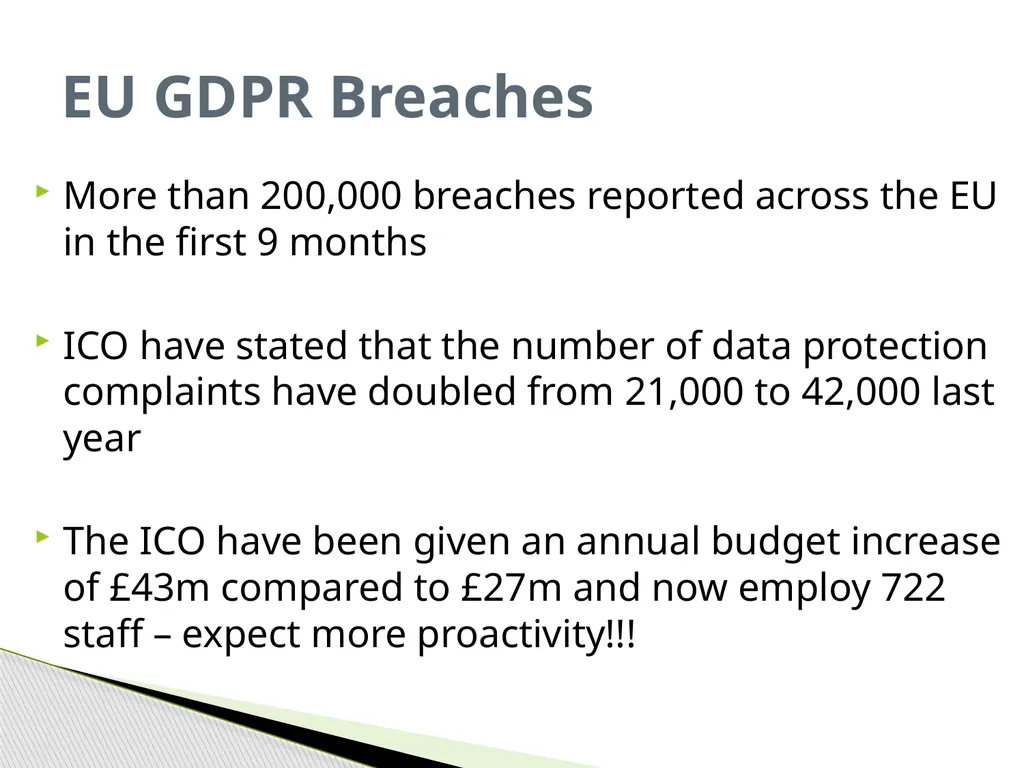
More than 200,000 breaches reported across the EU in the first 9 months
ICO have stated that the number of data protection complaints have doubled from 21,000 to 42,000 last year
The ICO have been given an annual budget increase of £43m compared to £27m and now employ 722 staff – expect more proactivity!!! EU GDPR Breaches<br>
ICO have stated that the number of data protection complaints have doubled from 21,000 to 42,000 last year
The ICO have been given an annual budget increase of £43m compared to £27m and now employ 722 staff – expect more proactivity!!! EU GDPR Breaches<br>
13
The ICO in the past tended to only fine as a last result
Of the 18,300 data protection cases it handled in 2016/17 it issued just 16 fines totalling £1.6m
But this is starting to change ……. In the past<br>
Of the 18,300 data protection cases it handled in 2016/17 it issued just 16 fines totalling £1.6m
But this is starting to change ……. In the past<br>
14
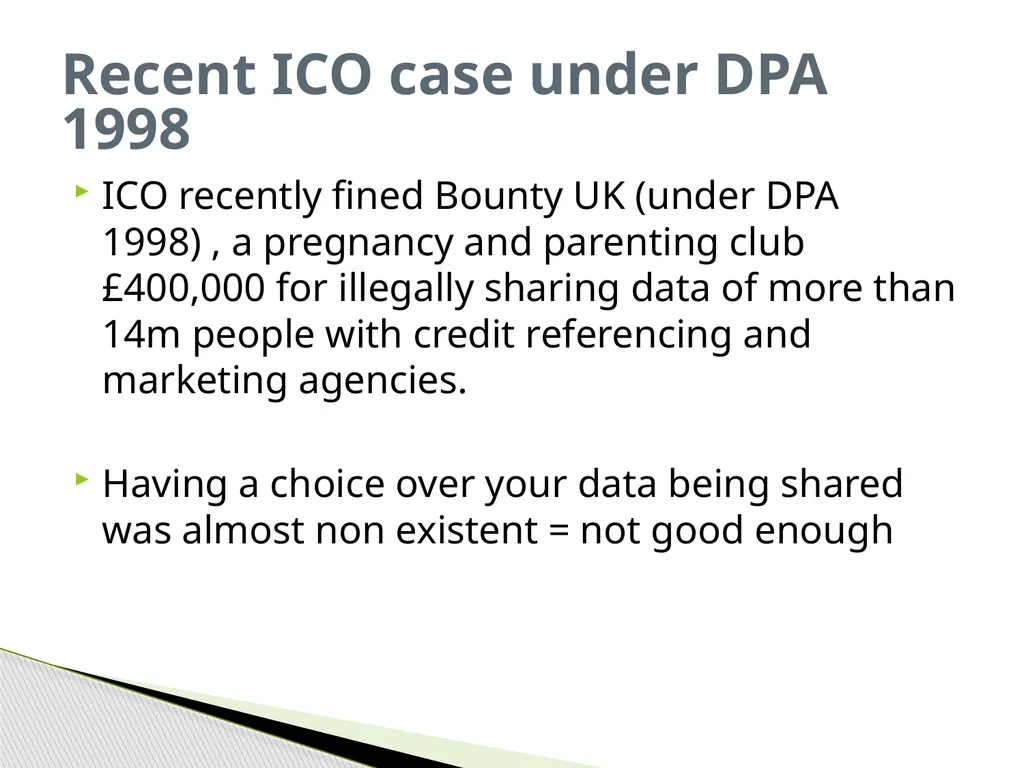
ICO recently fined Bounty UK (under DPA 1998) , a pregnancy and parenting club £400,000 for illegally sharing data of more than 14m people with credit referencing and marketing agencies.
Having a choice over your data being shared was almost non existent = not good enough Recent ICO case under DPA 1998<br>
Having a choice over your data being shared was almost non existent = not good enough Recent ICO case under DPA 1998<br>
15
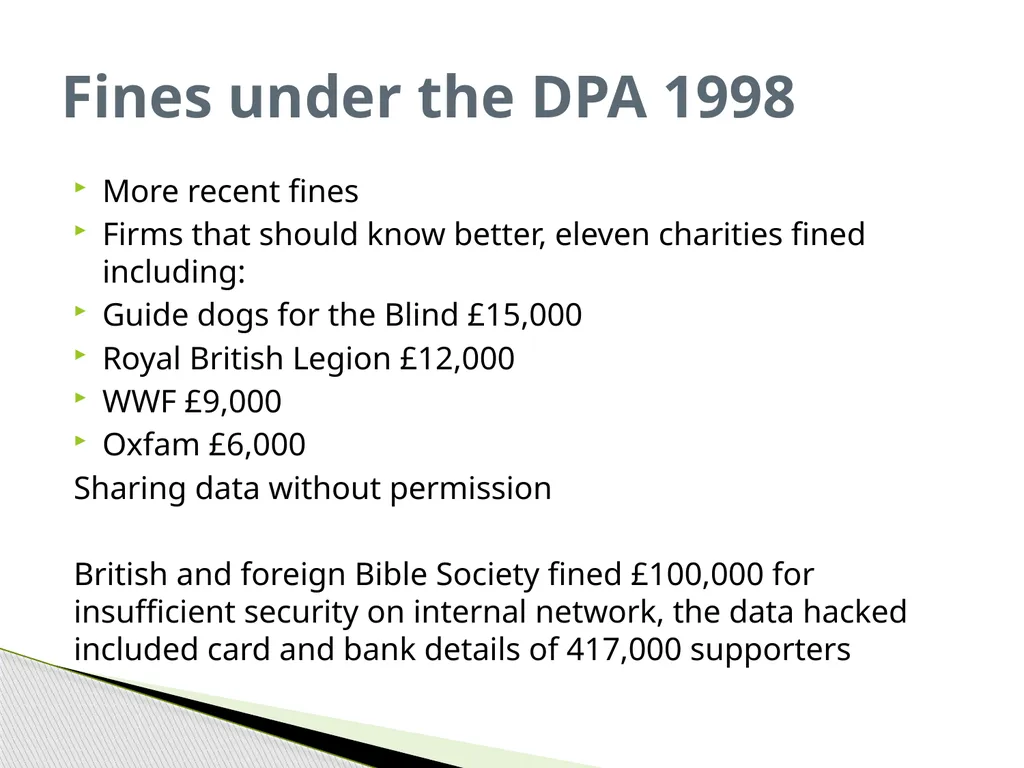
More recent fines
Firms that should know better, eleven charities fined including:
Guide dogs for the Blind £15,000
Royal British Legion £12,000
WWF £9,000
Oxfam £6,000
Sharing data without permission
British and foreign Bible Society fined £100,000 for insufficient security on internal network, the data hacked included card and bank details of 417,000 supporters Fines under the DPA 1998<br>
Firms that should know better, eleven charities fined including:
Guide dogs for the Blind £15,000
Royal British Legion £12,000
WWF £9,000
Oxfam £6,000
Sharing data without permission
British and foreign Bible Society fined £100,000 for insufficient security on internal network, the data hacked included card and bank details of 417,000 supporters Fines under the DPA 1998<br>
16
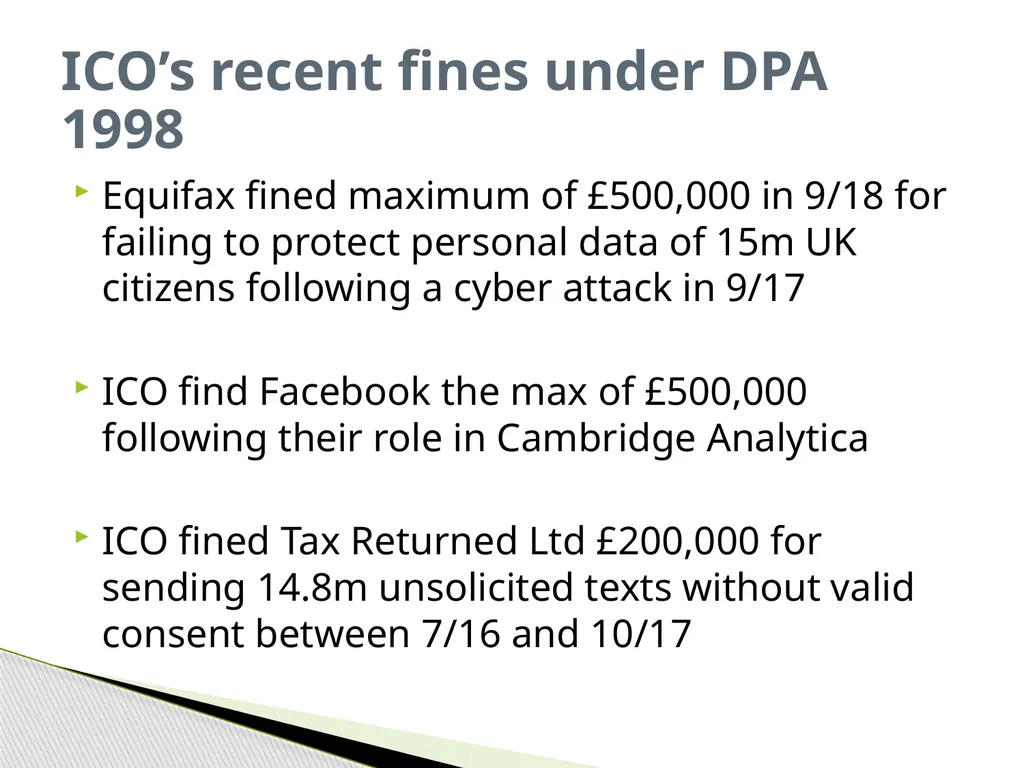
Equifax fined maximum of £500,000 in 9/18 for failing to protect personal data of 15m UK citizens following a cyber attack in 9/17
ICO find Facebook the max of £500,000 following their role in Cambridge Analytica
ICO fined Tax Returned Ltd £200,000 for sending 14.8m unsolicited texts without valid consent between 7/16 and 10/17 ICO’s recent fines under DPA 1998<br>
ICO find Facebook the max of £500,000 following their role in Cambridge Analytica
ICO fined Tax Returned Ltd £200,000 for sending 14.8m unsolicited texts without valid consent between 7/16 and 10/17 ICO’s recent fines under DPA 1998<br>
17
Still working through the backlog of DPA 1998 complaints and the UK does like an orderly queue moving in correct chronological order (until just now!)
The ICO issued an enforcement notice on a Canadian analytics firm Aggregator IQ Data Services stopping them processing personal data of any EU citizen – they were involved in the Cambridge analytical scandal and were found to be processing data without consent.
All seemed quiet on the ICO front and then…. GDPR Breaches<br>
The ICO issued an enforcement notice on a Canadian analytics firm Aggregator IQ Data Services stopping them processing personal data of any EU citizen – they were involved in the Cambridge analytical scandal and were found to be processing data without consent.
All seemed quiet on the ICO front and then…. GDPR Breaches<br>
18
Out of no where the ICO start punching like Tyson Fury<br>
19
The ICO were not the first out of the blocks but they have just set some eye watering fines:
BA £183.4m (1.5% of annual turnover) the maximum could have been 4% which would have been £489m
Marriott £99m (3% of annual turnover)
Money goes to the Treasury but ICO are trying to get some diverted to themselves to deal with future legal appeals!!! BA and Marriott = just under £300m fines<br>
BA £183.4m (1.5% of annual turnover) the maximum could have been 4% which would have been £489m
Marriott £99m (3% of annual turnover)
Money goes to the Treasury but ICO are trying to get some diverted to themselves to deal with future legal appeals!!! BA and Marriott = just under £300m fines<br>
20
British Airways is to be fined more than £183m by the Information Commissioner’s Office after hackers stole the personal data of half a million of the airline’s customers.
The ICO said its extensive investigation found that the incident involved customer details including login, payment card, name, address and travel booking information being harvested after being diverted to a fraudulent website.
The ICO said that data breach, which began in June 2018, occurred because British Airways had “poor security arrangements” in place to protect customer information being accessed BA Eye Watering Fine from the ICO<br>
The ICO said its extensive investigation found that the incident involved customer details including login, payment card, name, address and travel booking information being harvested after being diverted to a fraudulent website.
The ICO said that data breach, which began in June 2018, occurred because British Airways had “poor security arrangements” in place to protect customer information being accessed BA Eye Watering Fine from the ICO<br>
21
Marriott’s £99m fine was the result of a data breach that lasted over four years – between 2014 when it began and then discovered in 2018 – and exposed in the region of 339 million guest records globally.
Like BA bet they wish this breach had been discovered before May 2018 as fine would have only been £500,000 !!!! Marriott Eye Watering Fine from the ICO<br>
Like BA bet they wish this breach had been discovered before May 2018 as fine would have only been £500,000 !!!! Marriott Eye Watering Fine from the ICO<br>
22
ICO commissioner Elizabeth Denham said that when organisations fail to protect data from loss, damage or theft, it is “more than an inconvenience.”
"That's why the law is clear – when you are entrusted with personal data, you must look after it. Those that don't will face scrutiny from my office to check they have taken appropriate steps to protect fundamental privacy rights,” she cautioned Be afraid – be very afraid!<br>
"That's why the law is clear – when you are entrusted with personal data, you must look after it. Those that don't will face scrutiny from my office to check they have taken appropriate steps to protect fundamental privacy rights,” she cautioned Be afraid – be very afraid!<br>
23
Once they start processing the fines under the GDPR, the ICO have stated that each breach will be on a case-by-case basis in the spirit of being ‘effective, proportionate and dissuasive’.
They will take into account previous attempts to comply and also actions taken to mitigate damage – if you have well documented Data Protection procedures this will bode well if there is a issue.
The ICO have also been clear that firms that self report will be looked on favourably. ICO comments on fines<br>
They will take into account previous attempts to comply and also actions taken to mitigate damage – if you have well documented Data Protection procedures this will bode well if there is a issue.
The ICO have also been clear that firms that self report will be looked on favourably. ICO comments on fines<br>
24
For the rest of Europe there has been 63 m euros in fines so far across the Eu (which all of a sudden looks low due to the ICO actions)
57M of this was Google in France ! –fined by the French watchdog the Commission Nationale de l’informatique et des libertes (CNIL). The action was brought by two French privacy activists groups. If you have business in France be extra cautious!
CNIL felt Google had created a lack of transparency on how personal data would be used EU GDPR fines<br>
57M of this was Google in France ! –fined by the French watchdog the Commission Nationale de l’informatique et des libertes (CNIL). The action was brought by two French privacy activists groups. If you have business in France be extra cautious!
CNIL felt Google had created a lack of transparency on how personal data would be used EU GDPR fines<br>
25
CNIL also did not like the fact that users would have to click through many different pages and connections to see what their data was being used for, rather than one easy to use central place.
Remember Google data is stretched over many different sources e.g. google maps, G mail, You tube, browsing data etc, if you wanted to see the whole usage policy you had to click in many different places as the usage policy was spread over many pages in different locations – not good enough said the French regulator EU GDPR fines<br>
Remember Google data is stretched over many different sources e.g. google maps, G mail, You tube, browsing data etc, if you wanted to see the whole usage policy you had to click in many different places as the usage policy was spread over many pages in different locations – not good enough said the French regulator EU GDPR fines<br>
26
The CNIL were particularly critical about how the information provided by Google on how they point ads at you, based on the data they hold on you.
In their opinion this was far from transparent and this led the CNIL to conclude that there was no legal basis of ‘consent’ as the user had no idea what they were consenting to!
Google are appealing to the French Supreme court for administration. Google main issues<br>
In their opinion this was far from transparent and this led the CNIL to conclude that there was no legal basis of ‘consent’ as the user had no idea what they were consenting to!
Google are appealing to the French Supreme court for administration. Google main issues<br>
27
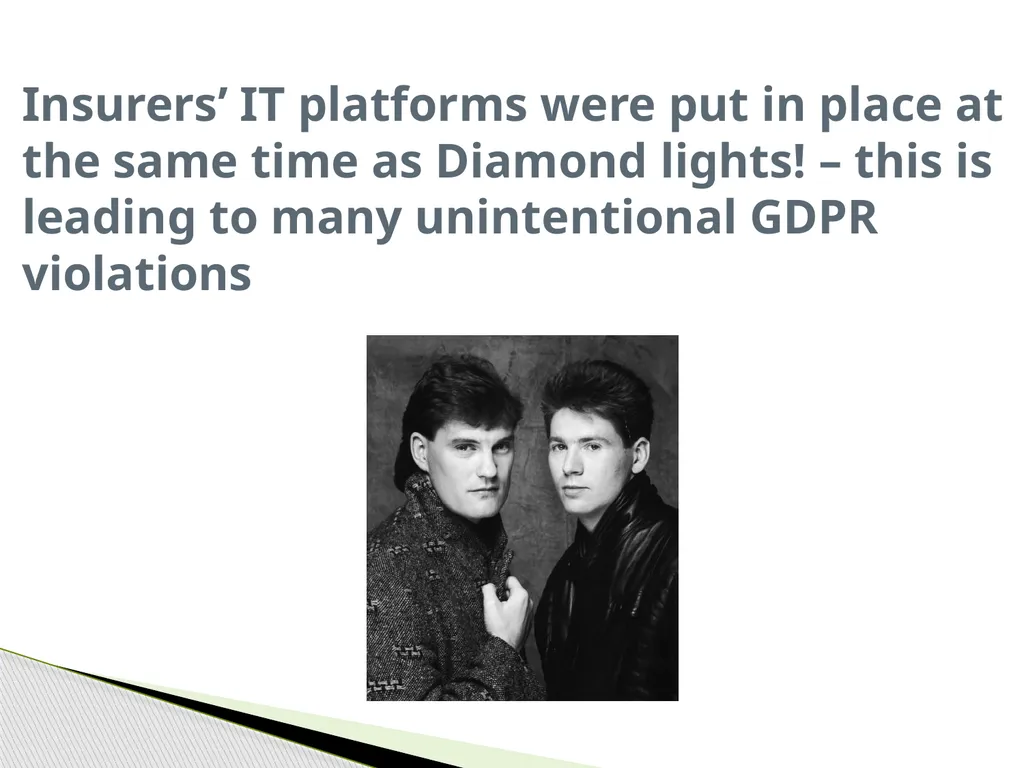
Insurers’ IT platforms were put in place at the same time as Diamond lights! – this is leading to many unintentional GDPR violations<br>
28
Reporting of serious breaches has become mandatory
Non EU countries will have to comply if they want to offer goods or services in the EU
Marketing will pose extra risks Background<br>
Non EU countries will have to comply if they want to offer goods or services in the EU
Marketing will pose extra risks Background<br>
29
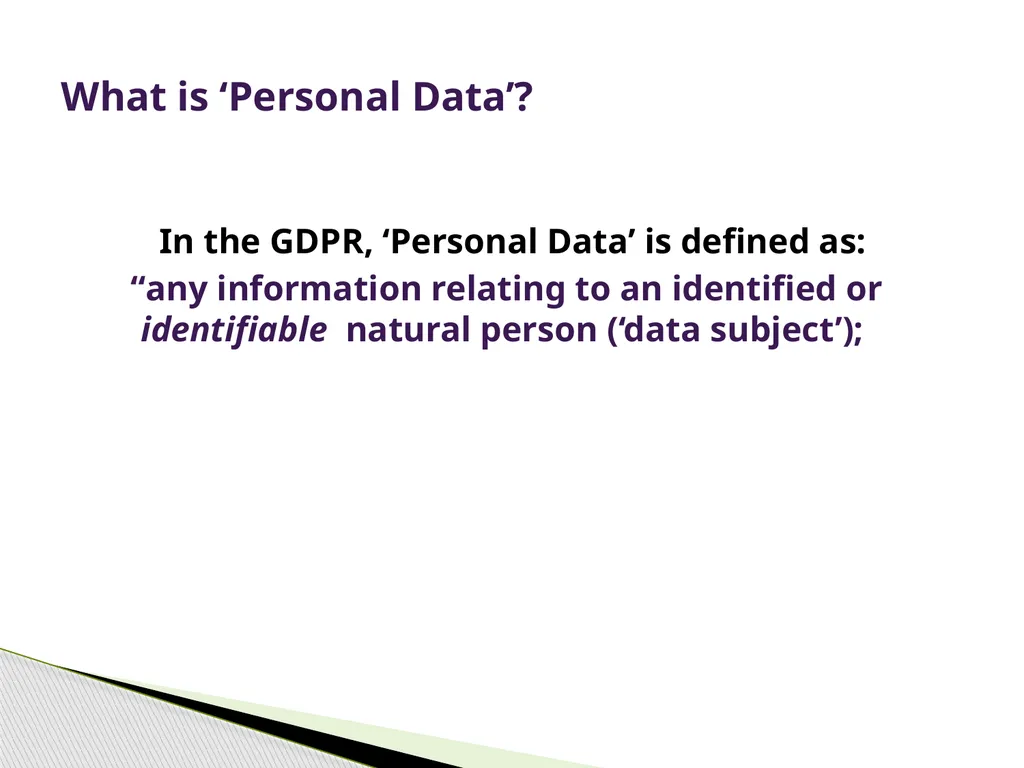
In the GDPR, ‘Personal Data’ is defined as:
“any information relating to an identified or identifiable natural person (‘data subject’); What is ‘Personal Data’?<br>
“any information relating to an identified or identifiable natural person (‘data subject’); What is ‘Personal Data’?<br>
30
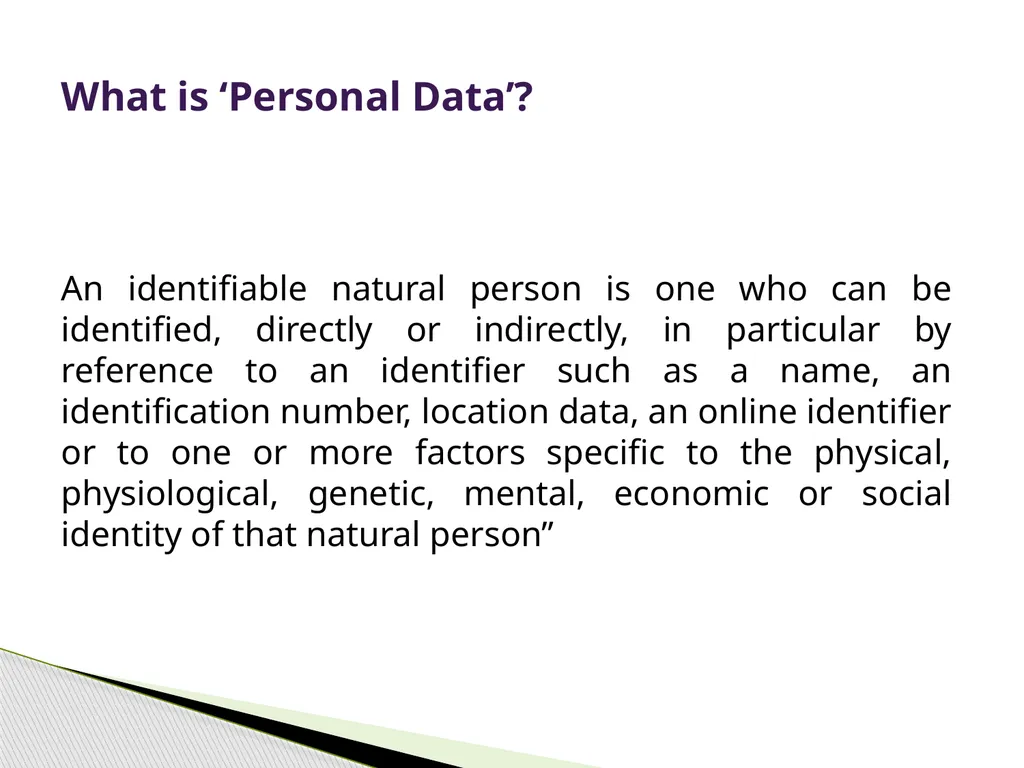
An identifiable natural person is one who can be identified, directly or indirectly, in particular by reference to an identifier such as a name, an identification number, location data, an online identifier or to one or more factors specific to the physical, physiological, genetic, mental, economic or social identity of that natural person” What is ‘Personal Data’?<br>
31
The GDPR definition of ‘Personal Data’ is wider than the definition under the DPA
It is designed to take account of new technologies and ways of doing business that have developed since the 1998 Data Protection Act (when we used to watch analogue TV and dial up via a modem to connect our PCs to the internet!) What is ‘Personal Data’?<br>
It is designed to take account of new technologies and ways of doing business that have developed since the 1998 Data Protection Act (when we used to watch analogue TV and dial up via a modem to connect our PCs to the internet!) What is ‘Personal Data’?<br>
32
What is ‘Personal Data’? It now includes biometric data such as fingerprints, iris scanning, voice recognition and facial images
Think about how much Google knows about us, it is scary<br>
Think about how much Google knows about us, it is scary<br>
33
Personal data relating to certain classes of data are known as ‘Special Categories’ of data (previously referred to as ‘Sensitive Personal Data” and cannot be processed without explicit consent and where the Government allows such as holding Health Care Data for Life Assurance ‘Special Categories’ of Data<br>
34
Special Categories could be described as those characteristics for which a person may be discriminated against ‘Special Categories’ of Data<br>
35
These include:
Racial or ethnic origin
Political opinions, religious or philosophical beliefs
Trade union membership
Genetic and biometric data
Health**
Sex life or sexual orientation ‘Special Categories’ of Data<br>
Racial or ethnic origin
Political opinions, religious or philosophical beliefs
Trade union membership
Genetic and biometric data
Health**
Sex life or sexual orientation ‘Special Categories’ of Data<br>
36
GDPR leaves Member States to decide where to allow the processing of Criminal Convictions
Are the UK insurance systems good enough here! Criminal Convictions & Offences<br>
Are the UK insurance systems good enough here! Criminal Convictions & Offences<br>
37
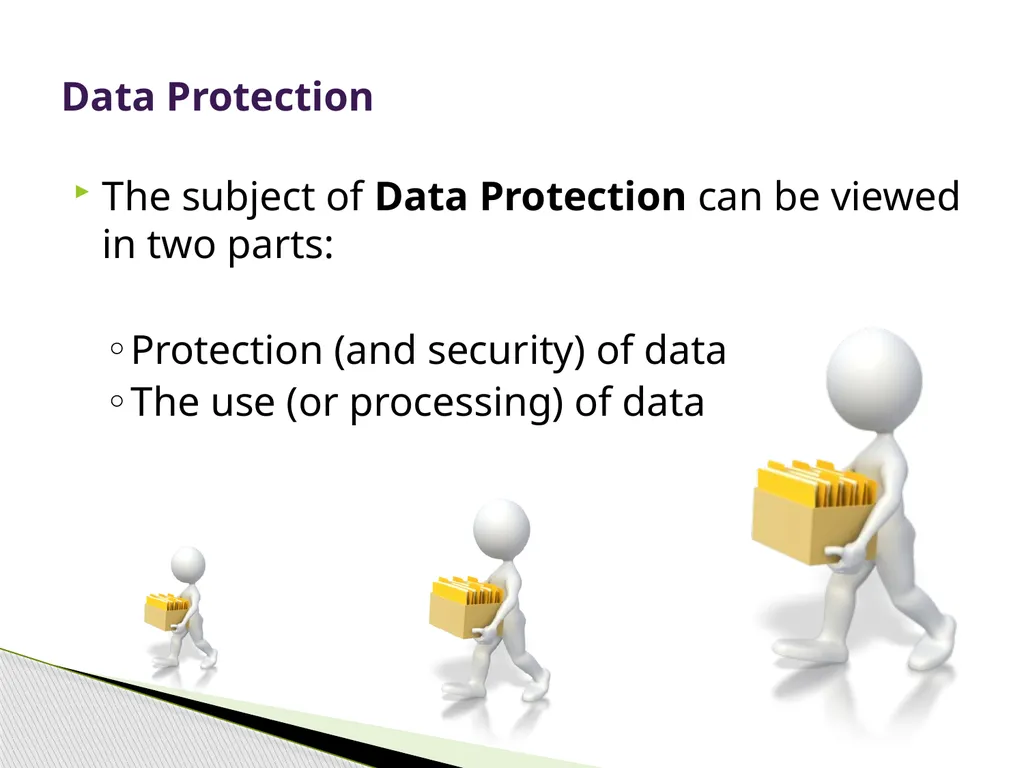
The subject of Data Protection can be viewed in two parts:
Protection (and security) of data
The use (or processing) of data Data Protection<br>
Protection (and security) of data
The use (or processing) of data Data Protection<br>
38
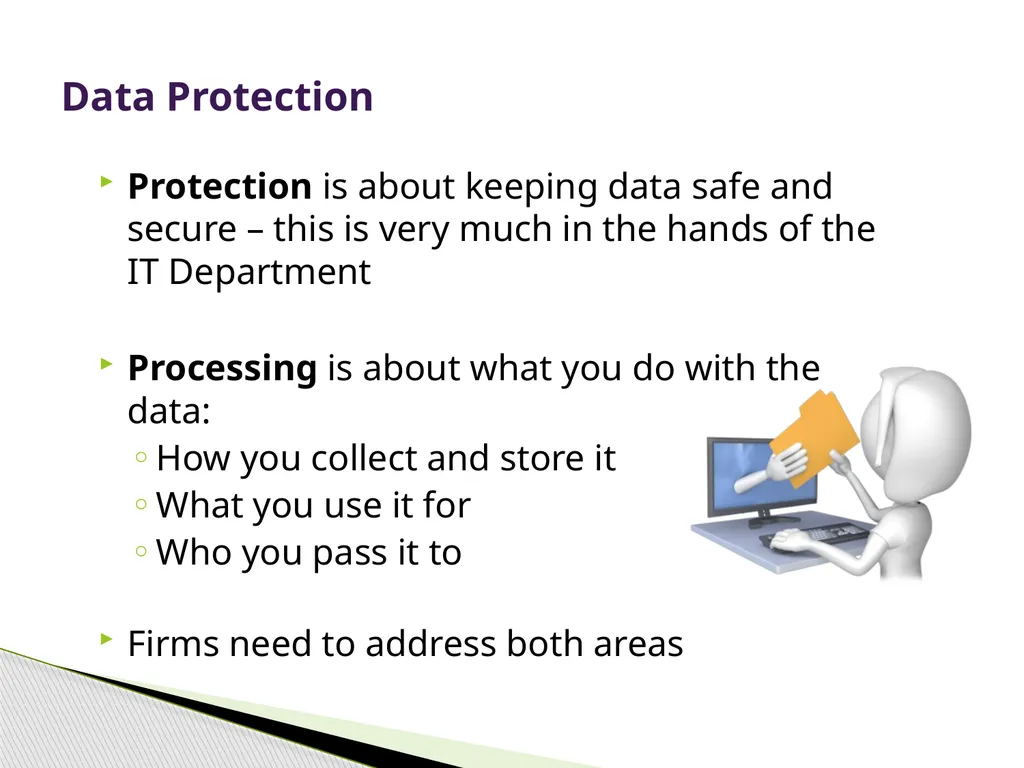
Protection is about keeping data safe and secure – this is very much in the hands of the IT Department
Processing is about what you do with the data:
How you collect and store it
What you use it for
Who you pass it to
Firms need to address both areas Data Protection<br>
Processing is about what you do with the data:
How you collect and store it
What you use it for
Who you pass it to
Firms need to address both areas Data Protection<br>
39
Understanding you legal basis for processing data<br>
40
Under GDPR, a firm must have a valid Legal Basis for processing data
There are six legal bases for processing data
Its not all about consent! Legal Basis for Processing Data<br>
There are six legal bases for processing data
Its not all about consent! Legal Basis for Processing Data<br>
41
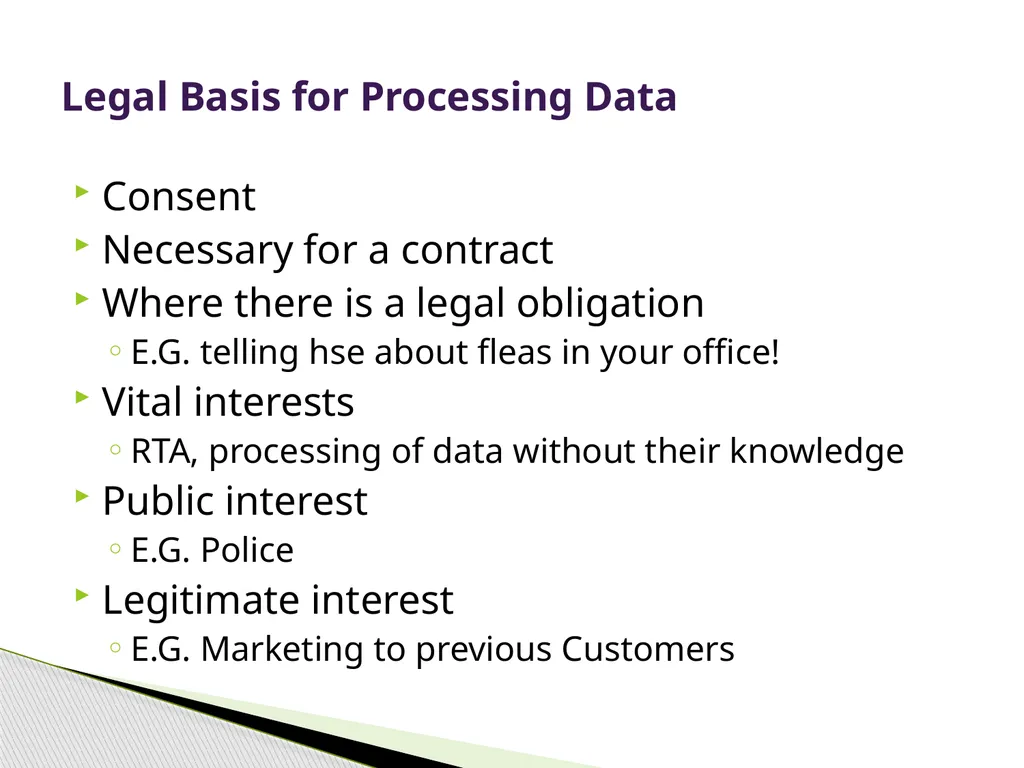
Consent
Necessary for a contract
Where there is a legal obligation
E.G. telling hse about fleas in your office!
Vital interests
RTA, processing of data without their knowledge
Public interest
E.G. Police
Legitimate interest
E.G. Marketing to previous Customers Legal Basis for Processing Data<br>
Necessary for a contract
Where there is a legal obligation
E.G. telling hse about fleas in your office!
Vital interests
RTA, processing of data without their knowledge
Public interest
E.G. Police
Legitimate interest
E.G. Marketing to previous Customers Legal Basis for Processing Data<br>
42
Rights of Individuals<br>
43
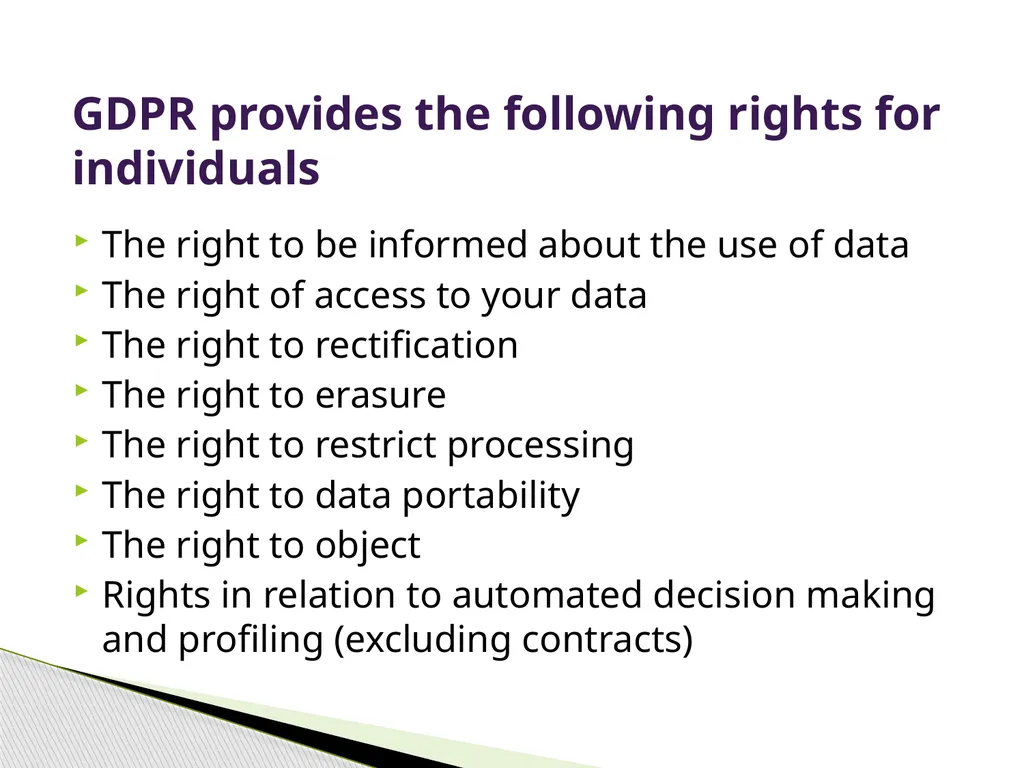
The right to be informed about the use of data
The right of access to your data
The right to rectification
The right to erasure
The right to restrict processing
The right to data portability
The right to object
Rights in relation to automated decision making and profiling (excluding contracts) GDPR provides the following rights for individuals<br>
The right of access to your data
The right to rectification
The right to erasure
The right to restrict processing
The right to data portability
The right to object
Rights in relation to automated decision making and profiling (excluding contracts) GDPR provides the following rights for individuals<br>
44
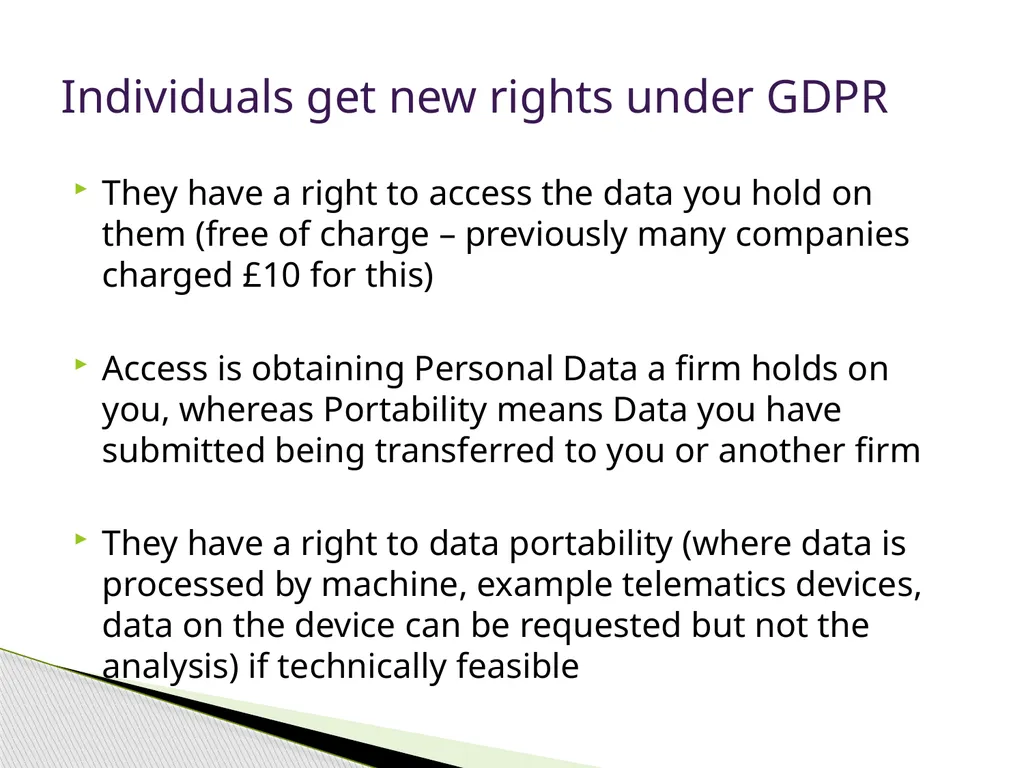
They have a right to access the data you hold on them (free of charge – previously many companies charged £10 for this)
Access is obtaining Personal Data a firm holds on you, whereas Portability means Data you have submitted being transferred to you or another firm
They have a right to data portability (where data is processed by machine, example telematics devices, data on the device can be requested but not the analysis) if technically feasible Individuals get new rights under GDPR<br>
Access is obtaining Personal Data a firm holds on you, whereas Portability means Data you have submitted being transferred to you or another firm
They have a right to data portability (where data is processed by machine, example telematics devices, data on the device can be requested but not the analysis) if technically feasible Individuals get new rights under GDPR<br>
45
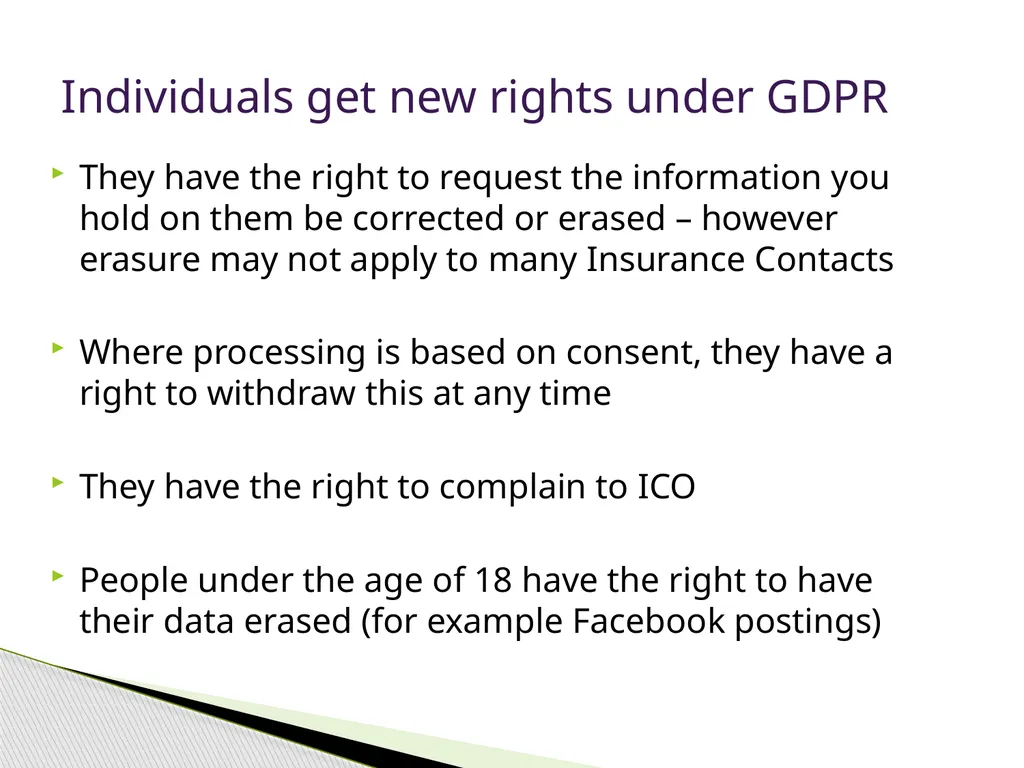
They have the right to request the information you hold on them be corrected or erased – however erasure may not apply to many Insurance Contacts
Where processing is based on consent, they have a right to withdraw this at any time
They have the right to complain to ICO
People under the age of 18 have the right to have their data erased (for example Facebook postings) Individuals get new rights under GDPR<br>
Where processing is based on consent, they have a right to withdraw this at any time
They have the right to complain to ICO
People under the age of 18 have the right to have their data erased (for example Facebook postings) Individuals get new rights under GDPR<br>
46
All Data Subjects will have the right to object to direct marketing
This right should be explicitly brought to their attention, and presented clearly and separately from any other information Right to Object<br>
This right should be explicitly brought to their attention, and presented clearly and separately from any other information Right to Object<br>
47
GDPR states that a firm must inform a Data Subject of this right at the time of the first communication
This means that when a firm collects data it must give the Data Subject options about whether to receive Marketing or not
Effectively, this means they must Opt-in Right to Object<br>
This means that when a firm collects data it must give the Data Subject options about whether to receive Marketing or not
Effectively, this means they must Opt-in Right to Object<br>
48
Under GDPR, a firm must have a valid Legal Basis for its Marketing activities
The Legal Basis for insurance broking marketing activities is likely to be either Legitimate Interest or Consent Legal Basis for Marketing<br>
The Legal Basis for insurance broking marketing activities is likely to be either Legitimate Interest or Consent Legal Basis for Marketing<br>
49
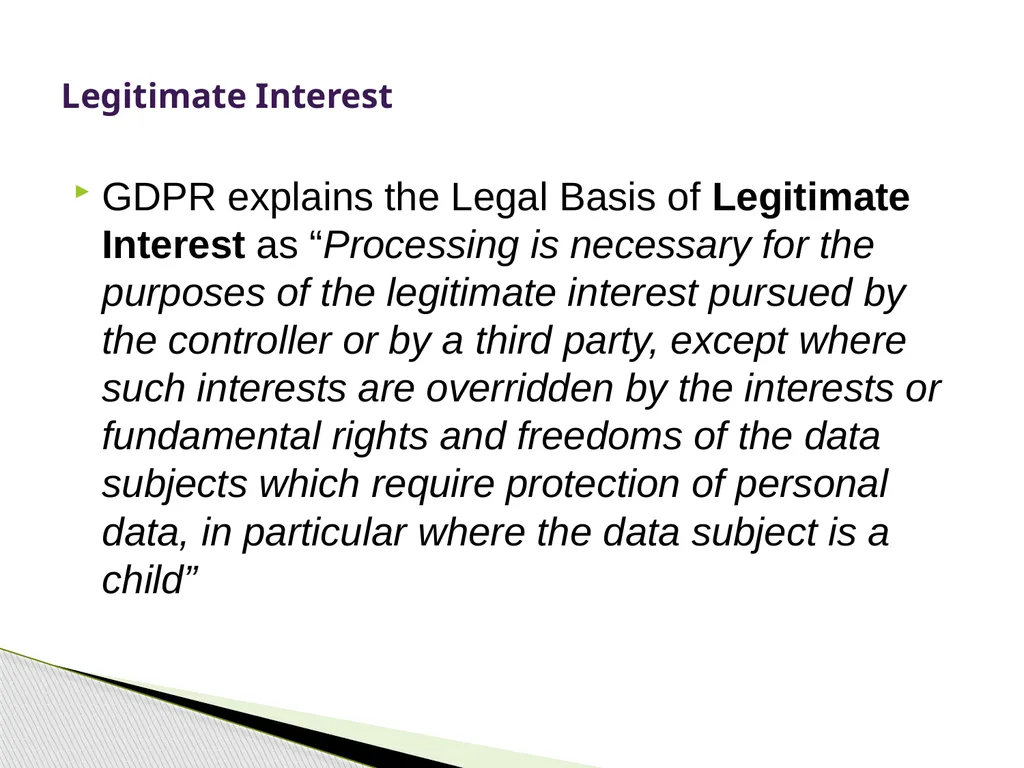
GDPR explains the Legal Basis of Legitimate Interest as “Processing is necessary for the purposes of the legitimate interest pursued by the controller or by a third party, except where such interests are overridden by the interests or fundamental rights and freedoms of the data subjects which require protection of personal data, in particular where the data subject is a child” Legitimate Interest<br>
50
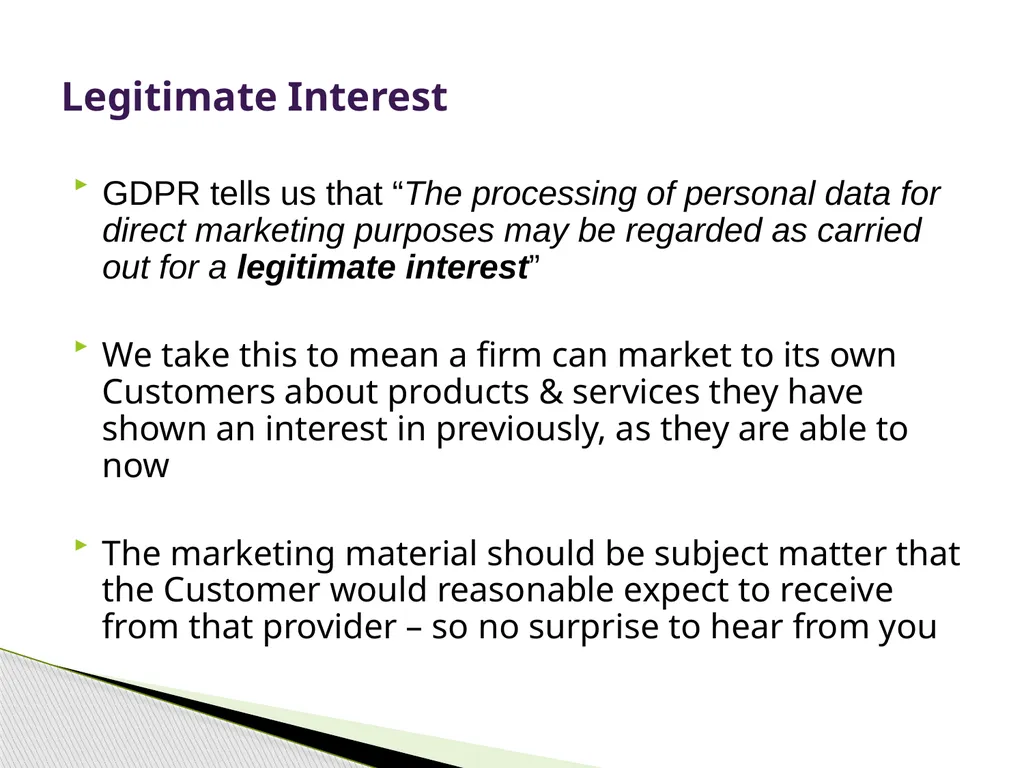
GDPR tells us that “The processing of personal data for direct marketing purposes may be regarded as carried out for a legitimate interest”
We take this to mean a firm can market to its own Customers about products & services they have shown an interest in previously, as they are able to now
The marketing material should be subject matter that the Customer would reasonable expect to receive from that provider – so no surprise to hear from you Legitimate Interest<br>
We take this to mean a firm can market to its own Customers about products & services they have shown an interest in previously, as they are able to now
The marketing material should be subject matter that the Customer would reasonable expect to receive from that provider – so no surprise to hear from you Legitimate Interest<br>
51
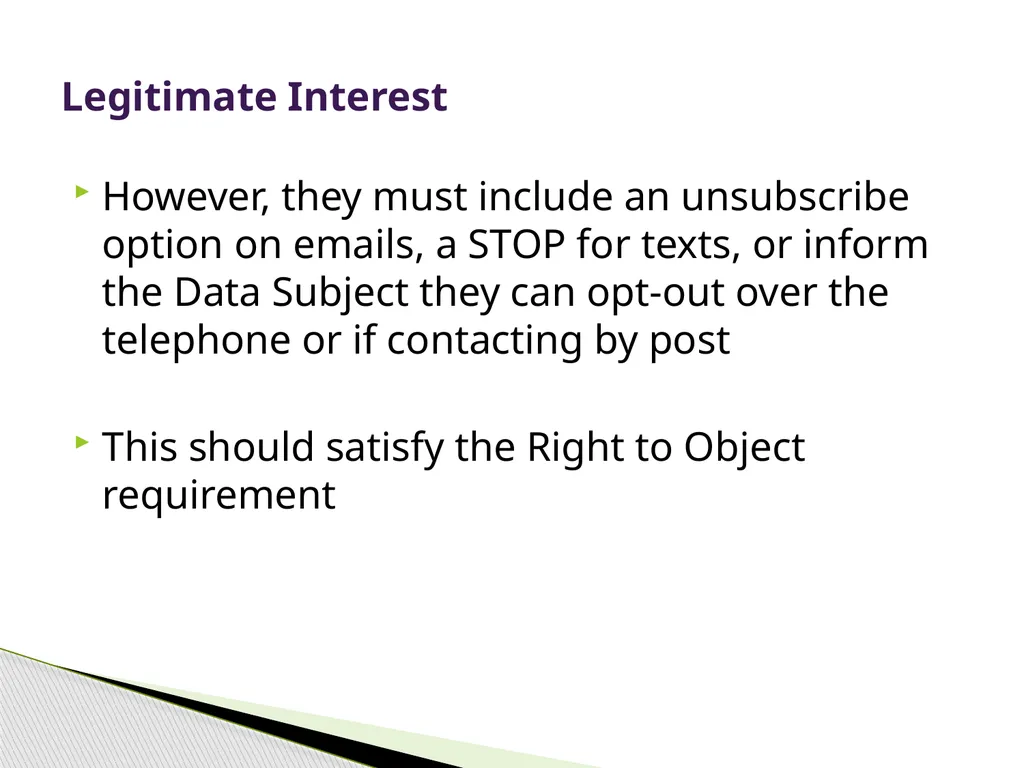
However, they must include an unsubscribe option on emails, a STOP for texts, or inform the Data Subject they can opt-out over the telephone or if contacting by post
This should satisfy the Right to Object requirement Legitimate Interest<br>
This should satisfy the Right to Object requirement Legitimate Interest<br>
52
The most used Legal Basis for wider Marketing therefore, will be Consent
GDPR states this Legal Basis as “The Data Subject has given consent to the processing of his or her personal data for one or more specific purposes” Consent<br>
GDPR states this Legal Basis as “The Data Subject has given consent to the processing of his or her personal data for one or more specific purposes” Consent<br>
53
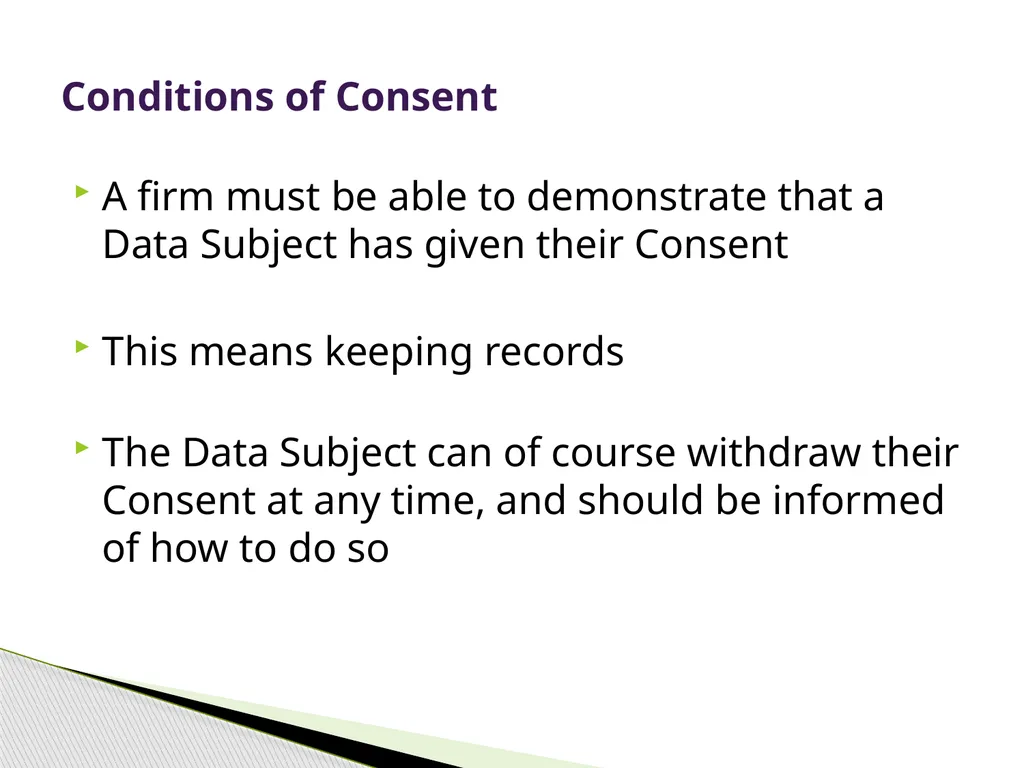
A firm must be able to demonstrate that a Data Subject has given their Consent
This means keeping records
The Data Subject can of course withdraw their Consent at any time, and should be informed of how to do so Conditions of Consent<br>
This means keeping records
The Data Subject can of course withdraw their Consent at any time, and should be informed of how to do so Conditions of Consent<br>
54
When obtaining Consent for Marketing purposes a firm should ensure Customers are actively opting-in
An important condition of Consent is that it must be “unambiguous”, and must be confirmed “by a statement or by a clear affirmative action”
This means the use of pre-ticked boxes on websites are not permitted Conditions of Consent<br>
An important condition of Consent is that it must be “unambiguous”, and must be confirmed “by a statement or by a clear affirmative action”
This means the use of pre-ticked boxes on websites are not permitted Conditions of Consent<br>
55
A firm should ensure that each method of Marketing (mail, email, call, automated call, text, fax etc.) is separately consented to (these can be separate boxes), allowing the Data Subject to decide by which methods they will accept Marketing information
Consent therefore should be separate from other terms and conditions Conditions of Consent<br>
Consent therefore should be separate from other terms and conditions Conditions of Consent<br>
56
A firm will not be able to sell its data to another firm, or share it for Marketing purposes without specific Consent from its Data Subjects Other Firms<br>
57
Governance, Systems and procedures<br>
58
Firms need two similar documents that set out how they process Data
The internal document is called the Record of Processing Activities
The external document is called a Privacy Notice Documents<br>
The internal document is called the Record of Processing Activities
The external document is called a Privacy Notice Documents<br>
59
Firms will need a written Record of Processing Activities (to be made available to ICO on request)
This is an internal document explaining how they process data, and is a requirement of GDPR
You must be able to demonstrate your compliance with the Regulation Record of Processing Activities<br>
This is an internal document explaining how they process data, and is a requirement of GDPR
You must be able to demonstrate your compliance with the Regulation Record of Processing Activities<br>
60
The information you need to provide in a Privacy Notice is very similar to the information you need to include in your record of processing activities:
Who you are;
What you will do with their data;
Who you will pass it to; and
How long you will keep it for. Privacy Notices<br>
Who you are;
What you will do with their data;
Who you will pass it to; and
How long you will keep it for. Privacy Notices<br>
61
You must also tell the data subject:
They have a right to data portability
Where processing is based on consent, they have a right to withdraw this at any time
They have the right to complain to ICO Privacy Notices<br>
They have a right to data portability
Where processing is based on consent, they have a right to withdraw this at any time
They have the right to complain to ICO Privacy Notices<br>
62
Data Protection Officers are required for:
Public authorities
Firms with large scale data monitoring as their core activity (targeted ad companies)
Large scale processors of special categories of data or data relating to criminal convictions
Most Insurers would need a DPO Data Protection Officers<br>
Public authorities
Firms with large scale data monitoring as their core activity (targeted ad companies)
Large scale processors of special categories of data or data relating to criminal convictions
Most Insurers would need a DPO Data Protection Officers<br>
63
There is no requirement for most insurance small – medium sized insurance brokers to appoint a Data Protection Officer Data Protection Officers<br>
64
However, a firm should have a senior member of staff responsible for Data Protection issues
The firm should not call this person a “Data Protection Officer” as they would be required to be experts, undertake specific tasks, and GDPR itself states they should not use this name, it is a minefield to use this term without professional consultation Data Protection Officers<br>
The firm should not call this person a “Data Protection Officer” as they would be required to be experts, undertake specific tasks, and GDPR itself states they should not use this name, it is a minefield to use this term without professional consultation Data Protection Officers<br>
65
Data subjects have the right to request a copy of the personal data that is being processed
You must provide this free of charge unless the request is ‘unreasonable’ in which case you can charge a reasonable fee based on admin costs
You should respond within one month rather than 40 days previously Subject Access Requests<br>
You must provide this free of charge unless the request is ‘unreasonable’ in which case you can charge a reasonable fee based on admin costs
You should respond within one month rather than 40 days previously Subject Access Requests<br>
66
You don’t have to supply original documents but you must give the requester:
A copy of any information you hold on them,
The reason(s) for processing it
Details of the source of the data and whether it is being passed to other organisations Subject Access Requests<br>
A copy of any information you hold on them,
The reason(s) for processing it
Details of the source of the data and whether it is being passed to other organisations Subject Access Requests<br>
67
Data breaches must be notified to ICO as soon as possible (latest 72 hours after becoming aware of it), unless the breach is unlikely to result in a risk to the rights and freedoms of natural persons
Firms must have processes in place for dealing with this Reporting of Breaches<br>
Firms must have processes in place for dealing with this Reporting of Breaches<br>
68
What you need to tell ICO:
The nature of the breach, including where possible the categories and number of data subjects concerned and the categories and approximate number of personal records concerned
The name and contact details for the DPO or whoever is in charge of Data Protection at your firm Reporting of Breaches<br>
The nature of the breach, including where possible the categories and number of data subjects concerned and the categories and approximate number of personal records concerned
The name and contact details for the DPO or whoever is in charge of Data Protection at your firm Reporting of Breaches<br>
69
Have procedures in place for dealing with:
Requests for deletion or rectification of data
Requests to cease processing data
Requests for data portability
Provide regular DPA training within the firm
Carry out information audits periodically GDPR CHECKLIST<br>
Requests for deletion or rectification of data
Requests to cease processing data
Requests for data portability
Provide regular DPA training within the firm
Carry out information audits periodically GDPR CHECKLIST<br>
70
Understand the background to GDPR
Describe what the changes are
Explain what the impact is on customers and firms and risks associated Objectives<br>
Describe what the changes are
Explain what the impact is on customers and firms and risks associated Objectives<br>
71
As you can see there is a lot to do
For further assistance or queries you may want to contact
Create Solutions Ltd
Tel 0161 870 6637
www.createsolutions.co.uk What firms should be doing<br>
For further assistance or queries you may want to contact
Create Solutions Ltd
Tel 0161 870 6637
www.createsolutions.co.uk What firms should be doing<br>
72
Presented by Alan Chandler
In association with
Create Solutions Ltd
The specialist training and compliance company for the general insurance industry
Tel 0161 870 6637
www.createsolutions.co.uk<br>
In association with
Create Solutions Ltd
The specialist training and compliance company for the general insurance industry
Tel 0161 870 6637
www.createsolutions.co.uk<br>