General Education Basics ASCCC Curriculum Institute July 2016 Bernie Day, Foothill College Dave Degroot, Allan Hancock College Tiffany Tran, Irvine Valley College What is a Degree? Major course requirements Major courses define the program
"General Education Basics ASCCC Curriculum" is the property of its rightful owner. Permission is granted to
download and print the materials on this website for personal, non-commercial use only, and to display it
on your personal computer provided you do not modify the materials and that you retain all copyright
notices contained in the materials. By downloading content from our website, you accept the terms of this
agreement.
Presentation Transcript
01
General Education Basics ASCCC Curriculum Institute July 2016
Bernie Day, Foothill College
Dave Degroot, Allan Hancock College
Tiffany Tran, Irvine Valley College<br>
02
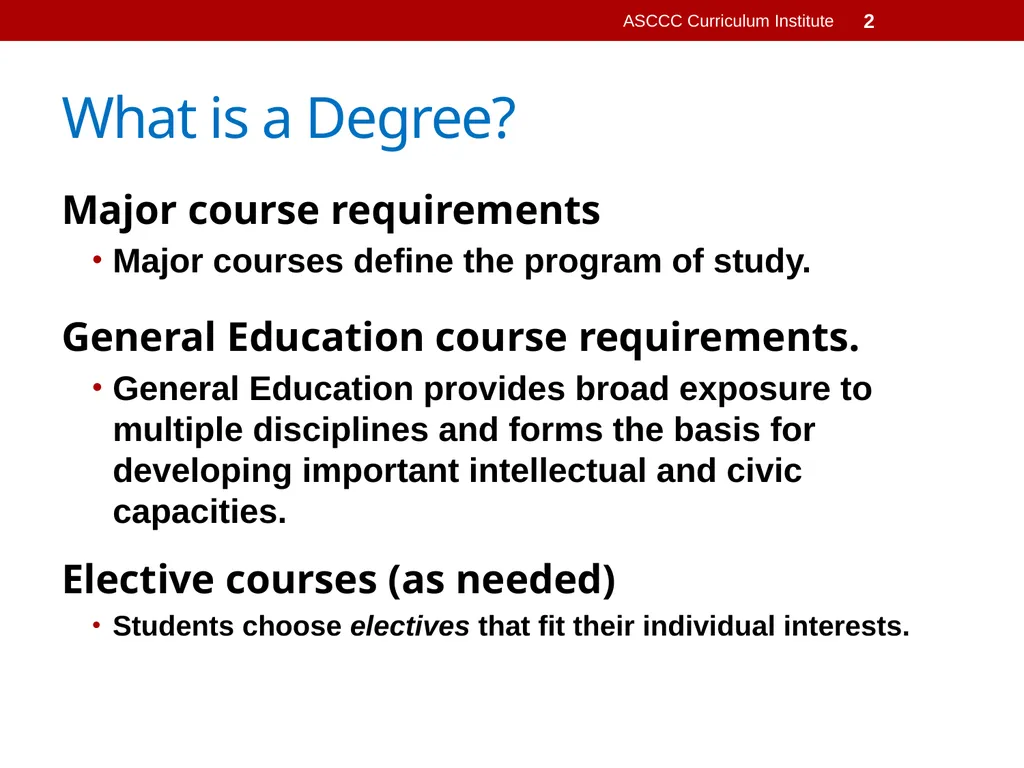
What is a Degree? Major course requirements
Major courses define the program of study.
General Education course requirements.
General Education provides broad exposure to multiple disciplines and forms the basis for developing important intellectual and civic capacities.
Elective courses (as needed)
Students choose electives that fit their individual interests. ASCCC Curriculum Institute 2<br>
03
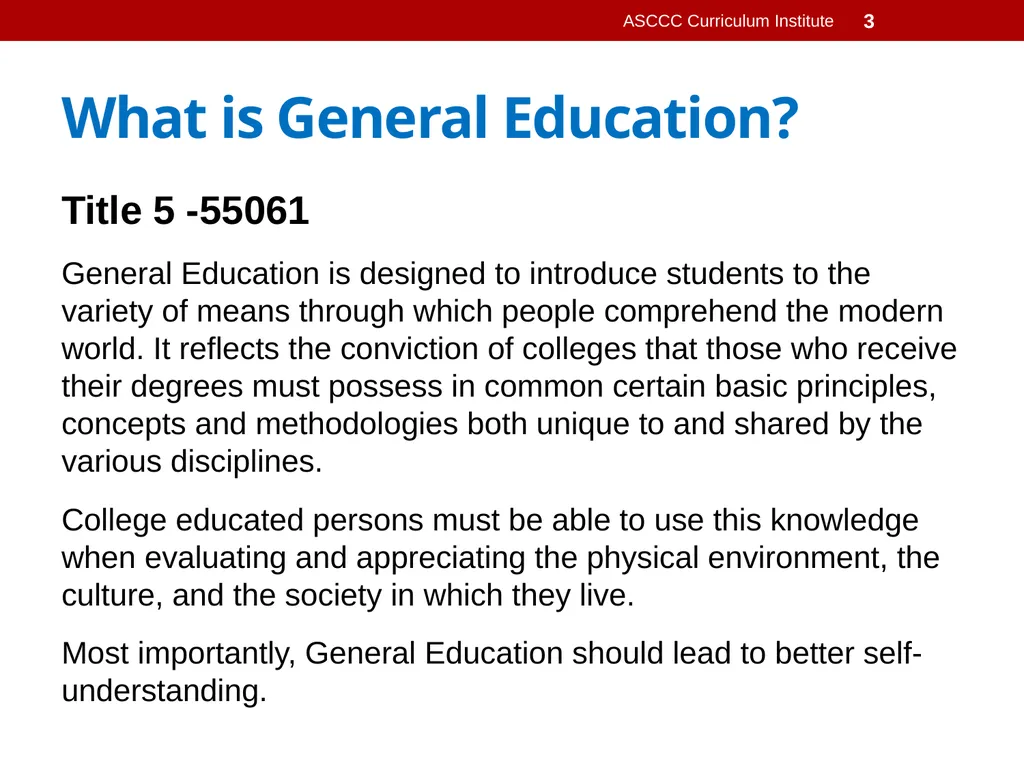
What is General Education? Title 5 -55061
General Education is designed to introduce students to the variety of means through which people comprehend the modern world. It reflects the conviction of colleges that those who receive their degrees must possess in common certain basic principles, concepts and methodologies both unique to and shared by the various disciplines.
College educated persons must be able to use this knowledge when evaluating and appreciating the physical environment, the culture, and the society in which they live.
Most importantly, General Education should lead to better self-understanding. ASCCC Curriculum Institute 3<br>
04
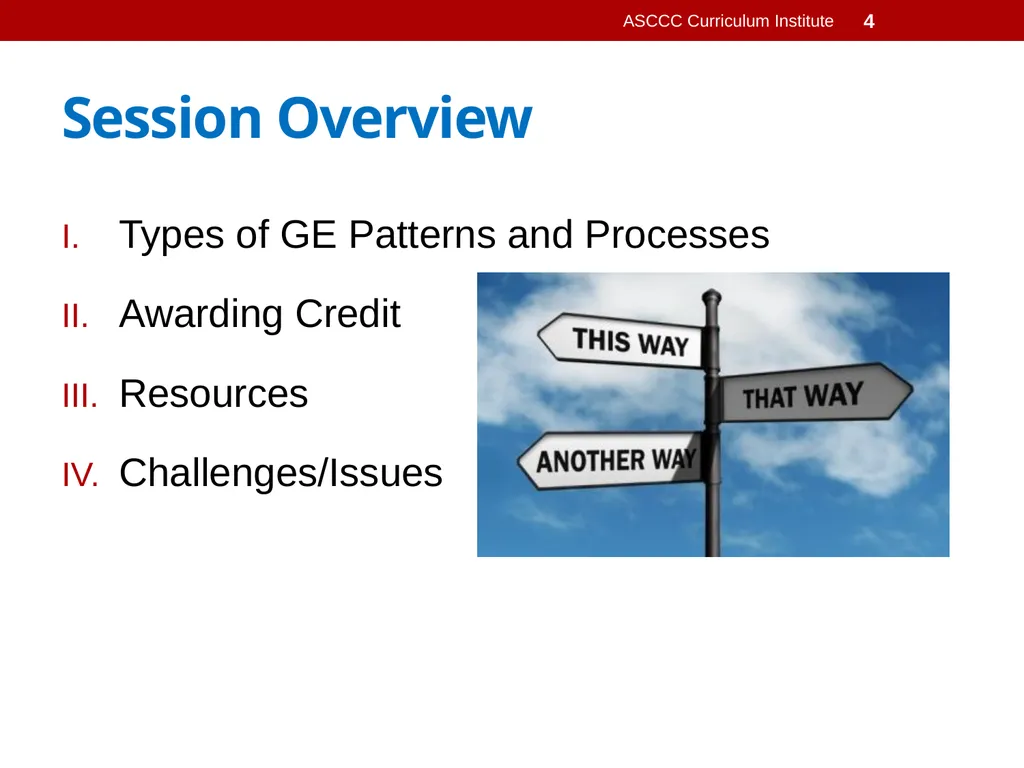
Session Overview Types of GE Patterns and Processes
Awarding Credit
Resources
Challenges/Issues ASCCC Curriculum Institute 4<br>
05
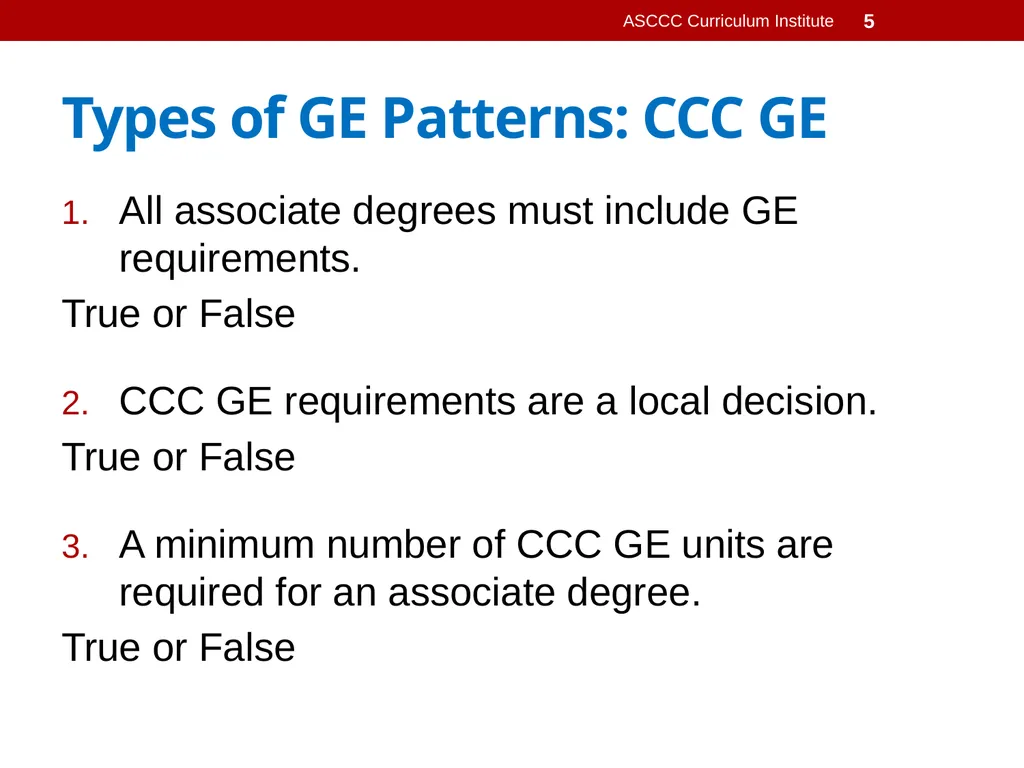
Types of GE Patterns: CCC GE All associate degrees must include GE requirements.
True or False
CCC GE requirements are a local decision.
True or False
A minimum number of CCC GE units are required for an associate degree.
True or False ASCCC Curriculum Institute 5<br>
06
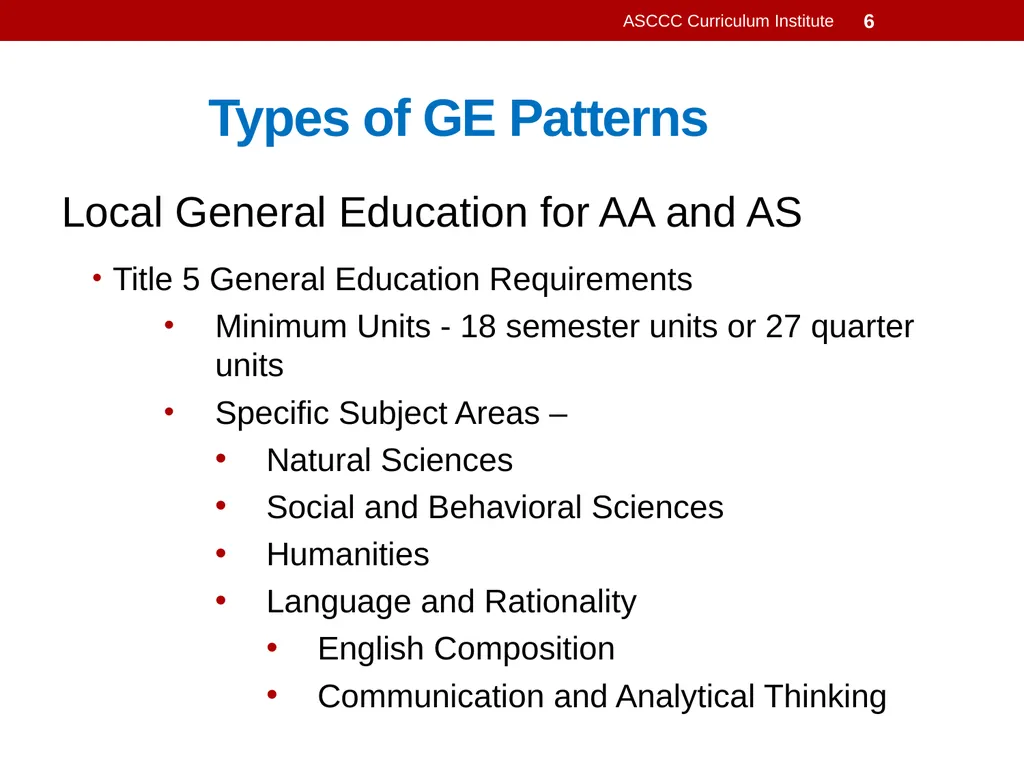
Types of GE Patterns Local General Education for AA and AS
Title 5 General Education Requirements
Minimum Units - 18 semester units or 27 quarter units
Specific Subject Areas –
Natural Sciences
Social and Behavioral Sciences
Humanities
Language and Rationality
English Composition
Communication and Analytical Thinking ASCCC Curriculum Institute 6<br>
07
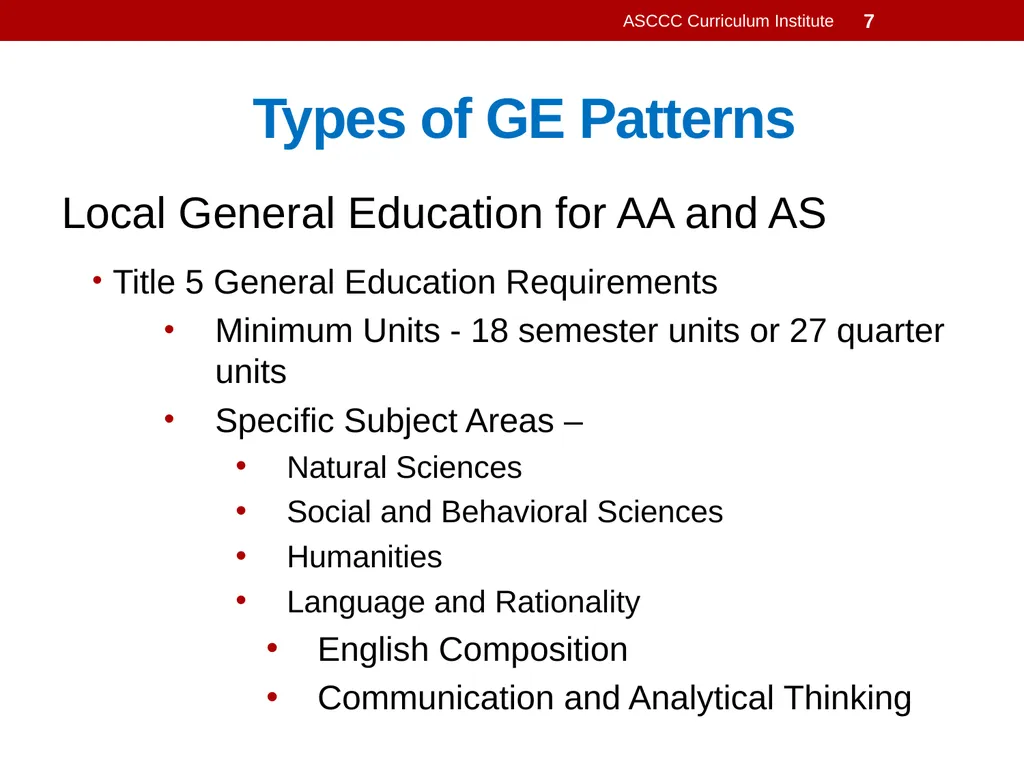
Types of GE Patterns Local General Education for AA and AS
Title 5 General Education Requirements
Minimum Units - 18 semester units or 27 quarter units
Specific Subject Areas –
Natural Sciences
Social and Behavioral Sciences
Humanities
Language and Rationality
English Composition
Communication and Analytical Thinking ASCCC Curriculum Institute 7<br>
08
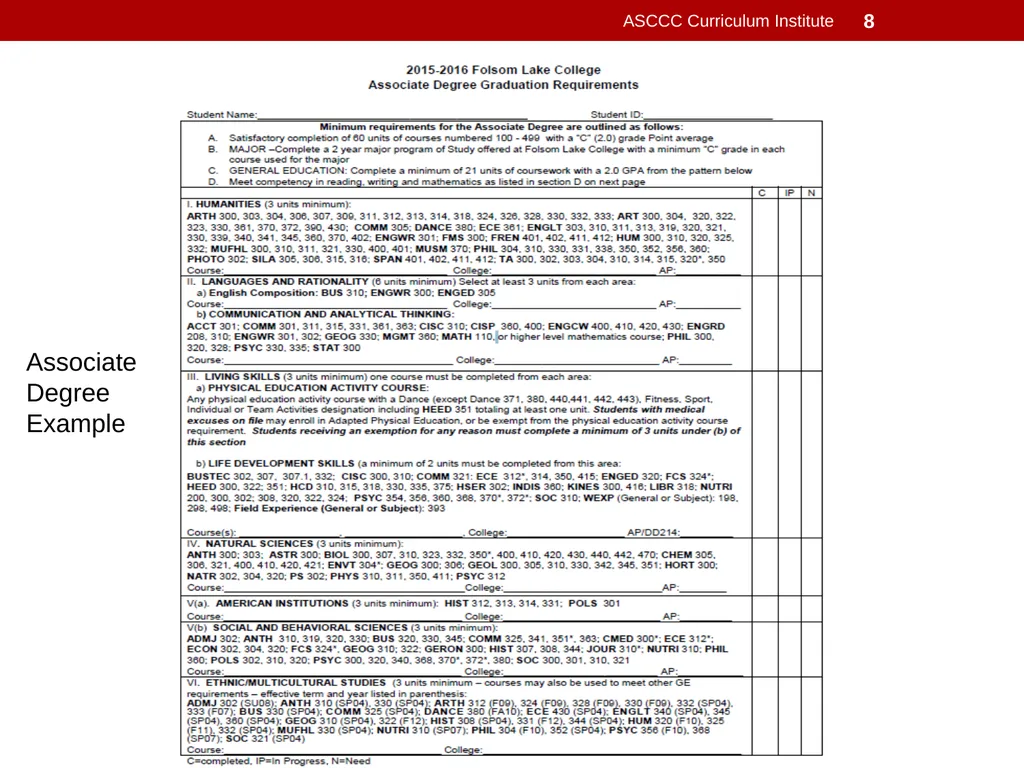
Associate Degree Example ASCCC Curriculum Institute 8<br>
09
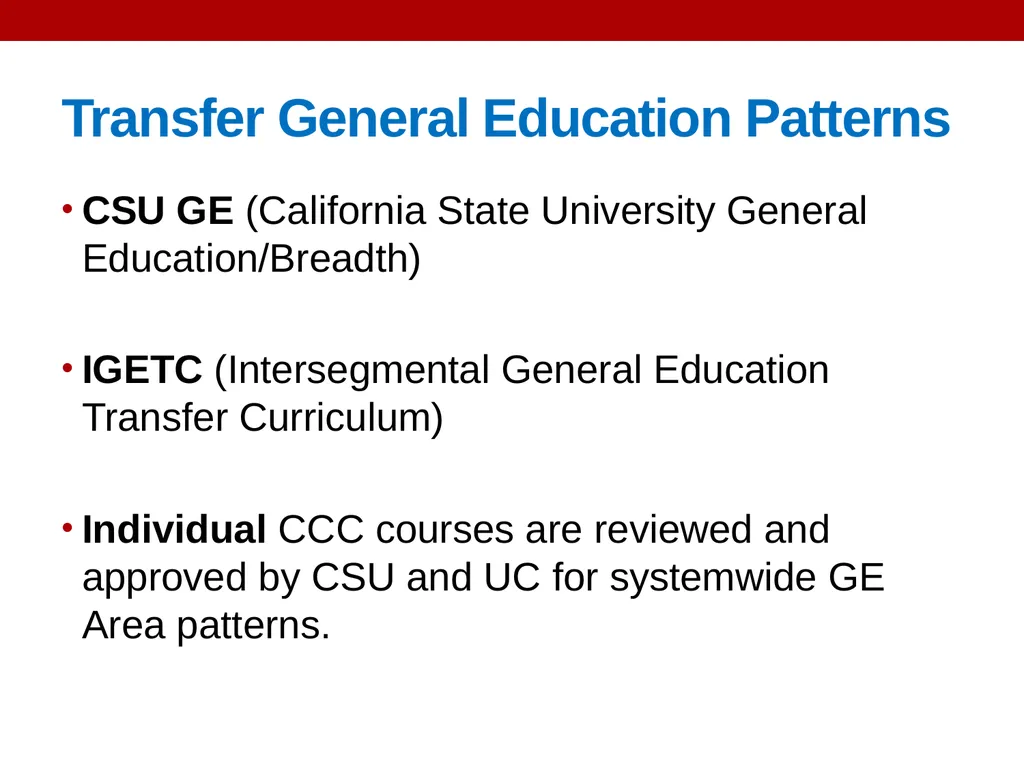
Transfer General Education Patterns CSU GE (California State University General Education/Breadth)
IGETC (Intersegmental General Education Transfer Curriculum)
Individual CCC courses are reviewed and approved by CSU and UC for systemwide GE Area patterns.<br>
10
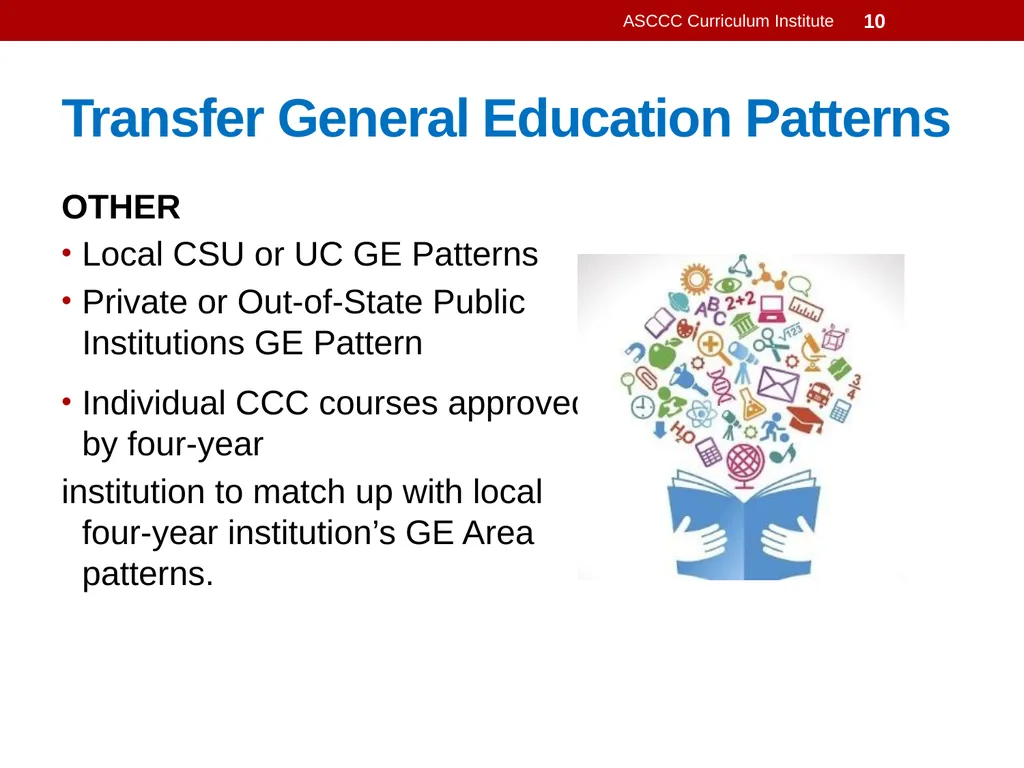
Transfer General Education Patterns OTHER
Local CSU or UC GE Patterns
Private or Out-of-State Public Institutions GE Pattern
Individual CCC courses approved by four-year
institution to match up with local four-year institution’s GE Area patterns. ASCCC Curriculum Institute 10<br>
11
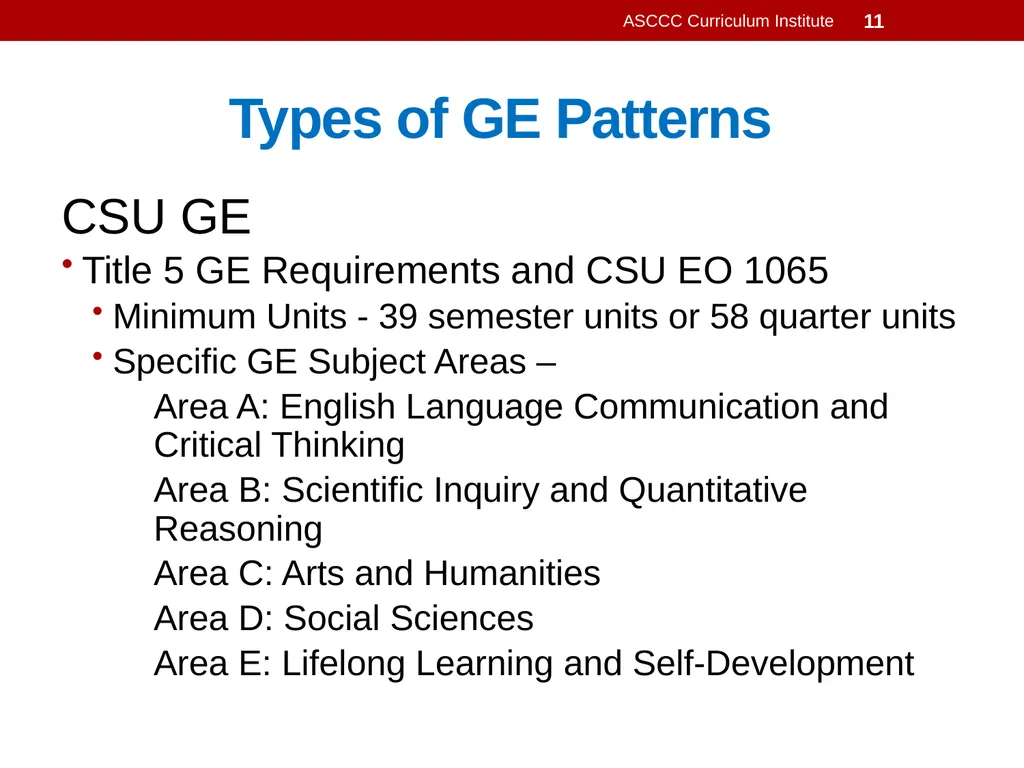
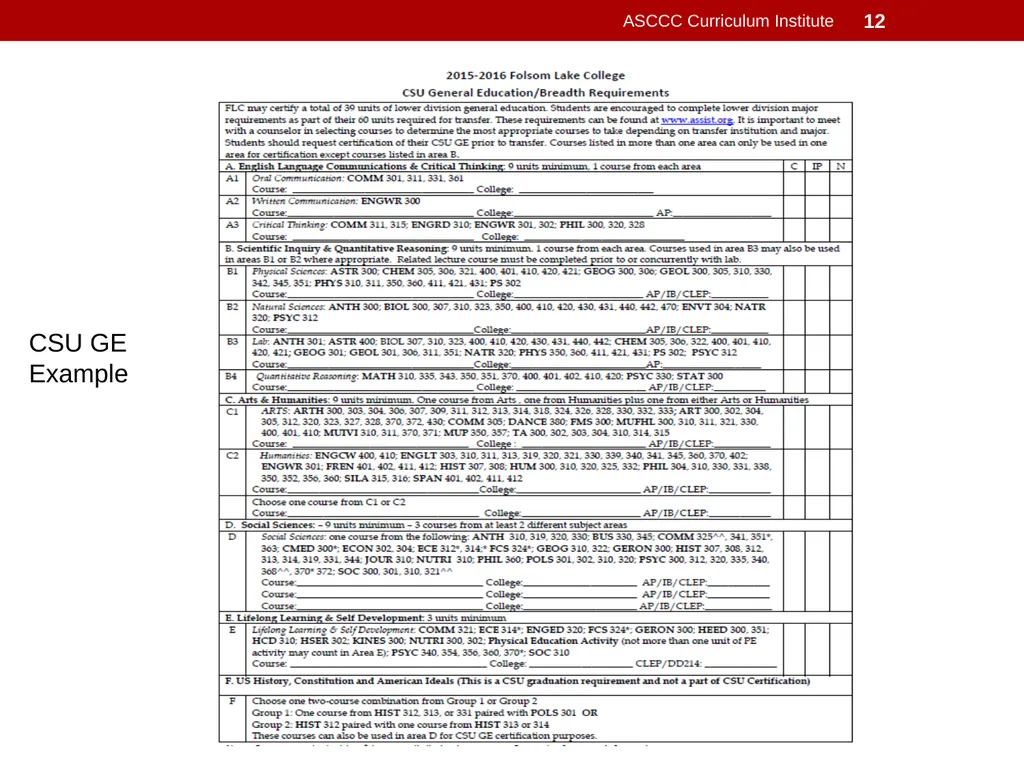
Types of GE Patterns CSU GE
Title 5 GE Requirements and CSU EO 1065
Minimum Units - 39 semester units or 58 quarter units
Specific GE Subject Areas –
Area A: English Language Communication and Critical Thinking
Area B: Scientific Inquiry and Quantitative Reasoning
Area C: Arts and Humanities
Area D: Social Sciences
Area E: Lifelong Learning and Self-Development ASCCC Curriculum Institute 11<br>
12
CSU GE Example ASCCC Curriculum Institute 12<br>
13
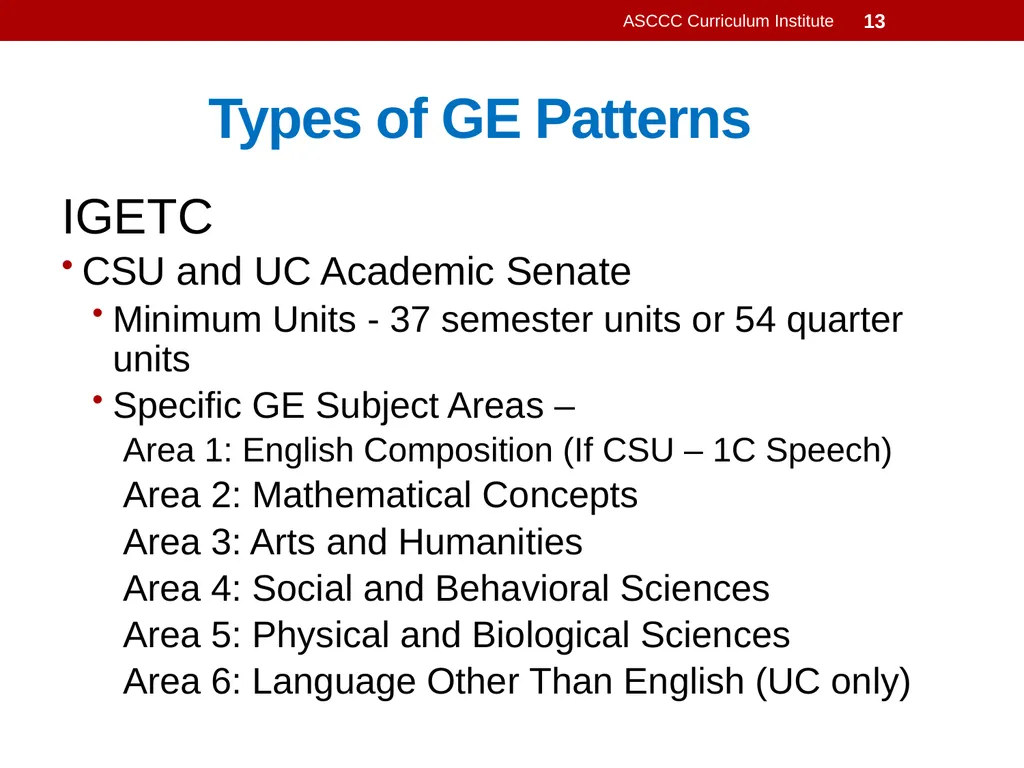
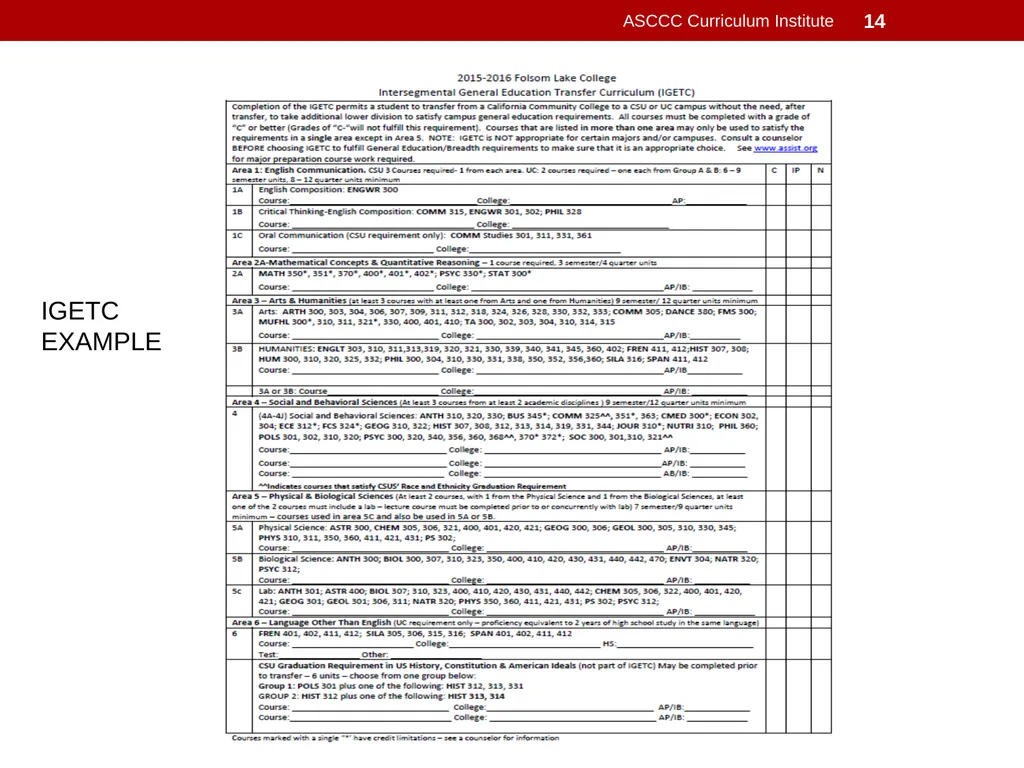
Types of GE Patterns IGETC
CSU and UC Academic Senate
Minimum Units - 37 semester units or 54 quarter units
Specific GE Subject Areas –
Area 1: English Composition (If CSU – 1C Speech)
Area 2: Mathematical Concepts
Area 3: Arts and Humanities
Area 4: Social and Behavioral Sciences
Area 5: Physical and Biological Sciences
Area 6: Language Other Than English (UC only) ASCCC Curriculum Institute 13<br>
14
IGETC EXAMPLE ASCCC Curriculum Institute 14<br>
15
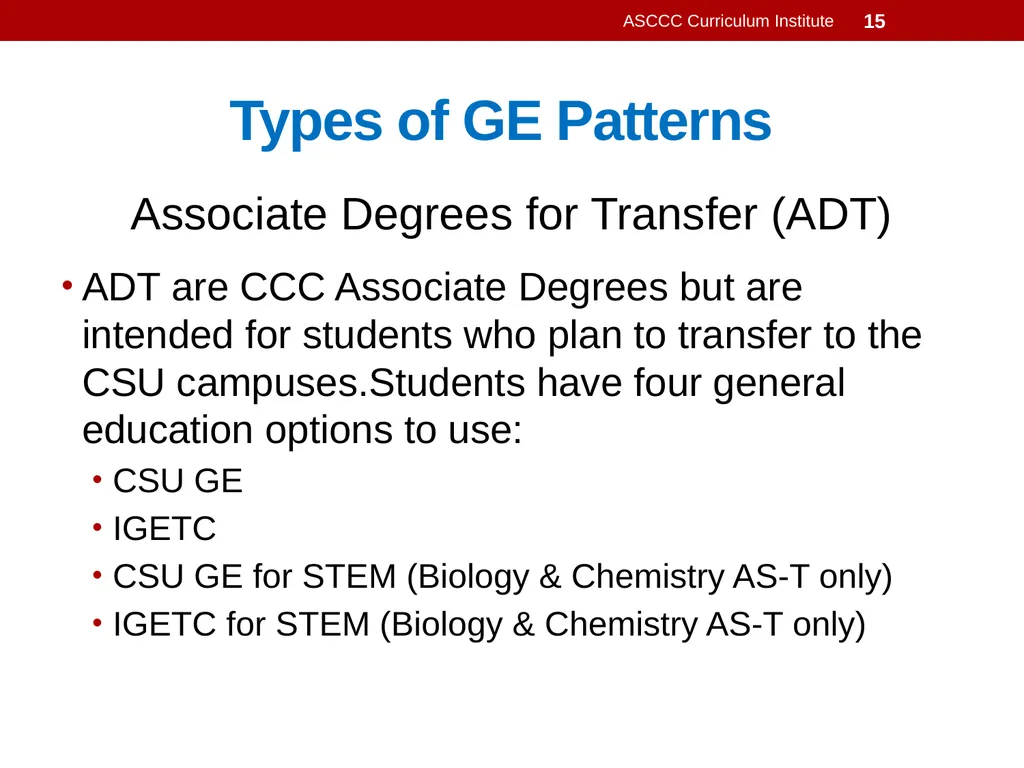
Types of GE Patterns Associate Degrees for Transfer (ADT)
ADT are CCC Associate Degrees but are intended for students who plan to transfer to the CSU campuses.Students have four general education options to use:
CSU GE
IGETC
CSU GE for STEM (Biology & Chemistry AS-T only)
IGETC for STEM (Biology & Chemistry AS-T only) ASCCC Curriculum Institute 15<br>
16
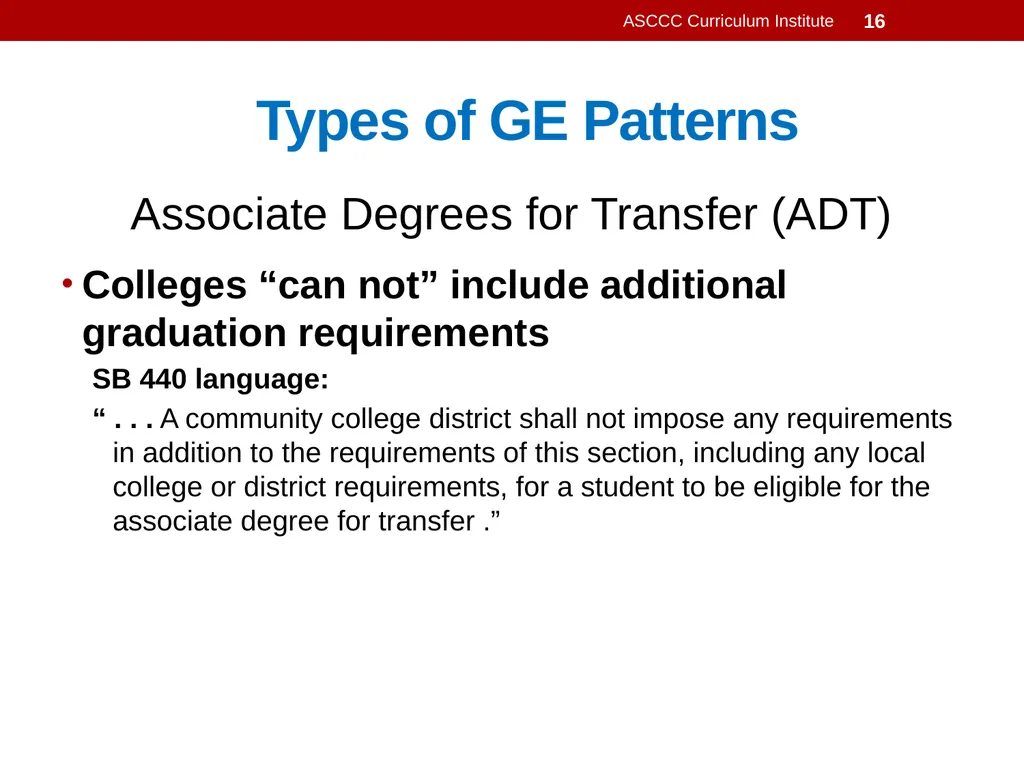
Types of GE Patterns Associate Degrees for Transfer (ADT)
Colleges “can not” include additional graduation requirements
SB 440 language:
“ . . . A community college district shall not impose any requirements in addition to the requirements of this section, including any local college or district requirements, for a student to be eligible for the associate degree for transfer .” ASCCC Curriculum Institute 16<br>
17
ASCCC Curriculum Institute 17<br>
18
ASCCC Curriculum Institute 18<br>
19
ASCCC Curriculum Institute 19<br>
20
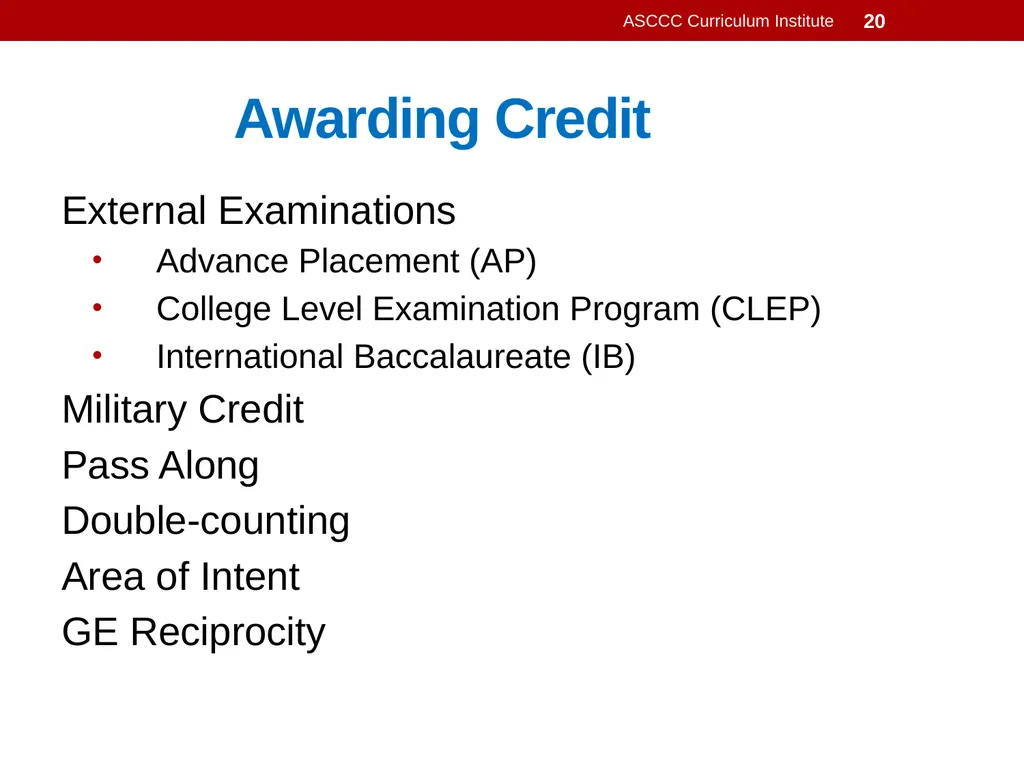
Awarding Credit External Examinations
Advance Placement (AP)
College Level Examination Program (CLEP)
International Baccalaureate (IB)
Military Credit
Pass Along
Double-counting
Area of Intent
GE Reciprocity ASCCC Curriculum Institute 20<br>
21
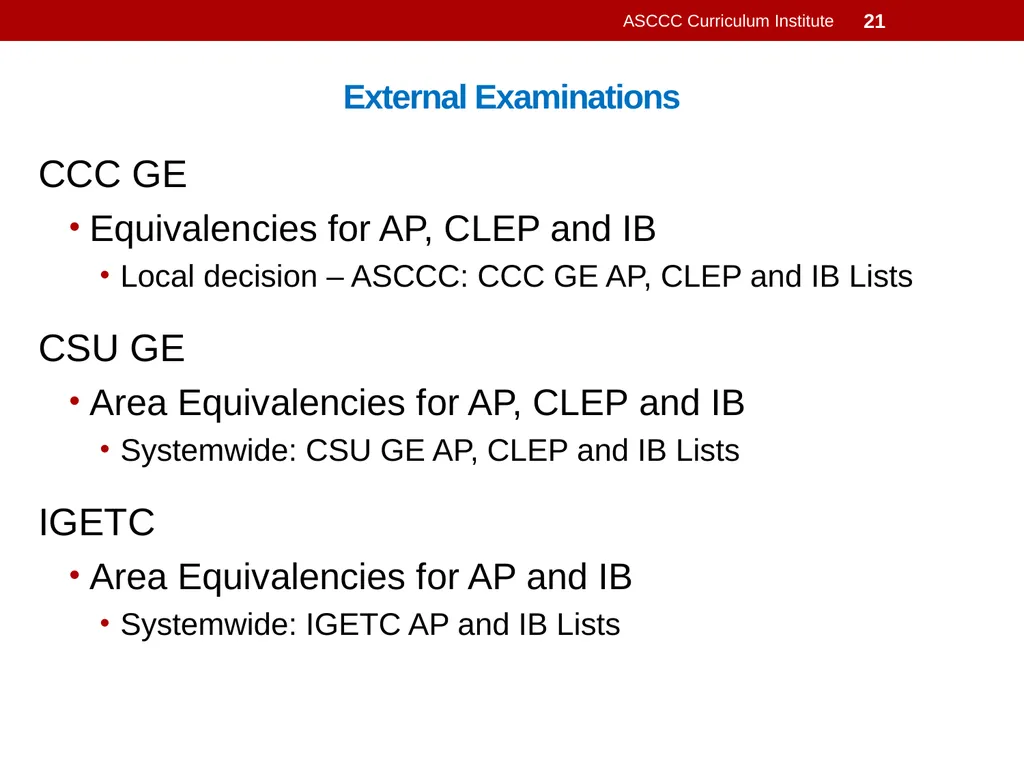
External Examinations CCC GE
Equivalencies for AP, CLEP and IB
Local decision – ASCCC: CCC GE AP, CLEP and IB Lists
CSU GE
Area Equivalencies for AP, CLEP and IB
Systemwide: CSU GE AP, CLEP and IB Lists
IGETC
Area Equivalencies for AP and IB
Systemwide: IGETC AP and IB Lists ASCCC Curriculum Institute 21<br>
22
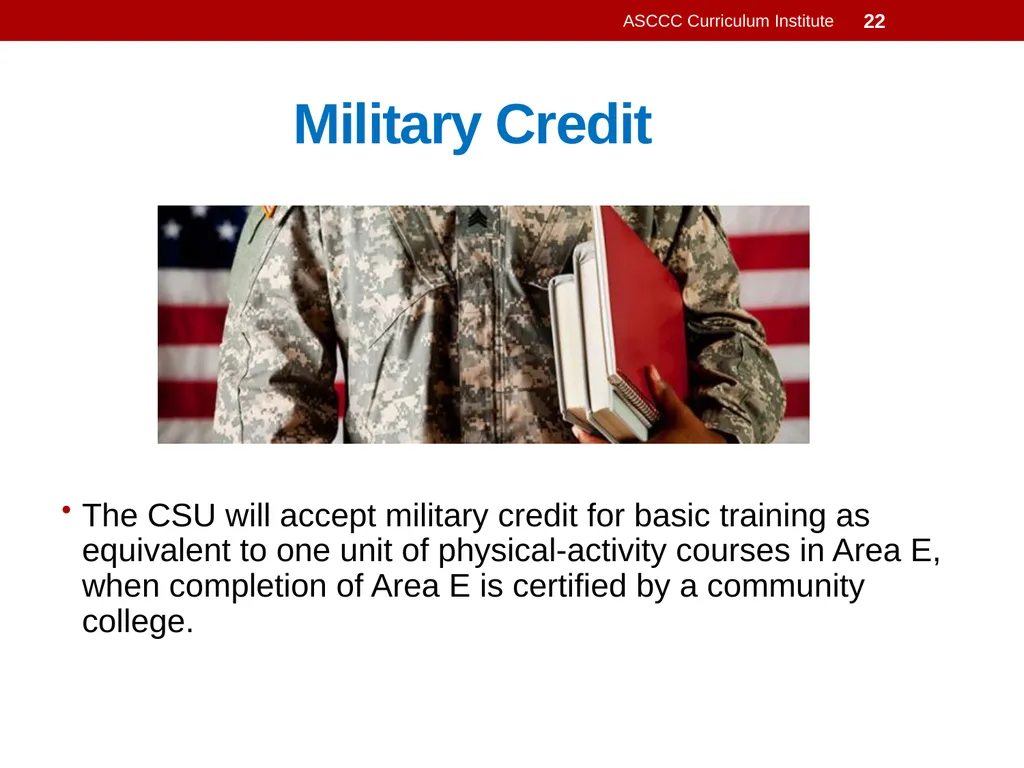
Military Credit The CSU will accept military credit for basic training as equivalent to one unit of physical-activity courses in Area E, when completion of Area E is certified by a community college. ASCCC Curriculum Institute 22<br>
23
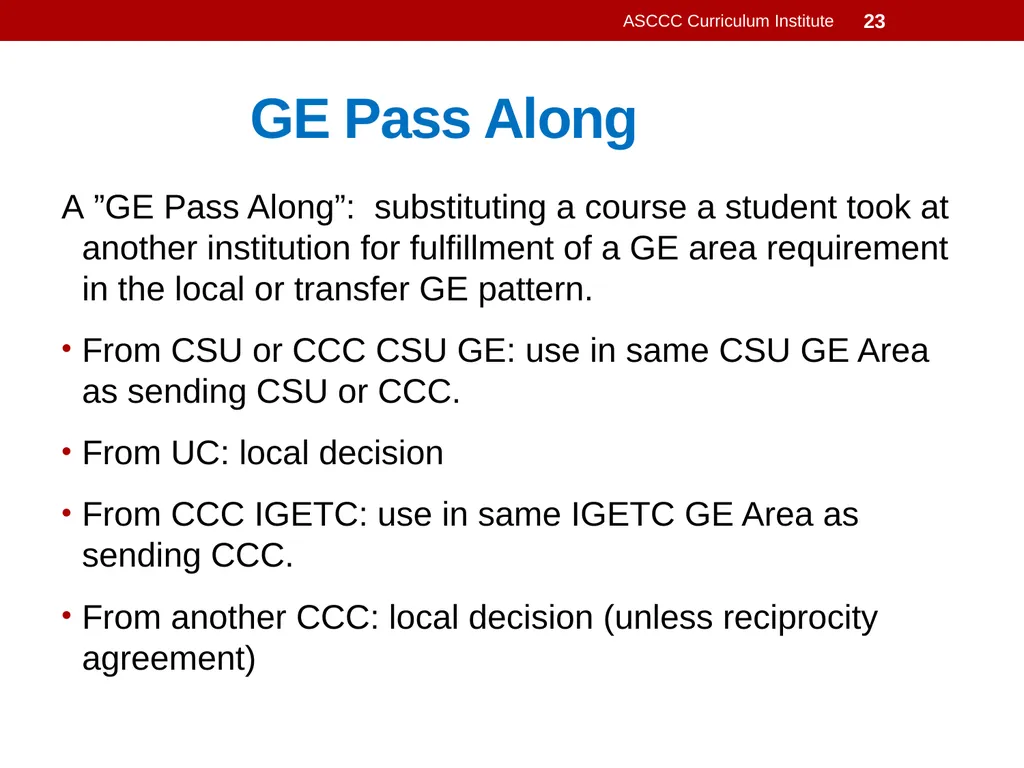
GE Pass Along A ”GE Pass Along”: substituting a course a student took at another institution for fulfillment of a GE area requirement in the local or transfer GE pattern.
From CSU or CCC CSU GE: use in same CSU GE Area as sending CSU or CCC.
From UC: local decision
From CCC IGETC: use in same IGETC GE Area as sending CCC.
From another CCC: local decision (unless reciprocity agreement) ASCCC Curriculum Institute 23<br>
24
Double-counting A course can meet general education and also major requirement.
Example: Introduction to Psychology (PSYCH 101) from University of Washington would satisfy the Social Science requirement for Local GE, IGETC and CSU GE and also for students majoring in Psychology.<br>
25
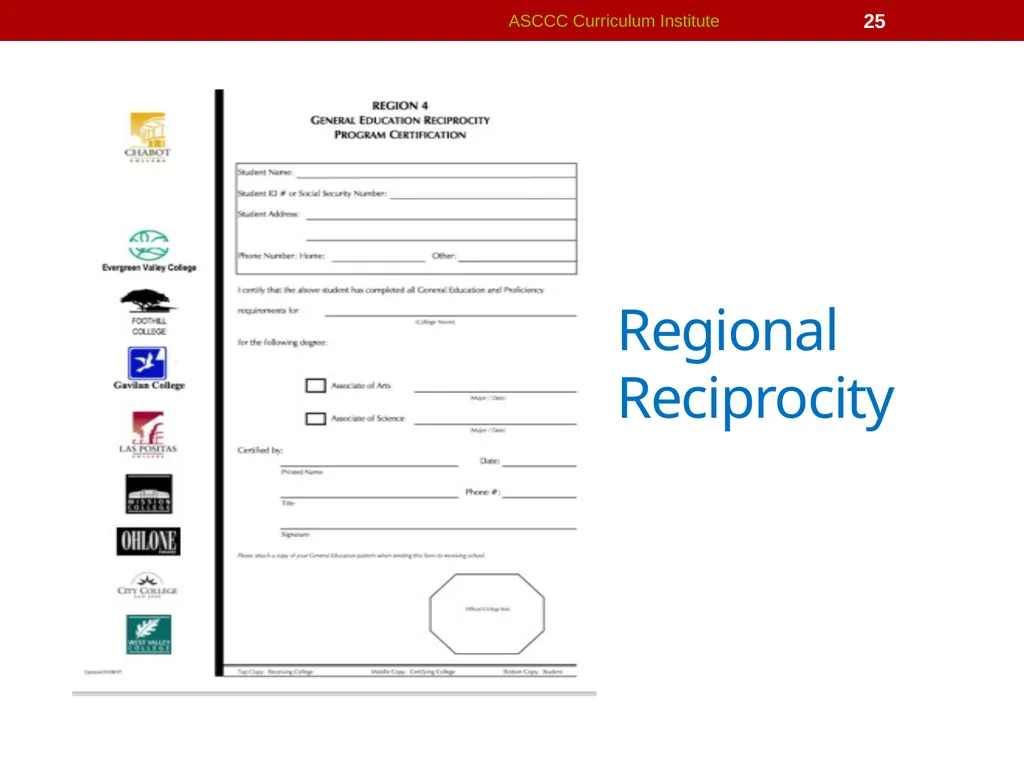
Regional Reciprocity ASCCC Curriculum Institute 25<br>
26
Resources Local
Articulation Officer
Counselors
University Transfer Center Coordinator
GE Sub-committee of Curriculum Committee
External
ASSIST www.assist.org
CCC Transfer Counselor www.ccctransfer.org ASCCC Curriculum Institute 26<br>
IGETC Standards http://ccctransfer.org/sites/default/files/documents/IGTEC/2015-16/IGETC-Standards-version-1-7.pdf ASCCC Curriculum Institute 27<br>
28
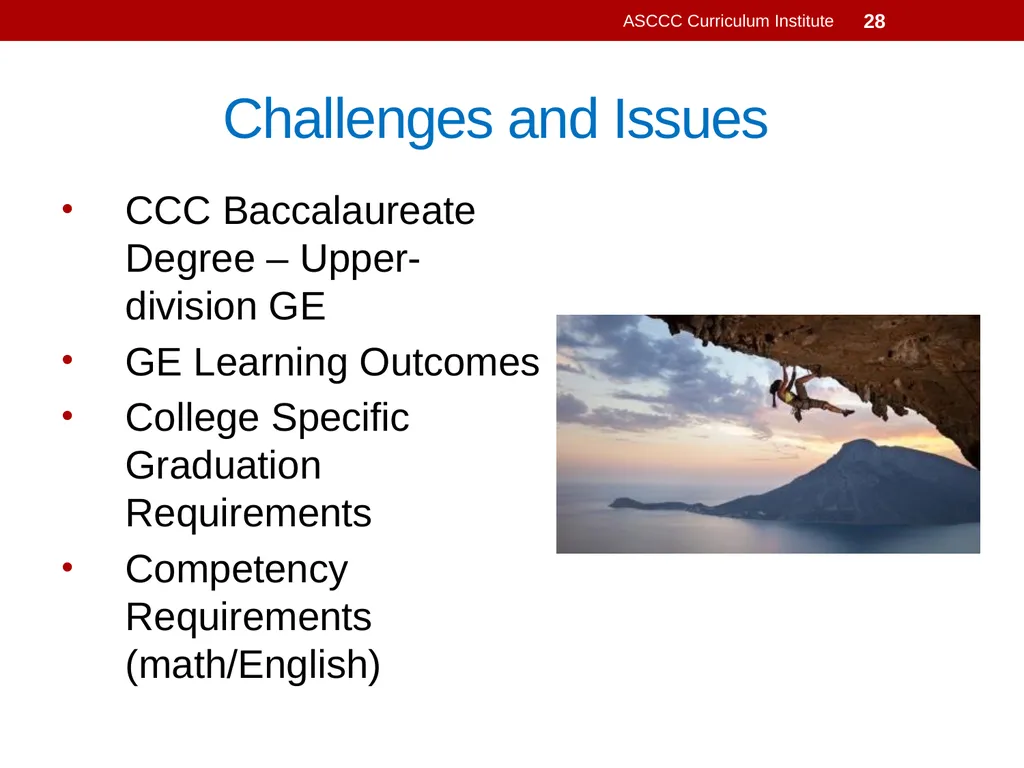
Challenges and Issues CCC Baccalaureate Degree – Upper-division GE
GE Learning Outcomes
College Specific Graduation Requirements
Competency Requirements (math/English) ASCCC Curriculum Institute 28<br>
29
Q&A Bernie Day – daybernie@fhda.edu
Dave DeGroot – ddegroot@hancockcollege.edu
Tiffany Tran – ttran76@ivc.edu ASCCC Curriculum Institute 29<br>