
General Education Board Fall Forum October 28,
CB
Published · 15 slides · 0 views

1 / 1
Description
General Education Board Fall Forum October 28, 2020 Zoom Todays discussion Discussion of the new capstone model for GE assessment Why we changed the assessment model What the results from Spring 2020 tell us How we should respond to these
Related Topics
Share
Embed code
Download this presentation From Below
"General Education Board Fall Forum October 28," is the property of its rightful owner. Permission is granted to download and print the materials on this website for personal, non-commercial use only, and to display it on your personal computer provided you do not modify the materials and that you retain all copyright notices contained in the materials. By downloading content from our website, you accept the terms of this agreement.
Presentation Transcript
01
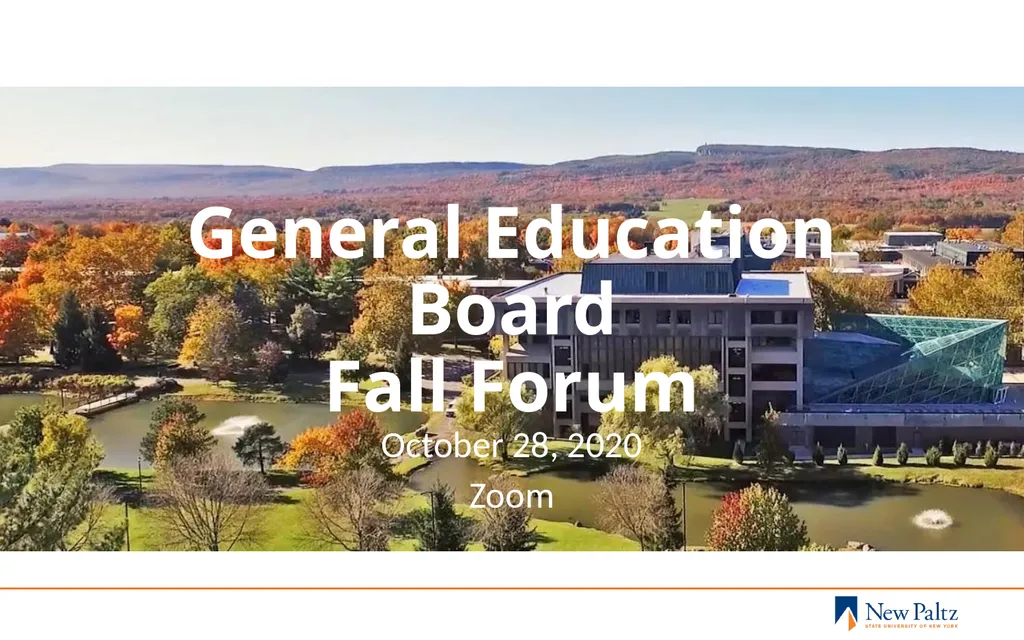
General Education Board
Fall Forum October 28, 2020
Zoom<br>
Zoom<br>
02
Today’s discussion Discussion of the new capstone model for GE assessment
Why we changed the assessment model
What the results from Spring 2020 tell us
How we should respond to these results
Split into working groups to discuss Spring 2021 assessment
United States Studies
World Civilizations
Basic Communications – Oral<br>
Why we changed the assessment model
What the results from Spring 2020 tell us
How we should respond to these results
Split into working groups to discuss Spring 2021 assessment
United States Studies
World Civilizations
Basic Communications – Oral<br>
03
Overview of New Capstone Assessment Approved by faculty at 4.3.19 Senate Meeting
Implemented for the first time during the 2019 – 2020 school year
Process overview:
Fall 2019: GE faculty develop essay prompts/questions and a rubric based on SLOs.
Spring 2020: about 25% of students in capstone classes participate in assessment. Groups of 5 faculty assessors review responses for each content area. Instructors teaching in assessed GE categories participate in a brief survey.
GE board analyzes and reports data to faculty connected to content areas.<br>
04
Example: essay prompt for Humanities Choose a text or work of art from the humanities (e.g. a novel, short story, poem, visual art, piece of music, film, play, philosophical dialogue or essay, historical text, etc.) that you can describe and analyze in some detail and, ideally, that you studied in the GE course that you took in the Humanities category. Analyze how the text or work of art reflects on some aspect of the human experience, using the conventions or methodology appropriate to that work, to the best of your ability.
As a guideline, spend 5-10 minutes brainstorming so you can remember details and find the language to describe your example, then spend 25-35 minutes writing an essay of no more than 3 pages that does all of the following:
Describes the main point or features of the chosen text or work of art and provides some context. What type of text or work is it? Who wrote or created it? What is it about? What categories, genres, or concepts would you apply to it? What is its historical or cultural context?
Applies your knowledge of the methods or conventions of the relevant discipline (e.g. literature, philosophy, art history, music, theater arts, media studies, political science, black studies, WGSS, etc.) to analyze and explain the significance of this item for understanding the humanities. How does this work exemplify the insight, power, or meaning of the humanities? What theories, methods, or approaches help us to understand it? For example, you might use formalist analysis (explication) to consider how a poem depicts or critiques issues of gender or politics, give a formal analysis and interpretation of a visual work of art to illustrate the value of artistic expression, explain how a specific philosopher approaches an enduring question about human existence, discuss how a play or film subverts a plot convention to achieve a particular dramatic effect, or analyze how a theory in political science challenges the concept of human nature or the purpose of democracy.<br>
05
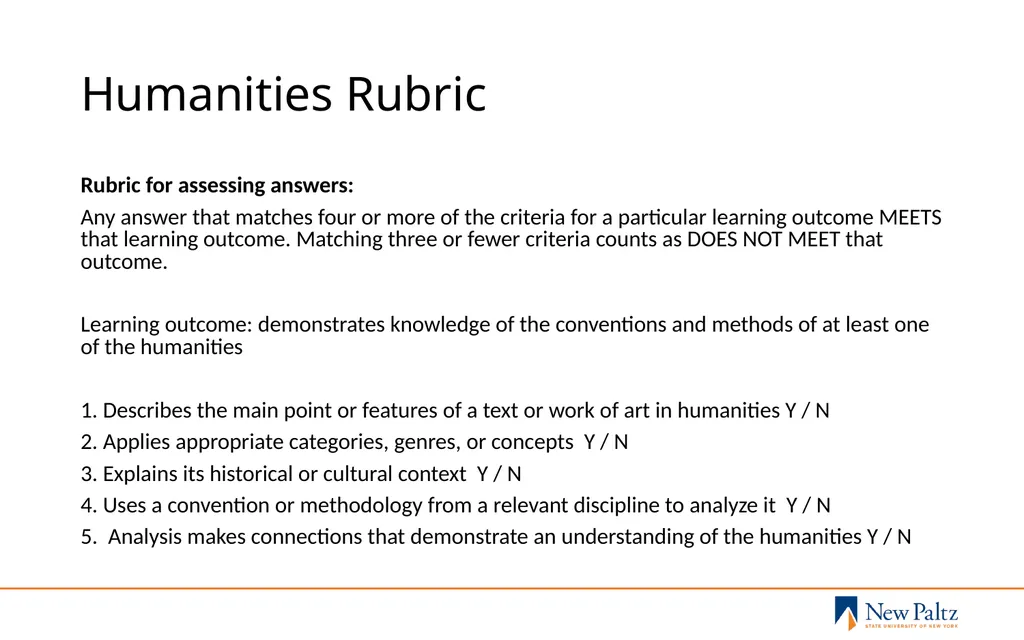
Humanities Rubric Rubric for assessing answers:
Any answer that matches four or more of the criteria for a particular learning outcome MEETS that learning outcome. Matching three or fewer criteria counts as DOES NOT MEET that outcome.
Learning outcome: demonstrates knowledge of the conventions and methods of at least one of the humanities
1. Describes the main point or features of a text or work of art in humanities Y / N
2. Applies appropriate categories, genres, or concepts Y / N
3. Explains its historical or cultural context Y / N
4. Uses a convention or methodology from a relevant discipline to analyze it Y / N
5. Analysis makes connections that demonstrate an understanding of the humanities Y / N<br>
06
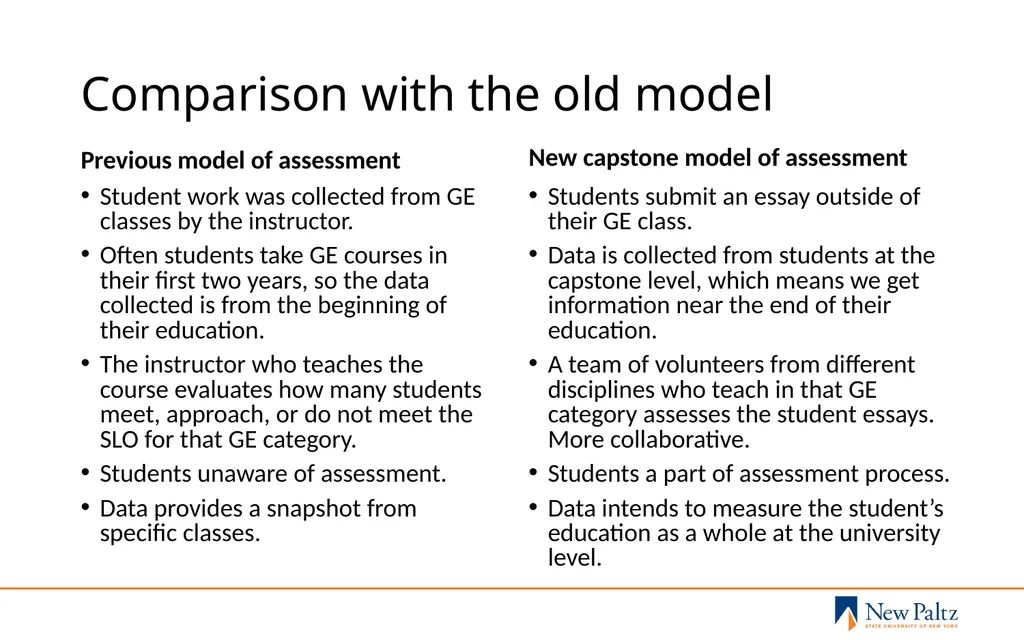
Comparison with the old model Previous model of assessment Student work was collected from GE classes by the instructor.
Often students take GE courses in their first two years, so the data collected is from the beginning of their education.
The instructor who teaches the course evaluates how many students meet, approach, or do not meet the SLO for that GE category.
Students unaware of assessment.
Data provides a snapshot from specific classes. New capstone model of assessment Students submit an essay outside of their GE class.
Data is collected from students at the capstone level, which means we get information near the end of their education.
A team of volunteers from different disciplines who teach in that GE category assesses the student essays. More collaborative.
Students a part of assessment process.
Data intends to measure the student’s education as a whole at the university level.<br>
07
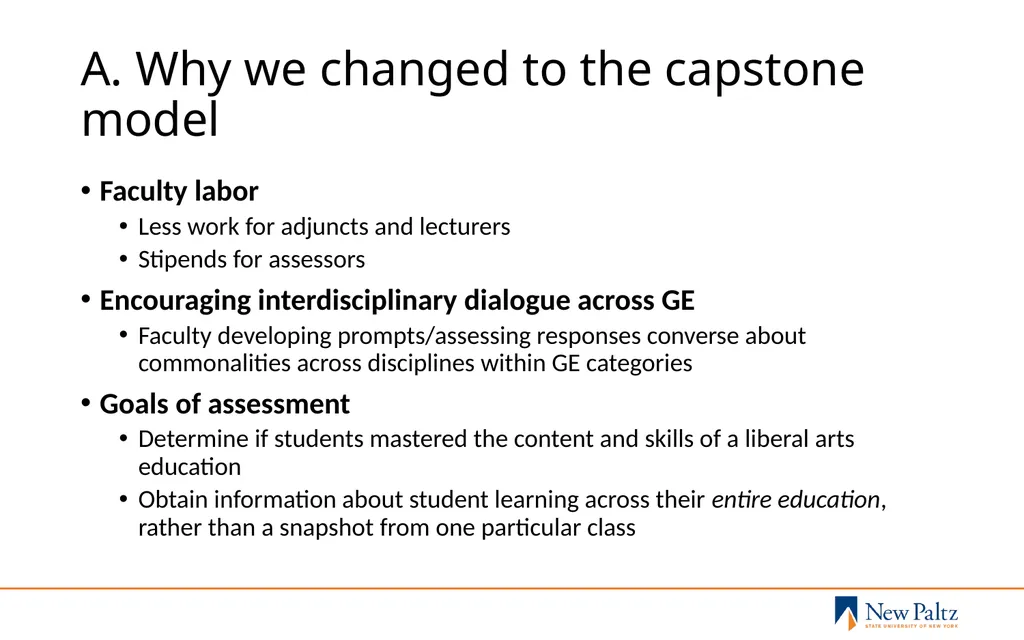
A. Why we changed to the capstone model Faculty labor
Less work for adjuncts and lecturers
Stipends for assessors
Encouraging interdisciplinary dialogue across GE
Faculty developing prompts/assessing responses converse about commonalities across disciplines within GE categories
Goals of assessment
Determine if students mastered the content and skills of a liberal arts education
Obtain information about student learning across their entire education, rather than a snapshot from one particular class<br>
08
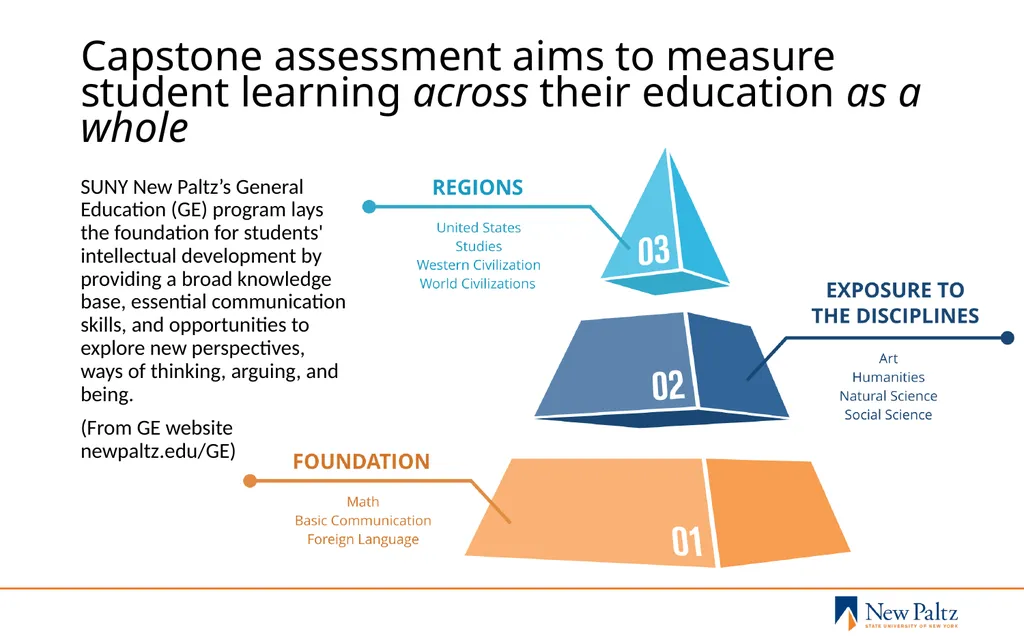
Capstone assessment aims to measure student learning across their education as a whole SUNY New Paltz’s General Education (GE) program lays the foundation for students' intellectual development by providing a broad knowledge base, essential communication skills, and opportunities to explore new perspectives, ways of thinking, arguing, and being.
(From GE website newpaltz.edu/GE)<br>
(From GE website newpaltz.edu/GE)<br>
09
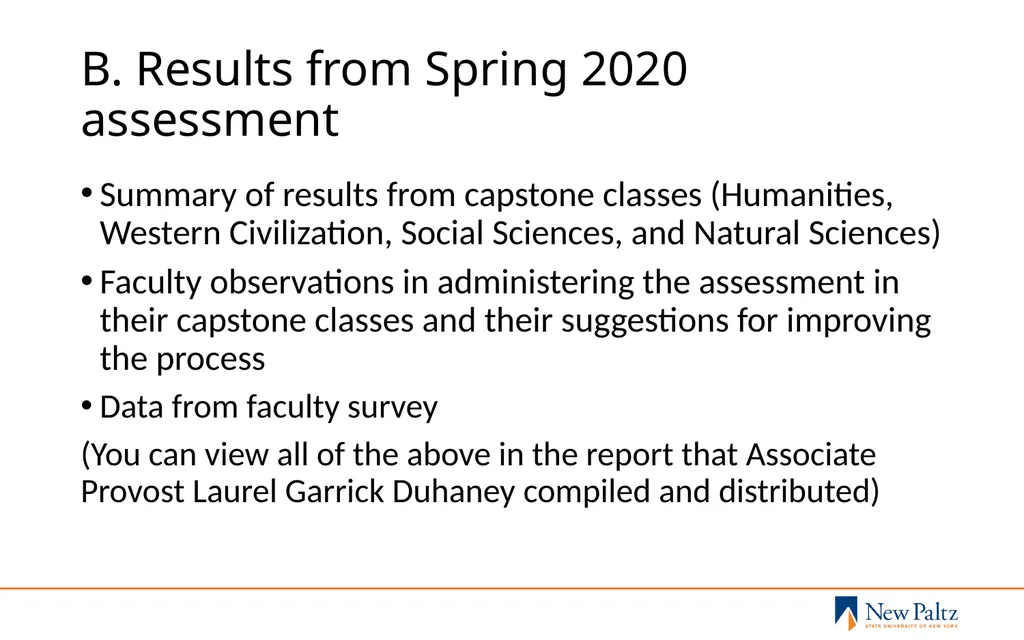
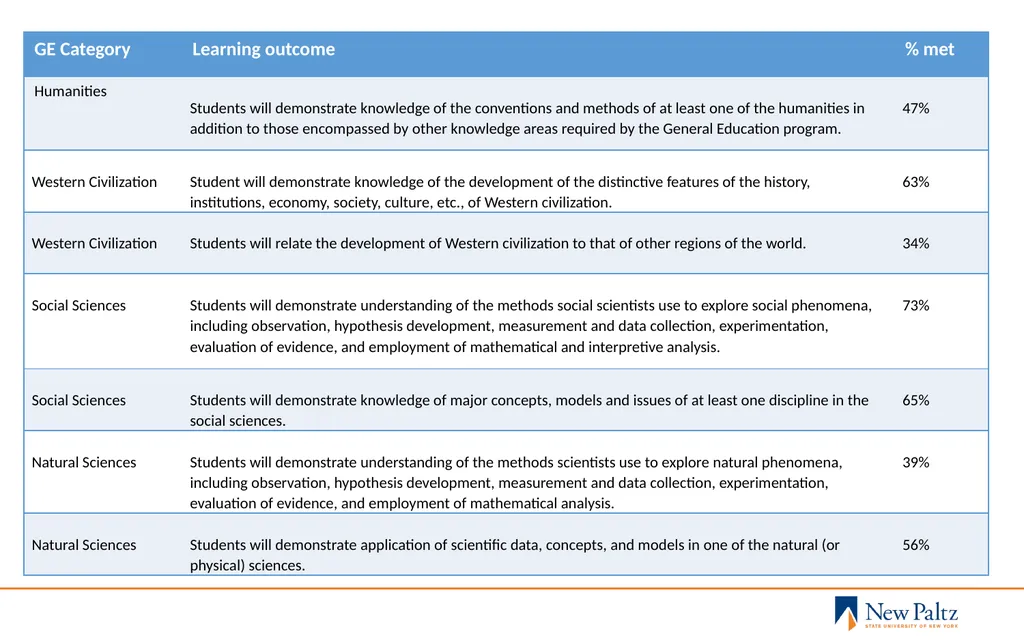
B. Results from Spring 2020 assessment Summary of results from capstone classes (Humanities, Western Civilization, Social Sciences, and Natural Sciences)
Faculty observations in administering the assessment in their capstone classes and their suggestions for improving the process
Data from faculty survey
(You can view all of the above in the report that Associate Provost Laurel Garrick Duhaney compiled and distributed)<br>
Faculty observations in administering the assessment in their capstone classes and their suggestions for improving the process
Data from faculty survey
(You can view all of the above in the report that Associate Provost Laurel Garrick Duhaney compiled and distributed)<br>
10
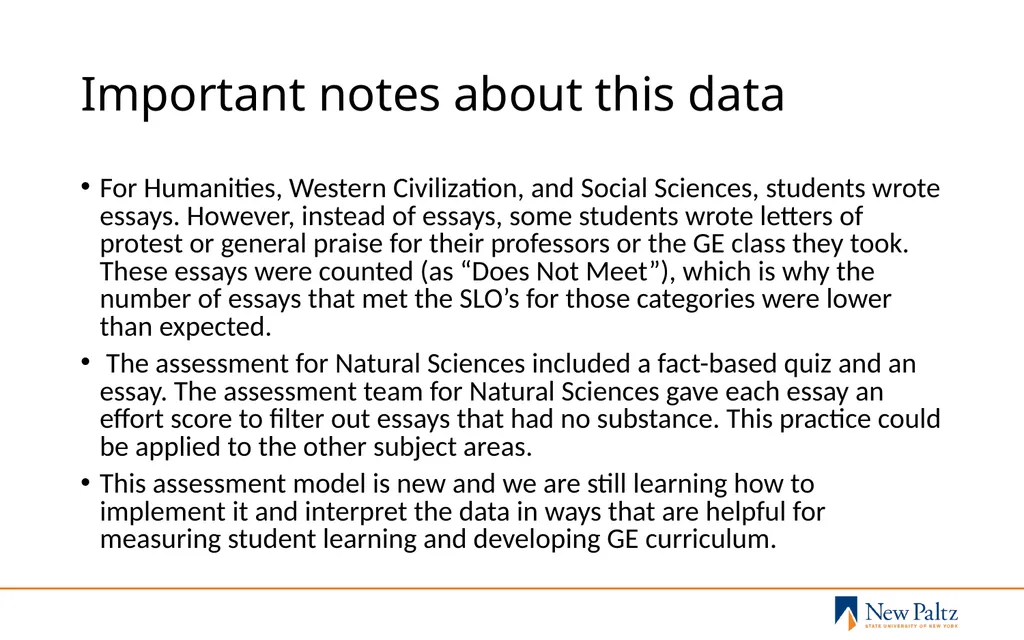
Important notes about this data For Humanities, Western Civilization, and Social Sciences, students wrote essays. However, instead of essays, some students wrote letters of protest or general praise for their professors or the GE class they took. These essays were counted (as “Does Not Meet”), which is why the number of essays that met the SLO’s for those categories were lower than expected.
The assessment for Natural Sciences included a fact-based quiz and an essay. The assessment team for Natural Sciences gave each essay an effort score to filter out essays that had no substance. This practice could be applied to the other subject areas.
This assessment model is new and we are still learning how to implement it and interpret the data in ways that are helpful for measuring student learning and developing GE curriculum.<br>
11
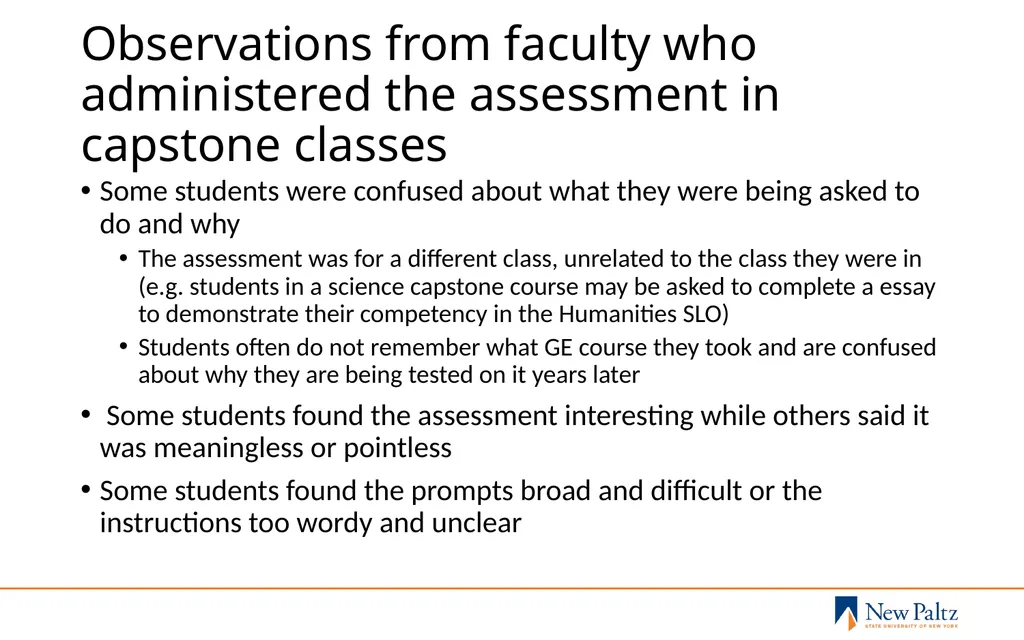
Observations from faculty who administered the assessment in capstone classes Some students were confused about what they were being asked to do and why
The assessment was for a different class, unrelated to the class they were in (e.g. students in a science capstone course may be asked to complete a essay to demonstrate their competency in the Humanities SLO)
Students often do not remember what GE course they took and are confused about why they are being tested on it years later
Some students found the assessment interesting while others said it was meaningless or pointless
Some students found the prompts broad and difficult or the instructions too wordy and unclear<br>
12
Faculty Comments about Improving the Assessment Take-home exam or online, not in class
Give students the chance to comment on the prompts and on GE
Mitigate the element of surprise that students showed by informing them about the assessment in their classes and explain the value of the information
Do not encourage students to write about an example from a GE course, but instead something they could comment on insightfully
Concerns about the timing and effectiveness<br>
13
C. How should we respond to these results? Refine the process for administering the assessment
Revise instructions and prompts for assessment
Refine the rubrics for assessing the essays based on what data would be most helpful
Discuss what to do with protest essays. Measure and track their frequency? Discard essays that show no effort?
Communicate the new assessment process and its goals more
Find meaningful ways to include student input in the assessment process
Other ideas?<br>
14
Breakout Groups Brainstorm ideas for new assessment prompts (World Civilizations, US Studies, Basic Communication-Oral)
Steve will place you in a group via Zoom
Do you have a group preference? Tell us in the chat<br>
Steve will place you in a group via Zoom
Do you have a group preference? Tell us in the chat<br>