
Generating Sense-specific Example Sentences with
Description: Generating Sense-specific Example Sentences with BART Goal Generate sentences using BART by encouraging the target word to appear in the sentence with the desired definition (sense). Ex: cool (fashionable and attractive at the time; often
Related Topics
Download Presentation
"Generating Sense-specific Example Sentences with" is the property of its rightful owner. Permission is granted to download and print the materials on this website for personal, non-commercial use only, and to display it on your personal computer provided you do not modify the materials and that you retain all copyright notices contained in the materials. By downloading content from our website, you accept the terms of this agreement.
Presentation Transcript
slide1. Generating Sense-specific Example Sentences with BART<br>
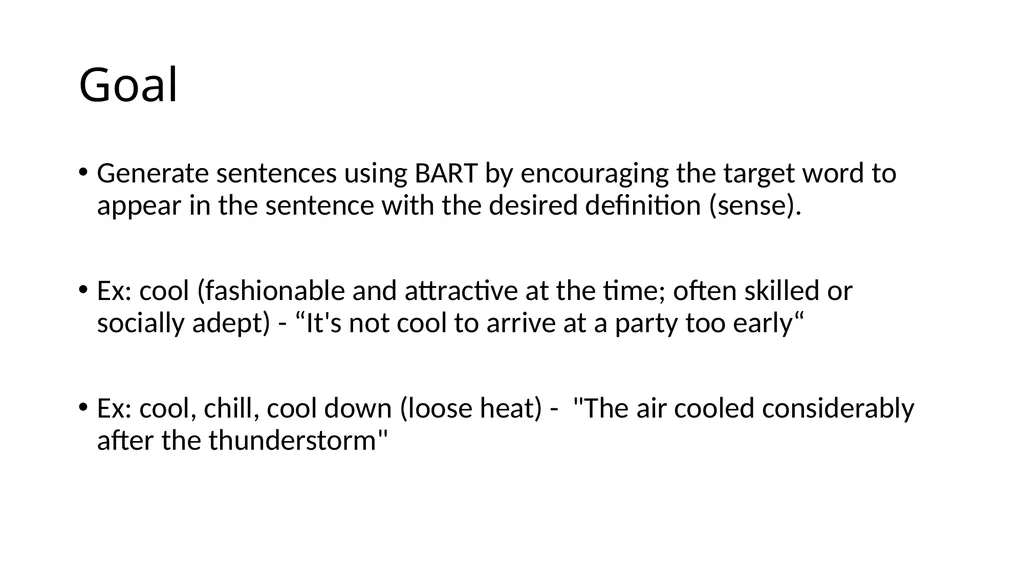
slide2. Goal Generate sentences using BART by encouraging the target word to appear in the sentence with the desired definition (sense).
Ex: cool (fashionable and attractive at the time; often skilled or socially adept) - “It's not cool to arrive at a party too early“
Ex: cool, chill, cool down (loose heat) - "The air cooled considerably after the thunderstorm"<br>
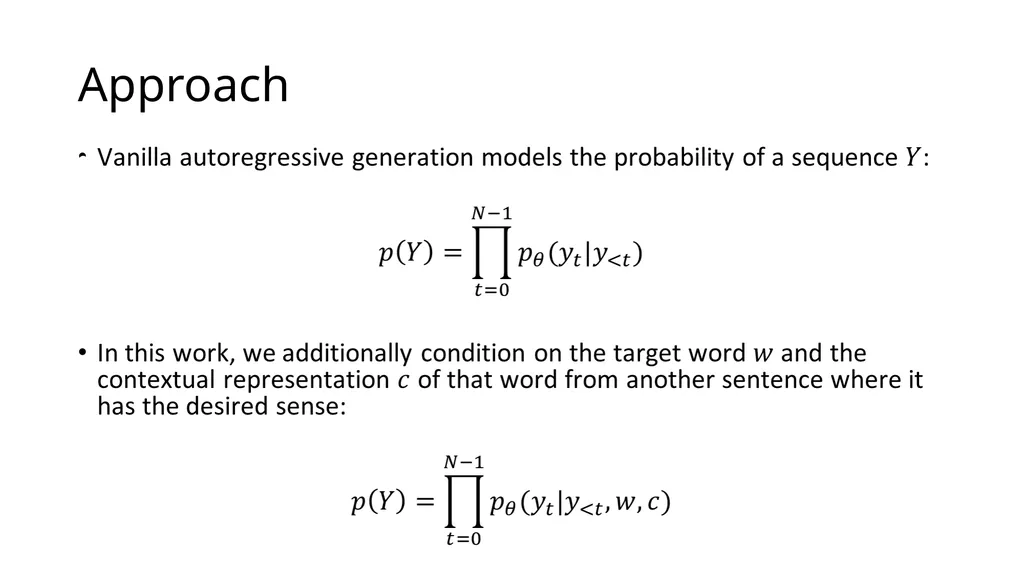
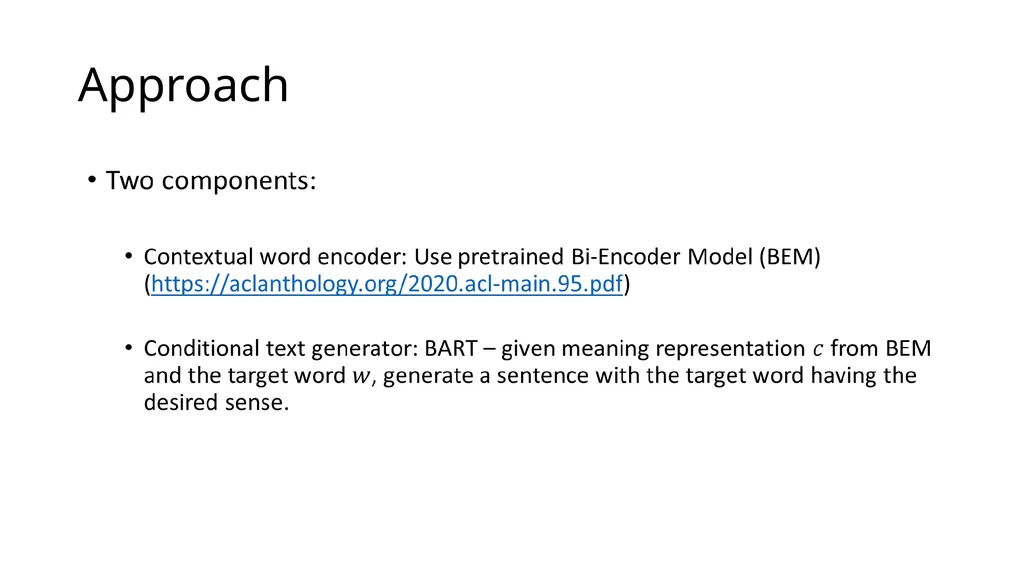
slide3. Approach<br>
slide4. Approach<br>
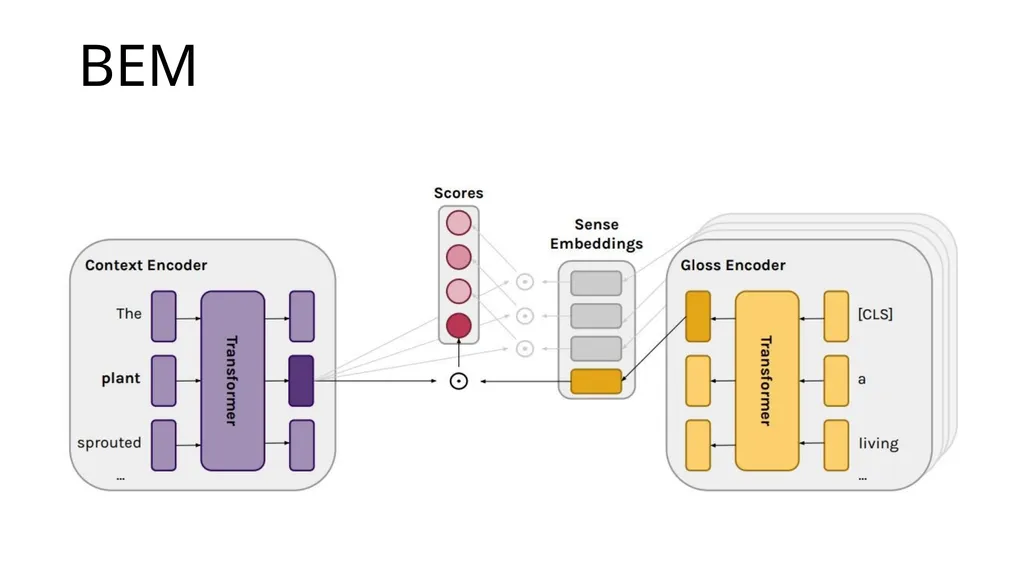
slide5. BEM<br>
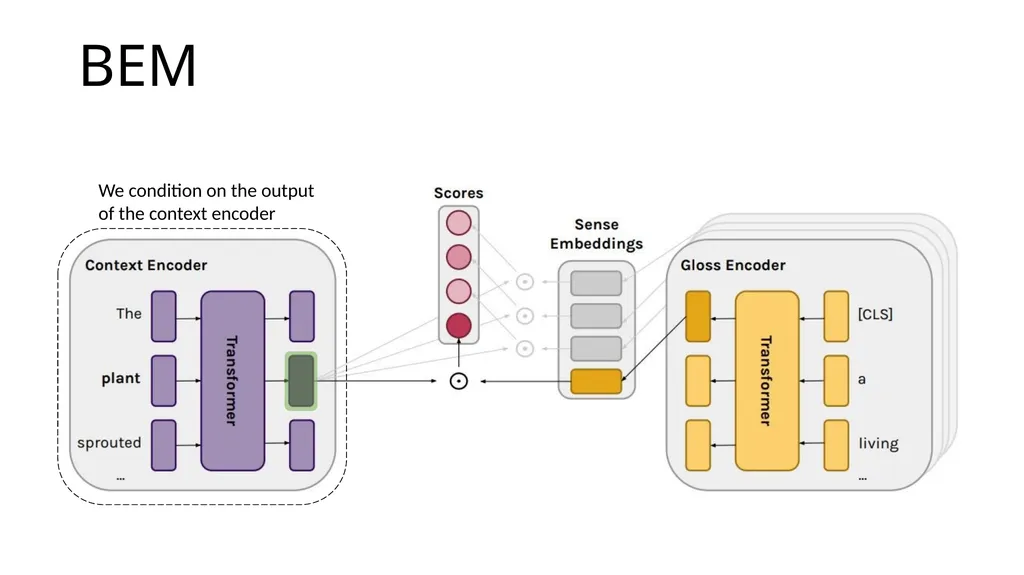
slide6. BEM We condition on the output of the context encoder<br>
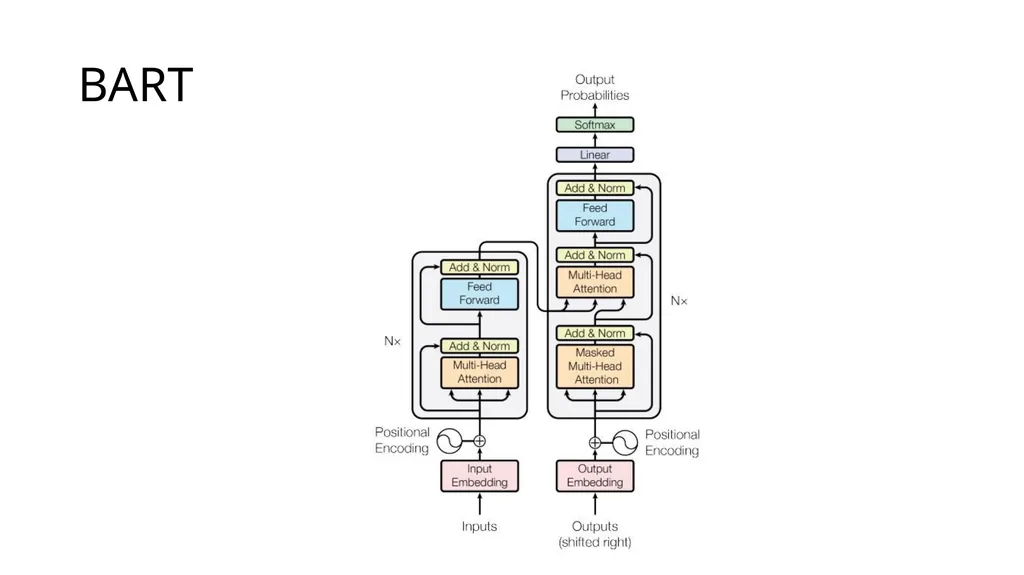
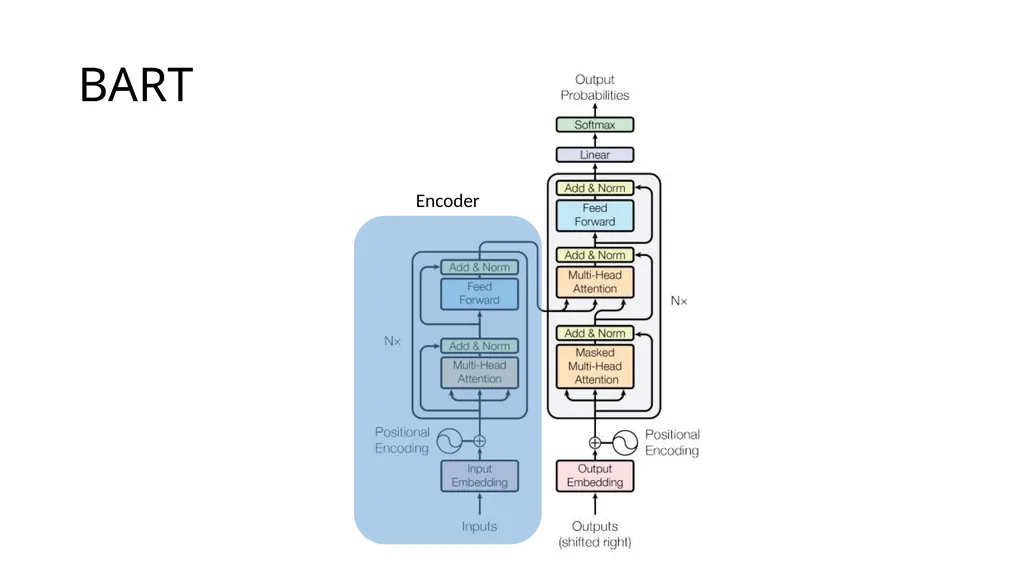
slide7. BART<br>
slide8. BART Encoder<br>
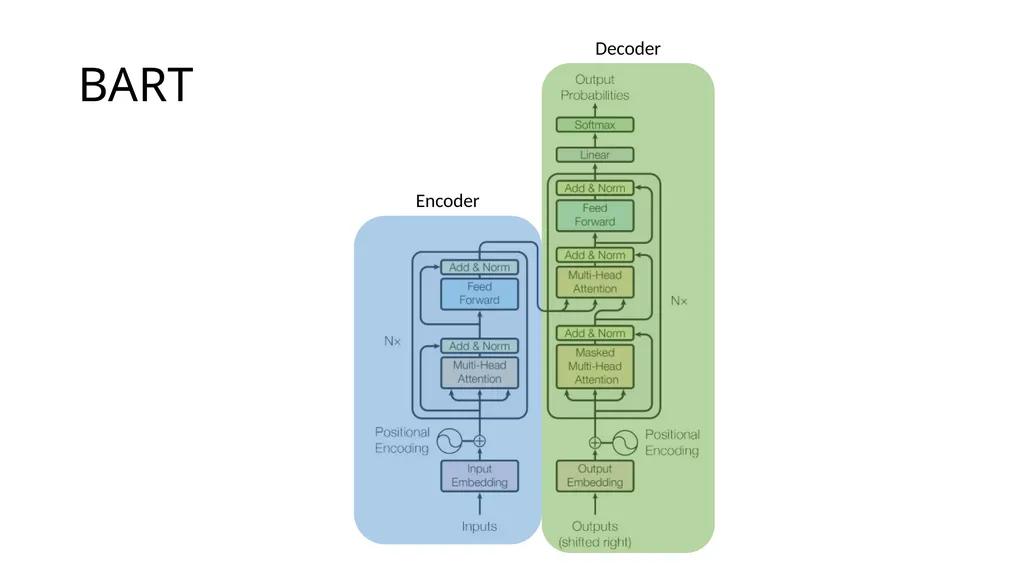
slide9. BART Encoder Decoder<br>
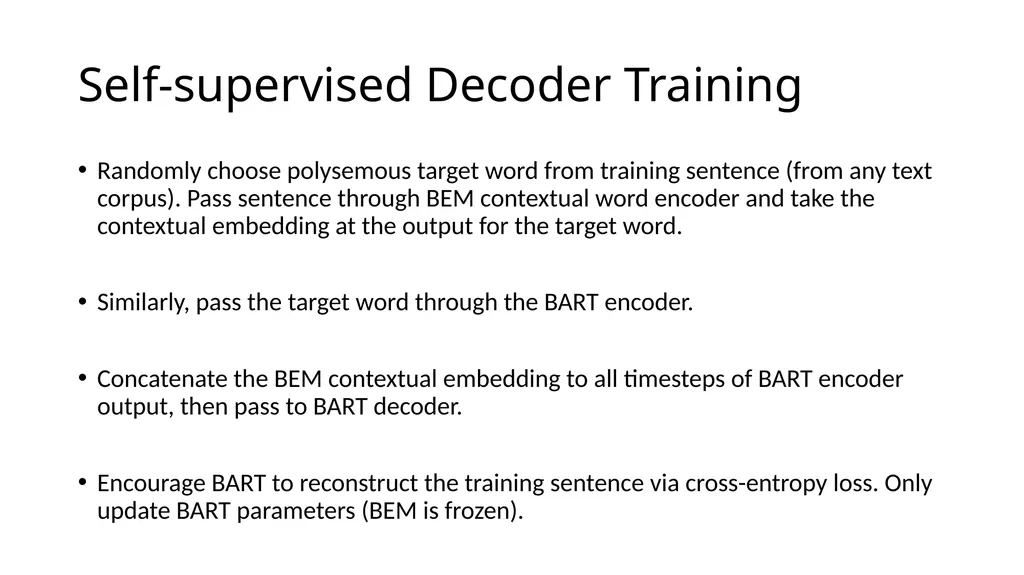
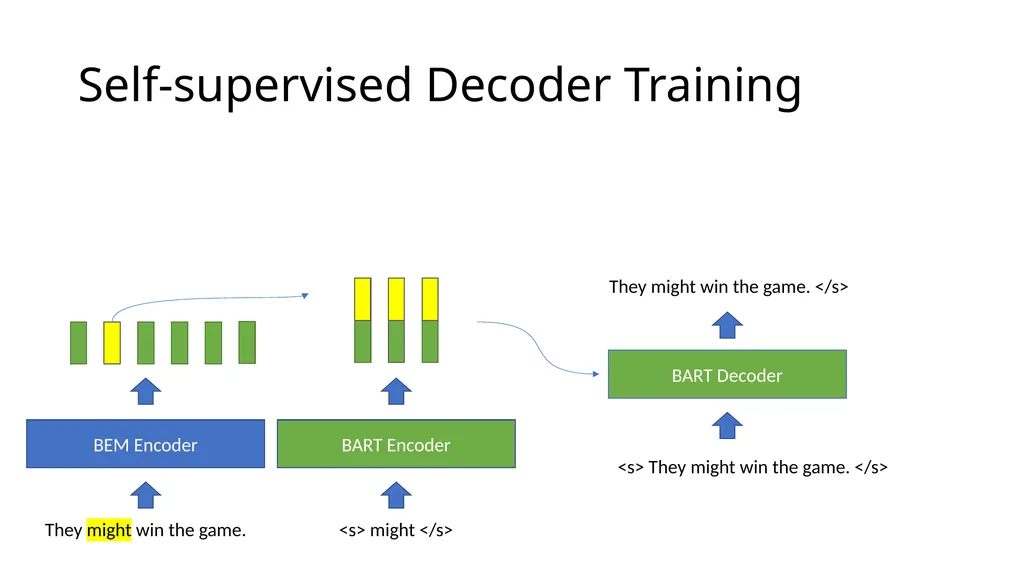
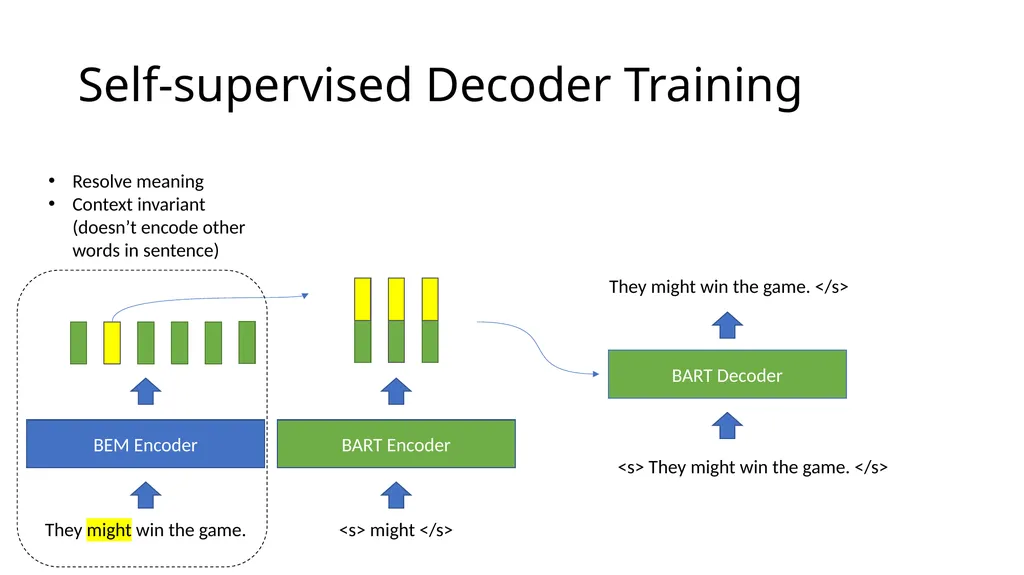
slide10. Self-supervised Decoder Training Randomly choose polysemous target word from training sentence (from any text corpus). Pass sentence through BEM contextual word encoder and take the contextual embedding at the output for the target word.
Similarly, pass the target word through the BART encoder.
Concatenate the BEM contextual embedding to all timesteps of BART encoder output, then pass to BART decoder.
Encourage BART to reconstruct the training sentence via cross-entropy loss. Only update BART parameters (BEM is frozen).<br>
slide11. Self-supervised Decoder Training BART Encoder <s> might </s> BART Decoder They might win the game. </s> <s> They might win the game. </s> BEM Encoder They might win the game.<br>
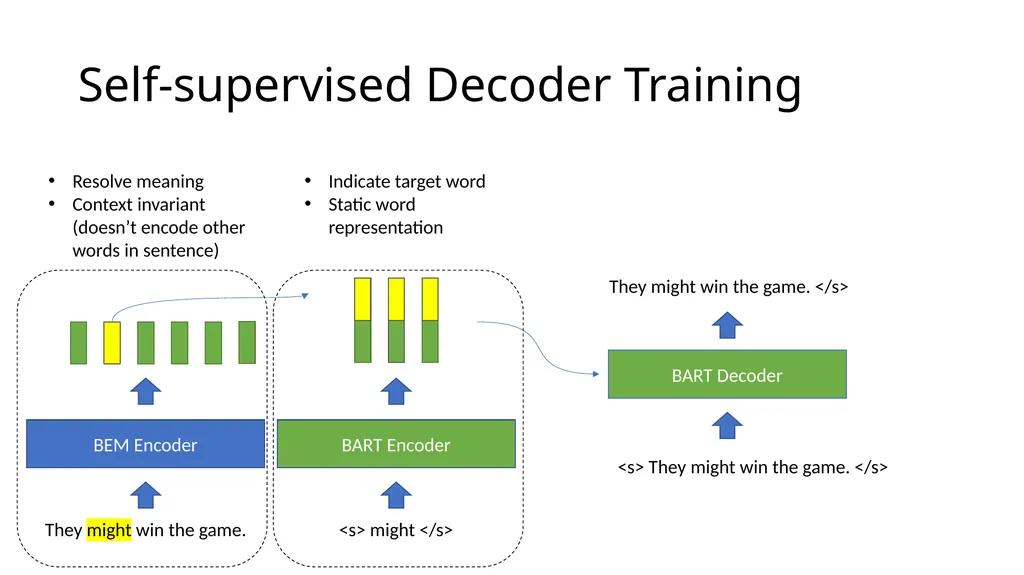
slide12. Self-supervised Decoder Training BART Encoder <s> might </s> BART Decoder They might win the game. </s> <s> They might win the game. </s> BEM Encoder They might win the game. Resolve meaning
Context invariant (doesn’t encode other words in sentence)<br>
slide13. Self-supervised Decoder Training BART Encoder <s> might </s> BART Decoder They might win the game. </s> <s> They might win the game. </s> BEM Encoder They might win the game. Resolve meaning
Context invariant (doesn’t encode other words in sentence) Indicate target word
Static word representation<br>
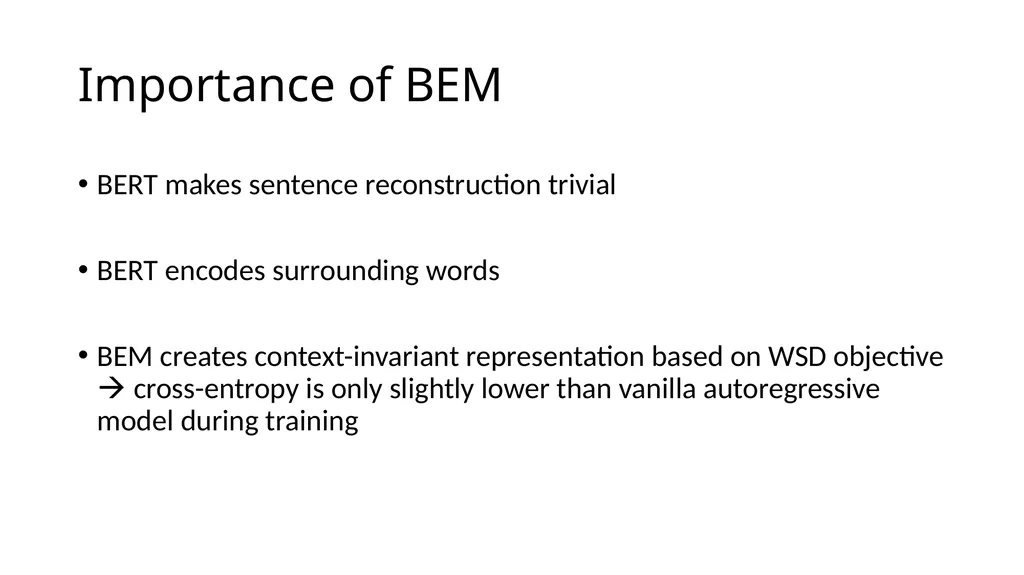
slide14. Importance of BEM BERT makes sentence reconstruction trivial
BERT encodes surrounding words
BEM creates context-invariant representation based on WSD objective cross-entropy is only slightly lower than vanilla autoregressive model during training<br>
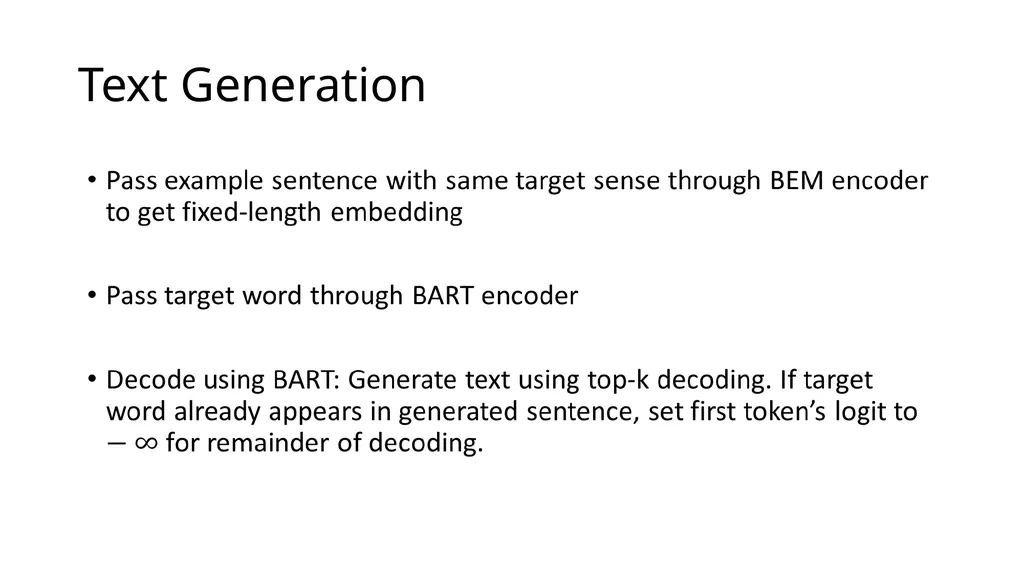
slide15. Text Generation<br>
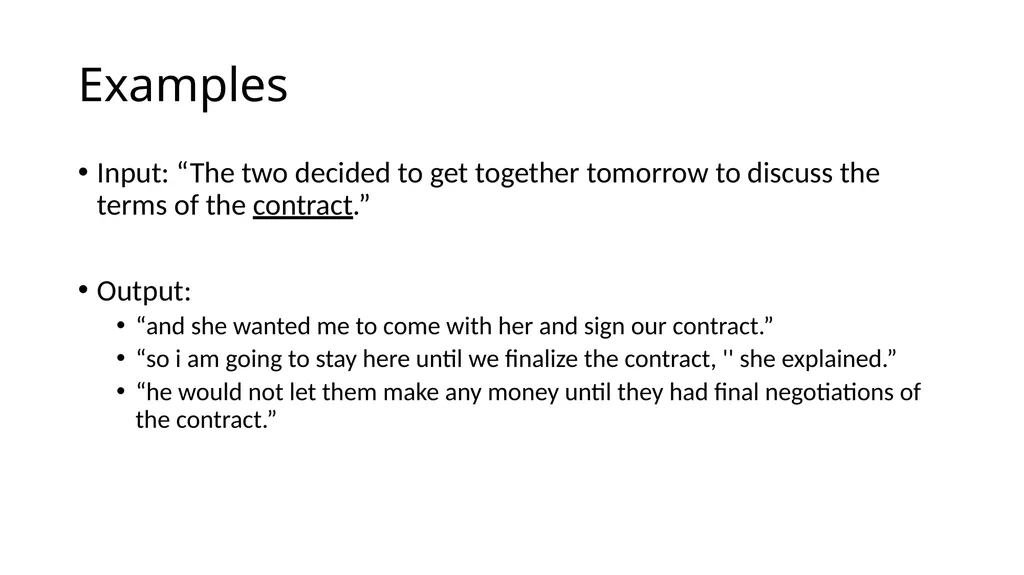
slide16. Examples Input: “The two decided to get together tomorrow to discuss the terms of the contract.”
Output:
“and she wanted me to come with her and sign our contract.”
“so i am going to stay here until we finalize the contract, '' she explained.”
“he would not let them make any money until they had final negotiations of the contract.”<br>
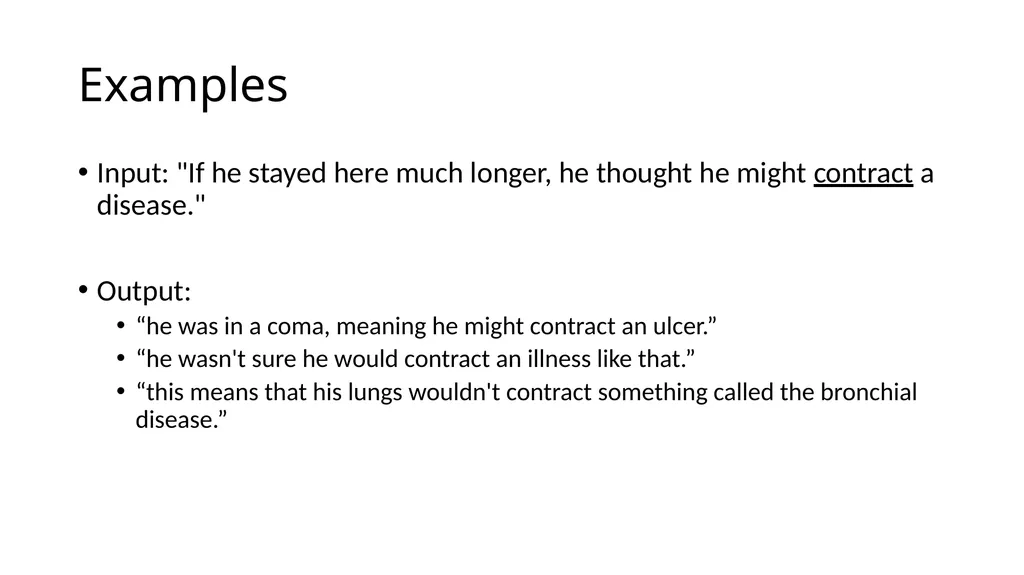
slide17. Examples Input: "If he stayed here much longer, he thought he might contract a disease."
Output:
“he was in a coma, meaning he might contract an ulcer.”
“he wasn't sure he would contract an illness like that.”
“this means that his lungs wouldn't contract something called the bronchial disease.”<br>
slide18. Evaluations Word-in-Context
Word Sense Disambiguation
Human evaluations<br>
slide19. Conclusions Self-supervised approach for generating sentences with a target word sense
Future applications include data augmentation and construction of dictionaries for low-resourced languages<br>
slide2. Goal Generate sentences using BART by encouraging the target word to appear in the sentence with the desired definition (sense).
Ex: cool (fashionable and attractive at the time; often skilled or socially adept) - “It's not cool to arrive at a party too early“
Ex: cool, chill, cool down (loose heat) - "The air cooled considerably after the thunderstorm"<br>
slide3. Approach<br>
slide4. Approach<br>
slide5. BEM<br>
slide6. BEM We condition on the output of the context encoder<br>
slide7. BART<br>
slide8. BART Encoder<br>
slide9. BART Encoder Decoder<br>
slide10. Self-supervised Decoder Training Randomly choose polysemous target word from training sentence (from any text corpus). Pass sentence through BEM contextual word encoder and take the contextual embedding at the output for the target word.
Similarly, pass the target word through the BART encoder.
Concatenate the BEM contextual embedding to all timesteps of BART encoder output, then pass to BART decoder.
Encourage BART to reconstruct the training sentence via cross-entropy loss. Only update BART parameters (BEM is frozen).<br>
slide11. Self-supervised Decoder Training BART Encoder <s> might </s> BART Decoder They might win the game. </s> <s> They might win the game. </s> BEM Encoder They might win the game.<br>
slide12. Self-supervised Decoder Training BART Encoder <s> might </s> BART Decoder They might win the game. </s> <s> They might win the game. </s> BEM Encoder They might win the game. Resolve meaning
Context invariant (doesn’t encode other words in sentence)<br>
slide13. Self-supervised Decoder Training BART Encoder <s> might </s> BART Decoder They might win the game. </s> <s> They might win the game. </s> BEM Encoder They might win the game. Resolve meaning
Context invariant (doesn’t encode other words in sentence) Indicate target word
Static word representation<br>
slide14. Importance of BEM BERT makes sentence reconstruction trivial
BERT encodes surrounding words
BEM creates context-invariant representation based on WSD objective cross-entropy is only slightly lower than vanilla autoregressive model during training<br>
slide15. Text Generation<br>
slide16. Examples Input: “The two decided to get together tomorrow to discuss the terms of the contract.”
Output:
“and she wanted me to come with her and sign our contract.”
“so i am going to stay here until we finalize the contract, '' she explained.”
“he would not let them make any money until they had final negotiations of the contract.”<br>
slide17. Examples Input: "If he stayed here much longer, he thought he might contract a disease."
Output:
“he was in a coma, meaning he might contract an ulcer.”
“he wasn't sure he would contract an illness like that.”
“this means that his lungs wouldn't contract something called the bronchial disease.”<br>
slide18. Evaluations Word-in-Context
Word Sense Disambiguation
Human evaluations<br>
slide19. Conclusions Self-supervised approach for generating sentences with a target word sense
Future applications include data augmentation and construction of dictionaries for low-resourced languages<br>