Genesis 5 and 11: Chronogenealogies in the Biblical History of Beginnings Gerhard F. Hasel There is a renewed interest in biblical genealogies in general and in Genesis 5 and 11:10-26 in particular. It is important to consider Genesis 5 and
"Genesis 5 and 11: Chronogenealogies in the" is the property of its rightful owner. Permission is granted to
download and print the materials on this website for personal, non-commercial use only, and to display it
on your personal computer provided you do not modify the materials and that you retain all copyright
notices contained in the materials. By downloading content from our website, you accept the terms of this
agreement.
Presentation Transcript
01
Genesis 5 and 11: Chronogenealogies in the Biblical History of Beginnings Gerhard F. Hasel<br>
02
There is a renewed interest in biblical genealogies in general and in Genesis 5 and 11:10-26 in particular.
It is important to consider Genesis 5 and 11 in view of
Their unique nature and function in the book of Genesis and in relation to other genealogies
Their textual history
Their interpretation<br>
03
There is a renewed interest in biblical genealogies in general and in Genesis 5 and 11:10-26 in particular.
It is important to consider Genesis 5 and 11 in view of
Their unique nature and function in the book of Genesis and in relation to other genealogies
Their textual history
Their interpretation<br>
04
Unique Nature and Function Trace the godly line, the carriers of God’s promises
Genesis 5--Adam to Noah
Genesis 11--Shem to Abram<br>
05
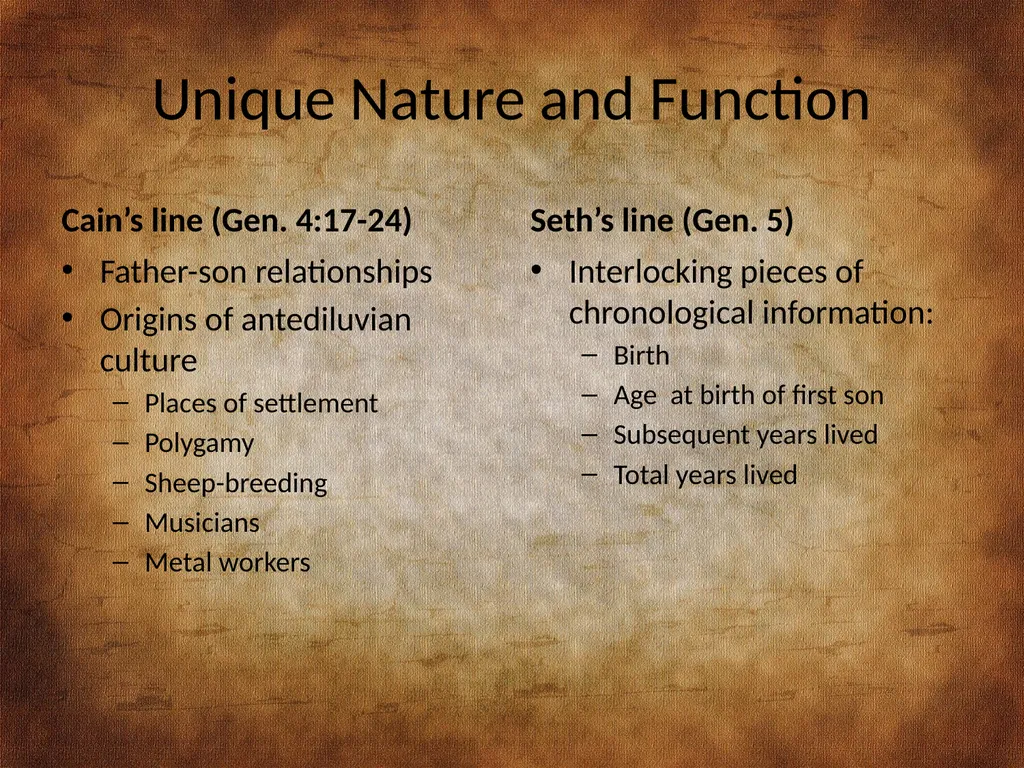
Unique Nature and Function Cain’s line (Gen. 4:17-24) Father-son relationships
Origins of antediluvian culture
Places of settlement
Polygamy
Sheep-breeding
Musicians
Metal workers Seth’s line (Gen. 5) Interlocking pieces of chronological information:
Birth
Age at birth of first son
Subsequent years lived
Total years lived<br>
06
Unique Nature and Function Chronogenealogies
These interlocking time specifications are not found in any other genealogies<br>
07
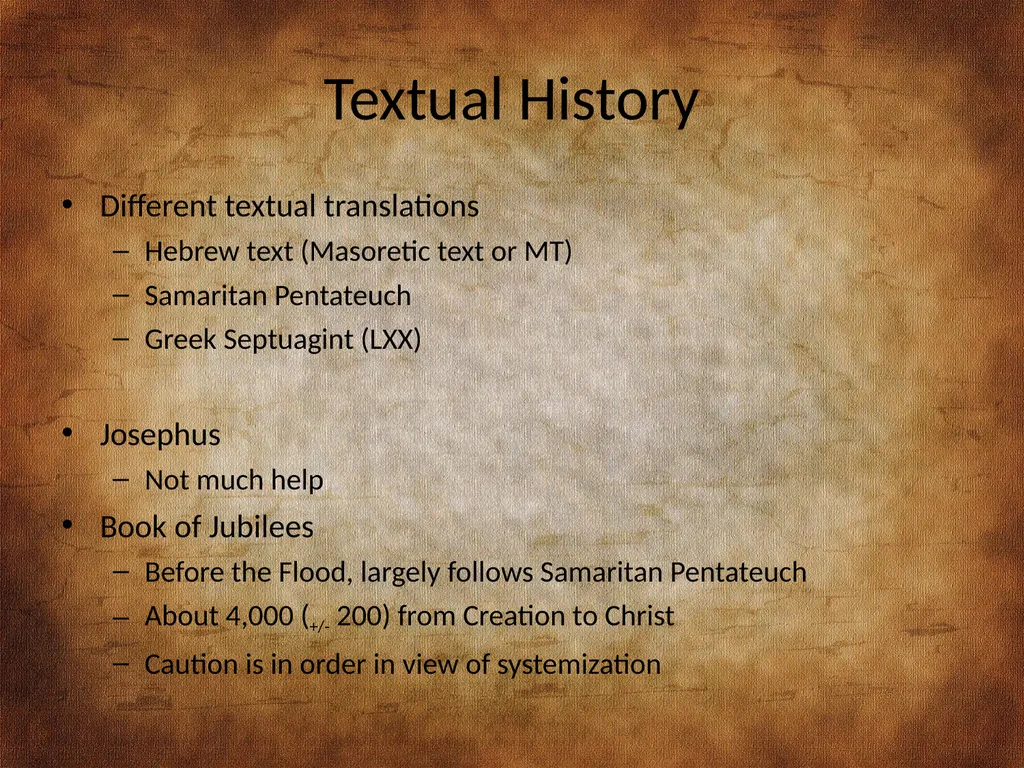
Textual History Different textual translations
Hebrew text (Masoretic text or MT)
Samaritan Pentateuch
Greek Septuagint (LXX)
Josephus
Not much help
Book of Jubilees
Before the Flood, largely follows Samaritan Pentateuch
About 4,000 (+/- 200) from Creation to Christ
Caution is in order in view of systemization<br>
08
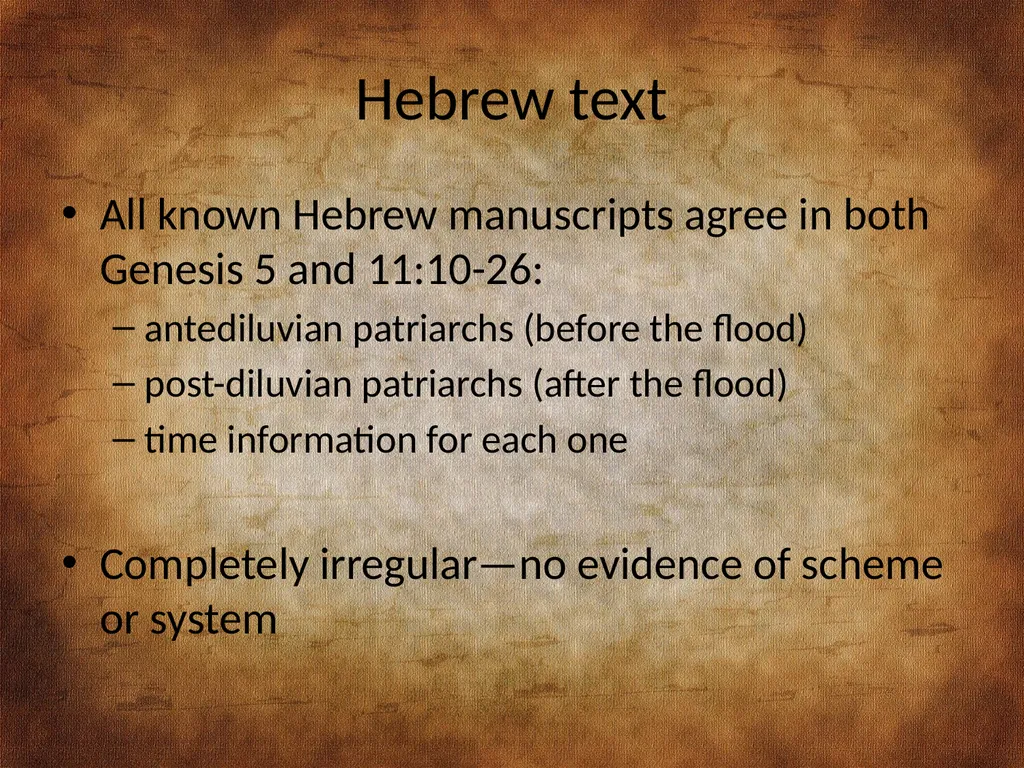
Hebrew text All known Hebrew manuscripts agree in both Genesis 5 and 11:10-26:
antediluvian patriarchs (before the flood)
post-diluvian patriarchs (after the flood)
time information for each one
Completely irregular—no evidence of scheme or system<br>
09
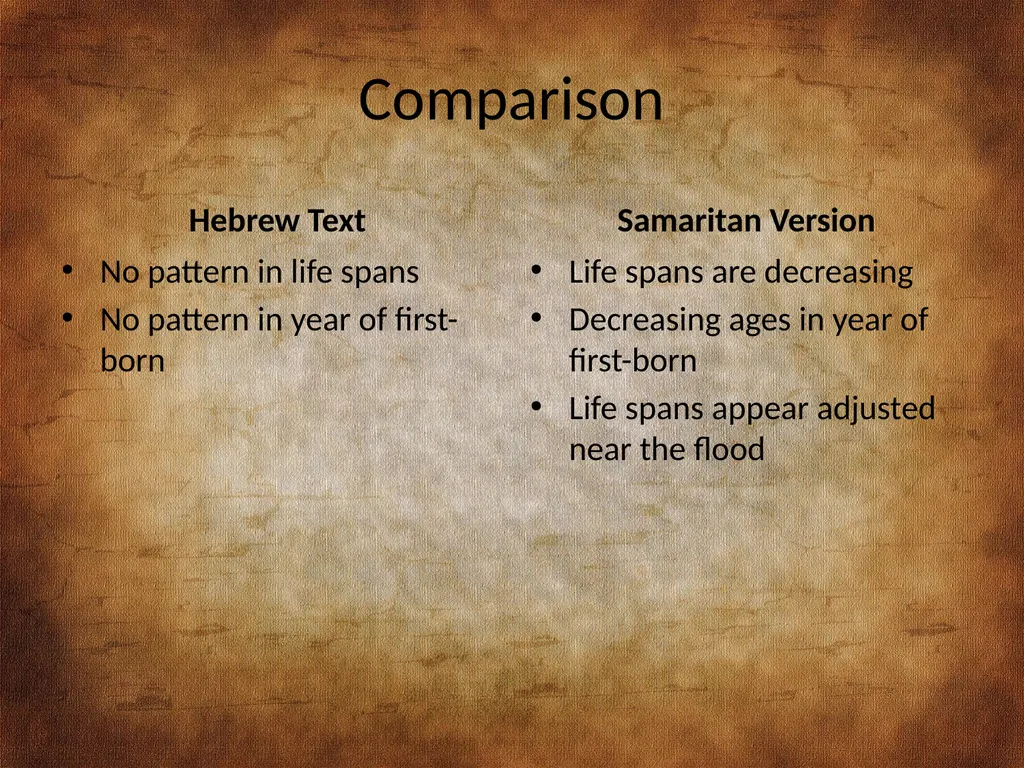
Comparison Hebrew Text No pattern in life spans
No pattern in year of first-born Samaritan Version Life spans are decreasing
Decreasing ages in year of first-born
Life spans appear adjusted near the flood<br>
10
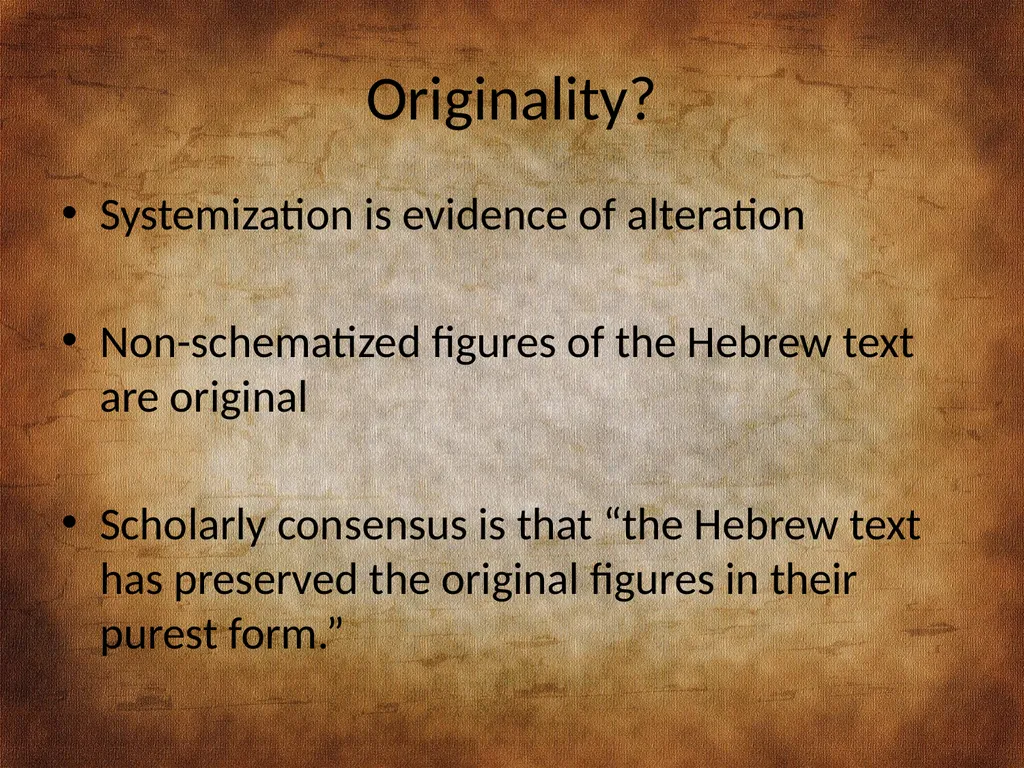
Originality? Systemization is evidence of alteration
Non-schematized figures of the Hebrew text are original
Scholarly consensus is that “the Hebrew text has preserved the original figures in their purest form.”<br>
11
Septuagint (LXX)—textual variants Vaticanus Methuselah’s age when his son was born: 167 (without reducing total lifespan)
Methuselah outlived the flood by 14 years
Nahor’s age when his son was born: 179 Alexandrinus Methuselah’s age when his son was born: 187
Nahor’s age when his son was born: 79<br>
12
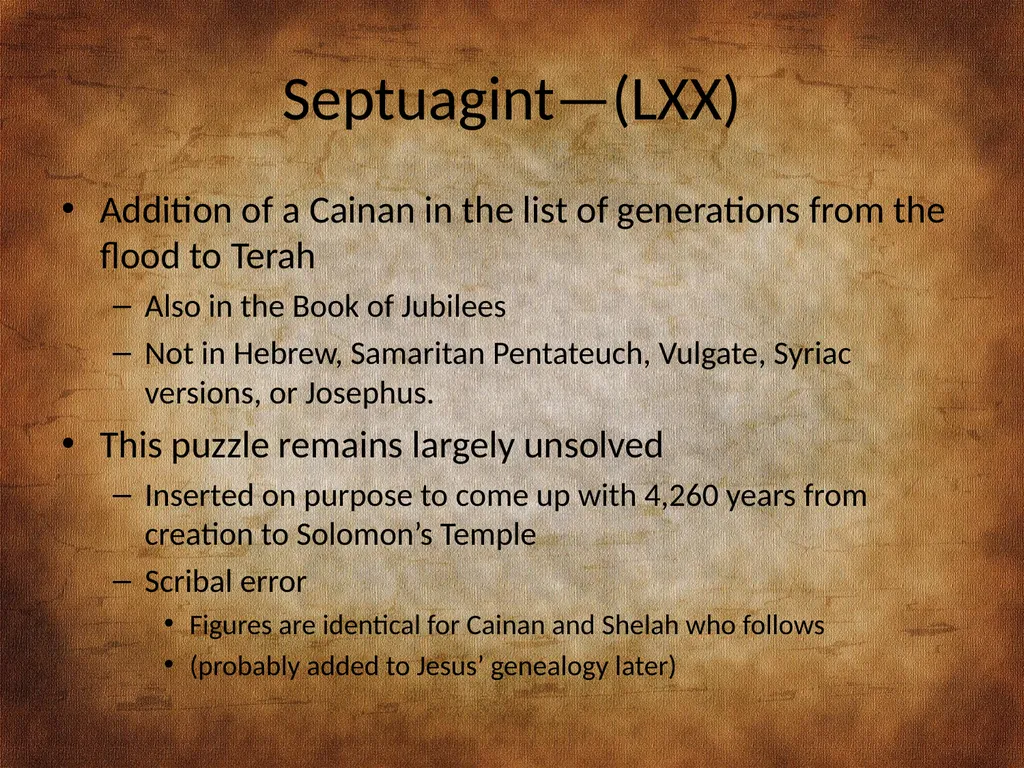
Septuagint—(LXX) Addition of a Cainan in the list of generations from the flood to Terah
Also in the Book of Jubilees
Not in Hebrew, Samaritan Pentateuch, Vulgate, Syriac versions, or Josephus.
This puzzle remains largely unsolved
Inserted on purpose to come up with 4,260 years from creation to Solomon’s Temple
Scribal error
Figures are identical for Cainan and Shelah who follows
(probably added to Jesus’ genealogy later)<br>
13
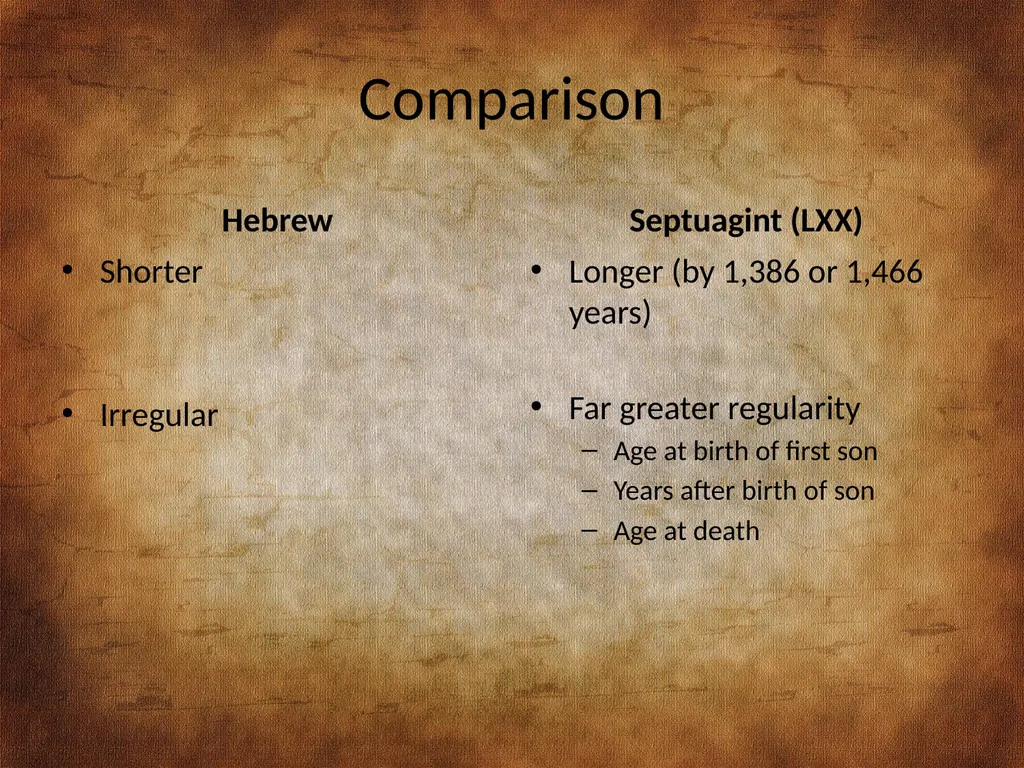
Comparison Hebrew Shorter
Irregular Septuagint (LXX) Longer (by 1,386 or 1,466 years)
Far greater regularity
Age at birth of first son
Years after birth of son
Age at death<br>
14
Originality? Majority scholarly opinion holds that the less schematized and the more irregular chronology has claim to originality<br>
15
Conclusions The Hebrew MT has non-schematic figures
The Samaritan version shows evidence of schematization and the Septuagint (LXX) even more so.
At the present it is impossible to decide on the basis of external manuscript evidence which figures (MT or LXX) have priority and can claim originality<br>
16
Genesis 5 and 11 “Chronogenealogies in the Biblical History of Beginnings” Origins 7/1 (1980) 23-37 Gerhard F. Hasel<br>