
Genetic Programming Representations Sean Harris
CB
Published · 26 slides · 0 views
1 / 1
Description
Genetic Programming Representations Sean Harris Auburn University Fall 2024 Genetic Programming A form of evolutionary algorithm designed to automate the creation of programs Applications include the design of equations (symbolic
Related Topics
Share
Embed code
Download this presentation From Below
"Genetic Programming Representations Sean Harris" is the property of its rightful owner. Permission is granted to download and print the materials on this website for personal, non-commercial use only, and to display it on your personal computer provided you do not modify the materials and that you retain all copyright notices contained in the materials. By downloading content from our website, you accept the terms of this agreement.
Presentation Transcript
01
Genetic Programming Representations Sean Harris
Auburn University
Fall 2024<br>
Auburn University
Fall 2024<br>
02
Genetic Programming A form of evolutionary algorithm designed to automate the creation of “programs”
Applications include the design of equations (symbolic regression), electronic circuits, and computer algorithms
Evolution attempts to find useful ways to combine primitive program nodes to meet a desired result
Comes in many variants which represent the program in different ways<br>
Applications include the design of equations (symbolic regression), electronic circuits, and computer algorithms
Evolution attempts to find useful ways to combine primitive program nodes to meet a desired result
Comes in many variants which represent the program in different ways<br>
03
Overview Genetic programming combines primitives (operators and terminals) into a structured genotype
There are many different ways to structure the genotype!
Five common representations that we’ll look at:
Tree-based GP
Linear GP
Cartesian GP
Grammatical Evolution
Stack-based GP<br>
There are many different ways to structure the genotype!
Five common representations that we’ll look at:
Tree-based GP
Linear GP
Cartesian GP
Grammatical Evolution
Stack-based GP<br>
04
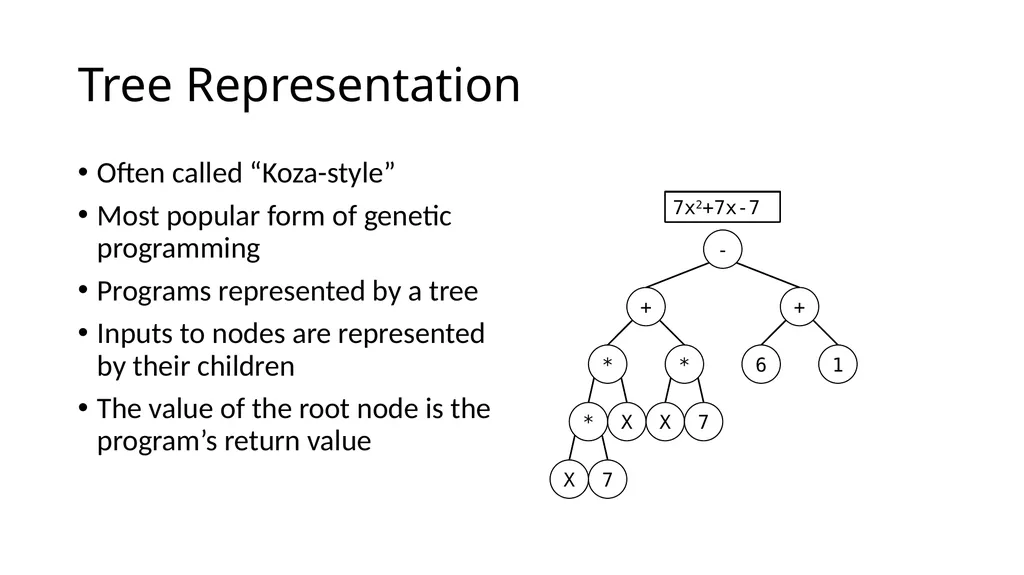
Tree Representation Often called “Koza-style”
Most popular form of genetic programming
Programs represented by a tree
Inputs to nodes are represented by their children
The value of the root node is the program’s return value - + + * * 6 1 * X X 7 X 7 7x2+7x-7<br>
Most popular form of genetic programming
Programs represented by a tree
Inputs to nodes are represented by their children
The value of the root node is the program’s return value - + + * * 6 1 * X X 7 X 7 7x2+7x-7<br>
05
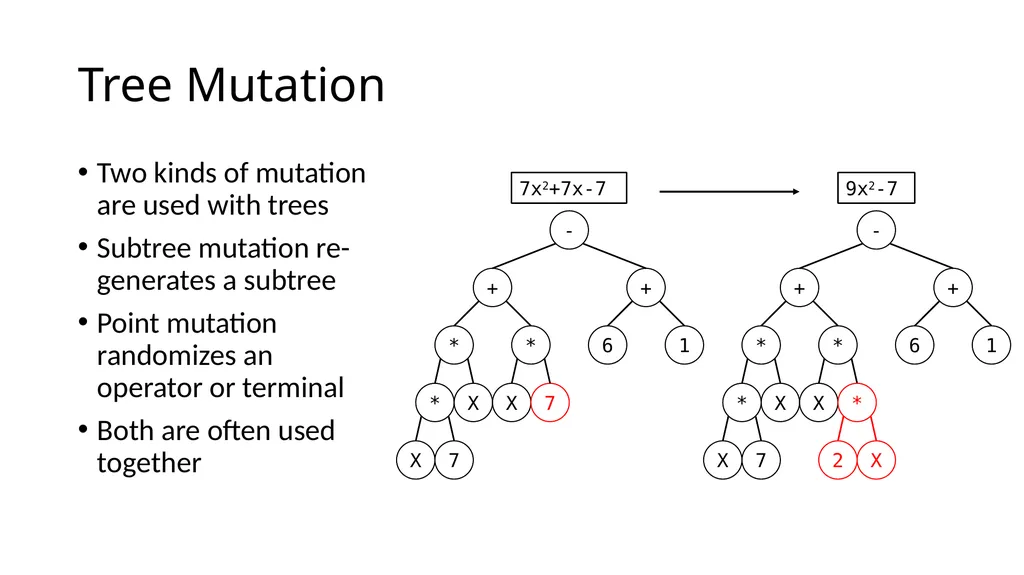
Tree Mutation Two kinds of mutation are used with trees
Subtree mutation re-generates a subtree
Point mutation randomizes an operator or terminal
Both are often used together - + + * * 6 1 * X X 7 X 7 7x2+7x-7 - + + * * 6 1 X X * 2 X * X 7 9x2-7<br>
Subtree mutation re-generates a subtree
Point mutation randomizes an operator or terminal
Both are often used together - + + * * 6 1 * X X 7 X 7 7x2+7x-7 - + + * * 6 1 X X * 2 X * X 7 9x2-7<br>
06
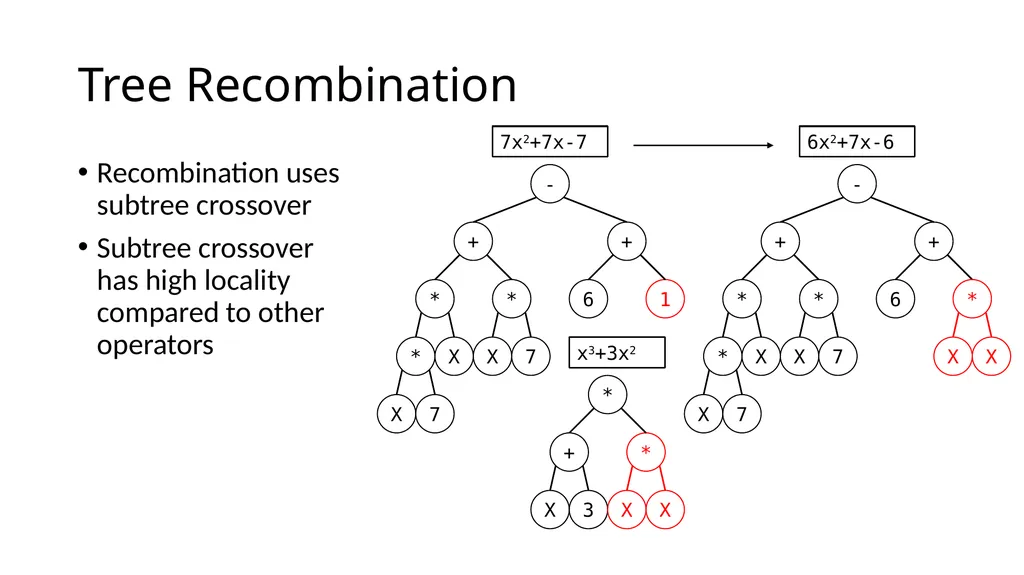
Tree Recombination Recombination uses subtree crossover
Subtree crossover has high locality compared to other operators - + + * * 6 1 * X X 7 X 7 7x2+7x-7 - + + * * 6 * X X 7 X 7 6x2+7x-6 * + X 3 * X X x3+3x2 * X X<br>
Subtree crossover has high locality compared to other operators - + + * * 6 1 * X X 7 X 7 7x2+7x-7 - + + * * 6 * X X 7 X 7 6x2+7x-6 * + X 3 * X X x3+3x2 * X X<br>
07
Notes About Tree-Based GP Relatively human-interpretable compared to other representations
Needs methods like automatically-defined-functions to reuse results
The entire tree is used, no introns
Only generates one output per tree; if you need more than one:
Multiple trees are commonly used together as a single genotype
One tree can be run repeatedly, changing or updating the inputs<br>
Needs methods like automatically-defined-functions to reuse results
The entire tree is used, no introns
Only generates one output per tree; if you need more than one:
Multiple trees are commonly used together as a single genotype
One tree can be run repeatedly, changing or updating the inputs<br>
08
Variant: Strongly-Typed Genetic Programming A versatile form of tree-based genetic programming
Each primitive has data types for inputs and outputs
Initialization and variation operators ensure that the input types for parent nodes match the output types of their child nodes
For subtree crossover, ensure the parent’s subtree has the same output type as the donor’s subtree<br>
Each primitive has data types for inputs and outputs
Initialization and variation operators ensure that the input types for parent nodes match the output types of their child nodes
For subtree crossover, ensure the parent’s subtree has the same output type as the donor’s subtree<br>
09
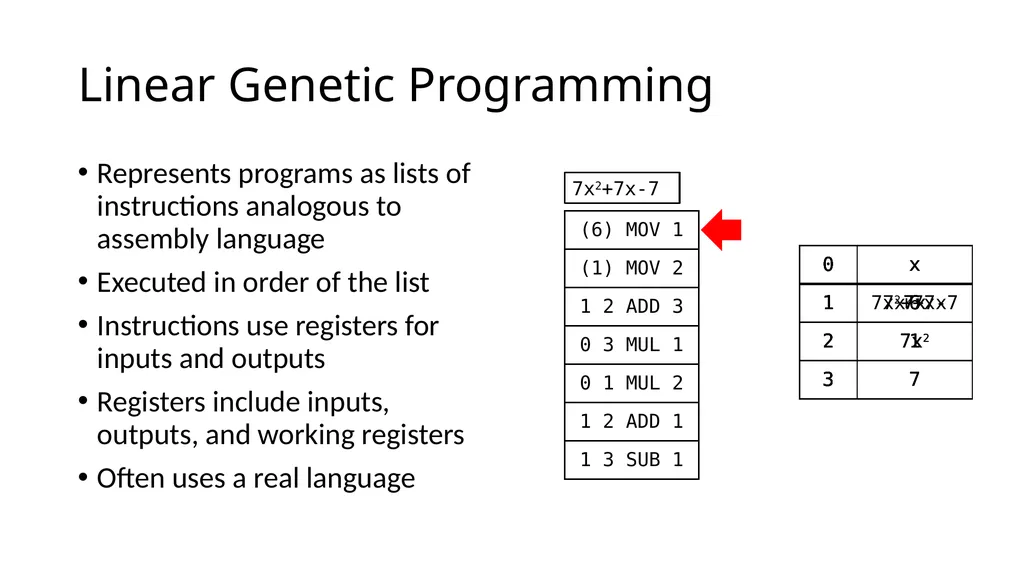
Linear Genetic Programming Represents programs as lists of instructions analogous to assembly language
Executed in order of the list
Instructions use registers for inputs and outputs
Registers include inputs, outputs, and working registers
Often uses a real language 7x2+7x-7<br>
Executed in order of the list
Instructions use registers for inputs and outputs
Registers include inputs, outputs, and working registers
Often uses a real language 7x2+7x-7<br>
10
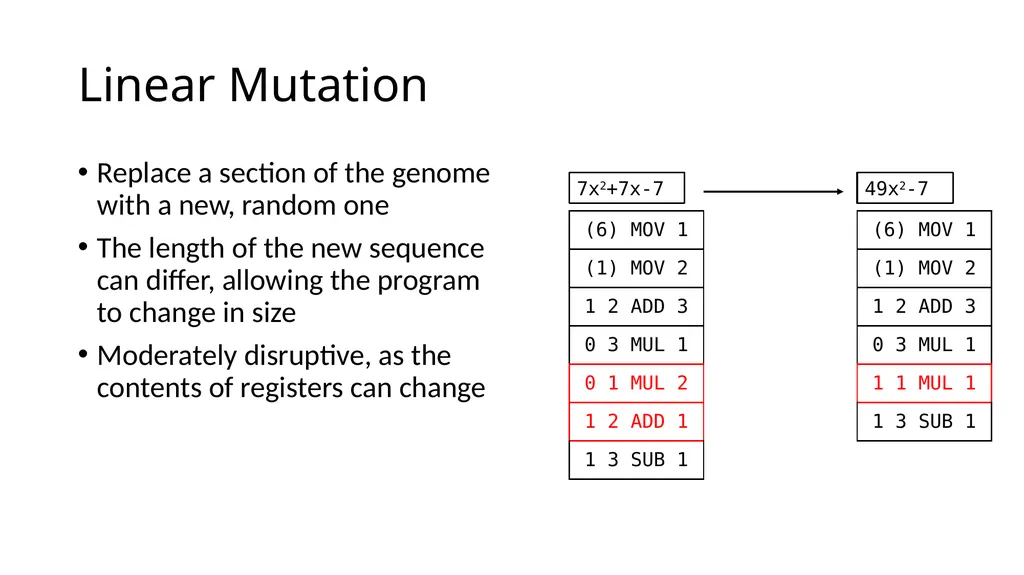
Linear Mutation Replace a section of the genome with a new, random one
The length of the new sequence can differ, allowing the program to change in size
Moderately disruptive, as the contents of registers can change 7x2+7x-7 49x2-7<br>
The length of the new sequence can differ, allowing the program to change in size
Moderately disruptive, as the contents of registers can change 7x2+7x-7 49x2-7<br>
11
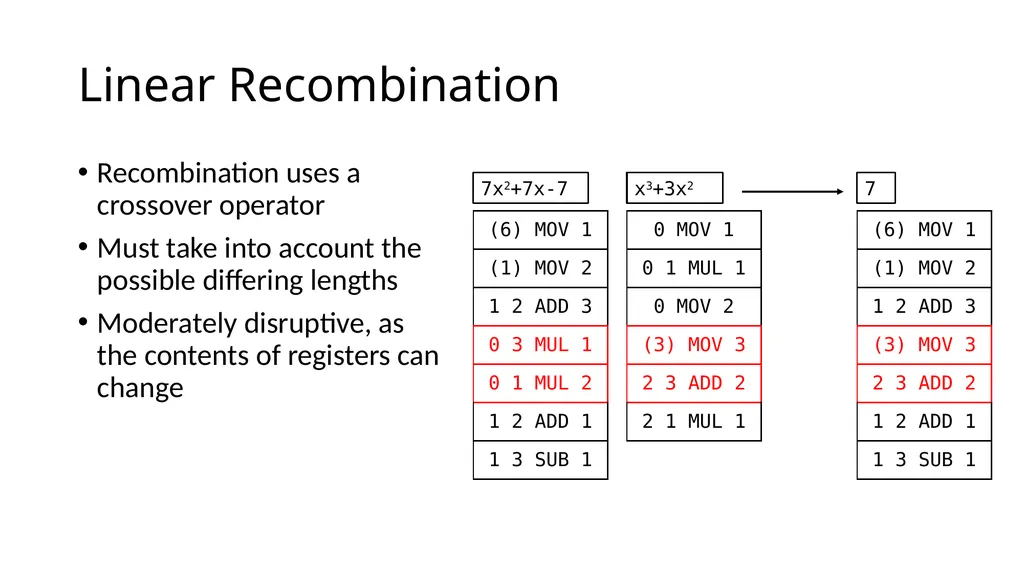
Linear Recombination Recombination uses a crossover operator
Must take into account the possible differing lengths
Moderately disruptive, as the contents of registers can change 7x2+7x-7 x3+3x2 7<br>
Must take into account the possible differing lengths
Moderately disruptive, as the contents of registers can change 7x2+7x-7 x3+3x2 7<br>
12
Notes About Linear Genetic Programming Registers can be reused, allowing for smaller genotypes
Performance is highly sensitive to number of registers
Too few limits the working space of the program
Too many results in an overly large search space
Genotypes can contain introns, pieces of genetic material which have no effect on fitness
Introns tend to be positive for evolution, as they can store functional but unused segments of programs
Programs can have multiple outputs by adding more output registers<br>
Performance is highly sensitive to number of registers
Too few limits the working space of the program
Too many results in an overly large search space
Genotypes can contain introns, pieces of genetic material which have no effect on fitness
Introns tend to be positive for evolution, as they can store functional but unused segments of programs
Programs can have multiple outputs by adding more output registers<br>
13
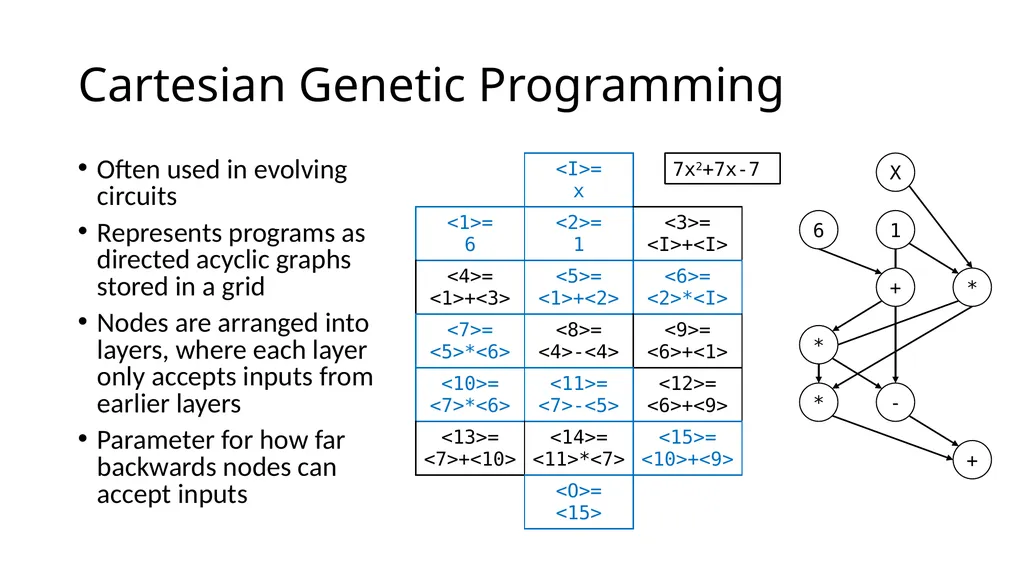
Cartesian Genetic Programming Often used in evolving circuits
Represents programs as directed acyclic graphs stored in a grid
Nodes are arranged into layers, where each layer only accepts inputs from earlier layers
Parameter for how far backwards nodes can accept inputs 7x2+7x-7 X 1 6 + * * * - +<br>
Represents programs as directed acyclic graphs stored in a grid
Nodes are arranged into layers, where each layer only accepts inputs from earlier layers
Parameter for how far backwards nodes can accept inputs 7x2+7x-7 X 1 6 + * * * - +<br>
14
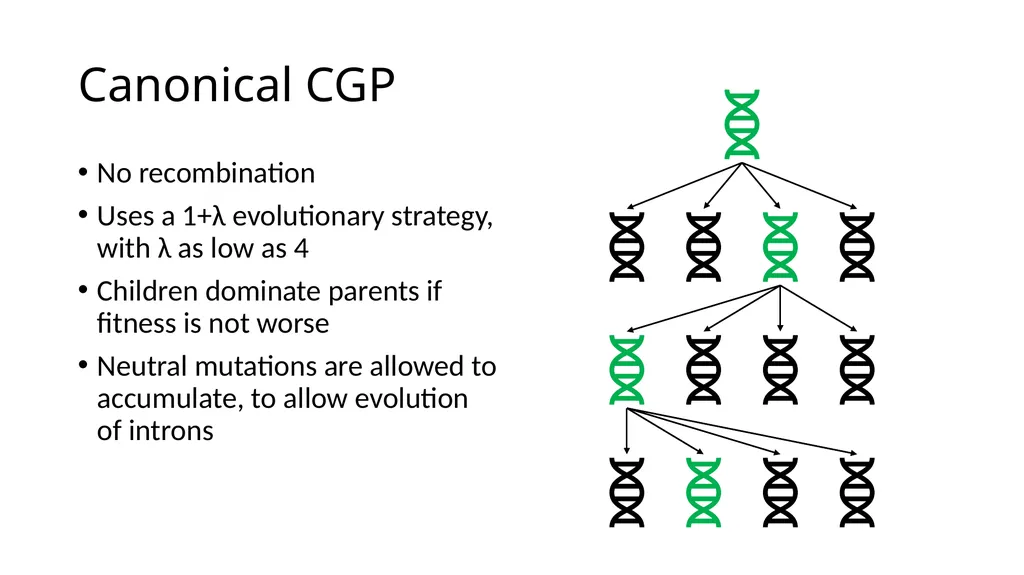
Canonical CGP No recombination
Uses a 1+λ evolutionary strategy, with λ as low as 4
Children dominate parents if fitness is not worse
Neutral mutations are allowed to accumulate, to allow evolution of introns 14<br>
Uses a 1+λ evolutionary strategy, with λ as low as 4
Children dominate parents if fitness is not worse
Neutral mutations are allowed to accumulate, to allow evolution of introns 14<br>
15
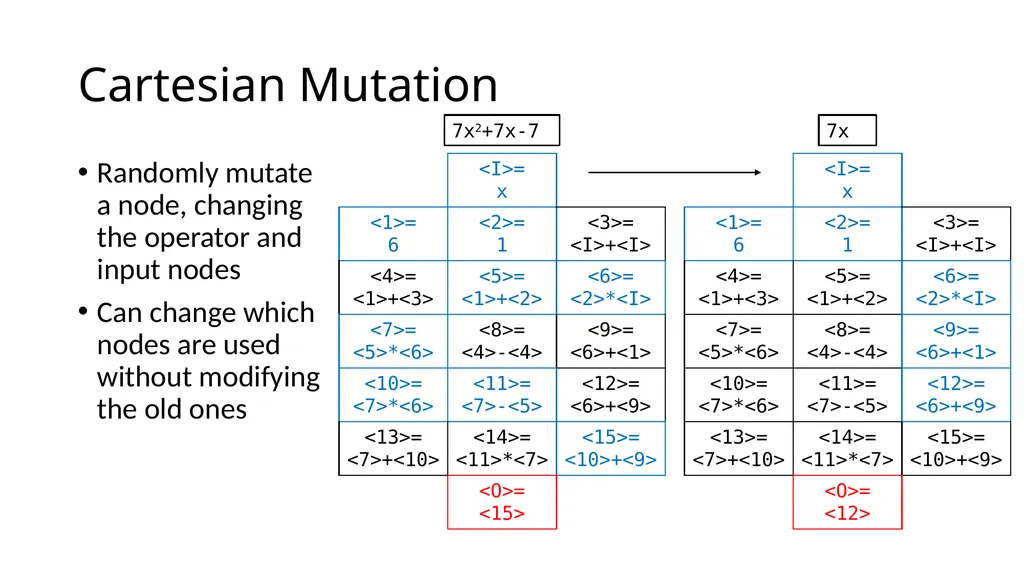
Cartesian Mutation Randomly mutate a node, changing the operator and input nodes
Can change which nodes are used without modifying the old ones 7x2+7x-7 7x<br>
Can change which nodes are used without modifying the old ones 7x2+7x-7 7x<br>
16
Notes About Cartesian Genetic Programming Cells can be reused, allowing for smaller genotypes
Limit on program size which needs to be tuned, but prevents bloat
Multiple output cells can be used
Very nonstandard EA configuration!
Often used in neural architecture search
Strong results for agent-based AI, comparable to neural network techniques for reinforcement learning
Evolving simple programs for playing Atari games, by Wilson et al. (2018)<br>
Limit on program size which needs to be tuned, but prevents bloat
Multiple output cells can be used
Very nonstandard EA configuration!
Often used in neural architecture search
Strong results for agent-based AI, comparable to neural network techniques for reinforcement learning
Evolving simple programs for playing Atari games, by Wilson et al. (2018)<br>
17
Variant: Differentiable CGP A form of Cartesian genetic programming which uses differentiable primitives
Enables backpropagation and gradient descent to precisely tune constants
Primarily made for symbolic regression, but can be applied anywhere where gradients are available
Differentiable Genetic Programming, by Izzo et al. (2016)<br>
Enables backpropagation and gradient descent to precisely tune constants
Primarily made for symbolic regression, but can be applied anywhere where gradients are available
Differentiable Genetic Programming, by Izzo et al. (2016)<br>
18
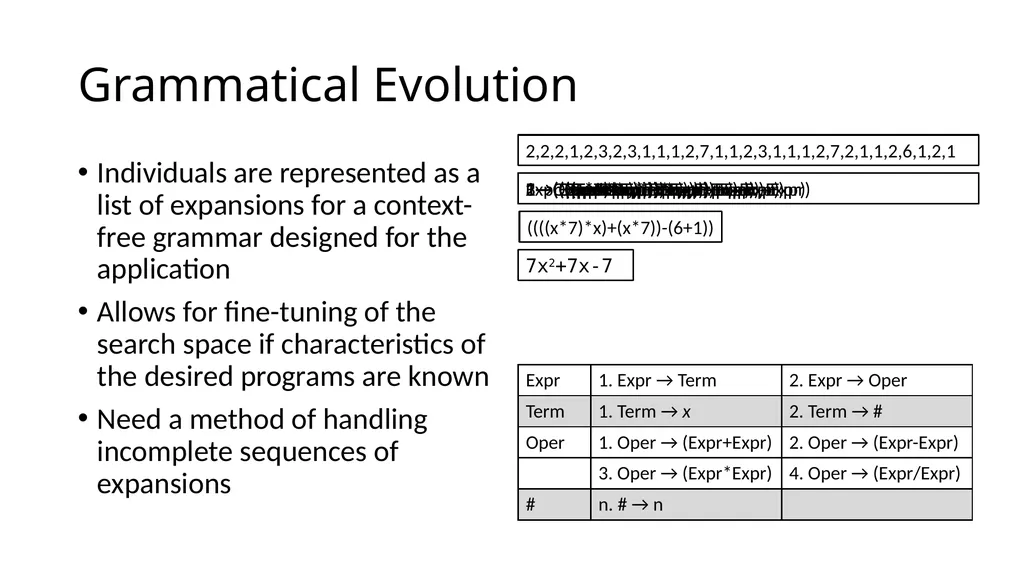
Grammatical Evolution Individuals are represented as a list of expansions for a context-free grammar designed for the application
Allows for fine-tuning of the search space if characteristics of the desired programs are known
Need a method of handling incomplete sequences of expansions Expr 2,2,2,1,2,3,2,3,1,1,1,2,7,1,1,2,3,1,1,1,2,7,2,1,1,2,6,1,2,1 7x2+7x-7 ((((x*7)*x)+(x*7))-(6+1)) 2→Oper 2→(Expr-Expr) 2→(Oper-Expr) 1→((Expr+Expr)-Expr) 2→((Oper+Expr)-Expr) 3→(((Expr*Expr)+Expr)-Expr) 2→(((Oper*Expr)+Expr)-Expr) 3→((((Expr*Expr)*Expr)+Expr)-Expr) 1→((((Term*Expr)*Expr)+Expr)-Expr) 1→((((x*Expr)*Expr)+Expr)-Expr) 1→((((x*Term)*Expr)+Expr)-Expr) 1→((((x*#)*Expr)+Expr)-Expr) 1→((((x*7)*Expr)+Expr)-Expr)<br>
Allows for fine-tuning of the search space if characteristics of the desired programs are known
Need a method of handling incomplete sequences of expansions Expr 2,2,2,1,2,3,2,3,1,1,1,2,7,1,1,2,3,1,1,1,2,7,2,1,1,2,6,1,2,1 7x2+7x-7 ((((x*7)*x)+(x*7))-(6+1)) 2→Oper 2→(Expr-Expr) 2→(Oper-Expr) 1→((Expr+Expr)-Expr) 2→((Oper+Expr)-Expr) 3→(((Expr*Expr)+Expr)-Expr) 2→(((Oper*Expr)+Expr)-Expr) 3→((((Expr*Expr)*Expr)+Expr)-Expr) 1→((((Term*Expr)*Expr)+Expr)-Expr) 1→((((x*Expr)*Expr)+Expr)-Expr) 1→((((x*Term)*Expr)+Expr)-Expr) 1→((((x*#)*Expr)+Expr)-Expr) 1→((((x*7)*Expr)+Expr)-Expr)<br>
19
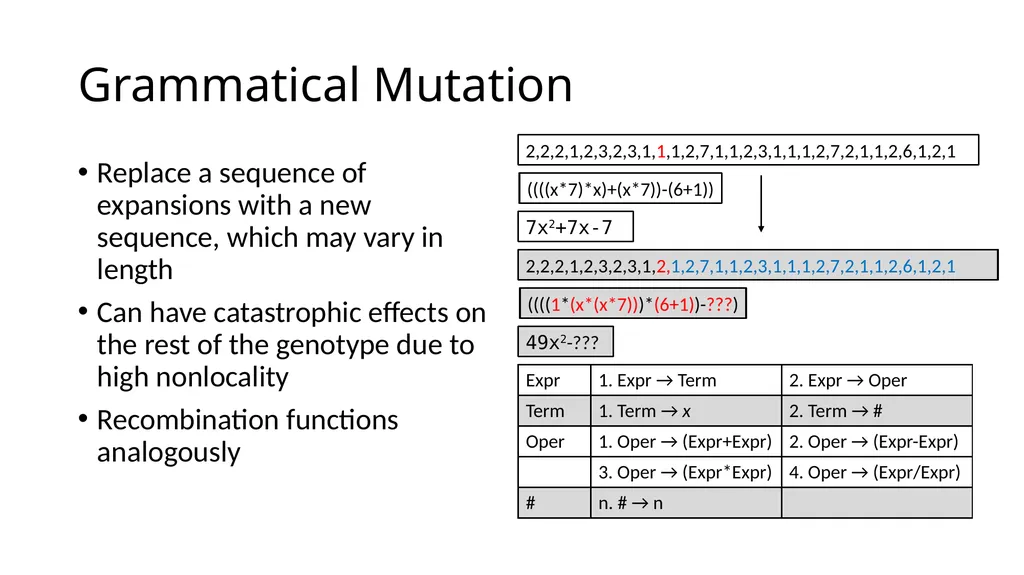
Grammatical Mutation Replace a sequence of expansions with a new sequence, which may vary in length
Can have catastrophic effects on the rest of the genotype due to high nonlocality
Recombination functions analogously ((((x*7)*x)+(x*7))-(6+1)) 2,2,2,1,2,3,2,3,1,1,1,2,7,1,1,2,3,1,1,1,2,7,2,1,1,2,6,1,2,1 7x2+7x-7 ((((1*(x*(x*7)))*(6+1))-???) 2,2,2,1,2,3,2,3,1,2,1,2,7,1,1,2,3,1,1,1,2,7,2,1,1,2,6,1,2,1 49x2-???<br>
Can have catastrophic effects on the rest of the genotype due to high nonlocality
Recombination functions analogously ((((x*7)*x)+(x*7))-(6+1)) 2,2,2,1,2,3,2,3,1,1,1,2,7,1,1,2,3,1,1,1,2,7,2,1,1,2,6,1,2,1 7x2+7x-7 ((((1*(x*(x*7)))*(6+1))-???) 2,2,2,1,2,3,2,3,1,2,1,2,7,1,1,2,3,1,1,1,2,7,2,1,1,2,6,1,2,1 49x2-???<br>
20
Notes About Grammatical Evolution Extremely powerful ability to fine-tune the search space, though this can lead to bias
Implementation of typed GP is simple
Extremely poor locality from genetic operators
High non-uniform redundancy, meaning some phenotypes are underrepresented
Frequently used for evolution on existing programming languages
Also used in neural architecture search<br>
Implementation of typed GP is simple
Extremely poor locality from genetic operators
High non-uniform redundancy, meaning some phenotypes are underrepresented
Frequently used for evolution on existing programming languages
Also used in neural architecture search<br>
21
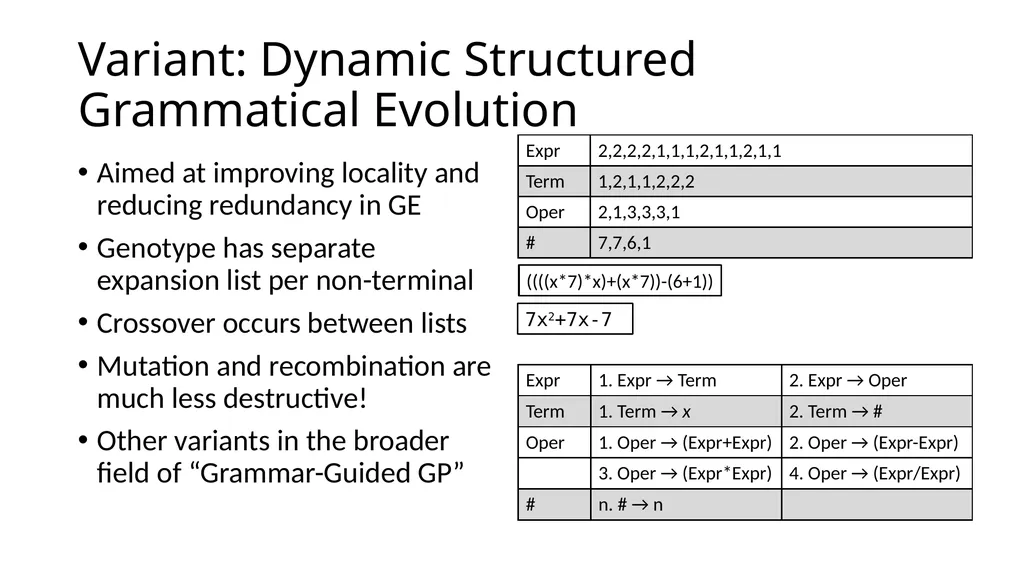
Variant: Dynamic Structured Grammatical Evolution Aimed at improving locality and reducing redundancy in GE
Genotype has separate expansion list per non-terminal
Crossover occurs between lists
Mutation and recombination are much less destructive!
Other variants in the broader field of “Grammar-Guided GP” ((((x*7)*x)+(x*7))-(6+1)) 7x2+7x-7 ((((x*7)*x)+(x*7))-(6+1)) 7x2+7x-7<br>
Genotype has separate expansion list per non-terminal
Crossover occurs between lists
Mutation and recombination are much less destructive!
Other variants in the broader field of “Grammar-Guided GP” ((((x*7)*x)+(x*7))-(6+1)) 7x2+7x-7 ((((x*7)*x)+(x*7))-(6+1)) 7x2+7x-7<br>
22
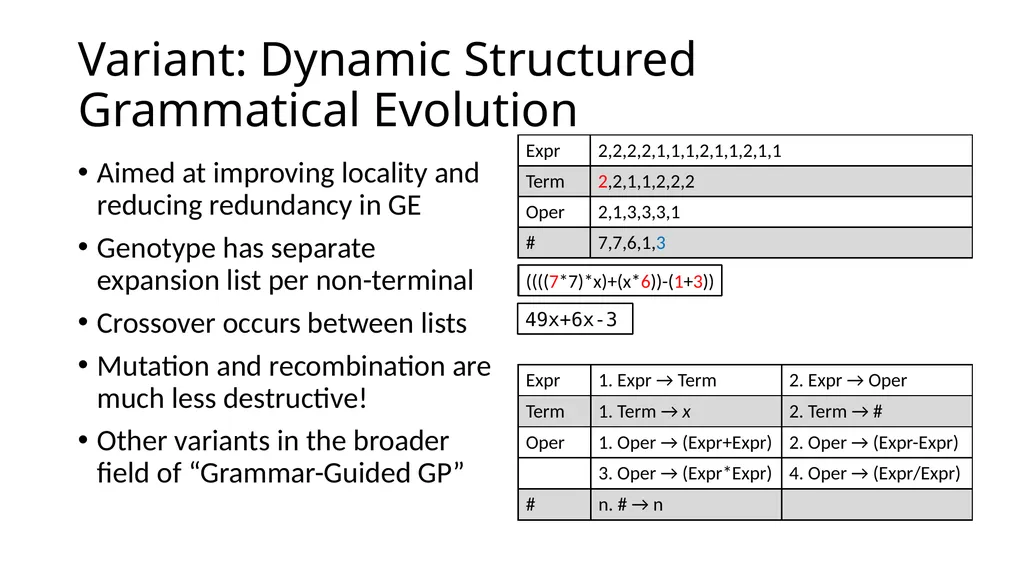
Variant: Dynamic Structured Grammatical Evolution Aimed at improving locality and reducing redundancy in GE
Genotype has separate expansion list per non-terminal
Crossover occurs between lists
Mutation and recombination are much less destructive!
Other variants in the broader field of “Grammar-Guided GP” ((((x*7)*x)+(x*7))-(6+1)) 7x2+7x-7 ((((7*7)*x)+(x*6))-(1+3)) 49x+6x-3<br>
Genotype has separate expansion list per non-terminal
Crossover occurs between lists
Mutation and recombination are much less destructive!
Other variants in the broader field of “Grammar-Guided GP” ((((x*7)*x)+(x*7))-(6+1)) 7x2+7x-7 ((((7*7)*x)+(x*6))-(1+3)) 49x+6x-3<br>
23
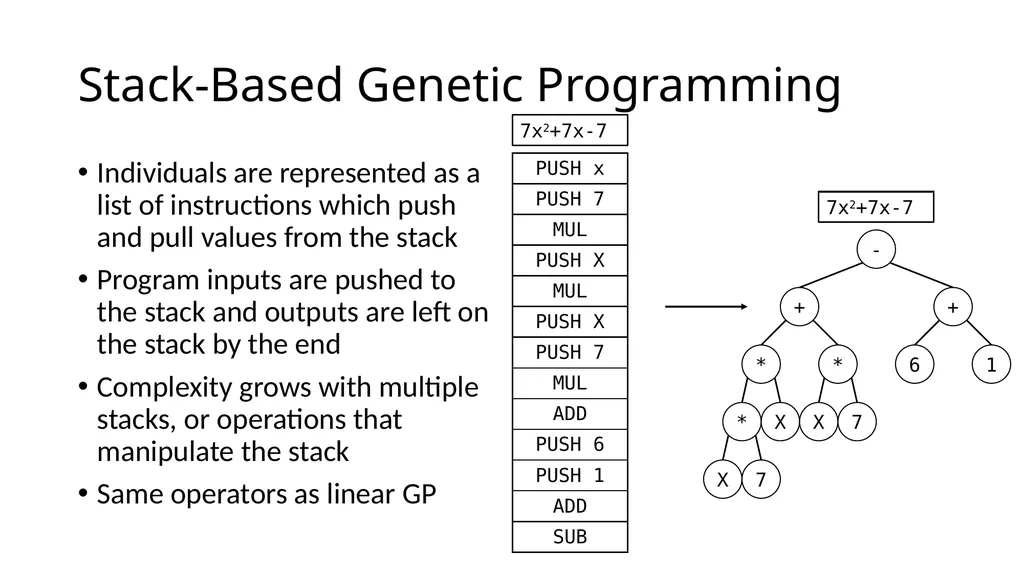
Stack-Based Genetic Programming Individuals are represented as a list of instructions which push and pull values from the stack
Program inputs are pushed to the stack and outputs are left on the stack by the end
Complexity grows with multiple stacks, or operations that manipulate the stack
Same operators as linear GP - + + * * 6 1 * X X 7 X 7 7x2+7x-7 7x2+7x-7<br>
Program inputs are pushed to the stack and outputs are left on the stack by the end
Complexity grows with multiple stacks, or operations that manipulate the stack
Same operators as linear GP - + + * * 6 1 * X X 7 X 7 7x2+7x-7 7x2+7x-7<br>
24
Variant: PushGP The dominant form of stack-based genetic programming
Implements the Push language, based on the Forth language
Individuals represent instructions as a self-modifiable stack
Multiple data types each use a separate stack
A variant, PushPop, makes individuals encode their own variation operators
Genetic Programming and Autoconstructive Evolution with the Push Programming Language, by Spector and Robinson (2002) 24<br>
Implements the Push language, based on the Forth language
Individuals represent instructions as a self-modifiable stack
Multiple data types each use a separate stack
A variant, PushPop, makes individuals encode their own variation operators
Genetic Programming and Autoconstructive Evolution with the Push Programming Language, by Spector and Robinson (2002) 24<br>
25
Notes About Stack-Based GP With one stack, programs are very similar to tree-based GP
Multiple data types can be represented with a stack for each type
Allows for introns if extra data is pushed and never popped
Can represent existing stack-based languages
Mostly used to study automatic code generation and repair<br>
Multiple data types can be represented with a stack for each type
Allows for introns if extra data is pushed and never popped
Can represent existing stack-based languages
Mostly used to study automatic code generation and repair<br>
26
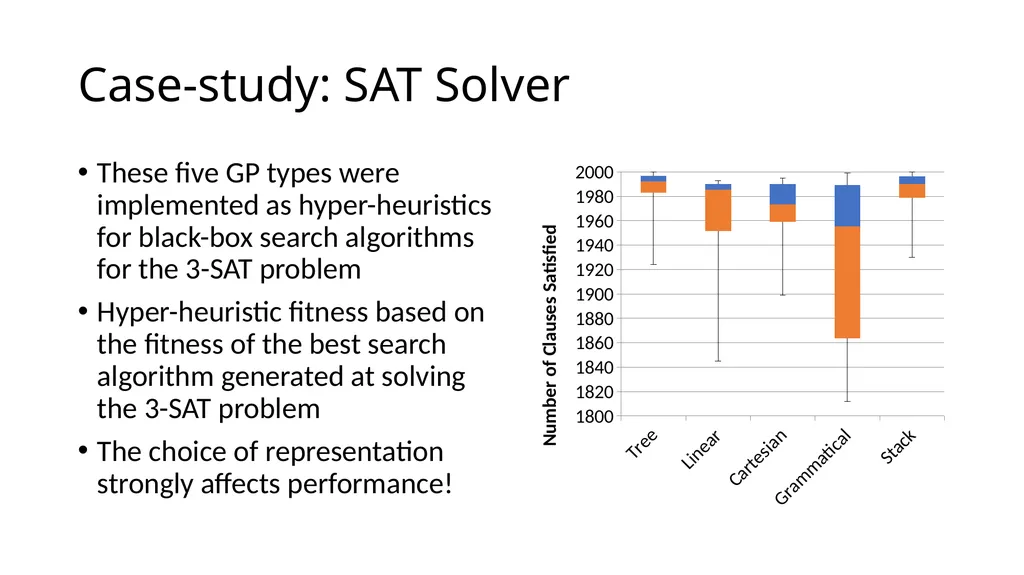
Case-study: SAT Solver These five GP types were implemented as hyper-heuristics for black-box search algorithms for the 3-SAT problem
Hyper-heuristic fitness based on the fitness of the best search algorithm generated at solving the 3-SAT problem
The choice of representation strongly affects performance!<br>
Hyper-heuristic fitness based on the fitness of the best search algorithm generated at solving the 3-SAT problem
The choice of representation strongly affects performance!<br>
27
Recommended Reading A Field Guide to Genetic Programming, by Poli, Langdon, and McPhee (2008)
A well-regarded free textbook on genetic programming, which covers many of these variants (and others!)
Cartesian genetic programming: its status and future, by Julian Miller (2020)
A recent and extensive survey paper on Cartesian genetic programming (which isn’t covered very well by the Field Guide)<br>
A well-regarded free textbook on genetic programming, which covers many of these variants (and others!)
Cartesian genetic programming: its status and future, by Julian Miller (2020)
A recent and extensive survey paper on Cartesian genetic programming (which isn’t covered very well by the Field Guide)<br>