
Genetic Research with Children Affected by
AS
Published · 49 slides · 0 views

1 / 1











Description
Genetic Research with Children Affected by Parental Substance Abuse: Seven Ethical Sisters Thomas McMahon, PhD Yale University School of Medicine Departments of Psychiatry and Child Study Primary Goal To introduce the seven ethical sisters
Related Topics
Share
Embed code
Download this presentation From Below
"Genetic Research with Children Affected by" is the property of its rightful owner. Permission is granted to download and print the materials on this website for personal, non-commercial use only, and to display it on your personal computer provided you do not modify the materials and that you retain all copyright notices contained in the materials. By downloading content from our website, you accept the terms of this agreement.
Presentation Transcript
01
Genetic Research with Children Affected by Parental Substance Abuse:
Seven Ethical Sisters Thomas McMahon, PhD
Yale University School of Medicine
Departments of Psychiatry and Child Study<br>
Yale University School of Medicine
Departments of Psychiatry and Child Study<br>
02
Primary Goal To introduce the seven ethical sisters who thoughtfully guide genetic research done with children affected by parental substance abuse.<br>
03
The Background McMahon, T. J. (2012). Ethical considerations in genetic research with children affected by parental substance abuse. In A. R. Chapman (Ed.), Genetic research on addiction: Ethics, the law, and public health (pp. 61-83). New York: Cambridge University Press.<br>
04
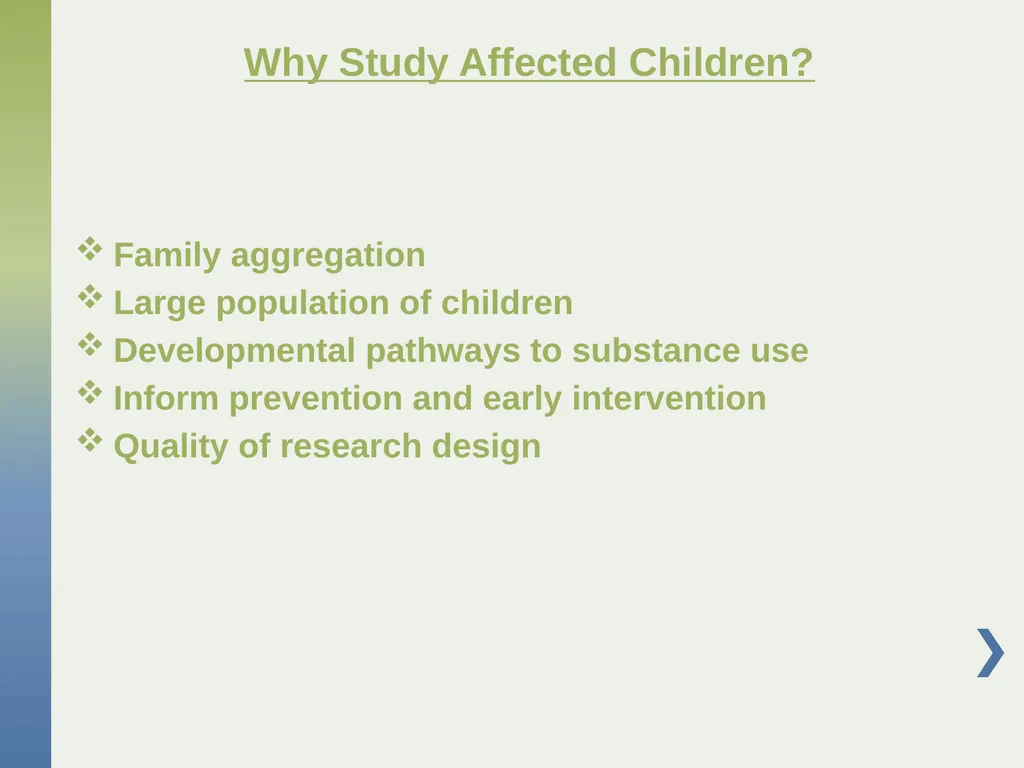
Family aggregation
Large population of children
Developmental pathways to substance use
Inform prevention and early intervention
Quality of research design Why Study Affected Children?<br>
Large population of children
Developmental pathways to substance use
Inform prevention and early intervention
Quality of research design Why Study Affected Children?<br>
05
How do professionals enrolling children affected by parental substance abuse in genetic research that typically involves minimal risk with no direct benefit to the individual balance the need to protect children from harm against the need to generate
scientific knowledge that may
inform prevention and early
intervention? The BIG Ethical Question<br>
scientific knowledge that may
inform prevention and early
intervention? The BIG Ethical Question<br>
06
Community consultation
Recruitment
Child assent and parental permission
Phenotyping
Genotyping
Payment
Biodata banks Seven Ethical Sisters<br>
Recruitment
Child assent and parental permission
Phenotyping
Genotyping
Payment
Biodata banks Seven Ethical Sisters<br>
07
Seven ethical sisters
Ethics question
Ethical concepts
Empirical evidence
Focus on minor children
Practical focus The Framework<br>
Ethics question
Ethical concepts
Empirical evidence
Focus on minor children
Practical focus The Framework<br>
08
The Most Politic Sister:
Community Consultation<br>
09
Do professionals doing genetic research with children affected by parental substance abuse have an ethical responsibility to consult with the community where the research will be done? Community Consultation:
Ethics Question<br>
10
Emanuel et al. (2000, 2004)
Social value
Scientific validity
Fair subject selection
Favorable risk-benefit
Independent review
Informed consent
Respect for participants
Community consultation Community Consultation: Ethical Concepts<br>
Social value
Scientific validity
Fair subject selection
Favorable risk-benefit
Independent review
Informed consent
Respect for participants
Community consultation Community Consultation: Ethical Concepts<br>
11
Kaufman et al. (2008) American Journal of Medical Genetics (Part C)
Coors & Raymond (2009) Psychiatric Genetics Community Consultation: Ethics Research<br>
Coors & Raymond (2009) Psychiatric Genetics Community Consultation: Ethics Research<br>
12
The Most Socially Just Sister:
Recruitment<br>
13
Do professionals doing genetic research with children affected by substance abuse have an ethical responsibility to offer all affected children an opportunity to participate?
Do professionals doing genetic research with vulnerable children affected by parental substance abuse have an ethical responsibility to distinguish risks associated with recruitment from risks associated with participation? Recruitment: Ethics Questions<br>
Do professionals doing genetic research with vulnerable children affected by parental substance abuse have an ethical responsibility to distinguish risks associated with recruitment from risks associated with participation? Recruitment: Ethics Questions<br>
14
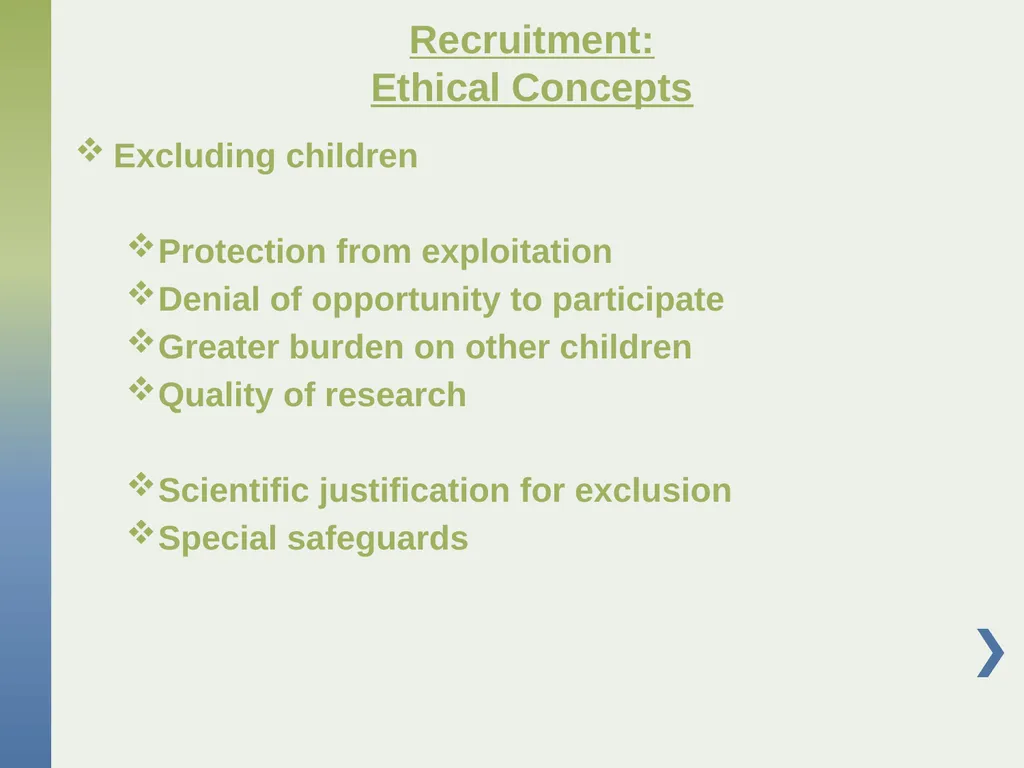
Excluding children
Protection from exploitation
Denial of opportunity to participate
Greater burden on other children
Quality of research
Scientific justification for exclusion
Special safeguards Recruitment: Ethical Concepts<br>
Protection from exploitation
Denial of opportunity to participate
Greater burden on other children
Quality of research
Scientific justification for exclusion
Special safeguards Recruitment: Ethical Concepts<br>
15
Parental substance abuse and risk for neglect
Parental substance abuse and risk for out-of-home placement
Parental substance abuse and risk for longer out-of-home placement Recruitment: Ethics Research<br>
Parental substance abuse and risk for out-of-home placement
Parental substance abuse and risk for longer out-of-home placement Recruitment: Ethics Research<br>
16
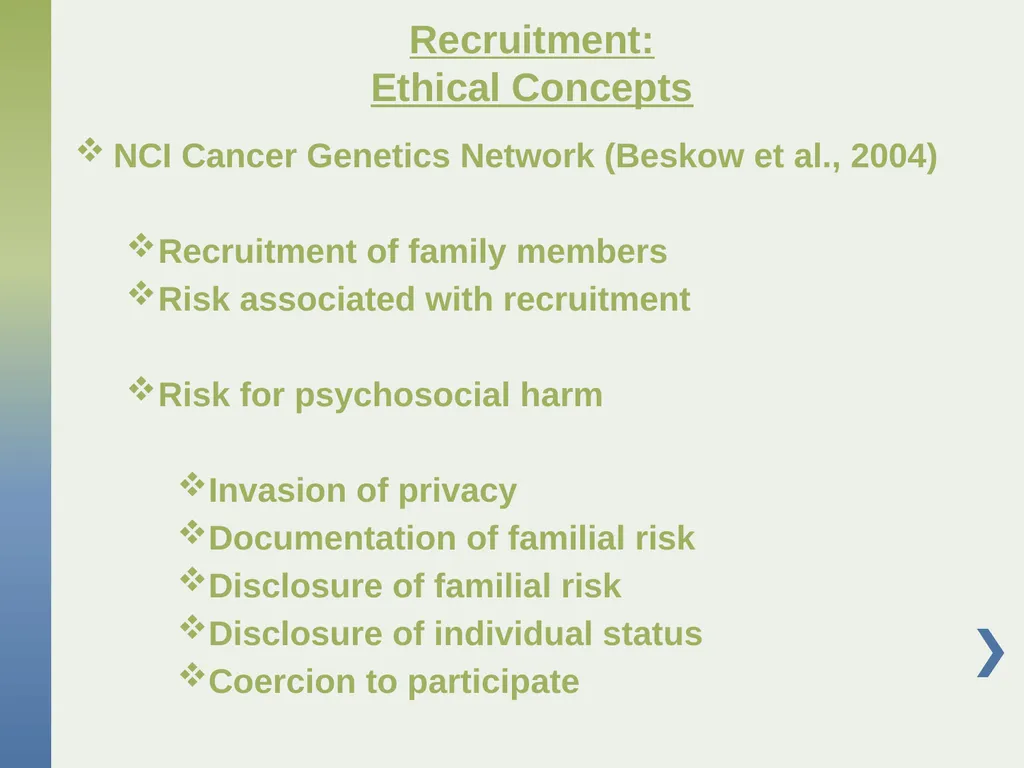
NCI Cancer Genetics Network (Beskow et al., 2004)
Recruitment of family members
Risk associated with recruitment
Risk for psychosocial harm
Invasion of privacy
Documentation of familial risk
Disclosure of familial risk
Disclosure of individual status
Coercion to participate Recruitment: Ethical Concepts<br>
Recruitment of family members
Risk associated with recruitment
Risk for psychosocial harm
Invasion of privacy
Documentation of familial risk
Disclosure of familial risk
Disclosure of individual status
Coercion to participate Recruitment: Ethical Concepts<br>
17
? Recruitment:
Ethics Research<br>
18
The Most Rational Sister:
Child Assent and Parental Permission<br>
19
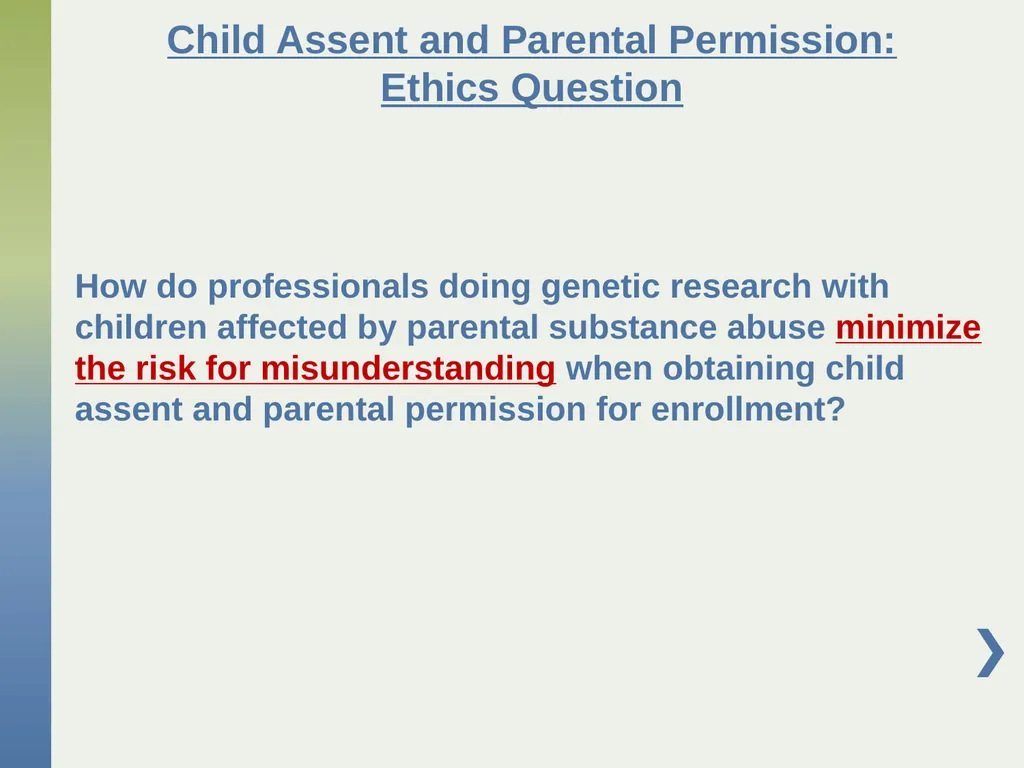
How do professionals doing genetic research with children affected by parental substance abuse minimize the risk for misunderstanding when obtaining child assent and parental permission for enrollment? Child Assent and Parental Permission:
Ethics Question<br>
20
Characteristics of potential participants
A priori assumptions about decisional capacity
Child and parental motivation to seek enrollment
Child assent
Child dissent
Overemphasis about potential benefits to class Child Assent and Parental Permission: Ethical Concepts<br>
A priori assumptions about decisional capacity
Child and parental motivation to seek enrollment
Child assent
Child dissent
Overemphasis about potential benefits to class Child Assent and Parental Permission: Ethical Concepts<br>
21
Research on parental permission
Parents overestimate their understanding
Parents expect information about genetic risk
Parents still expect information about genetic risk even when told researchers do not agree Child Assent and Parental Permission: Ethics Research<br>
Parents overestimate their understanding
Parents expect information about genetic risk
Parents still expect information about genetic risk even when told researchers do not agree Child Assent and Parental Permission: Ethics Research<br>
22
Research on child assent
Age is not a good proxy for capacity to understand
Children rarely completely understand their right to refuse participation
Children rarely dissent
Parents do not talk about genetic liability
Science education literature on child and adolescent understanding of genetics
Children and adolescents are not likely to understand specific concepts associated with genetic research Child Assent and Parental Permission: Ethics Research<br>
Age is not a good proxy for capacity to understand
Children rarely completely understand their right to refuse participation
Children rarely dissent
Parents do not talk about genetic liability
Science education literature on child and adolescent understanding of genetics
Children and adolescents are not likely to understand specific concepts associated with genetic research Child Assent and Parental Permission: Ethics Research<br>
23
The Most Protective Sister:
Phenotyping<br>
24
To what extent do professionals doing genetic research with children affected by parental substance abuse have an ethical responsibility to promote the well-being of children at risk for serious adversity, emotional-behavioral difficulty, and early substance use? Phenotyping:
Ethics Question<br>
25
Unequivocal ethical-legal obligations
Immediate danger to self-others
Reasonable suspicion of child abuse and neglect
Equivocal ethical obligations
Clinically significant emotional-behavioral difficulty
Specific obligations associated with the genetic risk
General obligations Phenotyping: Ethical Concepts<br>
Immediate danger to self-others
Reasonable suspicion of child abuse and neglect
Equivocal ethical obligations
Clinically significant emotional-behavioral difficulty
Specific obligations associated with the genetic risk
General obligations Phenotyping: Ethical Concepts<br>
26
Parents expect disclosure under many conditions
Adolescents expect disclosure about some conditions
Parents expect more disclosure than adolescents
Parents and adolescents do not agree about disclosure of substance use Phenotyping: Ethics Research<br>
Adolescents expect disclosure about some conditions
Parents expect more disclosure than adolescents
Parents and adolescents do not agree about disclosure of substance use Phenotyping: Ethics Research<br>
27
The Most Future-Oriented Sister:
Genotyping<br>
28
Under what circumstances do professionals doing genetic research with children affected by parental substance abuse will have an ethical responsibility to provide information about genetic liability and incidental findings to parents and children? Genotyping:
Ethics Question<br>
29
Current standards for disclosure?
Clinical laboratory standards
Clinical significance
Early onset disease
No standards for clinical significance
Potential costs and benefits of disclosure
Consent for disclosure
Circumstances for direct disclosure to the child
Circumstances for disclosure of incidental findings Genotyping: Ethical Concepts<br>
Clinical laboratory standards
Clinical significance
Early onset disease
No standards for clinical significance
Potential costs and benefits of disclosure
Consent for disclosure
Circumstances for direct disclosure to the child
Circumstances for disclosure of incidental findings Genotyping: Ethical Concepts<br>
30
Parents expect information about genetic risk
Parents still expect information about genetic risk even when told researchers do not agree Genotyping: Ethics Research<br>
Parents still expect information about genetic risk even when told researchers do not agree Genotyping: Ethics Research<br>
31
The Most Practical Sister:
Payment<br>
32
To what extent do professionals doing genetic research with children affected by parental substance abuse have an ethical responsibility to provide payment to children for participation? Payment:
Ethics Question<br>
33
Wendler et al. (2002)
Reimbursement for expenses
Gifts of appreciation
Compensation for time
Incentives Payment: Ethical Concepts<br>
Reimbursement for expenses
Gifts of appreciation
Compensation for time
Incentives Payment: Ethical Concepts<br>
34
Consensus about reimbursement to parents and small gifts to children
Lack of consensus about compensation and incentives for child participation
Some consensus to compensate children in a developmentally appropriate manner
No potential for benefit
No burden beyond inconvenience
Age-related understanding of time and money
Incentives and risk for coercion of children
Misuse of research payments Payment: Ethics Research<br>
Lack of consensus about compensation and incentives for child participation
Some consensus to compensate children in a developmentally appropriate manner
No potential for benefit
No burden beyond inconvenience
Age-related understanding of time and money
Incentives and risk for coercion of children
Misuse of research payments Payment: Ethics Research<br>
35
IRB differences in policy
IRB differences in procedures for the same study
Differences in practice across researchers
Differences not associated with nature of the research
Compensation does facilitate participation in longitudinal research with substance-abusing adults
Little evidence that compensation to substance-abusing adults is diverted to alcohol or drug use Payment: Ethics Research<br>
IRB differences in procedures for the same study
Differences in practice across researchers
Differences not associated with nature of the research
Compensation does facilitate participation in longitudinal research with substance-abusing adults
Little evidence that compensation to substance-abusing adults is diverted to alcohol or drug use Payment: Ethics Research<br>
36
The Most Cautious Sister:
Biodata Banks<br>
37
When professionals pursue genetic research with children affected by parental substance abuse who provides consent for the biobanking and sharing of data? Biodata Banks:
Ethics Question<br>
38
Hens et al. (2009, 2011)
Consent
Potential risks
Potential benefits
Disclosure
Right of ownership
Assume unforeseen risk for benefit of others
Potential benefit to the class of children
Children with a disease versus children at risk Biodata Banks: Ethical Concepts<br>
Consent
Potential risks
Potential benefits
Disclosure
Right of ownership
Assume unforeseen risk for benefit of others
Potential benefit to the class of children
Children with a disease versus children at risk Biodata Banks: Ethical Concepts<br>
39
Parents believe they should be able to consent to biobanking with broad permission for all types of research
Parents believe they should be contacted periodically to renew consent
Parents appear to be very concerned about assent
Parents believe children should provide consent when mature enough
Parents agree children should provide consent when 15 to 18 years of age
Elements of these preferences are inconsistently being implemented in large, cohort studies around the world Biodata Banks: Ethics Research<br>
Parents believe they should be contacted periodically to renew consent
Parents appear to be very concerned about assent
Parents believe children should provide consent when mature enough
Parents agree children should provide consent when 15 to 18 years of age
Elements of these preferences are inconsistently being implemented in large, cohort studies around the world Biodata Banks: Ethics Research<br>
40
(203) 974-5950
thomas.mcmahon@yale.edu Thank you<br>
41
Seven sister liberal arts colleges for women
Seven sister oil companies
Seven sister movie studios
Seven sister law firms in Canada
Seven sisters of American Protestantism
Seven sister professional soccer clubs in Italy
Seven Sisters, an 1860 burlesque extravaganza
Seven Sisters, a 1915 silent film
Seven Sisters, five songs and two record albums
Seven sister women’s magazines
Seven Sisters, characters in Dungeons and Dragons Seven Sisters<br>
Seven sister oil companies
Seven sister movie studios
Seven sister law firms in Canada
Seven sisters of American Protestantism
Seven sister professional soccer clubs in Italy
Seven Sisters, an 1860 burlesque extravaganza
Seven Sisters, a 1915 silent film
Seven Sisters, five songs and two record albums
Seven sister women’s magazines
Seven Sisters, characters in Dungeons and Dragons Seven Sisters<br>
42
Seven sister states in northeastern India
Seven Sisters, break points for surfing in Mexico
Seven sister peaks in Ireland and Canada
Seven sister hills in Massachusetts
Seven sister chalk cliffs on the English Channel
Seven sister buildings in Moscow
Seven sister waterfalls in Norway and Grenada
Seven Sisters, an Asian bird (Turdoides striata) Seven Sisters<br>
Seven Sisters, break points for surfing in Mexico
Seven sister peaks in Ireland and Canada
Seven sister hills in Massachusetts
Seven sister chalk cliffs on the English Channel
Seven sister buildings in Moscow
Seven sister waterfalls in Norway and Grenada
Seven Sisters, an Asian bird (Turdoides striata) Seven Sisters<br>
43
Research on child assent
Limited altruistic and experiential motivations
Younger children are not likely to understand abstract research concepts
Younger children are more likely to understand what is expected of them
Adolescents understanding not different from adults
Age is not a good proxy for capacity to understand Child Assent and Parental Permission: Ethics Research<br>
Limited altruistic and experiential motivations
Younger children are not likely to understand abstract research concepts
Younger children are more likely to understand what is expected of them
Adolescents understanding not different from adults
Age is not a good proxy for capacity to understand Child Assent and Parental Permission: Ethics Research<br>
44
Fisher & Goodman (2009)
Define potential circumstances for disclosure
Clarify legal parameters
Define ethical positions, policy, procedures
Determine resources needed
Communicate disclosure policy and procedures
Monitor implementation
Modify policy and procedures Phenotyping: Ethical Concepts<br>
Define potential circumstances for disclosure
Clarify legal parameters
Define ethical positions, policy, procedures
Determine resources needed
Communicate disclosure policy and procedures
Monitor implementation
Modify policy and procedures Phenotyping: Ethical Concepts<br>
45
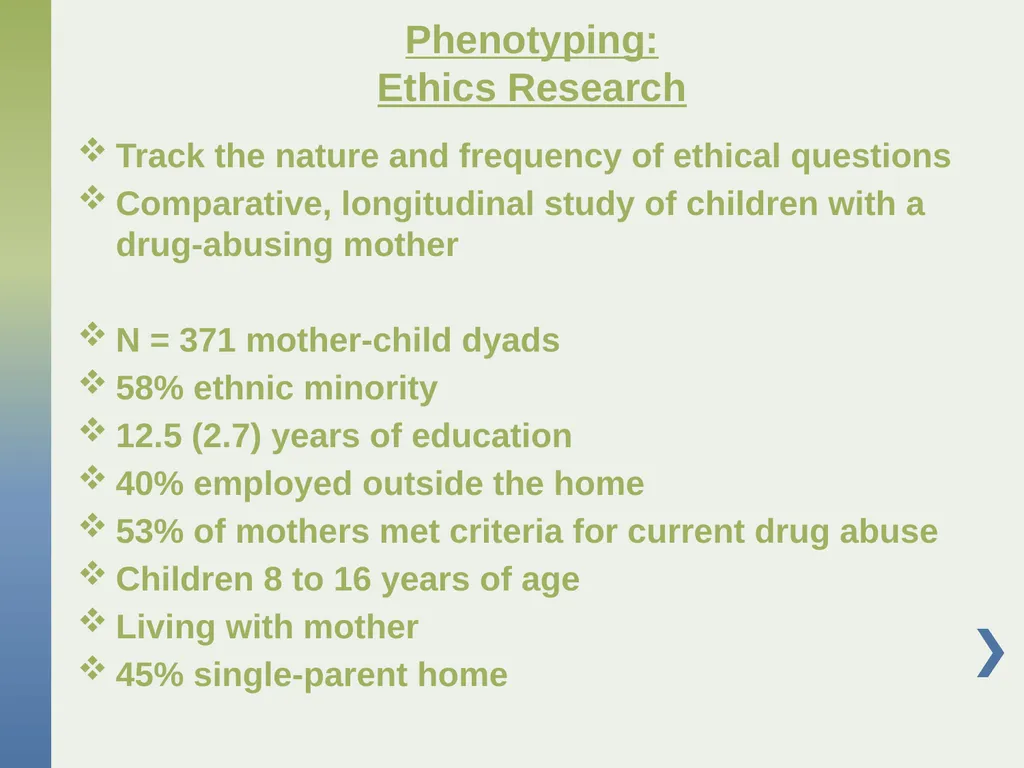
Track the nature and frequency of ethical questions
Comparative, longitudinal study of children with a drug-abusing mother
N = 371 mother-child dyads
58% ethnic minority
12.5 (2.7) years of education
40% employed outside the home
53% of mothers met criteria for current drug abuse
Children 8 to 16 years of age
Living with mother
45% single-parent home Phenotyping: Ethics Research<br>
Comparative, longitudinal study of children with a drug-abusing mother
N = 371 mother-child dyads
58% ethnic minority
12.5 (2.7) years of education
40% employed outside the home
53% of mothers met criteria for current drug abuse
Children 8 to 16 years of age
Living with mother
45% single-parent home Phenotyping: Ethics Research<br>
46
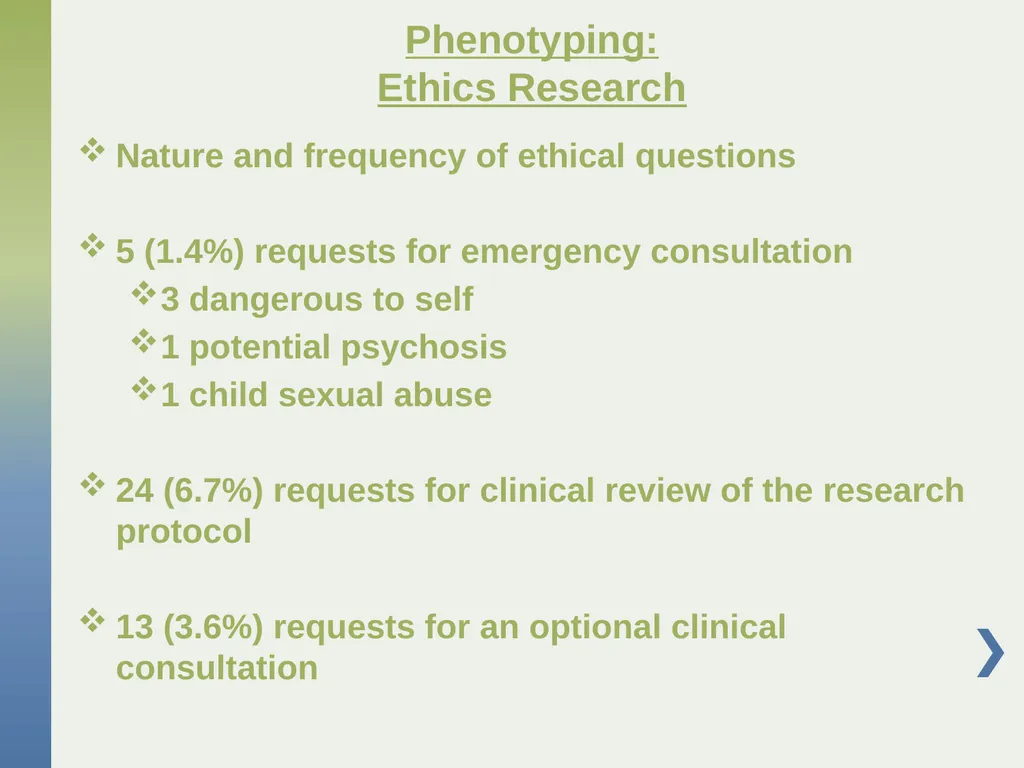
Nature and frequency of ethical questions
5 (1.4%) requests for emergency consultation
3 dangerous to self
1 potential psychosis
1 child sexual abuse
24 (6.7%) requests for clinical review of the research protocol
13 (3.6%) requests for an optional clinical consultation Phenotyping: Ethics Research<br>
5 (1.4%) requests for emergency consultation
3 dangerous to self
1 potential psychosis
1 child sexual abuse
24 (6.7%) requests for clinical review of the research protocol
13 (3.6%) requests for an optional clinical consultation Phenotyping: Ethics Research<br>