
Geography Year 8 Amazing ecosystems Key Knowledge
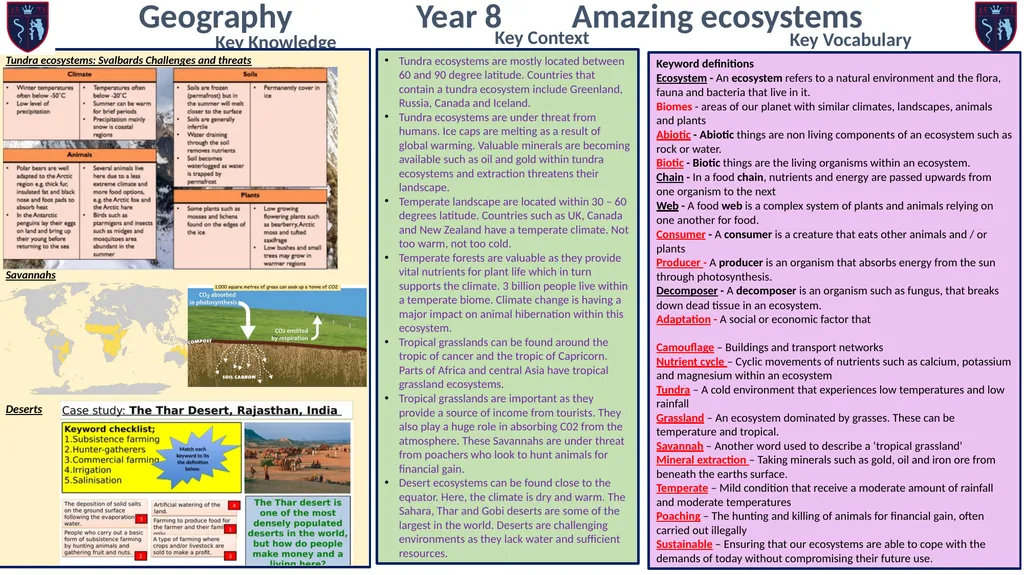
Description: Geography Year 8 Amazing ecosystems Key Knowledge Tundra ecosystems: Svalbards Challenges and threats Savannahs Deserts Tundra ecosystems are mostly located between 60 and 90 degree latitude. Countries that contain a tundra ecosystem
Related Topics
Download Presentation
"Geography Year 8 Amazing ecosystems Key Knowledge" is the property of its rightful owner. Permission is granted to download and print the materials on this website for personal, non-commercial use only, and to display it on your personal computer provided you do not modify the materials and that you retain all copyright notices contained in the materials. By downloading content from our website, you accept the terms of this agreement.
Presentation Transcript
slide1. Geography Year 8 Amazing ecosystems Key Knowledge Tundra ecosystems: Svalbards Challenges and threats
Savannahs
Deserts Tundra ecosystems are mostly located between 60 and 90 degree latitude. Countries that contain a tundra ecosystem include Greenland, Russia, Canada and Iceland.
Tundra ecosystems are under threat from humans. Ice caps are melting as a result of global warming. Valuable minerals are becoming available such as oil and gold within tundra ecosystems and extraction threatens their landscape.
Temperate landscape are located within 30 – 60 degrees latitude. Countries such as UK, Canada and New Zealand have a temperate climate. Not too warm, not too cold.
Temperate forests are valuable as they provide vital nutrients for plant life which in turn supports the climate. 3 billion people live within a temperate biome. Climate change is having a major impact on animal hibernation within this ecosystem.
Tropical grasslands can be found around the tropic of cancer and the tropic of Capricorn. Parts of Africa and central Asia have tropical grassland ecosystems.
Tropical grasslands are important as they provide a source of income from tourists. They also play a huge role in absorbing C02 from the atmosphere. These Savannahs are under threat from poachers who look to hunt animals for financial gain.
Desert ecosystems can be found close to the equator. Here, the climate is dry and warm. The Sahara, Thar and Gobi deserts are some of the largest in the world. Deserts are challenging environments as they lack water and sufficient resources. Keyword definitions
Ecosystem - An ecosystem refers to a natural environment and the flora, fauna and bacteria that live in it.
Biomes - areas of our planet with similar climates, landscapes, animals and plants
Abiotic - Abiotic things are non living components of an ecosystem such as rock or water.
Biotic - Biotic things are the living organisms within an ecosystem.
Chain - In a food chain, nutrients and energy are passed upwards from one organism to the next
Web - A food web is a complex system of plants and animals relying on one another for food.
Consumer - A consumer is a creature that eats other animals and / or plants Producer - A producer is an organism that absorbs energy from the sun through photosynthesis.
Decomposer - A decomposer is an organism such as fungus, that breaks down dead tissue in an ecosystem.
Adaptation - A social or economic factor that
Camouflage – Buildings and transport networks
Nutrient cycle – Cyclic movements of nutrients such as calcium, potassium and magnesium within an ecosystem
Tundra – A cold environment that experiences low temperatures and low rainfall
Grassland – An ecosystem dominated by grasses. These can be temperature and tropical.
Savannah – Another word used to describe a ‘tropical grassland’
Mineral extraction – Taking minerals such as gold, oil and iron ore from beneath the earths surface.
Temperate – Mild condition that receive a moderate amount of rainfall and moderate temperatures
Poaching – The hunting and killing of animals for financial gain, often carried out illegally
Sustainable – Ensuring that our ecosystems are able to cope with the demands of today without compromising their future use. Key Vocabulary Key Context<br>
Savannahs
Deserts Tundra ecosystems are mostly located between 60 and 90 degree latitude. Countries that contain a tundra ecosystem include Greenland, Russia, Canada and Iceland.
Tundra ecosystems are under threat from humans. Ice caps are melting as a result of global warming. Valuable minerals are becoming available such as oil and gold within tundra ecosystems and extraction threatens their landscape.
Temperate landscape are located within 30 – 60 degrees latitude. Countries such as UK, Canada and New Zealand have a temperate climate. Not too warm, not too cold.
Temperate forests are valuable as they provide vital nutrients for plant life which in turn supports the climate. 3 billion people live within a temperate biome. Climate change is having a major impact on animal hibernation within this ecosystem.
Tropical grasslands can be found around the tropic of cancer and the tropic of Capricorn. Parts of Africa and central Asia have tropical grassland ecosystems.
Tropical grasslands are important as they provide a source of income from tourists. They also play a huge role in absorbing C02 from the atmosphere. These Savannahs are under threat from poachers who look to hunt animals for financial gain.
Desert ecosystems can be found close to the equator. Here, the climate is dry and warm. The Sahara, Thar and Gobi deserts are some of the largest in the world. Deserts are challenging environments as they lack water and sufficient resources. Keyword definitions
Ecosystem - An ecosystem refers to a natural environment and the flora, fauna and bacteria that live in it.
Biomes - areas of our planet with similar climates, landscapes, animals and plants
Abiotic - Abiotic things are non living components of an ecosystem such as rock or water.
Biotic - Biotic things are the living organisms within an ecosystem.
Chain - In a food chain, nutrients and energy are passed upwards from one organism to the next
Web - A food web is a complex system of plants and animals relying on one another for food.
Consumer - A consumer is a creature that eats other animals and / or plants Producer - A producer is an organism that absorbs energy from the sun through photosynthesis.
Decomposer - A decomposer is an organism such as fungus, that breaks down dead tissue in an ecosystem.
Adaptation - A social or economic factor that
Camouflage – Buildings and transport networks
Nutrient cycle – Cyclic movements of nutrients such as calcium, potassium and magnesium within an ecosystem
Tundra – A cold environment that experiences low temperatures and low rainfall
Grassland – An ecosystem dominated by grasses. These can be temperature and tropical.
Savannah – Another word used to describe a ‘tropical grassland’
Mineral extraction – Taking minerals such as gold, oil and iron ore from beneath the earths surface.
Temperate – Mild condition that receive a moderate amount of rainfall and moderate temperatures
Poaching – The hunting and killing of animals for financial gain, often carried out illegally
Sustainable – Ensuring that our ecosystems are able to cope with the demands of today without compromising their future use. Key Vocabulary Key Context<br>