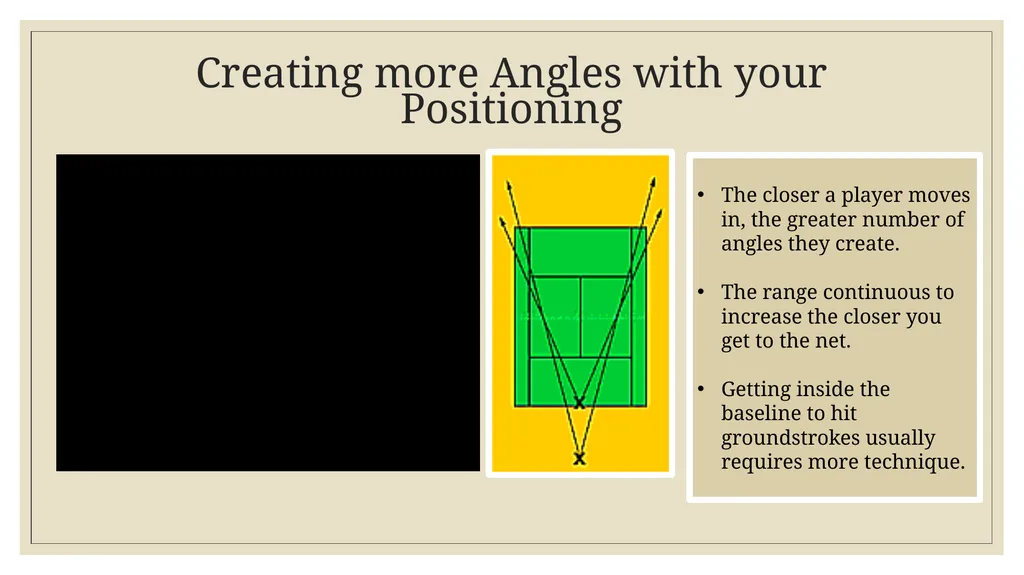
Geometry and tennis By: Evelina Borvanova Introduction Creating more Angles with your Positioning The closer a player moves in, the greater number of angles they create. The range continuous to increase the closer you get to the net.
"Geometry and tennis By: Evelina Borvanova" is the property of its rightful owner. Permission is granted to
download and print the materials on this website for personal, non-commercial use only, and to display it
on your personal computer provided you do not modify the materials and that you retain all copyright
notices contained in the materials. By downloading content from our website, you accept the terms of this
agreement.
Presentation Transcript
01
Geometry and tennis By: Evelina Borvanova<br>
02
Introduction<br>
03
Creating more Angles with your Positioning The closer a player moves in, the greater number of angles they create.
The range continuous to increase the closer you get to the net.
Getting inside the baseline to hit groundstrokes usually requires more technique.<br>
04
Hitting Crosscourt on Rallies Figure 1 Figure 2 Figure 3 Hitting crosscourt makes the ball pass over the lower portion of the net
The tennis court, which 78 feet in length, is about 10% longer if you hit cross court than down-the-line.
Court geometry becomes extremely important when one considers the possible replies from your opponent.<br>
05
Hitting Crosscourt on Rallies<br>
06
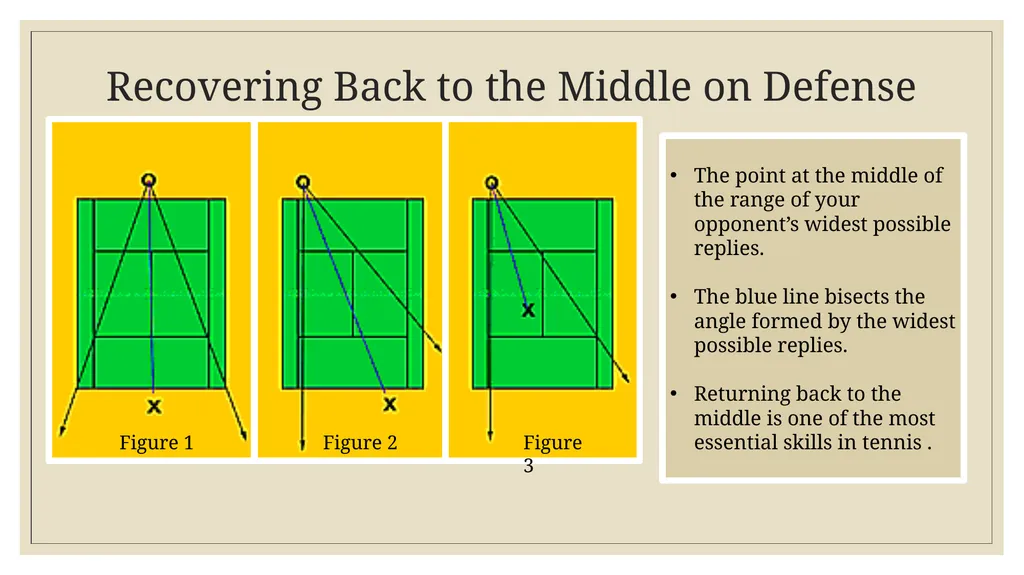
Recovering Back to the Middle on Defense Figure 1 Figure 2 Figure 3 The point at the middle of the range of your opponent’s widest possible replies.
The blue line bisects the angle formed by the widest possible replies.
Returning back to the middle is one of the most essential skills in tennis .<br>
07
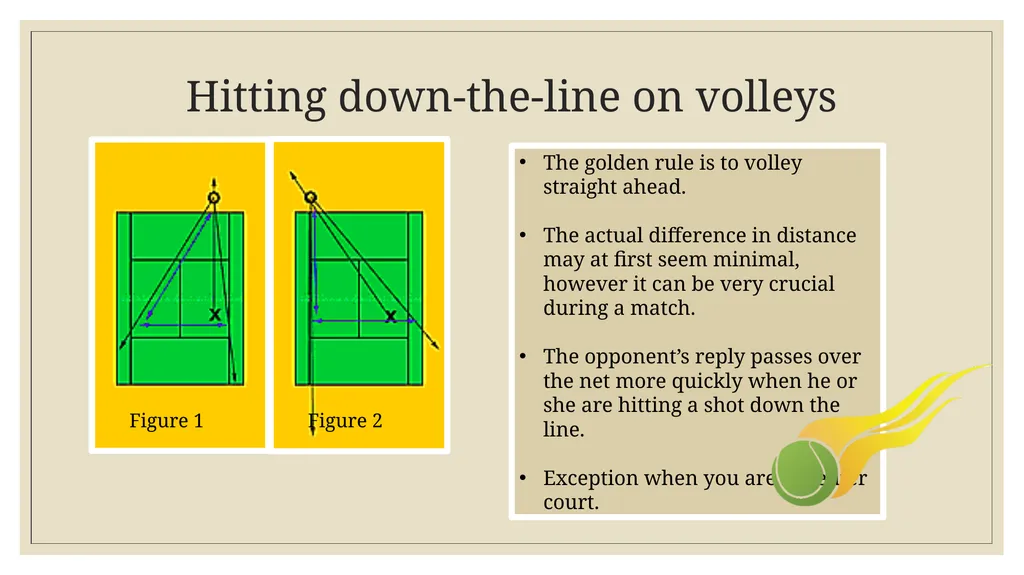
Hitting down-the-line on volleys Figure 1 Figure 2 The golden rule is to volley straight ahead.
The actual difference in distance may at first seem minimal, however it can be very crucial during a match.
The opponent’s reply passes over the net more quickly when he or she are hitting a shot down the line.
Exception when you are in center court.<br>
08
Professional Tennis Players<br>
09
Personal Application of Court Geometry<br>
10
Conclusion and Further Questions Further Questions to Possibly Explore:
How can you calculate the probability of a game?
What concepts of physics are used in tennis?
How can I achieve a perfect serve?
How does court geometry change between playing singles or doubles?
What other sports use geometry?
Are there certain exceptions to these geometry rules?
Does the Hawk-Eye use math calculations?<br>
11
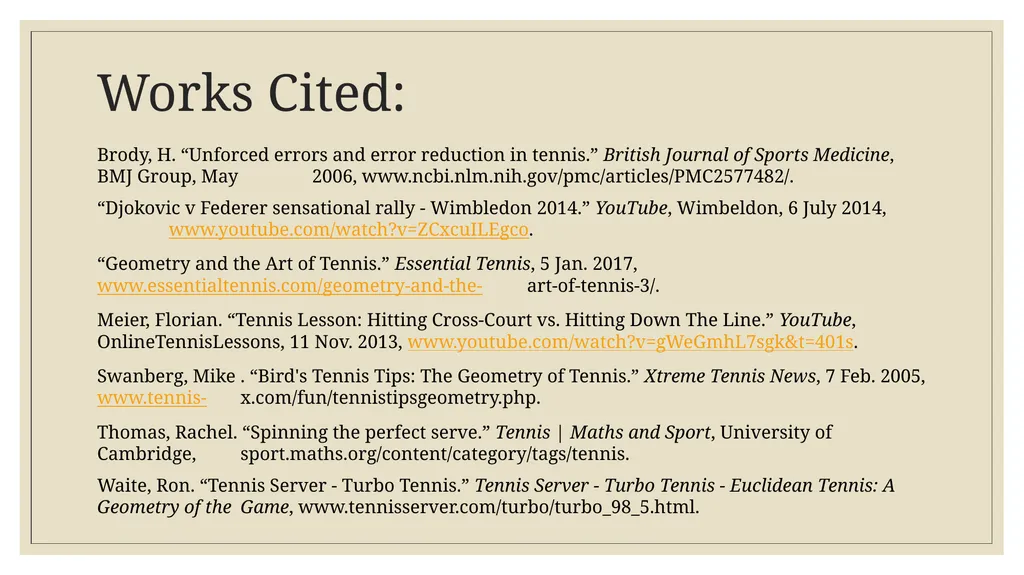
Works Cited: Brody, H. “Unforced errors and error reduction in tennis.” British Journal of Sports Medicine, BMJ Group, May 2006, www.ncbi.nlm.nih.gov/pmc/articles/PMC2577482/.
“Djokovic v Federer sensational rally - Wimbledon 2014.” YouTube, Wimbeldon, 6 July 2014, www.youtube.com/watch?v=ZCxcuILEgco.
“Geometry and the Art of Tennis.” Essential Tennis, 5 Jan. 2017, www.essentialtennis.com/geometry-and-the- art-of-tennis-3/.
Meier, Florian. “Tennis Lesson: Hitting Cross-Court vs. Hitting Down The Line.” YouTube, OnlineTennisLessons, 11 Nov. 2013, www.youtube.com/watch?v=gWeGmhL7sgk&t=401s.
Swanberg, Mike . “Bird's Tennis Tips: The Geometry of Tennis.” Xtreme Tennis News, 7 Feb. 2005, www.tennis- x.com/fun/tennistipsgeometry.php.
Thomas, Rachel. “Spinning the perfect serve.” Tennis | Maths and Sport, University of Cambridge, sport.maths.org/content/category/tags/tennis.
Waite, Ron. “Tennis Server - Turbo Tennis.” Tennis Server - Turbo Tennis - Euclidean Tennis: A Geometry of the Game, www.tennisserver.com/turbo/turbo_98_5.html.<br>