
Global banking outlook 2016 Transforming talent
TA
Published · 14 slides · 0 views

1 / 1
Description
Global banking outlook 2016 Transforming talent The banker of the future Think about the future. How do you define a leading bank? Are banks focused on improving financial KPIs or cultural attributes? Earnings numbers vs. ethos Compliance
Related Topics
Share
Embed code
Download this presentation From Below
"Global banking outlook 2016 Transforming talent" is the property of its rightful owner. Permission is granted to download and print the materials on this website for personal, non-commercial use only, and to display it on your personal computer provided you do not modify the materials and that you retain all copyright notices contained in the materials. By downloading content from our website, you accept the terms of this agreement.
Presentation Transcript
01
Global banking outlook 2016 Transforming talent
The banker of the future<br>
The banker of the future<br>
02
Think about the future.
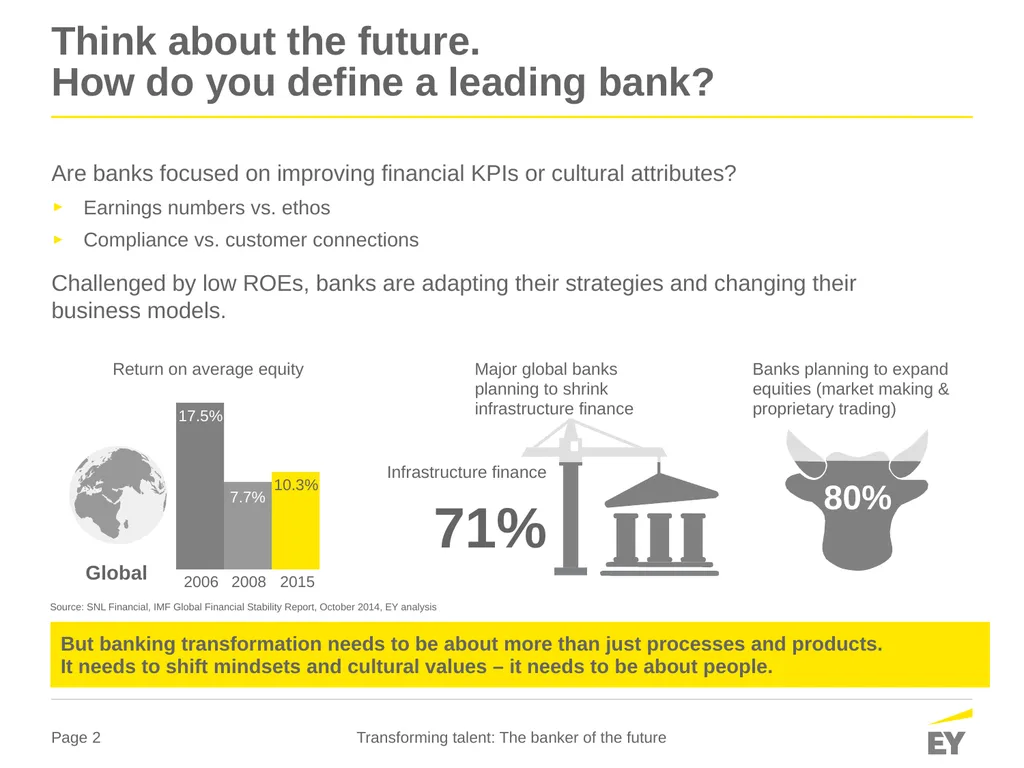
How do you define a leading bank? Are banks focused on improving financial KPIs or cultural attributes?
Earnings numbers vs. ethos
Compliance vs. customer connections
Challenged by low ROEs, banks are adapting their strategies and changing their business models. Return on average equity Banks planning to expand equities (market making & proprietary trading) Major global banks planning to shrink infrastructure finance Source: SNL Financial, IMF Global Financial Stability Report, October 2014, EY analysis Infrastructure finance
71% 10.3% 7.7% Global 17.5% 2006 80% But banking transformation needs to be about more than just processes and products. It needs to shift mindsets and cultural values – it needs to be about people. 2008 2015<br>
Earnings numbers vs. ethos
Compliance vs. customer connections
Challenged by low ROEs, banks are adapting their strategies and changing their business models. Return on average equity Banks planning to expand equities (market making & proprietary trading) Major global banks planning to shrink infrastructure finance Source: SNL Financial, IMF Global Financial Stability Report, October 2014, EY analysis Infrastructure finance
71% 10.3% 7.7% Global 17.5% 2006 80% But banking transformation needs to be about more than just processes and products. It needs to shift mindsets and cultural values – it needs to be about people. 2008 2015<br>
03
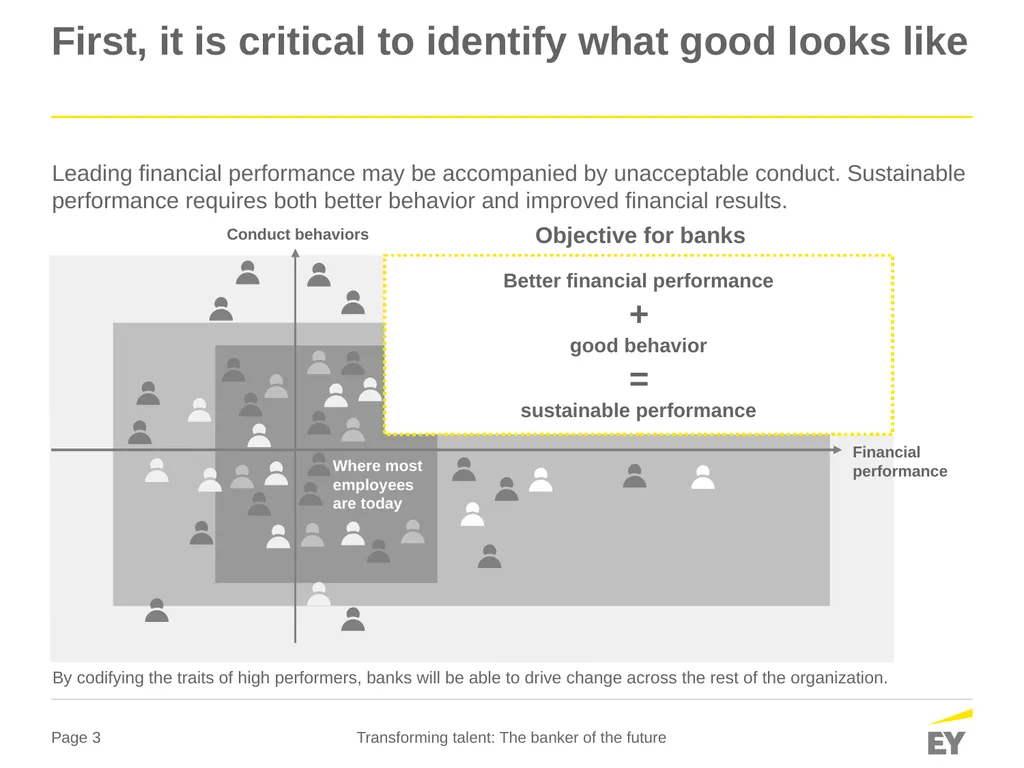
First, it is critical to identify what good looks like Conduct behaviors Financial performance Where most employees are today Objective for banks Better financial performance
+
good behavior
=
sustainable performance Leading financial performance may be accompanied by unacceptable conduct. Sustainable performance requires both better behavior and improved financial results. By codifying the traits of high performers, banks will be able to drive change across the rest of the organization.<br>
+
good behavior
=
sustainable performance Leading financial performance may be accompanied by unacceptable conduct. Sustainable performance requires both better behavior and improved financial results. By codifying the traits of high performers, banks will be able to drive change across the rest of the organization.<br>
04
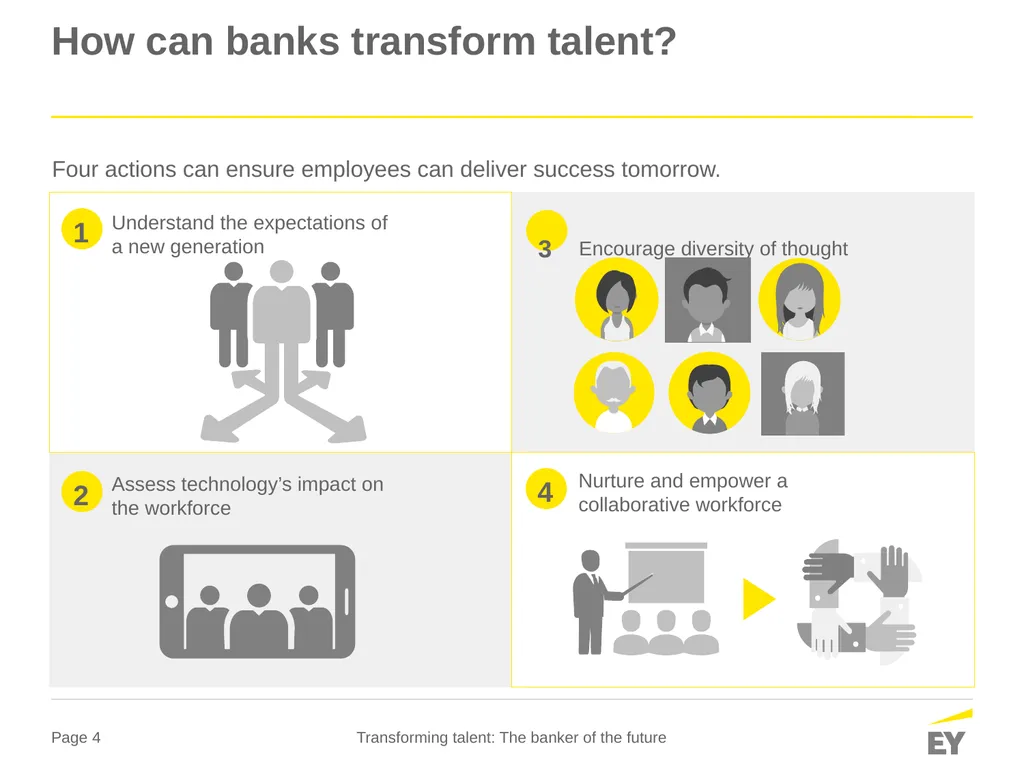
How can banks transform talent? Understand the expectations of a new generation Assess technology’s impact on the workforce Nurture and empower a collaborative workforce 1 2 Four actions can ensure employees can deliver success tomorrow.<br>
05
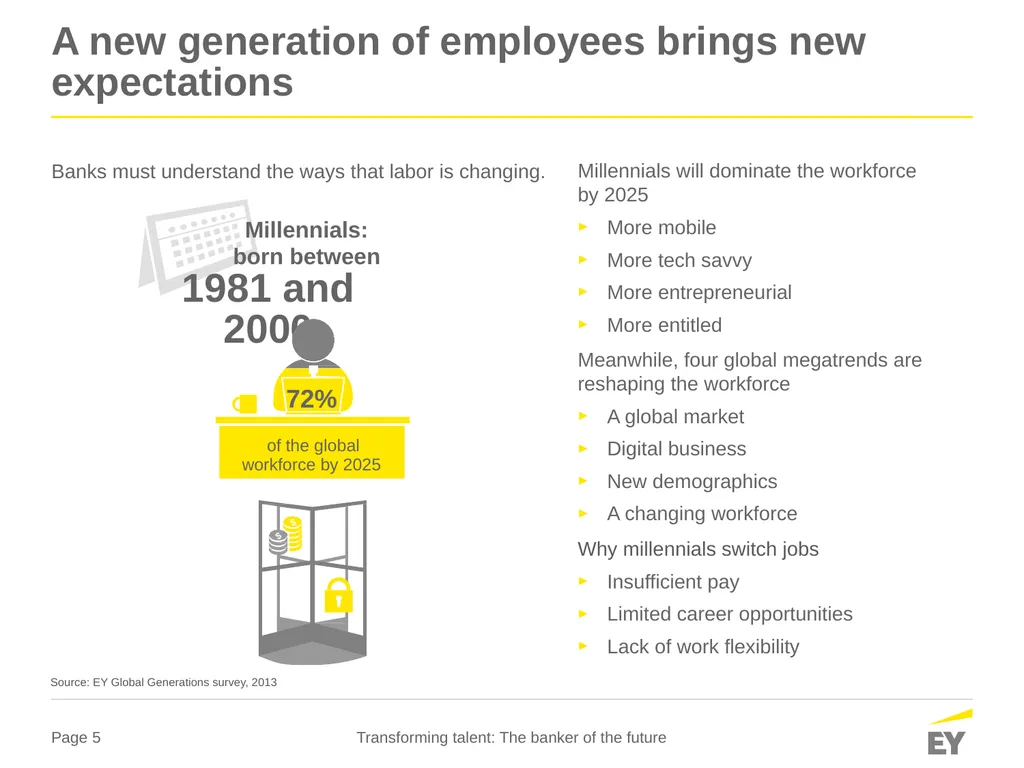
Millennials: born between
1981 and 2000 Banks must understand the ways that labor is changing. Millennials will dominate the workforce by 2025
More mobile
More tech savvy
More entrepreneurial
More entitled
Meanwhile, four global megatrends are reshaping the workforce
A global market
Digital business
New demographics
A changing workforce
Why millennials switch jobs
Insufficient pay
Limited career opportunities
Lack of work flexibility Source: EY Global Generations survey, 2013 A new generation of employees brings new expectations<br>
1981 and 2000 Banks must understand the ways that labor is changing. Millennials will dominate the workforce by 2025
More mobile
More tech savvy
More entrepreneurial
More entitled
Meanwhile, four global megatrends are reshaping the workforce
A global market
Digital business
New demographics
A changing workforce
Why millennials switch jobs
Insufficient pay
Limited career opportunities
Lack of work flexibility Source: EY Global Generations survey, 2013 A new generation of employees brings new expectations<br>
06
223 192 2011 2014 Branch banking
Number of branches (in '000s) Online banking
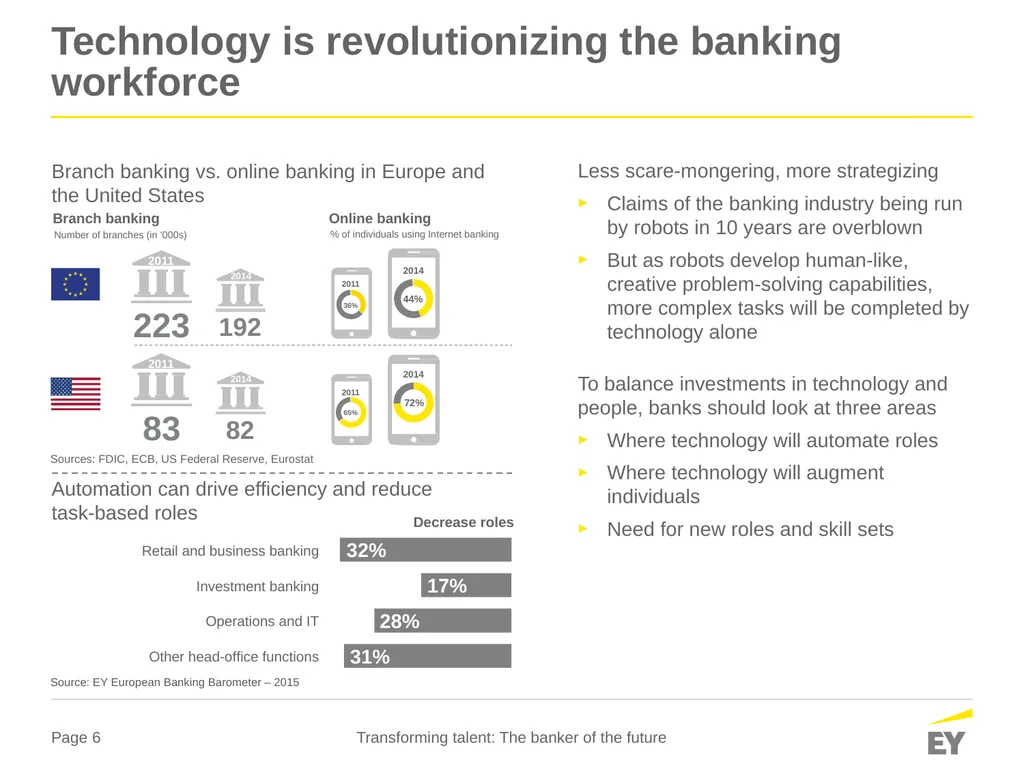
% of individuals using Internet banking 2014 2011 36% 44% 65% 2014 Technology is revolutionizing the banking workforce Retail and business banking 32% 17% 28% 31% Branch banking vs. online banking in Europe and the United States 2011 72% 83 82 2011 2014 Sources: FDIC, ECB, US Federal Reserve, Eurostat Less scare-mongering, more strategizing
Claims of the banking industry being run by robots in 10 years are overblown
But as robots develop human-like, creative problem-solving capabilities, more complex tasks will be completed by technology alone
To balance investments in technology and people, banks should look at three areas
Where technology will automate roles
Where technology will augment individuals
Need for new roles and skill sets Automation can drive efficiency and reduce task-based roles Investment banking Operations and IT Other head-office functions Source: EY European Banking Barometer – 2015 Decrease roles<br>
Number of branches (in '000s) Online banking
% of individuals using Internet banking 2014 2011 36% 44% 65% 2014 Technology is revolutionizing the banking workforce Retail and business banking 32% 17% 28% 31% Branch banking vs. online banking in Europe and the United States 2011 72% 83 82 2011 2014 Sources: FDIC, ECB, US Federal Reserve, Eurostat Less scare-mongering, more strategizing
Claims of the banking industry being run by robots in 10 years are overblown
But as robots develop human-like, creative problem-solving capabilities, more complex tasks will be completed by technology alone
To balance investments in technology and people, banks should look at three areas
Where technology will automate roles
Where technology will augment individuals
Need for new roles and skill sets Automation can drive efficiency and reduce task-based roles Investment banking Operations and IT Other head-office functions Source: EY European Banking Barometer – 2015 Decrease roles<br>
07
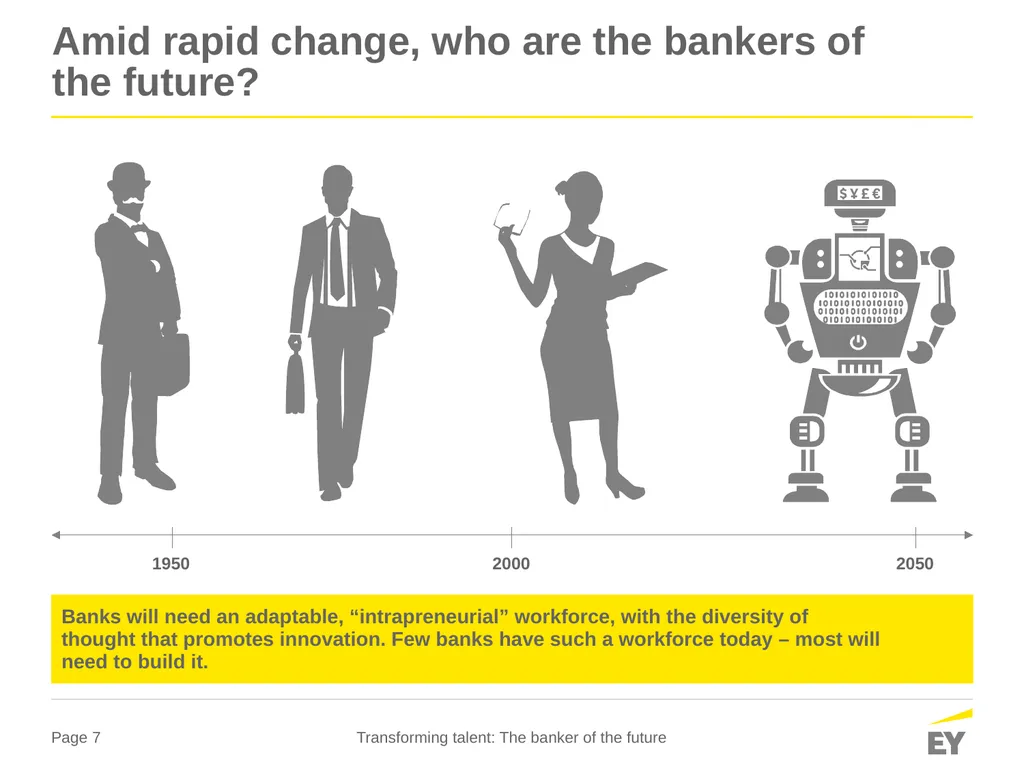
Banks will need an adaptable, “intrapreneurial” workforce, with the diversity of thought that promotes innovation. Few banks have such a workforce today – most will need to build it. Amid rapid change, who are the bankers of
the future? 1950 2000 2050<br>
08
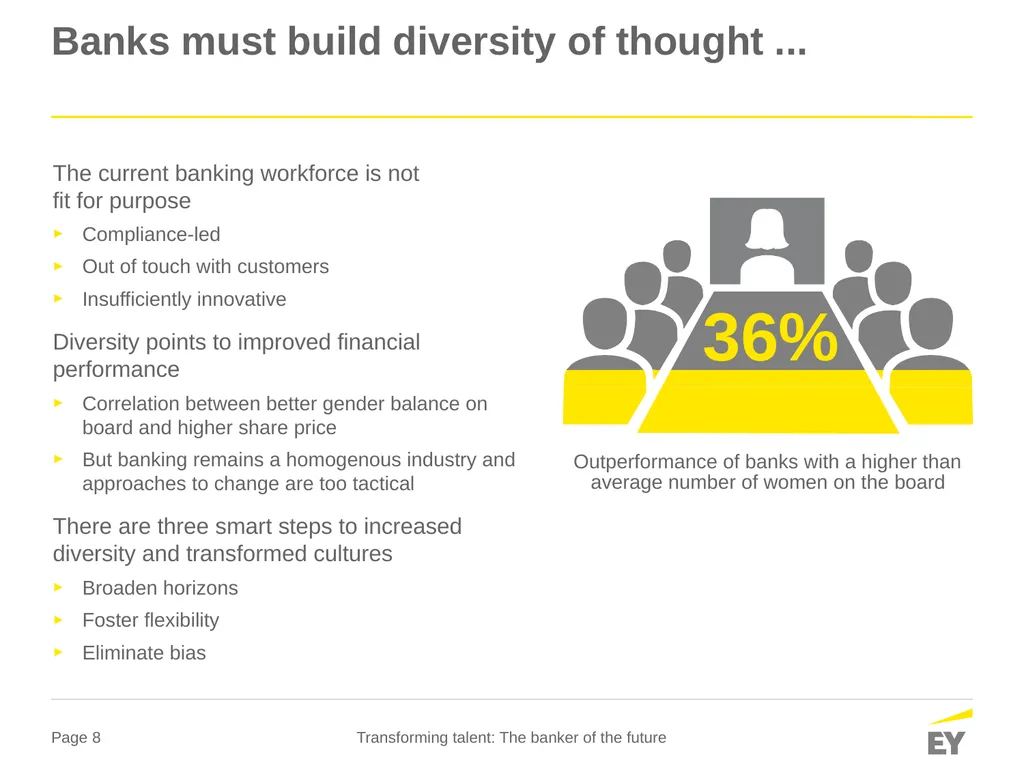
Banks must build diversity of thought ... 36% Outperformance of banks with a higher than average number of women on the board The current banking workforce is not
fit for purpose
Compliance-led
Out of touch with customers
Insufficiently innovative
Diversity points to improved financial performance
Correlation between better gender balance on board and higher share price
But banking remains a homogenous industry and approaches to change are too tactical
There are three smart steps to increased diversity and transformed cultures
Broaden horizons
Foster flexibility
Eliminate bias<br>
Compliance-led
Out of touch with customers
Insufficiently innovative
Diversity points to improved financial performance
Correlation between better gender balance on board and higher share price
But banking remains a homogenous industry and approaches to change are too tactical
There are three smart steps to increased diversity and transformed cultures
Broaden horizons
Foster flexibility
Eliminate bias<br>
09
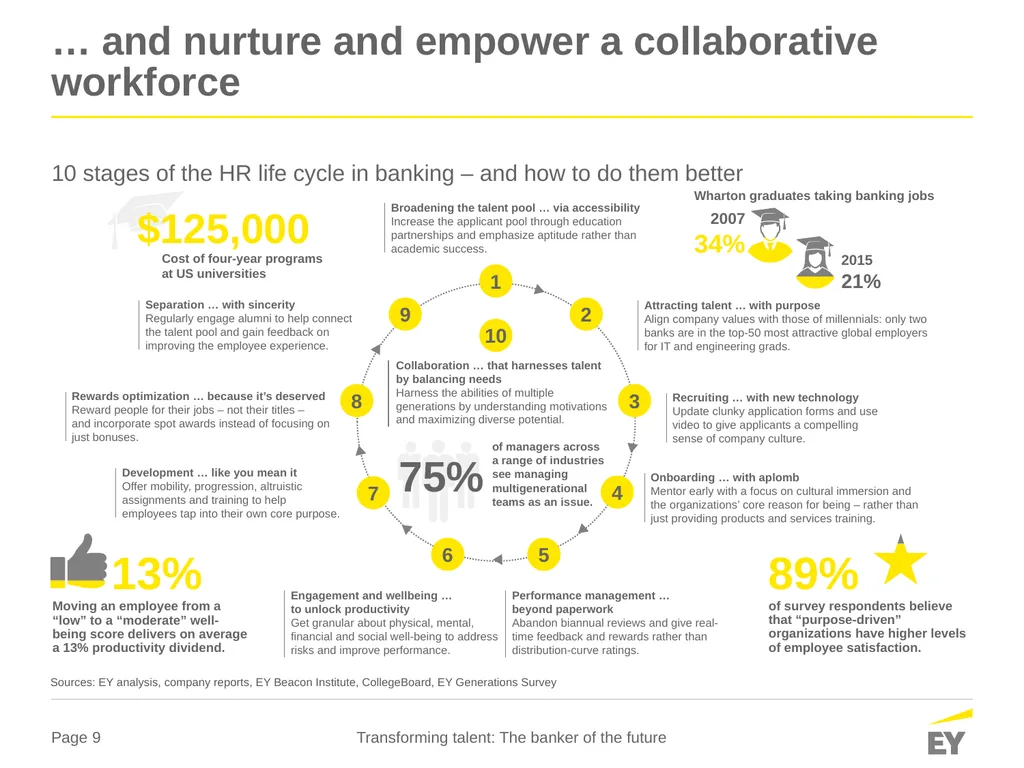
Moving an employee from a “low” to a “moderate” well- being score delivers on average a 13% productivity dividend. … and nurture and empower a collaborative workforce Attracting talent … with purpose
Align company values with those of millennials: only two banks are in the top-50 most attractive global employers for IT and engineering grads. of managers across a range of industries see managing multigenerational teams as an issue. 89%
of survey respondents believe that “purpose-driven”
organizations have higher levels of employee satisfaction. 75% 4 3 2 1 9 8 7 6 10 5 Wharton graduates taking banking jobs 2007
34% 2015
21% Recruiting … with new technology
Update clunky application forms and use video to give applicants a compelling sense of company culture. Onboarding … with aplomb
Mentor early with a focus on cultural immersion and the organizations’ core reason for being – rather than just providing products and services training. Performance management … beyond paperwork
Abandon biannual reviews and give real- time feedback and rewards rather than distribution-curve ratings. Engagement and wellbeing … to unlock productivity
Get granular about physical, mental, financial and social well-being to address risks and improve performance. Development … like you mean it
Offer mobility, progression, altruistic assignments and training to help employees tap into their own core purpose. Rewards optimization … because it’s deserved
Reward people for their jobs – not their titles – and incorporate spot awards instead of focusing on just bonuses. Separation … with sincerity
Regularly engage alumni to help connect the talent pool and gain feedback on improving the employee experience. Broadening the talent pool … via accessibility
Increase the applicant pool through education partnerships and emphasize aptitude rather than academic success. $125,000
Cost of four-year programs
at US universities 10 stages of the HR life cycle in banking – and how to do them better Collaboration … that harnesses talent by balancing needs
Harness the abilities of multiple generations by understanding motivations and maximizing diverse potential. Sources: EY analysis, company reports, EY Beacon Institute, CollegeBoard, EY Generations Survey 13%<br>
Align company values with those of millennials: only two banks are in the top-50 most attractive global employers for IT and engineering grads. of managers across a range of industries see managing multigenerational teams as an issue. 89%
of survey respondents believe that “purpose-driven”
organizations have higher levels of employee satisfaction. 75% 4 3 2 1 9 8 7 6 10 5 Wharton graduates taking banking jobs 2007
34% 2015
21% Recruiting … with new technology
Update clunky application forms and use video to give applicants a compelling sense of company culture. Onboarding … with aplomb
Mentor early with a focus on cultural immersion and the organizations’ core reason for being – rather than just providing products and services training. Performance management … beyond paperwork
Abandon biannual reviews and give real- time feedback and rewards rather than distribution-curve ratings. Engagement and wellbeing … to unlock productivity
Get granular about physical, mental, financial and social well-being to address risks and improve performance. Development … like you mean it
Offer mobility, progression, altruistic assignments and training to help employees tap into their own core purpose. Rewards optimization … because it’s deserved
Reward people for their jobs – not their titles – and incorporate spot awards instead of focusing on just bonuses. Separation … with sincerity
Regularly engage alumni to help connect the talent pool and gain feedback on improving the employee experience. Broadening the talent pool … via accessibility
Increase the applicant pool through education partnerships and emphasize aptitude rather than academic success. $125,000
Cost of four-year programs
at US universities 10 stages of the HR life cycle in banking – and how to do them better Collaboration … that harnesses talent by balancing needs
Harness the abilities of multiple generations by understanding motivations and maximizing diverse potential. Sources: EY analysis, company reports, EY Beacon Institute, CollegeBoard, EY Generations Survey 13%<br>
10
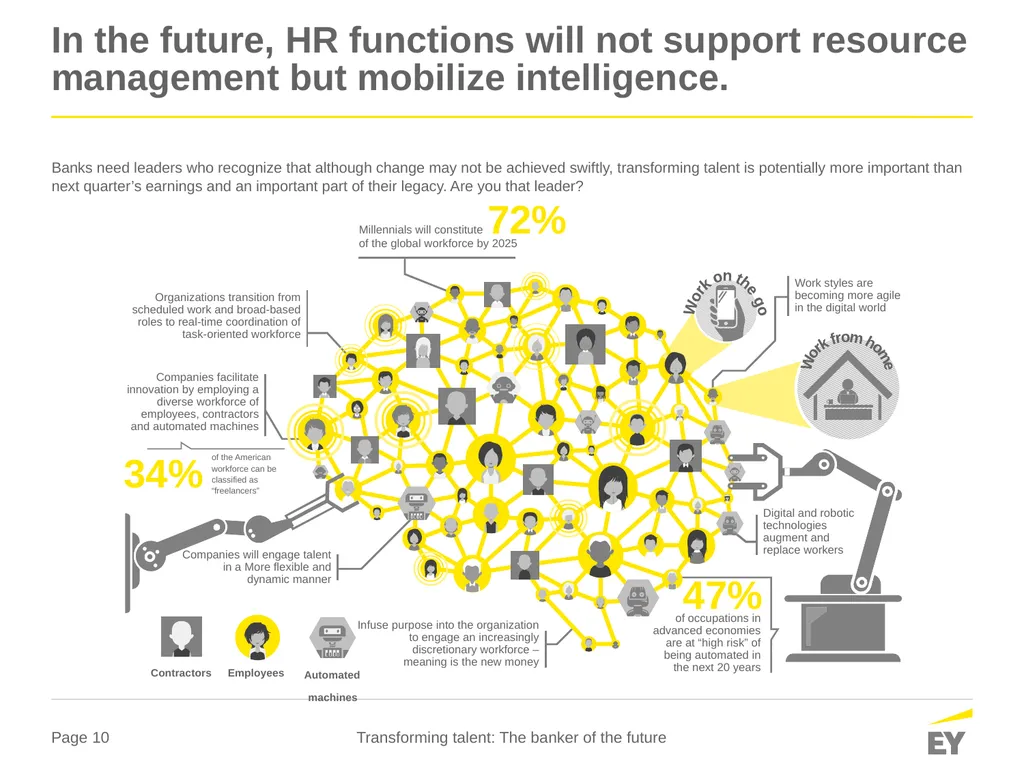
72% Banks need leaders who recognize that although change may not be achieved swiftly, transforming talent is potentially more important than next quarter’s earnings and an important part of their legacy. Are you that leader? Work styles are becoming more agile in the digital world Digital and robotic technologies augment and
replace workers of occupations in advanced economies are at “high risk” of being automated in the next 20 years Infuse purpose into the organization
to engage an increasingly discretionary workforce –
meaning is the new money Companies will engage talent
in a More flexible and
dynamic manner Employees Contractors Automated machines Organizations transition from scheduled work and broad-based roles to real-time coordination of task-oriented workforce Companies facilitate innovation by employing a diverse workforce of
employees, contractors and automated machines of the American workforce can be classified as
“freelancers” 34% Work on the go Work from home In the future, HR functions will not support resource management but mobilize intelligence. Millennials will constitute of the global workforce by 2025 47%<br>
employees, contractors and automated machines of the American workforce can be classified as
“freelancers” 34% Work on the go Work from home In the future, HR functions will not support resource management but mobilize intelligence. Millennials will constitute of the global workforce by 2025 47%<br>
11
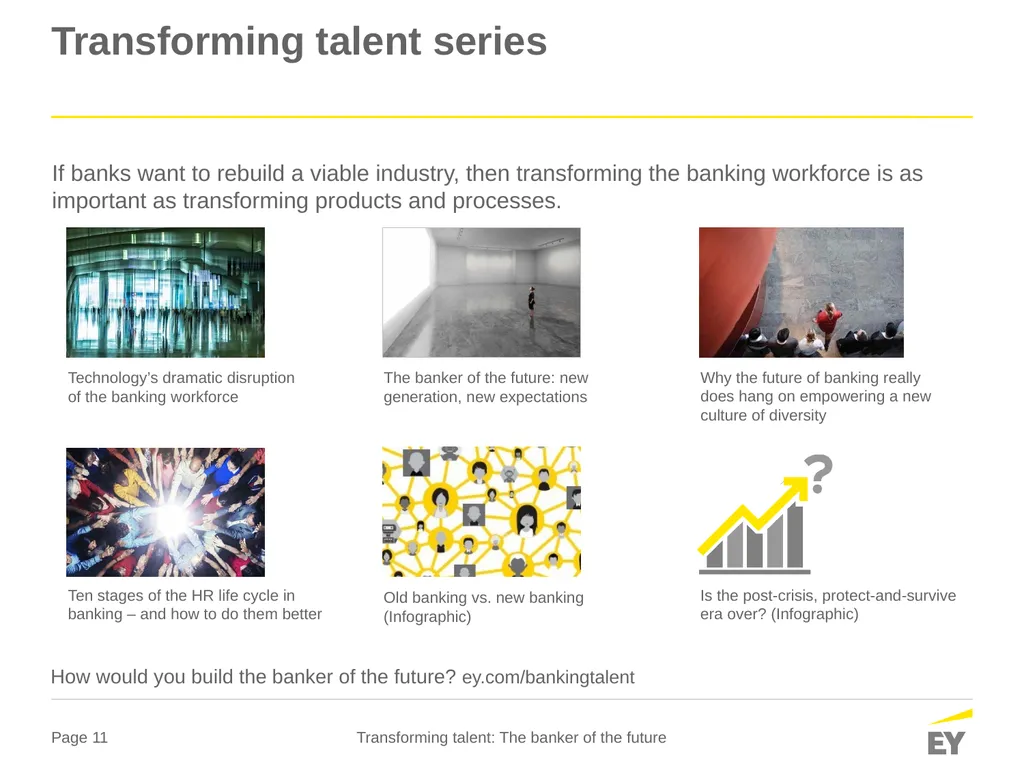
Transforming talent series How would you build the banker of the future? If banks want to rebuild a viable industry, then transforming the banking workforce is as important as transforming products and processes. The banker of the future: new generation, new expectations Why the future of banking really does hang on empowering a new culture of diversity Ten stages of the HR life cycle in banking – and how to do them better Old banking vs. new banking (Infographic) Is the post-crisis, protect-and-survive
era over? (Infographic) Technology’s dramatic disruption
of the banking workforce ey.com/bankingtalent<br>
12
How would you
build the banker
of the future? If banks want to rebuild a viable industry, transforming the banking workforce is as important as transforming products and processes. Get ready to transform talent. ey.com/bankingtalent #BetterQuestions<br>
13
Global Bill Schlich
Global Banking & Capital Markets Leader
Toronto
william.schlich@ey.com
+1 416 943 4554 John Weisel
Deputy Banking & Capital Markets Leader
New York
john.weisel@ey.com
+1 212 773 8273 Jan Bellens
Global Banking & Capital Markets Emerging
Markets and Asia Pacific Leader Singapore jan.bellens@sg.ey.com +65 6309 6888 Steven Lewis
Global Banking & Capital Markets Lead Analyst
London
slewis2@uk.ey.com
+44 20 7951 9471
Karl Meekings
Global Banking & Capital Markets Strategic Analyst
London
kmeekings@uk.ey.com
+44 20 7783 0081 Regions Michael Onak
Banking & Capital Markets Americas Leader
Charlotte
michael.onak@ey.com
+1 704 331 1827 Marie-Laure Delarue
Banking & Capital Markets EMEIA Leader
Paris
marie-laure.delarue@fr.ey.com
+33 1 46 93 73 21 Noboru Miura
Banking & Capital Markets Japan Area Leader
Tokyo
miura-nbr@shinnihon.or.jp
+81 3 3503 1115 People Advisory Services Chris Price
Global People Advisory Services Leader
London
cprice1@uk.ey.com
+44 20 7951 2313 Contacts<br>
Global Banking & Capital Markets Leader
Toronto
william.schlich@ey.com
+1 416 943 4554 John Weisel
Deputy Banking & Capital Markets Leader
New York
john.weisel@ey.com
+1 212 773 8273 Jan Bellens
Global Banking & Capital Markets Emerging
Markets and Asia Pacific Leader Singapore jan.bellens@sg.ey.com +65 6309 6888 Steven Lewis
Global Banking & Capital Markets Lead Analyst
London
slewis2@uk.ey.com
+44 20 7951 9471
Karl Meekings
Global Banking & Capital Markets Strategic Analyst
London
kmeekings@uk.ey.com
+44 20 7783 0081 Regions Michael Onak
Banking & Capital Markets Americas Leader
Charlotte
michael.onak@ey.com
+1 704 331 1827 Marie-Laure Delarue
Banking & Capital Markets EMEIA Leader
Paris
marie-laure.delarue@fr.ey.com
+33 1 46 93 73 21 Noboru Miura
Banking & Capital Markets Japan Area Leader
Tokyo
miura-nbr@shinnihon.or.jp
+81 3 3503 1115 People Advisory Services Chris Price
Global People Advisory Services Leader
London
cprice1@uk.ey.com
+44 20 7951 2313 Contacts<br>
14
EY | Assurance | Tax | Transactions | Advisory
About EY
EY is a global leader in assurance, tax, transaction and advisory services. The insights and quality services we deliver help build trust and confidence in the capital markets and in economies the world over. We develop outstanding leaders who team to deliver on our promises to all of our stakeholders. In so doing, we play a critical role in building a better working world for our people, for our clients and for our communities.
EY refers to the global organization, and may refer to one or more, of the member firms of Ernst & Young Global Limited,
each of which is a separate legal entity. Ernst & Young Global Limited, a UK company limited by guarantee, does not provide services to clients. For more information about our organization, please visit ey.com.
About EY’s Global Banking & Capital Markets network
In today’s globally competitive and highly regulated environment, managing risk effectively while satisfying an array of divergent stakeholders is a key goal of banks and securities firms. EY’s Global Banking & Capital Markets network brings together a worldwide team of professionals to help you succeed – a team with deep technical
experience in providing assurance, tax, transaction and advisory services. The network works to anticipate market trends, identify the implications and develop points of view on relevant sector issues. Ultimately it enables us to help you meet your goals and compete more effectively.
© 2015 EYGM Limited. All Rights Reserved.
1512-1782583
ED 1116
This material has been prepared for general informational purposes only and is not intended to be relied upon as accounting, tax or other professional advice. Please refer to your advisors for specific advice.
ey.com/bankingtalent<br>
About EY
EY is a global leader in assurance, tax, transaction and advisory services. The insights and quality services we deliver help build trust and confidence in the capital markets and in economies the world over. We develop outstanding leaders who team to deliver on our promises to all of our stakeholders. In so doing, we play a critical role in building a better working world for our people, for our clients and for our communities.
EY refers to the global organization, and may refer to one or more, of the member firms of Ernst & Young Global Limited,
each of which is a separate legal entity. Ernst & Young Global Limited, a UK company limited by guarantee, does not provide services to clients. For more information about our organization, please visit ey.com.
About EY’s Global Banking & Capital Markets network
In today’s globally competitive and highly regulated environment, managing risk effectively while satisfying an array of divergent stakeholders is a key goal of banks and securities firms. EY’s Global Banking & Capital Markets network brings together a worldwide team of professionals to help you succeed – a team with deep technical
experience in providing assurance, tax, transaction and advisory services. The network works to anticipate market trends, identify the implications and develop points of view on relevant sector issues. Ultimately it enables us to help you meet your goals and compete more effectively.
© 2015 EYGM Limited. All Rights Reserved.
1512-1782583
ED 1116
This material has been prepared for general informational purposes only and is not intended to be relied upon as accounting, tax or other professional advice. Please refer to your advisors for specific advice.
ey.com/bankingtalent<br>