
Global Financial Development Report 2013
Description: Global Financial Development Report 2013 Rethinking the Role of the State in Finance Martin Čihák, Lead Economist, World Bank Warsaw, December 3, 2012 http:www.worldbank.orgfinancialdevelopment First in a series Combines new data,
Related Topics
Download Presentation
"Global Financial Development Report 2013" is the property of its rightful owner. Permission is granted to download and print the materials on this website for personal, non-commercial use only, and to display it on your personal computer provided you do not modify the materials and that you retain all copyright notices contained in the materials. By downloading content from our website, you accept the terms of this agreement.
Presentation Transcript
slide1. Global Financial Development Report 2013
Rethinking the Role of the State in Finance
Martin Čihák, Lead Economist, World Bank
Warsaw, December 3, 2012 http://www.worldbank.org/financialdevelopment<br>
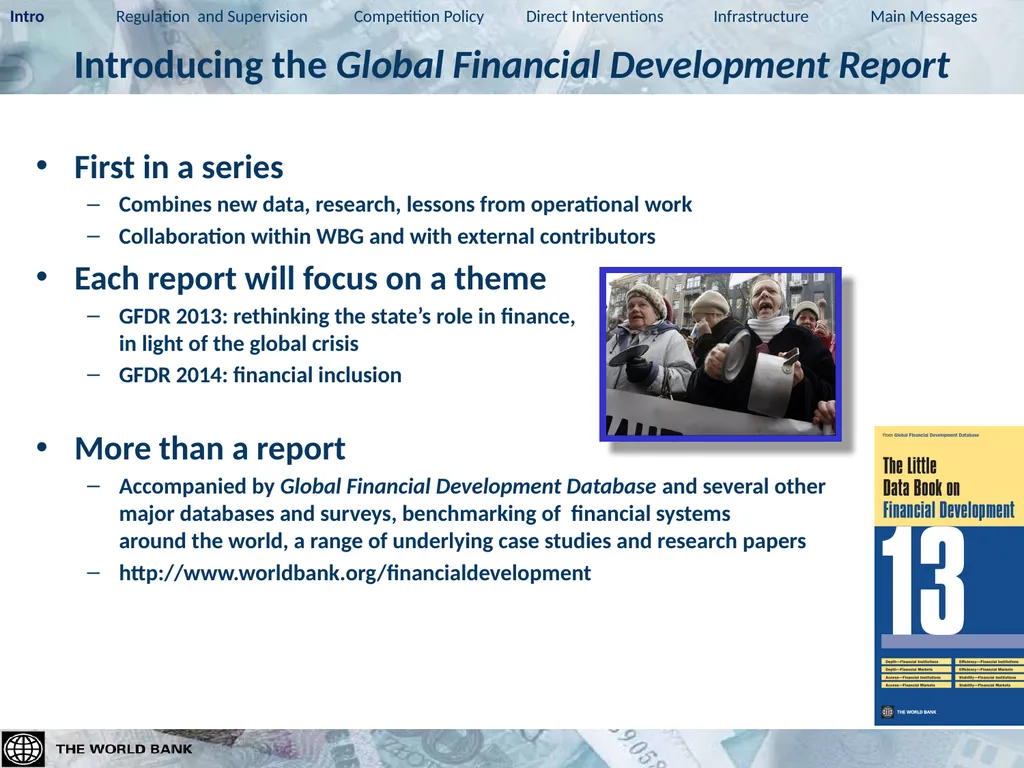
slide2. First in a series
Combines new data, research, lessons from operational work
Collaboration within WBG and with external contributors
Each report will focus on a theme
GFDR 2013: rethinking the state’s role in finance, in light of the global crisis
GFDR 2014: financial inclusion
More than a report
Accompanied by Global Financial Development Database and several other major databases and surveys, benchmarking of financial systems around the world, a range of underlying case studies and research papers
http://www.worldbank.org/financialdevelopment Introducing the Global Financial Development Report Intro Regulation and Supervision Competition Policy Direct Interventions Infrastructure Main Messages Source: AFP Source: AFP<br>
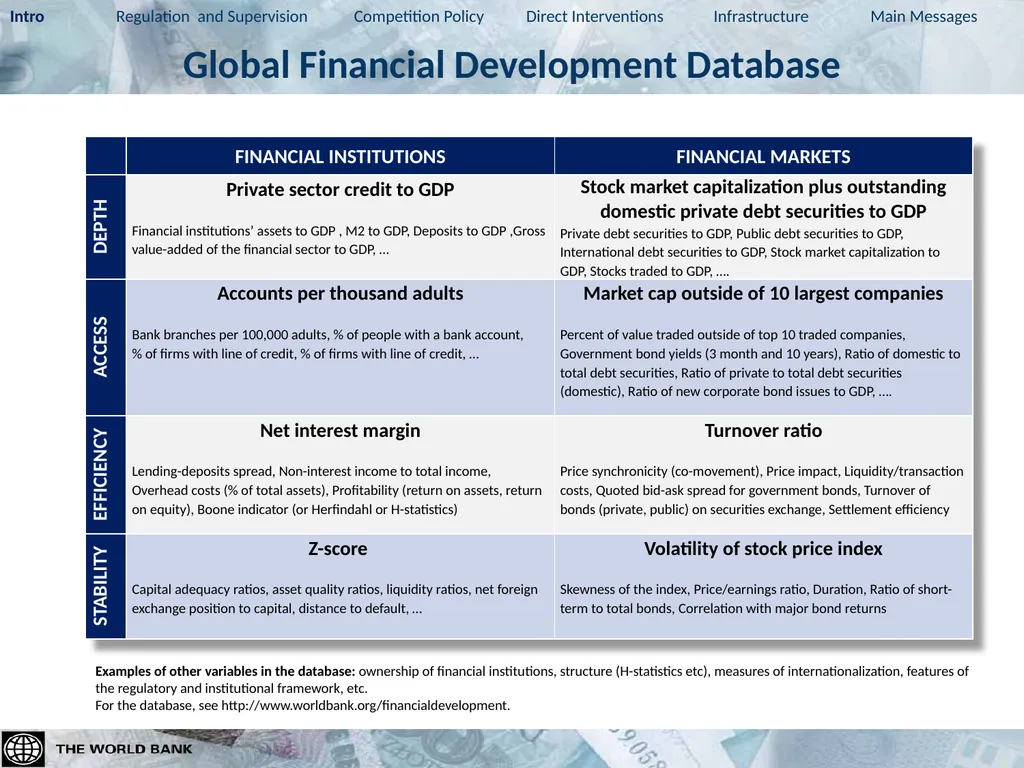
slide3. Examples of other variables in the database: ownership of financial institutions, structure (H-statistics etc), measures of internationalization, features of the regulatory and institutional framework, etc.
For the database, see http://www.worldbank.org/financialdevelopment. Intro Regulation and Supervision Competition Policy Direct Interventions Infrastructure Main Messages Global Financial Development Database<br>
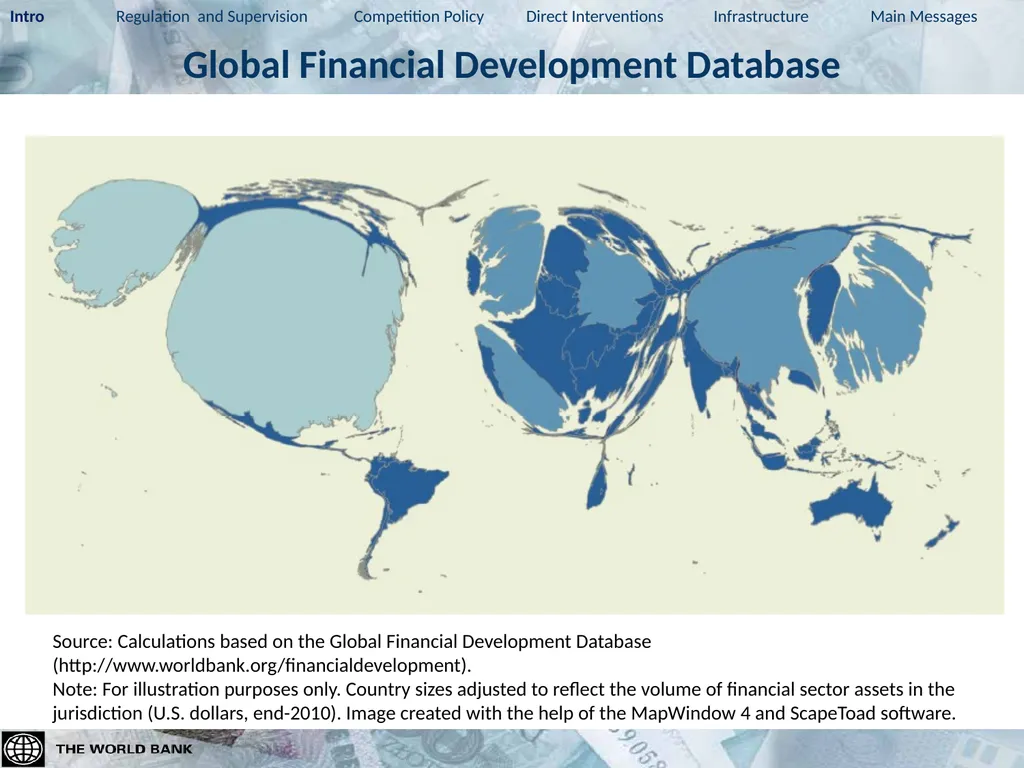
slide4. Global Financial Development Database Intro Regulation and Supervision Competition Policy Direct Interventions Infrastructure Main Messages Source: Calculations based on the Global Financial Development Database (http://www.worldbank.org/financialdevelopment).
Note: For illustration purposes only. Country sizes adjusted to reflect the volume of financial sector assets in the jurisdiction (U.S. dollars, end-2010). Image created with the help of the MapWindow 4 and ScapeToad software.<br>
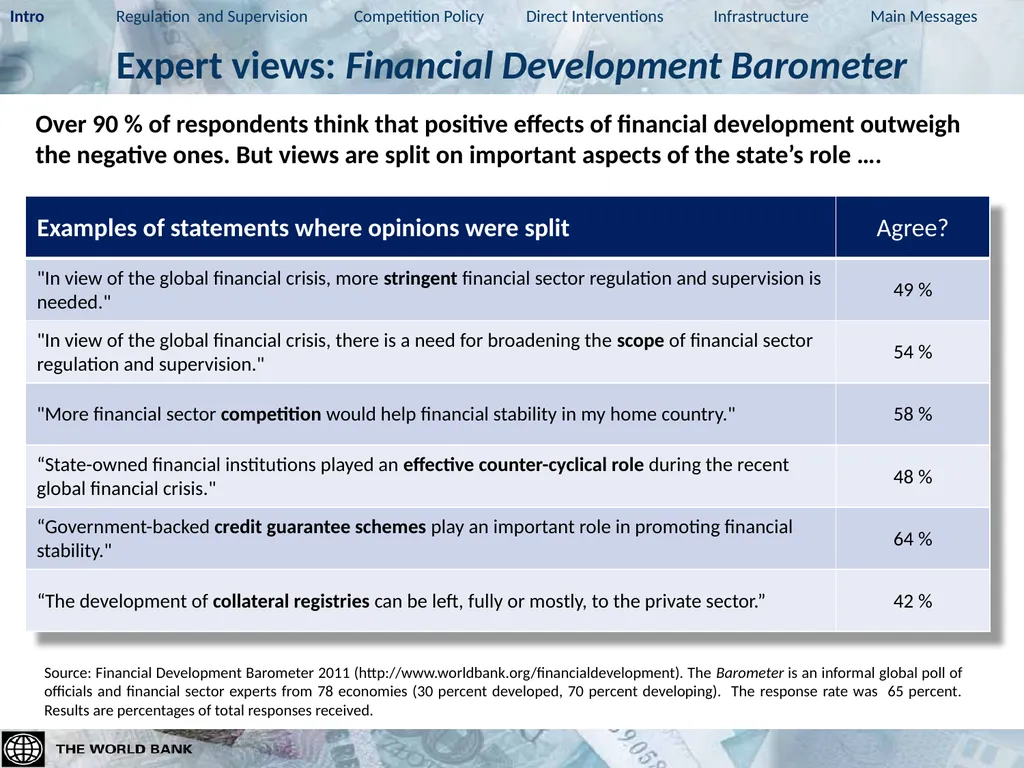
slide5. Expert views: Financial Development Barometer Source: Financial Development Barometer 2011 (http://www.worldbank.org/financialdevelopment). The Barometer is an informal global poll of officials and financial sector experts from 78 economies (30 percent developed, 70 percent developing). The response rate was 65 percent. Results are percentages of total responses received. Intro Regulation and Supervision Competition Policy Direct Interventions Infrastructure Main Messages Over 90 % of respondents think that positive effects of financial development outweigh the negative ones. But views are split on important aspects of the state’s role ….<br>
slide6. Area where role of state undisputed
Crisis: major shortcomings in market discipline and R&S
How to best ensure that R&S supports sound financial development?
Important trade-offs (too much/too little R&S)
Calls for not “more”, but for “right” type of regulation
New WB survey of R&S in 142 countries allows us to investigate two issues and shed new light:
How does R&S and market discipline compare in crisis-hit countries relative to the rest?
How did R&S and market discipline change since the crisis? State as regulator and supervisor Intro Regulation and Supervision Competition Policy Direct Interventions Infrastructure Main Messages<br>
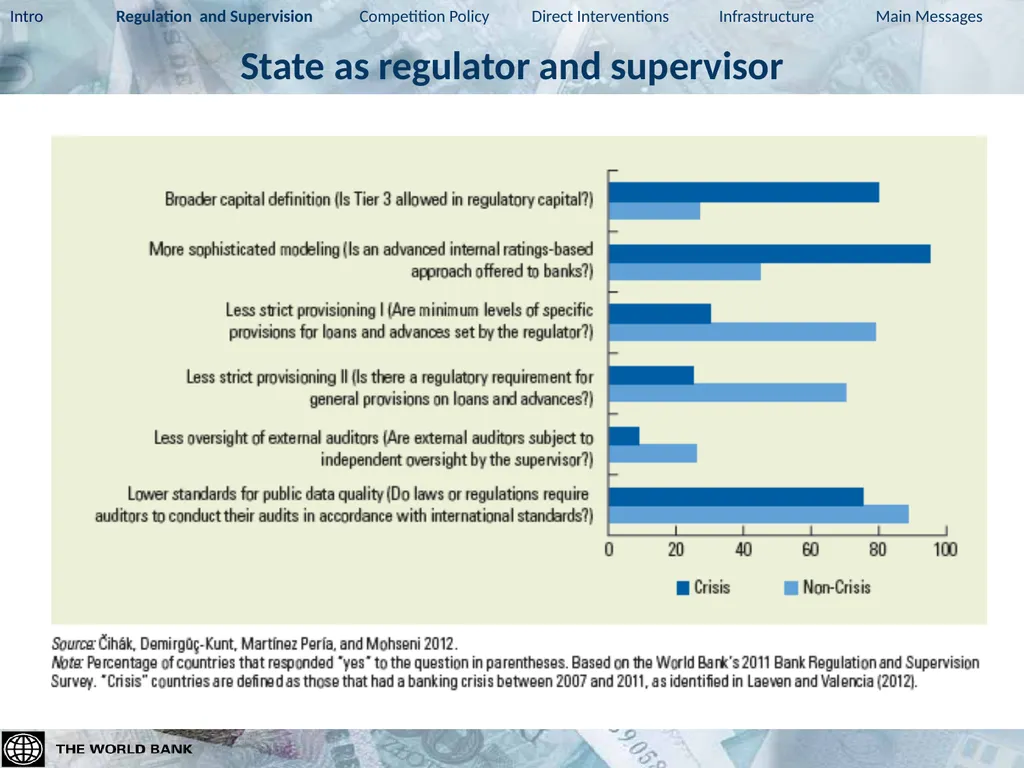
slide7. State as regulator and supervisor Intro Regulation and Supervision Competition Policy Direct Interventions Infrastructure Main Messages<br>
slide8. Findings on regulation and supervision Crisis hit countries had weaker regulation and supervision practices… (e.g., less stringent capital and provisioning rules, reliance on banks’ own risk assessment)
… and less scope for market incentives (e.g., generous deposit protection coverage, lower quality of published financial information)
After crisis, countries stepped up efforts on macroprudential policy, crisis resolution, and consumer protection
However, unclear whether incentives for market discipline improved
Survey suggests scope for improving disclosures and monitoring incentives
Broad agreement: important to address “basics” first
Simpler but strongly enforced regulation tends to work better
Institutional and legal frameworks that enable market discipline complemented with strong and timely supervisory action
Many developing economies: supervisory capacity = top priority
Challenge: introducing reforms that are incentive-robust (one proposal: “incentive audits”) Intro Regulation and Supervision Competition Policy Direct Interventions Infrastructure Main Messages<br>
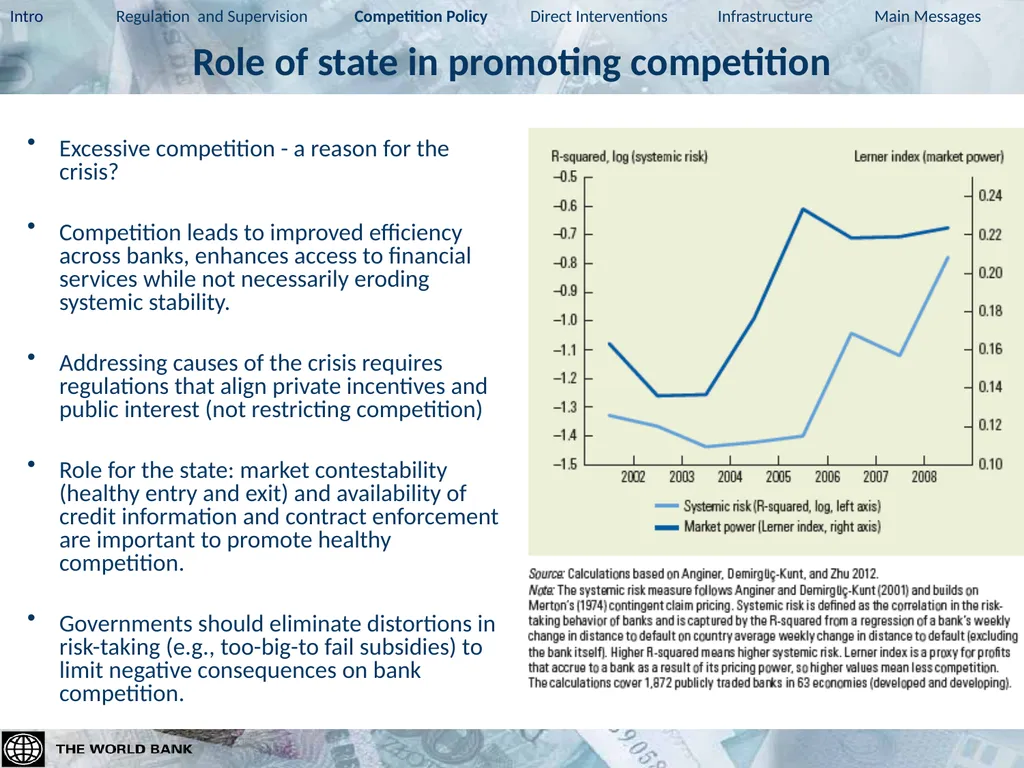
slide9. Role of state in promoting competition Intro Regulation and Supervision Competition Policy Direct Interventions Infrastructure Main Messages Excessive competition - a reason for the crisis?
Competition leads to improved efficiency across banks, enhances access to financial services while not necessarily eroding systemic stability.
Addressing causes of the crisis requires regulations that align private incentives and public interest (not restricting competition)
Role for the state: market contestability (healthy entry and exit) and availability of credit information and contract enforcement are important to promote healthy competition.
Governments should eliminate distortions in risk-taking (e.g., too-big-to fail subsidies) to limit negative consequences on bank competition.<br>
slide10. Direct state interventions Crisis re-ignited the debate on the role of state owned banks
Is the counter-cyclical role of state-owned banks in offsetting credit contractions justification enough?
Pros: additional tool for crisis management in the short term
Cons: misallocation and efficiency losses due to politically-motivated lending
Array of strategies to restart the financial and real sectors
Lending to private sector by state-owned banks
Commercial banks: Banco de Estado (Chile), PKO Bank Polski (Poland)
Development banks: BNDES (Brazil), China Development Bank
Credit guarantees
Mexico
Unconventional monetary policies
QE and credit policies by central banks (advanced economies) Intro Regulation and Supervision Competition Policy Direct Interventions Infrastructure Main Messages<br>
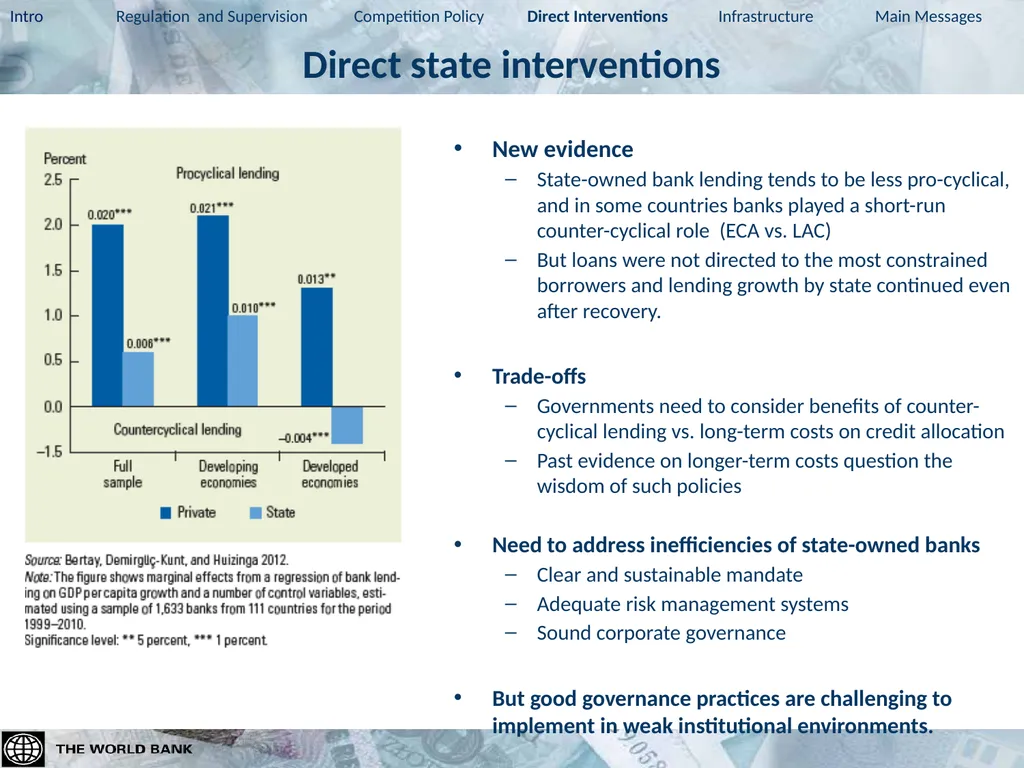
slide11. Direct state interventions Intro Regulation and Supervision Competition Policy Direct Interventions Infrastructure Main Messages New evidence
State-owned bank lending tends to be less pro-cyclical, and in some countries banks played a short-run counter-cyclical role (ECA vs. LAC)
But loans were not directed to the most constrained borrowers and lending growth by state continued even after recovery.
Trade-offs
Governments need to consider benefits of counter-cyclical lending vs. long-term costs on credit allocation
Past evidence on longer-term costs question the wisdom of such policies
Need to address inefficiencies of state-owned banks
Clear and sustainable mandate
Adequate risk management systems
Sound corporate governance
But good governance practices are challenging to implement in weak institutional environments.<br>
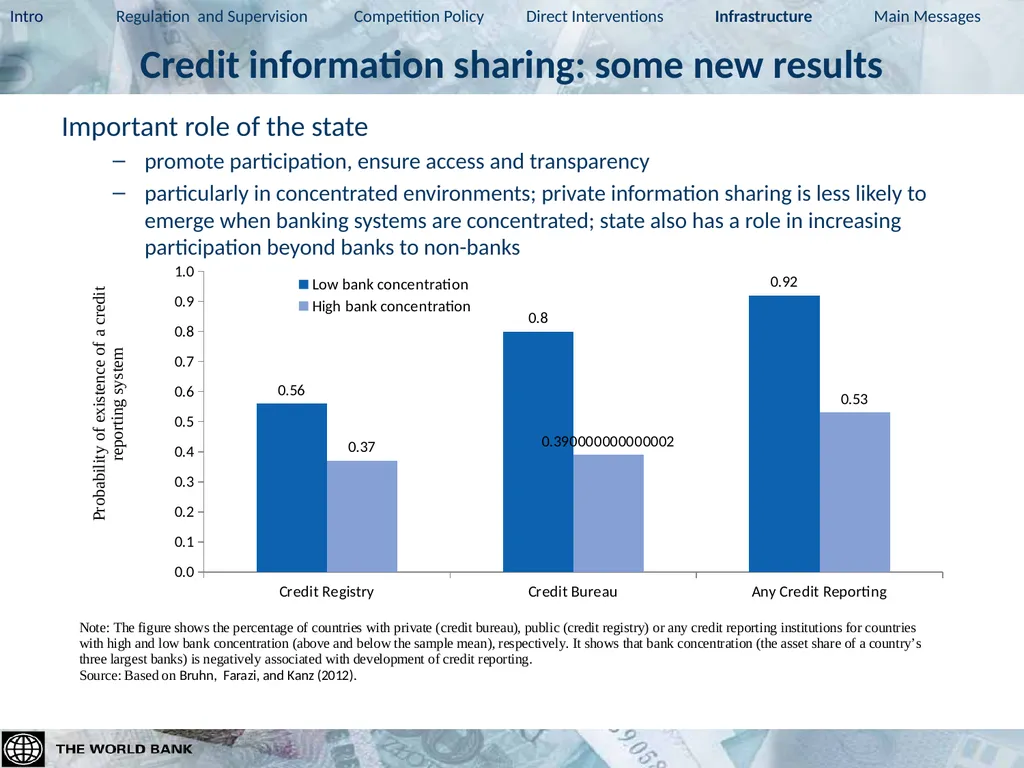
slide12. Credit information sharing: some new results Important role of the state
promote participation, ensure access and transparency
particularly in concentrated environments; private information sharing is less likely to emerge when banking systems are concentrated; state also has a role in increasing participation beyond banks to non-banks Intro Regulation and Supervision Competition Policy Direct Interventions Infrastructure Main Messages<br>
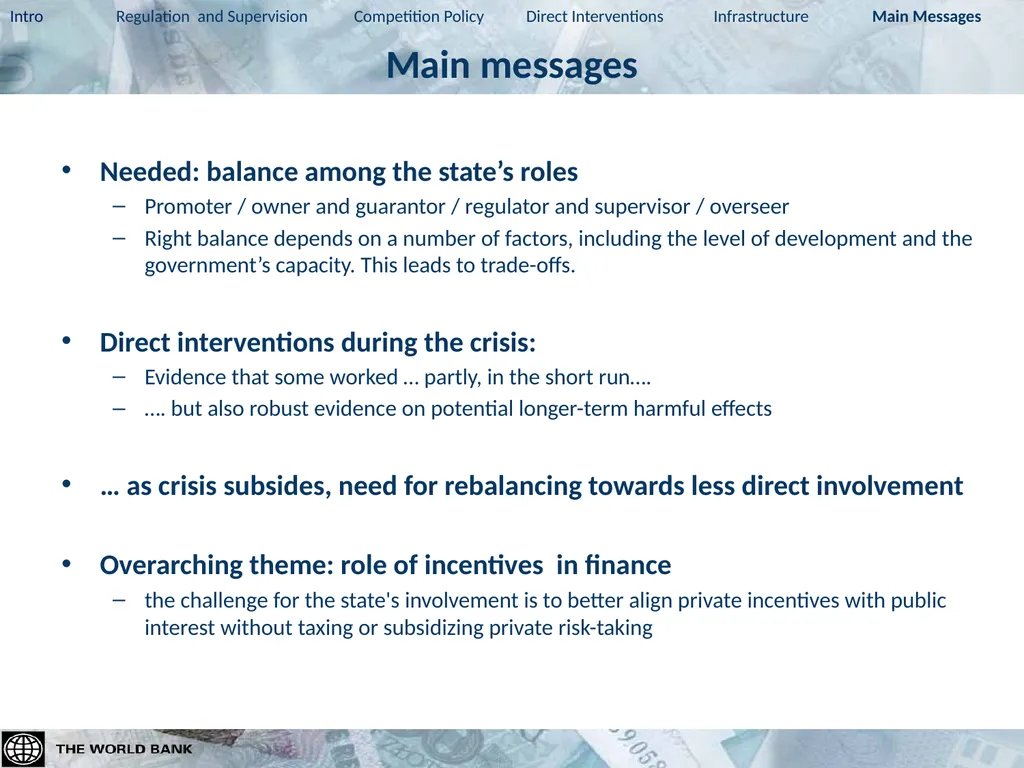
slide13. Needed: balance among the state’s roles
Promoter / owner and guarantor / regulator and supervisor / overseer
Right balance depends on a number of factors, including the level of development and the government’s capacity. This leads to trade-offs.
Direct interventions during the crisis:
Evidence that some worked … partly, in the short run….
…. but also robust evidence on potential longer-term harmful effects
… as crisis subsides, need for rebalancing towards less direct involvement
Overarching theme: role of incentives in finance
the challenge for the state's involvement is to better align private incentives with public interest without taxing or subsidizing private risk-taking Main messages Intro Regulation and Supervision Competition Policy Direct Interventions Infrastructure Main Messages<br>
slide14. Thank you http://www.worldbank.org/financialdevelopment Global Financial Development Report 2013 benefitted from support by<br>
Rethinking the Role of the State in Finance
Martin Čihák, Lead Economist, World Bank
Warsaw, December 3, 2012 http://www.worldbank.org/financialdevelopment<br>
slide2. First in a series
Combines new data, research, lessons from operational work
Collaboration within WBG and with external contributors
Each report will focus on a theme
GFDR 2013: rethinking the state’s role in finance, in light of the global crisis
GFDR 2014: financial inclusion
More than a report
Accompanied by Global Financial Development Database and several other major databases and surveys, benchmarking of financial systems around the world, a range of underlying case studies and research papers
http://www.worldbank.org/financialdevelopment Introducing the Global Financial Development Report Intro Regulation and Supervision Competition Policy Direct Interventions Infrastructure Main Messages Source: AFP Source: AFP<br>
slide3. Examples of other variables in the database: ownership of financial institutions, structure (H-statistics etc), measures of internationalization, features of the regulatory and institutional framework, etc.
For the database, see http://www.worldbank.org/financialdevelopment. Intro Regulation and Supervision Competition Policy Direct Interventions Infrastructure Main Messages Global Financial Development Database<br>
slide4. Global Financial Development Database Intro Regulation and Supervision Competition Policy Direct Interventions Infrastructure Main Messages Source: Calculations based on the Global Financial Development Database (http://www.worldbank.org/financialdevelopment).
Note: For illustration purposes only. Country sizes adjusted to reflect the volume of financial sector assets in the jurisdiction (U.S. dollars, end-2010). Image created with the help of the MapWindow 4 and ScapeToad software.<br>
slide5. Expert views: Financial Development Barometer Source: Financial Development Barometer 2011 (http://www.worldbank.org/financialdevelopment). The Barometer is an informal global poll of officials and financial sector experts from 78 economies (30 percent developed, 70 percent developing). The response rate was 65 percent. Results are percentages of total responses received. Intro Regulation and Supervision Competition Policy Direct Interventions Infrastructure Main Messages Over 90 % of respondents think that positive effects of financial development outweigh the negative ones. But views are split on important aspects of the state’s role ….<br>
slide6. Area where role of state undisputed
Crisis: major shortcomings in market discipline and R&S
How to best ensure that R&S supports sound financial development?
Important trade-offs (too much/too little R&S)
Calls for not “more”, but for “right” type of regulation
New WB survey of R&S in 142 countries allows us to investigate two issues and shed new light:
How does R&S and market discipline compare in crisis-hit countries relative to the rest?
How did R&S and market discipline change since the crisis? State as regulator and supervisor Intro Regulation and Supervision Competition Policy Direct Interventions Infrastructure Main Messages<br>
slide7. State as regulator and supervisor Intro Regulation and Supervision Competition Policy Direct Interventions Infrastructure Main Messages<br>
slide8. Findings on regulation and supervision Crisis hit countries had weaker regulation and supervision practices… (e.g., less stringent capital and provisioning rules, reliance on banks’ own risk assessment)
… and less scope for market incentives (e.g., generous deposit protection coverage, lower quality of published financial information)
After crisis, countries stepped up efforts on macroprudential policy, crisis resolution, and consumer protection
However, unclear whether incentives for market discipline improved
Survey suggests scope for improving disclosures and monitoring incentives
Broad agreement: important to address “basics” first
Simpler but strongly enforced regulation tends to work better
Institutional and legal frameworks that enable market discipline complemented with strong and timely supervisory action
Many developing economies: supervisory capacity = top priority
Challenge: introducing reforms that are incentive-robust (one proposal: “incentive audits”) Intro Regulation and Supervision Competition Policy Direct Interventions Infrastructure Main Messages<br>
slide9. Role of state in promoting competition Intro Regulation and Supervision Competition Policy Direct Interventions Infrastructure Main Messages Excessive competition - a reason for the crisis?
Competition leads to improved efficiency across banks, enhances access to financial services while not necessarily eroding systemic stability.
Addressing causes of the crisis requires regulations that align private incentives and public interest (not restricting competition)
Role for the state: market contestability (healthy entry and exit) and availability of credit information and contract enforcement are important to promote healthy competition.
Governments should eliminate distortions in risk-taking (e.g., too-big-to fail subsidies) to limit negative consequences on bank competition.<br>
slide10. Direct state interventions Crisis re-ignited the debate on the role of state owned banks
Is the counter-cyclical role of state-owned banks in offsetting credit contractions justification enough?
Pros: additional tool for crisis management in the short term
Cons: misallocation and efficiency losses due to politically-motivated lending
Array of strategies to restart the financial and real sectors
Lending to private sector by state-owned banks
Commercial banks: Banco de Estado (Chile), PKO Bank Polski (Poland)
Development banks: BNDES (Brazil), China Development Bank
Credit guarantees
Mexico
Unconventional monetary policies
QE and credit policies by central banks (advanced economies) Intro Regulation and Supervision Competition Policy Direct Interventions Infrastructure Main Messages<br>
slide11. Direct state interventions Intro Regulation and Supervision Competition Policy Direct Interventions Infrastructure Main Messages New evidence
State-owned bank lending tends to be less pro-cyclical, and in some countries banks played a short-run counter-cyclical role (ECA vs. LAC)
But loans were not directed to the most constrained borrowers and lending growth by state continued even after recovery.
Trade-offs
Governments need to consider benefits of counter-cyclical lending vs. long-term costs on credit allocation
Past evidence on longer-term costs question the wisdom of such policies
Need to address inefficiencies of state-owned banks
Clear and sustainable mandate
Adequate risk management systems
Sound corporate governance
But good governance practices are challenging to implement in weak institutional environments.<br>
slide12. Credit information sharing: some new results Important role of the state
promote participation, ensure access and transparency
particularly in concentrated environments; private information sharing is less likely to emerge when banking systems are concentrated; state also has a role in increasing participation beyond banks to non-banks Intro Regulation and Supervision Competition Policy Direct Interventions Infrastructure Main Messages<br>
slide13. Needed: balance among the state’s roles
Promoter / owner and guarantor / regulator and supervisor / overseer
Right balance depends on a number of factors, including the level of development and the government’s capacity. This leads to trade-offs.
Direct interventions during the crisis:
Evidence that some worked … partly, in the short run….
…. but also robust evidence on potential longer-term harmful effects
… as crisis subsides, need for rebalancing towards less direct involvement
Overarching theme: role of incentives in finance
the challenge for the state's involvement is to better align private incentives with public interest without taxing or subsidizing private risk-taking Main messages Intro Regulation and Supervision Competition Policy Direct Interventions Infrastructure Main Messages<br>
slide14. Thank you http://www.worldbank.org/financialdevelopment Global Financial Development Report 2013 benefitted from support by<br>