Global Forum for Media Development GFMD- not-for-profit, international network of around 200 journalism support and media development organisations working across more than 70 countries. GFMDs core value is to support the creation and
"Global Forum for Media Development GFMD-" is the property of its rightful owner. Permission is granted to
download and print the materials on this website for personal, non-commercial use only, and to display it
on your personal computer provided you do not modify the materials and that you retain all copyright
notices contained in the materials. By downloading content from our website, you accept the terms of this
agreement.
Presentation Transcript
01
Global Forum for Media Development GFMD- not-for-profit, international network of around 200 journalism support and media development organisations working across more than 70 countries.
GFMD’s core value is to support the creation and strengthening of journalism and free, independent, sustainable, and pluralistic news ecosystem. Public access to information and the free exchange of ideas are prerequisites for building “peaceful, accountable and inclusive societies” – the overarching aim of SDG 16.
Target 16.10: Ensure public access to information and protect fundamental freedoms, in accordance with national legislation and international agreements.
Indicator 16.10.1: Number of verified cases of killing, kidnapping, enforced disappearance, arbitrary detention and torture of journalists, associated media personnel, trade unionists and human rights advocates in the previous 12 months.
UNESCO observatory of killed journalists
A total of 62 journalists were killed in 2020 compared to 57 in 2019, with 65 per cent killed in non-conflict countries and territories. 25 journalists killed so far in 2021.<br>
02
Committee to Protect Journalists - CPJ Database
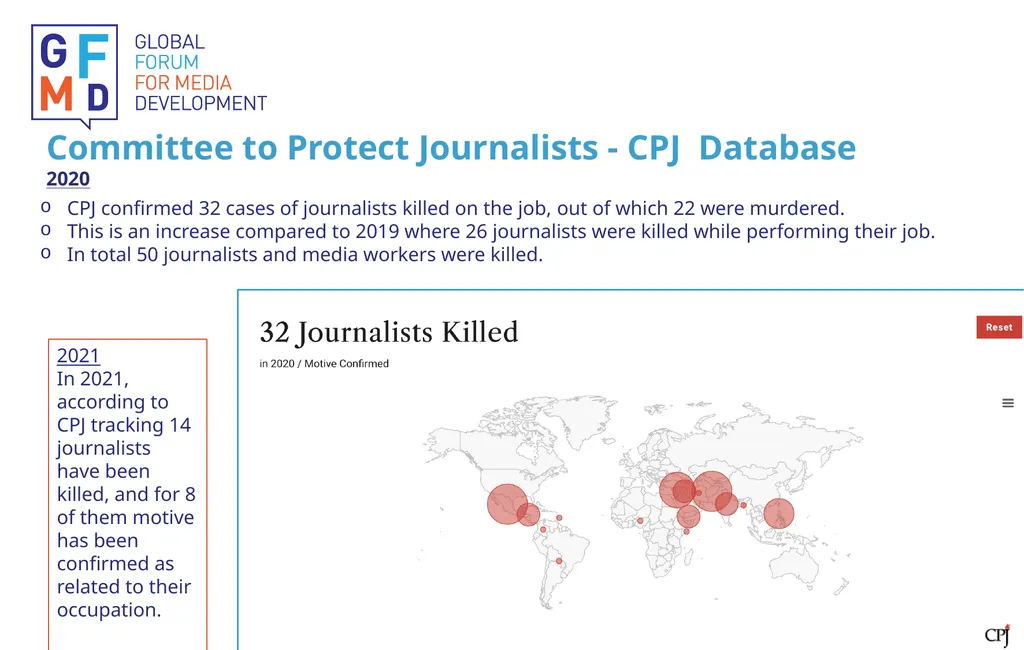
2020 CPJ confirmed 32 cases of journalists killed on the job, out of which 22 were murdered.
This is an increase compared to 2019 where 26 journalists were killed while performing their job.
In total 50 journalists and media workers were killed. 2021
In 2021, according to CPJ tracking 14 journalists have been killed, and for 8 of them motive has been confirmed as related to their occupation.<br>
03
CPJ 2020 Report Findings While the number of murders rose in 2020, the number of combat-related deaths—three—dropped to the lowest level since 2000,
Mexico has long been the most dangerous country in the Western hemisphere for the press
The year 2020 also saw widespread global political upheaval, and journalists faced violence covering these events.
A record number of journalists (274) were jailed because of their work in 2020, as governments cracked down on coverage of COVID-19 or attempted to suppress reporting on political unrest, according to CPJ research.
The COVID-19 pandemic also forced journalists to constantly adapt to evolving safety advice and restrictions on travel and movement set by local authorities. The virus posed extreme health risks to those arrested because of their work. At least two journalists died after contracting the coronavirus in custody.
Criminal groups were the most frequently suspected killers of journalists in 2020, while politics was the most dangerous beat.
Two of the journalists killed were female.
One media worker was killed in Afghanistan. Impunity
In at least 8 out of 10 cases, the murderers of journalists go free.<br>
04
Non-official data
Reporters sans Frontières (RSF) 2021 World Press Freedom Index: …journalism, which is arguably the best vaccine against the virus of disinformation, is totally blocked or seriously impeded in 73 countries and constrained in 59 others, which together represent 73% of the countries evaluated.
The Index data reflect a dramatic deterioration in people's access to information and an increase in obstacles to news coverage.
The World Press Freedom map has not had so few countries coloured white – indicating a country situation that is at least good if not optimal – since 2013, when the current evaluation method was adopted. This year, only 12 of the Index’s 180 countries (7%) can claim to offer a favourable environment for journalism, as opposed to 13 countries (8%) last year.
RSF’s global indicator – its measure of the level of media freedom worldwide – is only 0.3% lower in the 2021 Index than it was in 2020. However, the past year’s relative stability should not divert attention from the fact that it has deteriorated by 12% since this indicator was created in 2013.<br>
05
New forms of violence against women journalists Online attacks have real-life impacts. Not only do they affect mental health and productivity, but physical attacks and legal harassment are increasingly seeded online.
Misogyny intersects with other forms of discrimination. Women journalists who are also disadvantaged by racism, homophobia, religious bigotry and other forms of discrimination face additional exposure to online attacks, with worse impacts.
Gendered online violence intersects with disinformation. While orchestrated disinformation campaigns weaponise misogyny to chill critical reporting, reporting on disinformation can be a trigger for heightened attacks.
Online attacks against women journalists have political motives. Political actors, extremist networks and partisan media are identified as instigators and amplifiers of online violence against women journalists.
Social media platforms and news organisations are still struggling to respond effectively. In the context of an increasingly toxic information ecosystem, platforms are seen as major enablers for online violence. When women journalists turn to them or their employers in the midst of an online violence storm, they often fail to receive effective responses and even face victim-blaming behaviour. ‘The Chilling: Global trends in online violence against women journalists’ discussion paper, extract from an interdisciplinary study carried out by the International Center for Journalists (ICFJ) and UNESCO.<br>
06
Non-official data and data analysis are provided by international press freedom groups and human rights organizations and for the past several years they report constant decline and deterioration in the environment for independent journalism- legal, political conditions and safety of journalists and media workers.
They also register other forms of threats: online threats, harassment, and violence and its effect on press freedom, especially for women journalists. Non-official data<br>
07
Recommendations Civil society organisations, reputable independent information sources, such as those mentioned today are best placed to be involved in measuring the progress towards achieving SDG16. As Covid 19 pandemic has demonstrated governments are not to be considered as definitive source of information on the work-related murders of journalists, some of whom would be considered critics of those governments.
Include data that reflect new forms of supressing journalism and media and endangering safety of journalists and press freedom - online threats and harassment especially those directed towards women.<br>