Global labour governance: an idea whose time has come? Shirley Lerner Lecture 2017 Jimmy Donaghey University of Warwick Overview Context of global labour governance The paradox of private labour governance Approaches to transnational labour
Related Topics
Share
Embed code
Download this presentation From Below
"Global labour governance: an idea whose time has" is the property of its rightful owner. Permission is granted to
download and print the materials on this website for personal, non-commercial use only, and to display it
on your personal computer provided you do not modify the materials and that you retain all copyright
notices contained in the materials. By downloading content from our website, you accept the terms of this
agreement.
Presentation Transcript
01
Global labour governance: an idea whose time has come? Shirley Lerner Lecture 2017
Jimmy Donaghey
University of Warwick<br>
02
Overview Context of global labour governance
The paradox of private labour governance
Approaches to transnational labour governance
Case study: the response to the Rana Plaza disaster
Unresolved questions of global labour governance
Conclusions<br>
03
Context of global labour governance Series of (low impact) public government initiatives to regulate MNC employment activities
OECD Guidelines on MNCs
UN Global Compact
ILO Guidelines on MNCs
All non-binding and advisory in nature
Emergence of (private) global labour governance
Three approaches in literature
GVCs/GPNs
Main focus on interfirm linkages
Industrial relations approach
Comparison of IFAs and Codes of Conduct
Corporate Social Responsibility
Power relations in private labour governance<br>
04
Why is global labour governance necessary? Global labour governance generally viewed as the regulation of MNCs and their supply chains across borders
Workers
Low labour standards
Western Brands
Downward competitive pressures
Substantial risks
Spreading financial risk can increase reputational risk<br>
05
Challenges in developing Global Labour Governance Low levels of unionisation and worker representation in many developing economies
Lack of independent unions in others
No coherent and meaningful sanctions available at intergovernmental level
Western Buyer Brands engaged in downwards spiral in standards
Interbrand competition
Inter-supplier competition
State incentives not to raise standards
Low standard model as development
Who enforces governance initiatives?<br>
06
The paradox of global labour governance MNCs seeking regimes with low labour cost and low labour standards with lack of meaningful government oversight develop private governance regimes
Two contrasting approaches
Industrial relations versus Corporate Social Responsibility
CSR approach sees brands as relatively benign actor that acts as enforcer
Focus will be on the development of an experiment in the IR approach which has some strong elements of CSR<br>
07
The response to the Rana Plaza disaster Bangladesh Ready Made Garment sector bedevilled by a series of deadly accidents
23rd April 2013- Collapse of Rana Plaza, more than 1100 workers killed
Factories producing sub-contracted goods for western brands
Emergence of two initiatives
Bangladesh Accord for Building and Fire Safety
“Collective agreement” approach
Alliance for Worker Safety in Bangladesh
CSR approach
Both programmes to run until 2018<br>
08
A complex governance challenge Low structural power of workers
Fragmented supply chain at each end; international competition
Low associational power
97% factories completely non-union + union fragmentation
lack of solidarity along the chain low/Workers covered by different GUFs
IFAs with buyers (eg H&M, Inditex) could not be extended
High mobilising capacity amongst NGOs (‘voice’) to create reputation risk against brands
Workers Rights Consortium and Clean Clothes Campaign high level of on the ground knowledge<br>
09
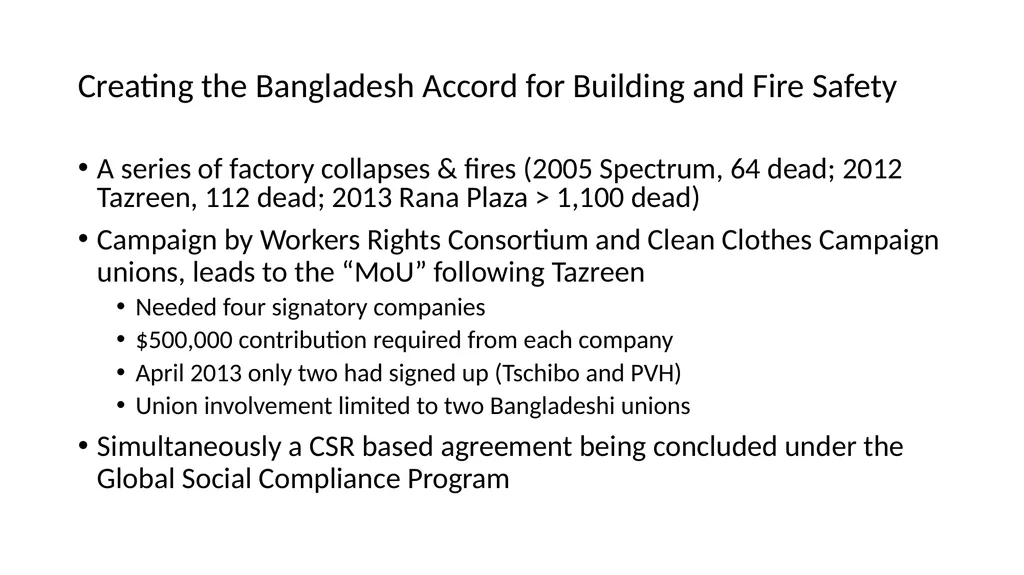
Creating the Bangladesh Accord for Building and Fire Safety A series of factory collapses & fires (2005 Spectrum, 64 dead; 2012 Tazreen, 112 dead; 2013 Rana Plaza > 1,100 dead)
Campaign by Workers Rights Consortium and Clean Clothes Campaign unions, leads to the “MoU” following Tazreen
Needed four signatory companies
$500,000 contribution required from each company
April 2013 only two had signed up (Tschibo and PVH)
Union involvement limited to two Bangladeshi unions
Simultaneously a CSR based agreement being concluded under the Global Social Compliance Program<br>
10
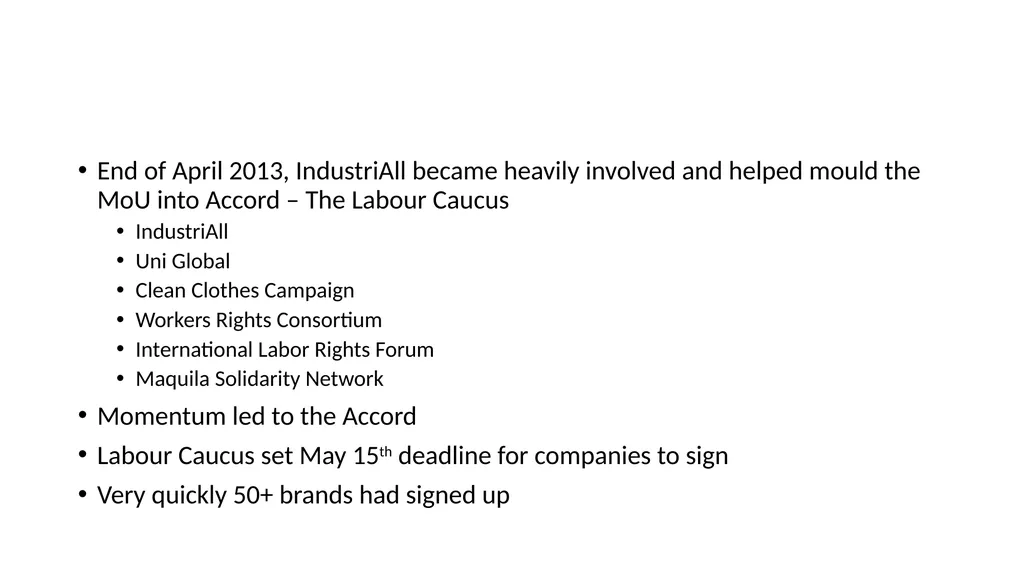
End of April 2013, IndustriAll became heavily involved and helped mould the MoU into Accord – The Labour Caucus
IndustriAll
Uni Global
Clean Clothes Campaign
Workers Rights Consortium
International Labor Rights Forum
Maquila Solidarity Network
Momentum led to the Accord
Labour Caucus set May 15th deadline for companies to sign
Very quickly 50+ brands had signed up<br>
11
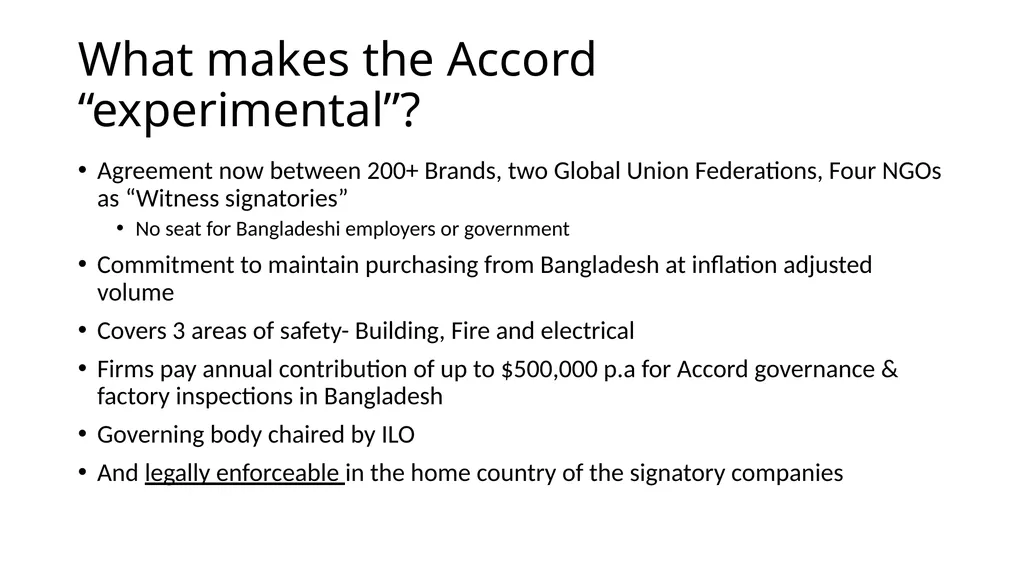
What makes the Accord “experimental”? Agreement now between 200+ Brands, two Global Union Federations, Four NGOs as “Witness signatories”
No seat for Bangladeshi employers or government
Commitment to maintain purchasing from Bangladesh at inflation adjusted volume
Covers 3 areas of safety- Building, Fire and electrical
Firms pay annual contribution of up to $500,000 p.a for Accord governance & factory inspections in Bangladesh
Governing body chaired by ILO
And legally enforceable in the home country of the signatory companies<br>
12
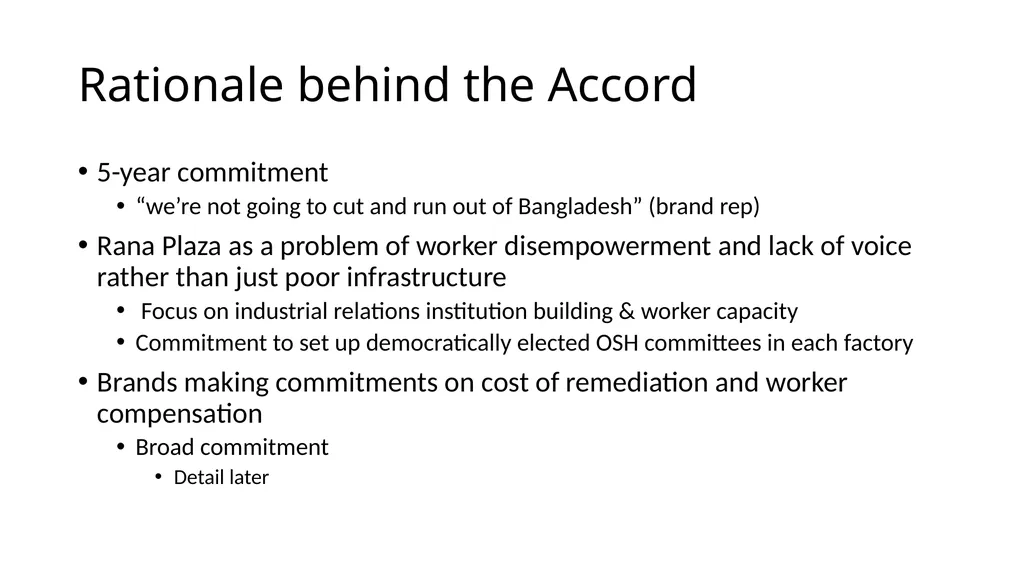
Rationale behind the Accord 5-year commitment
“we’re not going to cut and run out of Bangladesh” (brand rep)
Rana Plaza as a problem of worker disempowerment and lack of voice rather than just poor infrastructure
Focus on industrial relations institution building & worker capacity
Commitment to set up democratically elected OSH committees in each factory
Brands making commitments on cost of remediation and worker compensation
Broad commitment
Detail later<br>
13
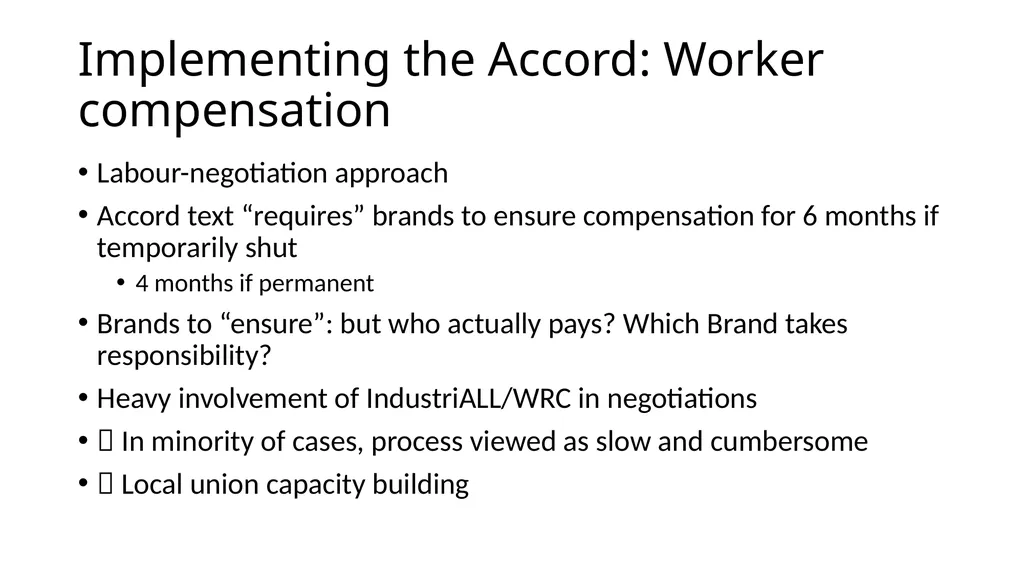
Implementing the Accord: Worker compensation Labour-negotiation approach
Accord text “requires” brands to ensure compensation for 6 months if temporarily shut
4 months if permanent
Brands to “ensure”: but who actually pays? Which Brand takes responsibility?
Heavy involvement of IndustriALL/WRC in negotiations
In minority of cases, process viewed as slow and cumbersome
Local union capacity building<br>
14
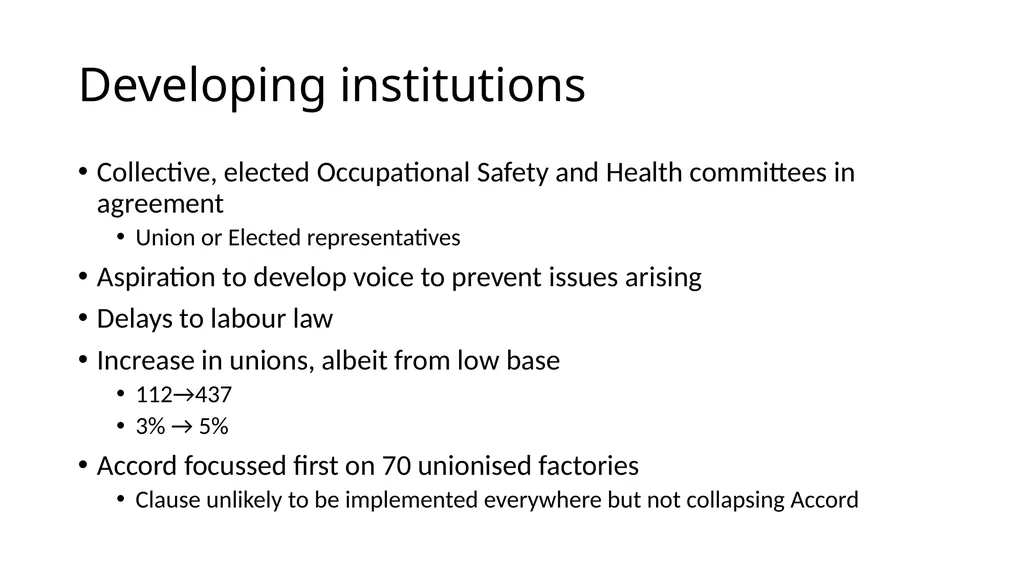
Developing institutions Collective, elected Occupational Safety and Health committees in agreement
Union or Elected representatives
Aspiration to develop voice to prevent issues arising
Delays to labour law
Increase in unions, albeit from low base
112→437
3% → 5%
Accord focussed first on 70 unionised factories
Clause unlikely to be implemented everywhere but not collapsing Accord<br>
15
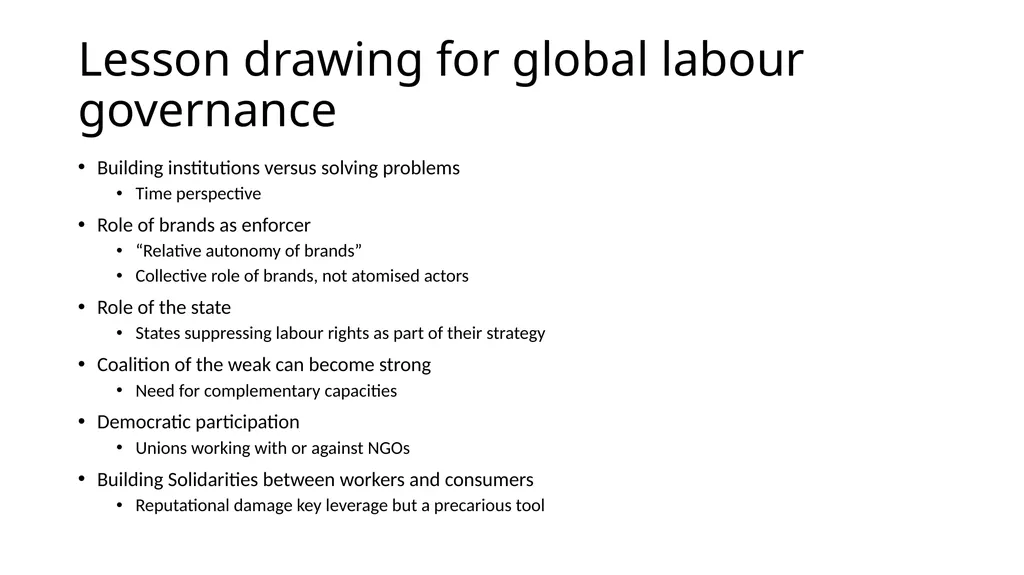
Lesson drawing for global labour governance Building institutions versus solving problems
Time perspective
Role of brands as enforcer
“Relative autonomy of brands”
Collective role of brands, not atomised actors
Role of the state
States suppressing labour rights as part of their strategy
Coalition of the weak can become strong
Need for complementary capacities
Democratic participation
Unions working with or against NGOs
Building Solidarities between workers and consumers
Reputational damage key leverage but a precarious tool<br>
16
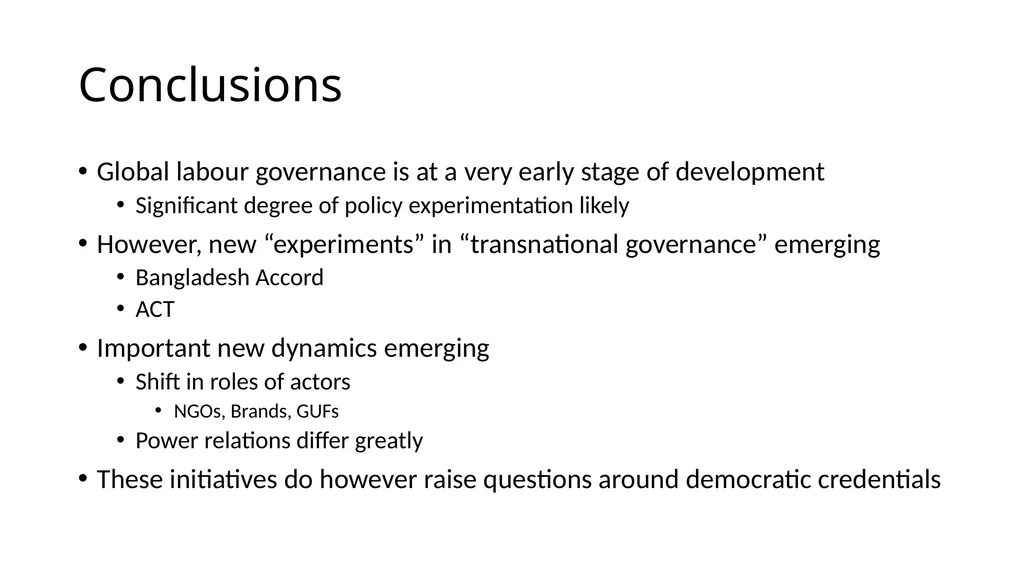
Conclusions Global labour governance is at a very early stage of development
Significant degree of policy experimentation likely
However, new “experiments” in “transnational governance” emerging
Bangladesh Accord
ACT
Important new dynamics emerging
Shift in roles of actors
NGOs, Brands, GUFs
Power relations differ greatly
These initiatives do however raise questions around democratic credentials<br>
17
Work upon which the lecture is based Donaghey, J. and Reinecke, J. (2017) "When industrial democracy meets corporate social responsibility – a comparison of the Bangladesh Accord and Alliance as responses to the Rana Plaza disaster", British Journal of Industrial Relations (published today)
Reinecke, J. and Donaghey, J. (2015) "After Rana Plaza : building coalitional power for labour rights between unions and (consumption-based) social movement organisations", Organization, 22, 5, 720-740
Donaghey, J., Reinecke, J., Niforou, C. and Lawson, B. (2014) "From employment relations to consumption relations : balancing labor governance in global supply chains", Human Resource Management, 53, 2, 229-252<br>