
Globalization Debate The Central Questions
AM
Published · 12 slides · 0 views
1 / 1
Description
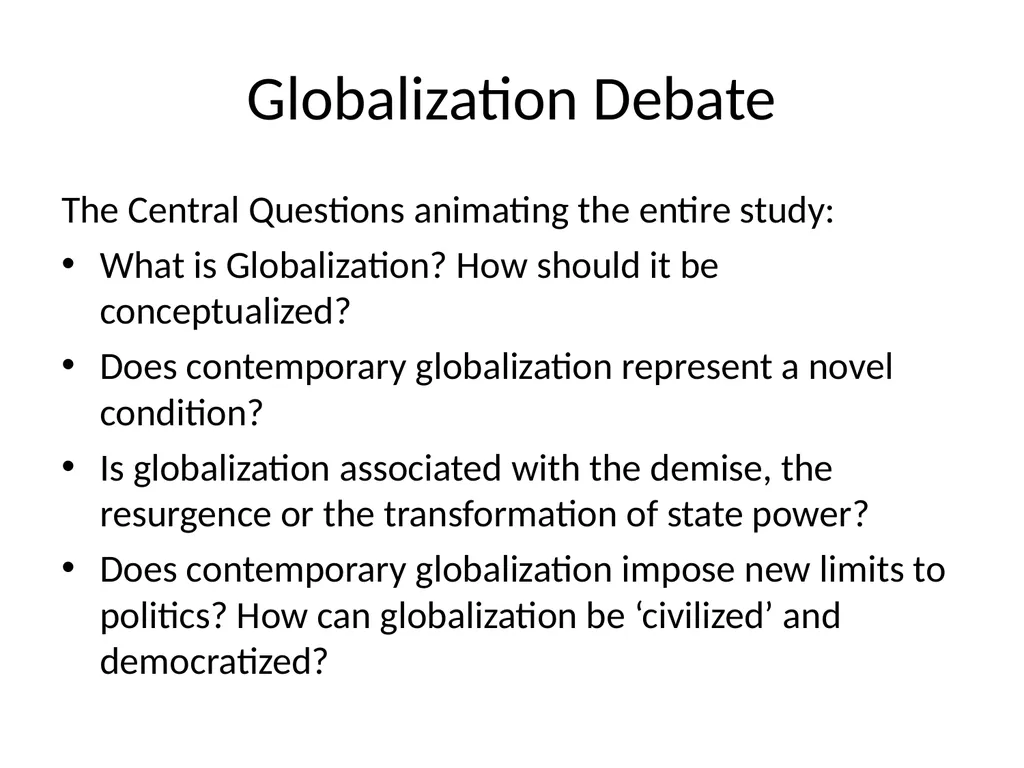
Globalization Debate The Central Questions animating the entire study: What is Globalization? How should it be conceptualized? Does contemporary globalization represent a novel condition? Is globalization associated with the demise, the
Related Topics
Share
Embed code
Download this presentation From Below
"Globalization Debate The Central Questions" is the property of its rightful owner. Permission is granted to download and print the materials on this website for personal, non-commercial use only, and to display it on your personal computer provided you do not modify the materials and that you retain all copyright notices contained in the materials. By downloading content from our website, you accept the terms of this agreement.
Presentation Transcript
01
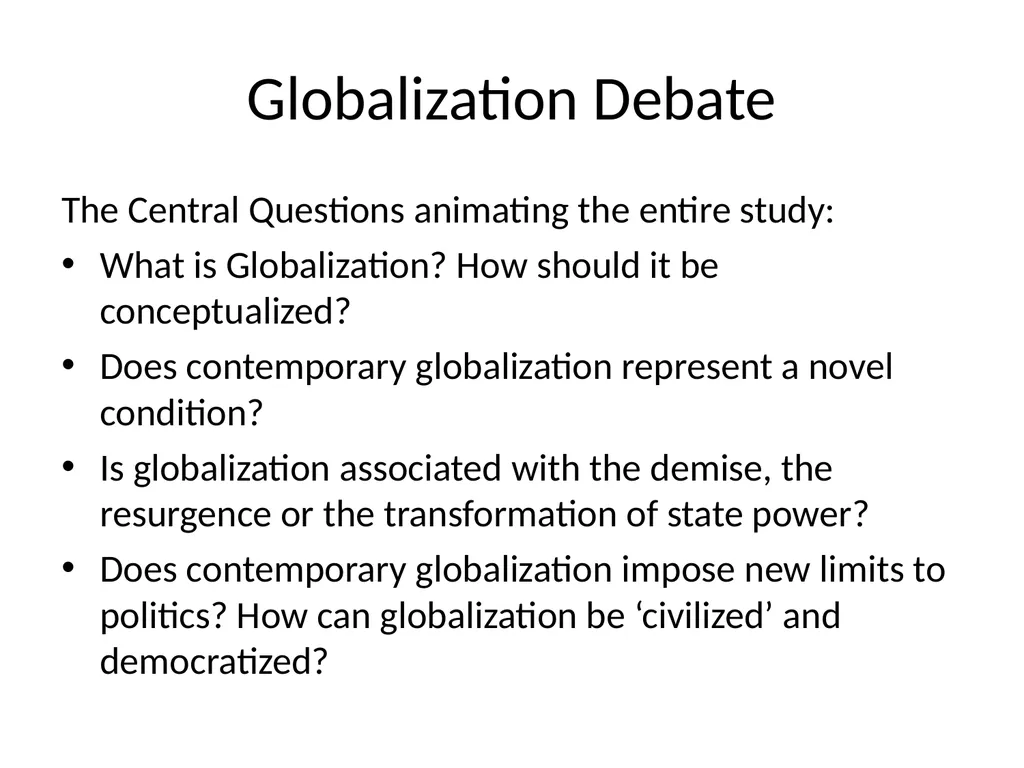
Globalization Debate The Central Questions animating the entire study:
What is Globalization? How should it be conceptualized?
Does contemporary globalization represent a novel condition?
Is globalization associated with the demise, the resurgence or the transformation of state power?
Does contemporary globalization impose new limits to politics? How can globalization be ‘civilized’ and democratized?<br>
What is Globalization? How should it be conceptualized?
Does contemporary globalization represent a novel condition?
Is globalization associated with the demise, the resurgence or the transformation of state power?
Does contemporary globalization impose new limits to politics? How can globalization be ‘civilized’ and democratized?<br>
02
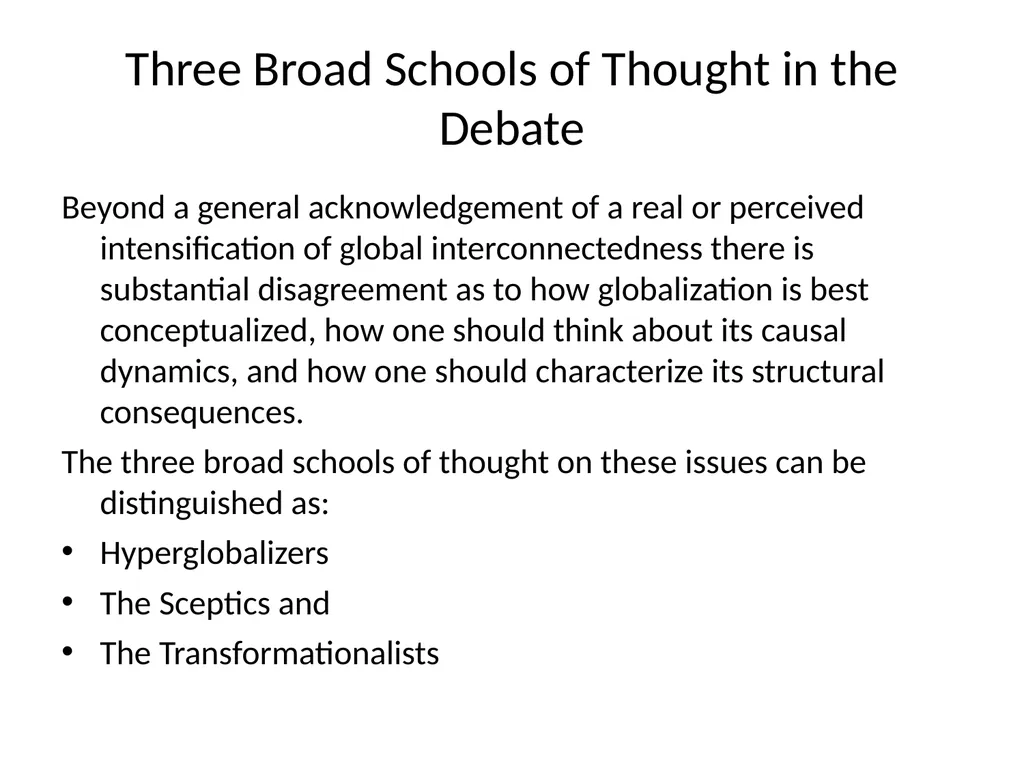
Three Broad Schools of Thought in the Debate Beyond a general acknowledgement of a real or perceived intensification of global interconnectedness there is substantial disagreement as to how globalization is best conceptualized, how one should think about its causal dynamics, and how one should characterize its structural consequences.
The three broad schools of thought on these issues can be distinguished as:
Hyperglobalizers
The Sceptics and
The Transformationalists<br>
The three broad schools of thought on these issues can be distinguished as:
Hyperglobalizers
The Sceptics and
The Transformationalists<br>
03
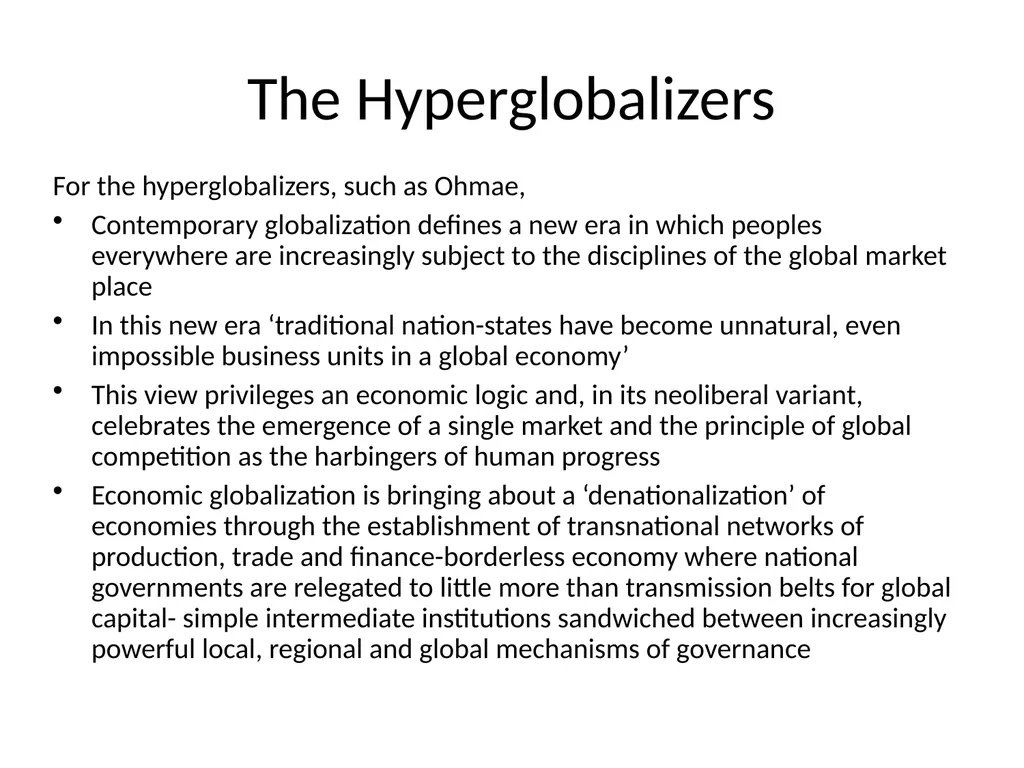
The Hyperglobalizers For the hyperglobalizers, such as Ohmae,
Contemporary globalization defines a new era in which peoples everywhere are increasingly subject to the disciplines of the global market place
In this new era ‘traditional nation-states have become unnatural, even impossible business units in a global economy’
This view privileges an economic logic and, in its neoliberal variant, celebrates the emergence of a single market and the principle of global competition as the harbingers of human progress
Economic globalization is bringing about a ‘denationalization’ of economies through the establishment of transnational networks of production, trade and finance-borderless economy where national governments are relegated to little more than transmission belts for global capital- simple intermediate institutions sandwiched between increasingly powerful local, regional and global mechanisms of governance<br>
Contemporary globalization defines a new era in which peoples everywhere are increasingly subject to the disciplines of the global market place
In this new era ‘traditional nation-states have become unnatural, even impossible business units in a global economy’
This view privileges an economic logic and, in its neoliberal variant, celebrates the emergence of a single market and the principle of global competition as the harbingers of human progress
Economic globalization is bringing about a ‘denationalization’ of economies through the establishment of transnational networks of production, trade and finance-borderless economy where national governments are relegated to little more than transmission belts for global capital- simple intermediate institutions sandwiched between increasingly powerful local, regional and global mechanisms of governance<br>
04
The Hyperglobalizers (Contd.) There is considerable normative divergence within this framework between:
the neoliberals who welcome the triumph of individual autonomy and the market principle over state-power, and
the radicals or neo-Marxists for whom contemporary globalization represents the triumph of an oppressive global capitalism.
But despite divergent ideological convictions, there exists a shared set of beliefs that:
Globalization is primarily an economic phenomenon;
An increasingly integrated global economy exists today; and
That the needs of global capital impose a neoliberal economic discipline on all governments such that politics is no longer the ‘art of the possible’ but rather the practice of ‘sound economic management’.<br>
the neoliberals who welcome the triumph of individual autonomy and the market principle over state-power, and
the radicals or neo-Marxists for whom contemporary globalization represents the triumph of an oppressive global capitalism.
But despite divergent ideological convictions, there exists a shared set of beliefs that:
Globalization is primarily an economic phenomenon;
An increasingly integrated global economy exists today; and
That the needs of global capital impose a neoliberal economic discipline on all governments such that politics is no longer the ‘art of the possible’ but rather the practice of ‘sound economic management’.<br>
05
The Hyperglobalizers (Contd.) Economic globalization is generating a new pattern of winners as well as losers in the global economy
The old North-South division is giving way to a new global division of labour which replaces the traditional core-periphery structure with a more complex architecture of economic power
Against this background, governments have to ‘manage’ the social consequences of globalization
The neoliberals within this framework believe that global competition does not necessarily produce zero-sum outcomes and take an optimistic view that things can be sorted out in the long run
But the Neo-Marxists and radicals in this group view such optimism as unjustified and believe that global capitalism creates and reinforces structural patterns of inequality within and between countries
However, they agree at least with their neoliberal counterparts that traditional welfare options for social protection are difficult to sustain<br>
The old North-South division is giving way to a new global division of labour which replaces the traditional core-periphery structure with a more complex architecture of economic power
Against this background, governments have to ‘manage’ the social consequences of globalization
The neoliberals within this framework believe that global competition does not necessarily produce zero-sum outcomes and take an optimistic view that things can be sorted out in the long run
But the Neo-Marxists and radicals in this group view such optimism as unjustified and believe that global capitalism creates and reinforces structural patterns of inequality within and between countries
However, they agree at least with their neoliberal counterparts that traditional welfare options for social protection are difficult to sustain<br>
06
The Hyperglobalizers on a radically New World Order Tacit transnational ‘class’ allegiances, cemented by an ideological attachment to a neoliberal economic orthodoxy, have evolved among the elites and ‘knowledge workers’ of the new global economy
The worldwide diffusion of a consumerist ideology is imposing a new sense of identity among the marginalized which is displacing traditional cultures and ways of life
The global spread of liberal democracy further reinforces the sense of an emerging global civilization defined by universal standards of economic and political organization with its own mechanisms of global governance
When the neoliberals paint the picture of a truly global civilization many radicals brand it the global ‘market civilization’
The emergence of institutions of global governance and the global diffusion and hybridization of cultures are interpreted as evidence of a radically new world order which prefigures the demise of the nation-state (‘a transitional mode of organization for managing economic affairs’)
Transnational cooperation between peoples owing to global infrastructures of communication and increasing awareness of many common interests is leading to an emerging ‘global civil society’
Economic power and political power are becoming effectively denationalized and diffused such that nation-states are increasingly becoming ‘a transitional mode of organization for managing economic affairs.<br>
The worldwide diffusion of a consumerist ideology is imposing a new sense of identity among the marginalized which is displacing traditional cultures and ways of life
The global spread of liberal democracy further reinforces the sense of an emerging global civilization defined by universal standards of economic and political organization with its own mechanisms of global governance
When the neoliberals paint the picture of a truly global civilization many radicals brand it the global ‘market civilization’
The emergence of institutions of global governance and the global diffusion and hybridization of cultures are interpreted as evidence of a radically new world order which prefigures the demise of the nation-state (‘a transitional mode of organization for managing economic affairs’)
Transnational cooperation between peoples owing to global infrastructures of communication and increasing awareness of many common interests is leading to an emerging ‘global civil society’
Economic power and political power are becoming effectively denationalized and diffused such that nation-states are increasingly becoming ‘a transitional mode of organization for managing economic affairs.<br>
07
The Sceptical Thesis Drawing on statistical evidence of world flows of trade, investment and labour from the 19th century, the sceptics maintain that contemporary levels of economic interdependence are by no means historically unprecedented. The sceptics reject the hyperglobalists’ thesis on the following reasons:
Sceptics argue that globalization is a myth as there is no existence of a perfectly integrated worldwide economy in which the ‘law of one price’ prevails. Rather, the historical evidence best confirms only heightened levels of internationalization, that is, interactions between predominantly national economies. The economic integration remains much less significant than in the 19th century.
Sceptics consider the hyperglobalist thesis as fundamentally flawed and also politically naïve since it underestimates the enduring power of national governments to regulate international economic activity
Rather than being out of control, the forces of internationalization themselves depend on the regulatory power of national governments to ensure continuing economic globalization.<br>
Sceptics argue that globalization is a myth as there is no existence of a perfectly integrated worldwide economy in which the ‘law of one price’ prevails. Rather, the historical evidence best confirms only heightened levels of internationalization, that is, interactions between predominantly national economies. The economic integration remains much less significant than in the 19th century.
Sceptics consider the hyperglobalist thesis as fundamentally flawed and also politically naïve since it underestimates the enduring power of national governments to regulate international economic activity
Rather than being out of control, the forces of internationalization themselves depend on the regulatory power of national governments to ensure continuing economic globalization.<br>
08
THE Sceptical Thesis (contd.) For most sceptics if the current evidence demonstrates anything it is that economic activity is undergoing a significant ‘regionalization’ as the world economy evolves in the direction of three major financial and trading blocs, that is, Europe, Asia-Pacific and North America.
The world economy is therefore significantly less integrated than it once was. Globalization and regionalization are conceived as contradictory tendencies among the sceptics.
Sceptics also discount the presumption that internationalization prefigures the emergence of a new, less state-centric world order. Rather, they point to the growing centrality of governments in the regulation and active promotion of cross-border economic activity. So governments are not the passive victims of internationalization but, on the contrary, its primary architects.
Gilpin considers internationalization largely a by-product of the US-initiated multilateral economic order which, in the aftermath of the Second World War, created the impetus for the liberalization of national economies.<br>
The world economy is therefore significantly less integrated than it once was. Globalization and regionalization are conceived as contradictory tendencies among the sceptics.
Sceptics also discount the presumption that internationalization prefigures the emergence of a new, less state-centric world order. Rather, they point to the growing centrality of governments in the regulation and active promotion of cross-border economic activity. So governments are not the passive victims of internationalization but, on the contrary, its primary architects.
Gilpin considers internationalization largely a by-product of the US-initiated multilateral economic order which, in the aftermath of the Second World War, created the impetus for the liberalization of national economies.<br>
09
The Sceptical Thesis (contd.) Callinicos and others, from a very different perspective, explain the recent intensification of worldwide trade and foreign investment as a new phase of Western imperialism in which national governments, as the agents of monopoly capital, are deeply implicated.
Internationalization has not been accompanied by an erosion of North-South inequalities but, on the contrary, by the growing economic marginalization of many ‘Third World’ states as trade and investment flows within the rich North intensify to the exclusion of much of the rest of the globe.
Such inequality, in view of many sceptics, contributes to the advance of both fundamentalism and aggressive nationalism such that rather than the emergence of a global civilization, as the hyperglobalizers predict, the world is fragmenting into civilizational blocs and cultural and ethnic enclaves (Huntington, 1996). The notion of cultural homogenization and a global culture are thus further myths.<br>
Internationalization has not been accompanied by an erosion of North-South inequalities but, on the contrary, by the growing economic marginalization of many ‘Third World’ states as trade and investment flows within the rich North intensify to the exclusion of much of the rest of the globe.
Such inequality, in view of many sceptics, contributes to the advance of both fundamentalism and aggressive nationalism such that rather than the emergence of a global civilization, as the hyperglobalizers predict, the world is fragmenting into civilizational blocs and cultural and ethnic enclaves (Huntington, 1996). The notion of cultural homogenization and a global culture are thus further myths.<br>
10
The Sceptical Thesis (contd.) The deepening of global inequalities, the realpolitik of international relations and the ‘clash of civilizations’ expose the illusory nature of ‘global governance’ in so far as the management of world order remains, as it has since the last century, overwhelmingly the preserve of Western states.
Thus, global governance and economic internationalization are conceived by sceptics as primarily Western projects, the main object of which is to sustain the primacy of the West in world affairs.
According to E.H. Carr ‘international order and “international solidarity” will always be slogans of those who feel strong enough to impose them on others’.<br>
Thus, global governance and economic internationalization are conceived by sceptics as primarily Western projects, the main object of which is to sustain the primacy of the West in world affairs.
According to E.H. Carr ‘international order and “international solidarity” will always be slogans of those who feel strong enough to impose them on others’.<br>
11
The Transformationalists’ Perspective Reject both the hyperglobalist rhetoric of the end of the sovereign nation-state and the sceptics’ claim that nothing much has changed. They argue that globalization is transforming or reconstituting the power and authority of national governments.
The doctrine of sovereign statehood has always readily adapted to changing historical realities. So a new ‘sovereignty regime’ is displacing traditional conceptions of statehood as an absolute, indivisible, territorially exclusive and zero-sum form of public power.
The emergence of powerful new non-territorial forms of economic and political organization in the global domain- such as MNCs, transnational social movements, international regulatory agencies, etc.<br>
The doctrine of sovereign statehood has always readily adapted to changing historical realities. So a new ‘sovereignty regime’ is displacing traditional conceptions of statehood as an absolute, indivisible, territorially exclusive and zero-sum form of public power.
The emergence of powerful new non-territorial forms of economic and political organization in the global domain- such as MNCs, transnational social movements, international regulatory agencies, etc.<br>
12
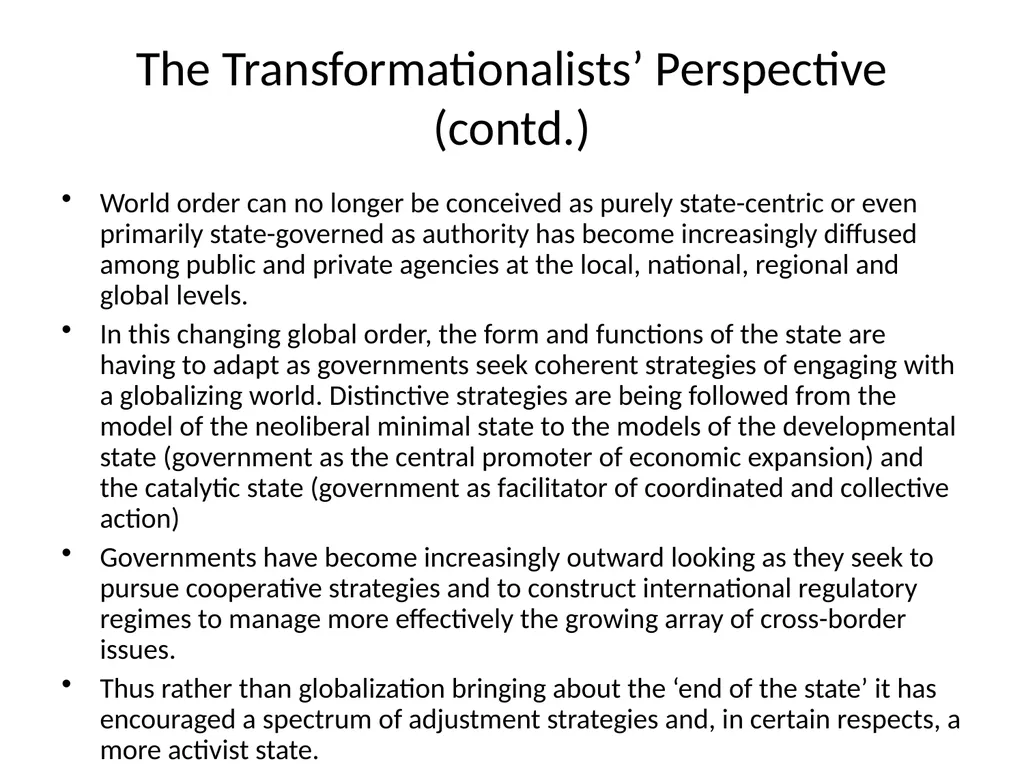
The Transformationalists’ Perspective (contd.) World order can no longer be conceived as purely state-centric or even primarily state-governed as authority has become increasingly diffused among public and private agencies at the local, national, regional and global levels.
In this changing global order, the form and functions of the state are having to adapt as governments seek coherent strategies of engaging with a globalizing world. Distinctive strategies are being followed from the model of the neoliberal minimal state to the models of the developmental state (government as the central promoter of economic expansion) and the catalytic state (government as facilitator of coordinated and collective action)
Governments have become increasingly outward looking as they seek to pursue cooperative strategies and to construct international regulatory regimes to manage more effectively the growing array of cross-border issues.
Thus rather than globalization bringing about the ‘end of the state’ it has encouraged a spectrum of adjustment strategies and, in certain respects, a more activist state.<br>
In this changing global order, the form and functions of the state are having to adapt as governments seek coherent strategies of engaging with a globalizing world. Distinctive strategies are being followed from the model of the neoliberal minimal state to the models of the developmental state (government as the central promoter of economic expansion) and the catalytic state (government as facilitator of coordinated and collective action)
Governments have become increasingly outward looking as they seek to pursue cooperative strategies and to construct international regulatory regimes to manage more effectively the growing array of cross-border issues.
Thus rather than globalization bringing about the ‘end of the state’ it has encouraged a spectrum of adjustment strategies and, in certain respects, a more activist state.<br>