
Gothic Horror Writing Knowledge Organiser Gothic
SB
Published · 6 slides · 0 views
1 / 1
Description
Gothic Horror Writing Knowledge Organiser Gothic Context The Gothic genre first appeared in the late 18th century. It tried to stimulate strong emotions in the reader - fear and worry. It uses setting and speech to build suspense and a
Related Topics
Share
Embed code
Download this presentation From Below
"Gothic Horror Writing Knowledge Organiser Gothic" is the property of its rightful owner. Permission is granted to download and print the materials on this website for personal, non-commercial use only, and to display it on your personal computer provided you do not modify the materials and that you retain all copyright notices contained in the materials. By downloading content from our website, you accept the terms of this agreement.
Presentation Transcript
01
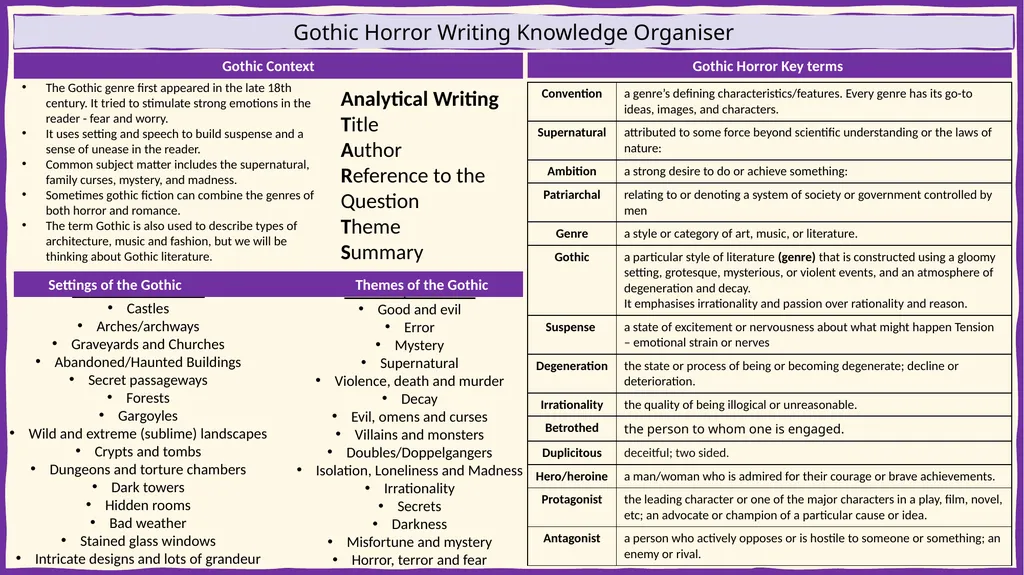
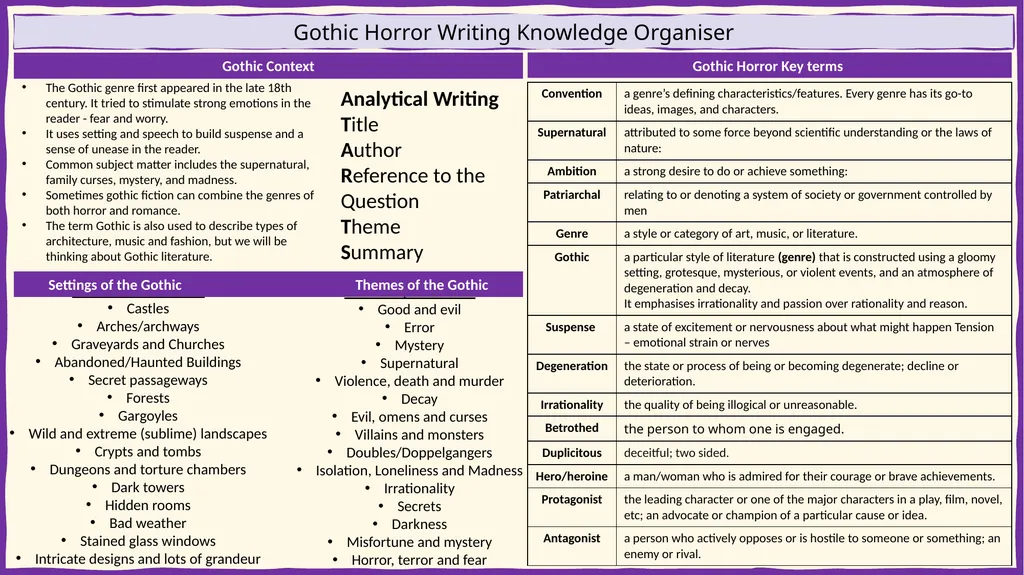
Gothic Horror Writing Knowledge Organiser Gothic Context The Gothic genre first appeared in the late 18th century. It tried to stimulate strong emotions in the reader - fear and worry.
It uses setting and speech to build suspense and a sense of unease in the reader.
Common subject matter includes the supernatural, family curses, mystery, and madness.
Sometimes gothic fiction can combine the genres of both horror and romance.
The term Gothic is also used to describe types of architecture, music and fashion, but we will be thinking about Gothic literature. Gothic Horror Key terms Settings of the Gothic
Castles
Arches/archways
Graveyards and Churches
Abandoned/Haunted Buildings
Secret passageways
Forests
Gargoyles
Wild and extreme (sublime) landscapes
Crypts and tombs
Dungeons and torture chambers
Dark towers
Hidden rooms
Bad weather
Stained glass windows
Intricate designs and lots of grandeur Themes of the Gothic
Good and evil
Error
Mystery
Supernatural
Violence, death and murder
Decay
Evil, omens and curses
Villains and monsters
Doubles/Doppelgangers
Isolation, Loneliness and Madness
Irrationality
Secrets
Darkness
Misfortune and mystery
Horror, terror and fear Settings of the Gothic Themes of the Gothic Analytical Writing
Title
Author
Reference to the Question
Theme
Summary<br>
It uses setting and speech to build suspense and a sense of unease in the reader.
Common subject matter includes the supernatural, family curses, mystery, and madness.
Sometimes gothic fiction can combine the genres of both horror and romance.
The term Gothic is also used to describe types of architecture, music and fashion, but we will be thinking about Gothic literature. Gothic Horror Key terms Settings of the Gothic
Castles
Arches/archways
Graveyards and Churches
Abandoned/Haunted Buildings
Secret passageways
Forests
Gargoyles
Wild and extreme (sublime) landscapes
Crypts and tombs
Dungeons and torture chambers
Dark towers
Hidden rooms
Bad weather
Stained glass windows
Intricate designs and lots of grandeur Themes of the Gothic
Good and evil
Error
Mystery
Supernatural
Violence, death and murder
Decay
Evil, omens and curses
Villains and monsters
Doubles/Doppelgangers
Isolation, Loneliness and Madness
Irrationality
Secrets
Darkness
Misfortune and mystery
Horror, terror and fear Settings of the Gothic Themes of the Gothic Analytical Writing
Title
Author
Reference to the Question
Theme
Summary<br>
02
Gothic Horror writing language devices Mystery and Fear
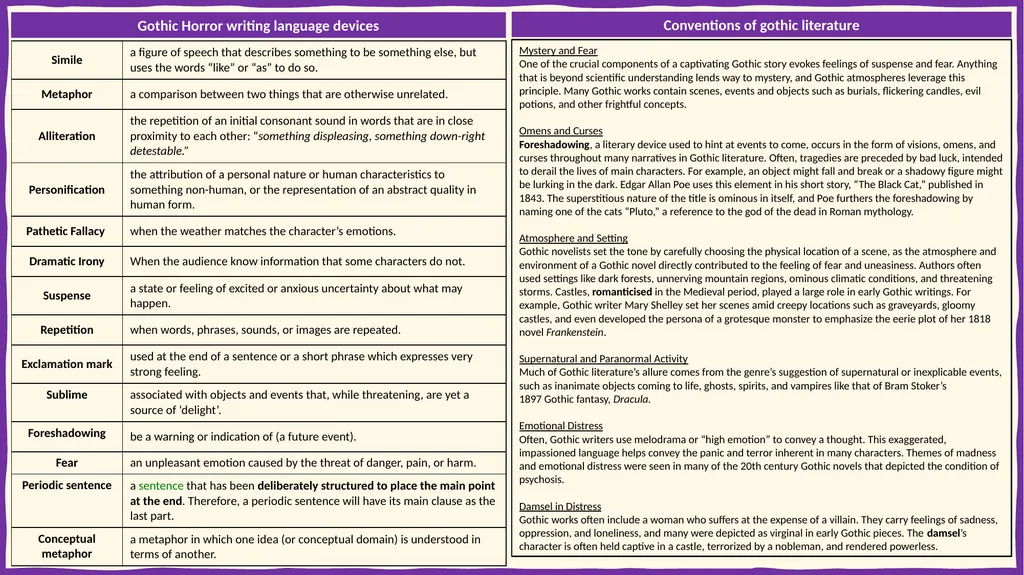
One of the crucial components of a captivating Gothic story evokes feelings of suspense and fear. Anything that is beyond scientific understanding lends way to mystery, and Gothic atmospheres leverage this principle. Many Gothic works contain scenes, events and objects such as burials, flickering candles, evil potions, and other frightful concepts.
Omens and Curses
Foreshadowing, a literary device used to hint at events to come, occurs in the form of visions, omens, and curses throughout many narratives in Gothic literature. Often, tragedies are preceded by bad luck, intended to derail the lives of main characters. For example, an object might fall and break or a shadowy figure might be lurking in the dark. Edgar Allan Poe uses this element in his short story, “The Black Cat,” published in 1843. The superstitious nature of the title is ominous in itself, and Poe furthers the foreshadowing by naming one of the cats “Pluto,” a reference to the god of the dead in Roman mythology.
Atmosphere and Setting
Gothic novelists set the tone by carefully choosing the physical location of a scene, as the atmosphere and environment of a Gothic novel directly contributed to the feeling of fear and uneasiness. Authors often used settings like dark forests, unnerving mountain regions, ominous climatic conditions, and threatening storms. Castles, romanticised in the Medieval period, played a large role in early Gothic writings. For example, Gothic writer Mary Shelley set her scenes amid creepy locations such as graveyards, gloomy castles, and even developed the persona of a grotesque monster to emphasize the eerie plot of her 1818 novel Frankenstein.
Supernatural and Paranormal Activity
Much of Gothic literature’s allure comes from the genre’s suggestion of supernatural or inexplicable events, such as inanimate objects coming to life, ghosts, spirits, and vampires like that of Bram Stoker’s 1897 Gothic fantasy, Dracula.
Emotional Distress
Often, Gothic writers use melodrama or “high emotion” to convey a thought. This exaggerated, impassioned language helps convey the panic and terror inherent in many characters. Themes of madness and emotional distress were seen in many of the 20th century Gothic novels that depicted the condition of psychosis.
Damsel in Distress
Gothic works often include a woman who suffers at the expense of a villain. They carry feelings of sadness, oppression, and loneliness, and many were depicted as virginal in early Gothic pieces. The damsel’s character is often held captive in a castle, terrorized by a nobleman, and rendered powerless. Conventions of gothic literature<br>
One of the crucial components of a captivating Gothic story evokes feelings of suspense and fear. Anything that is beyond scientific understanding lends way to mystery, and Gothic atmospheres leverage this principle. Many Gothic works contain scenes, events and objects such as burials, flickering candles, evil potions, and other frightful concepts.
Omens and Curses
Foreshadowing, a literary device used to hint at events to come, occurs in the form of visions, omens, and curses throughout many narratives in Gothic literature. Often, tragedies are preceded by bad luck, intended to derail the lives of main characters. For example, an object might fall and break or a shadowy figure might be lurking in the dark. Edgar Allan Poe uses this element in his short story, “The Black Cat,” published in 1843. The superstitious nature of the title is ominous in itself, and Poe furthers the foreshadowing by naming one of the cats “Pluto,” a reference to the god of the dead in Roman mythology.
Atmosphere and Setting
Gothic novelists set the tone by carefully choosing the physical location of a scene, as the atmosphere and environment of a Gothic novel directly contributed to the feeling of fear and uneasiness. Authors often used settings like dark forests, unnerving mountain regions, ominous climatic conditions, and threatening storms. Castles, romanticised in the Medieval period, played a large role in early Gothic writings. For example, Gothic writer Mary Shelley set her scenes amid creepy locations such as graveyards, gloomy castles, and even developed the persona of a grotesque monster to emphasize the eerie plot of her 1818 novel Frankenstein.
Supernatural and Paranormal Activity
Much of Gothic literature’s allure comes from the genre’s suggestion of supernatural or inexplicable events, such as inanimate objects coming to life, ghosts, spirits, and vampires like that of Bram Stoker’s 1897 Gothic fantasy, Dracula.
Emotional Distress
Often, Gothic writers use melodrama or “high emotion” to convey a thought. This exaggerated, impassioned language helps convey the panic and terror inherent in many characters. Themes of madness and emotional distress were seen in many of the 20th century Gothic novels that depicted the condition of psychosis.
Damsel in Distress
Gothic works often include a woman who suffers at the expense of a villain. They carry feelings of sadness, oppression, and loneliness, and many were depicted as virginal in early Gothic pieces. The damsel’s character is often held captive in a castle, terrorized by a nobleman, and rendered powerless. Conventions of gothic literature<br>
03
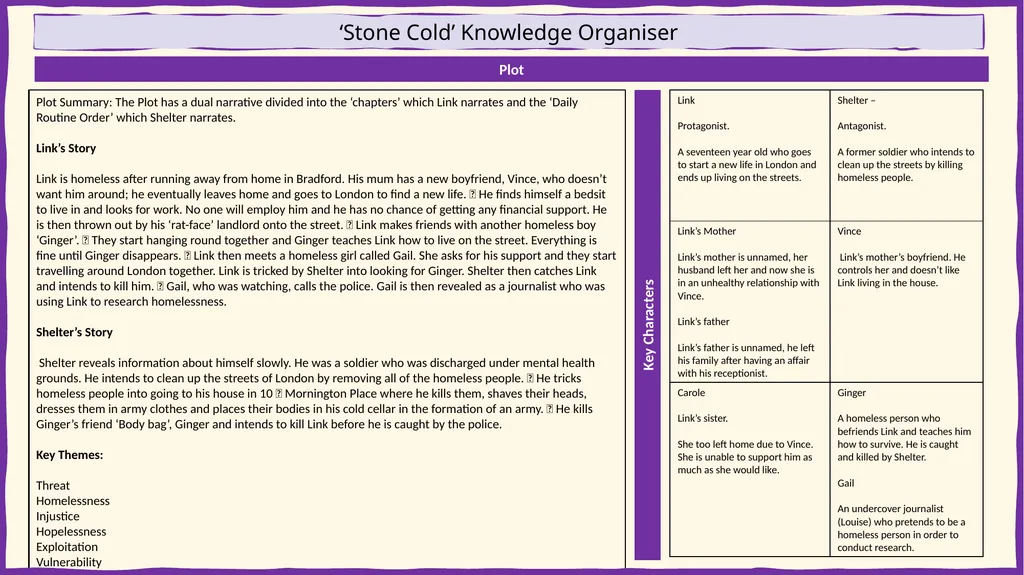
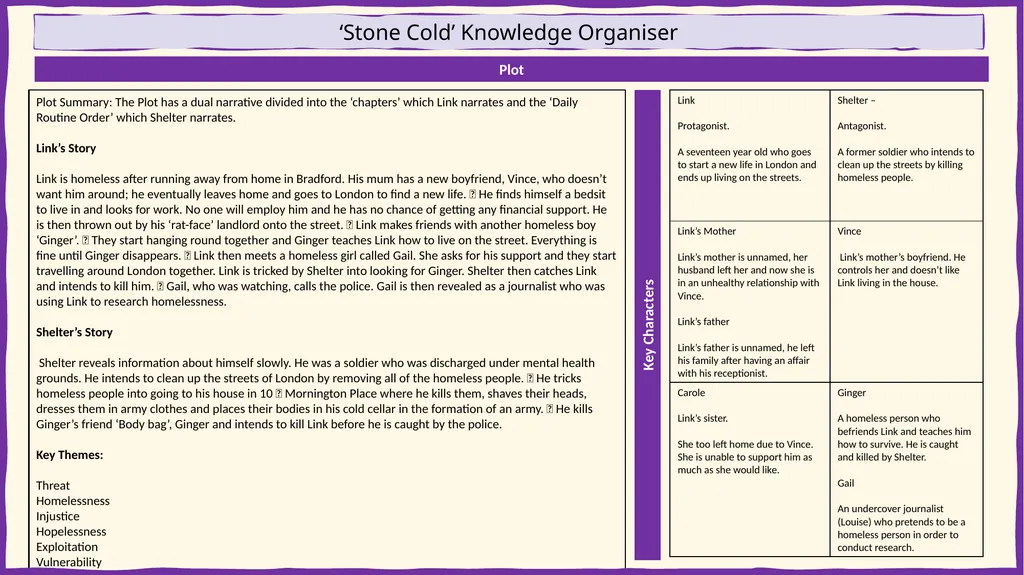
‘Stone Cold’ Knowledge Organiser Plot Plot Summary: The Plot has a dual narrative divided into the ‘chapters’ which Link narrates and the ‘Daily Routine Order’ which Shelter narrates.
Link’s Story
Link is homeless after running away from home in Bradford. His mum has a new boyfriend, Vince, who doesn’t want him around; he eventually leaves home and goes to London to find a new life. He finds himself a bedsit to live in and looks for work. No one will employ him and he has no chance of getting any financial support. He is then thrown out by his ‘rat-face’ landlord onto the street. Link makes friends with another homeless boy ‘Ginger’. They start hanging round together and Ginger teaches Link how to live on the street. Everything is fine until Ginger disappears. Link then meets a homeless girl called Gail. She asks for his support and they start travelling around London together. Link is tricked by Shelter into looking for Ginger. Shelter then catches Link and intends to kill him. Gail, who was watching, calls the police. Gail is then revealed as a journalist who was using Link to research homelessness.
Shelter’s Story
Shelter reveals information about himself slowly. He was a soldier who was discharged under mental health grounds. He intends to clean up the streets of London by removing all of the homeless people. He tricks homeless people into going to his house in 10 Mornington Place where he kills them, shaves their heads, dresses them in army clothes and places their bodies in his cold cellar in the formation of an army. He kills Ginger’s friend ‘Body bag’, Ginger and intends to kill Link before he is caught by the police.
Key Themes:
Threat
Homelessness
Injustice
Hopelessness
Exploitation
Vulnerability Key Characters<br>
Link’s Story
Link is homeless after running away from home in Bradford. His mum has a new boyfriend, Vince, who doesn’t want him around; he eventually leaves home and goes to London to find a new life. He finds himself a bedsit to live in and looks for work. No one will employ him and he has no chance of getting any financial support. He is then thrown out by his ‘rat-face’ landlord onto the street. Link makes friends with another homeless boy ‘Ginger’. They start hanging round together and Ginger teaches Link how to live on the street. Everything is fine until Ginger disappears. Link then meets a homeless girl called Gail. She asks for his support and they start travelling around London together. Link is tricked by Shelter into looking for Ginger. Shelter then catches Link and intends to kill him. Gail, who was watching, calls the police. Gail is then revealed as a journalist who was using Link to research homelessness.
Shelter’s Story
Shelter reveals information about himself slowly. He was a soldier who was discharged under mental health grounds. He intends to clean up the streets of London by removing all of the homeless people. He tricks homeless people into going to his house in 10 Mornington Place where he kills them, shaves their heads, dresses them in army clothes and places their bodies in his cold cellar in the formation of an army. He kills Ginger’s friend ‘Body bag’, Ginger and intends to kill Link before he is caught by the police.
Key Themes:
Threat
Homelessness
Injustice
Hopelessness
Exploitation
Vulnerability Key Characters<br>
04
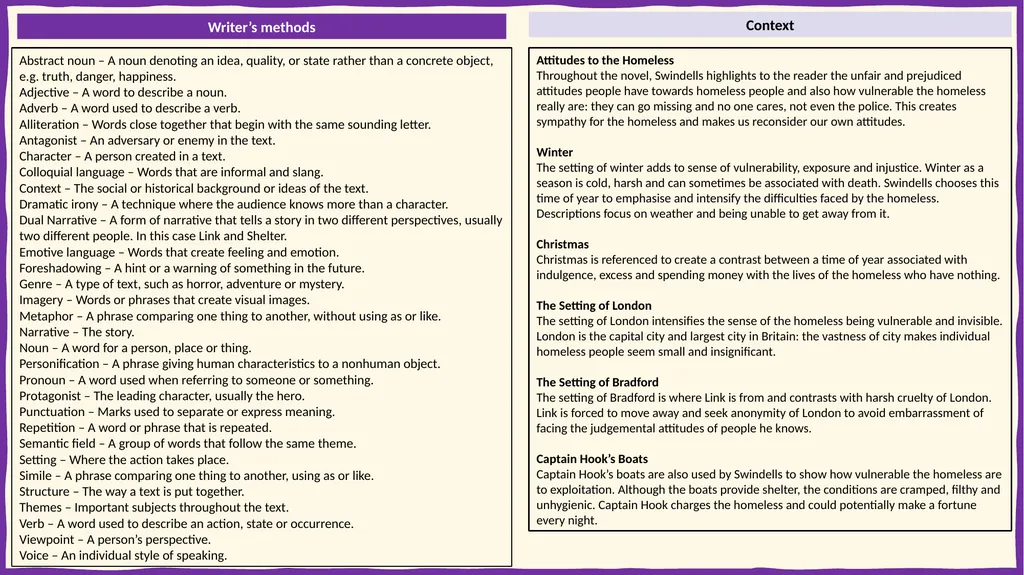
Writer’s methods Attitudes to the Homeless
Throughout the novel, Swindells highlights to the reader the unfair and prejudiced attitudes people have towards homeless people and also how vulnerable the homeless really are: they can go missing and no one cares, not even the police. This creates sympathy for the homeless and makes us reconsider our own attitudes.
Winter
The setting of winter adds to sense of vulnerability, exposure and injustice. Winter as a season is cold, harsh and can sometimes be associated with death. Swindells chooses this time of year to emphasise and intensify the difficulties faced by the homeless. Descriptions focus on weather and being unable to get away from it.
Christmas
Christmas is referenced to create a contrast between a time of year associated with indulgence, excess and spending money with the lives of the homeless who have nothing.
The Setting of London
The setting of London intensifies the sense of the homeless being vulnerable and invisible. London is the capital city and largest city in Britain: the vastness of city makes individual homeless people seem small and insignificant.
The Setting of Bradford
The setting of Bradford is where Link is from and contrasts with harsh cruelty of London. Link is forced to move away and seek anonymity of London to avoid embarrassment of facing the judgemental attitudes of people he knows.
Captain Hook’s Boats
Captain Hook’s boats are also used by Swindells to show how vulnerable the homeless are to exploitation. Although the boats provide shelter, the conditions are cramped, filthy and unhygienic. Captain Hook charges the homeless and could potentially make a fortune every night. Context Abstract noun – A noun denoting an idea, quality, or state rather than a concrete object, e.g. truth, danger, happiness.
Adjective – A word to describe a noun.
Adverb – A word used to describe a verb.
Alliteration – Words close together that begin with the same sounding letter.
Antagonist – An adversary or enemy in the text.
Character – A person created in a text.
Colloquial language – Words that are informal and slang.
Context – The social or historical background or ideas of the text.
Dramatic irony – A technique where the audience knows more than a character.
Dual Narrative – A form of narrative that tells a story in two different perspectives, usually two different people. In this case Link and Shelter.
Emotive language – Words that create feeling and emotion.
Foreshadowing – A hint or a warning of something in the future.
Genre – A type of text, such as horror, adventure or mystery.
Imagery – Words or phrases that create visual images.
Metaphor – A phrase comparing one thing to another, without using as or like.
Narrative – The story.
Noun – A word for a person, place or thing.
Personification – A phrase giving human characteristics to a nonhuman object.
Pronoun – A word used when referring to someone or something.
Protagonist – The leading character, usually the hero.
Punctuation – Marks used to separate or express meaning.
Repetition – A word or phrase that is repeated.
Semantic field – A group of words that follow the same theme.
Setting – Where the action takes place.
Simile – A phrase comparing one thing to another, using as or like.
Structure – The way a text is put together.
Themes – Important subjects throughout the text.
Verb – A word used to describe an action, state or occurrence.
Viewpoint – A person’s perspective.
Voice – An individual style of speaking.<br>
Throughout the novel, Swindells highlights to the reader the unfair and prejudiced attitudes people have towards homeless people and also how vulnerable the homeless really are: they can go missing and no one cares, not even the police. This creates sympathy for the homeless and makes us reconsider our own attitudes.
Winter
The setting of winter adds to sense of vulnerability, exposure and injustice. Winter as a season is cold, harsh and can sometimes be associated with death. Swindells chooses this time of year to emphasise and intensify the difficulties faced by the homeless. Descriptions focus on weather and being unable to get away from it.
Christmas
Christmas is referenced to create a contrast between a time of year associated with indulgence, excess and spending money with the lives of the homeless who have nothing.
The Setting of London
The setting of London intensifies the sense of the homeless being vulnerable and invisible. London is the capital city and largest city in Britain: the vastness of city makes individual homeless people seem small and insignificant.
The Setting of Bradford
The setting of Bradford is where Link is from and contrasts with harsh cruelty of London. Link is forced to move away and seek anonymity of London to avoid embarrassment of facing the judgemental attitudes of people he knows.
Captain Hook’s Boats
Captain Hook’s boats are also used by Swindells to show how vulnerable the homeless are to exploitation. Although the boats provide shelter, the conditions are cramped, filthy and unhygienic. Captain Hook charges the homeless and could potentially make a fortune every night. Context Abstract noun – A noun denoting an idea, quality, or state rather than a concrete object, e.g. truth, danger, happiness.
Adjective – A word to describe a noun.
Adverb – A word used to describe a verb.
Alliteration – Words close together that begin with the same sounding letter.
Antagonist – An adversary or enemy in the text.
Character – A person created in a text.
Colloquial language – Words that are informal and slang.
Context – The social or historical background or ideas of the text.
Dramatic irony – A technique where the audience knows more than a character.
Dual Narrative – A form of narrative that tells a story in two different perspectives, usually two different people. In this case Link and Shelter.
Emotive language – Words that create feeling and emotion.
Foreshadowing – A hint or a warning of something in the future.
Genre – A type of text, such as horror, adventure or mystery.
Imagery – Words or phrases that create visual images.
Metaphor – A phrase comparing one thing to another, without using as or like.
Narrative – The story.
Noun – A word for a person, place or thing.
Personification – A phrase giving human characteristics to a nonhuman object.
Pronoun – A word used when referring to someone or something.
Protagonist – The leading character, usually the hero.
Punctuation – Marks used to separate or express meaning.
Repetition – A word or phrase that is repeated.
Semantic field – A group of words that follow the same theme.
Setting – Where the action takes place.
Simile – A phrase comparing one thing to another, using as or like.
Structure – The way a text is put together.
Themes – Important subjects throughout the text.
Verb – A word used to describe an action, state or occurrence.
Viewpoint – A person’s perspective.
Voice – An individual style of speaking.<br>
05
‘Stone Cold’ Knowledge Organiser Plot Plot Summary: The Plot has a dual narrative divided into the ‘chapters’ which Link narrates and the ‘Daily Routine Order’ which Shelter narrates.
Link’s Story
Link is homeless after running away from home in Bradford. His mum has a new boyfriend, Vince, who doesn’t want him around; he eventually leaves home and goes to London to find a new life. He finds himself a bedsit to live in and looks for work. No one will employ him and he has no chance of getting any financial support. He is then thrown out by his ‘rat-face’ landlord onto the street. Link makes friends with another homeless boy ‘Ginger’. They start hanging round together and Ginger teaches Link how to live on the street. Everything is fine until Ginger disappears. Link then meets a homeless girl called Gail. She asks for his support and they start travelling around London together. Link is tricked by Shelter into looking for Ginger. Shelter then catches Link and intends to kill him. Gail, who was watching, calls the police. Gail is then revealed as a journalist who was using Link to research homelessness.
Shelter’s Story
Shelter reveals information about himself slowly. He was a soldier who was discharged under mental health grounds. He intends to clean up the streets of London by removing all of the homeless people. He tricks homeless people into going to his house in 10 Mornington Place where he kills them, shaves their heads, dresses them in army clothes and places their bodies in his cold cellar in the formation of an army. He kills Ginger’s friend ‘Body bag’, Ginger and intends to kill Link before he is caught by the police.
Key Themes:
Threat
Homelessness
Injustice
Hopelessness
Exploitation
Vulnerability Key Characters<br>
Link’s Story
Link is homeless after running away from home in Bradford. His mum has a new boyfriend, Vince, who doesn’t want him around; he eventually leaves home and goes to London to find a new life. He finds himself a bedsit to live in and looks for work. No one will employ him and he has no chance of getting any financial support. He is then thrown out by his ‘rat-face’ landlord onto the street. Link makes friends with another homeless boy ‘Ginger’. They start hanging round together and Ginger teaches Link how to live on the street. Everything is fine until Ginger disappears. Link then meets a homeless girl called Gail. She asks for his support and they start travelling around London together. Link is tricked by Shelter into looking for Ginger. Shelter then catches Link and intends to kill him. Gail, who was watching, calls the police. Gail is then revealed as a journalist who was using Link to research homelessness.
Shelter’s Story
Shelter reveals information about himself slowly. He was a soldier who was discharged under mental health grounds. He intends to clean up the streets of London by removing all of the homeless people. He tricks homeless people into going to his house in 10 Mornington Place where he kills them, shaves their heads, dresses them in army clothes and places their bodies in his cold cellar in the formation of an army. He kills Ginger’s friend ‘Body bag’, Ginger and intends to kill Link before he is caught by the police.
Key Themes:
Threat
Homelessness
Injustice
Hopelessness
Exploitation
Vulnerability Key Characters<br>
06
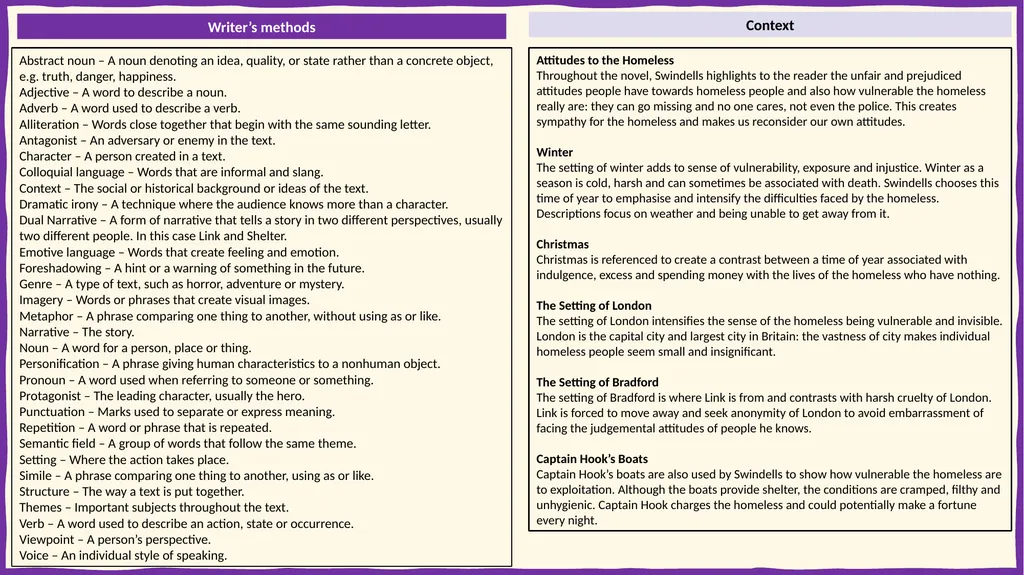
Writer’s methods Attitudes to the Homeless
Throughout the novel, Swindells highlights to the reader the unfair and prejudiced attitudes people have towards homeless people and also how vulnerable the homeless really are: they can go missing and no one cares, not even the police. This creates sympathy for the homeless and makes us reconsider our own attitudes.
Winter
The setting of winter adds to sense of vulnerability, exposure and injustice. Winter as a season is cold, harsh and can sometimes be associated with death. Swindells chooses this time of year to emphasise and intensify the difficulties faced by the homeless. Descriptions focus on weather and being unable to get away from it.
Christmas
Christmas is referenced to create a contrast between a time of year associated with indulgence, excess and spending money with the lives of the homeless who have nothing.
The Setting of London
The setting of London intensifies the sense of the homeless being vulnerable and invisible. London is the capital city and largest city in Britain: the vastness of city makes individual homeless people seem small and insignificant.
The Setting of Bradford
The setting of Bradford is where Link is from and contrasts with harsh cruelty of London. Link is forced to move away and seek anonymity of London to avoid embarrassment of facing the judgemental attitudes of people he knows.
Captain Hook’s Boats
Captain Hook’s boats are also used by Swindells to show how vulnerable the homeless are to exploitation. Although the boats provide shelter, the conditions are cramped, filthy and unhygienic. Captain Hook charges the homeless and could potentially make a fortune every night. Context Abstract noun – A noun denoting an idea, quality, or state rather than a concrete object, e.g. truth, danger, happiness.
Adjective – A word to describe a noun.
Adverb – A word used to describe a verb.
Alliteration – Words close together that begin with the same sounding letter.
Antagonist – An adversary or enemy in the text.
Character – A person created in a text.
Colloquial language – Words that are informal and slang.
Context – The social or historical background or ideas of the text.
Dramatic irony – A technique where the audience knows more than a character.
Dual Narrative – A form of narrative that tells a story in two different perspectives, usually two different people. In this case Link and Shelter.
Emotive language – Words that create feeling and emotion.
Foreshadowing – A hint or a warning of something in the future.
Genre – A type of text, such as horror, adventure or mystery.
Imagery – Words or phrases that create visual images.
Metaphor – A phrase comparing one thing to another, without using as or like.
Narrative – The story.
Noun – A word for a person, place or thing.
Personification – A phrase giving human characteristics to a nonhuman object.
Pronoun – A word used when referring to someone or something.
Protagonist – The leading character, usually the hero.
Punctuation – Marks used to separate or express meaning.
Repetition – A word or phrase that is repeated.
Semantic field – A group of words that follow the same theme.
Setting – Where the action takes place.
Simile – A phrase comparing one thing to another, using as or like.
Structure – The way a text is put together.
Themes – Important subjects throughout the text.
Verb – A word used to describe an action, state or occurrence.
Viewpoint – A person’s perspective.
Voice – An individual style of speaking.<br>
Throughout the novel, Swindells highlights to the reader the unfair and prejudiced attitudes people have towards homeless people and also how vulnerable the homeless really are: they can go missing and no one cares, not even the police. This creates sympathy for the homeless and makes us reconsider our own attitudes.
Winter
The setting of winter adds to sense of vulnerability, exposure and injustice. Winter as a season is cold, harsh and can sometimes be associated with death. Swindells chooses this time of year to emphasise and intensify the difficulties faced by the homeless. Descriptions focus on weather and being unable to get away from it.
Christmas
Christmas is referenced to create a contrast between a time of year associated with indulgence, excess and spending money with the lives of the homeless who have nothing.
The Setting of London
The setting of London intensifies the sense of the homeless being vulnerable and invisible. London is the capital city and largest city in Britain: the vastness of city makes individual homeless people seem small and insignificant.
The Setting of Bradford
The setting of Bradford is where Link is from and contrasts with harsh cruelty of London. Link is forced to move away and seek anonymity of London to avoid embarrassment of facing the judgemental attitudes of people he knows.
Captain Hook’s Boats
Captain Hook’s boats are also used by Swindells to show how vulnerable the homeless are to exploitation. Although the boats provide shelter, the conditions are cramped, filthy and unhygienic. Captain Hook charges the homeless and could potentially make a fortune every night. Context Abstract noun – A noun denoting an idea, quality, or state rather than a concrete object, e.g. truth, danger, happiness.
Adjective – A word to describe a noun.
Adverb – A word used to describe a verb.
Alliteration – Words close together that begin with the same sounding letter.
Antagonist – An adversary or enemy in the text.
Character – A person created in a text.
Colloquial language – Words that are informal and slang.
Context – The social or historical background or ideas of the text.
Dramatic irony – A technique where the audience knows more than a character.
Dual Narrative – A form of narrative that tells a story in two different perspectives, usually two different people. In this case Link and Shelter.
Emotive language – Words that create feeling and emotion.
Foreshadowing – A hint or a warning of something in the future.
Genre – A type of text, such as horror, adventure or mystery.
Imagery – Words or phrases that create visual images.
Metaphor – A phrase comparing one thing to another, without using as or like.
Narrative – The story.
Noun – A word for a person, place or thing.
Personification – A phrase giving human characteristics to a nonhuman object.
Pronoun – A word used when referring to someone or something.
Protagonist – The leading character, usually the hero.
Punctuation – Marks used to separate or express meaning.
Repetition – A word or phrase that is repeated.
Semantic field – A group of words that follow the same theme.
Setting – Where the action takes place.
Simile – A phrase comparing one thing to another, using as or like.
Structure – The way a text is put together.
Themes – Important subjects throughout the text.
Verb – A word used to describe an action, state or occurrence.
Viewpoint – A person’s perspective.
Voice – An individual style of speaking.<br>