
Grading ECF Arbiter Seminar - Materials by CAA

Published  . 0 views
↓ Download
Grading ECF Arbiter Seminar - Materials by CAA
1 / 1
Grading ECF Arbiter Seminar - Materials by CAA - slide 1 of 5 Grading ECF Arbiter Seminar - Materials by CAA - slide 2 of 5 Grading ECF Arbiter Seminar - Materials by CAA - slide 3 of 5 Grading ECF Arbiter Seminar - Materials by CAA - slide 4 of 5 Grading ECF Arbiter Seminar - Materials by CAA - slide 5 of 5

Description: Grading ECF Arbiter Seminar - Materials by CAA Grading info It is a condition of submitting results to the ECF for grading that the following data is collected, which will appear on the ECF grading website: The players forename and surname

Related Topics

Download Presentation

"Grading ECF Arbiter Seminar - Materials by CAA" is the property of its rightful owner. Permission is granted to download and print the materials on this website for personal, non-commercial use only, and to display it on your personal computer provided you do not modify the materials and that you retain all copyright notices contained in the materials. By downloading content from our website, you accept the terms of this agreement.

Presentation Transcript

slide1. Grading ECF Arbiter Seminar - Materials by CAA<br>
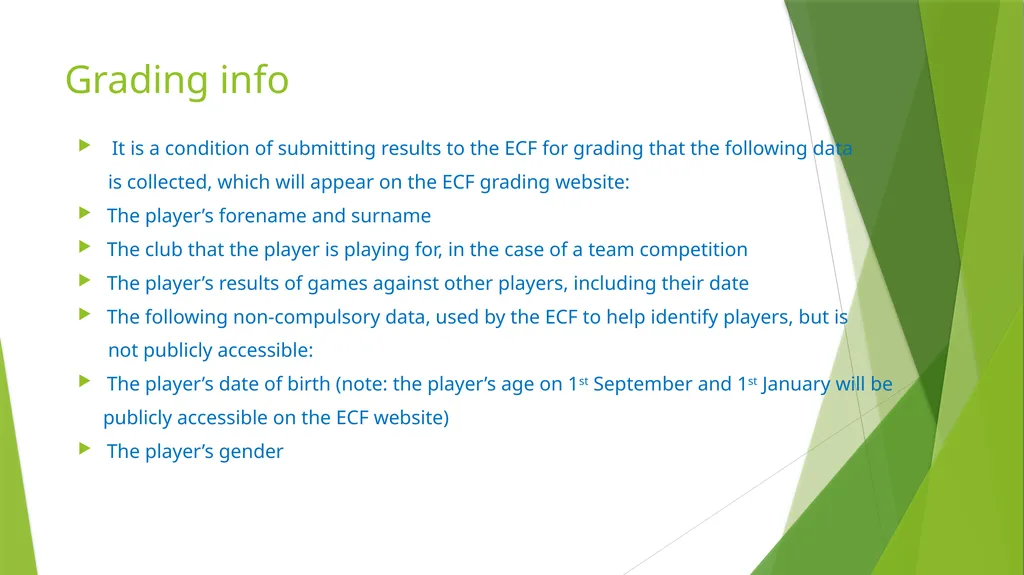
slide2. Grading info It is a condition of submitting results to the ECF for grading that the following data
is collected, which will appear on the ECF grading website:
The player’s forename and surname
The club that the player is playing for, in the case of a team competition
The player’s results of games against other players, including their date
The following non-compulsory data, used by the ECF to help identify players, but is
not publicly accessible:
The player’s date of birth (note: the player’s age on 1st September and 1st January will be
publicly accessible on the ECF website)
The player’s gender<br>
slide3. Non-gradable events The following types of game are ineligible for grading:
Thematic
Lightning
Correspondence
Games played without chess clocks
Chess960 games<br>
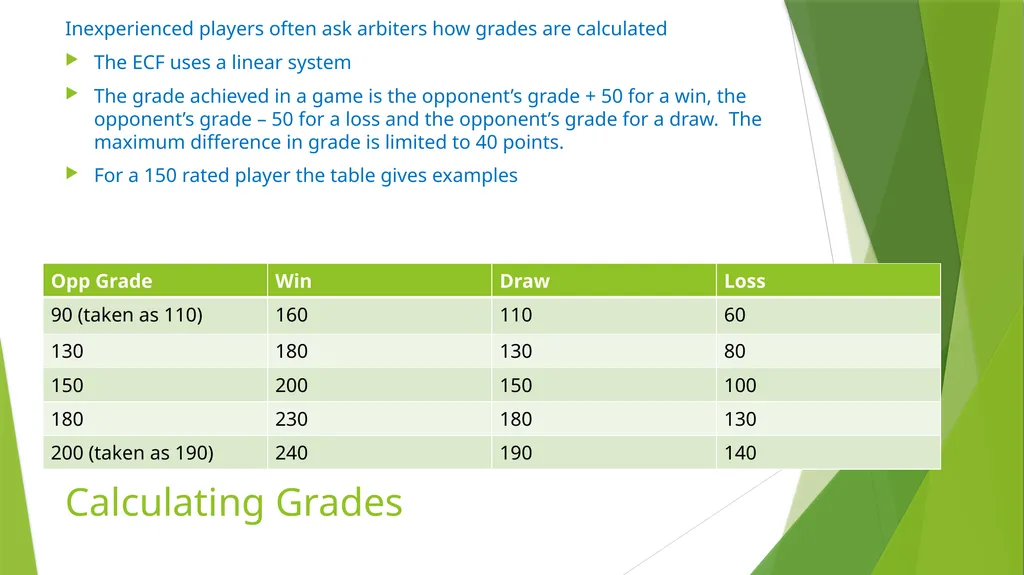
slide4. Calculating Grades Inexperienced players often ask arbiters how grades are calculated
The ECF uses a linear system
The grade achieved in a game is the opponent’s grade + 50 for a win, the opponent’s grade – 50 for a loss and the opponent’s grade for a draw. The maximum difference in grade is limited to 40 points.
For a 150 rated player the table gives examples<br>
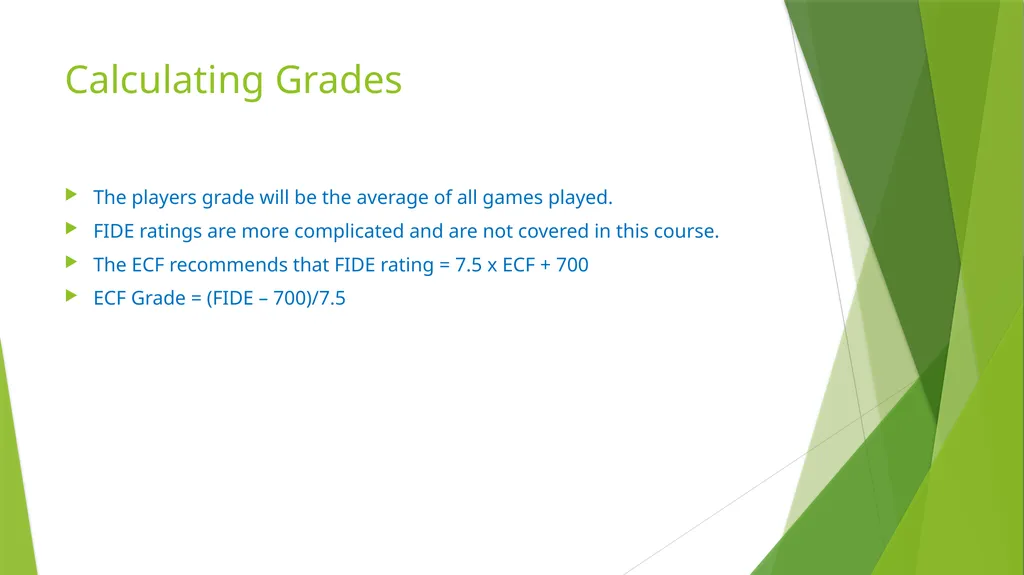
slide5. Calculating Grades The players grade will be the average of all games played.
FIDE ratings are more complicated and are not covered in this course.
The ECF recommends that FIDE rating = 7.5 x ECF + 700
ECF Grade = (FIDE – 700)/7.5<br>