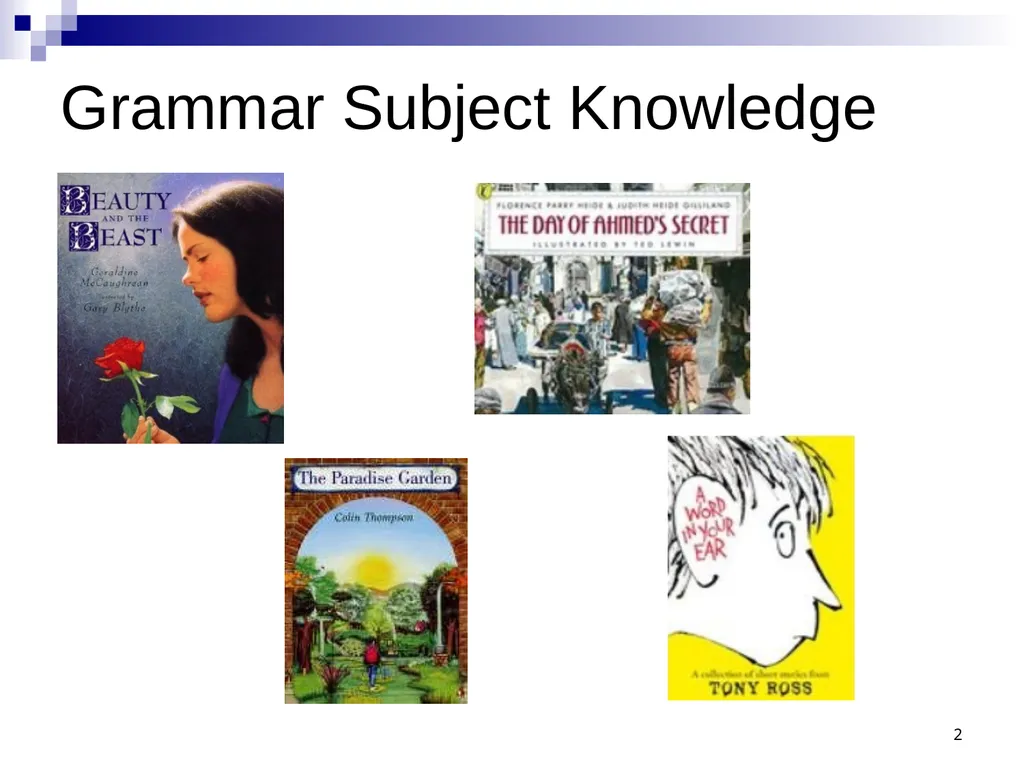
GRAMMAR SUBJECT KNOWLEDGE Phrase Clause - Sentence 1 Grammar Subject Knowledge 2 Phrase, clause, sentence? Beauty and the Beast - Geraldine McCaughrean (2000) 3 Which of the following are phrases? clauses? sentences? though she told
"GRAMMAR SUBJECT KNOWLEDGE Phrase – Clause -" is the property of its rightful owner. Permission is granted to
download and print the materials on this website for personal, non-commercial use only, and to display it
on your personal computer provided you do not modify the materials and that you retain all copyright
notices contained in the materials. By downloading content from our website, you accept the terms of this
agreement.
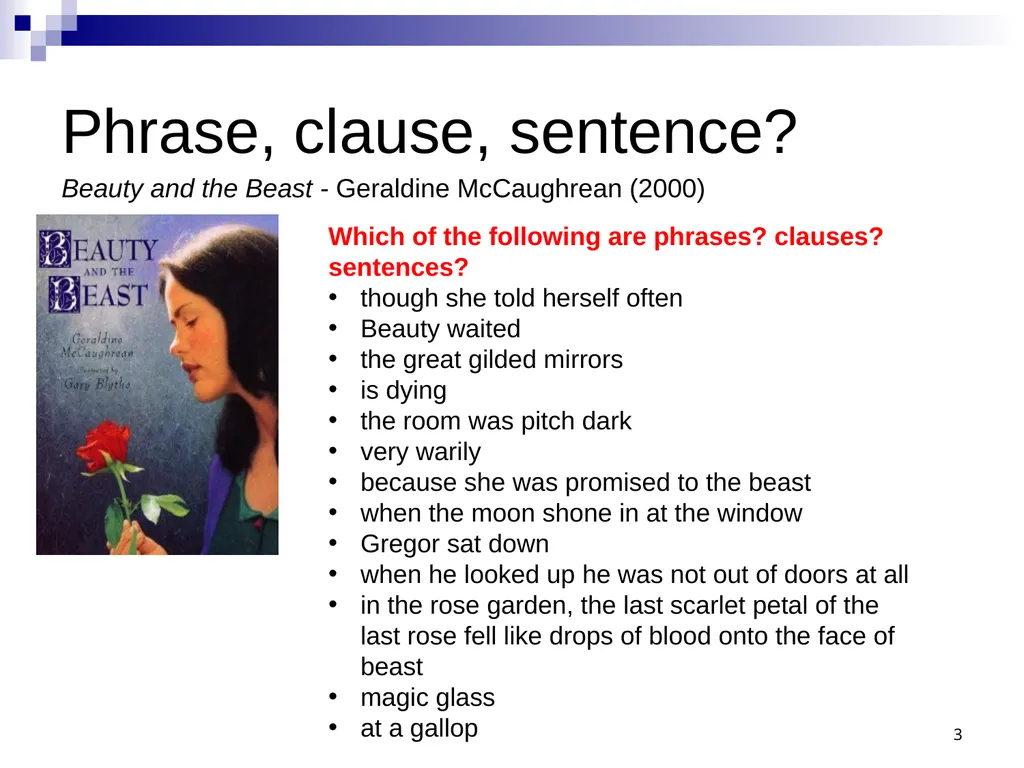
Phrase, clause, sentence? Beauty and the Beast - Geraldine McCaughrean (2000) 3 Which of the following are phrases? clauses? sentences?
though she told herself often
Beauty waited
the great gilded mirrors
is dying
the room was pitch dark
very warily
because she was promised to the beast
when the moon shone in at the window
Gregor sat down
when he looked up he was not out of doors at all
in the rose garden, the last scarlet petal of the last rose fell like drops of blood onto the face of beast
magic glass
at a gallop<br>
04
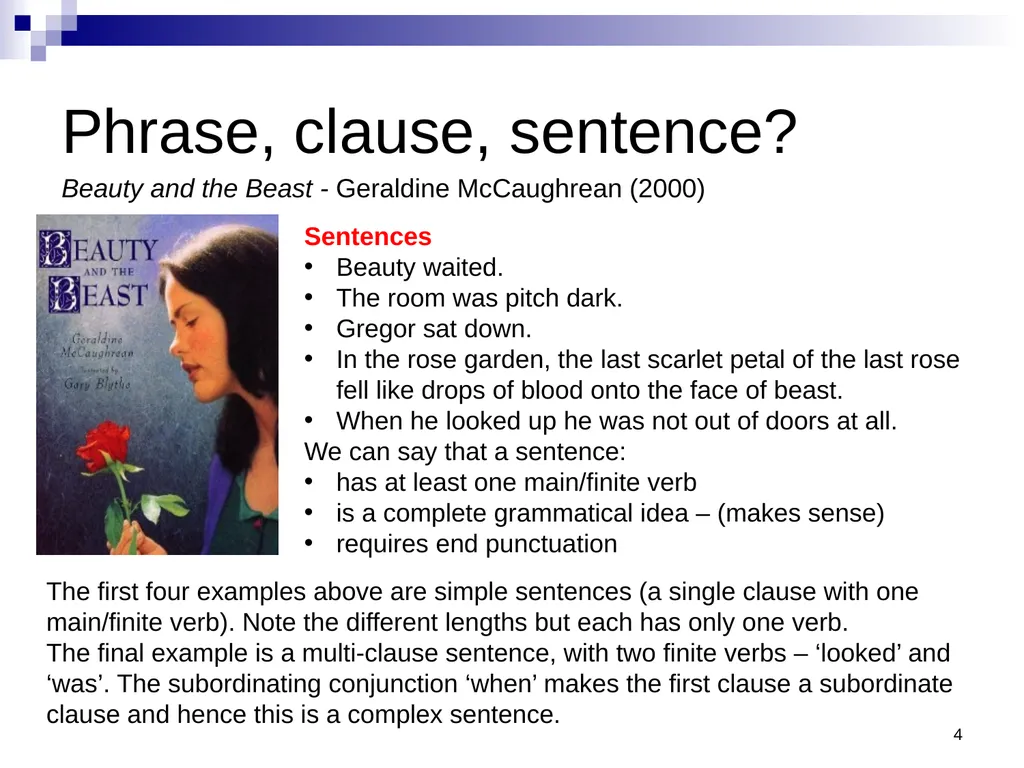
Phrase, clause, sentence? Beauty and the Beast - Geraldine McCaughrean (2000) 4 Sentences
Beauty waited.
The room was pitch dark.
Gregor sat down.
In the rose garden, the last scarlet petal of the last rose fell like drops of blood onto the face of beast.
When he looked up he was not out of doors at all.
We can say that a sentence:
has at least one main/finite verb
is a complete grammatical idea – (makes sense)
requires end punctuation The first four examples above are simple sentences (a single clause with one main/finite verb). Note the different lengths but each has only one verb.
The final example is a multi-clause sentence, with two finite verbs – ‘looked’ and ‘was’. The subordinating conjunction ‘when’ makes the first clause a subordinate clause and hence this is a complex sentence.<br>
05
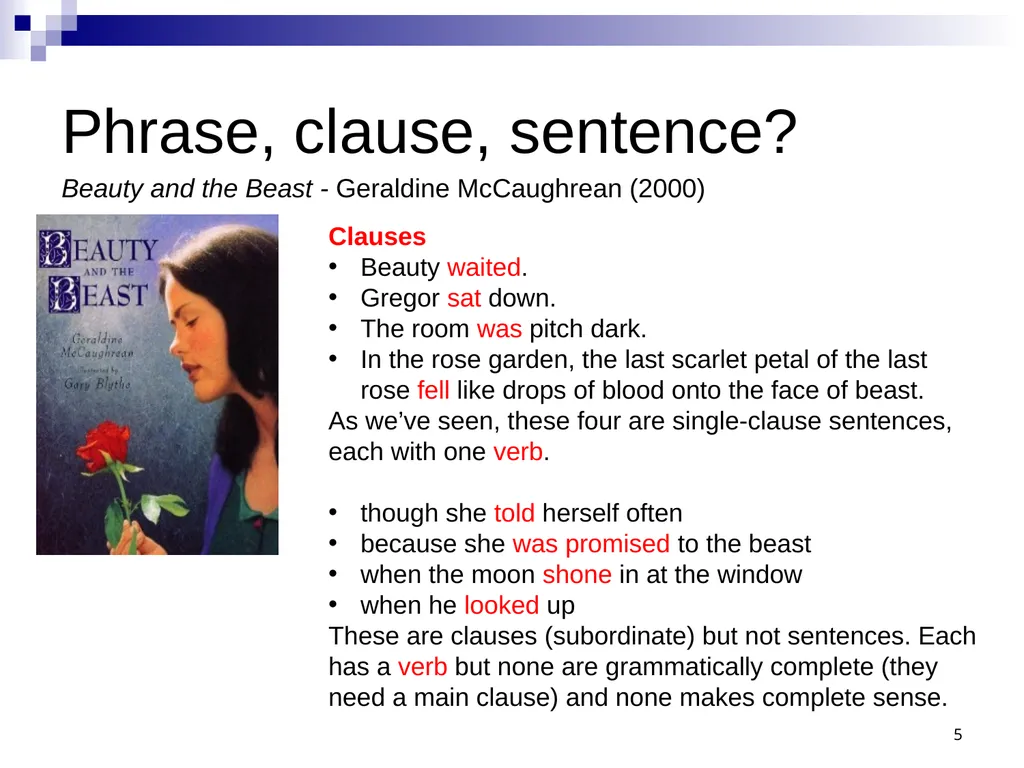
Phrase, clause, sentence? Beauty and the Beast - Geraldine McCaughrean (2000) 5 Clauses
Beauty waited.
Gregor sat down.
The room was pitch dark.
In the rose garden, the last scarlet petal of the last rose fell like drops of blood onto the face of beast.
As we’ve seen, these four are single-clause sentences, each with one verb.
though she told herself often
because she was promised to the beast
when the moon shone in at the window
when he looked up
These are clauses (subordinate) but not sentences. Each has a verb but none are grammatically complete (they need a main clause) and none makes complete sense.<br>
06
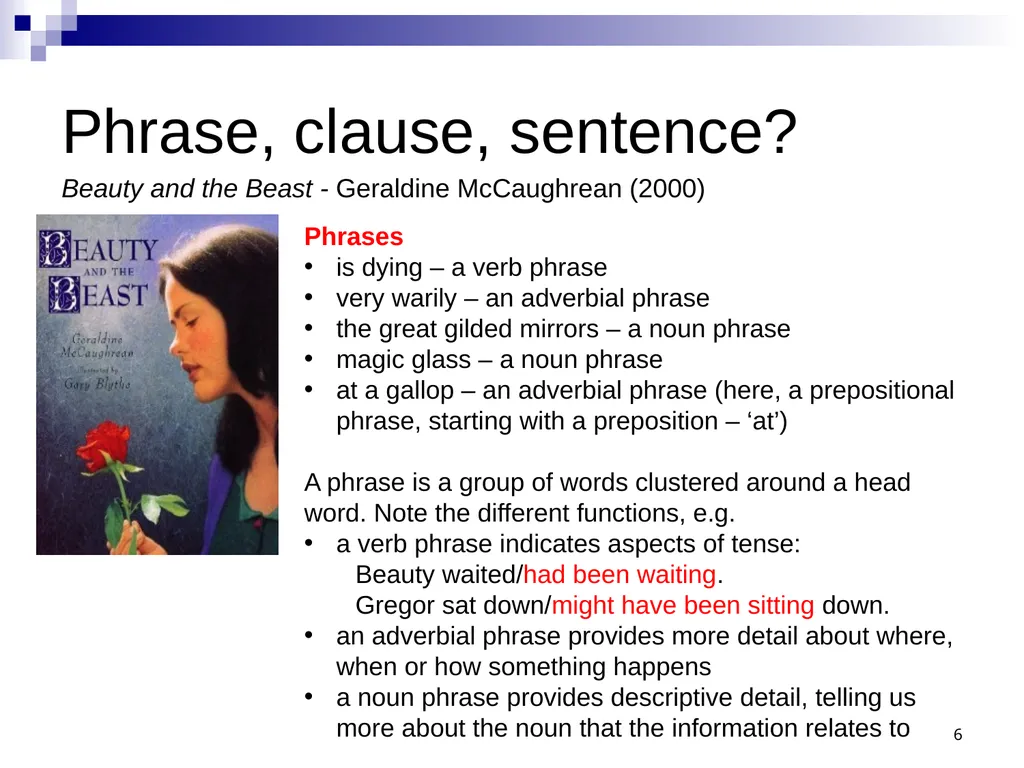
Phrase, clause, sentence? Beauty and the Beast - Geraldine McCaughrean (2000) 6 Phrases
is dying – a verb phrase
very warily – an adverbial phrase
the great gilded mirrors – a noun phrase
magic glass – a noun phrase
at a gallop – an adverbial phrase (here, a prepositional phrase, starting with a preposition – ‘at’)
A phrase is a group of words clustered around a head word. Note the different functions, e.g.
a verb phrase indicates aspects of tense:
Beauty waited/had been waiting.
Gregor sat down/might have been sitting down.
an adverbial phrase provides more detail about where, when or how something happens
a noun phrase provides descriptive detail, telling us more about the noun that the information relates to<br>
07
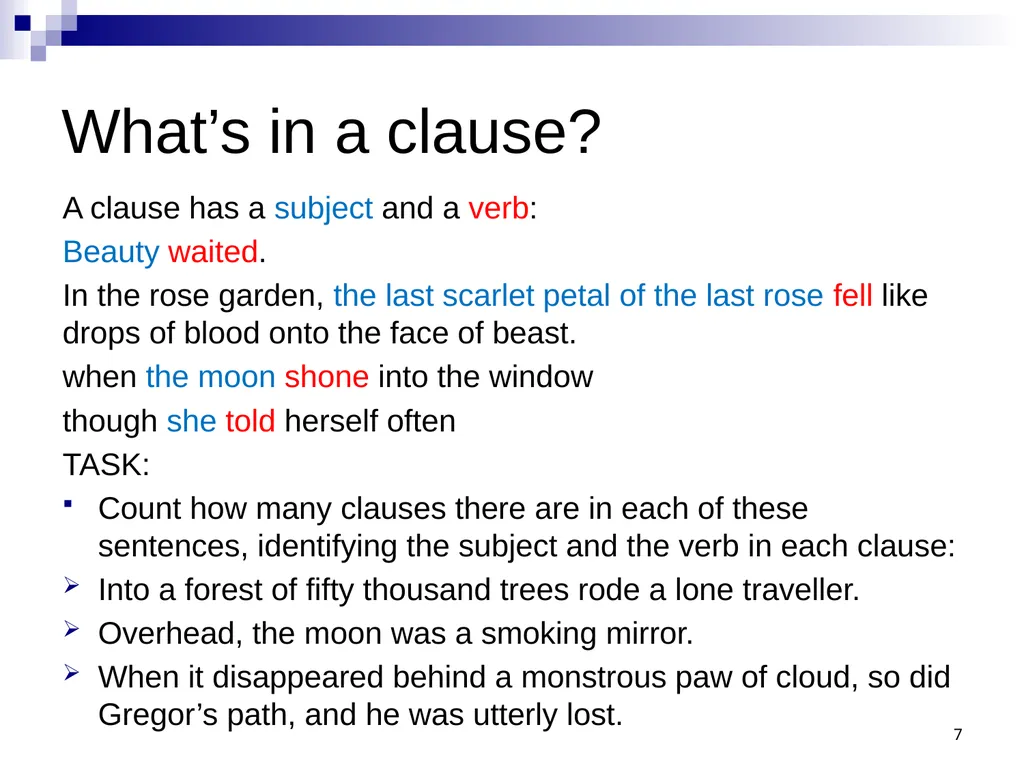
What’s in a clause? A clause has a subject and a verb:
Beauty waited.
In the rose garden, the last scarlet petal of the last rose fell like drops of blood onto the face of beast.
when the moon shone into the window
though she told herself often
TASK:
Count how many clauses there are in each of these sentences, identifying the subject and the verb in each clause:
Into a forest of fifty thousand trees rode a lone traveller.
Overhead, the moon was a smoking mirror.
When it disappeared behind a monstrous paw of cloud, so did Gregor’s path, and he was utterly lost. 7<br>
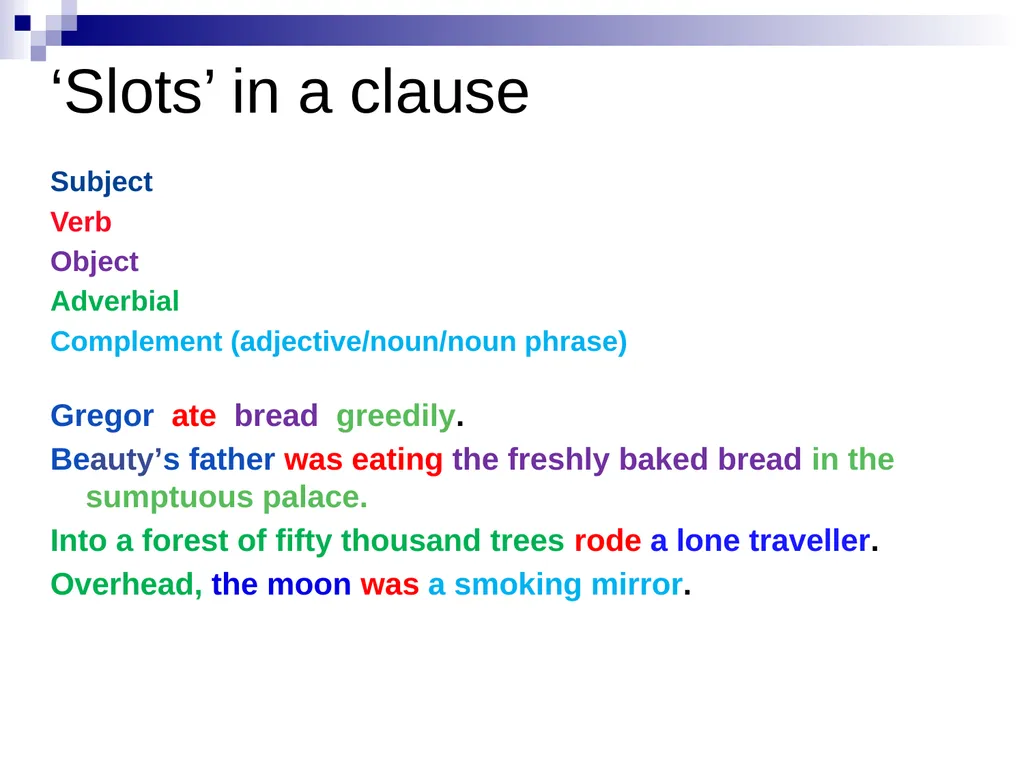
Gregor ate bread greedily.
Beauty’s father was eating the freshly baked bread in the sumptuous palace.
Into a forest of fifty thousand trees rode a lone traveller.
Overhead, the moon was a smoking mirror. ‘Slots’ in a clause<br>
09
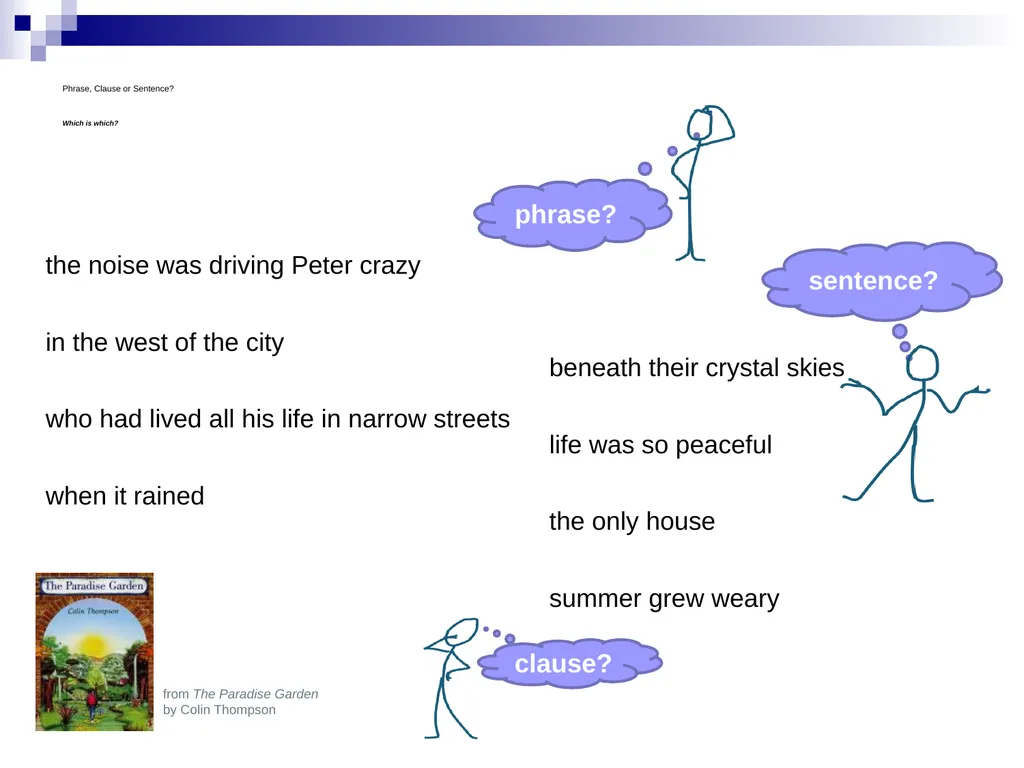
beneath their crystal skies
life was so peaceful
the only house
summer grew weary Phrase, Clause or Sentence?
Which is which? the noise was driving Peter crazy
in the west of the city
who had lived all his life in narrow streets
when it rained from The Paradise Garden by Colin Thompson<br>
10
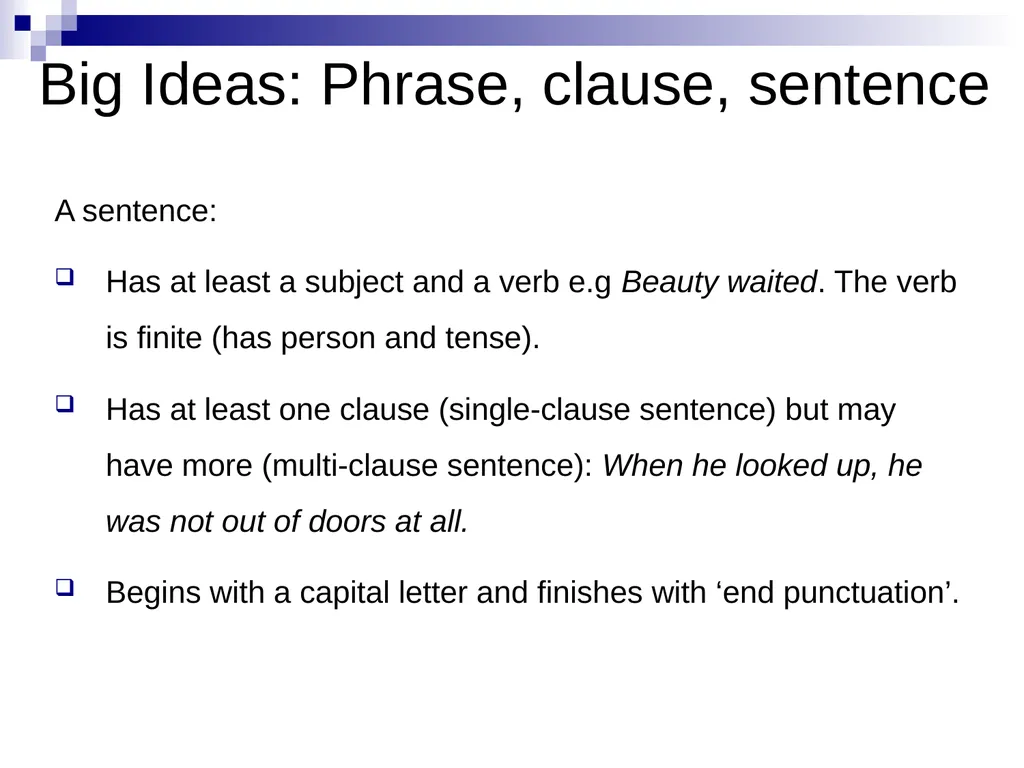
A sentence:
Has at least a subject and a verb e.g Beauty waited. The verb is finite (has person and tense).
Has at least one clause (single-clause sentence) but may have more (multi-clause sentence): When he looked up, he was not out of doors at all.
Begins with a capital letter and finishes with ‘end punctuation’. Big Ideas: Phrase, clause, sentence<br>
11
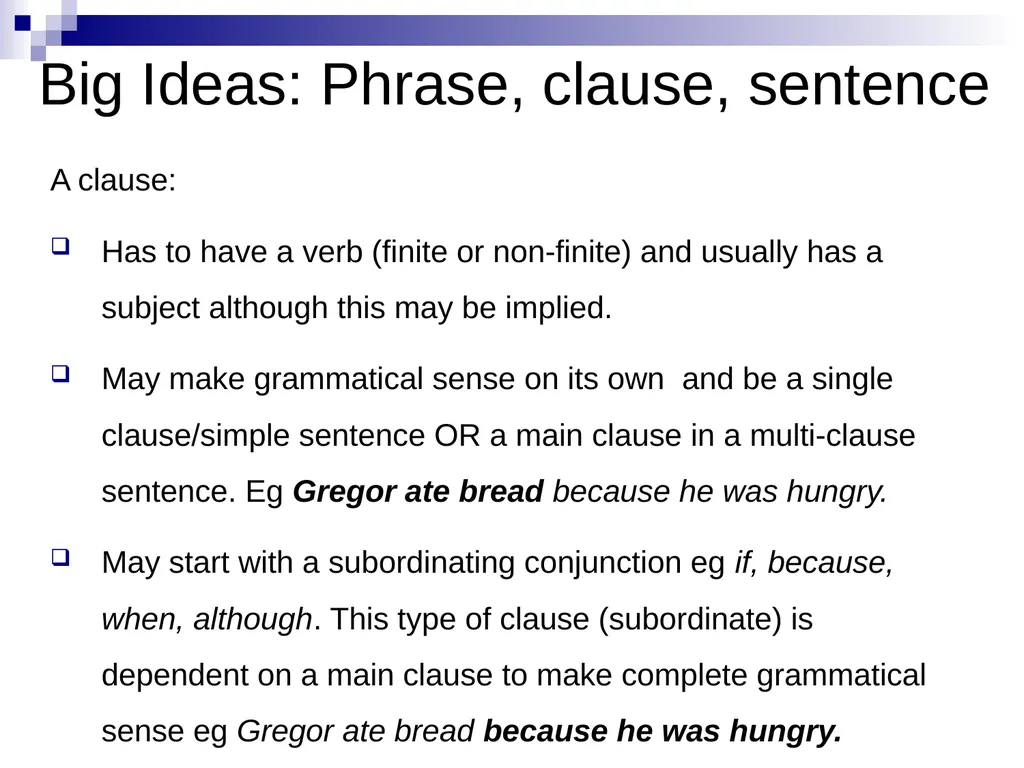
A clause:
Has to have a verb (finite or non-finite) and usually has a subject although this may be implied.
May make grammatical sense on its own and be a single clause/simple sentence OR a main clause in a multi-clause sentence. Eg Gregor ate bread because he was hungry.
May start with a subordinating conjunction eg if, because, when, although. This type of clause (subordinate) is dependent on a main clause to make complete grammatical sense eg Gregor ate bread because he was hungry. Big Ideas: Phrase, clause, sentence<br>
12
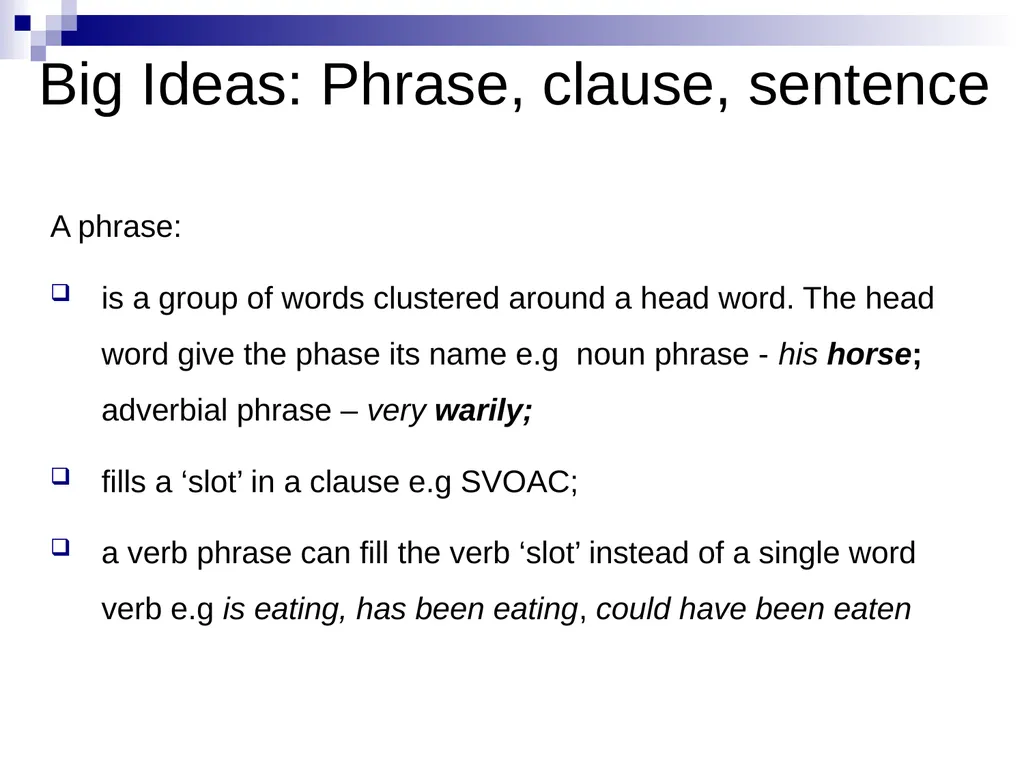
A phrase:
is a group of words clustered around a head word. The head word give the phase its name e.g noun phrase - his horse; adverbial phrase – very warily;
fills a ‘slot’ in a clause e.g SVOAC;
a verb phrase can fill the verb ‘slot’ instead of a single word verb e.g is eating, has been eating, could have been eaten Big Ideas: Phrase, clause, sentence<br>
13
Resources to help you… Essential Primary Grammar:
Myhill, Jones, Watson & Lines (2016) No Nonsense Grammar: Babcock LDP Literacy Team, Raintree (2016) www.babcock-education.co.uk/ldp/literacy<br>