04
2. The change of type Is a rather common means of indicating stress and other changes in prosodic elements, includes:
italics,
bold type,
h-y-p-h-e-n-a-t-i-o-n,
s p a c i n g o u t,
mmmmmultiplication
and CAPITALIZATION.<br>
05
The change of type serves to convey exaggerated articulation:
la-a-arge…
I des-pise you!
Allll aboarrrrd!
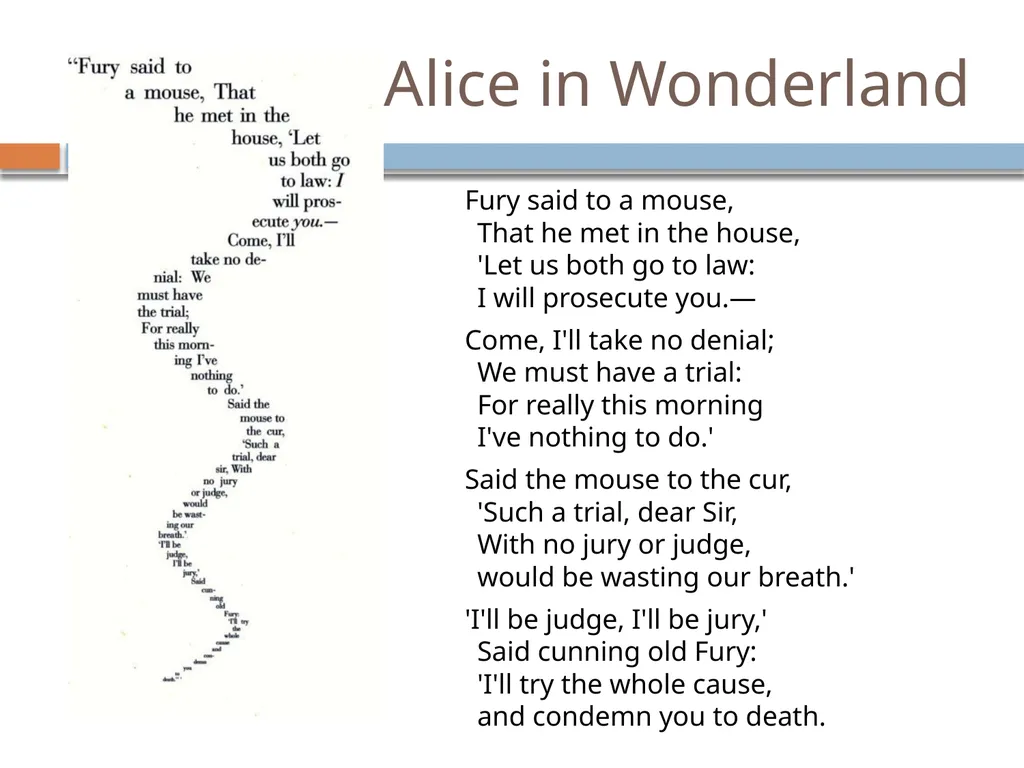
contributes to the overall meaning of a literary work (poems): Alice in Wonderland, The concrete poem<br>
06
Alice in Wonderland Fury said to a mouse, �That he met in the house, �'Let us both go to law: �I will prosecute you.—
Come, I'll take no denial; �We must have a trial: �For really this morning �I've nothing to do.'
Said the mouse to the cur, �'Such a trial, dear Sir, �With no jury or judge, �would be wasting our breath.'
'I'll be judge, I'll be jury,' �Said cunning old Fury: �'I'll try the whole cause, �and condemn you to death.<br>
07
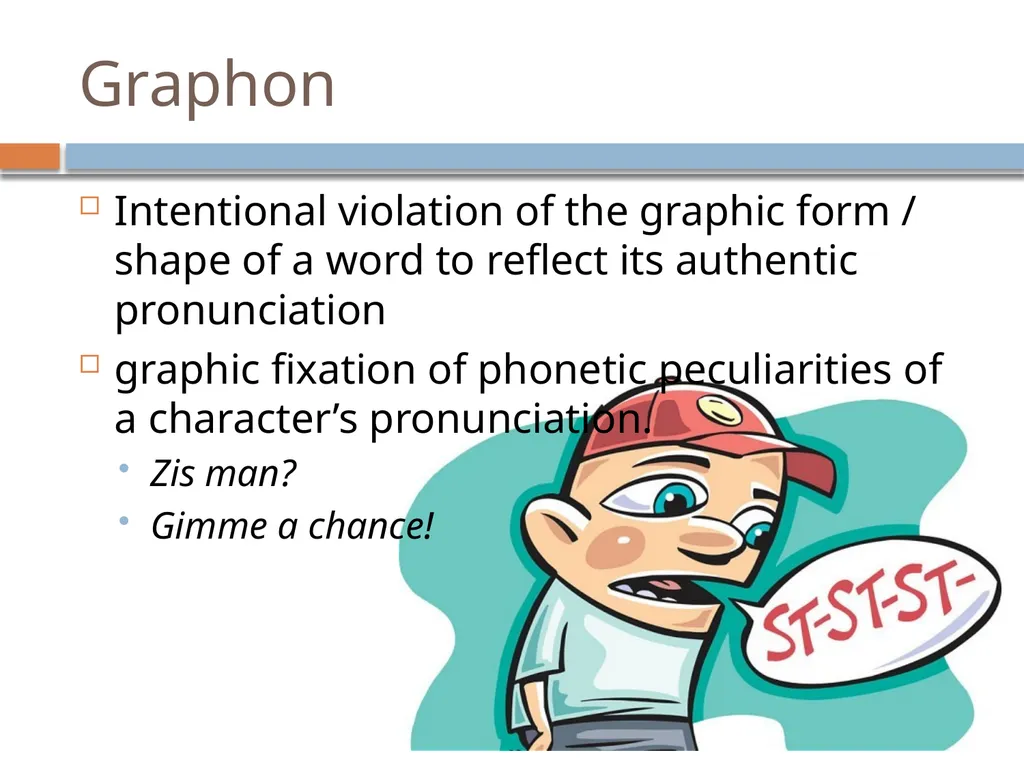
Graphon Intentional violation of the graphic form / shape of a word to reflect its authentic pronunciation
graphic fixation of phonetic peculiarities of a character’s pronunciation.
Zis man?
Gimme a chance!<br>
08
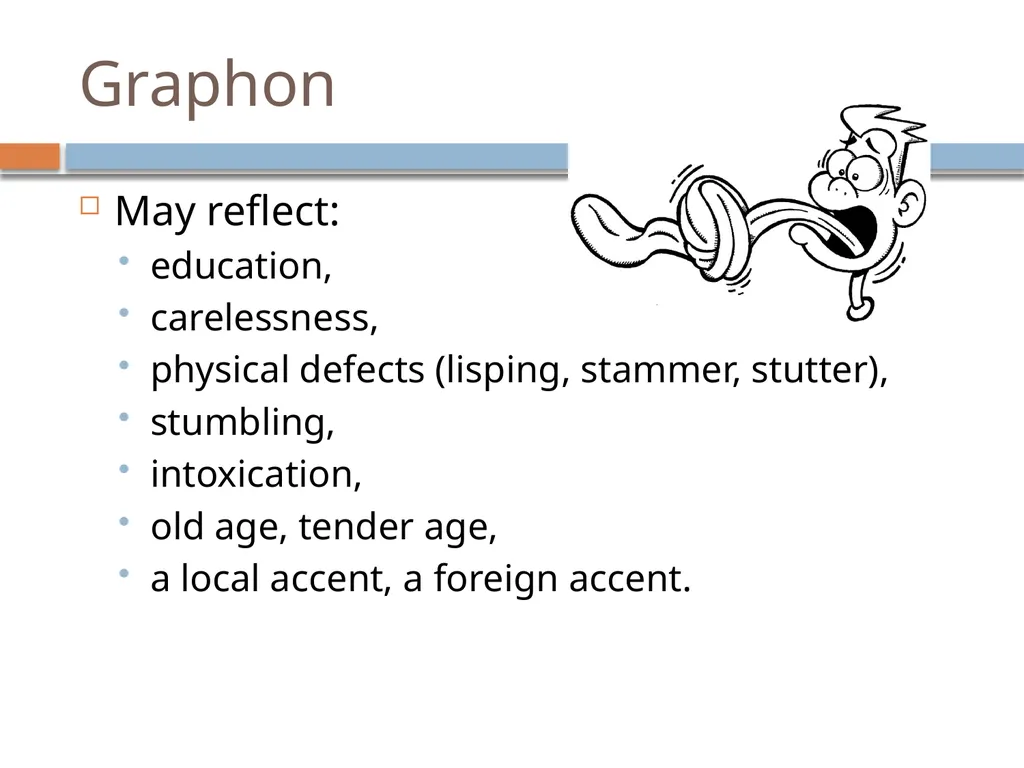
Graphon May reflect:
education,
carelessness,
physical defects (lisping, stammer, stutter),
stumbling,
intoxication,
old age, tender age,
a local accent, a foreign accent.<br>
09
How to Analyze a Poem The Road Not Taken
by R.Frost<br>
10
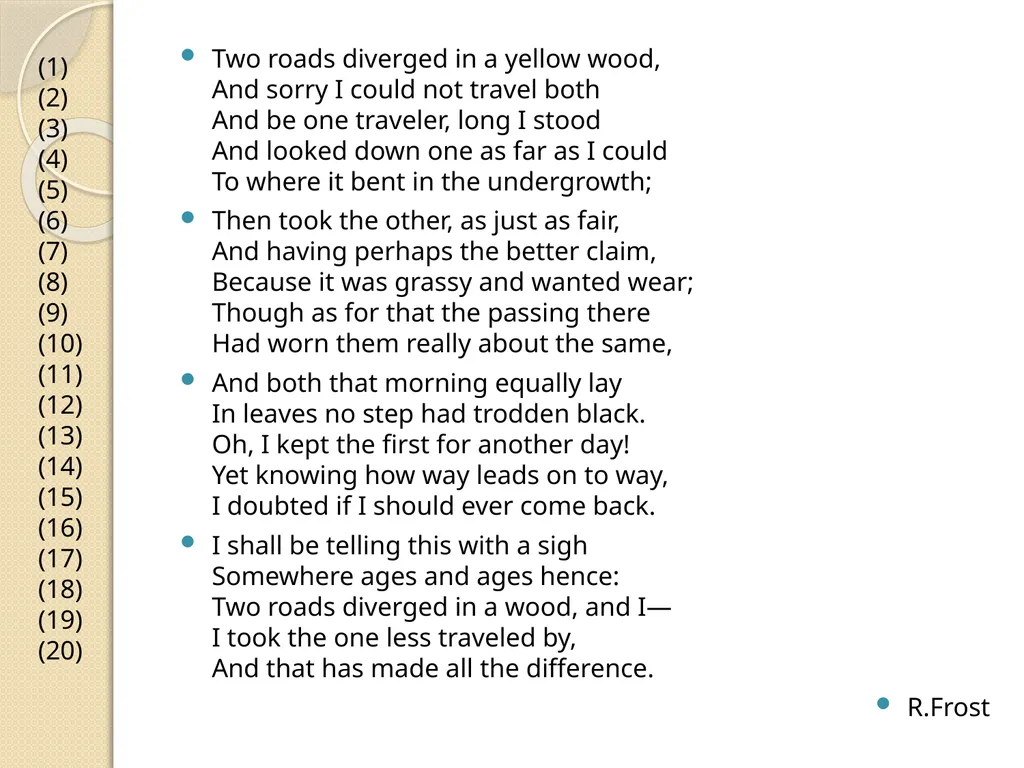
Two roads diverged in a yellow wood,�And sorry I could not travel both�And be one traveler, long I stood�And looked down one as far as I could�To where it bent in the undergrowth;
Then took the other, as just as fair,�And having perhaps the better claim,�Because it was grassy and wanted wear;�Though as for that the passing there�Had worn them really about the same,
And both that morning equally lay�In leaves no step had trodden black.�Oh, I kept the first for another day!�Yet knowing how way leads on to way,�I doubted if I should ever come back.
I shall be telling this with a sigh�Somewhere ages and ages hence:�Two roads diverged in a wood, and I—�I took the one less traveled by,�And that has made all the difference.
R.Frost (1)
(2)
(3)
(4)
(5)
(6)
(7)
(8)
(9)
(10)
(11)
(12)
(13)
(14)
(15)�(16)
(17)
(18)
(19)
(20)<br>
11
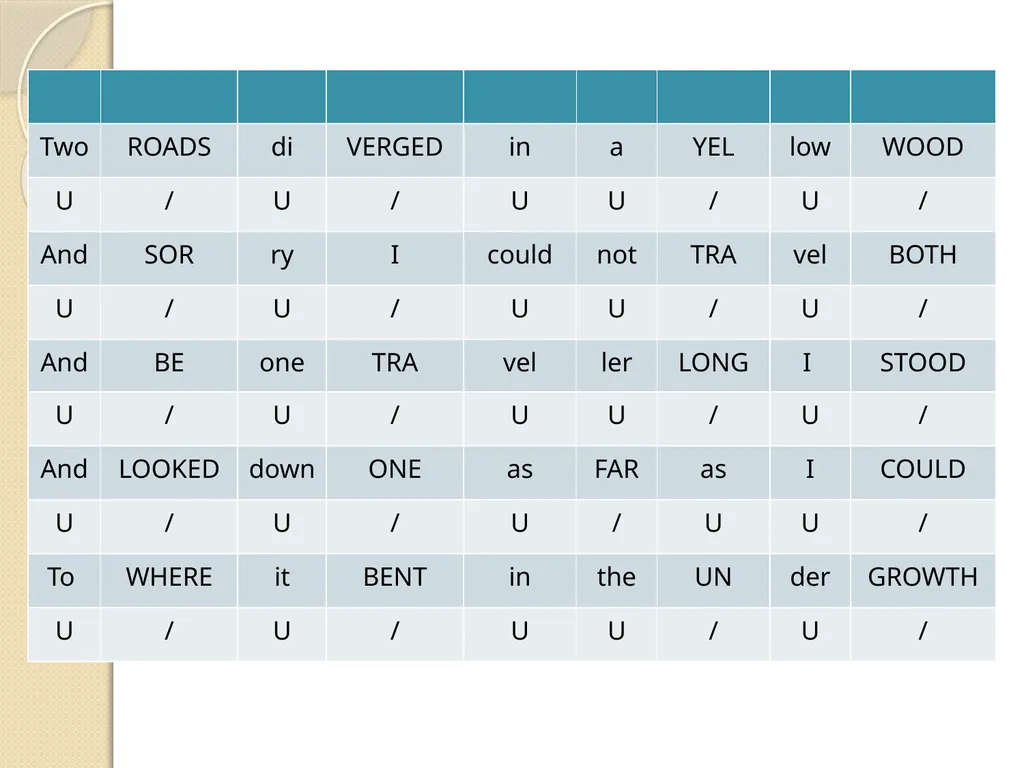
1. Phonetic level Step 1 – counting syllables, identifying feet and meter according to the PREVAILING foot
There can and WILL be deviations from the metrical pattern<br>
12
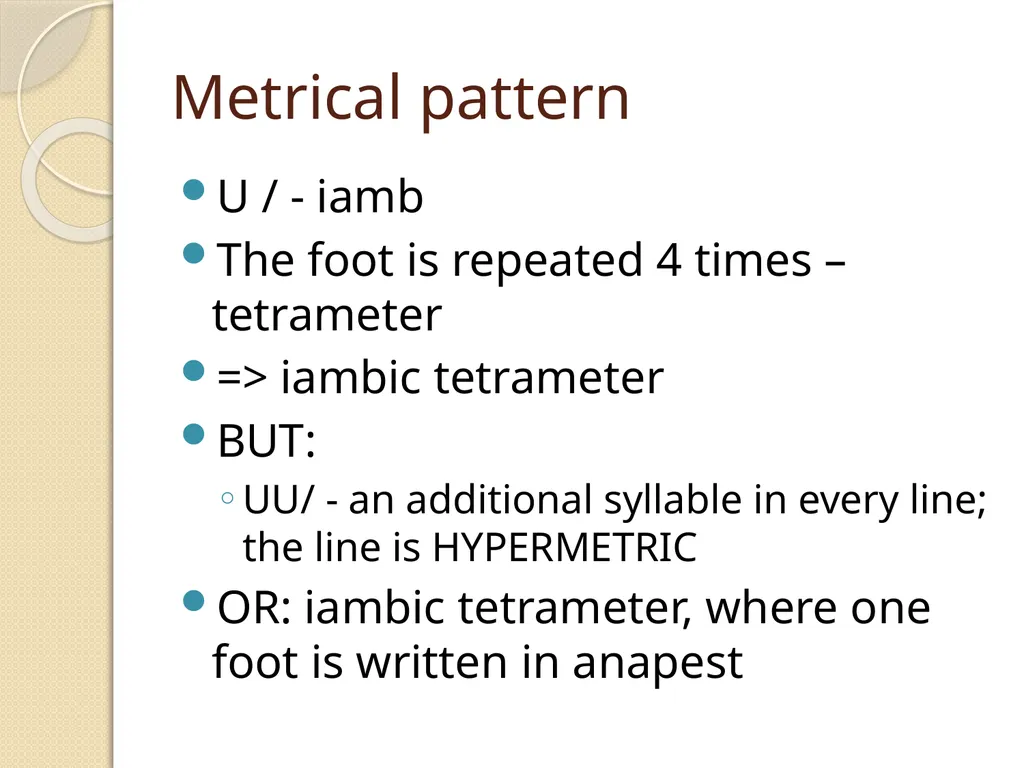
Metrical pattern U / - iamb
The foot is repeated 4 times – tetrameter
=> iambic tetrameter
BUT:
UU/ - an additional syllable in every line; the line is HYPERMETRIC
OR: iambic tetrameter, where one foot is written in anapest<br>
13
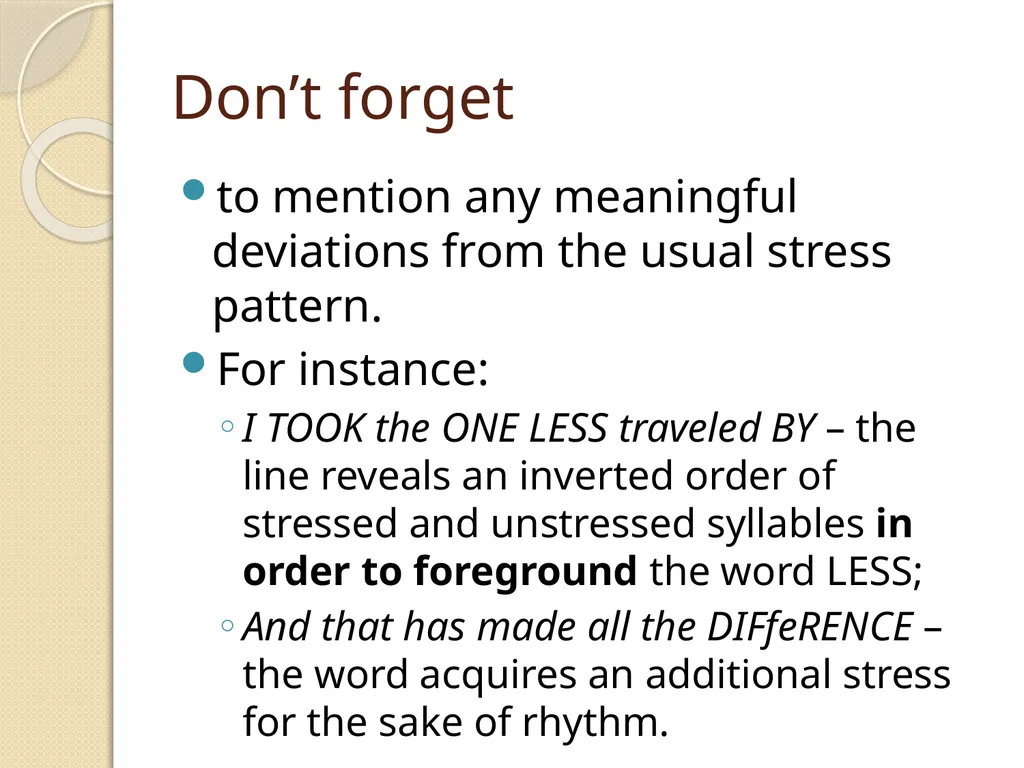
Don’t forget to mention any meaningful deviations from the usual stress pattern.
For instance:
I TOOK the ONE LESS traveled BY – the line reveals an inverted order of stressed and unstressed syllables in order to foreground the word LESS;
And that has made all the DIFfeRENCE – the word acquires an additional stress for the sake of rhythm.<br>
14
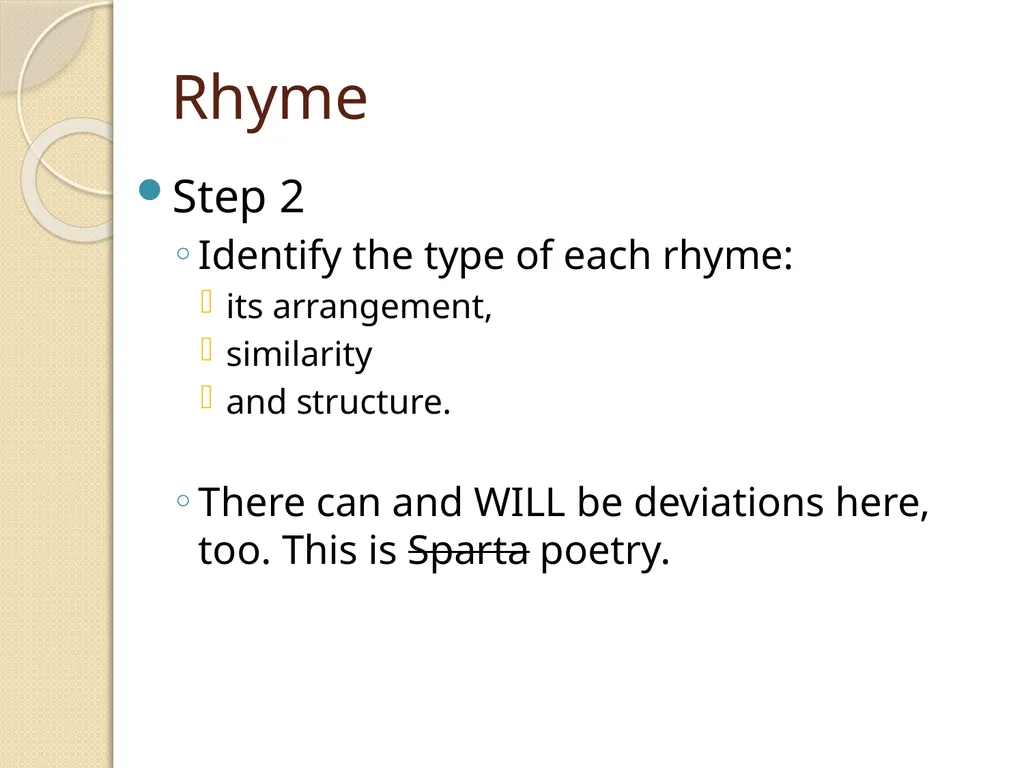
Rhyme Step 2
Identify the type of each rhyme:
its arrangement,
similarity
and structure.
There can and WILL be deviations here, too. This is Sparta poetry.<br>
15
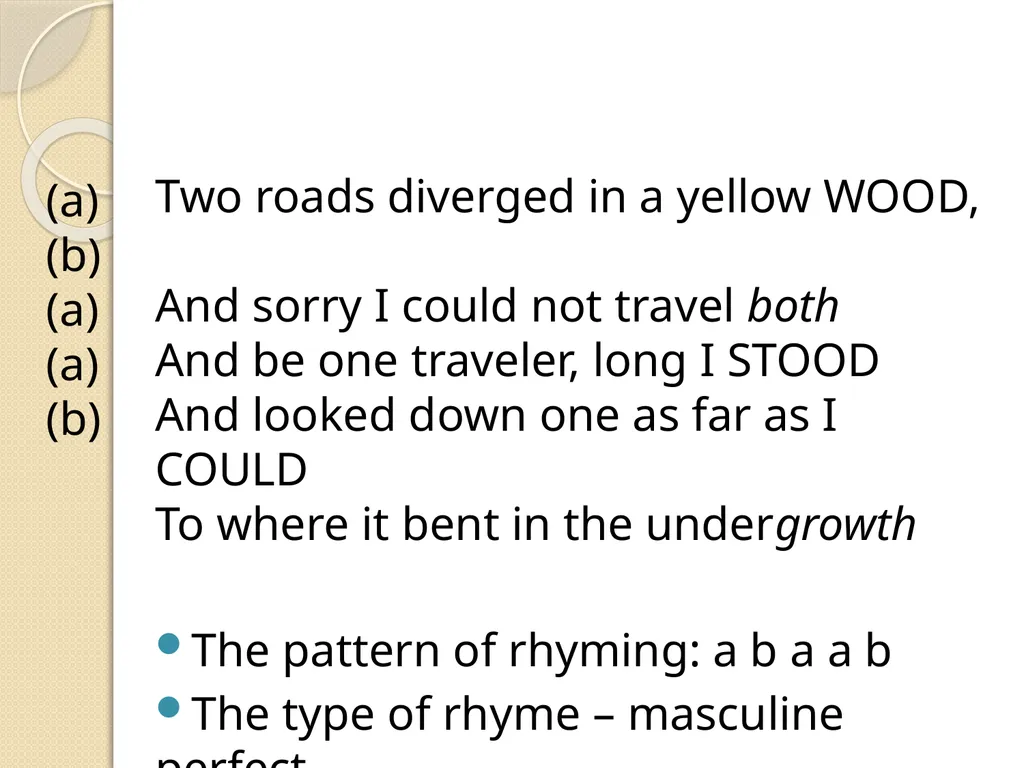
Two roads diverged in a yellow WOOD, �And sorry I could not travel both�And be one traveler, long I STOOD�And looked down one as far as I COULD�To where it bent in the undergrowth
The pattern of rhyming: a b a a b
The type of rhyme – masculine perfect (a)
(b)
(a)
(a)
(b)<br>
16
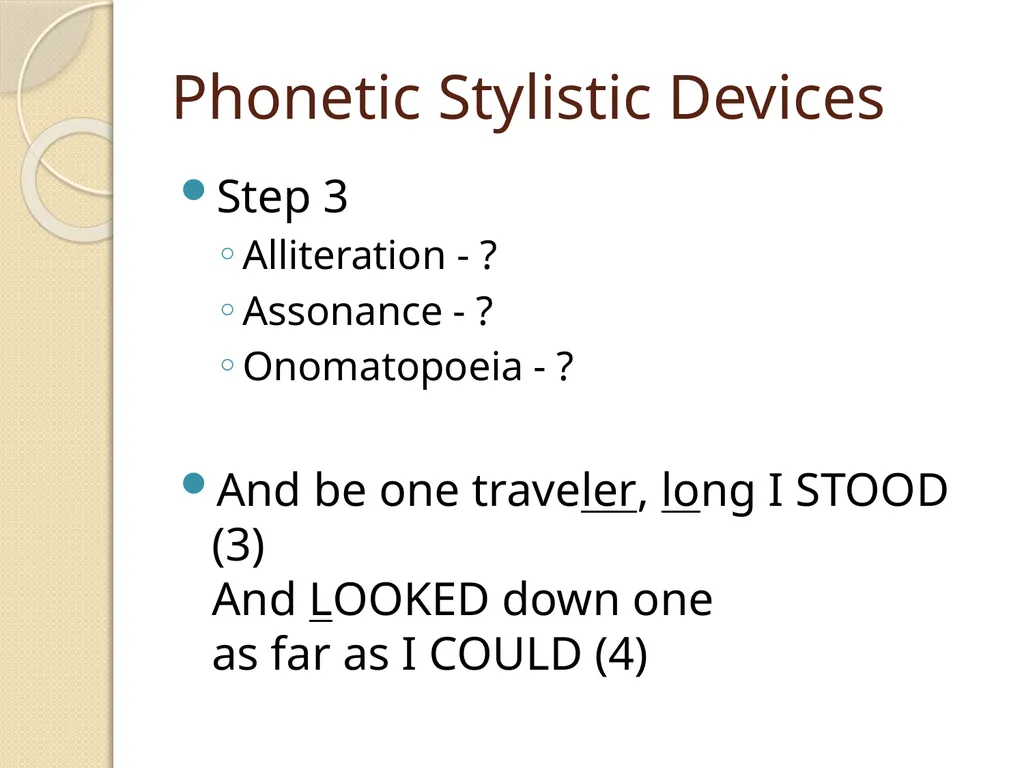
Phonetic Stylistic Devices Step 3
Alliteration - ?
Assonance - ?
Onomatopoeia - ?
And be one traveler, long I STOOD (3)�And LOOKED down one �as far as I COULD (4)<br>
17
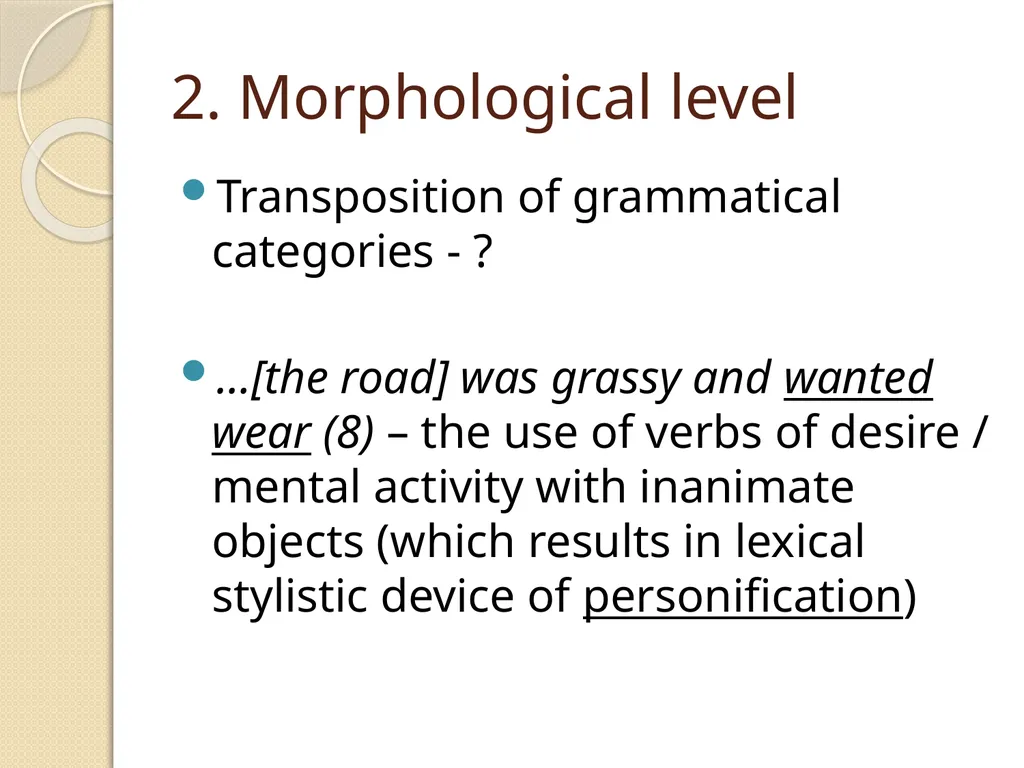
2. Morphological level Transposition of grammatical categories - ?
…[the road] was grassy and wanted wear (8) – the use of verbs of desire / mental activity with inanimate objects (which results in lexical stylistic device of personification)<br>
18
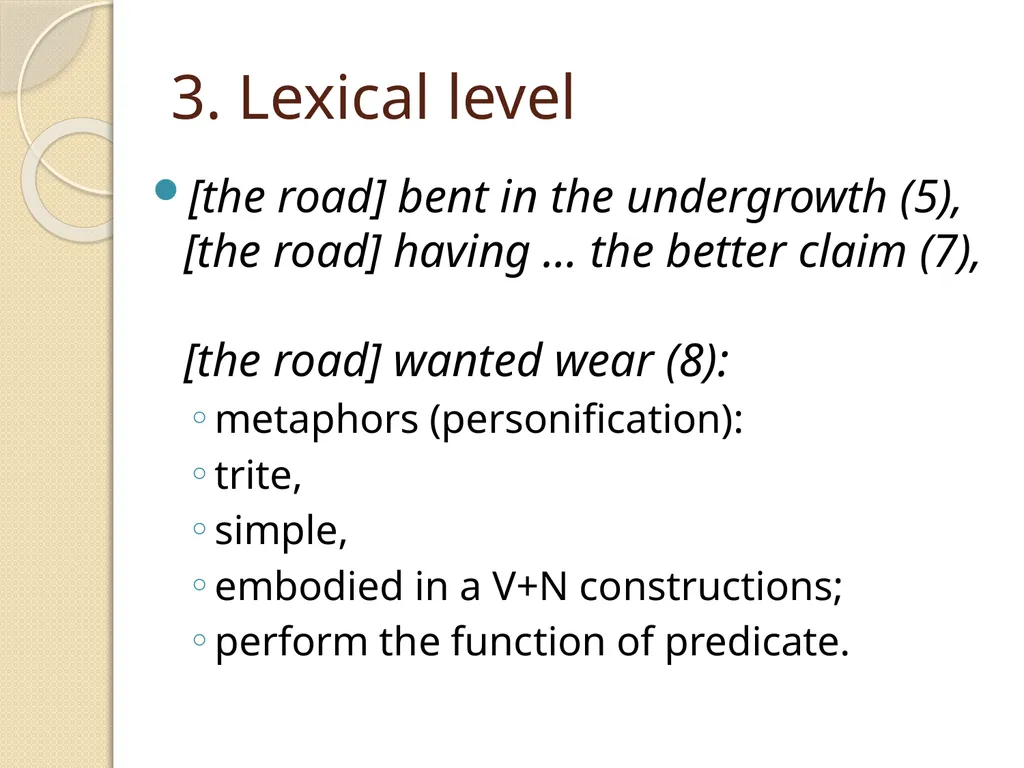
3. Lexical level [the road] bent in the undergrowth (5),�[the road] having … the better claim (7), �[the road] wanted wear (8):
metaphors (personification):
trite,
simple,
embodied in a V+N constructions;
perform the function of predicate.<br>
19
no step had trodden black (12):
metonymy
based on the relations between the object (here regarded as a kind of an instrument) and the process; + agent > result of action
fresh;
expressed by a N; by a V+Adj;
performs the function of the subject of the sentence; predicate.<br>
20
Morphemic repetition The lexical repetition of the words with the same root morpheme travel:
serves as a means of cohesion:
being repeated at the beginning of the poem and at the end of it, it unites the stanzas into a coherent whole
travel (2), traveller (3) and travelled (19).<br>
21
Lexical markers of poetic style If there are words that belong to poetic style (lofty, bookish) – or to colloquial, or… – point it out.
Lexical markers of poetic style:
had trodden (12), hence (17).<br>
22
4. Syntactical level Inversion:
sorry I could not travel both (2)
be one traveler, long I stood (3),
- the occurrence of AM in the preposition:
to create emphasis,
to foreground the logical meaning �of the word.<br>
23
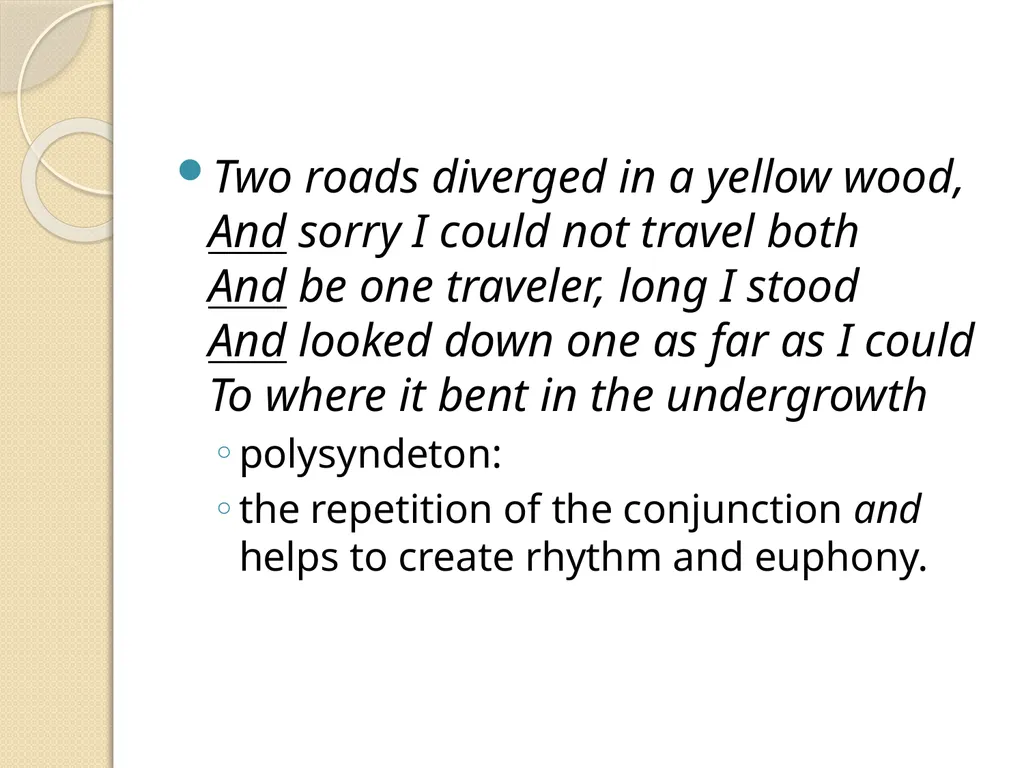
Two roads diverged in a yellow wood,�And sorry I could not travel both�And be one traveler, long I stood�And looked down one as far as I could�To where it bent in the undergrowth
polysyndeton:
the repetition of the conjunction and helps to create rhythm and euphony.<br>