“Growing South Africa together for a capable and
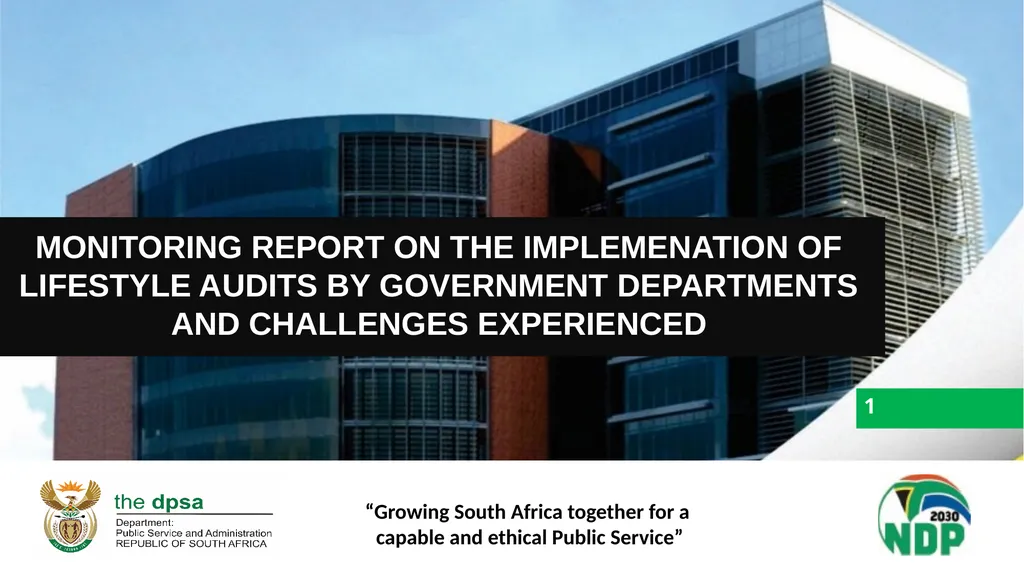
Description: Growing South Africa together for a capable and ethical Public Service 1 MONITORING REPORT ON THE IMPLEMENATION OF LIFESTYLE AUDITS BY GOVERNMENT DEPARTMENTS AND CHALLENGES EXPERIENCED Aim of presentation To provide the Portfolio
Related Topics
Download Presentation
"“Growing South Africa together for a capable and" is the property of its rightful owner. Permission is granted to download and print the materials on this website for personal, non-commercial use only, and to display it on your personal computer provided you do not modify the materials and that you retain all copyright notices contained in the materials. By downloading content from our website, you accept the terms of this agreement.
Presentation Transcript
slide1. “Growing South Africa together for a
capable and ethical Public Service” 1 MONITORING REPORT ON THE IMPLEMENATION OF LIFESTYLE AUDITS BY GOVERNMENT DEPARTMENTS AND CHALLENGES EXPERIENCED<br>
slide2. Aim of presentation To provide the Portfolio Committee with an overview of the monitoring report on the implementation of lifestyle audits by government departments and challenges experienced.<br>
slide3. Overview of presentation Background
Introduction
Implementation support
Feedback on 2022/2023 FY
Findings on 2022/2023 FY
Challenges
Way forward
Conclusion<br>
slide4. Background On 1 April 2021 it became compulsory for government departments to conduct lifestyle audits.
A Guide to implement lifestyle audits in the Public Service that outlines the process to implement lifestyle audits was adopted and shared with departments in 2021.
Extensive awareness were raised, including the hosting of a Lifestyle Audit Indaba in 2021, and with various different types of training interventions performed by the Public Administration Ethics, Integrity and Disciplinary technical Assistance Unit (PAEIDTAU).
To monitor implementation, the DPSA in November 2022 issued a circular, In 2021 the DPSA issued a circular to all government departments, requesting them to report to the DPSA by end of January 2023 on lifestyle audits conducted for the 2022/2023 period.<br>
slide5. Background Lifestyle audits are a decentralized process – each department conducts their lifestyle audits based on the risks identified, as per Regulation 22 of the Public Service Regulations, 2016.
The PAEIDTAU is mandated ito the Public Administration Management Act, 2014 (PAMA), Section 15 (4)(a) and 15(4)(d) to:
provide technical assistance and support to institutions in all spheres of government strengthen government oversight of ethics, integrity and discipline, and where necessary, in cases where systemic weaknesses are identified, to intervene.<br>
slide6. Background Lifestyle Reviews: First step of the process, where ethics officers conduct lifestyle reviews by verifying information submitted onto the eDisclosure system.
This is verified against information of the Deeds office (DPSA pays for the data), the eNatis system and CIPC system. This information is integrated into the eDisclosure system, with all ethics officers having direct access. Once a year, the DPSA updates the information.
Ethics Officers also consults internal records, such as gifts registers, the Central Supplier Database, register for employees performing other remunerative work, etc.
If unexplained wealth of conflict of interests are detected, a file is forwarded to the investigator to perform an investigation. If nothing is found, the lifestyle audit process are closed.<br>
slide7. Background Lifestyle Investigations: Departmental investigators investigate cases that is referred by the Ethics Office. When criminality is detected, a criminal case is opened and the Directorate for Priority Crime Investigations is notified.
Lifestyle Audit: When a case is extremely complex, the services of an auditor is served to do an audit. This must be cost effective.<br>
slide8. Implementation support All implementation support interventions were synchronised with the prescribed disclosure periods: April 2022 for SMS and June/July 2022 for the other categories (Levels 9 and 10) (see Public Service Regulations).
Training and awareness sessions:
03 August 2022: Limpopo Office of the Premier
10 August 2022: Gauteng Office of the Premier
16 August 2022: Eastern Cape Department of Sports, Recreation, Arts and Culture
24 August 2022: Western Cape Department of the Premier invited PAEIDTAU to provide implementation support on the implementation of lifestyle audits to various provincial departments in the Western Cape.<br>
slide9. Implementation support 21 September 2022: Western Cape Provincial government
28 September 2022: During Public Service month all the Justice Crime Prevention and Security (JCPS) Cluster departments were invited and then trained on how to implement the Guide on lifestyle audits.
03 October 2022: Limpopo Department Transport and Community Safety
11 November 2022: National Government Communication Information System
15-16 November 2022: Department of Employment and Labour (UIF)
27 January 2023: Mpumalanga Department of Public Works, Roads and Transport<br>
slide10. Implementation support Specialist training interventions on Risk-based verification (Lifestyle Review), developed by the World Bank and United Nations Office on Drugs and Crime (UNODC) were held to capacitate Ethics Officers:
08 and 09 June 2022: Security Cluster departments were trained namely:
South African Police Service, Independent Police Investigative Directorate, Civilian Secretariat of Police, Correctional Service, Home Affairs, Military Veterans, South African National Defence Force, National Prosecuting Authority, Justice and Constitutional Development, Office of the Chief Justice, Office of Public Service Commission, Government Printing Works, Government Pensions Administration Agency<br>
slide11. Implementation support On 22 and 23 June 2022: Social Cluster departments were trained namely:
Digital Communications, Government Communication Information System, Public Enterprises, Social Development, Water and Sanitation, Statistics South Africa, Transport, National School of Government, Basic Education, Higher Education, Science and Innovation, Tourism, Small Business Development
On 27 and 28 June 2022: Governance Cluster departments were trained namely:
Public Service and Administration, Planning Monitoring and Evaluation, Cooperative Governance, Traditional Affairs, Agriculture Land Reform and Rural Development, Human Settlements, Public Works, National Treasury, Government Technical Advisory, Sports, Arts and Culture, Trade Industry and Competition, Health<br>
slide12. Feedback on 2022/2023 FY As at the end of January 2023, the following feedback was received:
A total of 24 National Departments (27 National Departments previously) and 71 departments in the nine provinces (only 47 previously) provided feedback.<br>
slide13. Feedback on 2022/2023 FY The following National Departments provided feedback:
Basic Education, Communications and Digital Technologies, Cooperative Governance, Employment and Labour, Government Communication and Information System, Government Pensions Administration Agency, Human Settlements, International Relations and Cooperation, Mineral Resources and Energy, Municipal Infrastructure Agency, National School of Government, Office of the public Service Commission, Planning Monitoring and Evaluation, Public Enterprises, Public Service and Administration, Science and Innovation, Small Business Development, South African Police Service, Sport Arts and Culture, Statistics South Africa, Tourism, Trade Industry and Competition, Traditional Affairs, Water and Sanitation.<br>
slide14. Feedback on 2022/2023 FY The following National Departments did not comply as at the end of January 2023:
Agriculture, Land Reform and Rural Development; Civilian Secretariat for Police; Correctional Services; Defence; Forestry, Fisheries and the Environment; Health; Higher Education and Training; Home Affairs; Independent Police Investigative Directorate; Justice and Constitutional Development; Military Veterans; National Treasury; Presidency; Public Works and Infrastructure; Social Development; Transport; and Women, Youth and Persons with Disabilities.<br>
slide15. Feedback on 2022/2023 FY The following Provincial Departments did not comply as at the end of January 2023:
Eastern Cape: Economic Development, Environmental Affairs and Tourism; Health, Human Settlements; Education, Rural Development and Agrarian Reform, Provincial Treasury; Sports, Recreation, Arts and Culture; and Transport.
Free State: Economic, Small Business Development, Tourism and Environmental Affairs; Health, Human Settlements, Police, Roads and Transport, Provincial Treasury and Social Development.
Gauteng: Health, Education and Youth Development; Infrastructure Development & Property Management; Cooperative Governance and Traditional Affairs.
The Department of Social Development indicated that it will use the services of the Special Investigative Unit (SIU) to conduct lifestyle audits. Quarterly progress reports will be submitted to the DPSA.<br>
slide16. Feedback on 2022/2023 FY The following Provincial Departments did not comply as at the end of January 2023:
Limpopo: Office of the Premier; Economic Development, Environment and Tourism, Health, Transport and Community Safety, Social Development, Cooperative Governance and Traditional Affairs and Sports, Arts and Culture.
Mpumalanga: Agriculture, Rural Development, Land and Environmental Affairs, Cooperative Governance and Traditional Affairs; Culture, Sports and Recreation and Finance.
North West: Education and Community Safety and Transport Management.<br>
slide17. Feedback on 2022/2023 FY The following Provincial Departments did not comply as at the end of January 2023:
Northern Cape: The Director-General of the Northern Cape Provincial Government informed the DPSA that they have outsourced the services of South African law enforcement agencies to conduct lifestyle audits in the provincial government.
The provincial government is currently drafting legal arrangements with the law enforcement agencies and will provide quarterly reports to the DPSA.
Only one department in the Northern Cape that indicated that it conducted lifestyle audits was the Department of Cooperative Governance and Traditional Affairs.<br>
slide18. Feedback on 2022/2023 FY Provincial Governments with 100% compliance:
KwaZulu-Natal Provincial Government; and
Western Cape Provincial Government.<br>
slide19. Findings on 2022/2023 FY The provincial departments have shown a huge improvement in the implementation of lifestyle audit when compared to the previous period.
Referred investigations:
Western Cape Agriculture, Gauteng Transport and Logistics, North West Health, Statistics South Africa, Government Pension Administration Agency, KwaZulu-Natal Health, Free State Cooperative Governance and Traditional Affairs, Gauteng Office of the Premier, Western Cape Health and Wellness have reported that they are busy with investigations on some of the officials.
The DPSA will be informed of the outcomes thereof.<br>
slide20. Challenges Ethics Officers, key role-players for lifestyle audits, are designated and not appointed. Result: Ethics management is an over and above function and in some departments they are rotated annually, making capacity building difficult.
Some departments rotate their Ethics Officers yearly, making training and implementation support from the side of PAEIDTAU difficult.
Ethics Officers identified a lack of knowledge to determine when an employee is living beyond his or her means - PAEIDTAU has rolled out formal training on the Risk-based verification of financial disclosures to address this challenge.<br>
slide21. Way forward The priority for PAEIDTAU is to stabilise the cohort of Ethics Officers. In the next financial year, the focus of PAEIDTAU will be to assist with the professionalization of Ethics Officers, amongst other to adopt a Directive on the functions of the Ethics Officer.
PAEIDTAU is assisted by the Strengthening Ethics and Integrity Project (Canadian Government support) in developing training material for Investigators on lifestyle investigations. An electronic platform (Moodle) was procured to quickly assist the role-players and to upload training material.
PAEIDTAU received funding to improve the eDisclosure system so that it will automatically detect unexplained wealth. This will assist Ethics Officers and strengthen oversight of the PAEIDTAU.<br>
slide22. Way forward The SIU will be formally approached to perform lifestyle audits on those departments who did not perform lifestyle audits since 01 April 2021.
The Department of Planning, Monitoring and Evaluation is contemplating including the conducting of lifestyle audits in the performance agreements of accounting officers.
PAEIDTAU has started to support the implementation of lifestyle audits in the local sphere of government.<br>
slide23. Conclusion The Unit will continue to provide support to national and provincial departments as part of improving skills of Ethics Officers as well as ensuring that the process becomes institutionalized in the public service.<br>
slide24. THANK YOU<br>
capable and ethical Public Service” 1 MONITORING REPORT ON THE IMPLEMENATION OF LIFESTYLE AUDITS BY GOVERNMENT DEPARTMENTS AND CHALLENGES EXPERIENCED<br>
slide2. Aim of presentation To provide the Portfolio Committee with an overview of the monitoring report on the implementation of lifestyle audits by government departments and challenges experienced.<br>
slide3. Overview of presentation Background
Introduction
Implementation support
Feedback on 2022/2023 FY
Findings on 2022/2023 FY
Challenges
Way forward
Conclusion<br>
slide4. Background On 1 April 2021 it became compulsory for government departments to conduct lifestyle audits.
A Guide to implement lifestyle audits in the Public Service that outlines the process to implement lifestyle audits was adopted and shared with departments in 2021.
Extensive awareness were raised, including the hosting of a Lifestyle Audit Indaba in 2021, and with various different types of training interventions performed by the Public Administration Ethics, Integrity and Disciplinary technical Assistance Unit (PAEIDTAU).
To monitor implementation, the DPSA in November 2022 issued a circular, In 2021 the DPSA issued a circular to all government departments, requesting them to report to the DPSA by end of January 2023 on lifestyle audits conducted for the 2022/2023 period.<br>
slide5. Background Lifestyle audits are a decentralized process – each department conducts their lifestyle audits based on the risks identified, as per Regulation 22 of the Public Service Regulations, 2016.
The PAEIDTAU is mandated ito the Public Administration Management Act, 2014 (PAMA), Section 15 (4)(a) and 15(4)(d) to:
provide technical assistance and support to institutions in all spheres of government strengthen government oversight of ethics, integrity and discipline, and where necessary, in cases where systemic weaknesses are identified, to intervene.<br>
slide6. Background Lifestyle Reviews: First step of the process, where ethics officers conduct lifestyle reviews by verifying information submitted onto the eDisclosure system.
This is verified against information of the Deeds office (DPSA pays for the data), the eNatis system and CIPC system. This information is integrated into the eDisclosure system, with all ethics officers having direct access. Once a year, the DPSA updates the information.
Ethics Officers also consults internal records, such as gifts registers, the Central Supplier Database, register for employees performing other remunerative work, etc.
If unexplained wealth of conflict of interests are detected, a file is forwarded to the investigator to perform an investigation. If nothing is found, the lifestyle audit process are closed.<br>
slide7. Background Lifestyle Investigations: Departmental investigators investigate cases that is referred by the Ethics Office. When criminality is detected, a criminal case is opened and the Directorate for Priority Crime Investigations is notified.
Lifestyle Audit: When a case is extremely complex, the services of an auditor is served to do an audit. This must be cost effective.<br>
slide8. Implementation support All implementation support interventions were synchronised with the prescribed disclosure periods: April 2022 for SMS and June/July 2022 for the other categories (Levels 9 and 10) (see Public Service Regulations).
Training and awareness sessions:
03 August 2022: Limpopo Office of the Premier
10 August 2022: Gauteng Office of the Premier
16 August 2022: Eastern Cape Department of Sports, Recreation, Arts and Culture
24 August 2022: Western Cape Department of the Premier invited PAEIDTAU to provide implementation support on the implementation of lifestyle audits to various provincial departments in the Western Cape.<br>
slide9. Implementation support 21 September 2022: Western Cape Provincial government
28 September 2022: During Public Service month all the Justice Crime Prevention and Security (JCPS) Cluster departments were invited and then trained on how to implement the Guide on lifestyle audits.
03 October 2022: Limpopo Department Transport and Community Safety
11 November 2022: National Government Communication Information System
15-16 November 2022: Department of Employment and Labour (UIF)
27 January 2023: Mpumalanga Department of Public Works, Roads and Transport<br>
slide10. Implementation support Specialist training interventions on Risk-based verification (Lifestyle Review), developed by the World Bank and United Nations Office on Drugs and Crime (UNODC) were held to capacitate Ethics Officers:
08 and 09 June 2022: Security Cluster departments were trained namely:
South African Police Service, Independent Police Investigative Directorate, Civilian Secretariat of Police, Correctional Service, Home Affairs, Military Veterans, South African National Defence Force, National Prosecuting Authority, Justice and Constitutional Development, Office of the Chief Justice, Office of Public Service Commission, Government Printing Works, Government Pensions Administration Agency<br>
slide11. Implementation support On 22 and 23 June 2022: Social Cluster departments were trained namely:
Digital Communications, Government Communication Information System, Public Enterprises, Social Development, Water and Sanitation, Statistics South Africa, Transport, National School of Government, Basic Education, Higher Education, Science and Innovation, Tourism, Small Business Development
On 27 and 28 June 2022: Governance Cluster departments were trained namely:
Public Service and Administration, Planning Monitoring and Evaluation, Cooperative Governance, Traditional Affairs, Agriculture Land Reform and Rural Development, Human Settlements, Public Works, National Treasury, Government Technical Advisory, Sports, Arts and Culture, Trade Industry and Competition, Health<br>
slide12. Feedback on 2022/2023 FY As at the end of January 2023, the following feedback was received:
A total of 24 National Departments (27 National Departments previously) and 71 departments in the nine provinces (only 47 previously) provided feedback.<br>
slide13. Feedback on 2022/2023 FY The following National Departments provided feedback:
Basic Education, Communications and Digital Technologies, Cooperative Governance, Employment and Labour, Government Communication and Information System, Government Pensions Administration Agency, Human Settlements, International Relations and Cooperation, Mineral Resources and Energy, Municipal Infrastructure Agency, National School of Government, Office of the public Service Commission, Planning Monitoring and Evaluation, Public Enterprises, Public Service and Administration, Science and Innovation, Small Business Development, South African Police Service, Sport Arts and Culture, Statistics South Africa, Tourism, Trade Industry and Competition, Traditional Affairs, Water and Sanitation.<br>
slide14. Feedback on 2022/2023 FY The following National Departments did not comply as at the end of January 2023:
Agriculture, Land Reform and Rural Development; Civilian Secretariat for Police; Correctional Services; Defence; Forestry, Fisheries and the Environment; Health; Higher Education and Training; Home Affairs; Independent Police Investigative Directorate; Justice and Constitutional Development; Military Veterans; National Treasury; Presidency; Public Works and Infrastructure; Social Development; Transport; and Women, Youth and Persons with Disabilities.<br>
slide15. Feedback on 2022/2023 FY The following Provincial Departments did not comply as at the end of January 2023:
Eastern Cape: Economic Development, Environmental Affairs and Tourism; Health, Human Settlements; Education, Rural Development and Agrarian Reform, Provincial Treasury; Sports, Recreation, Arts and Culture; and Transport.
Free State: Economic, Small Business Development, Tourism and Environmental Affairs; Health, Human Settlements, Police, Roads and Transport, Provincial Treasury and Social Development.
Gauteng: Health, Education and Youth Development; Infrastructure Development & Property Management; Cooperative Governance and Traditional Affairs.
The Department of Social Development indicated that it will use the services of the Special Investigative Unit (SIU) to conduct lifestyle audits. Quarterly progress reports will be submitted to the DPSA.<br>
slide16. Feedback on 2022/2023 FY The following Provincial Departments did not comply as at the end of January 2023:
Limpopo: Office of the Premier; Economic Development, Environment and Tourism, Health, Transport and Community Safety, Social Development, Cooperative Governance and Traditional Affairs and Sports, Arts and Culture.
Mpumalanga: Agriculture, Rural Development, Land and Environmental Affairs, Cooperative Governance and Traditional Affairs; Culture, Sports and Recreation and Finance.
North West: Education and Community Safety and Transport Management.<br>
slide17. Feedback on 2022/2023 FY The following Provincial Departments did not comply as at the end of January 2023:
Northern Cape: The Director-General of the Northern Cape Provincial Government informed the DPSA that they have outsourced the services of South African law enforcement agencies to conduct lifestyle audits in the provincial government.
The provincial government is currently drafting legal arrangements with the law enforcement agencies and will provide quarterly reports to the DPSA.
Only one department in the Northern Cape that indicated that it conducted lifestyle audits was the Department of Cooperative Governance and Traditional Affairs.<br>
slide18. Feedback on 2022/2023 FY Provincial Governments with 100% compliance:
KwaZulu-Natal Provincial Government; and
Western Cape Provincial Government.<br>
slide19. Findings on 2022/2023 FY The provincial departments have shown a huge improvement in the implementation of lifestyle audit when compared to the previous period.
Referred investigations:
Western Cape Agriculture, Gauteng Transport and Logistics, North West Health, Statistics South Africa, Government Pension Administration Agency, KwaZulu-Natal Health, Free State Cooperative Governance and Traditional Affairs, Gauteng Office of the Premier, Western Cape Health and Wellness have reported that they are busy with investigations on some of the officials.
The DPSA will be informed of the outcomes thereof.<br>
slide20. Challenges Ethics Officers, key role-players for lifestyle audits, are designated and not appointed. Result: Ethics management is an over and above function and in some departments they are rotated annually, making capacity building difficult.
Some departments rotate their Ethics Officers yearly, making training and implementation support from the side of PAEIDTAU difficult.
Ethics Officers identified a lack of knowledge to determine when an employee is living beyond his or her means - PAEIDTAU has rolled out formal training on the Risk-based verification of financial disclosures to address this challenge.<br>
slide21. Way forward The priority for PAEIDTAU is to stabilise the cohort of Ethics Officers. In the next financial year, the focus of PAEIDTAU will be to assist with the professionalization of Ethics Officers, amongst other to adopt a Directive on the functions of the Ethics Officer.
PAEIDTAU is assisted by the Strengthening Ethics and Integrity Project (Canadian Government support) in developing training material for Investigators on lifestyle investigations. An electronic platform (Moodle) was procured to quickly assist the role-players and to upload training material.
PAEIDTAU received funding to improve the eDisclosure system so that it will automatically detect unexplained wealth. This will assist Ethics Officers and strengthen oversight of the PAEIDTAU.<br>
slide22. Way forward The SIU will be formally approached to perform lifestyle audits on those departments who did not perform lifestyle audits since 01 April 2021.
The Department of Planning, Monitoring and Evaluation is contemplating including the conducting of lifestyle audits in the performance agreements of accounting officers.
PAEIDTAU has started to support the implementation of lifestyle audits in the local sphere of government.<br>
slide23. Conclusion The Unit will continue to provide support to national and provincial departments as part of improving skills of Ethics Officers as well as ensuring that the process becomes institutionalized in the public service.<br>
slide24. THANK YOU<br>