Gymnastics is:- a sport that includes exercises requiring balance, strength, flexibility, agility, coordination, and endurance. Apparatus: Any one of the pieces of equipment used in gymnastics competition, The movements involved in
"Gymnastics is:- a sport that includes exercises" is the property of its rightful owner. Permission is granted to
download and print the materials on this website for personal, non-commercial use only, and to display it
on your personal computer provided you do not modify the materials and that you retain all copyright
notices contained in the materials. By downloading content from our website, you accept the terms of this
agreement.
Presentation Transcript
01
Gymnastics is:-
a sport that includes exercises requiring balance, strength, flexibility, agility, coordination, and endurance.
Apparatus: Any one of the pieces of equipment used in gymnastics competition,
The movements involved in gymnastics contribute to the development of the arms, legs, shoulders, back, chest, and abdominal muscle groups<br>
02
Alertness, precision, daring, self-confidence, and self-discipline are mental traits that can also be developed through gymnastics Gymnastics evolved from exercises used by the ancient Greeks that included skills for mounting and dismounting a horse and from circus performance skills
The most common form of competitive gymnastics is artistic gymnastics, which consists of<br>
03
the vaulting table,
uneven bars,
balance beam,
the horizontal bars,
parallel bars,
the pommel horse and
still rings<br>
04
Gymnastics was introduced in early Greek civilization to facilitate bodily development through a series of exercises that included
running,
jumping,
swimming,
throwing,
wrestling, and
weight lifting.<br>
05
Modern Gymnastics
In 1774, a Prussian, Johann Bernhard Basedow, included physical exercises with other forms of instruction at his school in Dessau, Saxony.
In the late 1700s, Friedrich Ludwig Jahn of Germany developed the side bar, the horizontal bar, the parallel bars, the balance beam, and jumping events. is considered the "father of modern gymnastics."<br>
06
Artistic events for women
Vault
Uneven bars
Balance beam
Floor
Artistic events for men
Floor
Pommel horse
Still rings
Vault
Parallel bars
Horizontal bar<br>
07
The Federation of International Gymnastics (FIG) was founded in Liege in 1881
The governing body for gymnastics through out the world.
Eight sports are governed by the FIG, which include:-<br>
08
Gymnastics for All,
Men's and Women’s Artistic Gymnastics,
Rhythmic Gymnastics,
Trampoline (including Double Mini-trampoline),
Tumbling,
Aerobics,
Acrobatics, and Parkour<br>
09
Artistic gymnastics
The most popular and widely-practised form,
artistic gymnastics is divided into women’s and men’s gymnastics. Women compete on four events:
The sport consists mainly of the use of various gymnastic apparatus, as well as the use of the floor for different exercises.
Vault<br>
10
In the vaulting events, gymnasts sprint down a 25 metres (82 ft) runway,
jump onto a springboard (or perform a roundoff or handspring entry onto a springboard),
land momentarily inverted on the hands on the vaulting horse or vaulting table (pre-flight segment),
then propel themselves forward or backward off that platform to a two-footed landing (post-flight segment).
Every gymnast starts at a different point on the vault runway depending on their height and strength.<br>
11
Gymnast on uneven bars
On the uneven bars, the gymnast performs a timed routine on two parallel horizontal bars set at different heights<br>
12
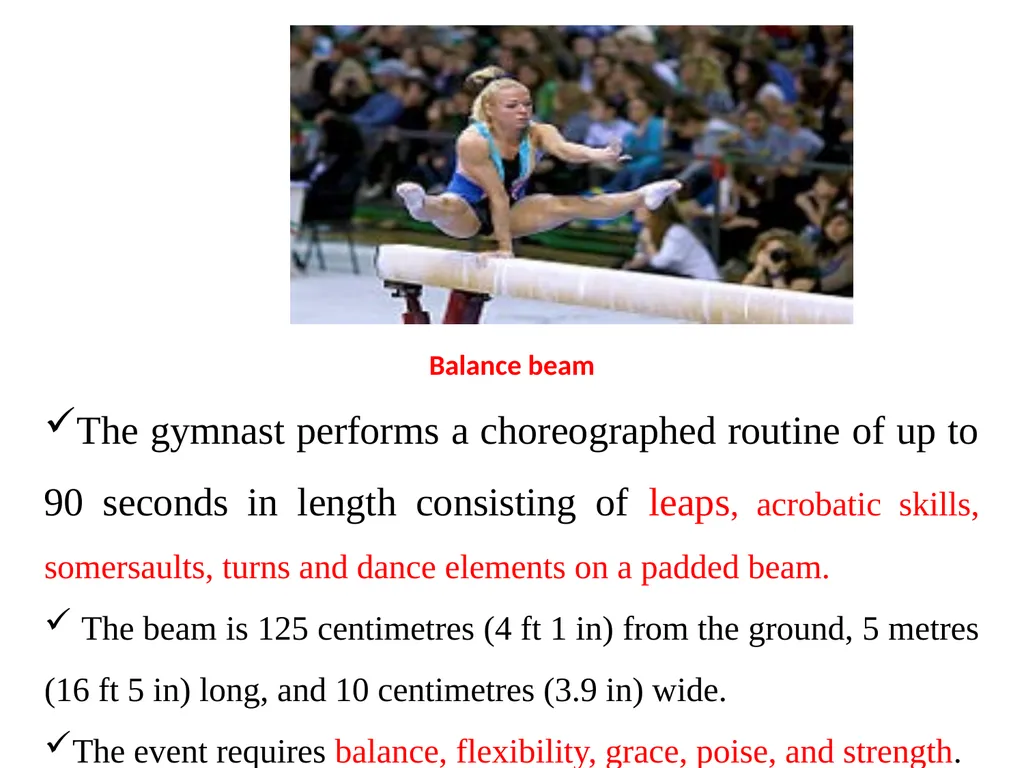
Balance beam
The gymnast performs a choreographed routine of up to 90 seconds in length consisting of leaps, acrobatic skills, somersaults, turns and dance elements on a padded beam.
The beam is 125 centimetres (4 ft 1 in) from the ground, 5 metres (16 ft 5 in) long, and 10 centimetres (3.9 in) wide.
The event requires balance, flexibility, grace, poise, and strength.<br>
13
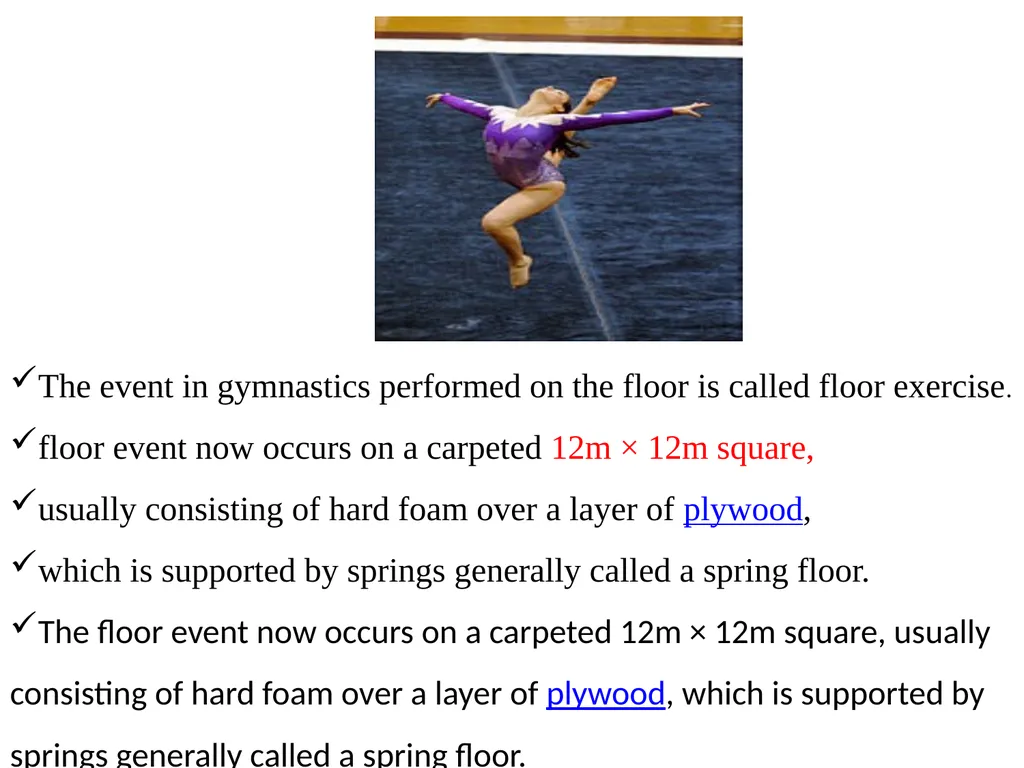
The event in gymnastics performed on the floor is called floor exercise.
floor event now occurs on a carpeted 12m × 12m square,
usually consisting of hard foam over a layer of plywood,
which is supported by springs generally called a spring floor.
The floor event now occurs on a carpeted 12m × 12m square, usually consisting of hard foam over a layer of plywood, which is supported by springs generally called a spring floor.<br>