GYMNOSPERM: AN INTRODUCTION By PRATIVA DEKA Associate Professor Dept. of Botany Mangaldai College GYMNOSPERM : INTRODUCTION Gymnosperms are a group of plants which produced seeds that are not enclosed within the fruit. The term gymnosperm
"GYMNOSPERM: AN INTRODUCTION By PRATIVA DEKA" is the property of its rightful owner. Permission is granted to
download and print the materials on this website for personal, non-commercial use only, and to display it
on your personal computer provided you do not modify the materials and that you retain all copyright
notices contained in the materials. By downloading content from our website, you accept the terms of this
agreement.
Presentation Transcript
01
GYMNOSPERM:
AN INTRODUCTION
By
PRATIVA DEKA
Associate Professor
Dept. of Botany
Mangaldai College<br>
02
GYMNOSPERM : INTRODUCTION Gymnosperms are a group of plants which produced seeds that are not enclosed within the fruit.
The term “gymnosperm” derived from two Greek words gymnos means naked and sperma means seed.
The word “gymnosperm” was first used by Theophrastus in 300 B.C. in his book “Enquiry into Pants”.
The seed plants Spermatophyta or Phanerogams are grouped into two major groups on the basis of protection afforded to the ovule before and after fertilization, viz. Gymnosperms and Angiosperms.
The ovules of gymnosperms freely exposed before and after fertilization.
They are not enclosed by ovary, hench fruits are absent in gymnosperms.<br>
03
CHARACTERISTICS OF GYMNOSPERMS Plants are sporophytic. True roots. stems and leaves are present. Majority are tall woody, perennial and evergreen plants, rarely shrubs.
Plants are heterosporous. Microspore produces male gametophytes and megaspore produces female gametophytes.
Vascular bundles in stem are conjoint, collateral and open. Vessels are absent except order Gnetales. Companion cells are altogether absent. Secondary growth present.
Leaves are of two types (dimorphic). Brown scale leaves and green foliage leaves.
Flowers are unisexual, simple, reduced naked ie. Without perianth. (true flowers absent)<br>
04
CHARACTERISTICS OF GYMNOSPERMS Male flowers are known as microspophylls and female flowers known as megasporophylls. Generally micro and megasporophylls are aggregated into cones or strobilli.
Megasporangia i.e. ovules are directly borne on the megasporophylls, so that ovules remains uncovered i.e. not enclosed within the ovary.
Ovule is generally orthotropous, unitegmic with three layers.
Pollination takes place by wind (anemophily). At the time of pollination pollen grains are directly carried by wind to the micropyle of the ovule.
Gametophytes are much smaller, reduced but more conspicuous than angiosperms.<br>
05
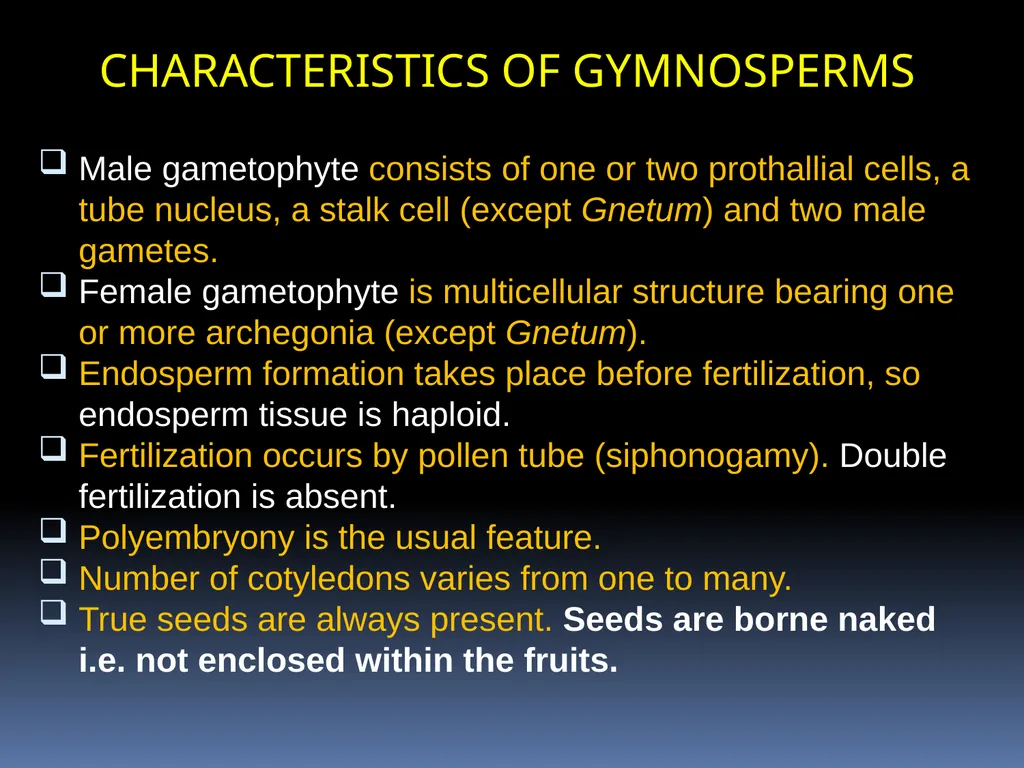
CHARACTERISTICS OF GYMNOSPERMS Male gametophyte consists of one or two prothallial cells, a tube nucleus, a stalk cell (except Gnetum) and two male gametes.
Female gametophyte is multicellular structure bearing one or more archegonia (except Gnetum).
Endosperm formation takes place before fertilization, so endosperm tissue is haploid.
Fertilization occurs by pollen tube (siphonogamy). Double fertilization is absent.
Polyembryony is the usual feature.
Number of cotyledons varies from one to many.
True seeds are always present. Seeds are borne naked i.e. not enclosed within the fruits.<br>