
Gynecologic Emergencies CHAPTER 23 Introduction
AM
Published · 80 slides · 0 views
1 / 1

Description
Gynecologic Emergencies CHAPTER 23 Introduction Gynecology Deals with diseases and routine care of female reproductive system Female Reproductive System (1 of 7) Jones Bartlett Learning. Female Reproductive System (2 of 7) Ovaries These
Related Topics
Share
Embed code
Download this presentation From Below
"Gynecologic Emergencies CHAPTER 23 Introduction" is the property of its rightful owner. Permission is granted to download and print the materials on this website for personal, non-commercial use only, and to display it on your personal computer provided you do not modify the materials and that you retain all copyright notices contained in the materials. By downloading content from our website, you accept the terms of this agreement.
Presentation Transcript
01
Gynecologic Emergencies CHAPTER 23<br>
02
Introduction Gynecology
Deals with diseases and routine care of female reproductive system<br>
Deals with diseases and routine care of female reproductive system<br>
03
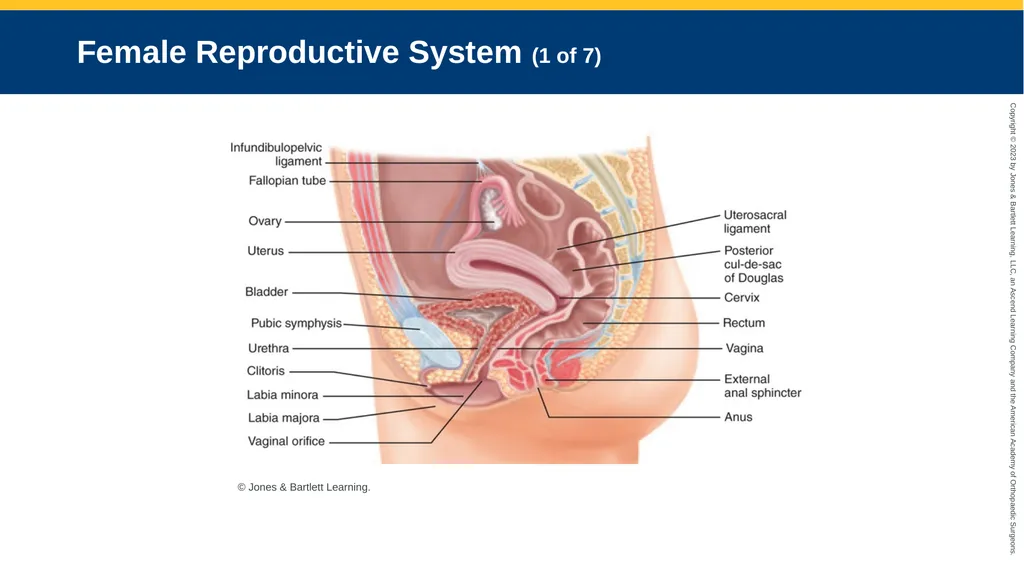
Female Reproductive System (1 of 7) © Jones & Bartlett Learning.<br>
04
Female Reproductive System (2 of 7) Ovaries
These are a pair of organs that release eggs, or ova, and reproductive hormones.
The egg travels down the adjacent fallopian tube into the uterus.<br>
These are a pair of organs that release eggs, or ova, and reproductive hormones.
The egg travels down the adjacent fallopian tube into the uterus.<br>
05
Female Reproductive System (3 of 7) Uterus
A pear-shaped organ where the embryo, or fertilized egg, implants and grows
Upper, convex portion is the fundus and has an internal uterine cavity.
The uterine wall consists of myometrium and endometrium.<br>
A pear-shaped organ where the embryo, or fertilized egg, implants and grows
Upper, convex portion is the fundus and has an internal uterine cavity.
The uterine wall consists of myometrium and endometrium.<br>
06
Female Reproductive System (4 of 7) Uterus (cont’d)
The neck of the uterus (cervix) inserts into the vagina.
The lower part of the uterus, cervix, and vagina are referred to as the birth canal.
Perineum is the tissue between the vaginal opening and the anus.<br>
The neck of the uterus (cervix) inserts into the vagina.
The lower part of the uterus, cervix, and vagina are referred to as the birth canal.
Perineum is the tissue between the vaginal opening and the anus.<br>
07
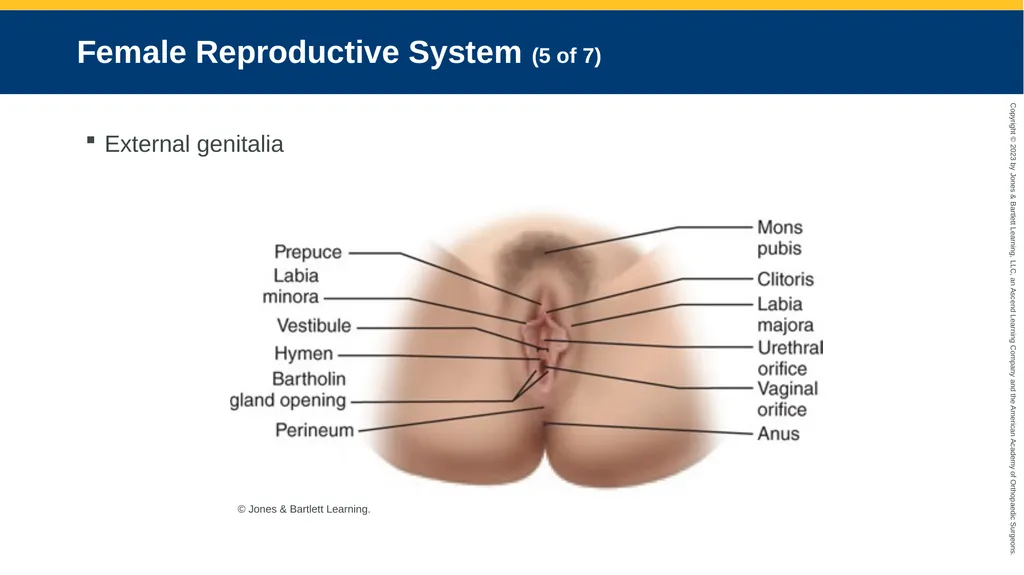
Female Reproductive System (5 of 7) External genitalia © Jones & Bartlett Learning.<br>
08
Female Reproductive System (6 of 7) Hymen
Protects vaginal orifice
May break before first intercourse
Pain and vaginal bleeding when it breaks<br>
Protects vaginal orifice
May break before first intercourse
Pain and vaginal bleeding when it breaks<br>
09
Female Reproductive System (7 of 7) Imperforate hymen
The hymen completely covers the vaginal orifice.
May lead to complications such as:
Blockage of menses
Endometriosis
Acute pain
This can be caused by childhood sexual abuse.<br>
The hymen completely covers the vaginal orifice.
May lead to complications such as:
Blockage of menses
Endometriosis
Acute pain
This can be caused by childhood sexual abuse.<br>
10
Menstruation (1 of 5) Menstruation
The normal discharge of blood, epithelial cells, mucus, and tissue
Menarche is the onset of the first menses.
Menopause is the cessation of ovarian function and menstrual cycle.<br>
The normal discharge of blood, epithelial cells, mucus, and tissue
Menarche is the onset of the first menses.
Menopause is the cessation of ovarian function and menstrual cycle.<br>
11
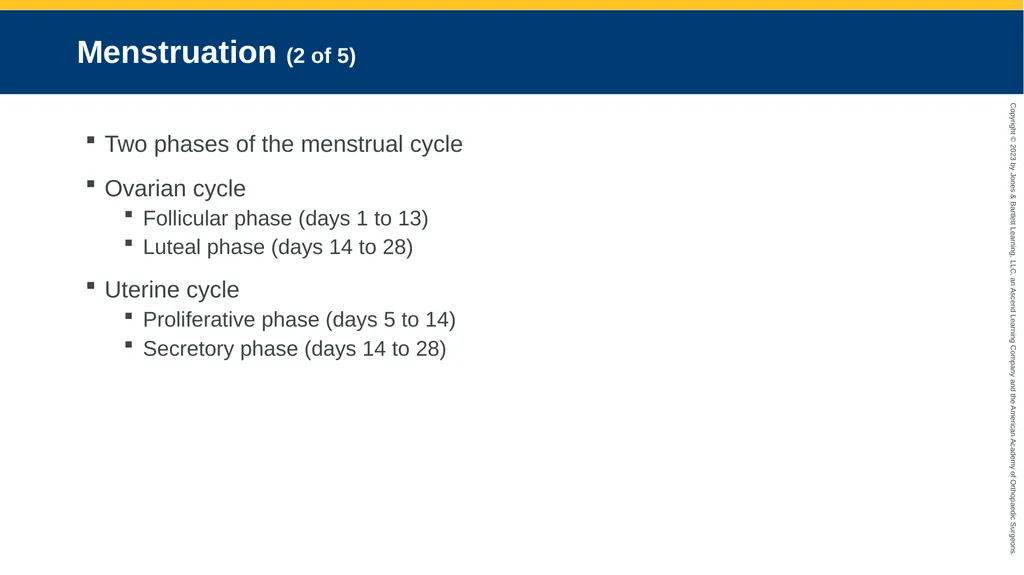
Menstruation (2 of 5) Two phases of the menstrual cycle
Ovarian cycle
Follicular phase (days 1 to 13)
Luteal phase (days 14 to 28)
Uterine cycle
Proliferative phase (days 5 to 14)
Secretory phase (days 14 to 28)<br>
Ovarian cycle
Follicular phase (days 1 to 13)
Luteal phase (days 14 to 28)
Uterine cycle
Proliferative phase (days 5 to 14)
Secretory phase (days 14 to 28)<br>
12
Menstruation (3 of 5) Ovulation occurs when an ovum, or egg, is released from an ovarian follicle.
It usually occurs 14 days after the start of the previous menstrual period.
If the ovum is not fertilized, menstruation ensues.
Menstruation lasts 4 to 6 days, with blood loss of 25 to 65 mL.<br>
It usually occurs 14 days after the start of the previous menstrual period.
If the ovum is not fertilized, menstruation ensues.
Menstruation lasts 4 to 6 days, with blood loss of 25 to 65 mL.<br>
13
Menstruation (4 of 5) Mittelschmerz
Abdominal pain and cramping in the middle of the cycle
Usually not severe
Signs and symptoms
Sharp, cramping pain in lower abdomen
Localized to one side
Beginning midcycle, history of similar episodes
Often relieved by OTC analgesics<br>
Abdominal pain and cramping in the middle of the cycle
Usually not severe
Signs and symptoms
Sharp, cramping pain in lower abdomen
Localized to one side
Beginning midcycle, history of similar episodes
Often relieved by OTC analgesics<br>
14
Menstruation (5 of 5) Amenorrhea is the absence or cessation of menses.
Amenorrhea may occur due to:
Pregnancy (most common cause)
Exercise
Drop of body fat
Emotional problems or extreme stress
Anorexia nervosa<br>
Amenorrhea may occur due to:
Pregnancy (most common cause)
Exercise
Drop of body fat
Emotional problems or extreme stress
Anorexia nervosa<br>
15
Patient Assessment (1 of 2) Gynecologic emergencies are usually associated with one or more of the following signs or symptoms:
Vaginal bleeding
Abdominal pain or tenderness
Vomiting
Fever
Tachycardia
Hypotension<br>
Vaginal bleeding
Abdominal pain or tenderness
Vomiting
Fever
Tachycardia
Hypotension<br>
16
Patient Assessment (2 of 2) Gynecologic emergencies signs or symptoms (cont’d):
Diaphoresis
Syncope
Changes in stool pattern
Dyspareunia (pain during intercourse)
Urinary symptoms<br>
Diaphoresis
Syncope
Changes in stool pattern
Dyspareunia (pain during intercourse)
Urinary symptoms<br>
17
Scene Size-up Gynecologic emergencies can involve blood and body fluids.
You may be required to testify in court regarding scene conditions.<br>
You may be required to testify in court regarding scene conditions.<br>
18
Primary Survey Assess ABCDEs and manage life threats.
Provide pain management and fluid resuscitation as needed.
Do not pack dressings inside vagina.
Note amount, color, and type of discharge or bleeding.
Transport to the hospital.<br>
Provide pain management and fluid resuscitation as needed.
Do not pack dressings inside vagina.
Note amount, color, and type of discharge or bleeding.
Transport to the hospital.<br>
19
History Taking (1 of 4) History should include chief complaint and associated symptoms.
If vaginal bleeding has occurred, try to quantify amount in:
Pads per hour
Comparison with patient’s normal menstrual period<br>
If vaginal bleeding has occurred, try to quantify amount in:
Pads per hour
Comparison with patient’s normal menstrual period<br>
20
History Taking (2 of 4) Ask about:
Date of the last normal menstrual period
Regularity of menstrual cycles
Whether a current pregnancy exists
Number of previous pregnancies
Number of pregnancies that lasted to term
Number of miscarriages or abortions<br>
Date of the last normal menstrual period
Regularity of menstrual cycles
Whether a current pregnancy exists
Number of previous pregnancies
Number of pregnancies that lasted to term
Number of miscarriages or abortions<br>
21
History Taking (3 of 4) Ask about (cont’d):
History of prior gynecologic problems or surgeries
Current sexual activity
Type of birth control
History of sexually transmitted infections (STIs)<br>
History of prior gynecologic problems or surgeries
Current sexual activity
Type of birth control
History of sexually transmitted infections (STIs)<br>
22
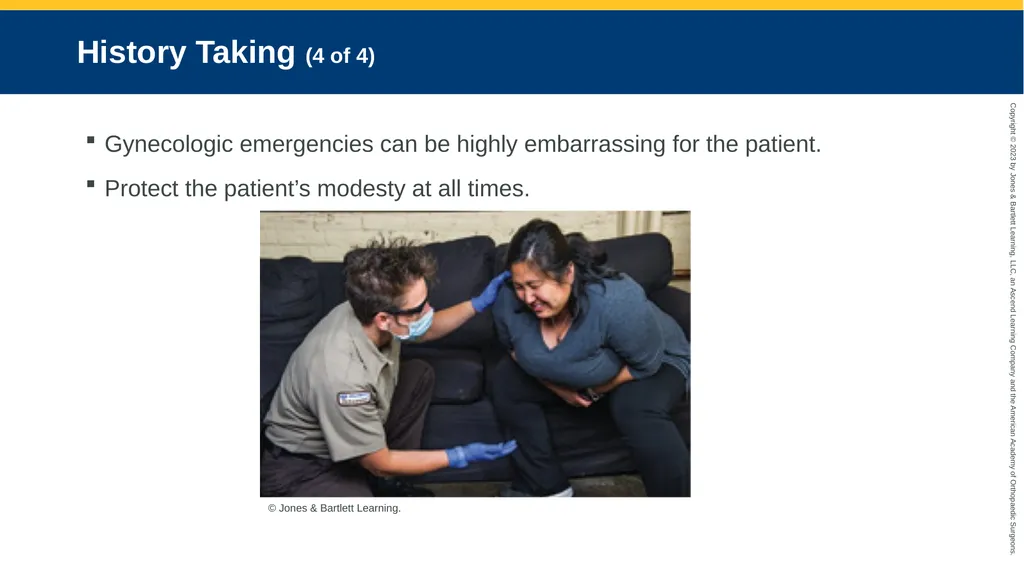
History Taking (4 of 4) Gynecologic emergencies can be highly embarrassing for the patient.
Protect the patient’s modesty at all times. © Jones & Bartlett Learning.<br>
Protect the patient’s modesty at all times. © Jones & Bartlett Learning.<br>
23
Secondary Assessment (1 of 4) When possible, the paramedic should be the same gender as the patient.
Limit the crowd to personnel required to perform the necessary tasks.
Show the patient respect by advocating for her modesty.<br>
Limit the crowd to personnel required to perform the necessary tasks.
Show the patient respect by advocating for her modesty.<br>
24
Secondary Assessment (2 of 4) Examine the patient’s abdomen for:
Bruising, which could indicate possible abuse
Evidence of needle tracks from illicit drug use
A positive Cullen sign or Grey-Turner sign<br>
Bruising, which could indicate possible abuse
Evidence of needle tracks from illicit drug use
A positive Cullen sign or Grey-Turner sign<br>
25
Secondary Assessment (3 of 4) Palpate the abdomen.
Start at the quadrant farthest from the pain.
Rigid abdomen?
Point tenderness?
Does the palpation elicit more pain?
Rebound tenderness?
Masses?<br>
Start at the quadrant farthest from the pain.
Rigid abdomen?
Point tenderness?
Does the palpation elicit more pain?
Rebound tenderness?
Masses?<br>
26
Secondary Assessment (4 of 4) Determine vital signs.
Blood pressure
Normal, low, or elevated
Orthostatic changes<br>
Blood pressure
Normal, low, or elevated
Orthostatic changes<br>
27
Reassessment En route to the hospital:
Recheck your interventions.
Obtain serial vitals.
Pay attention to the needs of your patient.<br>
Recheck your interventions.
Obtain serial vitals.
Pay attention to the needs of your patient.<br>
28
Emergency Medical Care Management is directed at:
Mitigating life threats
Assessing and supplying oxygen, obtaining vital signs, and following local protocols
Providing transport
Protecting the patient’s modesty and providing emotional care<br>
Mitigating life threats
Assessing and supplying oxygen, obtaining vital signs, and following local protocols
Providing transport
Protecting the patient’s modesty and providing emotional care<br>
29
Management of Gynecologic Trauma The female genital area is highly vascular.
Bleeding may be profuse.
Exsanguinating vaginal hemorrhage must be treated as any exsanguinating hemorrhage.<br>
Bleeding may be profuse.
Exsanguinating vaginal hemorrhage must be treated as any exsanguinating hemorrhage.<br>
30
Pelvic Inflammatory Disease (PID) (1 of 5) PID is an infection of a woman’s reproductive organs.
Although PID is often a complication of an STI, it can occur with other infections.<br>
Although PID is often a complication of an STI, it can occur with other infections.<br>
31
Pelvic Inflammatory Disease (PID) (2 of 5) Disease process
Disease-causing organisms enter the vagina and migrate into the uterine cavity.
Infection may expand to the fallopian tubes.
Purulent fluid drips out of the tube and onto the ovary and surrounding tissue.
Peritonitis may develop, and pelvic abscesses may form.<br>
Disease-causing organisms enter the vagina and migrate into the uterine cavity.
Infection may expand to the fallopian tubes.
Purulent fluid drips out of the tube and onto the ovary and surrounding tissue.
Peritonitis may develop, and pelvic abscesses may form.<br>
32
Pelvic Inflammatory Disease (PID) (3 of 5) Symptoms
Pain starts during or after menstruation, diffuse across quadrants of the lower abdomen.
Associated symptoms include:
Vaginal discharge
Fever and chills
Pain or burning on urination (dysuria)<br>
Pain starts during or after menstruation, diffuse across quadrants of the lower abdomen.
Associated symptoms include:
Vaginal discharge
Fever and chills
Pain or burning on urination (dysuria)<br>
33
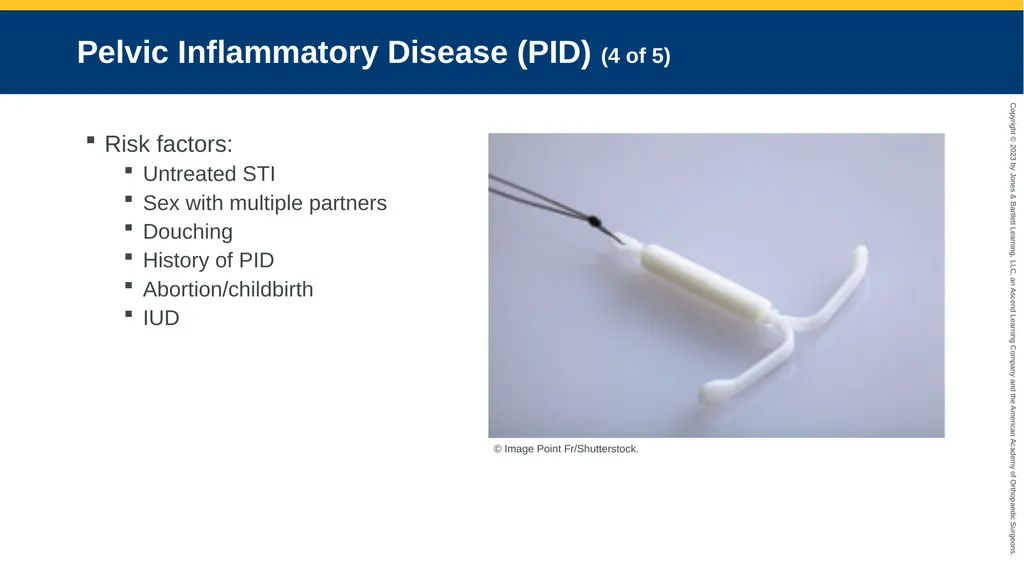
Pelvic Inflammatory Disease (PID) (4 of 5) Risk factors:
Untreated STI
Sex with multiple partners
Douching
History of PID
Abortion/childbirth
IUD © Image Point Fr/Shutterstock.<br>
Untreated STI
Sex with multiple partners
Douching
History of PID
Abortion/childbirth
IUD © Image Point Fr/Shutterstock.<br>
34
Pelvic Inflammatory Disease (PID) (5 of 5) Management
PID generally requires antibiotics.
Prehospital care is supportive.<br>
PID generally requires antibiotics.
Prehospital care is supportive.<br>
35
Bartholin Abscess (1 of 2) Two small ducts just inside the lower vagina lead to the Bartholin glands.
A cyst may form if one of the ducts becomes blocked, causing the duct and gland to swell.
A Bartholin abscess can develop if the cyst or gland itself becomes infected.
A Bartholin cyst is usually small.<br>
A cyst may form if one of the ducts becomes blocked, causing the duct and gland to swell.
A Bartholin abscess can develop if the cyst or gland itself becomes infected.
A Bartholin cyst is usually small.<br>
36
Bartholin Abscess (2 of 2) Large or infected cyst can cause:
Vulvar pain
A painful lump
Painful intercourse
If a cyst is infected or an abscess is present, a physician will need to create a surgical incision to drain the infected gland.<br>
Vulvar pain
A painful lump
Painful intercourse
If a cyst is infected or an abscess is present, a physician will need to create a surgical incision to drain the infected gland.<br>
37
Vaginitis (1 of 6) Inflammation of the vagina caused by an infection
Can spread upward to the cervix, uterus, fallopian tubes, and ovaries to cause PID<br>
Can spread upward to the cervix, uterus, fallopian tubes, and ovaries to cause PID<br>
38
Vaginitis (2 of 6) Common symptoms of vaginitis:
Itching
Irritation
Discharge
Odor
Painful intercourse
Lower abdominal pain
Vaginal foreign bodies may predispose women to vaginitis.<br>
Itching
Irritation
Discharge
Odor
Painful intercourse
Lower abdominal pain
Vaginal foreign bodies may predispose women to vaginitis.<br>
39
Vaginitis (3 of 6) Vaginal yeast infection is a type of vaginitis.
Typically caused by Candida albicans fungus.
Normal acidic environment of the vagina helps keep yeast from growing.
Yeast population may increase and result in infection if the vagina becomes less acidic.<br>
Typically caused by Candida albicans fungus.
Normal acidic environment of the vagina helps keep yeast from growing.
Yeast population may increase and result in infection if the vagina becomes less acidic.<br>
40
Vaginitis (4 of 6) Symptoms of vaginal yeast infections:
Itching
Burning
Soreness in the vagina and around the vulva
Vulvar swelling
Possibly a thick, white vaginal discharge
Pain during sexual intercourse
Burning on urination<br>
Itching
Burning
Soreness in the vagina and around the vulva
Vulvar swelling
Possibly a thick, white vaginal discharge
Pain during sexual intercourse
Burning on urination<br>
41
Vaginitis (5 of 6) Vulvovaginitis
Inflammation of the external vulva.
Patients should be evaluated by a physician.
Symptoms of vulvovaginitis:
Redness, pain, swelling, discharge, burning, itching<br>
Inflammation of the external vulva.
Patients should be evaluated by a physician.
Symptoms of vulvovaginitis:
Redness, pain, swelling, discharge, burning, itching<br>
42
Vaginitis (6 of 6) If not treated, vaginitis can lead to:
Infertility
Preterm birth
Endometritis
PID
Increased risk for STIs
Treatment is antibiotics.
Prehospital management is supportive.<br>
Infertility
Preterm birth
Endometritis
PID
Increased risk for STIs
Treatment is antibiotics.
Prehospital management is supportive.<br>
43
Cystitis (1 of 2) Usually caused by bacteria that ascend from the perineum through the genital tract into the urethral opening.
Infection is isolated in the bladder.
Patients often present with suprapubic pain, cloudy urine, urinary frequency, hematuria, and dysuria.<br>
Infection is isolated in the bladder.
Patients often present with suprapubic pain, cloudy urine, urinary frequency, hematuria, and dysuria.<br>
44
Cystitis (2 of 2) If untreated, cystitis may lead to pyelonephritis.
Pyelonephritis is an infection of the kidneys.
Treatment of cystitis and pyelonephritis includes antibiotics and pain relief.<br>
Pyelonephritis is an infection of the kidneys.
Treatment of cystitis and pyelonephritis includes antibiotics and pain relief.<br>
45
Ovarian Cyst (1 of 2) Fluid-filled sac on or within an ovary
Common, developing in both ruptured and unruptured ovarian follicles
Typically asymptomatic
May cause pelvic discomfort, urinary retention or urinary frequency, or menstrual irregularities<br>
Common, developing in both ruptured and unruptured ovarian follicles
Typically asymptomatic
May cause pelvic discomfort, urinary retention or urinary frequency, or menstrual irregularities<br>
46
Ovarian Cyst (2 of 2) Cyst may rupture spontaneously or after mild abdominal injury, intercourse, or exercise.
If rupture occurs:
Symptoms may be absent, mild, or severe.
Lower abdominal discomfort could occur and may radiate to the back.<br>
If rupture occurs:
Symptoms may be absent, mild, or severe.
Lower abdominal discomfort could occur and may radiate to the back.<br>
47
Ovarian Torsion (1 of 2) Twisting of the ovary such that its blood supply is interrupted
Must be considered if lower abdominal pain is severe or symptoms worsen
More common in patients with history of ovarian cysts
Surgical emergency and can lead to permanent damage to ovary<br>
Must be considered if lower abdominal pain is severe or symptoms worsen
More common in patients with history of ovarian cysts
Surgical emergency and can lead to permanent damage to ovary<br>
48
Ovarian Torsion (2 of 2) Acute onset of moderate to severe unilateral pain in lower abdomen that increases over a period of hours
Tender to palpation, often with a mass
Prehospital treatment for ovarian torsion or ruptured cyst: recognition, quick transport to ED, treatment of symptoms<br>
Tender to palpation, often with a mass
Prehospital treatment for ovarian torsion or ruptured cyst: recognition, quick transport to ED, treatment of symptoms<br>
49
Endometritis (1 of 3) Inflammation or irritation of the endometrium
Most common cause of infection after childbirth
Signs and symptoms usually occur within 36 hours<br>
Most common cause of infection after childbirth
Signs and symptoms usually occur within 36 hours<br>
50
Endometritis (2 of 3) Symptoms may include:
Fever
Chills
Vomiting
Tachycardia
Lower abdominal or pelvic pain
Cramping
Foul-smelling discharge<br>
Fever
Chills
Vomiting
Tachycardia
Lower abdominal or pelvic pain
Cramping
Foul-smelling discharge<br>
51
Endometritis (3 of 3) Management
Provide reassurance.
Transport in a comfortable position.
IV may be necessary.
Severe infection and sepsis may occur if untreated.<br>
Provide reassurance.
Transport in a comfortable position.
IV may be necessary.
Severe infection and sepsis may occur if untreated.<br>
52
Endometriosis (1 of 3) Pathophysiology
Endometrial tissue grows outside the uterus.
Many women do not recognize it until they encounter difficulties trying to get pregnant.<br>
Endometrial tissue grows outside the uterus.
Many women do not recognize it until they encounter difficulties trying to get pregnant.<br>
53
Endometriosis (2 of 3) The most common complaint is pain.
Other symptoms include:
Heavy or prolonged menstrual flow
Extremely painful menstrual cramping
Pain with intercourse
Sensations of rectal pressure or urgency
Fatigue
Bleeding between periods or premenstrual spotting<br>
Other symptoms include:
Heavy or prolonged menstrual flow
Extremely painful menstrual cramping
Pain with intercourse
Sensations of rectal pressure or urgency
Fatigue
Bleeding between periods or premenstrual spotting<br>
54
Endometriosis (3 of 3) Prehospital care is based on signs/symptoms.
If the patient reports severe pain:
Provide pain relief.
Position the patient comfortably.
Use dressing or towels as needed.<br>
If the patient reports severe pain:
Provide pain relief.
Position the patient comfortably.
Use dressing or towels as needed.<br>
55
Uterine Prolapse (1 of 4) Protrusion of part, or all, of the uterus outside the vagina
Occurs when fascia, muscles, tendons, and ligaments become weakened and can no longer hold the uterus in place<br>
Occurs when fascia, muscles, tendons, and ligaments become weakened and can no longer hold the uterus in place<br>
56
Uterine Prolapse (2 of 4) Predisposing factors
Genetics
Obesity
Weakening of pelvic support because of decreased estrogen
Increased intra-abdominal pressure related to pregnancy
Difficult childbirth<br>
Genetics
Obesity
Weakening of pelvic support because of decreased estrogen
Increased intra-abdominal pressure related to pregnancy
Difficult childbirth<br>
57
Uterine Prolapse (3 of 4) Patients often report:
Pelvic heaviness or fullness
Fatigue
Low back pain
Symptoms are worsened by prolonged standing and relieved by lying down.<br>
Pelvic heaviness or fullness
Fatigue
Low back pain
Symptoms are worsened by prolonged standing and relieved by lying down.<br>
58
Uterine Prolapse (4 of 4) Do not replace any tissue.
Cover with warm, moist dressings.
Transport patient to closest appropriate facility.<br>
Cover with warm, moist dressings.
Transport patient to closest appropriate facility.<br>
59
Vaginal Bleeding (1 of 11) Dysfunctional uterine bleeding
Uterine bleeding that is abnormal in amount or frequency (more than every 21 days)
Diagnosed after ruling out anatomic or systemic conditions such as medication therapy or disease
Occurs when the hormonal events responsible for the balance of the menstrual cycle are interrupted<br>
Uterine bleeding that is abnormal in amount or frequency (more than every 21 days)
Diagnosed after ruling out anatomic or systemic conditions such as medication therapy or disease
Occurs when the hormonal events responsible for the balance of the menstrual cycle are interrupted<br>
60
Vaginal Bleeding (2 of 11) Dysfunctional uterine bleeding (cont’d)
Risk factors include:
Extreme weight loss or gain
Age over 40 years
High stress levels
Polycystic ovary disease
Long-term medication use (eg, oral contraceptives)
Excessive exercise
Anatomic abnormalities such as uterine fibroids<br>
Risk factors include:
Extreme weight loss or gain
Age over 40 years
High stress levels
Polycystic ovary disease
Long-term medication use (eg, oral contraceptives)
Excessive exercise
Anatomic abnormalities such as uterine fibroids<br>
61
Vaginal Bleeding (3 of 11) Dysfunctional uterine bleeding (cont’d)
Hormone therapy or surgery
Supportive prehospital care<br>
Hormone therapy or surgery
Supportive prehospital care<br>
62
Vaginal Bleeding (4 of 11) Traumatic vaginal bleeding
Not uncommon after vigorous voluntary intercourse, although violent involuntary sexual activity should be considered
Other causes:
Straddle-type injury
Pelvic fracture
Direct blow to perineum
Foreign body inserted into vagina
Abortion attempts<br>
Not uncommon after vigorous voluntary intercourse, although violent involuntary sexual activity should be considered
Other causes:
Straddle-type injury
Pelvic fracture
Direct blow to perineum
Foreign body inserted into vagina
Abortion attempts<br>
63
Vaginal Bleeding (5 of 11) Traumatic vaginal bleeding (cont’d)
Complications include bleeding, organ rupture, and hypovolemic shock.
Treat the patient as you would any patient with potential for hemorrhagic shock.<br>
Complications include bleeding, organ rupture, and hypovolemic shock.
Treat the patient as you would any patient with potential for hemorrhagic shock.<br>
64
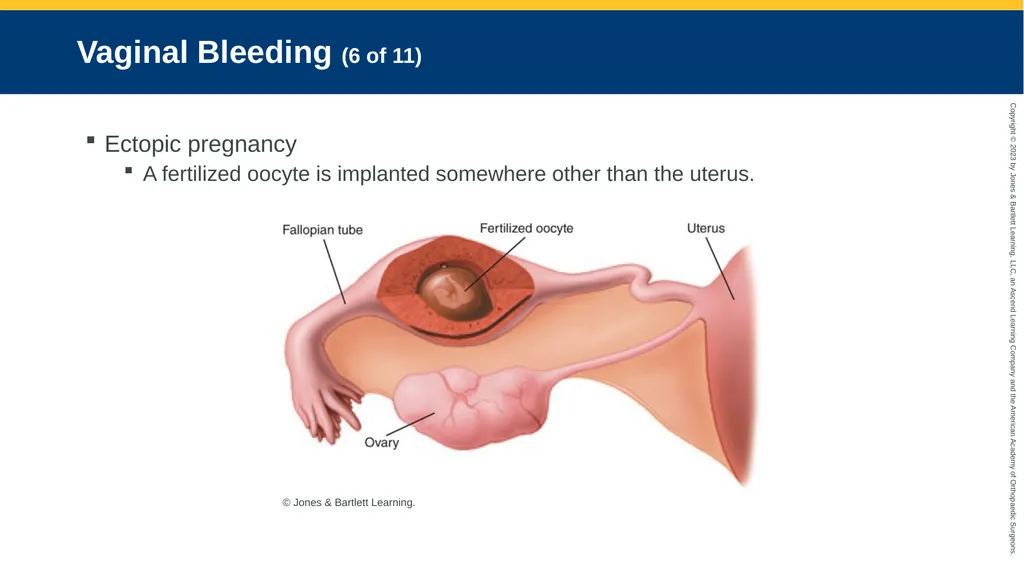
Vaginal Bleeding (6 of 11) Ectopic pregnancy
A fertilized oocyte is implanted somewhere other than the uterus. © Jones & Bartlett Learning.<br>
A fertilized oocyte is implanted somewhere other than the uterus. © Jones & Bartlett Learning.<br>
65
Vaginal Bleeding (7 of 11) Ectopic pregnancy (cont’d)
Life-threatening cause of vaginal bleeding in early pregnancy
Risk factors:
Previous surgical adhesions
Ectopic pregnancies
PID
Tubal ligation
IUD use<br>
Life-threatening cause of vaginal bleeding in early pregnancy
Risk factors:
Previous surgical adhesions
Ectopic pregnancies
PID
Tubal ligation
IUD use<br>
66
Vaginal Bleeding (8 of 11) Ectopic pregnancy (cont’d)
A fertilized oocyte stretches the tube as it grows.
Three signs of implantation in fallopian tubes include:
Abdominal pain
Delayed menses
Abnormal vaginal bleeding (spotting) 6 to 8 weeks after last normal menstrual period<br>
A fertilized oocyte stretches the tube as it grows.
Three signs of implantation in fallopian tubes include:
Abdominal pain
Delayed menses
Abnormal vaginal bleeding (spotting) 6 to 8 weeks after last normal menstrual period<br>
67
Vaginal Bleeding (9 of 11) Ectopic pregnancy (cont’d)
Most patients present with abdominal pain.
As the tube stretches, pain becomes colicky, then stabbing.
With rupture, pain becomes excruciating in the lower abdomen.
Referred pain to the shoulder is possible.<br>
Most patients present with abdominal pain.
As the tube stretches, pain becomes colicky, then stabbing.
With rupture, pain becomes excruciating in the lower abdomen.
Referred pain to the shoulder is possible.<br>
68
Vaginal Bleeding (10 of 11) Ectopic pregnancy (cont’d)
Management:
Ensure an adequate airway and administer oxygen.
Keep the patient left laterally recumbent.
Initiate IV fluid therapy with an 18-gauge IV line.
Anticipate vomiting.
Keep the patient warm.
Place the patient on a cardiac monitor.
Transport.<br>
Management:
Ensure an adequate airway and administer oxygen.
Keep the patient left laterally recumbent.
Initiate IV fluid therapy with an 18-gauge IV line.
Anticipate vomiting.
Keep the patient warm.
Place the patient on a cardiac monitor.
Transport.<br>
69
Vaginal Bleeding (11 of 11) Ectopic pregnancy (cont’d)
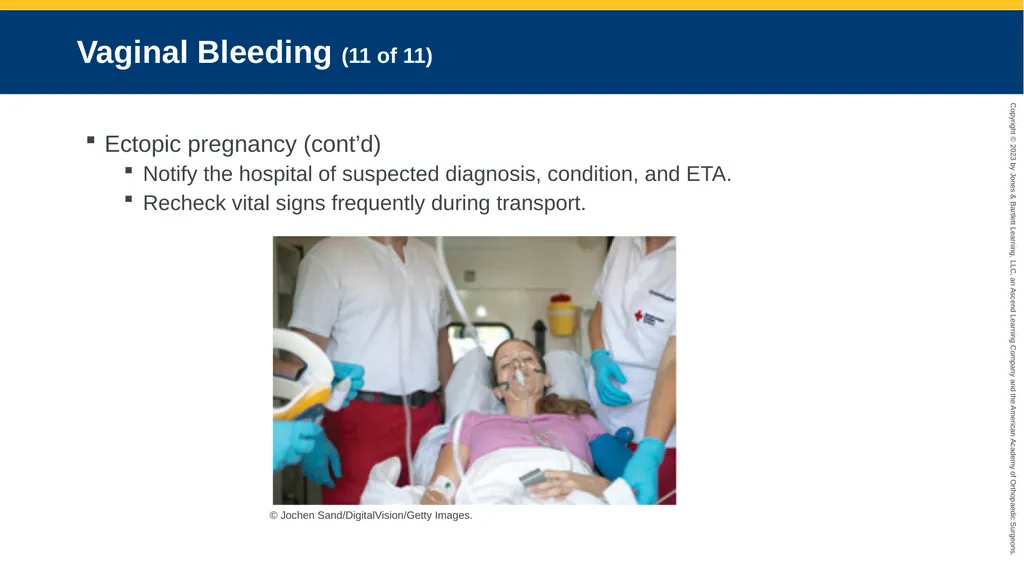
Notify the hospital of suspected diagnosis, condition, and ETA.
Recheck vital signs frequently during transport. © Jochen Sand/DigitalVision/Getty Images.<br>
Notify the hospital of suspected diagnosis, condition, and ETA.
Recheck vital signs frequently during transport. © Jochen Sand/DigitalVision/Getty Images.<br>
70
Sexual Assault (1 of 7) Any nonconsensual sexual act proscribed by federal, tribal, or state law, including when the victim lacks the capacity to consent
Rape: nonconsensual oral, anal, or vaginal penetration by body parts or objects using force or threats of bodily harm or by taking advantage of a victim who is incapable of giving consent<br>
Rape: nonconsensual oral, anal, or vaginal penetration by body parts or objects using force or threats of bodily harm or by taking advantage of a victim who is incapable of giving consent<br>
71
Sexual Assault (2 of 7) Being professional, respectful, and sensitive is very important.
Both men and women can be victims of sexual assault.
When possible, a female paramedic should treat a female victim.
Rape is a crime, and law enforcement involvement should be expected.<br>
Both men and women can be victims of sexual assault.
When possible, a female paramedic should treat a female victim.
Rape is a crime, and law enforcement involvement should be expected.<br>
72
Sexual Assault (3 of 7) Assessment
Ask patients if they would be more comfortable with a female or male paramedic.
Limit your examination to a brief survey.
Protect the patient’s privacy.
Examine and interview the patient with a minimum of people present.<br>
Ask patients if they would be more comfortable with a female or male paramedic.
Limit your examination to a brief survey.
Protect the patient’s privacy.
Examine and interview the patient with a minimum of people present.<br>
73
Sexual Assault (4 of 7) Assessment (cont’d)
Provide medical treatment and emotional care for the patient.
Recognize signs of date rape or club drugs.
If drugs are still in the patient’s system, you may see hypotension, bradycardia, difficulty breathing, seizures, coma, and even death.<br>
Provide medical treatment and emotional care for the patient.
Recognize signs of date rape or club drugs.
If drugs are still in the patient’s system, you may see hypotension, bradycardia, difficulty breathing, seizures, coma, and even death.<br>
74
Sexual Assault (5 of 7) Management
You have a responsibility to preserve evidence.
Discourage the patient from doing anything that will possibly destroy or contaminate any evidence.
Respect the patient’s feelings.
Offer to call the local rape crisis center.<br>
You have a responsibility to preserve evidence.
Discourage the patient from doing anything that will possibly destroy or contaminate any evidence.
Respect the patient’s feelings.
Offer to call the local rape crisis center.<br>
75
Sexual Assault (6 of 7) Management (cont’d)
Record the following observations:
The patient’s emotional state
The condition of her clothing
Any obvious injuries<br>
Record the following observations:
The patient’s emotional state
The condition of her clothing
Any obvious injuries<br>
76
Sexual Assault (7 of 7) Intimate partner violence
Physical, sexual, or psychological harm by a current or former partner or spouse
This can occur among heterosexual or same-sex couples and does not require sexual intimacy.
Your priority is safety—yours, your partner’s, and your patient’s.<br>
Physical, sexual, or psychological harm by a current or former partner or spouse
This can occur among heterosexual or same-sex couples and does not require sexual intimacy.
Your priority is safety—yours, your partner’s, and your patient’s.<br>
77
Sexual Practices and Vaginal Foreign Bodies (1 of 4) Foreign objects stuck in the vagina or anus
Keep the patient calm.
Protect their dignity.
Transport.
Do not attempt to remove any foreign object.
Do not let the patient walk.<br>
Keep the patient calm.
Protect their dignity.
Transport.
Do not attempt to remove any foreign object.
Do not let the patient walk.<br>
78
Sexual Practices and Vaginal Foreign Bodies (2 of 4) Possible assault
Fisting
Placing the closed fist and wrist into a body orifice for sexual stimulation
Organ rupture likely
Insertion of live animals into the vagina or anus<br>
Fisting
Placing the closed fist and wrist into a body orifice for sexual stimulation
Organ rupture likely
Insertion of live animals into the vagina or anus<br>
79
Sexual Practices and Vaginal Foreign Bodies (3 of 4) Assessment
Maintain your patient’s privacy.
Inspection of the genital area may be necessary.
Conduct a thorough patient assessment.<br>
Maintain your patient’s privacy.
Inspection of the genital area may be necessary.
Conduct a thorough patient assessment.<br>
80
Sexual Practices and Vaginal Foreign Bodies (4 of 4) Management
Treat the patient as you would with any foreign object.
Remain nonjudgmental.
Transport.
Do not attempt to retrieve the object.
Transport the patient with knees flexed and legs together.<br>
Treat the patient as you would with any foreign object.
Remain nonjudgmental.
Transport.
Do not attempt to retrieve the object.
Transport the patient with knees flexed and legs together.<br>