
H.C.Khincha & Co ISSUES IN SECTION 45(5A), 50C AND
MJ
Published · 278 slides · 0 views

1 / 1






























Description
H.C.Khincha Co ISSUES IN SECTION 45(5A), 50C AND 43CA Presentation by : CA. Naveen Khariwal G Chartered Accountant No. 40, 1st Floor, Laxmi Complex, K R Road, Near Bangalore Medical College Opp: Vani Vilas Hospital Bangalore - 560 002
Related Topics
Share
Embed code
Download this presentation From Below
"H.C.Khincha & Co ISSUES IN SECTION 45(5A), 50C AND" is the property of its rightful owner. Permission is granted to download and print the materials on this website for personal, non-commercial use only, and to display it on your personal computer provided you do not modify the materials and that you retain all copyright notices contained in the materials. By downloading content from our website, you accept the terms of this agreement.
Presentation Transcript
01
H.C.Khincha & Co ISSUES IN SECTION
45(5A), 50C AND 43CA Presentation by :
CA. Naveen Khariwal G
Chartered Accountant
No. 40, 1st Floor, Laxmi Complex,
K R Road, Near Bangalore Medical College
Opp: Vani Vilas Hospital
Bangalore - 560 002
naveenkhariwalg@gmail.com
Mob No : 9880683725<br>
CA. Naveen Khariwal G
Chartered Accountant
No. 40, 1st Floor, Laxmi Complex,
K R Road, Near Bangalore Medical College
Opp: Vani Vilas Hospital
Bangalore - 560 002
naveenkhariwalg@gmail.com
Mob No : 9880683725<br>
02
Legal Position uptill AY 2017-18
For JDAs entered into on or before 31-3-2017 :
Determination of the Taxable Event/Date of Transfer of Land by the landowner to the developer -
Capital Gains arise on "transfer" of a capital asset.
The Finance Act, 1987 introduced sub-clause (v) and (vi) to Section 2 (47) of the Act and brought into tax ambit, even deemed transfer which is otherwise not transfer under the general law. H.C.Khincha & Co<br>
For JDAs entered into on or before 31-3-2017 :
Determination of the Taxable Event/Date of Transfer of Land by the landowner to the developer -
Capital Gains arise on "transfer" of a capital asset.
The Finance Act, 1987 introduced sub-clause (v) and (vi) to Section 2 (47) of the Act and brought into tax ambit, even deemed transfer which is otherwise not transfer under the general law. H.C.Khincha & Co<br>
03
Sec. 2(47) "transfer", in relation to a capital asset, includes-
Sec. 2(47)(v)
any transaction involving the allowing of the possession of any immovable property to be taken or retained in part performance of a contract of the nature referred to in section 53A of the Transfer of Property Act, 1882 (4 of 1882) ; or
In other words, transfer includes any arrangement or transaction where any rights are handed over in execution of part performance of contract, even though the legal title has not been transferred. Thus by legislation by incorporation, transfer in part performance of contract as provided in Section 53A of the Transfer of Property Act was made applicable to transfer of capital asset for capital gains tax purposes. H.C.Khincha & Co<br>
Sec. 2(47)(v)
any transaction involving the allowing of the possession of any immovable property to be taken or retained in part performance of a contract of the nature referred to in section 53A of the Transfer of Property Act, 1882 (4 of 1882) ; or
In other words, transfer includes any arrangement or transaction where any rights are handed over in execution of part performance of contract, even though the legal title has not been transferred. Thus by legislation by incorporation, transfer in part performance of contract as provided in Section 53A of the Transfer of Property Act was made applicable to transfer of capital asset for capital gains tax purposes. H.C.Khincha & Co<br>
04
Sec. 2(47)(vi)
any transaction (whether by way of becoming a member of, or acquiring shares in, a co-operative society, company or other association of persons or by way of any agreement or any arrangement or in any other manner whatsoever) which has the effect of transferring, or enabling the enjoyment of, any immovable property.
Explanation 1- For the purposes of sub-clauses (v) and (vi), "immovable property" shall have the same meaning as in clause (d) of section 269UA.] H.C.Khincha & Co<br>
any transaction (whether by way of becoming a member of, or acquiring shares in, a co-operative society, company or other association of persons or by way of any agreement or any arrangement or in any other manner whatsoever) which has the effect of transferring, or enabling the enjoyment of, any immovable property.
Explanation 1- For the purposes of sub-clauses (v) and (vi), "immovable property" shall have the same meaning as in clause (d) of section 269UA.] H.C.Khincha & Co<br>
05
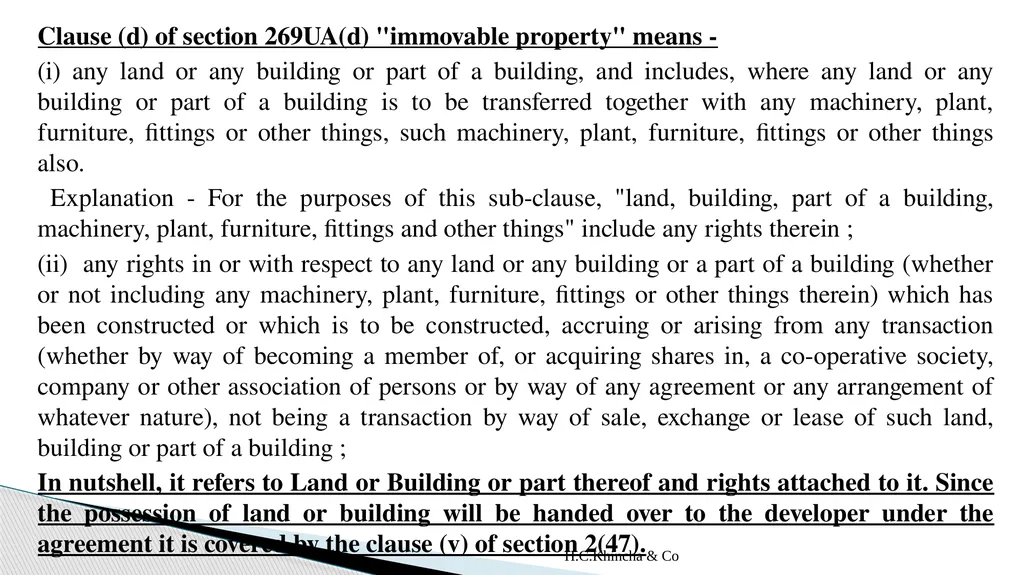
Clause (d) of section 269UA(d) "immovable property" means -
(i) any land or any building or part of a building, and includes, where any land or any building or part of a building is to be transferred together with any machinery, plant, furniture, fittings or other things, such machinery, plant, furniture, fittings or other things also.
Explanation - For the purposes of this sub-clause, "land, building, part of a building, machinery, plant, furniture, fittings and other things" include any rights therein ;
(ii) any rights in or with respect to any land or any building or a part of a building (whether or not including any machinery, plant, furniture, fittings or other things therein) which has been constructed or which is to be constructed, accruing or arising from any transaction (whether by way of becoming a member of, or acquiring shares in, a co-operative society, company or other association of persons or by way of any agreement or any arrangement of whatever nature), not being a transaction by way of sale, exchange or lease of such land, building or part of a building ;
In nutshell, it refers to Land or Building or part thereof and rights attached to it. Since the possession of land or building will be handed over to the developer under the agreement it is covered by the clause (v) of section 2(47). H.C.Khincha & Co<br>
(i) any land or any building or part of a building, and includes, where any land or any building or part of a building is to be transferred together with any machinery, plant, furniture, fittings or other things, such machinery, plant, furniture, fittings or other things also.
Explanation - For the purposes of this sub-clause, "land, building, part of a building, machinery, plant, furniture, fittings and other things" include any rights therein ;
(ii) any rights in or with respect to any land or any building or a part of a building (whether or not including any machinery, plant, furniture, fittings or other things therein) which has been constructed or which is to be constructed, accruing or arising from any transaction (whether by way of becoming a member of, or acquiring shares in, a co-operative society, company or other association of persons or by way of any agreement or any arrangement of whatever nature), not being a transaction by way of sale, exchange or lease of such land, building or part of a building ;
In nutshell, it refers to Land or Building or part thereof and rights attached to it. Since the possession of land or building will be handed over to the developer under the agreement it is covered by the clause (v) of section 2(47). H.C.Khincha & Co<br>
06
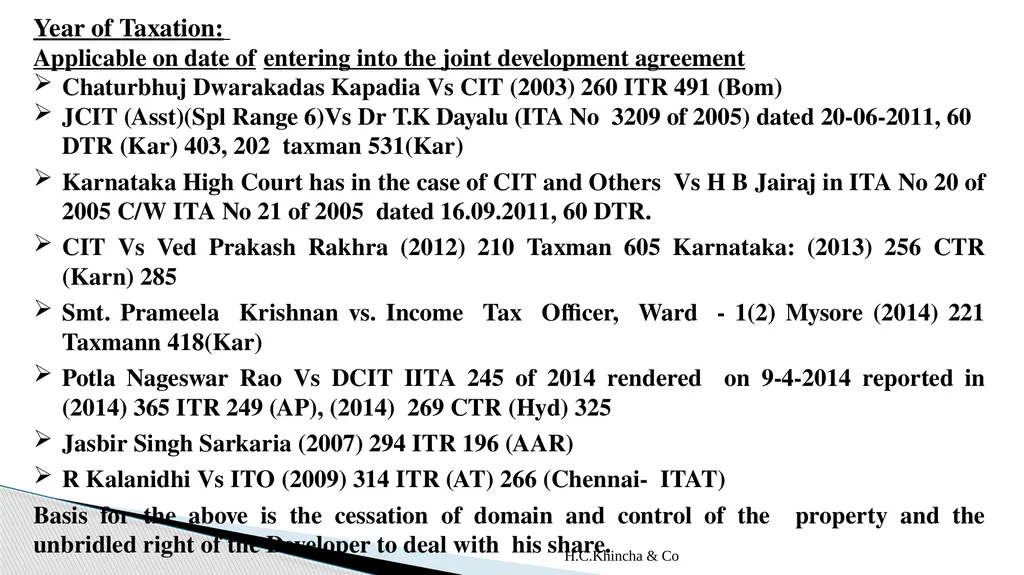
Year of Taxation:
Applicable on date of entering into the joint development agreement
Chaturbhuj Dwarakadas Kapadia Vs CIT (2003) 260 ITR 491 (Bom)
JCIT (Asst)(Spl Range 6)Vs Dr T.K Dayalu (ITA No 3209 of 2005) dated 20-06-2011, 60 DTR (Kar) 403, 202 taxman 531(Kar)
Karnataka High Court has in the case of CIT and Others Vs H B Jairaj in ITA No 20 of 2005 C/W ITA No 21 of 2005 dated 16.09.2011, 60 DTR.
CIT Vs Ved Prakash Rakhra (2012) 210 Taxman 605 Karnataka: (2013) 256 CTR (Karn) 285
Smt. Prameela Krishnan vs. Income Tax Officer, Ward - 1(2) Mysore (2014) 221 Taxmann 418(Kar)
Potla Nageswar Rao Vs DCIT IITA 245 of 2014 rendered on 9-4-2014 reported in (2014) 365 ITR 249 (AP), (2014) 269 CTR (Hyd) 325
Jasbir Singh Sarkaria (2007) 294 ITR 196 (AAR)
R Kalanidhi Vs ITO (2009) 314 ITR (AT) 266 (Chennai- ITAT)
Basis for the above is the cessation of domain and control of the property and the unbridled right of the Developer to deal with his share. H.C.Khincha & Co<br>
Applicable on date of entering into the joint development agreement
Chaturbhuj Dwarakadas Kapadia Vs CIT (2003) 260 ITR 491 (Bom)
JCIT (Asst)(Spl Range 6)Vs Dr T.K Dayalu (ITA No 3209 of 2005) dated 20-06-2011, 60 DTR (Kar) 403, 202 taxman 531(Kar)
Karnataka High Court has in the case of CIT and Others Vs H B Jairaj in ITA No 20 of 2005 C/W ITA No 21 of 2005 dated 16.09.2011, 60 DTR.
CIT Vs Ved Prakash Rakhra (2012) 210 Taxman 605 Karnataka: (2013) 256 CTR (Karn) 285
Smt. Prameela Krishnan vs. Income Tax Officer, Ward - 1(2) Mysore (2014) 221 Taxmann 418(Kar)
Potla Nageswar Rao Vs DCIT IITA 245 of 2014 rendered on 9-4-2014 reported in (2014) 365 ITR 249 (AP), (2014) 269 CTR (Hyd) 325
Jasbir Singh Sarkaria (2007) 294 ITR 196 (AAR)
R Kalanidhi Vs ITO (2009) 314 ITR (AT) 266 (Chennai- ITAT)
Basis for the above is the cessation of domain and control of the property and the unbridled right of the Developer to deal with his share. H.C.Khincha & Co<br>
07
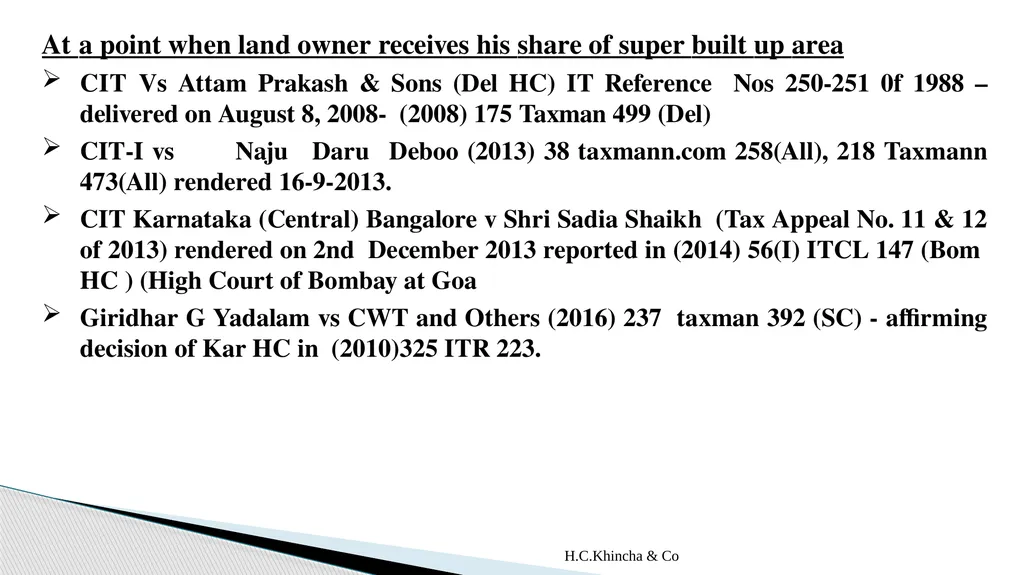
At a point when land owner receives his share of super built up area
CIT Vs Attam Prakash & Sons (Del HC) IT Reference Nos 250-251 0f 1988 – delivered on August 8, 2008- (2008) 175 Taxman 499 (Del)
CIT-I vs Naju Daru Deboo (2013) 38 taxmann.com 258(All), 218 Taxmann 473(All) rendered 16-9-2013.
CIT Karnataka (Central) Bangalore v Shri Sadia Shaikh (Tax Appeal No. 11 & 12 of 2013) rendered on 2nd December 2013 reported in (2014) 56(I) ITCL 147 (Bom HC ) (High Court of Bombay at Goa
Giridhar G Yadalam vs CWT and Others (2016) 237 taxman 392 (SC) - affirming decision of Kar HC in (2010)325 ITR 223. H.C.Khincha & Co<br>
CIT Vs Attam Prakash & Sons (Del HC) IT Reference Nos 250-251 0f 1988 – delivered on August 8, 2008- (2008) 175 Taxman 499 (Del)
CIT-I vs Naju Daru Deboo (2013) 38 taxmann.com 258(All), 218 Taxmann 473(All) rendered 16-9-2013.
CIT Karnataka (Central) Bangalore v Shri Sadia Shaikh (Tax Appeal No. 11 & 12 of 2013) rendered on 2nd December 2013 reported in (2014) 56(I) ITCL 147 (Bom HC ) (High Court of Bombay at Goa
Giridhar G Yadalam vs CWT and Others (2016) 237 taxman 392 (SC) - affirming decision of Kar HC in (2010)325 ITR 223. H.C.Khincha & Co<br>
08
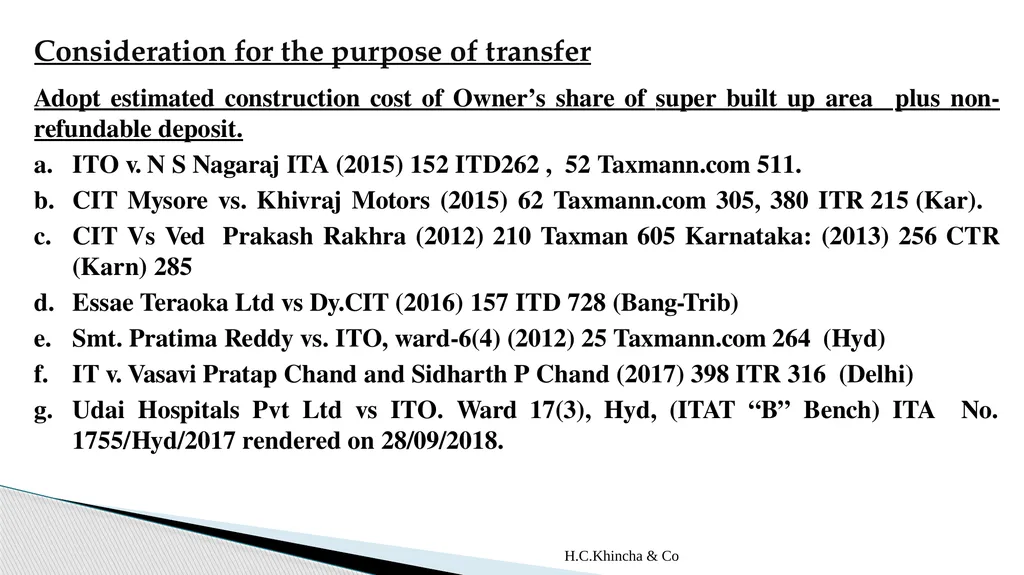
Consideration for the purpose of transfer Adopt estimated construction cost of Owner’s share of super built up area plus non- refundable deposit.
ITO v. N S Nagaraj ITA (2015) 152 ITD262 , 52 Taxmann.com 511.
CIT Mysore vs. Khivraj Motors (2015) 62 Taxmann.com 305, 380 ITR 215 (Kar).
CIT Vs Ved Prakash Rakhra (2012) 210 Taxman 605 Karnataka: (2013) 256 CTR (Karn) 285
Essae Teraoka Ltd vs Dy.CIT (2016) 157 ITD 728 (Bang-Trib)
Smt. Pratima Reddy vs. ITO, ward-6(4) (2012) 25 Taxmann.com 264 (Hyd)
IT v. Vasavi Pratap Chand and Sidharth P Chand (2017) 398 ITR 316 (Delhi)
Udai Hospitals Pvt Ltd vs ITO. Ward 17(3), Hyd, (ITAT “B” Bench) ITA No. 1755/Hyd/2017 rendered on 28/09/2018. H.C.Khincha & Co<br>
ITO v. N S Nagaraj ITA (2015) 152 ITD262 , 52 Taxmann.com 511.
CIT Mysore vs. Khivraj Motors (2015) 62 Taxmann.com 305, 380 ITR 215 (Kar).
CIT Vs Ved Prakash Rakhra (2012) 210 Taxman 605 Karnataka: (2013) 256 CTR (Karn) 285
Essae Teraoka Ltd vs Dy.CIT (2016) 157 ITD 728 (Bang-Trib)
Smt. Pratima Reddy vs. ITO, ward-6(4) (2012) 25 Taxmann.com 264 (Hyd)
IT v. Vasavi Pratap Chand and Sidharth P Chand (2017) 398 ITR 316 (Delhi)
Udai Hospitals Pvt Ltd vs ITO. Ward 17(3), Hyd, (ITAT “B” Bench) ITA No. 1755/Hyd/2017 rendered on 28/09/2018. H.C.Khincha & Co<br>
09
Adopt guideline value of the land to be transferred to the Developer and/or his/its nominees as per provisions of Section 50 D
ACIT vs M/s Shankar Vittal Motor Co. Ltd. ITA No.35/Bang/2015 rendered on 18/03/2016
B V Narayana Reddy vs Asst. CIT (2015) TaxPub (DT) 4553 (Hyd “B”- Trib)
Circular F.No. 225/58/2016/ITA.II dated 29/02/2016 issued by CBDT
[Fair market value deemed to be full value of consideration in certain cases.
50D. Where the consideration received or accruing as a result of the transfer of a capital asset by an assessee is not ascertainable or cannot be determined, then, for the purpose of computing income chargeable to tax as capital gains, the fair market value of the said asset on the date of transfer shall be deemed to be the full value of the consideration received or accruing as a result of such transfer.] H.C.Khincha & Co<br>
ACIT vs M/s Shankar Vittal Motor Co. Ltd. ITA No.35/Bang/2015 rendered on 18/03/2016
B V Narayana Reddy vs Asst. CIT (2015) TaxPub (DT) 4553 (Hyd “B”- Trib)
Circular F.No. 225/58/2016/ITA.II dated 29/02/2016 issued by CBDT
[Fair market value deemed to be full value of consideration in certain cases.
50D. Where the consideration received or accruing as a result of the transfer of a capital asset by an assessee is not ascertainable or cannot be determined, then, for the purpose of computing income chargeable to tax as capital gains, the fair market value of the said asset on the date of transfer shall be deemed to be the full value of the consideration received or accruing as a result of such transfer.] H.C.Khincha & Co<br>
10
JUDICIAL PRONOUNCEMENTS
The Bombay High Court held in a landmark case of Chaturbhuj Dwarkadas Kapadia v. CIT 260 ITR 491 (Bom.) (2003) that the execution of Joint Development Agreement would amount to transfer and the owner would be liable to capital gains tax at the time of execution of the Joint Development Agreement itself, disregarding the time when the construction was substantially complete or the handing over of possession to the owner.
The proposition which held the field was further elaborated upon by the Authority for Advance Ruling in the case of Jasbir Singh Sarkaria 294 ITR 196(AAR) (2007), which laid down that where the land owner has given irrevocable POA (effective control over land was transferred) and possession of the land in pursuance of the Developer, it would be treated as transfer of land by the owner to Developer for the purposes of Section 2(47)(v) of the Act. H.C.Khincha & Co<br>
The Bombay High Court held in a landmark case of Chaturbhuj Dwarkadas Kapadia v. CIT 260 ITR 491 (Bom.) (2003) that the execution of Joint Development Agreement would amount to transfer and the owner would be liable to capital gains tax at the time of execution of the Joint Development Agreement itself, disregarding the time when the construction was substantially complete or the handing over of possession to the owner.
The proposition which held the field was further elaborated upon by the Authority for Advance Ruling in the case of Jasbir Singh Sarkaria 294 ITR 196(AAR) (2007), which laid down that where the land owner has given irrevocable POA (effective control over land was transferred) and possession of the land in pursuance of the Developer, it would be treated as transfer of land by the owner to Developer for the purposes of Section 2(47)(v) of the Act. H.C.Khincha & Co<br>
11
The turning point in determination of the taxable event was introduced with the C.S. Atwal judgment by the Punjab & Haryana High Court (2015) 378 ITR 244 (P&H),
In which it was held that since collaboration agreement is unregistered, Section 53 A of the Transfer of Property Act cannot be applied to such unregistered document.
The clauses of the registered power of attorney were treated to be mere license to enter the land for the purpose of Development and which could not be treated as transfer of possession.
It was also held that where the Development was not carried out due to non fulfillment of obligation by the Developer, clause (v) of Section 2(47) will not be attracted. H.C.Khincha & Co<br>
In which it was held that since collaboration agreement is unregistered, Section 53 A of the Transfer of Property Act cannot be applied to such unregistered document.
The clauses of the registered power of attorney were treated to be mere license to enter the land for the purpose of Development and which could not be treated as transfer of possession.
It was also held that where the Development was not carried out due to non fulfillment of obligation by the Developer, clause (v) of Section 2(47) will not be attracted. H.C.Khincha & Co<br>
12
This contentious issue, to some an extent was resolved and addressed by the Hon'ble Supreme Court in its landmark judgment in the case of "CIT v. Balbir Singh Maini [2017] 86 taxmann.com 94/251 Taxman 202 (SC)” wherein judgment in C.S. Atwal was affirmed.
It was held that giving of possession of land for purposes of development under an unregistered joint development agreement could not be regarded as giving rise to capital gains.
The registration and other Related Laws (Amendment) Act, 2001, was brought in with simultaneous amendments in Section 53A of the Transfer of Property Act and Sections 17 and 49 of the Indian Registration Act.
Thus, unless the document containing the contract to transfer for consideration any immovable property (for the purpose of Section 53A of 1882 Act) is registered, it shall not have any effect in law for the purpose of Section 53A.
Therefore, in order to qualify as a ‘transfer’ of a capital asset under Section 2(47)(v), there must be a ‘contract’ which can be enforced in law under Section 53A of the Transfer of Property Act. H.C.Khincha & Co<br>
It was held that giving of possession of land for purposes of development under an unregistered joint development agreement could not be regarded as giving rise to capital gains.
The registration and other Related Laws (Amendment) Act, 2001, was brought in with simultaneous amendments in Section 53A of the Transfer of Property Act and Sections 17 and 49 of the Indian Registration Act.
Thus, unless the document containing the contract to transfer for consideration any immovable property (for the purpose of Section 53A of 1882 Act) is registered, it shall not have any effect in law for the purpose of Section 53A.
Therefore, in order to qualify as a ‘transfer’ of a capital asset under Section 2(47)(v), there must be a ‘contract’ which can be enforced in law under Section 53A of the Transfer of Property Act. H.C.Khincha & Co<br>
13
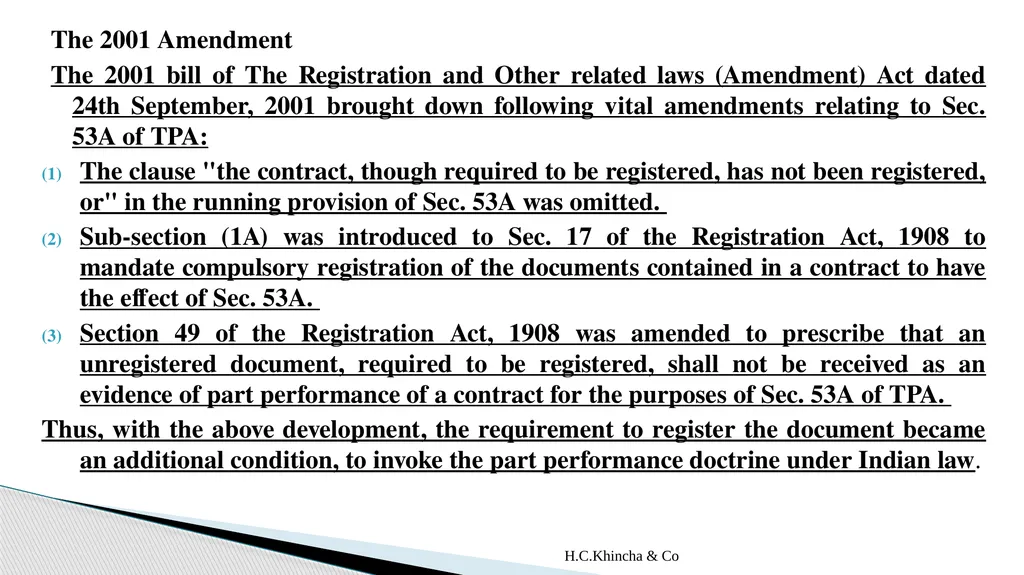
The 2001 Amendment
The 2001 bill of The Registration and Other related laws (Amendment) Act dated 24th September, 2001 brought down following vital amendments relating to Sec. 53A of TPA:
The clause "the contract, though required to be registered, has not been registered, or" in the running provision of Sec. 53A was omitted.
Sub-section (1A) was introduced to Sec. 17 of the Registration Act, 1908 to mandate compulsory registration of the documents contained in a contract to have the effect of Sec. 53A.
Section 49 of the Registration Act, 1908 was amended to prescribe that an unregistered document, required to be registered, shall not be received as an evidence of part performance of a contract for the purposes of Sec. 53A of TPA.
Thus, with the above development, the requirement to register the document became an additional condition, to invoke the part performance doctrine under Indian law. H.C.Khincha & Co<br>
The 2001 bill of The Registration and Other related laws (Amendment) Act dated 24th September, 2001 brought down following vital amendments relating to Sec. 53A of TPA:
The clause "the contract, though required to be registered, has not been registered, or" in the running provision of Sec. 53A was omitted.
Sub-section (1A) was introduced to Sec. 17 of the Registration Act, 1908 to mandate compulsory registration of the documents contained in a contract to have the effect of Sec. 53A.
Section 49 of the Registration Act, 1908 was amended to prescribe that an unregistered document, required to be registered, shall not be received as an evidence of part performance of a contract for the purposes of Sec. 53A of TPA.
Thus, with the above development, the requirement to register the document became an additional condition, to invoke the part performance doctrine under Indian law. H.C.Khincha & Co<br>
14
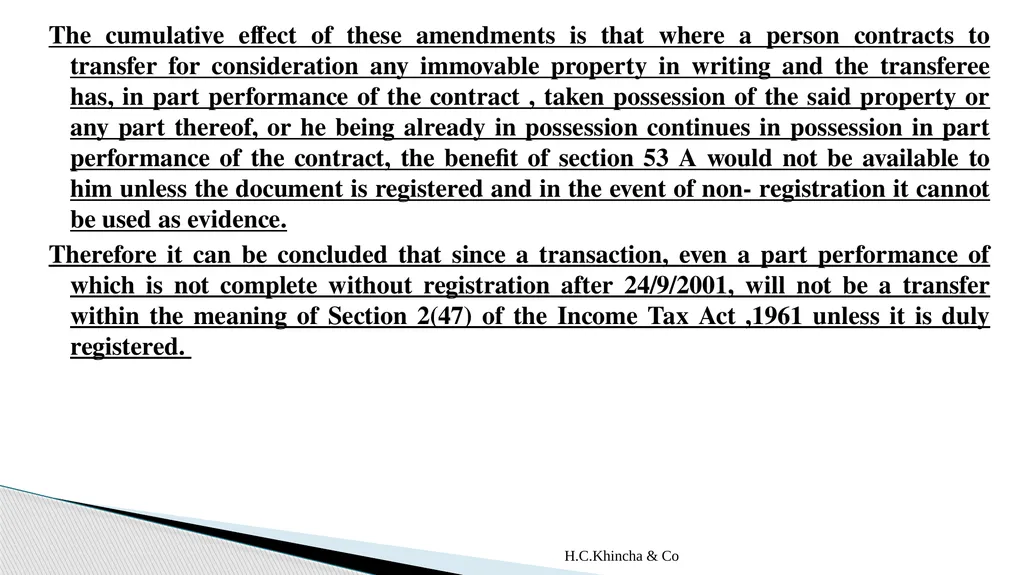
The cumulative effect of these amendments is that where a person contracts to transfer for consideration any immovable property in writing and the transferee has, in part performance of the contract , taken possession of the said property or any part thereof, or he being already in possession continues in possession in part performance of the contract, the benefit of section 53 A would not be available to him unless the document is registered and in the event of non- registration it cannot be used as evidence.
Therefore it can be concluded that since a transaction, even a part performance of which is not complete without registration after 24/9/2001, will not be a transfer within the meaning of Section 2(47) of the Income Tax Act ,1961 unless it is duly registered. H.C.Khincha & Co<br>
Therefore it can be concluded that since a transaction, even a part performance of which is not complete without registration after 24/9/2001, will not be a transfer within the meaning of Section 2(47) of the Income Tax Act ,1961 unless it is duly registered. H.C.Khincha & Co<br>
15
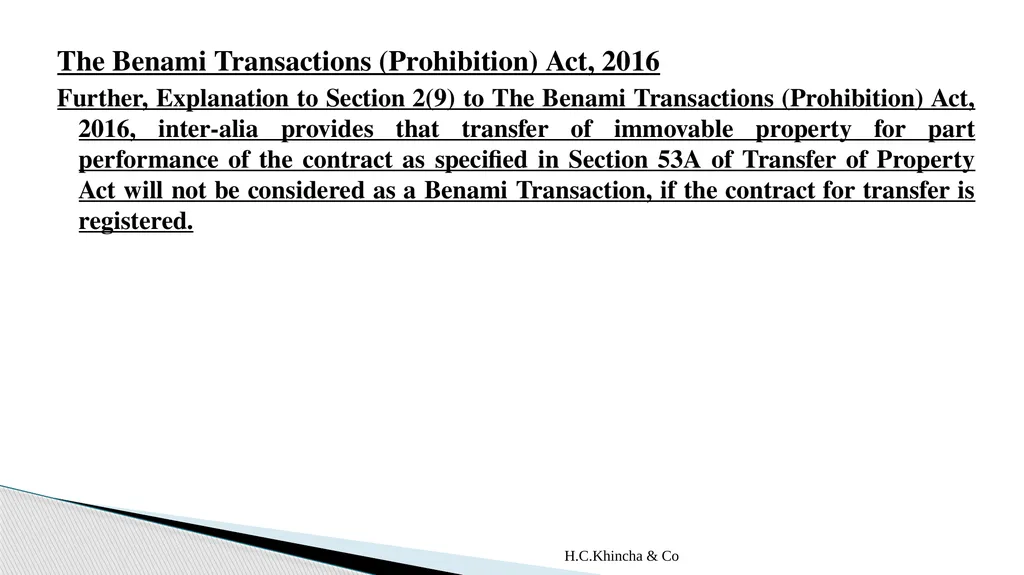
The Benami Transactions (Prohibition) Act, 2016
Further, Explanation to Section 2(9) to The Benami Transactions (Prohibition) Act, 2016, inter-alia provides that transfer of immovable property for part performance of the contract as specified in Section 53A of Transfer of Property Act will not be considered as a Benami Transaction, if the contract for transfer is registered. H.C.Khincha & Co<br>
Further, Explanation to Section 2(9) to The Benami Transactions (Prohibition) Act, 2016, inter-alia provides that transfer of immovable property for part performance of the contract as specified in Section 53A of Transfer of Property Act will not be considered as a Benami Transaction, if the contract for transfer is registered. H.C.Khincha & Co<br>
16
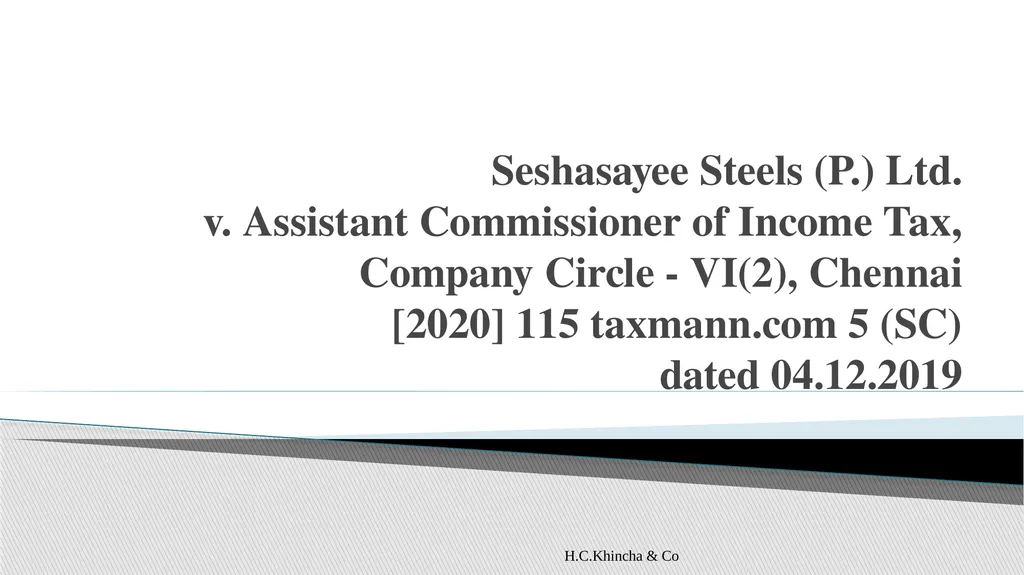
Seshasayee Steels (P.) Ltd.
v. Assistant Commissioner of Income Tax, Company Circle - VI(2), Chennai
[2020] 115 taxmann.com 5 (SC)
dated 04.12.2019 H.C.Khincha & Co<br>
17
HEAD NOTE
Where under sale agreement entered into by assessee for transfer of land to 'V', only permission or license had been granted to start advertising, selling and construction on land, it would not result in transfer of immovable property for purpose of capital gains taxation
GIST
Section 2(47) of the Income-tax Act, 1961 - Capital gains - Transfer (Development agreement) -
Assessee entered into a sale agreement for transfer of land to 'V' -
Under sale agreement, assessee granted permission or license to start advertising, selling and construction on land -
On 27-11-1998, assessee also executed a Power of Attorney under which a director of 'V' was appointed to execute sale agreements in favour of third party after construction on land -
Both parties were entitled to specific performance of this agreement -
Subsequently, on 19-7-2003, a memo of compromise was executed between assessee and V under which sale agreement and power of attorney granted were confirmed, total amount payable and already paid by 'V' to assessee was mentioned, further, manner of payment of remaining amount was specified for which post-dated cheques were also handed over to assesse. H.C.Khincha & Co<br>
Where under sale agreement entered into by assessee for transfer of land to 'V', only permission or license had been granted to start advertising, selling and construction on land, it would not result in transfer of immovable property for purpose of capital gains taxation
GIST
Section 2(47) of the Income-tax Act, 1961 - Capital gains - Transfer (Development agreement) -
Assessee entered into a sale agreement for transfer of land to 'V' -
Under sale agreement, assessee granted permission or license to start advertising, selling and construction on land -
On 27-11-1998, assessee also executed a Power of Attorney under which a director of 'V' was appointed to execute sale agreements in favour of third party after construction on land -
Both parties were entitled to specific performance of this agreement -
Subsequently, on 19-7-2003, a memo of compromise was executed between assessee and V under which sale agreement and power of attorney granted were confirmed, total amount payable and already paid by 'V' to assessee was mentioned, further, manner of payment of remaining amount was specified for which post-dated cheques were also handed over to assesse. H.C.Khincha & Co<br>
18
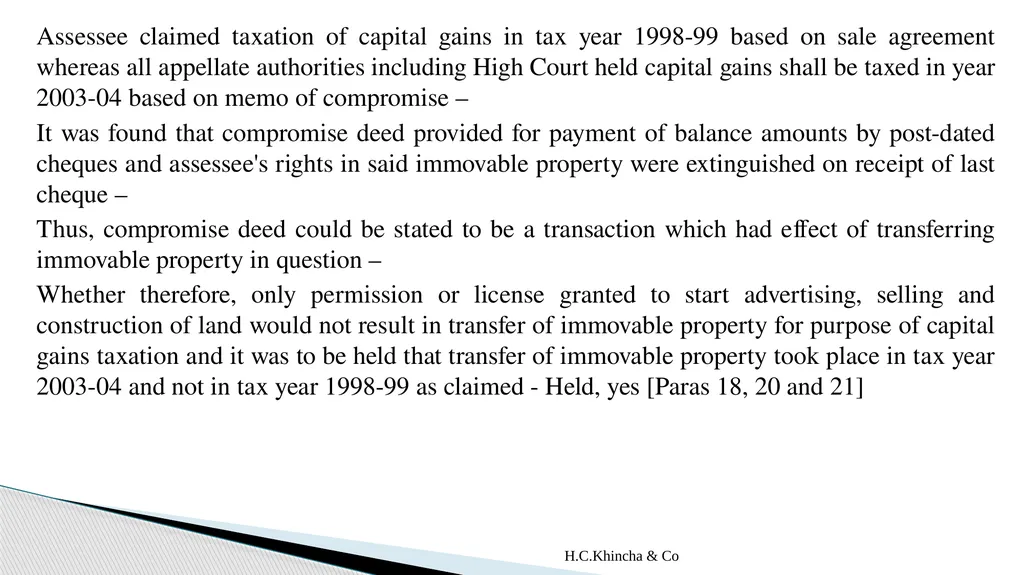
Assessee claimed taxation of capital gains in tax year 1998-99 based on sale agreement whereas all appellate authorities including High Court held capital gains shall be taxed in year 2003-04 based on memo of compromise –
It was found that compromise deed provided for payment of balance amounts by post-dated cheques and assessee's rights in said immovable property were extinguished on receipt of last cheque –
Thus, compromise deed could be stated to be a transaction which had effect of transferring immovable property in question –
Whether therefore, only permission or license granted to start advertising, selling and construction of land would not result in transfer of immovable property for purpose of capital gains taxation and it was to be held that transfer of immovable property took place in tax year 2003-04 and not in tax year 1998-99 as claimed - Held, yes [Paras 18, 20 and 21] H.C.Khincha & Co<br>
It was found that compromise deed provided for payment of balance amounts by post-dated cheques and assessee's rights in said immovable property were extinguished on receipt of last cheque –
Thus, compromise deed could be stated to be a transaction which had effect of transferring immovable property in question –
Whether therefore, only permission or license granted to start advertising, selling and construction of land would not result in transfer of immovable property for purpose of capital gains taxation and it was to be held that transfer of immovable property took place in tax year 2003-04 and not in tax year 1998-99 as claimed - Held, yes [Paras 18, 20 and 21] H.C.Khincha & Co<br>
19
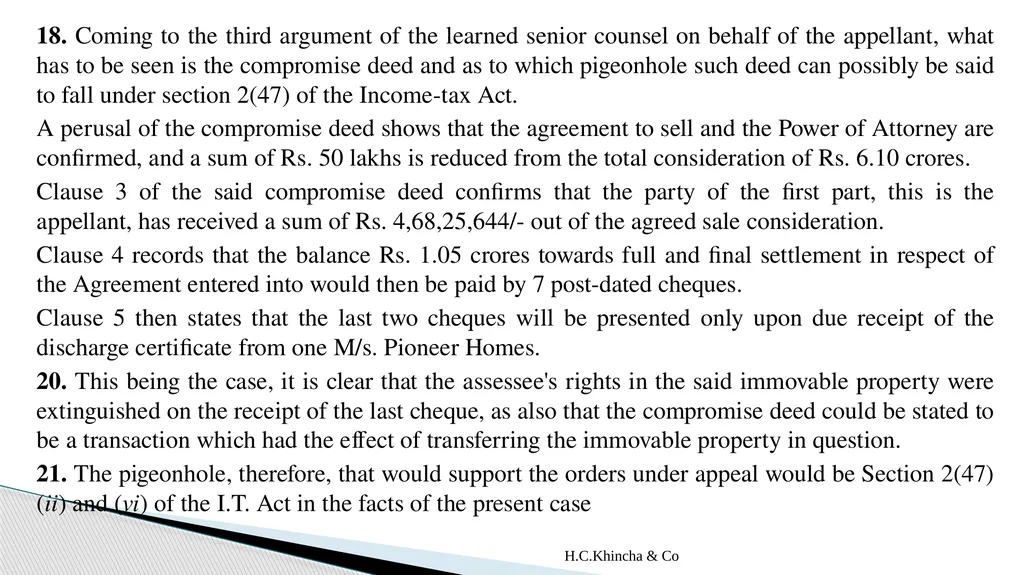
18. Coming to the third argument of the learned senior counsel on behalf of the appellant, what has to be seen is the compromise deed and as to which pigeonhole such deed can possibly be said to fall under section 2(47) of the Income-tax Act.
A perusal of the compromise deed shows that the agreement to sell and the Power of Attorney are confirmed, and a sum of Rs. 50 lakhs is reduced from the total consideration of Rs. 6.10 crores.
Clause 3 of the said compromise deed confirms that the party of the first part, this is the appellant, has received a sum of Rs. 4,68,25,644/- out of the agreed sale consideration.
Clause 4 records that the balance Rs. 1.05 crores towards full and final settlement in respect of the Agreement entered into would then be paid by 7 post-dated cheques.
Clause 5 then states that the last two cheques will be presented only upon due receipt of the discharge certificate from one M/s. Pioneer Homes.
20. This being the case, it is clear that the assessee's rights in the said immovable property were extinguished on the receipt of the last cheque, as also that the compromise deed could be stated to be a transaction which had the effect of transferring the immovable property in question.
21. The pigeonhole, therefore, that would support the orders under appeal would be Section 2(47)(ii) and (vi) of the I.T. Act in the facts of the present case H.C.Khincha & Co<br>
A perusal of the compromise deed shows that the agreement to sell and the Power of Attorney are confirmed, and a sum of Rs. 50 lakhs is reduced from the total consideration of Rs. 6.10 crores.
Clause 3 of the said compromise deed confirms that the party of the first part, this is the appellant, has received a sum of Rs. 4,68,25,644/- out of the agreed sale consideration.
Clause 4 records that the balance Rs. 1.05 crores towards full and final settlement in respect of the Agreement entered into would then be paid by 7 post-dated cheques.
Clause 5 then states that the last two cheques will be presented only upon due receipt of the discharge certificate from one M/s. Pioneer Homes.
20. This being the case, it is clear that the assessee's rights in the said immovable property were extinguished on the receipt of the last cheque, as also that the compromise deed could be stated to be a transaction which had the effect of transferring the immovable property in question.
21. The pigeonhole, therefore, that would support the orders under appeal would be Section 2(47)(ii) and (vi) of the I.T. Act in the facts of the present case H.C.Khincha & Co<br>
20
ISSUE IN SECTION 45(5A)
CAPITAL GAINS H.C.Khincha & Co<br>
CAPITAL GAINS H.C.Khincha & Co<br>
21
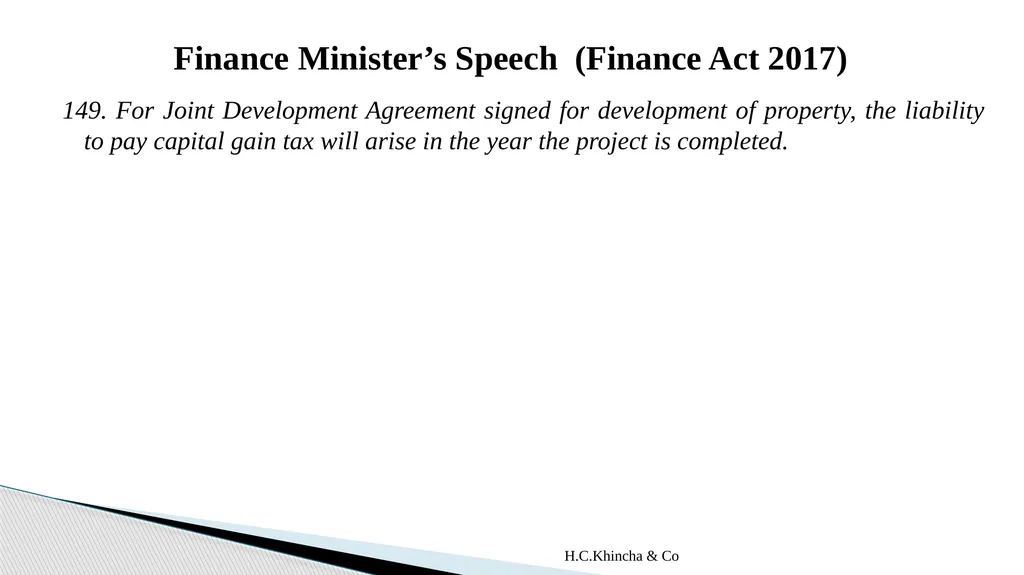
149. For Joint Development Agreement signed for development of property, the liability to pay capital gain tax will arise in the year the project is completed. H.C.Khincha & Co Finance Minister’s Speech (Finance Act 2017)<br>
22
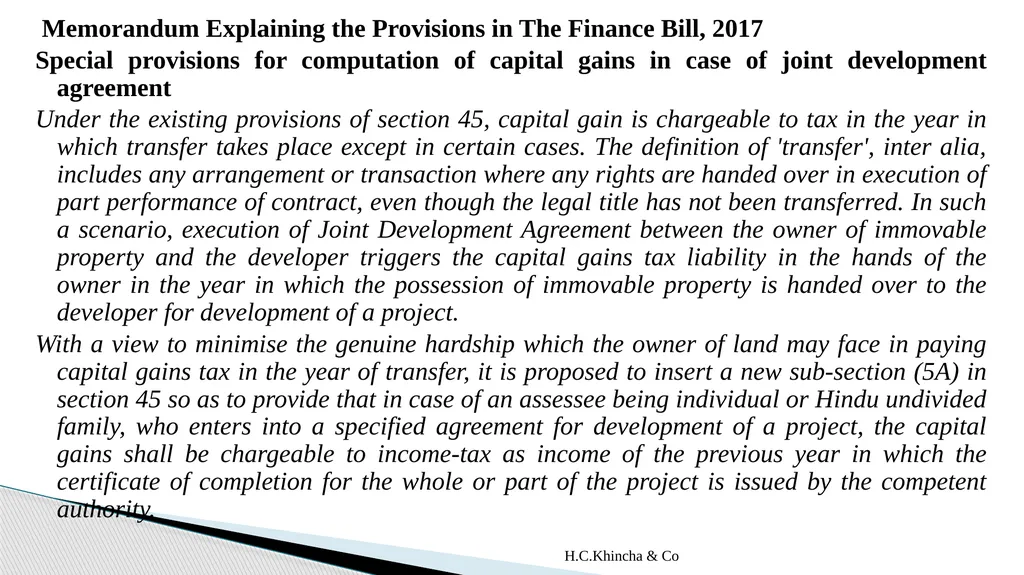
Memorandum Explaining the Provisions in The Finance Bill, 2017
Special provisions for computation of capital gains in case of joint development agreement
Under the existing provisions of section 45, capital gain is chargeable to tax in the year in which transfer takes place except in certain cases. The definition of 'transfer', inter alia, includes any arrangement or transaction where any rights are handed over in execution of part performance of contract, even though the legal title has not been transferred. In such a scenario, execution of Joint Development Agreement between the owner of immovable property and the developer triggers the capital gains tax liability in the hands of the owner in the year in which the possession of immovable property is handed over to the developer for development of a project.
With a view to minimise the genuine hardship which the owner of land may face in paying capital gains tax in the year of transfer, it is proposed to insert a new sub-section (5A) in section 45 so as to provide that in case of an assessee being individual or Hindu undivided family, who enters into a specified agreement for development of a project, the capital gains shall be chargeable to income-tax as income of the previous year in which the certificate of completion for the whole or part of the project is issued by the competent authority. H.C.Khincha & Co<br>
Special provisions for computation of capital gains in case of joint development agreement
Under the existing provisions of section 45, capital gain is chargeable to tax in the year in which transfer takes place except in certain cases. The definition of 'transfer', inter alia, includes any arrangement or transaction where any rights are handed over in execution of part performance of contract, even though the legal title has not been transferred. In such a scenario, execution of Joint Development Agreement between the owner of immovable property and the developer triggers the capital gains tax liability in the hands of the owner in the year in which the possession of immovable property is handed over to the developer for development of a project.
With a view to minimise the genuine hardship which the owner of land may face in paying capital gains tax in the year of transfer, it is proposed to insert a new sub-section (5A) in section 45 so as to provide that in case of an assessee being individual or Hindu undivided family, who enters into a specified agreement for development of a project, the capital gains shall be chargeable to income-tax as income of the previous year in which the certificate of completion for the whole or part of the project is issued by the competent authority. H.C.Khincha & Co<br>
23
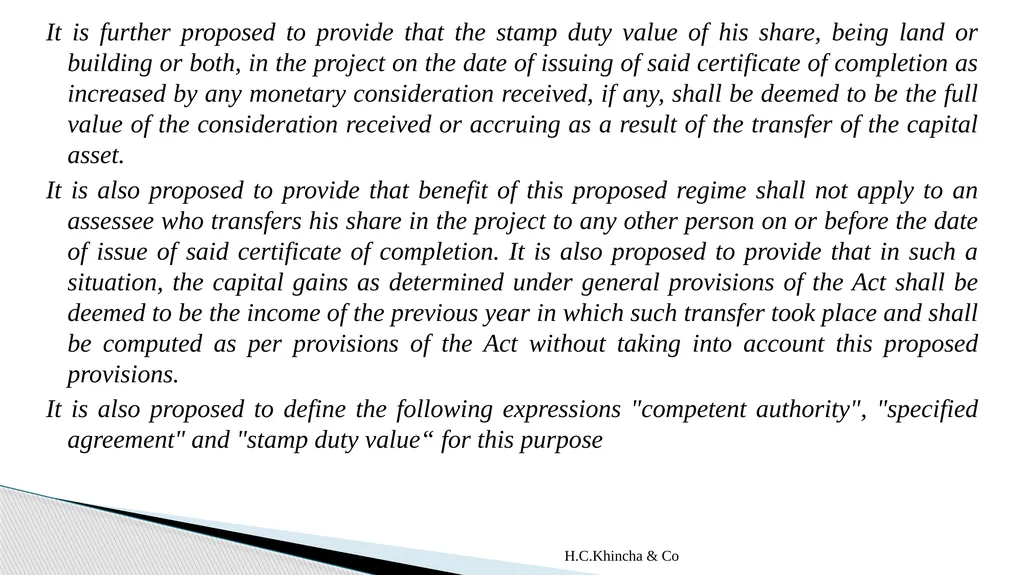
It is further proposed to provide that the stamp duty value of his share, being land or building or both, in the project on the date of issuing of said certificate of completion as increased by any monetary consideration received, if any, shall be deemed to be the full value of the consideration received or accruing as a result of the transfer of the capital asset.
It is also proposed to provide that benefit of this proposed regime shall not apply to an assessee who transfers his share in the project to any other person on or before the date of issue of said certificate of completion. It is also proposed to provide that in such a situation, the capital gains as determined under general provisions of the Act shall be deemed to be the income of the previous year in which such transfer took place and shall be computed as per provisions of the Act without taking into account this proposed provisions.
It is also proposed to define the following expressions "competent authority", "specified agreement" and "stamp duty value“ for this purpose H.C.Khincha & Co<br>
It is also proposed to provide that benefit of this proposed regime shall not apply to an assessee who transfers his share in the project to any other person on or before the date of issue of said certificate of completion. It is also proposed to provide that in such a situation, the capital gains as determined under general provisions of the Act shall be deemed to be the income of the previous year in which such transfer took place and shall be computed as per provisions of the Act without taking into account this proposed provisions.
It is also proposed to define the following expressions "competent authority", "specified agreement" and "stamp duty value“ for this purpose H.C.Khincha & Co<br>
24
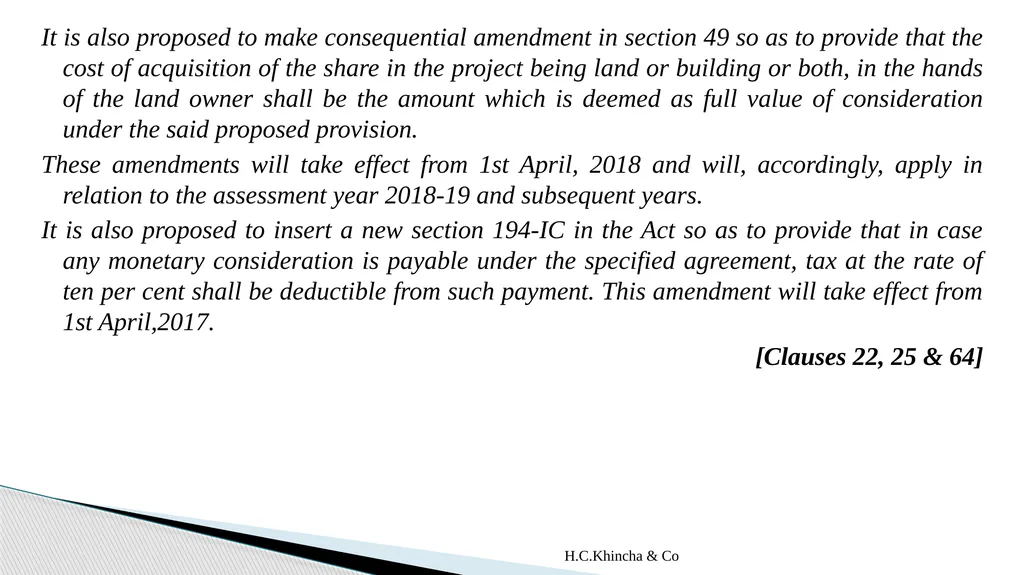
It is also proposed to make consequential amendment in section 49 so as to provide that the cost of acquisition of the share in the project being land or building or both, in the hands of the land owner shall be the amount which is deemed as full value of consideration under the said proposed provision.
These amendments will take effect from 1st April, 2018 and will, accordingly, apply in relation to the assessment year 2018-19 and subsequent years.
It is also proposed to insert a new section 194-IC in the Act so as to provide that in case any monetary consideration is payable under the specified agreement, tax at the rate of ten per cent shall be deductible from such payment. This amendment will take effect from 1st April,2017.
[Clauses 22, 25 & 64] H.C.Khincha & Co<br>
These amendments will take effect from 1st April, 2018 and will, accordingly, apply in relation to the assessment year 2018-19 and subsequent years.
It is also proposed to insert a new section 194-IC in the Act so as to provide that in case any monetary consideration is payable under the specified agreement, tax at the rate of ten per cent shall be deductible from such payment. This amendment will take effect from 1st April,2017.
[Clauses 22, 25 & 64] H.C.Khincha & Co<br>
25
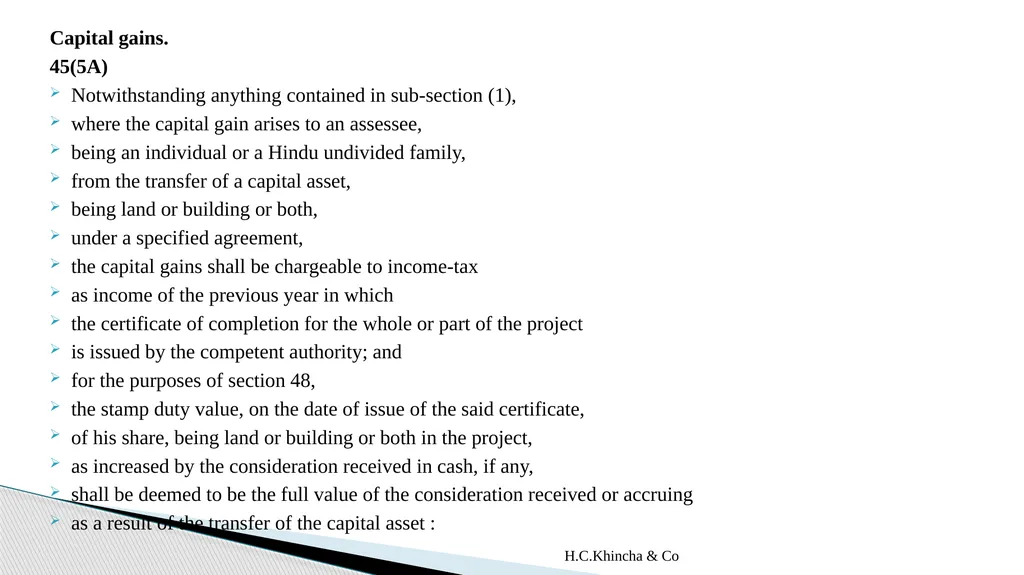
Capital gains.
45(5A)
Notwithstanding anything contained in sub-section (1),
where the capital gain arises to an assessee,
being an individual or a Hindu undivided family,
from the transfer of a capital asset,
being land or building or both,
under a specified agreement,
the capital gains shall be chargeable to income-tax
as income of the previous year in which
the certificate of completion for the whole or part of the project
is issued by the competent authority; and
for the purposes of section 48,
the stamp duty value, on the date of issue of the said certificate,
of his share, being land or building or both in the project,
as increased by the consideration received in cash, if any,
shall be deemed to be the full value of the consideration received or accruing
as a result of the transfer of the capital asset : H.C.Khincha & Co<br>
45(5A)
Notwithstanding anything contained in sub-section (1),
where the capital gain arises to an assessee,
being an individual or a Hindu undivided family,
from the transfer of a capital asset,
being land or building or both,
under a specified agreement,
the capital gains shall be chargeable to income-tax
as income of the previous year in which
the certificate of completion for the whole or part of the project
is issued by the competent authority; and
for the purposes of section 48,
the stamp duty value, on the date of issue of the said certificate,
of his share, being land or building or both in the project,
as increased by the consideration received in cash, if any,
shall be deemed to be the full value of the consideration received or accruing
as a result of the transfer of the capital asset : H.C.Khincha & Co<br>
26
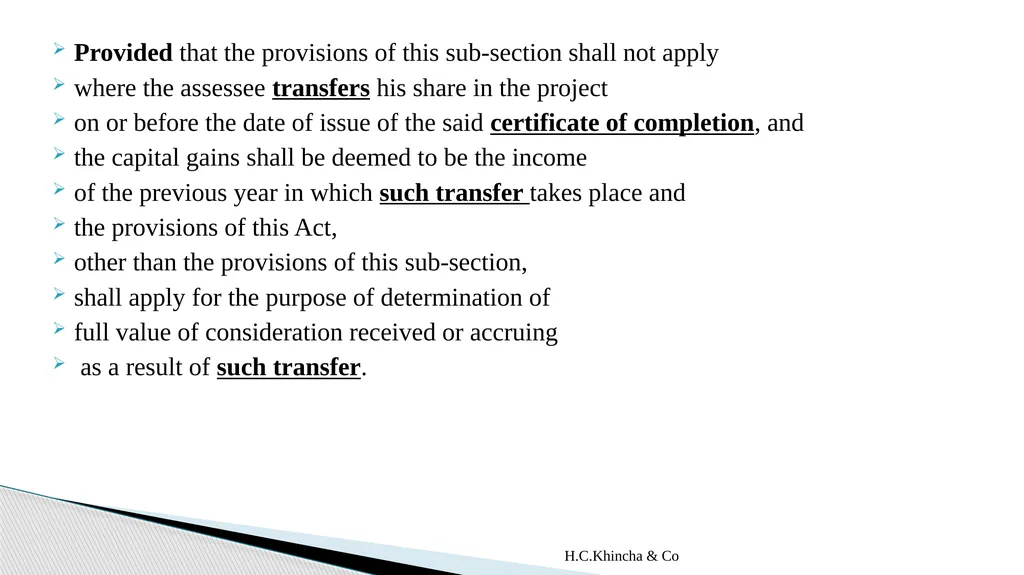
Provided that the provisions of this sub-section shall not apply
where the assessee transfers his share in the project
on or before the date of issue of the said certificate of completion, and
the capital gains shall be deemed to be the income
of the previous year in which such transfer takes place and
the provisions of this Act,
other than the provisions of this sub-section,
shall apply for the purpose of determination of
full value of consideration received or accruing
as a result of such transfer. H.C.Khincha & Co<br>
where the assessee transfers his share in the project
on or before the date of issue of the said certificate of completion, and
the capital gains shall be deemed to be the income
of the previous year in which such transfer takes place and
the provisions of this Act,
other than the provisions of this sub-section,
shall apply for the purpose of determination of
full value of consideration received or accruing
as a result of such transfer. H.C.Khincha & Co<br>
27
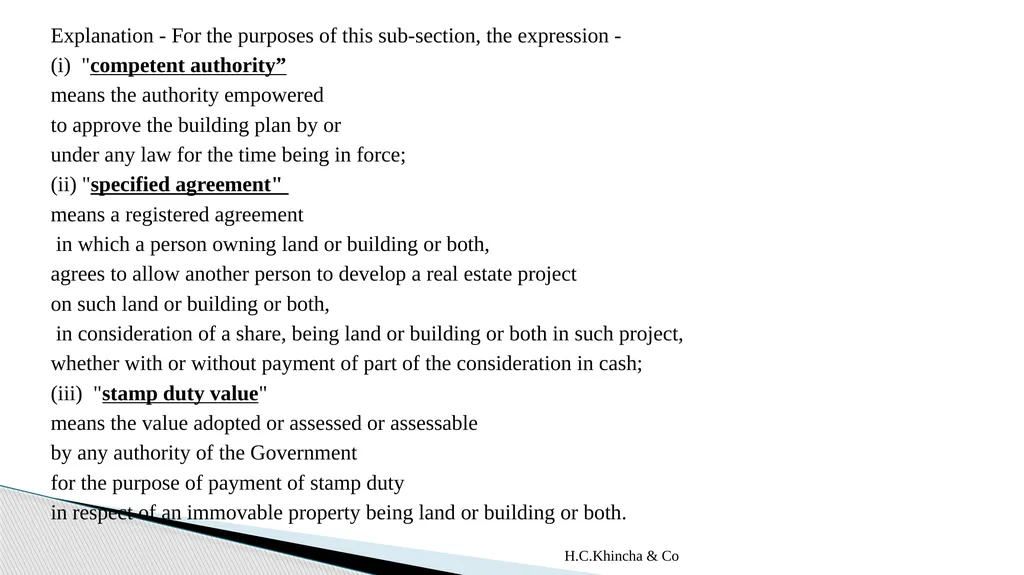
Explanation - For the purposes of this sub-section, the expression -
(i) "competent authority”
means the authority empowered
to approve the building plan by or
under any law for the time being in force;
(ii) "specified agreement"
means a registered agreement
in which a person owning land or building or both,
agrees to allow another person to develop a real estate project
on such land or building or both,
in consideration of a share, being land or building or both in such project,
whether with or without payment of part of the consideration in cash;
(iii) "stamp duty value"
means the value adopted or assessed or assessable
by any authority of the Government
for the purpose of payment of stamp duty
in respect of an immovable property being land or building or both. H.C.Khincha & Co<br>
(i) "competent authority”
means the authority empowered
to approve the building plan by or
under any law for the time being in force;
(ii) "specified agreement"
means a registered agreement
in which a person owning land or building or both,
agrees to allow another person to develop a real estate project
on such land or building or both,
in consideration of a share, being land or building or both in such project,
whether with or without payment of part of the consideration in cash;
(iii) "stamp duty value"
means the value adopted or assessed or assessable
by any authority of the Government
for the purpose of payment of stamp duty
in respect of an immovable property being land or building or both. H.C.Khincha & Co<br>
28
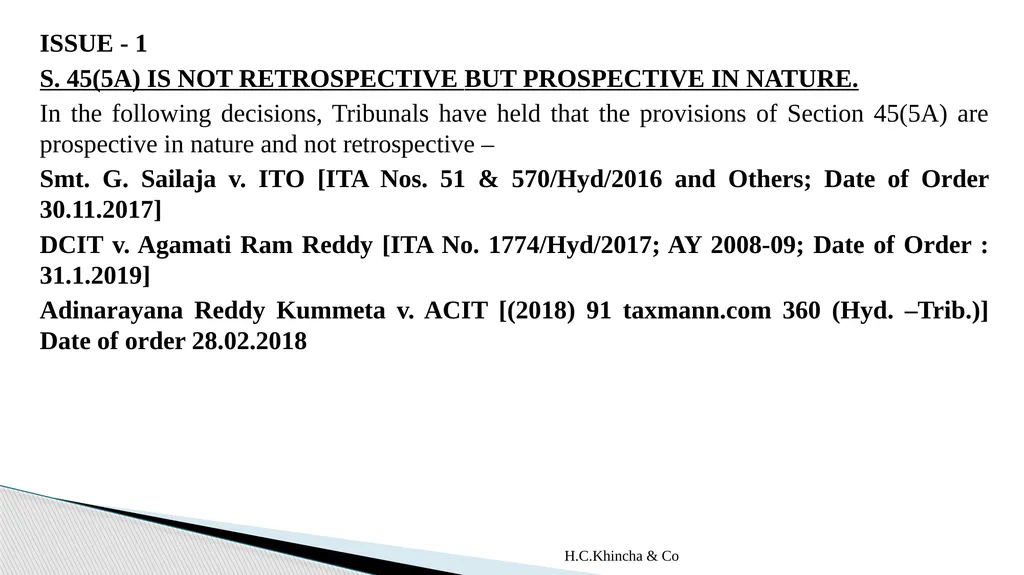
ISSUE - 1
S. 45(5A) IS NOT RETROSPECTIVE BUT PROSPECTIVE IN NATURE.
In the following decisions, Tribunals have held that the provisions of Section 45(5A) are prospective in nature and not retrospective –
Smt. G. Sailaja v. ITO [ITA Nos. 51 & 570/Hyd/2016 and Others; Date of Order 30.11.2017]
DCIT v. Agamati Ram Reddy [ITA No. 1774/Hyd/2017; AY 2008-09; Date of Order : 31.1.2019]
Adinarayana Reddy Kummeta v. ACIT [(2018) 91 taxmann.com 360 (Hyd. –Trib.)] Date of order 28.02.2018 H.C.Khincha & Co<br>
S. 45(5A) IS NOT RETROSPECTIVE BUT PROSPECTIVE IN NATURE.
In the following decisions, Tribunals have held that the provisions of Section 45(5A) are prospective in nature and not retrospective –
Smt. G. Sailaja v. ITO [ITA Nos. 51 & 570/Hyd/2016 and Others; Date of Order 30.11.2017]
DCIT v. Agamati Ram Reddy [ITA No. 1774/Hyd/2017; AY 2008-09; Date of Order : 31.1.2019]
Adinarayana Reddy Kummeta v. ACIT [(2018) 91 taxmann.com 360 (Hyd. –Trib.)] Date of order 28.02.2018 H.C.Khincha & Co<br>
29
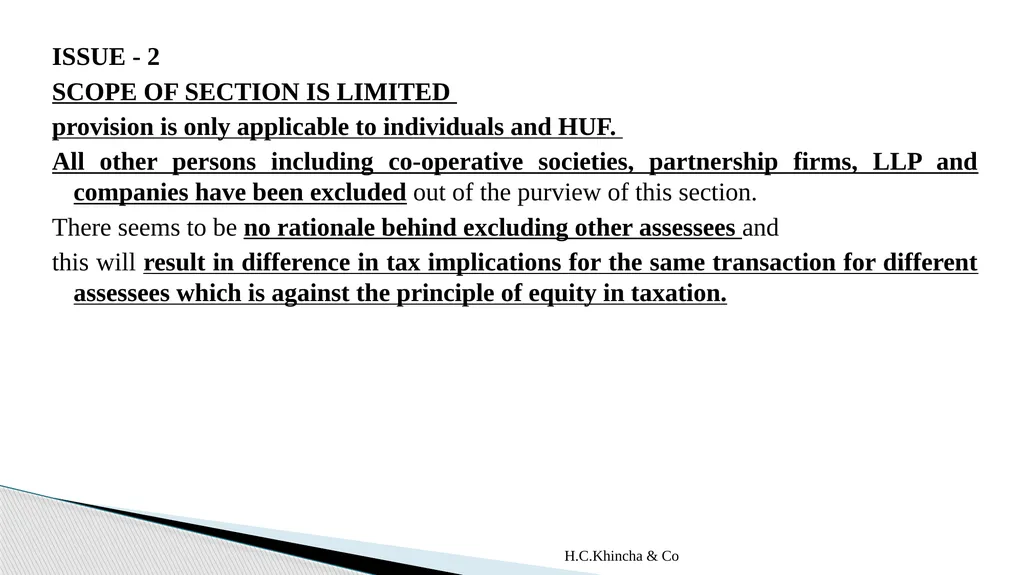
ISSUE - 2
SCOPE OF SECTION IS LIMITED
provision is only applicable to individuals and HUF.
All other persons including co-operative societies, partnership firms, LLP and companies have been excluded out of the purview of this section.
There seems to be no rationale behind excluding other assessees and
this will result in difference in tax implications for the same transaction for different assessees which is against the principle of equity in taxation. H.C.Khincha & Co<br>
SCOPE OF SECTION IS LIMITED
provision is only applicable to individuals and HUF.
All other persons including co-operative societies, partnership firms, LLP and companies have been excluded out of the purview of this section.
There seems to be no rationale behind excluding other assessees and
this will result in difference in tax implications for the same transaction for different assessees which is against the principle of equity in taxation. H.C.Khincha & Co<br>
30
ISSUE - 3
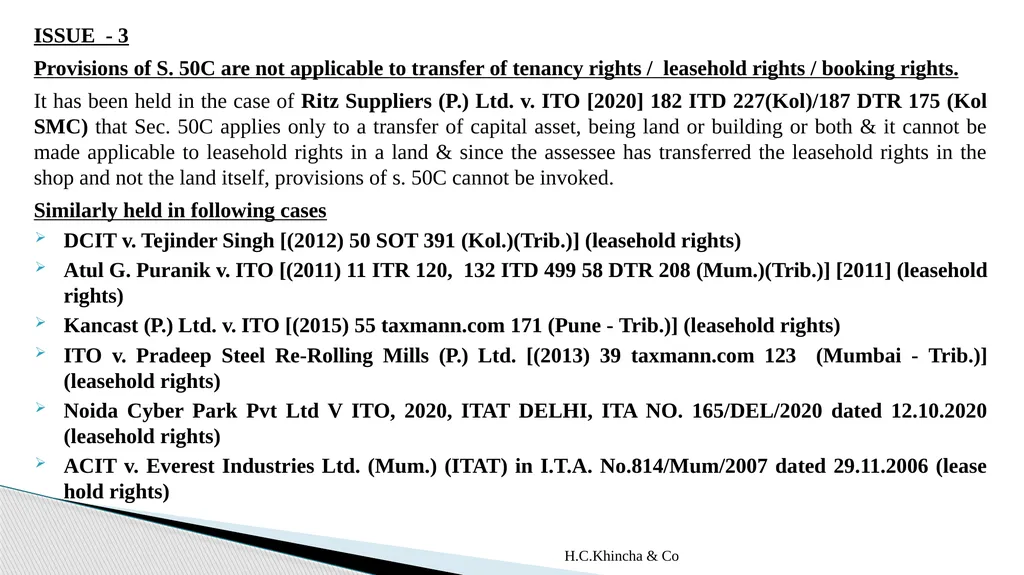
PROVISIONS OF S. 45(5A) ARE NOT APPLICABLE TO TRANSFER OF TENANCY RIGHTS / LEASEHOLD RIGHTS / BOOKING RIGHTS / RIGHTS IN LAND OR BUILDING
In context of section 50C courts have held that section does not apply to tenancy rights / leasehold rights / booking rights / rights in land or rights in building:
V.S. Chandrashekar V ACIT, 2021 432 ITR 330 / 199 DTR 545 / 320 CTR 339 / 282 Taxman 244(Karn)(HC) (rights in land & building)
Smt. Devindraben I. Barot v. ITO [(2016) 70 taxmann.com 235 (Ahmedabad - Trib.)] (rights in land & building)
ITO v. Tara Chand Jain [(2015) 63 taxmann.com 286 (Jaipur - Trib.)] (rights in land & building)
DCIT v. Tejinder Singh [(2012) 50 SOT 391 (Kol.)(Trib.)] (leasehold rights)
Atul G. Puranik v. ITO [(2011) 11 ITR 120, 132 ITD 499 58 DTR 208 (Mum.)(Trib.)] [2011] (leasehold rights) H.C.Khincha & Co<br>
PROVISIONS OF S. 45(5A) ARE NOT APPLICABLE TO TRANSFER OF TENANCY RIGHTS / LEASEHOLD RIGHTS / BOOKING RIGHTS / RIGHTS IN LAND OR BUILDING
In context of section 50C courts have held that section does not apply to tenancy rights / leasehold rights / booking rights / rights in land or rights in building:
V.S. Chandrashekar V ACIT, 2021 432 ITR 330 / 199 DTR 545 / 320 CTR 339 / 282 Taxman 244(Karn)(HC) (rights in land & building)
Smt. Devindraben I. Barot v. ITO [(2016) 70 taxmann.com 235 (Ahmedabad - Trib.)] (rights in land & building)
ITO v. Tara Chand Jain [(2015) 63 taxmann.com 286 (Jaipur - Trib.)] (rights in land & building)
DCIT v. Tejinder Singh [(2012) 50 SOT 391 (Kol.)(Trib.)] (leasehold rights)
Atul G. Puranik v. ITO [(2011) 11 ITR 120, 132 ITD 499 58 DTR 208 (Mum.)(Trib.)] [2011] (leasehold rights) H.C.Khincha & Co<br>
31
Kancast (P.) Ltd. v. ITO [(2015) 55 taxmann.com 171 (Pune - Trib.)] (leasehold rights)
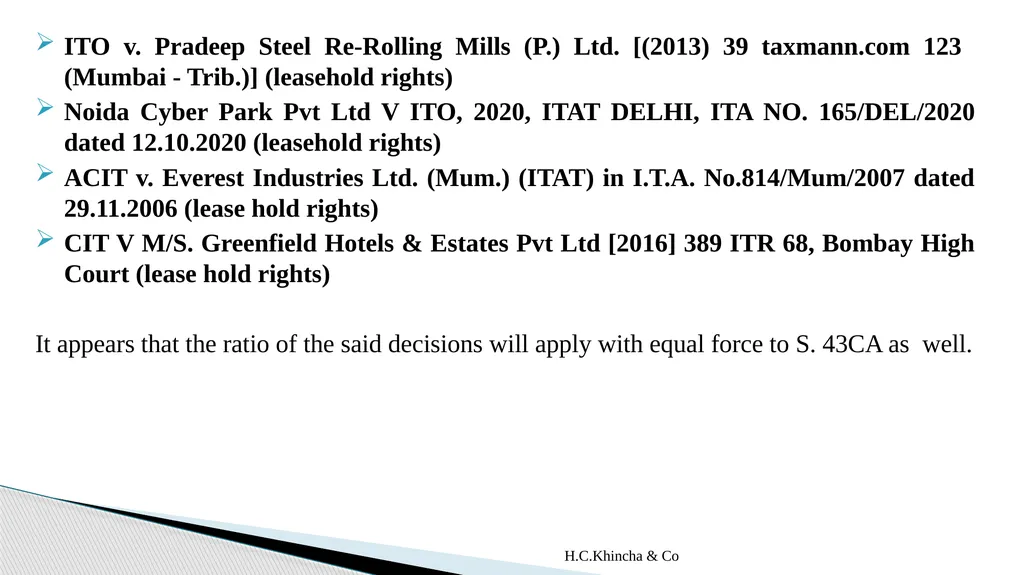
ITO v. Pradeep Steel Re-Rolling Mills (P.) Ltd. [(2013) 39 taxmann.com 123 (Mumbai - Trib.)] (leasehold rights)
Noida Cyber Park Pvt Ltd V ITO, 2020, ITAT DELHI, ITA NO. 165/DEL/2020 dated 12.10.2020 (leasehold rights)
ACIT v. Everest Industries Ltd. (Mum.) (ITAT) in I.T.A. No.814/Mum/2007 dated 29.11.2006 (lease hold rights)
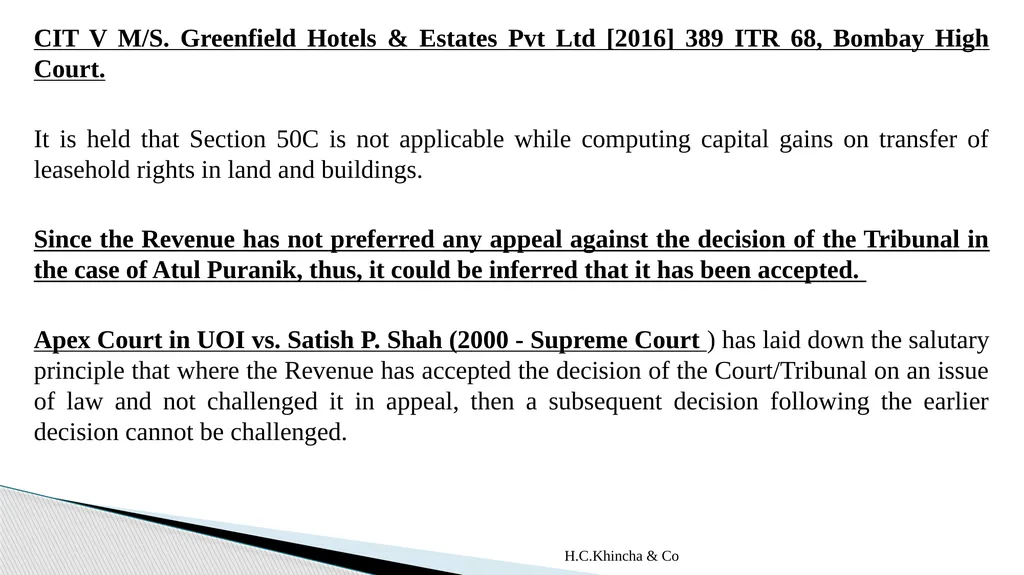
CIT V M/S. Greenfield Hotels & Estates Pvt Ltd [2016] 389 ITR 68, Bombay High Court (lease hold rights) H.C.Khincha & Co<br>
ITO v. Pradeep Steel Re-Rolling Mills (P.) Ltd. [(2013) 39 taxmann.com 123 (Mumbai - Trib.)] (leasehold rights)
Noida Cyber Park Pvt Ltd V ITO, 2020, ITAT DELHI, ITA NO. 165/DEL/2020 dated 12.10.2020 (leasehold rights)
ACIT v. Everest Industries Ltd. (Mum.) (ITAT) in I.T.A. No.814/Mum/2007 dated 29.11.2006 (lease hold rights)
CIT V M/S. Greenfield Hotels & Estates Pvt Ltd [2016] 389 ITR 68, Bombay High Court (lease hold rights) H.C.Khincha & Co<br>
32
The term ‘transfer’ has been defined under section 2(47) of the Act.
section 45(5A) deals only with the capital assets being in the nature of land or building.
The definition of transfer as provided under section 2(47) includes any sale, exchange or relinquishment of the asset, or the extinguishment of any rights therein.
It may also include transfers in the nature of any transaction involving the allowing of the possession of any immovable property to be taken or retained in part performance of a contract of the nature referred to in section 53A of the Transfer of Property Act, 1882.
As the transfer is so well defined under the Act and no diversion is provided even under section 45(5A), the date of transfer has been made rigid by the instance of transfer as per this provision.
Only the instance of taxability has been deferred by it. H.C.Khincha & Co ISSUE - 4 DATE OF TRANSFER IS FROZEN<br>
section 45(5A) deals only with the capital assets being in the nature of land or building.
The definition of transfer as provided under section 2(47) includes any sale, exchange or relinquishment of the asset, or the extinguishment of any rights therein.
It may also include transfers in the nature of any transaction involving the allowing of the possession of any immovable property to be taken or retained in part performance of a contract of the nature referred to in section 53A of the Transfer of Property Act, 1882.
As the transfer is so well defined under the Act and no diversion is provided even under section 45(5A), the date of transfer has been made rigid by the instance of transfer as per this provision.
Only the instance of taxability has been deferred by it. H.C.Khincha & Co ISSUE - 4 DATE OF TRANSFER IS FROZEN<br>
33
Another such instance under the Act is section 45(2), where also the date of transfer is deferred.
In that section a situation is envisaged, where a capital asset is converted into stock in trade, capital gain is though taken to have arisen on the date of such conversion, the taxability arises only at the time of sale of the stock, which came into existence on conversion of the capital asset.
The intention is clearly to tax the person at the time the consideration is realised, as on the date of conversion only the nature of asset changes from investment to inventory and nothing actually realises on that day.
The similar intention is there in section 45(5A), as on the date of transfer nothing would have actually realised. However, the property actually gets transferred on a date preceding the chargeability of tax. H.C.Khincha & Co<br>
In that section a situation is envisaged, where a capital asset is converted into stock in trade, capital gain is though taken to have arisen on the date of such conversion, the taxability arises only at the time of sale of the stock, which came into existence on conversion of the capital asset.
The intention is clearly to tax the person at the time the consideration is realised, as on the date of conversion only the nature of asset changes from investment to inventory and nothing actually realises on that day.
The similar intention is there in section 45(5A), as on the date of transfer nothing would have actually realised. However, the property actually gets transferred on a date preceding the chargeability of tax. H.C.Khincha & Co<br>
34
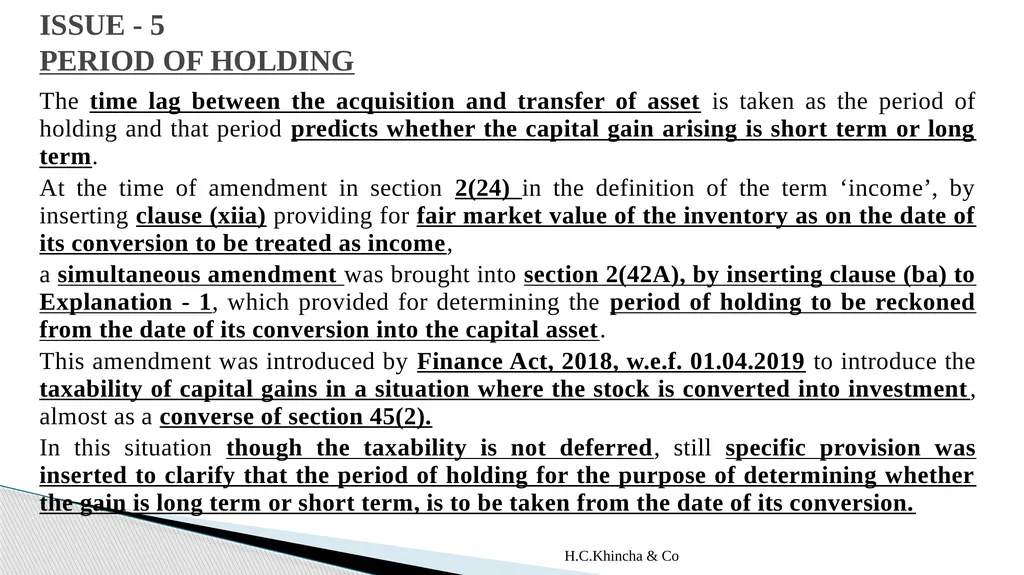
The time lag between the acquisition and transfer of asset is taken as the period of holding and that period predicts whether the capital gain arising is short term or long term.
At the time of amendment in section 2(24) in the definition of the term ‘income’, by inserting clause (xiia) providing for fair market value of the inventory as on the date of its conversion to be treated as income,
a simultaneous amendment was brought into section 2(42A), by inserting clause (ba) to Explanation - 1, which provided for determining the period of holding to be reckoned from the date of its conversion into the capital asset.
This amendment was introduced by Finance Act, 2018, w.e.f. 01.04.2019 to introduce the taxability of capital gains in a situation where the stock is converted into investment, almost as a converse of section 45(2).
In this situation though the taxability is not deferred, still specific provision was inserted to clarify that the period of holding for the purpose of determining whether the gain is long term or short term, is to be taken from the date of its conversion. H.C.Khincha & Co ISSUE - 5 PERIOD OF HOLDING<br>
At the time of amendment in section 2(24) in the definition of the term ‘income’, by inserting clause (xiia) providing for fair market value of the inventory as on the date of its conversion to be treated as income,
a simultaneous amendment was brought into section 2(42A), by inserting clause (ba) to Explanation - 1, which provided for determining the period of holding to be reckoned from the date of its conversion into the capital asset.
This amendment was introduced by Finance Act, 2018, w.e.f. 01.04.2019 to introduce the taxability of capital gains in a situation where the stock is converted into investment, almost as a converse of section 45(2).
In this situation though the taxability is not deferred, still specific provision was inserted to clarify that the period of holding for the purpose of determining whether the gain is long term or short term, is to be taken from the date of its conversion. H.C.Khincha & Co ISSUE - 5 PERIOD OF HOLDING<br>
35
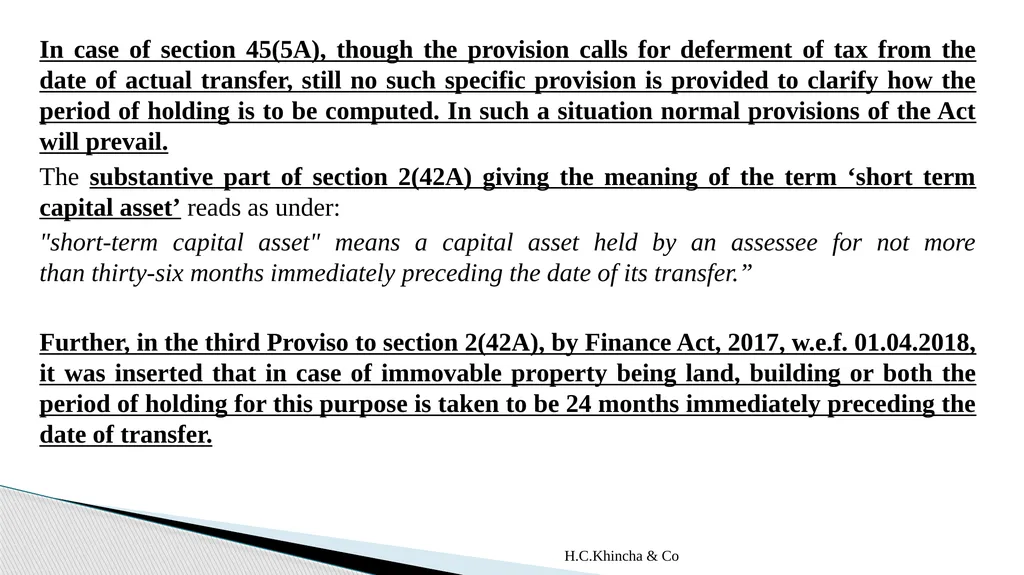
In case of section 45(5A), though the provision calls for deferment of tax from the date of actual transfer, still no such specific provision is provided to clarify how the period of holding is to be computed. In such a situation normal provisions of the Act will prevail.
The substantive part of section 2(42A) giving the meaning of the term ‘short term capital asset’ reads as under:
"short-term capital asset" means a capital asset held by an assessee for not more than thirty-six months immediately preceding the date of its transfer.”
Further, in the third Proviso to section 2(42A), by Finance Act, 2017, w.e.f. 01.04.2018, it was inserted that in case of immovable property being land, building or both the period of holding for this purpose is taken to be 24 months immediately preceding the date of transfer. H.C.Khincha & Co<br>
The substantive part of section 2(42A) giving the meaning of the term ‘short term capital asset’ reads as under:
"short-term capital asset" means a capital asset held by an assessee for not more than thirty-six months immediately preceding the date of its transfer.”
Further, in the third Proviso to section 2(42A), by Finance Act, 2017, w.e.f. 01.04.2018, it was inserted that in case of immovable property being land, building or both the period of holding for this purpose is taken to be 24 months immediately preceding the date of transfer. H.C.Khincha & Co<br>
36
In the scenarios envisaged by section 45(5A), the transfer takes place at the time of transfer as defined under section 2(47), the tax may be imposed at a later date when the completion certificate is issued but even at that time for the purposes of capital gain, the period between the acquisition and transfer of property is to be computed.
This may lead to certain weird situations.
For example, an assessee transfers a property under JDA to the developer for development after only a period of six months of its acquisition, the completion certificate is issued, say, after five years of such transfer.
The capital gain would be taxable after a period of more than five years from the acquisition, however only as short term capital gain, since the period of holding between acquisition and transfer is only six months. H.C.Khincha & Co<br>
This may lead to certain weird situations.
For example, an assessee transfers a property under JDA to the developer for development after only a period of six months of its acquisition, the completion certificate is issued, say, after five years of such transfer.
The capital gain would be taxable after a period of more than five years from the acquisition, however only as short term capital gain, since the period of holding between acquisition and transfer is only six months. H.C.Khincha & Co<br>
37
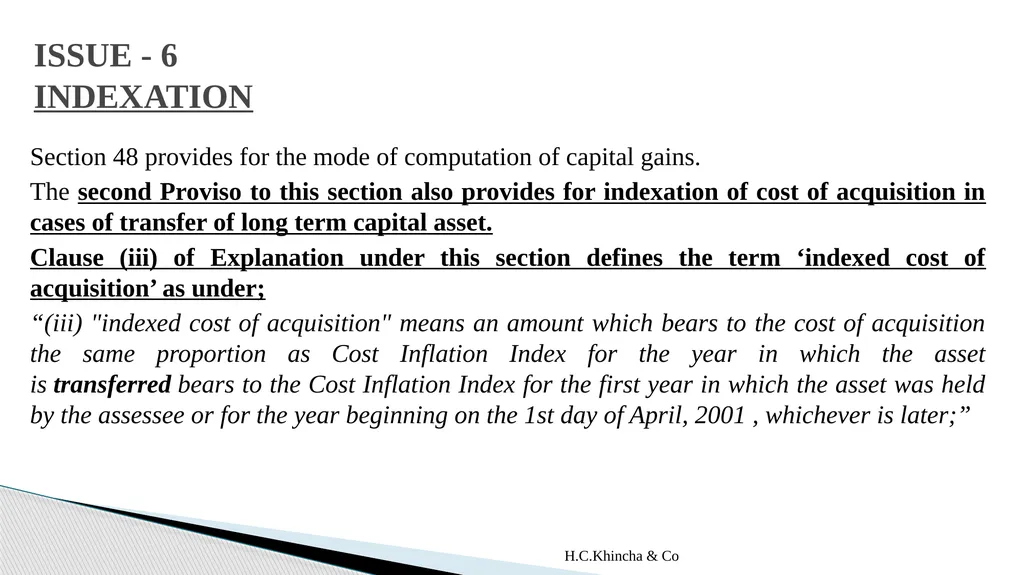
Section 48 provides for the mode of computation of capital gains.
The second Proviso to this section also provides for indexation of cost of acquisition in cases of transfer of long term capital asset.
Clause (iii) of Explanation under this section defines the term ‘indexed cost of acquisition’ as under;
“(iii) "indexed cost of acquisition" means an amount which bears to the cost of acquisition the same proportion as Cost Inflation Index for the year in which the asset is transferred bears to the Cost Inflation Index for the first year in which the asset was held by the assessee or for the year beginning on the 1st day of April, 2001 , whichever is later;” H.C.Khincha & Co ISSUE - 6 INDEXATION<br>
The second Proviso to this section also provides for indexation of cost of acquisition in cases of transfer of long term capital asset.
Clause (iii) of Explanation under this section defines the term ‘indexed cost of acquisition’ as under;
“(iii) "indexed cost of acquisition" means an amount which bears to the cost of acquisition the same proportion as Cost Inflation Index for the year in which the asset is transferred bears to the Cost Inflation Index for the first year in which the asset was held by the assessee or for the year beginning on the 1st day of April, 2001 , whichever is later;” H.C.Khincha & Co ISSUE - 6 INDEXATION<br>
38
The law is very clear that the indexation benefit will be given to the extent of cost inflation index till the year of transfer.
Suppose a land or building which was acquired by an individual before 2001 and the same is transferred for development under a JDA to the developer as on 31st March 2019, the completion certificate is issued sometime in the April 2025.
In such a case the long term capital gain arising to the assessee on transfer of asset will be chargeable to tax in the Assessment Year 2026-27, while, it appears that the indexed cost of acquisition will be computed by taking cost inflation index for the year 2020 only, since the ‘transfer’ took place in the Financial Year 2019-20 only. H.C.Khincha & Co<br>
Suppose a land or building which was acquired by an individual before 2001 and the same is transferred for development under a JDA to the developer as on 31st March 2019, the completion certificate is issued sometime in the April 2025.
In such a case the long term capital gain arising to the assessee on transfer of asset will be chargeable to tax in the Assessment Year 2026-27, while, it appears that the indexed cost of acquisition will be computed by taking cost inflation index for the year 2020 only, since the ‘transfer’ took place in the Financial Year 2019-20 only. H.C.Khincha & Co<br>
39
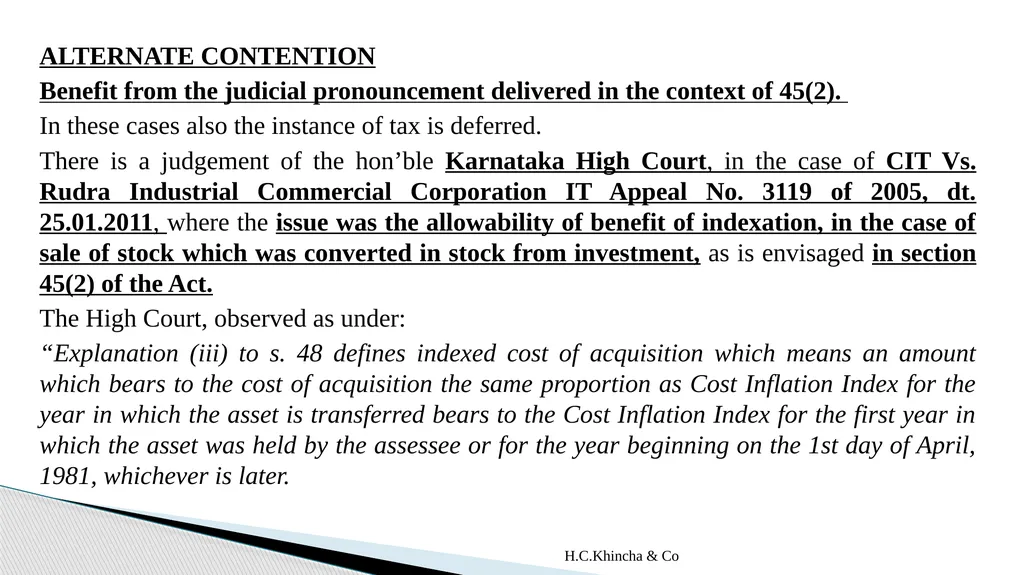
ALTERNATE CONTENTION
Benefit from the judicial pronouncement delivered in the context of 45(2).
In these cases also the instance of tax is deferred.
There is a judgement of the hon’ble Karnataka High Court, in the case of CIT Vs. Rudra Industrial Commercial Corporation IT Appeal No. 3119 of 2005, dt. 25.01.2011, where the issue was the allowability of benefit of indexation, in the case of sale of stock which was converted in stock from investment, as is envisaged in section 45(2) of the Act.
The High Court, observed as under:
“Explanation (iii) to s. 48 defines indexed cost of acquisition which means an amount which bears to the cost of acquisition the same proportion as Cost Inflation Index for the year in which the asset is transferred bears to the Cost Inflation Index for the first year in which the asset was held by the assessee or for the year beginning on the 1st day of April, 1981, whichever is later. H.C.Khincha & Co<br>
Benefit from the judicial pronouncement delivered in the context of 45(2).
In these cases also the instance of tax is deferred.
There is a judgement of the hon’ble Karnataka High Court, in the case of CIT Vs. Rudra Industrial Commercial Corporation IT Appeal No. 3119 of 2005, dt. 25.01.2011, where the issue was the allowability of benefit of indexation, in the case of sale of stock which was converted in stock from investment, as is envisaged in section 45(2) of the Act.
The High Court, observed as under:
“Explanation (iii) to s. 48 defines indexed cost of acquisition which means an amount which bears to the cost of acquisition the same proportion as Cost Inflation Index for the year in which the asset is transferred bears to the Cost Inflation Index for the first year in which the asset was held by the assessee or for the year beginning on the 1st day of April, 1981, whichever is later. H.C.Khincha & Co<br>
40
ALTERNATE CONTENTION
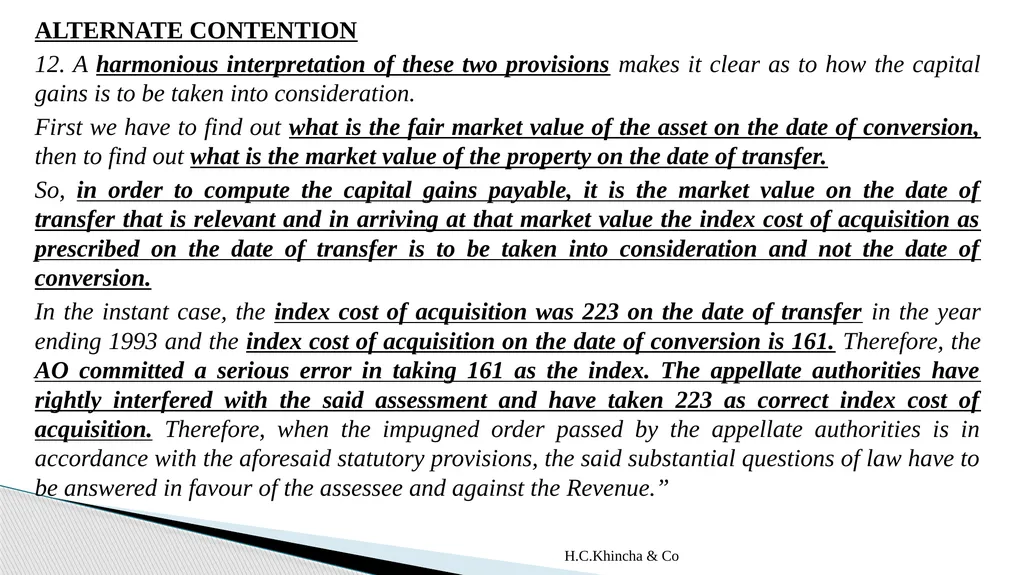
12. A harmonious interpretation of these two provisions makes it clear as to how the capital gains is to be taken into consideration.
First we have to find out what is the fair market value of the asset on the date of conversion, then to find out what is the market value of the property on the date of transfer.
So, in order to compute the capital gains payable, it is the market value on the date of transfer that is relevant and in arriving at that market value the index cost of acquisition as prescribed on the date of transfer is to be taken into consideration and not the date of conversion.
In the instant case, the index cost of acquisition was 223 on the date of transfer in the year ending 1993 and the index cost of acquisition on the date of conversion is 161. Therefore, the AO committed a serious error in taking 161 as the index. The appellate authorities have rightly interfered with the said assessment and have taken 223 as correct index cost of acquisition. Therefore, when the impugned order passed by the appellate authorities is in accordance with the aforesaid statutory provisions, the said substantial questions of law have to be answered in favour of the assessee and against the Revenue.” H.C.Khincha & Co<br>
12. A harmonious interpretation of these two provisions makes it clear as to how the capital gains is to be taken into consideration.
First we have to find out what is the fair market value of the asset on the date of conversion, then to find out what is the market value of the property on the date of transfer.
So, in order to compute the capital gains payable, it is the market value on the date of transfer that is relevant and in arriving at that market value the index cost of acquisition as prescribed on the date of transfer is to be taken into consideration and not the date of conversion.
In the instant case, the index cost of acquisition was 223 on the date of transfer in the year ending 1993 and the index cost of acquisition on the date of conversion is 161. Therefore, the AO committed a serious error in taking 161 as the index. The appellate authorities have rightly interfered with the said assessment and have taken 223 as correct index cost of acquisition. Therefore, when the impugned order passed by the appellate authorities is in accordance with the aforesaid statutory provisions, the said substantial questions of law have to be answered in favour of the assessee and against the Revenue.” H.C.Khincha & Co<br>
41
ALTERNATE CONTENTION
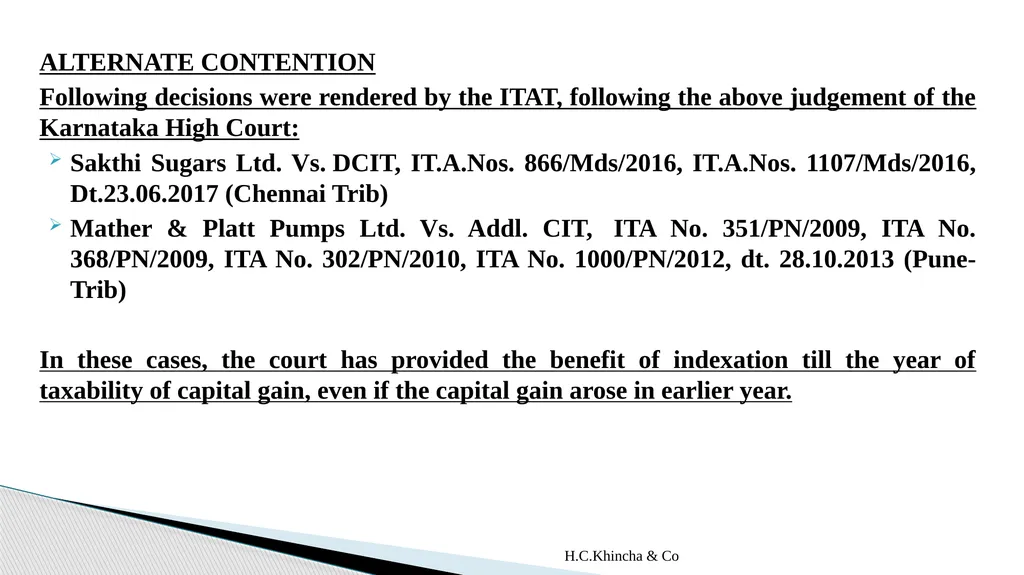
Following decisions were rendered by the ITAT, following the above judgement of the Karnataka High Court:
Sakthi Sugars Ltd. Vs. DCIT, IT.A.Nos. 866/Mds/2016, IT.A.Nos. 1107/Mds/2016, Dt.23.06.2017 (Chennai Trib)
Mather & Platt Pumps Ltd. Vs. Addl. CIT, ITA No. 351/PN/2009, ITA No. 368/PN/2009, ITA No. 302/PN/2010, ITA No. 1000/PN/2012, dt. 28.10.2013 (Pune- Trib)
In these cases, the court has provided the benefit of indexation till the year of taxability of capital gain, even if the capital gain arose in earlier year. H.C.Khincha & Co<br>
Following decisions were rendered by the ITAT, following the above judgement of the Karnataka High Court:
Sakthi Sugars Ltd. Vs. DCIT, IT.A.Nos. 866/Mds/2016, IT.A.Nos. 1107/Mds/2016, Dt.23.06.2017 (Chennai Trib)
Mather & Platt Pumps Ltd. Vs. Addl. CIT, ITA No. 351/PN/2009, ITA No. 368/PN/2009, ITA No. 302/PN/2010, ITA No. 1000/PN/2012, dt. 28.10.2013 (Pune- Trib)
In these cases, the court has provided the benefit of indexation till the year of taxability of capital gain, even if the capital gain arose in earlier year. H.C.Khincha & Co<br>
42
ALTERNATE CONTENTION
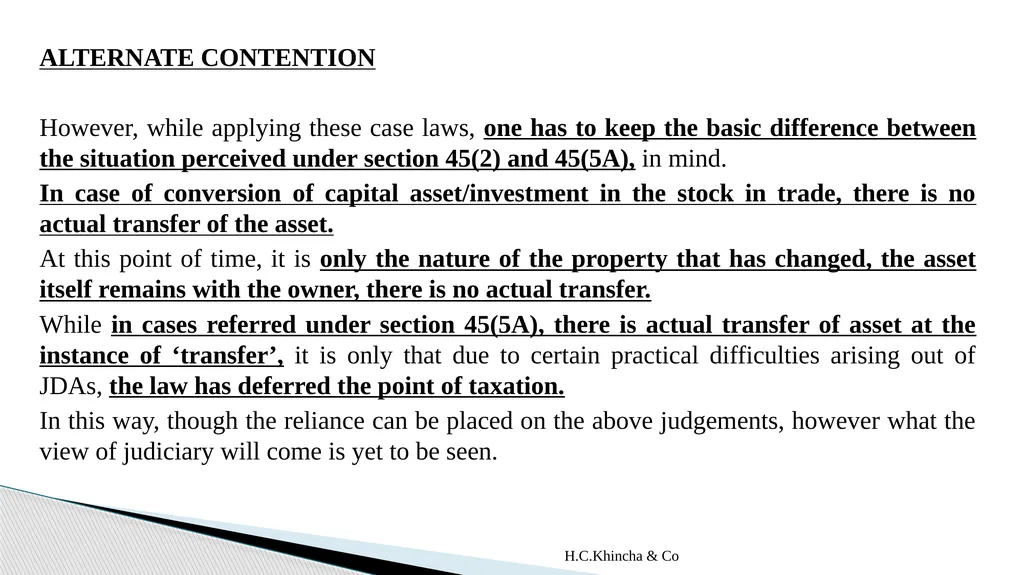
However, while applying these case laws, one has to keep the basic difference between the situation perceived under section 45(2) and 45(5A), in mind.
In case of conversion of capital asset/investment in the stock in trade, there is no actual transfer of the asset.
At this point of time, it is only the nature of the property that has changed, the asset itself remains with the owner, there is no actual transfer.
While in cases referred under section 45(5A), there is actual transfer of asset at the instance of ‘transfer’, it is only that due to certain practical difficulties arising out of JDAs, the law has deferred the point of taxation.
In this way, though the reliance can be placed on the above judgements, however what the view of judiciary will come is yet to be seen. H.C.Khincha & Co<br>
However, while applying these case laws, one has to keep the basic difference between the situation perceived under section 45(2) and 45(5A), in mind.
In case of conversion of capital asset/investment in the stock in trade, there is no actual transfer of the asset.
At this point of time, it is only the nature of the property that has changed, the asset itself remains with the owner, there is no actual transfer.
While in cases referred under section 45(5A), there is actual transfer of asset at the instance of ‘transfer’, it is only that due to certain practical difficulties arising out of JDAs, the law has deferred the point of taxation.
In this way, though the reliance can be placed on the above judgements, however what the view of judiciary will come is yet to be seen. H.C.Khincha & Co<br>
43
ALTERNATE CONTENTION
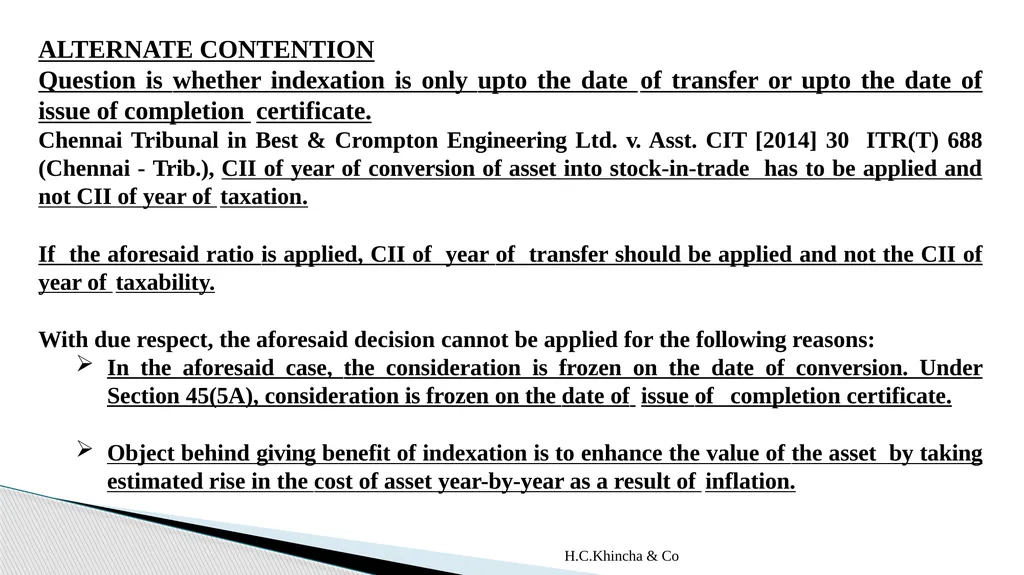
Question is whether indexation is only upto the date of transfer or upto the date of issue of completion certificate.
Chennai Tribunal in Best & Crompton Engineering Ltd. v. Asst. CIT [2014] 30 ITR(T) 688 (Chennai - Trib.), CII of year of conversion of asset into stock-in-trade has to be applied and not CII of year of taxation.
If the aforesaid ratio is applied, CII of year of transfer should be applied and not the CII of year of taxability.
With due respect, the aforesaid decision cannot be applied for the following reasons:
In the aforesaid case, the consideration is frozen on the date of conversion. Under Section 45(5A), consideration is frozen on the date of issue of completion certificate.
Object behind giving benefit of indexation is to enhance the value of the asset by taking estimated rise in the cost of asset year-by-year as a result of inflation. H.C.Khincha & Co<br>
Question is whether indexation is only upto the date of transfer or upto the date of issue of completion certificate.
Chennai Tribunal in Best & Crompton Engineering Ltd. v. Asst. CIT [2014] 30 ITR(T) 688 (Chennai - Trib.), CII of year of conversion of asset into stock-in-trade has to be applied and not CII of year of taxation.
If the aforesaid ratio is applied, CII of year of transfer should be applied and not the CII of year of taxability.
With due respect, the aforesaid decision cannot be applied for the following reasons:
In the aforesaid case, the consideration is frozen on the date of conversion. Under Section 45(5A), consideration is frozen on the date of issue of completion certificate.
Object behind giving benefit of indexation is to enhance the value of the asset by taking estimated rise in the cost of asset year-by-year as a result of inflation. H.C.Khincha & Co<br>
44
ALTERNATE CONTENTION
If indexation is restricted upto the year of transfer as against year of taxability, the effect of inflation during the period between the year of transfer and year of taxability will be ignored.
This may defeat the objective in granting the benefit of indexation.
Further, while the indexation during the aforesaid period is ignored, the stamp duty value applied will be as on the date of issue of completion certificate [year of taxability]. This causes lack of parity.
Therefore, it may be said that cost inflation index of the year of taxability should be applied. H.C.Khincha & Co<br>
If indexation is restricted upto the year of transfer as against year of taxability, the effect of inflation during the period between the year of transfer and year of taxability will be ignored.
This may defeat the objective in granting the benefit of indexation.
Further, while the indexation during the aforesaid period is ignored, the stamp duty value applied will be as on the date of issue of completion certificate [year of taxability]. This causes lack of parity.
Therefore, it may be said that cost inflation index of the year of taxability should be applied. H.C.Khincha & Co<br>
45
Very similar to the provisions related to cost of acquisition are the provisions related to the cost of improvement.
Clause (iv) to the Proviso to section 48, defines ‘indexed cost of improvement’ as follows:
“(iv) "indexed cost of any improvement" means an amount which bears to the cost of improvement the same proportion as Cost Inflation Index for the year in which the asset is transferred bears to the Cost Inflation Index for the year in which the improvement to the asset took place;”
The cost of improvement incurred by an assessee on the capital asset transferred is recognized only till the date of transfer. Therefore only improvements done till the date of transfer will be given even if the capital gain is taxed years after transfer.
In any case after the property has in fact been actually transferred to the developer, generally no expenses would be incurred by the owner after the date of transfer, on account of improvement of the property. H.C.Khincha & Co ISSUE - 7 COST OF IMPROVEMENT- TILL WHICH DATE<br>
Clause (iv) to the Proviso to section 48, defines ‘indexed cost of improvement’ as follows:
“(iv) "indexed cost of any improvement" means an amount which bears to the cost of improvement the same proportion as Cost Inflation Index for the year in which the asset is transferred bears to the Cost Inflation Index for the year in which the improvement to the asset took place;”
The cost of improvement incurred by an assessee on the capital asset transferred is recognized only till the date of transfer. Therefore only improvements done till the date of transfer will be given even if the capital gain is taxed years after transfer.
In any case after the property has in fact been actually transferred to the developer, generally no expenses would be incurred by the owner after the date of transfer, on account of improvement of the property. H.C.Khincha & Co ISSUE - 7 COST OF IMPROVEMENT- TILL WHICH DATE<br>
46
The definition of ‘specified agreement’ provides that the consideration shall be land or building or both (kind) whether with or without payment of part of the consideration in cash
The Legislature has not specified the ratio of the part of the consideration to be received in cash.
Therefore, a question arises whether the consideration in cash can be more than consideration in kind (i.e. land or building or both)
Going by the spirit of Section 45(5A) and use of language ‘whether with or without the payment of part of the consideration in cash’, consideration in cash cannot be more than consideration in kind. H.C.Khincha & Co ISSUE - 8 SPECIFIED AGREEMENT<br>
The Legislature has not specified the ratio of the part of the consideration to be received in cash.
Therefore, a question arises whether the consideration in cash can be more than consideration in kind (i.e. land or building or both)
Going by the spirit of Section 45(5A) and use of language ‘whether with or without the payment of part of the consideration in cash’, consideration in cash cannot be more than consideration in kind. H.C.Khincha & Co ISSUE - 8 SPECIFIED AGREEMENT<br>
47
In general the section envisages a situation, where the completion certificate is issued after the date of transfer.
However, there may be a situation where the transfer takes place only after the issue of completion certificate. In practice, generally it may not happen but there may be situations where because of some dispute between the developer and owner or for any other such reason, the transfer may get delayed.
It is to be understood that the capital gain arises only on transfer of an asset. In the case of above referred situation, it cannot be said that on issue of completion certificate the capital gain has arisen to the assessee. Therefore, in any case, capital gain cannot be taxed at the time of issue of completion certificate. Same has to necessarily be taxed at the time of transfer only.
In this case the provisions of section 45(5A) will not be applicable and the capital gains will be taxed in the year of transfer as per normal provisions of the Act. However, it is to be borne in mind that provisions of section 50C/43CA referring to the stamp duty valuation will be duly applicable. H.C.Khincha & Co ISSUE - 9 WHAT IF TRANSFER IS LATER THAN THE DATE OF ISSUE OF COMPLETION CERTIFICATE<br>
However, there may be a situation where the transfer takes place only after the issue of completion certificate. In practice, generally it may not happen but there may be situations where because of some dispute between the developer and owner or for any other such reason, the transfer may get delayed.
It is to be understood that the capital gain arises only on transfer of an asset. In the case of above referred situation, it cannot be said that on issue of completion certificate the capital gain has arisen to the assessee. Therefore, in any case, capital gain cannot be taxed at the time of issue of completion certificate. Same has to necessarily be taxed at the time of transfer only.
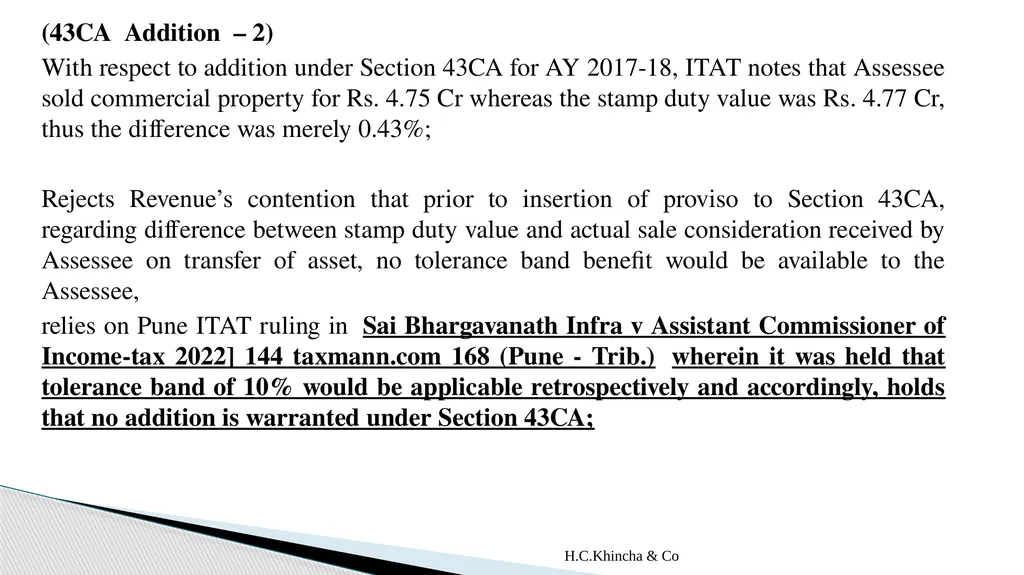
In this case the provisions of section 45(5A) will not be applicable and the capital gains will be taxed in the year of transfer as per normal provisions of the Act. However, it is to be borne in mind that provisions of section 50C/43CA referring to the stamp duty valuation will be duly applicable. H.C.Khincha & Co ISSUE - 9 WHAT IF TRANSFER IS LATER THAN THE DATE OF ISSUE OF COMPLETION CERTIFICATE<br>
48
Provided that the provisions of this sub-section shall not apply
where the assessee transfers his share in the project
on or before the date of issue of the said certificate of completion, and
the capital gains shall be deemed to be the income
of the previous year in which such transfer takes place and
the provisions of this Act,
other than the provisions of this sub-section, shall apply
for the purpose of determination of full value of consideration received or accruing
as a result of such transfer.
Three times the word transfer is used. H.C.Khincha & Co ISSUE - 10 WHAT IF TRANSFERRED BEFORE ISSUE OF COMPLETION CERTIFICATE.<br>
where the assessee transfers his share in the project
on or before the date of issue of the said certificate of completion, and
the capital gains shall be deemed to be the income
of the previous year in which such transfer takes place and
the provisions of this Act,
other than the provisions of this sub-section, shall apply
for the purpose of determination of full value of consideration received or accruing
as a result of such transfer.
Three times the word transfer is used. H.C.Khincha & Co ISSUE - 10 WHAT IF TRANSFERRED BEFORE ISSUE OF COMPLETION CERTIFICATE.<br>
49
Section 45(5A) would not apply where the assessee transfers his share in the project on or before the date of issue of the said certificate of completion
Meaning of share in the project:
Is it interest in the project or is it his share being land or building or both in the project. Former would not require any specific identification whereas the latter requires the completion of building as well as specific identification.
Does the proviso apply only when the share in the project is fully transferred or would it apply even if the share is partly transferred?
If the proviso were to apply only when the share is fully transferred, it may frustrate the very objective and taxpayer may resort to transfer of bulk of share retaining a miniscule portion H.C.Khincha & Co<br>
Meaning of share in the project:
Is it interest in the project or is it his share being land or building or both in the project. Former would not require any specific identification whereas the latter requires the completion of building as well as specific identification.
Does the proviso apply only when the share in the project is fully transferred or would it apply even if the share is partly transferred?
If the proviso were to apply only when the share is fully transferred, it may frustrate the very objective and taxpayer may resort to transfer of bulk of share retaining a miniscule portion H.C.Khincha & Co<br>
50
If the proviso were to apply even when the share is partly transferred, question is whether the proviso would apply in entirety or would it apply only to the part of the share so transferred.
If the proviso were to fully apply even when a part of the share is transferred, it would be a case completely covered by the proviso
If the proviso were to only partly apply even when a part of the share is transferred, it would be a case where both section 45(5A) as well as the proviso would apply. While section 45(5A) would apply to the part retained, the proviso would apply to the part that is transferred.
The capital gains shall be deemed to be the income of the previous year in which such transfer takes place : ‘such transfer’ is not the original transfer but transfer contemplated in the proviso H.C.Khincha & Co<br>
If the proviso were to fully apply even when a part of the share is transferred, it would be a case completely covered by the proviso
If the proviso were to only partly apply even when a part of the share is transferred, it would be a case where both section 45(5A) as well as the proviso would apply. While section 45(5A) would apply to the part retained, the proviso would apply to the part that is transferred.
The capital gains shall be deemed to be the income of the previous year in which such transfer takes place : ‘such transfer’ is not the original transfer but transfer contemplated in the proviso H.C.Khincha & Co<br>
51
In other words, in the PY in which he transfers his share in the project [before the date of issue of completion certificate], he is liable to pay tax in respect of capital gains on transfer of original asset i.e. land or building under the specified agreement
The aforesaid interpretation is flowing from literal reading of the Proviso.
However, Memorandum suggests that by virtue of the proviso, capital gains will be charged to tax in the year of transfer.
If the aforesaid interpretation is applied, there would be issues of limitation whereby department may not be able to tax the capital gain at all. No extended time limit for re-assessment or rectification is provided
Further, if the intention is to revert back to normal situation, proviso could have been worded simply that section 45(5A) is not applicable.
Ideally, proviso ought to have been worded similar to section 45(2) H.C.Khincha & Co<br>
The aforesaid interpretation is flowing from literal reading of the Proviso.
However, Memorandum suggests that by virtue of the proviso, capital gains will be charged to tax in the year of transfer.
If the aforesaid interpretation is applied, there would be issues of limitation whereby department may not be able to tax the capital gain at all. No extended time limit for re-assessment or rectification is provided
Further, if the intention is to revert back to normal situation, proviso could have been worded simply that section 45(5A) is not applicable.
Ideally, proviso ought to have been worded similar to section 45(2) H.C.Khincha & Co<br>
52
Section 45(5A) – Proviso : Gains from original asset
Full value consideration for transfer of original asset will be determined on the basis of actual consideration as compared with stamp duty valuation under section 50C. If the actual consideration is not ascertainable or indeterminate, section 50D would apply whereby FMV of outgoing asset would be deemed to be FVC
As the capital gains on transfer of original asset are deemed to be the income of PY of transfer of share in the project, question is how to determine the period of holding and whether FVC/50C/50D and indexation are to be applied in the year of transfer or in the year of taxation?
As far actual cost and indexation are concerned, the actual cost of original asset would be taken subject to indexation. The period upto which indexation can be made is open to dispute<br>
Full value consideration for transfer of original asset will be determined on the basis of actual consideration as compared with stamp duty valuation under section 50C. If the actual consideration is not ascertainable or indeterminate, section 50D would apply whereby FMV of outgoing asset would be deemed to be FVC
As the capital gains on transfer of original asset are deemed to be the income of PY of transfer of share in the project, question is how to determine the period of holding and whether FVC/50C/50D and indexation are to be applied in the year of transfer or in the year of taxation?
As far actual cost and indexation are concerned, the actual cost of original asset would be taken subject to indexation. The period upto which indexation can be made is open to dispute<br>
53
Section 45(5A) – Proviso : Gains from share
In that PY he is also liable to pay tax in respect of capital gains arising from transfer of share in the project
For the purpose of determination of full value of consideration received or accruing as a result of such transfer, the provisions of this Act, other than the provisions of this sub-section, shall apply.
This would mean that actual consideration would be determined on the basis of section 48 or 50D. Section 50C may not apply as what is transferred is not land or building or both but a share in the project.
What would be the cost of acquisition in respect of his share in the project. There is no provision similar to section 49(7). However, it is only fair that the FVC adopted for taxing the gains from original asset should be adopted as actual cost. If not, very taxation is vulnerable to challenge on the basis that the cost is not ascertainable<br>
In that PY he is also liable to pay tax in respect of capital gains arising from transfer of share in the project
For the purpose of determination of full value of consideration received or accruing as a result of such transfer, the provisions of this Act, other than the provisions of this sub-section, shall apply.
This would mean that actual consideration would be determined on the basis of section 48 or 50D. Section 50C may not apply as what is transferred is not land or building or both but a share in the project.
What would be the cost of acquisition in respect of his share in the project. There is no provision similar to section 49(7). However, it is only fair that the FVC adopted for taxing the gains from original asset should be adopted as actual cost. If not, very taxation is vulnerable to challenge on the basis that the cost is not ascertainable<br>
54
The purpose of all these exemptions seems to give incentive to further invest the sale consideration received on transfer of a capital asset into some other form of capital asset.
In all these provisions a time line is given to reinvest the sale consideration into new asset, with reference to the date of transfer.
Section 54H applies only in respect of transfer by way of compulsory acquisition. H.C.Khincha & Co ISSUE - 11 EXEMPTION UNDER SECTION 54/54F<br>
In all these provisions a time line is given to reinvest the sale consideration into new asset, with reference to the date of transfer.
Section 54H applies only in respect of transfer by way of compulsory acquisition. H.C.Khincha & Co ISSUE - 11 EXEMPTION UNDER SECTION 54/54F<br>
55
ALTERNATE CONTENTION
The issue is in cases referred to in section 45(5A), as the sale consideration is not realised at the time of transfer, how can an assessee be expected to reinvest the same after transfer.
In the context of section 45(2), where an investment is converted into stock and the transferred, the CBDT had issued a circular no. 791, dt 02.06.2000, which came out in the context specifically of exemptions provided in section 54EA/54EB/54EC.
In this circular it was provided that for the purposes of these exemptions date of transfer has to be taken as the sale of transfer of stock in trade only. H.C.Khincha & Co<br>
The issue is in cases referred to in section 45(5A), as the sale consideration is not realised at the time of transfer, how can an assessee be expected to reinvest the same after transfer.
In the context of section 45(2), where an investment is converted into stock and the transferred, the CBDT had issued a circular no. 791, dt 02.06.2000, which came out in the context specifically of exemptions provided in section 54EA/54EB/54EC.
In this circular it was provided that for the purposes of these exemptions date of transfer has to be taken as the sale of transfer of stock in trade only. H.C.Khincha & Co<br>
56
In the case of Rajesh Kumar Adukia vs. DCIT, ITA 14/Ran/2018, dated 30.10.2019, the Ranchi bench of the tribunal held as under:
20. At thus juncture, I take cognizance of CBDT Circular No.791 dated 2.6.2000 (supra), which clarified that for the purpose of claiming deduction u/s. 54EA/54EB/54EC, the date of transfer shall be the date on which the stock-in-trade is sold or otherwise transferred by the assessee and not on the date of conversion of the capital asset into stock-in-trade. Further, Special Bench of ITAT Kolkata in the case of Octavius Steel & Co. Ltd (supra) has held that on conversion of capital asset into stock-in-trade, there is no profit as no can make profit out of himself. Further, as per amended sub-section(2) of section 45 of the Act, which was inserted by the Taxation Legislation (Amendment Act), 1984 w.e.f. 1.4.1985, notwithstanding anything contained in sub-section (1), the profits or gains arising from the transfer by way of conversion by the owner of a capital asset into, or its treatment by him as stock-in-trade of a business carried on by him shall be chargeable to income tax as his income of the previous year in which such stock in trade is sold or otherwise transferred by him and, for the purposes of section 48, the fair market value of the asset on the date of such conversion or treatment shall be deemed to be the full value of the consideration received or accruing as a result of the transfer of the capital asset. Therefore, in view of above CBDT circular and order of Special Bench of Kolkata Bench of the Tribunal in the case of Octavius Steel & Co. Ltd (supra), I have no hesitation to hold that the Assessing Officer was also not correct in denying benefit of section 54F of the Act to the assessee on the ground that residential flat was not constructed after the date of transfer but along with saleable flats.” H.C.Khincha & Co<br>
20. At thus juncture, I take cognizance of CBDT Circular No.791 dated 2.6.2000 (supra), which clarified that for the purpose of claiming deduction u/s. 54EA/54EB/54EC, the date of transfer shall be the date on which the stock-in-trade is sold or otherwise transferred by the assessee and not on the date of conversion of the capital asset into stock-in-trade. Further, Special Bench of ITAT Kolkata in the case of Octavius Steel & Co. Ltd (supra) has held that on conversion of capital asset into stock-in-trade, there is no profit as no can make profit out of himself. Further, as per amended sub-section(2) of section 45 of the Act, which was inserted by the Taxation Legislation (Amendment Act), 1984 w.e.f. 1.4.1985, notwithstanding anything contained in sub-section (1), the profits or gains arising from the transfer by way of conversion by the owner of a capital asset into, or its treatment by him as stock-in-trade of a business carried on by him shall be chargeable to income tax as his income of the previous year in which such stock in trade is sold or otherwise transferred by him and, for the purposes of section 48, the fair market value of the asset on the date of such conversion or treatment shall be deemed to be the full value of the consideration received or accruing as a result of the transfer of the capital asset. Therefore, in view of above CBDT circular and order of Special Bench of Kolkata Bench of the Tribunal in the case of Octavius Steel & Co. Ltd (supra), I have no hesitation to hold that the Assessing Officer was also not correct in denying benefit of section 54F of the Act to the assessee on the ground that residential flat was not constructed after the date of transfer but along with saleable flats.” H.C.Khincha & Co<br>
57
This case was also followed by the another decision of the Ranchi bench of the ITAT in the case of Nisha Sarawagi vs. ACIT, ITA No. 137/Ran/2019, dt. 02.03.2020.
It is to be noted that the circular was specifically for the purposes of investments mentioned under section 54EA / 54EB / 54EC only.
However, taking a cue from there the ITAT had allowed the extended time limit for the purposes of investments referred to in section 54F of the Act.
In this manner, it may be observed that the legislature is mindful of the practical difficulty faced by assessees in such situation, it may be expected that certain clarification from departmental side may come in this regard.
Till then, the above said circular and decisions may be used for assessee’s benefit. H.C.Khincha & Co<br>
It is to be noted that the circular was specifically for the purposes of investments mentioned under section 54EA / 54EB / 54EC only.
However, taking a cue from there the ITAT had allowed the extended time limit for the purposes of investments referred to in section 54F of the Act.
In this manner, it may be observed that the legislature is mindful of the practical difficulty faced by assessees in such situation, it may be expected that certain clarification from departmental side may come in this regard.
Till then, the above said circular and decisions may be used for assessee’s benefit. H.C.Khincha & Co<br>
58
In most of the exemption provisions, there are also provision of depositing the sale consideration in the Capital Gains Account Scheme, if the assessee is unable to invest the money within the year of transfer as prescribed under respective sections.
In the context of section 45(5A), the same should be applicable from the date of issue of completion certificate only as the sale consideration, in a manner, is assumed to have realised on that day. H.C.Khincha & Co ISSUE -12 CAPITAL GAINS ACCOUNT SCHEME<br>
In the context of section 45(5A), the same should be applicable from the date of issue of completion certificate only as the sale consideration, in a manner, is assumed to have realised on that day. H.C.Khincha & Co ISSUE -12 CAPITAL GAINS ACCOUNT SCHEME<br>
59
ISSUE - 13
NO MECHANISM FOR REFERENCE TO VALUATION OFFICER
Unlike the provisions of section 50C, there is no provision to contest before the Assessing Officer that the stamp duty value exceeds the FMV of the property and seek for a reference to the Valuation Officer.
Therefore, if the market price of units in a particular project is lower than the stamp duty value, the assessees would be burdened with a higher tax liability. H.C.Khincha & Co<br>
NO MECHANISM FOR REFERENCE TO VALUATION OFFICER
Unlike the provisions of section 50C, there is no provision to contest before the Assessing Officer that the stamp duty value exceeds the FMV of the property and seek for a reference to the Valuation Officer.
Therefore, if the market price of units in a particular project is lower than the stamp duty value, the assessees would be burdened with a higher tax liability. H.C.Khincha & Co<br>
60
Payment under specified agreement.
194-IC.
Notwithstanding anything contained in section 194-IA,
any person responsible for paying to a resident any sum by way of consideration,
not being consideration in kind,
under the agreement referred to in sub-section (5A) of section 45,
shall at the time of credit of such sum to the account of the payee or at the time of payment thereof in cash or by issue of a cheque or draft or by any other mode,
whichever is earlier,
deduct an amount equal to ten per cent of such sum as income-tax thereon. H.C.Khincha & Co<br>
194-IC.
Notwithstanding anything contained in section 194-IA,
any person responsible for paying to a resident any sum by way of consideration,
not being consideration in kind,
under the agreement referred to in sub-section (5A) of section 45,
shall at the time of credit of such sum to the account of the payee or at the time of payment thereof in cash or by issue of a cheque or draft or by any other mode,
whichever is earlier,
deduct an amount equal to ten per cent of such sum as income-tax thereon. H.C.Khincha & Co<br>
61
In a case covered by section 45(5A), section 194IA does not apply.
Therefore, higher TDS of 10% as against 1% would apply
In case of NRs, section 195 would apply
TDS is required only in respect of cash component
If because of proviso, section 45(5A) may no longer apply, will section 194IA cease to apply in respect of cash payments if any made to the assessee H.C.Khincha & Co Section 194IC - Analysis<br>
Therefore, higher TDS of 10% as against 1% would apply
In case of NRs, section 195 would apply
TDS is required only in respect of cash component
If because of proviso, section 45(5A) may no longer apply, will section 194IA cease to apply in respect of cash payments if any made to the assessee H.C.Khincha & Co Section 194IC - Analysis<br>
62
When the assessee transfers his share in the project to any other person before issue of CC, the buyer is not covered under section 194IC. He may not be covered under section 194IA also as immovable property would mean land or building or part of a building. What is transferred is only a share of owner before issue of CC and such share cannot be regarded as land or building or part of a building
When the assessee transfers his share in the project to any other person after of CC, the buyer is not covered under section 194IC. Is he covered under section 194IA? Immovable property is defined as any land or building or part of the building. What is sold is a composite asset which consists of SBU and UDI. Language used is different from ‘land, building or both’ used in section 50C/45(5A) H.C.Khincha & Co Section 194IC - Analysis<br>
When the assessee transfers his share in the project to any other person after of CC, the buyer is not covered under section 194IC. Is he covered under section 194IA? Immovable property is defined as any land or building or part of the building. What is sold is a composite asset which consists of SBU and UDI. Language used is different from ‘land, building or both’ used in section 50C/45(5A) H.C.Khincha & Co Section 194IC - Analysis<br>
63
H.C.Khincha & Co Cost with reference to certain modes of acquisition. 49(7)
Where the capital gain arises from the transfer of a capital asset,
being share in the project,
in the form of land or building or both,
referred to in sub-section (5A) of section 45,
not being the capital asset referred to in the proviso to the said sub-section,
the cost of acquisition of such asset,
shall be the amount which is deemed as full value of consideration in that sub-section.<br>
Where the capital gain arises from the transfer of a capital asset,
being share in the project,
in the form of land or building or both,
referred to in sub-section (5A) of section 45,
not being the capital asset referred to in the proviso to the said sub-section,
the cost of acquisition of such asset,
shall be the amount which is deemed as full value of consideration in that sub-section.<br>
64
ISSUES IN SECTION 50C
SPECIAL PROVISION FOR FULL VALUE OF CONSIDERATION IN CERTAIN CASES H.C.Khincha & Co<br>
65
Why was 50C inserted:
Prior to 50C being enacted, understating the consideration for transfer of capital assets (land or building or both) in the instrument of transfer and paying a substantial part of the actual consideration with unaccounted money (cash) was a longstanding practice to evade tax on capital gains. 50C was inserted by the Finance Act, 2002 w.e.f 1-4-2003 to prevent large-scale undervaluation real estate and tax unaccounted money in transactions. H.C.Khincha & Co<br>
Prior to 50C being enacted, understating the consideration for transfer of capital assets (land or building or both) in the instrument of transfer and paying a substantial part of the actual consideration with unaccounted money (cash) was a longstanding practice to evade tax on capital gains. 50C was inserted by the Finance Act, 2002 w.e.f 1-4-2003 to prevent large-scale undervaluation real estate and tax unaccounted money in transactions. H.C.Khincha & Co<br>
66
Computation of capital gains in real estate transactions
The Bill proposes to insert a new section 50C in the Income-tax Act to make a special provision for determining the full value of consideration in cases of transfer of immovable property.
It is proposed to provide that where the consideration declared to be received or accruing as a result of the transfer of land or building or both, is less than the value adopted or assessed by any authority of a State Government for the purpose of payment of stamp duty in respect of such transfer, the value so adopted or assessed shall be deemed to be the full value of the consideration, and capital gains shall be computed accordingly under section 48 of the Income-tax Act. H.C.Khincha & Co MEMORANDUM EXPLAINING THE PROVISIONS IN THE FINANCE BILL, 2002 PROVISIONS RELATING TO DIRECT TAXES<br>
The Bill proposes to insert a new section 50C in the Income-tax Act to make a special provision for determining the full value of consideration in cases of transfer of immovable property.
It is proposed to provide that where the consideration declared to be received or accruing as a result of the transfer of land or building or both, is less than the value adopted or assessed by any authority of a State Government for the purpose of payment of stamp duty in respect of such transfer, the value so adopted or assessed shall be deemed to be the full value of the consideration, and capital gains shall be computed accordingly under section 48 of the Income-tax Act. H.C.Khincha & Co MEMORANDUM EXPLAINING THE PROVISIONS IN THE FINANCE BILL, 2002 PROVISIONS RELATING TO DIRECT TAXES<br>
67
It is further proposed to provide that where the assessee claims that the value adopted or assessed for stamp duty purposes exceeds the fair market value of the property as on the date of transfer, and he has not disputed the value so adopted or assessed in any appeal or revision or reference before any authority or Court, the Assessing Officer may refer the valuation of the relevant asset to a Valuation Officer in accordance with section 55A of the Income-tax Act. If the fair market value determined by the Valuation Officer is less than the value adopted for stamp duty purposes, the Assessing Officer may take such fair market value to be the full value of consideration. However, if the fair market value determined by the Valuation Officer is more than the value adopted or assessed for stamp duty purposes, the Assessing Officer shall not adopt such fair market value and will take the full value of consideration to be the value adopted or assessed for stamp duty purposes.
It is also proposed to provide that if the value adopted or assessed for stamp duty purposes is revised in any appeal, revision or reference, the assessment made shall be amended to recompute the capital gains by taking the revised value as the full value of consideration.
These amendments will take effect from 1st April, 2003 and will, accordingly, apply in relation to the assessment year 2003-2004 and subsequent years.
[Clauses 24 and 59] H.C.Khincha & Co MEMORANDUM EXPLAINING THE PROVISIONS IN THE FINANCE BILL, 2002 PROVISIONS RELATING TO DIRECT TAXES<br>
It is also proposed to provide that if the value adopted or assessed for stamp duty purposes is revised in any appeal, revision or reference, the assessment made shall be amended to recompute the capital gains by taking the revised value as the full value of consideration.
These amendments will take effect from 1st April, 2003 and will, accordingly, apply in relation to the assessment year 2003-2004 and subsequent years.
[Clauses 24 and 59] H.C.Khincha & Co MEMORANDUM EXPLAINING THE PROVISIONS IN THE FINANCE BILL, 2002 PROVISIONS RELATING TO DIRECT TAXES<br>
68
50C(1)
Where the consideration received or accruing
as a result of the transfer
by an assessee of a capital asset,
being a land or building or both,
is less than the value adopted or assessed [or assessable]
by any authority of a State Government
(hereafter in this section referred to as the "stamp valuation authority")
for the purpose of payment of stamp duty in respect of such transfer,
the value so adopted or assessed [or assessable] shall,
for the purposes of section 48,
be deemed to be the full value of the consideration
received or accruing as a result of such transfer : H.C.Khincha & Co<br>
Where the consideration received or accruing
as a result of the transfer
by an assessee of a capital asset,
being a land or building or both,
is less than the value adopted or assessed [or assessable]
by any authority of a State Government
(hereafter in this section referred to as the "stamp valuation authority")
for the purpose of payment of stamp duty in respect of such transfer,
the value so adopted or assessed [or assessable] shall,
for the purposes of section 48,
be deemed to be the full value of the consideration
received or accruing as a result of such transfer : H.C.Khincha & Co<br>
69
1st Proviso (Inserted by FA, 2016 w.e.f. 1.4.2017)
Provided that where the date of the agreement fixing the amount of consideration and
the date of registration for the transfer of the capital asset
are not the same,
the value adopted or assessed or assessable
by the stamp valuation authority
on the date of agreement
may be taken for the purposes of computing full value of consideration
for such transfer: H.C.Khincha & Co<br>
Provided that where the date of the agreement fixing the amount of consideration and
the date of registration for the transfer of the capital asset
are not the same,
the value adopted or assessed or assessable
by the stamp valuation authority
on the date of agreement
may be taken for the purposes of computing full value of consideration
for such transfer: H.C.Khincha & Co<br>
70
2nd Proviso
Provided further that
the first proviso shall apply only in a case
where the amount of consideration or a part thereof,
has been received by way of an account payee cheque or account payee bank draft or by use of electronic clearing system through a bank account
[or through such other electronic mode as may be prescribed] Inserted by Finance (No. 2) Act, 2019 w.e.f. 1.4.2020
on or before the date of the agreement for transfer:] H.C.Khincha & Co<br>
Provided further that
the first proviso shall apply only in a case
where the amount of consideration or a part thereof,
has been received by way of an account payee cheque or account payee bank draft or by use of electronic clearing system through a bank account
[or through such other electronic mode as may be prescribed] Inserted by Finance (No. 2) Act, 2019 w.e.f. 1.4.2020
on or before the date of the agreement for transfer:] H.C.Khincha & Co<br>
71
3rd Proviso (Inserted by the Finance Act, 2018, w.e.f. 1-4-2019)
[Provided also that
where the value adopted or assessed or assessable
by the stamp valuation authority
does not exceed one hundred and [ten] (Substituted for "five" by the Finance Act, 2020, w.e.f. 1-4-2021) per cent
of the consideration received or accruing as a result of the transfer,
the consideration so received or accruing
as a result of the transfer shall,
for the purposes of section 48,
be deemed to be the full value of the consideration.] H.C.Khincha & Co<br>
[Provided also that
where the value adopted or assessed or assessable
by the stamp valuation authority
does not exceed one hundred and [ten] (Substituted for "five" by the Finance Act, 2020, w.e.f. 1-4-2021) per cent
of the consideration received or accruing as a result of the transfer,
the consideration so received or accruing
as a result of the transfer shall,
for the purposes of section 48,
be deemed to be the full value of the consideration.] H.C.Khincha & Co<br>
72
50C(2)
Without prejudice to the provisions of sub-section (1),
where -
(a) the assessee claims before any Assessing Officer
that the value adopted or assessed [or assessable]
by the stamp valuation authority under sub-section (1)
exceeds the fair market value of the property
as on the date of transfer;
(b) the value so adopted or assessed [or assessable]
by the stamp valuation authority under sub-section (1)
has not been disputed in any appeal or revision or
no reference has been made before any other authority, court or the High Court,
the Assessing Officer may refer the valuation of the capital asset to
a Valuation Officer H.C.Khincha & Co<br>
Without prejudice to the provisions of sub-section (1),
where -
(a) the assessee claims before any Assessing Officer
that the value adopted or assessed [or assessable]
by the stamp valuation authority under sub-section (1)
exceeds the fair market value of the property
as on the date of transfer;
(b) the value so adopted or assessed [or assessable]
by the stamp valuation authority under sub-section (1)
has not been disputed in any appeal or revision or
no reference has been made before any other authority, court or the High Court,
the Assessing Officer may refer the valuation of the capital asset to
a Valuation Officer H.C.Khincha & Co<br>
73
and where any such reference is made,
the provisions of sub-sections (2), (3), (4), (5) and (6) of section 16A,
clause (i) of sub-section (1) and sub-sections (6) and (7) of section 23A,
sub-section (5) of section 24,
section 34AA, section 35 and section 37
of the Wealth-tax Act, 1957 (27 of 1957),
shall, with necessary modifications,
apply in relation to such reference
as they apply in relation to a reference made
by the Assessing Officer under sub-section (1) of section 16A of that Act. H.C.Khincha & Co<br>
the provisions of sub-sections (2), (3), (4), (5) and (6) of section 16A,
clause (i) of sub-section (1) and sub-sections (6) and (7) of section 23A,
sub-section (5) of section 24,
section 34AA, section 35 and section 37
of the Wealth-tax Act, 1957 (27 of 1957),
shall, with necessary modifications,
apply in relation to such reference
as they apply in relation to a reference made
by the Assessing Officer under sub-section (1) of section 16A of that Act. H.C.Khincha & Co<br>
74
Explanation - 1
For the purposes of this section, "Valuation Officer" shall have the same meaning as in clause (r) of section 2 of the Wealth-tax Act, 1957 (27 of 1957).
Explanation - 2
For the purposes of this section,
the expression "assessable" means the price
which the stamp valuation authority would have,
notwithstanding anything to the contrary contained in any other law
for the time being in force,
adopted or assessed,
if it were referred to such authority
for the purposes of the payment of stamp duty. H.C.Khincha & Co<br>
For the purposes of this section, "Valuation Officer" shall have the same meaning as in clause (r) of section 2 of the Wealth-tax Act, 1957 (27 of 1957).
Explanation - 2
For the purposes of this section,
the expression "assessable" means the price
which the stamp valuation authority would have,
notwithstanding anything to the contrary contained in any other law
for the time being in force,
adopted or assessed,
if it were referred to such authority
for the purposes of the payment of stamp duty. H.C.Khincha & Co<br>
75
50C(3)
Subject to the provisions contained in sub-section (2),
where the value ascertained under sub-section (2)
exceeds the value adopted or assessed [or assessable]
by the stamp valuation authority referred to in sub-section (1),
the value so adopted or assessed [or assessable]
by such authority shall be taken
as the full value of the consideration received or accruing
as a result of the transfer.] H.C.Khincha & Co<br>
Subject to the provisions contained in sub-section (2),
where the value ascertained under sub-section (2)
exceeds the value adopted or assessed [or assessable]
by the stamp valuation authority referred to in sub-section (1),
the value so adopted or assessed [or assessable]
by such authority shall be taken
as the full value of the consideration received or accruing
as a result of the transfer.] H.C.Khincha & Co<br>
76
The section is applicable from assessment year 2003-04.
There should be a transfer of capital asset, being land or building or both;
There should be a transfer of such capital asset by way of registration with the Stamp Duty Authorities;
Stamp duty is sought to be imposed by the Stamp Valuation Authorities at certain value of the capital asset which is different than the sale consideration shown in the documents of transfer sought to be registered;
Where valuation done by the Stamp Valuation Authorities for levying Stamp duty is less than the sale consideration shown by the assessee in the sale deed, Section 50C cannot be invoked; H.C.Khincha & Co SALIENT FEATURES OF SECTION 50C<br>
There should be a transfer of capital asset, being land or building or both;
There should be a transfer of such capital asset by way of registration with the Stamp Duty Authorities;
Stamp duty is sought to be imposed by the Stamp Valuation Authorities at certain value of the capital asset which is different than the sale consideration shown in the documents of transfer sought to be registered;
Where valuation done by the Stamp Valuation Authorities for levying Stamp duty is less than the sale consideration shown by the assessee in the sale deed, Section 50C cannot be invoked; H.C.Khincha & Co SALIENT FEATURES OF SECTION 50C<br>
77
6. Where valuation done by the Stamp Valuation Authorities for levying stamp duty is more than the sale consideration shown by the transferor in the sale deed then such higher valuation will be considered as full value of consideration and, accordingly, such full value of consideration being valuation done by the Stamp Valuation Authorities will be substituted for apparent consideration;
7. The capital gains under Section 48 shall be computed accordingly on the basis of such higher full value of consideration and not on the basis of apparent consideration shown in the sale deed;
8. If the assessee, being transferor, claims before the Assessing Officer that fair market value of the property under transfer is less than the valuation done by the Stamp Valuation Authorities then the Assessing Officer may refer the property to the Valuation Officer for determining its fair market value as on the date of the transfer; H.C.Khincha & Co<br>
7. The capital gains under Section 48 shall be computed accordingly on the basis of such higher full value of consideration and not on the basis of apparent consideration shown in the sale deed;
8. If the assessee, being transferor, claims before the Assessing Officer that fair market value of the property under transfer is less than the valuation done by the Stamp Valuation Authorities then the Assessing Officer may refer the property to the Valuation Officer for determining its fair market value as on the date of the transfer; H.C.Khincha & Co<br>
78
9. Such reference would be made in accordance with Section 55A;
10. On receipt of valuation report from the Valuation Officer, the Assessing Officer has to compare the fair market value as determined by the Valuation Officer with the valuation done by the Stamp Valuation Authorities under the Stamp Duty Act and with the apparent sale consideration shown by the assessee in the sale deed;
11. Where valuation done by the Valuation Officer is more than the valuation done by the Stamp Valuation Authorities (SVA) then valuation done by the SVA would be taken as full value of consideration and capital gains will be calculated accordingly; H.C.Khincha & Co<br>
10. On receipt of valuation report from the Valuation Officer, the Assessing Officer has to compare the fair market value as determined by the Valuation Officer with the valuation done by the Stamp Valuation Authorities under the Stamp Duty Act and with the apparent sale consideration shown by the assessee in the sale deed;
11. Where valuation done by the Valuation Officer is more than the valuation done by the Stamp Valuation Authorities (SVA) then valuation done by the SVA would be taken as full value of consideration and capital gains will be calculated accordingly; H.C.Khincha & Co<br>
79
12. If valuation done by the Valuation Officer is less than the valuation done by the SVA then valuation done by the Valuation Officer would be adopted as full value of consideration as against the apparent consideration shown by the assessee or the valuation done by the SVA and capital gains be calculated accordingly;
13. If valuation done by the Valuation Officer is less than the valuation done by the SVA as well as sale consideration shown by the assessee in the sale deed then apparent consideration shown in the sale deed would alone be accepted as full value of consideration and capital gains be calculated accordingly, i.e. as shown by the assessee;
14. Use of the word ‘shall’ in Section 50C makes it mandatory for the Assessing Officer to adopt the valuation done by the SVA in place of apparent consideration, if necessary conditions under Section 50C are satisfied. The Assessing Officer has no discretion. H.C.Khincha & Co<br>
13. If valuation done by the Valuation Officer is less than the valuation done by the SVA as well as sale consideration shown by the assessee in the sale deed then apparent consideration shown in the sale deed would alone be accepted as full value of consideration and capital gains be calculated accordingly, i.e. as shown by the assessee;
14. Use of the word ‘shall’ in Section 50C makes it mandatory for the Assessing Officer to adopt the valuation done by the SVA in place of apparent consideration, if necessary conditions under Section 50C are satisfied. The Assessing Officer has no discretion. H.C.Khincha & Co<br>
80
Background & Constitutional Validity
The Constitutional validity of S.50C has been upheld by
Madras High Court in K.R. Palanisamy & Ors. v/s. UOI &Ors. (2008) 306 ITR 61(Mad.)
Bombay High Court in Bhatia Nagar Premises Co-op. Soc. Ltd. v/s. UOI &Ors. (2011) 334 ITR 145 (Bom.). H.C.Khincha & Co<br>
The Constitutional validity of S.50C has been upheld by
Madras High Court in K.R. Palanisamy & Ors. v/s. UOI &Ors. (2008) 306 ITR 61(Mad.)
Bombay High Court in Bhatia Nagar Premises Co-op. Soc. Ltd. v/s. UOI &Ors. (2011) 334 ITR 145 (Bom.). H.C.Khincha & Co<br>
81
The important principles relating to provisions of S.50C laid down by the Courts while upholding the Constitutional Validity of S.50C are as under:
i) S.50C is only a standard of measure for computation of the tax which is chargeable u/s. 4 and 5 of I.T. Act.
ii) A complete full proof safeguard has been given to the assessee to establish before the authorities concerned the real value under sub-section (2) of Section 50C. Hence, S.50C deals with real value which is to be determined only after hearing the assessee as per the statutory provisions.
iii) The provisions of S.50C cannot be read down as assessee has been given an opportunity to rebut the presumption as to the fair market value of the capital asset arrived at by the authorities under the Stamp Act. Hence, the ratio of decisions of Supreme Court in K.P. Varghese v/s. ITO (1981) 131 ITR 597 is not applicable to S.50C. H.C.Khincha & Co<br>
i) S.50C is only a standard of measure for computation of the tax which is chargeable u/s. 4 and 5 of I.T. Act.
ii) A complete full proof safeguard has been given to the assessee to establish before the authorities concerned the real value under sub-section (2) of Section 50C. Hence, S.50C deals with real value which is to be determined only after hearing the assessee as per the statutory provisions.
iii) The provisions of S.50C cannot be read down as assessee has been given an opportunity to rebut the presumption as to the fair market value of the capital asset arrived at by the authorities under the Stamp Act. Hence, the ratio of decisions of Supreme Court in K.P. Varghese v/s. ITO (1981) 131 ITR 597 is not applicable to S.50C. H.C.Khincha & Co<br>
82
ISSUE - 1
Provisions of s. 50C do not apply to “rights in land & building”.
V.S. Chandrashekar V ACIT, 2021 432 ITR 330 / 199 DTR 545 / 320 CTR 339 / 282 Taxman 244(Karn)(HC)
Where assessee entered into an unregistered agreement for sale with one NE for purchase of land, but later NE sold said land to other party through sale deeds where assessee was merely a consenting witness, even though assessee had certain rights under agreement, section 50C would not apply to assessee since assessee was not a transferor/co-owner of land sold. H.C.Khincha & Co<br>
Provisions of s. 50C do not apply to “rights in land & building”.
V.S. Chandrashekar V ACIT, 2021 432 ITR 330 / 199 DTR 545 / 320 CTR 339 / 282 Taxman 244(Karn)(HC)
Where assessee entered into an unregistered agreement for sale with one NE for purchase of land, but later NE sold said land to other party through sale deeds where assessee was merely a consenting witness, even though assessee had certain rights under agreement, section 50C would not apply to assessee since assessee was not a transferor/co-owner of land sold. H.C.Khincha & Co<br>
83
FACTS
The assessee entered into an unregistered agreement for sale with one NE for purchase of land. Later, said land was sold to parties other than assessee.
The Assessing Officer held that section 50C would apply to assessee with respect to land sold.
On appeal, the assessee contended that under agreement entered into with NE, he was neither handed over possession of land nor power of attorney was executed in his favour and also NE sold the land through sale deeds where assessee was not a party but merely a consenting witness. The Commissioner (Appeals) partly allowed the appeal.
On further appeal, The Tribunal upheld decision of the Assessing Officer<br>
The assessee entered into an unregistered agreement for sale with one NE for purchase of land. Later, said land was sold to parties other than assessee.
The Assessing Officer held that section 50C would apply to assessee with respect to land sold.
On appeal, the assessee contended that under agreement entered into with NE, he was neither handed over possession of land nor power of attorney was executed in his favour and also NE sold the land through sale deeds where assessee was not a party but merely a consenting witness. The Commissioner (Appeals) partly allowed the appeal.
On further appeal, The Tribunal upheld decision of the Assessing Officer<br>
84
On appeal to the High Court :
HELD
From perusal of the provisions of sections 2(47) and 50C, it is axiomatic that Explanation 1 to section 2(47) uses the term 'immovable property' whereas, section 50C uses the expression 'land' instead of immovable property.
It is also pertinent to mention that wherever the legislature intended to expand the meaning of the land to include rights or interests in land, it has said so specifically, viz., section 35(1)(a), section 54G(1), section 54GA(1) and section 269UA(d) and Explanation to section 155(5A).
Thus, section 50C applies only in case of a transferor of land which in the instant case was NE and not the assessee who was only a consenting party and not a transferor/co-owner of the property.
Undoubtedly, the assessee had certain rights under the agreement, entered into with NE, from the clear, plain and unambiguous language employed in section 50C, it is evident that the same does not apply to a case of rights in land.
It is equally well-settled rule of statutory interpretation with regard to taxing statute that an assessee cannot be taxed without clear words for that purpose and every Act of the Parliament has to be read as per its natural construction of words.
For the aforementioned reasons, the provisions of section 50C were not applicable to the case of the assessee. [Para 11]<br>
HELD
From perusal of the provisions of sections 2(47) and 50C, it is axiomatic that Explanation 1 to section 2(47) uses the term 'immovable property' whereas, section 50C uses the expression 'land' instead of immovable property.
It is also pertinent to mention that wherever the legislature intended to expand the meaning of the land to include rights or interests in land, it has said so specifically, viz., section 35(1)(a), section 54G(1), section 54GA(1) and section 269UA(d) and Explanation to section 155(5A).
Thus, section 50C applies only in case of a transferor of land which in the instant case was NE and not the assessee who was only a consenting party and not a transferor/co-owner of the property.
Undoubtedly, the assessee had certain rights under the agreement, entered into with NE, from the clear, plain and unambiguous language employed in section 50C, it is evident that the same does not apply to a case of rights in land.
It is equally well-settled rule of statutory interpretation with regard to taxing statute that an assessee cannot be taxed without clear words for that purpose and every Act of the Parliament has to be read as per its natural construction of words.
For the aforementioned reasons, the provisions of section 50C were not applicable to the case of the assessee. [Para 11]<br>
85
11. Thus, from perusal of the aforesaid provisions, it is axiomatic that Explanation 1 to section 2(47) uses the term 'immovable property' whereas, Section 50C uses the expression 'land' instead of immovable property. It is also pertinent to mention that wherever the legislature intended to expand the meaning of the land to include rights or interests in land, it has said so specifically viz., Section 35(l)(a), Section 54G(1), Section 54GA(1) and Section 269UA(d) and Explanation to Section 155(5A). Thus, Section 50C applies only in case of a transferor of land which in the instant case is M/s Namaste Exports and not the assessee who was only a consenting party and not a transferor/co-owner of the property.
Undoubtedly, the assessee had certain rights under the agreement, however, from the clear plain and unambiguous language employed in Section 50C, it is evident that the same does not apply to a case of rights in land.
It is equally well settled rule of statutory interpretation with regard to taxing statute that an assessee cannot be taxed without clear words for that purpose and every Act of the Parliament has to be read as per its natural construction of words.
For the aforementioned reasons, in our considered opinion, the provisions of Section 50C are not applicable to the case of the assessee.
In the result, the first substantial question of law is answered in the negative and in favour of the assessee. H.C.Khincha & Co<br>
Undoubtedly, the assessee had certain rights under the agreement, however, from the clear plain and unambiguous language employed in Section 50C, it is evident that the same does not apply to a case of rights in land.
It is equally well settled rule of statutory interpretation with regard to taxing statute that an assessee cannot be taxed without clear words for that purpose and every Act of the Parliament has to be read as per its natural construction of words.
For the aforementioned reasons, in our considered opinion, the provisions of Section 50C are not applicable to the case of the assessee.
In the result, the first substantial question of law is answered in the negative and in favour of the assessee. H.C.Khincha & Co<br>
86
Smt. Devindraben I. Barot v. ITO [(2016) 70 taxmann.com 235 (Ahmedabad - Trib.)] - Section 50C would have no application where assessee has transferred only rights in impugned land which cannot be equated to land or building or both.
ITO v. Tara Chand Jain [(2015) 63 taxmann.com 286 (Jaipur - Trib.)]
50C does not apply to a case where the ownership of the land is with the State Government. The land is acquired and the assessee is merely a Kashtkar, this clearly shows that the assessee is only having the limited rights in the land sold. The limited rights of Kashtkar on the land cannot be equated with the ownership of land or with building or with both. The Act clearly recognizes the distinction between the land or building or any right in the land or building under section50C. Thus, the Act has given the separate treatment to land, building and rights in the land. [Para 6.10] H.C.Khincha & Co<br>
ITO v. Tara Chand Jain [(2015) 63 taxmann.com 286 (Jaipur - Trib.)]
50C does not apply to a case where the ownership of the land is with the State Government. The land is acquired and the assessee is merely a Kashtkar, this clearly shows that the assessee is only having the limited rights in the land sold. The limited rights of Kashtkar on the land cannot be equated with the ownership of land or with building or with both. The Act clearly recognizes the distinction between the land or building or any right in the land or building under section50C. Thus, the Act has given the separate treatment to land, building and rights in the land. [Para 6.10] H.C.Khincha & Co<br>
87
ISSUE – 2
Provisions of S. 50C are applicable to Development Agreements.
Chiranjeev Lal Khanna v. ITO (2012) 66 DTR 260 / 144 TTJ 607 / (2011) 132 ITD 474 (Mum.)(Trib.)
It has been held in the case of Chiranjeev Lal Khanna v. ITO [2011] 132 ITD 474/66 DTR 260 (Mum 'C') that where the assessee, co-owner of a building had entered into development agreement with builder developer under which the developer was to demolish the existing building and redevelop the land into building on 50-50 sharing basis, there was a transfer of land and building and s. 50C was applicable.
Mrs Arlette Rodrigues v. ITO [2011] 10 taxmann.com 235 (Mumbai)
When development rights are transferred, it is nothing but right to exploit said property in favour of developer, and same is covered under sub-clause (i) of section 2(47) and, therefore, provisions of Section 50C were applicable when rights to develop property was transferred. H.C.Khincha & Co<br>
Provisions of S. 50C are applicable to Development Agreements.
Chiranjeev Lal Khanna v. ITO (2012) 66 DTR 260 / 144 TTJ 607 / (2011) 132 ITD 474 (Mum.)(Trib.)
It has been held in the case of Chiranjeev Lal Khanna v. ITO [2011] 132 ITD 474/66 DTR 260 (Mum 'C') that where the assessee, co-owner of a building had entered into development agreement with builder developer under which the developer was to demolish the existing building and redevelop the land into building on 50-50 sharing basis, there was a transfer of land and building and s. 50C was applicable.
Mrs Arlette Rodrigues v. ITO [2011] 10 taxmann.com 235 (Mumbai)
When development rights are transferred, it is nothing but right to exploit said property in favour of developer, and same is covered under sub-clause (i) of section 2(47) and, therefore, provisions of Section 50C were applicable when rights to develop property was transferred. H.C.Khincha & Co<br>
88
Arif Akhtar Hussain v. ITO [(2011) 59 DTR 307 (Mum.)(Trib.)]
The argument that transfer of development rights does not amount to transfer of land or building and therefore s. 50C is not applicable is not acceptable because u/s 2(47)(v) the giving of possession in part performance of a contract as per s. 53A of the Transfer of property Act is deemed to be a “transfer”. When the assessee received the sale consideration and handed over possession of the property vide the development agreement, the condition prescribed in s. 53A of the Transfer of Property Act was satisfied and u/s 2 (47) (v) the transaction of transfer was completed. The fact that the assessee’s name stands in the municipal records does not change the nature of the transaction.
Smt. Myrtle D’Souza v. ITO [ITA No. 3168/Mum/2011)] H.C.Khincha & Co<br>
The argument that transfer of development rights does not amount to transfer of land or building and therefore s. 50C is not applicable is not acceptable because u/s 2(47)(v) the giving of possession in part performance of a contract as per s. 53A of the Transfer of property Act is deemed to be a “transfer”. When the assessee received the sale consideration and handed over possession of the property vide the development agreement, the condition prescribed in s. 53A of the Transfer of Property Act was satisfied and u/s 2 (47) (v) the transaction of transfer was completed. The fact that the assessee’s name stands in the municipal records does not change the nature of the transaction.
Smt. Myrtle D’Souza v. ITO [ITA No. 3168/Mum/2011)] H.C.Khincha & Co<br>
89
7.1 In the present case before us, the capital asset transferred by the assessee was 'Development Rights in the land' and not the 'Land' itself. If we go through similar provisions of the Act, we find that the legislature has used this expression consciously and carefully and keeping in view its need and objective of legislating section 50C. For example, in section 269A, the expression 'immovable property' has been defined as under:
"Immovable property" means-
(i) any land or any building or part of a building, and includes, where any land or any building or part of a building is transferred together with any machinery, plant, furniture, fittings or other thing which machinery, plant furniture, fittings or other things also.
Explanation- for the purposes of this [sub-clause], land building part of a building, machinery, plant, furniture, fittings and other things include any rights therein;
(ii) any rights of the nature referred to in clause (b) of sub-section (1) of section 269AB..... H.C.Khincha & Co Contrary view Provisions of S. 50C are not applicable to land development rights Smt. Sowmya Sathyan V ITO, Mysuru, ITAT Bangalore in ITA 1224/ BANG/2019 dated 02.12.2020<br>
"Immovable property" means-
(i) any land or any building or part of a building, and includes, where any land or any building or part of a building is transferred together with any machinery, plant, furniture, fittings or other thing which machinery, plant furniture, fittings or other things also.
Explanation- for the purposes of this [sub-clause], land building part of a building, machinery, plant, furniture, fittings and other things include any rights therein;
(ii) any rights of the nature referred to in clause (b) of sub-section (1) of section 269AB..... H.C.Khincha & Co Contrary view Provisions of S. 50C are not applicable to land development rights Smt. Sowmya Sathyan V ITO, Mysuru, ITAT Bangalore in ITA 1224/ BANG/2019 dated 02.12.2020<br>
90
7.2 Similarly, in section 269UA also identical definition has been given. In these cases, 'rights' in 'land & building' have been specifically included as per requirement of these sections. In other words, term 'land & building' and 'rights therein' have been clearly understood and treated as independent from each other.
Thus, the perusal of the definitions given in these sections when compared with section 50C shows that legislature was conscious about the proper expression to be used as per its intention, scope, object and purpose of the section 50C, wherein it has been expressly mentioned that capital asset should be 'land or building or both'.
It has not been mentioned that any type of 'rights' shall also be included in the definition of capital assets to be transferred by an assessee. H.C.Khincha & Co<br>
Thus, the perusal of the definitions given in these sections when compared with section 50C shows that legislature was conscious about the proper expression to be used as per its intention, scope, object and purpose of the section 50C, wherein it has been expressly mentioned that capital asset should be 'land or building or both'.
It has not been mentioned that any type of 'rights' shall also be included in the definition of capital assets to be transferred by an assessee. H.C.Khincha & Co<br>
91
7.3 The provisions of section 50C are deeming provisions. It is settled law and well accepted rule of interpretation that deeming provisions are to be construed strictly. Thus, while interpreting deeming provisions neither any words can be added nor deleted from language used expressly. We should apply the 'Rule of strict Interpretation' as well as 'Rule of Literal Construction' while understanding the meaning and scope of deeming provisions.
In our opinion, under the given facts and circumstances, Ld. Counsel has rightly contended that since the impugned capital asset transferred by the assessee upon which long term capital gain has been computed by the AO is on account of transfer of Development Rights in the land of the assessee. The land itself has not been transferred by the assessee.
Thus, in our opinion provisions of section 50C have been wrongly applied upon the impugned transaction. Thus, we reverse the action of lower authorities in applying the provisions of section 50C and in substituting any value other than the amount of actual sales consideration received by the assessee. It is also noted by us that for the assessment year under consideration there is no other provisions on the statute which permit the AO to substitute any other value with the full amount of consideration actually received by the assessee, while computing income under the head of capital gains. Under these circumstances, this ground of the assessee is allowed.
7. In the result, the appeal of the assessee is allowed. H.C.Khincha & Co<br>
In our opinion, under the given facts and circumstances, Ld. Counsel has rightly contended that since the impugned capital asset transferred by the assessee upon which long term capital gain has been computed by the AO is on account of transfer of Development Rights in the land of the assessee. The land itself has not been transferred by the assessee.
Thus, in our opinion provisions of section 50C have been wrongly applied upon the impugned transaction. Thus, we reverse the action of lower authorities in applying the provisions of section 50C and in substituting any value other than the amount of actual sales consideration received by the assessee. It is also noted by us that for the assessment year under consideration there is no other provisions on the statute which permit the AO to substitute any other value with the full amount of consideration actually received by the assessee, while computing income under the head of capital gains. Under these circumstances, this ground of the assessee is allowed.
7. In the result, the appeal of the assessee is allowed. H.C.Khincha & Co<br>
92
Voltas Ltd v ITO (2016) 74 taxmann.com 99(Mum)(Trib)
S.50C not applicable to transfer of development rights as there was no transfer of land.
ITO v. Ronak Marble Industries [ITA No. 3318/Mum./2015; AY : 2009-10; Date of Order : 14.3.2017] - application of provisions of section 50C is also bad in the present scenario as no transfer of land or building has taken place.
Shakti Insulated Wires Pvt. Ltd. v ITO (Mum)(URO) [(ITA No. 3710/Mum/07. Assessment Year 2003-04; Mumbai E-1 Bench, Order dated 27.4.2009)] H.C.Khincha & Co<br>
S.50C not applicable to transfer of development rights as there was no transfer of land.
ITO v. Ronak Marble Industries [ITA No. 3318/Mum./2015; AY : 2009-10; Date of Order : 14.3.2017] - application of provisions of section 50C is also bad in the present scenario as no transfer of land or building has taken place.
Shakti Insulated Wires Pvt. Ltd. v ITO (Mum)(URO) [(ITA No. 3710/Mum/07. Assessment Year 2003-04; Mumbai E-1 Bench, Order dated 27.4.2009)] H.C.Khincha & Co<br>
93
ISSUE - 3
Provisions of S. 50C are not applicable to transfer of tenancy rights / leasehold rights / booking rights.
It has been held in the case of Ritz Suppliers (P.) Ltd. v. ITO [2020] 182 ITD 227(Kol)/187 DTR 175 (Kol SMC) that Sec. 50C applies only to a transfer of capital asset, being land or building or both & it cannot be made applicable to leasehold rights in a land & since the assessee has transferred the leasehold rights in the shop and not the land itself, provisions of s. 50C cannot be invoked.
Similarly held in following cases
DCIT v. Tejinder Singh [(2012) 50 SOT 391 (Kol.)(Trib.)] (leasehold rights)
Atul G. Puranik v. ITO [(2011) 11 ITR 120, 132 ITD 499 58 DTR 208 (Mum.)(Trib.)] [2011] (leasehold rights)
Kancast (P.) Ltd. v. ITO [(2015) 55 taxmann.com 171 (Pune - Trib.)] (leasehold rights)
ITO v. Pradeep Steel Re-Rolling Mills (P.) Ltd. [(2013) 39 taxmann.com 123 (Mumbai - Trib.)] (leasehold rights)
Noida Cyber Park Pvt Ltd V ITO, 2020, ITAT DELHI, ITA NO. 165/DEL/2020 dated 12.10.2020 (leasehold rights)
ACIT v. Everest Industries Ltd. (Mum.) (ITAT) in I.T.A. No.814/Mum/2007 dated 29.11.2006 (lease hold rights) H.C.Khincha & Co<br>
Provisions of S. 50C are not applicable to transfer of tenancy rights / leasehold rights / booking rights.
It has been held in the case of Ritz Suppliers (P.) Ltd. v. ITO [2020] 182 ITD 227(Kol)/187 DTR 175 (Kol SMC) that Sec. 50C applies only to a transfer of capital asset, being land or building or both & it cannot be made applicable to leasehold rights in a land & since the assessee has transferred the leasehold rights in the shop and not the land itself, provisions of s. 50C cannot be invoked.
Similarly held in following cases
DCIT v. Tejinder Singh [(2012) 50 SOT 391 (Kol.)(Trib.)] (leasehold rights)
Atul G. Puranik v. ITO [(2011) 11 ITR 120, 132 ITD 499 58 DTR 208 (Mum.)(Trib.)] [2011] (leasehold rights)
Kancast (P.) Ltd. v. ITO [(2015) 55 taxmann.com 171 (Pune - Trib.)] (leasehold rights)
ITO v. Pradeep Steel Re-Rolling Mills (P.) Ltd. [(2013) 39 taxmann.com 123 (Mumbai - Trib.)] (leasehold rights)
Noida Cyber Park Pvt Ltd V ITO, 2020, ITAT DELHI, ITA NO. 165/DEL/2020 dated 12.10.2020 (leasehold rights)
ACIT v. Everest Industries Ltd. (Mum.) (ITAT) in I.T.A. No.814/Mum/2007 dated 29.11.2006 (lease hold rights) H.C.Khincha & Co<br>
94
CIT V M/S. Greenfield Hotels & Estates Pvt Ltd [2016] 389 ITR 68, Bombay High Court.
It is held that Section 50C is not applicable while computing capital gains on transfer of leasehold rights in land and buildings.
Since the Revenue has not preferred any appeal against the decision of the Tribunal in the case of Atul Puranik, thus, it could be inferred that it has been accepted.
Apex Court in UOI vs. Satish P. Shah (2000 - Supreme Court ) has laid down the salutary principle that where the Revenue has accepted the decision of the Court/Tribunal on an issue of law and not challenged it in appeal, then a subsequent decision following the earlier decision cannot be challenged. H.C.Khincha & Co<br>
It is held that Section 50C is not applicable while computing capital gains on transfer of leasehold rights in land and buildings.
Since the Revenue has not preferred any appeal against the decision of the Tribunal in the case of Atul Puranik, thus, it could be inferred that it has been accepted.
Apex Court in UOI vs. Satish P. Shah (2000 - Supreme Court ) has laid down the salutary principle that where the Revenue has accepted the decision of the Court/Tribunal on an issue of law and not challenged it in appeal, then a subsequent decision following the earlier decision cannot be challenged. H.C.Khincha & Co<br>
95
CIT v. Heatex Products Pvt. Ltd. [2016 (7) TMI 1393 – Bombay High Court]
In this case the revenue contended that Section 50C would apply also to transfer of leasehold interest in land and is not limited to only to transfer of land and building or both.
The Court held that the impugned order of the Tribunal allowed the respondent assessee's appeal by following its own decision in Atul G. Puranik V. ITO [2011 (5) TMI 576 - ITAT, Mumbai] has held that Section 50C of the Act would apply only to a capital asset being land or building or both and it cannot apply to transfer of lease rights in a land.
No substantial question of law. H.C.Khincha & Co<br>
In this case the revenue contended that Section 50C would apply also to transfer of leasehold interest in land and is not limited to only to transfer of land and building or both.
The Court held that the impugned order of the Tribunal allowed the respondent assessee's appeal by following its own decision in Atul G. Puranik V. ITO [2011 (5) TMI 576 - ITAT, Mumbai] has held that Section 50C of the Act would apply only to a capital asset being land or building or both and it cannot apply to transfer of lease rights in a land.
No substantial question of law. H.C.Khincha & Co<br>
96
Contrary view
Provisions of section 50C are applicable to transfer of leasehold rights
Keki Bomi Dadiseth vs. CIT [2017 (3) TMI 1055 – Bombay High Court] (leasehold rights)
Sharvan Kumar Sharma v. ITO DB ITA No. 49/2018, dated 3.7.2018 (Raj.) (leasehold rights)
ITO v. Hari Om Gupta [2017] 82 taxmann.com 398 (Luck.-Trib.) (leasehold rights) H.C.Khincha & Co<br>
Provisions of section 50C are applicable to transfer of leasehold rights
Keki Bomi Dadiseth vs. CIT [2017 (3) TMI 1055 – Bombay High Court] (leasehold rights)
Sharvan Kumar Sharma v. ITO DB ITA No. 49/2018, dated 3.7.2018 (Raj.) (leasehold rights)
ITO v. Hari Om Gupta [2017] 82 taxmann.com 398 (Luck.-Trib.) (leasehold rights) H.C.Khincha & Co<br>
97
Similarly held that sec 50C is not applicable in following cases with respect to Tenancy rights
Kishori Sharad Gaitonde [(Mum SMC)(URO)] in ITA No. 1561/M/09 for Assessment Year: 2005-06
Fleurette Marine Novelle Hatam V. ITO (International Taxation) [(2015) 61 taxmann.com 362 (Mumbai - Trib.)] H.C.Khincha & Co<br>
Kishori Sharad Gaitonde [(Mum SMC)(URO)] in ITA No. 1561/M/09 for Assessment Year: 2005-06
Fleurette Marine Novelle Hatam V. ITO (International Taxation) [(2015) 61 taxmann.com 362 (Mumbai - Trib.)] H.C.Khincha & Co<br>
98
Similarly held that sec 50C is not applicable in following cases with respect to Booking rights
ITO v. Yasin Moosa Godil (Ahd.)(ITAT) in ITA No.2519/AHD/2009 for Assessment Year 2006-07 dated 27.03.2012.
The assessee has transferred booking rights and received back the booking advance. Booking advance cannot be equated with the capital asset and therefore section 50C cannot be invoked. H.C.Khincha & Co<br>
ITO v. Yasin Moosa Godil (Ahd.)(ITAT) in ITA No.2519/AHD/2009 for Assessment Year 2006-07 dated 27.03.2012.
The assessee has transferred booking rights and received back the booking advance. Booking advance cannot be equated with the capital asset and therefore section 50C cannot be invoked. H.C.Khincha & Co<br>
99
ISSUE - 4
Section 50C cannot be applied to stock in trade
Where a property is treated as stock in trade or business asset it would not be a capital asset and, therefore, provisions of Section 50C cannot be invoked.
CIT v Thiruvengadam Investments (P)Ltd. (2010) 320 ITR 345 (Mad.) has held that provisions of S. 50C is applicable only to ascertain the true value of capital asset and is not applicable to business assets i.e. stock in trade.
Inderlok Hotels (P)Ltd. v. ITO (2009) 32 SOT 419 (Mum),
Asst. CIT v. Excellent Land Developers (P)Ltd. (2010) 1 ITR (Trib) 563 (Delhi).
Neelkamal Realtors & Erectors India, [2017] 79 taxmann.com 238 (Bombay HC)
CIT V M/S Kan Construction and Colonizers (P) Ltd, 2012 [2012] 20 taxmann.com 381 (Allahabad HC)
CIT vs. Mukesh & Kishor Barot Co-owner (2013) 215 Taxman 151 (Guj.)(HC) 33 taxmann.com 87 (Gujarat). H.C.Khincha & Co<br>
Section 50C cannot be applied to stock in trade
Where a property is treated as stock in trade or business asset it would not be a capital asset and, therefore, provisions of Section 50C cannot be invoked.
CIT v Thiruvengadam Investments (P)Ltd. (2010) 320 ITR 345 (Mad.) has held that provisions of S. 50C is applicable only to ascertain the true value of capital asset and is not applicable to business assets i.e. stock in trade.
Inderlok Hotels (P)Ltd. v. ITO (2009) 32 SOT 419 (Mum),
Asst. CIT v. Excellent Land Developers (P)Ltd. (2010) 1 ITR (Trib) 563 (Delhi).
Neelkamal Realtors & Erectors India, [2017] 79 taxmann.com 238 (Bombay HC)
CIT V M/S Kan Construction and Colonizers (P) Ltd, 2012 [2012] 20 taxmann.com 381 (Allahabad HC)
CIT vs. Mukesh & Kishor Barot Co-owner (2013) 215 Taxman 151 (Guj.)(HC) 33 taxmann.com 87 (Gujarat). H.C.Khincha & Co<br>
100
ISSUE - 5
Exemption under section 54/54F/54EC and section 50C:
The deeming fiction as provided u/s 50C of the Act for computation of the full value of consideration is to be applied only to section 48 of the Act and therefore meaning of full value of consideration as referred to in explanation to section 54F of the Act is not governed by the meaning of the words full value of consideration as mentioned in section 50C of the Act. H.C.Khincha & Co<br>
Exemption under section 54/54F/54EC and section 50C:
The deeming fiction as provided u/s 50C of the Act for computation of the full value of consideration is to be applied only to section 48 of the Act and therefore meaning of full value of consideration as referred to in explanation to section 54F of the Act is not governed by the meaning of the words full value of consideration as mentioned in section 50C of the Act. H.C.Khincha & Co<br>
101
Sunil Miglani V DCIT, Ghaziabad, 2020 [2020] 115 taxmann.com 91 (Delhi - Trib.)
While computing exemption u/s 54F actual sale consideration received was to be taken into account and not stamp duty valuation under section 50C.
8. We have heard both the parties and perused all the relevant materials available on records. It is pertinent to note that the Assessing Officer admitted the claim of the assessee for exemption under section 54F(1)(b) in respect of investment on long term capital gain but instead of taking actual sale consideration received, has adopted the figure of sale consideration by invoking Section 50C.
This is not in accordance with the provision of Section 50C which has created a deeming fiction.
Section 54F is an exemption provision and it has given its applicability in itself, therefore, Section 50C will not come under picture. H.C.Khincha & Co<br>
While computing exemption u/s 54F actual sale consideration received was to be taken into account and not stamp duty valuation under section 50C.
8. We have heard both the parties and perused all the relevant materials available on records. It is pertinent to note that the Assessing Officer admitted the claim of the assessee for exemption under section 54F(1)(b) in respect of investment on long term capital gain but instead of taking actual sale consideration received, has adopted the figure of sale consideration by invoking Section 50C.
This is not in accordance with the provision of Section 50C which has created a deeming fiction.
Section 54F is an exemption provision and it has given its applicability in itself, therefore, Section 50C will not come under picture. H.C.Khincha & Co<br>
102
The Long Term Capital Gain exemption is admissible under section 54F(1)(b) of the Income-tax Act, 1961 wherein total taxable gain comes to Rs. 2,68,830/- only as the investment made by the assessee adopting the figure of the actual sale consideration received in consequence with Section 54F of the Income-tax Act.
Therefore, the CIT(A) while enhancing the addition has ignored the very effect of the provisions of Section 54F.
9. In the result, appeal of the assessee is allowed. H.C.Khincha & Co<br>
Therefore, the CIT(A) while enhancing the addition has ignored the very effect of the provisions of Section 54F.
9. In the result, appeal of the assessee is allowed. H.C.Khincha & Co<br>
103
Anant Chetan Agarwal v. Dy. CIT [2018] 97 taxmann.com 621/172 ITD 525 (Lucknow - Trib) (54 F)
Given the facts and circumstances of every case, section 50C to be applied separately and again in another set of facts and circumstances where there is applicability of section 54F, that is to be applied.
Sanctity, as we observed, with regard to section 54F is concerned, whether entire net consideration received by the assessee has been utilized or not.
Assessee cannot be expected to do more than whatever he has received; meaning thereby assessee can invest that amount only which he has actually physically received from transfer of long term capital asset other than residential house as provided under section 54F of the Act.
There is a doctrine of impossibility of performance wherein it is only to the extent of funds available with the assessee that he can be expected to invest.
This view has been adopted by various judicial pronouncements like in the case of National Aviation Co. of India vs. DCIT [2011] 137 TTJ 662 by Mumbai Bench of the Tribunal and in the case of Jagdish Malpani vs. ACIT [2005] 94 TTJ 321 by Indore Bench of the Tribunal. H.C.Khincha & Co<br>
Given the facts and circumstances of every case, section 50C to be applied separately and again in another set of facts and circumstances where there is applicability of section 54F, that is to be applied.
Sanctity, as we observed, with regard to section 54F is concerned, whether entire net consideration received by the assessee has been utilized or not.
Assessee cannot be expected to do more than whatever he has received; meaning thereby assessee can invest that amount only which he has actually physically received from transfer of long term capital asset other than residential house as provided under section 54F of the Act.
There is a doctrine of impossibility of performance wherein it is only to the extent of funds available with the assessee that he can be expected to invest.
This view has been adopted by various judicial pronouncements like in the case of National Aviation Co. of India vs. DCIT [2011] 137 TTJ 662 by Mumbai Bench of the Tribunal and in the case of Jagdish Malpani vs. ACIT [2005] 94 TTJ 321 by Indore Bench of the Tribunal. H.C.Khincha & Co<br>
104
Now the contention of the assessee is that entire net consideration has been invested in the new house property, therefore, he would be eligible for deduction under section 54F and assessee is not liable to pay any capital gain tax.
On perusal of section 54F, what is, therefore, relevant is the investment of the net consideration in respect of original asset which has been transferred and whether net consideration is fully invested in the new asset.
The net consideration as determined under section 50C based on the stamp duty authority valuation is not a consideration which has been received by or has accrued to the assessee.
The ld. D.R. did not place reliance on the proviso to section 54F. It is, therefore, clear that the entire net consideration and whatever has physically received and accrued to the assessee, the entire amount has been invested and in such circumstances, provisions of section 54F(1)(a) are complied with by the assessee and, therefore, assessee becomes eligible for deduction in respect of whole of the capital gains to be computed under section 45 read with section 48 and 54F(1)(a) of the Act.
In this view of the matter, we set aside the order of the ld. CIT(A) and allow the appeal of the assessee.
8. In the result, appeal of the assessee is allowed. H.C.Khincha & Co<br>
On perusal of section 54F, what is, therefore, relevant is the investment of the net consideration in respect of original asset which has been transferred and whether net consideration is fully invested in the new asset.
The net consideration as determined under section 50C based on the stamp duty authority valuation is not a consideration which has been received by or has accrued to the assessee.
The ld. D.R. did not place reliance on the proviso to section 54F. It is, therefore, clear that the entire net consideration and whatever has physically received and accrued to the assessee, the entire amount has been invested and in such circumstances, provisions of section 54F(1)(a) are complied with by the assessee and, therefore, assessee becomes eligible for deduction in respect of whole of the capital gains to be computed under section 45 read with section 48 and 54F(1)(a) of the Act.
In this view of the matter, we set aside the order of the ld. CIT(A) and allow the appeal of the assessee.
8. In the result, appeal of the assessee is allowed. H.C.Khincha & Co<br>
105
Other Judicial Pronouncements
i. Smt. Sabita Devi Agarwal v. ITO [2019] 104 taxmann.com 12 (Kol. - Trib.) (54 F)
ii. ITO v. Raj Kumar Parashar [2017] 86 taxmann.com 78/167 ITD 237 (JP - Trib.)(54F)
iii. Dy. CIT v. Dr. Chalasani Mallikajuna Rao [2016] 75 taxmann.com 270/161 ITD 721 (Visakhapatnam - Trib.)(54F)
iv. Prakash Karnawat v. ITO [2011] 16 taxmann.com 357/[2012] 49 SOT 160 (JP) (54F)
v. Raj Babbar v. ITO [2013] 29 taxmann.com 11/56 SOT 1 (JP ITAT) (54F)
vi. Gyan Chand Batra V ITO [2010] 8 taxmann.com 22 (Jaipur)/[2010] 6 ITR(T) 147 (Jaipur (54F)
vii. Gouli Mahadevappa v. ITO (2011) 128 ITD 503 (2010) (Bangalore) (54F) H.C.Khincha & Co<br>
i. Smt. Sabita Devi Agarwal v. ITO [2019] 104 taxmann.com 12 (Kol. - Trib.) (54 F)
ii. ITO v. Raj Kumar Parashar [2017] 86 taxmann.com 78/167 ITD 237 (JP - Trib.)(54F)
iii. Dy. CIT v. Dr. Chalasani Mallikajuna Rao [2016] 75 taxmann.com 270/161 ITD 721 (Visakhapatnam - Trib.)(54F)
iv. Prakash Karnawat v. ITO [2011] 16 taxmann.com 357/[2012] 49 SOT 160 (JP) (54F)
v. Raj Babbar v. ITO [2013] 29 taxmann.com 11/56 SOT 1 (JP ITAT) (54F)
vi. Gyan Chand Batra V ITO [2010] 8 taxmann.com 22 (Jaipur)/[2010] 6 ITR(T) 147 (Jaipur (54F)
vii. Gouli Mahadevappa v. ITO (2011) 128 ITD 503 (2010) (Bangalore) (54F) H.C.Khincha & Co<br>
106
Section 50C r.w.s 54
Nandlal Sharma v. ITO [2015] 61 taxmann.com 271 (JP - Trib.) (54)
Hon'ble Delhi High Court in the case of CIT vs. Smt. Nilofer I Singh (supra) has categorically held that mode of computation of capital gain is statutorily defined u/s 48 of the Act which uses the words actual cost of "consideration" and not the deemed cost of consideration u/s 50C.
We find merit in the arguments of the ld. AR that Section 50C is deeming fiction by which stamp duty value of the asset sold is to be substituted for actual consideration.
This being purely a fiction, its scope is limited to Section 50C only and cannot be enlarged without a specific reference.
In the absence of any enabling statutorily provision, a fiction cannot be imported in other section.
This view has been squarely adopted by Hon'ble Delhi High Court in the case of CIT vs. Smt. Nilofer Singh (supra) and followed it by this Bench ITAT in the case of Gyan Chand Batra vs. ITO (supra).
Respectfully following the same, we hold that while computing exemption u/s 54, the actual sale consideration is to be taken into consideration and not the stamp duty valuation u/s 50C.
Thus, assessee's claim of exemption as made in the return of income as raised in Ground No. 2 of the assessee is allowed. H.C.Khincha & Co<br>
Nandlal Sharma v. ITO [2015] 61 taxmann.com 271 (JP - Trib.) (54)
Hon'ble Delhi High Court in the case of CIT vs. Smt. Nilofer I Singh (supra) has categorically held that mode of computation of capital gain is statutorily defined u/s 48 of the Act which uses the words actual cost of "consideration" and not the deemed cost of consideration u/s 50C.
We find merit in the arguments of the ld. AR that Section 50C is deeming fiction by which stamp duty value of the asset sold is to be substituted for actual consideration.
This being purely a fiction, its scope is limited to Section 50C only and cannot be enlarged without a specific reference.
In the absence of any enabling statutorily provision, a fiction cannot be imported in other section.
This view has been squarely adopted by Hon'ble Delhi High Court in the case of CIT vs. Smt. Nilofer Singh (supra) and followed it by this Bench ITAT in the case of Gyan Chand Batra vs. ITO (supra).
Respectfully following the same, we hold that while computing exemption u/s 54, the actual sale consideration is to be taken into consideration and not the stamp duty valuation u/s 50C.
Thus, assessee's claim of exemption as made in the return of income as raised in Ground No. 2 of the assessee is allowed. H.C.Khincha & Co<br>
107
Section 50C r.w.s 54EC
Nila V. Shah v. CIT 83 DTR 218 (Mum.) ITA No. : 3745/Mum/2008 dt : 29.02.2012 (54EC)
8.3 Lastly, for the purpose of deduction u/s.54EC where the sale value should be taken at `.16,00,000/- which is the actual value or `.24,48,128/- which has been adopted by the Stamp Valuation Authorities u/s.50C.
Section 54EC provides for exemption from tax on Long Term Capital Gain when the capital gain arise from the transfer of Long Term Capital Asset and the whole or any part of the said capital gain is invested in certain bonds within the period of 6 months.
Section 54EC speaks of the actual capital gain which arises out of transfer of Long Term Capital Asset and not deeming amount.
Whereas section 50C provides for deeming fiction where value of consideration is adopted as per the Stamp Valuation Authorities or any Authority of the State Government.
Even if the property has been sold at a lesser price but under the deeming fiction of section 50C, the value adopted by the Stamp Valuation Authorities is taken as sale consideration.
Such a deeming fiction cannot be imported into section 54EC and hence the deemed value cannot be considered for the purpose of exemption u/s 54EC. H.C.Khincha & Co<br>
Nila V. Shah v. CIT 83 DTR 218 (Mum.) ITA No. : 3745/Mum/2008 dt : 29.02.2012 (54EC)
8.3 Lastly, for the purpose of deduction u/s.54EC where the sale value should be taken at `.16,00,000/- which is the actual value or `.24,48,128/- which has been adopted by the Stamp Valuation Authorities u/s.50C.
Section 54EC provides for exemption from tax on Long Term Capital Gain when the capital gain arise from the transfer of Long Term Capital Asset and the whole or any part of the said capital gain is invested in certain bonds within the period of 6 months.
Section 54EC speaks of the actual capital gain which arises out of transfer of Long Term Capital Asset and not deeming amount.
Whereas section 50C provides for deeming fiction where value of consideration is adopted as per the Stamp Valuation Authorities or any Authority of the State Government.
Even if the property has been sold at a lesser price but under the deeming fiction of section 50C, the value adopted by the Stamp Valuation Authorities is taken as sale consideration.
Such a deeming fiction cannot be imported into section 54EC and hence the deemed value cannot be considered for the purpose of exemption u/s 54EC. H.C.Khincha & Co<br>
108
Thus the claim of the appellant u/s.54EC would be only `.16,00,000/- which is the actual investment in the specified bonds.
At the same time, for the working of the Long Term Capital Gain, the sale consideration will be taken up as per the value determined u/s.50C which here in this case is at `.24,48,128/-.
To summarise our above findings, we hold that :-
The transaction of sale will amount to Long Term Capital Gain and not Short Term Capital Gain.
Cost of the acquisition of the said property would be taken at `.4,75,000/-.
The sale value for the purpose of computation of Long Term Capital Gain would be taken at `.24,48,128/-.
For the purpose of deduction u/s.54EC, the sale value would be taken at `.16,00,000/- which is the actual sale consideration which has been invested in the bond. H.C.Khincha & Co<br>
At the same time, for the working of the Long Term Capital Gain, the sale consideration will be taken up as per the value determined u/s.50C which here in this case is at `.24,48,128/-.
To summarise our above findings, we hold that :-
The transaction of sale will amount to Long Term Capital Gain and not Short Term Capital Gain.
Cost of the acquisition of the said property would be taken at `.4,75,000/-.
The sale value for the purpose of computation of Long Term Capital Gain would be taken at `.24,48,128/-.
For the purpose of deduction u/s.54EC, the sale value would be taken at `.16,00,000/- which is the actual sale consideration which has been invested in the bond. H.C.Khincha & Co<br>
109
ISSUE – 6
Retrospective Application of Tolerance Band of 10% to Sections 50C.
Why the Safe Harbour Limit of 10% Should be Retrospective?
Legal maxim 'Law Prospicit Non Respicit' presumes law to be prospective & not retrospective.
However, where the legislation is enacted with a purpose of mitigating undue hardship the provision in such a case has to be given a reasonable & equitable construction & has to be considered to be retrospective in nature so as to make the provisions workable. The rule of beneficial construction should apply in such a case. H.C.Khincha & Co<br>
Retrospective Application of Tolerance Band of 10% to Sections 50C.
Why the Safe Harbour Limit of 10% Should be Retrospective?
Legal maxim 'Law Prospicit Non Respicit' presumes law to be prospective & not retrospective.
However, where the legislation is enacted with a purpose of mitigating undue hardship the provision in such a case has to be given a reasonable & equitable construction & has to be considered to be retrospective in nature so as to make the provisions workable. The rule of beneficial construction should apply in such a case. H.C.Khincha & Co<br>
110
Hon. Apex Court has followed reasonable construction instead of strict interpretation in the following cases:-
R.B. Jodha Mal Kuthiala vs. CIT 82 ITR 570 (SC) [1971]
CIT vs. J.H. Gotla 156 I.T.R. 323(SC) [1985]
Good Year India Ltd. vs. State of Haryana 188 ITR 402 SC [1991]
In CIT v. Calcutta Export Company (SC) (2018) 93 taxmann.com 51
The issue before the Hon. Apex Court was whether the amendment to sec 40(a)(ia) by Finance Act 2010 can be considered to be retrospective in nature.
The hon. Apex Court after considering the relevant schema of Section 40(a)(ia) & taking into consideration the purpose of the amendment was to mitigate undue hardship held the amendment to be retrospective in nature. H.C.Khincha & Co<br>
R.B. Jodha Mal Kuthiala vs. CIT 82 ITR 570 (SC) [1971]
CIT vs. J.H. Gotla 156 I.T.R. 323(SC) [1985]
Good Year India Ltd. vs. State of Haryana 188 ITR 402 SC [1991]
In CIT v. Calcutta Export Company (SC) (2018) 93 taxmann.com 51
The issue before the Hon. Apex Court was whether the amendment to sec 40(a)(ia) by Finance Act 2010 can be considered to be retrospective in nature.
The hon. Apex Court after considering the relevant schema of Section 40(a)(ia) & taking into consideration the purpose of the amendment was to mitigate undue hardship held the amendment to be retrospective in nature. H.C.Khincha & Co<br>
111
Finance Act, 2018 has w.e.f. 1.4.2019 inserted third proviso to Section 50C which provides for a tolerance limit of 5% of the consideration received or accruing as a result of the transfer.
The limit of 5% has been increased to 10% by the Finance Act, 2020 w.e.f. 1.4.2021. H.C.Khincha & Co<br>
The limit of 5% has been increased to 10% by the Finance Act, 2020 w.e.f. 1.4.2021. H.C.Khincha & Co<br>
112
A question arises as to whether the tolerance limit is prospective from the date of its introduction or is retrospective? If it is retrospective, it is retrospective since when?
Amendment made in section 50C(1) by inserting third proviso by Finance Act, 2018, with effect from 1-4-2019 is curative in nature and same would apply retrospectively
a) Joseph Mudaliar v. Deputy Commissioner of Income-tax, CC-4(3), Mumbai [2021] 130 taxmann.com 250 (Mumbai - Trib.) Dated 14.09.2021
Amendment made in scheme of section 50C(1), by inserting third proviso thereto and by enhancing tolerance band for variations between stated sale consideration vis-à-vis stamp duty valuation from 5 per cent to 10 per cent are effective from date on which section 50C, itself was introduced, i.e 1-4-2003.
a) Sandeep Patil vs ITO in ITA no 924/Bang/2019 dated 09.09.2020 for AY 2016-17 .
b) Maria Fernandes Charyl vs ITO 123 Taxmann 252/2021/Mum dated 15.01.2021. for AY 2011-12
c) Mamatha Divakar Shetty vs ITO in ITA No. 1204/H/2017 dated 30.09.2021. for AY 2009-10
d) Amrapali Cinema Vs. ACIT, [2021] 127 Taxmann.com 376 (Delhi - Trib.) dated 28.04.2021 for AY 2012-13 H.C.Khincha & Co<br>
Amendment made in section 50C(1) by inserting third proviso by Finance Act, 2018, with effect from 1-4-2019 is curative in nature and same would apply retrospectively
a) Joseph Mudaliar v. Deputy Commissioner of Income-tax, CC-4(3), Mumbai [2021] 130 taxmann.com 250 (Mumbai - Trib.) Dated 14.09.2021
Amendment made in scheme of section 50C(1), by inserting third proviso thereto and by enhancing tolerance band for variations between stated sale consideration vis-à-vis stamp duty valuation from 5 per cent to 10 per cent are effective from date on which section 50C, itself was introduced, i.e 1-4-2003.
a) Sandeep Patil vs ITO in ITA no 924/Bang/2019 dated 09.09.2020 for AY 2016-17 .
b) Maria Fernandes Charyl vs ITO 123 Taxmann 252/2021/Mum dated 15.01.2021. for AY 2011-12
c) Mamatha Divakar Shetty vs ITO in ITA No. 1204/H/2017 dated 30.09.2021. for AY 2009-10
d) Amrapali Cinema Vs. ACIT, [2021] 127 Taxmann.com 376 (Delhi - Trib.) dated 28.04.2021 for AY 2012-13 H.C.Khincha & Co<br>
113
Sri Sandeep Patil, Bangalore vs Income Tax Officer, Ward-1(3)(5) dated 9.09.2020
10. We also notice that the Parliament has introduced third proviso in section 50C(1) of the Act, as per which the difference in stamp duty valuation and actual consideration should be ignored, if it is less than 5%/10%.
Even though the said provision has come into effect from 1.4.2019/1.4.2021, we notice that the Kolkata Bench of Tribunal has held it to be curative in nature in the case of Chandra Prakash Jhunjhunwala (supra) and accordingly held that the proviso shall apply since the date of insertion of sec.50C of the Act. Accordingly, the above said reasoning given by the Kolkata bench of ITAT also supports the contentions of the assessee.
11. In view of the foregoing discussions we find merit in the prayer of the assessee. We notice that the addition of Rs.15,92,800/- sustained by Ld CIT(A) works out to less than 10% of the actual consideration of Rs.2,33,00,000/- paid by the assessee. Accordingly, we modify the order passed by Ld. CIT(A) and direct the A.O. to ignore the difference between fair market value determined by CIT(A) and the actual consideration as the same is less than 10% of the actual consideration. H.C.Khincha & Co<br>
10. We also notice that the Parliament has introduced third proviso in section 50C(1) of the Act, as per which the difference in stamp duty valuation and actual consideration should be ignored, if it is less than 5%/10%.
Even though the said provision has come into effect from 1.4.2019/1.4.2021, we notice that the Kolkata Bench of Tribunal has held it to be curative in nature in the case of Chandra Prakash Jhunjhunwala (supra) and accordingly held that the proviso shall apply since the date of insertion of sec.50C of the Act. Accordingly, the above said reasoning given by the Kolkata bench of ITAT also supports the contentions of the assessee.
11. In view of the foregoing discussions we find merit in the prayer of the assessee. We notice that the addition of Rs.15,92,800/- sustained by Ld CIT(A) works out to less than 10% of the actual consideration of Rs.2,33,00,000/- paid by the assessee. Accordingly, we modify the order passed by Ld. CIT(A) and direct the A.O. to ignore the difference between fair market value determined by CIT(A) and the actual consideration as the same is less than 10% of the actual consideration. H.C.Khincha & Co<br>
114
Maria Fernandes Cheryl v. Income Tax Officer, (International Taxation), 2(3)(1) (ITAT Mumbai) [2021] 123 taxmann.com 252 (Mumbai - Trib.) dated 15.01.2021.
Para 7 of the decision makes a reference to the Central Board of Direct Taxes (CBDT) Circular (Circular No. 8 of 2018) :
“These submissions, however, do not impress us. As noted by the Central Board of Direct Taxes circular # 8 of 2018, explaining the reason for the insertion of the third proviso to Section 50C(1), has observed that "It has been pointed out that the variation between stamp duty value and actual consideration received can occur in respect of similar properties in the same area because of a variety of factors, including the shape of the plot or location".
Once the CBDT itself accepts that these variations could be on account of a variety of factors, essentially bonafide factors, and, for this reason, Section 50C(1) should not come into play, it was an "unintended consequence" of Section 50C(1) that even in such bonafide situations, this provision, which is inherently in the nature of an anti-avoidance provision, is invoked.
Once this situation is sought to be addressed, as is the settled legal position- as we will see a little later in our analysis, this situation needs to be addressed in entirety for the entire period in which such legal provisions had effect, and not for a specific time period only. There is no good reason for holding the curative amendment to be only as prospective in effect.” H.C.Khincha & Co<br>
Para 7 of the decision makes a reference to the Central Board of Direct Taxes (CBDT) Circular (Circular No. 8 of 2018) :
“These submissions, however, do not impress us. As noted by the Central Board of Direct Taxes circular # 8 of 2018, explaining the reason for the insertion of the third proviso to Section 50C(1), has observed that "It has been pointed out that the variation between stamp duty value and actual consideration received can occur in respect of similar properties in the same area because of a variety of factors, including the shape of the plot or location".
Once the CBDT itself accepts that these variations could be on account of a variety of factors, essentially bonafide factors, and, for this reason, Section 50C(1) should not come into play, it was an "unintended consequence" of Section 50C(1) that even in such bonafide situations, this provision, which is inherently in the nature of an anti-avoidance provision, is invoked.
Once this situation is sought to be addressed, as is the settled legal position- as we will see a little later in our analysis, this situation needs to be addressed in entirety for the entire period in which such legal provisions had effect, and not for a specific time period only. There is no good reason for holding the curative amendment to be only as prospective in effect.” H.C.Khincha & Co<br>
115
7. ………… The reasons assigned by the CBDT, i.e., "the variation between stamp duty value and actual consideration received can occur in respect of similar properties in the same area because of a variety of factors, including the shape of the plot or location," was as much valid in 2003 as it is in 2021.
There is no variation in the material facts in this respect in 2021 vis-à-vis the material facts in 2003. What holds good in 2021 was also good in 2003. If variations up to 10% need to be tolerated and need not be probed further, under section 50C, in 2021, there were no good reasons to probe such variations, under section 50C, in the earlier periods as well.
We are, therefore, satisfied that the amendment in the scheme of Section 50C(1), by inserting the third proviso thereto and by enhancing the tolerance band for variations between the stated sale consideration vis-à-vis stamp duty valuation to 10%, are curative in nature and, therefore, these provisions, even though stated to be prospective, must be held to relate back to the date when the related statutory provision of Section 50C, i.e. 1st April 2003.
In plain words, what is means is that even if the valuation of a property, for the purpose of stamp duty valuation, is 10% more than the stated sale consideration, the stated sale consideration will be accepted at the face value and the anti-avoidance provisions under section 50C will not be invoked. H.C.Khincha & Co<br>
There is no variation in the material facts in this respect in 2021 vis-à-vis the material facts in 2003. What holds good in 2021 was also good in 2003. If variations up to 10% need to be tolerated and need not be probed further, under section 50C, in 2021, there were no good reasons to probe such variations, under section 50C, in the earlier periods as well.
We are, therefore, satisfied that the amendment in the scheme of Section 50C(1), by inserting the third proviso thereto and by enhancing the tolerance band for variations between the stated sale consideration vis-à-vis stamp duty valuation to 10%, are curative in nature and, therefore, these provisions, even though stated to be prospective, must be held to relate back to the date when the related statutory provision of Section 50C, i.e. 1st April 2003.
In plain words, what is means is that even if the valuation of a property, for the purpose of stamp duty valuation, is 10% more than the stated sale consideration, the stated sale consideration will be accepted at the face value and the anti-avoidance provisions under section 50C will not be invoked. H.C.Khincha & Co<br>
116
8. Once legislature very graciously accepts, by introducing the legal amendments in question, that there were lacunas in the provisions of Section 50C in the sense that even in the cases of genuine variations between the stated consideration and the stamp duty valuation, anti-avoidance provisions under section 50C could be pressed into service, and thus remedied the law, there is no escape from holding that these amendments are effective with effect from the date on which the related provision, i.e., Section 50C, itself was introduced.
These amendments are thus held to be retrospective in effect.
In our considered view, therefore, the provisions of the third proviso to Section 50C (1), as they stand now, must be held to be effective with effect from 1st April 2003. H.C.Khincha & Co<br>
These amendments are thus held to be retrospective in effect.
In our considered view, therefore, the provisions of the third proviso to Section 50C (1), as they stand now, must be held to be effective with effect from 1st April 2003. H.C.Khincha & Co<br>
117
Mamatha Divakar Shetty vs ITO in ITA No. 1204/H/2017 for AY 2009-10 dated 30.09.2021.
9. ………… Further, on going through the latest amendments made by the Finance Act, in section 50C(1), 3rd proviso, where the value adopted or assessed or assessable by the same valuation authority does not exceed 10% of the consideration received or accruing as a result of transfer of consideration so received or accruing as a result of the transfer shall for the purpose of section 48 deemed to be the full value of the consideration.
As per the above proviso, it is clear that if there is variation of 10% of stamp duty value adopted by the SRO or the value shown by the assessee for computation of capital gains, in such a case, the value offered for tax by the assessee is to be adopted and section 50C does not apply to the case of the assessee. H.C.Khincha & Co<br>
9. ………… Further, on going through the latest amendments made by the Finance Act, in section 50C(1), 3rd proviso, where the value adopted or assessed or assessable by the same valuation authority does not exceed 10% of the consideration received or accruing as a result of transfer of consideration so received or accruing as a result of the transfer shall for the purpose of section 48 deemed to be the full value of the consideration.
As per the above proviso, it is clear that if there is variation of 10% of stamp duty value adopted by the SRO or the value shown by the assessee for computation of capital gains, in such a case, the value offered for tax by the assessee is to be adopted and section 50C does not apply to the case of the assessee. H.C.Khincha & Co<br>
118
This amendment take effect as retrospective in nature and this view is supported by the decisions of the coordinate benches of ITAT, which are as under:
1. Maria Fernandes Cheryl Vs. ITO, [2021] 123 Taxmann.com 252 (Mumbai – Trib.)
2. Amrapali Cinema Vs. ACIT, [2021] 127 Taxmann.com 376 (Delhi – Trib.)
9.1. The assessee in AY 2012-13, has taken the value of Rs. 9,44,98,000/- whereas Pr. CIT adopted the value of Rs. 9,75,22,000/-, which is less than 10% as per the amended provision. Considering the above judgments, we are of the view that the order passed by the AO is not erroneous and prejudicial to the interests of revenue, as held by the Pr. CIT. H.C.Khincha & Co<br>
1. Maria Fernandes Cheryl Vs. ITO, [2021] 123 Taxmann.com 252 (Mumbai – Trib.)
2. Amrapali Cinema Vs. ACIT, [2021] 127 Taxmann.com 376 (Delhi – Trib.)
9.1. The assessee in AY 2012-13, has taken the value of Rs. 9,44,98,000/- whereas Pr. CIT adopted the value of Rs. 9,75,22,000/-, which is less than 10% as per the amended provision. Considering the above judgments, we are of the view that the order passed by the AO is not erroneous and prejudicial to the interests of revenue, as held by the Pr. CIT. H.C.Khincha & Co<br>
119
ISSUE - 7
SECTION 50C DOES NOT APPLY WHEN IMMOVABLE PROPERTIES COMPULSORILY ACQUIRED BY GOVERNMENT
PCIT Vs Durgapur Projects Limited (Calcutta High Court) IN ITAT NO. 282 OF 2022 (G.A. NO. 02 OF 2022) DATED 24.02.2023.
Judgment of the court was delivered by The Hon’ble Mr. Justice T. S. Sivagnanam and The Hon’ble Mr. Justice Hiranmay Bhattacharyya) H.C.Khincha & Co<br>
SECTION 50C DOES NOT APPLY WHEN IMMOVABLE PROPERTIES COMPULSORILY ACQUIRED BY GOVERNMENT
PCIT Vs Durgapur Projects Limited (Calcutta High Court) IN ITAT NO. 282 OF 2022 (G.A. NO. 02 OF 2022) DATED 24.02.2023.
Judgment of the court was delivered by The Hon’ble Mr. Justice T. S. Sivagnanam and The Hon’ble Mr. Justice Hiranmay Bhattacharyya) H.C.Khincha & Co<br>
120
Whether provisions of Section 50C can be applied when the immovable property is compulsorily acquired by the Government?
Whether the definition of transfer u/s 2(47) can be considered for applying Section 50C or only when the transfer involves payment of stamp duty that the provisions of Section 50C comes into play? H.C.Khincha & Co<br>
Whether the definition of transfer u/s 2(47) can be considered for applying Section 50C or only when the transfer involves payment of stamp duty that the provisions of Section 50C comes into play? H.C.Khincha & Co<br>
121
The Division bench of calcutta high court in this case was considering the claim of department to apply Section 50C when the land in question was acquired by the Government and compensation was given and there was no stamp duty payable.
The court noted that this was not a case of transaction between two private parties where there can be room to suspect.
Moreover, Justice Hiranmoy Bhattacharya penned down a concurring but separate reasoning on this issue by bringing out the finer distinction between the language of Section 50C and Section 2(47) by holding that the term “transfer” used in Section 50C has to be given a restricted meaning and the same do not have a wider connotation so as to include all kinds of transfer as contemplated under Section 2(47) of the Act and accordingly it was held that the provisions of Section 50C shall be applicable in cases where transfer of the capital asset has to be effected only upon payment of stamp duty. H.C.Khincha & Co<br>
The court noted that this was not a case of transaction between two private parties where there can be room to suspect.
Moreover, Justice Hiranmoy Bhattacharya penned down a concurring but separate reasoning on this issue by bringing out the finer distinction between the language of Section 50C and Section 2(47) by holding that the term “transfer” used in Section 50C has to be given a restricted meaning and the same do not have a wider connotation so as to include all kinds of transfer as contemplated under Section 2(47) of the Act and accordingly it was held that the provisions of Section 50C shall be applicable in cases where transfer of the capital asset has to be effected only upon payment of stamp duty. H.C.Khincha & Co<br>
122
In case of a transfer by way of compulsory acquisition, the capital asset being land or building or both vests upon the government by operation of the provisions of the relevant statute governing such acquisition proceeding and subject to the terms and conditions laid down in the said statute being followed.
In case of compulsory acquisition the transfer of property takes place by operation of law and the provisions of the Transfer of Property Act or the Indian Registration Act do not have any manner of application to such transfers.
The question of payment of stamp duty also does not arise in such cases. H.C.Khincha & Co<br>
In case of compulsory acquisition the transfer of property takes place by operation of law and the provisions of the Transfer of Property Act or the Indian Registration Act do not have any manner of application to such transfers.
The question of payment of stamp duty also does not arise in such cases. H.C.Khincha & Co<br>
123
The Court cannot rewrite or recast a legislation [see (2022) 9 SCC 186 and (2010) 4 SCC 653].
It is also well settled that the Court has to make an effort to give effect to each and every word used by the legislature and it is to be presumed that the legislature inserted every part thereof for a purpose and the legislative intention is that every part of the provision should have effect.
While interpreting a provision the Court should keep in mind that the legislature did not intend to use superfluous word(s) or expressions in a statutory provision. [see (2005) 2 SCC 271].
This Court accordingly holds that in case of compulsory acquisition of a capital asset being land or building or both, the provisions of Section 50C cannot be applied as the question of payment of stamp duty for effecting such transfer does not arise. H.C.Khincha & Co<br>
It is also well settled that the Court has to make an effort to give effect to each and every word used by the legislature and it is to be presumed that the legislature inserted every part thereof for a purpose and the legislative intention is that every part of the provision should have effect.
While interpreting a provision the Court should keep in mind that the legislature did not intend to use superfluous word(s) or expressions in a statutory provision. [see (2005) 2 SCC 271].
This Court accordingly holds that in case of compulsory acquisition of a capital asset being land or building or both, the provisions of Section 50C cannot be applied as the question of payment of stamp duty for effecting such transfer does not arise. H.C.Khincha & Co<br>
124
ISSUE – 8.1
Should sec. 50C(2) to be invoked by the assesse?
Section 50C(1) - deems / presumes stamp valuation as sale consideration. However, this presumption is a rebuttable one at the option of the assessee.
Under S. 50C(2), the onus to show that stamp valuation is not the Fair market value is on the assessee and hence it is necessary for the assessee to specifically dispute the stamp valuation before the Assessing Officer.
Hence, provisions of S.50C(2) has to be invoked by the Assessee as held in Sanjaybhai Z. Patel vs. ACIT (2011) 48 SOT 231 (Ahd.) and Ambattur Clothing Co. Ltd. vs. ACIT (2010) 326 ITR 248 (Mad.)
Though S.50C(2) does not lay down any specific mode in which the stamp valuation is to be disputed, it is better to have valuation done by an independent registered valuer for disputing the stamp valuation.
A.O. is not an expert in valuation as held in Ajmal Fragrances and Fashions P. Ltd. vs. ACIT (2009) 34 SOT 57 (Mum.) and hence, it is incumbent upon the A.O. to refer the valuation to departmental valuation officer. H.C.Khincha & Co<br>
Should sec. 50C(2) to be invoked by the assesse?
Section 50C(1) - deems / presumes stamp valuation as sale consideration. However, this presumption is a rebuttable one at the option of the assessee.
Under S. 50C(2), the onus to show that stamp valuation is not the Fair market value is on the assessee and hence it is necessary for the assessee to specifically dispute the stamp valuation before the Assessing Officer.
Hence, provisions of S.50C(2) has to be invoked by the Assessee as held in Sanjaybhai Z. Patel vs. ACIT (2011) 48 SOT 231 (Ahd.) and Ambattur Clothing Co. Ltd. vs. ACIT (2010) 326 ITR 248 (Mad.)
Though S.50C(2) does not lay down any specific mode in which the stamp valuation is to be disputed, it is better to have valuation done by an independent registered valuer for disputing the stamp valuation.
A.O. is not an expert in valuation as held in Ajmal Fragrances and Fashions P. Ltd. vs. ACIT (2009) 34 SOT 57 (Mum.) and hence, it is incumbent upon the A.O. to refer the valuation to departmental valuation officer. H.C.Khincha & Co<br>
125
ISSUE - 8.2
Reference to DVO, whether mandatory?
AO is bound to make a reference to DVO, if the assessee makes a claim that the fair market value of the property transferred is less than its value as determined by stamp valuation authorities.
The word ‘may’ in sec. 50C(2) should be read as ‘should’.
If sec. 50C is read to mean that if the AO is not satisfied with the explanation of the assessee then he ‘may’ or ‘may not’ send the matter for valuation to the DVO, then in that case this provision would be rendered redundant.
S. Muthuraja v. CIT [(2013) 37 taxmann.com 352 (Madras HC)]
M/s Fortuna Structures Pvt. Ltd. v ACIT [(2008)(60 itatindia 886)(Lucknow)]
Meghraj Baid v ITO [23 SOT 25 / 114 TTJ 841 (Jodh)] (2018) H.C.Khincha & Co<br>
Reference to DVO, whether mandatory?
AO is bound to make a reference to DVO, if the assessee makes a claim that the fair market value of the property transferred is less than its value as determined by stamp valuation authorities.
The word ‘may’ in sec. 50C(2) should be read as ‘should’.
If sec. 50C is read to mean that if the AO is not satisfied with the explanation of the assessee then he ‘may’ or ‘may not’ send the matter for valuation to the DVO, then in that case this provision would be rendered redundant.
S. Muthuraja v. CIT [(2013) 37 taxmann.com 352 (Madras HC)]
M/s Fortuna Structures Pvt. Ltd. v ACIT [(2008)(60 itatindia 886)(Lucknow)]
Meghraj Baid v ITO [23 SOT 25 / 114 TTJ 841 (Jodh)] (2018) H.C.Khincha & Co<br>
126
d) Kalpataru Industries v ITO [(Mum) (41-B BCAJ 32) (ITA No. 5540/Mum/2007, Mum H Bench, Asst Year 2005-06, Order dated 24.8.2009)]
e) Abbas T. Reshamwala v ITO [(41-B BCAJ 33)(Mum) (ITANo. 3093/Mum/2009) (AY 2006-07) (Decided on 30.11.2009)]
f) Manjula Singhal v. ITO [(2011) 46 SOT 149 (Jodh) (Trib.)]
g) K.K. Nag Ltd. v. Addl. CIT [2012] 52 SOT 381 (Pune)
h) Sunil Kumar Agarwal v. CIT 112 DTR 164 (Cal)
i) ITO V. Aditya Narain Verma 154 DTR 62 (Del)(Trib.)
j) Dr. Sanjay Chobey HUF v. ACIT 169 DTR 35 (Agra)(Trib.)
k) ACIT v. Tarun Agarwal 175 DTR 299 (Agra)(Trib.) H.C.Khincha & Co<br>
e) Abbas T. Reshamwala v ITO [(41-B BCAJ 33)(Mum) (ITANo. 3093/Mum/2009) (AY 2006-07) (Decided on 30.11.2009)]
f) Manjula Singhal v. ITO [(2011) 46 SOT 149 (Jodh) (Trib.)]
g) K.K. Nag Ltd. v. Addl. CIT [2012] 52 SOT 381 (Pune)
h) Sunil Kumar Agarwal v. CIT 112 DTR 164 (Cal)
i) ITO V. Aditya Narain Verma 154 DTR 62 (Del)(Trib.)
j) Dr. Sanjay Chobey HUF v. ACIT 169 DTR 35 (Agra)(Trib.)
k) ACIT v. Tarun Agarwal 175 DTR 299 (Agra)(Trib.) H.C.Khincha & Co<br>
127
The word “may” used in S.50C(2) should be treated as “shall” once the assessee objects to the stamp duty value as held in
A.T.E Enterprises P Ltd vs. Dy CIT (2013) 55 SOT 175 (Mum) (Trib),
Anant Raj Ltd vs ACIT [2020] 116 taxmann.com 741 (Del) (Trib).
Clauses (a) and (b) of sub-section (2) of S. 50C are in continuation to each other and, therefore, conditions laid down in both the clauses are required to be satisfied together.
The AO has to refer the capital asset for valuation to DVO only when there is a claim made by the assessee.
If there is no claim by the assessee the AO need not refer the property for valuation to DVO. H.C.Khincha & Co<br>
A.T.E Enterprises P Ltd vs. Dy CIT (2013) 55 SOT 175 (Mum) (Trib),
Anant Raj Ltd vs ACIT [2020] 116 taxmann.com 741 (Del) (Trib).
Clauses (a) and (b) of sub-section (2) of S. 50C are in continuation to each other and, therefore, conditions laid down in both the clauses are required to be satisfied together.
The AO has to refer the capital asset for valuation to DVO only when there is a claim made by the assessee.
If there is no claim by the assessee the AO need not refer the property for valuation to DVO. H.C.Khincha & Co<br>
128
ISSUE – 8.3
In a case where fair market value ascertained by the DVO is less than the value adopted by the stamp duty authorities, the AO has to adopt the value ascertained by the DVO
When the claim is raised by the assessee that fair market value of the property is less than the stamp duty value, Assessing Officer is required to refer the matter for valuation to the valuation officer.
A question may arise as to whether the valuation report given by the valuation officer is binding on the Assessing Officer or he may ignore and substitute his own judgment in this regard.
Sub-section (2) of section 50C prescribes that where any reference is made to the valuation officer, the provisions of sub-sections (2), (3), (4), (5) & (6) of section 16A of the Wealth Tax Act, 1957 shall apply in relation to such reference.
Sub-section (6) of section 16A of the Wealth Tax Act prescribes that on receipt of the order under sub-section (3) or sub-section (5) from the valuation officer, the Assessing Officer shall proceed to complete the assessment in conformity with the estimate of the valuation officer. H.C.Khincha & Co<br>
In a case where fair market value ascertained by the DVO is less than the value adopted by the stamp duty authorities, the AO has to adopt the value ascertained by the DVO
When the claim is raised by the assessee that fair market value of the property is less than the stamp duty value, Assessing Officer is required to refer the matter for valuation to the valuation officer.
A question may arise as to whether the valuation report given by the valuation officer is binding on the Assessing Officer or he may ignore and substitute his own judgment in this regard.
Sub-section (2) of section 50C prescribes that where any reference is made to the valuation officer, the provisions of sub-sections (2), (3), (4), (5) & (6) of section 16A of the Wealth Tax Act, 1957 shall apply in relation to such reference.
Sub-section (6) of section 16A of the Wealth Tax Act prescribes that on receipt of the order under sub-section (3) or sub-section (5) from the valuation officer, the Assessing Officer shall proceed to complete the assessment in conformity with the estimate of the valuation officer. H.C.Khincha & Co<br>
129
Department valuation report is binding on the Assessing Officer as held in
CIT v. Rajabhai Lumbabhai Hadiya [(2016) 65 taxmann.com 18 (Gujarat HC)]
Mohammed Sohaib [29 DTR 306 (Luck)]
CIT vs. Dr.Indra Swaroop Bhatnagar (2012) 349 ITR 210 (All.) (HC)
Bharat Jayesh Sangani vs. ITO (2011) 128 ITD 345 (Mum.)
Pr. CIT v. Ravjibhai Nagjibhai Thesia [2016] 388 ITR 358 (GUJ HC)
Hence where the valuation by DVO is less than stamp valuation it will not be open to the A.O. to take stamp value as sale consideration.
However, sub-section (3) of section 50C has prescribed that where the value ascertained by the valuation officer exceeds the stamp duty value of the property, in such case the stamp duty value of the property shall be taken as full value of sale consideration. H.C.Khincha & Co<br>
CIT v. Rajabhai Lumbabhai Hadiya [(2016) 65 taxmann.com 18 (Gujarat HC)]
Mohammed Sohaib [29 DTR 306 (Luck)]
CIT vs. Dr.Indra Swaroop Bhatnagar (2012) 349 ITR 210 (All.) (HC)
Bharat Jayesh Sangani vs. ITO (2011) 128 ITD 345 (Mum.)
Pr. CIT v. Ravjibhai Nagjibhai Thesia [2016] 388 ITR 358 (GUJ HC)
Hence where the valuation by DVO is less than stamp valuation it will not be open to the A.O. to take stamp value as sale consideration.
However, sub-section (3) of section 50C has prescribed that where the value ascertained by the valuation officer exceeds the stamp duty value of the property, in such case the stamp duty value of the property shall be taken as full value of sale consideration. H.C.Khincha & Co<br>
130
CIT vs. Dr.Indra Swaroop Bhatnagar (2012) 349 ITR 210 (All.) (HC)
Where assessee had sold a property and Assessing Officer after rejecting valuation of property submitted by assessee referred matter to DVO to obtain fair market value, valuation done by DVO was binding on Assessing Officer.
Relevant para’s of the order
8. It provides that where the consideration declared to be received or accruing as a result of the transfer of land or building or both is less than the value adopted or assessed by any authority of a State Government for the purpose of payment of stamp duty in respect of such transfer, the value so adopted or assessed shall be deemed to be the full value of the consideration, and capital gains shall be computed accordingly under section 48 of the Income-tax Act.
9. It is further provided that where the assessee claims that the value adopted or assessed for stamp duty purposes exceeds the fair market value of the property as on the date of transfer, the Assessing Officer may refer the valuation of the relevant asset to a Valuation Officer in accordance with section 55A of the Income-tax Act. H.C.Khincha & Co<br>
Where assessee had sold a property and Assessing Officer after rejecting valuation of property submitted by assessee referred matter to DVO to obtain fair market value, valuation done by DVO was binding on Assessing Officer.
Relevant para’s of the order
8. It provides that where the consideration declared to be received or accruing as a result of the transfer of land or building or both is less than the value adopted or assessed by any authority of a State Government for the purpose of payment of stamp duty in respect of such transfer, the value so adopted or assessed shall be deemed to be the full value of the consideration, and capital gains shall be computed accordingly under section 48 of the Income-tax Act.
9. It is further provided that where the assessee claims that the value adopted or assessed for stamp duty purposes exceeds the fair market value of the property as on the date of transfer, the Assessing Officer may refer the valuation of the relevant asset to a Valuation Officer in accordance with section 55A of the Income-tax Act. H.C.Khincha & Co<br>
131
10. The above preposition of law has been upheld in the case of Dr. H. Rahman (supra) while interpreting the provision of section 50C.
In this section, the provisions of the Wealth-tax Act are applicable. This hon'ble court observed that (page 308) :
"A reading of the sub-section shows that the Wealth-tax Officer has no option but to proceed to complete the assessment in conformity with the assessment of the Valuation Officer in so far as the valuation of the asset in question is concerned. This is also the view taken by a Division Bench of this court in M. C. Khunnah v. Union of India [1979] 118 ITR 414 (All)."
11. In view of the above discussions and by considering the totality of the facts and circumstances of the case, it is crystal clear that generally, when the Assessing Officer has obtained the D. V. O. report then the same is binding. Therefore, we find no reason to interfere with the impugned order passed by the Tribunal, it is hereby upheld with the reasons mentioned therein.
12. Thus, the answer to the substantial questions of law is in favour of the assessee and against the Department. H.C.Khincha & Co<br>
In this section, the provisions of the Wealth-tax Act are applicable. This hon'ble court observed that (page 308) :
"A reading of the sub-section shows that the Wealth-tax Officer has no option but to proceed to complete the assessment in conformity with the assessment of the Valuation Officer in so far as the valuation of the asset in question is concerned. This is also the view taken by a Division Bench of this court in M. C. Khunnah v. Union of India [1979] 118 ITR 414 (All)."
11. In view of the above discussions and by considering the totality of the facts and circumstances of the case, it is crystal clear that generally, when the Assessing Officer has obtained the D. V. O. report then the same is binding. Therefore, we find no reason to interfere with the impugned order passed by the Tribunal, it is hereby upheld with the reasons mentioned therein.
12. Thus, the answer to the substantial questions of law is in favour of the assessee and against the Department. H.C.Khincha & Co<br>
132
ISSUE - 8.4
Is DVO entitled to hearing if assessee objects it???
Valuation Officer entitled to hearing if his report is objected to by the assessee in an appeal
CIT v. Prabhu Steel Industries [2013 (7) TMI 204 - Bombay High Court]
Valuation officer is constituted as an independent and distinct statutory forum for resolving the controversy regarding determination of the market value of the property with all necessary powers.
Its order or report is made binding on the Assessing officer and thus he enjoys equivalent status.
As per the statutory scheme when the report /order of Valuation Officer under Section 50C(2) is objected to by assessee, the CIT (Appeals) or ITAT are obliged to extend an opportunity of hearing to such Valuation Officer. H.C.Khincha & Co<br>
Is DVO entitled to hearing if assessee objects it???
Valuation Officer entitled to hearing if his report is objected to by the assessee in an appeal
CIT v. Prabhu Steel Industries [2013 (7) TMI 204 - Bombay High Court]
Valuation officer is constituted as an independent and distinct statutory forum for resolving the controversy regarding determination of the market value of the property with all necessary powers.
Its order or report is made binding on the Assessing officer and thus he enjoys equivalent status.
As per the statutory scheme when the report /order of Valuation Officer under Section 50C(2) is objected to by assessee, the CIT (Appeals) or ITAT are obliged to extend an opportunity of hearing to such Valuation Officer. H.C.Khincha & Co<br>
133
ISSUE - 8.5
Whether the report of DVO is binding on appellate authorities?
Report of DVO is not binding on the CIT(A) as held by the Chennai Tribunal in ACIT vs. MIL Industries Ltd. (2013) 142 ITD 428 and hence CIT(A) is fully competent to go below the valuation given by DVO.
The DVO report is not binding on ITAT as held by the Mumbai Bench of the ITAT in Abbas T. Reshamwala vs. ITO, ITA No.892/M/2012, dt. 20/2/2013.
ITO vs. Gita Roy (2012) 135 ITD 345 (Kol.) Reference to DVO can be made by the CIT(A) also. H.C.Khincha & Co<br>
Whether the report of DVO is binding on appellate authorities?
Report of DVO is not binding on the CIT(A) as held by the Chennai Tribunal in ACIT vs. MIL Industries Ltd. (2013) 142 ITD 428 and hence CIT(A) is fully competent to go below the valuation given by DVO.
The DVO report is not binding on ITAT as held by the Mumbai Bench of the ITAT in Abbas T. Reshamwala vs. ITO, ITA No.892/M/2012, dt. 20/2/2013.
ITO vs. Gita Roy (2012) 135 ITD 345 (Kol.) Reference to DVO can be made by the CIT(A) also. H.C.Khincha & Co<br>
134
The Madras High Court in N. Meenakshi vs. ACIT (2010) 326 ITR 229 entertained the writ petition and set aside the order of the A.O. adopting stamp valuation during the pendency of report from DVO as the assessment was getting time barred.
The court held that a writ was maintainable as S.50C(2) grants statutory protection to the Assessee and extended the time limit for completing Assessment after receiving report from DVO.
Sometimes, A.O. adopts stamp valuation U/s.50C subject to DVO report where assessments are getting time bared.
In such cases remedy u/s. 154 can be invoked.
Where assessee does not file a writ petition, assessee can either place reliance or dispute the DVO report at the appellate stage also. H.C.Khincha & Co<br>
The court held that a writ was maintainable as S.50C(2) grants statutory protection to the Assessee and extended the time limit for completing Assessment after receiving report from DVO.
Sometimes, A.O. adopts stamp valuation U/s.50C subject to DVO report where assessments are getting time bared.
In such cases remedy u/s. 154 can be invoked.
Where assessee does not file a writ petition, assessee can either place reliance or dispute the DVO report at the appellate stage also. H.C.Khincha & Co<br>
135
H.C.Khincha & Co ISSUE - 9 Penalty u/s 271(1)(c) of the Act is not leviable in the event an addition is made to the total income merely by invoking provisions of S.50C
CIT v. Fortune Hotels and Estates (P.) Ltd. [(2014) 52 taxmann.com 330 (Bom HC)]
CIT v. Madan Theatres Ltd. [(2014) 44 taxmann.com 382 (Calcutta HC)]
Prakash Chand Nahar v. ITO [(2007) 110 TTJ 886 (Jodh.)(Trib.)]
Renu Hingorani v. ACIT [ITA No. 2210/Mum/2010; AY 2006-07; Mumbai `D’ Bench; Order dated 22.12.2010)]<br>
CIT v. Fortune Hotels and Estates (P.) Ltd. [(2014) 52 taxmann.com 330 (Bom HC)]
CIT v. Madan Theatres Ltd. [(2014) 44 taxmann.com 382 (Calcutta HC)]
Prakash Chand Nahar v. ITO [(2007) 110 TTJ 886 (Jodh.)(Trib.)]
Renu Hingorani v. ACIT [ITA No. 2210/Mum/2010; AY 2006-07; Mumbai `D’ Bench; Order dated 22.12.2010)]<br>
136
H.C.Khincha & Co ISSUE - 9 Penalty u/s 271(1)(c) of the Act is not leviable in the event an addition is made to the total income merely by invoking provisions of S.50C
Chimanlal Manilal Patel v. ACIT [ITA No. 508/Ahd/2010; AY 2006-07, Ahmedabad `D’ Bench; Order dated 22.6.2012)]
ACIT vs. Mrs. N. Meenakshi (2009) 125 TTJ (Chennai) 856
Jodhpur bench of the Tribunal in Prakashchand Nahar vs. ITO (2007) 110 TTJ (Jd.) 886.
ITO V Ajay Sharma in ITA.No.995/Del./2016 dated 23.11.2017 (ITAT Delhi )
Ravindra Anant Bhuskute V ITO in ITA No.3041/PUN/2017 dated 04.08.2020 for Assessment Year : 2011-12 (ITAT Pune)<br>
Chimanlal Manilal Patel v. ACIT [ITA No. 508/Ahd/2010; AY 2006-07, Ahmedabad `D’ Bench; Order dated 22.6.2012)]
ACIT vs. Mrs. N. Meenakshi (2009) 125 TTJ (Chennai) 856
Jodhpur bench of the Tribunal in Prakashchand Nahar vs. ITO (2007) 110 TTJ (Jd.) 886.
ITO V Ajay Sharma in ITA.No.995/Del./2016 dated 23.11.2017 (ITAT Delhi )
Ravindra Anant Bhuskute V ITO in ITA No.3041/PUN/2017 dated 04.08.2020 for Assessment Year : 2011-12 (ITAT Pune)<br>
137
ISSUE - 10
Section 50C cannot be invoked qua purchaser
Provisions of S. 50C cannot be invoked to make an addition in the assessment of the purchaser of property. Fiction created u/s 50C is applicable only for computing capital gains in the hands of seller and does not apply to buyer for invoking S. 69B.
CIT v Chandni Bhuchar [191 Taxman 142 (P & H)(HC)]
CIT v Khoobsurat Resorts (P.) Ltd. [(2013) 256 CTR 371 (Del)(HC)]
CIT v. Sarjan Realities Ltd [(2013) 40 taxmann.com 398 (Gujarat)]
ITO v Optec Disc Mfg [11 DTR 264 (Chd)(ITAT)]
ITO v Smt. Kusum Gilani [(Delhi)(ITAT)(ITA No. 1576/Del/2008, AY 2004-05, order dated 11.12.2009)]
DCIT v. Vallabhbhai Purshottambhai Surani [(2012) 54 SOT 566 (Ahd.)(Trib.)] ITO v. Fitwell Logic System P. Ltd. [(2010) 1 ITR 286 (Del) (Trib.)] H.C.Khincha & Co<br>
Section 50C cannot be invoked qua purchaser
Provisions of S. 50C cannot be invoked to make an addition in the assessment of the purchaser of property. Fiction created u/s 50C is applicable only for computing capital gains in the hands of seller and does not apply to buyer for invoking S. 69B.
CIT v Chandni Bhuchar [191 Taxman 142 (P & H)(HC)]
CIT v Khoobsurat Resorts (P.) Ltd. [(2013) 256 CTR 371 (Del)(HC)]
CIT v. Sarjan Realities Ltd [(2013) 40 taxmann.com 398 (Gujarat)]
ITO v Optec Disc Mfg [11 DTR 264 (Chd)(ITAT)]
ITO v Smt. Kusum Gilani [(Delhi)(ITAT)(ITA No. 1576/Del/2008, AY 2004-05, order dated 11.12.2009)]
DCIT v. Vallabhbhai Purshottambhai Surani [(2012) 54 SOT 566 (Ahd.)(Trib.)] ITO v. Fitwell Logic System P. Ltd. [(2010) 1 ITR 286 (Del) (Trib.)] H.C.Khincha & Co<br>
138
ISSUE – 11
In which circumstances stamp duty value as on the date of agreement can be taken ?
Proviso to section 50C stipulates that stamp duty value as on the date of agreement may be considered as sale consideration instead of stamp duty value on the date of transfer of the property.
Sale consideration is determined between the parties at the time of entering into the sale agreement, and fair market value of the property as on the date of agreement is more relevant for the purpose of application of deeming provision of section 50C.
There may be considerable time gap between the date of agreement and the completion of the project and actual transfer of the property.
In most of the cases, it is from 3 years to 10 years.
In such cases, there is considerable increase in the stamp duty value as on the date of transfer of property which should not be the basis to make comparison with the actual sale consideration determined between the parties long ago when the agreement was entered. H.C.Khincha & Co<br>
In which circumstances stamp duty value as on the date of agreement can be taken ?
Proviso to section 50C stipulates that stamp duty value as on the date of agreement may be considered as sale consideration instead of stamp duty value on the date of transfer of the property.
Sale consideration is determined between the parties at the time of entering into the sale agreement, and fair market value of the property as on the date of agreement is more relevant for the purpose of application of deeming provision of section 50C.
There may be considerable time gap between the date of agreement and the completion of the project and actual transfer of the property.
In most of the cases, it is from 3 years to 10 years.
In such cases, there is considerable increase in the stamp duty value as on the date of transfer of property which should not be the basis to make comparison with the actual sale consideration determined between the parties long ago when the agreement was entered. H.C.Khincha & Co<br>
139
However, to safeguard from the menace of entering into backdated sale agreement at lesser value and to ensure that such sale agreement are genuine in nature, second proviso to this section provided that some part of sale consideration should be transacted by banking channel on or before the date of the agreement.
It is not required that such agreement should be a registered agreement. Any agreement between the parties even if it is unregistered but preceded by the part of the payment of consideration through banking channel would suffice the requirement of this proviso.
It is also not necessary that such agreement should be on stamp paper.
Even allotment letter, inter alia, stipulating the sale consideration can also be treated as an agreement for this purpose. H.C.Khincha & Co<br>
It is not required that such agreement should be a registered agreement. Any agreement between the parties even if it is unregistered but preceded by the part of the payment of consideration through banking channel would suffice the requirement of this proviso.
It is also not necessary that such agreement should be on stamp paper.
Even allotment letter, inter alia, stipulating the sale consideration can also be treated as an agreement for this purpose. H.C.Khincha & Co<br>
140
ISSUE – 12
Whether a registered agreement without banking transaction may be considered for this purpose?
There may be situation when sale agreement is registered but no consideration is transacted through banking channel as on the date of agreement or prior to it.
This may so happen particularly in case of joint development agreement between the land owner and the developer.
Proviso to section 50C requires that some part of sale consideration should be transacted through the banking channel for this purpose.
Object of such condition appears to be to ensure that sale agreement is genuine in nature and is not entered in back date.
In case sale agreement or Joint Development agreement is registered, the genuineness of such agreement is established and in such cases, there should not be any reason as to why the stamp duty value as on the date of such registered agreement be not taken. H.C.Khincha & Co<br>
Whether a registered agreement without banking transaction may be considered for this purpose?
There may be situation when sale agreement is registered but no consideration is transacted through banking channel as on the date of agreement or prior to it.
This may so happen particularly in case of joint development agreement between the land owner and the developer.
Proviso to section 50C requires that some part of sale consideration should be transacted through the banking channel for this purpose.
Object of such condition appears to be to ensure that sale agreement is genuine in nature and is not entered in back date.
In case sale agreement or Joint Development agreement is registered, the genuineness of such agreement is established and in such cases, there should not be any reason as to why the stamp duty value as on the date of such registered agreement be not taken. H.C.Khincha & Co<br>
141
There may be another situation when some part of sale consideration is paid through banking channel at a date later than the date of agreement.
Though proviso requires some consideration to be paid on or before the date of agreement, however even in such a case, stamp duty value as on the date of first banking transaction should be taken for this purpose keeping in view of the intention of legislation. H.C.Khincha & Co<br>
Though proviso requires some consideration to be paid on or before the date of agreement, however even in such a case, stamp duty value as on the date of first banking transaction should be taken for this purpose keeping in view of the intention of legislation. H.C.Khincha & Co<br>
142
ISSUE - 13
Whether the proviso specifying the date of agreement to be taken for stamp duty valuation can be applied retrospectively?
First and second proviso to section 50C(1) were inserted by the Finance Act, 2016 applicable with effect from 1st April, 2017 specifying that the stamp duty value of the property may be considered as on the date of sale agreement entered between the parties instead of the date of actual transfer of the property.
A question may arise as to whether these provisos can be applied retrospectively. H.C.Khincha & Co<br>
Whether the proviso specifying the date of agreement to be taken for stamp duty valuation can be applied retrospectively?
First and second proviso to section 50C(1) were inserted by the Finance Act, 2016 applicable with effect from 1st April, 2017 specifying that the stamp duty value of the property may be considered as on the date of sale agreement entered between the parties instead of the date of actual transfer of the property.
A question may arise as to whether these provisos can be applied retrospectively. H.C.Khincha & Co<br>
143
Provisos to S. 50C(1) inserted by FA, 2016 is retrospective & applies from 01/04/2003
Kishore Hira Bhandari Vs ITO (ITAT Mumbai) Appeal Number : ITA No. 370/Mum/2018 Dated 06/06/2019 for Assessment Year : 2014-15.
Where date of agreement fixing amount of consideration and date of registration for transfer of capital asset are not same, value adopted or assessed or assessable by stamp valuation authority on date of 'agreement' may be taken for purpose of computing full value of consideration for such transfer
Dharamshibhai Sonani Vs. Asstt. Commissioner of Income Tax (ITAT Ahmedabad) in I.T.A. No.1237/Ahd/2013 (161 ITD 627 ) dated 30.09.2016 (AY 2008-09). H.C.Khincha & Co<br>
Kishore Hira Bhandari Vs ITO (ITAT Mumbai) Appeal Number : ITA No. 370/Mum/2018 Dated 06/06/2019 for Assessment Year : 2014-15.
Where date of agreement fixing amount of consideration and date of registration for transfer of capital asset are not same, value adopted or assessed or assessable by stamp valuation authority on date of 'agreement' may be taken for purpose of computing full value of consideration for such transfer
Dharamshibhai Sonani Vs. Asstt. Commissioner of Income Tax (ITAT Ahmedabad) in I.T.A. No.1237/Ahd/2013 (161 ITD 627 ) dated 30.09.2016 (AY 2008-09). H.C.Khincha & Co<br>
144
Division Bench decisions on the lines of Dharamshibhai Somani [(2016) 161 ITD 627 (Ahd. – Trib.)(SMC)]
a) Amit Bansal v. ACIT [(2018) 100 taxmann.com 334 (Delhi – Trib.)]
b) Devendra J. Mehta v. ACIT [(2017) 77 taxmann.com 282 (Rajkot – Trib.)]
c) Goldgerg Finance Pvt. Ltd. v. ACIT [(2017) 78 taxmann.com 123 (Mumbai – Trib.)]
d) Hari Mohan Das Tandon v. Pr. CIT [(2018) 91 taxmann.com 199 (Allahabad – Trib.)]
e) Rahul G. Patel v. DCIT [(2018) 97 taxmann.com 598 (Ahmedabad-Trib.)]
f) Smt. Chalasani Naga Ratna Kumari v. ITO [(2017) 79 taxmann.com 104 (Visakhapatnam – Trib.)] H.C.Khincha & Co<br>
a) Amit Bansal v. ACIT [(2018) 100 taxmann.com 334 (Delhi – Trib.)]
b) Devendra J. Mehta v. ACIT [(2017) 77 taxmann.com 282 (Rajkot – Trib.)]
c) Goldgerg Finance Pvt. Ltd. v. ACIT [(2017) 78 taxmann.com 123 (Mumbai – Trib.)]
d) Hari Mohan Das Tandon v. Pr. CIT [(2018) 91 taxmann.com 199 (Allahabad – Trib.)]
e) Rahul G. Patel v. DCIT [(2018) 97 taxmann.com 598 (Ahmedabad-Trib.)]
f) Smt. Chalasani Naga Ratna Kumari v. ITO [(2017) 79 taxmann.com 104 (Visakhapatnam – Trib.)] H.C.Khincha & Co<br>
145
ISSUE - 14
Whether section 50C is applicable in case of transfer of property by way of gift, will, merger or any other such mode?
This section is applicable when there is transfer of immovable property in which sale consideration is received or accrued to the transferor.
Situations as prescribed u/s. 47 which are not regarded as 'transfer' would not be covered within the ambit of section 50C.
Accordingly, transfer of asset by way of gift or Will or an irrevocable trust, on partition of HUF, are not regarded as 'transfer' and in such cases, there would be no applicability of the provisions of section 50C. H.C.Khincha & Co<br>
Whether section 50C is applicable in case of transfer of property by way of gift, will, merger or any other such mode?
This section is applicable when there is transfer of immovable property in which sale consideration is received or accrued to the transferor.
Situations as prescribed u/s. 47 which are not regarded as 'transfer' would not be covered within the ambit of section 50C.
Accordingly, transfer of asset by way of gift or Will or an irrevocable trust, on partition of HUF, are not regarded as 'transfer' and in such cases, there would be no applicability of the provisions of section 50C. H.C.Khincha & Co<br>
146
ISSUE – 15
Whether section 50C is applicable in case of transfer of 'rural agricultural land'?
Section 50C is applicable when there is transfer of land or building or both in the nature of 'capital asset'.
As per section 2(14) of the Act Rural agricultural land' situated beyond the prescribed distances from the municipality limits is not treated as 'capital asset'.
Therefore, in case of transfer of rural agricultural land, there is no applicability of section 50C.
However, in case of transfer of urban agricultural land, section 50C would remain applicable. H.C.Khincha & Co<br>
Whether section 50C is applicable in case of transfer of 'rural agricultural land'?
Section 50C is applicable when there is transfer of land or building or both in the nature of 'capital asset'.
As per section 2(14) of the Act Rural agricultural land' situated beyond the prescribed distances from the municipality limits is not treated as 'capital asset'.
Therefore, in case of transfer of rural agricultural land, there is no applicability of section 50C.
However, in case of transfer of urban agricultural land, section 50C would remain applicable. H.C.Khincha & Co<br>
147
2(14) "capital asset" means—
(iii) agricultural land in India, not being land situate—
(a) in any area which is comprised within the jurisdiction of a municipality (whether known as a municipality, municipal corporation, notified area committee, town area committee, town committee, or by any other name) or a cantonment board and which has a population of not less than ten thousand ; or
(b) in any area within the distance, measured aerially,—
(I) not being more than two kilometres, from the local limits of any municipality or cantonment board referred to in item (a) and which has a population of more than ten thousand but not exceeding one lakh; or
(II) not being more than six kilometres, from the local limits of any municipality or cantonment board referred to in item (a) and which has a population of more than one lakh but not exceeding ten lakh; or
(III) not being more than eight kilometres, from the local limits of any municipality or cantonment board referred to in item (a) and which has a population of more than ten lakh.
Explanation.—For the purposes of this sub-clause, "population" means the population according to the last preceding census of which the relevant figures have been published before the first day of the previous year;<br>
(iii) agricultural land in India, not being land situate—
(a) in any area which is comprised within the jurisdiction of a municipality (whether known as a municipality, municipal corporation, notified area committee, town area committee, town committee, or by any other name) or a cantonment board and which has a population of not less than ten thousand ; or
(b) in any area within the distance, measured aerially,—
(I) not being more than two kilometres, from the local limits of any municipality or cantonment board referred to in item (a) and which has a population of more than ten thousand but not exceeding one lakh; or
(II) not being more than six kilometres, from the local limits of any municipality or cantonment board referred to in item (a) and which has a population of more than one lakh but not exceeding ten lakh; or
(III) not being more than eight kilometres, from the local limits of any municipality or cantonment board referred to in item (a) and which has a population of more than ten lakh.
Explanation.—For the purposes of this sub-clause, "population" means the population according to the last preceding census of which the relevant figures have been published before the first day of the previous year;<br>
148
ISSUE - 16
Whether the word 'assessable' inserted with the stamp duty value can be applied retrospectively?
Section 50C was introduced by the Finance Act, 2002 with effect from 1st April, 2003 providing that the stamp duty value adopted or assessed shall be deemed to be the full value of sale consideration for transfer of immovable property.
The words 'adopted or assessed' with stamp duty value were being interpreted as if section 50C would be applicable only when there is registration of sale deed when stamp duty is paid.
However, the intention of law appeared to be covering the situations of transfer of property even when sale deed is not registered. It is pertinent to mention that as per the definition of 'transfer' of 'capital asset' as given in section 2(47) of the Act, there may be situation when capital asset may be transferred under the circumstances even when there is no registration of sale deed.
Therefore, legislature inserted the word 'assessable' along with the words 'adopted or assessed' for the purpose of stamp duty valuation which enlarged the scope of the section to cover all kind of cases where transfer of capital asset is recognized. H.C.Khincha & Co<br>
Whether the word 'assessable' inserted with the stamp duty value can be applied retrospectively?
Section 50C was introduced by the Finance Act, 2002 with effect from 1st April, 2003 providing that the stamp duty value adopted or assessed shall be deemed to be the full value of sale consideration for transfer of immovable property.
The words 'adopted or assessed' with stamp duty value were being interpreted as if section 50C would be applicable only when there is registration of sale deed when stamp duty is paid.
However, the intention of law appeared to be covering the situations of transfer of property even when sale deed is not registered. It is pertinent to mention that as per the definition of 'transfer' of 'capital asset' as given in section 2(47) of the Act, there may be situation when capital asset may be transferred under the circumstances even when there is no registration of sale deed.
Therefore, legislature inserted the word 'assessable' along with the words 'adopted or assessed' for the purpose of stamp duty valuation which enlarged the scope of the section to cover all kind of cases where transfer of capital asset is recognized. H.C.Khincha & Co<br>
149
A question may arise as to whether this amendment is curative or prospective in nature.
CBDT had issued circular No. 5 dated 3.6.2010 specifying that the amendment is prospective in nature. Relevant No. 23.4 of the said circular is reproduced as below:
"23.4 Applicability:- These amendments have been made applicable with effect from 1st October, 2009 and will accordingly, apply in relation to transactions undertaken on or after such date."
Hon'ble Madras High Court in the case of CIT v. R. Sugantha Ravindran [2013] 352 ITR 488 (Mad.) in its order delivered on 6th March, has also held that the said amendment is prospective & held as under:
Insertion of words “or assessable” by amending Section 50C with effect from 01.10.2009 was neither a clarification nor an explanation to the already existing provision and it was only an inclusion of new class of transactions namely the transfers of properties without or before registration. Hence assessee's transfer admittedly made earlier to such amendment cannot be brought under Section 50C. H.C.Khincha & Co<br>
CBDT had issued circular No. 5 dated 3.6.2010 specifying that the amendment is prospective in nature. Relevant No. 23.4 of the said circular is reproduced as below:
"23.4 Applicability:- These amendments have been made applicable with effect from 1st October, 2009 and will accordingly, apply in relation to transactions undertaken on or after such date."
Hon'ble Madras High Court in the case of CIT v. R. Sugantha Ravindran [2013] 352 ITR 488 (Mad.) in its order delivered on 6th March, has also held that the said amendment is prospective & held as under:
Insertion of words “or assessable” by amending Section 50C with effect from 01.10.2009 was neither a clarification nor an explanation to the already existing provision and it was only an inclusion of new class of transactions namely the transfers of properties without or before registration. Hence assessee's transfer admittedly made earlier to such amendment cannot be brought under Section 50C. H.C.Khincha & Co<br>
150
ISSUE – 17
Whether stamp duty value of the property is to be considered in case equity shares of the company holding the property are transferred?
Prior to insertion of section 50CA by the Finance Act, 2017 with effect from 1st April, 2018, it could be possible to transfer the ownership of the property by way of transfer of equity shares of the company which owns the immovable property against the sale consideration of the equity shares at book value of such shares without giving effect to stamp duty value of the property. This position of law was upheld by Chennai Bench of Tribunal in the case of DCIT v. Maya Appliances (P.) Ltd. 158 DTR 210 (Chennai-Trib.).
This planning has been plugged by the legislature by introducing section 50CA under the Act, prescribing that where the consideration of transfer of unquoted share of a company is less than the fair market value of such share as prescribed under Rule 11UAA, then such fair market value shall be deemed to be the consideration of the transfer of such shares.
Rule 11UAA has been inserted with effect from 1st April, 2018 prescribing inter alia that unquoted share of a company shall be valued by taking the stamp duty value of the immovable property as on the date of transfer. H.C.Khincha & Co<br>
Whether stamp duty value of the property is to be considered in case equity shares of the company holding the property are transferred?
Prior to insertion of section 50CA by the Finance Act, 2017 with effect from 1st April, 2018, it could be possible to transfer the ownership of the property by way of transfer of equity shares of the company which owns the immovable property against the sale consideration of the equity shares at book value of such shares without giving effect to stamp duty value of the property. This position of law was upheld by Chennai Bench of Tribunal in the case of DCIT v. Maya Appliances (P.) Ltd. 158 DTR 210 (Chennai-Trib.).
This planning has been plugged by the legislature by introducing section 50CA under the Act, prescribing that where the consideration of transfer of unquoted share of a company is less than the fair market value of such share as prescribed under Rule 11UAA, then such fair market value shall be deemed to be the consideration of the transfer of such shares.
Rule 11UAA has been inserted with effect from 1st April, 2018 prescribing inter alia that unquoted share of a company shall be valued by taking the stamp duty value of the immovable property as on the date of transfer. H.C.Khincha & Co<br>
151
ISSUE - 18
Whether provision of section 50C is applicable on transfer of building being depreciable asset?
Any immovable property being building used in the business is entitled to depreciation. But this property still remains as 'capital asset'. At the time of transfer of such depreciable asset, computation of income is also done as short term capital gain u/s 50, chargeable to tax under the head "Income from capital gain". Therefore, on transfer of such depreciable asset, provision of section 50C should be applicable.
ACIT v. ETC Industries Ltd. 79 DTR 391 (Indore)
Provisions of section 50C would be applicable on sale of depreciable assets.
ITO v. United Marine Academy 54 DTR 177 (Mum)(SB).
In our opinion, the Assessing Officer thus was right in applying the provision of section 50C to the transfer of depreciable capital assets covered by section 50 and in computing the capital gain arising from the said transfer by adopting the stamp duty valuation. We, therefore, answer the question referred to this special bench in the affirmative i.e. in favour of the Revenue and against the assesse.
However, there is divergent view on this issue by the decision in the case of Pachiram Nahata v. JCIT [2010] 127 TTJ 128 (Kol). H.C.Khincha & Co<br>
Whether provision of section 50C is applicable on transfer of building being depreciable asset?
Any immovable property being building used in the business is entitled to depreciation. But this property still remains as 'capital asset'. At the time of transfer of such depreciable asset, computation of income is also done as short term capital gain u/s 50, chargeable to tax under the head "Income from capital gain". Therefore, on transfer of such depreciable asset, provision of section 50C should be applicable.
ACIT v. ETC Industries Ltd. 79 DTR 391 (Indore)
Provisions of section 50C would be applicable on sale of depreciable assets.
ITO v. United Marine Academy 54 DTR 177 (Mum)(SB).
In our opinion, the Assessing Officer thus was right in applying the provision of section 50C to the transfer of depreciable capital assets covered by section 50 and in computing the capital gain arising from the said transfer by adopting the stamp duty valuation. We, therefore, answer the question referred to this special bench in the affirmative i.e. in favour of the Revenue and against the assesse.
However, there is divergent view on this issue by the decision in the case of Pachiram Nahata v. JCIT [2010] 127 TTJ 128 (Kol). H.C.Khincha & Co<br>
152
ISSUE - 19
Whether section 50C may be applicable in case of transfer of property to a person being 'relative' for inadequate consideration?
In case there is transfer of property to a person who falls within the definition of 'relative' as given u/s 56(2)(vii) or 56(2)(x) for a consideration at less than the stamp duty value, there is no taxability in the hands of the buyer of the property as specifically provided under that section.
Section 50C provides a corresponding provision for taxability of deemed sale consideration in the hands of the seller of property.
No such corresponding provision has been made in section 50C or section 43CA. H.C.Khincha & Co<br>
Whether section 50C may be applicable in case of transfer of property to a person being 'relative' for inadequate consideration?
In case there is transfer of property to a person who falls within the definition of 'relative' as given u/s 56(2)(vii) or 56(2)(x) for a consideration at less than the stamp duty value, there is no taxability in the hands of the buyer of the property as specifically provided under that section.
Section 50C provides a corresponding provision for taxability of deemed sale consideration in the hands of the seller of property.
No such corresponding provision has been made in section 50C or section 43CA. H.C.Khincha & Co<br>
153
ISSUE - 20
Sec 50C does not apply to distress Sale of Land to Govt Company.
Income-tax Officer Vs. Southern Steel Ltd. (ITAT Hyderabad) Appeal Number : ITA No. 1220/Hyd/2016 Date of Judgement/Order : 11/2017 Related Assessment Year : 2012-13
10. In the present case, assessee before us is a statutory body and the sale of properties in question has been made through the route of Public auction, which is not in dispute.
The CIT(A) has also reproduced the submissions of the assessee before him which inter-alia contain averments that the sale of the properties was conducted in Public auction, after seeking necessary permissions from the Director of Panan of Maharashtra State.
Factually speaking, in our considered opinion, the impugned transfers effected by the assessee by way of public auction fall within the purview of the Circular issued by Government of Maharashtra dated 30.06.2005 (supra) for the purposes of payment of stamp duty.
In terms of the said Circular, the highest price in the sale auction is considered to be the fair market value for the purposes of payment of stamp duty.
This would mean that the consideration stated in the sale-deed is to be accepted as the fair market value for the purposes of payment of stamp duty in the present case and not the prices worked out as per the ready reckoner. H.C.Khincha & Co<br>
Sec 50C does not apply to distress Sale of Land to Govt Company.
Income-tax Officer Vs. Southern Steel Ltd. (ITAT Hyderabad) Appeal Number : ITA No. 1220/Hyd/2016 Date of Judgement/Order : 11/2017 Related Assessment Year : 2012-13
10. In the present case, assessee before us is a statutory body and the sale of properties in question has been made through the route of Public auction, which is not in dispute.
The CIT(A) has also reproduced the submissions of the assessee before him which inter-alia contain averments that the sale of the properties was conducted in Public auction, after seeking necessary permissions from the Director of Panan of Maharashtra State.
Factually speaking, in our considered opinion, the impugned transfers effected by the assessee by way of public auction fall within the purview of the Circular issued by Government of Maharashtra dated 30.06.2005 (supra) for the purposes of payment of stamp duty.
In terms of the said Circular, the highest price in the sale auction is considered to be the fair market value for the purposes of payment of stamp duty.
This would mean that the consideration stated in the sale-deed is to be accepted as the fair market value for the purposes of payment of stamp duty in the present case and not the prices worked out as per the ready reckoner. H.C.Khincha & Co<br>
154
Ostensibly, in such a situation the invoking section 50C of the Act for the purposes of substituting the full value of consideration in order to compute the capital gain would fail since there would not be any differential between the stated consideration and the Value to be considered by the stamp valuation authority of the state government for the payment of stamp duty.
However, it has been pointed out by the Revenue that the buyers of the properties have paid stamp duty at the value determined on the basis of rates prescribed in the ready reckoner, which are higher than stated consideration.
In our considered opinion, the aforesaid factum would not make any difference to the rationale of invoking section 50C of the Act, which has to be decided on the basis of the prevailing legal position, and not on the basis of the position taken by a party.
Pertinently, the purchaser of the properties are liable to bear expenses of stamp duty and it was not within the domain of the assessee and therefore assessee cannot be put to a jeopardy of invoking of section 50C of the Act merely because of the fault of the buyers of the properties. H.C.Khincha & Co<br>
However, it has been pointed out by the Revenue that the buyers of the properties have paid stamp duty at the value determined on the basis of rates prescribed in the ready reckoner, which are higher than stated consideration.
In our considered opinion, the aforesaid factum would not make any difference to the rationale of invoking section 50C of the Act, which has to be decided on the basis of the prevailing legal position, and not on the basis of the position taken by a party.
Pertinently, the purchaser of the properties are liable to bear expenses of stamp duty and it was not within the domain of the assessee and therefore assessee cannot be put to a jeopardy of invoking of section 50C of the Act merely because of the fault of the buyers of the properties. H.C.Khincha & Co<br>
155
CIT Vs. Shr. Chandra Narain Chaudhri vide ITA No. 287 of 2011, dated 29/08/2013. (Allahabad High Court)
“Section 50-C of the Act is a rule of evidence in assessing the valuation of property for calculating the capital gain. The deeming provision under Section 50C(1) of the Act is rebuttable. It is well known that an immovable property may have various attributes, charges, encumbrances, limitations and conditions.
In the present case, it is stated that the property was under the tenancy of father of the purchaser since 1969 and thus the assessee being land lord of the property, offered it for sale to the tenant, which could not have attracted fair market value, as a willing purchaser may have offered for a property in vacant condition.
The Stamp Valuation Authority does not take into consideration the attributes of the property for determining the fair market value in the condition the property is a offered for sale and is purchased. He is required to value the property in accordance with the circle rates fixed by the Collector.
The object of the valuation by the Stamp Valuation Authority is to secure revenue on such sale and not to determine the true, correct and fair market value on Which it may be purchased by a Willing purchaser Subject to and taking into consideration its situation, condition and of her attributes such as its occupation by tenant, any charge or legal encumbrances.” H.C.Khincha & Co<br>
“Section 50-C of the Act is a rule of evidence in assessing the valuation of property for calculating the capital gain. The deeming provision under Section 50C(1) of the Act is rebuttable. It is well known that an immovable property may have various attributes, charges, encumbrances, limitations and conditions.
In the present case, it is stated that the property was under the tenancy of father of the purchaser since 1969 and thus the assessee being land lord of the property, offered it for sale to the tenant, which could not have attracted fair market value, as a willing purchaser may have offered for a property in vacant condition.
The Stamp Valuation Authority does not take into consideration the attributes of the property for determining the fair market value in the condition the property is a offered for sale and is purchased. He is required to value the property in accordance with the circle rates fixed by the Collector.
The object of the valuation by the Stamp Valuation Authority is to secure revenue on such sale and not to determine the true, correct and fair market value on Which it may be purchased by a Willing purchaser Subject to and taking into consideration its situation, condition and of her attributes such as its occupation by tenant, any charge or legal encumbrances.” H.C.Khincha & Co<br>
156
Krishi Utpanna Bazar Samittee Vs. DCIT, in ITA No. 2043/PN/2012 (A.Y. 2008-09) (ITAT Pune Bench) and others vide order dated 20/03/2014
8. We have carefully considered the rival submissions. Section 50C of the Act is a special provision which provides a deeming fiction. In terms of section 50C of the Act in cases where the consideration received or accruing as result of the transfer of a capital asset being land or building or both, is lower than the value adopted or assessed by any authority of State of Government for the purposes of payment of stamp duty in respect of such transfer, then the value so adopted or assessed shall be deemed to be the full value of the consideration received or accruing as a result of such transfer for the purposes of computing capital gain in terms of section 48 of the Act.
In the present case, the Revenue has sought to justify invoking of section 50C of the Act primarily on the ground that the value adopted by the Stamp Valuation Authority for the purposes of payment of stamp duty in respect of transfer of the two properties in question is higher than the actual consideration accruing to the assessee as a result of their sale. H.C.Khincha & Co<br>
8. We have carefully considered the rival submissions. Section 50C of the Act is a special provision which provides a deeming fiction. In terms of section 50C of the Act in cases where the consideration received or accruing as result of the transfer of a capital asset being land or building or both, is lower than the value adopted or assessed by any authority of State of Government for the purposes of payment of stamp duty in respect of such transfer, then the value so adopted or assessed shall be deemed to be the full value of the consideration received or accruing as a result of such transfer for the purposes of computing capital gain in terms of section 48 of the Act.
In the present case, the Revenue has sought to justify invoking of section 50C of the Act primarily on the ground that the value adopted by the Stamp Valuation Authority for the purposes of payment of stamp duty in respect of transfer of the two properties in question is higher than the actual consideration accruing to the assessee as a result of their sale. H.C.Khincha & Co<br>
157
The defence of the assessee is that the sale consideration stated in the sale-deed is liable to be taken as the fair market value even for the purposes of payment of stamp duty in the present case because the sale/transfer in the present case is by way of a public auction conducted by a statutory body.
Pertinently, the assessee is a statutory body incorporated under the provisions of the Maharashtra Agricultural Produce Marketing (Regulation) Act, 1963 and is interalia, engaged in the activity of marketing of agricultural produce as a public utility. The moot question is as to whether the aforesaid proposition of the assessee is in accordance with law or not. H.C.Khincha & Co<br>
Pertinently, the assessee is a statutory body incorporated under the provisions of the Maharashtra Agricultural Produce Marketing (Regulation) Act, 1963 and is interalia, engaged in the activity of marketing of agricultural produce as a public utility. The moot question is as to whether the aforesaid proposition of the assessee is in accordance with law or not. H.C.Khincha & Co<br>
158
9. As noted earlier, the objective of section 50C of the Act is to substitute the value adopted by a Stamp Valuation Authority as the full value of consideration in cases where the actual consideration received or accruing to an assessee is lower than the value assessed by Stamp Valuation Authority. In other words, in such situations, the value determined by the Stamp Valuation Authority is to be taken as the full value of consideration in order to compute the capital gains.
In this context, assessee has referred to the provisions of rule 4(6) of the Bombay Stamp (Determination of True Market Value of Property) Rules, 1995, especially the proviso which we have reproduced in the earlier part of this order. In terms of the said proviso, the Government of Maharashtra has issued a Circular dated 30.06.2005 (supra) dealing with the cases where sale is conducted by Debt Recovery Tribunal and other Government or non-government organizations by Public auction. H.C.Khincha & Co<br>
In this context, assessee has referred to the provisions of rule 4(6) of the Bombay Stamp (Determination of True Market Value of Property) Rules, 1995, especially the proviso which we have reproduced in the earlier part of this order. In terms of the said proviso, the Government of Maharashtra has issued a Circular dated 30.06.2005 (supra) dealing with the cases where sale is conducted by Debt Recovery Tribunal and other Government or non-government organizations by Public auction. H.C.Khincha & Co<br>
159
Considering the provisions of rule 4(6) of the Bombay Stamp (Determination of True Market Value of Property) Rules, 1995, the said Circular prescribes that in aforesaid cases the highest price as certified shall be considered as the fair market value for the purposes of payment of stamp duty.
The relevant portion of the Circular, a copy of which has been placed on record, reads as under :-
“1. While registering the documents in respect of Sale conducted by Debt Recovery Tribunal and other Govt./ non govt. organizations or their competent authorities by public auction on as is where is basis and along with the encumbrances and as per terms and conditions of the auction sale, the highest price as certified in the sale certificate or other order issued by such authority should be considered as fair market value for the purposes of stamp duty and in such cases the price as per ready reckoner should not be considered.
2. The registering authority should assess the stamp duty on the value mentioned in the Sale certificate and the said Sale certificate and extract of property card should be made annexure of the document to be registered.
3. The market value as defined in Section 2 [na] of The Bombay Stamp Act, 1958 in respect of such property should be restricted to the value declared in sale certificate only for registration of such document. Therefore if such property is / subsequently sold, the value as per ready reckoner should be taken for that transaction.” H.C.Khincha & Co<br>
The relevant portion of the Circular, a copy of which has been placed on record, reads as under :-
“1. While registering the documents in respect of Sale conducted by Debt Recovery Tribunal and other Govt./ non govt. organizations or their competent authorities by public auction on as is where is basis and along with the encumbrances and as per terms and conditions of the auction sale, the highest price as certified in the sale certificate or other order issued by such authority should be considered as fair market value for the purposes of stamp duty and in such cases the price as per ready reckoner should not be considered.
2. The registering authority should assess the stamp duty on the value mentioned in the Sale certificate and the said Sale certificate and extract of property card should be made annexure of the document to be registered.
3. The market value as defined in Section 2 [na] of The Bombay Stamp Act, 1958 in respect of such property should be restricted to the value declared in sale certificate only for registration of such document. Therefore if such property is / subsequently sold, the value as per ready reckoner should be taken for that transaction.” H.C.Khincha & Co<br>
160
SPECIAL PROVISION FOR FULL VALUE OF CONSIDERATION FOR TRANSFER OF ASSETS OTHER THAN CAPITAL ASSETS IN CERTAIN CASES. Section 43CA H.C.Khincha & Co<br>
161
EXPLANATORY MEMORANDUM
The Memorandum explaining the provisions of the Finance Act, 2013 states as under-
“E. WIDENING OF TAX BASE AND ANTI TAX AVOIDANCE MEASURES Computation of income under the head “Profits and gains of business or profession” for transfer of immovable property in certain cases.
Currently, when a capital asset, being immovable property, is transferred for a consideration which is less than the value adopted, assessed or assessable by any authority of a State Government for the purpose of payment of stamp duty in respect of such transfer, then such value (stamp duty value) is taken as full value of consideration under section 50C of the Income-tax Act. These provisions do not apply to transfer of immovable property, held by the transferor as stock-in-trade. H.C.Khincha & Co<br>
The Memorandum explaining the provisions of the Finance Act, 2013 states as under-
“E. WIDENING OF TAX BASE AND ANTI TAX AVOIDANCE MEASURES Computation of income under the head “Profits and gains of business or profession” for transfer of immovable property in certain cases.
Currently, when a capital asset, being immovable property, is transferred for a consideration which is less than the value adopted, assessed or assessable by any authority of a State Government for the purpose of payment of stamp duty in respect of such transfer, then such value (stamp duty value) is taken as full value of consideration under section 50C of the Income-tax Act. These provisions do not apply to transfer of immovable property, held by the transferor as stock-in-trade. H.C.Khincha & Co<br>
162
Explanatory Memorandum ….
It is proposed to provide by inserting a new section 43CA that where the consideration for the transfer of an asset (other than capital asset), being land or building or both, is less than the stamp duty value, the value so adopted or assessed or assessable shall be deemed to be the full value of the consideration for the purposes of computing income under the head “Profits and gains of business of profession”.
It is also proposed to provide that where the date of an agreement fixing the value of consideration for the transfer of the asset and the date of registration of the transfer of the asset are not same, the stamp duty value may be taken as on the date of the agreement for transfer and not as on the date of registration for such transfer. However, this exception shall apply only in those cases where amount of consideration or a part thereof for the transfer has been received by any mode other than cash on or before the date of the agreement.
These amendments will take effect from 1st April, 2014 and will, accordingly, apply in relation to the assessment year 2014-15 and subsequent assessment years. [Clause 8]” H.C.Khincha & Co<br>
It is proposed to provide by inserting a new section 43CA that where the consideration for the transfer of an asset (other than capital asset), being land or building or both, is less than the stamp duty value, the value so adopted or assessed or assessable shall be deemed to be the full value of the consideration for the purposes of computing income under the head “Profits and gains of business of profession”.
It is also proposed to provide that where the date of an agreement fixing the value of consideration for the transfer of the asset and the date of registration of the transfer of the asset are not same, the stamp duty value may be taken as on the date of the agreement for transfer and not as on the date of registration for such transfer. However, this exception shall apply only in those cases where amount of consideration or a part thereof for the transfer has been received by any mode other than cash on or before the date of the agreement.
These amendments will take effect from 1st April, 2014 and will, accordingly, apply in relation to the assessment year 2014-15 and subsequent assessment years. [Clause 8]” H.C.Khincha & Co<br>
163
43CA (1)
Where the consideration received or accruing
as a result of the transfer by an assessee of an asset (other than a capital asset),
being land or building or both,
is less than the value adopted or assessed or assessable by any authority of a State Government
for the purpose of payment of stamp duty in respect of such transfer,
the value so adopted or assessed or assessable shall,
for the purposes of computing profits and gains from transfer of such asset,
be deemed to be the full value of the consideration received or accruing as a result of such transfer: H.C.Khincha & Co<br>
Where the consideration received or accruing
as a result of the transfer by an assessee of an asset (other than a capital asset),
being land or building or both,
is less than the value adopted or assessed or assessable by any authority of a State Government
for the purpose of payment of stamp duty in respect of such transfer,
the value so adopted or assessed or assessable shall,
for the purposes of computing profits and gains from transfer of such asset,
be deemed to be the full value of the consideration received or accruing as a result of such transfer: H.C.Khincha & Co<br>
164
[Provided that where the value adopted or assessed or assessable by the authority
for the purpose of payment of stamp duty does not exceed one hundred and *[ten] per cent of the consideration received or accruing as a result of the transfer,
the consideration so received or accruing as a result of the transfer shall,
for the purposes of computing profits and gains from transfer of such asset,
be deemed to be the full value of the consideration:]
* Substituted for "five" by the Finance Act, 2020, w.e.f. 1-4-2021. H.C.Khincha & Co<br>
for the purpose of payment of stamp duty does not exceed one hundred and *[ten] per cent of the consideration received or accruing as a result of the transfer,
the consideration so received or accruing as a result of the transfer shall,
for the purposes of computing profits and gains from transfer of such asset,
be deemed to be the full value of the consideration:]
* Substituted for "five" by the Finance Act, 2020, w.e.f. 1-4-2021. H.C.Khincha & Co<br>
165
[Provided further that in case of transfer of an asset,
being a residential unit,
the provisions of this proviso shall have the effect as if for the words "one hundred and ten per cent",
the words "one hundred and twenty per cent" had been substituted,
if the following conditions are satisfied, namely:-
(i) the transfer of such residential unit takes place during the period beginning from the 12th day of November, 2020 and ending on the 30th day of June, 2021;
(ii) such transfer is by way of first time allotment of the residential unit to any person; and
(iii) the consideration received or accruing as a result of such transfer does not exceed two crore rupees.] H.C.Khincha & Co<br>
being a residential unit,
the provisions of this proviso shall have the effect as if for the words "one hundred and ten per cent",
the words "one hundred and twenty per cent" had been substituted,
if the following conditions are satisfied, namely:-
(i) the transfer of such residential unit takes place during the period beginning from the 12th day of November, 2020 and ending on the 30th day of June, 2021;
(ii) such transfer is by way of first time allotment of the residential unit to any person; and
(iii) the consideration received or accruing as a result of such transfer does not exceed two crore rupees.] H.C.Khincha & Co<br>
166
43CA(2)
The provisions of sub-section (2) and sub-section (3) of section 50C shall,
so far as may be,
apply in relation to determination of the value adopted or assessed or assessable under sub-section (1).
43CA(3)
Where the date of agreement fixing the value of consideration for transfer of the asset and
the date of registration of such transfer of asset are not the same,
the value referred to in sub-section (1) may be taken as the value assessable by any authority of a State Government
for the purpose of payment of stamp duty
in respect of such transfer on the date of the agreement. H.C.Khincha & Co<br>
The provisions of sub-section (2) and sub-section (3) of section 50C shall,
so far as may be,
apply in relation to determination of the value adopted or assessed or assessable under sub-section (1).
43CA(3)
Where the date of agreement fixing the value of consideration for transfer of the asset and
the date of registration of such transfer of asset are not the same,
the value referred to in sub-section (1) may be taken as the value assessable by any authority of a State Government
for the purpose of payment of stamp duty
in respect of such transfer on the date of the agreement. H.C.Khincha & Co<br>
167
43CA(4)
The provisions of sub-section (3) shall apply only in a case
where the amount of consideration or a part thereof has been received
*[by way of an account payee cheque or an account payee bank draft or by use of electronic clearing system through a bank account] **[or through such other electronic mode as may be prescribed]
on or before the date of agreement for transfer of the asset.]
*Substituted for "by any mode other than cash" by the Finance Act, 2018, w.e.f. 1-4-2019.
** Inserted by the Finance (No. 2) Act, 2019, w.e.f. 1-4-2020. H.C.Khincha & Co<br>
The provisions of sub-section (3) shall apply only in a case
where the amount of consideration or a part thereof has been received
*[by way of an account payee cheque or an account payee bank draft or by use of electronic clearing system through a bank account] **[or through such other electronic mode as may be prescribed]
on or before the date of agreement for transfer of the asset.]
*Substituted for "by any mode other than cash" by the Finance Act, 2018, w.e.f. 1-4-2019.
** Inserted by the Finance (No. 2) Act, 2019, w.e.f. 1-4-2020. H.C.Khincha & Co<br>
168
SALIENT FEATURES OF SECTION 43CA
1. The section is applicable from assessment year 2014-15.
2. Applicable to any person transferring land or building or both held as stock in trade.
3. Profit arising on transfer is computed under the head Income from 'Business' and not as 'capital gain’.
4. a) The section is applicable to assessee who held land or building or both as stock in trade and not capital assets (used in business or profession), land or building can be residential flats, commercial flats, industrial building or plots, residential plot in a township or even agricultural lands whether in rural area or urban area.
b) In the case of rural agricultural land held as investment, provision of section 50C is not applicable as it does not constitute 'capital asset' under section 2(14) but rural agricultural land held as stock in trade would nonetheless be covered for the purpose of section 43CA. H.C.Khincha & Co<br>
1. The section is applicable from assessment year 2014-15.
2. Applicable to any person transferring land or building or both held as stock in trade.
3. Profit arising on transfer is computed under the head Income from 'Business' and not as 'capital gain’.
4. a) The section is applicable to assessee who held land or building or both as stock in trade and not capital assets (used in business or profession), land or building can be residential flats, commercial flats, industrial building or plots, residential plot in a township or even agricultural lands whether in rural area or urban area.
b) In the case of rural agricultural land held as investment, provision of section 50C is not applicable as it does not constitute 'capital asset' under section 2(14) but rural agricultural land held as stock in trade would nonetheless be covered for the purpose of section 43CA. H.C.Khincha & Co<br>
169
5. In case of such profit or gain, assessee would not be entitled to get exemption under section 54, 54F or 54EC etc.
6. a) Provision of this section is applicable when transfer' of the property is recognized by the developer.
b) The transfer of the ownership of property may take place by any mode.
c) In case transfer of property takes place without registration of sale deed but by execution of sale agreement and power of attorney or by way of transfer with the regulatory authority in any other manner, provision of section 43CA shall be applicable.
7. With respect to stamp duty value to be considered as on the date of sale agreement and stamp duty value as adopted, assessed or assessable, there are similar provisions under section 43CA corresponding to the provisions as contained under section 50C. H.C.Khincha & Co<br>
6. a) Provision of this section is applicable when transfer' of the property is recognized by the developer.
b) The transfer of the ownership of property may take place by any mode.
c) In case transfer of property takes place without registration of sale deed but by execution of sale agreement and power of attorney or by way of transfer with the regulatory authority in any other manner, provision of section 43CA shall be applicable.
7. With respect to stamp duty value to be considered as on the date of sale agreement and stamp duty value as adopted, assessed or assessable, there are similar provisions under section 43CA corresponding to the provisions as contained under section 50C. H.C.Khincha & Co<br>
170
8. Sale value of consideration [Proviso to Section 43CA(1)] H.C.Khincha & Co<br>
171
Extended safe harbour rules of 20% are applicable only for a limited set of transactions which satisfy the following conditions:
(a) Residential units of value up to Rs. 2 crores.
(b) Primary sale by real estate developer to home buyers (i.e stock-in-trade).
(c) Sale from 12.11.2020 to 30.06.2021.
Scenarios where the said extension of safe harbour rules will not apply
Sale of Capital Assets (not stock-in-trade) i.e sale by one home buyer to another.
Sale of land or commercial units (i.e Offices / shops etc.)
Sale of residential units above Rs. 2 crores. H.C.Khincha & Co<br>
(a) Residential units of value up to Rs. 2 crores.
(b) Primary sale by real estate developer to home buyers (i.e stock-in-trade).
(c) Sale from 12.11.2020 to 30.06.2021.
Scenarios where the said extension of safe harbour rules will not apply
Sale of Capital Assets (not stock-in-trade) i.e sale by one home buyer to another.
Sale of land or commercial units (i.e Offices / shops etc.)
Sale of residential units above Rs. 2 crores. H.C.Khincha & Co<br>
172
ISSUE - 1
Whether applies to rights in land or building?
The section applies to transfer of land or building or both which are stock-in-trade of the assessee.
Rights in land or building may not be covered by the provisions of this section.
In context of section 50C courts have held that section does not apply to tenancy rights / leasehold rights / booking rights / rights in land or rights in building:
V.S. Chandrashekar V ACIT, 2021 432 ITR 330 / 199 DTR 545 / 320 CTR 339 / 282 Taxman 244(Karn)(HC)
Smt. Devindraben I. Barot v. ITO [(2016) 70 taxmann.com 235 (Ahmedabad - Trib.)]
ITO v. Tara Chand Jain [(2015) 63 taxmann.com 286 (Jaipur - Trib.)]
DCIT v. Tejinder Singh [(2012) 50 SOT 391 (Kol.)(Trib.)] (leasehold rights)
Atul G. Puranik v. ITO [(2011) 11 ITR 120, 132 ITD 499 58 DTR 208 (Mum.)(Trib.)] [2011] (leasehold rights)
Kancast (P.) Ltd. v. ITO [(2015) 55 taxmann.com 171 (Pune - Trib.)] (leasehold rights)7 H.C.Khincha & Co<br>
Whether applies to rights in land or building?
The section applies to transfer of land or building or both which are stock-in-trade of the assessee.
Rights in land or building may not be covered by the provisions of this section.
In context of section 50C courts have held that section does not apply to tenancy rights / leasehold rights / booking rights / rights in land or rights in building:
V.S. Chandrashekar V ACIT, 2021 432 ITR 330 / 199 DTR 545 / 320 CTR 339 / 282 Taxman 244(Karn)(HC)
Smt. Devindraben I. Barot v. ITO [(2016) 70 taxmann.com 235 (Ahmedabad - Trib.)]
ITO v. Tara Chand Jain [(2015) 63 taxmann.com 286 (Jaipur - Trib.)]
DCIT v. Tejinder Singh [(2012) 50 SOT 391 (Kol.)(Trib.)] (leasehold rights)
Atul G. Puranik v. ITO [(2011) 11 ITR 120, 132 ITD 499 58 DTR 208 (Mum.)(Trib.)] [2011] (leasehold rights)
Kancast (P.) Ltd. v. ITO [(2015) 55 taxmann.com 171 (Pune - Trib.)] (leasehold rights)7 H.C.Khincha & Co<br>
173
ITO v. Pradeep Steel Re-Rolling Mills (P.) Ltd. [(2013) 39 taxmann.com 123 (Mumbai - Trib.)] (leasehold rights)
Noida Cyber Park Pvt Ltd V ITO, 2020, ITAT DELHI, ITA NO. 165/DEL/2020 dated 12.10.2020 (leasehold rights)
ACIT v. Everest Industries Ltd. (Mum.) (ITAT) in I.T.A. No.814/Mum/2007 dated 29.11.2006 (lease hold rights)
CIT V M/S. Greenfield Hotels & Estates Pvt Ltd [2016] 389 ITR 68, Bombay High Court (lease hold rights)
It appears that the ratio of the said decisions will apply with equal force to S. 43CA as well. H.C.Khincha & Co<br>
Noida Cyber Park Pvt Ltd V ITO, 2020, ITAT DELHI, ITA NO. 165/DEL/2020 dated 12.10.2020 (leasehold rights)
ACIT v. Everest Industries Ltd. (Mum.) (ITAT) in I.T.A. No.814/Mum/2007 dated 29.11.2006 (lease hold rights)
CIT V M/S. Greenfield Hotels & Estates Pvt Ltd [2016] 389 ITR 68, Bombay High Court (lease hold rights)
It appears that the ratio of the said decisions will apply with equal force to S. 43CA as well. H.C.Khincha & Co<br>
174
ISSUE - 2
Whether definition of transfer u/s. 2(47) applies to sec 43CA.
Section 2(47) relating to transfer of asset doesn’t apply in case of transfers covered u/s 43CA since it is applicable only for transfer of capital assets. [Section2(47): “transfer” in relation to capital asset, includes,-……]. Thus, as there is a corresponding Section - 2(47) with regard to operation of transfer of capital asset [deeming under Section 50C],there is no such corresponding Section with regard to operation of transfer of current asset(Section 43CA for stock-in-trade).
Normally, an immovable property being land or building is transferred only by way of a conveyance.
Apex Court has in the case of Alapati Venkataramiah v. CIT (57 ITR 185)(SC) held that for determining the year of chargeability, the relevant date is not the date of the agreement to sell but the date of the sale i.e., effective transfer of title as contemplated by the parties. H.C.Khincha & Co<br>
Whether definition of transfer u/s. 2(47) applies to sec 43CA.
Section 2(47) relating to transfer of asset doesn’t apply in case of transfers covered u/s 43CA since it is applicable only for transfer of capital assets. [Section2(47): “transfer” in relation to capital asset, includes,-……]. Thus, as there is a corresponding Section - 2(47) with regard to operation of transfer of capital asset [deeming under Section 50C],there is no such corresponding Section with regard to operation of transfer of current asset(Section 43CA for stock-in-trade).
Normally, an immovable property being land or building is transferred only by way of a conveyance.
Apex Court has in the case of Alapati Venkataramiah v. CIT (57 ITR 185)(SC) held that for determining the year of chargeability, the relevant date is not the date of the agreement to sell but the date of the sale i.e., effective transfer of title as contemplated by the parties. H.C.Khincha & Co<br>
175
ISSUE - 3
Provisions of sub-section (2) and sub-section (3) of S. 50C shall apply in relation to determination of the stamp duty value
Sub-section (2) of S. 43CA provides that the provisions of sub-section (2) and sub-section (3) of S. 50C shall apply in relation to determination of stamp duty value. H.C.Khincha & Co<br>
Provisions of sub-section (2) and sub-section (3) of S. 50C shall apply in relation to determination of the stamp duty value
Sub-section (2) of S. 43CA provides that the provisions of sub-section (2) and sub-section (3) of S. 50C shall apply in relation to determination of stamp duty value. H.C.Khincha & Co<br>
176
The implication of this is as under -
A) In case the assessee has not accepted the stamp duty value and claims before the AO that the value adopted or assessed or assessable by the stamp valuation authority exceeds the fair market value of the asset on the date of transfer then the AO may refer valuation of such asset to the DVO.
Though the section uses the term `may’, in the context of S. 50C, in various cases, the Tribunal has held that the AO is bound to make a reference to the DVO.
Upon a reference being made certain provisions of the Wealth-tax Act, 1957 shall apply in relation to such reference as they apply in relation to a reference made by the AO u/s 16A(1) of the Wealth-tax Act, 1957. H.C.Khincha & Co<br>
A) In case the assessee has not accepted the stamp duty value and claims before the AO that the value adopted or assessed or assessable by the stamp valuation authority exceeds the fair market value of the asset on the date of transfer then the AO may refer valuation of such asset to the DVO.
Though the section uses the term `may’, in the context of S. 50C, in various cases, the Tribunal has held that the AO is bound to make a reference to the DVO.
Upon a reference being made certain provisions of the Wealth-tax Act, 1957 shall apply in relation to such reference as they apply in relation to a reference made by the AO u/s 16A(1) of the Wealth-tax Act, 1957. H.C.Khincha & Co<br>
177
B). In case the DVO determines the fair market value of the asset transferred to be less than the value adopted or assessed or assessable by the stamp valuation authority, the value determined by DVO shall be considered by the AO to be full value of consideration received or accruing as a result of such transfer.
In other words, the computation of profits and gains arising on such transfer will be with reference to value determined by DVO and not the stamp duty value.
However, if the DVO determines the fair market value of the asset transferred to be more than the value adopted or assessed or assessable by the stamp valuation authority, the stamp duty value shall be deemed to be full value of consideration received or accruing as a result of such transfer.
In other words, the valuation done by the DVO in excess of stamp duty value needs to be ignored and computation of profits and gains is to be made with reference to stamp duty value. H.C.Khincha & Co<br>
In other words, the computation of profits and gains arising on such transfer will be with reference to value determined by DVO and not the stamp duty value.
However, if the DVO determines the fair market value of the asset transferred to be more than the value adopted or assessed or assessable by the stamp valuation authority, the stamp duty value shall be deemed to be full value of consideration received or accruing as a result of such transfer.
In other words, the valuation done by the DVO in excess of stamp duty value needs to be ignored and computation of profits and gains is to be made with reference to stamp duty value. H.C.Khincha & Co<br>
178
C). In case the assessee has disputed the value adopted or assessed or assessable by the stamp valuation authority in any appeal or revision or reference has been made before any other authority, court or the High Court then the AO shall not be bound to make a reference to the DVO.
In such cases, the value upheld in an appeal or revision or reference shall be deemed to be full value of consideration received or accruing as a result of the transfer of such asset. H.C.Khincha & Co<br>
In such cases, the value upheld in an appeal or revision or reference shall be deemed to be full value of consideration received or accruing as a result of the transfer of such asset. H.C.Khincha & Co<br>
179
D) The term ‘assessable’ is used in S. 43CA(1) but the same is not defined.
The expression ‘assessable’ is defined in Explanation 2 to S. 50C.
The term ‘Valuation Officer’ is defined in Explanation 1 to S.50C.
Both the Explanations to S. 50C clearly state that the meanings therein are for the purpose of the said section i.e. S. 50C.
S.43CA makes sub-sections (2) and (3) of S.50C applicable to S.43CA but not the Explanations.
However, since sub-sections (2) and (3) of Section 50C use the terms defined in Explanations to S.50C it may be possible to contend that the said Explanations are also applicable to S.43CA. H.C.Khincha & Co<br>
The expression ‘assessable’ is defined in Explanation 2 to S. 50C.
The term ‘Valuation Officer’ is defined in Explanation 1 to S.50C.
Both the Explanations to S. 50C clearly state that the meanings therein are for the purpose of the said section i.e. S. 50C.
S.43CA makes sub-sections (2) and (3) of S.50C applicable to S.43CA but not the Explanations.
However, since sub-sections (2) and (3) of Section 50C use the terms defined in Explanations to S.50C it may be possible to contend that the said Explanations are also applicable to S.43CA. H.C.Khincha & Co<br>
180
ISSUE - 4
Cases where date of agreement fixing value of consideration for transfer of the asset and the date of registration of such transfer are not the same {S.43CA(3) and S. 43CA(4)}
Sub-section (3) of S. 43CA deals with cases where date of agreement fixing value of consideration for transfer of the asset and the date of registration of such transfer are not the same. H.C.Khincha & Co<br>
Cases where date of agreement fixing value of consideration for transfer of the asset and the date of registration of such transfer are not the same {S.43CA(3) and S. 43CA(4)}
Sub-section (3) of S. 43CA deals with cases where date of agreement fixing value of consideration for transfer of the asset and the date of registration of such transfer are not the same. H.C.Khincha & Co<br>
181
The provisions of sub-section (3) apply when the following conditions are cumulatively satisfied –
there is an agreement;
the agreement is dated;
the agreement is for transfer of the asset;
the agreement fixes value of consideration;
the date of agreement and date of registration of such transfer are not the same;
the amount of consideration or a part thereof has been received by any mode other than cash;
the amount referred to in 6 above is received on or before the date of the agreement.
If all the above mentioned conditions are cumulatively satisfied the consequence is that the stamp duty value of the asset on the date of agreement shall be deemed to be full value of consideration received or accruing as a result of such transfer. H.C.Khincha & Co<br>
there is an agreement;
the agreement is dated;
the agreement is for transfer of the asset;
the agreement fixes value of consideration;
the date of agreement and date of registration of such transfer are not the same;
the amount of consideration or a part thereof has been received by any mode other than cash;
the amount referred to in 6 above is received on or before the date of the agreement.
If all the above mentioned conditions are cumulatively satisfied the consequence is that the stamp duty value of the asset on the date of agreement shall be deemed to be full value of consideration received or accruing as a result of such transfer. H.C.Khincha & Co<br>
182
The term `agreement’ has not been defined in the Act.
S. 2(e) of The Indian Contract Act, 1872 defines the term `agreement’ as:
“Every promise and every set of promises, forming the consideration for each other, is an agreement.
(Indian Contract Act (9 of 1872)” H.C.Khincha & Co<br>
S. 2(e) of The Indian Contract Act, 1872 defines the term `agreement’ as:
“Every promise and every set of promises, forming the consideration for each other, is an agreement.
(Indian Contract Act (9 of 1872)” H.C.Khincha & Co<br>
183
ISSUE - 5
Significance of the word `may’ in sub-section (3) of section 43CA
Sub-section (3) of section 43CA “…….., the stamp duty value on the date of the agreement may be taken for the purposes of this sub-clause”.
What is the significance of the word ‘may’?
Does it mean that the AO has discretion not to consider stamp duty value on the date of the agreement?
It appears that for the following reasons the answer is in the negative.
Sub-section (3) carves out an exception to the main provision contained in sub-section (1) viz. sub-section (3) deals with a situation where there is an agreement for transfer of an asset; such agreement fixes the value of consideration for the transfer of asset and the date of registration and date of the agreement are not the same. H.C.Khincha & Co<br>
Significance of the word `may’ in sub-section (3) of section 43CA
Sub-section (3) of section 43CA “…….., the stamp duty value on the date of the agreement may be taken for the purposes of this sub-clause”.
What is the significance of the word ‘may’?
Does it mean that the AO has discretion not to consider stamp duty value on the date of the agreement?
It appears that for the following reasons the answer is in the negative.
Sub-section (3) carves out an exception to the main provision contained in sub-section (1) viz. sub-section (3) deals with a situation where there is an agreement for transfer of an asset; such agreement fixes the value of consideration for the transfer of asset and the date of registration and date of the agreement are not the same. H.C.Khincha & Co<br>
184
Once these conditions are satisfied sub-section (3) contemplates that the stamp duty value on the date of agreement may be taken for the purpose of comparison with the amount of consideration.
The issue is whether the use of the word `may’ signifies discretion to the AO to consider or not to consider the stamp duty value on the date of the agreement.
It appears that the legislature has used the word `may’ because this sub-section has to be read along with sub-section (4).
Sub-section (4) states that sub-section (3) shall apply only in a case where the amount of consideration or a part thereof has been received by any mode other than cash on or before the date of the agreement for transfer.
Therefore, if this condition is not satisfied then the AO will be justified in not considering the stamp duty value on the date of the agreement.
However, if this condition is satisfied then the AO will have to mandatorily consider the stamp duty value on the date of the agreement. H.C.Khincha & Co<br>
The issue is whether the use of the word `may’ signifies discretion to the AO to consider or not to consider the stamp duty value on the date of the agreement.
It appears that the legislature has used the word `may’ because this sub-section has to be read along with sub-section (4).
Sub-section (4) states that sub-section (3) shall apply only in a case where the amount of consideration or a part thereof has been received by any mode other than cash on or before the date of the agreement for transfer.
Therefore, if this condition is not satisfied then the AO will be justified in not considering the stamp duty value on the date of the agreement.
However, if this condition is satisfied then the AO will have to mandatorily consider the stamp duty value on the date of the agreement. H.C.Khincha & Co<br>
185
ISSUE - 6
Can the benefit of sub-section (3) be denied in a case where the initial amount is received by cash but subsequent amounts are received by cheque:
Sub-section (4) of section 43CA states that the provisions of sub-section (3) shall apply only when the consideration or part thereof has been received by any mode other than cash on or before the date of agreement for transfer of asset.
In a given case the assessee may have entered into an agreement for transfer of asset say on 1.7.2022 and on that date received a sum of Rs.2,00,000 in cash towards part of consideration under the said agreement and three days later received further sum of Rs. 3,00,000 by cheque under the same agreement.
Can the benefit of sub-section (3) be denied on the ground that the conditions prescribed by sub-section (4) are not satisfied. H.C.Khincha & Co<br>
Can the benefit of sub-section (3) be denied in a case where the initial amount is received by cash but subsequent amounts are received by cheque:
Sub-section (4) of section 43CA states that the provisions of sub-section (3) shall apply only when the consideration or part thereof has been received by any mode other than cash on or before the date of agreement for transfer of asset.
In a given case the assessee may have entered into an agreement for transfer of asset say on 1.7.2022 and on that date received a sum of Rs.2,00,000 in cash towards part of consideration under the said agreement and three days later received further sum of Rs. 3,00,000 by cheque under the same agreement.
Can the benefit of sub-section (3) be denied on the ground that the conditions prescribed by sub-section (4) are not satisfied. H.C.Khincha & Co<br>
186
It appears that the Court in such case may take a liberal view and hold that if it is otherwise evident that the assessee is entitled to benefit of sub-section (3) the same may not be denied only on the ground that the initial amount was received by cash.
Possibly the assessee may have to explain the reason for receiving the amount by cash.
The intention of prescribing that the consideration should be received by mode other than cash appears to be to ensure that the assessee gets the benefit only in genuine cases and therefore if the Court is convinced that the assessee’s case is bonafide it may hold that the benefit should not be denied only for the reason that initial amount was received by cash. H.C.Khincha & Co<br>
Possibly the assessee may have to explain the reason for receiving the amount by cash.
The intention of prescribing that the consideration should be received by mode other than cash appears to be to ensure that the assessee gets the benefit only in genuine cases and therefore if the Court is convinced that the assessee’s case is bonafide it may hold that the benefit should not be denied only for the reason that initial amount was received by cash. H.C.Khincha & Co<br>
187
ISSUE - 7
Can the assessee opt not to be covered by sub-section (3)
In a case where the stamp duty value on the date of registration of transfer of asset has fallen as compared to stamp duty value on the date of agreement fixing value of consideration for the transfer of the asset it would be beneficial to the assessee to contend that since the provisions of sub-section (3) are intended to grant a benefit, he does not seek to avail of the same and therefore the stamp duty value on the date of agreement fixing the value of consideration for the transfer of the asset be ignored and the computation be done with reference to stamp duty value on the date of registration of transfer of asset. H.C.Khincha & Co<br>
Can the assessee opt not to be covered by sub-section (3)
In a case where the stamp duty value on the date of registration of transfer of asset has fallen as compared to stamp duty value on the date of agreement fixing value of consideration for the transfer of the asset it would be beneficial to the assessee to contend that since the provisions of sub-section (3) are intended to grant a benefit, he does not seek to avail of the same and therefore the stamp duty value on the date of agreement fixing the value of consideration for the transfer of the asset be ignored and the computation be done with reference to stamp duty value on the date of registration of transfer of asset. H.C.Khincha & Co<br>
188
ISSUE - 8
Whether deemed consideration can be introduced in the books of account and what accounting treatment should be given to deemed consideration?
There is no necessity to record the difference of the deemed consideration and the actual consideration in the books of account.
In case assessee opts to record such difference in the books of account to create capital when income tax with respect to such difference is being paid, it would require difference of amount to be receivable from the buyer of the property.
As per mutual agreement between the parties, no such consideration is transacted.
In the absence of any evidence to this effect available, it may not be possible to show the difference amount receivable or received from the buyer.
Moreover, any such position taken by the seller of the property may put the buyer also under scrutiny and there may not be any such acceptance of consideration paid by the buyer. H.C.Khincha & Co<br>
Whether deemed consideration can be introduced in the books of account and what accounting treatment should be given to deemed consideration?
There is no necessity to record the difference of the deemed consideration and the actual consideration in the books of account.
In case assessee opts to record such difference in the books of account to create capital when income tax with respect to such difference is being paid, it would require difference of amount to be receivable from the buyer of the property.
As per mutual agreement between the parties, no such consideration is transacted.
In the absence of any evidence to this effect available, it may not be possible to show the difference amount receivable or received from the buyer.
Moreover, any such position taken by the seller of the property may put the buyer also under scrutiny and there may not be any such acceptance of consideration paid by the buyer. H.C.Khincha & Co<br>
189
ISSUE - 9
What may be the implications if difference between deemed consideration & actual consideration is introduced in the books of the developer as cash received?
In the absence of any evidence found or available for the difference between the actual sale consideration and deemed sale consideration transacted between the parties, if cash is introduced by the developer in his books of account, it may have adverse consequence.
Since the source of such amount is not established, such amount/income may be treated as deemed income under section 68 on which rate of tax would be applicable as per section 115BBE.
Such income cannot be regarded as business income in the absence of availability of any such evidence H.C.Khincha & Co<br>
What may be the implications if difference between deemed consideration & actual consideration is introduced in the books of the developer as cash received?
In the absence of any evidence found or available for the difference between the actual sale consideration and deemed sale consideration transacted between the parties, if cash is introduced by the developer in his books of account, it may have adverse consequence.
Since the source of such amount is not established, such amount/income may be treated as deemed income under section 68 on which rate of tax would be applicable as per section 115BBE.
Such income cannot be regarded as business income in the absence of availability of any such evidence H.C.Khincha & Co<br>
190
ISSUE - 10
In case on-money evidence is found regarding unaccounted cash transacted between the developer & the customers, what would be the taxability for the developer?
In case any evidence regarding on-money received by the developer from the customers is found and fact of receipt of such on-money is established, such on-money would partake the character of actual sale consideration and for applicability of section 43CA, gross sale consideration inclusive of such on-money amount would be taken into account.
However, it is significant to note that in such a situation, developer would also be liable to be penalized under section 271D for accepting amount in cash in violation of section 269SS.
A question may further arise as to whether such income is liable to be taxed in the year of receipt of the amount or in accordance with the method of accounting regularly followed by the developer.
such income would not be taxable in the year of receipt and would have to be dealt with in accordance with method of accounting being followed regularly. H.C.Khincha & Co<br>
In case on-money evidence is found regarding unaccounted cash transacted between the developer & the customers, what would be the taxability for the developer?
In case any evidence regarding on-money received by the developer from the customers is found and fact of receipt of such on-money is established, such on-money would partake the character of actual sale consideration and for applicability of section 43CA, gross sale consideration inclusive of such on-money amount would be taken into account.
However, it is significant to note that in such a situation, developer would also be liable to be penalized under section 271D for accepting amount in cash in violation of section 269SS.
A question may further arise as to whether such income is liable to be taxed in the year of receipt of the amount or in accordance with the method of accounting regularly followed by the developer.
such income would not be taxable in the year of receipt and would have to be dealt with in accordance with method of accounting being followed regularly. H.C.Khincha & Co<br>
191
In case developer is following percentage of completion method for revenue recognition, it would increase the total sale consideration and PCM may be applied based upon such gross sale consideration.
In case evidence regarding the receipt of on-money amount are relating to the year for which return of income is yet to be filed, it would not pose much problem as the effect in the revenue may be given while filing the return of income.
However, in case evidence is relating to earlier year(s), assessee may face the consequences of not disclosing the correct income in the earlier years.
In the hands of the customers, such evidence may lead to the addition to be made under section 69 as undisclosed investment. H.C.Khincha & Co<br>
In case evidence regarding the receipt of on-money amount are relating to the year for which return of income is yet to be filed, it would not pose much problem as the effect in the revenue may be given while filing the return of income.
However, in case evidence is relating to earlier year(s), assessee may face the consequences of not disclosing the correct income in the earlier years.
In the hands of the customers, such evidence may lead to the addition to be made under section 69 as undisclosed investment. H.C.Khincha & Co<br>
192
ISSUE - 11
In case difference of deemed sale consideration & actual sale consideration is taxed in the hands of the developer, what may be the corresponding impact in the hands of the buyer?
Any adjustment of sale consideration and addition to income due to applicability of section 43CA cannot lead to the presumption that differential amount has been received by the developer.
Similarly, there can be no presumption that such differential amount has been paid by the buyer of the property.
However, the differential would constitute income in the hands of the buyer of the property taxable under section 56(2)(x) for which separate proceeding may be undertaken by concerned assessing officer. H.C.Khincha & Co<br>
In case difference of deemed sale consideration & actual sale consideration is taxed in the hands of the developer, what may be the corresponding impact in the hands of the buyer?
Any adjustment of sale consideration and addition to income due to applicability of section 43CA cannot lead to the presumption that differential amount has been received by the developer.
Similarly, there can be no presumption that such differential amount has been paid by the buyer of the property.
However, the differential would constitute income in the hands of the buyer of the property taxable under section 56(2)(x) for which separate proceeding may be undertaken by concerned assessing officer. H.C.Khincha & Co<br>
193
ISSUE - 12
In case land owner treats land as business asset & receives sale consideration as certain percentage of total revenue from the developer, whether provision of section 43CA would be applicable to the developer as well as land owner?
Provision of section 43CA is applicable at the time of the transfer of the property being stock in trade.
Developer transfers the developed real estate to the customers and any application of the provision of section 43CA would be applicable to the developer on such transfer of developed real estate.
Even when some percentage of revenue is paid by the developer to the land owner, there can be no passing of such difference to the land owner.
In fact, land owner has transferred land to the developer which is a distinct asset than the developed property transferred by the developer to the customer.
In the hands of the land owner, applicability of section 43CA would be examined with respect to the transfer of land by him to the developer. H.C.Khincha & Co<br>
In case land owner treats land as business asset & receives sale consideration as certain percentage of total revenue from the developer, whether provision of section 43CA would be applicable to the developer as well as land owner?
Provision of section 43CA is applicable at the time of the transfer of the property being stock in trade.
Developer transfers the developed real estate to the customers and any application of the provision of section 43CA would be applicable to the developer on such transfer of developed real estate.
Even when some percentage of revenue is paid by the developer to the land owner, there can be no passing of such difference to the land owner.
In fact, land owner has transferred land to the developer which is a distinct asset than the developed property transferred by the developer to the customer.
In the hands of the land owner, applicability of section 43CA would be examined with respect to the transfer of land by him to the developer. H.C.Khincha & Co<br>
194
ISSUE - 13
In case on-money evidence is found regarding unaccounted cash transacted between the developer & the land owner, what would be the taxability for the developer?
In case evidence is found regarding the unaccounted cash paid by the developer to the land owner for acquiring land etc., it would lead to addition under section 69C as unexplained expenditure with no benefit of deduction of this expenditure as prescribed under the proviso to section 69C.
In such a situation, higher rate of tax as pre- scribed under section 115BBE would be levied. H.C.Khincha & Co<br>
In case on-money evidence is found regarding unaccounted cash transacted between the developer & the land owner, what would be the taxability for the developer?
In case evidence is found regarding the unaccounted cash paid by the developer to the land owner for acquiring land etc., it would lead to addition under section 69C as unexplained expenditure with no benefit of deduction of this expenditure as prescribed under the proviso to section 69C.
In such a situation, higher rate of tax as pre- scribed under section 115BBE would be levied. H.C.Khincha & Co<br>
195
ISSUE - 14
Section 43CA was not applicable if transfer was only rights in under construction flats instead of property per se.
Since assessee had transferred pursuant to registration of the agreement was only the rights in the flat/ office (which was under construction) and not the property per se hence, there was no transfer of any land or building or both by the assessee in favour of the flat buyers pursuant to registration of the agreement in the year under appeal, therefore, the provisions of section 43CA could not be made applicable to the same.
Shree Laxmi Estate (P) Ltd. v. ITO dated 05.07.2019 (ITAT Mumbai) H.C.Khincha & Co<br>
Section 43CA was not applicable if transfer was only rights in under construction flats instead of property per se.
Since assessee had transferred pursuant to registration of the agreement was only the rights in the flat/ office (which was under construction) and not the property per se hence, there was no transfer of any land or building or both by the assessee in favour of the flat buyers pursuant to registration of the agreement in the year under appeal, therefore, the provisions of section 43CA could not be made applicable to the same.
Shree Laxmi Estate (P) Ltd. v. ITO dated 05.07.2019 (ITAT Mumbai) H.C.Khincha & Co<br>
196
ISSUE – 15
Macrotech Developers Ltd. (MDL) Vs. DCIT-7(3), ITA Nos. 2266 & 2239/Mum/2022 Date of Pronouncement 17.04.2023
(43 CA Addition – 1)
Mumbai ITAT deletes addition made under Section 43CA on the ground that Revenue failed to follow the mandate of Section 43CA(2) read with Section 50C(2) by not referring valuation of property sold to valuation officer;
(43 CA Addition – 2)
tolerance band of 10% would be applicable retrospectively and no addition is warranted u/s 43CA. H.C.Khincha & Co<br>
Macrotech Developers Ltd. (MDL) Vs. DCIT-7(3), ITA Nos. 2266 & 2239/Mum/2022 Date of Pronouncement 17.04.2023
(43 CA Addition – 1)
Mumbai ITAT deletes addition made under Section 43CA on the ground that Revenue failed to follow the mandate of Section 43CA(2) read with Section 50C(2) by not referring valuation of property sold to valuation officer;
(43 CA Addition – 2)
tolerance band of 10% would be applicable retrospectively and no addition is warranted u/s 43CA. H.C.Khincha & Co<br>
197
(43CA Addition – 1)
Mumbai ITAT deletes addition made under Section 43CA on the ground that Revenue failed to follow the mandate of Section 43CA(2) read with Section 50C(2) by not referring valuation of property sold to valuation officer; Opines that “AO is duty-bound to follow the mandate of subsection (2) of section 43CA of the act.”, holds that where the Revenue fails to follow mandate of law, there is no alternative but to delete the addition/disallowance made;
For AY 2018-19, Assessee-Company sold various properties both commercial and residential in nature and offered Rs.1.44 Cr as disallowance under Section 43CA for difference in stamp duty value and sale consideration of the properties sold by it; H.C.Khincha & Co<br>
Mumbai ITAT deletes addition made under Section 43CA on the ground that Revenue failed to follow the mandate of Section 43CA(2) read with Section 50C(2) by not referring valuation of property sold to valuation officer; Opines that “AO is duty-bound to follow the mandate of subsection (2) of section 43CA of the act.”, holds that where the Revenue fails to follow mandate of law, there is no alternative but to delete the addition/disallowance made;
For AY 2018-19, Assessee-Company sold various properties both commercial and residential in nature and offered Rs.1.44 Cr as disallowance under Section 43CA for difference in stamp duty value and sale consideration of the properties sold by it; H.C.Khincha & Co<br>
198
However, Revenue observed that the total variance was Rs.39.79 Cr., thus, disallowed the balance amount of Rs.38.35 Cr.; ITAT notes that during the assessment proceedings, Assessee had objected to the addition proposed and had even obtained valuation report from an independent valuer, however, the Revenue did not take cognizance of Assessee’s submission that the stamp duty rates are not the fair market value of the property; H.C.Khincha & Co<br>
199
Refers to provisions of Section 43CA(2) read with Section 50(2)/(3), whereby if the Assessee claims before the Revenue that the value of the property determined by the stamp valuation authority exceeds the fair market value of the property as on date of transfer, the Revenue is duty-bound to refer valuation of such capital asset to valuation officer and thereafter to look at provisions of section 50(3) to substitute the actual sale consideration with the such valuation;
Holds that the Revenue failed to do what the law mandates him to do and conveniently did not look into Assessee’s claim at all, states that there was no justification in rejecting Assessee’s claim by holding that the Assessee failed to substantiate that valuation of stamp duty authority is not challenged/disputed; Holds that “where the law mandates the learned assessing officer to do the things in a particular manner, if he fails to do so as per the provisions of the law, we do not have any other alternative but to delete the addition.”, accordingly deletes the addition made under Section 43CA; H.C.Khincha & Co<br>
Holds that the Revenue failed to do what the law mandates him to do and conveniently did not look into Assessee’s claim at all, states that there was no justification in rejecting Assessee’s claim by holding that the Assessee failed to substantiate that valuation of stamp duty authority is not challenged/disputed; Holds that “where the law mandates the learned assessing officer to do the things in a particular manner, if he fails to do so as per the provisions of the law, we do not have any other alternative but to delete the addition.”, accordingly deletes the addition made under Section 43CA; H.C.Khincha & Co<br>
200
(43CA Addition – 2)
With respect to addition under Section 43CA for AY 2017-18, ITAT notes that Assessee sold commercial property for Rs. 4.75 Cr whereas the stamp duty value was Rs. 4.77 Cr, thus the difference was merely 0.43%;
Rejects Revenue’s contention that prior to insertion of proviso to Section 43CA, regarding difference between stamp duty value and actual sale consideration received by Assessee on transfer of asset, no tolerance band benefit would be available to the Assessee,
relies on Pune ITAT ruling in Sai Bhargavanath Infra v Assistant Commissioner of Income-tax 2022] 144 taxmann.com 168 (Pune - Trib.) wherein it was held that tolerance band of 10% would be applicable retrospectively and accordingly, holds that no addition is warranted under Section 43CA; H.C.Khincha & Co<br>
With respect to addition under Section 43CA for AY 2017-18, ITAT notes that Assessee sold commercial property for Rs. 4.75 Cr whereas the stamp duty value was Rs. 4.77 Cr, thus the difference was merely 0.43%;
Rejects Revenue’s contention that prior to insertion of proviso to Section 43CA, regarding difference between stamp duty value and actual sale consideration received by Assessee on transfer of asset, no tolerance band benefit would be available to the Assessee,
relies on Pune ITAT ruling in Sai Bhargavanath Infra v Assistant Commissioner of Income-tax 2022] 144 taxmann.com 168 (Pune - Trib.) wherein it was held that tolerance band of 10% would be applicable retrospectively and accordingly, holds that no addition is warranted under Section 43CA; H.C.Khincha & Co<br>
201
43. Therefore, the above decision of the coordinate bench clearly clinches the issue in favour of the assessee wherein it has been held that tolerance band of 10% would be applicable retrospectively. We also find that similar view has also been taken in
i. SHRI HARISH H GANDHI VERSUS ACIT 33 (1) , MUMBAI ITA No.1244/Mum/2019 And ITA No.2603/Mum/2019
ii. V.K. DEVELOPERS VERSUS THE ACIT, CIRCLE-3, PUNE. ITA No.923/PUN/2019
iii. M/S. SHETH DEVELOPERS PRIVATE LIMITED VERSUS DEPUTY COMMISSIONER OF INCOME TAX, CENTRAL CIRCLE-4 (2) , MUMBAI AND (VICE-VERSA)
ITA No.1953/Mum/2020 And
ITA No.1954/Mum/2020 And
ITA No.11/Mum/2021 And
ITA No.12/Mum/2021
iv. M/S. CITY CORPORATION LIMITED, (EARLIER KNOWN AS M/S. AMANORA FUTURE TOWERS PVT. LTD.,) VERSUS DCIT, CIRCLE-1 (1) PUNE AND VICE VERSA [2022] 96 ITR (Trib) 246 (ITAT [Pune]) H.C.Khincha & Co<br>
i. SHRI HARISH H GANDHI VERSUS ACIT 33 (1) , MUMBAI ITA No.1244/Mum/2019 And ITA No.2603/Mum/2019
ii. V.K. DEVELOPERS VERSUS THE ACIT, CIRCLE-3, PUNE. ITA No.923/PUN/2019
iii. M/S. SHETH DEVELOPERS PRIVATE LIMITED VERSUS DEPUTY COMMISSIONER OF INCOME TAX, CENTRAL CIRCLE-4 (2) , MUMBAI AND (VICE-VERSA)
ITA No.1953/Mum/2020 And
ITA No.1954/Mum/2020 And
ITA No.11/Mum/2021 And
ITA No.12/Mum/2021
iv. M/S. CITY CORPORATION LIMITED, (EARLIER KNOWN AS M/S. AMANORA FUTURE TOWERS PVT. LTD.,) VERSUS DCIT, CIRCLE-1 (1) PUNE AND VICE VERSA [2022] 96 ITR (Trib) 246 (ITAT [Pune]) H.C.Khincha & Co<br>
202
46. Accordingly we hold that if the difference between the stamp duty value of a stock in trade and the transaction value covered by the provisions of section 43CA is less than 10% even prior to 1/4/2021, does not warrant any addition in the hands of the assessee. Accordingly, we direct the learned assessing officer to delete the addition of ₹ 203,051/– made under section 43CA of the act. Ground number 4 of the appeal of the assessee is allowed. H.C.Khincha & Co<br>
203
Demystifying section 43B(h) of IT Act, 1961
Disallowance on account of delayed payment to Micro and Small Enterprises
Applicable from AY 2024-25 onwards H.C.Khincha & Co Presentation by :
CA. Naveen Khariwal G
Chartered Accountant
Partner : H.C. Khincha & Co
H.C. Khincha & Associates
No. 40, 1ST Floor, Laxmi Complex,
K R Fort Road, Bangalore - 560 002. naveenkhariwalg@gmail.com
Mob No : 9880683725<br>
Disallowance on account of delayed payment to Micro and Small Enterprises
Applicable from AY 2024-25 onwards H.C.Khincha & Co Presentation by :
CA. Naveen Khariwal G
Chartered Accountant
Partner : H.C. Khincha & Co
H.C. Khincha & Associates
No. 40, 1ST Floor, Laxmi Complex,
K R Fort Road, Bangalore - 560 002. naveenkhariwalg@gmail.com
Mob No : 9880683725<br>
204
What is MSMEs?
MSMEs are Micro, Small and Medium Enterprises engaged is manufacturing and supply of more than 6000 products.
Generally, the number of 6000 products includes necessity consumer products such as Milk, Biscuits, packed foods etc.
MSMEs play a significant role in the Indian economy, MSMEs immensely contribute almost 8% of the nation’s GDP, around 45% of manufacturing output and 40% of exports.
MSMEs are also termed as “Backbone of the nation.
Government provide support to MSMEs by granting them Collateral free guarantee under Credit Guarantee Scheme for Micro, Small and Medium Enterprises.
Support by Indian Government helps MSMEs to expand more, expansion leads to growth and growth will automatically increase employment opportunities in the nation. H. C. Khincha & Co<br>
MSMEs are Micro, Small and Medium Enterprises engaged is manufacturing and supply of more than 6000 products.
Generally, the number of 6000 products includes necessity consumer products such as Milk, Biscuits, packed foods etc.
MSMEs play a significant role in the Indian economy, MSMEs immensely contribute almost 8% of the nation’s GDP, around 45% of manufacturing output and 40% of exports.
MSMEs are also termed as “Backbone of the nation.
Government provide support to MSMEs by granting them Collateral free guarantee under Credit Guarantee Scheme for Micro, Small and Medium Enterprises.
Support by Indian Government helps MSMEs to expand more, expansion leads to growth and growth will automatically increase employment opportunities in the nation. H. C. Khincha & Co<br>
205
What is section 43B of Income Tax Act, 1961?
Section 43B of the Income Tax Act, 1961 has specified certain deductions which shall be allowed as deduction under the head ‘Income from business and profession’ on actual payment basis rather than accrual basis.
Hence, section 43B advocates deduction of spending on an actual payment basis.
However, this section shall not apply if payment is made by an assessee on or before due date of filing the return under section 139(1) in respect of the previous year in which liability was incurred. H. C. Khincha & Co<br>
Section 43B of the Income Tax Act, 1961 has specified certain deductions which shall be allowed as deduction under the head ‘Income from business and profession’ on actual payment basis rather than accrual basis.
Hence, section 43B advocates deduction of spending on an actual payment basis.
However, this section shall not apply if payment is made by an assessee on or before due date of filing the return under section 139(1) in respect of the previous year in which liability was incurred. H. C. Khincha & Co<br>
206
MSMEs and Professionals
134. MSMEs are growth engines of our economy. ………………. Moreover, to support MSMEs in timely receipt of payments, I propose to allow deduction for expenditure incurred on payments made to them only when payment is actually made. H. C. Khincha & Co Budget speech to Finance Bill 2023<br>
134. MSMEs are growth engines of our economy. ………………. Moreover, to support MSMEs in timely receipt of payments, I propose to allow deduction for expenditure incurred on payments made to them only when payment is actually made. H. C. Khincha & Co Budget speech to Finance Bill 2023<br>
207
B. Socio Economic Welfare Measures
Promoting timely payments to Micro and Small Enterprises
Section 43B of the Act provides for certain deductions to be allowed only on actual payment. Further, the proviso of this section allows deduction on accrual basis, if the amount is paid by due date of furnishing of the return of income. H. C. Khincha & Co MEMORANDUM EXPLAINING THE PROVISIONS IN THE FINANCE BILL, 2023<br>
Promoting timely payments to Micro and Small Enterprises
Section 43B of the Act provides for certain deductions to be allowed only on actual payment. Further, the proviso of this section allows deduction on accrual basis, if the amount is paid by due date of furnishing of the return of income. H. C. Khincha & Co MEMORANDUM EXPLAINING THE PROVISIONS IN THE FINANCE BILL, 2023<br>
208
2. In order to promote timely payments to micro and small enterprises, it is proposed to include payments made to such enterprises within the ambit of section 43B of the Act. Accordingly, it is proposed to insert a new clause (h) in section 43B of the Act to provide that any sum payable by the assessee to a micro or small enterprise beyond the time limit specified in section 15 of the Micro, Small and Medium Enterprises Development (MSMED) Act 2006 shall be allowed as deduction only on actual payment. However, it is also proposed that the proviso to section 43B of the Act shall not apply to such payments. H. C. Khincha & Co<br>
209
3. Section 15 of the MSMED Act mandates payments to micro and small enterprises within the time as per the written agreement, which cannot be more than 45 days. If there is no such written agreement, the section mandates that the payment shall be made within 15 days. Thus, the proposed amendment to section 43B of the Act will allow the payment as deduction only on payment basis. It can be allowed on accrual basis only if the payment is within the time mandated under section 15 of the MSMED Act.
4. This amendment will take effect from 1st April, 2024 and will accordingly apply to the assessment year 2024-25 and subsequent assessment years.
[clause 13] H. C. Khincha & Co<br>
4. This amendment will take effect from 1st April, 2024 and will accordingly apply to the assessment year 2024-25 and subsequent assessment years.
[clause 13] H. C. Khincha & Co<br>
210
Amendment in Section 43B
As per the Amendment made by the Finance Act, 2023 clause (h) shall be inserted after clause (g) of section 43B. Clause (h) reads as under:
“Certain deductions to be only on actual payment.
43B. Notwithstanding anything contained in any other provision of this Act, a deduction otherwise allowable under this Act in respect of -
(h) any sum payable by the assessee to a micro or small enterprise beyond the time limit specified in section 15 of the Micro, Small and Medium Enterprises Development Act, 2006 (27 of 2006)” H. C. Khincha & Co<br>
As per the Amendment made by the Finance Act, 2023 clause (h) shall be inserted after clause (g) of section 43B. Clause (h) reads as under:
“Certain deductions to be only on actual payment.
43B. Notwithstanding anything contained in any other provision of this Act, a deduction otherwise allowable under this Act in respect of -
(h) any sum payable by the assessee to a micro or small enterprise beyond the time limit specified in section 15 of the Micro, Small and Medium Enterprises Development Act, 2006 (27 of 2006)” H. C. Khincha & Co<br>
211
Further, clause (e) & (g) of explanation 4 to section 43B also inserted which defines micro enterprise and small enterprise respectively, same are as under:
43B(e) “micro enterprise” shall have the meaning assigned to it in clause (h) of section 2 of the Micro, Small and Medium Enterprises Development Act, 2006 (27 of 2006).
Clause (h) of section 2 of MSMED Act 2006
(h) "micro enterprise" means an enterprise classified as such under sub-clause (i) of clause (a) or sub-clause (i) of clause (b) of sub-section (1) of section 7;
43B(g) “small enterprise” shall have the meaning assigned to it in clause (m) of section 2 of the Micro, Small and Medium Enterprises Development Act, 2006 (27 of 2006).
Clause (m) of section 2 of MSMED Act 2006
(m) "small enterprise" means an enterprise classified as such under sub-clause (ii) of clause (a) or sub-clause (ii) of clause (b) of sub-section (1) of section 7; H. C. Khincha & Co<br>
43B(e) “micro enterprise” shall have the meaning assigned to it in clause (h) of section 2 of the Micro, Small and Medium Enterprises Development Act, 2006 (27 of 2006).
Clause (h) of section 2 of MSMED Act 2006
(h) "micro enterprise" means an enterprise classified as such under sub-clause (i) of clause (a) or sub-clause (i) of clause (b) of sub-section (1) of section 7;
43B(g) “small enterprise” shall have the meaning assigned to it in clause (m) of section 2 of the Micro, Small and Medium Enterprises Development Act, 2006 (27 of 2006).
Clause (m) of section 2 of MSMED Act 2006
(m) "small enterprise" means an enterprise classified as such under sub-clause (ii) of clause (a) or sub-clause (ii) of clause (b) of sub-section (1) of section 7; H. C. Khincha & Co<br>
212
In addition to above, first proviso to section 43B is also amended to provide that the proviso will not be applicable for payment mentioned in clause (h).
From combined reading of all above, it can derived that if an assessee makes payment to micro or small enterprises beyond the limit specified in section 15 of the MSME Act, 2006 then deduction of such payment shall not be allowed in the previous year in which payment is due but it shall be allowed in the previous year in which payment is actually made. H. C. Khincha & Co<br>
From combined reading of all above, it can derived that if an assessee makes payment to micro or small enterprises beyond the limit specified in section 15 of the MSME Act, 2006 then deduction of such payment shall not be allowed in the previous year in which payment is due but it shall be allowed in the previous year in which payment is actually made. H. C. Khincha & Co<br>
213
RELEVANT PROVISIONS OF MICRO, SMALL AND MEDIUM ENTERPRISES DEVELOPMENT ACT, 2006
(MSMED ACT 2006) H. C. Khincha & Co<br>
(MSMED ACT 2006) H. C. Khincha & Co<br>
214
Section 15 of MSMED Act, 2006
“Liability of buyer to make payment.
15. Where any supplier, supplies any goods or gives any services to any buyer, the buyer shall make payment therefor on or before the date agreed upon between him and the supplier in writing or, where there is no agreement in this behalf, before the appointed day:
Provided that in no case the period agreed upon between the supplier and the buyer in writing shall exceed forty-five days from the day of acceptance or the day of deemed acceptance.” H. C. Khincha & Co<br>
“Liability of buyer to make payment.
15. Where any supplier, supplies any goods or gives any services to any buyer, the buyer shall make payment therefor on or before the date agreed upon between him and the supplier in writing or, where there is no agreement in this behalf, before the appointed day:
Provided that in no case the period agreed upon between the supplier and the buyer in writing shall exceed forty-five days from the day of acceptance or the day of deemed acceptance.” H. C. Khincha & Co<br>
215
Section 2(n) defines supplier as under:
“Supplier” means a micro or small enterprise, which has filed a memorandum with the authority referred to in sub-section (1) of section 8, and includes -
(i) the National Small Industries Corporation, being a company, registered under the Companies Act, 1956 (1 of 1956);
(ii) the Small Industries Development Corporation of a State or a Union territory, by whatever name called, being a company registered under the Companies Act, 1956 (1 of 1956);
(iii) any company, co-operative society, trust or a body, by whatever name called, registered or constituted under any law for the time being in force and engaged in selling goods produced by micro or small enterprises and rendering services which are provided by such enterprises. H. C. Khincha & Co<br>
“Supplier” means a micro or small enterprise, which has filed a memorandum with the authority referred to in sub-section (1) of section 8, and includes -
(i) the National Small Industries Corporation, being a company, registered under the Companies Act, 1956 (1 of 1956);
(ii) the Small Industries Development Corporation of a State or a Union territory, by whatever name called, being a company registered under the Companies Act, 1956 (1 of 1956);
(iii) any company, co-operative society, trust or a body, by whatever name called, registered or constituted under any law for the time being in force and engaged in selling goods produced by micro or small enterprises and rendering services which are provided by such enterprises. H. C. Khincha & Co<br>
216
Section 2(b) defines appointed day as under:
“appointed day” means the day following immediately after the expiry of the period of fifteen days from the day of acceptance or the day of deemed acceptance of any goods or any services by a buyer from a supplier.
Explanation. —For the purposes of this clause, —
(i) “the day of acceptance” means, -
(a) the day of the actual delivery of goods or the rendering of services; or
(b) where any objection is made in writing by the buyer regarding acceptance of goods or services within fifteen days from the day of the delivery of goods or the rendering of services, the day on which such objection is removed by the supplier.
(ii) “the day of deemed acceptance” means, where no objection is made in writing by the buyer regarding acceptance of goods or services within fifteen days from the day of the delivery of goods or the rendering of services, the day of the actual delivery of goods or the rendering of services;” H. C. Khincha & Co<br>
“appointed day” means the day following immediately after the expiry of the period of fifteen days from the day of acceptance or the day of deemed acceptance of any goods or any services by a buyer from a supplier.
Explanation. —For the purposes of this clause, —
(i) “the day of acceptance” means, -
(a) the day of the actual delivery of goods or the rendering of services; or
(b) where any objection is made in writing by the buyer regarding acceptance of goods or services within fifteen days from the day of the delivery of goods or the rendering of services, the day on which such objection is removed by the supplier.
(ii) “the day of deemed acceptance” means, where no objection is made in writing by the buyer regarding acceptance of goods or services within fifteen days from the day of the delivery of goods or the rendering of services, the day of the actual delivery of goods or the rendering of services;” H. C. Khincha & Co<br>
217
From the combined reading of section 15 and section 2(b) of MSMED Act, 2006, following can be summarized:
A buyer is liable to make payment within a period of 15 days if there is not agreed date of payment and in case there is agreed date of payment then agreed date or maximum 45 days whichever is earlier.
However, the period of 15 days/45 days shall be reckoned from the day of acceptance / deemed acceptance, which is summarised as under: H. C. Khincha & Co<br>
A buyer is liable to make payment within a period of 15 days if there is not agreed date of payment and in case there is agreed date of payment then agreed date or maximum 45 days whichever is earlier.
However, the period of 15 days/45 days shall be reckoned from the day of acceptance / deemed acceptance, which is summarised as under: H. C. Khincha & Co<br>
218
Section 7 of the MSMED Act, 2006 read with notification dated 01.06.2020 revising the limits, classification of micro and small enterprise can be summarised as under: H. C. Khincha & Co<br>
219
From combined reading of Section 43B of Income Tax Act and relevant provisions of MSMED Act, 2006, following can be summarised:
Only Micro and Small enterprises will be governed by section 43B(h) i.e., amount payable to medium enterprises will not be governed by section 43B(h).
When there is no agreement between the buyer and supplier in writing, any amount remained outstanding as on 31st March, if not paid within 15 days from the date as mentioned above, shall be disallowed in that year.
Any amount remained outstanding as on 31st March and if not paid within 45 days or period agreed between the buyer and supplier in writing, whichever is earlier, shall be disallowed in that year. H. C. Khincha & Co<br>
Only Micro and Small enterprises will be governed by section 43B(h) i.e., amount payable to medium enterprises will not be governed by section 43B(h).
When there is no agreement between the buyer and supplier in writing, any amount remained outstanding as on 31st March, if not paid within 15 days from the date as mentioned above, shall be disallowed in that year.
Any amount remained outstanding as on 31st March and if not paid within 45 days or period agreed between the buyer and supplier in writing, whichever is earlier, shall be disallowed in that year. H. C. Khincha & Co<br>
220
H. C. Khincha & Co DIFFERENT ANGLE<br>
221
Section 2(e) defines the term "enterprise" as under:
"Enterprise means an industrial undertaking or a business concern or any other establishment, by whatever name called, engaged in the manufacture or production of goods, in any manner, pertaining to any industry specified in the First Schedule to the Industries (Development and Regulation) Act, 1951 or engaged in providing or rendering any service or services". H. C. Khincha & Co<br>
"Enterprise means an industrial undertaking or a business concern or any other establishment, by whatever name called, engaged in the manufacture or production of goods, in any manner, pertaining to any industry specified in the First Schedule to the Industries (Development and Regulation) Act, 1951 or engaged in providing or rendering any service or services". H. C. Khincha & Co<br>
222
Analysis
i. The enterprise must be engaged in the manufacture or production of goods / rendering any services.
ii. Therefore, an enterprise which is engaged in trading is not covered by the term "enterprise".
iii. Expression "engaged" is not defined in the MSME Act, 2006.
iv. However, in the portal www.dcmsme.gov.in being the portal belonging to the Government of India the meaning of manufacturing enterprise is explained as "employing plant and machinery in the process of value addition to the final product having a distinct name or character or use".
Thus, a unit engaged in manufacturing or producing an article which is having distinct name or character or use can be stated as an entity covered by the definition. H. C. Khincha & Co<br>
i. The enterprise must be engaged in the manufacture or production of goods / rendering any services.
ii. Therefore, an enterprise which is engaged in trading is not covered by the term "enterprise".
iii. Expression "engaged" is not defined in the MSME Act, 2006.
iv. However, in the portal www.dcmsme.gov.in being the portal belonging to the Government of India the meaning of manufacturing enterprise is explained as "employing plant and machinery in the process of value addition to the final product having a distinct name or character or use".
Thus, a unit engaged in manufacturing or producing an article which is having distinct name or character or use can be stated as an entity covered by the definition. H. C. Khincha & Co<br>
223
v. In National Projects Construction Corpn. Ltd. v. CWT [1969] 74 ITR 465 (Delhi) the court was to decide about an industrial undertaking engaged in the manufacture or production or processing of goods or articles.
It held that "the word 'engage' may have variety of meanings depending on the context and setting in which it is used.
Ordinarily the expression connotes doing of more than one act or one transaction.
Continuity of action is implicit in the meaning of the word. H. C. Khincha & Co<br>
It held that "the word 'engage' may have variety of meanings depending on the context and setting in which it is used.
Ordinarily the expression connotes doing of more than one act or one transaction.
Continuity of action is implicit in the meaning of the word. H. C. Khincha & Co<br>
224
It has also been used in the sense of being busy or conducting or devoting attention or effort or employing oneself.
The words "engaged in the manufacture, production" etc should normally, therefore mean continuously occupied in the manufacture as a principal business as distinguished from occasional participation or single act or casual employment or a mere supervision without physical participation.
The extent of activity would be a relevant factor and if such activity is at an extended scale, it may be suggestive of being "engaged" in manufacturing activity." H. C. Khincha & Co<br>
The words "engaged in the manufacture, production" etc should normally, therefore mean continuously occupied in the manufacture as a principal business as distinguished from occasional participation or single act or casual employment or a mere supervision without physical participation.
The extent of activity would be a relevant factor and if such activity is at an extended scale, it may be suggestive of being "engaged" in manufacturing activity." H. C. Khincha & Co<br>
225
Yet another limb of the definition is "manufacture or production of goods, in any manner, pertaining to any industry specified in the First Schedule to the Industries (Development and Regulation) Act, 1951". H. C. Khincha & Co<br>
226
The following goods whether manufactured or produced in any manner is covered:
THE FIRST SCHEDULE
[See sections 2 and 3(i)]
Any industry engaged in the manufacture or production of any of the articles mentioned under each of the following heading or sub-headings, namely:- H. C. Khincha & Co<br>
THE FIRST SCHEDULE
[See sections 2 and 3(i)]
Any industry engaged in the manufacture or production of any of the articles mentioned under each of the following heading or sub-headings, namely:- H. C. Khincha & Co<br>
227
H. C. Khincha & Co<br>
228
H. C. Khincha & Co<br>
229
H. C. Khincha & Co<br>
230
H. C. Khincha & Co<br>
231
H. C. Khincha & Co<br>
232
H. C. Khincha & Co<br>
233
H. C. Khincha & Co<br>
234
H. C. Khincha & Co<br>
235
H. C. Khincha & Co<br>
236
H. C. Khincha & Co<br>
237
H. C. Khincha & Co<br>
238
H. C. Khincha & Co<br>
239
H. C. Khincha & Co<br>
240
H. C. Khincha & Co<br>
241
Explanation 1.- The articles specified under each of the headings Nos. 3, 4, 5, 6,7, 8, 10, 11 and 13 shall include their component parts and accessories.
Explanation 2.-- The articles specified under each of the headings Nos. 18, 19, 21 and 22 shall include the intermediates required for their manufacture. H. C. Khincha & Co<br>
Explanation 2.-- The articles specified under each of the headings Nos. 18, 19, 21 and 22 shall include the intermediates required for their manufacture. H. C. Khincha & Co<br>
242
Details of manufacture of agarbatti and other products classified under National Industrial Classification as under: H. C. Khincha & Co<br>
243
Enterprises covered & other conditions
Units who are engaged in manufacture or production of goods listed in First Schedule to Industries (Regulation and Development) Act, 1951 are classified as under as per Notification No. S.O. 2119 (E) dated 26 th June, 2020: H. C. Khincha & Co<br>
Units who are engaged in manufacture or production of goods listed in First Schedule to Industries (Regulation and Development) Act, 1951 are classified as under as per Notification No. S.O. 2119 (E) dated 26 th June, 2020: H. C. Khincha & Co<br>
244
In the same notification it is stated that that composite criteria of investment and turnover would be applied for classification as micro, small and medium enterprise.
Which means both the conditions given in the above table are to be satisfied for classifying a unit as micro, small or medium enterprise.
It is also stated that if an enterprise crosses any of the limits specified in its present category either by way of investment in plant & machinery / equipment or turnover, it would be placed in the next higher category.
However, for downgrading the enterprise, both the criteria should be below the limit from the existing level. H. C. Khincha & Co<br>
Which means both the conditions given in the above table are to be satisfied for classifying a unit as micro, small or medium enterprise.
It is also stated that if an enterprise crosses any of the limits specified in its present category either by way of investment in plant & machinery / equipment or turnover, it would be placed in the next higher category.
However, for downgrading the enterprise, both the criteria should be below the limit from the existing level. H. C. Khincha & Co<br>
245
As regards, calculation of investment in plant & machinery or equipment, it is with reference to the ITR of the previous year filed under the Income tax Act,1961.
Therefore, WDV of the assets would be considered and not their original cost.
Similarly, for computing the turnover, it shall exclude export of goods or services or both.
Information as regards turnover and export turnover shall be linked to the Income-tax Act, 1961 or the Central Goods and Services Act and the GSTIN. H. C. Khincha & Co<br>
Therefore, WDV of the assets would be considered and not their original cost.
Similarly, for computing the turnover, it shall exclude export of goods or services or both.
Information as regards turnover and export turnover shall be linked to the Income-tax Act, 1961 or the Central Goods and Services Act and the GSTIN. H. C. Khincha & Co<br>
246
Office Memorandum dated 2nd July, 2021 of the Government of India, Ministry of MSME.
It says that based on representations it was decided to include retail and wholesale trades being registered on Udyam Registration Portal.
However, benefits to retail and wholesale trade MSMEs are to be restricted to priority sector lending.
Thus, units engaged in trading though registered as MSME would not be covered by this Act. H. C. Khincha & Co<br>
It says that based on representations it was decided to include retail and wholesale trades being registered on Udyam Registration Portal.
However, benefits to retail and wholesale trade MSMEs are to be restricted to priority sector lending.
Thus, units engaged in trading though registered as MSME would not be covered by this Act. H. C. Khincha & Co<br>
247
Section 16 of MSMED Act, 2006
Date from which and rate at which interest is payable.
16. Where any buyer fails to make payment of the amount to the supplier,
as required under section 15,
the buyer shall,
notwithstanding anything contained in any agreement between the buyer and the supplier or
in any law for the time being in force,
be liable to pay compound interest with monthly rests to the supplier
on that amount from the appointed day or,
as the case may be,
from the date immediately following the date agreed upon,
at three times of the bank rate notified by the Reserve Bank. H. C. Khincha & Co<br>
Date from which and rate at which interest is payable.
16. Where any buyer fails to make payment of the amount to the supplier,
as required under section 15,
the buyer shall,
notwithstanding anything contained in any agreement between the buyer and the supplier or
in any law for the time being in force,
be liable to pay compound interest with monthly rests to the supplier
on that amount from the appointed day or,
as the case may be,
from the date immediately following the date agreed upon,
at three times of the bank rate notified by the Reserve Bank. H. C. Khincha & Co<br>
248
Section 23 of MSMED Act, 2006
Interest not to be allowed as deduction from income.
23. Notwithstanding anything contained in the Income-tax Act, 1961 (43 of 1961),
the amount of interest payable or paid by any buyer,
under or in accordance with the provisions of this Act,
shall not,
for the purposes of computation of income under the Income-tax Act, 1961,
be allowed as deduction. H. C. Khincha & Co<br>
Interest not to be allowed as deduction from income.
23. Notwithstanding anything contained in the Income-tax Act, 1961 (43 of 1961),
the amount of interest payable or paid by any buyer,
under or in accordance with the provisions of this Act,
shall not,
for the purposes of computation of income under the Income-tax Act, 1961,
be allowed as deduction. H. C. Khincha & Co<br>
249
Frequently Asked Questions (FAQs) on Amendment in Section 43B
Q-1: What is the effective date of the applicability of clause (h) of Section 43B?
Ans : The effective date for the applicability of clause (h) of Section 43B would be from 1st April, 2024. H. C. Khincha & Co<br>
Q-1: What is the effective date of the applicability of clause (h) of Section 43B?
Ans : The effective date for the applicability of clause (h) of Section 43B would be from 1st April, 2024. H. C. Khincha & Co<br>
250
Q-2: Whether this amendment can be made applicable for an amount outstanding to micro and small enterprise as on 31/03/2023?
Ans.: This amendment is made applicable from AY 2024-25 i.e. FY 2023-24. Hence, this amendment is not applicable for an amount outstanding to micro and small enterprise as on 31/03/2023.
Any outstanding balance as on 31st March, 2023, if continues to remain outstanding as on 31.03.2024, the provisions meant for disallowance contained in section 43B(h) would not apply. H. C. Khincha & Co<br>
Ans.: This amendment is made applicable from AY 2024-25 i.e. FY 2023-24. Hence, this amendment is not applicable for an amount outstanding to micro and small enterprise as on 31/03/2023.
Any outstanding balance as on 31st March, 2023, if continues to remain outstanding as on 31.03.2024, the provisions meant for disallowance contained in section 43B(h) would not apply. H. C. Khincha & Co<br>
251
Q-3: To attract the disallowance u/s 43B(h), is it mandatory that supplier should have registration under MSMED Act, 2006?
Ans.: From the combined reading of section 15 and section 2(n) of the MSMED Act, 2006, only such micro and small enterprises which are registered under MSMED Act shall be considered for the purpose of applicability of section 43B(h).
If supplier is not registered under MSMED Act 2006, then disallowance u/s 43B(h) cannot be invoked for dues outstanding to them.
MSMED, Act 2006 recognition is required for the protection under Income Tax Act because it has clearly provided in the Explanation to section 43B. H. C. Khincha & Co<br>
Ans.: From the combined reading of section 15 and section 2(n) of the MSMED Act, 2006, only such micro and small enterprises which are registered under MSMED Act shall be considered for the purpose of applicability of section 43B(h).
If supplier is not registered under MSMED Act 2006, then disallowance u/s 43B(h) cannot be invoked for dues outstanding to them.
MSMED, Act 2006 recognition is required for the protection under Income Tax Act because it has clearly provided in the Explanation to section 43B. H. C. Khincha & Co<br>
252
In fact, although in context of benefit under MSMED Act 2006, it has been held in a recent judgment by Supreme Court in Silpi Industries v Kerala State Road Transport Corporation [2021] 129 taxmann.com 228 (SC)[29-06-2021] categorically held that the seller/supplier ought to have registered under the provisions of the Act as on the date of entering into the contract with the buyer for the purpose of taking the benefit of the provisions of the Act. H. C. Khincha & Co<br>
253
Q-4: How to verify whether supplier is registered under MSMED act, 2006 or not?
Ans.: After amendment in section 43B(h) in Budget 2023, many suppliers have started to include their MSME registration number on their invoices.
Through MSME Portal, one can verify MSME registration and the type of enterprise (Micro/ Small/ Medium) using the registration number.
By this way, one can find that whether supplier is registered under MSMED act or not. H. C. Khincha & Co<br>
Ans.: After amendment in section 43B(h) in Budget 2023, many suppliers have started to include their MSME registration number on their invoices.
Through MSME Portal, one can verify MSME registration and the type of enterprise (Micro/ Small/ Medium) using the registration number.
By this way, one can find that whether supplier is registered under MSMED act or not. H. C. Khincha & Co<br>
254
Q-5: What if supplier has not intimated his registration under MSME, Act 2006 in any manner to buyer?
Ans.: It is the responsibility of the supplier to intimate its registration to the buyer.
If in any case, the supplier has not in any manner intimated his MSME registration, then in absence of availability of information, no disallowance can be made under section 43B(h). H. C. Khincha & Co<br>
Ans.: It is the responsibility of the supplier to intimate its registration to the buyer.
If in any case, the supplier has not in any manner intimated his MSME registration, then in absence of availability of information, no disallowance can be made under section 43B(h). H. C. Khincha & Co<br>
255
Q-6: Whether section 43B(h) is applicable for dues outstanding to traders having MSME registration?
Ans.: As per section 2(e) of MSMED act, 2006 – “enterprise” means an industrial undertaking or a business concern or any other establishment, by whatever name called, engaged in the manufacture or production of goods, in any manner, pertaining to any industry specified in the First Schedule to the Industries (Development and Regulation) Act, 1951 (65 of 1951) or engaged in providing or rendering of any service or services. Hence, definition of enterprise does not include traders.
Hence, section 43B(h) is not applicable for dues outstanding to traders.
The Ministry of Micro, Small and Medium Enterprises vide Office Memorandum (OM) No. 5/2(2)/2021-E/P & G/Policy dated July 2, 2021 has allowed Udyam registration for retail and wholesale trade. However, benefits to Retail and Wholesale trade MSMEs are restricted to Priority Sector Lending only. Hence, other benefits available under MSMED act are not applicable to traders. Resultantly benefit of section 15 of MSMED act is not available to traders and hence 43B(h) cannot be made applicable to dues outstanding to traders. H. C. Khincha & Co<br>
Ans.: As per section 2(e) of MSMED act, 2006 – “enterprise” means an industrial undertaking or a business concern or any other establishment, by whatever name called, engaged in the manufacture or production of goods, in any manner, pertaining to any industry specified in the First Schedule to the Industries (Development and Regulation) Act, 1951 (65 of 1951) or engaged in providing or rendering of any service or services. Hence, definition of enterprise does not include traders.
Hence, section 43B(h) is not applicable for dues outstanding to traders.
The Ministry of Micro, Small and Medium Enterprises vide Office Memorandum (OM) No. 5/2(2)/2021-E/P & G/Policy dated July 2, 2021 has allowed Udyam registration for retail and wholesale trade. However, benefits to Retail and Wholesale trade MSMEs are restricted to Priority Sector Lending only. Hence, other benefits available under MSMED act are not applicable to traders. Resultantly benefit of section 15 of MSMED act is not available to traders and hence 43B(h) cannot be made applicable to dues outstanding to traders. H. C. Khincha & Co<br>
256
Q-7: If supplier is engaged in both i.e. trading as well as manufacturing/services, in that situation whether section 43B(h) is applicable for dues outstanding to that supplier?
Ans.: In such a situation, section 43B(h) can be made applicable for dues outstanding to such suppliers. H. C. Khincha & Co<br>
Ans.: In such a situation, section 43B(h) can be made applicable for dues outstanding to such suppliers. H. C. Khincha & Co<br>
257
Q-8: Can disallowance be attracted under section 43B(h) for dues outstanding in relation to capital expenditure?
Ans.: Section 43B reads as – “Notwithstanding anything contained in any other provision of this Act, a deduction otherwise allowable under this Act in respect of……”
It is clear from above that 43B can be made applicable only to those deductions which is otherwise available under income tax act. Capital expenditure is not an allowable expense under income tax act. Hence, no disallowance will be attracted under section 43B(h) for dues outstanding in relation to capital expenditure. H. C. Khincha & Co<br>
Ans.: Section 43B reads as – “Notwithstanding anything contained in any other provision of this Act, a deduction otherwise allowable under this Act in respect of……”
It is clear from above that 43B can be made applicable only to those deductions which is otherwise available under income tax act. Capital expenditure is not an allowable expense under income tax act. Hence, no disallowance will be attracted under section 43B(h) for dues outstanding in relation to capital expenditure. H. C. Khincha & Co<br>
258
Q-9: How year-end provisions will be dealt in for disallowance under 43B(h)?
Ans.: As per section 15 and section 2(b) of MSMED Act, 2006 payment must be made within 15/45 days from the actual delivery of goods or services.
Hence, for any provision made for which actual delivery of goods or service does not take place till the end of year, no disallowance can be made under section 43B(h). H. C. Khincha & Co<br>
Ans.: As per section 15 and section 2(b) of MSMED Act, 2006 payment must be made within 15/45 days from the actual delivery of goods or services.
Hence, for any provision made for which actual delivery of goods or service does not take place till the end of year, no disallowance can be made under section 43B(h). H. C. Khincha & Co<br>
259
Q-10: What if buyer makes payment to supplier after 15/45 days, but before end of financial year?
Ans.: In such situation, deduction can be claimed in same financial year as payment is made in same year. H. C. Khincha & Co<br>
Ans.: In such situation, deduction can be claimed in same financial year as payment is made in same year. H. C. Khincha & Co<br>
260
Q-11: What if buyer makes payment to supplier after 15/45 days, but before filing the return of income for that financial year?
Ans.: As per the amendment made in first proviso to section 43B, benefit of first proviso will not be available for due to micro and small enterprise,
Hence, though payment is made before filing return of income, deduction can only be claimed in the year in which actual payment is made and not in the year of accrual. H. C. Khincha & Co<br>
Ans.: As per the amendment made in first proviso to section 43B, benefit of first proviso will not be available for due to micro and small enterprise,
Hence, though payment is made before filing return of income, deduction can only be claimed in the year in which actual payment is made and not in the year of accrual. H. C. Khincha & Co<br>
261
Q-12: Disallowance under 43B(h) can be attracted for assessee opting presumptive taxation i.e., 44AD/44ADA/44AE etc.?
Ans.: Section 43B is not applicable to assessee opting for presumptive taxation.
In the case of taxpayers who opt for presumptive income determination under section 44AD the disallowance contained in section 43B will not apply for the reason that the presumptive income determination subsumes "anything contrary contained in sections 28 to 43C".
Thus, taxpayers having turnover up to Rs.2 crores (Rs. 3 Crores from AY 2024-25) may take shelter by opting section 44AD provisions.
Hence, no disallowance can be made in such cases. H. C. Khincha & Co<br>
Ans.: Section 43B is not applicable to assessee opting for presumptive taxation.
In the case of taxpayers who opt for presumptive income determination under section 44AD the disallowance contained in section 43B will not apply for the reason that the presumptive income determination subsumes "anything contrary contained in sections 28 to 43C".
Thus, taxpayers having turnover up to Rs.2 crores (Rs. 3 Crores from AY 2024-25) may take shelter by opting section 44AD provisions.
Hence, no disallowance can be made in such cases. H. C. Khincha & Co<br>
262
Krishna Kumar Agrawal v. Income-tax Officer (Raipur ITAT) [2023] 147 taxmann.com 48 (Raipur - Trib.)
Section 43B, read with section 44AD, of the Income-tax Act, 1961 - Business disallowance
Certain deductions to be allowed only on actual payment (Bank interest) - Assessment year 2009-10
During year assessee incurred interest expenditure on loans raised from Bank
He disclosed income from business under section 44AD and had not sought any deduction of bank interest
Assessing Officer made disallowance of bank interest on plea that as assessee had claimed it as an expenditure but not paid it before due date of filing of return of income, same was liable to be disallowed under section 43B(e) - Commissioner (Appeals) sustained disallowance
It was noted that when assessee had disclosed his income under section 44AD no disallowance of bank interest was called for in his hands
It was further noted that as disallowance under section 43B pre-supposed raising of a claim for deduction and when assessee had not sought any deduction of bank interest, there could have been no justification in disallowing same
Whether disallowance of bank interest made by Assessing Officer under section 43B(e) deserved to be vacated - Held, yes [Para 11] [In favour of assessee] H. C. Khincha & Co<br>
Section 43B, read with section 44AD, of the Income-tax Act, 1961 - Business disallowance
Certain deductions to be allowed only on actual payment (Bank interest) - Assessment year 2009-10
During year assessee incurred interest expenditure on loans raised from Bank
He disclosed income from business under section 44AD and had not sought any deduction of bank interest
Assessing Officer made disallowance of bank interest on plea that as assessee had claimed it as an expenditure but not paid it before due date of filing of return of income, same was liable to be disallowed under section 43B(e) - Commissioner (Appeals) sustained disallowance
It was noted that when assessee had disclosed his income under section 44AD no disallowance of bank interest was called for in his hands
It was further noted that as disallowance under section 43B pre-supposed raising of a claim for deduction and when assessee had not sought any deduction of bank interest, there could have been no justification in disallowing same
Whether disallowance of bank interest made by Assessing Officer under section 43B(e) deserved to be vacated - Held, yes [Para 11] [In favour of assessee] H. C. Khincha & Co<br>
263
11. ………… In our considered view, now when the assessee had disclosed his income u/s.44AD of the Act, therefore, no disallowance of the aforesaid amount was called for in his hands. As the disallowance u/s.43B presupposes raising of a claim for deduction, therefore, now when in the case before us the assessee had not sought any deduction of bank interest of Rs. 23,21,099/-, there could have been no justification in disallowing the same. We, thus, in terms of our aforesaid observations are unable to sustain the disallowance of bank interest of Rs. 23,21,099/- made by the A.O u/s.43B(e) of the Act. Accordingly, the order of the CIT (Appeals) qua the aforesaid issue in hand is set aside with a direction to the A.O to vacate the disallowance of Rs. 23,21,099/- made by him u/s.43B(e) of the Act. Thus, the Ground of appeal No. 2 raised by the assessee is allowed in terms of our aforesaid observations.
12. In the result, appeal of the assessee is partly allowed in terms of our aforesaid observations. H. C. Khincha & Co<br>
12. In the result, appeal of the assessee is partly allowed in terms of our aforesaid observations. H. C. Khincha & Co<br>
264
Contrary view
Good Luck Kinetic v. Income-tax Officer, Ward -2, Margao (PANAJI ITAT) [2015] 58 taxmann.com 267 (Panaji - Trib.)
Section 43B, read with section 44AF, of the Income-tax Act, 1961 - Business disallowance - Certain deduction to be allowed only on actual payment (In case of assessment under section 44AF) - Assessment year 2006-07 - Whether disallowance under section 43B can be made in respect of statutory liabilities even though assessee's income was assessed under section 44AF - Held, yes [Para 5] [In favour of revenue] H. C. Khincha & Co<br>
Good Luck Kinetic v. Income-tax Officer, Ward -2, Margao (PANAJI ITAT) [2015] 58 taxmann.com 267 (Panaji - Trib.)
Section 43B, read with section 44AF, of the Income-tax Act, 1961 - Business disallowance - Certain deduction to be allowed only on actual payment (In case of assessment under section 44AF) - Assessment year 2006-07 - Whether disallowance under section 43B can be made in respect of statutory liabilities even though assessee's income was assessed under section 44AF - Held, yes [Para 5] [In favour of revenue] H. C. Khincha & Co<br>
265
5………….. The statutory liability in the present case has not been paid before the due date of filing the return.
Further, the non-obstante clause in Sec. 43B has a far wider amplitude because it uses the words "notwithstanding anything contained in any other provisions of this Act".
Therefore, even assuming that the deduction is permissible or the deduction is deemed to have been allowed under any other provisions of this Act, still the control placed by the provisions of Sec. 43B in respect of the statutory liabilities still holds precedence over such allowance.
This is because the dues to the crown has no limitation and has precedence over all other allowances and claims.
In these circumstances, we are of the view that the disallowance made by the AO by invoking the provisions of Sec. 43B of the Act in respect of the statutory liabilities are in order even though the Assessee's income has been offered and assessed under the provisions of Sec. 44AF of the Act. H. C. Khincha & Co<br>
Further, the non-obstante clause in Sec. 43B has a far wider amplitude because it uses the words "notwithstanding anything contained in any other provisions of this Act".
Therefore, even assuming that the deduction is permissible or the deduction is deemed to have been allowed under any other provisions of this Act, still the control placed by the provisions of Sec. 43B in respect of the statutory liabilities still holds precedence over such allowance.
This is because the dues to the crown has no limitation and has precedence over all other allowances and claims.
In these circumstances, we are of the view that the disallowance made by the AO by invoking the provisions of Sec. 43B of the Act in respect of the statutory liabilities are in order even though the Assessee's income has been offered and assessed under the provisions of Sec. 44AF of the Act. H. C. Khincha & Co<br>
266
Q-13: What is the Time Limit specified u/s 15 of the Micro, Small, and Medium Enterprises Development Act, 2006?
Ans. : Section 15 of MSME Development Act, 2006 stipulates that
“Where any supplier supplies any goods or renders any services to any buyer, the buyer shall make payment therefor on or before the date agreed upon between him and the supplier in writing or, where there is no agreement in this behalf, before the appointed day.”
Provided that in no case the period agreed upon between the supplier and the buyer in writing shall not exceed forty-five days from the day of acceptance or the day of deemed acceptance”
From the above, it is clear that the buyer shall make the payment to the supplier as agreed between them, however the same cannot exceed 45 days from the date of acceptance or the day of deemed acceptance i.e., from the day of endorsement of the goods/service. H. C. Khincha & Co<br>
Ans. : Section 15 of MSME Development Act, 2006 stipulates that
“Where any supplier supplies any goods or renders any services to any buyer, the buyer shall make payment therefor on or before the date agreed upon between him and the supplier in writing or, where there is no agreement in this behalf, before the appointed day.”
Provided that in no case the period agreed upon between the supplier and the buyer in writing shall not exceed forty-five days from the day of acceptance or the day of deemed acceptance”
From the above, it is clear that the buyer shall make the payment to the supplier as agreed between them, however the same cannot exceed 45 days from the date of acceptance or the day of deemed acceptance i.e., from the day of endorsement of the goods/service. H. C. Khincha & Co<br>
267
Q-14: Consequences upon Failure to make payment to MSME’s within the time limit specified u/s 15 of MSME Development Act, 2006.
Ans. : The buyer who fails to make the payment to the supplier of goods or service being the organization registered as a micro or small enterprise shall be hit by the new insertion of Finance Act 2023 vide clause (h) of Section 43B in addition to the compensatory interest liability as imposed by section 16 of MSME Development Act, 2006 which is also an ineligible business expenditure. H. C. Khincha & Co<br>
Ans. : The buyer who fails to make the payment to the supplier of goods or service being the organization registered as a micro or small enterprise shall be hit by the new insertion of Finance Act 2023 vide clause (h) of Section 43B in addition to the compensatory interest liability as imposed by section 16 of MSME Development Act, 2006 which is also an ineligible business expenditure. H. C. Khincha & Co<br>
268
The said consequences are as under:
Compensatory Interest u/s.16: Where any buyer fails to make payment of the amount to the supplier, as required under section 15, the buyer shall, notwithstanding anything contained in any agreement between the buyer and the supplier or in any law for the time being in force, be liable to pay compound interest with monthly rests to the supplier on that amount from the appointed day or, as the case may be, from the date immediately following the date agreed upon, at three times of the bank rate notified by the Reserve Bank. The bank rate notified by the RBI for this purpose is the RBI Repo Rate as on.
Disallowance of Compensatory Interest paid to MSME’s u/s. 23: As per the provisions of Section 23 of MSME Development Act, 2006, the amount of interest payable or paid by any buyer, under or in accordance with the provisions of MSME Development Act, 2006, shall not, for the purposes of computation of income under the Income-tax Act, 1961, be allowed as deduction.
Any sum payable by an assessee for the expenditure incurred or payment against the purchase to the supplier who is registered as a micro or small enterprise shall be disallowed if the same is not paid within the time limit specified in 15 of the MSME Development Act, 2006 as discussed above. H. C. Khincha & Co<br>
Compensatory Interest u/s.16: Where any buyer fails to make payment of the amount to the supplier, as required under section 15, the buyer shall, notwithstanding anything contained in any agreement between the buyer and the supplier or in any law for the time being in force, be liable to pay compound interest with monthly rests to the supplier on that amount from the appointed day or, as the case may be, from the date immediately following the date agreed upon, at three times of the bank rate notified by the Reserve Bank. The bank rate notified by the RBI for this purpose is the RBI Repo Rate as on.
Disallowance of Compensatory Interest paid to MSME’s u/s. 23: As per the provisions of Section 23 of MSME Development Act, 2006, the amount of interest payable or paid by any buyer, under or in accordance with the provisions of MSME Development Act, 2006, shall not, for the purposes of computation of income under the Income-tax Act, 1961, be allowed as deduction.
Any sum payable by an assessee for the expenditure incurred or payment against the purchase to the supplier who is registered as a micro or small enterprise shall be disallowed if the same is not paid within the time limit specified in 15 of the MSME Development Act, 2006 as discussed above. H. C. Khincha & Co<br>
269
Q 15 : Which of the organizations are covered under clause (h) of Section 43B and how to identify them?
Ans : The clause is applicable only for the sum payable to the Micro & Small Enterprises. Therefore, the sum payable to Medium Enterprise is eligible for deduction on accrual basis also. H. C. Khincha & Co<br>
Ans : The clause is applicable only for the sum payable to the Micro & Small Enterprises. Therefore, the sum payable to Medium Enterprise is eligible for deduction on accrual basis also. H. C. Khincha & Co<br>
270
Q 16 : Classification of Enterprises [Section 7 of MSME Development Act, 2006
Ans : The Central Government is empowered to classify any class or classes of enterprises, whether proprietorship, Hindu undivided family, an association of persons, co-operative society, partnership firm, company or undertaking or any other legal entity as a micro, small or medium enterprise.
This section overrides section 11B of the Industries (Development and Regulation) Act, 1951. H. C. Khincha & Co<br>
Ans : The Central Government is empowered to classify any class or classes of enterprises, whether proprietorship, Hindu undivided family, an association of persons, co-operative society, partnership firm, company or undertaking or any other legal entity as a micro, small or medium enterprise.
This section overrides section 11B of the Industries (Development and Regulation) Act, 1951. H. C. Khincha & Co<br>
271
The classification of the enterprise as Micro, Small & Medium as defined in the Micro, Small and Medium Enterprises Development Act, 2006 is hereby produced for reference:
1. Micro Enterprise
Investments less than Rs. 1 crore
Turnover of less than Rs. 5 crore
2. Small Enterprise
Investments less than Rs. 10 crore
Turnover less than Rs. 50 crore
3. Medium Enterprise Investments
Investments less than Rs. 50 crore
Turnover less than Rs. 250 crore H. C. Khincha & Co<br>
1. Micro Enterprise
Investments less than Rs. 1 crore
Turnover of less than Rs. 5 crore
2. Small Enterprise
Investments less than Rs. 10 crore
Turnover less than Rs. 50 crore
3. Medium Enterprise Investments
Investments less than Rs. 50 crore
Turnover less than Rs. 250 crore H. C. Khincha & Co<br>
272
It is advisable for business entities to take an Annual Declaration from their supplier indicating that they are micro or small enterprises registered under the Micro, Small and Medium Enterprises Development Act, 2006 which will facilitate the buyer to identify the enterprise and to ensure the due compliances.
Further, the micro and small enterprises are also advised to mention a note on the invoice issued by them indicating that they are registered as micro or small enterprises under MSME Development Act, 2006 to facilitate the buyer about the compliance requirements. H. C. Khincha & Co<br>
Further, the micro and small enterprises are also advised to mention a note on the invoice issued by them indicating that they are registered as micro or small enterprises under MSME Development Act, 2006 to facilitate the buyer about the compliance requirements. H. C. Khincha & Co<br>
273
Conclusion
This amendment brought additional duties and responsibilities upon the taxpayers as well auditors.
The amendment shall cast additional responsibility on tax auditors to carefully check the trade creditors as on 31st March for allowability or otherwise in view of stringent provisions of the MSMED Act, 2006 read with Income Tax Act.
This amendment to section 43B is blessing for the micro and small suppliers and at the same time it may turn into tax bomb for the buyer who keeps such suppliers unpaid.
The interplay between provisions of Income tax act and MSMED Act, 2006 makes understanding of this legislative change little difficult. H. C. Khincha & Co<br>
This amendment brought additional duties and responsibilities upon the taxpayers as well auditors.
The amendment shall cast additional responsibility on tax auditors to carefully check the trade creditors as on 31st March for allowability or otherwise in view of stringent provisions of the MSMED Act, 2006 read with Income Tax Act.
This amendment to section 43B is blessing for the micro and small suppliers and at the same time it may turn into tax bomb for the buyer who keeps such suppliers unpaid.
The interplay between provisions of Income tax act and MSMED Act, 2006 makes understanding of this legislative change little difficult. H. C. Khincha & Co<br>
274
v. In the recent times all entities availing funds from banks and financial institutions towards working capital or by way of term loan have obtained MSME registration to have the benefit of concessional rate of interest on their borrowings.
The insertion of clause (h) to section 43B would be harsh on small entities as the buyers having better market reach and coverage would like to avail more credit period and thus prefer entities not falling within the boundaries of MSME Act.
vi. There could be a bias in purchase of goods from micro and small enterprises. Many corporate giants and PSUs outsource manufacturing to small and micro units.
The payments to those units are obviously delayed as they have less bargaining power in the process. H. C. Khincha & Co<br>
The insertion of clause (h) to section 43B would be harsh on small entities as the buyers having better market reach and coverage would like to avail more credit period and thus prefer entities not falling within the boundaries of MSME Act.
vi. There could be a bias in purchase of goods from micro and small enterprises. Many corporate giants and PSUs outsource manufacturing to small and micro units.
The payments to those units are obviously delayed as they have less bargaining power in the process. H. C. Khincha & Co<br>
275
Request to government
The Government may consider either amending the MSME Act to provide extra time for the buyers of goods and services from such enterprises to make payment so that such enterprises do not suffer due to the present unrealistic timeline prescribed in law
or alternatively,
clause (h) of section 43B may also be given the benefit of the proviso therein, in which case the taxpayers can discharge the liability to MSME units before the 'due date‘ for filing the return specified in section 139(1). H. C. Khincha & Co<br>
The Government may consider either amending the MSME Act to provide extra time for the buyers of goods and services from such enterprises to make payment so that such enterprises do not suffer due to the present unrealistic timeline prescribed in law
or alternatively,
clause (h) of section 43B may also be given the benefit of the proviso therein, in which case the taxpayers can discharge the liability to MSME units before the 'due date‘ for filing the return specified in section 139(1). H. C. Khincha & Co<br>
276
Thanks to my computer operators
Sri. N. Beeresh Kumar & Sri. Vinay Kumar .H H.C.Khincha & Co<br>
Sri. N. Beeresh Kumar & Sri. Vinay Kumar .H H.C.Khincha & Co<br>