
H070 Topic Title H470 Topic Title Component 3




Description: H070 Topic Title H470 Topic Title Component 3 Globalisation and the digital social world A selfstudy presentation GCE Overview Our practical and exciting AS and A Level courses have been developed after feedback from teachers, higher
Related Topics
Download Presentation
"H070 Topic Title H470 Topic Title Component 3" is the property of its rightful owner. Permission is granted to download and print the materials on this website for personal, non-commercial use only, and to display it on your personal computer provided you do not modify the materials and that you retain all copyright notices contained in the materials. By downloading content from our website, you accept the terms of this agreement.
Presentation Transcript
slide1. H070 Topic Title H470 Topic Title Component 3 Globalisation and
the digital social world A self–study presentation<br>
slide2. GCE Overview Our practical and exciting AS and A Level courses have been developed after feedback from teachers, higher education and other key stakeholders.
The content has been designed to inspire, nurture and develop students.
The most popular aspects of our current AS and A Level courses have been retained or enhanced with a stronger global dimension to reflect society today, and a focus on key sociological themes.<br>
slide3. Purpose of this resource We’ve put these slides together for you to digest in your own time as you plan to deliver this section of the A Level specification.
There are a number of possible examples/studies given in this resource which you may, or may not, wish to use. The studies we’ve included are in no way ‘required’ nor have we provided an exhaustive list. With increasing amounts of new research and evidence being published, this is merely designed to be a helpful starting point!<br>
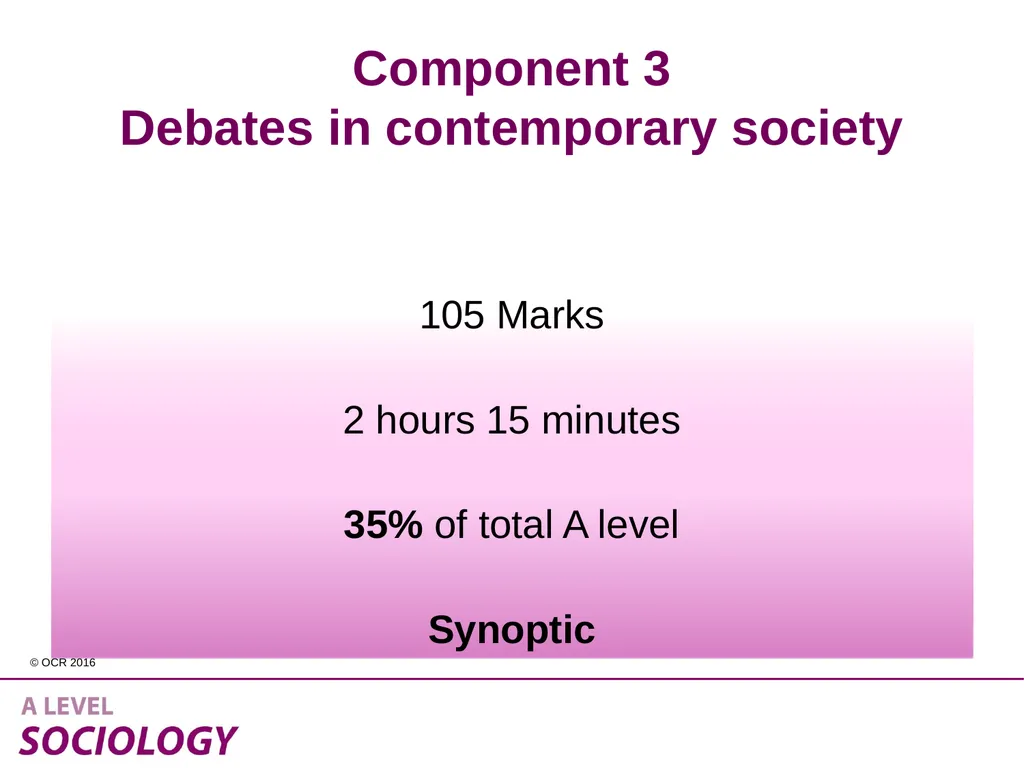
slide4. Component 3 Debates in contemporary society 105 Marks
2 hours 15 minutes
35% of total A level
Synoptic<br>
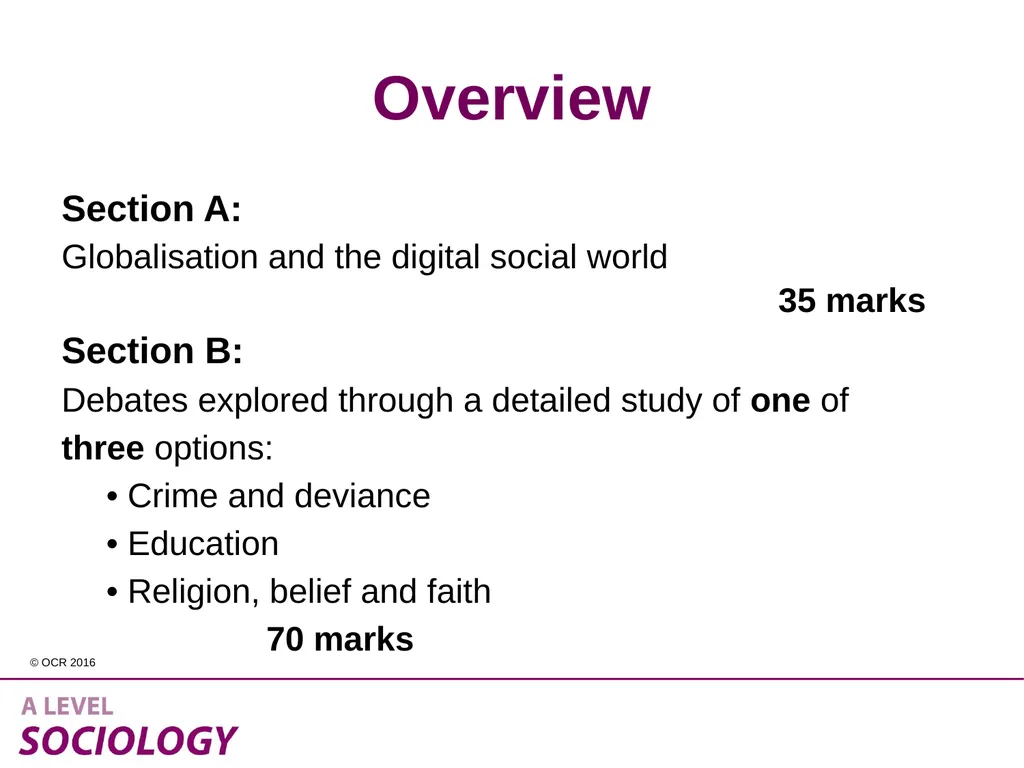
slide5. Overview Section A:
Globalisation and the digital social world
35 marks
Section B:
Debates explored through a detailed study of one of
three options:
• Crime and deviance
• Education
• Religion, belief and faith
70 marks<br>
slide6. Section A:
a starting point<br>
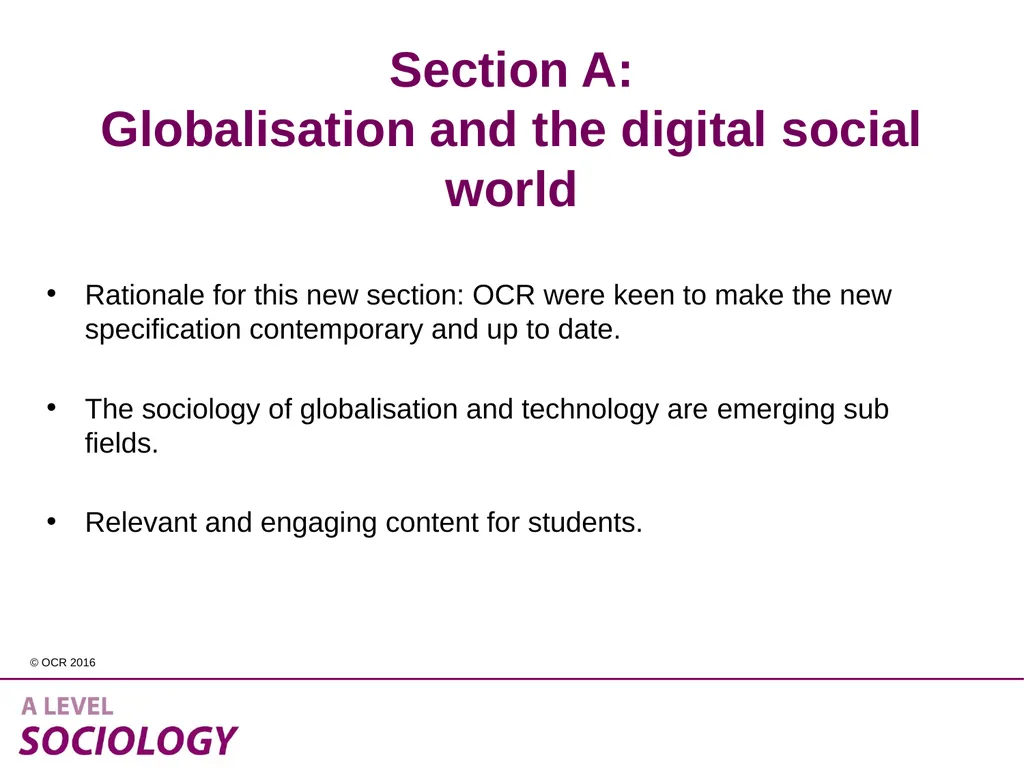
slide7. Section A: Globalisation and the digital social world Rationale for this new section: OCR were keen to make the new specification contemporary and up to date.
The sociology of globalisation and technology are emerging sub fields.
Relevant and engaging content for students.<br>
slide8. A starting point – set the context: Our world has changed! Your students are digital natives unlike the vast majority of us who are still digital immigrants.
This is new sociology ‐ the internet and digital communication is relatively new.
The growth in the internet has been fast – this BBC map just shows the change from 1998 – 2008.
http://news.bbc.co.uk/1/hi/technology/8552410.stm
This has moved on even further in the last 8 years!<br>
slide9. A starting point ‐ set the context: Our world has changed! http://wearesocial.com/uk/special-reports/digital-in-2016<br>
slide10. A starting point ‐ set the context: Our world has changed! Your students are likely to use and know lots
about digital communications
BUT
Have they thought about it from a sociological perspective? As their teacher that’s where you come in!<br>
slide11. The digital social world and sociology The specification asks students to consider digital communications in relation to sociological theory:
Marxism
Feminism
Postmodernism
Also what impact digital communications have had on people (e.g. our relationships, inequalities, our identity) and society.
It is not necessary for students to remember lots of statistics – rather the focus should be on considering the issues involved.<br>
slide12. Key Question 1:
What is the relationship between globalisation and digital forms of
communication?<br>
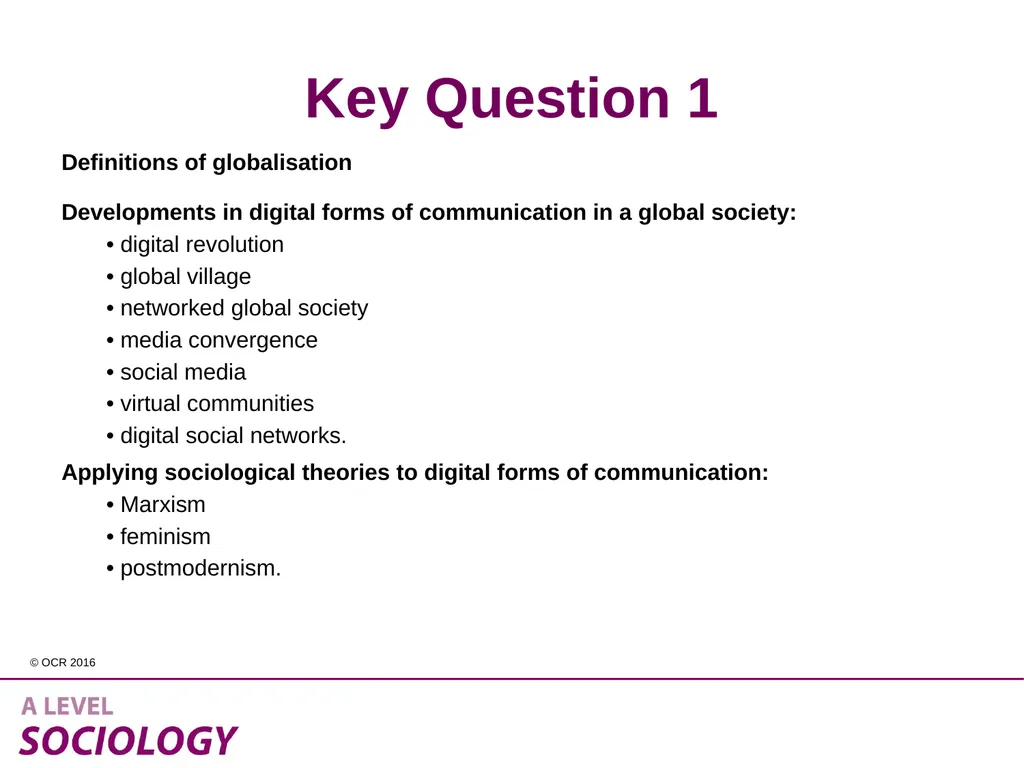
slide13. Key Question 1 Definitions of globalisation
Developments in digital forms of communication in a global society:
• digital revolution
• global village
• networked global society
• media convergence
• social media
• virtual communities
• digital social networks.
Applying sociological theories to digital forms of communication:
• Marxism
• feminism
• postmodernism.<br>
slide14. Globalisation As a starting point, globalisation needs some explaining and contextualising.
Begin by comparing definitions of globalisation and explain which one is best and why (see the OCR Delivery Guide).
You may like to download our podcast scripts and ask students to read these out loud:
Defining globalisation http://www.ocr.org.uk/Images/342389-defining-globalisation-podcast-script.doc
Developments in digital forms of communication in a global society http://www.ocr.org.uk/Images/342345-developments-in-digital-forms-of-communication-in-a-global-society-podcast-script.doc
You can listen to A Level students from an OCR centre reading the ‘Defining globalisation’ podcast at https://audioboom.com/playlists/4585998-ocr-sociology<br>
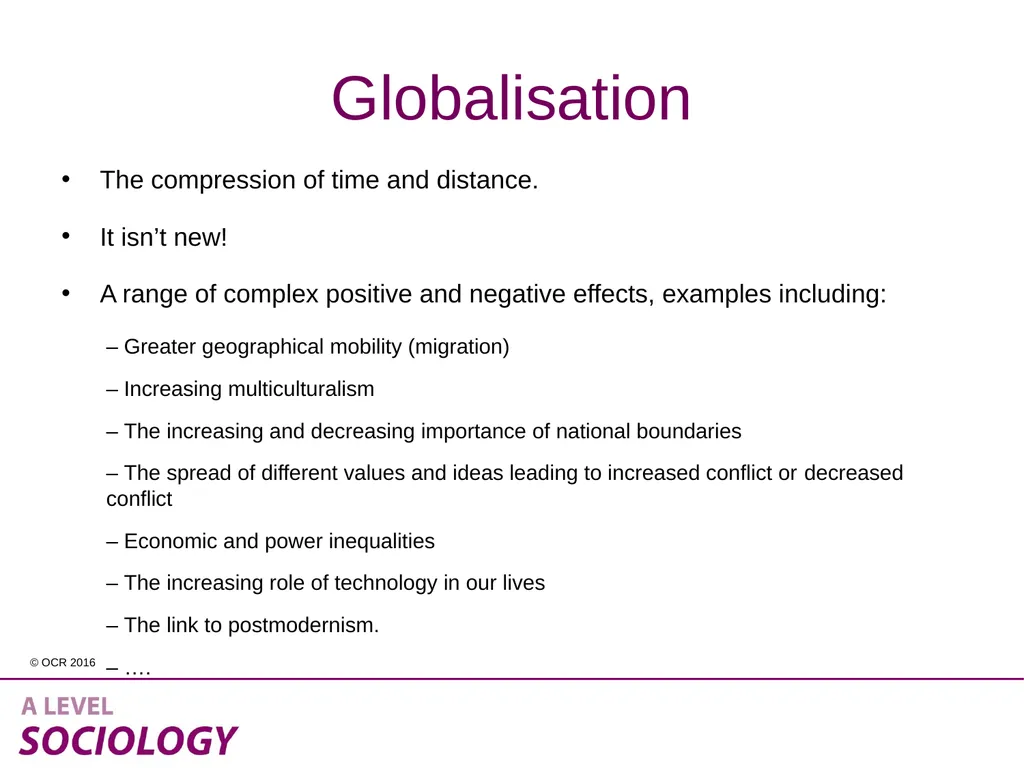
slide15. Globalisation The compression of time and distance.
It isn’t new!
A range of complex positive and negative effects, examples including:
– Greater geographical mobility (migration)
– Increasing multiculturalism
– The increasing and decreasing importance of national boundaries
– The spread of different values and ideas leading to increased conflict or decreased conflict
– Economic and power inequalities
– The increasing role of technology in our lives
– The link to postmodernism.
– ….<br>
slide16. The link between globalisation and the digital social world • Whilst definitions of globalisation need to be considered (and the problems of defining it), remember the focus is on globalisation and the digital social world – recognition that digital communications have contributed to globalisation.
• The emergence of the Internet and digital communications was an important contributing factor in speeding up the process of globalisation.
• “Miles of fiber‐optic cable now connect the continents, allowing people around the world to communicate instantly through the borderless World Wide Web” National Geographic http://education.nationalgeographic.org/encyclopedia/globalization/<br>
slide17. What are digital communications? Communications that occurs via a digital device.
The digital world is changing and evolving quickly so examples of digital communications are likely to change.
For now examples could include text messages, emails, Facebook, WhatsApp, Skype, Facetime, Instagram, Twitter, Linkedin etc.<br>
slide18. Familiarise yourself with key terms Definitions may vary slightly but OCR has provided some broad definitions within student resource 4 of the OCR Delivery Guide.
For example, media convergence the combination of three c’s:
– computing
– communication
– (media) content
www.britannica.com/topic/media-convergence<br>
slide19. Familiarise yourself with key terms Try to use examples to demonstrate concepts, for example virtual communities:
Denise Carter (2005) conducted fieldwork in one particular virtual community known as Cybercity. She spent three and a half years on her fieldwork from September 1999.
Carter visited the community at least once every day. She used a predominantly Western sample and participant observation as a main research method. She also used questionnaires including open and closed questions.<br>
slide20. Familiarise yourself with key terms Virtual communities: student research task idea
Ask students to sign up for an under 18 virtual community e.g. Second Life, Sims.
Ask them to carry out research into what is and what is not possible within the virtual community.
Ask them to consider the impact on the individuals’ real and virtual identity.
Ask them to think about how different theoretical approaches might interpret these virtual communities.<br>
slide21. Theoretical perspectives Broadly how Marxists perceive digital communication:
Technology is material culture, controlled by capitalist organisations and the ruling class. Those who produce it are therefore basing it on their ideas, values, interests, and knowledge.
The internet is dominated by business corporations who see members of virtual communities simply as commodities, gathering and selling their details for profits for anyone who wants it.
Edward Snowden criticises massive companies dominating and monopolising the sphere of social media http://www.independent.co.uk/news/people/edward-snowden-facebook-fake-news-claims-fusion-president-donald-trump-a7422641.html
Ruling class have greater access (can afford the technology and the latest versions, fastest broadband contracts etc).<br>
slide22. Theoretical perspectives Broadly how feminists perceive digital communication:
It can free women as they can be whoever they want to be online.
The internet has emerged as an increasingly important space for feminist activists – it has created a “call out” culture in which sexism and misogyny can be called out and challenged.
Digital media can be a masculine dominated area with men reinforcing gender identities.
Julia Schuster’s work on women’s feminist engagement in New Zealand notes that online activism is often primarily used by the young, and that due to the closed nature of some social networks, feminist discussion is often ‘hidden’ from those who are not sufficiently networked. For Schuster, this may create a divide between young feminists and older activists, as the new wave of feminists unwittingly hide their politics from their older peers.<br>
slide23. Theoretical perspectives Broadly how postmodernists perceive digital communication:
• Offers freedom and choice.
• We live in a media‐saturated society where people respond to media images rather than to real persons or places.
• On social networking sites, we create profiles of ourselves which represent us in the virtual world. We are representing ourselves by making a copy of ourselves for other users to see. Baudrillard calls this a simulacra, a mediated version of our identity. (Durham and Kellner: 2009)<br>
slide24. Key Question 2
What is the impact of digital forms of communication in a global context?<br>
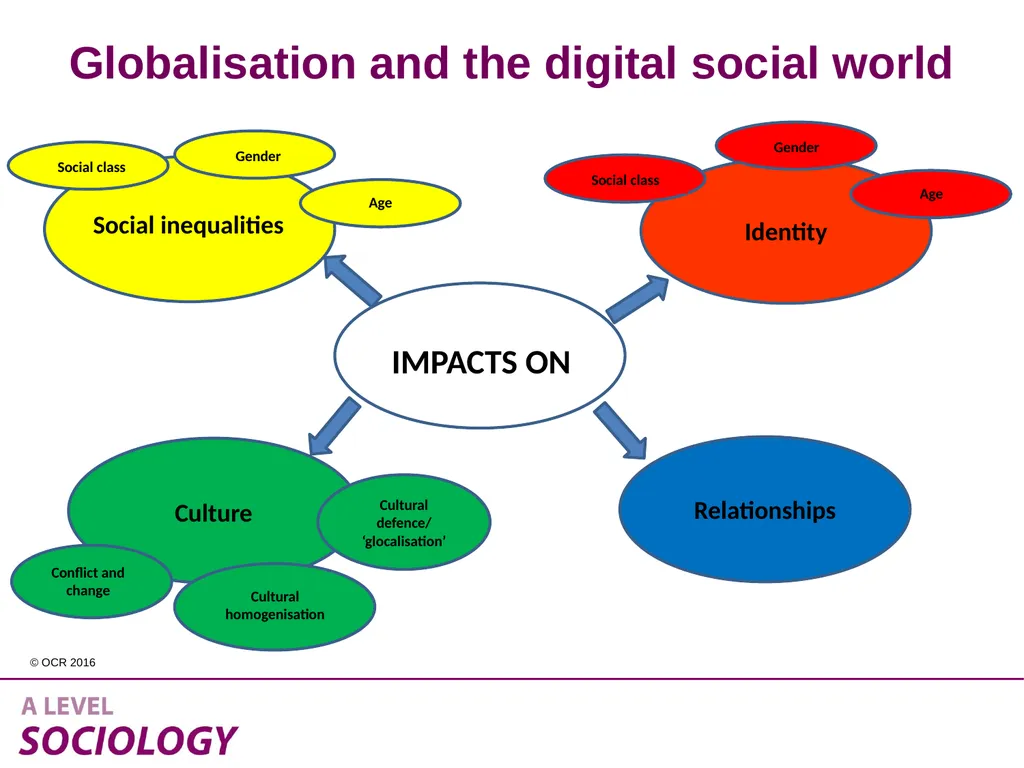
slide25. Globalisation and the digital social world Age Age Conflict and change Cultural homogenisation Cultural defence/ ‘glocalisation’<br>
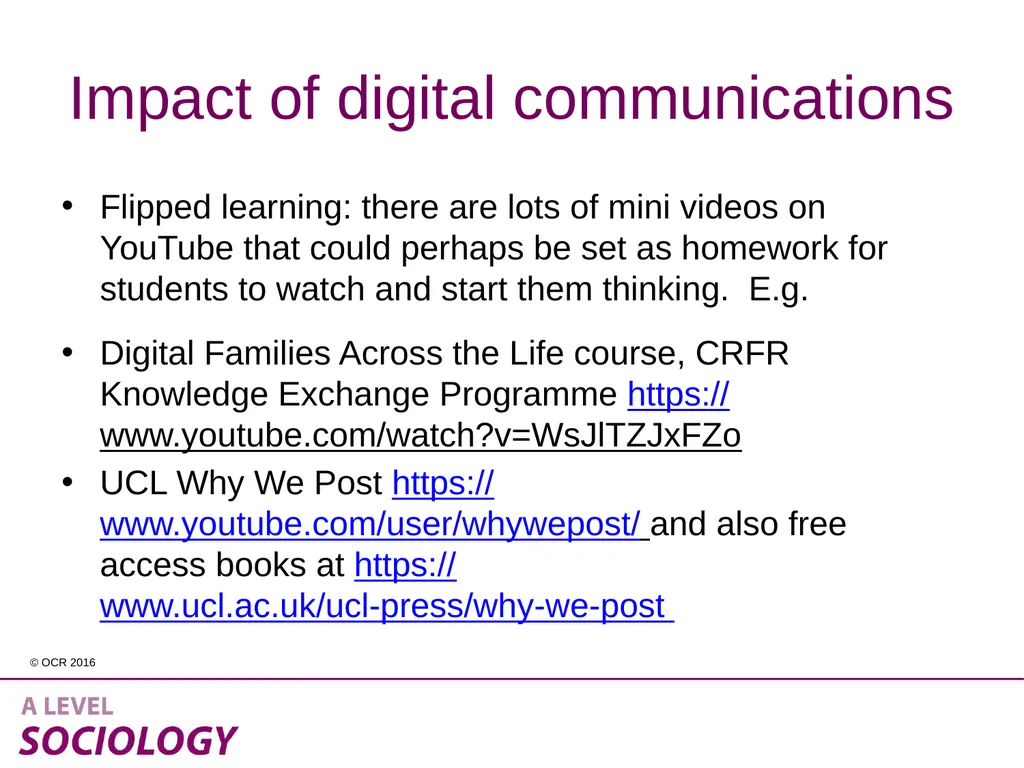
slide26. Impact of digital communications Flipped learning: there are lots of mini videos on YouTube that could perhaps be set as homework for students to watch and start them thinking. E.g.
Digital Families Across the Life course, CRFR Knowledge Exchange Programme https://www.youtube.com/watch?v=WsJlTZJxFZo
UCL Why We Post https://www.youtube.com/user/whywepost/ and also free access books at https://www.ucl.ac.uk/ucl-press/why-we-post<br>
slide27. Impact on people’s identity Positive: some possible general examples below
People are free from their physical bodies and the constraints these may place on people – they can choose their identity and appearance, (e.g. Rosenblatt and Tushnet: 2015).
Can reinforce people’s identity – joining specific online groups with a shared interest. (e.g. http://discoversociety.org/2017/01/03/understanding-twitch-chat-new-forms-of-digital-community-and-play/)
You can reinforce your identity through the writing of blogs.
Opportunity to have a business that can be run from home e.g selling products – can benefit women caring for children at home, the disabled (see case study video on Digital Dividends ‐ http://www.worldbank.org/en/publication/wdr2016
Haraway: 1995 it can free women – a “post gender world”.
‘Google Proposes New Emoji Designs to “Empower Girls Everywhere”(WYSK, May 12 2016) www.womenyoushouldknow.net/google-proposes-new-emoji-designs-empower-girls-everywhere<br>
slide28. Impact on people’s identity Negative: some possible general examples below
What we post/share may be wrongly interpreted and affect how people perceive us.
We know less about people’s identity if we aren’t able to see facial expressions, intonation of voice etc. (Justice T and Jamieson D: 2012).
We can narrow our thinking by only interacting with people who have existing shared views (Bauman: 2016).
Being shaped by capitalist products e.g. phones as a status symbol, targeted advertising.
Your online identity can impact you even when offline (e.g. prospective employers being able to view photos or posts you have made that influence their decision to hire).
Marxists would argue it enables subtle surveillance from which to regulate people. We’re largely unaware of what happens to the information we provide online (e.g. Cornford and Robins: 1999)
Gender differences exist in the use of the internet (Li and Kirkup 2007)
Feminists also argue patriarchal control with increased opportunities for the exploitation of women
Women’s Rights Online Translating Access into Empowerment, World Wide Web Foundation http://webfoundation.org/docs/2015/10/womens-rights-online_Report.pdf
eGirls, eCitizens project https://egirlsproject.ca/ https://www.ruor.uottawa.ca/bitstream/10393/32376/1/9780776622590_WEB.pdf<br>
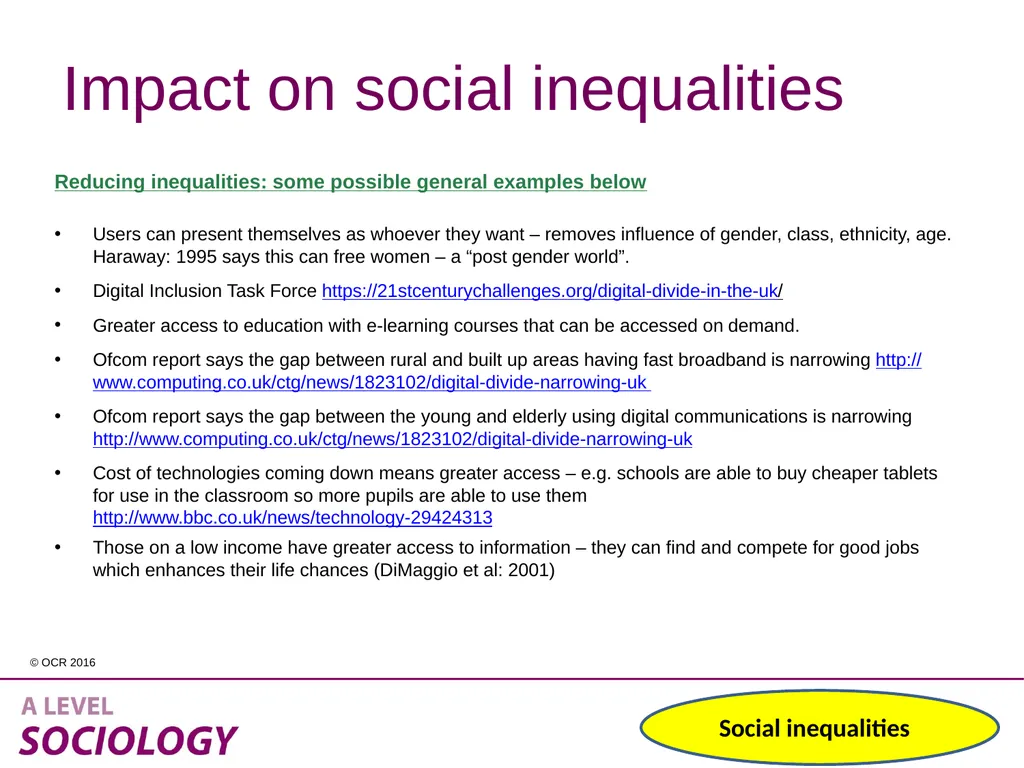
slide29. Impact on social inequalities Reducing inequalities: some possible general examples below
Users can present themselves as whoever they want – removes influence of gender, class, ethnicity, age. Haraway: 1995 says this can free women – a “post gender world”.
Digital Inclusion Task Force https://21stcenturychallenges.org/digital-divide-in-the-uk/
Greater access to education with e‐learning courses that can be accessed on demand.
Ofcom report says the gap between rural and built up areas having fast broadband is narrowing http://www.computing.co.uk/ctg/news/1823102/digital-divide-narrowing-uk
Ofcom report says the gap between the young and elderly using digital communications is narrowing http://www.computing.co.uk/ctg/news/1823102/digital-divide-narrowing-uk
Cost of technologies coming down means greater access – e.g. schools are able to buy cheaper tablets for use in the classroom so more pupils are able to use them http://www.bbc.co.uk/news/technology-29424313
Those on a low income have greater access to information – they can find and compete for good jobs which enhances their life chances (DiMaggio et al: 2001)<br>
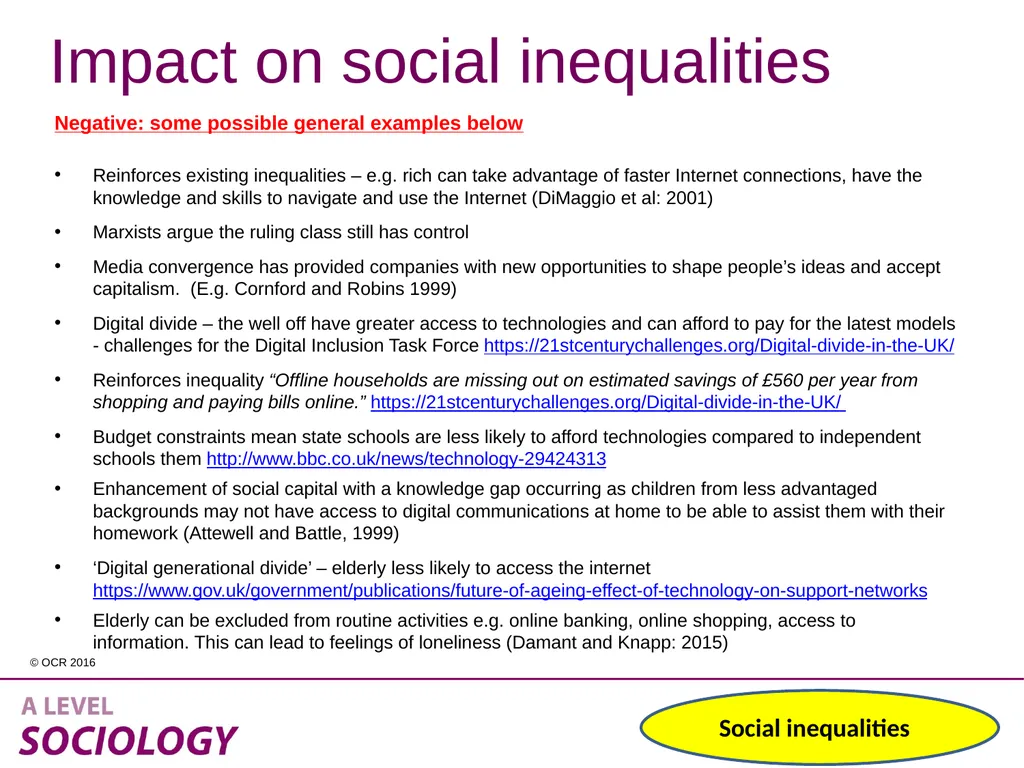
slide30. Impact on social inequalities Negative: some possible general examples below
Reinforces existing inequalities – e.g. rich can take advantage of faster Internet connections, have the knowledge and skills to navigate and use the Internet (DiMaggio et al: 2001)
Marxists argue the ruling class still has control
Media convergence has provided companies with new opportunities to shape people’s ideas and accept capitalism. (E.g. Cornford and Robins 1999)
Digital divide – the well off have greater access to technologies and can afford to pay for the latest models ‐ challenges for the Digital Inclusion Task Force https://21stcenturychallenges.org/Digital-divide-in-the-UK/
Reinforces inequality “Offline households are missing out on estimated savings of £560 per year from shopping and paying bills online.” https://21stcenturychallenges.org/Digital-divide-in-the-UK/
Budget constraints mean state schools are less likely to afford technologies compared to independent schools them http://www.bbc.co.uk/news/technology-29424313
Enhancement of social capital with a knowledge gap occurring as children from less advantaged backgrounds may not have access to digital communications at home to be able to assist them with their homework (Attewell and Battle, 1999)
‘Digital generational divide’ – elderly less likely to access the internet https://www.gov.uk/government/publications/future-of-ageing-effect-of-technology-on-support-networks
Elderly can be excluded from routine activities e.g. online banking, online shopping, access to information. This can lead to feelings of loneliness (Damant and Knapp: 2015)<br>
slide31. Impact on social inequalities Flipped learning idea – ask students to read the article from the Guardian before beginning a lesson looking at whether digital communications have an impact of social inequalities
https://www.theguardian.com/technology/2016/jan/13/internet‐not‐conquered‐digital‐divide‐rich‐poor‐world‐bank‐report
OCR Lesson Element http://www.ocr.org.uk/Images/179499‐the‐impact‐of‐digital‐forms‐of‐communication‐onsocial‐inequality‐activity‐teacher‐instructions‐.pdf and http://www.ocr.org.uk/qualifications/as‐a‐level‐gce‐sociology‐h180‐h580‐from‐2015/ Social inequalities<br>
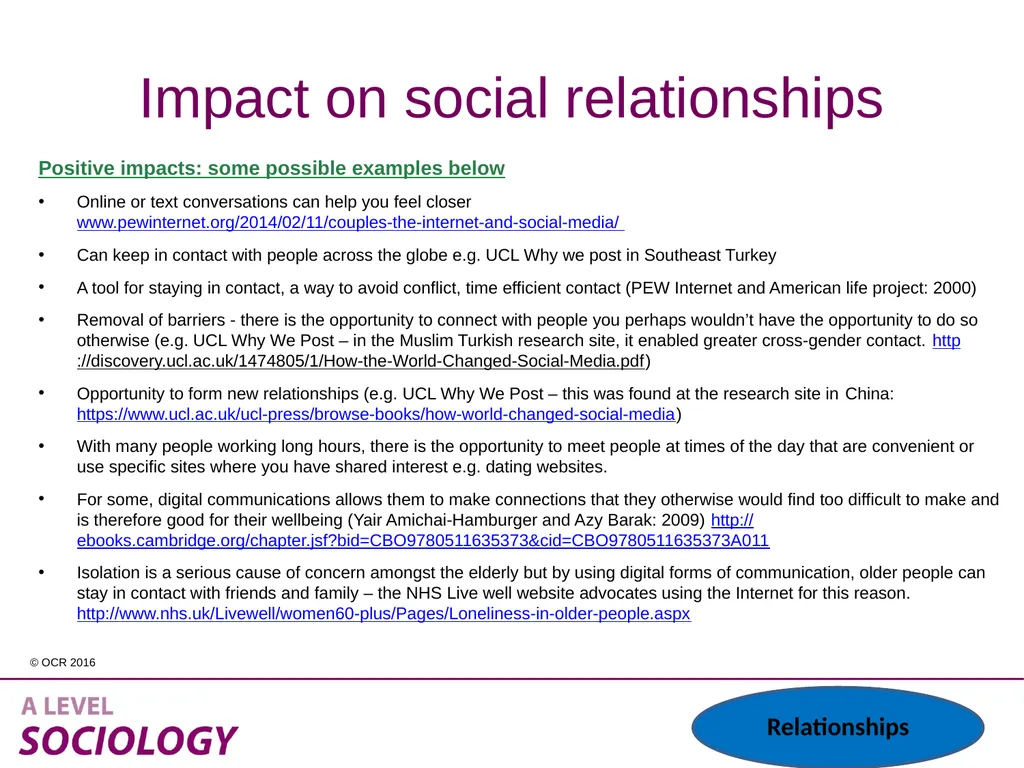
slide32. Impact on social relationships Positive impacts: some possible examples below
Online or text conversations can help you feel closer www.pewinternet.org/2014/02/11/couples-the-internet-and-social-media/
Can keep in contact with people across the globe e.g. UCL Why we post in Southeast Turkey
A tool for staying in contact, a way to avoid conflict, time efficient contact (PEW Internet and American life project: 2000)
Removal of barriers ‐ there is the opportunity to connect with people you perhaps wouldn’t have the opportunity to do so otherwise (e.g. UCL Why We Post – in the Muslim Turkish research site, it enabled greater cross‐gender contact. http://discovery.ucl.ac.uk/1474805/1/How‐the‐World‐Changed‐Social‐Media.pdf)
Opportunity to form new relationships (e.g. UCL Why We Post – this was found at the research site in China: https://www.ucl.ac.uk/ucl‐press/browse‐books/how‐world‐changed‐social‐media)
With many people working long hours, there is the opportunity to meet people at times of the day that are convenient or use specific sites where you have shared interest e.g. dating websites.
For some, digital communications allows them to make connections that they otherwise would find too difficult to make and is therefore good for their wellbeing (Yair Amichai‐Hamburger and Azy Barak: 2009) http://ebooks.cambridge.org/chapter.jsf?bid=CBO9780511635373&cid=CBO9780511635373A011
Isolation is a serious cause of concern amongst the elderly but by using digital forms of communication, older people can stay in contact with friends and family – the NHS Live well website advocates using the Internet for this reason. http://www.nhs.uk/Livewell/women60-plus/Pages/Loneliness-in-older-people.aspx<br>
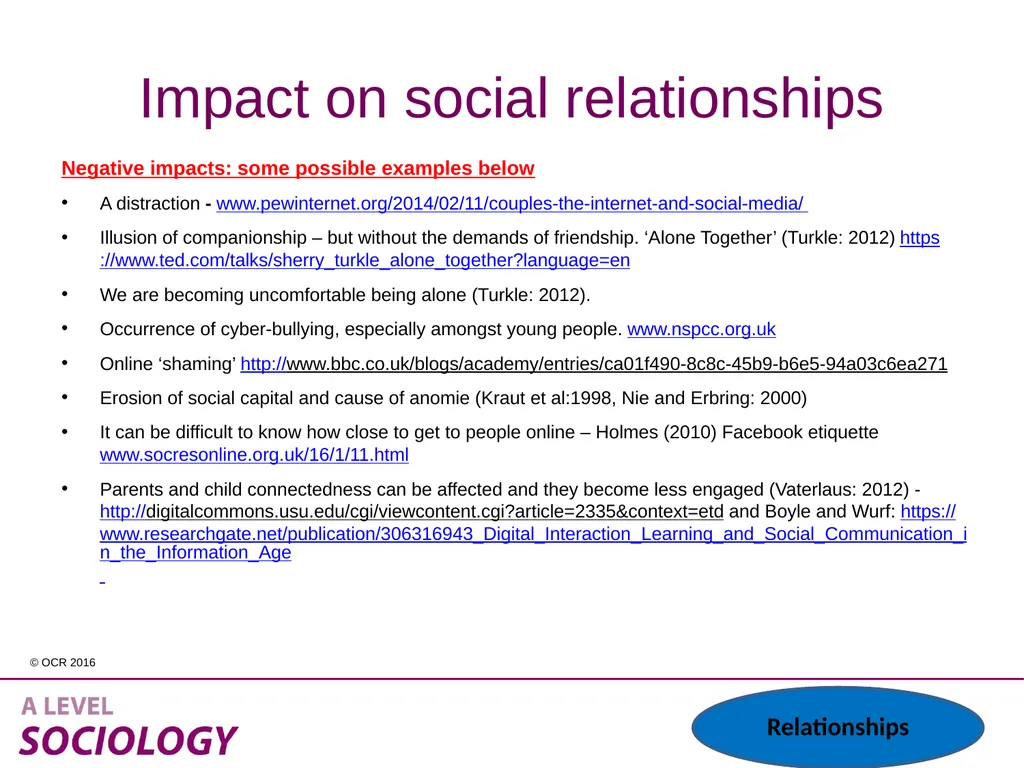
slide33. Impact on social relationships Negative impacts: some possible examples below
A distraction - www.pewinternet.org/2014/02/11/couples-the-internet-and-social-media/
Illusion of companionship – but without the demands of friendship. ‘Alone Together’ (Turkle: 2012) https://www.ted.com/talks/sherry_turkle_alone_together?language=en
We are becoming uncomfortable being alone (Turkle: 2012).
Occurrence of cyber‐bullying, especially amongst young people. www.nspcc.org.uk
Online ‘shaming’ http://www.bbc.co.uk/blogs/academy/entries/ca01f490-8c8c-45b9-b6e5-94a03c6ea271
Erosion of social capital and cause of anomie (Kraut et al:1998, Nie and Erbring: 2000)
It can be difficult to know how close to get to people online – Holmes (2010) Facebook etiquette www.socresonline.org.uk/16/1/11.html
Parents and child connectedness can be affected and they become less engaged (Vaterlaus: 2012) ‐ http://digitalcommons.usu.edu/cgi/viewcontent.cgi?article=2335&context=etd and Boyle and Wurf: https://www.researchgate.net/publication/306316943_Digital_Interaction_Learning_and_Social_Communication_in_the_Information_Age<br>
slide34. Impact on social relationships OCR Lesson Element on social relationships and social media
http://www.ocr.org.uk/Images/163794-social-relationships-and-social-media-activity.docx
and
http://www.ocr.org.uk/Images/163793-social-relationships-and-social-media-activity-teacher-instructions.pdf<br>
slide35. Impact on culture This is a chance to consolidate component 1 content on socialisation, culture and identity:
E.g. Global culture, cultural hybridity.<br>
slide36. Impact on culture: Conflict and change Some possible examples
Religious fundamentalist groups rely on technology to spread their message yet seek to return to ‘traditional’ ways of life.
Political parties now using social media for their campaigns, for example ‘Welcome to the social media election that never was’ written by David Fletcher in the Guardian Newspaper on 27 April 2015
Ability to start revolutions:
Protests in Ukraine https://www.washingtonpost.com/blogs/monkey‐cage/wp/2014/01/02/social‐networks‐and‐social‐media‐in‐ukrainianeuromaidan‐protests‐2
Arab uprising: see the OCR Lesson Element on social relationships and social media http://www.ocr.org.uk/Images/163793-social-relationships-and-social-media-activity-teacher-instructions.pdf and http://www.ocr.org.uk/Images/163794‐social‐relationships‐and‐social‐mediaactivity.doc<br>
slide37. Impact on culture: Cultural homogenisation Developed world dominates the generation and use of digital communications, spreading their ideas and influencing non‐western culture. E.g. English is the main language used for internet content.
Western ideas might include: capitalism, patriarchy, consumerism and secularisation (useful links to Marxism and feminism).
Leads to a lack of cultural diversity.<br>
slide38. Impact on culture: Cultural defence/’glocalisation’ In response to the spread of Western ideas, a separate process of culture defence is taking place. This is when local cultures are promoted/resist the take over of ideas.
Interesting ways in which new forms of social media are being used to highlight issues of social injustice. E.g. Tribal network, lobby groups on Facebook.
Examples of how new forms of communication are being used to protect and promote local practices.
Web used to find out about local events/community news/organisations etc. http://www.pewinternet.org/2001/10/31/online-communities/
Local events and meetings organised via social networks and community blogs e.g. Bournvillevillage.com in Birmingham.
UCL Why We Post examples from Italy, Turkey and Brazil: https://www.ucl.ac.uk/why-we-post/discoveries<br>
slide39. References Amichai‐Hamburger, A (2009) Technology and Psychological Well‐being, Cambridge: Cambridge University Press https://www.cambridge.org/core/books/technology-and-psychological-well-being/6E159275952CBAA6E75DB6F969D12E4D
Attewell P. Battle J. 1999 Home computers and school performance. Info. Soc. 15:1-10
Bailey J and Steeves V (2015) eGirls, eCitizens: Putting Technology, Theory and Policy into Dialogue with Girls’ and Young Women’s Voices, Canada: University of Ottawa Press https://egirlsproject.ca/
Baudrillard J. (1991) The Gulf Ward did not take place, Indiana University Press, USA
Bauman, Z (2016), “Social media are a trap”, El Pais in English http://elpais.com/elpais/2016/01/19/inenglish/1453208692_424660.html
Boyle, C and Wurf G: Digital Interaction: Learning and social communication in the information age www.researchgate.net/publication/306316943_Digital_Interaction_Learning_and_Social_Communication_in_the_Information_Age
Cornford, J and Robins, ‘New Media’ in The Media in Britain, eds Jane Stokes and Anna Reading, London: Palgrave, 1999
Damant J and Knapp M (2015) What are the likely changes in society and technology which will impact upon the ability of older adults to maintain social (extra‐familial) networks of support now, in 2025 and 2040 via www.gov.uk published 7 August 2015
DiMaggio P, Hargittai E, Neuman WR, Robinson P, (2001) Social Implications of the Internet, Annual Review of Sociology, Vol. 27 pp307-336 www.jstor.org/stable/2678624
Durham G and Kellner D (2006) Media and Cultural Studies, Oxford:Blackwell Publishing
Haraway D (1985) A Cyborg Manifesto: Science, Technology, and Socialist‐Feminism in the Late Twentieth Century published in :‐
Haraway D (1991) Simians, Cyborgs and Women: The Reinvention of Nature Part V: The Postmodern Turn and New Media, Oxon: Routledge
Holmes, M (2011) Emotional Reflexivity in Contemporary Friendships: Understanding It Using Elias and Facebook Etiquette, Sociological Research Online, 16 (1) 11 www.socresonline.org.uk/16/1/11.html
Justice T and Jamieson D (2012) The Facilitator’s Fieldbook – Section V Facilitating in a Virtual World: page 387 AMACOM
Kraut R, Patterson M, Lundmark V, Kiesler S, Mukhophadhyay T, Scherlis W, 1999 Internet paradox: A social technology that reduces social involvement and psychological well-being? Am. Psychol. 53:1011031 http://kraut.hciresearch.org/sites/kraut.hciresearch.org/files/articles/kraut98-InternetParadox.pdf
Nie NH, Ebring L, 2000, Internet and society: A Preliminary Report. Stanford, CA; Institute for the Quantitative Study of Society
PEW Internet and American Life Project (2000, May 10) Tracking online life: How women use the Internet to cultivate relationships with family and friends. Online Internet Life Report www.pewinternet.org/2000/05/10/tracking-online-life-how-women-use-the-internet-to-cultivate-relationships-with-family-and-friends/
Rosenblatt E and Tushnet R (2015) Transformative Works: Young Women’s Voice on Fandom and Fair Use, in Bailey J and Steeves V(2015) eGirls, eCitizens: Putting Technology, Theory and Policy into Dialogue with Girls’ and Young Women’s Voices, Canada: University of Ottawa Press
Schuster J (2013) Invisible feminists? Social media and young women’s political participation, Political Science vol. 65 no. 1 8‐24 http://pnz.sagepub.com/content/65/1/8.short?rss=1&ssource=mfr
Turkle, S (2012) Alone Together: www.alonetogetherbook.com/ or www.ted.com/talks/sherry_turkle_alone_together?language=en
UCL Why we Post: www.ucl.ac.uk/why-we-post/discoveries
Vaterlaus, J (2012) Late Adolescents’ Perceptions of a Digital Generation Gap and Perceived Parent Child Relations, Utah State University http://digitalcommons.usu.edu/cgi/viewcontent.cgi?article=2335&context=etd<br>
slide40. Assessment of Section A<br>
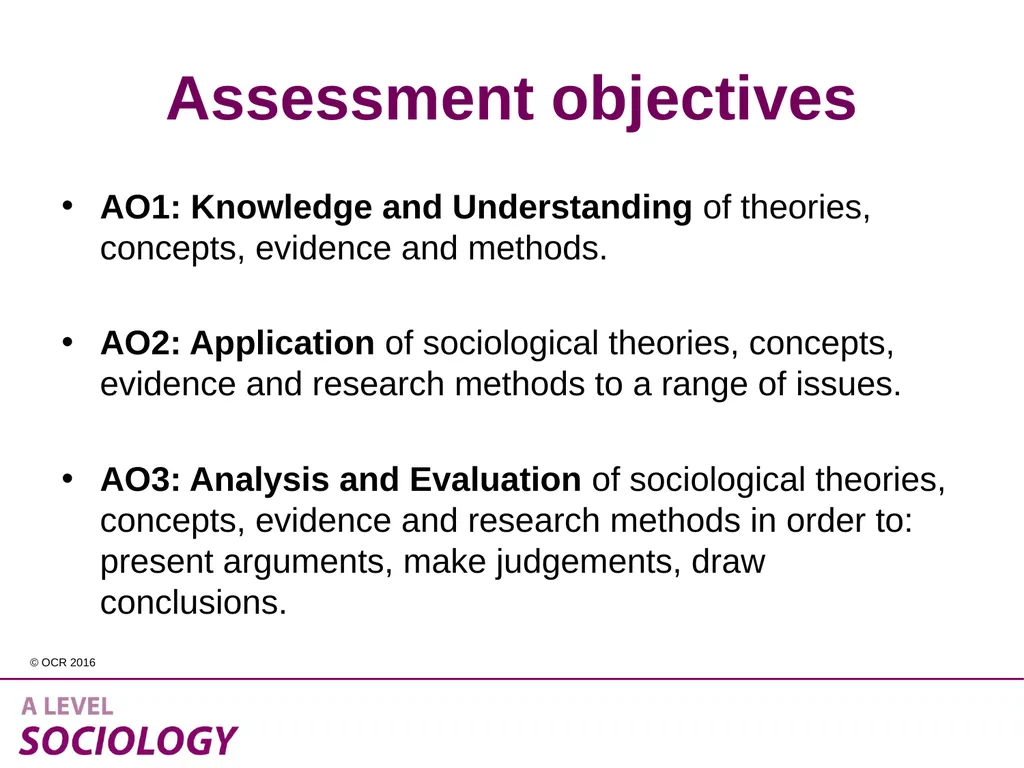
slide41. Assessment objectives AO1: Knowledge and Understanding of theories, concepts, evidence and methods.
AO2: Application of sociological theories, concepts, evidence and research methods to a range of issues.
AO3: Analysis and Evaluation of sociological theories, concepts, evidence and research methods in order to: present arguments, make judgements, draw conclusions.<br>
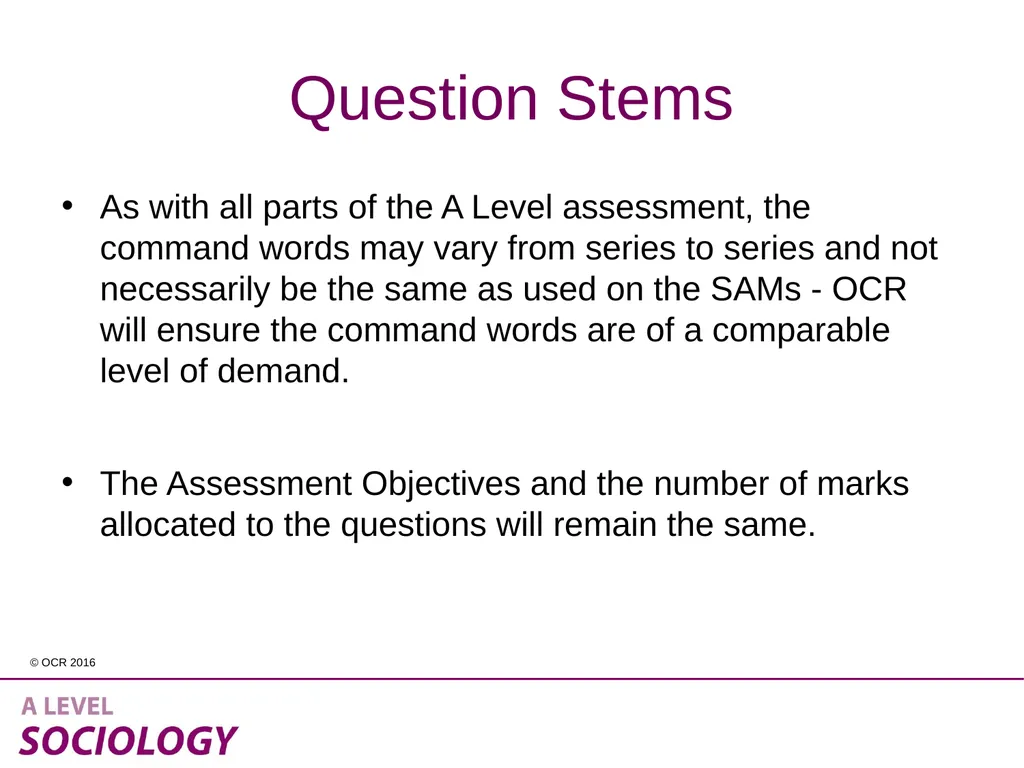
slide42. Question Stems As with all parts of the A Level assessment, the command words may vary from series to series and not necessarily be the same as used on the SAMs ‐ OCR will ensure the command words are of a comparable level of demand.
The Assessment Objectives and the number of marks allocated to the questions will remain the same.<br>
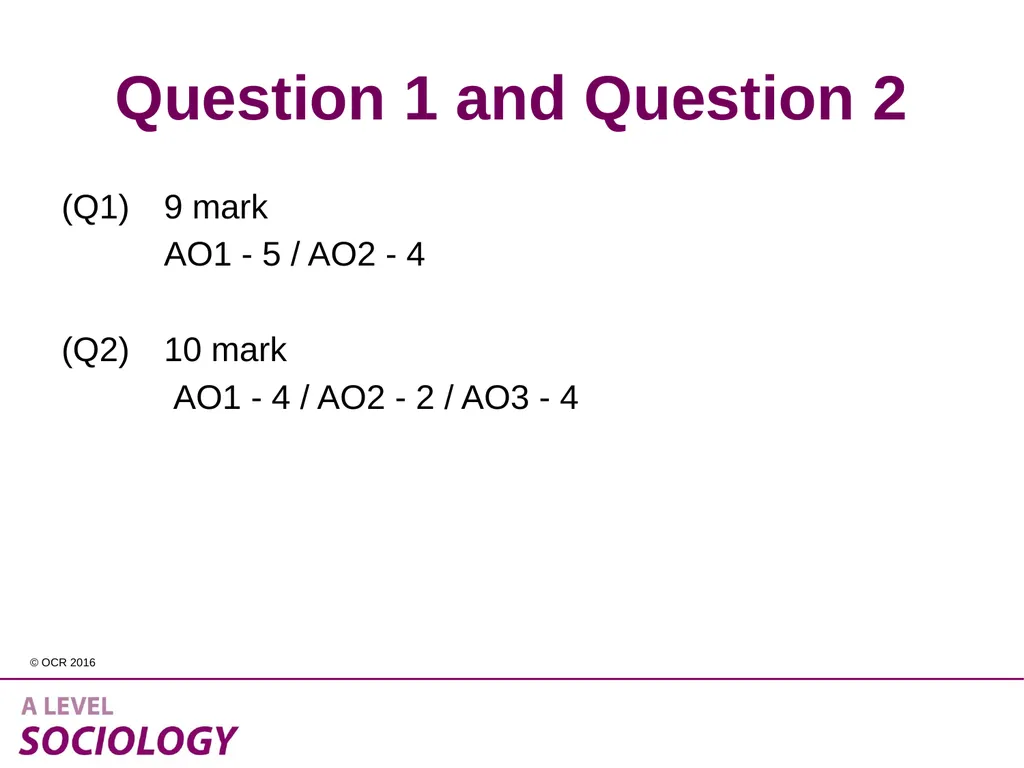
slide43. Question 1 and Question 2 (Q1) 9 mark
AO1 ‐ 5 / AO2 ‐ 4
(Q2) 10 mark
AO1 ‐ 4 / AO2 - 2 / AO3 ‐ 4<br>
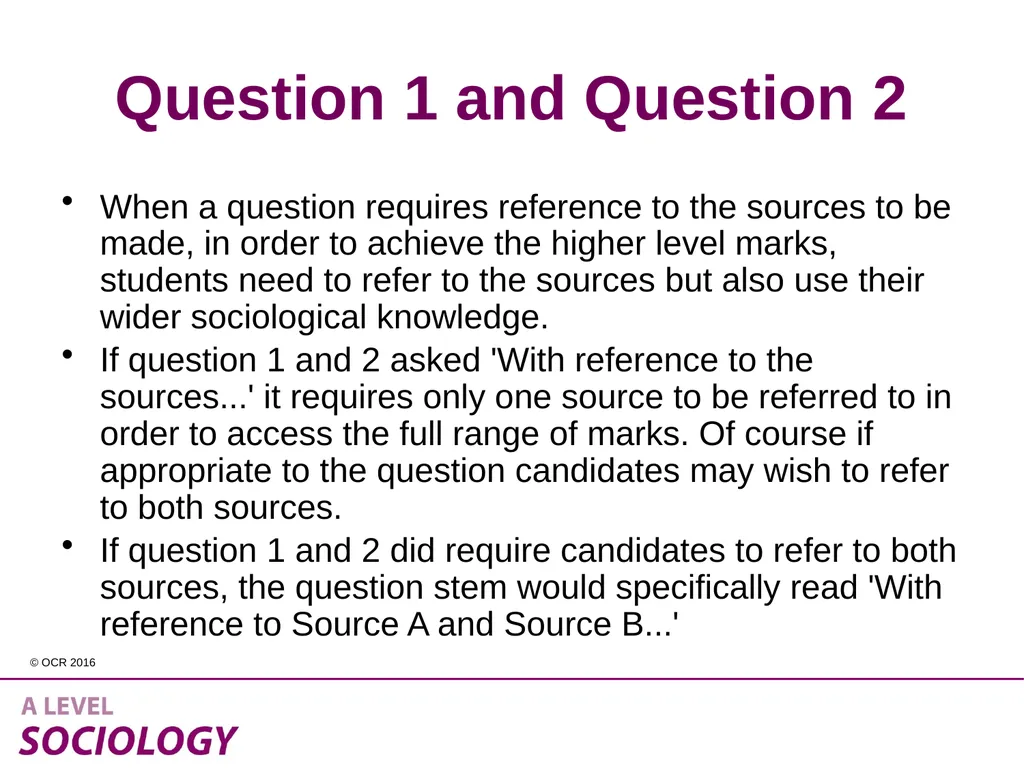
slide44. Question 1 and Question 2 When a question requires reference to the sources to be made, in order to achieve the higher level marks, students need to refer to the sources but also use their wider sociological knowledge.
If question 1 and 2 asked 'With reference to the sources...' it requires only one source to be referred to in order to access the full range of marks. Of course if appropriate to the question candidates may wish to refer to both sources.
If question 1 and 2 did require candidates to refer to both sources, the question stem would specifically read 'With reference to Source A and Source B...'<br>
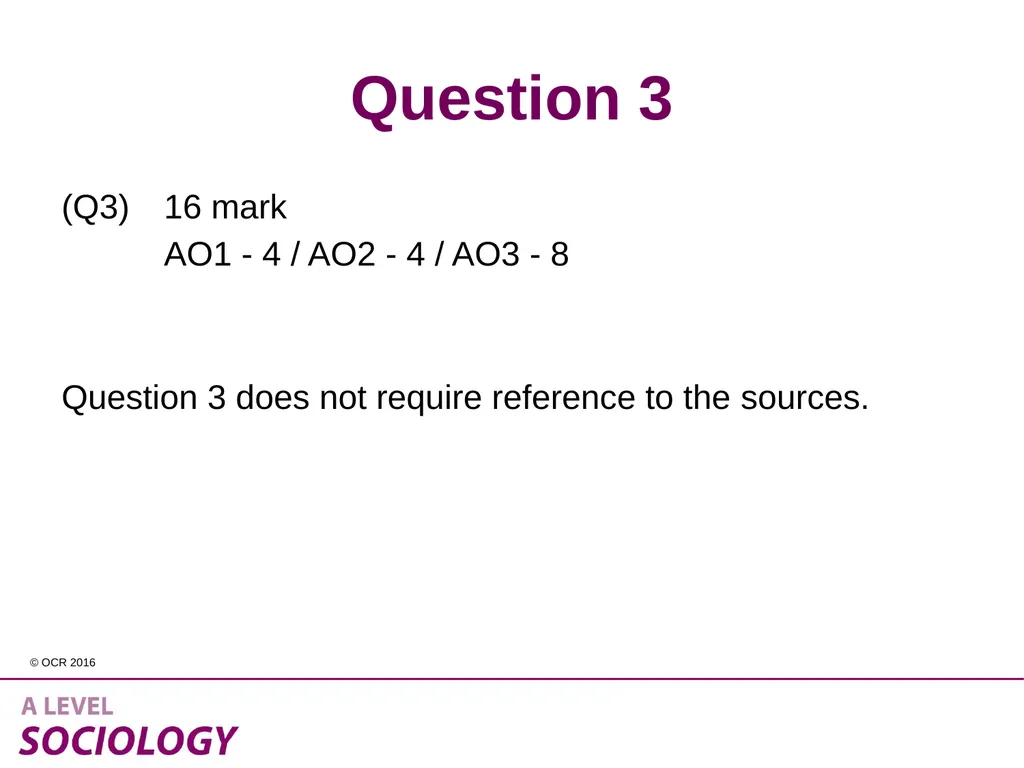
slide45. Question 3 (Q3) 16 mark
AO1 ‐ 4 / AO2 ‐ 4 / AO3 ‐ 8
Question 3 does not require reference to the sources.<br>
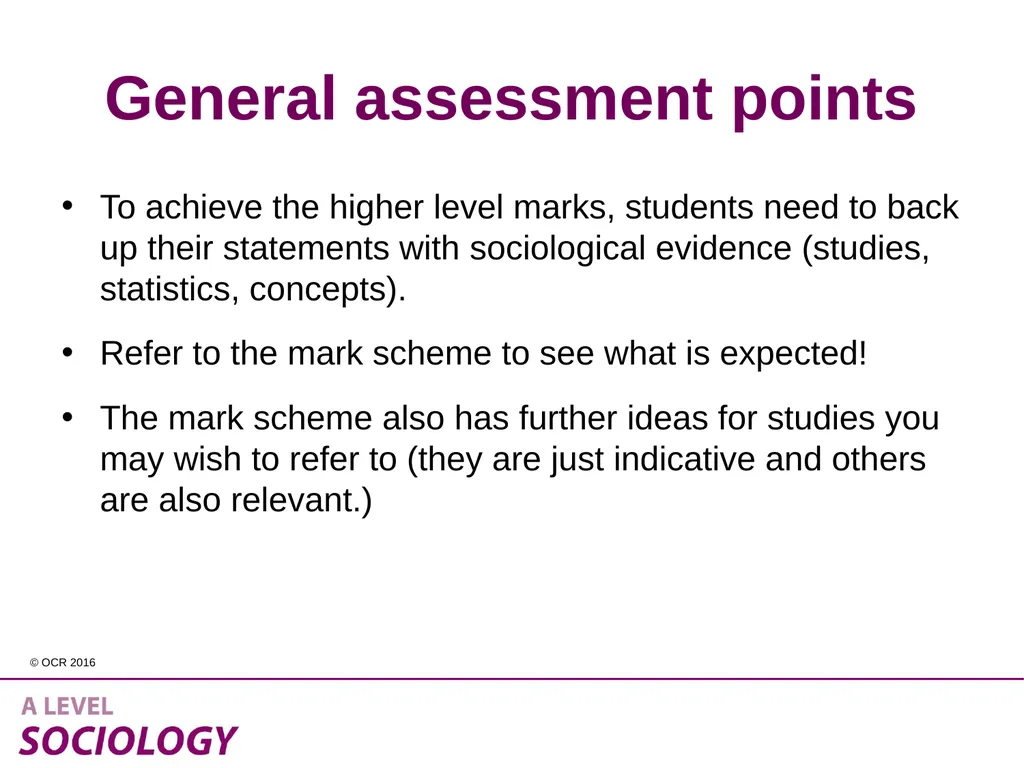
slide46. General assessment points To achieve the higher level marks, students need to back up their statements with sociological evidence (studies, statistics, concepts).
Refer to the mark scheme to see what is expected!
The mark scheme also has further ideas for studies you may wish to refer to (they are just indicative and others are also relevant.)<br>
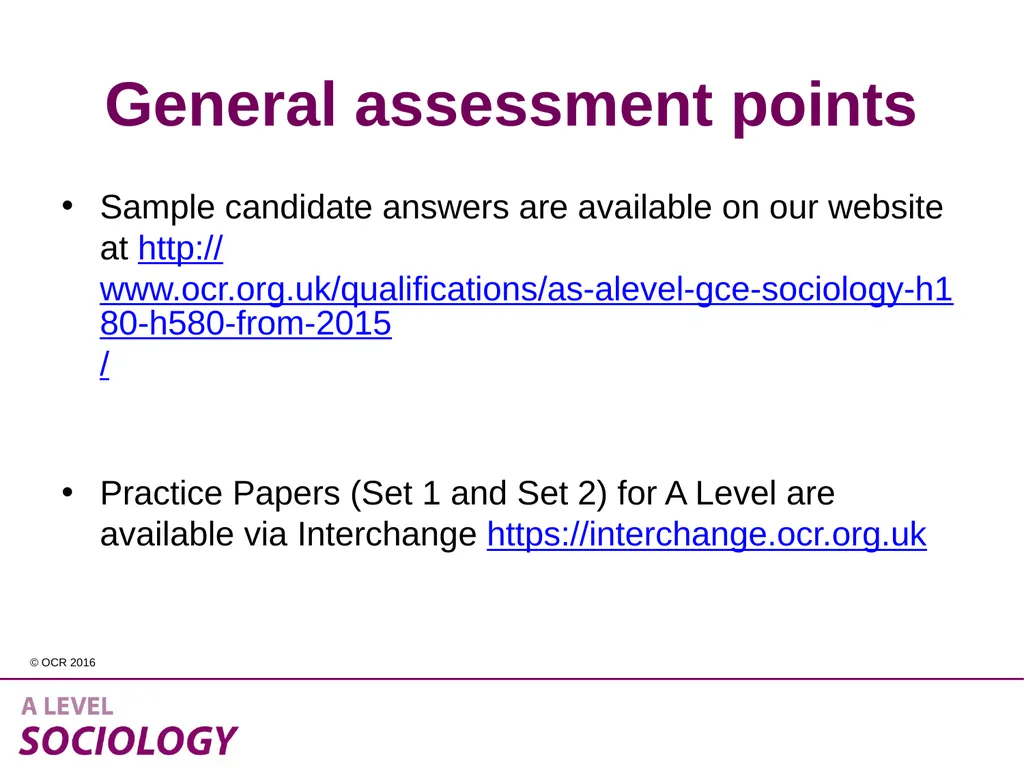
slide47. General assessment points Sample candidate answers are available on our website at http://www.ocr.org.uk/qualifications/as‐alevel‐gce‐sociology‐h180‐h580‐from‐2015/
Practice Papers (Set 1 and Set 2) for A Level are available via Interchange https://interchange.ocr.org.uk<br>
slide48. Global perspective within Section B<br>
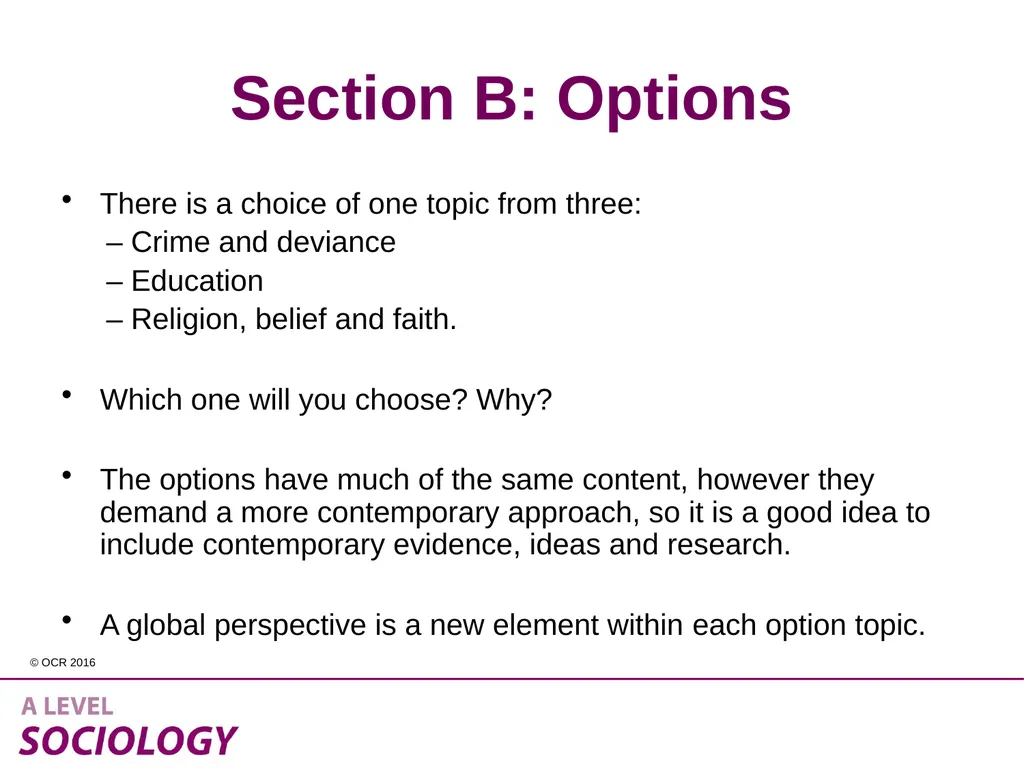
slide49. Section B: Options There is a choice of one topic from three:
– Crime and deviance
– Education
– Religion, belief and faith.
Which one will you choose? Why?
The options have much of the same content, however they demand a more contemporary approach, so it is a good idea to include contemporary evidence, ideas and research.
A global perspective is a new element within each option topic.<br>
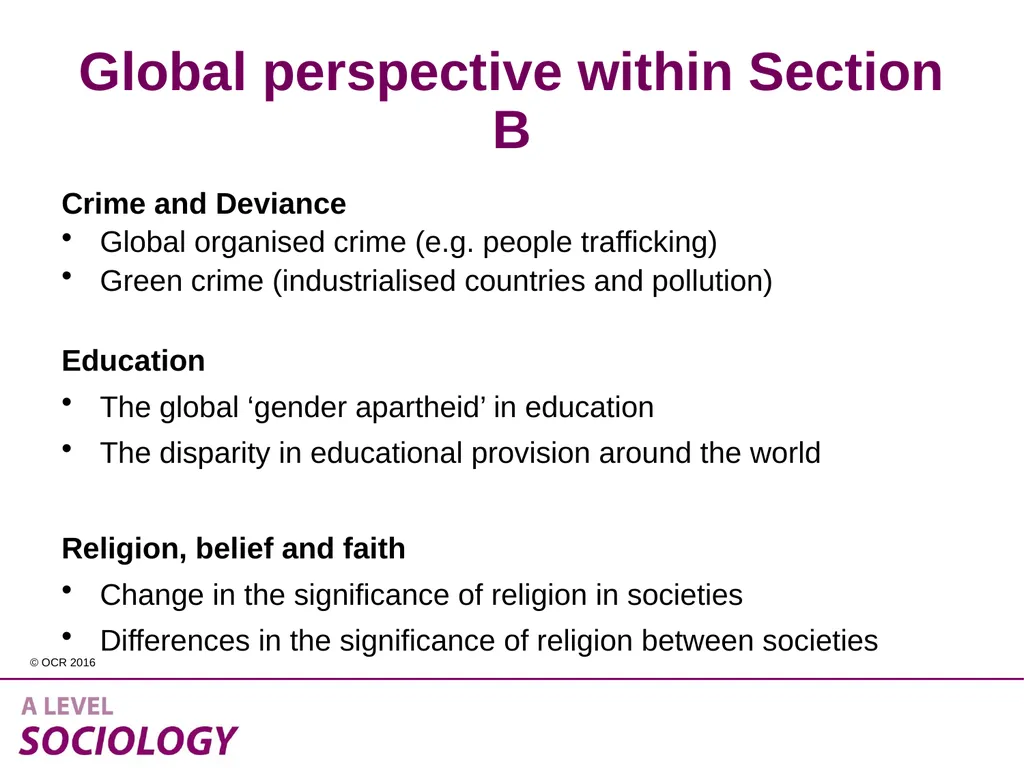
slide50. Global perspective within Section B Crime and Deviance
Global organised crime (e.g. people trafficking)
Green crime (industrialised countries and pollution)
Education
The global ‘gender apartheid’ in education
The disparity in educational provision around the world
Religion, belief and faith
Change in the significance of religion in societies
Differences in the significance of religion between societies<br>
slide51. What next?<br>
slide52. Hopefully you’ve found this resource useful and you are feeling excited about delivering this new content!
Remember we also have the Delivery Guide to support your teaching http://www.ocr.org.uk/qualifications/as-a-level-gce-sociology-h180-h580-from-2015/
Join the discussion! Perhaps you might like to share your plans and ideas further with other OCR sociology teachers? Perhaps you have further questions? Why not post a message on the OCR Sociology eCommunity
http://social.ocr.org.uk/groups/sociology What next?<br>
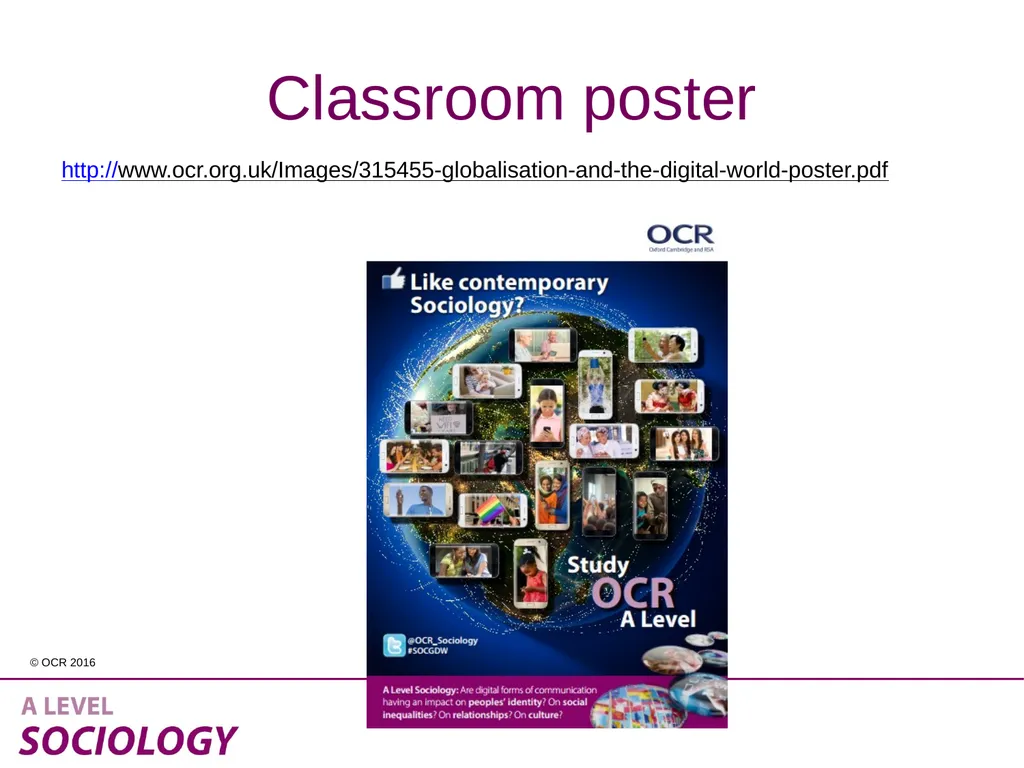
slide53. Classroom poster http://www.ocr.org.uk/Images/315455-globalisation-and-the-digital-world-poster.pdf<br>
slide54. OCR Resources: the small print OCR’s resources are provided to support the teaching of OCR specifications, but in no way constitute an endorsed teaching method that is required by the Board, and the decision to use them lies with the individual teacher. Whilst every effort is made to ensure the accuracy of the content, OCR cannot be held responsible for any errors or omissions within these resources. © OCR 2016 - This resource may be freely copied and distributed, as long as the OCR logo and this message remain intact and OCR is acknowledged as the originator of this work.
OCR acknowledges the use of the following content: Slide 3: Global digital snapshot - http://wearesocial.com/uk/special‐reports/digital‐in‐2016
Please get in touch if you want to discuss the accessibility of resources we offer to support delivery of our qualifications: resources.feedback@ocr.org.uk<br>
the digital social world A self–study presentation<br>
slide2. GCE Overview Our practical and exciting AS and A Level courses have been developed after feedback from teachers, higher education and other key stakeholders.
The content has been designed to inspire, nurture and develop students.
The most popular aspects of our current AS and A Level courses have been retained or enhanced with a stronger global dimension to reflect society today, and a focus on key sociological themes.<br>
slide3. Purpose of this resource We’ve put these slides together for you to digest in your own time as you plan to deliver this section of the A Level specification.
There are a number of possible examples/studies given in this resource which you may, or may not, wish to use. The studies we’ve included are in no way ‘required’ nor have we provided an exhaustive list. With increasing amounts of new research and evidence being published, this is merely designed to be a helpful starting point!<br>
slide4. Component 3 Debates in contemporary society 105 Marks
2 hours 15 minutes
35% of total A level
Synoptic<br>
slide5. Overview Section A:
Globalisation and the digital social world
35 marks
Section B:
Debates explored through a detailed study of one of
three options:
• Crime and deviance
• Education
• Religion, belief and faith
70 marks<br>
slide6. Section A:
a starting point<br>
slide7. Section A: Globalisation and the digital social world Rationale for this new section: OCR were keen to make the new specification contemporary and up to date.
The sociology of globalisation and technology are emerging sub fields.
Relevant and engaging content for students.<br>
slide8. A starting point – set the context: Our world has changed! Your students are digital natives unlike the vast majority of us who are still digital immigrants.
This is new sociology ‐ the internet and digital communication is relatively new.
The growth in the internet has been fast – this BBC map just shows the change from 1998 – 2008.
http://news.bbc.co.uk/1/hi/technology/8552410.stm
This has moved on even further in the last 8 years!<br>
slide9. A starting point ‐ set the context: Our world has changed! http://wearesocial.com/uk/special-reports/digital-in-2016<br>
slide10. A starting point ‐ set the context: Our world has changed! Your students are likely to use and know lots
about digital communications
BUT
Have they thought about it from a sociological perspective? As their teacher that’s where you come in!<br>
slide11. The digital social world and sociology The specification asks students to consider digital communications in relation to sociological theory:
Marxism
Feminism
Postmodernism
Also what impact digital communications have had on people (e.g. our relationships, inequalities, our identity) and society.
It is not necessary for students to remember lots of statistics – rather the focus should be on considering the issues involved.<br>
slide12. Key Question 1:
What is the relationship between globalisation and digital forms of
communication?<br>
slide13. Key Question 1 Definitions of globalisation
Developments in digital forms of communication in a global society:
• digital revolution
• global village
• networked global society
• media convergence
• social media
• virtual communities
• digital social networks.
Applying sociological theories to digital forms of communication:
• Marxism
• feminism
• postmodernism.<br>
slide14. Globalisation As a starting point, globalisation needs some explaining and contextualising.
Begin by comparing definitions of globalisation and explain which one is best and why (see the OCR Delivery Guide).
You may like to download our podcast scripts and ask students to read these out loud:
Defining globalisation http://www.ocr.org.uk/Images/342389-defining-globalisation-podcast-script.doc
Developments in digital forms of communication in a global society http://www.ocr.org.uk/Images/342345-developments-in-digital-forms-of-communication-in-a-global-society-podcast-script.doc
You can listen to A Level students from an OCR centre reading the ‘Defining globalisation’ podcast at https://audioboom.com/playlists/4585998-ocr-sociology<br>
slide15. Globalisation The compression of time and distance.
It isn’t new!
A range of complex positive and negative effects, examples including:
– Greater geographical mobility (migration)
– Increasing multiculturalism
– The increasing and decreasing importance of national boundaries
– The spread of different values and ideas leading to increased conflict or decreased conflict
– Economic and power inequalities
– The increasing role of technology in our lives
– The link to postmodernism.
– ….<br>
slide16. The link between globalisation and the digital social world • Whilst definitions of globalisation need to be considered (and the problems of defining it), remember the focus is on globalisation and the digital social world – recognition that digital communications have contributed to globalisation.
• The emergence of the Internet and digital communications was an important contributing factor in speeding up the process of globalisation.
• “Miles of fiber‐optic cable now connect the continents, allowing people around the world to communicate instantly through the borderless World Wide Web” National Geographic http://education.nationalgeographic.org/encyclopedia/globalization/<br>
slide17. What are digital communications? Communications that occurs via a digital device.
The digital world is changing and evolving quickly so examples of digital communications are likely to change.
For now examples could include text messages, emails, Facebook, WhatsApp, Skype, Facetime, Instagram, Twitter, Linkedin etc.<br>
slide18. Familiarise yourself with key terms Definitions may vary slightly but OCR has provided some broad definitions within student resource 4 of the OCR Delivery Guide.
For example, media convergence the combination of three c’s:
– computing
– communication
– (media) content
www.britannica.com/topic/media-convergence<br>
slide19. Familiarise yourself with key terms Try to use examples to demonstrate concepts, for example virtual communities:
Denise Carter (2005) conducted fieldwork in one particular virtual community known as Cybercity. She spent three and a half years on her fieldwork from September 1999.
Carter visited the community at least once every day. She used a predominantly Western sample and participant observation as a main research method. She also used questionnaires including open and closed questions.<br>
slide20. Familiarise yourself with key terms Virtual communities: student research task idea
Ask students to sign up for an under 18 virtual community e.g. Second Life, Sims.
Ask them to carry out research into what is and what is not possible within the virtual community.
Ask them to consider the impact on the individuals’ real and virtual identity.
Ask them to think about how different theoretical approaches might interpret these virtual communities.<br>
slide21. Theoretical perspectives Broadly how Marxists perceive digital communication:
Technology is material culture, controlled by capitalist organisations and the ruling class. Those who produce it are therefore basing it on their ideas, values, interests, and knowledge.
The internet is dominated by business corporations who see members of virtual communities simply as commodities, gathering and selling their details for profits for anyone who wants it.
Edward Snowden criticises massive companies dominating and monopolising the sphere of social media http://www.independent.co.uk/news/people/edward-snowden-facebook-fake-news-claims-fusion-president-donald-trump-a7422641.html
Ruling class have greater access (can afford the technology and the latest versions, fastest broadband contracts etc).<br>
slide22. Theoretical perspectives Broadly how feminists perceive digital communication:
It can free women as they can be whoever they want to be online.
The internet has emerged as an increasingly important space for feminist activists – it has created a “call out” culture in which sexism and misogyny can be called out and challenged.
Digital media can be a masculine dominated area with men reinforcing gender identities.
Julia Schuster’s work on women’s feminist engagement in New Zealand notes that online activism is often primarily used by the young, and that due to the closed nature of some social networks, feminist discussion is often ‘hidden’ from those who are not sufficiently networked. For Schuster, this may create a divide between young feminists and older activists, as the new wave of feminists unwittingly hide their politics from their older peers.<br>
slide23. Theoretical perspectives Broadly how postmodernists perceive digital communication:
• Offers freedom and choice.
• We live in a media‐saturated society where people respond to media images rather than to real persons or places.
• On social networking sites, we create profiles of ourselves which represent us in the virtual world. We are representing ourselves by making a copy of ourselves for other users to see. Baudrillard calls this a simulacra, a mediated version of our identity. (Durham and Kellner: 2009)<br>
slide24. Key Question 2
What is the impact of digital forms of communication in a global context?<br>
slide25. Globalisation and the digital social world Age Age Conflict and change Cultural homogenisation Cultural defence/ ‘glocalisation’<br>
slide26. Impact of digital communications Flipped learning: there are lots of mini videos on YouTube that could perhaps be set as homework for students to watch and start them thinking. E.g.
Digital Families Across the Life course, CRFR Knowledge Exchange Programme https://www.youtube.com/watch?v=WsJlTZJxFZo
UCL Why We Post https://www.youtube.com/user/whywepost/ and also free access books at https://www.ucl.ac.uk/ucl-press/why-we-post<br>
slide27. Impact on people’s identity Positive: some possible general examples below
People are free from their physical bodies and the constraints these may place on people – they can choose their identity and appearance, (e.g. Rosenblatt and Tushnet: 2015).
Can reinforce people’s identity – joining specific online groups with a shared interest. (e.g. http://discoversociety.org/2017/01/03/understanding-twitch-chat-new-forms-of-digital-community-and-play/)
You can reinforce your identity through the writing of blogs.
Opportunity to have a business that can be run from home e.g selling products – can benefit women caring for children at home, the disabled (see case study video on Digital Dividends ‐ http://www.worldbank.org/en/publication/wdr2016
Haraway: 1995 it can free women – a “post gender world”.
‘Google Proposes New Emoji Designs to “Empower Girls Everywhere”(WYSK, May 12 2016) www.womenyoushouldknow.net/google-proposes-new-emoji-designs-empower-girls-everywhere<br>
slide28. Impact on people’s identity Negative: some possible general examples below
What we post/share may be wrongly interpreted and affect how people perceive us.
We know less about people’s identity if we aren’t able to see facial expressions, intonation of voice etc. (Justice T and Jamieson D: 2012).
We can narrow our thinking by only interacting with people who have existing shared views (Bauman: 2016).
Being shaped by capitalist products e.g. phones as a status symbol, targeted advertising.
Your online identity can impact you even when offline (e.g. prospective employers being able to view photos or posts you have made that influence their decision to hire).
Marxists would argue it enables subtle surveillance from which to regulate people. We’re largely unaware of what happens to the information we provide online (e.g. Cornford and Robins: 1999)
Gender differences exist in the use of the internet (Li and Kirkup 2007)
Feminists also argue patriarchal control with increased opportunities for the exploitation of women
Women’s Rights Online Translating Access into Empowerment, World Wide Web Foundation http://webfoundation.org/docs/2015/10/womens-rights-online_Report.pdf
eGirls, eCitizens project https://egirlsproject.ca/ https://www.ruor.uottawa.ca/bitstream/10393/32376/1/9780776622590_WEB.pdf<br>
slide29. Impact on social inequalities Reducing inequalities: some possible general examples below
Users can present themselves as whoever they want – removes influence of gender, class, ethnicity, age. Haraway: 1995 says this can free women – a “post gender world”.
Digital Inclusion Task Force https://21stcenturychallenges.org/digital-divide-in-the-uk/
Greater access to education with e‐learning courses that can be accessed on demand.
Ofcom report says the gap between rural and built up areas having fast broadband is narrowing http://www.computing.co.uk/ctg/news/1823102/digital-divide-narrowing-uk
Ofcom report says the gap between the young and elderly using digital communications is narrowing http://www.computing.co.uk/ctg/news/1823102/digital-divide-narrowing-uk
Cost of technologies coming down means greater access – e.g. schools are able to buy cheaper tablets for use in the classroom so more pupils are able to use them http://www.bbc.co.uk/news/technology-29424313
Those on a low income have greater access to information – they can find and compete for good jobs which enhances their life chances (DiMaggio et al: 2001)<br>
slide30. Impact on social inequalities Negative: some possible general examples below
Reinforces existing inequalities – e.g. rich can take advantage of faster Internet connections, have the knowledge and skills to navigate and use the Internet (DiMaggio et al: 2001)
Marxists argue the ruling class still has control
Media convergence has provided companies with new opportunities to shape people’s ideas and accept capitalism. (E.g. Cornford and Robins 1999)
Digital divide – the well off have greater access to technologies and can afford to pay for the latest models ‐ challenges for the Digital Inclusion Task Force https://21stcenturychallenges.org/Digital-divide-in-the-UK/
Reinforces inequality “Offline households are missing out on estimated savings of £560 per year from shopping and paying bills online.” https://21stcenturychallenges.org/Digital-divide-in-the-UK/
Budget constraints mean state schools are less likely to afford technologies compared to independent schools them http://www.bbc.co.uk/news/technology-29424313
Enhancement of social capital with a knowledge gap occurring as children from less advantaged backgrounds may not have access to digital communications at home to be able to assist them with their homework (Attewell and Battle, 1999)
‘Digital generational divide’ – elderly less likely to access the internet https://www.gov.uk/government/publications/future-of-ageing-effect-of-technology-on-support-networks
Elderly can be excluded from routine activities e.g. online banking, online shopping, access to information. This can lead to feelings of loneliness (Damant and Knapp: 2015)<br>
slide31. Impact on social inequalities Flipped learning idea – ask students to read the article from the Guardian before beginning a lesson looking at whether digital communications have an impact of social inequalities
https://www.theguardian.com/technology/2016/jan/13/internet‐not‐conquered‐digital‐divide‐rich‐poor‐world‐bank‐report
OCR Lesson Element http://www.ocr.org.uk/Images/179499‐the‐impact‐of‐digital‐forms‐of‐communication‐onsocial‐inequality‐activity‐teacher‐instructions‐.pdf and http://www.ocr.org.uk/qualifications/as‐a‐level‐gce‐sociology‐h180‐h580‐from‐2015/ Social inequalities<br>
slide32. Impact on social relationships Positive impacts: some possible examples below
Online or text conversations can help you feel closer www.pewinternet.org/2014/02/11/couples-the-internet-and-social-media/
Can keep in contact with people across the globe e.g. UCL Why we post in Southeast Turkey
A tool for staying in contact, a way to avoid conflict, time efficient contact (PEW Internet and American life project: 2000)
Removal of barriers ‐ there is the opportunity to connect with people you perhaps wouldn’t have the opportunity to do so otherwise (e.g. UCL Why We Post – in the Muslim Turkish research site, it enabled greater cross‐gender contact. http://discovery.ucl.ac.uk/1474805/1/How‐the‐World‐Changed‐Social‐Media.pdf)
Opportunity to form new relationships (e.g. UCL Why We Post – this was found at the research site in China: https://www.ucl.ac.uk/ucl‐press/browse‐books/how‐world‐changed‐social‐media)
With many people working long hours, there is the opportunity to meet people at times of the day that are convenient or use specific sites where you have shared interest e.g. dating websites.
For some, digital communications allows them to make connections that they otherwise would find too difficult to make and is therefore good for their wellbeing (Yair Amichai‐Hamburger and Azy Barak: 2009) http://ebooks.cambridge.org/chapter.jsf?bid=CBO9780511635373&cid=CBO9780511635373A011
Isolation is a serious cause of concern amongst the elderly but by using digital forms of communication, older people can stay in contact with friends and family – the NHS Live well website advocates using the Internet for this reason. http://www.nhs.uk/Livewell/women60-plus/Pages/Loneliness-in-older-people.aspx<br>
slide33. Impact on social relationships Negative impacts: some possible examples below
A distraction - www.pewinternet.org/2014/02/11/couples-the-internet-and-social-media/
Illusion of companionship – but without the demands of friendship. ‘Alone Together’ (Turkle: 2012) https://www.ted.com/talks/sherry_turkle_alone_together?language=en
We are becoming uncomfortable being alone (Turkle: 2012).
Occurrence of cyber‐bullying, especially amongst young people. www.nspcc.org.uk
Online ‘shaming’ http://www.bbc.co.uk/blogs/academy/entries/ca01f490-8c8c-45b9-b6e5-94a03c6ea271
Erosion of social capital and cause of anomie (Kraut et al:1998, Nie and Erbring: 2000)
It can be difficult to know how close to get to people online – Holmes (2010) Facebook etiquette www.socresonline.org.uk/16/1/11.html
Parents and child connectedness can be affected and they become less engaged (Vaterlaus: 2012) ‐ http://digitalcommons.usu.edu/cgi/viewcontent.cgi?article=2335&context=etd and Boyle and Wurf: https://www.researchgate.net/publication/306316943_Digital_Interaction_Learning_and_Social_Communication_in_the_Information_Age<br>
slide34. Impact on social relationships OCR Lesson Element on social relationships and social media
http://www.ocr.org.uk/Images/163794-social-relationships-and-social-media-activity.docx
and
http://www.ocr.org.uk/Images/163793-social-relationships-and-social-media-activity-teacher-instructions.pdf<br>
slide35. Impact on culture This is a chance to consolidate component 1 content on socialisation, culture and identity:
E.g. Global culture, cultural hybridity.<br>
slide36. Impact on culture: Conflict and change Some possible examples
Religious fundamentalist groups rely on technology to spread their message yet seek to return to ‘traditional’ ways of life.
Political parties now using social media for their campaigns, for example ‘Welcome to the social media election that never was’ written by David Fletcher in the Guardian Newspaper on 27 April 2015
Ability to start revolutions:
Protests in Ukraine https://www.washingtonpost.com/blogs/monkey‐cage/wp/2014/01/02/social‐networks‐and‐social‐media‐in‐ukrainianeuromaidan‐protests‐2
Arab uprising: see the OCR Lesson Element on social relationships and social media http://www.ocr.org.uk/Images/163793-social-relationships-and-social-media-activity-teacher-instructions.pdf and http://www.ocr.org.uk/Images/163794‐social‐relationships‐and‐social‐mediaactivity.doc<br>
slide37. Impact on culture: Cultural homogenisation Developed world dominates the generation and use of digital communications, spreading their ideas and influencing non‐western culture. E.g. English is the main language used for internet content.
Western ideas might include: capitalism, patriarchy, consumerism and secularisation (useful links to Marxism and feminism).
Leads to a lack of cultural diversity.<br>
slide38. Impact on culture: Cultural defence/’glocalisation’ In response to the spread of Western ideas, a separate process of culture defence is taking place. This is when local cultures are promoted/resist the take over of ideas.
Interesting ways in which new forms of social media are being used to highlight issues of social injustice. E.g. Tribal network, lobby groups on Facebook.
Examples of how new forms of communication are being used to protect and promote local practices.
Web used to find out about local events/community news/organisations etc. http://www.pewinternet.org/2001/10/31/online-communities/
Local events and meetings organised via social networks and community blogs e.g. Bournvillevillage.com in Birmingham.
UCL Why We Post examples from Italy, Turkey and Brazil: https://www.ucl.ac.uk/why-we-post/discoveries<br>
slide39. References Amichai‐Hamburger, A (2009) Technology and Psychological Well‐being, Cambridge: Cambridge University Press https://www.cambridge.org/core/books/technology-and-psychological-well-being/6E159275952CBAA6E75DB6F969D12E4D
Attewell P. Battle J. 1999 Home computers and school performance. Info. Soc. 15:1-10
Bailey J and Steeves V (2015) eGirls, eCitizens: Putting Technology, Theory and Policy into Dialogue with Girls’ and Young Women’s Voices, Canada: University of Ottawa Press https://egirlsproject.ca/
Baudrillard J. (1991) The Gulf Ward did not take place, Indiana University Press, USA
Bauman, Z (2016), “Social media are a trap”, El Pais in English http://elpais.com/elpais/2016/01/19/inenglish/1453208692_424660.html
Boyle, C and Wurf G: Digital Interaction: Learning and social communication in the information age www.researchgate.net/publication/306316943_Digital_Interaction_Learning_and_Social_Communication_in_the_Information_Age
Cornford, J and Robins, ‘New Media’ in The Media in Britain, eds Jane Stokes and Anna Reading, London: Palgrave, 1999
Damant J and Knapp M (2015) What are the likely changes in society and technology which will impact upon the ability of older adults to maintain social (extra‐familial) networks of support now, in 2025 and 2040 via www.gov.uk published 7 August 2015
DiMaggio P, Hargittai E, Neuman WR, Robinson P, (2001) Social Implications of the Internet, Annual Review of Sociology, Vol. 27 pp307-336 www.jstor.org/stable/2678624
Durham G and Kellner D (2006) Media and Cultural Studies, Oxford:Blackwell Publishing
Haraway D (1985) A Cyborg Manifesto: Science, Technology, and Socialist‐Feminism in the Late Twentieth Century published in :‐
Haraway D (1991) Simians, Cyborgs and Women: The Reinvention of Nature Part V: The Postmodern Turn and New Media, Oxon: Routledge
Holmes, M (2011) Emotional Reflexivity in Contemporary Friendships: Understanding It Using Elias and Facebook Etiquette, Sociological Research Online, 16 (1) 11 www.socresonline.org.uk/16/1/11.html
Justice T and Jamieson D (2012) The Facilitator’s Fieldbook – Section V Facilitating in a Virtual World: page 387 AMACOM
Kraut R, Patterson M, Lundmark V, Kiesler S, Mukhophadhyay T, Scherlis W, 1999 Internet paradox: A social technology that reduces social involvement and psychological well-being? Am. Psychol. 53:1011031 http://kraut.hciresearch.org/sites/kraut.hciresearch.org/files/articles/kraut98-InternetParadox.pdf
Nie NH, Ebring L, 2000, Internet and society: A Preliminary Report. Stanford, CA; Institute for the Quantitative Study of Society
PEW Internet and American Life Project (2000, May 10) Tracking online life: How women use the Internet to cultivate relationships with family and friends. Online Internet Life Report www.pewinternet.org/2000/05/10/tracking-online-life-how-women-use-the-internet-to-cultivate-relationships-with-family-and-friends/
Rosenblatt E and Tushnet R (2015) Transformative Works: Young Women’s Voice on Fandom and Fair Use, in Bailey J and Steeves V(2015) eGirls, eCitizens: Putting Technology, Theory and Policy into Dialogue with Girls’ and Young Women’s Voices, Canada: University of Ottawa Press
Schuster J (2013) Invisible feminists? Social media and young women’s political participation, Political Science vol. 65 no. 1 8‐24 http://pnz.sagepub.com/content/65/1/8.short?rss=1&ssource=mfr
Turkle, S (2012) Alone Together: www.alonetogetherbook.com/ or www.ted.com/talks/sherry_turkle_alone_together?language=en
UCL Why we Post: www.ucl.ac.uk/why-we-post/discoveries
Vaterlaus, J (2012) Late Adolescents’ Perceptions of a Digital Generation Gap and Perceived Parent Child Relations, Utah State University http://digitalcommons.usu.edu/cgi/viewcontent.cgi?article=2335&context=etd<br>
slide40. Assessment of Section A<br>
slide41. Assessment objectives AO1: Knowledge and Understanding of theories, concepts, evidence and methods.
AO2: Application of sociological theories, concepts, evidence and research methods to a range of issues.
AO3: Analysis and Evaluation of sociological theories, concepts, evidence and research methods in order to: present arguments, make judgements, draw conclusions.<br>
slide42. Question Stems As with all parts of the A Level assessment, the command words may vary from series to series and not necessarily be the same as used on the SAMs ‐ OCR will ensure the command words are of a comparable level of demand.
The Assessment Objectives and the number of marks allocated to the questions will remain the same.<br>
slide43. Question 1 and Question 2 (Q1) 9 mark
AO1 ‐ 5 / AO2 ‐ 4
(Q2) 10 mark
AO1 ‐ 4 / AO2 - 2 / AO3 ‐ 4<br>
slide44. Question 1 and Question 2 When a question requires reference to the sources to be made, in order to achieve the higher level marks, students need to refer to the sources but also use their wider sociological knowledge.
If question 1 and 2 asked 'With reference to the sources...' it requires only one source to be referred to in order to access the full range of marks. Of course if appropriate to the question candidates may wish to refer to both sources.
If question 1 and 2 did require candidates to refer to both sources, the question stem would specifically read 'With reference to Source A and Source B...'<br>
slide45. Question 3 (Q3) 16 mark
AO1 ‐ 4 / AO2 ‐ 4 / AO3 ‐ 8
Question 3 does not require reference to the sources.<br>
slide46. General assessment points To achieve the higher level marks, students need to back up their statements with sociological evidence (studies, statistics, concepts).
Refer to the mark scheme to see what is expected!
The mark scheme also has further ideas for studies you may wish to refer to (they are just indicative and others are also relevant.)<br>
slide47. General assessment points Sample candidate answers are available on our website at http://www.ocr.org.uk/qualifications/as‐alevel‐gce‐sociology‐h180‐h580‐from‐2015/
Practice Papers (Set 1 and Set 2) for A Level are available via Interchange https://interchange.ocr.org.uk<br>
slide48. Global perspective within Section B<br>
slide49. Section B: Options There is a choice of one topic from three:
– Crime and deviance
– Education
– Religion, belief and faith.
Which one will you choose? Why?
The options have much of the same content, however they demand a more contemporary approach, so it is a good idea to include contemporary evidence, ideas and research.
A global perspective is a new element within each option topic.<br>
slide50. Global perspective within Section B Crime and Deviance
Global organised crime (e.g. people trafficking)
Green crime (industrialised countries and pollution)
Education
The global ‘gender apartheid’ in education
The disparity in educational provision around the world
Religion, belief and faith
Change in the significance of religion in societies
Differences in the significance of religion between societies<br>
slide51. What next?<br>
slide52. Hopefully you’ve found this resource useful and you are feeling excited about delivering this new content!
Remember we also have the Delivery Guide to support your teaching http://www.ocr.org.uk/qualifications/as-a-level-gce-sociology-h180-h580-from-2015/
Join the discussion! Perhaps you might like to share your plans and ideas further with other OCR sociology teachers? Perhaps you have further questions? Why not post a message on the OCR Sociology eCommunity
http://social.ocr.org.uk/groups/sociology What next?<br>
slide53. Classroom poster http://www.ocr.org.uk/Images/315455-globalisation-and-the-digital-world-poster.pdf<br>
slide54. OCR Resources: the small print OCR’s resources are provided to support the teaching of OCR specifications, but in no way constitute an endorsed teaching method that is required by the Board, and the decision to use them lies with the individual teacher. Whilst every effort is made to ensure the accuracy of the content, OCR cannot be held responsible for any errors or omissions within these resources. © OCR 2016 - This resource may be freely copied and distributed, as long as the OCR logo and this message remain intact and OCR is acknowledged as the originator of this work.
OCR acknowledges the use of the following content: Slide 3: Global digital snapshot - http://wearesocial.com/uk/special‐reports/digital‐in‐2016
Please get in touch if you want to discuss the accessibility of resources we offer to support delivery of our qualifications: resources.feedback@ocr.org.uk<br>