Handling Temporal Correlated Noise in Large Scale Global GNSS processing Patrick Dumitraschkewitz, Torsten Mayer-Guerr IGS Workshop 2024 1.07.2024 2 Motivation Station GRAZ post-fit residuals of L1C of the GPS satellites PRN G01 and G03 in
Related Topics
Share
Embed code
Download this presentation From Below
"Handling Temporal Correlated Noise in Large Scale" is the property of its rightful owner. Permission is granted to
download and print the materials on this website for personal, non-commercial use only, and to display it
on your personal computer provided you do not modify the materials and that you retain all copyright
notices contained in the materials. By downloading content from our website, you accept the terms of this
agreement.
Presentation Transcript
01
Handling Temporal Correlated Noise in Large Scale Global GNSS processing Patrick Dumitraschkewitz, Torsten Mayer-Guerr IGS Workshop 2024 1.07.2024<br>
02
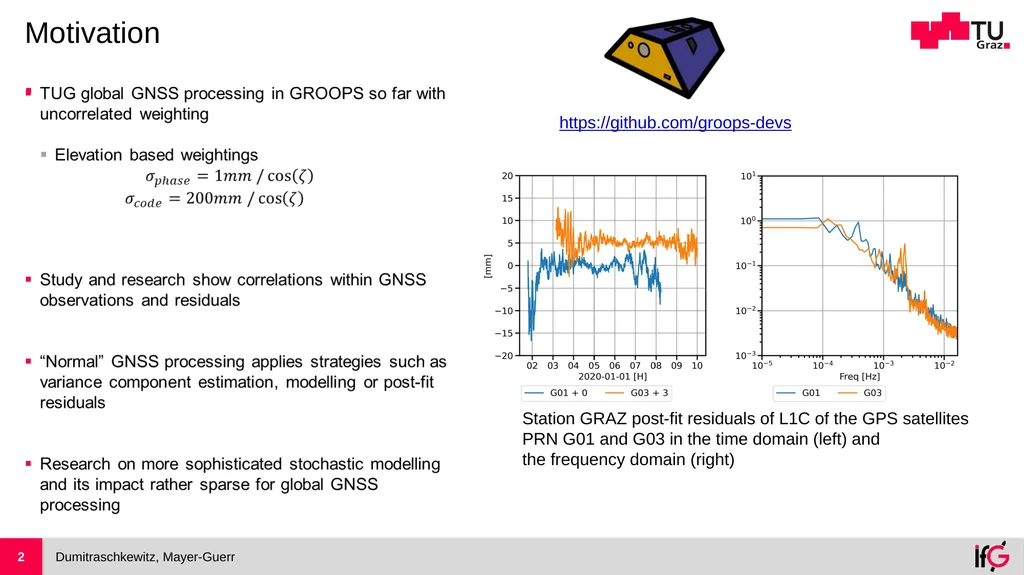
2 Motivation Station GRAZ post-fit residuals of L1C of the GPS satellites PRN G01 and G03 in the time domain (left) and the frequency domain (right) https://github.com/groops-devs Dumitraschkewitz, Mayer-Guerr<br>
03
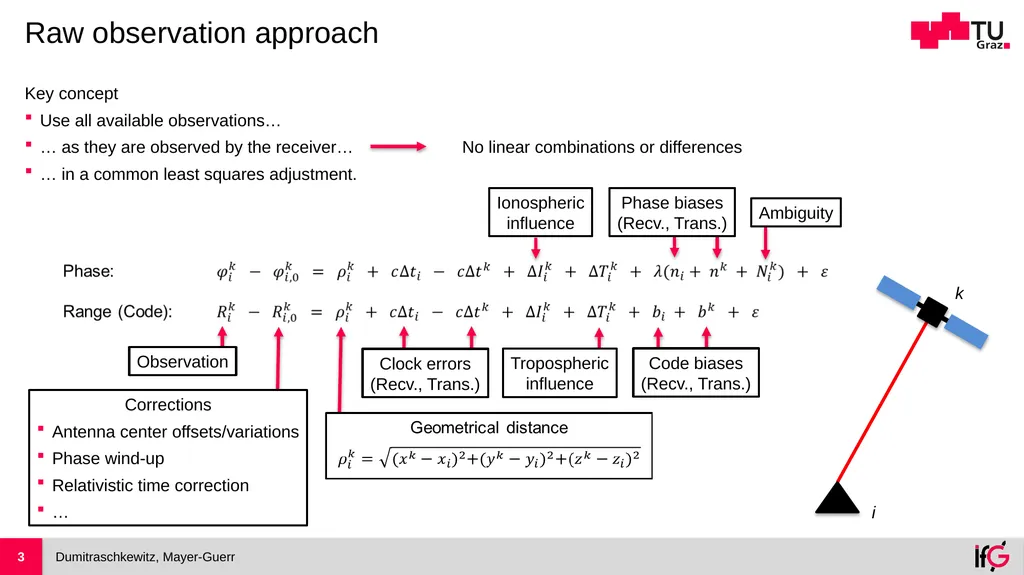
Raw observation approach Key concept
Use all available observations…
… as they are observed by the receiver… No linear combinations or differences
… in a common least squares adjustment. Observation Corrections
Antenna center offsets/variations
Phase wind-up
Relativistic time correction
… Clock errors
(Recv., Trans.) Tropospheric
influence Ionospheric
influence Phase biases
(Recv., Trans.) Ambiguity Code biases
(Recv., Trans.) 3 Dumitraschkewitz, Mayer-Guerr<br>
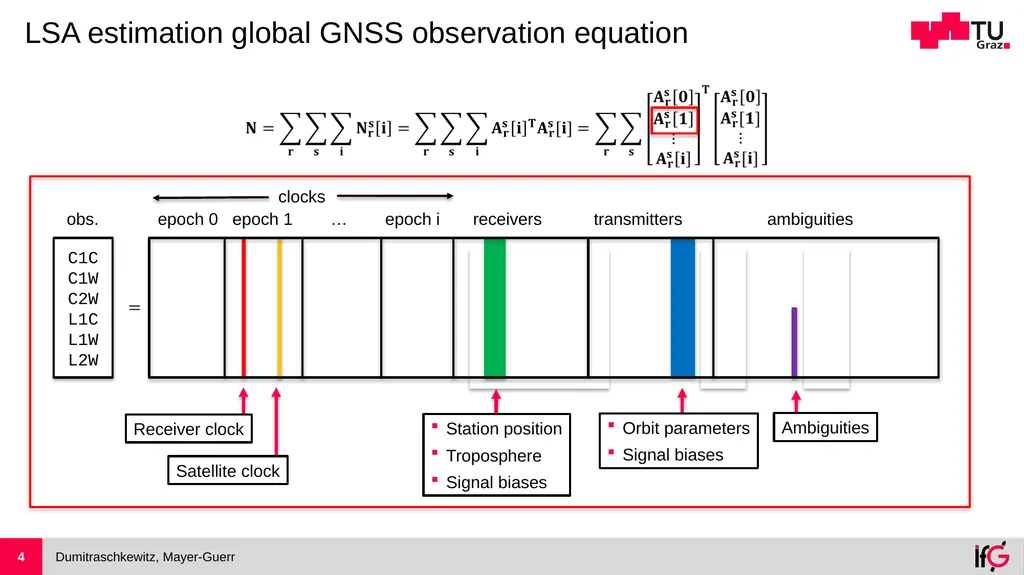
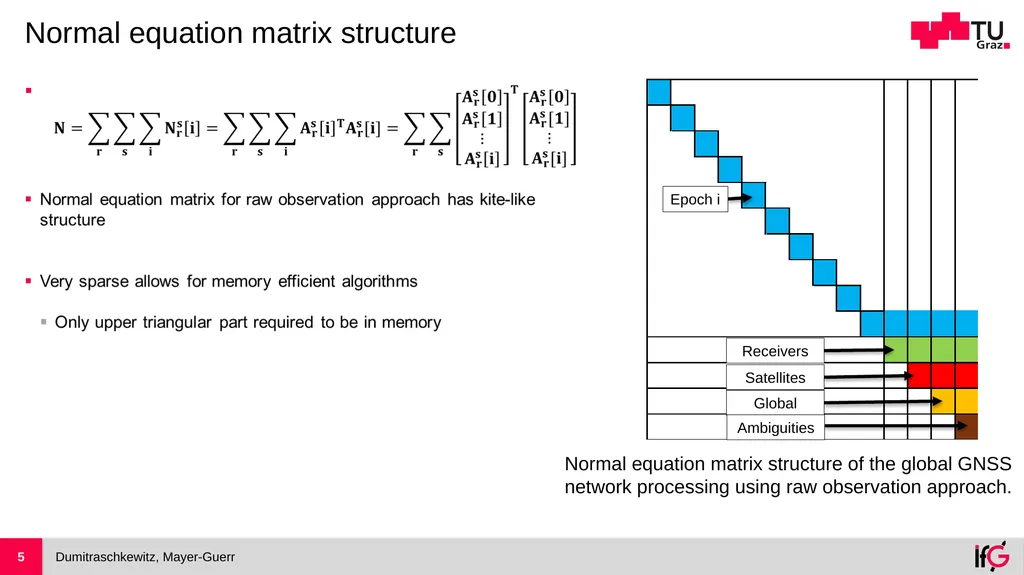
5 Normal equation matrix structure Normal equation matrix structure of the global GNSS network processing using raw observation approach. Dumitraschkewitz, Mayer-Guerr<br>
06
Requirements of the stochastic model The stochastic model is to be used on distributed memory system and it shall not excessively use communication between the processes
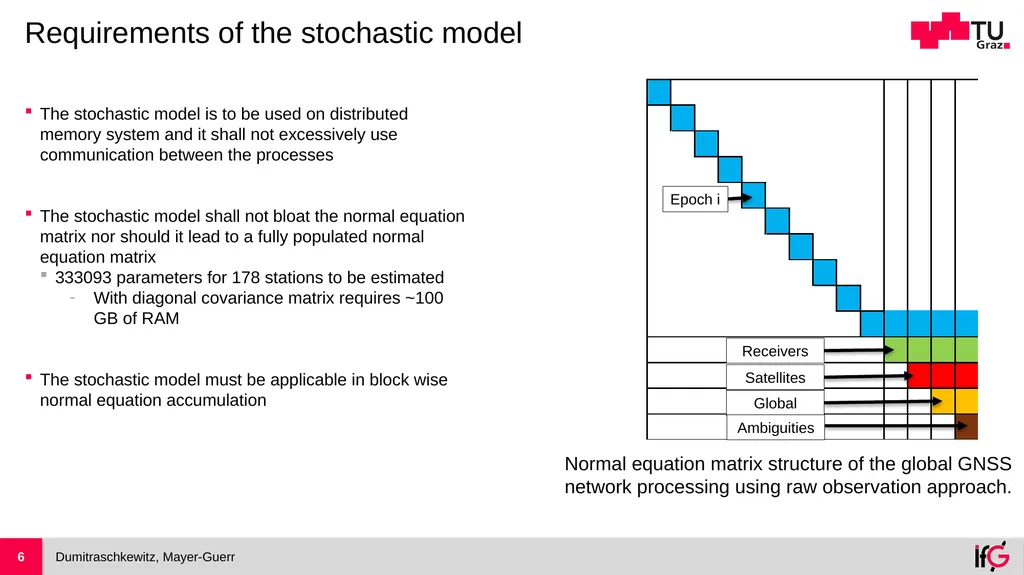
The stochastic model shall not bloat the normal equation matrix nor should it lead to a fully populated normal equation matrix
333093 parameters for 178 stations to be estimated
With diagonal covariance matrix requires ~100 GB of RAM
The stochastic model must be applicable in block wise normal equation accumulation 6 Normal equation matrix structure of the global GNSS network processing using raw observation approach. Dumitraschkewitz, Mayer-Guerr<br>
07
7 GNSS Stochastic Modelling – Temporal covariance models Three general ways to estimate VC components
Covariance component estimation
Iterative variance component estimation (VCE) ,
Minimum norm quadratic unbiased estimation (MINQUE, Wang et al. 1998)
LSA-VCE, (Teunissen and Amiri-Simkooei 2008)
Turbulence theory and correlations caused by tropospheric refractions (Kermarrec and Schön 2014)
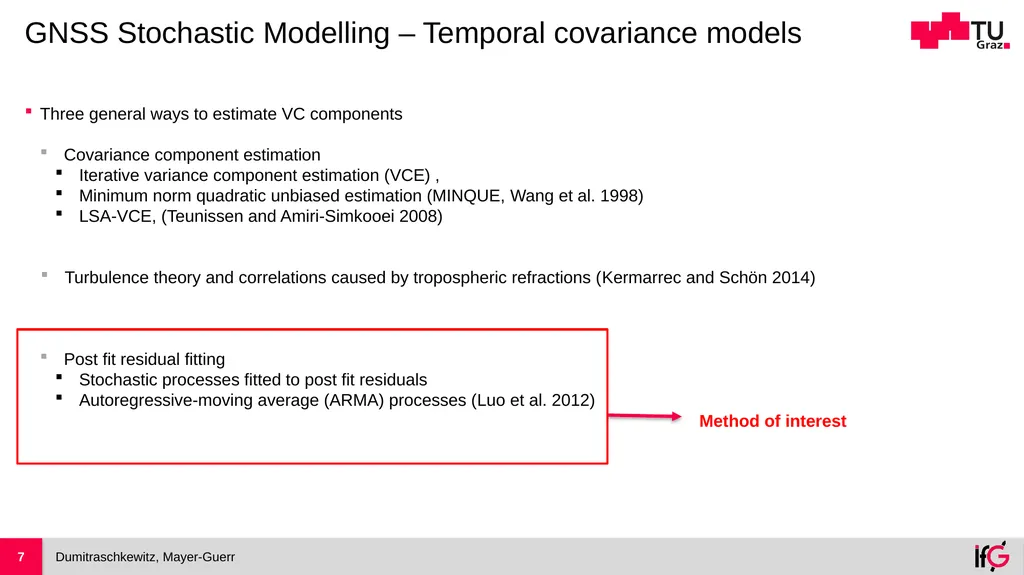
Post fit residual fitting
Stochastic processes fitted to post fit residuals
Autoregressive-moving average (ARMA) processes (Luo et al. 2012) Method of interest Dumitraschkewitz, Mayer-Guerr<br>
08
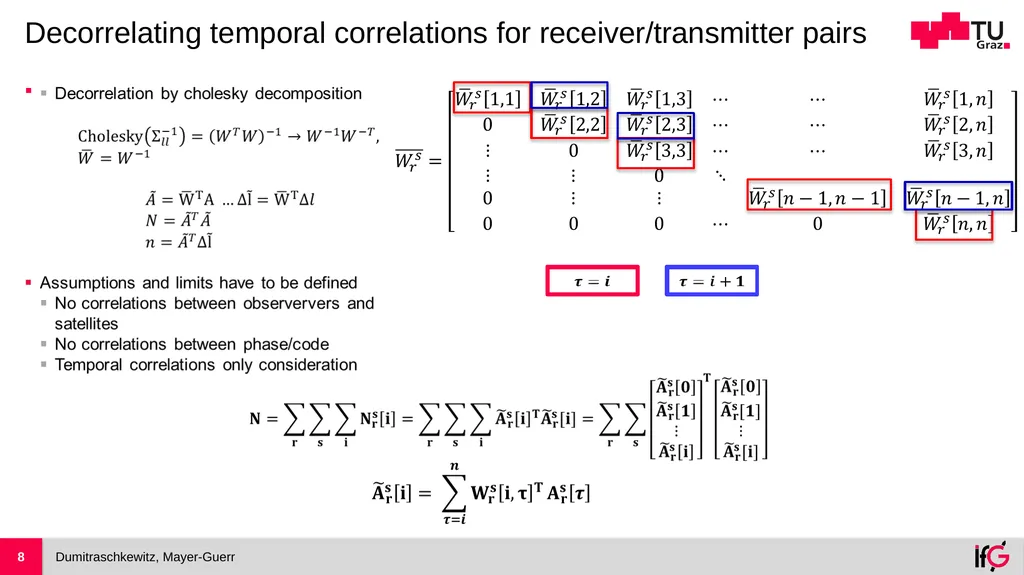
8 Decorrelating temporal correlations for receiver/transmitter pairs Dumitraschkewitz, Mayer-Guerr<br>
09
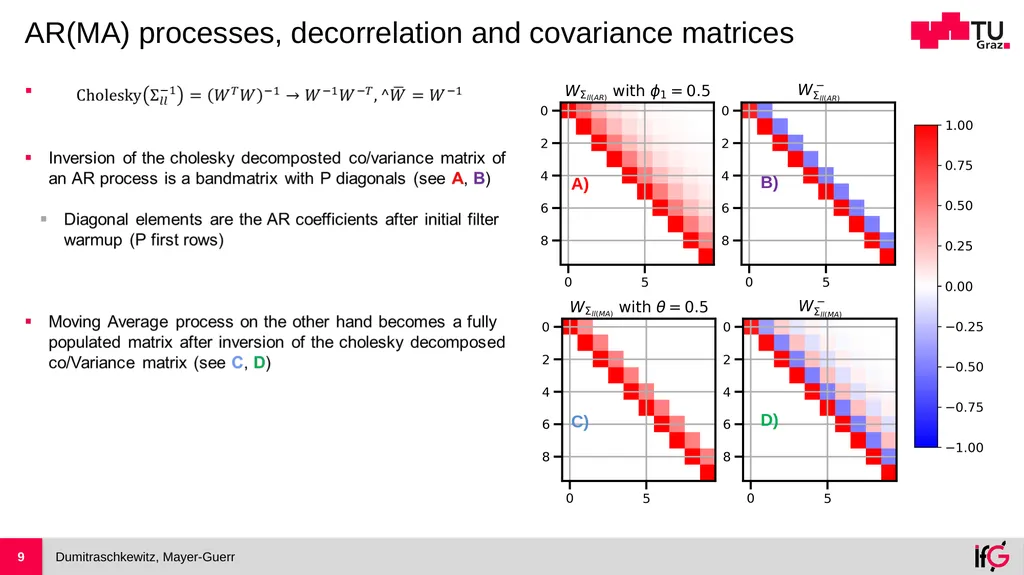
9 AR(MA) processes, decorrelation and covariance matrices Dumitraschkewitz, Mayer-Guerr<br>
10
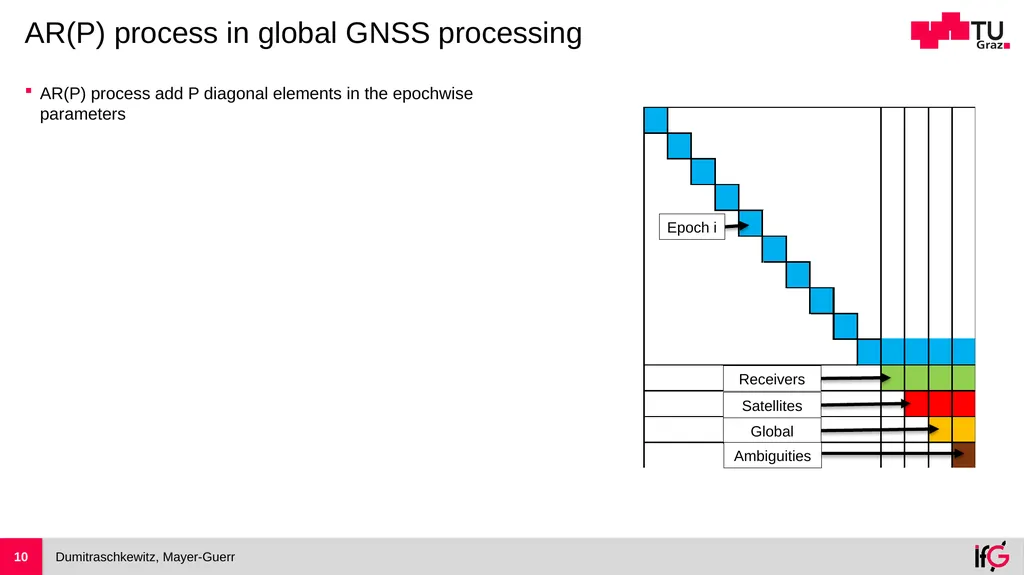
10 AR(P) process in global GNSS processing AR(P) process add P diagonal elements in the epochwise parameters Receivers Satellites Global Ambiguities Epoch i Dumitraschkewitz, Mayer-Guerr<br>
11
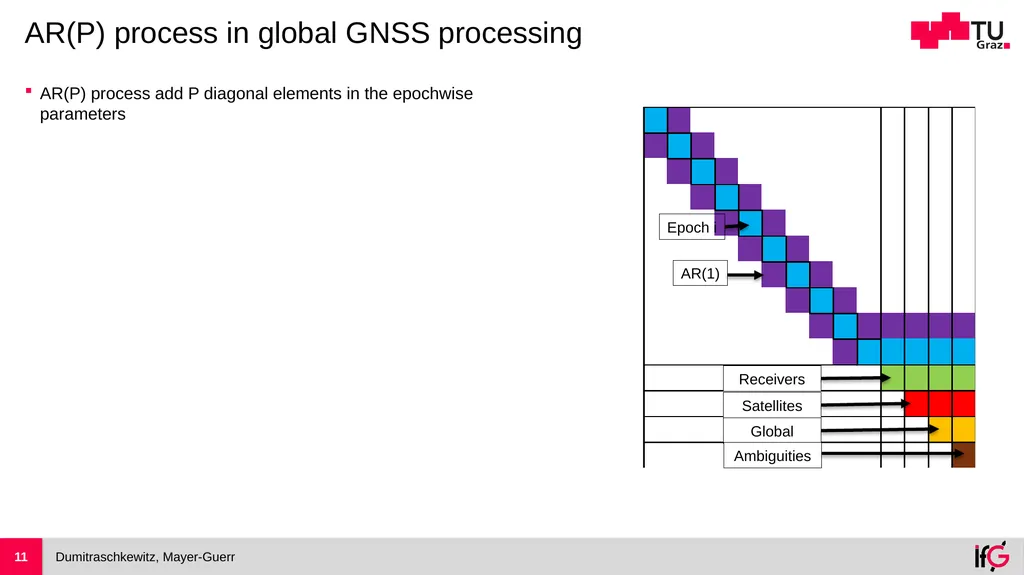
11 AR(P) process in global GNSS processing AR(P) process add P diagonal elements in the epochwise parameters Receivers Satellites Global Ambiguities Epoch i AR(1) Dumitraschkewitz, Mayer-Guerr<br>
12
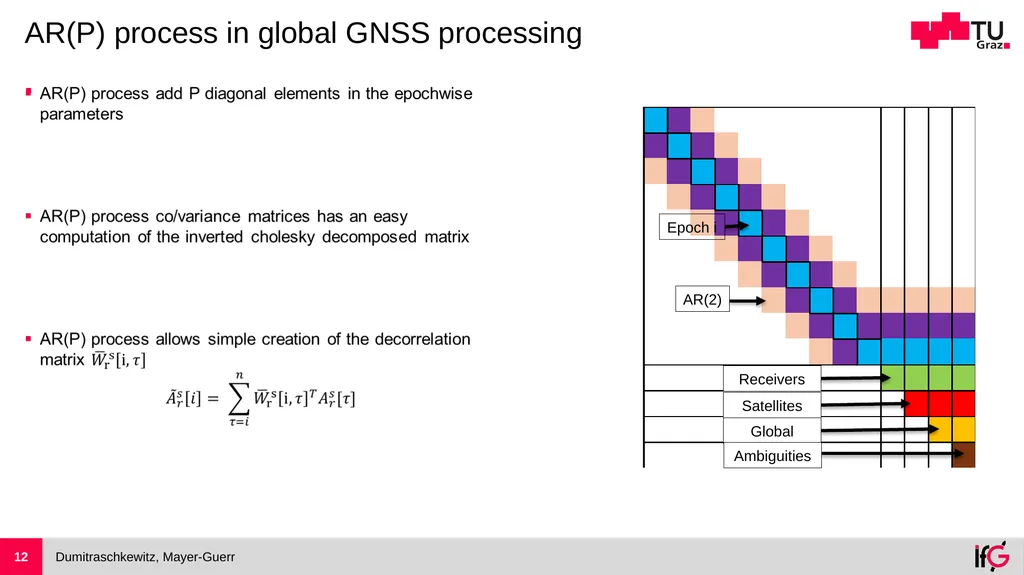
12 AR(P) process in global GNSS processing Receivers Satellites Global Ambiguities Epoch i AR(2) Dumitraschkewitz, Mayer-Guerr<br>
13
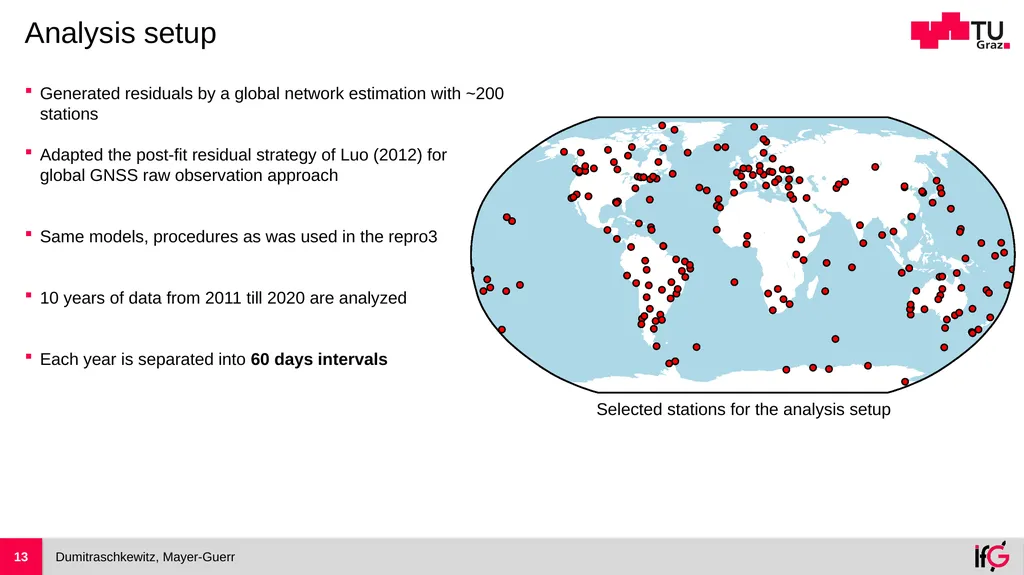
Analysis setup Generated residuals by a global network estimation with ~200 stations
Adapted the post-fit residual strategy of Luo (2012) for global GNSS raw observation approach
Same models, procedures as was used in the repro3
10 years of data from 2011 till 2020 are analyzed
Each year is separated into 60 days intervals Selected stations for the analysis setup 13 Dumitraschkewitz, Mayer-Guerr<br>
14
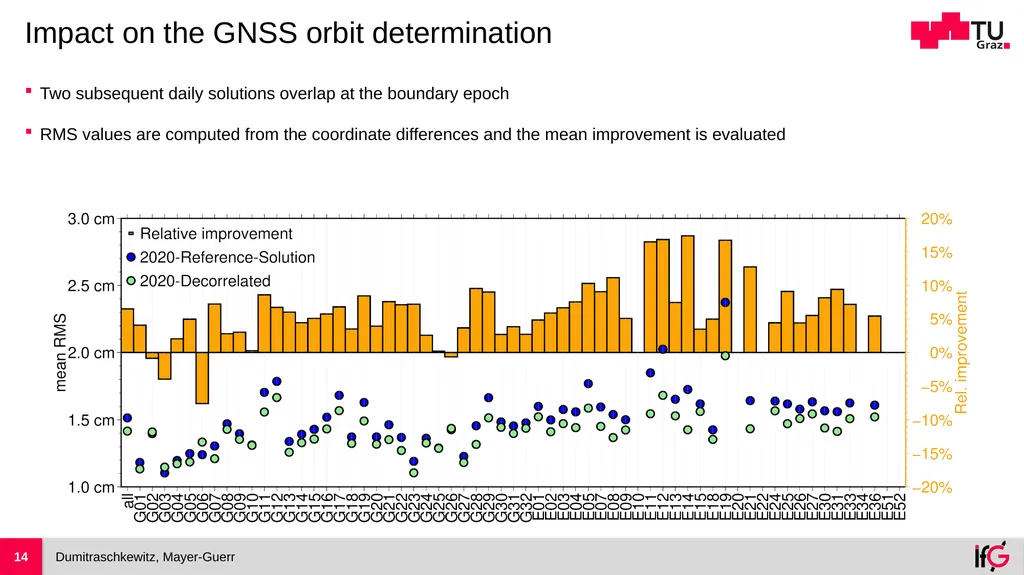
14 Impact on the GNSS orbit determination Two subsequent daily solutions overlap at the boundary epoch
RMS values are computed from the coordinate differences and the mean improvement is evaluated Dumitraschkewitz, Mayer-Guerr<br>
15
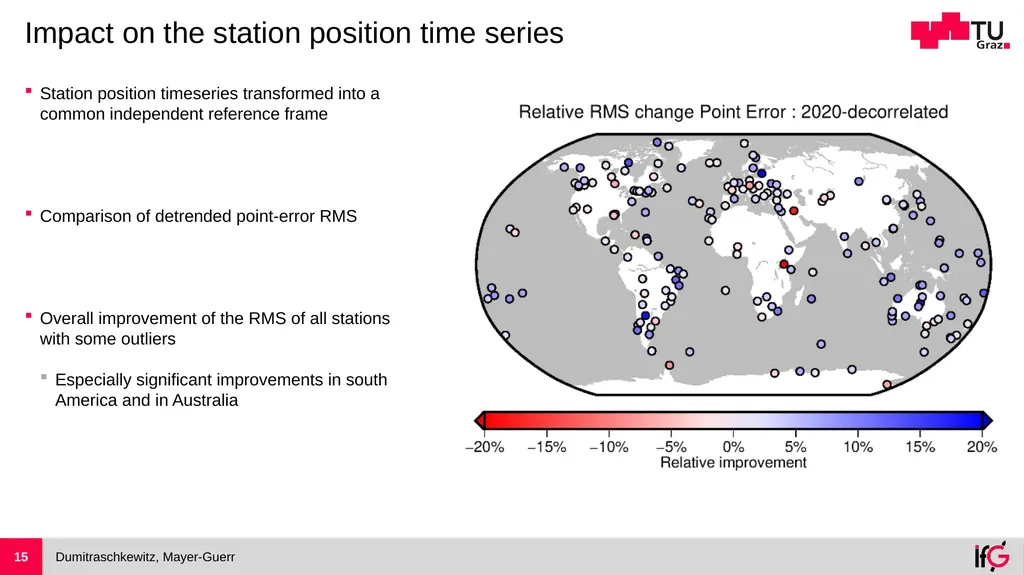
15 Impact on the station position time series Station position timeseries transformed into a common independent reference frame
Comparison of detrended point-error RMS
Overall improvement of the RMS of all stations with some outliers
Especially significant improvements in south America and in Australia Dumitraschkewitz, Mayer-Guerr<br>
16
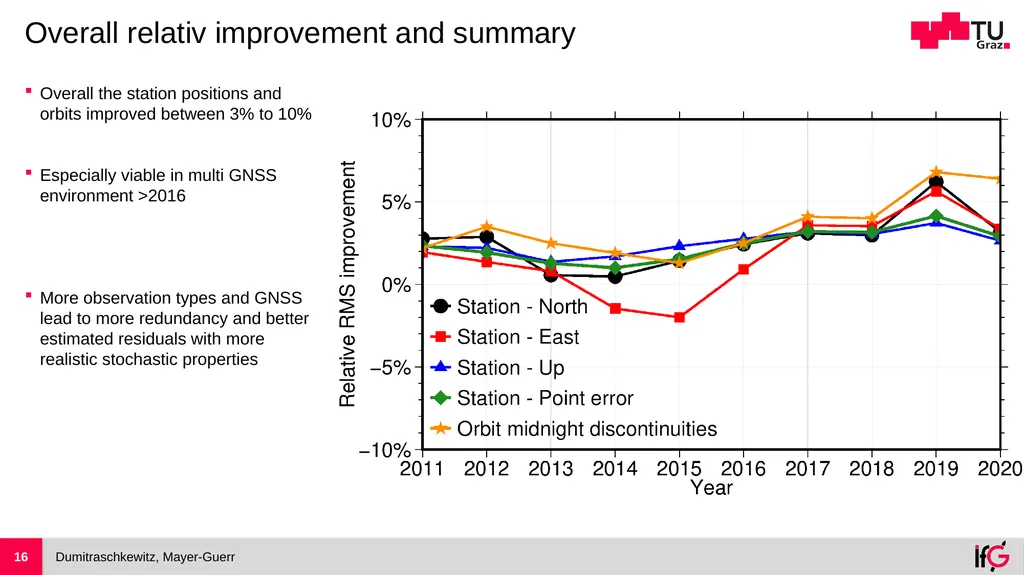
16 Overall relativ improvement and summary Overall the station positions and orbits improved between 3% to 10%
Especially viable in multi GNSS environment >2016
More observation types and GNSS lead to more redundancy and better estimated residuals with more realistic stochastic properties Dumitraschkewitz, Mayer-Guerr<br>
17
17 Future outlook Include the usage of BeiDou 3 within the stochastic modelling and the analysis setup
Expand the analysis scenario to include all available stations
Thorough investigate the ambiguity fixing rates in PPP environment while using the products with more sophisticated stochastic modelling
Investigation of spatial and other correlations Dumitraschkewitz, Mayer-Guerr<br>