
HAPTER 13 The Human Resources Management / Payroll
MT
Published · 67 slides · 0 views
1 / 1
Description
HAPTER 13 The Human Resources Management Payroll Cycle INTRODUCTION Questions to be addressed in this chapter include: What are the basic business activities and data processing operations that are performed in the human resources
Related Topics
Share
Embed code
Download this presentation From Below
"HAPTER 13 The Human Resources Management / Payroll" is the property of its rightful owner. Permission is granted to download and print the materials on this website for personal, non-commercial use only, and to display it on your personal computer provided you do not modify the materials and that you retain all copyright notices contained in the materials. By downloading content from our website, you accept the terms of this agreement.
Presentation Transcript
01
HAPTER 13 The Human Resources Management / Payroll Cycle<br>
02
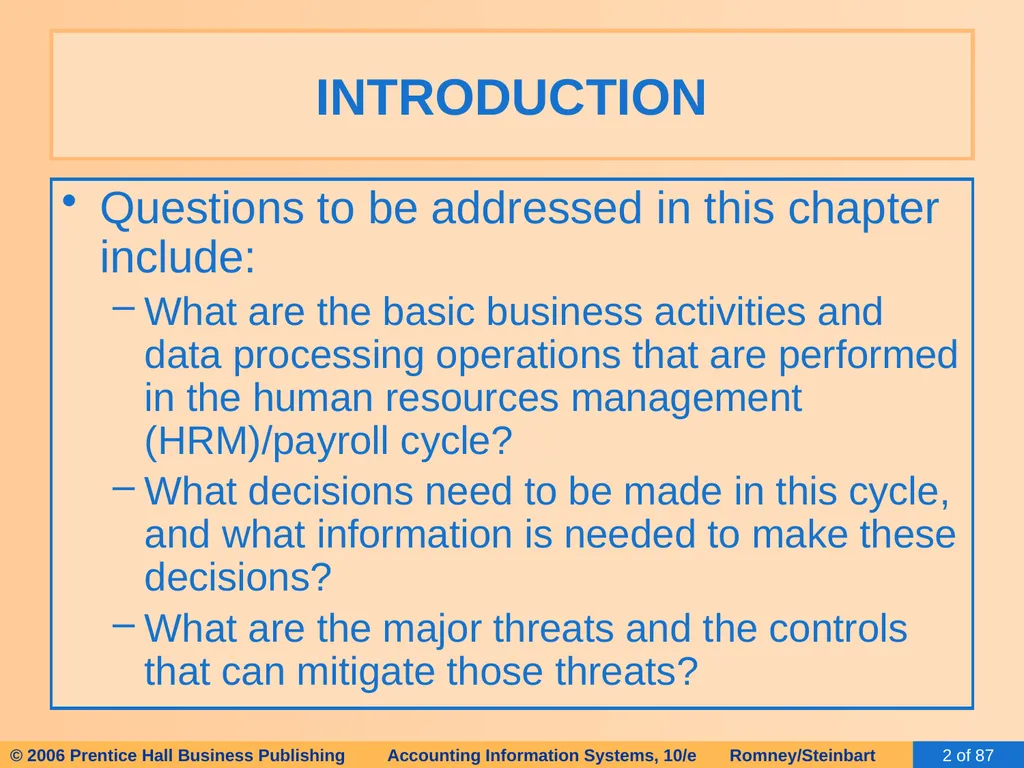
INTRODUCTION Questions to be addressed in this chapter include:
What are the basic business activities and data processing operations that are performed in the human resources management (HRM)/payroll cycle?
What decisions need to be made in this cycle, and what information is needed to make these decisions?
What are the major threats and the controls that can mitigate those threats?<br>
What are the basic business activities and data processing operations that are performed in the human resources management (HRM)/payroll cycle?
What decisions need to be made in this cycle, and what information is needed to make these decisions?
What are the major threats and the controls that can mitigate those threats?<br>
03
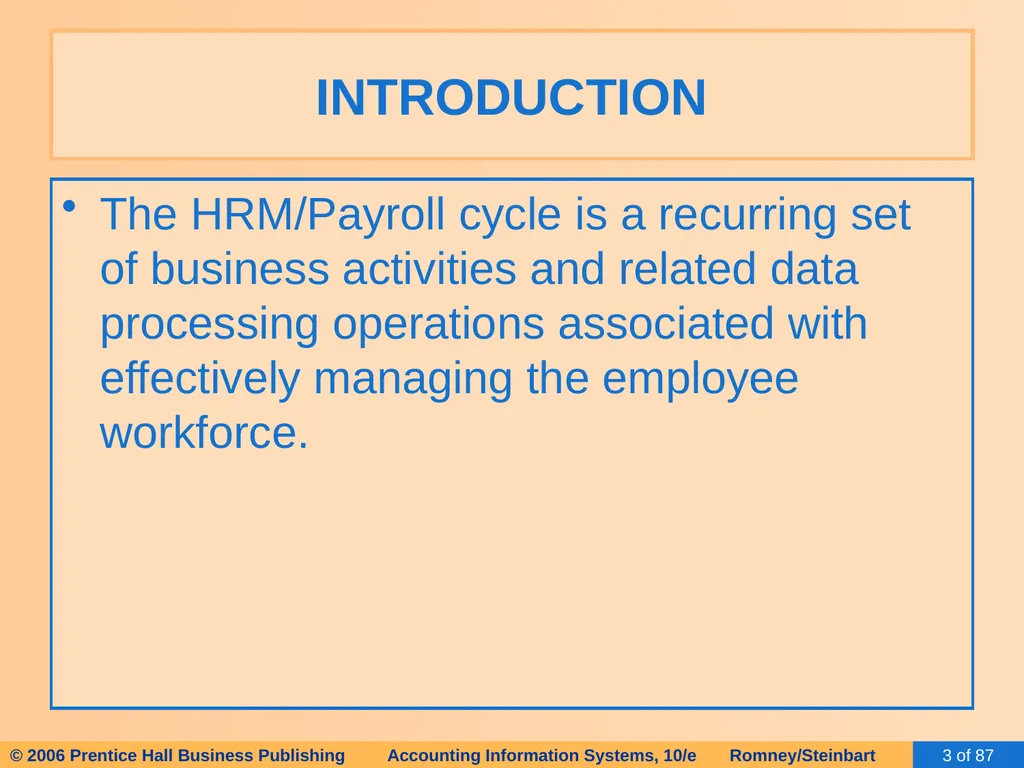
INTRODUCTION The HRM/Payroll cycle is a recurring set of business activities and related data processing operations associated with effectively managing the employee workforce.<br>
04
INTRODUCTION The most important tasks performed in the HRM/payroll cycle are:
Recruiting and hiring new employees
Training
Job assignment
Compensation (payroll)
Performance evaluation
Discharge of employees (voluntarily or involuntarily)
Payroll costs are also allocated to products and departments for use in product pricing and mix decisions.<br>
Recruiting and hiring new employees
Training
Job assignment
Compensation (payroll)
Performance evaluation
Discharge of employees (voluntarily or involuntarily)
Payroll costs are also allocated to products and departments for use in product pricing and mix decisions.<br>
05
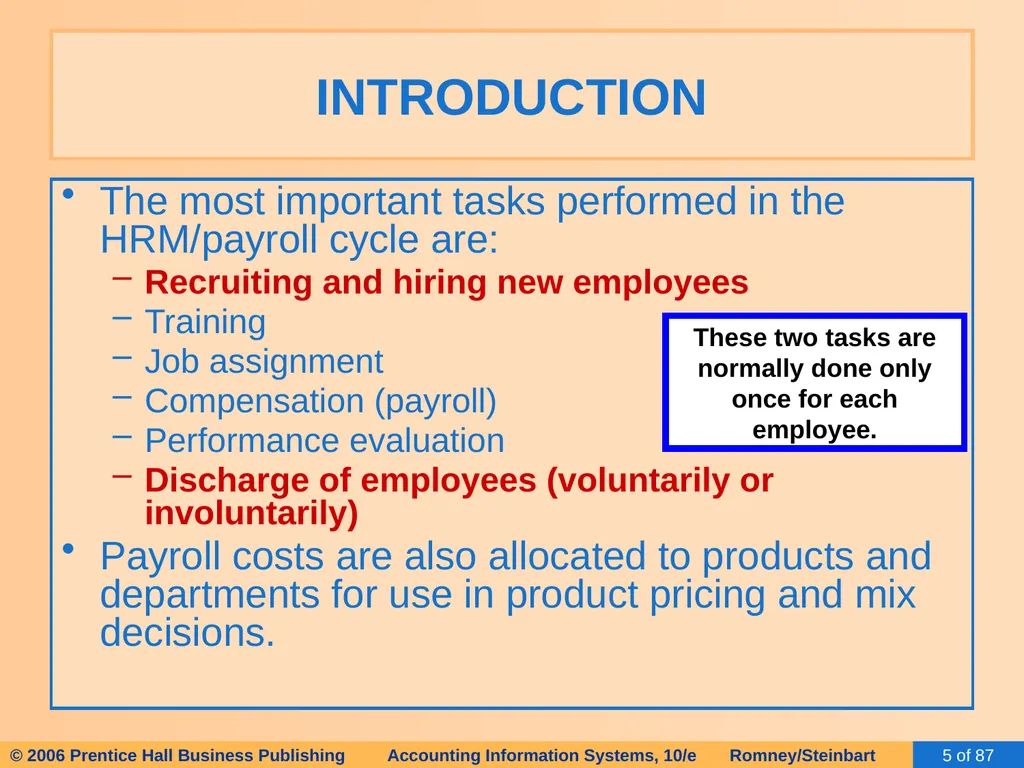
INTRODUCTION The most important tasks performed in the HRM/payroll cycle are:
Recruiting and hiring new employees
Training
Job assignment
Compensation (payroll)
Performance evaluation
Discharge of employees (voluntarily or involuntarily)
Payroll costs are also allocated to products and departments for use in product pricing and mix decisions. These two tasks are normally done only once for each employee.<br>
Recruiting and hiring new employees
Training
Job assignment
Compensation (payroll)
Performance evaluation
Discharge of employees (voluntarily or involuntarily)
Payroll costs are also allocated to products and departments for use in product pricing and mix decisions. These two tasks are normally done only once for each employee.<br>
06
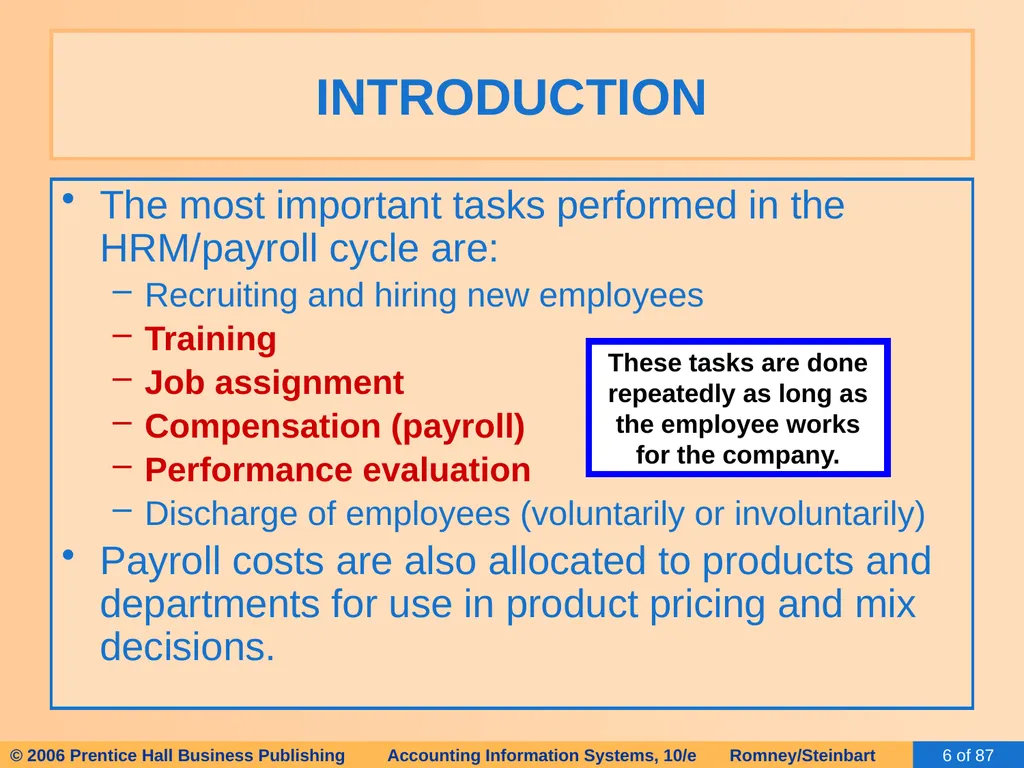
INTRODUCTION The most important tasks performed in the HRM/payroll cycle are:
Recruiting and hiring new employees
Training
Job assignment
Compensation (payroll)
Performance evaluation
Discharge of employees (voluntarily or involuntarily)
Payroll costs are also allocated to products and departments for use in product pricing and mix decisions. These tasks are done repeatedly as long as the employee works for the company.<br>
Recruiting and hiring new employees
Training
Job assignment
Compensation (payroll)
Performance evaluation
Discharge of employees (voluntarily or involuntarily)
Payroll costs are also allocated to products and departments for use in product pricing and mix decisions. These tasks are done repeatedly as long as the employee works for the company.<br>
07
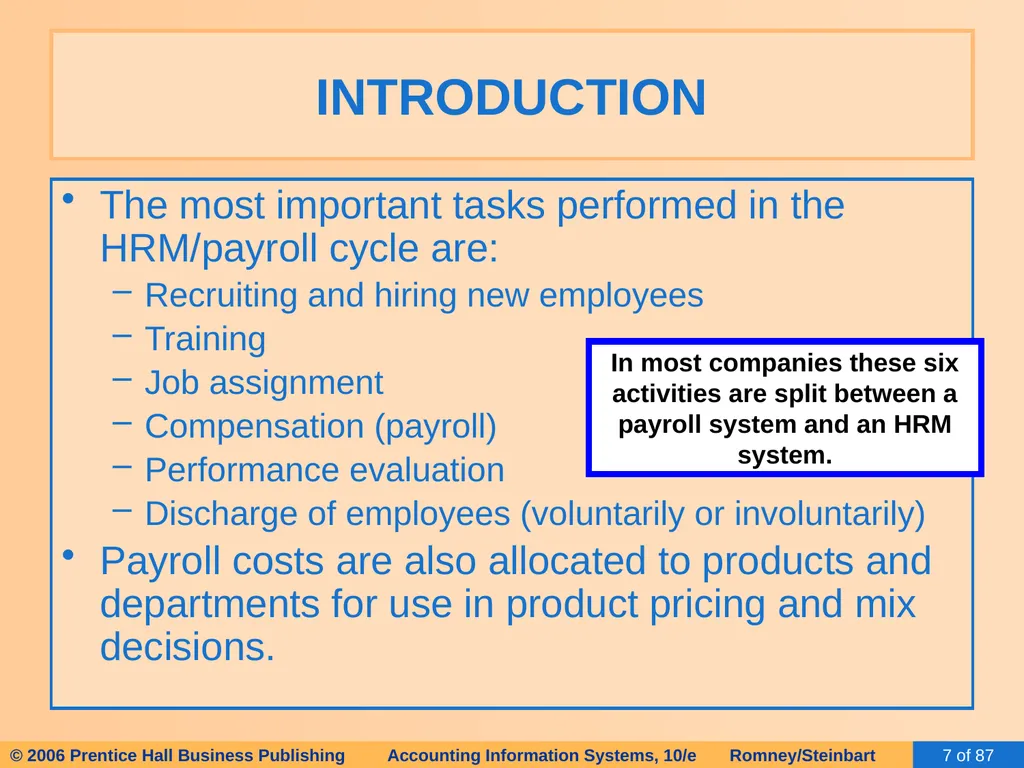
INTRODUCTION The most important tasks performed in the HRM/payroll cycle are:
Recruiting and hiring new employees
Training
Job assignment
Compensation (payroll)
Performance evaluation
Discharge of employees (voluntarily or involuntarily)
Payroll costs are also allocated to products and departments for use in product pricing and mix decisions. In most companies these six activities are split between a payroll system and an HRM system.<br>
Recruiting and hiring new employees
Training
Job assignment
Compensation (payroll)
Performance evaluation
Discharge of employees (voluntarily or involuntarily)
Payroll costs are also allocated to products and departments for use in product pricing and mix decisions. In most companies these six activities are split between a payroll system and an HRM system.<br>
08
INTRODUCTION The most important tasks performed in the HRM/payroll cycle are:
Recruiting and hiring new employees
Training
Job assignment
Compensation (payroll)
Performance evaluation
Discharge of employees (voluntarily or involuntarily)
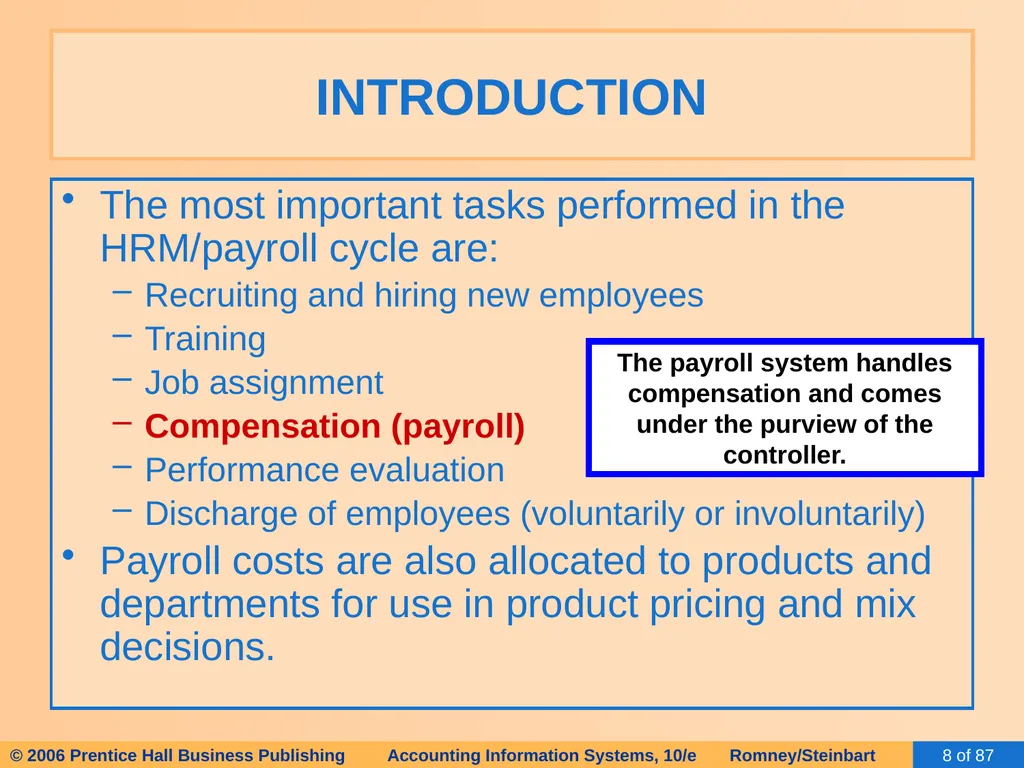
Payroll costs are also allocated to products and departments for use in product pricing and mix decisions. The payroll system handles compensation and comes under the purview of the controller.<br>
Recruiting and hiring new employees
Training
Job assignment
Compensation (payroll)
Performance evaluation
Discharge of employees (voluntarily or involuntarily)
Payroll costs are also allocated to products and departments for use in product pricing and mix decisions. The payroll system handles compensation and comes under the purview of the controller.<br>
09
INTRODUCTION The most important tasks performed in the HRM/payroll cycle are:
Recruiting and hiring new employees
Training
Job assignment
Compensation (payroll)
Performance evaluation
Discharge of employees (voluntarily or involuntarily)
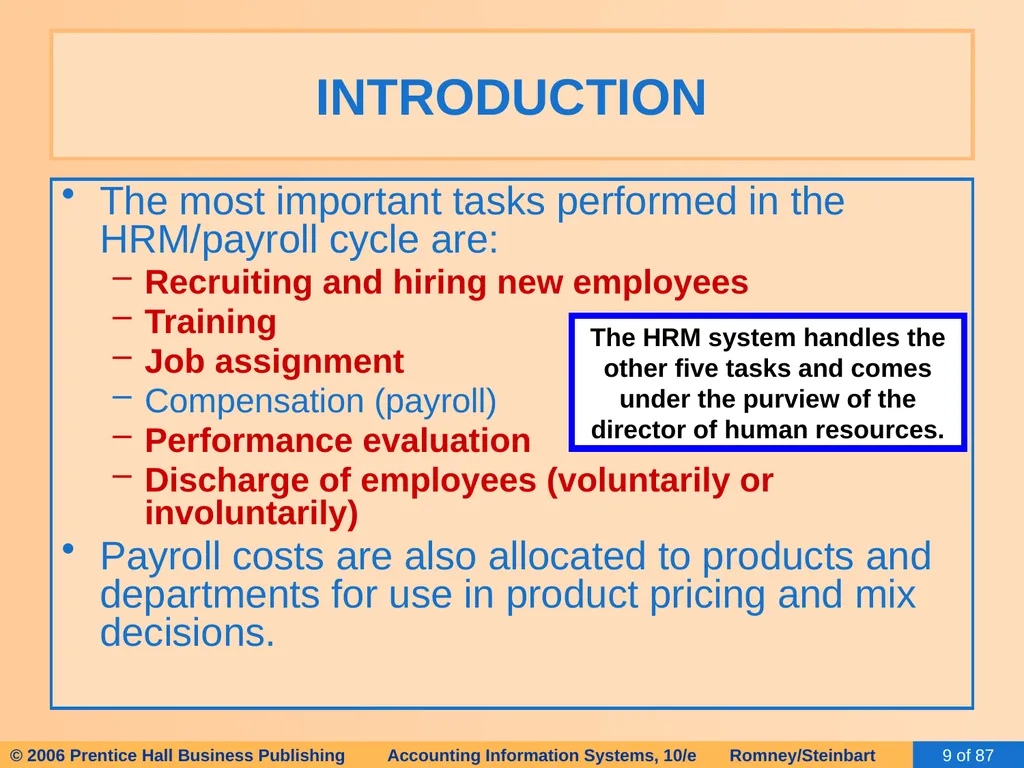
Payroll costs are also allocated to products and departments for use in product pricing and mix decisions. The HRM system handles the other five tasks and comes under the purview of the director of human resources.<br>
Recruiting and hiring new employees
Training
Job assignment
Compensation (payroll)
Performance evaluation
Discharge of employees (voluntarily or involuntarily)
Payroll costs are also allocated to products and departments for use in product pricing and mix decisions. The HRM system handles the other five tasks and comes under the purview of the director of human resources.<br>
10
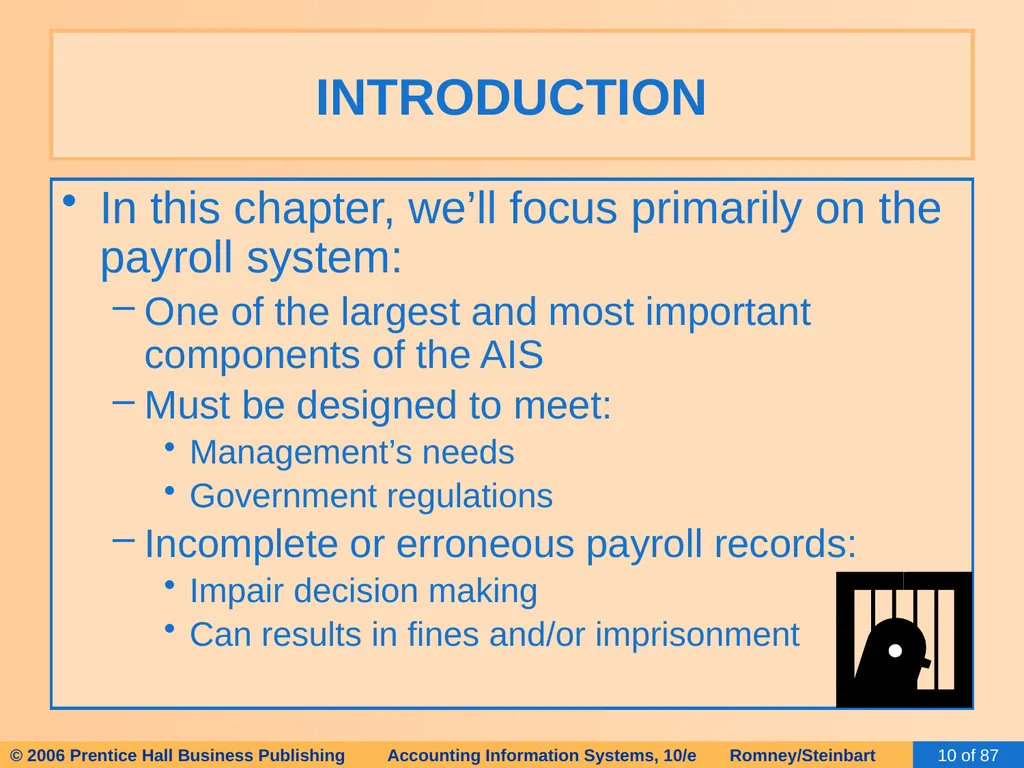
INTRODUCTION In this chapter, we’ll focus primarily on the payroll system:
One of the largest and most important components of the AIS
Must be designed to meet:
Management’s needs
Government regulations
Incomplete or erroneous payroll records:
Impair decision making
Can results in fines and/or imprisonment<br>
One of the largest and most important components of the AIS
Must be designed to meet:
Management’s needs
Government regulations
Incomplete or erroneous payroll records:
Impair decision making
Can results in fines and/or imprisonment<br>
11
INTRODUCTION The design of the HRM system is also important because the knowledge and skills of employees are valuable assets, so HRM systems should:
Help assign these assets to appropriate tasks; and
Help monitor their continuous development.<br>
Help assign these assets to appropriate tasks; and
Help monitor their continuous development.<br>
12
INTRODUCTION There are five major sources of input to the payroll system:
HRM department provides information about hirings, terminations, and pay-rate changes.
Employees provide changes in discretionary deductions (e.g., optional life insurance).
Various departments provide data about the actual hours worked by employees.
Government agencies provide tax rates and regulatory instructions.
Insurance companies and other organizations provide instructions for calculating and remitting various withholdings.<br>
HRM department provides information about hirings, terminations, and pay-rate changes.
Employees provide changes in discretionary deductions (e.g., optional life insurance).
Various departments provide data about the actual hours worked by employees.
Government agencies provide tax rates and regulatory instructions.
Insurance companies and other organizations provide instructions for calculating and remitting various withholdings.<br>
13
INTRODUCTION Principal outputs of the payroll system are checks:
Employees receive individual paychecks.
A payroll check is sent to the bank to transfer funds from the company’s regular account to its payroll account.
Checks are issued to government agencies, insurance companies, etc., to remit employee and employer taxes, insurance premiums, union dues, etc.
The payroll system also produces a variety of reports.<br>
Employees receive individual paychecks.
A payroll check is sent to the bank to transfer funds from the company’s regular account to its payroll account.
Checks are issued to government agencies, insurance companies, etc., to remit employee and employer taxes, insurance premiums, union dues, etc.
The payroll system also produces a variety of reports.<br>
14
INTRODUCTION Employees are an organization’s most valuable assets:
Their knowledge and skills affect quality and quantity of goods and services.
Labor costs are a major expense in generating revenues and a key cost driver.
The traditional AIS has not measured or reported on the status of a company’s human resources:
Financial statements do not regard employees as assets.
Under GAAP, the value of human services is not measured until they have been consumed.<br>
Their knowledge and skills affect quality and quantity of goods and services.
Labor costs are a major expense in generating revenues and a key cost driver.
The traditional AIS has not measured or reported on the status of a company’s human resources:
Financial statements do not regard employees as assets.
Under GAAP, the value of human services is not measured until they have been consumed.<br>
15
INTRODUCTION However, some companies are now creating positions for a direction of intellectual assets.
Some may even include HR info in their annual report, including reports on:
Human capital: The knowledge employees possess, which can be enhanced.
Intellectual capital: The knowledge that’s been captured and implemented in decision support systems, expert systems, or knowledge databases, so that it can be shared.<br>
Some may even include HR info in their annual report, including reports on:
Human capital: The knowledge employees possess, which can be enhanced.
Intellectual capital: The knowledge that’s been captured and implemented in decision support systems, expert systems, or knowledge databases, so that it can be shared.<br>
16
INTRODUCTION Because employees are so valuable, turnover is expensive:
Average cost of replacement is 1.5 times the employee’s annual salary.
Turnover rates need to be managed so they’re not excessive.<br>
Average cost of replacement is 1.5 times the employee’s annual salary.
Turnover rates need to be managed so they’re not excessive.<br>
17
INTRODUCTION Employee morale is also important.
Bad morale leads to high turnover.
Employee attitudes affect customer interactions and are positively correlated with profitability.
Employees need to:
Believe they have the opportunity to do what they do best
Believe their opinions count
Believe their coworkers are committed to quality
Understand the connection between their jobs and the company’s mission.<br>
Bad morale leads to high turnover.
Employee attitudes affect customer interactions and are positively correlated with profitability.
Employees need to:
Believe they have the opportunity to do what they do best
Believe their opinions count
Believe their coworkers are committed to quality
Understand the connection between their jobs and the company’s mission.<br>
18
INTRODUCTION To effectively track intellectual capital and human resources, the AIS must do more than just record time and attendance and prepare paychecks.
Payroll should be integrated with HRM so management can access data about employee-related costs and employee skills and knowledge.<br>
Payroll should be integrated with HRM so management can access data about employee-related costs and employee skills and knowledge.<br>
19
PAYROLL CYCLE ACTIVITIES Let’s take a look at payroll cycle activities.
The payroll application is processed in batch mode because:
Paychecks are issued periodically.
Most employees are paid at the same time.<br>
The payroll application is processed in batch mode because:
Paychecks are issued periodically.
Most employees are paid at the same time.<br>
20
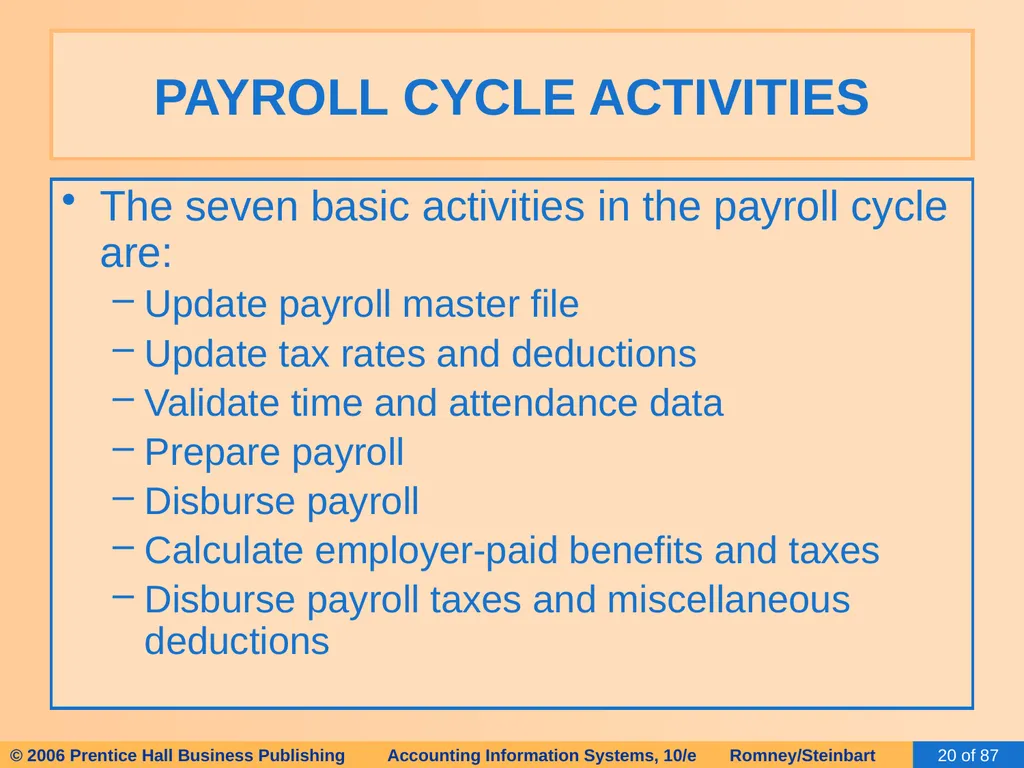
PAYROLL CYCLE ACTIVITIES The seven basic activities in the payroll cycle are:
Update payroll master file
Update tax rates and deductions
Validate time and attendance data
Prepare payroll
Disburse payroll
Calculate employer-paid benefits and taxes
Disburse payroll taxes and miscellaneous deductions<br>
Update payroll master file
Update tax rates and deductions
Validate time and attendance data
Prepare payroll
Disburse payroll
Calculate employer-paid benefits and taxes
Disburse payroll taxes and miscellaneous deductions<br>
21
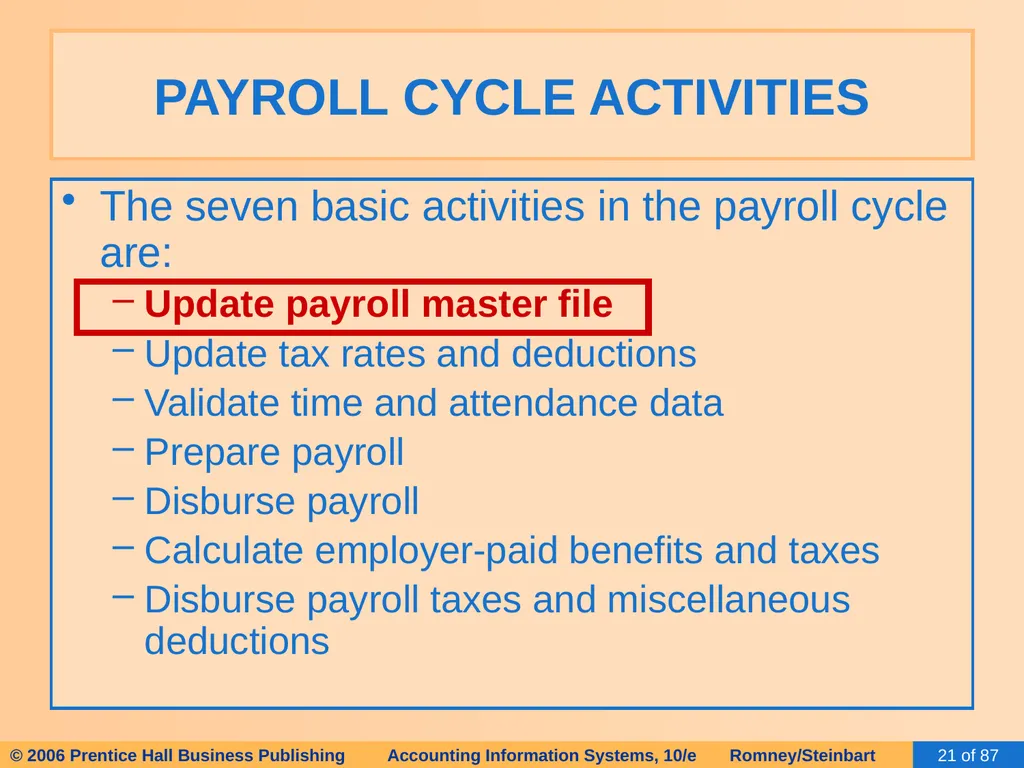
PAYROLL CYCLE ACTIVITIES The seven basic activities in the payroll cycle are:
Update payroll master file
Update tax rates and deductions
Validate time and attendance data
Prepare payroll
Disburse payroll
Calculate employer-paid benefits and taxes
Disburse payroll taxes and miscellaneous deductions<br>
Update payroll master file
Update tax rates and deductions
Validate time and attendance data
Prepare payroll
Disburse payroll
Calculate employer-paid benefits and taxes
Disburse payroll taxes and miscellaneous deductions<br>
22
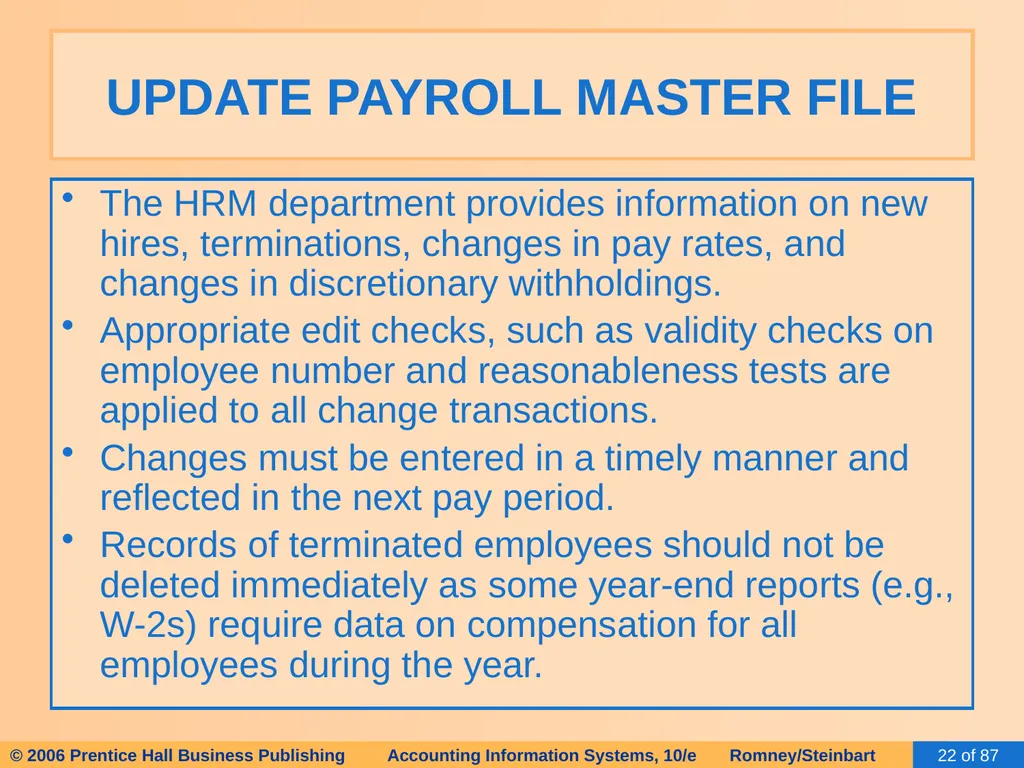
UPDATE PAYROLL MASTER FILE The HRM department provides information on new hires, terminations, changes in pay rates, and changes in discretionary withholdings.
Appropriate edit checks, such as validity checks on employee number and reasonableness tests are applied to all change transactions.
Changes must be entered in a timely manner and reflected in the next pay period.
Records of terminated employees should not be deleted immediately as some year-end reports (e.g., W-2s) require data on compensation for all employees during the year.<br>
Appropriate edit checks, such as validity checks on employee number and reasonableness tests are applied to all change transactions.
Changes must be entered in a timely manner and reflected in the next pay period.
Records of terminated employees should not be deleted immediately as some year-end reports (e.g., W-2s) require data on compensation for all employees during the year.<br>
23
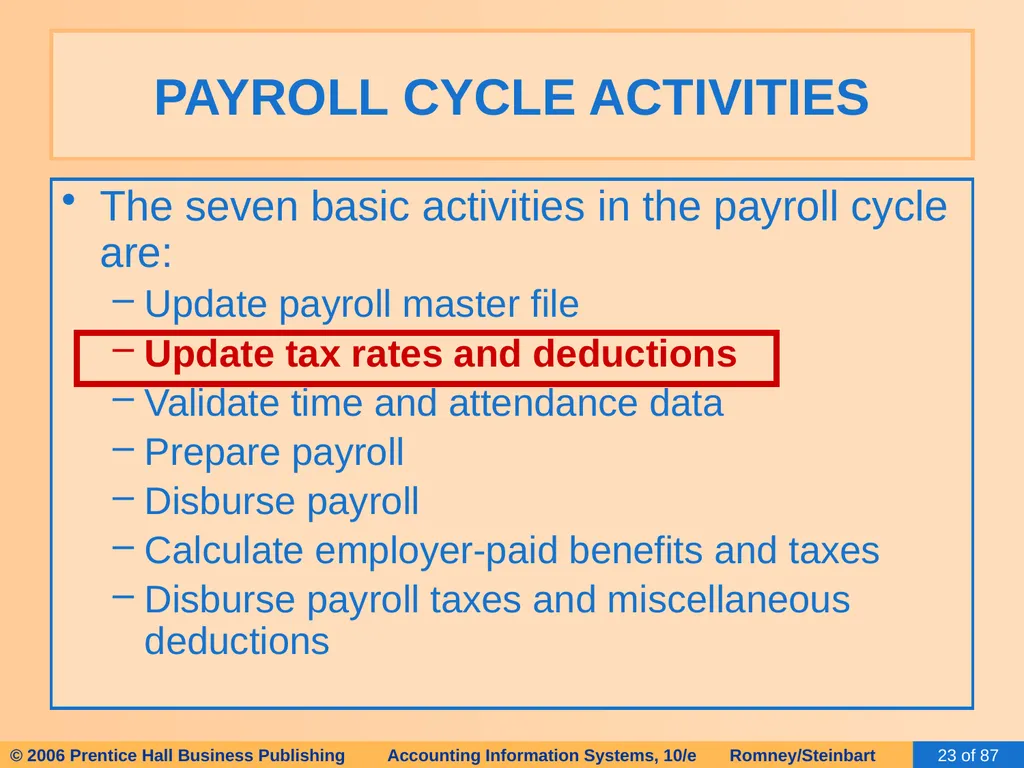
PAYROLL CYCLE ACTIVITIES The seven basic activities in the payroll cycle are:
Update payroll master file
Update tax rates and deductions
Validate time and attendance data
Prepare payroll
Disburse payroll
Calculate employer-paid benefits and taxes
Disburse payroll taxes and miscellaneous deductions<br>
Update payroll master file
Update tax rates and deductions
Validate time and attendance data
Prepare payroll
Disburse payroll
Calculate employer-paid benefits and taxes
Disburse payroll taxes and miscellaneous deductions<br>
24
UPDATE TAX RATES AND DEDUCTIONS The payroll department receives notification of changes in tax rates and other payroll deductions from government agencies, insurers, unions, etc.
These changes occur periodically.<br>
These changes occur periodically.<br>
25
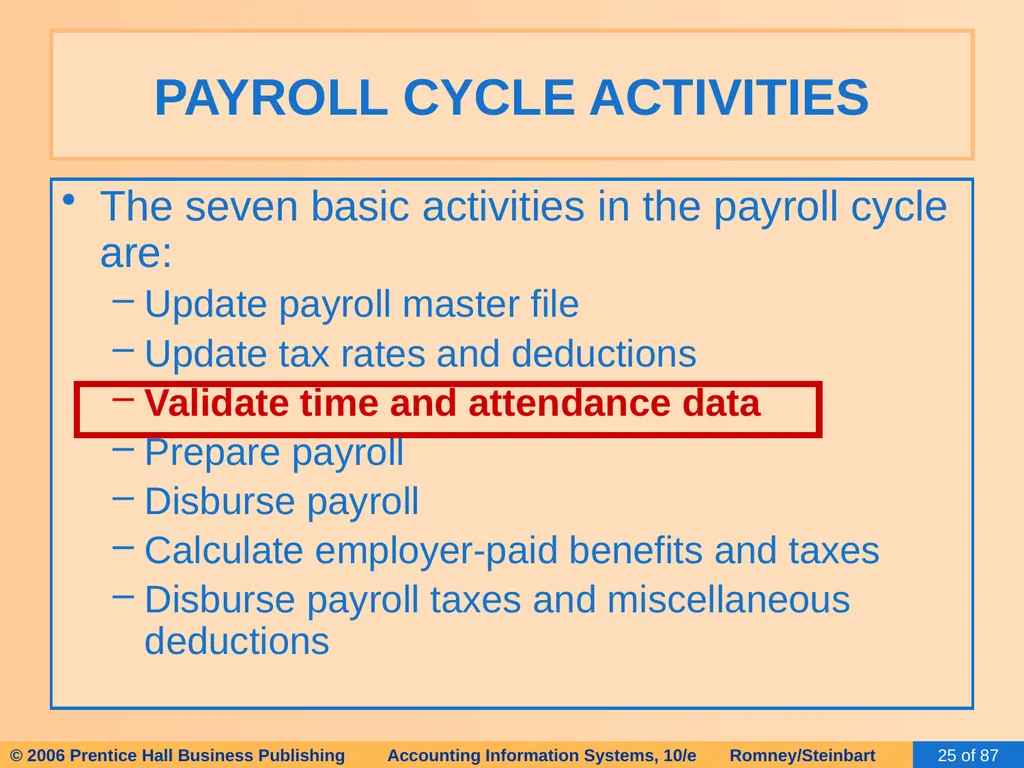
PAYROLL CYCLE ACTIVITIES The seven basic activities in the payroll cycle are:
Update payroll master file
Update tax rates and deductions
Validate time and attendance data
Prepare payroll
Disburse payroll
Calculate employer-paid benefits and taxes
Disburse payroll taxes and miscellaneous deductions<br>
Update payroll master file
Update tax rates and deductions
Validate time and attendance data
Prepare payroll
Disburse payroll
Calculate employer-paid benefits and taxes
Disburse payroll taxes and miscellaneous deductions<br>
26
VALIDATE TIME AND ATTENDANCE DATA Information on time and attendance comes in various forms depending on the employee’s pay scheme.<br>
27
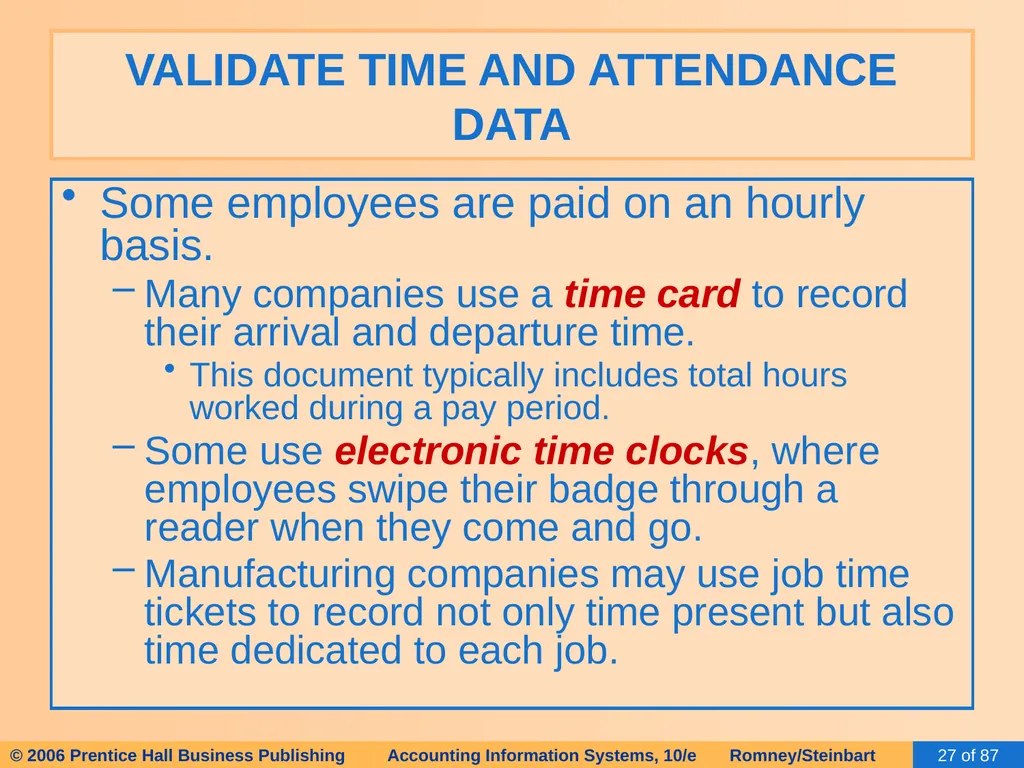
VALIDATE TIME AND ATTENDANCE DATA Some employees are paid on an hourly basis.
Many companies use a time card to record their arrival and departure time.
This document typically includes total hours worked during a pay period.
Some use electronic time clocks, where employees swipe their badge through a reader when they come and go.
Manufacturing companies may use job time tickets to record not only time present but also time dedicated to each job.<br>
Many companies use a time card to record their arrival and departure time.
This document typically includes total hours worked during a pay period.
Some use electronic time clocks, where employees swipe their badge through a reader when they come and go.
Manufacturing companies may use job time tickets to record not only time present but also time dedicated to each job.<br>
28
VALIDATE TIME AND ATTENDANCE DATA Some employees earn a fixed salary, e.g., managers and professional staff.
Usually don’t record their time, but supervisors informally monitor their presence.
Professionals in accounting, law, and consulting firms must track their time on various assignments to accurately bill clients.<br>
Usually don’t record their time, but supervisors informally monitor their presence.
Professionals in accounting, law, and consulting firms must track their time on various assignments to accurately bill clients.<br>
29
VALIDATE TIME AND ATTENDANCE DATA Sales staff are often paid on a straight commission or base salary plus commission.
Some may also receive bonuses for surpassing sales targets.
Requires careful recording of their sales.<br>
Some may also receive bonuses for surpassing sales targets.
Requires careful recording of their sales.<br>
30
VALIDATE TIME AND ATTENDANCE DATA Increasingly, laborers may be paid partly on productivity.
Some management and employees may receive stock to motivate them to cut costs and improve service.<br>
Some management and employees may receive stock to motivate them to cut costs and improve service.<br>
31
VALIDATE TIME AND ATTENDANCE DATA The payroll system needs to link to the revenue cycle and other cycles to calculate these payments.
It’s also important to design bonus schemes with realistic, attainable goals that:
Can be measured
Are congruent with corporate objectives
Are monitored by management for continued appropriateness
Are legal<br>
It’s also important to design bonus schemes with realistic, attainable goals that:
Can be measured
Are congruent with corporate objectives
Are monitored by management for continued appropriateness
Are legal<br>
32
VALIDATE TIME AND ATTENDANCE DATA Accountants and Compensation Policies
Recent corporate scandals have led to scrutiny and criticism of executive compensation plans:
FASB issued new rules requiring that stock options be expensed.
Major U.S. stock exchanges now require companies to obtain shareholder approval of stock compensation.<br>
Recent corporate scandals have led to scrutiny and criticism of executive compensation plans:
FASB issued new rules requiring that stock options be expensed.
Major U.S. stock exchanges now require companies to obtain shareholder approval of stock compensation.<br>
33
VALIDATE TIME AND ATTENDANCE DATA Compensation boards are being created to design compensation plans, rather than having executives create their own.
Accountants can help by:
Advising on financial and tax effects of proposals.
Identifying appropriate metrics to measure performance.
Enabling compliance with legal and regulatory requirements.
Suggesting appropriate public disclosures.<br>
Accountants can help by:
Advising on financial and tax effects of proposals.
Identifying appropriate metrics to measure performance.
Enabling compliance with legal and regulatory requirements.
Suggesting appropriate public disclosures.<br>
34
VALIDATE TIME AND ATTENDANCE DATA How can information technology help?
Collecting time and attendance data electronically, e.g.:
Badge readers
Electronic time clocks
Data entered on terminals
Touch-tone telephone logs
Using edit checks to verify accuracy and reasonableness when the data are entered.<br>
Collecting time and attendance data electronically, e.g.:
Badge readers
Electronic time clocks
Data entered on terminals
Touch-tone telephone logs
Using edit checks to verify accuracy and reasonableness when the data are entered.<br>
35
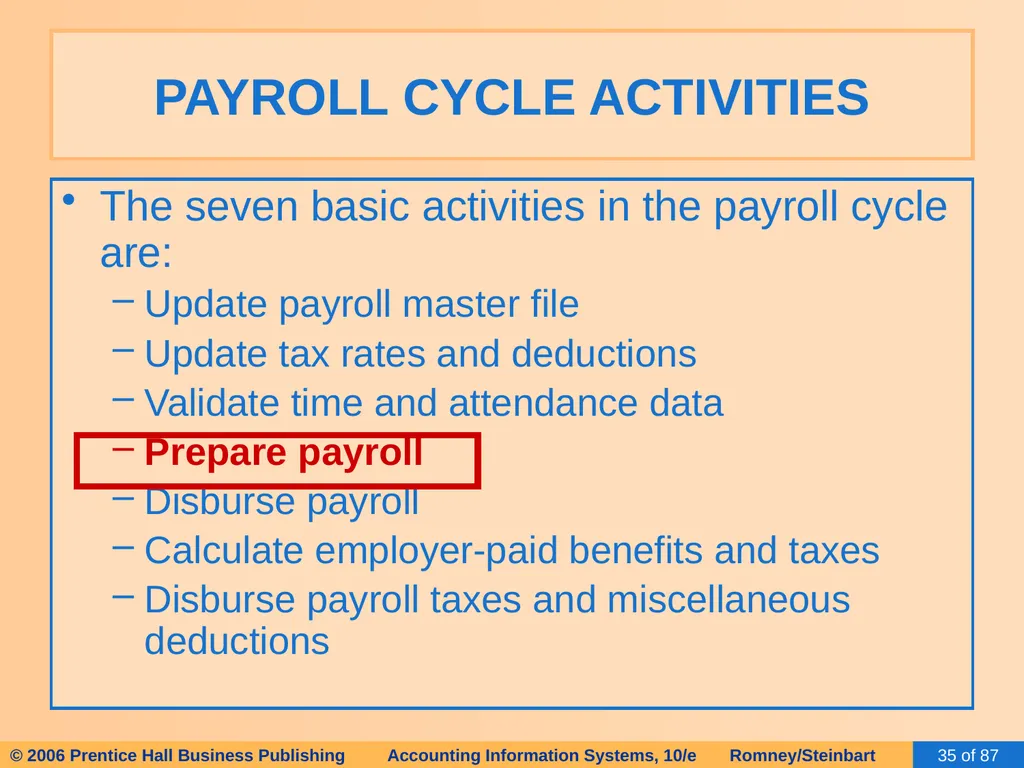
PAYROLL CYCLE ACTIVITIES The seven basic activities in the payroll cycle are:
Update payroll master file
Update tax rates and deductions
Validate time and attendance data
Prepare payroll
Disburse payroll
Calculate employer-paid benefits and taxes
Disburse payroll taxes and miscellaneous deductions<br>
Update payroll master file
Update tax rates and deductions
Validate time and attendance data
Prepare payroll
Disburse payroll
Calculate employer-paid benefits and taxes
Disburse payroll taxes and miscellaneous deductions<br>
36
PREPARE PAYROLL The employee’s department provides data about hours worked.
A supervisor confirms the data.
Pay rate information is obtained from the payroll master file.<br>
A supervisor confirms the data.
Pay rate information is obtained from the payroll master file.<br>
37
PREPARE PAYROLL Procedures:
The payroll transaction file is sorted by employee number (same sequence as master file).
For each transaction, the payroll master file is read for pay rates, etc., and gross pay is calculated.
Hourly Employees: Gross pay = (hours worked x wage rate) + Overtime + Bonuses
Salaried Employees: Gross pay = annual salary x fraction of year worked<br>
The payroll transaction file is sorted by employee number (same sequence as master file).
For each transaction, the payroll master file is read for pay rates, etc., and gross pay is calculated.
Hourly Employees: Gross pay = (hours worked x wage rate) + Overtime + Bonuses
Salaried Employees: Gross pay = annual salary x fraction of year worked<br>
38
PREPARE PAYROLL Payroll deductions are summed and subtracted from gross pay to obtain net pay. There are two types of deductions:
Payroll tax withholdings
Voluntary deductions
Year-to-date totals for gross pay, deductions, and net pay are calculated, and the master file is updated. Cumulative records are important because:
Social Security and other deductions cease or decline at certain levels.
The information will be needed for tax reports.<br>
Payroll tax withholdings
Voluntary deductions
Year-to-date totals for gross pay, deductions, and net pay are calculated, and the master file is updated. Cumulative records are important because:
Social Security and other deductions cease or decline at certain levels.
The information will be needed for tax reports.<br>
39
PREPARE PAYROLL The following are printed:
Paychecks for employees--often accompanied by an earnings statement, which lists pay detail, current and year-to-date.
A payroll register which lists each employee’s gross pay, deductions, and net pay in a multi-column format:
Is used to authorize the transfer of funds to the company’s payroll bank account.
May be accompanied by a deduction register, listing miscellaneous voluntary deductions for each employee.<br>
Paychecks for employees--often accompanied by an earnings statement, which lists pay detail, current and year-to-date.
A payroll register which lists each employee’s gross pay, deductions, and net pay in a multi-column format:
Is used to authorize the transfer of funds to the company’s payroll bank account.
May be accompanied by a deduction register, listing miscellaneous voluntary deductions for each employee.<br>
40
PREPARE PAYROLL As payroll transactions are processed, labor costs are accumulated by general ledger accounts based on codes on the job time tickets.
The totals for each account are used as the basis for a summary journal entry to be posted to the general ledger.
Other payroll reports and government reports are produced.<br>
The totals for each account are used as the basis for a summary journal entry to be posted to the general ledger.
Other payroll reports and government reports are produced.<br>
41
PAYROLL CYCLE ACTIVITIES The seven basic activities in the payroll cycle are:
Update payroll master file
Update tax rates and deductions
Validate time and attendance data
Prepare payroll
Disburse payroll
Calculate employer-paid benefits and taxes
Disburse payroll taxes and miscellaneous deductions<br>
Update payroll master file
Update tax rates and deductions
Validate time and attendance data
Prepare payroll
Disburse payroll
Calculate employer-paid benefits and taxes
Disburse payroll taxes and miscellaneous deductions<br>
42
DISBURSE PAYROLL Most employees are paid either by:
Check
Direct deposit
In some industries, such as construction, cash payments may still be made, but does not provide good documentation<br>
Check
Direct deposit
In some industries, such as construction, cash payments may still be made, but does not provide good documentation<br>
43
DISBURSE PAYROLL Procedures:
When paychecks have been prepared, the payroll register is sent to accounts payable for review and approval.
A disbursement voucher is prepared to authorize transfer of funds from checking to the payroll bank account.
For control purposes, checks should not be drawn on the company’s regular bank account
A separate account is created for this purpose
Limits the company’s loss exposure
Makes it easier to reconcile payroll and detect paycheck forgeries<br>
When paychecks have been prepared, the payroll register is sent to accounts payable for review and approval.
A disbursement voucher is prepared to authorize transfer of funds from checking to the payroll bank account.
For control purposes, checks should not be drawn on the company’s regular bank account
A separate account is created for this purpose
Limits the company’s loss exposure
Makes it easier to reconcile payroll and detect paycheck forgeries<br>
44
DISBURSE PAYROLL The approved disbursement voucher and payroll register are sent to the cashier. The cashier:
Reviews the documents.
Prepares and signs the payroll check to transfer the funds.
Reviews, signs, and distributes employee paychecks (which separates authorization and recording from distribution of checks).
Re-deposits unclaimed checks in the company’s bank account.
Sends a list of these paychecks to internal audit for investigation.<br>
Reviews the documents.
Prepares and signs the payroll check to transfer the funds.
Reviews, signs, and distributes employee paychecks (which separates authorization and recording from distribution of checks).
Re-deposits unclaimed checks in the company’s bank account.
Sends a list of these paychecks to internal audit for investigation.<br>
45
DISBURSE PAYROLL Returns the payroll register to payroll department, where it is filed with time cards and job time tickets.
Sends the disbursement voucher to accounting clerk to update general ledger.<br>
Sends the disbursement voucher to accounting clerk to update general ledger.<br>
46
DISBURSE PAYROLL Efficiency Opportunity: Direct Deposit
Direct deposit can improve efficiency and reduce costs of payroll processing
Employee receives a copy of the check and an earnings statement
Each bank receives a record of the payroll deposits for that bank via EDI. The record includes:
Employee number
Social Security number
Bank account number
Net pay amount<br>
Direct deposit can improve efficiency and reduce costs of payroll processing
Employee receives a copy of the check and an earnings statement
Each bank receives a record of the payroll deposits for that bank via EDI. The record includes:
Employee number
Social Security number
Bank account number
Net pay amount<br>
47
DISBURSE PAYROLL Savings occur because:
While the cashier does authorize release of funds, he/she does not sign each check.
Eliminates costs of buying, processing, and distributing paper checks.
Eliminates postage.
Additional costs:
Elimination of float between when check is distributed and when it is deposited by employee.
Savings typically outweigh costs<br>
While the cashier does authorize release of funds, he/she does not sign each check.
Eliminates costs of buying, processing, and distributing paper checks.
Eliminates postage.
Additional costs:
Elimination of float between when check is distributed and when it is deposited by employee.
Savings typically outweigh costs<br>
48
PAYROLL CYCLE ACTIVITIES The seven basic activities in the payroll cycle are:
Update payroll master file
Update tax rates and deductions
Validate time and attendance data
Prepare payroll
Disburse payroll
Calculate employer-paid benefits and taxes
Disburse payroll taxes and miscellaneous deductions<br>
Update payroll master file
Update tax rates and deductions
Validate time and attendance data
Prepare payroll
Disburse payroll
Calculate employer-paid benefits and taxes
Disburse payroll taxes and miscellaneous deductions<br>
49
CALCULATE EMPLOYER-PAID BENEFITS AND TAXES The employer pays some payroll taxes and employee benefits directly
The employer withholds federal and state taxes from employee paycheck, along with Medicare tax, and the employee’s share of Social Security.
May also withhold voluntary deductions such as union dues, United Way contributions, credit union savings, retirement contributions, etc.<br>
The employer withholds federal and state taxes from employee paycheck, along with Medicare tax, and the employee’s share of Social Security.
May also withhold voluntary deductions such as union dues, United Way contributions, credit union savings, retirement contributions, etc.<br>
50
CALCULATE EMPLOYER-PAID BENEFITS AND TAXES In addition, the employer pays:
A matching amount of Social Security
Federal and state unemployment taxes
The employer share of health, disability, and life insurance premiums, as well as pension contributions
Some companies offer flexible benefit plans, sometimes called cafeteria-style benefit plans.
These plans offer a menu of options.<br>
A matching amount of Social Security
Federal and state unemployment taxes
The employer share of health, disability, and life insurance premiums, as well as pension contributions
Some companies offer flexible benefit plans, sometimes called cafeteria-style benefit plans.
These plans offer a menu of options.<br>
51
CALCULATE EMPLOYER-PAID BENEFITS AND TAXES Benefit programs increase the demands on the HRM/payroll system for gathering employee data, disbursing payments and information, etc.
Providing access to payroll/HRM information through a company intranet can help reduce costs.<br>
Providing access to payroll/HRM information through a company intranet can help reduce costs.<br>
52
PAYROLL CYCLE ACTIVITIES The seven basic activities in the payroll cycle are:
Update payroll master file
Update tax rates and deductions
Validate time and attendance data
Prepare payroll
Disburse payroll
Calculate employer-paid benefits and taxes
Disburse payroll taxes and miscellaneous deductions<br>
Update payroll master file
Update tax rates and deductions
Validate time and attendance data
Prepare payroll
Disburse payroll
Calculate employer-paid benefits and taxes
Disburse payroll taxes and miscellaneous deductions<br>
53
DISBURSE PAYROLL TAXES AND MISCELLANEOUS DEDUCTIONS The company must periodically prepare checks or EFT to pay tax and other liabilities.<br>
54
OUTSOURCING OPTIONS Many entities outsource payroll and HRM to:
Payroll service bureaus
Maintain the payroll master file and perform payroll processing activities
Professional employer organizations (PEOs)
Perform the services of the payroll service bureau
Also administer and design employee benefit plans
Generally more expensive than payroll service bureaus<br>
Payroll service bureaus
Maintain the payroll master file and perform payroll processing activities
Professional employer organizations (PEOs)
Perform the services of the payroll service bureau
Also administer and design employee benefit plans
Generally more expensive than payroll service bureaus<br>
55
OUTSOURCING OPTIONS When organizations outsource payroll processing, they send the service bureau or PEO at the end of each period:
Personnel changes
Employee time and attendance data
The service bureau or PEO then:
Prepares paychecks, earnings statements, and a payroll register
Periodically produces tax documents<br>
Personnel changes
Employee time and attendance data
The service bureau or PEO then:
Prepares paychecks, earnings statements, and a payroll register
Periodically produces tax documents<br>
56
OUTSOURCING OPTIONS Outsourcing is especially attractive to small and mid-size businesses because:
It’s often cheaper for smaller companies
The bureau or PEO may provide a wider range of benefits
It frees up the company’s computer resources for other areas
However, companies must carefully monitor service quality to ensure that these systems integrate HRM and payroll data in a manner that supports effective management of employees.<br>
It’s often cheaper for smaller companies
The bureau or PEO may provide a wider range of benefits
It frees up the company’s computer resources for other areas
However, companies must carefully monitor service quality to ensure that these systems integrate HRM and payroll data in a manner that supports effective management of employees.<br>
57
CONTROL: OBJECTIVES, THREATS, AND PROCEDURES In the HRM/payroll cycle (or any cycle), a well-designed AIS should provide adequate controls to ensure that the following objectives are met:
All transactions are properly authorized
All recorded transactions are valid
All valid and authorized transactions are recorded
All transactions are recorded accurately
Assets are safeguarded from loss or theft
Business activities are performed efficiently and effectively
The company is in compliance with all applicable laws and regulations
All disclosures are full and fair<br>
All transactions are properly authorized
All recorded transactions are valid
All valid and authorized transactions are recorded
All transactions are recorded accurately
Assets are safeguarded from loss or theft
Business activities are performed efficiently and effectively
The company is in compliance with all applicable laws and regulations
All disclosures are full and fair<br>
58
CONTROL: OBJECTIVES, THREATS, AND PROCEDURES There are several actions a company can take with respect to any cycle to reduce threats of errors or irregularities. These include:
Using simple, easy-to-complete documents with clear instructions (enhances accuracy and reliability).
Using appropriate application controls, such as validity checks and field checks (enhances accuracy and reliability).
Providing space on forms to record who completed and who reviewed the form (encourages proper authorizations and accountability).<br>
Using simple, easy-to-complete documents with clear instructions (enhances accuracy and reliability).
Using appropriate application controls, such as validity checks and field checks (enhances accuracy and reliability).
Providing space on forms to record who completed and who reviewed the form (encourages proper authorizations and accountability).<br>
59
CONTROL: OBJECTIVES, THREATS, AND PROCEDURES Pre-numbering documents (encourages recording of valid and only valid transactions).
Restricting access to blank documents (reduces risk of unauthorized transaction).<br>
Restricting access to blank documents (reduces risk of unauthorized transaction).<br>
60
CONTROL: OBJECTIVES, THREATS, AND PROCEDURES Following is a discussion of threats to the HRM/payroll system, organized around three areas:
Employment practices
Payroll processing
General control issues<br>
Employment practices
Payroll processing
General control issues<br>
61
THREATS IN EMPLOYMENT PRACTICES Objective:
Effectively hire, retain, and dismiss employees.
The major threats in the employment practices area are:
THREAT 1: Hiring Unqualified or Larcenous Employees
THREAT 2: Violation of Employment Law You can click on any of the threats below to get more information on:
The types of problems posed by each threat
The controls that can mitigate the threats.<br>
Effectively hire, retain, and dismiss employees.
The major threats in the employment practices area are:
THREAT 1: Hiring Unqualified or Larcenous Employees
THREAT 2: Violation of Employment Law You can click on any of the threats below to get more information on:
The types of problems posed by each threat
The controls that can mitigate the threats.<br>
62
THREATS IN EMPLOYMENT PRACTICES THREAT 1: HIRING UNQUALIFIED OR LARCENOUS EMPLOYEES
Why is this a problem?
Can increase production expenses
Can result in theft of assets
Can result in civil and criminal penalties for the company (e.g., if an employee attempts to make a bribe)
Controls:
State skill qualifications for each position explicitly in the position control report
Ask candidates to sign a statement confirming the accuracy of the information on their application<br>
Why is this a problem?
Can increase production expenses
Can result in theft of assets
Can result in civil and criminal penalties for the company (e.g., if an employee attempts to make a bribe)
Controls:
State skill qualifications for each position explicitly in the position control report
Ask candidates to sign a statement confirming the accuracy of the information on their application<br>
63
THREATS IN EMPLOYMENT PRACTICES Recent honesty surveys indicate that 30% of Americans are dishonest, 30% are situationally honest, and 40% are honest. Therefore, ask candidates to consent to a thorough background check of their credentials, employment history, and credit:
You cannot conduct these checks without a written consent
Discard candidates who refuse to consent<br>
You cannot conduct these checks without a written consent
Discard candidates who refuse to consent<br>
64
THREATS IN EMPLOYMENT PRACTICES Conduct the background checks and verify skills and references, including college degrees earned:
Data released in March 2004 indicate that 50% of resumes contain false or embellished information.
Check at least three references, and regard it as a negative signal if at least one is not gratuitously positive. Return to
Threat Menu Go To
Next Threat<br>
Data released in March 2004 indicate that 50% of resumes contain false or embellished information.
Check at least three references, and regard it as a negative signal if at least one is not gratuitously positive. Return to
Threat Menu Go To
Next Threat<br>
65
THREATS IN EMPLOYMENT PRACTICES THREAT 2: VIOLATION OF EMPLOYMENT LAW
Why is this a problem?
Can result in stiff government penalties as well as civil suits
Controls:
Carefully document all actions relating to advertising, recruiting, hiring new employees, and dismissal of employees, to demonstrate compliance
Provide employees with continual training to keep them current with employment law Return to
Threat Menu Go To
Next Threat<br>
Why is this a problem?
Can result in stiff government penalties as well as civil suits
Controls:
Carefully document all actions relating to advertising, recruiting, hiring new employees, and dismissal of employees, to demonstrate compliance
Provide employees with continual training to keep them current with employment law Return to
Threat Menu Go To
Next Threat<br>
66
THREATS IN PAYROLL PROCESSING Objective:
Efficiently and effectively compensate employees for services provided.
The major threats in the employment practices area are:
THREAT 3: Unauthorized Changes to the Payroll Master File
THREAT 4: Inaccurate Time Data
THREAT 5: Inaccurate Processing of Payroll
THREAT 6: Theft or Fraudulent Distribution of Paychecks You can click on any of the threats below to get more information on:
The types of problems posed by each threat
The controls that can mitigate the threats.<br>
Efficiently and effectively compensate employees for services provided.
The major threats in the employment practices area are:
THREAT 3: Unauthorized Changes to the Payroll Master File
THREAT 4: Inaccurate Time Data
THREAT 5: Inaccurate Processing of Payroll
THREAT 6: Theft or Fraudulent Distribution of Paychecks You can click on any of the threats below to get more information on:
The types of problems posed by each threat
The controls that can mitigate the threats.<br>
67
THREATS IN PAYROLL PROCESSING THREAT 3: UNAUTHORIZED CHANGES TO THE PAYROLL MASTER FILE
Why is this a problem?
Can increase expenses if wages, salaries, commissions, or base rates are falsified
Can result in inaccurate reporting and erroneous decisions<br>
Why is this a problem?
Can increase expenses if wages, salaries, commissions, or base rates are falsified
Can result in inaccurate reporting and erroneous decisions<br>
68
THREATS IN PAYROLL PROCESSING Controls:
Proper segregation of duties:
Only HRM department should be able to update payroll master file.
HRM employees should not directly participate in payroll processing or distribution.
Prevents the creation of ghost employees and fraudulent checks.
Changes to the payroll master file should be reviewed and approved by someone other than the person recommending the change.
Department supervisors should receive copies of these documents for review.<br>
Proper segregation of duties:
Only HRM department should be able to update payroll master file.
HRM employees should not directly participate in payroll processing or distribution.
Prevents the creation of ghost employees and fraudulent checks.
Changes to the payroll master file should be reviewed and approved by someone other than the person recommending the change.
Department supervisors should receive copies of these documents for review.<br>
69
THREATS IN PAYROLL PROCESSING Restrict logical and physical access to the payroll system:
Utilize user IDs, passwords, and an access control matrix.
Control terminals from which payroll data and programs can be accessed. Return to
Threat Menu Go To
Next Threat<br>
Utilize user IDs, passwords, and an access control matrix.
Control terminals from which payroll data and programs can be accessed. Return to
Threat Menu Go To
Next Threat<br>
70
THREATS IN PAYROLL PROCESSING THREAT 4: INACCURATE TIME DATA
Why is this a problem?
Can result in payments for services not rendered
Inaccurate or missing checks can damage employee morale
Can result in inaccurate labor reporting<br>
Why is this a problem?
Can result in payments for services not rendered
Inaccurate or missing checks can damage employee morale
Can result in inaccurate labor reporting<br>
71
THREATS IN PAYROLL PROCESSING Controls:
Automation can reduce unintentional inaccuracies with:
Badge readers
Bar code scanners
Online terminals
Data entry programs should include edit checks:
Field checks for employee number and hours worked
Limit checks on hours worked
Validity checks on employee numbers<br>
Automation can reduce unintentional inaccuracies with:
Badge readers
Bar code scanners
Online terminals
Data entry programs should include edit checks:
Field checks for employee number and hours worked
Limit checks on hours worked
Validity checks on employee numbers<br>
72
THREATS IN PAYROLL PROCESSING Segregation of duties can reduce intentional inaccuracies:
People who process payroll should not have access to payroll master file.
Supervisors should approve all changes.
Time clock data should be reconciled to job time tickets by an independent party.
Supervisors should approve all time cards and job time tickets. Return to
Threat Menu Go To
Next Threat<br>
People who process payroll should not have access to payroll master file.
Supervisors should approve all changes.
Time clock data should be reconciled to job time tickets by an independent party.
Supervisors should approve all time cards and job time tickets. Return to
Threat Menu Go To
Next Threat<br>
73
THREATS IN PAYROLL PROCESSING THREAT 5: INACCURATE PROCESSING OF PAYROLL
Why is this a problem?
Errors damage employee morale, especially if they cause late paychecks.
Penalties can accrue if:
Proper payroll taxes are not remitted to the government
Court-ordered paycheck garnishments are not made appropriately<br>
Why is this a problem?
Errors damage employee morale, especially if they cause late paychecks.
Penalties can accrue if:
Proper payroll taxes are not remitted to the government
Court-ordered paycheck garnishments are not made appropriately<br>
74
THREATS IN PAYROLL PROCESSING Controls:
Batch totals:
Run and reconcile batch totals before and after processing and at the end of each stage, including hash totals of employee numbers
Cross-footing of payroll register
Make sure that sum of rows equals sum of columns, i.e., total of net pay column should equal total of gross pay minus deduction totals.<br>
Batch totals:
Run and reconcile batch totals before and after processing and at the end of each stage, including hash totals of employee numbers
Cross-footing of payroll register
Make sure that sum of rows equals sum of columns, i.e., total of net pay column should equal total of gross pay minus deduction totals.<br>
75
THREATS IN PAYROLL PROCESSING Payroll clearing account
A general ledger account used in a two-step process
First step:
Payroll control account is debited for amount of gross pay
Cash is credited for net pay
Various liabilities are credited for withholdings
Second step
Cost accounting process distributes labor costs to various expense categories and credits payroll control account for sum of the allocations.
Result should be a zero balance in the control account.<br>
A general ledger account used in a two-step process
First step:
Payroll control account is debited for amount of gross pay
Cash is credited for net pay
Various liabilities are credited for withholdings
Second step
Cost accounting process distributes labor costs to various expense categories and credits payroll control account for sum of the allocations.
Result should be a zero balance in the control account.<br>
76
THREATS IN PAYROLL PROCESSING Review decisions to hire temporary or outside help to make sure workers are properly classified as employees or independent contractors.
Improper classification can result in significant back taxes, interest, and penalties. Return to
Threat Menu Go To
Next Threat<br>
Improper classification can result in significant back taxes, interest, and penalties. Return to
Threat Menu Go To
Next Threat<br>
77
THREATS IN PAYROLL PROCESSING THREAT 6: THEFT OR FRAUDULENT DISTRIBUTION OF PAYCHECKS
Why is this a problem?
Payments may be made to fictitious (ghost) or terminated employees, resulting in:
Increased expenses
Loss of cash
Controls:
Restrict access to blank payroll checks and check signing machine.
All checks should be sequentially prenumbered and accounted for periodically.<br>
Why is this a problem?
Payments may be made to fictitious (ghost) or terminated employees, resulting in:
Increased expenses
Loss of cash
Controls:
Restrict access to blank payroll checks and check signing machine.
All checks should be sequentially prenumbered and accounted for periodically.<br>
78
THREATS IN PAYROLL PROCESSING Cashier should sign all checks, but only when supported by proper documentation.
An imprest payroll bank account should be used.
Someone independent of the payroll process should reconcile the payroll bank account.
Segregate duties between those who authorize and record payroll and those who distribute checks and transfer funds.
Have internal audit observe payroll distribution on a surprise basis.
Unclaimed checks should be returned to the treasurer’s office for prompt re-deposit and should be investigated. Return to
Threat Menu Go To
Next Threat<br>
An imprest payroll bank account should be used.
Someone independent of the payroll process should reconcile the payroll bank account.
Segregate duties between those who authorize and record payroll and those who distribute checks and transfer funds.
Have internal audit observe payroll distribution on a surprise basis.
Unclaimed checks should be returned to the treasurer’s office for prompt re-deposit and should be investigated. Return to
Threat Menu Go To
Next Threat<br>
79
GENERAL THREATS Two general objectives pertain to activities in every cycle:
Accurate data should be available when needed
Activities should be performed efficiently and effectively
The general threats are:
THREAT 7: Loss, Alteration, or Unauthorized Disclosure of Data
THREAT 8: Poor Performance You can click on any of the threats below to get more information on:
The types of problems posed by each threat
The controls that can mitigate the threats.<br>
Accurate data should be available when needed
Activities should be performed efficiently and effectively
The general threats are:
THREAT 7: Loss, Alteration, or Unauthorized Disclosure of Data
THREAT 8: Poor Performance You can click on any of the threats below to get more information on:
The types of problems posed by each threat
The controls that can mitigate the threats.<br>
80
GENERAL THREATS THREAT 7: LOSS, ALTERATION, OR UNAUTHORIZED DISCLOSURE OF DATA
Why is this a problem?
Loss or alteration of payroll data can result in delayed and/or inaccurate paychecks and reports.
Unauthorized disclosure of confidential employee data can violate state and federal laws and damage employee morale.<br>
Why is this a problem?
Loss or alteration of payroll data can result in delayed and/or inaccurate paychecks and reports.
Unauthorized disclosure of confidential employee data can violate state and federal laws and damage employee morale.<br>
81
GENERAL THREATS Controls:
Payroll files should be backed up regularly.
At least one backup on site and one offsite.
All disks and tapes should have external and internal file labels to reduce chance of accidentally erasing important data.
Access controls should be utilized
User IDs and passwords
Compatibility matrices
Controls for individual terminals (e.g., so the receiving dock can’t enter a sales order).
Logs of all activities, particularly those requiring specific authorizations, should be maintained.<br>
Payroll files should be backed up regularly.
At least one backup on site and one offsite.
All disks and tapes should have external and internal file labels to reduce chance of accidentally erasing important data.
Access controls should be utilized
User IDs and passwords
Compatibility matrices
Controls for individual terminals (e.g., so the receiving dock can’t enter a sales order).
Logs of all activities, particularly those requiring specific authorizations, should be maintained.<br>
82
GENERAL THREATS Default settings on ERP systems usually allow users far too much access to data, so these systems must be modified to enforce proper segregation of duties.
Sensitive data should be encrypted in storage and in transmission.
Websites should use SSL for secure employee communications.
Payroll service bureaus and PEOs can help provide security for data.
VPNs should be used to exchange data with service bureaus or PEOs.
Parity checks, acknowledgment messages, and control totals should be used to ensure transmission accuracy. Return to
Threat Menu Go To
Next Threat<br>
Sensitive data should be encrypted in storage and in transmission.
Websites should use SSL for secure employee communications.
Payroll service bureaus and PEOs can help provide security for data.
VPNs should be used to exchange data with service bureaus or PEOs.
Parity checks, acknowledgment messages, and control totals should be used to ensure transmission accuracy. Return to
Threat Menu Go To
Next Threat<br>
83
GENERAL THREATS THREAT 8: POOR PERFORMANCE
Why is this a problem?
May damage employee relations.
Reduces profitability
Controls:
Prepare and review performance reports Return to
Threat Menu Go To
Next Threat<br>
Why is this a problem?
May damage employee relations.
Reduces profitability
Controls:
Prepare and review performance reports Return to
Threat Menu Go To
Next Threat<br>
84
KEY DECISIONS AND INFORMATION NEEDS The payroll system should be integrated with cost data and HR information so management can make decisions with respect to the following types of issues:
Future work force staffing needs
Employee performance
Employee morale
Payroll processing efficiency and effectiveness<br>
Future work force staffing needs
Employee performance
Employee morale
Payroll processing efficiency and effectiveness<br>
85
KEY DECISIONS AND INFORMATION NEEDS Benefits of an integrated HRM/payroll model:
Access to current, accurate information about employee skills and knowledge.
HRM activities can be performed more efficiently and costs reduced.
EXAMPLE: Employment application terminals in Wal-Mart.
Recruiting costs can be reduced, when applicant data is electronically accessible.<br>
Access to current, accurate information about employee skills and knowledge.
HRM activities can be performed more efficiently and costs reduced.
EXAMPLE: Employment application terminals in Wal-Mart.
Recruiting costs can be reduced, when applicant data is electronically accessible.<br>
86
SUMMARY You’ve learned about the basic business activities and data processing operations that are performed in the HRM/payroll cycle, including recruiting, hiring, training, assigning, compensating, evaluating, and discharging employees.
You’ve also learned about key procedures in payroll processing.
You’ve learned how IT can improve the efficiency and effectiveness of these processes.<br>
You’ve also learned about key procedures in payroll processing.
You’ve learned how IT can improve the efficiency and effectiveness of these processes.<br>
87
SUMMARY You’ve learned about decisions that need to be made in the HRM/payroll cycle and what information is required to make these decisions.
You’ve also learned about the major threats that present themselves in the HRM/payroll cycle and the controls that can be instigated to mitigate those threats.<br>
You’ve also learned about the major threats that present themselves in the HRM/payroll cycle and the controls that can be instigated to mitigate those threats.<br>