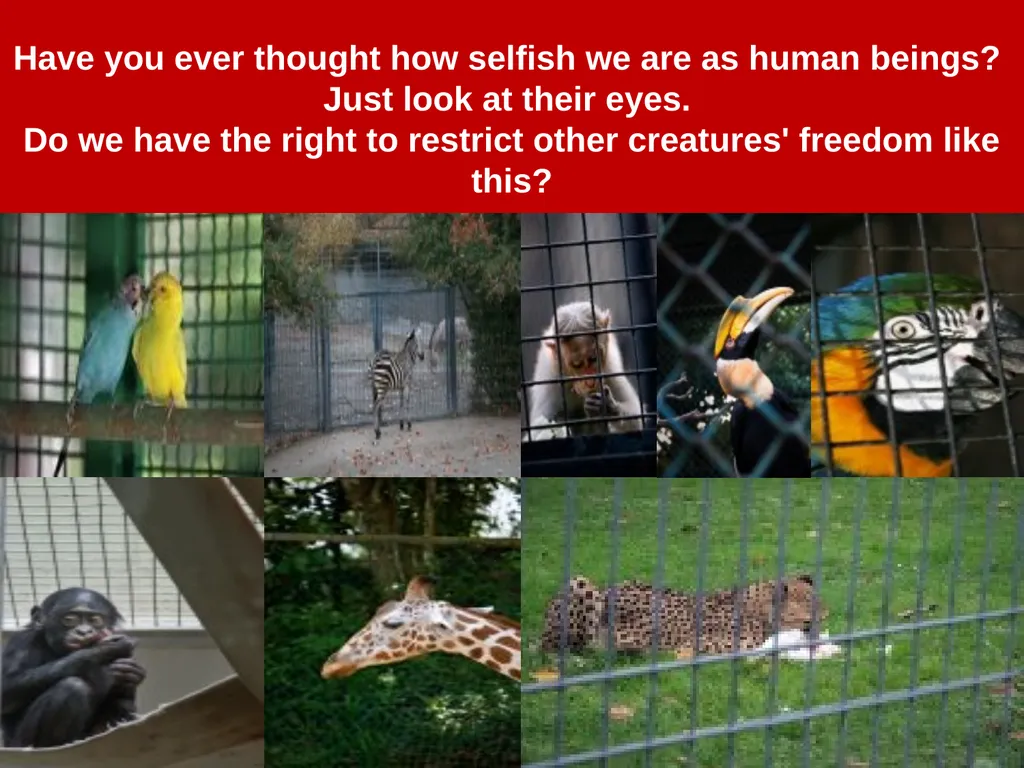
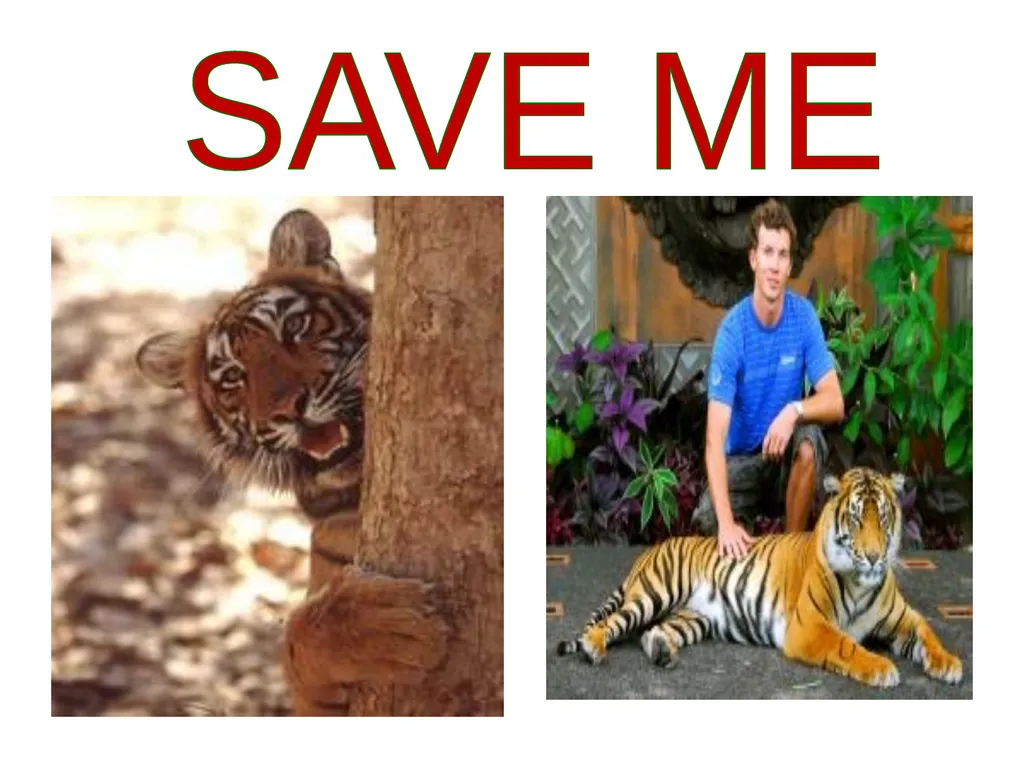
Have you ever thought how selfish we are as human beings? Just look at their eyes. Do we have the right to restrict other creatures freedom like this? Just Think Throughout the world, countless thousands of animals and birds are kept in
"Have you ever thought how selfish we are as human" is the property of its rightful owner. Permission is granted to
download and print the materials on this website for personal, non-commercial use only, and to display it
on your personal computer provided you do not modify the materials and that you retain all copyright
notices contained in the materials. By downloading content from our website, you accept the terms of this
agreement.
Presentation Transcript
01
Have you ever thought how selfish we are as human beings? Just look at their eyes. Do we have the right to restrict other creatures' freedom like this?<br>
02
Just Think… Throughout the world, countless thousands of animals and birds are kept in appalling conditions in zoos, circuses and private ownership. Even in modern zoos lions, tigers and other big cats repeatedly pace, frustrated because their hunting and territorial instincts are denied.
At present, wild tigers are in crisis and the main threat is human activity, while captive animals are exploited in zoos and circuses. In the wild, less than 5,000 tigers remain. The largest population is in India but less than 1,500 survive there. Threats include habitat loss due to mining, damns, logging, farming and human settlement; poaching for medicinal and other purposes.<br>
03
A TIGER IN THE ZOO
BY LESLIE NORRIS<br>
04
Publications : Finding Gold (1967), The Loud Winder (1967), Phoenix Living, Poets series: Ransoms (1970), Mountains, Polecats, Pheasants (1974), Sliding (1978), The Girl from Cardigan (1988), Norris's Ark (1988), The Collected Poems (1996), Collected Stories of Leslie Norris (1996), Holy Places (1998), A Tiger in the Zoo (1938).
In addition to poems and short stories, Norris published translation, biographies, and reviews.
His personal works deal with such themes as his Welsh home, his past, especially the pre-war period, his experiences as a teacher, nature, and the life of the instinct.
He won many prizes, among them the Cholmondeley Poetry Prize, the David Higham Memorial Prize, the Katherine Mansfield Memorial Award, the A.M.L. Award for poetry (in 1996) and the Welsh Arts Council Senior Fiction Award.
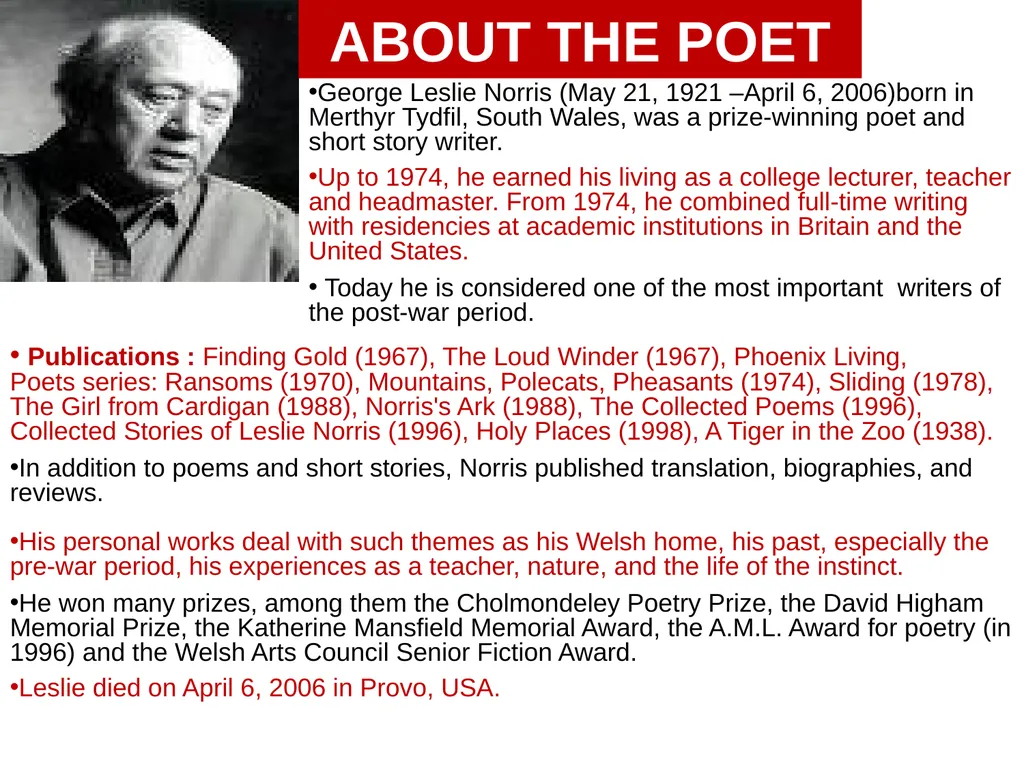
Leslie died on April 6, 2006 in Provo, USA. ABOUT THE POET George Leslie Norris (May 21, 1921 –April 6, 2006)born in Merthyr Tydfil, South Wales, was a prize-winning poet and short story writer.
Up to 1974, he earned his living as a college lecturer, teacher and headmaster. From 1974, he combined full-time writing with residencies at academic institutions in Britain and the United States.
Today he is considered one of the most important writers of the post-war period.<br>
05
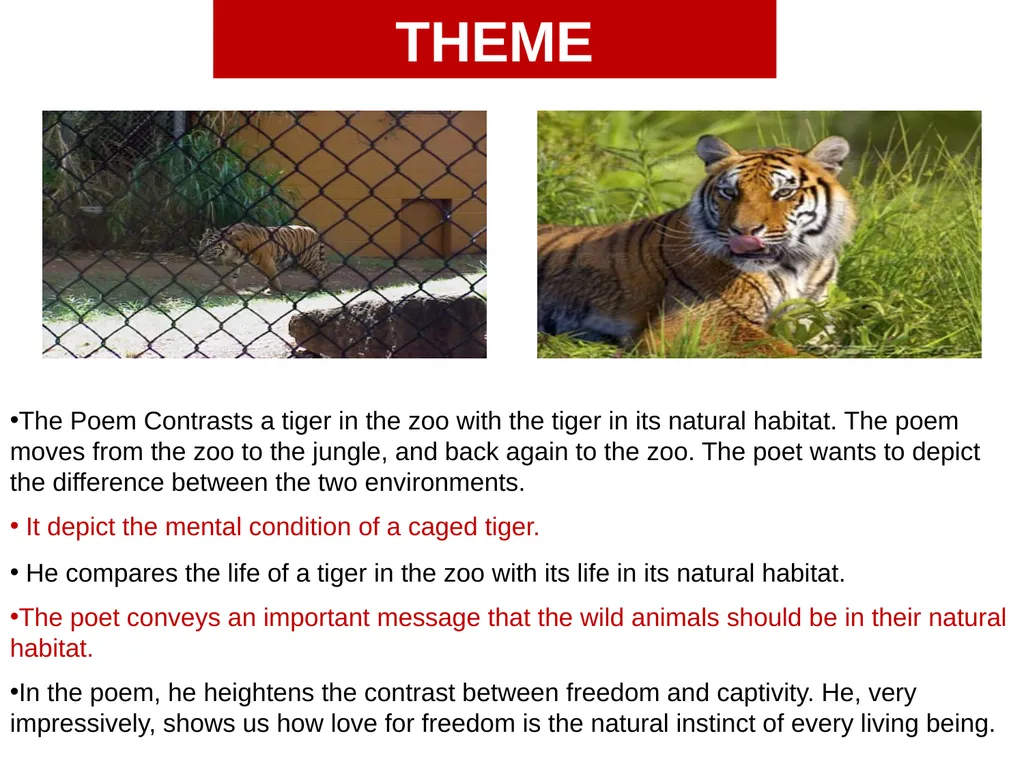
The Poem Contrasts a tiger in the zoo with the tiger in its natural habitat. The poem moves from the zoo to the jungle, and back again to the zoo. The poet wants to depict the difference between the two environments.
It depict the mental condition of a caged tiger.
He compares the life of a tiger in the zoo with its life in its natural habitat.
The poet conveys an important message that the wild animals should be in their natural habitat.
In the poem, he heightens the contrast between freedom and captivity. He, very impressively, shows us how love for freedom is the natural instinct of every living being. THEME<br>
06
STANZA-1<br>
07
STANZA-2<br>
08
STANZA-2<br>
09
STANZA-3<br>
10
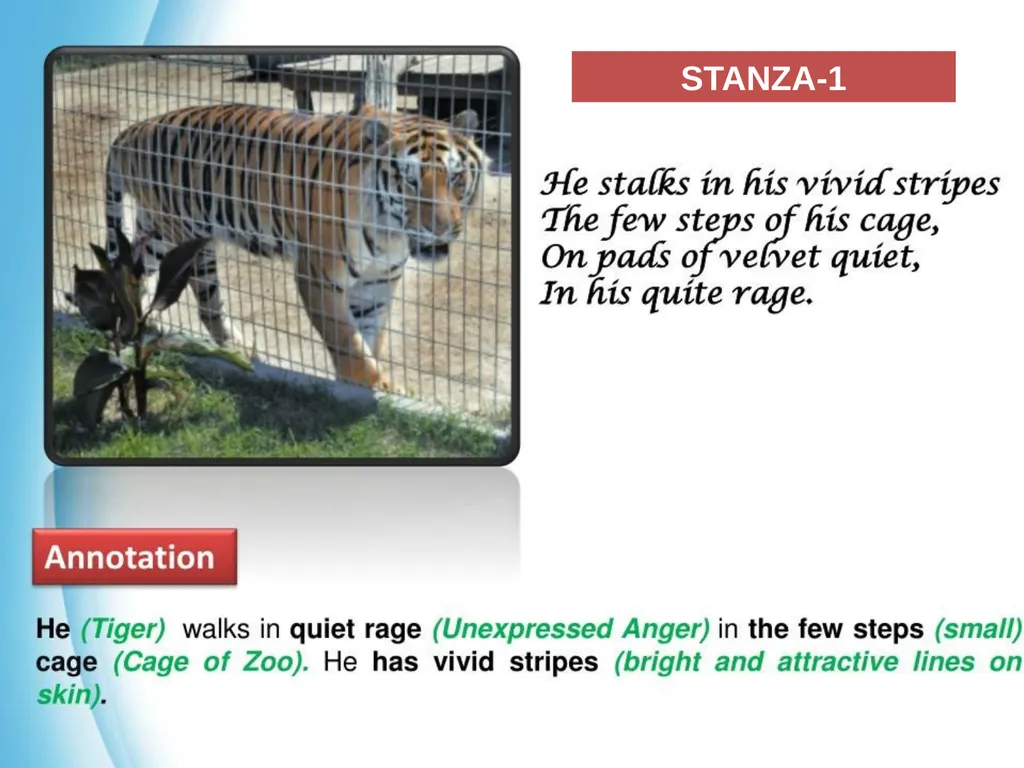
ANALYSIS OF STANZA-1 “He stalks in his vivid stripes. The few steps of his cage, On pads of velvet quiet, In his quiet rage.” The tiger, a mighty creature moves to and fro with his limited steps inside the cage. He moves quietly on his soft velvety pads (paws) expressing his anger quietly because all his freedom is locked inside the cage. He finds himself quiet helpless there.<br>
11
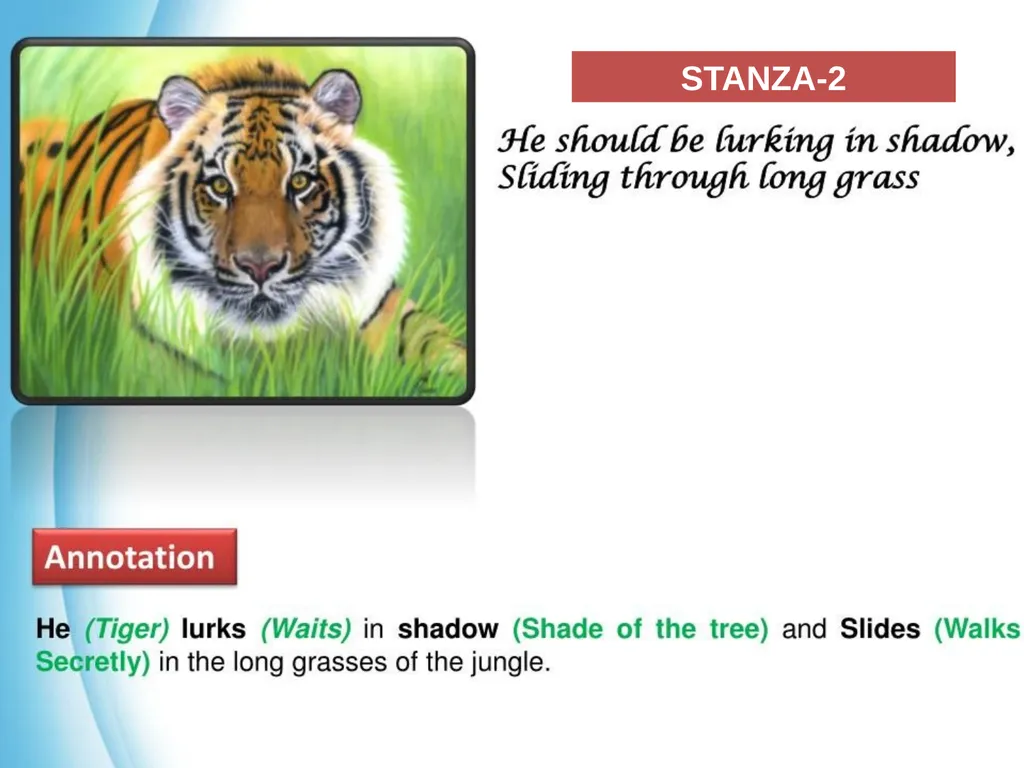
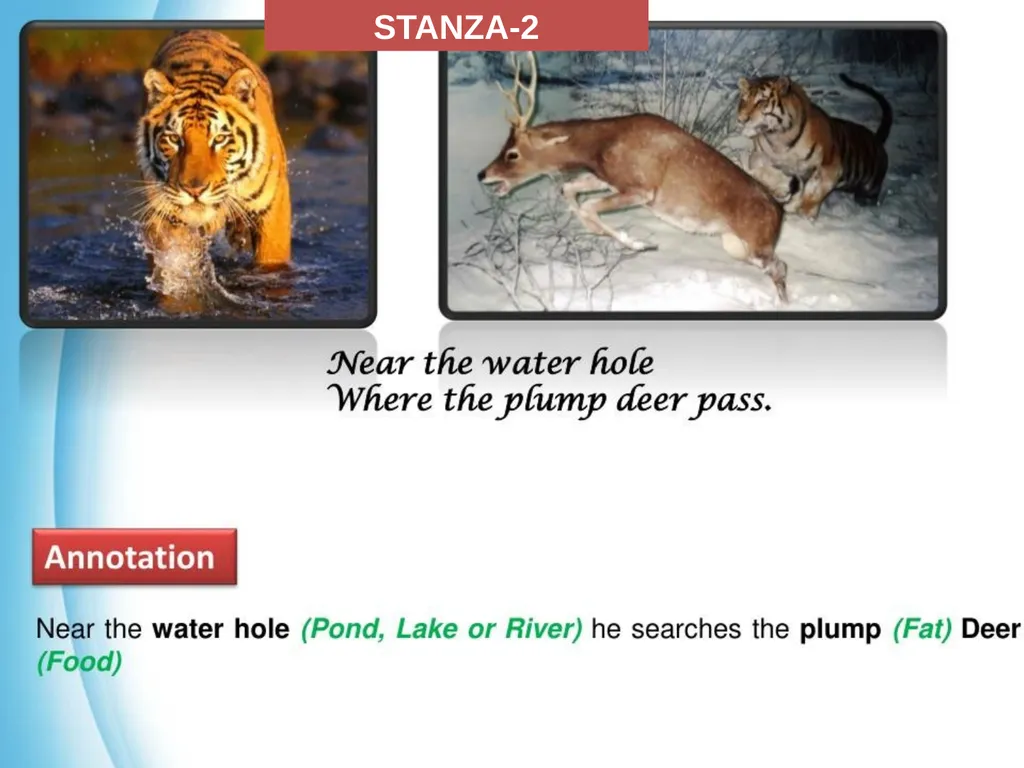
ANALYSIS OF STANZA-2 “He should be lurking in shadow, Sliding through long grass Near the water hole Where plump dear pass.” The poet is moved to pity for the tiger. He says that zoo is not the place where he should be. Rather he should have been in the jungle moving quietly in the shadows near some water source, and waiting for a healthy deer to pass that way.<br>
12
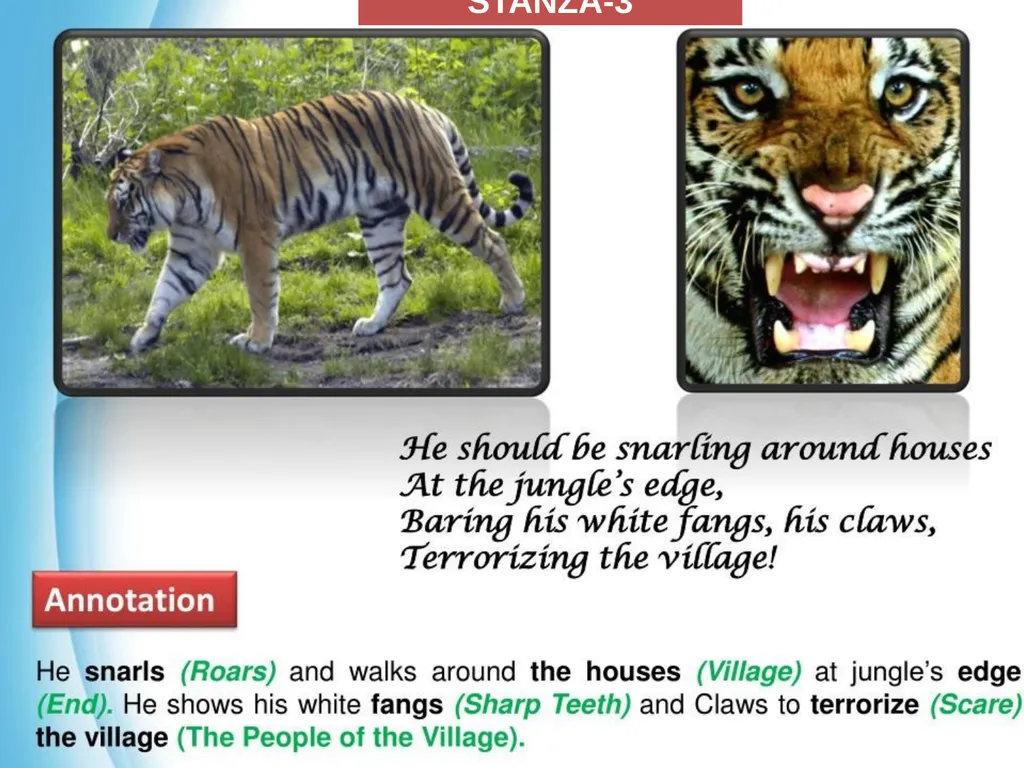
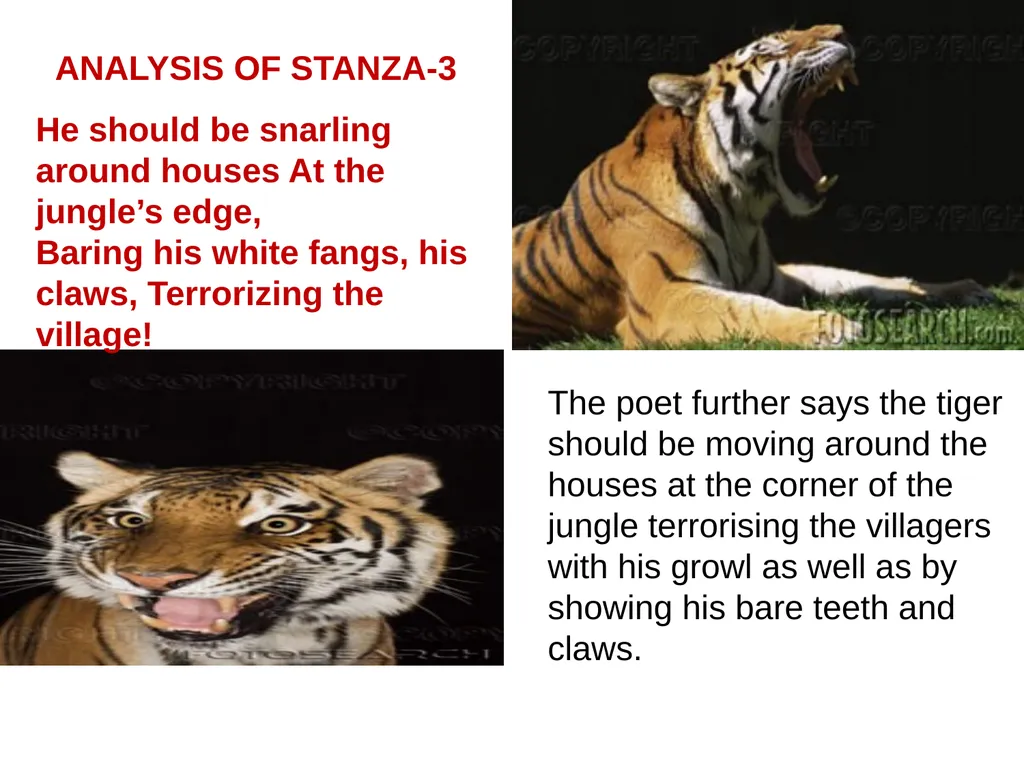
ANALYSIS OF STANZA-3 The poet further says the tiger should be moving around the houses at the corner of the jungle terrorising the villagers with his growl as well as by showing his bare teeth and claws. He should be snarling around houses At the jungle’s edge, Baring his white fangs, his claws, Terrorizing the village!<br>
13
ANALYSIS OF STANZA-4
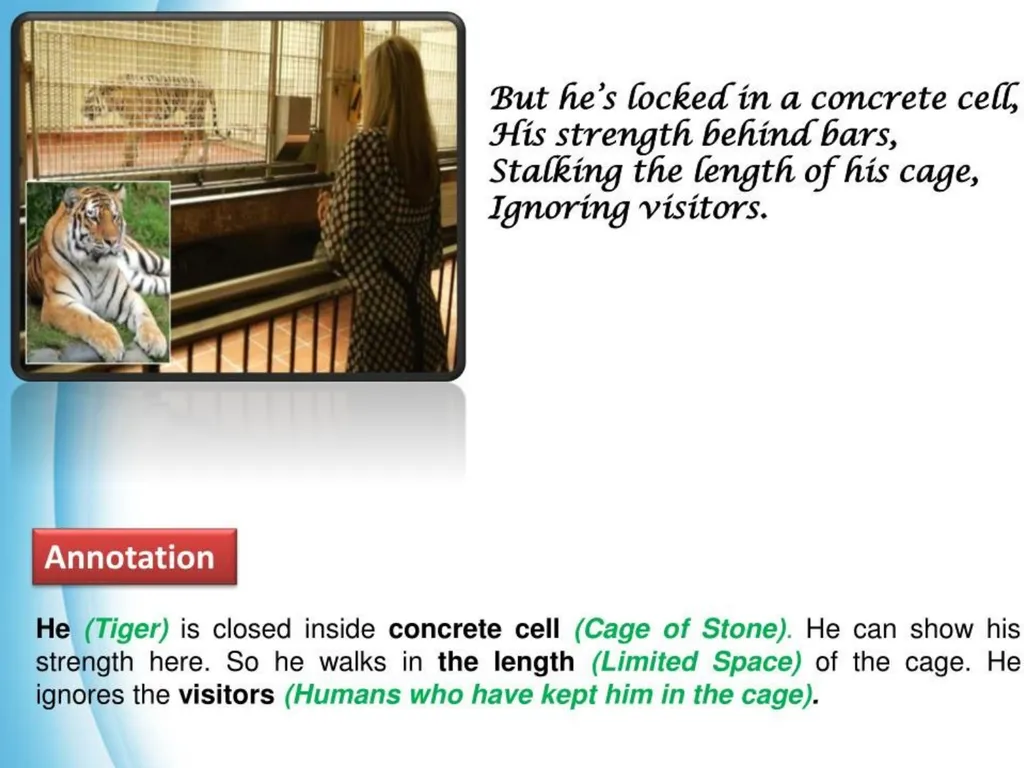
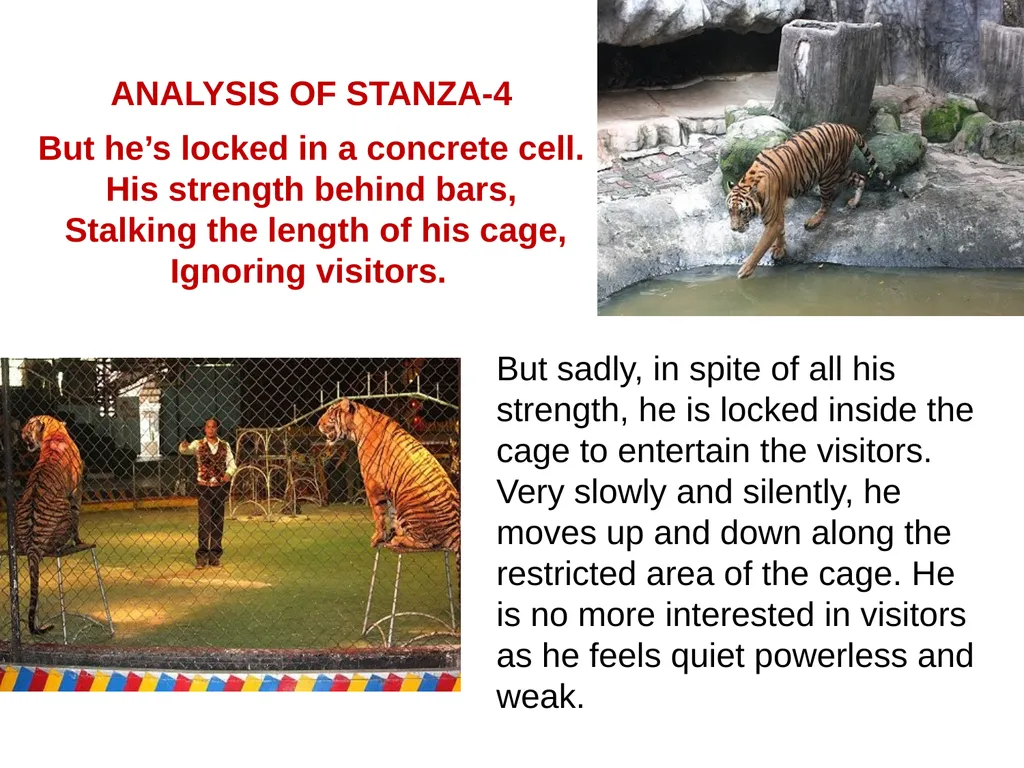
But he’s locked in a concrete cell. His strength behind bars, Stalking the length of his cage, Ignoring visitors. But sadly, in spite of all his strength, he is locked inside the cage to entertain the visitors. Very slowly and silently, he moves up and down along the restricted area of the cage. He is no more interested in visitors as he feels quiet powerless and weak.<br>