Hearing Conservation & Noise Control 1 PPT-017-03
Description: Hearing Conservation Noise Control 1 PPT-017-03 Bureau of Workers Compensation PA Training for Health Safety (PATHS) 29 CFR 1910.95 Why Hearing Conservation? Its the LAW Quality of Life Hearing Loss is GradualPainless 2 PPT-017-03
Related Topics
Download Presentation
"Hearing Conservation & Noise Control 1 PPT-017-03" is the property of its rightful owner. Permission is granted to download and print the materials on this website for personal, non-commercial use only, and to display it on your personal computer provided you do not modify the materials and that you retain all copyright notices contained in the materials. By downloading content from our website, you accept the terms of this agreement.
Presentation Transcript
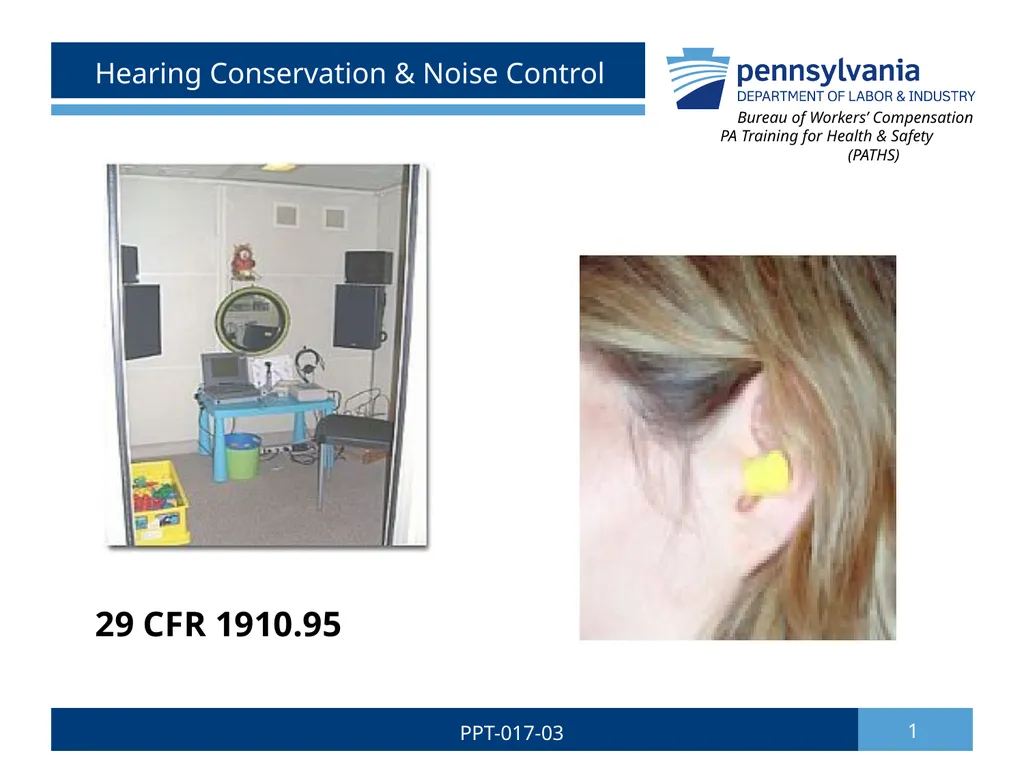
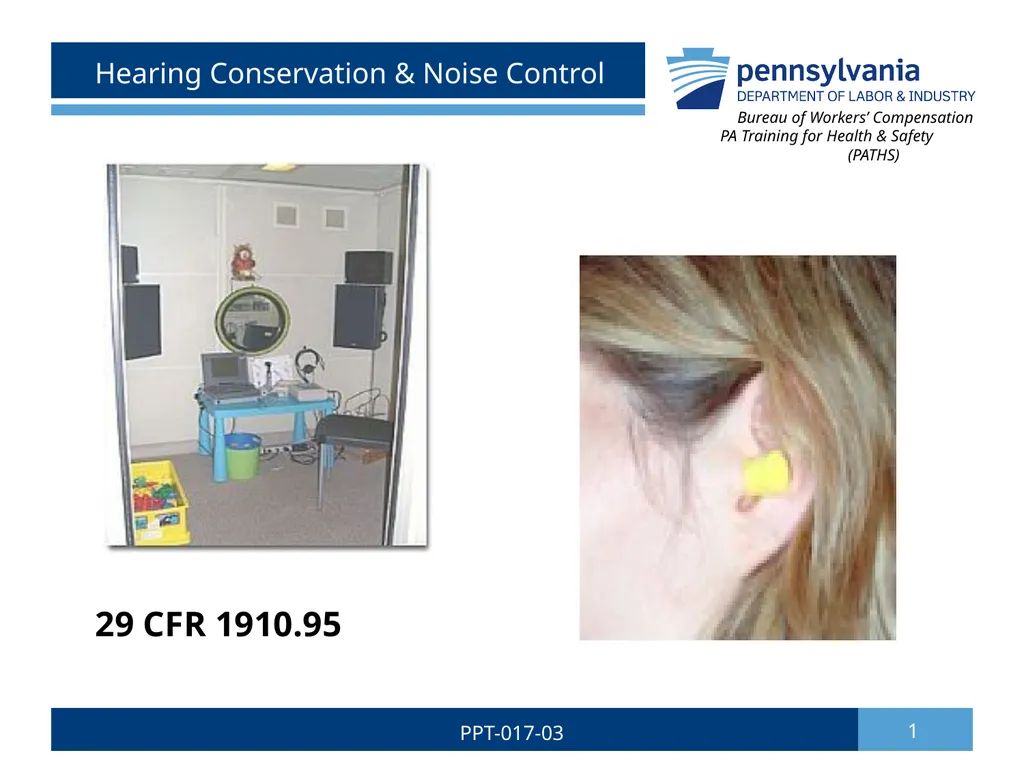
slide1. Hearing Conservation & Noise Control 1 PPT-017-03 Bureau of Workers’ Compensation
PA Training for Health & Safety (PATHS) 29 CFR 1910.95<br>
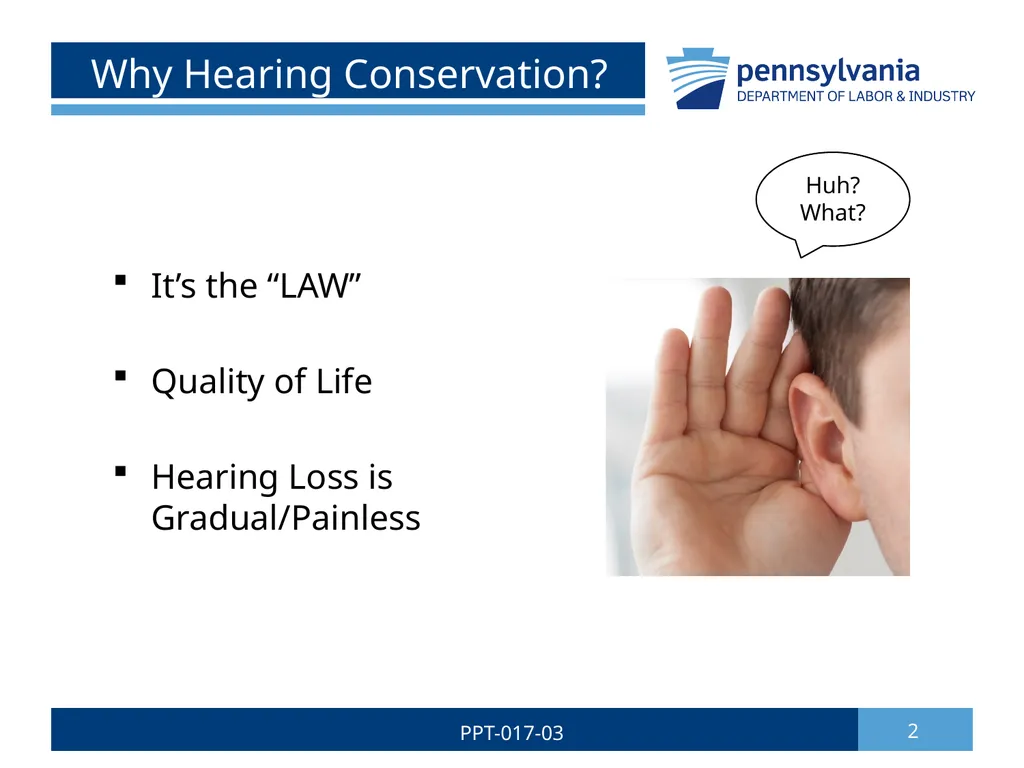
slide2. Why Hearing Conservation? It’s the “LAW”
Quality of Life
Hearing Loss is Gradual/Painless 2 PPT-017-03 Huh? What?<br>
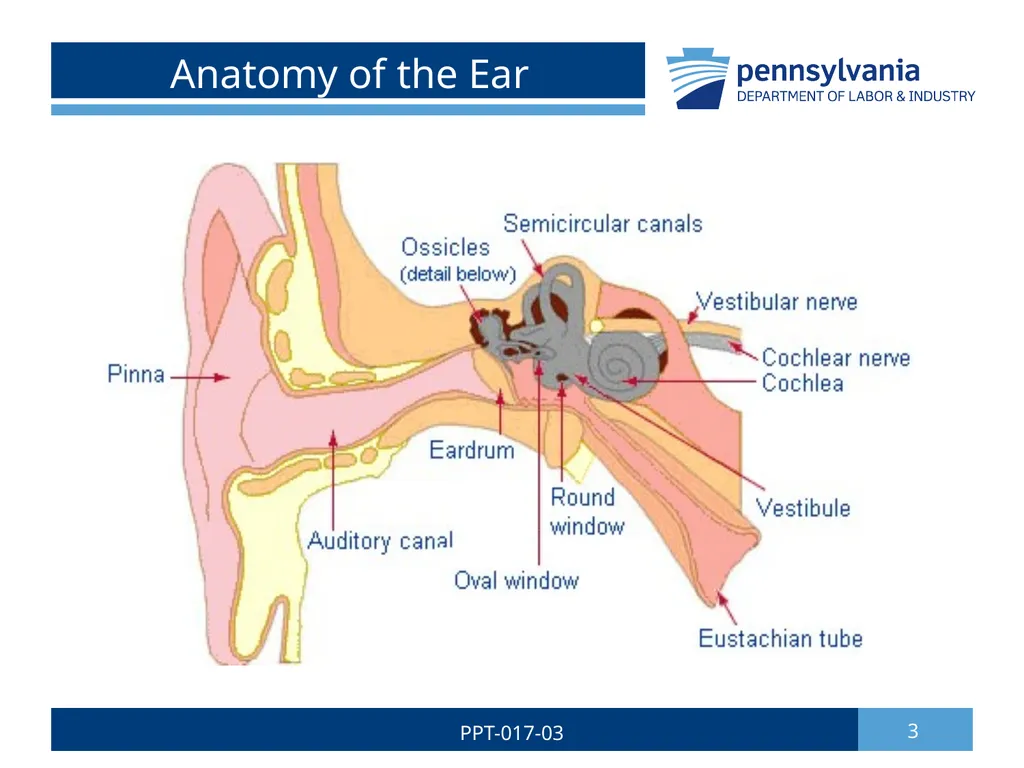
slide3. Anatomy of the Ear 3 PPT-017-03<br>
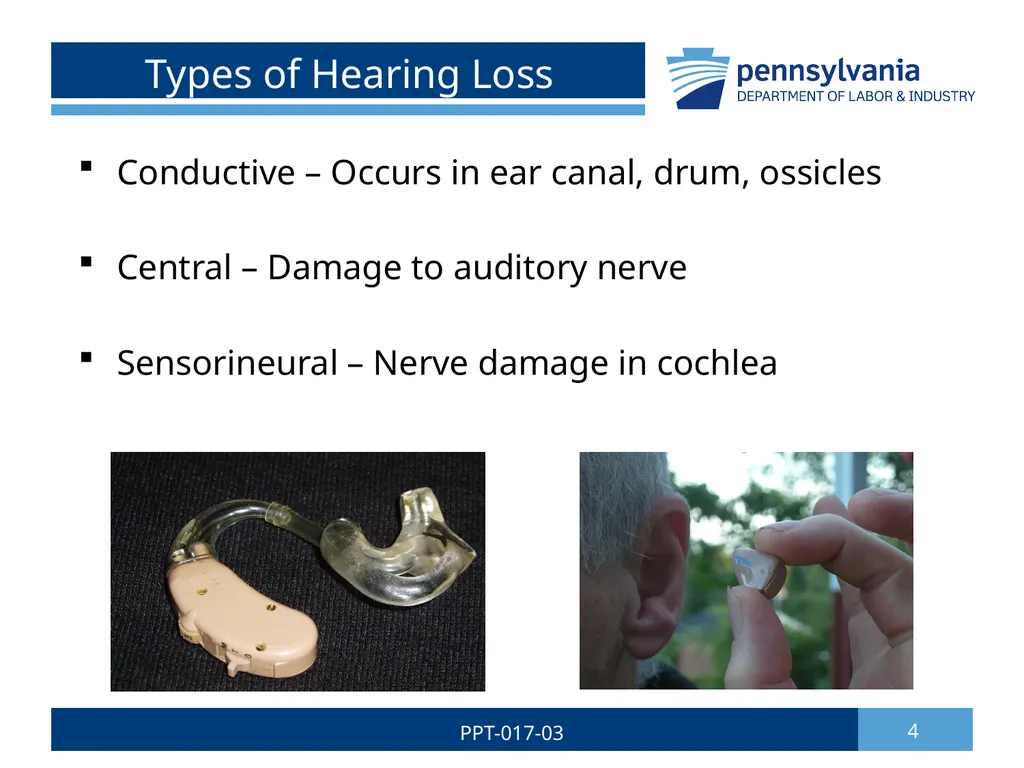
slide4. Types of Hearing Loss Conductive – Occurs in ear canal, drum, ossicles
Central – Damage to auditory nerve
Sensorineural – Nerve damage in cochlea 4 PPT-017-03<br>
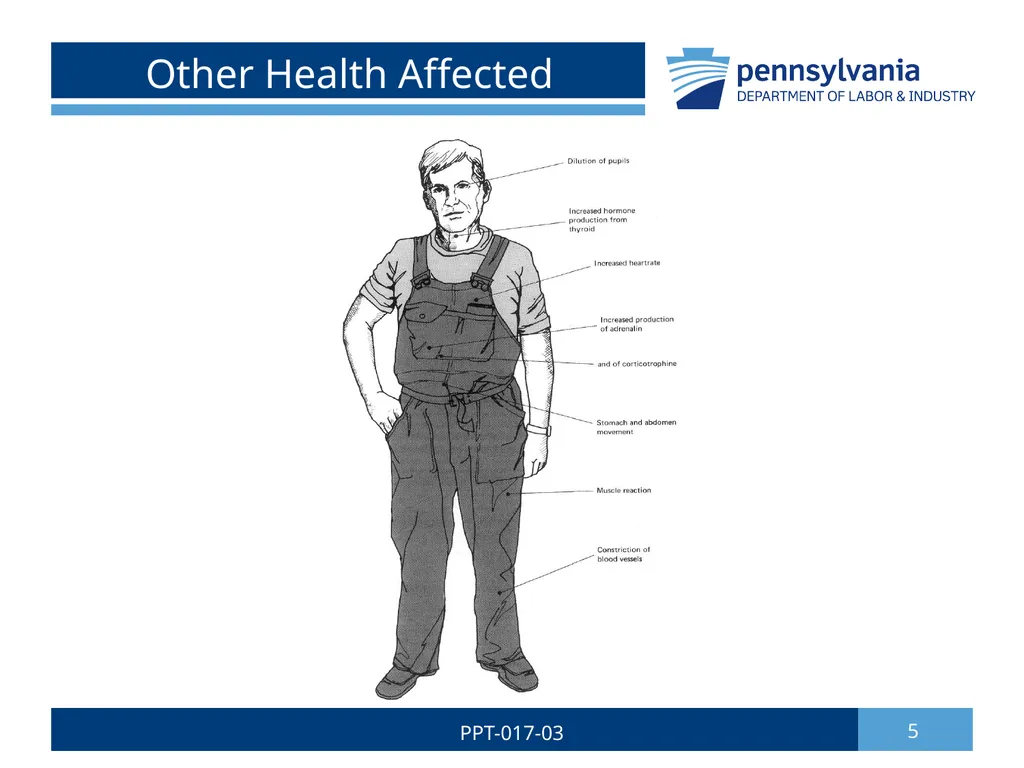
slide5. Other Health Affected 5 PPT-017-03<br>
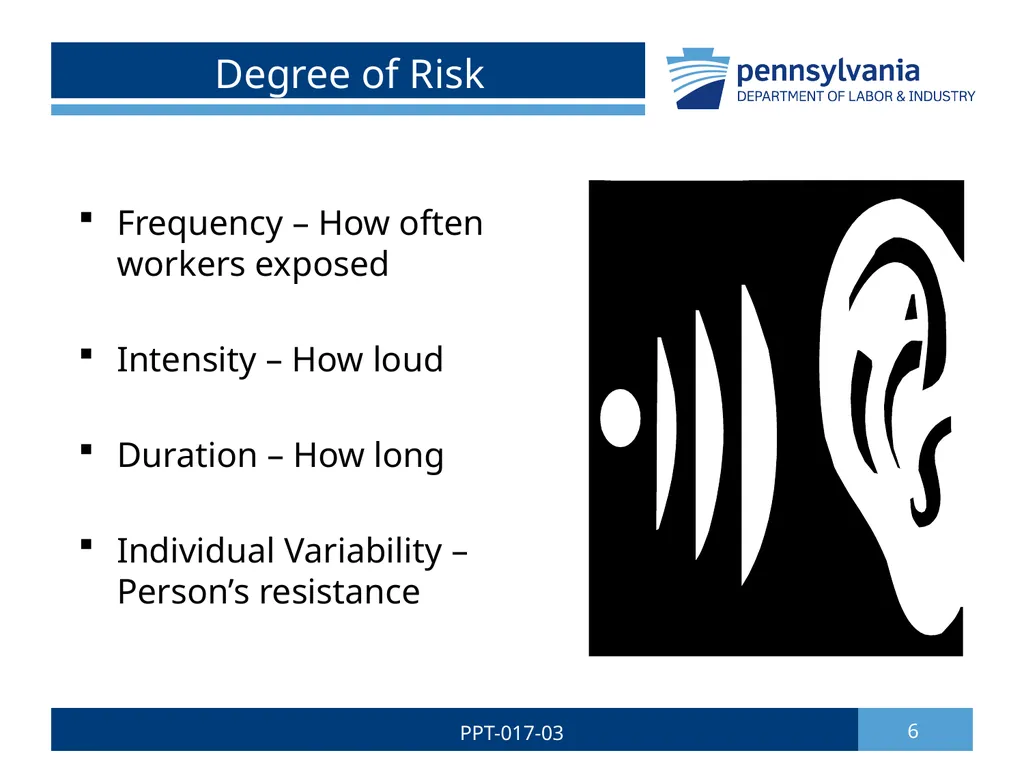
slide6. Degree of Risk Frequency – How often workers exposed
Intensity – How loud
Duration – How long
Individual Variability – Person’s resistance 6 PPT-017-03<br>
slide7. Decibel The ear has the remarkable ability to handle an enormous range of sound levels.
In order to express levels of sound meaningfully in numbers that are more manageable, a logarithmic scale is used, rather than a linear one.
This scale is the decibel scale used to express the ratio of two values of a physical quantity, often power or intensity (in this case, sound).
Zero decibels (0 dB) is the quietest sound audible to a healthy human ear.
From there, every increase of 3 dB represents a doubling of sound intensity, or acoustic power. 7 PPT-017-03<br>
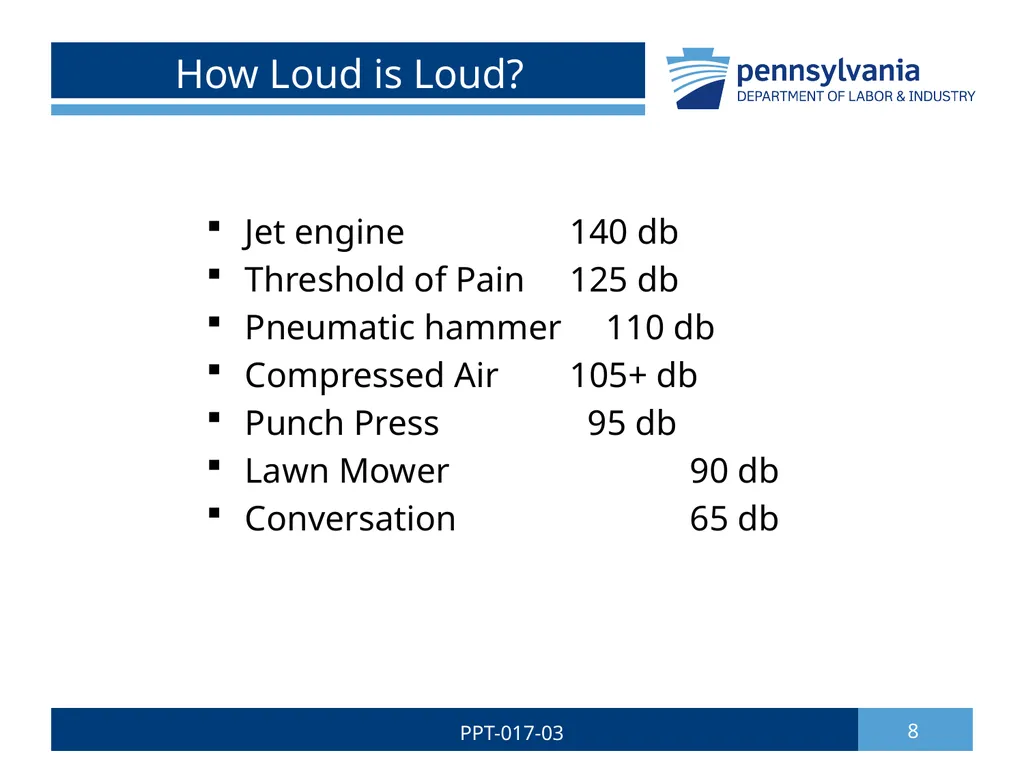
slide8. How Loud is Loud? Jet engine 140 db
Threshold of Pain 125 db
Pneumatic hammer 110 db
Compressed Air 105+ db
Punch Press 95 db
Lawn Mower 90 db
Conversation 65 db 8 PPT-017-03<br>
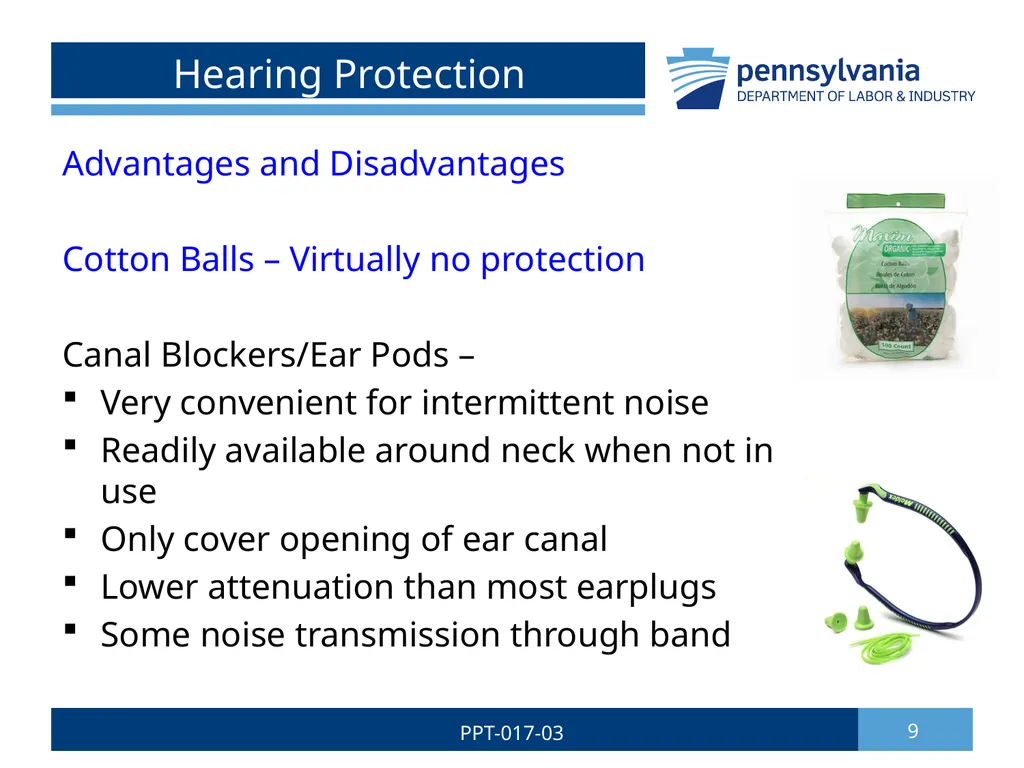
slide9. Hearing Protection Advantages and Disadvantages
Cotton Balls – Virtually no protection
Canal Blockers/Ear Pods –
Very convenient for intermittent noise
Readily available around neck when not in use
Only cover opening of ear canal
Lower attenuation than most earplugs
Some noise transmission through band 9 PPT-017-03<br>
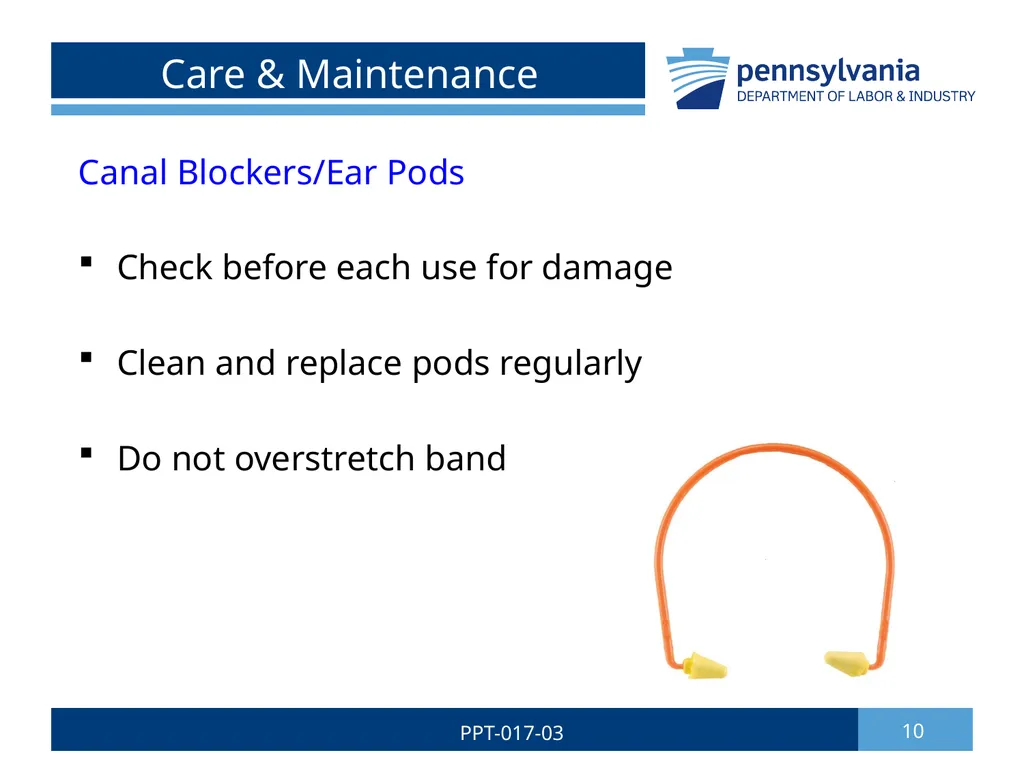
slide10. Care & Maintenance Canal Blockers/Ear Pods
Check before each use for damage
Clean and replace pods regularly
Do not overstretch band 10 PPT-017-03<br>
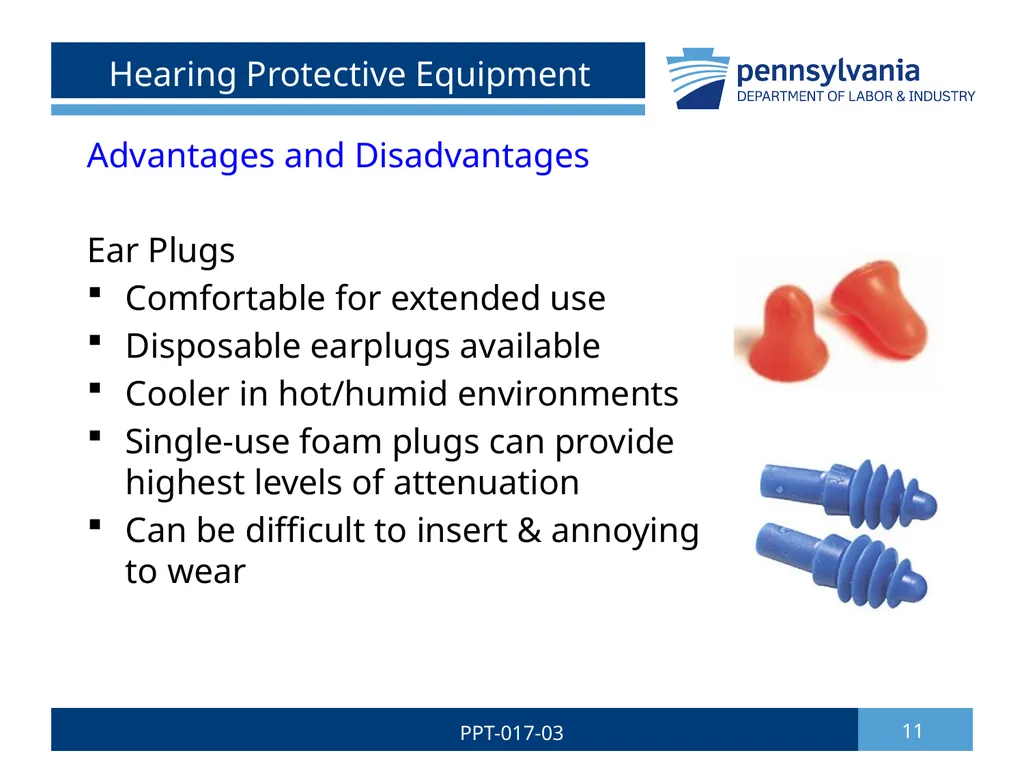
slide11. Hearing Protective Equipment Advantages and Disadvantages
Ear Plugs
Comfortable for extended use
Disposable earplugs available
Cooler in hot/humid environments
Single-use foam plugs can provide highest levels of attenuation
Can be difficult to insert & annoying to wear 11 PPT-017-03<br>
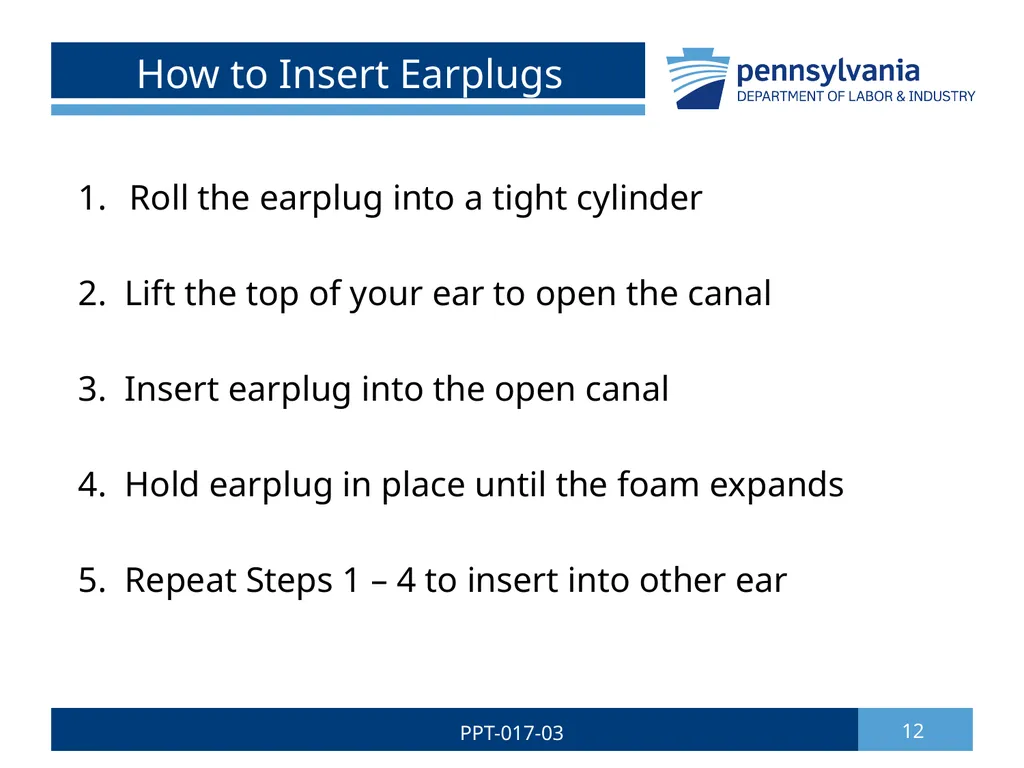
slide12. How to Insert Earplugs Roll the earplug into a tight cylinder
2. Lift the top of your ear to open the canal
3. Insert earplug into the open canal
4. Hold earplug in place until the foam expands
5. Repeat Steps 1 – 4 to insert into other ear 12 PPT-017-03<br>
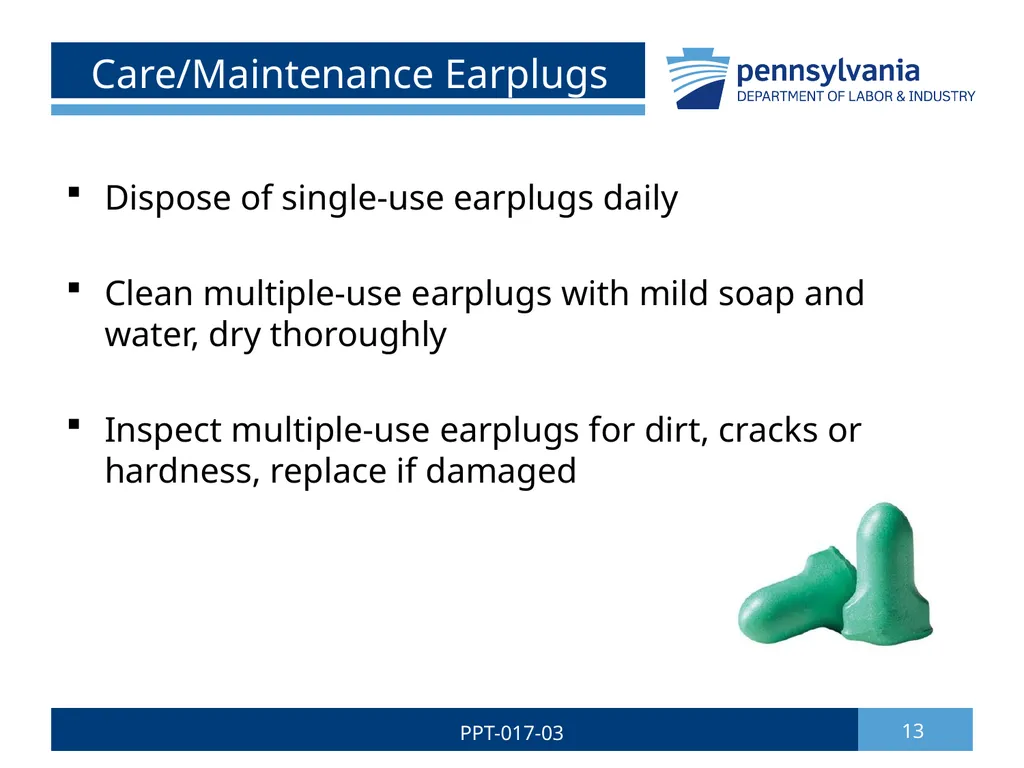
slide13. Care/Maintenance Earplugs Dispose of single-use earplugs daily
Clean multiple-use earplugs with mild soap and water, dry thoroughly
Inspect multiple-use earplugs for dirt, cracks or hardness, replace if damaged 13 PPT-017-03<br>
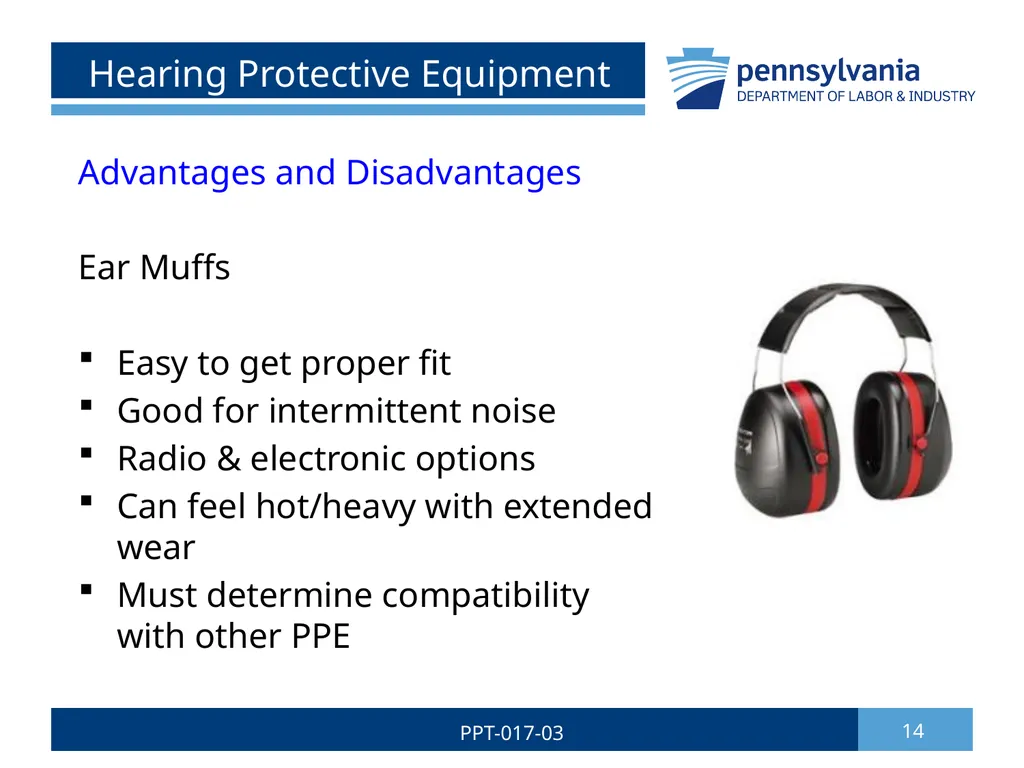
slide14. Hearing Protective Equipment Advantages and Disadvantages
Ear Muffs
Easy to get proper fit
Good for intermittent noise
Radio & electronic options
Can feel hot/heavy with extended wear
Must determine compatibility with other PPE 14 PPT-017-03<br>
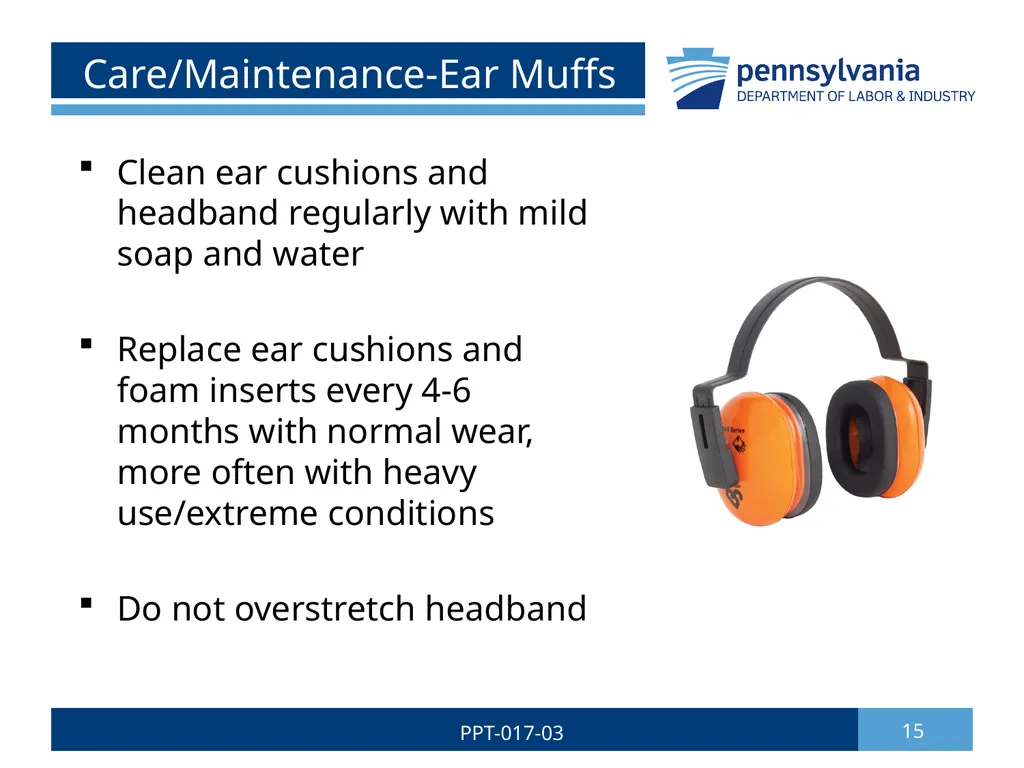
slide15. Care/Maintenance-Ear Muffs Clean ear cushions and headband regularly with mild soap and water
Replace ear cushions and foam inserts every 4-6 months with normal wear, more often with heavy use/extreme conditions
Do not overstretch headband 15 PPT-017-03<br>
slide16. dBA vs. dBC The A-weightings and C-weightings refer to different sensitivity scales for noise measurement.
“A” scale follows the frequency sensitivity of the human ear at low levels.
Is the most commonly used weighting scale, as it also predicts quite well the damage risk of the ear.
Sound level meters set to the A-weighting scale will filter out much of the low-frequency noise they measure, similar to the response of the human ear.
“C” scale follows the frequency sensitivity of the human ear at very high noise levels.
“C” scale is quite flat, and therefore includes much more of the low-frequency range of sounds than the A scales. 16 PPT-017-03<br>
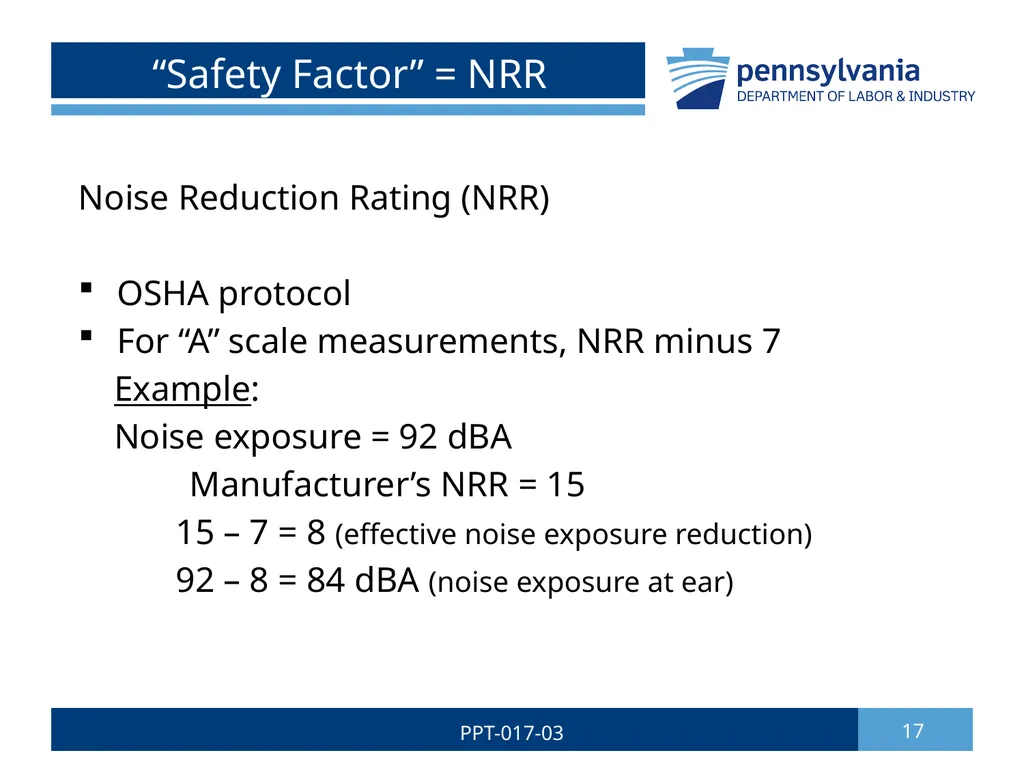
slide17. “Safety Factor” = NRR Noise Reduction Rating (NRR)
OSHA protocol
For “A” scale measurements, NRR minus 7
Example:
Noise exposure = 92 dBA
Manufacturer’s NRR = 15
15 – 7 = 8 (effective noise exposure reduction)
92 – 8 = 84 dBA (noise exposure at ear) 17 PPT-017-03<br>
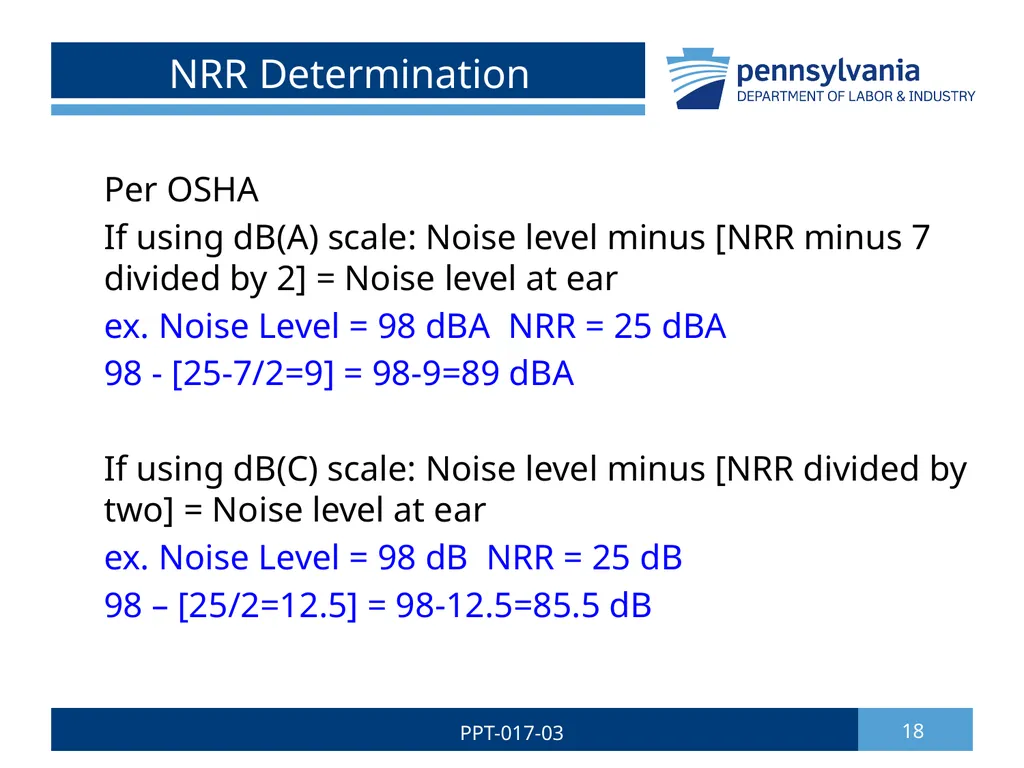
slide18. NRR Determination Per OSHA
If using dB(A) scale: Noise level minus [NRR minus 7 divided by 2] = Noise level at ear
ex. Noise Level = 98 dBA NRR = 25 dBA
98 - [25-7/2=9] = 98-9=89 dBA
If using dB(C) scale: Noise level minus [NRR divided by two] = Noise level at ear
ex. Noise Level = 98 dB NRR = 25 dB
98 – [25/2=12.5] = 98-12.5=85.5 dB 18 PPT-017-03<br>
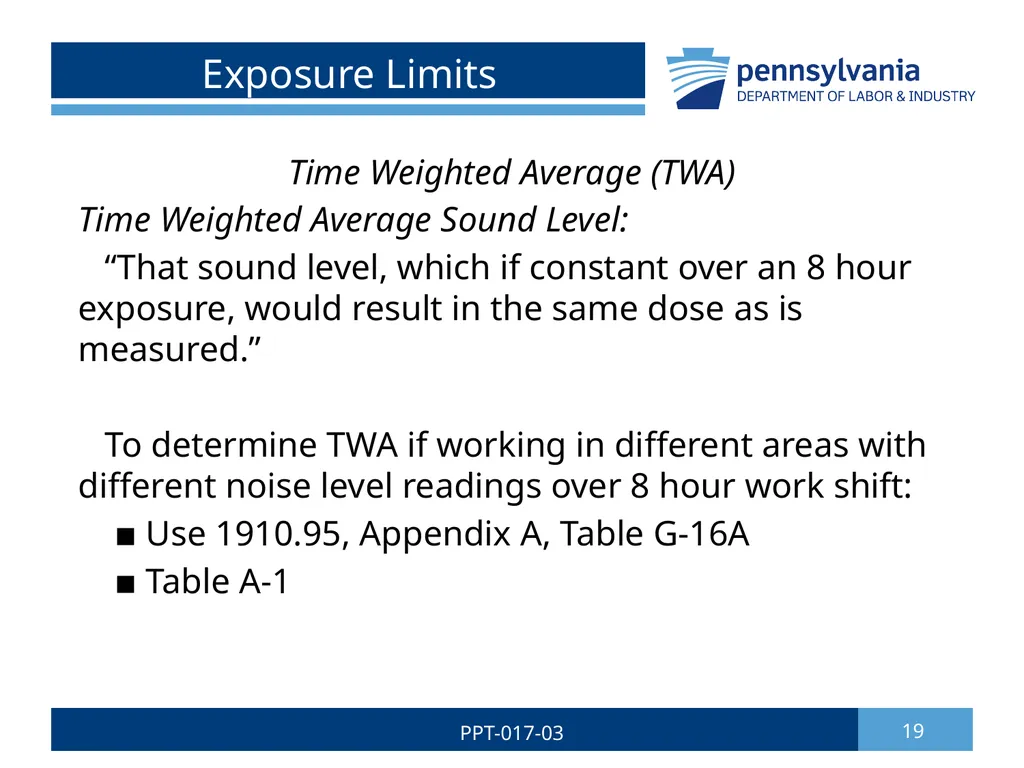
slide19. Exposure Limits Time Weighted Average (TWA)
Time Weighted Average Sound Level:
“That sound level, which if constant over an 8 hour exposure, would result in the same dose as is measured.”
To determine TWA if working in different areas with different noise level readings over 8 hour work shift:
▪ Use 1910.95, Appendix A, Table G-16A
▪ Table A-1 19 PPT-017-03<br>
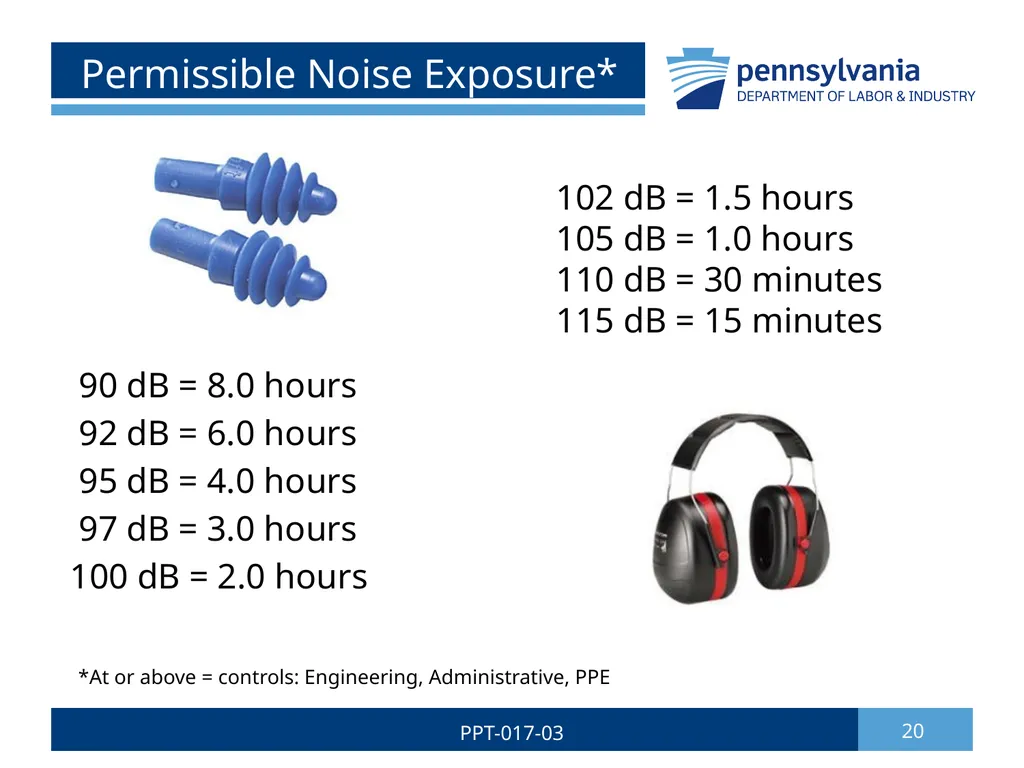
slide20. Permissible Noise Exposure* 90 dB = 8.0 hours
92 dB = 6.0 hours
95 dB = 4.0 hours
97 dB = 3.0 hours
100 dB = 2.0 hours 20 PPT-017-03 102 dB = 1.5 hours
105 dB = 1.0 hours
110 dB = 30 minutes
115 dB = 15 minutes *At or above = controls: Engineering, Administrative, PPE<br>
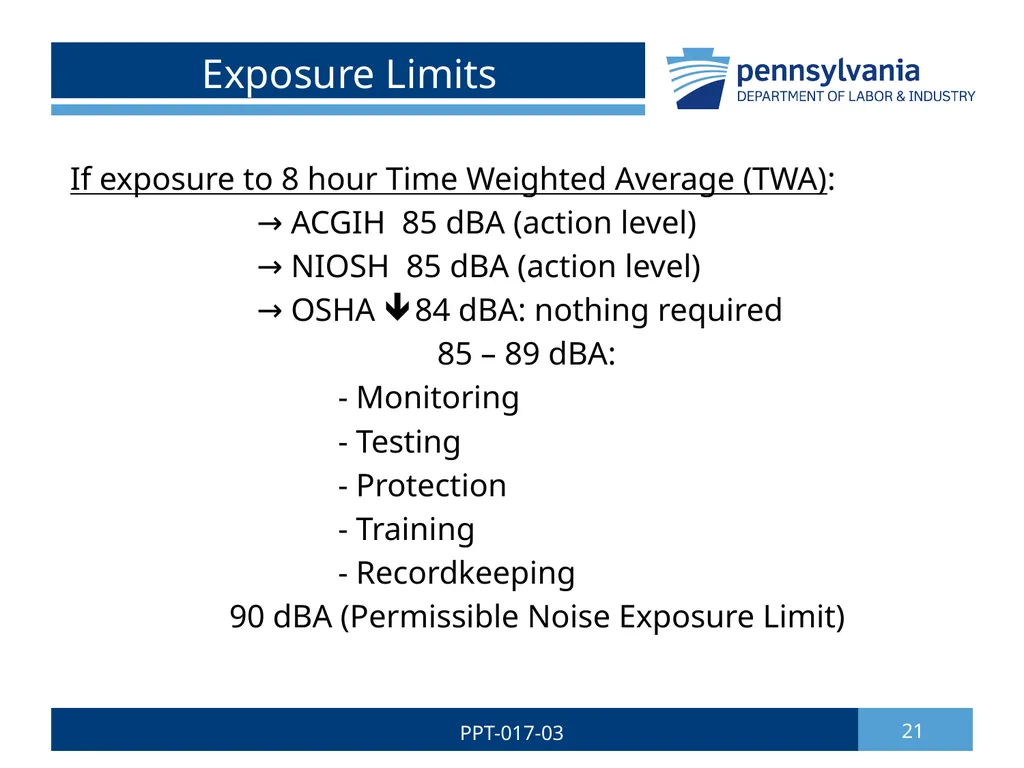
slide21. Exposure Limits If exposure to 8 hour Time Weighted Average (TWA):
→ ACGIH 85 dBA (action level)
→ NIOSH 85 dBA (action level)
→ OSHA 84 dBA: nothing required
85 – 89 dBA:
- Monitoring
- Testing
- Protection
- Training
- Recordkeeping
90 dBA (Permissible Noise Exposure Limit) 21 PPT-017-03<br>
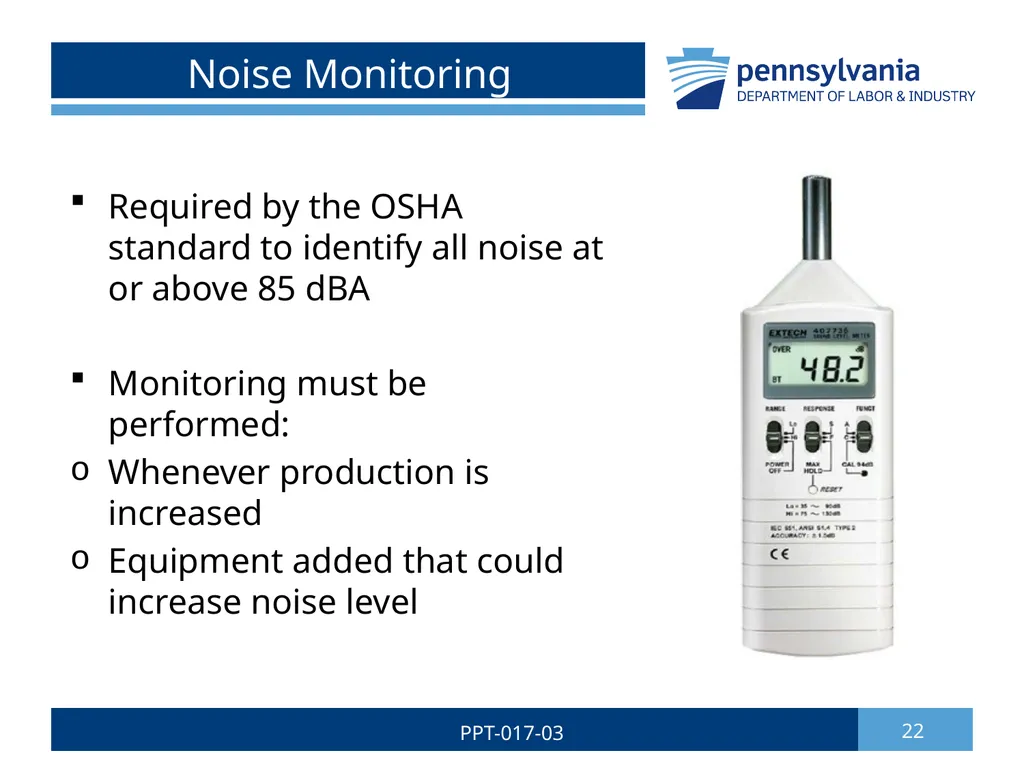
slide22. Noise Monitoring Required by the OSHA standard to identify all noise at or above 85 dBA
Monitoring must be performed:
Whenever production is increased
Equipment added that could increase noise level 22 PPT-017-03<br>
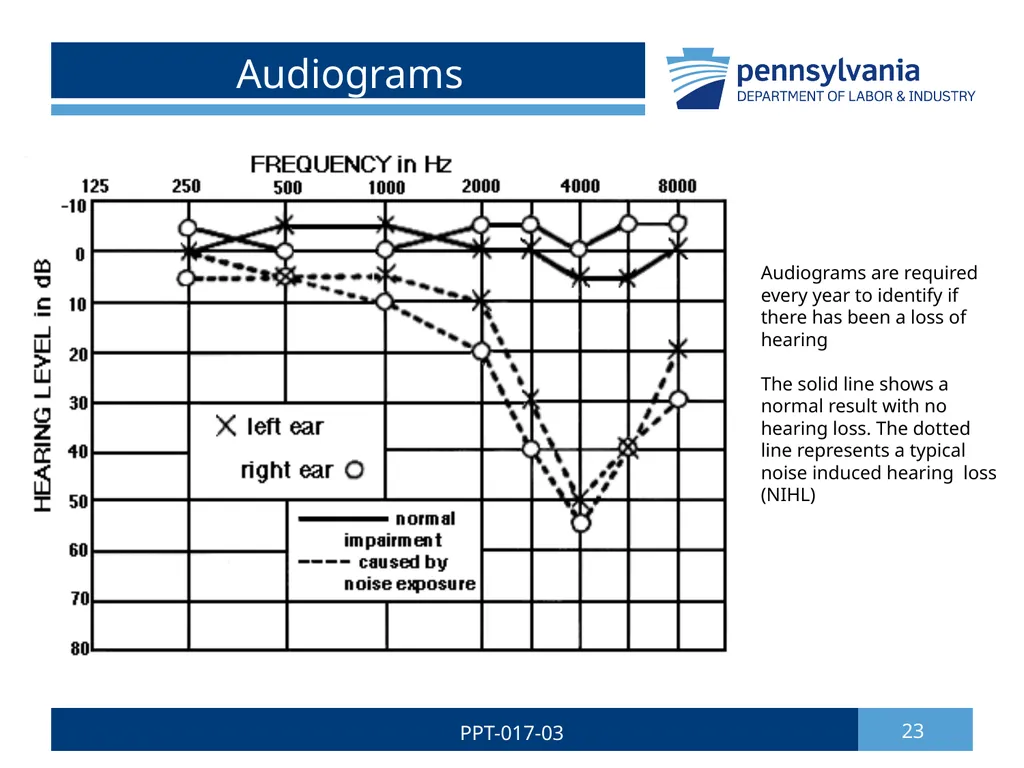
slide23. Audiograms 23 PPT-017-03 Audiograms are required every year to identify if there has been a loss of hearing
The solid line shows a normal result with no hearing loss. The dotted line represents a typical noise induced hearing loss (NIHL)<br>
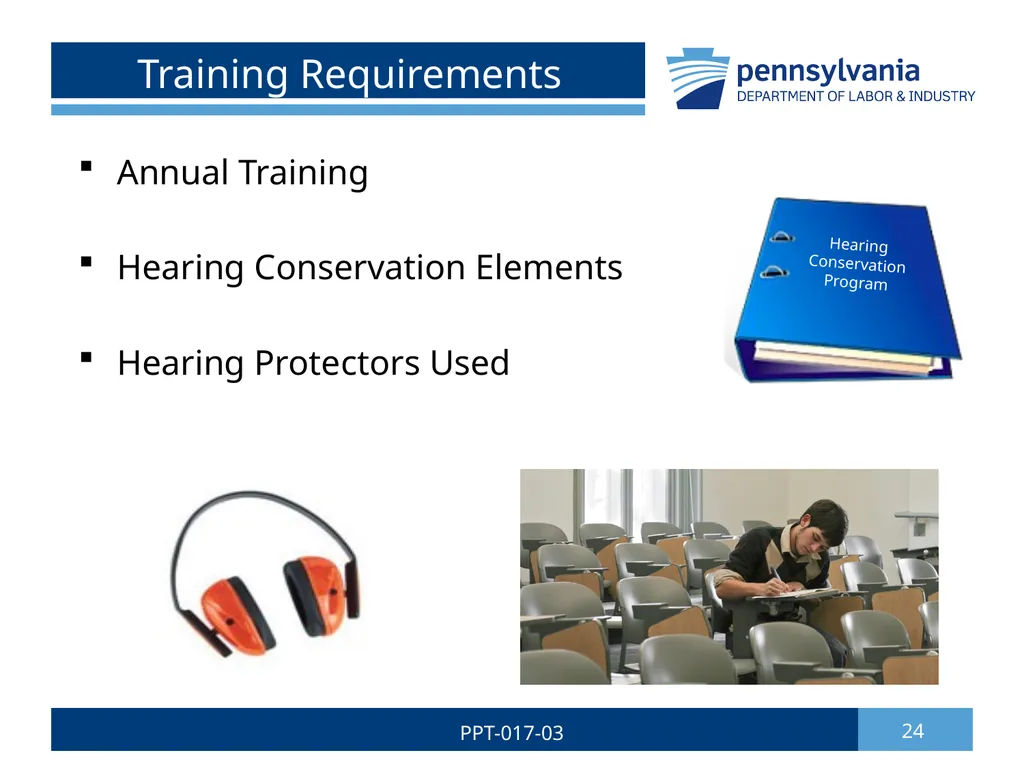
slide24. Training Requirements Annual Training
Hearing Conservation Elements
Hearing Protectors Used 24 PPT-017-03 Hearing Conservation Program<br>
slide25. Recordkeeping Monitoring records
(Keep for 2 years)
Audiometric testing records
(Keep for period of employment) 25 PPT-017-03<br>
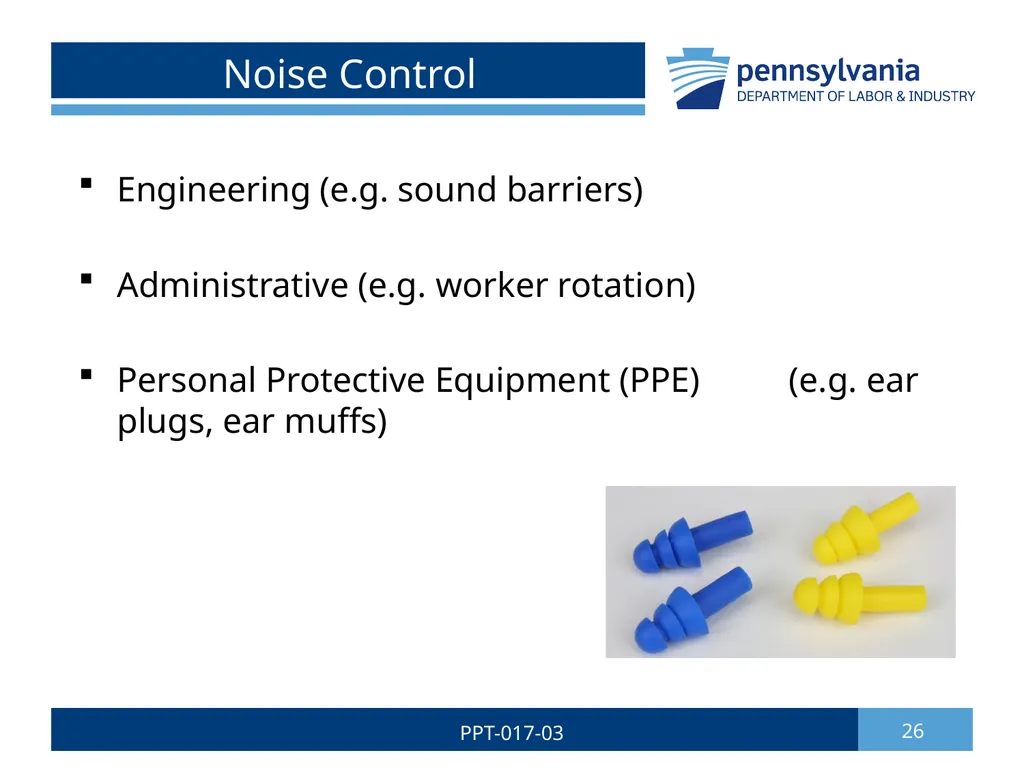
slide26. Noise Control Engineering (e.g. sound barriers)
Administrative (e.g. worker rotation)
Personal Protective Equipment (PPE) (e.g. ear plugs, ear muffs) 26 PPT-017-03<br>
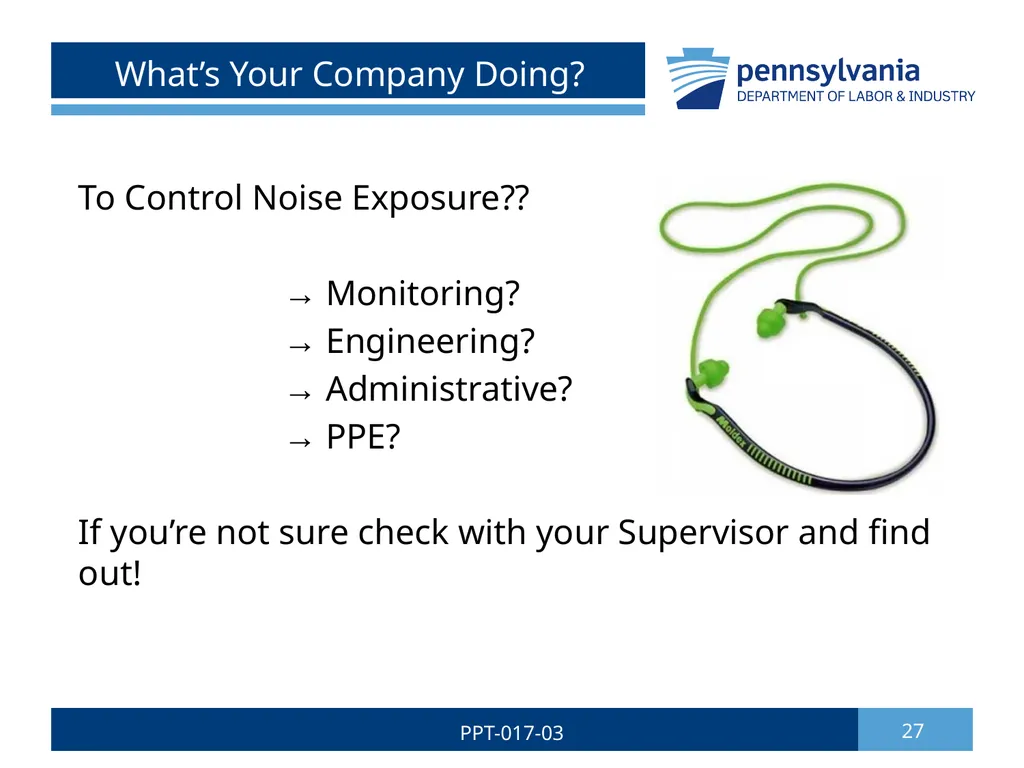
slide27. What’s Your Company Doing? To Control Noise Exposure??
→ Monitoring?
→ Engineering?
→ Administrative?
→ PPE?
If you’re not sure check with your Supervisor and find out! 27 PPT-017-03<br>
slide28. Contact Information Health & Safety Training Specialists
1171 South Cameron Street, Room 324
Harrisburg, PA 17104-2501
(717) 772-1635
RA-LI-BWC-PATHS@pa.gov 28 PPT-017-03 Like us on Facebook! - https://www.facebook.com/BWCPATHS<br>
slide29. Questions 29 PPT-017-03<br>
PA Training for Health & Safety (PATHS) 29 CFR 1910.95<br>
slide2. Why Hearing Conservation? It’s the “LAW”
Quality of Life
Hearing Loss is Gradual/Painless 2 PPT-017-03 Huh? What?<br>
slide3. Anatomy of the Ear 3 PPT-017-03<br>
slide4. Types of Hearing Loss Conductive – Occurs in ear canal, drum, ossicles
Central – Damage to auditory nerve
Sensorineural – Nerve damage in cochlea 4 PPT-017-03<br>
slide5. Other Health Affected 5 PPT-017-03<br>
slide6. Degree of Risk Frequency – How often workers exposed
Intensity – How loud
Duration – How long
Individual Variability – Person’s resistance 6 PPT-017-03<br>
slide7. Decibel The ear has the remarkable ability to handle an enormous range of sound levels.
In order to express levels of sound meaningfully in numbers that are more manageable, a logarithmic scale is used, rather than a linear one.
This scale is the decibel scale used to express the ratio of two values of a physical quantity, often power or intensity (in this case, sound).
Zero decibels (0 dB) is the quietest sound audible to a healthy human ear.
From there, every increase of 3 dB represents a doubling of sound intensity, or acoustic power. 7 PPT-017-03<br>
slide8. How Loud is Loud? Jet engine 140 db
Threshold of Pain 125 db
Pneumatic hammer 110 db
Compressed Air 105+ db
Punch Press 95 db
Lawn Mower 90 db
Conversation 65 db 8 PPT-017-03<br>
slide9. Hearing Protection Advantages and Disadvantages
Cotton Balls – Virtually no protection
Canal Blockers/Ear Pods –
Very convenient for intermittent noise
Readily available around neck when not in use
Only cover opening of ear canal
Lower attenuation than most earplugs
Some noise transmission through band 9 PPT-017-03<br>
slide10. Care & Maintenance Canal Blockers/Ear Pods
Check before each use for damage
Clean and replace pods regularly
Do not overstretch band 10 PPT-017-03<br>
slide11. Hearing Protective Equipment Advantages and Disadvantages
Ear Plugs
Comfortable for extended use
Disposable earplugs available
Cooler in hot/humid environments
Single-use foam plugs can provide highest levels of attenuation
Can be difficult to insert & annoying to wear 11 PPT-017-03<br>
slide12. How to Insert Earplugs Roll the earplug into a tight cylinder
2. Lift the top of your ear to open the canal
3. Insert earplug into the open canal
4. Hold earplug in place until the foam expands
5. Repeat Steps 1 – 4 to insert into other ear 12 PPT-017-03<br>
slide13. Care/Maintenance Earplugs Dispose of single-use earplugs daily
Clean multiple-use earplugs with mild soap and water, dry thoroughly
Inspect multiple-use earplugs for dirt, cracks or hardness, replace if damaged 13 PPT-017-03<br>
slide14. Hearing Protective Equipment Advantages and Disadvantages
Ear Muffs
Easy to get proper fit
Good for intermittent noise
Radio & electronic options
Can feel hot/heavy with extended wear
Must determine compatibility with other PPE 14 PPT-017-03<br>
slide15. Care/Maintenance-Ear Muffs Clean ear cushions and headband regularly with mild soap and water
Replace ear cushions and foam inserts every 4-6 months with normal wear, more often with heavy use/extreme conditions
Do not overstretch headband 15 PPT-017-03<br>

slide16. dBA vs. dBC The A-weightings and C-weightings refer to different sensitivity scales for noise measurement.
“A” scale follows the frequency sensitivity of the human ear at low levels.
Is the most commonly used weighting scale, as it also predicts quite well the damage risk of the ear.
Sound level meters set to the A-weighting scale will filter out much of the low-frequency noise they measure, similar to the response of the human ear.
“C” scale follows the frequency sensitivity of the human ear at very high noise levels.
“C” scale is quite flat, and therefore includes much more of the low-frequency range of sounds than the A scales. 16 PPT-017-03<br>
slide17. “Safety Factor” = NRR Noise Reduction Rating (NRR)
OSHA protocol
For “A” scale measurements, NRR minus 7
Example:
Noise exposure = 92 dBA
Manufacturer’s NRR = 15
15 – 7 = 8 (effective noise exposure reduction)
92 – 8 = 84 dBA (noise exposure at ear) 17 PPT-017-03<br>
slide18. NRR Determination Per OSHA
If using dB(A) scale: Noise level minus [NRR minus 7 divided by 2] = Noise level at ear
ex. Noise Level = 98 dBA NRR = 25 dBA
98 - [25-7/2=9] = 98-9=89 dBA
If using dB(C) scale: Noise level minus [NRR divided by two] = Noise level at ear
ex. Noise Level = 98 dB NRR = 25 dB
98 – [25/2=12.5] = 98-12.5=85.5 dB 18 PPT-017-03<br>
slide19. Exposure Limits Time Weighted Average (TWA)
Time Weighted Average Sound Level:
“That sound level, which if constant over an 8 hour exposure, would result in the same dose as is measured.”
To determine TWA if working in different areas with different noise level readings over 8 hour work shift:
▪ Use 1910.95, Appendix A, Table G-16A
▪ Table A-1 19 PPT-017-03<br>
slide20. Permissible Noise Exposure* 90 dB = 8.0 hours
92 dB = 6.0 hours
95 dB = 4.0 hours
97 dB = 3.0 hours
100 dB = 2.0 hours 20 PPT-017-03 102 dB = 1.5 hours
105 dB = 1.0 hours
110 dB = 30 minutes
115 dB = 15 minutes *At or above = controls: Engineering, Administrative, PPE<br>
slide21. Exposure Limits If exposure to 8 hour Time Weighted Average (TWA):
→ ACGIH 85 dBA (action level)
→ NIOSH 85 dBA (action level)
→ OSHA 84 dBA: nothing required
85 – 89 dBA:
- Monitoring
- Testing
- Protection
- Training
- Recordkeeping
90 dBA (Permissible Noise Exposure Limit) 21 PPT-017-03<br>
slide22. Noise Monitoring Required by the OSHA standard to identify all noise at or above 85 dBA
Monitoring must be performed:
Whenever production is increased
Equipment added that could increase noise level 22 PPT-017-03<br>
slide23. Audiograms 23 PPT-017-03 Audiograms are required every year to identify if there has been a loss of hearing
The solid line shows a normal result with no hearing loss. The dotted line represents a typical noise induced hearing loss (NIHL)<br>
slide24. Training Requirements Annual Training
Hearing Conservation Elements
Hearing Protectors Used 24 PPT-017-03 Hearing Conservation Program<br>
slide25. Recordkeeping Monitoring records
(Keep for 2 years)
Audiometric testing records
(Keep for period of employment) 25 PPT-017-03<br>
slide26. Noise Control Engineering (e.g. sound barriers)
Administrative (e.g. worker rotation)
Personal Protective Equipment (PPE) (e.g. ear plugs, ear muffs) 26 PPT-017-03<br>
slide27. What’s Your Company Doing? To Control Noise Exposure??
→ Monitoring?
→ Engineering?
→ Administrative?
→ PPE?
If you’re not sure check with your Supervisor and find out! 27 PPT-017-03<br>
slide28. Contact Information Health & Safety Training Specialists
1171 South Cameron Street, Room 324
Harrisburg, PA 17104-2501
(717) 772-1635
RA-LI-BWC-PATHS@pa.gov 28 PPT-017-03 Like us on Facebook! - https://www.facebook.com/BWCPATHS<br>
slide29. Questions 29 PPT-017-03<br>